PCMWG 1208 - Microwave Oven PROFICOOK - Free user manual and instructions
Find the device manual for free PCMWG 1208 PROFICOOK in PDF.


| Product type | Microwave oven with grill |
| Brand | ProfiCook |
| Model | PCMWG 1208 |
| Oven capacity | 17 liters |
| Net weight | 10.4 kg |
| Power supply | 230 V ~ 50 Hz |
| Microwave consumption | 1100 W |
| Grill consumption | 900 W |
| Microwave power | 700 W / 2450 MHz |
| Protection class | I |
| Main functions | Microwave, Grill, Combined, Defrost |
| Timer | 1 to 30 minutes |
| Turntable | Yes, glass |
| Grill included | Yes |
| Mica protection sheet | Yes, do not remove |
| Included accessories | Glass turntable, guide ring, grill |
| Care and cleaning | Interior: damp cloth; turntable and grill: dishwasher; do not use abrasive cleaners |
| Safety | Door lock, door seal, automatic stop when opening |
| Minimum installation distance | 30 cm above, 10 cm at the rear and sides |
| Intended use | Heating, cooking, gratinating, defrosting food |
| Repairability | Do not repair yourself; contact a qualified service; oven light replaceable by a specialist |
Frequently Asked Questions - PCMWG 1208 PROFICOOK
User questions about PCMWG 1208 PROFICOOK
0 question about this device. Answer the ones you know or ask your own.
Ask a new question about this device
Download the instructions for your Microwave Oven in PDF format for free! Find your manual PCMWG 1208 - PROFICOOK and take your electronic device back in hand. On this page are published all the documents necessary for the use of your device. PCMWG 1208 by PROFICOOK.
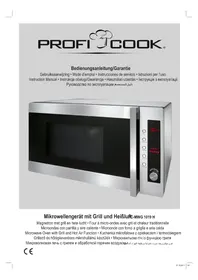
USER MANUAL PCMWG 1208 PROFICOOK
natural_image
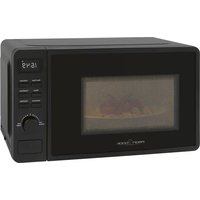
Black PROFIT COOK microwave oven with control knobs and a power level indicator (no visible text beyond branding)
ACHTUNG:
- Do not remove any installed parts from inside the oven or anything from the inside of the door!
• The foils on the inside of the door must not be removed! - The mica sheet (1) is also part of the appliance and must not be removed. It protects the electronic component located behind it from dirt.

UWAGA:
| Code Mikrowelle Grill | |
| Comb1 30% 70% | |
| Comb2 49% 51% | |
| Comb3 67% 33% |
⚠ WAARSCHUWING: Kookvertraging!
| Code | Magnetron | Grill |
| Comb1 | 30% | 70% |
| Comb2 | 49% | 51% |
| Comb3 | 67% | 33% |
| Code Micro-ondes Grill | |
| Comb1 30% 70% | |
| Comb2 49% 51% | |
| Comb3 67% 33% |
Microwave energy: Do not remove this cover!
Elementi di comando
Thank you for choosing our product. We hope you will enjoy using the appliance.
Symbols in these Instructions for Use
Important information for your safety is specially marked. It is essential to comply with these instructions in order to avoid accidents and prevent damage to the appliance:

WARNING:
This warns you of dangers to your health and indicates possible injury risks.

CAUTION:
This refers to possible hazards to the appliance or other objects.

NOTE: This highlights tips and information.
Contents
Overview of the Components....3
General Notes......46
Important Safety Information! 46
Signs and Symbols on the Appliance 48
Overview of the Components....48
Notes for Use....48
Information on Grilling and Combined Operation....48
Suitable Microwave Tableware 48
What you Should Know about Microwave Operation....49
Initial Operation....49
Installation Instructions....49
Preparation....49
Operating the Microwave....49
Pause or Cancel Cooking 49
Heating....49
Heating Table 49
Cooking....50
Hands-on Cooking Tips 50
Cooking Table 50
Grilling....51
Microwave and Grill Combination Modes....51
Tips for Combi Operation....51
Defrosting....51
Cleaning 52
Interior 52
External Walls 52
Accessories....52
Odours....52
Oven Light....52
Troubleshooting....52
Technical Data....52
Disposal 52
Meaning of the "Dustbin" Symbol 52
General Notes
Read the operating instructions carefully before putting the appliance into operation and keep the instructions including the warranty, the receipt and, if possible, the box with the internal packing. If you give this appliance to other people, please also pass on the operating instructions.
- The appliance is designed exclusively for private use and for the envisaged purpose. This appliance is not fit for commercial use.
- Do not use it outdoors. Keep it away from sources of heat, direct sunlight, humidity (never dip it into any liquid) and sharp edges. Do not use the appliance with wet hands. If the appliance is humid or wet, unplug it immediately.
- When cleaning or putting it away, switch off the appliance and always pull out the plug from the socket (pull the plug itself, not the lead) if the appliance is not being used and remove the attached accessories.
- Do not operate the appliance without supervision. If you leave the room you should always turn the appliance off. Remove the plug from the socket.
- The appliance and the mains lead have to be checked regularly for signs of damage. If damage is found the appliance must not be used.
- Use only original spare parts.
- In order to ensure your children's safety, please keep all packaging (plastic bags, boxes, polystyrene etc.) out of their reach.

WARNING:
Don't let small children play with foils for danger of suffocation!
Important Safety Information!
Please read carefully and keep for future use.

WARNING:
- The microwave oven is intended for heating foods and drinks. Drying foods or clothes or heating electric pads, slippers, sponges, wet cleaning rags, or similar can cause injuries, combustion, or fire.
- The microwave oven is not suitable for warming/heating up living animals.
- When the door or the door seals are damaged, the microwave oven must not be used until it has been repaired by a qualified specialist.
- Please do not repair the appliance yourself, but have it repaired by an authorised specialist. Carrying out maintenance or repair work which involves removal of the cover that protects the surroundings from microwave radiation is dangerous unless carried out by an expert.
- If the supply cord is damaged, it must be replaced by the manufacturer, its service agent or similarly qualified persons in order to avoid a hazard.
- Do not heat liquids in closed containers. DANGER OF EXPLOSION!
- Do not place your microwave in a cupboard.
WARNING:
- The appliance requires sufficient space for air circulation in order to function properly. Leave a distance of 30 cm above, of 10 cm on the back, and of 10 cm on both sides of the appliance. Do not cover the appliance. Never block the openings of the appliance. Do not remove the feet.
- Place the appliance with the back facing a wall.
- The appliance and its accessible parts become hot during use. Care should be taken to avoid touching heating elements. Children less than 8 years of age shall be kept away unless they are continuously supervised.
- Only suitable tableware should be used such as: glass, porcelain, ceramics, heat-resistant plastic or special microwave tableware.
- Metallic containers are not permitted for heating food and beverages in the microwave oven. Observe the notes in the chapter "Suitable Microwave Tableware".
- If food is being heated or cooked in combustible materials, such as plastic or paper containers, the microwave oven should be checked frequently due to the risk of fire.
- If smoke is produced, turn the appliance off and remove the plug. Keep the door closed in order to suffocate any flames.
- The contents of babies' bottles and jars of baby food must be stirred or shaken and the temperature checked before use. There is a danger of burns.
- Use oven cloths or kitchen gloves when removing the containers. DANGER OF BURNS!
- Food with a shell or skin, such as eggs, sausages, sealed jars etc. must not be heated up in the microwave as they may explode even when heating by the microwaves is finished.
WARNING: Delay in boiling!
During boiling, particularly during the reheating of liquids (water), it may happen that the boiling temperature has been reached but the typical bubbles have not yet started to rise. The liquid does not boil evenly. When the vessel is removed this so-called delay in boiling may result in the sudden formation of bubbles when the vessel is knocked, causing the water to boil over. There is a serious danger of burns! In order to achieve even boiling, please place a glass rod or similar item, but nothing metallic, in the vessel.
- This appliance can be used by children aged from 8 years and above and persons with reduced physical, sensory or mental capabilities or lack of experience and knowledge if they have been given supervision or instruction concerning use of the appliance in a safe way and understand the hazards involved.
• Children shall not play with the appliance. - Cleaning and user maintenance shall not be made by children unless they are older 8 years and supervised.
- Keep the appliance and its cord out of reach of children less than 8 years.
- Any dirt on the door frame/door seal and neighbouring parts must be carefully cleaned with a damp cloth.
- Clean the microwave oven regularly and remove any food residues from the interior.
- If the appliance is not clean the surface may be damaged, affecting its serviceable life and possibly resulting in hazardous situations.
- Do not use any aggressive abrasive cleaners or sharp metal scrapers to clean the glass door. You could scratch the surface. This can destroy the glass.
- Steam cleaner is not to be used.
- Also follow the instructions which are given in the "Cleaning" chapter.
- Do not operate the appliance with an external timer or separate remote control system.
• This appliance is used - for heating up and cooking solid or liquid foods
- for browning and grilling solid foods.
It is intended for the use in households and for similar applications, such as: - in staff kitchens of stores, offices, and other industrial areas;
- by guests in hotels, motels, and other housing facilities;
- in agricultural estates;
- in bed and breakfasts.
Signs and Symbols on the Appliance
There is a warning symbol attached to the top surface of the microwave oven:
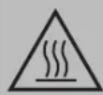
WARNING: Hot surface!
Risk of burning!
The temperature of accessible surfaces can get very hot during and after operation.
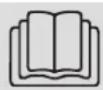
Read the Instructions!
Also note the information signs on the microwave:
WARNING
1: MICROWAVE AND HIGH VOLTAGE INSIDE. BE SURE NOT TO REMOVE THE ENCLOSURE.
2: THIS APPLIANCE IS EQUIPPED WITH A GROUNDED PLUG FOR YOUR PROTECTION AGAINST POSSIBLE SHOCK HAZARDS AND SHOULD BE CONNECTED TO A PROPERLY GROUNDED OUTLET.
3: THIS DEVICE IS TO BE SERVICED ONLY BY PROPERLY QUALIFIED SERVICE PERSONNEL.
4: DISCONNECT POWER PLUG BEFORE SERVICING. REMOVAL OF THE ENCLOSURE WITH PRODUCT ENERGIZED COULD EXPOSE SERVICEMEN TO HAZARDOUS HIGH VOLTAGE POTENTIAL.
Microwave energy: Do not remove this cover!
Overview of the Components
1 Mica sheet
2 Function switch
3 Timer
4 Drive shaft
5 Guide ring
6 Glass rotating plate
7 Griller
8 Door latch
9 Viewing window
Notes for Use
Information on Grilling and Combined Operation
- As heat radiation is used during grilling and combined operation, please use only heat-resistant tableware. Plastic containers are not suitable.
- When food is only being grilled, metal or aluminium tableware may also be used -but not during combined or microwave operation.
- Do not place anything on top of the housing as this becomes hot. Always leave the ventilation slits uncovered.
- Please use the grilling grid to move the food to be cooked nearer to the heating element.
Suitable Microwave Tableware
- The ideal material for use in a microwave is transparent and allows the microwave radiation to heat the food evenly.
- Round / oval dishes and plates are more suitable than rectangular ones as the food in the corners may overcook.

CAUTION:
Risk of explosion by sealed tableware.
- Open closed containers before cooking or heating.
- Pierce protective plastic foil several times using a fork.

CAUTION: Sparking and fire hazard!
- Microwaves cannot penetrate metal. Accordingly, no metal containers or plates may be used in microwave operation.
- Do not use any paper dishes made of recycled material as these may contain small amounts of metal, which may result in sparks or fires.
The list below is intended to help you select suitable microwave tableware:
| Material | Suitable for | ||
| Microwave | Grill Combination* | ||
| Heat-resistant glass vessel yes yes | yes | ||
| Non-heat-resistant glass vessel no no | no | ||
| Heat-resistant ceramic vessel / plate | yes yes | yes | |
| Plastic vessels suitable for microwave use | yes | no | no |
| Kitchen roll | yes | no | no |
| Metal or aluminium ovenware | no | yes | no |
| Grilling grid | no | yes | no |
| Aluminium foil and foil containers | no | yes | no |
*) Combination of microwave with grill
What you Should Know about Microwave Operation
- Your appliance works with microwave radiation, which heats up water particles in food in a very short time. There is no heat radiation and therefore hardly any browning.
- Only food should be heated up with this appliance.
- The appliance is not suitable for baking in floating fat.
- Only 1 - 2 portions should be heated up at the same time. Otherwise the microwave will become less efficient.
- Microwaves provide their full energy levels immediately. Pre-heating is therefore not necessary.
- Never operate the microwave function when the oven is empty.
- The microwave oven does not replace your traditional cooker. It is used mainly for:
- defrosting deep-frozen food
- rapid warming / heating of food or drinks
- cooking meals.
Initial Operation
Installation Instructions
• Install the appliance with the back of the appliance facing the wall.
- Maintain the following safety clearances:
- 10 cm to the back
- 10 cm to both sides
- 30 cm to the top of the microwave.
- In order to avoid interference with the operation of other appliances, do not place your appliance near other electronic appliances.
Preparation
- Use the handle to open the door.
- Remove any accessories from the cooking chamber and unpack.
- If not yet done: Place the drive shaft on the center of the bottom inside the oven.
- Install the guide ring in the center.
- Position the glass rotating plate in such a way that its lower recesses lock onto the center of the drive shaft.
- Make sure the mains voltage to be used corresponds to the voltage of the appliance. Check the rating label for specifications.
- Insert the mains plug into a properly installed power socket.

CAUTION:
- Do not remove any installed parts from inside the oven or from inside the door!
- The mica sheet (1) is also part of the appliance and must not be removed. It protects the electronic component located behind it from dirt.

NOTE:
If there are manufacturing or oil remains on the enclosure or heating element, smoke or odor might occur during the beginning operation.
This is normal and will cease after repeated use.
We strongly recommend proceeding as follows:
- Turn on the grill mode and let the appliance operate several times without food to be cooked.
- Ensure sufficient ventilation.
Operating the Microwave
- Place the food to be heated in a suitable piece of tableware.
-
Open the door and place the vessel in the middle of the glass plate. Then close the door. (For safety reasons the oven only operates when the door is tightly closed.)
-
Adjust the microwave power as required:
| Labelling | Description | Power Microwave in % * | Field of Application |
| Low | Keeping warm | 18 Melting | cheese etc. |
| * Defrost | Defrosting 36 | Defrosting frozen food | |
| Med Medium | 58 Continued cooking | ||
| M.High | Medium high | 81 | Cooking e.g. meat |
| High | High | 100 | Rapid heating |
*100% = 700 W
- Use the timer to set the desired cooking time between 1 minute and 30 minutes. The cooking time depends on the quantity and constituency of the contents of the oven. With a little practice you will soon learn to estimate the cooking time.
i NOTE:
- Preparation of food in a microwave oven is very much faster than in a conventional cooker. Set the cooking time to a low level if you are not sure and continue cooking again if necessary.
- Once the cooking time is set the oven switches itself on. The light inside the oven goes on.
-
Please note: A cover should be placed over the food when operating the microwave.
-
When the time has finished the oven switches off automatically. A sound is heard. The food should then be removed.
Pause or Cancel Cooking
- If you want to interrupt the cooking process, simply open the door.
• To continue cooking, close the door. - To abort the process completely, set the timer to position "0".
Heating
Warming and heating are special characteristics of microwaves. Refrigerated liquids and foods can be easily warmed up to room or eating temperature without having to use a lot of pots.
The heating times in the following table are for reference only, as the time depends very much on the original temperature and the texture of the food. It is therefore recommended to check once in a while whether the food is hot enough.
Heating Table
| Edibles/food | Quantity | Switch position | Time approx. Min. | Cover |
| Liquids | ||||
| 1 cup | 150 g | High | 0,5-1 | no |
| 0,5l | 500 g | High | 3,5-5 | no |
| 0,75l | 750 g | High | 5-7 | no |
| Tip: Put a glass stick into the container to avoid superheating; stir well before drinking. | ||||
| Plated meals | ||||
| Cutlet + potatoes and vegetables | 450 g | High | 2,5-3,5 | yes |
| Goulash with noodles | 450 g | High | 2-2,5 | yes |
| Meat + lump + sauce | 450 g | High | 2,5-3,5 | yes |
| Tip: Slightly moisten before cooking; stir occasionally. | ||||
| Edibles/food Quantity | Switch position | Time approx. Min. | Cover | |
| Meat | ||||
| Cutlet, breaded 200g High 1-2 no | ||||
| Meatballs, 4 pieces | 500g | High | 3-4 | no |
| Joint 250g High 2-3 no | ||||
| Tip: Coat with oil for the breading or crust not to soften. | ||||
| Poultry | ||||
| 12 chicken 450g High 3,5-5 no | ||||
| Chicken fricassee | 400g | High | 3-4,5 | yes |
| Tip: Coat with oil; stir occasionally. | ||||
| Side dish | ||||
| Noodles, rice, 1 serving2 servings | 150g High 1-2 yes | |||
| 300g High 2,5- | 3,5 yes | |||
| Potatoes | 500g | High | 3-4 | yes |
| Tip: Slightly moisten prior to cooking. | ||||
| Soups/sauce | ||||
| Broth, 1 plate | 250g High 1-1,5 | yes | ||
| Soup with solids | 250g | High | 1,5-2 | yes |
| Sauce | 250g | High | 1-2 | yes |
| Infant food | ||||
| Milk | 100ml | Med | 0,5-1 | no |
| Mash | 200g | Med | 1-1,5 | no |
| Tip: Thoroughly shake or stir. Check temperature! | ||||
Cooking
Hands-on Cooking Tips
Follow the guidelines given in the cooking table and recipe. Monitor the cooking process if you do not yet have as much experience.
You may open the door of the appliance at any time. The appliance will turn off automatically.
It will only continue operation when the door is closed.
Refrigerated food needs a longer cooking time than that with room temperature.
The chunkier the food, the longer the cooking time. Meat cut in bigger pieces, for example, requires longer cooking than meat of the same quantity cut into strips. It is recommended cooking larger amounts of food at maximum power and having it simmer at medium power for a more evenly cooking.
Lower foodstuffs cook faster than higher ones; therefore distribute the food as low as possible. Place thinner parts such as chicken legs or fish filets in the center or leave them overlapping.
Smaller amounts cook faster than bigger ones. The following rule of thumb applies:
Double amount = almost double time
Half amount = half time
If you cannot find the exact cooking time for a dish, you may apply the following rule:
Per 100 g approx. 1 minute cooking
All foods that you cover on a common stove should be covered in the microwave as well.
A cover will prevent the food from running dry. An upside-down plate, greaseproof paper or microwave cooking foil are all suitable as covers. Cook food that should be getting a crust without cover.
*) Ready-made food
Cooking Table
| Edibles / food Quantity | Switch position | Time approx. Min. | Cover | |
| Vegetables | ||||
| Eggplant | 500g | M.High | 7-10 | yes |
| Cauliflower | 500g | M.High | 13-15 | yes |
| Broccoli | 500g | M.High | 6-9 | yes |
| Chicory | 500g | M.High | 6-7 | yes |
| Peas | 500g | M.High | 6-7 | yes |
| Fennel | 500g | M.High | 8-11 | yes |
| Green beans | 300g | M.High | 13-15 | yes |
| Potatoes | 500g | M.High | 9-12 | yes |
| Stem turnip | 500g | M.High | 8-10 | yes |
| Leek | 500g | M.High | 7-9 | yes |
| Corn on the cob | 250g | M.High | 7-9 | yes |
| Carrot | 500g | M.High | 8-10 | yes |
| Pepper | 500g | M.High | 6-9 | yes |
| Brussels sprouts | 300g | M.High | 7-10 | yes |
| Asparagus | 300g | M.High | 6-9 | yes |
| Tomatoes | 500g | M.High | 6-7 | yes |
| Zucchini | 500g | M.High | 9-10 | yes |
| Tip: Cut vegetables into small pieces and cook with 2-3 spoons of liquid; stir occasionally. Simmer 3 - 5 minutes; add seasoning just before eating. | ||||
| Fruits | ||||
| Stewed apple or pear | 500g | M.High | 5-8 | yes |
| Stewed rhubarb | 250g | M.High | 4-6 | no |
| Roast apple, 4 pieces | 500g | M.High | 7-9 | yes |
| Tip: Add 125 ml of water; lemon juice will prevent the fruits from discoloring; simmer 3 - 5 minutes. | ||||
| Meat*) | ||||
| Meat with sauce | 400g | M.High | 10-12 | yes |
| Goulash, veal strips | 500g | M.High | 10-15 | yes |
| Beef roulades | 250g | M.High | 7-8 | yes |
| Tip: Stir occasionally; rest for 3 - 5 minutes. | ||||
| Poultry*) | ||||
| Chicken fricassee | 250g | M.High | 6-7 | yes |
| Chicken soup | 200g | M.High | 5-6 | yes |
| Tip: Stir occasionally; rest 3 - 5 minutes. | ||||
| Fish | ||||
| Fish filet | 300g | M.High | 7-8 | yes |
| 400g | M.High | 8-9 | yes | |
| Tip: Turn over after half the time has elapsed; simmer 3 - 5 minutes. | ||||
| Defrosting and cooking vegetables | ||||
| Red cabbage with apple 450 g M.High 14-16 yes | ||||
| Spinach leaves | 300 g | M.High | 11-13 | yes |
| Cauliflower 200 g M.High 7-9 yes | ||||
| String beans | 200 g | M.High | 8-10 | yes |
| Broccoli | 300 g M.High 8-9 yes | |||
| Peas | 300 g | M.High | 7-8 | yes |
| Stem turnip | 300 g | M.High | 13-15 | yes |
| Leek | 200 g | M.High | 10-11 | yes |
| Corn | 200 g | M.High | 4-6 | yes |
| Carrots | 200 g | M.High | 5-6 | yes |
| Brussels spout | 300 g | M.High | 7-8 | yes |
| Spinach | 450 g M.High 12-13 yes | |||
| 600 g M.High 15-17 yes | ||||
| Tip: Cook with 1-2 spoons of liquid; stir occasionally or carefully cut.Simmer 2-3 minutes; add seasoning just before eating. | ||||
| Soups/stew*) | ||||
| Stew | 500 g | M.High | 13-15 | yes |
| Soup with solids | 300 g | M.High | 7-8 | yes |
| Crème soup | 500 g | M.High | 13-15 | yes |
| Tip: Stir occasionally; simmer 3-5 minutes. | ||||
Grilling
Place the grill rack onto the supplied glass plate. Use suitable heat-resistant tableware or directly put the food onto the grill.
It is not necessary to preheat the grill rack since the grill generates radiant heat immediately.
Proceed as follows for roasting and scalloping:
- Set the function switch to position "Grill".
- Use the timer to set the desired roasting time between 1 minute and 30 minutes.
i NOTE:
We recommend turning the food (e.g. meat, sausage) after approx. half of the cooking time has elapsed. The fan continues running when the cooking process is paused.
| Edibles/food | Quantity | Time approx. min. | Cover |
| Scalloping toast with cheese | 2-3 slices | 8 | no |
| Scalloping soups, e.g. onion soup | 2-3 cups | 10-15 | no |
Microwave and Grill Combination Modes
During those modes the microwave and grill work alternately within a set time.
- Use the function switch to set the desired combination.
| Code | Microwave | Grill |
| Comb1 | 30% | 70% |
| Comb2 | 49% | 51% |
| Comb3 | 67% | 33% |
- Use the timer to set the desired cooking time between 1 minute and 30 minutes.
Tips for Combi Operation
When cooking food with the combined setting of microwave-grill, you should adhere to the following:
The cooking time for big and thick food items, such as roast pork, is respectively longer than for small, lower food. Nevertheless, when roasting, the opposite rule applies. The closer the food is to the grill, the faster it will become brown. I.e., when preparing big joints during combi operation, the roasting time is possibly shorter than for smaller joints.
Defrosting
i NOTE:
• Microwave power when defrosting is 36% (252 W).
- Since the microwaves always penetrate the food from the outside in, larger pieces may not be fully defrosted in their centre. The outer layers may already have started to cook.
- Turn foodstuff such as meat, sausages or bread once after approx. half of the defrost time has elapsed.
- Factor in a compensation time after the defrost program. This is a standing period during which a temperature compensation takes place through conduction of heat from the outside (defrosted) to the inside (frozen). You can leave the food in the switched off appliance or outside the appliance during the compensation time. The compensation time should be at least as many minutes as the defrost time in the microwave. It depends on the condition of the food.
- If the weight of the food is less than 200 g, do not place it in the middle but at the edge of the glass plate.
- You can shorten the compensation times by e.g. separating small pieces of meat or crumbling the remaining frozen chunks of mince after the defrosting time. For sliced bread or sausage, separate the slices during the compensation time.
- Allow fruit to defrost in a bowl with a lid. After around half the defrost time, gently stir the fruit once.
- Cakes or tarts with chocolate icing should not be defrosted in the microwave.
To use the defrost program, proceed as follows:
- Determine the weight of the food.
- Remove the food from its packaging. If it cannot be removed from the packaging, defrost for 30 seconds on maximum microwave power (Switch position "High").
-
Place the food to be defrosted onto the plate (fruit into a bowl). Also place meat onto a upturned saucer so that the meat juices can drain. This saucer should never be used for other foods or come into contact with them.
-
Set the function switch to position “* Defrost”.
-
Use the timer to set the desired cooking time between 1 minute and 30 minutes.
| Edibles | Weight | Defrost Time |
| Meat | 0,1 - 1,0 kg | 1:30 - 26:00 |
| Poultry | 0,2 - 1,0 kg | 2:30 - 22:00 |
| Fish | 0,1 - 0,9 kg | 1:30 - 14:00 |
Cleaning

WARNING:
Turn the microwave off and remove the mains plug.

CAUTION:
- Do not use any wire brush or other abrasive objects.
- Do not use any acidic or abrasive detergents.
- Do not use a metal scraper to clean the viewing window. The surface could be scratched and the glass could possibly break.
Interior
- Keep the interior of the oven clean. Splashes and overflowing liquids on the walls of the oven can be removed with a damp cloth. If the oven is very dirty a mild detergent can also be used.
- Wipe off the viewing window on the inside and outside with a damp cloth and remove splashes and stains from overflowing liquids regularly.
External Walls
- The external walls of the microwave should only be cleaned with a damp cloth. Please ensure that no water enters the openings in the housing and therefore inside the appliance.
- Open the microwave door before cleaning the control panel in order to avoid accidentally switching on the appliance.
Accessories
- Clean the glass plate in warm soapy water or in the dishwasher. Dry it before reinstalling it in the microwave.
- Regularly clean the guide ring and the inside of the bottom. You may remove the guide ring and manually clean it. Use a mild detergent or glass cleaner. Dry thoroughly. Make sure to position the ring properly afterwards.
- Clean the grill after each use with a dishwashing detergent or place it in a dishwasher for cleaning.
Odours
In order to remove any unpleasant odours that may emanate from the microwave, place a dish filled with water and lemon juice that is suitable for microwave use in the oven and heat it for approximately 5 minutes. Then wipe out the oven with a soft cloth.
Oven Light
If you need to replace the lighting in the oven, please contact a specialist workshop near you.
Troubleshooting
Malfunctions are often just caused due to minor problems. Before contacting our customer service, please check the table below:
| Problem Possible cause Notes/solution | ||
| Radio or TV reception is interrupted during microwave operation. | The electromagnetic fields of this appliance might interfere with the pictures and sound of special frequencies. | This is normal and not a malfunction. Position the appliances further away from each other. |
| The microwave does not start. | The door is not properly closed. | Check if there are objects or food remains jammed in the door. |
| Defect wall socket. Try another wall socket. | ||
| Check the main fuse in your household. | ||
| The turn-table causes a scratching or abradant noise. | There are dirt or foreign objects in the area of the turntable shaft. | Remove possible objects and food remains as described under “Cleaning”. |
| The operation is terminated without any obvious reason. | The appliance is defect. Please contact our customer service. | |
Technical Data
Model: PC-MWG 1208
Power supply: 230 V\~, 50 Hz
Power consumption:
Microwave: 1100 W Grill: 900 W
Rated microwave power output: 700 W / 2450 MHz
Cavity volume: approx. 17 litres
Protection class: I
Net weight: ....approx. 10.4 kg
The right to make technical and design modifications in the course of continuous product development remains reserved.
This appliance has been tested according to all relevant current CE guidelines, such as electromagnetic compatibility and low voltage directives, and is manufactured according to the latest safety regulations.
Disposal
Meaning of the "Dustbin" Symbol

Protect our environment: do not dispose of electrical equipment in the domestic waste.
Please return any electrical equipment that you will no longer use to the collection points provided for their disposal.
This helps avoid the potential effects of incorrect disposal on the environment and human health.
This will contribute to the recycling and other forms of re-utilisation of electrical and electronic equipment.
Information concerning where the equipment can be disposed of can be obtained from your local authority.
Instrukcja obsługi
CTC Clatronic Sp. z o.o
Ul. Brzeska 1
45-960 Opole
Usuwanie
Microwave energy: Do not remove this cover!