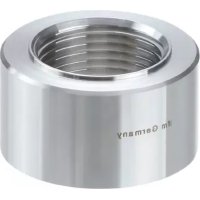
E30498 - Sensor IFM - Free user manual and instructions
Find the device manual for free E30498 IFM in PDF.


User questions about E30498 IFM
0 question about this device. Answer the ones you know or ask your own.
Ask a new question about this device
Download the instructions for your Sensor in PDF format for free! Find your manual E30498 - IFM and take your electronic device back in hand. On this page are published all the documents necessary for the use of your device. E30498 by IFM.
USER MANUAL E30498 IFM
Installation instructions
G1-A sealing cone welding adapter
Contents
1 Preliminary note.... 3
1.1 Symbols used.... 3
1.2 Warnings.... 3
2 Safety instructions 4
3 Transport, handling and storage 5
4 Intended use 6
4.1 Basic notes 6
5 Installation.... 7
5.1 Basics 7
5.2 Adapter with leakage port.... 8
5.3 Alignment of adapter / leakage port 8
5.4 Welding operation 8
6 Mount sensor 10
7 Set-up 11
8 Disposal 12
1 Preliminary note
You will find instructions, technical data, approvals and further information using the QR code on the unit / packaging or at documentation.ifm.com.
1.1 Symbols used
√ Requirement
Instruction
Reaction, result
bold Designation of keys, buttons or indications
→ Cross-reference without link
→ Cross-reference with link

Important note
Non-compliance may result in malfunction or interference

Information
Supplementary note
1.2 Warnings
Warnings indicate the possibility of personal injury and damage to property. This enables safe product handling. Warnings are graded as follows:

WARNING
Warning of serious personal injury
▷ If the warning is not observed, fatal and serious injuries are possible.

CAUTION
Warning of minor to moderate personal injury
▷ If the warning is not observed, minor to moderate injuries are possible.

ATTENTION
Warning of damage to property
▷ If the warning is not observed, damage to property is possible.
2 Safety instructions
- The unit described is a subcomponent for integration into a system.
- The system architect is responsible for the safety of the system.
- The system architect undertakes to perform a risk assessment and to create documentation in accordance with legal and normative requirements to be provided to the operator and user of the system. This documentation must contain all necessary information and safety instructions for the operator, the user and, if applicable, for any service personnel authorised by the architect of the system.
- Read this document before setting up the product and keep it during the entire service life.
- The product must be suitable for the corresponding applications and environmental conditions without any restrictions.
- Only use the product for its intended purpose (→ Intended use).
- Only use the product for permissible media (→ Technical data).
- If the operating instructions or the technical data are not adhered to, personal injury and/or damage to property may occur.
- The manufacturer assumes no liability or warranty for any consequences caused by tampering with the product or incorrect use by the operator.
- Installation, set-up, operation and maintenance of the product must be carried out by qualified personnel authorised by the machine operator.
- The welding operation must be carried out by authorised personnel.
- The welding operation must be carried out carefully and according to state-of-the-art technology.
- During the welding process, ensure sufficient fume extraction.
- Protect the product against damage.
- When using water cooling in a welding process, make sure that the coolant does not come to a standstill to prevent it from overheating.
- The cooling must not lead to the formation of condensate on the surface of the welding adapter, otherwise the welding process will be impeded.

CAUTION
During the welding operation, the adapter, the surrounding material and any welding aid used can increase in temperature to over 65\ °C ( 149\ °F ).
▷ Risk of burns.
▶ Allow all components to cool down.
3 Transport, handling and storage
▶ Store the product in its original packaging.
▶ Observe the permissible ambient conditions for the product during storage (→ Technical data).
▶ In case of return shipment, ensure that the product or components are cleaned especially from dangerous and toxic substances.
4 Intended use
The welding adapter allows the installation of sensors in tanks or piping systems.

The selection of the appropriate adapter must be made by a welding engineer.
4.1 Basic notes

If the tank is treated after the adapter has been welded in (e.g. grinding, pickling, sand-blasting, glass bead blasting, e-polishing or applying procedures such as powder coating, painting etc.):
▶ Make sure that the inside and sealing area of the adapter are clean and not damaged.

Carry out a leak check after the welding process.

The welding operation must be carried out by authorised personnel.
The welding operation must be carried out carefully and according to state-of-the-art technology.
During welding and the following cooling phase the sensor must not be in place.
A welding aid or cooling adapter must be used during welding.
The surfaces must be free from any contamination.
The welding materials must be compatible with the material of the adapter and the wall.
▶ The requirements in the specifications, of common practice, in regulations, norms, of intended use and the application must be applied.
▷ They determine the welding procedure, the welding material, the connection category and connection type, including chamfer, welding penetration depth and demands on the surface.

When used in hygienic areas to EHEDG and 3-A:
▶ Adhere to the applicable EHEDG and 3-A directives.
▶ Assure EHEDG-compliant or 3-A-compliant integration of the adapter in the plant (observe the respective notes in the operating instructions of the sensor to be used).
▶ 3-A approval: Use only adapters with 3-A approval and marked with the 3-A symbol.

Use in hygienic areas to EHEDG:
The food contact surface must be smooth (surface roughness Ra < 0.8 µ m) and the welding has to be done according to EHEDG guidelines 9 and 35.
▶ Use self-draining installation.
▶ For any structures in a tank, direct water jet cleaning must be possible.
5 Installation

CAUTION
During installation, pressure or other fluids may escape from the plant.
▷ Risk of injury from pressure or other media.
▶ Ensure that no pressure is applied to the system during installation.
▶ Ensure that no fluids can leak out during installation.

Observe and adhere to state-of-the-art technology and applicable regulations during the welding process.

Carefully read and apply the operating instructions of all components used.

ATTENTION
Danger to the plant and the environment during welding operations and rework.
▶ Consider potential dangers and adhere to applicable regulations and guidelines.

CAUTION
During the welding operation, the adapter, the surrounding material and any welding aid used can increase in temperature to over 65\ °C ( 149\ °F ).
▷ Risk of burns.
▶ Allow all components to cool down.

WARNING
Dangers to persons during welding operations, rework and pressure tests.
▶ Consider potential dangers and adhere to applicable regulations and guidelines.
▶ Bore a hole in the pipe or tank wall with the outside diameter of the adapter. Max. oversize 0.2 mm.
▶ Use a welding mandrel for heat dissipation, stabilisation and protection of the sealing edge. ➕ Order no. E30435.
5.1 Basics

While welding, the adapter must not warp.

Adapter with leakage ports according to EHEDG and 3-A:
▶ For reliable draining: Align the adapter with only one leakage port so that the leakage port is located at the lowest possible point. Adapter with leakage port 8

Recommendation: Application of the TIG method in accordance with ➕ EHEDG DOC 35 "Hygienic welding of stainless steel tubing in the food processing industry".
▶ Ensure correct alignment of the adapter.
▶ The adapter and its surface must be free from any kind of soiling and damage.
▶ Choose welding materials that are appropriate for the material of the adapter and the pipe.
5.2 Adapter with leakage port

Für eine sichere Selbstentleerung bei einem Adapter mit mehreren Leckagebohrungen:
▶ Eine der Leckagebohrungen so ausrichten, dass sich diese am tiefsten Punkt befindet.

Für eine sichere Selbstentleerung bei einem Adapter mit einer Leckagebohrung:
▶ Align the leakage port so that it is located at the lowest possible point.
5.3 Alignment of adapter / leakage port
Align marking 1 (marking may vary) of the adapter to the position provided for the display (if any) or the cable entry of the screwed-in sensor.

Adapter with leakage port according to EHEDG and 3A®:
For reliable draining: Align the adapter with only one leakage port so that the leakage port is located at the lowest possible point.
5.4 Welding operation

The basic notes and guidelines must be adhered to:
▶ The welding method must be suitable for the welding task and the power of the welding equipment must be adapted to the material thickness.
▶ During welding, avoid overheating of the adapter and observe sufficient cooling phases.
▶ Any specifications of a responsible welding specialist on targeted cooling devices must be applied.
▶ The sealing area of the adapter must not be damaged by weld spatter or similar. The sealing area should be sufficiently protected before starting the welding process.
▶ Use a welding mandrel for heat dissipation, stabilisation and protection of the sealing surface.
▶ Insert the welding adapter into the prepared drill hole and attach it.
▶ For an optimum welding result, apply a sufficient number of fixing points crosswise if necessary.

▶ For an optimum welding result, apply the welding segments crosswise in the back-step method if necessary.
▶ Ensure sufficient intervals between the individual sections to avoid overheating of the adapter.

▶ After each welding, including the cooling phase, check the thread of the welding adapter for ease of movement.
▶ After completion, remove all components from the welding adapter.
▶ Remove any residue from the thread of the adapter without damaging the sealing edge.
▶ Screw in the sensor by hand in order to check for dimensional accuracy and functionality of the thread.
▷ If the tightening torque is too high during screwing in, do not use any tools but check the thread and replace the welding adapter, if damaged.

Carry out a leak check after the welding process.
6 Mount sensor

General information for installing the sensor: ➕ Operating instructions of the sensor.

A lubricating paste is required to install the sensor. The paste must be suitable and approved for the respective application.
▶ Remove the protective packaging only just before mounting.
▶ Ensure cleanliness of the sealing areas.
▶ Use the lubricating paste sparingly and apply it to threaded parts.
▶ Screw the sensor hand-tight into the adapter.
▶ Tighten the sensor using a spanner. Tightening torque: ➞ Operating instructions of the sensor.

Too much torque may impair the seal.

If the sealing area is damaged:
▶ Replace the adapter.
7 Set-up
▶ Before setting up the system: Check all components for ingress resistance.
Setting up the sensor: ➕ Operating instructions of the sensor.
8 Disposal
▶ After use dispose of the product or components in an environmentally friendly way in accordance with the applicable national regulations.
Brand : IFM
Model : E30498
Category : Sensor