
IAN 21597 - Kite Playtive - Free user manual and instructions
Find the device manual for free IAN 21597 Playtive in PDF.



| Product type | Acrobatic kite |
| Brand | Playtive |
| Model | IAN 21597 |
| Dimensions (L x H) | Approx. 170 x 70 cm |
| Length of the control line | Approx. 50 m |
| Recommended age | From age 10 |
| Recommended wind strength | 2 to 5 on the Beaufort scale |
| Rod material | Fiberglass |
| Package contents | 1 kite, 1 short rod, 2 long rods, 2 lines with winding handles, 1 storage bag, 1 instruction manual |
| Intended use | Private use, leisure, for persons aged 10 and above |
| Assembly | Insert the rods into the side pockets and attach the lines to the rings with a bowline knot |
| Steering | Pull the right line to go right, pull the left line to go left; pull and hold for loops |
| Landing | Fly the kite out of the wind window (to the left or right) to bring it down safely |
| Cleaning | With a damp sponge; do not use harsh cleaners |
| Maintenance and storage | Regularly check for damage; store dry and away from light |
| Safety instructions | Not suitable for children under 36 months (choking hazard); adult supervision required; do not use near power lines, airports, roads, in strong wind or thunderstorms |
| Spare parts and repairability | Spare parts available at www.delta-sport.com |
| Customer service France | 0800 919270 (free) |
| Customer service Belgium | 070 270 171 (€0.15/min) |
| Warranty | Conformity according to Articles L211-4 et seq. of the Consumer Code and 1641 et seq. of the Civil Code |
| Disposal | Dispose of in an environmentally friendly manner, by waste category, at an approved center |
Frequently Asked Questions - IAN 21597 Playtive
User questions about IAN 21597 Playtive
0 question about this device. Answer the ones you know or ask your own.
Ask a new question about this device
Download the instructions for your Kite in PDF format for free! Find your manual IAN 21597 - Playtive and take your electronic device back in hand. On this page are published all the documents necessary for the use of your device. IAN 21597 by Playtive.
USER MANUAL IAN 21597 Playtive
ACROBATIC KITE
FR BE
ACROBATIC KITE
Instructions for use

IAN 21597
FR BE NL
DE AT CH
GB
![graph TD A["1"] --> B["2"] A --> C["3"] D["4"] --> E["5"] F["5"] --> G["6"] style A fill:#f9f,stroke:#333 style B fill:#ccf,stroke:#333 style C fill:#cfc,stroke:#333 style D fill:#fcc,stroke:#333 style E fill:#cff,stroke:#333 style F fill:#ffc,stroke:#333 style G fill:#fcf,stroke:#333](/content/2026/04/592992/images/73eebb56b0243439bc4fd06ade095ebf764f04b2b950ee480205598e3da17b92.jpg)
![graph TD A["2"] --> B["1a"] A --> C["3"] A --> D["1b"] A --> E["1c"] A --> F["1d"] B --> C C --> D C --> E C --> F D --> E D --> F E --> F](/content/2026/04/592992/images/dfa3105b8d67c608c2207c20e9e1928f5f620ae1aeee2c083c9f0d192fb07c70.jpg)


FR BE
Scope of delivery 15
Technical data 15
Correct use 15
Safety notes 15 - 16
Assembly 16
Starting 16
Steering 16
Landing 16
Wind strengths 16 - 17
Crash landings 17
Cleaning, maintenance, and storage 17
Notes on disposal 17
Congratulations! With your purchase you have decided on a high-quality product. Get to know the product before you start to use it.
quality product. Get to know the product before you start to use it.
Carefully read the following instruction manual. Use the product only as described and only for the given areas of application.
Keep these instructions safe. When passing the product on to a third party, always make sure that the documentation is included.
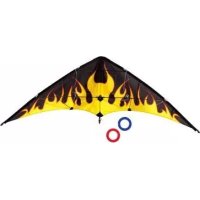
1 x Stunt kite (1) 1 x Short fibreglass rod (2) 2 x Long fibreglass rods (3) 2 x Steering line with winding handle (4) 1 x Bag (5) 1 x Instructions for use
1 x Stunt kite (1) 1 x Short fibreglass rod (2) 2 x Long fibreglass rods (3) 2 x Steering line with winding handle (4) 1 x Bag (5) 1 x Instructions for use
Dimensions: approx. 170 x 70cm (W x H)
steering line approx. 50m long
steering line approx. 50m long
Correct use
The article is intended as a leisure article for private use by persons of 10 years and above and for wind strengths of 2 to 5.

Safety notes
The handling of this article requires care and practice. Please note that even small kites can reach high speeds and can develop substantial tensile forces in high winds.
Important: read through these instructions for use carefully and be sure to retain them for future reference!
Danger to life!
- Warning! Not suitable for children under 36 months. Choking hazard due to small parts. Risk of strangulation due to long cords. Always use under adult supervision.
- Never leave children with the packaging materials without supervision. There is a risk of choking.
- The article may only be used under adult supervision.
Risk of injury!
Do not fly the article:
- In wind speeds that exceed your strength. Stop flying the article if the wind becomes too strong.
- In nature, landscape, or bird preservation areas or anywhere where it is expressly forbidden to fly kites.
- If you have a helper to aid with the start, this helper must step backwards out of the hazard area immediately after letting go of the article, so that he or she cannot be injured by a falling kite.
- Never fly the article holding the line in your hands and avoid touching the line while the kite is flying. The line can cause deep cuts.
- If you are no longer able to control the article and it develops too much tensile force before you can land, then let the line go before it lifts you up or injures you.
- Do not supplement the steering line supplied with the product. Otherwise it is hardly possible to control the article.
- Only use original replacement parts and lines in order to prevent damage to the article.
- Do not attach any additional loads to the article. Observe the maximum permitted wind speed for this article.
- Only fly at wind strengths that you can master with your skill and strength.
- Beginners should progress slowly to higher wind speeds.
Avoiding damage to property!
Never fly the article:
- Close to trees.
- Close to other stunt kites. Keep a sufficient, safe distance.
Warning: Danger to life!
Never fly the article:
- Above people or animals! • Less than 200m from roads, paths, railway lines, or busy areas.
- Less than 5km from airports, glider airfields, helicopter landing areas, or military low flying zones. • Higher than 100m! • Less than 500m from power masts and high voltage power lines.
- During storms.
- If you are abroad and are not aware of the national regulations in that country.
Assembly (figures B and C)
- Remove the article from the bag and lay all the parts on the floor.
- Unfold the article with the motif facing upwards and insert the short fibreglass rod (2) into the upper side pockets (1a) on the article.
- Push the ends of the long fibreglass rods (3) through the rod guides (1b).
- Insert one end into the side holes on the connecting cross (1c) and one end into the side pockets (1d) on the article.
- Attach two steering lines to the rings on the kite with a bowline knot (1e).
Starting (figure D)
IMPORTANT! First check that the surroundings are suitable, determine the wind direction and strength (you can use specialist wind measurement devices from a specialist retailer for this – not included in the scope of delivery), and examine your kite. Note the description of wind strengths. It is best if a helper holds the kite, with the front facing towards the wind. Now move backwards against the wind and carefully and without tension release almost all the kite line (at least 20 metres). The helper should still be holding the kite during this time.
At your command the helper should then let go of the kite.
Do not throw the kite upwards. If there is sufficient wind then a strong tug on the line and perhaps also a step backwards will be sufficient.
Pay close attention to other persons or obstacles.
Steering
Fly the kite as you could steer a bicycle. Pulling the right-hand line will make the kite fly to the right, pulling the left-hand line will made the kite fly to the left. If you hold the steering commands for longer, then the kite will fly entire circles (so-called looping moves). The more strongly you pull the line towards your body, the smaller the looping circles.
Landing (figure E)
To land, fly the kite far to the left or right, i.e., out of the wind window. It will fly more and more slowly and will land safely. Ideally, the wind window is a quarter sphere with the line length as a radius in which the kite can be flown. Collect the kite and, most importantly, the line, immediately after landing, in order to avoid damage or injury.
Wind strengths
Calm
0 bft 0-0.8 km/h 0-0.5 knots - Smoke from chimneys climbs vertically - Flat sea conditions - Kites only fly with support
Light air
1 bft 0.9-5.5 km/h 0.6-3.0 knots - Smoke from chimneys drifts - Ripples on the surface of water - Only suitable for very light kites
Light breeze
2 bft 5.6-12.1 km/h 3.1-6.5 knots - Leaves rustle, wind felt on exposed skin - Small wavelets - Good wind for experienced pilots
Gentle breeze
3 bft 12.2-19.6 km/h 6.6-10.5 knots
- Small twigs move
- Larger wavelets, crests begin to break
- Good wind for beginners
Moderate breeze
4 bft 19.7-28.5 km/h 10.6-15.5 knots
- Small branches move
- Small waves, some with whitecaps
- Better for medium-sized kites
Fresh breeze
5 bft 28.6-38.8km/h 15.6-20.9 knots
– Small trees and large branches sway - Moderate waves, many whitecaps - Large kites can be damaged
Strong breeze
6 bft 38.9-49.8km/h 21.0-26.9 knots
- Large branches move, wind whistles
- Large waves
- Limit for all rigid kites
High wind
7 bft 49.9-61.8km/h 27.0-33.3 knots - Trees in motion - Very large waves, lots of foam - Only for power kites with experienced pilots
Crash landings
Crash landings are unavoidable and part of kite flying. They often look worse than they are. The stronger the wind, the worse the crash landings! You should therefore try to avoid crashing. We cannot accept liability for damage caused by crashes.
Cleaning, maintenance, and storage
Check the article regularly for damage and only use it again when the defect has been fixed. Remove dirt with a damp sponge. Do not use aggressive cleaning agents. Store the dry article in a dry place where it is protected from light.


Notes on disposal
Please dispose of packaging and the article in an environmentally friendly manner and separate materials. Dispose of the article through an authorised waste disposal facility or through your local authority. Please observe the regulations that are currently valid.
IAN: 21597
GB Service Great Britain
Tel.: 0871 5000 720
(£ 0.10/Min.)
E-Mail: deltasport@lidl.co.uk
You can also find spare parts for your product at: www.delta-sport.com, category Service - Lidl Spare Parts Service
DELTA-SPORT HANDELSKONTOR GMBH
Wragekamp 6
D-22397 Hamburg
Version: 06/2014

- ACROBATIC KITE
- FR BE
- 1 X STUNT KITE (1) 1 X SHORT FIBREGLASS ROD (2) 2 X LONG FIBREGLASS RODS (3) 2 X STEERING LINE WITH WINDING HANDLE (4) 1 X BAG (5) 1 X INSTRUCTIONS FOR USE
- DIMENSIONS: APPROX. 170 X 70CM (W X H)
- CORRECT USE
- SAFETY NOTES
- IMPORTANT: READ THROUGH THESE INSTRUCTIONS FOR USE CAREFULLY AND BE SURE TO RETAIN THEM FOR FUTURE REFERENCE
- DANGER TO LIFE
- RISK OF INJURY
- AVOIDING DAMAGE TO PROPERTY
- WARNING: DANGER TO LIFE
- ASSEMBLY (FIGURES B AND C)
- STARTING (FIGURE D)
- STEERING
- LANDING (FIGURE E)
- WIND STRENGTHS
- CALM
- LIGHT AIR
- LIGHT BREEZE
- GENTLE BREEZE
- MODERATE BREEZE
- FRESH BREEZE
- STRONG BREEZE
- HIGH WIND
- CRASH LANDINGS
- CLEANING, MAINTENANCE, AND STORAGE
- NOTES ON DISPOSAL
Brand : Playtive
Model : IAN 21597
Category : Kite