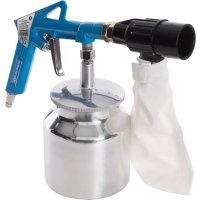
372673 - Air pistol SILVERLINE - Free user manual and instructions
Find the device manual for free 372673 SILVERLINE in PDF.


| Product Type | Compressed air sandblasting gun with abrasive recovery |
| Brand | Silverline |
| Model | 372673 |
| Maximum working pressure | 3-4 bar (43-58 psi) |
| Air consumption | 113 L/min |
| Abrasive tank capacity | 850 ml |
| Feed type | Suction feed |
| Nozzle outlet diameter | 2.8 mm |
| Weight | 0.61 kg |
| Recommended abrasive grit size | Corundum F220 to F40 (0.06 - 0.8 mm) |
| Abrasive mass flow rate | 200 g/min |
| Sound pressure level | 92 dB(A) |
| Sound power level | 103 dB(A) |
| Vibration emission value | 2.5 m/s² |
| Warranty | 3 years (subject to registration within 30 days) |
| Supply | Compressed air (male quick coupling EQ-4 or EN-6) |
| Included accessories | Recovery bag, 4 nozzle adapters, quick filter, abrasive tank |
| Maintenance | Regular cleaning, lubrication of moving parts, dry storage |
| Safety | Wear hearing, eye, respiratory protection and gloves |
| Application | Paint stripping, rust removal, surface cleaning |
Frequently Asked Questions - 372673 SILVERLINE
User questions about 372673 SILVERLINE
0 question about this device. Answer the ones you know or ask your own.
Ask a new question about this device
Download the instructions for your Air pistol in PDF format for free! Find your manual 372673 - SILVERLINE and take your electronic device back in hand. On this page are published all the documents necessary for the use of your device. 372673 by SILVERLINE.
USER MANUAL 372673 SILVERLINE
Description of Symbols
The rating plate on your tool may show symbols. These represent important information about the product or instructions on its use.

Wear hearing protection
Wear eye protection
Wear breathing protection
Wear head protection

Wear hand protection

Read instruction Manual

DO NOT use with compressed gas cylinders!

Toxic fumes or gases!

Caution!

Conforms to relevant legislation and safety standards
Technical Abbreviations Key
| psi Pounds per square inch | |
| Ø Diameter | |
| dB(A) Decibel sound level (A weighted) | |
Specification
Maximum operating pressure: 3-4Bar (43-58psi)
Air Consumption (CFM): 4CFM
Cup capacity: 850ml
Feed type: Suction
Inlet connection: 1/4
Outlet nozzle: 2.8mm
Weight: 0.61kg
Recommended abrasives: .F220 (0.06) - F40 (0.8mm)
Aluminium Oxide Grit
Material flow rate: 200g/min
As part of our ongoing product development,
specifications of Silverline products may alter without notice.
Noise and vibration information:
Level of sound pressure according to
Machinery directive 2006/42/EC:
Sound Pressure L 92dB(A)
Sound Power L 103dB(A)
Uncertainty K: 3dB
Vibration emission value a 2.5m/s²
Uncertainty K: 1.5m/s²
The sound intensity level for the operator may exceed 85dB(A)
and sound protection measures are necessary.
WARNING: Always wear ear protection where the sound level exceeds 85dB(A) and limit the time of exposure if necessary. If sound levels are uncomfortable, even with ear protection, stop using the tool immediately and check the ear protection is correctly fitted and provides the correct level of sound attenuation for the level of sound produced by your tool.
WARNING: User exposure to tool vibration can result in loss of sense of touch, numbness, tingling and reduced ability to grip. Long term exposure can lead to a chronic condition. If necessary, limit the length of time exposed to vibration and use anti-vibration gloves. Do not operate the tool with hands below a normal comfortable temperature, as vibration will have a greater effect. Use the figures provided in the specification relating to vibration to calculate the duration and frequency of operating the tool.
Sound and vibration levels in the specification are determined according to EN60745 or similar international standards. The figures represent normal use for the tool in normal working conditions. A poorly maintained, incorrectly assembled, or misused tool, may produce increased levels of noise and vibration. www.osha.europa.eu provides information on sound and vibration levels in the workplace that may be useful to domestic users who use tools for long periods of time.
General Safety
a) For multiple hazards, read and understand the safety instructions before installing, operating, repairing, maintaining, changing accessories on, or working near this tool. Failure to do so can result in serious bodily injury
b) Only qualified and trained operators should install, adjust, or use this tool
c) Do not modify this tool. Modifications can reduce the effectiveness of safety measures and increase the risks to the operator
d) Do not discard the safety instructions; give them to the operator.
e) Do not use this tool if it has been damaged
f) Tools shall be inspected periodically to verify that the ratings and markings required by this part of ISO 11148 are legibly marked on the tool. The employer/user should contact the manufacturer to obtain replacement marking labels when necessary
WARNING: This appliance is not intended for use by persons (including children) with reduced, physical or mental capabilities or lack of experience or knowledge unless they have been given supervision or instruction concerning use of the appliance by a person responsible for their safety. Children must be supervised to ensure that they do not play with the appliance.
Projectile Hazards
a) Be aware that failure of the workpiece or accessories, or even of the inserted tool itself, can generate high-velocity projectiles
b) Always wear impact-resistant eye protection during operation of this tool. The grade of protection required should be assessed for each use
c) For overhead work, wear a safety helmet
d) The risks to others should also be assessed at this time.
e) Ensure that the workpiece is securely fixed
Entanglement Hazards
a) Choking, scalping and/or lacerations can occur if loose clothing, personal jewellery, neck wear, hair or gloves are not kept away from the tool and its accessories
Operating Hazards
a) Use of the tool can expose the operator's hands to hazards, including cuts, abrasions and heat
b) Wear suitable gloves to protect hands
c) Operators and maintenance personnel should be physically able to handle the bulk, weight and power of the tool
d) Hold the tool correctly; be ready to counteract normal or sudden movements and have both hands available
e) Maintain a balanced body position and secure footing
f) Release the start-and-stop device in the case of an interruption of the energy supply
g) Use only lubricants recommended by the manufacturer
h) Personal protective safety glasses should be used; suitable gloves and protective clothing are recommended
i) Avoid direct contact with moving parts in order to prevent pinching or cutting of hands or other body parts
j) Wear suitable gloves to protect hands
k) There is a risk of electrostatic discharge if used on plastic and other non-conductive materials
Repetitive Motions Hazards
a) When using this tool to perform work-related activities, the operator can experience discomfort in the hands, arms, shoulders, neck or other parts of the body
b) While using this tool, the operator should adopt a comfortable posture whilst maintaining secure footing and avoiding awkward or off-balance postures. The operator should change posture during extended tasks; this can help avoid discomfort and fatigue
c) If the operator experiences symptoms such as persistent or recurring discomfort, pain, throbbing, aching, tingling, numbness, burning sensations or stiffness, these warning signs should not be ignored. The operator should inform the employer and consult a qualified health professional
Accessory Hazards
a) Disconnect the tool from the energy supply before fitting or changing the inserted tool or accessory
b) Avoid direct contact with the inserted tool during and after use, as it can be hot or sharp
c) Use only sizes and types of accessories and consumables that are recommended by the manufacturer of this tool; do not use other types or sizes of accessories or consumables
Workplace Hazards
a) Slips, trips and falls are major causes of workplace injury. Be aware of slippery surfaces caused by use of the tool and also of trip hazards caused by the air line or hydraulic hose
b) This tool is not intended for use in potentially explosive atmospheres and is not insulated against contact with electric power
Dust and Fume Hazards
a) Dust and fumes generated when using this tool can cause ill health (for example cancer, birth defects, asthma and/or dermatitis); risk assessment and implementation of appropriate controls for these hazards are essential
b) Risk assessment should include dust created by the use of the tool and the potential for disturbing existing dust
c) Direct the exhaust so as to minimise disturbance of dust in a dust-filled environment
d) Where dust or fumes are created, the priority should be to control them at the point of emission
e) Select, maintain and replace the consumable/inserted tool as recommended in the instruction handbook, to prevent an unnecessary increase in dust or fumes
f) Use respiratory protection in accordance with employer's instructions and as required by occupational health and safety regulations
Noise Hazards
a) Exposure to high noise levels can cause permanent, disabling hearing loss and other problems, such as tinnitus (ringing, buzzing, whistling or humming in the ears). Therefore, risk assessment and implementation of appropriate controls for these hazards are essential
b) Appropriate controls to reduce the risk can include actions such as damping materials to prevent workpieces from 'ringing'
c) Use hearing protection in accordance with employer's instructions and as required by occupational health and safety regulations
d) Operate and maintain this tool as recommended in the instruction handbook, to prevent an unnecessary increase in the noise level
e) Select, maintain and replace the consumable/inserted tool as recommended in the instruction handbook, to prevent an unnecessary increase in noise
f) If the tool has a silencer, always ensure it is in place and in good working order when the tool is being operated
Vibration Hazards
a) This information shall draw attention to vibration hazards that have not been eliminated by design and construction and remain as residual vibration risks. It shall enable employers to identify the circumstances in which the operator is likely to be at risk from vibration exposure. If the vibration-emission value obtained using ISO 28927-3 does not adequately represent the vibration emission in the intended uses (and foreseeable misuses) of the machine, additional information and/or warnings shall be supplied to enable the risks arising from vibration to be assessed and managed.
b) Exposure to vibration can cause disabling damage to the nerves and blood supply of the hands and arms
c) Wear warm clothing when working in cold conditions and keep your hands warm and dry
d) If you experience numbness, tingling, pain or whitening of the skin in your fingers or hands, stop using the machine, inform your employer and consult a physician
e) Operate and maintain the sander or polisher as recommended in the instruction handbook, to prevent an unnecessary increase in vibration levels
f) Hold the tool with a light but safe grip, taking account of the required hand reaction forces, because the risk from vibration is generally greater when the grip force is higher
Additional Safety Instructions for Pneumatic Power Tools
Air under pressure can cause severe injury:
- Always shut off air supply, drain hose of air pressure and disconnect tool from air supply when not in use, before changing accessories or when making repairs
- Never direct air at yourself or anyone else
- Whipping hoses can cause severe injury. Always check for damaged or loose hoses and fittings
- Whenever universal twist couplings (claw couplings) are used, lock pins should be installed and whipcheck safety cables should be used to safeguard against possible hose-to-tool or hose-to-hose connection failure
- Do not exceed the maximum air pressure stated on the tool
- Never carry an air tool by the hose
Sand Blasting Equipment Safety
WARNING: Abrasive blasting with sands containing crystalline silica can cause silicosis, a serious respiratory disease that can be fatal.
WARNING: Never blast abrasive material towards a source of heat or ignition, as this may cause a fire or an explosion.
WARNING: Dust emissions from sandblasting may contribute to the formation of explosive atmospheres. Ensure proper ventilation and take precautions to prevent dust explosions.
- ALWAYS wear adequate personal protective equipment, including eye and hearing protection, suitable gloves, long sleeves and protective clothing when operating a sandblaster.
- If large amounts of dust are created, helmets or hoods with air supply may be necessary
- Work gloves must protect the full forearm; protective clothing must provide suitable protection from rebounding abrasives
- Sandblasting operations are noisy. ALWAYS wear adequate hearing protection where sound levels exceed 85dB(A)
- Sandblasting equipment is likely to develop an electrostatic charge during operation. If an electrostatically conductive blast hose is not available the blast nozzle must be grounded
- NEVER direct the outlet nozzle towards people or animals
- DO NOT use other fluids than clean, dry, unoiled compressed air to power sandblasting equipment
- Wet, oily or otherwise contaminated compressed air will cause the abrasive to cake, and clog the sandblasting equipment
- NEVER use sandblasting equipment to spray solvents, acids or caustic agents
- DO NOT work near flammable items. Abrasive striking metal can cause sparks which may ignite flammable materials.
- Carefully cover areas of the workpiece that must not be sandblasted (e.g. insides of engine blocks, cylinder bores, and other functional surfaces)
Refer to the abrasive manufacturer's instructions with regards to additional safety warnings, usage recommendations and disposal procedures
- ALWAYS disconnect the sandblasting equipment from the air supply when relocating or refilling the abrasive container
Product Familiarisation
1 Collection Bag
2 Hook & Loop Strap
3 Collection Bag Port
4 Qutlet Connector
5 Barrel
61 trigger
7 Handle
8 Air Inlet
9 Quick Connector
10 Banister Connector
11 Sand Canister
Accessories (not shown):
- 4 x Nozzle Adaptors
Intended Use
Compressed-air-powered sandblasting gun that sprays abrasive material on to surfaces in order to remove coatings, rust and contaminants. Ideal for the removal of paint and light corrosion within tight spaces.
Unpacking Your Tool
- Carefully unpack and inspect your new tool. Familiarise yourself with all its features and functions
- Ensure that all parts of the tool are present and in good condition. If any parts are missing or damaged, have such parts replaced before attempting to use this tool
Before Use
WARNING: Always disconnect from the air supply and depressurise before cleaning or carrying out any maintenance.
Fitting the quick connector
Note: This tool is supplied with two different male air line quick connectors:
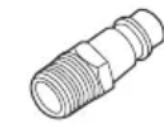
EQ-4
commonly used in Europe
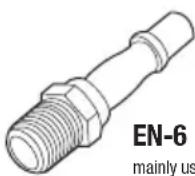
mainly used in the UK
- Please choose the connector that is compatible with the air line system you are using, and install as outlined below:
- Apply some PTFE tape (not included) to the screw threads of the Quick Connector (9). This will help to maintain an air-tight seal
Note: Apply PTFE tape tightly, and in a clockwise direction, so it does not come off when the thread is screwed into the tool. - Remove the protective plug from the Air Inlet (8)
- Using a spanner (not included) screw the Quick Connector into the Air Inlet located at the base of the handle
- Connect to air line, pressurise carefully, and carry out a leak check (e.g. by spraying small amounts of soapy water on to the outside of the connectors)
Air lines fitted with matching female quick connectors will now be a push fit to the tool
Air supply connection
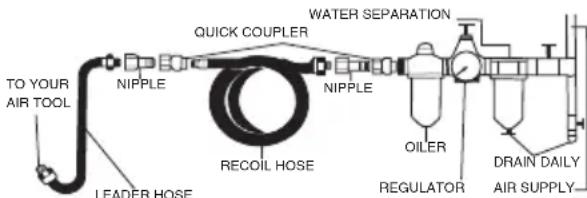
- This tool should be connected to a clean, dry air supply with inline oiler and water separator
- Do not allow supply pressure to exceed the maximum stated (see "Specifications")
- Ensure that water is drained from air system daily
- Ensure that all parts of the system (hoses, couplers, etc.) are correctly rated for the air pressure to be used
Grit selection
Note: This sandblaster is supplied with 0.8mm aluminium oxide grit. Always use good quality abrasive grit to maximise the quality of the finished task. Always test the sandblaster on a scrap piece of material to determine whether the grit grade is suitable for the intended task:
- Coarse (20 - 30 Mesh: 0.8mm, Aluminium oxide) for use on rough material
Medium (40 - 50 Mesh: 0.4mm Aluminium oxide) for smoothing off
Fine (80 - 120 Mesh: 0.08mm Aluminium oxide) for finishing
Filling the canister
- To remove the Sand Canister (11), twist anti-clockwise until it is removed from the Canister Connector (10)
- Fill the Sand Canister with a suitable abrasive material, being careful not to over-fill
- Re-attach the Sand Canister to the Canister Connector by locating the pins in the groove and turning the canister clockwise
Fitting a nozzle adaptor
- The sandblaster comes with four Nozzle Adaptors, the adaptors dictate the type of spray output from the Barrel (5)
- Slide the Nozzle Adaptor over the Barrel (5) to fix the nozzle in place
- The Nozzle Adaptors are made from a soft rubber compound to prevent damage to surfaces when working in close proximity areas
Using the sand collection bag
- To fit the Collection Bag (1), pull the opening over the Collection Bag Port on the Barrel and fasten the Hook & Loop Strap (2)
- The Collection Bag (1) catches excess abrasive material that builds up within the Barrel (5) during operation
- Abrasive material caught in the bag is fit for re-use. Remove the Collection Bag and pour the contents into the Sand Canister when full
Operation
WARNING: ALWAYS wear eye protection, adequate respiratory and hearing protection, as well as suitable gloves, when working with this tool.
- 1Connect the sandblaster to the air supply
- Adjust the air supply pressure according to the workpiece and abrasive used
WARNING: Ensure the air supply pressure does not exceed the maximum operating pressure stated in 'Specification'
WARNING: Ensure the pressure is suitable for the workpiece and does not damage the surface. ALWAYS test the effect of the abrasive on a scrap piece of material, or begin sandblasting at an inconspicuous place on the workpiece before starting the main job.
- Direct the Nozzle Adaptor towards the workpiece, and press the Trigger (6) to start the flow of abrasive
Note: When the Sand Canister (11) is empty, it may take a few seconds for the abrasive to start flowing into the sandblaster. Keep the Trigger depressed until the abrasive exits the Outlet Nozzle.
- Release the Trigger to stop sandblasting
WARNING: Be aware that air tools may hold residual pressure after use. Always bleed air pressure from the tool after shutting off air supply.
Accessories
- A range of accessories and consumables, including Coiled Air Hose (269591), Air Line Rubber Hose (427543) and Air Line Filter Regulator (427596) is available from your Silverline stockist. Spare parts can be obtained from toolsparesonline.com
Maintenance
WARNING: Always disconnect from the air supply and depressurise before cleaning or carrying out any maintenance.
Note: There is very little that can go wrong with your air tool and it should be noted that when an air tool fails to work it is generally because the internal workings have corroded due to dirty, wet air and failure to follow the operating instructions.
General inspection
- Regularly check that all the fixing screws are tight
- Inspect the supply cord of the tool, prior to each use, for damage or wear. Repairs should be carried out by an authorised Silverline service centre
Cleaning
- Keep your tool clean at all times. Dirt and dust will cause internal parts to wear quickly, and shorten the machine's service life
- Clean the tool casing with a soft damp cloth using a mild detergent. Do not use alcohol, petrol or strong cleaning agents
- Never use caustic agents to clean plastic parts
- Before disassembly, reconnect the sandblasting gun to the air supply
- Remove the Sand Canister (11)
- Direct the Barrel (5) in a safe object-free direction, and blow it through with air until all remaining abrasive is removed
- Disconnect from the air supply
- Remove the Collection Bag (1)
- Clean all accessible components and orifices thoroughly, being careful not to damage any internal components
WARNING: Do not probe any of the holes in the nozzles with metal instruments. If mechanical cleaning becomes necessary, use only implements from materials softer than brass, such as specialised nozzle cleaning aids.
- Re-fit the Sand Canister and the Collection Bag
Lubrication
- Slightly lubricate all moving parts at regular intervals with a suitable spray lubricant. Refrain from lubricating air and material passages
Storage
- Store this tool carefully in a secure, dry place out of the reach of children
Troubleshooting
| Problem Possible Cause Solution | ||
| Material not blasting from gun | Pressure incorrect Set the correct air pressure according to the specification | |
| Material hose clogged Remove rubber hose and remove blockages | ||
| Air blockage Check air supply; disassemble and clean sandblasting gun if necessary | ||
| Incompatible abrasive (too coarse or too heavy) Choose suitable abrasive | ||
| Clogged gun | Damp abrasive Replace with dry abrasive (damp material can be dried and reused) | |
| Water in air supply Check compressor or and filtration system | ||
| Incompatible abrasive (too coarse or too heavy) Choose suitable abrasive | ||
| Sputtering | Worn nozzle Replace nozzle | |
| Abrasive build-up around nozzle Remove nozzle and clean | ||
| Air leak | Check all fittings and hose for air leaks and correct issue by re-tightening, using PTEE tape and replacing | |
| Tool will not stop after Trigger (6) is fully released | Throttle valve O-ring or valve seat damaged Have the tool repaired at an authorised Silverline service centre | |
| If the above troubleshooting solutions fail, contact your dealer or an authorised Silverline service centre. | ||
Silverline Tools Guarantee
This Silverline product comes with a 3 year guarantee
Register this product at www.silverlinetools.com within 30 days of purchase in order to qualify for the 3 year guarantee. Guarantee period begins according to the date of purchase on your sales receipt.
Registering your purchase
Registration is made at silverlinetools.com by selecting the Guarantee Registration button. You will need to enter:-
- Your personal details
- Details of the product and purchase information
Once this information is entered your guarantee certificate will be created in PDF format for you to print out and keep with your purchase.
Terms & Conditions
Guarantee period becomes effective from the date of retail purchase as detailed on your sales receipt.
PLEASE KEEP YOUR SALES RECEIPT
If this product develops a fault within 30 days of purchase, return it to the stockist where it was purchased, with your receipt, stating details of the fault. You will receive a replacement or refund.
If this product develops a fault after the 30 day period, return it to:
Silverline Tools Service Centre
PO Box 2988
Yeovil
BA21 1WU,UK
The guarantee claim must be submitted during the guarantee period.
You must provide the original sales receipt indicating the purchase date, your name, address and place of purchase before any work can be carried out.
You must provide precise details of the fault requiring correction.
Claims made within the guarantee period will be verified by Silverline Tools to establish if the deficiencies are related to material or manufacturing of the product.
Carriage will not be refunded. Items for return must be in a suitably clean and safe state for repair, and should be packaged carefully to prevent damage or injury during transportation. We may reject unsuitable or unsafe deliveries.
All work will be carried out by Silverline Tools or its authorized repair agents.
The repair or replacement of the product will not extend the period of guarantee
Defects recognised by us as being covered by the guarantee shall be corrected by means of repair of the tool, free of charge (excluding carriage charges) or by replacement with a tool in perfect working order.
Retained tools, or parts, for which a replacement has been issued, will become the property of Silverline Tools.
The repair or replacement of your product under guarantee provides benefits which are additional to and do not affect your statutory rights as a consumer.
What is covered:
The repair of the product, if it can be verified to the satisfaction of Silverline Tools that the deficiencies were due to faulty materials or workmanship within the guarantee period.
If any part is no longer available or out of manufacture, Silverline Tools will replace it with a functional replacement part.
Use of this product in the EU.
What is not covered:
Silverline Tools does not guarantee repairs required as a result of:
Normal wear and tear caused by use in accordance with the operating instructions eg blades, brushes, belts, bulbs, batteries etc.
The replacement of any provided accessories drill bits, blades, sanding sheets, cutting discs and other related items.
Accidental damage, faults caused by negligent use or care, misuse, neglect, careless operation or handling of the product.
Use of the product for anything other than normal domestic purposes.
Change or modification of the product in any way.
Use of parts and accessories which are not genuine Silverline Tools components.
Faulty installation (except installed by Silverline Tools).
Repairs or alterations carried out by parties other than Silverline Tools or its authorized repair agents.
Claims other than the right to correction of faults on the tool named in these guarantee conditions are not covered by the guarantee.
Battery Guarantee
Silverline batteries are guaranteed for 30 days. If a defect occurs on a registered battery during the term of the Battery Guarantee, due to material or manufacturing fault, then Silverline will replace it free of charge. This guarantee does not apply to commercial use nor does it extend to normal wear and tear or damage as a result of accident, abuse or misuse.
CE Declaration of Conformity
The undersigned: Mr Darrell Morris
as authorised by: Silverline Tools
Declaresthat
Identification code: 372673
Description: 6pce Recirculating Sandblasting Kit
Conforms to the following directives and standards:
- Machinery Directive 2006/42/EC
EN1953:1998+A1:2009
EN1953:2013
The technical documentation is kept by: Silverline Tools
Date:23/07/15
Signed:
Managing Director
Name and address of the manufacturer:
Powerbox International Limited, Company No. 06897059. Registered address:
Central House, Church Street, Yeovil, Somerset BA20 1HH, United Kingdom.
Silverline Tools Service Centre
PO Box 2988
Yeovil
BA21 1WU, GroBbritannien
Characteristicas techniques
Signor Darrell Morris
Central House, Church Street, Yeovil, Somerset BA20 1HH, Regno Unito.
Silverline Tools Service Centre
PO Box 2988
Yeovil
BA21 1WU, GB
*Register online within 30 days. Terms & Conditions apply

Garantie de 3 ans
- Description of Symbols
- Technical Abbreviations Key
- Specification
- Noise and vibration information:
- General Safety
- Projectile Hazards
- Entanglement Hazards
- Operating Hazards
- Repetitive Motions Hazards
- Accessory Hazards
- Workplace Hazards
- Dust and Fume Hazards
- Noise Hazards
- Vibration Hazards
- Additional Safety Instructions for Pneumatic Power Tools
- Sand Blasting Equipment Safety
- Product Familiarisation
- Intended Use
- Unpacking Your Tool
- Before Use
- Fitting the quick connector
- Air supply connection
- Grit selection
- Filling the canister
- Fitting a nozzle adaptor
- Using the sand collection bag
- Operation
- Accessories
- Maintenance
- General inspection
- Cleaning
- Lubrication
- Storage
- Troubleshooting
- Silverline Tools Guarantee
- This Silverline product comes with a 3 year guarantee
- Registering your purchase
- Terms & Conditions
- PLEASE KEEP YOUR SALES RECEIPT
- What is covered:
- What is not covered:
- Battery Guarantee
- CE Declaration of Conformity
- BA21 1WU, GroBbritannien
- Characteristicas techniques
- Silverline Tools Service Centre
- PO Box 2988
- Yeovil
- BA21 1WU, GB
- Garantie de 3 ans
Brand : SILVERLINE
Model : 372673
Category : Air pistol