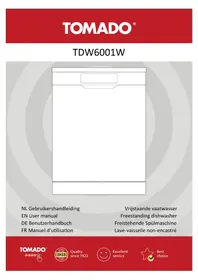
TDW6001W - Dishwasher Tomado - Free user manual and instructions
Find the device manual for free TDW6001W Tomado in PDF.



| Product type | Freestanding dishwasher |
| Capacity | 12 place settings |
| Wash programs | Intensive, Basic, Eco, Rapid '90, Delicate, Rapid '30 |
| Total electrical consumption | 1930 W |
| Heating power | 1800 W |
| Rated voltage | 220-240 V ~ 50 Hz |
| Rated current | 10 A |
| Net weight | 44 kg |
| Gross weight | 48 kg |
| Power cord length | 1.50 m |
| Inlet hose length | 1.50 m |
| Drain hose length | 1.40 m |
| Admissible water pressure | 0.03 - 1 MPa (0.3 - 10 bar) |
| Number of spray arms | 2 |
| Drying system | Active |
| Aquastop | Yes (double wall) |
| Delayed start timer | 2, 4, 6 or 8 hours |
| Half-load option | Yes |
| Height-adjustable upper basket | Yes |
| Control panel color | White |
| Filters | 3 components (main, micro, strainer) |
| Child safety | Key lock |
| Installation type | Freestanding (free-standing) |
| Visual indicators | Salt, rinse aid, water tap, child lock, delay |
Frequently Asked Questions - TDW6001W Tomado
User questions about TDW6001W Tomado
0 question about this device. Answer the ones you know or ask your own.
Ask a new question about this device
Download the instructions for your Dishwasher in PDF format for free! Find your manual TDW6001W - Tomado and take your electronic device back in hand. On this page are published all the documents necessary for the use of your device. TDW6001W by Tomado.
USER MANUAL TDW6001W Tomado
Freestanding dishwasher
HET APPARAAT PLAATSEN
HET APPARAAT PLAATSEN
HET APPARAAT STOPPEN

Opmerking:
1 Introduction 28
2 Safety. 28
3 Specifications 34
4 Description 35
5 Installation 37
6 Operation 39
7 Cleaning and maintenance. 43
8 Extra information. 44
9 Troubleshooting 45
10 Warranty conditions. 47
1 Introduction
HOW TO USE THIS DOCUMENT
- Read this document completely. Make sure that you know and understand all the instructions.
- Obey the safety instructions to prevent injury and/or damage to the appliance and its surroundings.
- Do the procedures completely and in the given sequence.
- Keep this document in a safe area for future use. This document is a part of the appliance.
SYMBOLS USED IN THIS DOCUMENT
| Safety symbol Function Description | ||
| Warning "Warning" means that injury or death is possible if you do not obey the instructions. | ||
| Caution "Caution" means that damage to the appliance is possible if you do not obey the instructions. | ||
| Note "Note" is used to give additional information. | ||
2 Safety
GENERAL SAFETY INSTRUCTIONS
- Fully read the instruction manual prior to using the appliance.
- Carefully store the instruction manual for future reference.
- Only use this appliance for the purposes described in the instruction manual. If the appliance is used for other purposes the full responsibility of any consequences lies with the user. Any damages to the appliance or other products are not covered by the warranty.
-
If the safety instructions and warnings are not observed, the manufacturer cannot be held liable for any resulting damage.
-
Make sure that the appliance is placed out of reach of children. Children are not always able to understand potential risks. Teach children how to handle electrical appliances in a responsible way.
- This appliance cannot be used by children from 0 to 8 years. This appliance can be used by children aged from 8 years and above and persons with reduced physical sensory or mental capabilities or lack of experience and knowledge if they have been given supervision or instruction concerning use of appliance in a safe way and understand the hazards involved.
- Keep the appliance and the mains cable out of reach of children younger than 8 years.
Children are not allowed to perform cleaning and maintenance. - Do not let children play with the appliance.
DELIVERY
- Do a check for damage to the packaging or the appliance that resulted during transportation.
- Do not use a damaged appliance. Contact your supplier.
- Dispose of the packaging materials according to local regulations.
- Keep the packaging material out of reach from children. Danger of suffocation.
INSTALLATION
- This appliance should be installed and repaired by an authorized service only.
- Place and connect the appliance according to the installation regulations.
- Make sure that the appliance is not plugged in during placement.
- Check whether the indoor electrical fuse system is connected according to the regulations.
- All electrical connections must match the values of the rating plate.
-
If the mains cable is damaged, it can only be replaced by the service organizations of the manufacturer or equivalent qualified persons.
-
Make sure that the appliance is not placed on the mains cable.
- Do not use an extension cable or a multiple socket for the connection. The mains plug must be easily accessible after installing the appliance.
- Do not excessively bend the water inlet and drain hoses or the mains cable during installation. Make sure that the water inlet and drain hoses or the mains cable do not become stuck.
- After installing the appliance, make sure that you run the appliance without dishes for the first time.
POSITIONING THE APPLIANCE
- When determining the place of the appliance, make sure that you choose a place where you can easily load and unload it.
- Do not place the appliance in a location where the room temperature can be below 0^ C .
- Place the appliance close to a water tap or drain and mains socket. Keep in mind that the connections will not be changed when they are made.
- Do not hold the appliance at the door or control panel to move it.
- Make sure that the water inlet and outlet hoses do not get stuck while placing the appliance.
- Place the appliance in a safe and level location.
- Make sure that the appliance is level and balanced by adjusting the feet. When the appliance is placed correctly the door opens and closes easily.
WATER CONNECTION
- Make sure that the indoor plumbing is suitable for installing the appliance.
- Install a filter at the water supply to avoid damage to the appliance due to contamination from the water (sand, clay, rust, etc.).
-
Use the new water inlet hose supplied with the appliance. Before making the connection, run water through the hose.
-
Make sure that you connect the water inlet hose directly to the water tap. The pressure of the water tap must be a minimum of 0,03 MPa and a maximum of 1 MPa. Install a pressure relief valve if the pressure is more than 1 MPa.
- After connecting the appliance, open the water tap completely and do a check for leaks.
- The appliance is supplied with a double-walled aquastop. The system automatically cuts off the water supply if the water inlet hose is leaking and the space between the walls is filled with water. Do not cut into the aquastop and make sure that the aquastop does not get twisted or stuck.
- Do not use a drain hose that is longer than 4 meter. As a result, dishes can remain dirty. The manufacturer will not accept responsibility.
- The water drain hose can be connected either directly to a drain pipe with a minimum diameter of 4cm , or let the hose run into the sink, making sure to avoid bending or crimping it. The free end of the hose must be at a height between 40 and 100cm and must not be immersed in water.
- The appliance must be connected to the water mains using the newly supplied hose sets. Do not reuse old hose sets.
ELECTRICAL CONNECTION
- Make sure that the mains plug of the appliance is connected to a grounded mains socket. The manufacturer is not responsible for damage resulting from using the appliance with a mains socket that is not grounded.
- Make sure that the voltage and the frequency values for the current correspond to the values of the rating plate.
- The electrical system in your home must be supplied with a 16 Amp fuse. The appliance is designed for connecting to 220 - 240V 50Hz .
- Do not connect the appliance during placement.
-
Use the provided mains plug.
-
The mains cable of the appliance must only be replaced by an authorized service or an authorized electrician. Failure to do so can lead to accidents.
- For safety reasons, make sure that you disconnect the mains plug when a program has finished. Do not disconnect the mains plug when your hands are wet. This can result in electric shock.
- Always pull the mains plug when you disconnect the appliance. Do not pull the mains cable.
SAFETY INSTRUCTIONS FOR OPERATION
- This appliance is intended to use in household and similar applications, such as shops, offices and other working environments, farm houses, customers of motels, hotels and other residential environments and bed and breakfasts.
- For safety reasons, only use accessories and spare parts from the manufacturer that are suitable for your appliance.
- This appliance must be grounded, this prevents the risk of electric shock in the event of an error or fault. The appliance has a grounded mains cable and mains plug. Only connect the mains plug to a grounded mains socket that is installed according to local electrical regulations.
- Incorrectly connecting the mains cable can result in a life threatening situation. In case of doubt, contact a qualified electrician or service technician.
- Do not make changes to the mains plug. If the mains plug does not fit into the mains socket, contact a qualified electrician.
- Do not place heavy objects on the opened door of the appliance.
- Do not stand on the opened door of the appliance. The appliance can fall over which can result into damage to the appliance.
- Do not put any chemical dissolving agents such as solvents in the appliance. There is a risk of explosion.
- Do not clean unsuitable plastic dishes in the appliance. Only dishes with a mark, indicating that they are dishwasher-safe can be cleaned
in the appliance. Follow the instructions of the manufacturer when dishes do not have a mark.
- Only use detergent, rinse aid and salt that is intended for dishwashers. The manufacturer will not be responsible for any damage resulting from using unsuitable products.
- Keep detergent and rinse aid out of reach of children.
- Keep children away from the appliance when the door is open. There can be cleaning agent present in the appliance. When cleaning agent is swallowed, immediately consult a doctor and take the packaging.
- Some dishwasher detergents are strongly alkaline and can be extremely dangerous if swallowed. Avoid contact with the skin and eyes. Keep children and pets away from the appliance when the door is open. Check that the detergent reservoir is empty after completion of the wash cycle.
- Keep the door closed. You can fall.
- Avoid contact between the cleaning agent and your skin and eyes.
- Make sure that all loose components in the appliance are fitted correctly.
- Do not open the door of the appliance during operation. Hot water can come out.
- Do not use the appliance for any other purpose than washing dishes.
- Only use the appliance in a frost free room.
- Remove the door or deactivate the lock when disposing of the appliance. Make sure that children cannot lock themselves in an old appliance.
- Make sure that the detergent reservoir is empty at the end of a wash cycle.
- Make sure that you fill the salt and rinse aid reservoir before first use and when the indicators are on.
- Make sure that you set the salt consumption before use.
-
Make sure that you disconnect the appliance before cleaning or performing repairs. Remove the mains plug from the mains socket or turn off the switch in the fuse box.
-
Make sure that long and/or sharp items of cutlery are placed facing down in the cutlery basket or are placed horizontally in the upper basket or the cutlery drawer.
- Do not put any items in the appliance that are not suitable for dishwashing.
- Do not fill a basket above the capacity. The manufacturer will not be responsible for damage to the appliance caused by movement of a basket.
- Do not drink the water from the appliance. The water is not suitable for consumption.
- Malfunctions of the appliance must be repaired by a qualified service technician. Repairs that are performed by other persons are not covered by the warranty.
3 Specifications
GENERAL SPECIFICATIONS
| Item Specification | |
| Freestanding Yes | |
| Color of control panel White | |
| Number of spray arms 2 | |
| Upper basket height adjustable Yes | |
| Maximum amount of place settings 12 | |
| Half-load option Yes | |
| Timer [hours] 2-4-6-8 | |
| Aquastop Yes | |
| Type of drying system Active |
TECHNICAL SPECIFICATIONS
| Item Specification | |
| Net weight [kg] 44 | |
| Gross weight [kg] 48 | |
| Total power consumption [W] | 1930 |
| Heating power [W] | 1800 |
| Rated voltage [V] / frequency [Hz] | 220-240 / 50 |
| Water supply pressure [MPa] | 0.03 (0.3 bar) - 1 (10 bar) |
| Current [A] | 10 |
| Length of mains cable [m] 1.50 | |
| Type of mains plug EU/TR | |
| Type of supply hose connection 3/4 inch, inner thread | |
| Position of supply hose Left rear | |
| Length of supply hose [m] 1.50 | |
| Position of outlet hose Left rear | |
| Length of outlet hose [m] 1.40 |
4 Description
INTENDED USE
The appliance is intended to wash dishes.
Do not use the appliance for any other purpose than described in this document.
FREESTANDING DISHWASHER
(Figure 1)
A Control panel
B Upper basket
C Lower basket
D Rating plate
E Detergent and rinse aid reservoir
F Cutlery basket
G Salt reservoir
H Filters
I Lower spray arm
J Upper spray arm
| Item Function | |
| Control panel Refer to section | ‘Control panel’. |
| Upper basket | Refer to section 'Loading the appliance'. |
| Lower basket | Refer to section 'Loading the appliance'. |
| Rating plate | To show the specifications of the appliance. |
| Detergent and rinse aid reservoir | To hold the detergent and rinse aid. |
| Cutlery basket | Refer to section 'Loading the appliance'. |
| Salt reservoir | To hold the salt. |
| Filters | To keep the appliance free from contamination. |
| Lower spray arm | To clean the dishes in the lower basket. |
| Upper spray arm | To clean the dishes in the upper basket. |
CONTROL PANEL
(Figure 2)
A On/off button
B Program selector button
C Programs
D Delay indicator - 2 hours
E Delay indicator - 4 hours
F Delay indicator - 6 hours
G Delay indicator - 8 hours
H Timer button
I Start/pause button
J Child-lock button
K Child-lock indicator
L Water tap indicator
M Salt indicator
N Rinse aid indicator
O Half-load indicator
P Half-load button
| Item Function | |
| On/off button To start or stop the appliance. | |
| Program selector button To select a program. | |
| Programs To show an overview of the available programs. Refer to section 'Programs'. | |
| Delay indicator - 2 hours To show that the start time of a program is delayed for 2 hours. | am is delayed for 2 hours. |
| Delay indicator - 4 hours To show that the start time of a program is delayed for 4 hours. | am is delayed for 4 hours. |
| Delay indicator - 6 hours To show that the start time of a program is delayed for 6 hours. | am is delayed for 6 hours. |
| Delay indicator - 8 hours To show that the start time of a program is delayed for 8 hours. | am is delayed for 8 hours. |
| Timer button To delay the start of a program. | |
| Start/pause button To start or pause a program. | |
| Child-lock button | To lock the buttons on the control panel, except for the on/off button. To lock or unlock the buttons on the control panel, hold the Child-lock button for 3 seconds. |
| Child-lock indicator To show that the child-lock is activated. | |
| Water tap indicator To show that the water tap is closed. | |
| Salt indicator To show that the level of salt is low. | The indicator is on when the salt reservoir is almost empty. |
| Rinse aid indicator To show that the level of rinse aid is low. | The indicator is on when the rinse aid reservoir is almost empty. |
| Half-load indicator To show that the half-load option is selected. | |
| Half-load button To decrease the duration of the selected program. | This decreases energy and water consumption. |
PROGRAMS
| Icon Name Description | on Time | [min.] | |
| Intensive | Program for heavily soiled dishes. | 205 | |
| Basic | Program for normally soiled dishes. | 175 | |
| ECO | Eco | Daily program for normally soiled dishes. The program takes longer, but uses less water and slowly heats for lower energy consumption. | 230 |
| 90' | Quick '90 | Short program for normally soiled dishes. | 90 |
| Icon Name Description | Time | [min.] | |
| ∅ | Delicate Program for no | mally soiled, delicate dishes. 120 | |
| 30' | Quick '30 Short program | for lightly soiled dishes, such as cups and glasses. 30 |

Note: The eco program is suitable to clean normally soiled dishes. It is the most efficient program because of the combined energy and water consumption and it complies with the EU ecodesign legislation.
5 Installation
POSITIONING THE APPLIANCE
- Read the warning texts on the packaging before removing the packaging and positioning the appliance.
- Leave some space around the appliance for easy cleaning.
- Do not place the appliance on the mains cable.
- When determining the place of the appliance, make sure that you choose a place where you can easily load and unload it.
- Do not place the appliance in a location where the room temperature can be below 0^ .
- Place the appliance close to a water tap or drain and mains socket. Keep in mind that the connections will not be changed when they are made.
- Do not hold the appliance at the door or control panel to move it.
Caution: Make sure that the water inlet and outlet hoses do not get stuck while placing the appliance.
Caution: Make sure that the water inlet and outlet hoses do not get stuck while placing the appliance.

- Place the appliance in a safe and level location.
- Do not place the appliance close to a refrigerator.
- Make sure that the appliance is level and balanced by adjusting the feet. When the appliance is placed correctly the door opens and closes easily.
WATER CONNECTION
- Make sure that the indoor plumbing is suitable for installing the appliance.
Install a filter at the water supply to avoid damage to the appliance due to contamination from the water (sand, clay, rust, etc.).

Warning: Use the new water inlet hose supplied with the appliance.

Warning: Before making the connection, run water through the hose.


- The appliance must be connected to the water mains using the newly supplied hose sets. Do not reuse old hose sets.


Warning: Make sure that you connect the water inlet hose directly to the water tap. The pressure of the water tap must be a minimum of 0,03 MPa and a maximum of 1 MPa. Install a pressure relief valve if the pressure is more than 1 MPa.

Caution: After connecting the appliance, open the water tap completely and do a check for leaks.



Caution: The appliance is supplied with a double-walled aquastop. The system automatically cuts off the water supply if the water inlet hose is leaking and the space between the walls is filled with water. Do not cut into the aquastop and make sure that the aquastop does not get twisted or stuck.


Note: Do not use a drain hose that is longer than 4 meter. As a result, dishes can remain dirty. The manufacturer will not accept responsibility.
- Keep the mark on the appliance in mind. If the appliance is marked '25', it means that the water temperature of the cold water can be maximum 25^ .
ELECTRICAL CONNECTION


Warning: Make sure that the mains plug of the appliance is connected to a grounded mains socket. The manufacturer is not responsible for damage resulting from using the appliance with a mains socket that is not grounded. Only an authorized electrician can install a grounded mains socket, if not available.
Make sure that the voltage and the frequency values for the current correspond to the values of the rating plate.


Warning: The electrical system in your home must be supplied with a 10-16 Amp fuse. The appliance is designed for connecting to 220 - 240V 50Hz
- Do not connect the appliance during placement.


Caution: Use the provided mains plug.
- The mains cable of the appliance must only be replaced by an authorized service or an authorized electrician. Failure to do so can lead to accidents.


Caution: For safety reasons, make sure that you disconnect the mains plug when a program has finished. Do not disconnect the mains plug when your hands are wet. This can result in electric shock.


Caution: Always pull the mains plug when you disconnect the appliance. Do not pull the mains cable.


Warning: The appliance is set to operate at 220-240V. Connect a 110/220V and 3000W transformer between the electrical connection if the mains supply is 110V.
INSTALLING THE APPLIANCE UNDER A WORKTOP

Warning:
The worktop must be stable.

Caution:
Make sure that the wiring and plumbing is suitable for installing the appliance under a worktop.

Caution:
Make sure that there is enough space under the worktop to install the appliance.
Preparing the appliance
In order to install the appliance under a worktop, the top panel must be removed.
- Remove the screws at the rear of the top panel.
- Push the panel rearwards for approximately 1 cm.
- Lift the panel to remove it.
(Figure 3)
Installing the appliance
- Adjust the feet to align the appliance with the worktop.
Make sure that the appliance is level.
(Figure 4)
- Push the appliance in the correct position. Refer to the dimensions in the figure.
(Figure 5)

Caution:
Be careful not to crush or bend the hoses during positioning of the appliance.

Note:
The minimum height A (820 mm) is suitable for appliances that do not have a felt layer on top.
The minimum height B (830 mm) is suitable for appliances that have a felt layer on top and have a second basket.
CONNECTING THE APPLIANCE
- Connect the drain hose directly to the drain hole or to the siphon. The connection must have a minimum
height of 50 cm and a maximum height of 110 cm. Refer to the figure.
(Figure 6)
- Do not let the drain hose hang lower than the appliance. Refer to the figure.
(Figure 7)
6 Operation
PREPARING FOR OPERATION
- Do a check if the electricity and the water supply connections of the appliance match the values indicated in the installation instructions.
- Remove all packaging material inside the appliance.
- Fill the salt reservoir. Refer to section 'Filling the salt reservoir'.
- Fill the rinse aid reservoir. Refer to section 'Filling the rinse aid reservoir'.
FILLING THE SALT RESERVOIR
For a good result the appliance needs soft (less calcareous) water. Salt is used to soften the water and it prevents white lime residues on your dishes and the interior of the appliance.

Caution:
Only use salt that is suitable for a dishwasher. Do not use table salt.

Note:
Fill the salt reservoir when the salt indicator on the control panel is on.
-
Remove the lower basket.
-
Turn the cap (A) of the salt reservoir counter-clockwise to remove it.
(Figure 8)
- Fill the salt reservoir with water.
(Figure 9)

Note:
You only have to fill the salt reservoir with water before first use of the appliance.
-
Put a funnel in the opening of the salt reservoir.
-
Fill the reservoir with salt until the overflow level.
- Install the cap of the salt reservoir.
(Figure 10)

Caution:
Remove any spilled salt immediately and run a full program to prevent corrosion of the appliance.
SETTING THE LEVEL OF SALT CONSUMPTION
The salt consumption of the appliance depends on the level of water hardness.
Set the level of salt consumption according to the information in section 'Water hardness level settings (salt consumption)'.

Note:
Contact your local water company to verify the level of water hardness in your area.

Note:
As a default, the level of water hardness of the appliance is set to level H3.
- Push the on/off button to start the appliance.
- Push and hold the program selector button within 1 minute after the appliance starts.
- Push the program selector button again to change the level of water hardness.
- Push the on/off button to confirm the setting.
FILLING THE DETERGENT RESERVOIR

Warning:
Store detergent out of reach of children in a cool and dry place.

Caution:
Only use detergent that is suitable for dishwashers.

Caution:
Do not put a detergent tablet in the cutlery basket, only use the detergent reservoir.

Note:
Detergent is available in powder, gel and tablets and is also available as a combined product (with salt and/or rinse aid). Combined products only produce sufficient results under certain conditions. Observe the instructions of the packaging.
- Make sure that you fill the detergent reservoir before you start the appliance.
- Push the latch (A) to open the detergent reservoir.
- Fill the large reservoir (B) with detergent. For heavily soiled dishes you can also add detergent in the smaller reservoir (C).
(Figure 11)
(Figure 12)

Caution:
The detergent reservoir has a capacity of 40 grams. Do not overfill the detergent reservoir. This can result in poorly dissolving detergent and damage to your glassware.
- Close the detergent reservoir.
- Select a program.
- Close the door.
FILLING THE RINSE AID RESERVOIR
Rinse aid is used to prevent traces of water droplets on clean dishes and increases drying performance.

Caution:
Only use rinse aid that is suitable for dishwashers.

Note:
Fill the rinse aid reservoir when the rinse aid indicator on the control panel is on.
- Turn the cap (A) counter-clockwise to open the rinse aid reservoir.
(Figure 13)
- Fill the reservoir (B) with rinse aid until the MAX level.
(Figure 14)

Caution:
Remove any spilled rinse aid immediately. Spilled rinse aid can form extreme foam which can cause leaks.
- Install the cap.
SETTING THE LEVEL OF RINSE AID CONSUMPTION
When water stains form on your dishes after a wash cycle, you have to increase the level of rinse aid consumption. When blue stains form on your dishes after a wash cycle, you have to decrease the level of rinse aid consumption.
- Remove the cap.
- Turn the dial to change the level of rinse aid consumption.
When set to a low number, the appliance uses less rinse aid. When set to a high number, the appliance uses more rinse aid.
- Install the cap.
LOADING THE APPLIANCE
Correctly placing dishes into the appliance has a positive effect on the energy consumption and the washing and drying performance of your appliance.
You can place dishes in the cutlery basket, the upper basket and the lower basket.

Caution:
Make sure that you load the appliance in such a way that the dishes do not block the upper and lower spray arm. If the spray arms are blocked they cannot spin during washing.
Loading the cutlery basket
The cutlery basket is designed for loading cutlery.

Warning:
Place sharp items of cutlery, such as knives and forks, face down in the cutlery basket to prevent injury.

Caution:
Make sure that there are no items of cutlery sticking out of the bottom of the basket.
- Place the cutlery piece by piece in a compartment of the cutlery basket to make sure that the spray arms can reach all items.
(Figure 15)
Loading the upper basket
The upper basket is designed for loading cups and saucers, small bowls and glasses. You can both adjust the height of the upper basket and the height of the racks of the upper basket to create more space.
- If necessary, adjust the height of the racks of the upper basket. Refer to section 'Adjusting the height of the racks of the upper basket'.
- If necessary, adjust the height of the upper basket. Refer to section 'Adjusting the height of the upper basket'.
- Place the dishes in the upper basket.
- Make sure that you place wine glasses and long-stem glasses against the edge of the basket, rack or glass supporter wire.

Caution:
Do not place wine glasses and long-stem glasses against other items to prevent damage to the glasses.
- Place long, small cooking utensils, such as wooden spoons, in the middle of the upper basket.
Loading the lower basket
The lower basket is designed for loading pots with long handles, pans, lids, plates and salad bowls. The lower basket also has space for the cutlery basket.
- Place the dishes in the lower basket.
(Figure 17)(Figure 18)
ADJUSTING THE HEIGHT OF THE RACKS OF THE UPPER BASKET
The racks can be moved up to create more space in the upper basket, for example to place different-sized glasses under the racks or to place cutlery items on the racks.
- Move the racks (A) up or down.
(Figure 19)
ADJUSTING THE HEIGHT OF THE UPPER BASKET
The complete upper basket can be moved to create more space in the upper basket or in the lower basket. When the upper basket is in the upper position, you can place large items, such as pots and large plates, in the lower basket. When the upper basket is in the lower position, you can place large plates in the upper basket.
-
Pull out the upper basket.
-
Remove the upper basket (A).
(Figure 20)
- Install the upper basket (A):
(Figure 21)
a. Install the basket in the upper runners to put the basket in the lower position (B).
b. Install the basket in the lower runners to put the basket in the upper position (C).
- Push in the upper basket.
STARTING THE APPLIANCE
- Close the door of the appliance.
- Push the on/off button to start the appliance. The program indicator goes on.
CHOOSING A PROGRAM

Note:
For an overview of the programs, refer to section 'Programs'.
- Use the program selector button to choose a program.
- If necessary, use the timer button to delay the start time of the program. Refer to section 'Delaying the program'.
- Push the start/pause button to start the program.
CHANGING THE PROGRAM

Note:
You can only change the program shortly after the appliance has started.
- Push the start/pause button to pause the program.
- Push and hold the program selector button for 3 seconds to start the program selection mode.
- Push the program selector button to change the program.
- Push the start/pause button to start the selected program.
The newly selected program will resume the course of the previously selected program.
DELAYING THE PROGRAM

Note:
The start time of a program can be delayed for 2, 4, 6, or 8 hours.
- Push the timer button to delay the start time of a program. Every time you push the button the indicator for the next delay interval goes on.
- Push the timer button again to increase the delay of the start time or to cancel the timer.
- Close the door.
- Push the start/pause button.
The program will start when the timer has finished.
STOPPING THE APPLIANCE

Note:
The appliance is silent for 40 to 45 minutes during the drying process.

Note:
A buzzer sounds five times when the program is finished.
- Open the door.
- Wait a few minutes before you unload the appliance. The dishes are very hot and can break.
- Push the on/off button to switch off the appliance.
7 Cleaning and maintenance
CLEANING THE APPLIANCE

Caution:
Make sure that the appliance is off.

Note:
If you clean the appliance regularly, it will improve the service life.
- Clean the outside of the appliance. Use a damp cloth.
- Clean the seals of the door. Use a soft cloth.
- Clean the inside of the appliance in case of high contamination:
a. Fill the detergent reservoir with a special cleaning agent for dishwashers.
b. Select a program with a high temperature.
c. Start the program.
CLEANING THE FILTERS
The filter system of the appliance consists of three components: the main filter, the micro filter and the sieve.
Clean the filters weekly.

Warning:
Do not use the appliance without the filter system.

Note:
Clean filters make sure that your appliance functions correctly.
- Remove the lower basket.
- Turn the main filter (A) counter-clockwise to remove it.
(Figure 22)

Note:
The micro filter and the sieve are attached to the main filter.
- Remove the micro filter (A) from the filter assembly (B).
(Figure 23)
- Turn the main filter (A) counter-clockwise to remove it.
(Figure 24)
-
Clean the main filter, the micro filter and the sieve. Use warm water and a dishwaving brush.
-
Install the sieve.
-
Install the main filter into the micro filter. Make sure that the markers are aligned.
-
Install the main filter into the sieve.
-
Turn the main filter (A) clockwise to fasten it.
(Figure 25)

Caution:
Make sure that the filters are placed correctly. Incorrect placement of the filters affects the maximum performance of the appliance.
CLEANING THE SPRAY ARMS
- Remove the upper and lower basket.
(Figure 26)
-
Remove the nut (A).
-
Remove the upper spray arm (B).
-
Pull the lower spray arm (C) upwards to remove it.
-
Clean the spray arms. Use warm water.
-
Install the lower spray arm (C).
-
Install the upper spray arm (B).
-
Tighten the nut (A).
(Figure 27)
8 Extra information
WATER HARDNESS LEVEL SETTINGS (SALT CONSUMPTION)
| Level German | hardness [dH] | French hardness [dF] | British hardness [dE] | Program | selector button on |
| H1 0-5 0-9 0 | -6 Quick '30, on | ||||
| H2 6-11 10-20 | 7-14 Delicate, on | ||||
| H3 12-17 21 | -30 15-21 Delicate and Quick '30, on | ||||
| H4 18-22 31 | -40 22-28 Quick '90, on | ||||
| H5 23-34 41 | -60 29-42 Quick '90 and Quick '30, on | ||||
| H6 35-50 61 | -90 43-63 Quick '90 and Delicate, on |
9 Troubleshooting
GENERAL TROUBLESHOOTING PROCEDURE
- Try to find a solution for the problem with the help of the troubleshooting table and the fault codes.
- If the fault code keeps re-occurring, contact the Tomado-servicedienst.
TROUBLESHOOTING TABLE
| Problem Possible cause Possible solution | |||
| The program does not start. The mains plug is not connected. Connect the mains plug. | |||
| There is a problem with the fuse. Do a check on the fuse box. | |||
| There is no water supply. Open the water tap. | |||
| The door of the appliance is open. Close the door. | |||
| The appliance is switched off. | Start the appliance. Refer to section 'Starting the appliance'. | ||
| The water inlet hose and filters are clogged. | Make sure that the water inlet hose and the filters are not clogged. | ||
| The detergent reservoir contains detergent residues. | The detergent reservoir is filled while the reservoir was still damp. | Make sure that you fill the detergent reservoir when it is dry. | |
| The appliance contains water when the program is finished. | The drain hose is clogged or twisted. | • Make sure that the drain hose is not clogged. • Make sure that the drain hose is not twisted. | |
| The filters are clogged. | Clean the filters. Refer to section 'Cleaning the filters'. | ||
| The program has not finished. | Wait until the program is finished. A buzzer sounds five times when the program is finished. | ||
| The appliance stops during a program. | There is a power failure. | Make sure that there is power. | |
| There is a water inlet failure. | Make sure that there is water inlet supply. | ||
| The program is paused. | Start the program. | ||
| The appliance makes unusual sounds during a program. | The appliance is not loaded correctly. | Make sure that you load the appliance correctly. Refer to section 'Loading the appliance'. | |
| One of the spray arms hits the dishes. | Make sure that you load the appliance correctly. Refer to section 'Loading the appliance'. | ||
| There is food waste left on the dishes. | The appliance is not loaded correctly and the spray arms cannot reach all the dishes. | Make sure that you load the appliance correctly. Refer to section 'Loading the appliance'. | |
| The cutlery basket is too full. | Make sure that you load the appliance correctly. Refer to section 'Loading the appliance'. | ||
| The dishes are placed too close together. | Make sure that you load the appliance correctly. Refer to section 'Loading the appliance'. | ||
| The amount of detergent is insufficient. | Make sure that you fill the detergent reservoir with a sufficient amount of detergent. Refer to section 'Filling the detergent reservoir'. | ||
| The selected program is not suitable for the loaded dishes. | Choose a suitable program. Refer to section 'Programs'. | ||
| One of the spray arms is clogged. Clean the spray arms. Refer to section 'Cleaning the spray arms'. | |||
| The filters are clogged. | Clean the filters. Refer to section 'Cleaning the filters'. | ||
| The filters are not placed correctly. Make sure that you correctly place the filters. | |||
| The water drain pump is clogged. Make sure that the water drain pump is not clogged. | |||
| There are white stains on the dishes. | The amount of detergent is insufficient. | Make sure that you fill the detergent reservoir with a sufficient amount of detergent. Refer to section 'Filling the detergent reservoir'. | |
| The level of rinse aid consumption is set too low. | Adjust the level of rinse aid consumption. Refer to section 'Setting the level of rinse aid consumption'. | ||
| There is a high level of water hardness and no salt is used. | Fill the salt reservoir. Refer to section 'Filling the salt reservoir'. | ||
| The level of water hardness is set too low, which affects the salt consumption. | Adjust the level of salt consumption. Refer to section 'Setting the level of salt consumption'. | ||
| The cap of the salt reservoir is not closed correctly. | Make sure that the cap of the salt reservoir is closed firmly. | ||
| The dishes are not dry. The selected program am does not include drying. | Choose a program that includes drying. Refer to section 'Programs'. | ||
| The level of rinse aid consumption is set too low. | Adjust the level of rinse aid consumption. Refer to section 'Setting the level of rinse aid consumption'. | ||
| The appliance is unloaded too quickly after the program is finished. | Wait a few minutes after the program is finished before you unload the appliance. | ||
| There are rust stains on the dishes. The stainless steel quality of the dishes is insufficient. | Make sure that you only clean dishwasher-safe dishes in the appliance. | ||
| The level of salt consumption is set too high. | Adjust the level of salt consumption. Refer to section 'Setting the level of salt consumption'. | ||
| The cap of the salt reservoir is not closed correctly. | Make sure that the cap of the salt reservoir is closed firmly. | ||
| Any spilled salt during filling of the salt reservoir was not cleaned immediately. | Make sure that you clean any spilled salt immediately and run a full program to prevent corrosion. | ||
| The water supply is polluted. Do a check on the water supply. | |||
FAULT CODES
The fault codes are shown on the display of the control panel.
| Program selector button | Possible cause Possible solution | |
| Quick '30, blinks There is | insufficient water supply. | ·Make sure that the water tap is fully open and that the water supply is not blocked. ·Close the water tap, remove the water inlet hose and do a check if the hose is clogged. ·Start the appliance again. ·Contact the Tomado-servicedienst if the fault code keeps re-occurring. |
| Quick '30 and Quick '90, blinks | The heater has an error. Contact the | Tomado-servicedienst. |
| Delicate, blinks The safety for water overflow is activated. | Contact the Tomado-servicedienst. | |
10 Warranty conditions
Ordering accessories
Go to 'https://www.tomado.com/support' to purchase accessories or spare parts.
Warranty conditions
A 24 month warranty is provided for this product. Your warranty is valid if the product has been used in accordance with the user instructions and for the purpose for which it was made. Also the original proof of purchase must be submitted, stating the date of purchase, the name of the retailer and the item number of the product. For extensive warranty information you are referred to our website: 'https://www.tomado.com/support'.
Inhaltsverzeichnis
P Bouton demi-charge


- HET APPARAAT PLAATSEN
- HET APPARAAT STOPPEN
- Opmerking:
- Introduction
- HOW TO USE THIS DOCUMENT
- SYMBOLS USED IN THIS DOCUMENT
- Safety
- GENERAL SAFETY INSTRUCTIONS
- DELIVERY
- INSTALLATION
- POSITIONING THE APPLIANCE
- WATER CONNECTION
- ELECTRICAL CONNECTION
- SAFETY INSTRUCTIONS FOR OPERATION
- Specifications
- Description
- INTENDED USE
- FREESTANDING DISHWASHER
- CONTROL PANEL
- Installation
- INSTALLING THE APPLIANCE UNDER A WORKTOP
- Warning:
- Caution:
- Preparing the appliance
- Installing the appliance
- Note:
- CONNECTING THE APPLIANCE
- Operation
- PREPARING FOR OPERATION
- FILLING THE SALT RESERVOIR
- SETTING THE LEVEL OF SALT CONSUMPTION
- FILLING THE DETERGENT RESERVOIR
- FILLING THE RINSE AID RESERVOIR
- SETTING THE LEVEL OF RINSE AID CONSUMPTION
- LOADING THE APPLIANCE
- Loading the cutlery basket
- Loading the upper basket
- Loading the lower basket
- ADJUSTING THE HEIGHT OF THE RACKS OF THE UPPER BASKET
- ADJUSTING THE HEIGHT OF THE UPPER BASKET
- STARTING THE APPLIANCE
- CHOOSING A PROGRAM
- CHANGING THE PROGRAM
- DELAYING THE PROGRAM
- STOPPING THE APPLIANCE
- Cleaning and maintenance
- CLEANING THE APPLIANCE
- CLEANING THE FILTERS
- CLEANING THE SPRAY ARMS
- Extra information
- Troubleshooting
- GENERAL TROUBLESHOOTING PROCEDURE
- FAULT CODES
- Warranty conditions
- Ordering accessories
- Warranty conditions
- Inhaltsverzeichnis
Brand : Tomado
Model : TDW6001W
Category : Dishwasher