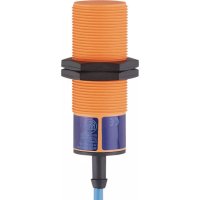
KI5030 - Capacitive proximity sensor IFM - Free user manual and instructions
Find the device manual for free KI5030 IFM in PDF.


User questions about KI5030 IFM
0 question about this device. Answer the ones you know or ask your own.
Ask a new question about this device
Download the instructions for your Capacitive proximity sensor in PDF format for free! Find your manual KI5030 - IFM and take your electronic device back in hand. On this page are published all the documents necessary for the use of your device. KI5030 by IFM.
USER MANUAL KI5030 IFM
Operating instructions (Ex protection related part) Capacitive NAMUR sensor
KI5030
KI5031
1 Safety instructions

Remarks for safe use in hazardous areas.
- The device must only be installed, connected and set up by qualified staff. The qualified staff must have knowledge of types of protection, regulations and provisions for apparatus in hazardous areas.
- The classification and marking of the device must be suitable for the application.
- Adhere to the respective national regulations and provisions as well as the relevant installation regulations.
- Observe applicable documents.
2 Intended use
Use in hazardous areas according to the classification:
| ATEX classification | Identification | Permissible ambient temperature |
| Ex II 1G | Ex ia IIB T6 Ga | Ta -20...60°C |
| Ex II 1D | Ex ia IIIC T200 90°C Da | Ta -20...60°C |
Type examination certificate:
• DMT 01 ATEX E020 X
• IEC: IECEx BVS 06.0003X
The requirements of the following standards are met:
• EN IEC 60079-0:2018, EN 60079-11:2012
• IEC 60079-0:2017, IEC 60079-11:2011
Connection only to intrinsically safe circuits which are approved with the type examination certificate and do not exceed the following maximum values:
Ui = 1 5 V, Ii = 5 0 mA, Pi = 1 2 0 mW
Maximum effective internal inductance (Li) and capacitance (Ci):
KI5030:
Li = 1 µH, Ci = 3 7 5 nF
KI5031:
Li = 3 µH, Ci = 3 7 5. 6 4 nF
3 Installation
▶ Protect device and cable against destruction.
▶ Do not install the device in the partition between different zones.
3.1 Special conditions for safe operation
▶ Always refer to the operating instructions for the identification, as it may not be fully applied to the device due to lack of space.
▶ Ensure that intensive electrostatic charging is excluded.
4 Maintenance, repair and disposal
No modifications or repairs may be made to the device.
▶ In case of a fault please contact the manufacturer.
▶ If required, request data sheets or type examination certificates / certificates from the manufacturer ( → cover sheet / back).
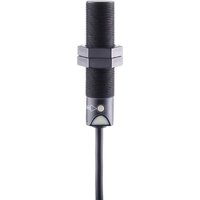
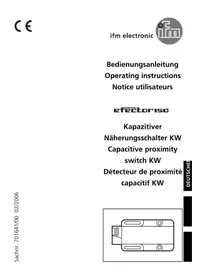

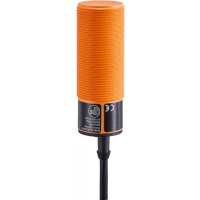
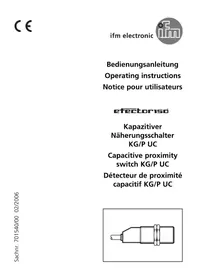
Brand : IFM
Model : KI5030
Category : Capacitive proximity sensor