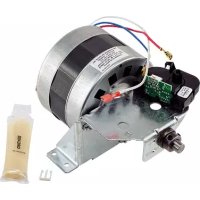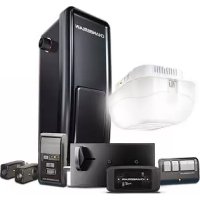
RJO20C - Garage door CHAMBERLAIN - Free user manual and instructions
Find the device manual for free RJO20C CHAMBERLAIN in PDF.


User questions about RJO20C CHAMBERLAIN
0 question about this device. Answer the ones you know or ask your own.
Ask a new question about this device
Download the instructions for your Garage door in PDF format for free! Find your manual RJO20C - CHAMBERLAIN and take your electronic device back in hand. On this page are published all the documents necessary for the use of your device. RJO20C by CHAMBERLAIN.
USER MANUAL RJO20C CHAMBERLAIN
For Residential Use Install On Sectional Doors With Torsion Assemblies Only
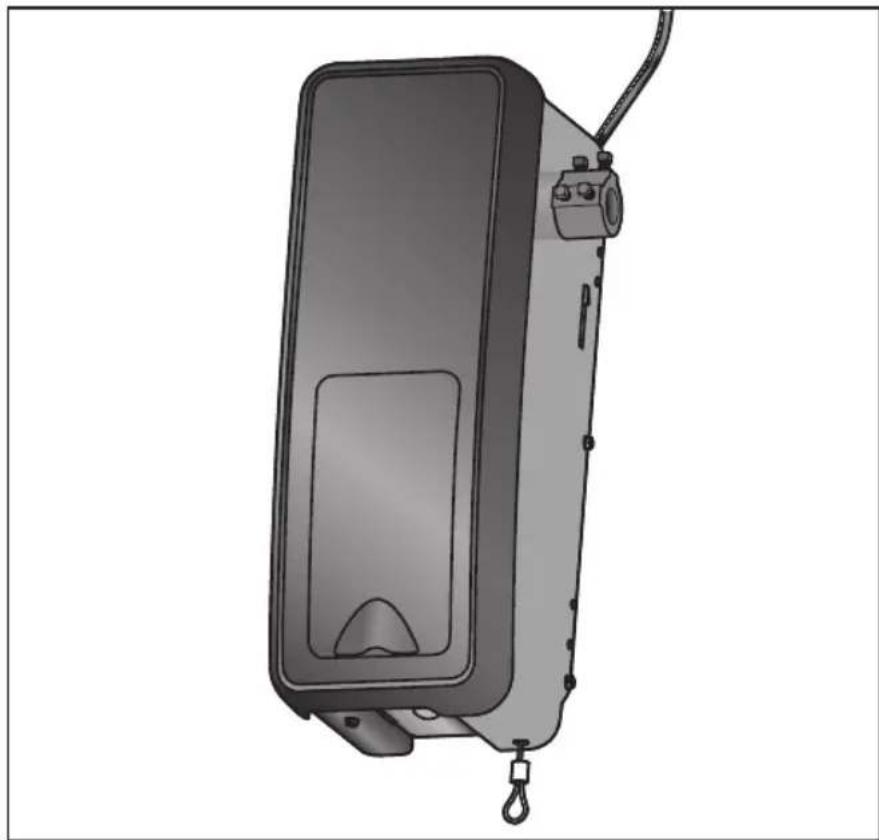
This product is NOT intended for use on low headroom tracks with outside pickup drum or garage doors utilizing extension springs. For advanced or customized adjustments, door springs, and/or track configurations, contact a trained door systems technician.
- Please read this manual and the enclosed safety materials carefully!
- Fasten the manual near the garage door after installation.
- The door WILL NOT CLOSE unless the Protector System ^ and cable tension monitor are connected and properly aligned.
- Periodic checks of the garage door opener are required to ensure safe operation.
This garage door opener is ONLY compatible with myQ ® accessories. - The model number label is located behind the hinged door of your opener.
Table of Contents
PREPARATION 2
Safety Symbol and Signal Word Review 2
Glossary. 3
Is Your Garage Door Ready? 4
Prepare Your Garage Door. 5
Carton Inventory 6
Hardware 6
Overview of Installation. 7
INSTALLATION 7
Important Installation Instructions...8
Tools You Will Need... 8
Attach the Collar to the Garage Door Opener 9
Position and Mount the Garage Door Opener 10
Attach the Emergency Release Rope and Handle. 12
Power Door Lock. 12-13
Position the Cable Tension Monitor (Required) 13
Attach the Cable Tension Monitor (Required) 14
Install the Door Control (myQ® Control Panel) 15
Install Remote Light. 16
Install the Protector System 17
Connect Power. 20
Align the Safety Reversing Sensors 21
ADJUSTMENT 22
Program the Travel Limits. 22
Enter Force Adjustment Mode...23
Test the Safety Reversal System....24
Test the Protector System 24
Test the Power Door Lock. 25
Test the Emergency Release 25
Test Cable Tension Monitor 25
OPERATION 26
Using Your Garage Door Opener....26
Using the Door Control (myQ Control Panel) 27
Using the Remote Control. 28
PROGRAMMING 29
To Add a Remote Control, Keypad, or myQ® Enabled Accessories 29
Reprogramming Remote Light or Additional Light. 30
HomeLink 30
Chamberlain Internet Gateway ....31
To Erase All Codes From the Door Control (myQ® Control Panel) Memory 31
MAINTENANCE 32
Care of Your Garage Door Opener..32
TROUBLESHOOTING 33
Diagnostic Chart 33
Troubleshooting 34
SAFETY & MAINTENANCE GUIDE 36-37
ACCESSIONS 38
WARRANTY 39
REPAIR PARTS 39
Installation Parts. 39
Garage Door Opener Assembly Parts 40
CONTACT INFORMATION 40
Preparation
Safety Symbol and Signal Word Review
This garage door opener has been designed and tested to offer safe service provided it is installed, operated, maintained, and tested in strict accordance with the instructions and warnings contained in this manual.
WARNING
Mechanical
WARNING
Electrical
CAUTION
When you see these Safety Symbols and Signal Words on the following pages, they will alert you to the possibility of serious injury or death if you do not comply with the warnings that accompany them. The hazard may come from something mechanical or from electric shock. Read the warnings carefully.
When you see this Signal Word on the following pages, it will alert you to the possibility of damage to your garage door and/or the garage door opener if you do not comply with the cautionary statements that accompany it. Read them carefully.
UNATTENDED OPERATION
The Timer-to-Close (TTC) feature, the myQ® Smartphone Control app and myQ® Garage Door are examples of unattended close and are to be used ONLY with sectional doors. Any device or feature that allows the door to close without being in the line of sight of the door is considered unattended close.

WARNING: This product can expose you to chemicals including lead, which are known to the State of California to cause cancer or birth defects or other reproductive harm. For more information go to www.P65Warnings.ca.gov.
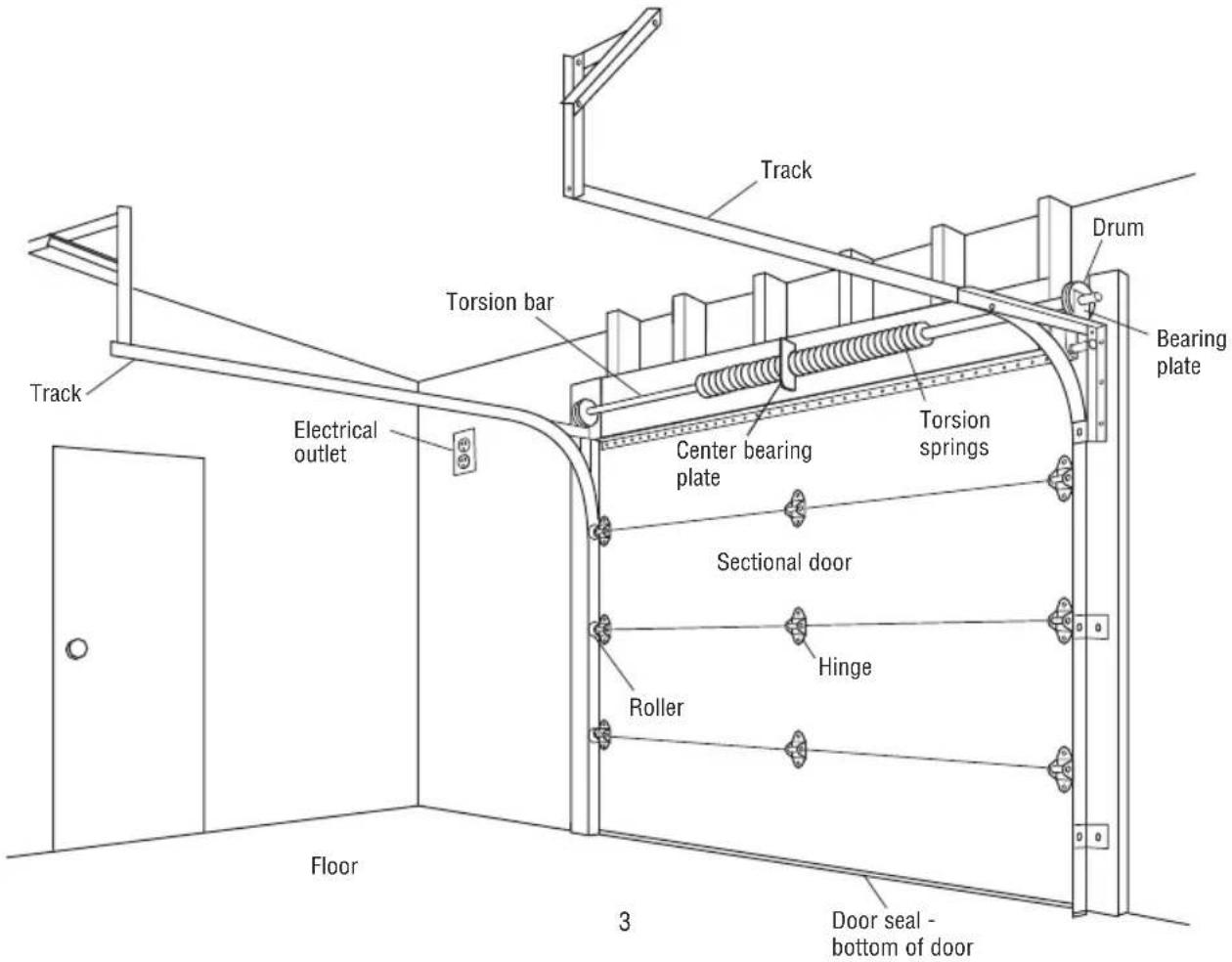
Glossary
Here are some basic terms you may encounter as you prepare and install your garage door opener.
| Term Definition | |
| Bearing Plate | Acts as a support for the torsion bar. The bearing and mounting plate are typically located above the garage door. |
| Cable Tension Monitor | The cable tension monitor detects any slack in the garage door cables. Failure to properly install the cable tension monitor may cause the cables to be thrown and may result in a hazardous situation. (Not shown below) |
| Door Seal | The door seal is located at the bottom of the door and helps to keep outdoor elements from entering the garage. |
| Drum Drums are round, grooved spools on the torsion bar that keep door cables orderly. | |
| Extension Springs | Extension springs are NOT compatible with this opener. Extension springs are typically mounted along the horizontal section of the track and extend from the front of the door opening to the back hang. The springs are intended to make a door lighter so you can easily open and close the door by hand. |
| High Lift Sectional Door | A type of garage door constructed with multiple panels that slide along a track inside the garage. The track runs vertically up the wall beyond the top of the door opening several inches before encountering the curve in the track. The extended distance above the top of the garage door determines the amount of a high lift. |
| Roller Small wheels which allow the door to move up and down the track. | |
| Safety Reversing Sensor | The safety reversing sensors are a set of sensor eyes that detect obstructions in the path of the garage door. If an obstruction is found, the sensors tell the door to reverse direction. (Not shown below) |
| Torsion Springs | A torsion spring is a type of spring that counter balances the garage door. The torsion spring is located above the door on the torsion bar. The springs are intended to make a door lighter so you can easily open and close the door by hand. Consult a trained door systems technician if you need the springs adjusted or replaced. |
| Torsion Bar | A torsion bar is a horizontal metal bar mounted above the garage door. The torsion springs are located on the torsion bar. Most torsion bars are hollow, while some are solid. Some solid torsion bars may have a groove called a keyway that runs the length of the bar. |
Is Your Garage Ready?
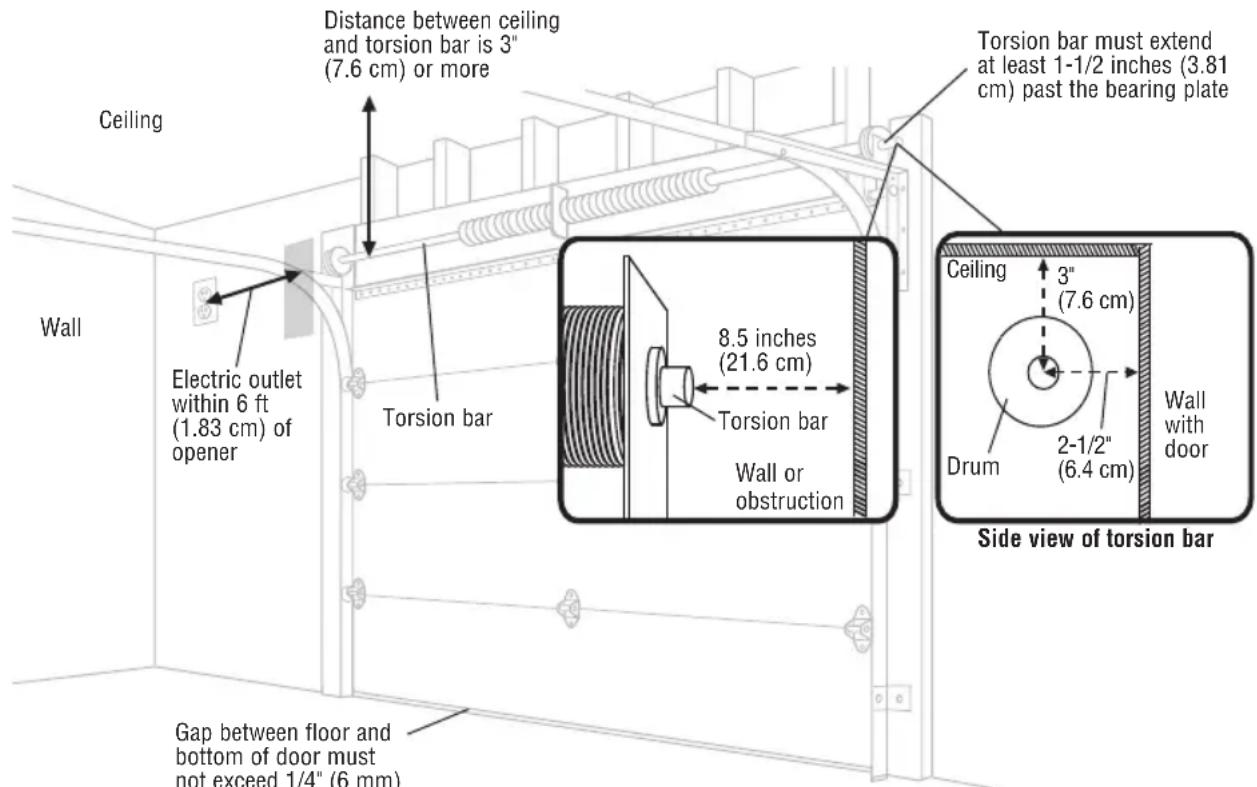
Use this check list to see if your garage is compatible with the garage door opener requirements. Note that you can install the garage door opener on either the left or the right side of the garage door.
IMPORTANT: Your garage MUST meet the following requirements to install this opener to ensure safe and proper operation. If your door does not meet these criteria, you must choose a different model of operator. If your torsion bar, power source and/or drums do not meet the requirements, contact a trained door systems technician.
REQUIREMENTS CHECK LIST

Sectional garage door:
Standard sectional door up to 14 feet (4.3 m) high, but only up to 180 sq. ft. (16.7 sq. m).
- Standard sectional doors up to 18 feet (5.5 m) wide, but only up to 180 sq. ft. (16.7 sq. m)
- Standard sectional high lift door (up to 54 inches (137.2cm) of high lift)
- Any gap between the floor and the bottom of the door must not exceed 1/4 inch (6 mm). Otherwise, the safety reversal system may not work properly.

Torsion bar and torsion springs:
- Torsion bar is 1 inch (2.5 cm) diameter.
- Torsion bar must extend at least 1-1/2 inches (3.81 cm) past the bearing plate and be free of damage.
- Distance between ceiling and center of torsion bar is 3 inches (7.6 cm) or more.
- Distance between garage wall the torsion bar is mounted on and center of torsion bar is 2-1/2 inches (6.4 cm) or more.
- A minimum of 8.5 inches (21.6 cm) between the side garage wall (or obstruction) and the end of the torsion bar.

Drums:
- NOT compatible with reverse wound drums.
- 4-6 inches (10-15 cm) diameter.
- 3-3.9 inch (7.6-9.9 cm) diameter drums may be used on doors up to 430 lbs (194kgs).

Power:
- An electric outlet must be accessible within a 6 foot (1.83 m) diameter of the installation area for the opener. The outlet must be 120 VAC - 60 Hz ONLY. Contact a qualified electrician if you need an outlet installed.

Previously installed garage door opener has been removed completely.
WARNING
To prevent possible SERIOUS INJURY or DEATH:
- ALWAYS call a trained door systems technician if garage door binds, sticks, or is out of balance. An unbalanced garage door may NOT reverse when required.
- NEVER try to loosen, move or adjust garage door, door springs, cables, pulleys, brackets or their hardware, ALL of which are under EXTREME tension.
- Disable ALL locks and remove ALL ropes connected to garage door BEFORE installing and operating garage door opener to avoid entanglement.
CAUTION
To prevent damage to garage door and opener:
- ALWAYS disable locks BEFORE installing and operating the opener.
- ONLY operate garage door opener at 120V , 60Hz to avoid malfunction and damage.
Prepare your Garage Door
- Uninstall previous garage door opener.
- Disable locks.
- Remove any ropes connected to the garage door.
- Check the seal on the bottom of the door. Any gap between the floor and the bottom of the door must not exceed 1/4 inch (6 mm). Otherwise, the safety reversal system may not work properly.
Complete the test below to make sure the garage door is balanced and is not sticking or binding.
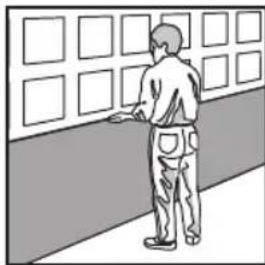
- Lift the door 3-4 feet off the ground. Release the door. If balanced, it should stay in place, supported entirely by its springs.
- Raise and lower the door to check for binding or sticking. If your door binds, sticks, or is out of balance, contact a trained door systems technician BEFORE you install this opener.
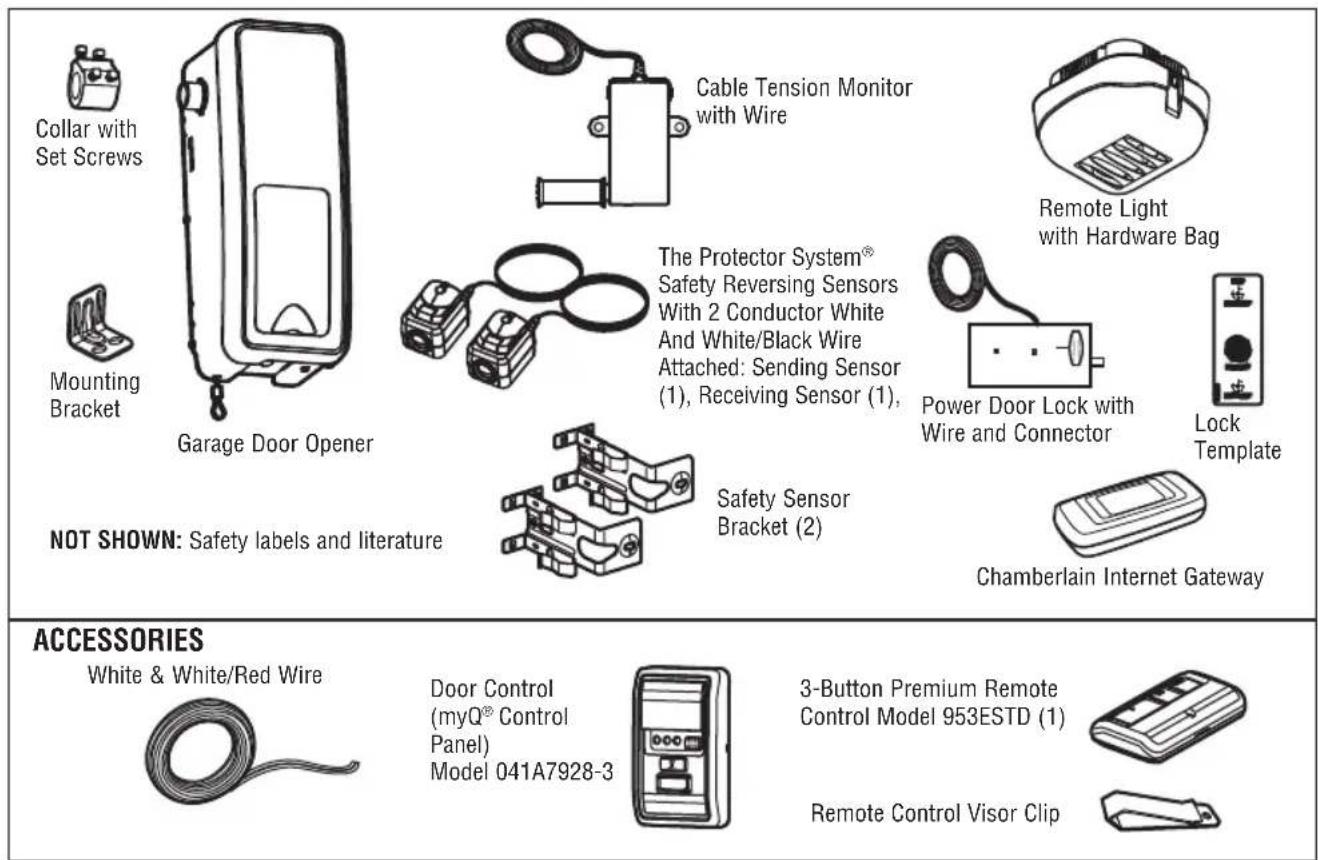
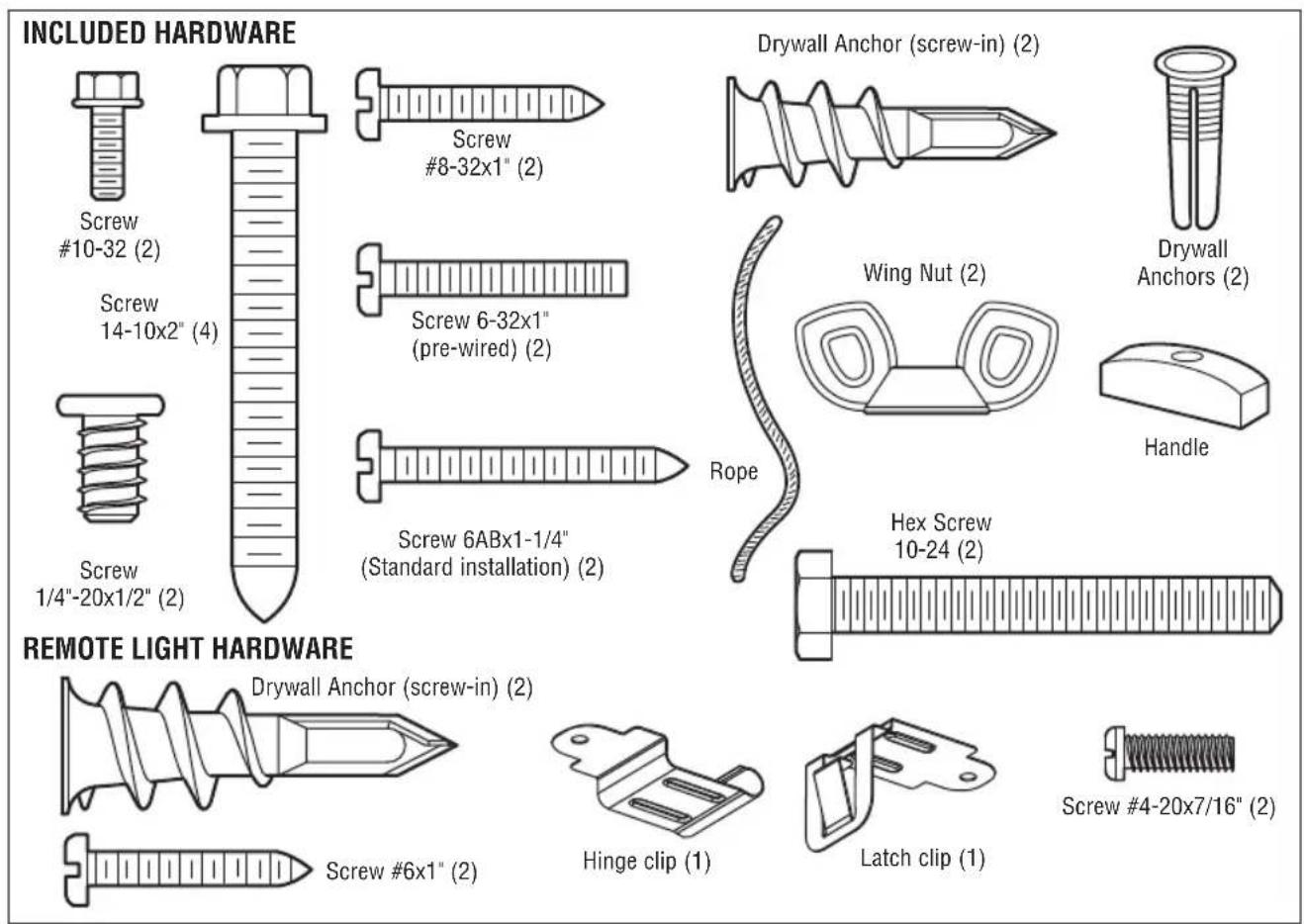
Carton Inventory
Save the carton and packing material until the installation and adjustment is complete. The images throughout this manual are for reference only and your product may look different.
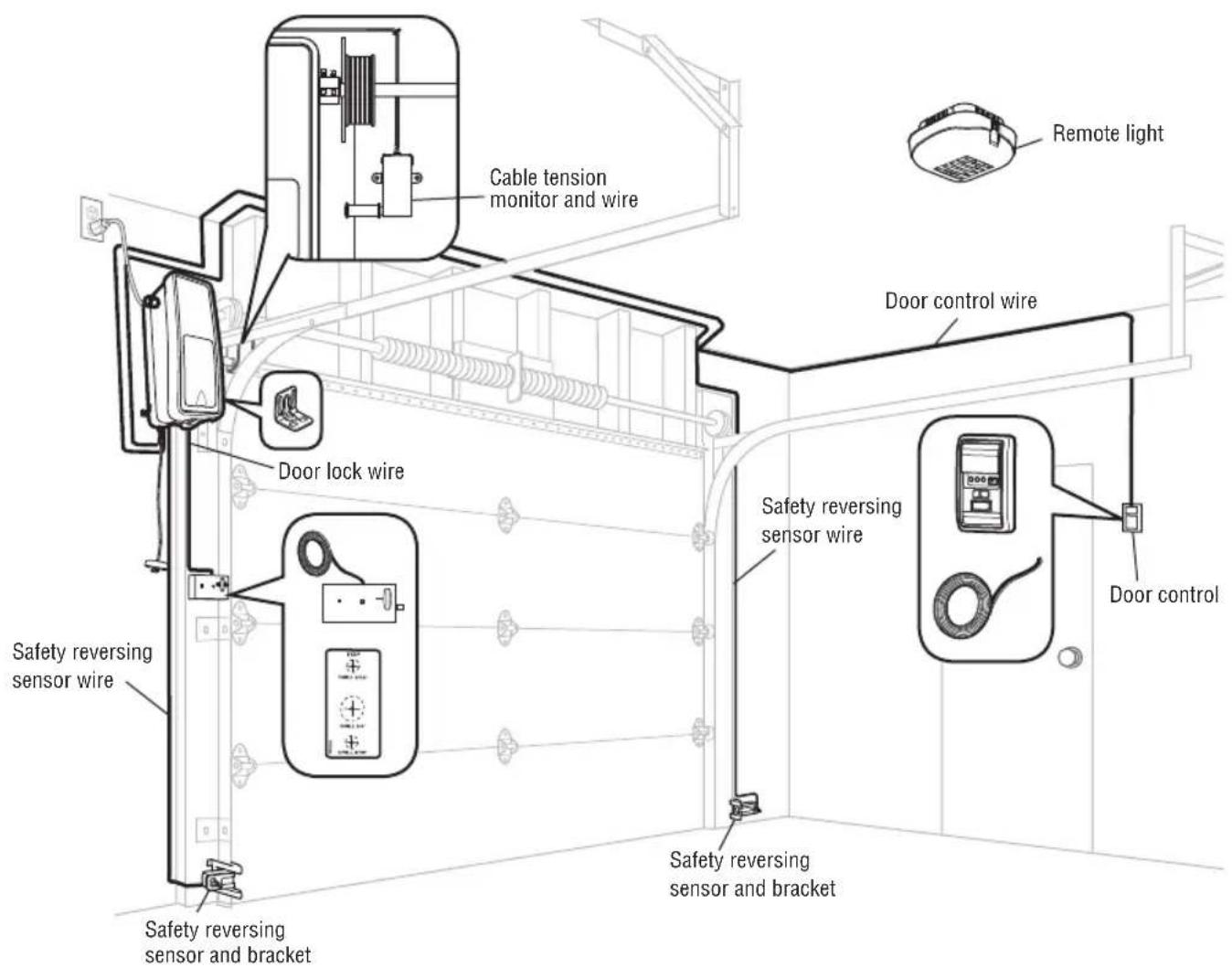
Overview of Installation
ADDITIONAL ITEMS YOU MAY NEED FOR THE INSTALLATION:
Survey your garage area to see if you will need any of the following items:
Wood blocks and/or shimming material.
- Used to mount the cable tension monitor.
Fastening hardware.
- Alternate floor mounting of the safety reversing sensor will require hardware not provided.
- Extension brackets (Model 041A5281-1) or wood blocks and shimming material.
- Used to position the garage door opener during installation and for testing the safety reversing sensors if installed on the wall or floor.
IMPORTANT INSTALLATION INSTRUCTIONS
WARNING
To reduce the risk of SEVERE INJURY or DEATH:
- READ AND FOLLOW ALL INSTALLATION WARNINGS AND INSTRUCTIONS.
- Install garage door opener ONLY on properly balanced and lubricated door. An improperly balanced door may NOT reverse when required and could result in SEVERE INJURY or DEATH.
- ALL repairs to cables, spring assemblies and other hardware MUST be made by a trained door systems technician BEFORE installing garage door opener.
- Disable ALL locks and remove ALL ropes connected to door BEFORE installing garage door opener to avoid entanglement.
- Where possible, install the door operator 7 feet or more above the floor.
- Mount the emergency release within reach, but at least 6 feet (1.83m) above the floor and avoiding contact with vehicles to avoid accidental release.
-
NEVER connect garage door opener to power source until instructed to do so.
-
NEVER wear watches, rings or loose clothing while installing or servicing the garage door opener. They could be caught in door or operator mechanisms.
-
Install wall-mounted door control:
within sight of the door.
out of reach of small children at a minimum height of 5 feet (1.5m) above floors, landings, steps or any other adjacent walking surface.
away from ALL moving parts of the door.
- Install the Entrapment Warning Placard next to the door control in a prominent location.
- Place emergency release/safety reverse test label in plain view on inside of door.
- Upon completion of installation, test safety reversal system. Door MUST reverse on contact with a 1 - 1 / 2'' (3.8 cm) high object (or a 2x4 laid flat) on the floor.
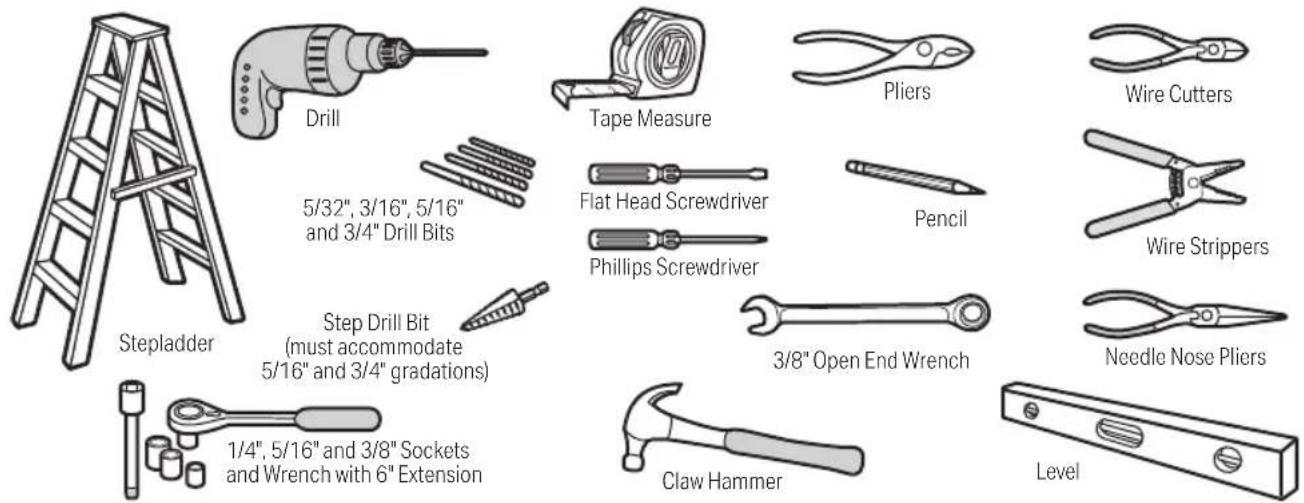
Tools You Will Need
During assembly, installation and adjustment of the garage door opener, you will need these tools.
1 Attach the Collar to the Garage Door Opener
The garage door opener can be installed on either side of the door; see "Is Your Garage Ready?" on page 4. The illustrations shown are for installation on the left side.
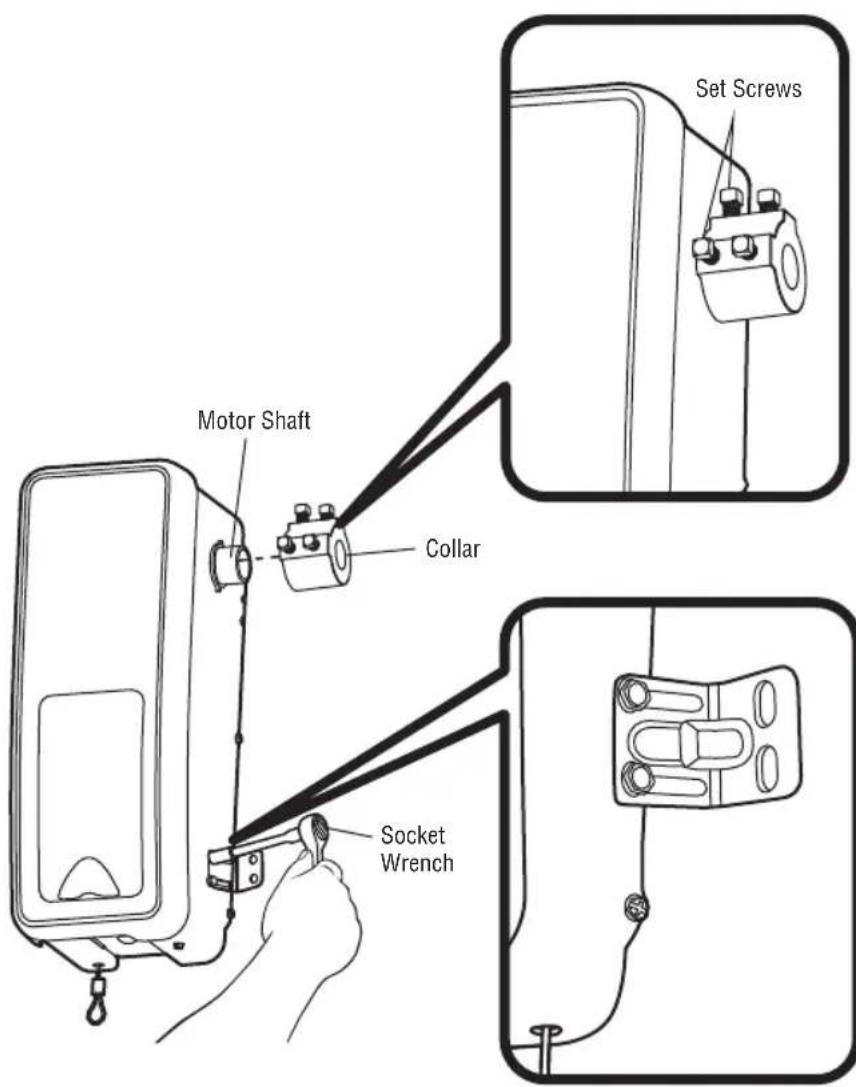
- Loosen the preset collar screws with the 3/8 open end wrench.
- Slide the collar onto the garage door opener shaft until it stops.
- Position the collar so the screws are facing out and accessible when attached to the torsion bar.
- Tighten the 2 square head set screws by hand until they contact the torsion bar. Then, use a socket wrench to finish tightening the set screws by turning them 1/4 - 1/2 turn.
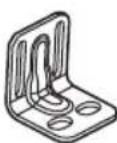
- Loosely attach slotted side of mounting bracket to the same side of the garage door opener as the collar, using screws provided. NOTE: Do not tighten mounting bracket screws until instructed.

WARNING
To prevent possible SERIOUS INJURY or DEATH, the collar MUST be properly tightened. The door may not reverse correctly or limits may be lost due to collar slip.
YOU WILL NEED
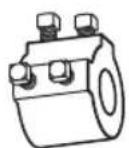
Collar
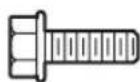
Screw
10-32 (2)
Mounting
bracket
2 Position and Mount the Garage Door Opener
- Close the garage door completely.
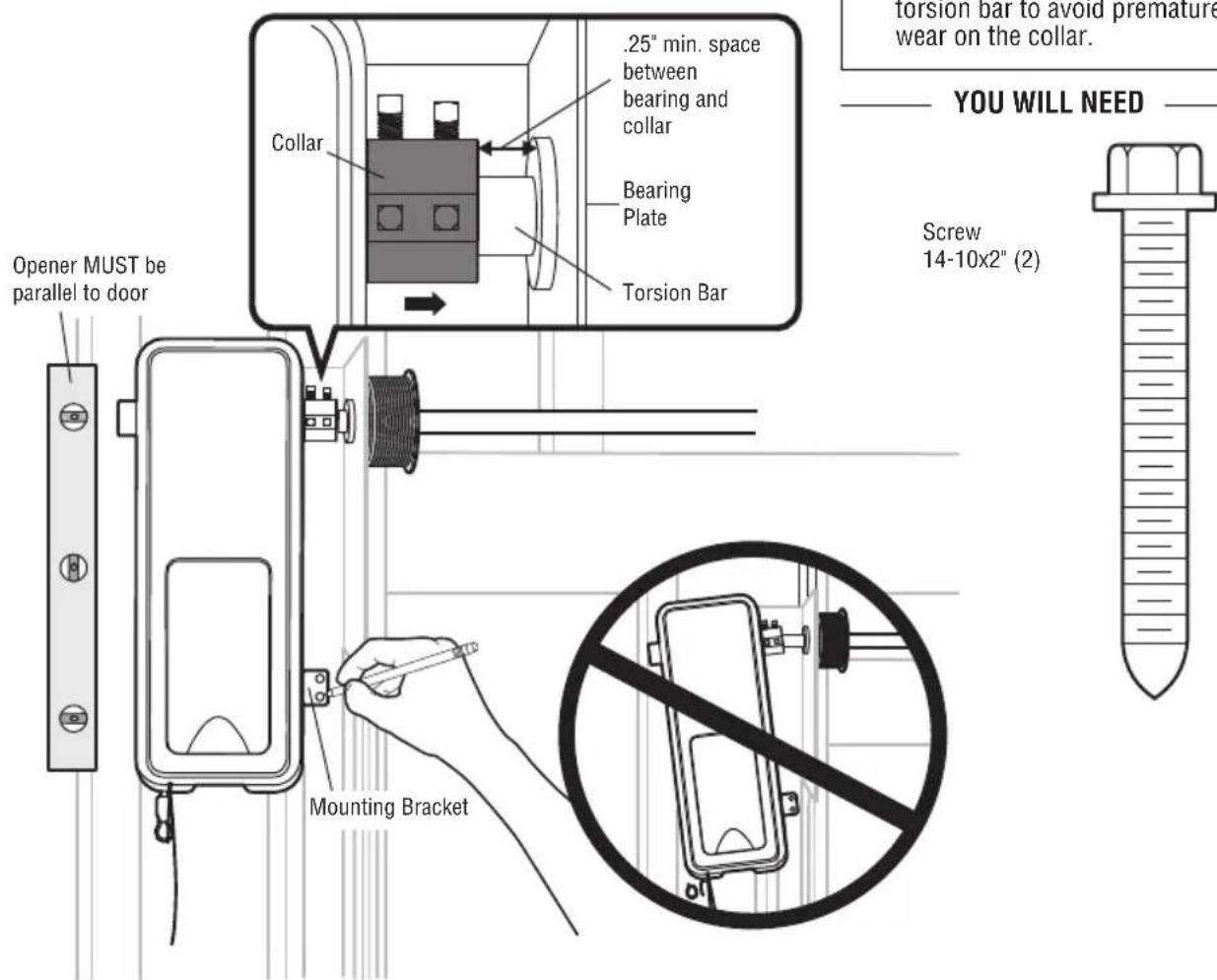
- Slide the garage door opener onto the end of the torsion bar. Ensure the collar does NOT touch the bearing plate.
- Use a level to align the garage door opener parallel to the door. Verify the mounting bracket installation wall is a solid surface, such as wood, concrete or a door/flag bracket.
IMPORTANT: If installing on drywall, the mounting bracket MUST be attached to a stud.
- When the garage door opener is properly aligned, mark the mounting bracket holes. If necessary, tighten collar screws on the torsion bar to hold garage door opener in place while marking holes.
NOTE: The garage door opener does not have to be flush to the wall.

WARNING
To prevent possible SERIOUS INJURY or DEATH:
Concrete anchors MUST be used if mounting bracket into masonry.
NEVER try to loosen, move or adjust garage door, springs, cables, pulleys, brackets or their hardware, ALL of which are under EXTREME tension.
- ALWAYS call a trained door systems technician if garage door binds, sticks or is out of balance. An unbalanced garage door might NOT reverse when required.
- Garage door opener MUST be mounted at a right angle to the torsion bar to avoid premature wear on the collar.
Installation (continued)
- Remove the garage door opener from torsion bar.
- Drill 3/16 inch pilot holes at the marked locations. Drill through metal door rail plates if necessary.
- Slide the garage door opener back onto the torsion bar until pilot holes align with bracket.
- Tighten the 2 square head set screws on the torsion bar. For a hollow torsion bar, tighten screws 3/4 - 1 full turn after making contact with the bar. For a solid shaft torsion bar, tighten screws 1/4 - no more than 1/2 turn after making contact with the shaft. If installing on a keyed torsion bar, DO NOT tighten the screws into the keyway.
- Secure the mounting bracket to the wall and to the garage door opener. Use the 14-10x2" screws to secure the mounting bracket to the wall.
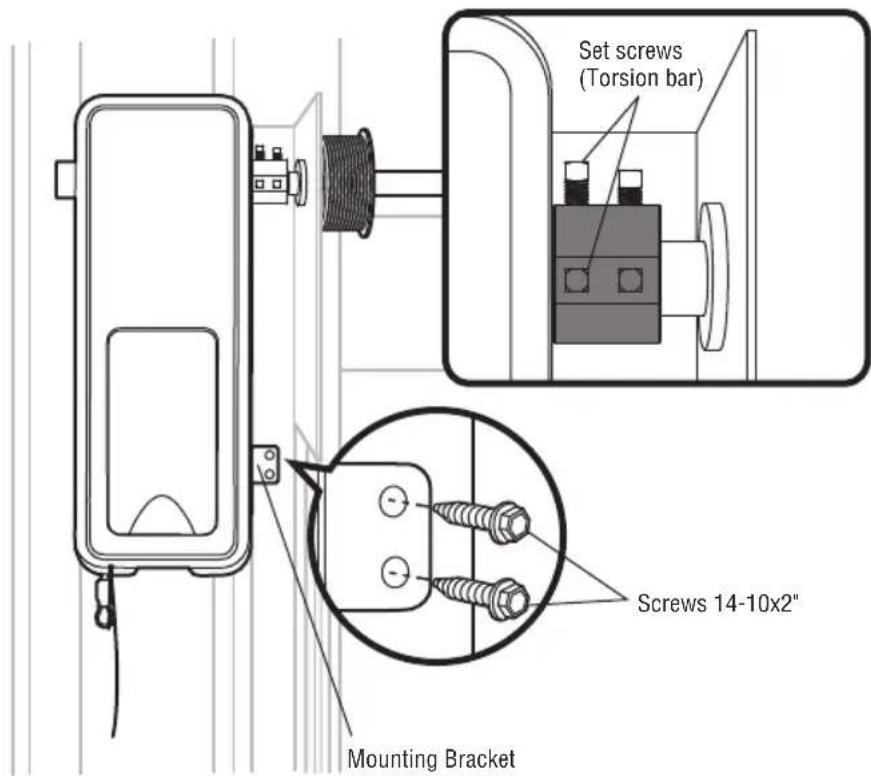
NOTE: Due to torsion bars being out-of-round, the operator may wobble during operation. This is normal.
3 Attach the Emergency Release Rope and Handle
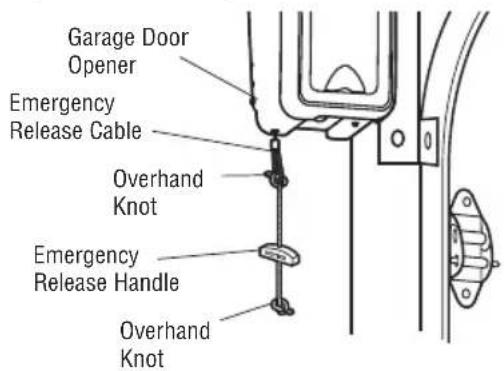
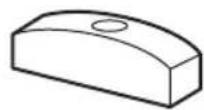
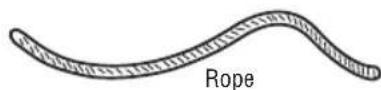
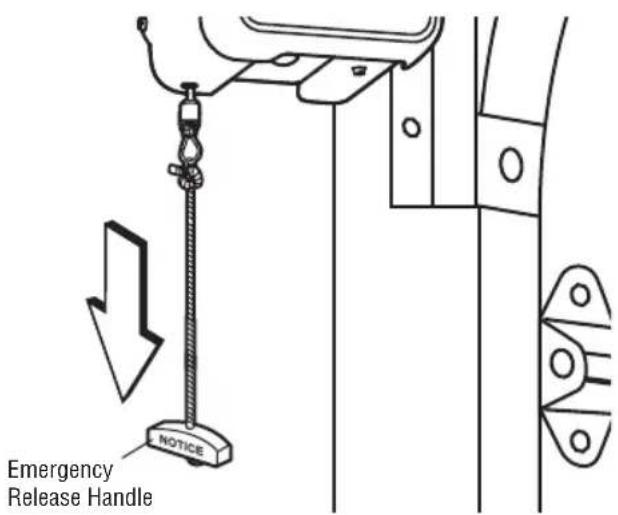
- Thread one end of the rope through the hole in the top of the red handle so "NOTICE" reads right side up. Secure with an overhand knot at least 1 inch (2.5 cm) from the end of the rope to prevent slipping.
- Thread the other end of the rope through the loop in the emergency release cable. Adjust rope length so the handle is within reach but is no lower than 6 feet (1.83m) above the floor, and avoid contact with vehicles to avoid accidental release. Secure with an overhand knot.
NOTE: If it is necessary to cut the rope, heat seal cut rope end with a match or lighter to prevent unraveling.
WARNING
To prevent possible SERIOUS INJURY or DEATH from a falling garage door:
- If possible, use emergency release handle to disengage door ONLY when garage door is CLOSED. Weak or broken springs or unbalanced door could result in an open door falling rapidly and/or unexpectedly.
- NEVER use emergency release handle unless garage doorway is clear of persons and obstructions.
YOU WILL NEED
Handle
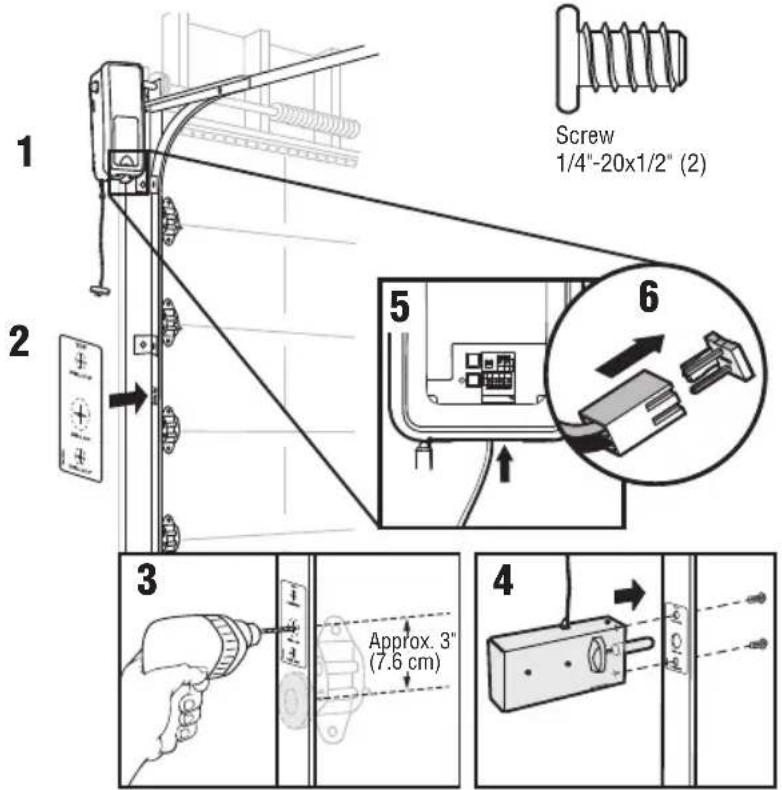
4 Power Door Lock Location
-
Determine where to install the power door lock.
-
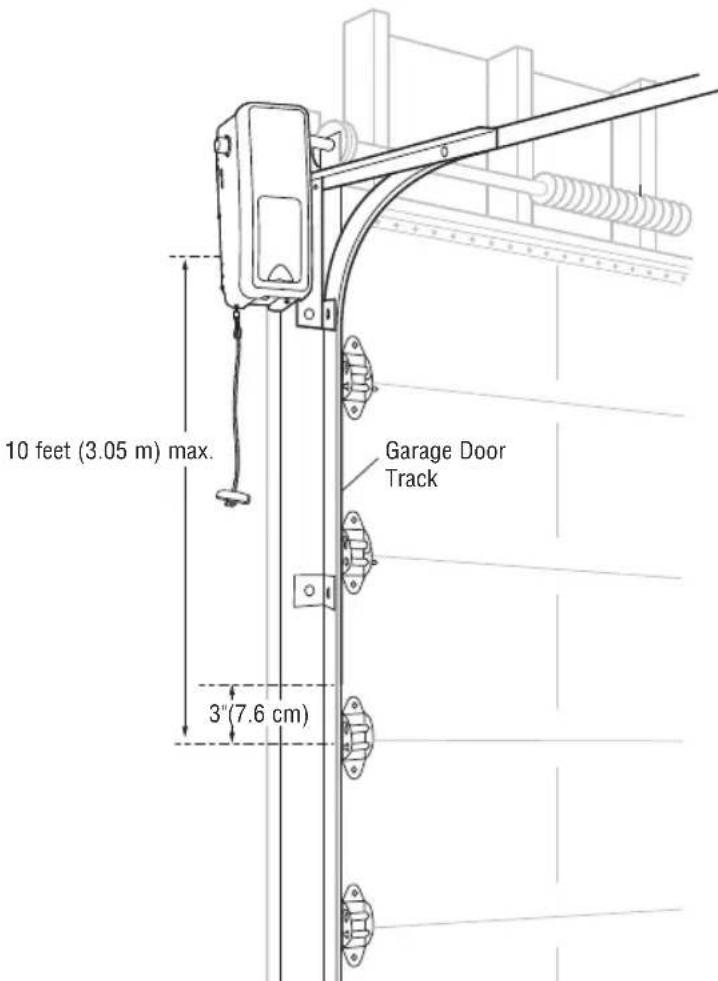
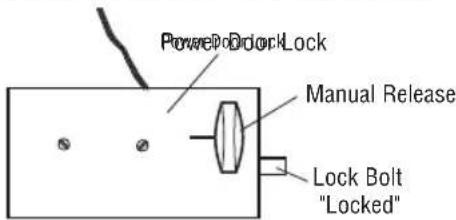
Mount the door lock on the same side as the opener. The third roller from the floor is ideal for most installations.
- The power door lock MUST be mounted within 10 feet (3.05 m) of garage door opener with approximately a 3 inch (7.6 cm) distance between the center of a door roller and the hole for the power door lock bolt.
5 Install Power Door Lock
- Pull down on the manual release to disengage the door and open the door manually.
- Clean track surface, and attach lock template to the track.
- Drill holes as marked on the template. You may find it useful to pre-drill the holes with a smaller bit before proceeding to larger sizes.
- Fasten power door lock to the outside of the garage door track with 1/4 "20x1/2" screws provided.
- Run wire up wall to garage door opener. Use insulated staples to secure wire in several places.
- Insert wire through the bottom of the garage door opener and plug the connector into the garage door opener.
YOU WILL NEED
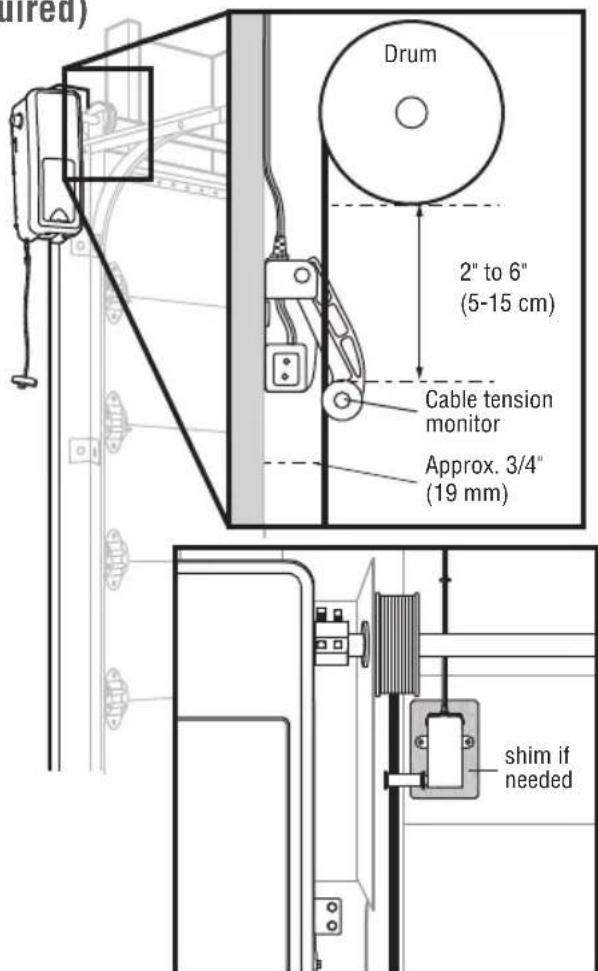
6 Position the Cable Tension Monitor (Required)
The cable tension monitor detects any slack in the garage door cables. When slack is detected, the garage door opener stops the door from closing, and reverses the door to stay open. The cable tension monitor MUST be connected and properly installed BEFORE the garage door opener will move in the down direction.
The cable tension monitor must be installed on the same side as the garage door opener. Factory default is configured for left-side installation.
- Determine if the cable tension monitor will be installed on the left or right side of the door.
- For left-side installation, skip to Step 3. For right-side installation ONLY, remove the c-clip from the roller shaft, move the roller to the other side, and reinstall the c-clip.
- Make sure the door cable is approximately 3/4'' (19 mm) from the mounting surface.
-
Position the cable tension monitor 2^ to 6^ (5-15 cm) from the drum, and over a wood support surface.
-
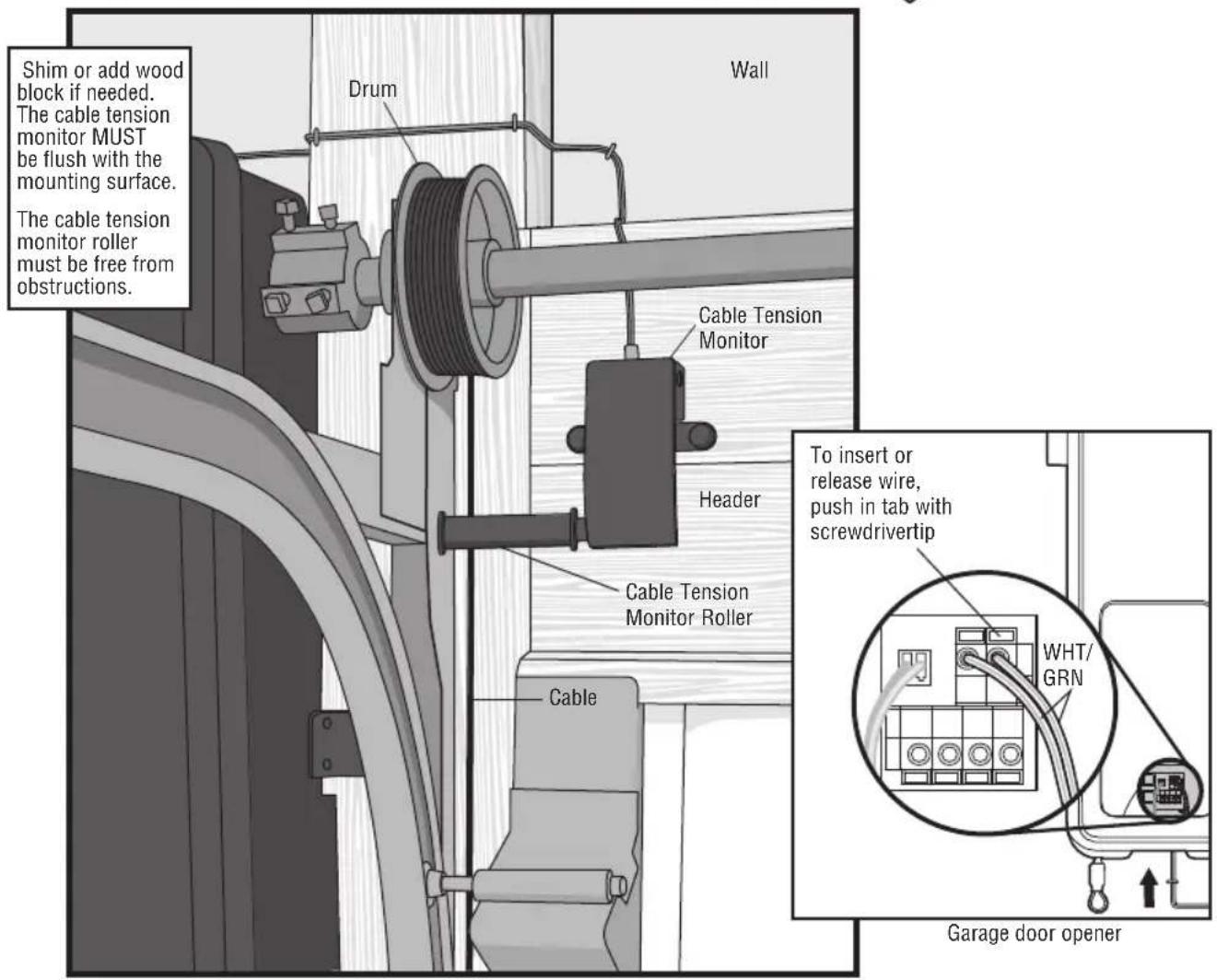
Shim or add wood block if needed. The cable tension monitor MUST be flush with the mounting surface.
- Cable tension monitor roller must be free from obstructions.
NOTE: No obstructions should exist that prevent the cable tension monitor from closing completely when slack is detected.
7 Attach the Cable Tension Monitor
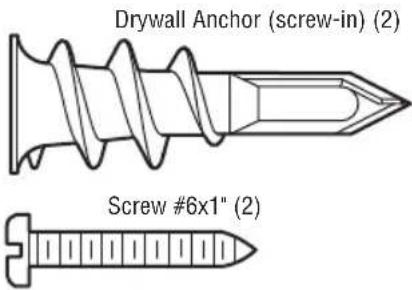
- Mark and drill 3/16 inch pilot holes for screws. If the cable tension monitor cannot be mounted into wood, it can be mounted into 1/2 inch (1 cm) or greater drywall using the drywall anchors (2) and the #8 screws (2) provided in the hardware bag.
- Attach the cable tension monitor to the wall using the hardware provided. Check that the roller is on top of the cable.
- Run wire to garage door opener. Securely affix wire to wall and ceiling. Secure any additional wire away from the moving parts of the door.
- Connect wire to the green quick-connect terminals on the garage door opener.
NOTE: Cable must have tension through entire door travel. Check there is no slack in cable on opposite side of garage door during normal operation. If slack occurs during door travel, contact a trained door systems technician.
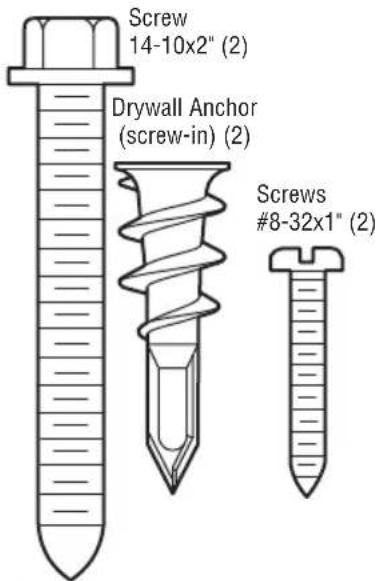
YOU WILL NEED
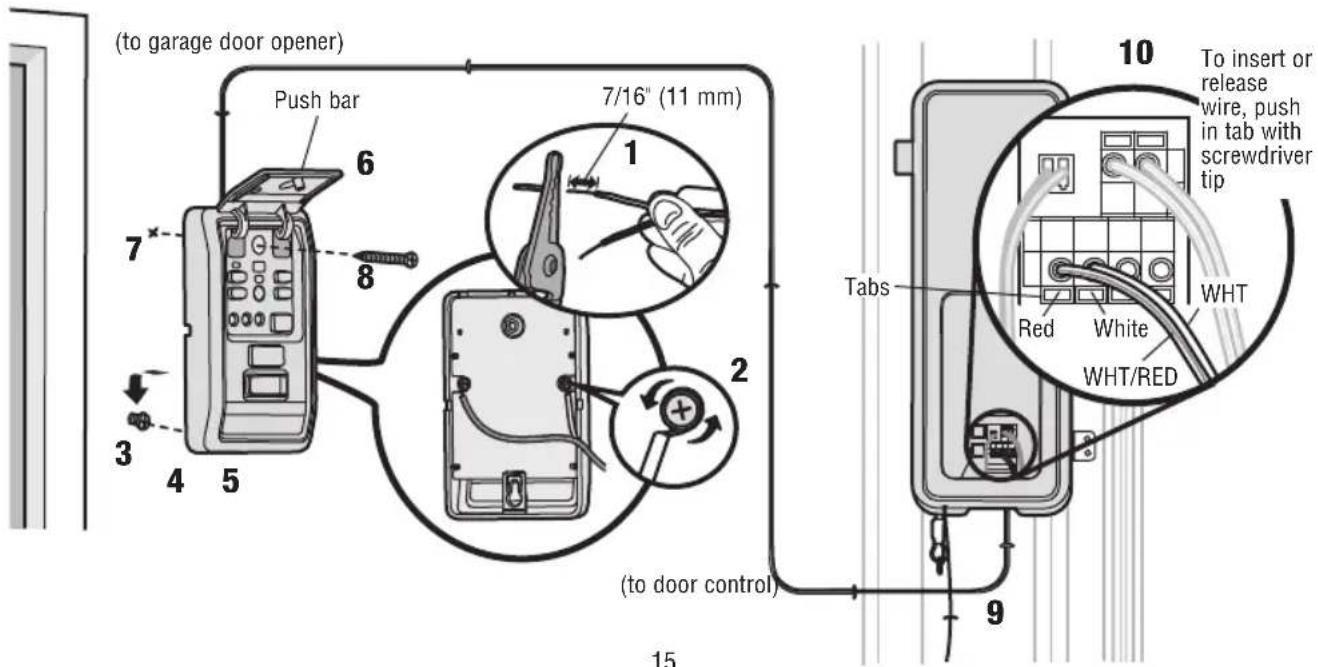
8 Install the Door Control (myQ® Control Panel)
Install door control within sight of garage door, out of reach of small children at a minimum height of 5 feet (1.5 m) above floors, landings, steps or any other adjacent walking surface, and away from ALL moving parts of door.
For gang box installations it is not necessary to drill holes or install the drywall anchors. Use the existing holes in the gang box.
NOTE: Due to power consumption this door control (Model 041A7928-3) cannot be used in conjunction with another wired door control connected to your garage door opener. If an additional door control is needed, the wireless door control model 041A7773-1 can be programmed to the door control (Model 041A7928-3).
- Strip 7/16" (11 mm) of insulation from one end of the wire and separate the wires.
- Connect wires to the door control. Make sure the polarity is correct.
Red wire to the RED terminal.
- White wire to the WHT terminal.
- Mark the location of the bottom mounting hole and drill a 5 / 32'' (4 mm) hole.
- Install the bottom screw, allowing 1/8'' (3 mm) to protrude from the wall.
- Position the bottom hole of the door control over the screw and slide down into place.
- Lift the push bar up and mark the top hole.
- Remove the door control from the wall and drill a 5/32'' (4 mm) hole for the top screw.
- Position the bottom hole of the door control over the screw and slide down into place. Attach the top screw.
- Run the white and red/white wire from the door control to the garage door opener. Attach the wire to the wall and ceiling with the staples (not applicable for gang box or pre-wired installations).
- Strip 7/16" (11 mm) of insulation from the end of the wire near the garage door opener. Connect wire to the quick-connect terminals on the garage door opener: white to white and white/red to red.
- Fasten the warning placard to the wall next to the door control.
NOTE: DO NOT connect the power and operate the garage door opener at this time. The door will travel to the full open position but will not return to the close position until the safety reversing sensors are connected and properly aligned. See page 16.
WARNING
To prevent possible SERIOUS
INJURY or DEATH from electrocution:
- Be sure power is NOT connected BEFORE installing door control.
- Connect ONLY to 7-28 VOLT low voltage wires.
To prevent possible SERIOUS INJURY or DEATH from a closing garage door:
Install door control within sight of garage door, out of reach of small children at a minimum height of 5 feet (1.5 m) above floors, landings, steps or any other adjacent walking surface, and away from ALL moving parts of door.
NEVER permit children to operate or play with door control push buttons or remote control transmitters.
- Activate door ONLY when it can be seen clearly, is properly adjusted, and there are no obstructions to door travel.
- ALWAYS keep garage door in sight until completely closed. NEVER permit anyone to cross path of closing garage door.
YOU WILL NEED
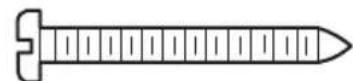
Screw 6ABx1-1/4" (Standard installation) (2)
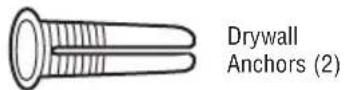

IMPORTANT INSTALLATION INSTRUCTIONS
WARNING
To reduce the risk of SEVERE INJURY or DEATH:
- This portable luminaire has a polarized plug (one blade is wider than the other) as a feature to reduce the risk of electric shock.
- This plug will fit in a polarized outlet ONLY one way.
-
If the plug does not fit fully in the outlet, reverse the plug.
-
If it still does not fit, contact a qualified electrician.
- NEVER use with an extension cord unless plug can be fully inserted.
- DO NOT alter the plug.
- Light is intended for ceiling mount and indoor applications ONLY.
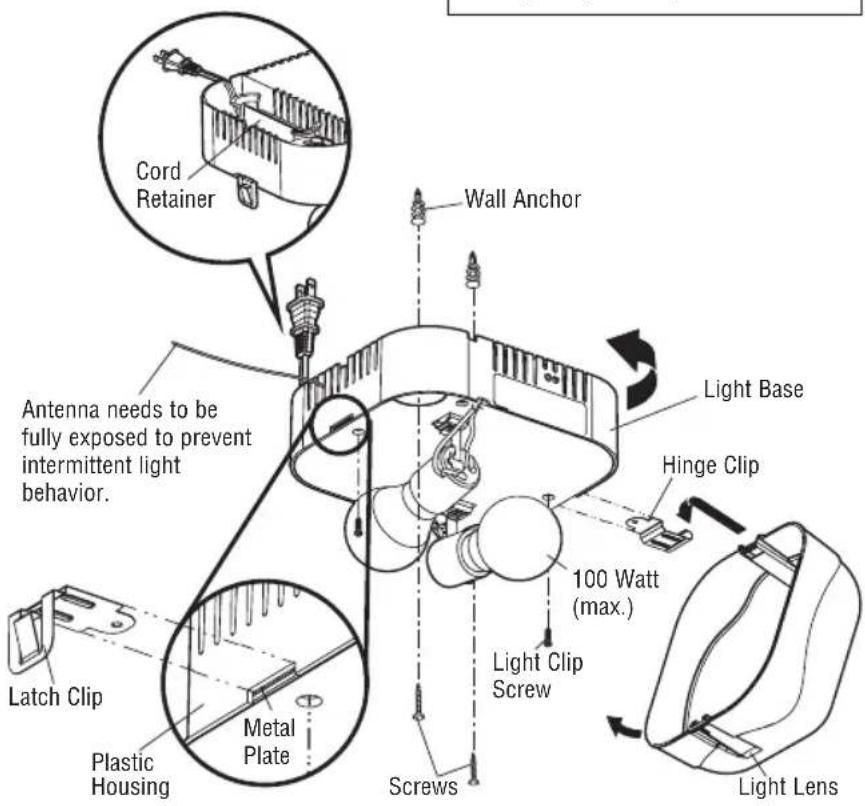
9 Install Remote Light
The remote light (garage door opener light) is designed to plug directly into a standard 120V outlet. Select an appropriate location on the ceiling to mount the light within 6 feet (1.83m) of an electrical outlet so that the cord and light are away from moving parts.
- Install the hinge and latch clips. Clips slide in between the metal plate and the plastic housing on each side of the light base.
- Install screws into the ceiling through the metal plate, leaving 1/8 inch (3 mm) of the thread exposed.
NOTE: If installing light on drywall and a ceiling joist cannot be located, use drywall anchors provided. No pilot hole is required for drywall anchors.
- Wind any excess cord around cord retainer on the top side of the light base.
- Install the light base by pushing onto the screws and turning the base clockwise to lock the light in place.
- Install two Type A19 incandescent or compact fluorescent bulbs (100 watt maximum per bulb, 200 watts total).
NOTE: Do not use LED bulbs as they may reduce the range or performance of your remote control(s).
6. Install the light lens by hooking one end of the lens over the hinge and pressing up on the other end to latch into place.
7. Plug in the light to outlet.
NOTE: Light will not operate until the garage door opener is activated. Multiple openers in the same garage may cause interference between lights. Program all lights to one opener to avoid interference.
HARDWARE
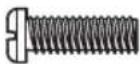
Screw #4-20x7/16" (2)
CAUTION
To prevent possible OVERHEATING of the end panel or light socket:
DO NOT use short neck or specialty light bulbs.
DO NOT use halogen bulbs. Use ONLY incandescent.
DO NOT use bulbs larger than 100W.
- ONLY use A19 size bulbs.
To provide an adequate visual alert, the garage door opener light bulb MUST be a minimum of 40 Watt (or equivalent).
10 Install the Protector System®
IMPORTANT: The safety reversing sensors MUST be connected and aligned correctly before the garage door opener will move in the down direction.
The Protector System® includes two safety reversing sensors which use a light beam to prevent the garage door from closing. The sending sensor (amber LED) transmits the beam to the receiving sensor (green LED) when both are powered and aligned. If an obstruction breaks the light beam while the door is closing, the door will stop, and reverse to the full open position.
When installing the sagety reversing senors, check:
- Sensors are installed INSIDE the garage.
- Sensor lenses are facing each other. IMPORTANT: Do not allow direct sunlight to the receiving sensor (green LED).
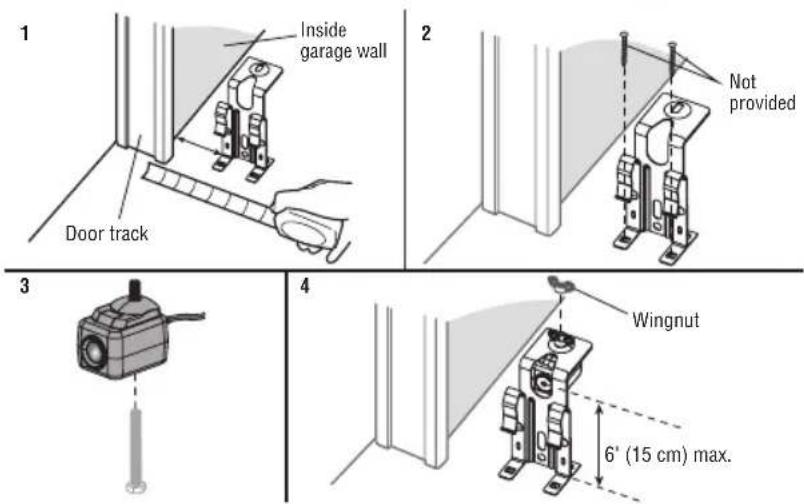
- Sensor beam is NO HIGHER than 6^ (15 cm) above the floor and the light beam is unobstructed.

WARNING
Be sure power is NOT connected to the garage door opener BEFORE installing the safety reversing sensor.
To prevent SERIOUS INJURY or DEATH from a closing garage door:
- Correctly connect and align the safety reversing sensor. This required safety device MUST NOT be disabled.
Install the safety reversing sensor so beam is NO HIGHER than 6" (15 cm) above garage floor.
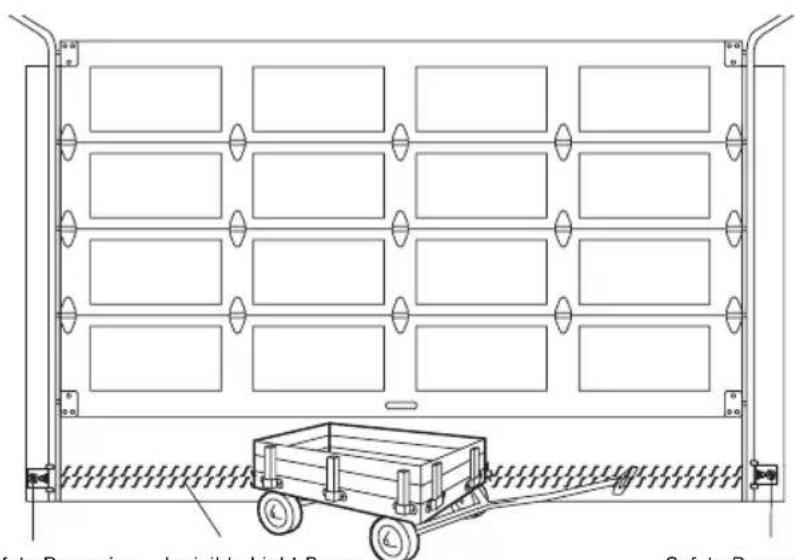
Safety Reversing Sensor 6" (15 cm) max. above floor
Invisible Light Beam Protection Area
Safety Reversing Sensor 6" (15 cm) max. above floor
Facing the door from inside the garage.
The safety reversing sensors are designed to clip onto the door track with the provided sensor brackets. If the door track will not support the sensor bracket a wall installation is recommended. The sensor beam should be NO HIGHER than 6^ (15 cm) above the floor.
HARDWARE
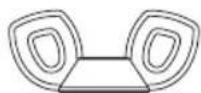
Wing Nut (2)
INSTALLING THE BRACKETS
The brackets house the safety reversing sensors in a fixed, secure position so the safety reversing sensors will face each other across the garage door, with the beam no higher than 6^ (15 cm) above the floor. Be sure power to the opener is disconnected.
Choose one of the following installations.
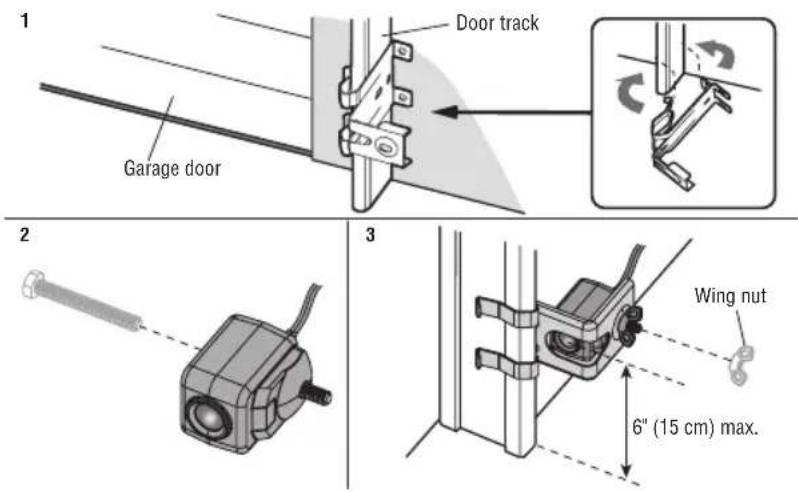
DOOR TRACK INSTALLATION
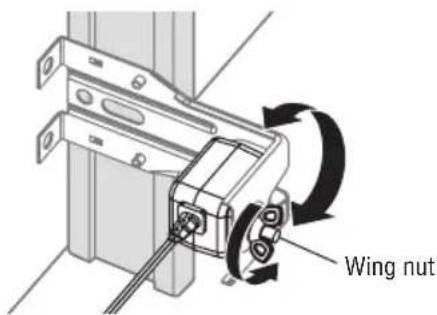
- Slide the curved arms of the sensor bracket around the edge of the door track. Snap into place so that the sensor bracket is flush against the track.
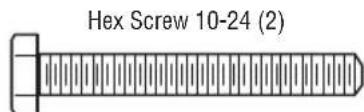
- Slide the hex screw through the sensor.
- Attach the sensor to the bracket with the wing nut. Make sure the lens is not obstructed by the bracket.
Repeat the steps with the other sensor on the opposite door track. Both lenses must face each other.
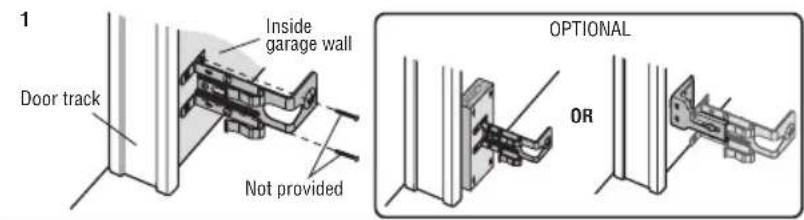
WALL OPTION
Make sure the brackets on each side are clear of the door track and have the same amount of clearance so the sensors will align correctly. If additional clearance is needed, use extension brackets 041A5281-1 (not provided) or wood blocks.
- Attach the sensor bracket against the wall with two lag screws (not provided).
- Slide the hex screw through the sensor.
- Attach the sensor to the bracket with the wing nut. Make sure the lens is not obstructed by the bracket.
Repeat the steps with the other sensor on the opposite side of the garage door. Both lenses must face each other.
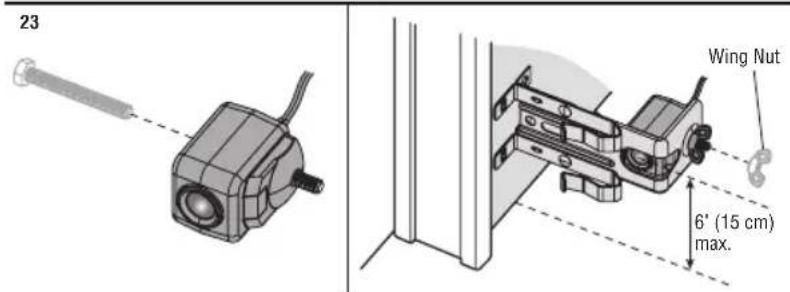
FLOOR OPTION
- Measure the position of both sensor brackets so they will be the same distance from the wall and unobstructed.
- Attach the bracket to the floor with concrete anchors (not provided).
- Slide the hex screw through the sensor.
- Attach the sensor to the bracket with the wing nut. Make sure the lens is not obstructed by the bracket.
MOUNTING THE SAFETY REVERSING SENSORS
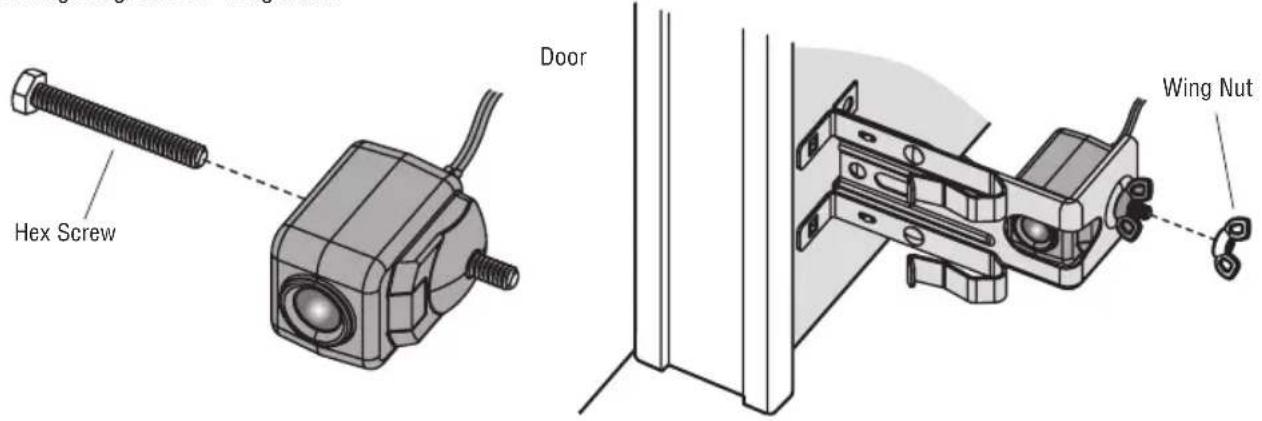
- Slide a hex screw into the slot on each sensor.
-
Use wing nuts to fasten safety reversing sensors to brackets, with lenses pointing toward each other across the door. Be sure the lens is not obstructed by a bracket extension.
-
Finger tighten the wing nuts.
WIRE THE SAFETY REVERSING SENSORS
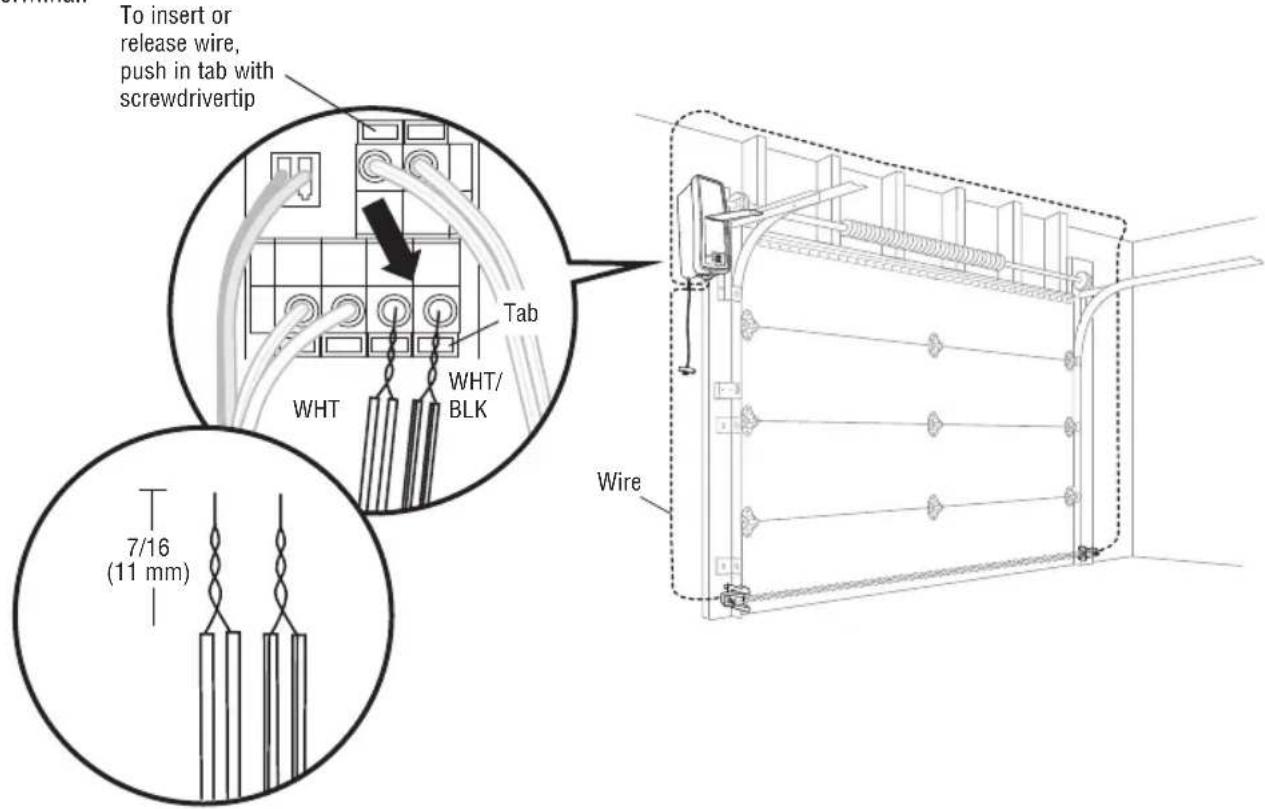
- Run the wire from both sensors to the garage door opener. Securely affix the wire to the wall and ceiling with staples (not provided).
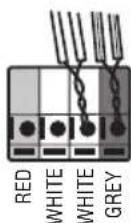
- Strip 7/16 inch (11 mm) of insulation from each set of wires. Separate white from the black the wires. Twist the white wires together. Twist the white/black wires together.
- On the garage door opener, push the tab with a screwdriver tip to insert the white wires into the white terminal and the white/black wires into the grey terminal.
11 Connect Power
To avoid installation difficulties, do not run the garage door opener at this time.
To reduce the risk of electric shock, your garage door opener has a grounding type plug with a third grounding pin. This plug will only fit into a grounding type outlet. If the plug doesn't fit into the outlet you have, contact a qualified electrician to install the proper outlet.
WARNING
To prevent possible SERIOUS INJURY or DEATH from electrocution or fire:
- Be sure power is NOT connected to the opener, and disconnect power to circuit BEFORE removing cover to establish permanent wiring connection.
- Garage door installation and wiring MUST be in compliance with ALL local electrical and building codes.
- NEVER use an extension cord, 2-wire adapter or change plug in ANY way to make it fit outlet. Be sure the opener is grounded.
There are two options for connecting power:
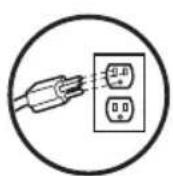
OPTION A: TYPICAL WIRING
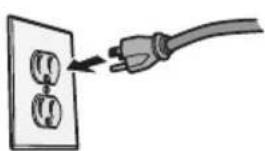
- Plug in the garage door opener into a grounded outlet.
- DO NOT run garage door opener at this time.
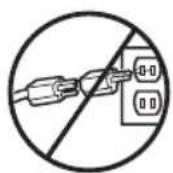
WRONGRIGHT
OPTION B: PERMANENT WIRING CONNECTION
If permanent wiring is required by your local code, refer to the following procedure.
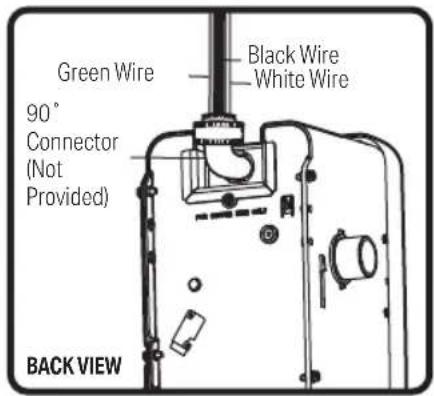
- To make a permanent connection through the 7/8 inch hole in the back of the garage door opener (according to local code):
- Be sure power is NOT connected to the opener, and disconnect power to circuit.
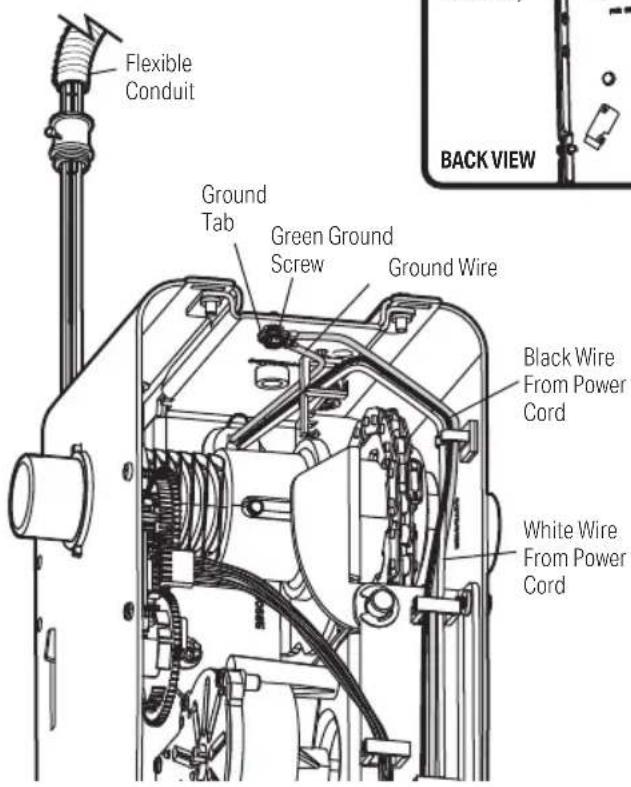
- Remove the garage door opener from the torsion bar, remove cover screws and set the cover aside.
- Cut the line cord 6'' (15.2 cm) above the strain relief.
- Squeeze the strain relief and push into garage door opener, then remove the strain relief from the line cord.
- Install a 90^ conduit (not provided) or flex cable adapter (not provided) to the 7/8" hole. Reinstall garage door opener to torsion bar.
- Run wires through conduit, cut to proper length and strip insulation.
- Strip 1 / 2'' (1.3 cm) of insulation from the existing black, white and green wires.
- Connect the line to the black wire and neutral to the white wire with wire nuts (not provided). Connect ground wire to the green ground screw.
- Properly secure wires under plastic ties so that they do not come into contact with moving parts.
- Reinstall cover.
12 Align the safety reversing sensors
IMPORTANT: The safety reversing sensors MUST be connected and aligned correctly before the garage door opener will move in the down direction.
When the garaged door opener has power, check the safety reversing sensors. If the sensors are aligned and wired correctly, both LEDs will glow steadily.
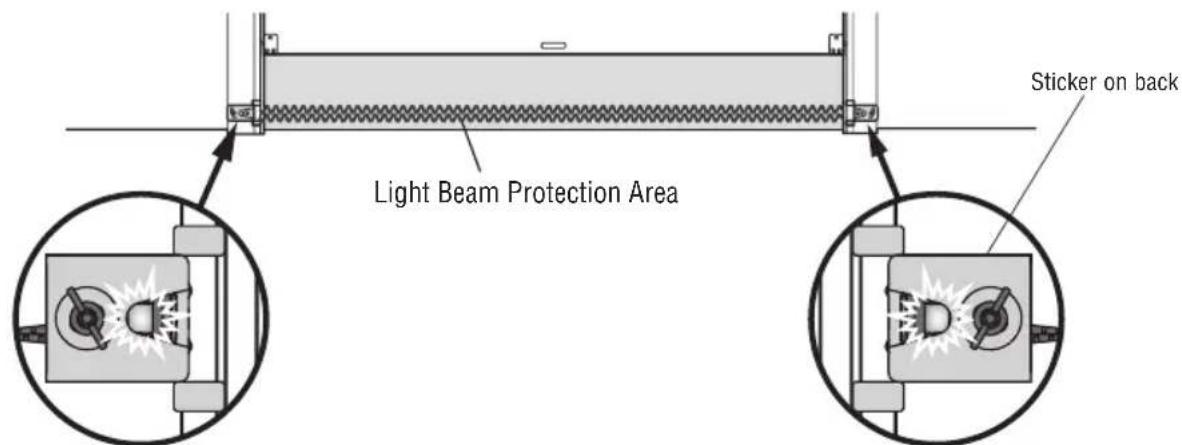
Receiving sensor - green LEDsending sensor -
TO ALIGN THE SAFTY REVERSING SENSORS:
- Loosen the wing nuts.
- Adjust the sensors up or down until both LEDs glow steady indicating alignment.
- Tighten the wing nut to secure the sensor.
SAFETY SENSOR TROUBLESHOOTING If either of the sensor LEDs are off, there is no power to the sensor:
- Check that you have power to the garage door opener.
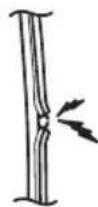
- Check the sensor wire is not shorted or broken.
- Check that the sensors is wired correctly; white wires to white terminal and white/black wires to grey terminal.
1
2
3
If the green receiving sensor LED is blinking, the sensors are obstructed or misaligned:
- Check for obstructions in the sensor light beam.
- Align the sensors.
- If the receiving sensor (green LED) faces direct sunlight, switch the receiving sensor with the sending sensor and repeat STEP 10 Install the Protector System® page 17 to assure proper operation.
1 Program the Travel Limits
Travel limits regulate the points at which the door will stop when moving up or down.
Adjust the position of the door by using the black and yellow buttons. Black moves the door UP (open) and yellow moves the door DOWN (close).
NOTE: The yellow command LED and the red learn LED will blink quickly for up to 5 minutes as the control panel recharges. When the control panel is operational, the yellow command LED will glow steadily.
SETTING THE UP POSITION:
- Starting with door down, press and hold the black button until the LED starts flashing slowly, then release.
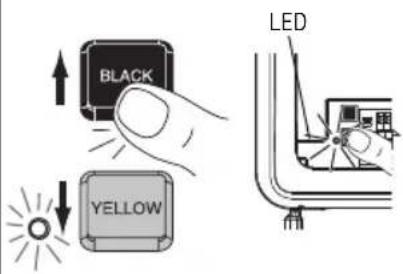
- Push and hold the black button until the door reaches the desired UP (open) position.
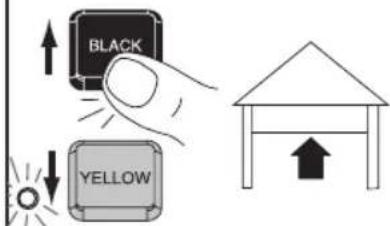
NOTE: Make sure the door opens high enough for your vehicle.
- Push the door control or programmed remote control. This sets the UP (open) limit and begins closing the door.
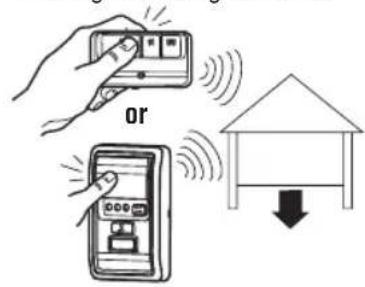
- Quickly press and release either the black or yellow button to stop the door.
WARNING
Without a properly installed safety reversal system, persons (particularly small children) could be SERIOUSLY INJURED or KILLED by a closing garage door.
NEVER learn forces or limits when door is binding or sticking. Repair door first.
Incorrect adjustment of garage door travel limits will interfere with proper operation of safety reversal system.
After ANY adjustments are made, the safety reversal system MUST be tested. Door MUST reverse on contact with 1-1/2" high (3.8 cm) object (or 2x4 laid flat) on floor.
CAUTION
To prevent damage to vehicles, be sure fully open door provides adequate clearance.
IMPORTANT: As you perform this task, watch the door for binding, sticking, or swaying. Contact a door systems technician to address these issues if they occur.
SETTING THE DOWN POSITION:
- Push and hold the yellow button until the door reaches the desired DOWN (closed) position.
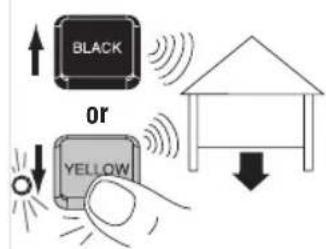
- Once the door is closed, if there appears to be too much pressure on the door, you may toggle the door back and forth using
the black and yellow buttons to reach the desired closed position.
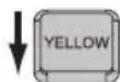
- Push the door control or programmed remote control. This sets the DOWN (close) limit and the door should open.
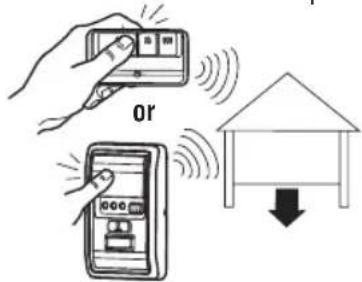
Proceed to Enter Force Adjustment Mode.
2 Enter Force Adjustment Mode
The force setting measures the amount of force required to open and close the door.
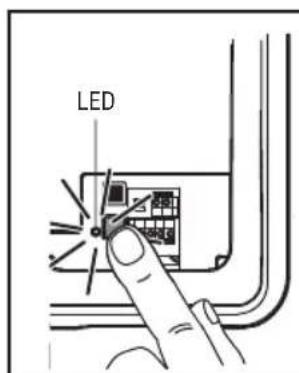
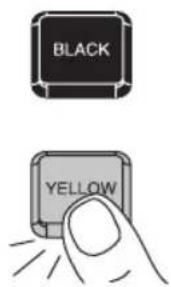
-
Push the yellow button twice to enter into the Force Adjustment Mode. The LED will flash quickly.
-
Push the door control or programmed remote control. The door will close (DOWN).
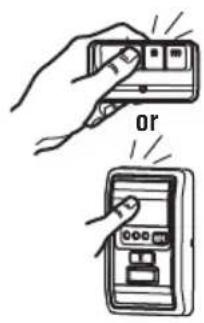
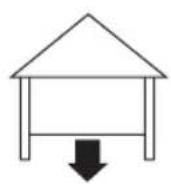
- Push the door control or programmed remote control again. The door will open (UP).
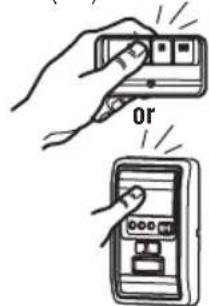
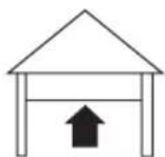
- Push the door control or programmed remote control a third time to close the door (DOWN).
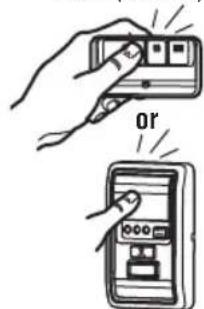
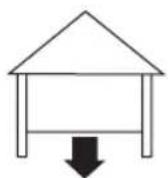
The LED will stop flashing when the force has been programmed.
The door must travel through a complete cycle, up and down, in order for the force to be set properly. If the garage door opener cannot open and close the door fully, inspect the door to ensure that it is balanced properly and is not sticking or binding.
If the door is not stopping exactly where you would like it, repeat Program the Travel Limits.

WARNING
Without a properly installed safety reversal system, persons (particularly small children) could be SERIOUSLY INJURED or KILLED by a closing garage door.
NEVER learn forces or limits when door is binding or sticking. Repair door first.
- Too much force on garage door will interfere with proper operation of safety reversal system.
After ANY adjustments are made, the safety reversal system MUST be tested. Door MUST reverse on contact with 1-1/2" high (3.8 cm) object (or 2x4 laid flat) on floor.
3 Test the Safety Reversal System
TEST
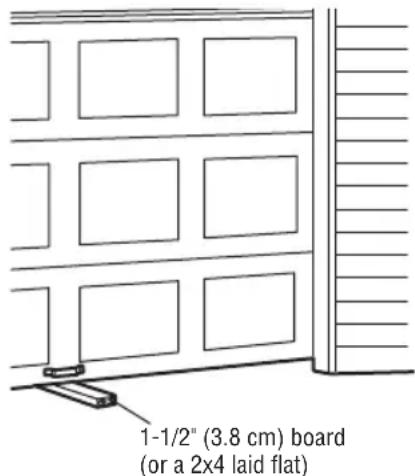
- With the door fully open, place a 1 - 1 / 2 (3.8 cm) board (or a 2x4 laid flat) on the floor, centered under the garage door.
- Press the remote control or wall-mounted door control to close the door. The door should stop and reverse when it makes contact with the board. The door returns to the previous open position.
- If the door reverses, remove the board. The test is complete.
If the door stops but does not reverse:
- Review the installation instructions provided to ensure all steps were followed.
- If the door stops on the obstruction, it is not traveling far enough in the down direction. Complete Adjustment Steps 1 and 2 Program the Travel Limits and Set the Force.
- Repeat the Safety Reversal Test.
- When the door reverses on the 1-1/2 inch (3.8 cm) board (or 2x4 laid flat), remove the obstruction and run the garage door opener through 3 or 4 complete travel cycles to test adjustment.
If the test continues to fail, call a trained door systems technicians.
IMPORTANT SAFETY CHECK:
Test the safety reversal system after:
Each adjustment of limits, or force controls.
- Any repair to or adjustment of the garage door (including springs and hardware).
- Any repair to or buckling of the garage floor.
- Any repair to or adjustment of the opener.
4 Test the Protector System®
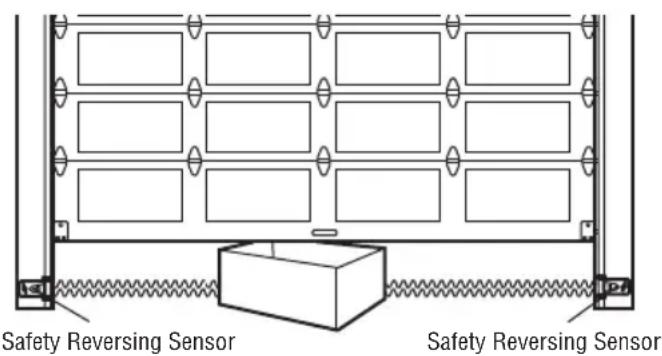
- Press the remote control push button to open the door.
- Place the opener carton in the path of the door.
- Press the remote control push button to close the door. The door will not move more than an inch (2.5 cm).
The garage door opener will not close from a remote if the indicator light in either sensor is off (alerting you to the fact that the sensor is misaligned or obstructed).
If the garage door opener closes the door when the safety reversing sensor is obstructed, do not operate the door. Call for a trained door systems technician.

WARNING
Without a properly installed safety reversal system, persons (particularly small children) could be SERIOUSLY INJURED or KILLED by a closing garage door.
- Safety reversal system MUST be tested every month.
If one control (force or travel limits) is adjusted, the other control may also need adjustment.
After ANY adjustments are made, the safety reversal system MUST be tested. Door MUST reverse on contact with 1 - 1 / 2 (3.8 cm) high object (or 2x4 laid flat) on the floor.

WARNING
Without a properly installed safety reversing sensor, persons (particularly small children) could be SERIOUSLY INJURED or KILLED by a closing garage door.
5 Test the Power Door Lock
- With the door fully closed, check to ensure that the power lock bolt is visible protruding through the track.
- Press the button on the remote control to open the garage door. The power door lock should retract before the door begins to move.
- Press the button on the remote control to close the garage door. When the door reaches the fully closed position, the power door lock should automatically activate to secure the door.
NOTE: The power door lock can be manually released by sliding the manual release handle to the open position. However, if the power door lock does not function, contact Chamberlain for a replacement.
WARNING
To prevent possible SERIOUS INJURY or DEATH from a falling garage door:
- If possible, use emergency release handle to disengage door ONLY when garage door is CLOSED. Weak or broken springs or unbalanced door could result in an open door falling rapidly and/or unexpectedly.
- NEVER use emergency release handle unless garage doorway is clear of persons and obstructions.
6 Test the Emergency Release
OPEN THE DOOR MANUALLY:
- Close the garage door. Slide the manual release handle on power door lock to open before proceeding.
- Pull down on the emergency release handle until you hear a click.
- Lift the door manually.
RECONNECT THE DOOR TO THE GARAGE DOOR OPENER:
- Pull down on the emergency release handle until you hear a click. The door will reconnect on the next UP or DOWN operation.
7 Test the Cable Tension Monitor
- Close the garage door.
- Pull down on the emergency release handle until you hear a click.
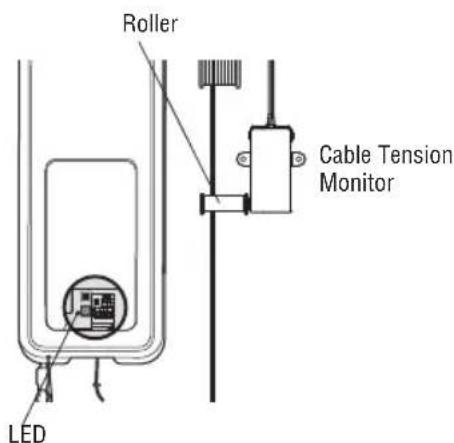
- Press on the front of the cable tension monitor, you should hear a click.
- Reconnect the garage to the garage door opener.
If there is no click, the roller may be hitting the jamb and not allowing the switch to detect slack in the cable. Make sure the cable tension monitor is mounted flush with the wall and the roller is free from any obstructions.
When the cable tension monitor has been activated, the LED on the garage door opener will blink 9 times.
IMPORTANT SAFETY INSTRUCTIONS
WARNING
To reduce the risk of SEVERE INJURY or DEATH:
- READ AND FOLLOW ALL WARNING AND INSTRUCTIONS.
- ALWAYS keep remote controls out of reach of children. NEVER permit children to operate or play with door control push buttons or remote controls.
- ONLY activate door when it can be seen clearly, it is properly adjusted and there are no obstructions to door travel.
- ALWAYS keep garage door in sight and away from people and objects until completely closed. NO ONE SHOULD CROSS THE PATH OF THE MOVING DOOR.
- NO ONE SHOULD GO UNDER A STOPPED, PARTIALLY OPENED DOOR.
- If possible, use emergency release handle to disengage door ONLY when door is CLOSED. Use caution when using this release with the door open. Weak or broken springs or unbalanced door could result in an open door falling rapidly and/or unexpectedly and increasing the risk of SEVERE INJURY or DEATH.
- NEVER use emergency release handle unless doorway is clear of persons and obstructions.
-
After ANY adjustments are made, the safety reversal system MUST be tested. Failure to adjust the garage door opener properly may cause SEVERE INJURY or DEATH.
-
Safety reversal system MUST be tested every month. Door MUST reverse on contact with 1 - 1 / 2^ (3.8 cm) high object (or a 2x4 laid flat) on the floor. Failure to adjust the garage door opener properly may cause SEVERE INJURY or DEATH.
- ALWAYS KEEP DOOR PROPERLY BALANCED (see page 4). An improperly balanced door may NOT reverse when required and could result in SEVERE INJURY or DEATH.
- ALL repairs to cables, spring assemblies and other hardware, ALL of which are under EXTREME tension, MUST be made by a trained door systems technician.
- To avoid SERIOUS PERSONAL INJURY or DEATH from electrocution, disconnect ALL electric and battery power BEFORE performing ANY service or maintenance.
-
This operator system is equipped with an unattended operation feature. The door could move unexpectedly. NO ONE SHOULD CROSS THE PATH OF THE MOVING DOOR.
-
SAVE THESE INSTRUCTIONS.
Using Your Garage Door Opener
Your garage door opener has already been programmed at the factory to operate with your remote control, which changes with each use, randomly accessing over 100 billion new codes. When programmed to the Chamberlain® Internet Gateway you can monitor and control your garage door from your smartphone.
You may program the myQ control panel with up to:
12 remote controls
- 2 keypads
a combination of 16 myQ® accessories
See Accessories page 38.
The garage door opener can be activated through a wall-mounted door control, remote control, wireless keypad or myQ® accessory. When the door is closed and the garage door opener is activated the door will open. If the door makes contact with an obstruction or is interrupted while opening, the door will stop.
When the door is in any position other than closed and the garage door opener is activated, the door will close.
However, you can close the door if you hold the button on the door control or wireless keypad until the door is fully closed. The safety reversing sensors do not affect the opening cycle. The safety reversing sensor must be connected and aligned correctly before the garage door opener will move in the down direction.
The garage door opener lights will turn on when the garage door opener is activated. They will turn off automatically after 4-1/2 minutes or provide constant light when the Light feature on the myQ® Control Panel is activated. Bulb size is A19. Bulb power is 100 watts maximum.
TIMER-TO-CLOSE (TTC)
The TTC feature automatically closes the door after a specified time period that can be adjusted using a TTC enabled door control. Prior to and during the door closing, the garage door opener lights will flash and the garage door opener will beep.
Using the Door Control (myQ® Control Panel)
NOTE: Due to power consumption, this door control (Model 041A7928-3) cannot be used in conjunction with another wired door control connected to your garage door opener. If an additional door control is needed, the wireless door control model 041A7773-1 can be programmed to the door control (Model 041A7928-3). To program the 041A7773-1 to the myQ® Control Panel, follow the remote control programming steps.
FEATURE HOW TO
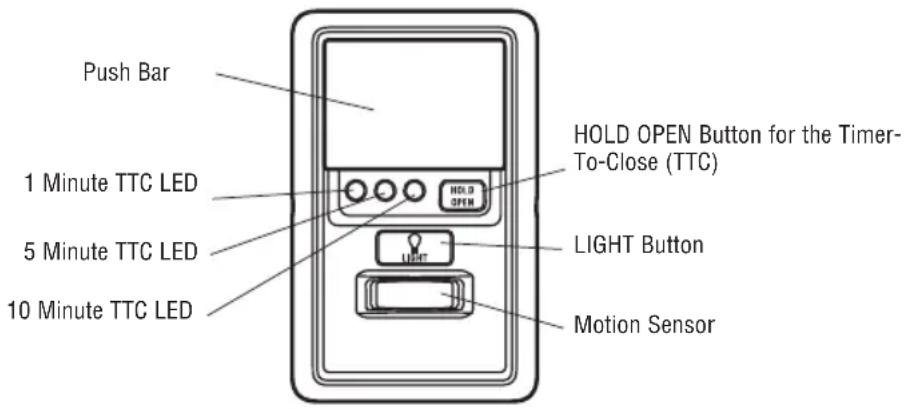
| PUSH BAR | Press the push bar to open/close the door. |
| LOCKDesigned to prevent operation of the door from hand-held remote controls. However, the door will open and close from the Door Control, keypad, and myQ® App. | Activate: Press and hold the LOCK button for 2 seconds. The command LED will flash as long as the lock feature is activated and your handheld remote control will not operate your door at this time.Deactivate: Press and hold the LOCK button again for 2 seconds. The command LED will stop flashing and normal operation will resume. |
| MOTION SENSORThis feature will automatically turn on the garage door opener lights when motion is sensed. The lights will come on for 4-1/2 minutes, then shut off. | Activate/Deactivate:Slide the motion sensor switch ON or OFF. |
| TIMER-TO-CLOSE (TTC)The TTC feature automatically closes the door after a specified time period (1, 5, or 10 minutes). Once the TTC has been set and the door is open, the LED for the selected close interval will blink and begin to count down to close the door. The control panel will beep and the garage door opener lights will flash before closing the door.The TTC feature will deactivate if the garage door encounters an obstruction twice; or the safety reversing sensors are incorrectly installed. The garage door will reverse open and WILL NOT close until the obstructions are clear or the safety reversing sensors are correctly installed. When the obstruction has been cleared or the safety reversing sensors have been aligned, the door will close when the garage door opener is activated | Activate: Press and hold the ON button until one of the TTC LEDs light up. Then press the ON button again to cycle through the time interval options (the corresponding TTC LED will light for each time interval). The garage door opener light bulbs will blink as confirmation.Deactivate: Press and hold the OFF button until all TTC LEDs turn off and a beep is heard from the control panel.To suspend the TTC: To suspend the TTC and temporarily hold the door open, press and release the HOLD OPEN button (the HOLD OPEN LED will turn solid). The TTC will remain suspended until the HOLD OPEN button is pressed again or the garage door opener is activated from another device (door control, remote control, keypad, etc.). |
Using the Door Control (continued)
FEATURE HOW TO
LIGHTS:
Press the LIGHT button to turn the garage door opener lights on or off. When the lights are turned on they will stay on until the LIGHT button is pressed again, or until the garage door opener is activated. Once the garage door opener is activated the lights will turn off after the specified period of time (the factory setting is 4-1/2 minutes). The LIGHT button will not control the lights when the door is in motion.
TO CHANGE THE AMOUNT OF TIME THE REMOTE LIGHTS WILL STAY ON:
Press and hold the LOCK button until the garage door opener lights flash. The time interval is indicated by the number of flashes.
| NUMBER OF TIMES GARAGE DOOR OPENER LIGHTS FLASH | TIME THE GARAGE DOOR OPENER LIGHT STAYS ON |
| 1 1 ½ Minutes | |
| 2 2 ½ Minutes | |
| 3 3 ½ Minutes | |
| 4 4 ½ Minutes |
Using the Remote Control
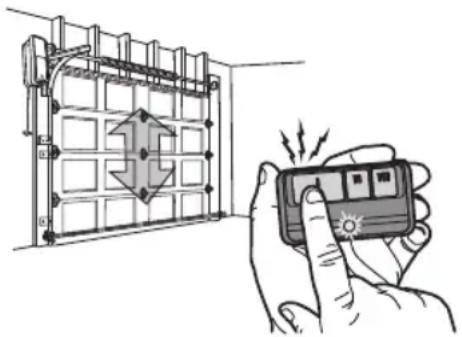
Press and hold the button down until the door or gate starts to move. The remote control will operate from up to 3 car lengths away on typical installations. Installations and conditions vary, contact an installing dealer for more information.
NOTICE: This device complies with part 15 of the FCC rules and Innovation, Science and Economic Development Canada license-exempt RSSs. Operation is subject to the following two conditions: (1) this device may not cause harmful interference, and (2) this device must accept any interference received, including interference that may cause undesired operation.
Any changes or modifications not expressly approved by the party responsible for compliance could void the user's authority to operate the equipment.
This device must be installed to ensure a minimum 20~cm (8 in.) distance is maintained between users/bystanders and device. This device has been tested and found to comply with the limits for a Class B digital device, pursuant to part 15 of the FCC rules and Industry Canada ICES standard. These limits are designed to provide reasonable protection against harmful interference in a residential installation. This equipment generates, uses and can radiate radio frequency energy and, if not installed and used in accordance with the instructions, may cause harmful interference to radio communications. However, there is no guarantee that interference will not occur in a particular installation. If this equipment does cause harmful interference to radio or television reception, which can be determined by turning the equipment off and on, the user is encouraged to try to correct the interference by one or more of the following measures:
- Reorient or relocate the receiving antenna.
- Increase the separation between the equipment and receiver.
- Connect the equipment into an outlet on a circuit different from that to which the receiver is connected.
- Consult the dealer or an experienced radio/TV technician for help.
Programming
Your hand-held remote control (model 953ESTD) has already programmed to the door control (myQ® Control Panel) at the factory. Below are instructions for programming additional remote controls and keypads.
NOTE: Use the learn button on the door control to program all accessories. The yellow learn button on the garage door opener will NOT program accessories.
To Add a Remote Control or Keypad
REMOTE CONTROL
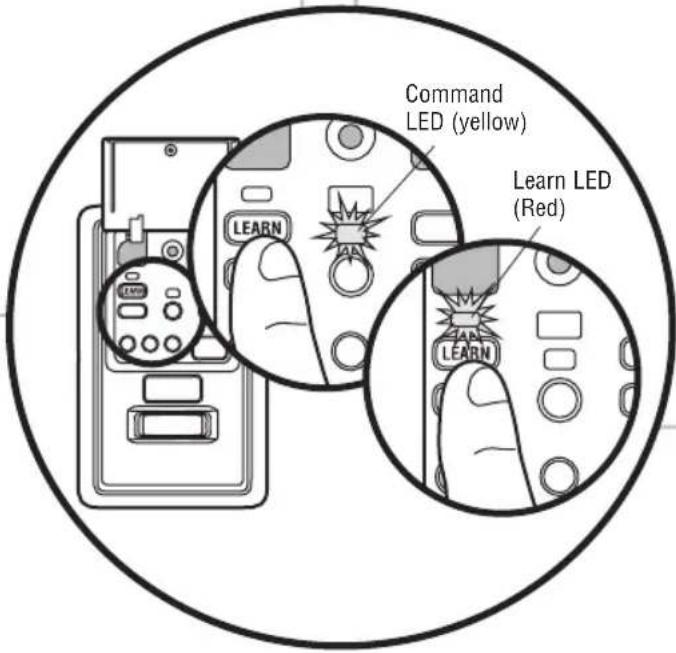
- Press the myQ Control Panel LEARN button twice, the red learn LED will turn on.
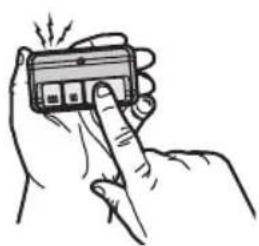
- Press the button on the remote control that you wish to operate your garage door.
- The garage door opener lights will flash (or two clicks will be heard) when the code has been programmed.
KEYPAD
- Press the myQ Control Panel LEARN button twice, the red learn LED will turn on.
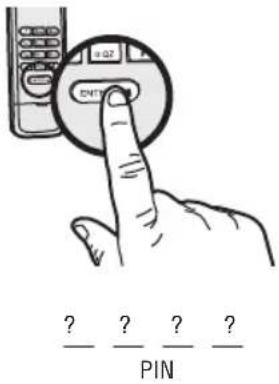
- Enter a 4-digit personal identification number (PIN) of your choice on the keypad. Then press the ENTER button.
- The garage door opener lights will flash (or two clicks will be heard) when the code has been programmed.
Reprogramming Remote Light or Additional Light
Your garage door opener remote light has already been programmed at the factory to operate with your opener. Any additional or replacement remote lights will need to be programmed.
- Press the LEARN button on the light until the LED comes ON.
- Activate the garage door opener using the hand-held remote, door control, or keypad.
- The code has been programmed when the remote light comes on.
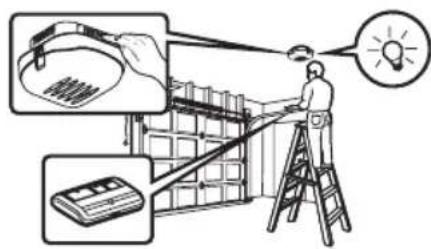
HomeLink
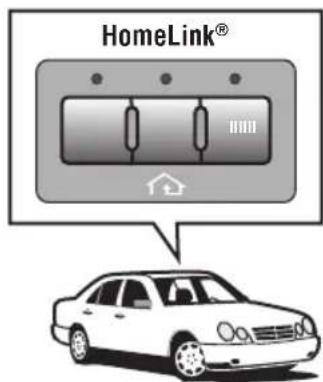
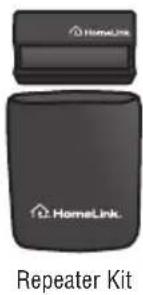
In the rare case the HomeLink system does not program with the Security+ 2.0 Garage door opener, install a repeater kit. Refer to HomeLink instructions below.
HomeLink is the in-vehicle system. The image used is for reference only and your product may look different.
WHEN TO INSTALL A HOMELINK REPEATER KIT
All 2006 and older vehicles - A repeater kit is required and must be purchased by the homeowner.
All 2007 and newer vehicles - Program the HomeLink according to the vehicle instructions. If after ONE attempt to program the HomeLink to the garage door opener and you are unsuccessful, install a repeater.
HOW TO ORDER
Order the HomeLink repeater kit from an installer or call 1-800-355-3515. To program the HomeLink repeater kit, refer to the instructions provided in the kit or visit: http://www.homelink.com/program.
INSTALLATION QUICK FACTS
- Only one repeater kit is required per home.
- Use different HomeLink buttons in vehicle if programming multiple cars, button 1 first car, button 2 second car... etc.
HomeLink remote is NOT a garage door opener. - If you are using the HomeLink repeater with a garage door opener that has a battery backup system, ensure your original garage door opener remote control is programmed to the garage door opener and place it in your glove box for use in the event of a power outage.
- The remote included in this repeater kit MUST be kept for future programming - new vehicle, new garage door opener, etc.
Internet Gateway
The Internet Gateway gives you control of your garage door from your internet-connected computer or mobile device, letting you use the myQ® app to open and close your door, get alerts, and set schedules from anywhere. You must have your Internet Gateway set up in the myQ® app to use it with the control panel.
Before you begin, you will need:
Wi-Fi enabled smartphone or tablet
- Broadband internet connection and router
my serial number located on the Internet gateway
Connect the Internet Gateway to your router and power. When the green LED on the gateway has stopped blinking and glows steadily, it is connected to the internet.
Setup and Connect Your Gateway and Opener in the myQ® App
- Download the myQ App and set up your account.
- Follow the instructions given in the app to find and connect your Internet Gateway.
- Next, select the device you wish to add (Garage Door Opener).
- Once you select the opener in the app, you have 3 minutes to press the LEARN button two times on the myQ control panel. The red LEARN LED will turn on. (Figure 2)
- When the red LEARN LED turns off, programming is complete. Once the opener is learned and appears in the app device list, name your device (e.g., Garage Door Opener).
NOTE: If you are unable to add the myQ Control Panel to your Chamberlain Internet Gateway, erase all codes from the door control and try again. Note that you will need to reprogram any accessories you wish to use.
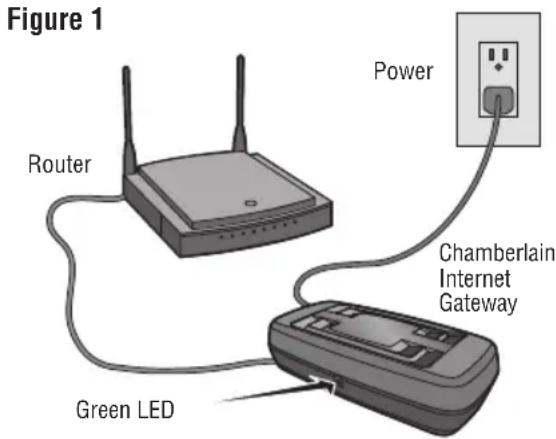
When the Chamberlain Internet Gateway connects to the internet, the green LED will stop blinking and will glow steadily.
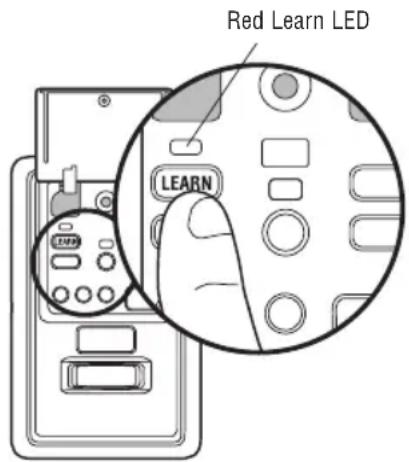
Figure 2
myQ Control Panel
To Erase All Codes From the Door Control (myQ® Control Panel) Memory
Erase all remote controls and keyless entries:
- Press and hold the LEARN button on the control panel until the red learn LED goes out (approximately 6 seconds). All remote control and keypad codes are now erased. Reprogram any compatible accessory you wish to use.
Erase all devices (including myQ® enabled accessories):
- Press and hold the LEARN button on the control panel until the red Learn LED goes out (approximately 6 seconds).
- Immediately press and hold the LEARN button again until the red Learn LED goes out. All codes are now erased. Reprogram any compatible accessory you wish to use.
Care of Your Garage Door Opener
MAINTENANCE SCHEDULE
Once a Month
- Manually operate door. If it is unbalanced or binding, call a trained door systems technician.
- Check to be sure door opens and closes fully. Adjust limits and/or force if necessary (see Adjustment Steps 1 and 2).
- Repeat the safety reverse test. Make any necessary adjustments (see Adjustment Step 3).
Once a Year
- Oil door rollers, bearings and hinges. The garage door opener does not require additional lubrication. Do not grease the door tracks.
THE REMOTE CONTROL BATTERY
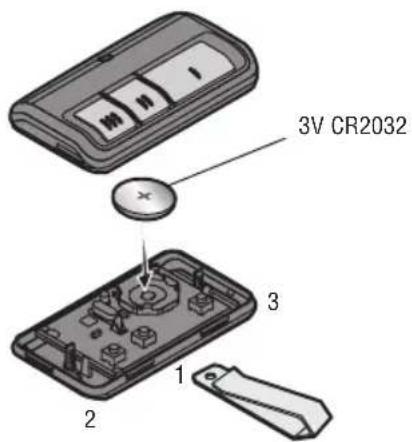
The 3V CR2032 Lithium battery should produce power for up to 3 years. If the battery is low, the remote control's LED will not flash when the button is pressed.
To replace battery, pry open the case first in the middle (1), then at each side (2 and 3) with the visor clip. Replace the batteries with only 3V CR2032 coin cell batteries. Insert battery positive side up. Dispose of old batteries properly.

WARNING
To prevent possible SERIOUS INJURY or DEATH:
NEVER allow small children near batteries.
If battery is swallowed, immediately notify doctor.
To reduce risk of fire, explosion or chemical burn:
- Replace ONLY with 3V CR2032 coin batteries.
DO NOT recharge, disassemble, heat above 212^ F (100^) or incinerate.
Diagnostic Chart
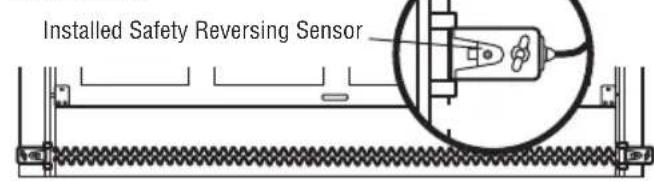
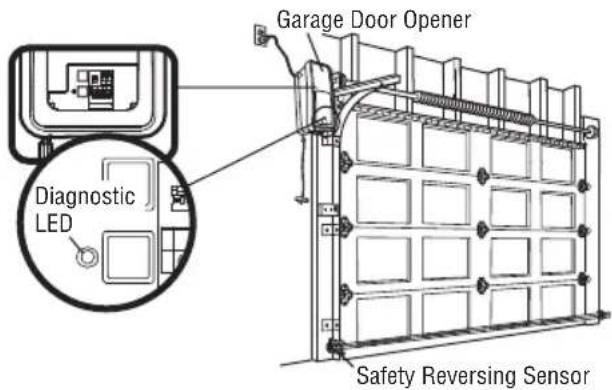
Your garage door opener is programmed with self-diagnostic capabilities. The diagnostic LED will flash a number of times, then pause, signifying it has found a potential issue. Consult Diagnostic Chart below.
1 FLASH
Safety reversing sensors wire open (broken or disconnected)
OR
2 FLASHES
Safety reversing sensors wire shorted or black/white wire reversed
3 FLASHES
Door control or wire shorted
4 FLASHES
Safety reversing sensors slightly misaligned (dim or flashing LED)
5 FLASHES
Motor RPM is not recognized
9 FLASHES
Cable tension monitor reversal
10 FLASHES
Limits and forces need reprogramming
11 FLASHES
Limits and forces need reprogramming
12 FLASHES
Attempting to compensate
13 FLASHES
Attempting to compensate
SYMPTOM: One or both of the Indicator lights on the safety sensors do not glow steady.
- Safety reversing sensors are not installed, connected, or wires may be cut. Inspect sensor wires for a disconnected or cut wire.
- There is a short or reversed wire for the safety reversing sensors. Inspect safety sensor wire to all staple and connection points, replace wire or correct as needed.
SYMPTOM: The door doesn't activate from the door control.
- Inspect door control/wires for a short (staple in wire), replace as needed.
- Disconnect wires at door control, touch wires together. If garage door opener activates, replace door control.
- If garage door opener does not activate, disconnect door control wires from garage door opener. Momentarily short across red and white terminals with jumper wire. If garage door opener activates, replace door control wires.
SYMPTOM: Sending indicator light glows steadily, receiving indicator light is dim or flashing.
Realign receiving sensor, clean lens and secure brackets.
- Verify door track is firmly secured to wall and does not move.
SYMPTOM: Door travels 2-3 inches and stops.
- Reprogram limits and forces. See Adjustment section.
- If the motor unit continues to travel 2-3 inches, check the travel module connection or replace the travel module.
SYMPTOM: No movement, motor runs 2-3 seconds.
- Reconnect the emergency release.
- Motor may need to be replaced.
SYMPTOM: Door stops and reverses while closing.
- Check for possible door obstructions and remove.
- Check that the cable tension monitor is properly connected to the opener.
- Replace the cable tension monitor.
SYMPTOM: Door stops while opening.
- Reprogram limits and forces. See Adjustment section.
SYMPTOM: Door stops and reverses while closing.
- Reprogram limits and forces. See Adjustment section.
SYMPTOM: Door stops and reverses while closing.
- Garage door opener will try to compensate three times before turning to a 10 Flash.
SYMPTOM: Door stops while opening.
- Garage door opener will try to compensate three times before turning to a 11 Flash.
Troubleshooting
The garage door opener doesn't operate from either the Door Control or the remote control:
- Does the garage door opener have electric power? Plug a lamp into the outlet. If it doesn't light, check the fuse box or the circuit breaker. (Some outlets are controlled by a wall switch.)
- Have you disabled all door locks? Review installation instruction warnings on page 7.
- Is there a build-up of ice or snow under the door? The door may be frozen to the ground. Remove any restriction.
- The garage door spring may be broken. Have it replaced (see page 3 for reference).
- If the yellow command LED does not turn on, reverse the wires connected to the RED and WHT terminals of the control panel. Replace wire if necessary.
The yellow and red LEDs on the Door Control are blinking quickly:
- The control panel is charging, and may take up to 5 minutes to become operational.
My remote control will not activate the garage door:
- Verify the lock feature is not activated on the door control.
- Reprogram the remote control.
- If the remote control will still not activate the door check the diagnostic codes to ensure the garage door opener is working properly.
The remote control has short range:
- Change the location of the remote control in your car.
- Some installations may have shorter range due to a metal door, foil backed insulation, or metal garage siding.
The door doesn't open completely:
- Check power door lock.
The door opens but won't close:
- Check that cable tension monitor is correctly installed. If a second cable tension monitor has been removed, follow the instructions to relearn a single cable tension monitor.
- The safety reversing sensors must be connected and aligned correctly before the door opener will move in the down direction. If you are able to close the door using constant pressure, verify the safety reversing sensors are properly installed, aligned and free of any obstructions.
- If the garage door opener lights blink 10 times, check the safety reversing sensors.
- If the garage door opener lights don't blink and it is a new installation see Adjustment section. For an existing installation, see below.
Repeat the safety reverse test after the adjustment is complete.
The door reverses for no apparent reason and garage door opener lights don't blink:
- Check cable tension monitor.
- Clear any ice or snow from the garage floor area where the door closes.
Review Adjustment section.
Repeat safety reverse test after adjustments.
My door will not close:
The cable tension monitor must be installed and working properly before the garage door opener will move in the down direction.
- Verify the cable tension monitor is installed and working properly.
-
The safety reversing sensor must be connected and aligned correctly before the garage door opener will move in the down direction.
-
Verify the safety reversing sensors are properly installed, aligned and free of any obstructions.
Troubleshooting (Continued)
The door stops or reverses to open limit:
- Is something obstructing the door? Is it out of balance, or are the springs broken? Remove the obstruction or call a trained door system technician to repair the door.
The garage door opener strains to operate door:
- The door may be out of balance or the springs may be broken. Close the door and use the emergency release handle to disconnect the door. Open and close the door manually. A properly balanced door will stay in any point of travel while being supported entirely by its springs. If it does not, disconnect the garage door opener and call a trained door systems technician.
The garage door opener motor hums briefly, then won't work:
- The garage door springs may be broken. See above.
- If the problem occurs on the first operation of the garage door opener, door may be locked. Disable the power door lock.
The garage door opener won't operate due to power failure:
- Manually open the power door lock.
- Use the emergency release handle to disconnect the door. The door can be opened and closed manually. When power is restored, pull manual release a second time.
Door loses limits.
- Collar not tightened securely. Tighten collar (see Assembly Steps 1 and 2 on pages 9 and 10) and reprogram limits (see Adjustment Step 1 on page 22).
The garage door opener moves when the door is in operation:
- Some minor movement is normal for this product. If it is excessive the collar will wear prematurely.
- Check to make sure the torsion bar is not moving left/right excessively.
- Check to make sure the torsion bar is not visibly moving up and down as it rotates.
- Check that the opener is mounted at a right angle to the jackshaft. If not, move the position of the mounting bracket.
Power lock makes noise when operating.
- Call Chamberlain © for replacement power lock.
Safety sensor LED lights are not lit.
- The opener may be in sleep mode.
- The sensor LEDs will turn on when the opener is activated.
- If the sensor LEDs do not glow steadily when the opener is activated, see SAFETY SENSOR TROUBLESHOOTING page 33.
Automatic Garage Door Opener Safety & Maintenance Guide
Garage Door Opener Safety - An Automatic Decision
A garage door is the largest moving object in the home. An improperly adjusted garage door and opener can exert deadly force when the door closes – which could lead to entrapment of children or adults and subsequent injury or death.
Proper installation, operation, maintenance, and testing of the garage door and automatic opener are necessary to provide a safe, trouble-free system.
Careless operation or allowing children to play with or use garage door opener controls are also dangerous situations that can lead to tragic results. A few simple precautions can protect your family and friends from potential harm.
Please review the safety and maintenance tips in this guide carefully and keep it for reference. Check the operation of your garage door and opener to ensure they function in a safe and trouble-free manner.
Be sure to read all Important Safety Information found in your garage door opener's manual as it provides more details and safety considerations than can be supplied with this guide.
Garage Door Openers are Not Toys
Discuss garage door and opener safety with your children. Explain the danger of being trapped under the door.
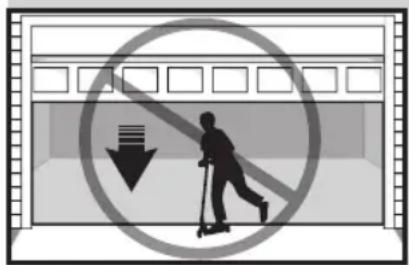
Stay away from a moving door.
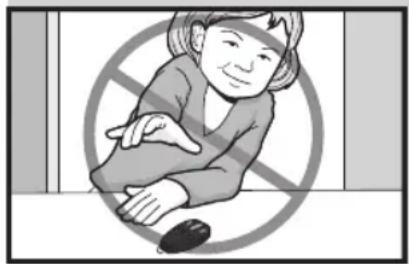
Keep transmitters and remote controls out of reach of children. Do not let children play with or use transmitters or other remote control devices.
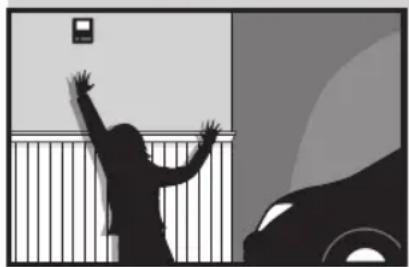
The wall-mounted push button should be out of reach of children, at least 5 feet from the nearest standing surface and away from all moving parts. Mount and use the button where you can clearly see the closing garage door.
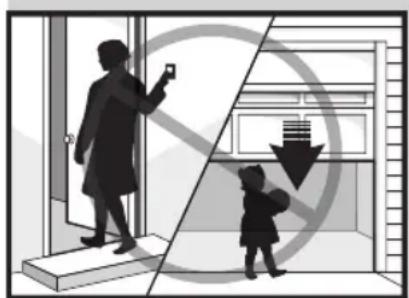
Keep the door in sight until it completely closes when using the wall-mounted push button or transmitter.
Routine Maintenance Can Prevent Tragedies
Make monthly inspection and testing of your garage door and opener system a part of your regular routine. Review your owner's manual for both the door and door opener. If you don't have the owner's manuals, contact the manufacturer(s) and request a copy for your specific model(s). Look for the opener model number on the back of the power unit.

WARNING - Springs are under high tension. Only qualified individuals should adjust them.
Visually check the door and installation:
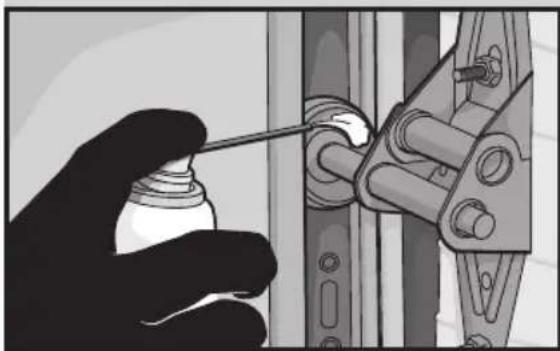
- Starting with the door in the closed position, use the manual disconnect on the opener to disconnect the door.
- Look for signs of wear or damage on hinges, rollers, springs, and door panels.
- These parts may require periodic lubrication. Check the owner's manual for suggested maintenance.
- If any signs of damage are evident, contact a trained door systems technician for assistance.
- Verify the photoeye height is no higher than 6^ from the garage floor.
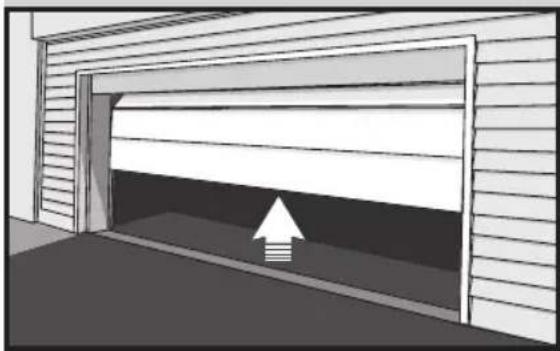
Test the door for proper operation:
- Open and close the door manually using handles or suitable gripping points.
- The door should move freely and without difficulty.
- The door should balance and stay partially open 3-4 feet above the floor.
- If you detect any signs of improper operation, contact a trained door systems technician for assistance.
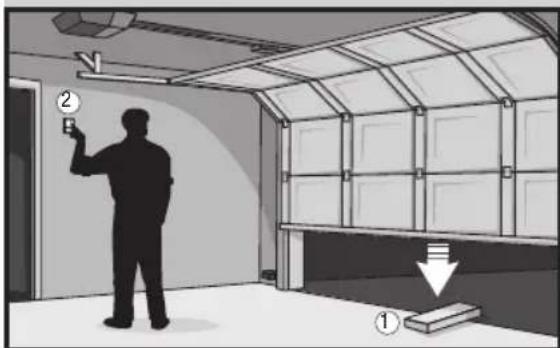
Test the opener safety features:
- Reconnect the opener to the door using the manual disconnect and open the door.
- Place a 2x4 board flat in the path of the door (1) and try to close it (2). The door should stop when it comes in contact with the 2x4 and then reverse direction.
- Block the photoelectric sensor by waving an object in front of the sensor and attempt to close the door. The door should not close unless the wall-mounted push button is manually held during operation.
- If the opener does not perform as described, contact a trained door systems technician for assistance.
Accessories
G940EV
Wireless Keypad:
For use outside of the home to enable access to the garage using a 4-digit PIN. Works with ALL Chamberlain openers from 1993-present.myQ
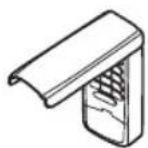
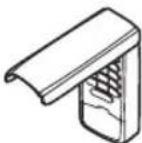
940ESTD
Wireless Keypad:
For use outside of the home to enable access to the garage using a 4-digit PIN.
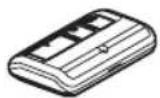
G953EV
Remote Control:
Works with ALL Chamberlain openers from 1993-present. myQ compatible. Includes visor clip.
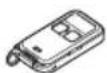
G956EV
Keychain Remote Control
Works with ALL Chamberlain openers from 1993-present. myQ compatible. With key ring.
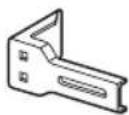
041A5281-1
Extension Brackets:
(Optional) For safety reversing sensor installation onto the wall or floor.
PROVIDED ACCESSORIES
041A7928-3 828LM-041A6287
myQ® Control Panel Internet Gateway:
Internet enabled
accessory which
connects to the
computer and allows
you to monitor and control garage
door openers and lighting accessories
enabled by myQ technology.
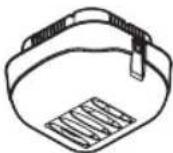
Remote Light:
Enables homeowner to turn on a work light from their car with their garage door opener remote or from anywhere in their home with an Chamberlain® remote
CHAMBERLAIN® LIMITED WARRANTY
The Chamberlain Group, Inc. ("Seller") warrants to the first retail purchaser of this product, for the residence in which this product is originally installed, that it is free from defects in materials and/or workmanship for a specific period of time as defined below (the "Warranty Period"). The warranty period commences from the date of purchase.
| WARRANTY PERIOD | ||
| Parts | Motor | Accessories |
| 5 years | Lifetime | 1 year |
The proper operation of this product is dependent on your compliance with the instructions regarding installation, operation, and maintenance and testing. Failure to comply strictly with those instructions will void this limited warranty in its entirety. If, during the limited warranty period, this product appears to contain a defect covered by this limited warranty, visit chamberlain.com, before dismantling this product. You will be advised of disassembly and shipping instructions when you call. Then send the product or component, pre-paid and insured, as directed to our service center for warranty repair. Please include a brief description of the problem and a dated proof-of-purchase receipt with any product returned for warranty repair. Products returned to Seller for warranty repair, which upon receipt by Seller are confirmed to be defective and covered by this limited warranty, will be repaired or replaced (at Seller's sole option) at no cost to you and returned pre-paid. Defective parts will be repaired or replaced with new or factory rebuilt parts at Seller's sole option. [You are responsible for any costs incurred in removing and/or reinstalling the product or any component.] ALL IMPLIED WARRANTY FOR THE PRODUCT, INCLUDING BUT NOT LIMITED TO ANY IMPLIED WARRANTY OF MERCHANTABILITY AND FITNESS FOR A PARTICULAR PURPOSE, ARE LIMITED IN DURATION TO THE APPLICABLE LIMITED WARRANTY PERIOD SET FORTH ABOVE FOR THE RELATED COMPONENT(S), AND NO IMPLIED WARRANTY WILL EXIST OR APPLY AFTER SUCH PERIOD. Some States and Provinces do not allow limitations on how long an implied warranty lasts, so the above limitation may not apply to you. THIS LIMITED WARRANTY DOES NOT COVER NON-DEFFECT DAMAGE, DAMAGE CAUSED BY IMPROPER INSTALLATION, OPERATION OR CARE (INCLUDING, BUT NOT LIMITED TO ABUSE, MISUSE, FAILURE TO PROVIDE REASONABLE AND NECESSARY MAINTENANCE, UNAUTHORIZED REPAIRS OR ANY ALTERATIONS TO THIS PRODUCT), LABOR CHARGES FOR REINSTALLING A REPAIRED OR REPLACED UNIT, REPLACEMENT OF CONSUMABLE ITEMS (E.G., BATTERIES IN REMOTE CONTROL TRANSMITTERS AND LIGHT BULBS), OR UNITS INSTALLED FOR NON-RESIDENTIAL USE. THIS LIMITED WARRANTY DOES NOT COVER ANY PROBLEMS WITH, OR RELATING TO, THE GARAGE DOOR OR GARAGE DOOR HARDWARE, INCLUDING BUT NOT LIMITED TO THE DOOR SPRINGS, DOOR ROLLERS, DOOR ALIGNMENT OR HINGES. THIS LIMITED WARRANTY ALSO DOES NOT COVER ANY PROBLEMS CAUSED BY INTERFERENCE. UNDER NO CIRCUMSTANCES SHALL SELLER BE LIABLE FOR CONSEQUENTIAL, INCIDENTAL OR SPECIAL DAMAGES ARISING IN CONNECTION WITH USE, OR INABILITY TO USE, THIS PRODUCT. IN NO EVENT SHALL SELLER'S LIABILITY FOR BREACH OF WARRANTY, BREACH OF CONTRACT, NEGLIGENCE OR STRICT LIABILITY EXCEED THE COST OF THE PRODUCT COVERED HEREBY. NO PERSON IS AUTHORIZED TO ASSUME FOR US ANY OTHER LIABILITY IN CONNECTION WITH THE SALE OF THIS PRODUCT.
Some states and provinces do not allow the exclusion or limitation of consequential, incidental or special damages, so the above limitation or exclusion may not apply to you. This limited warranty gives you specific legal rights, and you may also have other rights, which vary from state to state and province to province.
Repair Parts
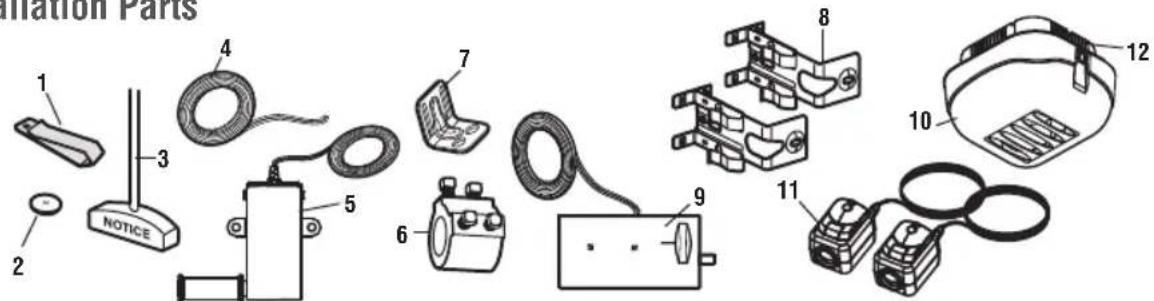
Installation Parts
| KEY PART NO. NO. DESCRIPTION | KEY PART NO. NO. DESCRIPTION |
| 1 K029B0137 Remote control visor clip | 10 041D0096-1 Light lens for light |
| 2 K010A0020 3V CR2032 Lithium battery | 11 041-0136 Safety sensor kit: receiving and sending sensors with 2-conductor wire |
| 3 041A4582 Emergency release rope & handle assembly | 12 041A6287 Remote Light (garage door opener light) |
| 4 041A4494-1 2-Conductor wire - white and white/red | NOT SHOWN |
| 5 041A6104 Cable tension monitor | 041A6288 Hardware bag for light |
| 6 041D8615 Collar with set screws | 041A6298 Installation hardware bag |
| 7 041B6228 Mounting bracket | (includes hardware listed on page 6) |
| 8 041-0155 Safety sensor brackets (2) | 114A5146D 114A5145D Quick start guide |
| 9 041A6102 Power door lock |
Garage Door Opener Parts
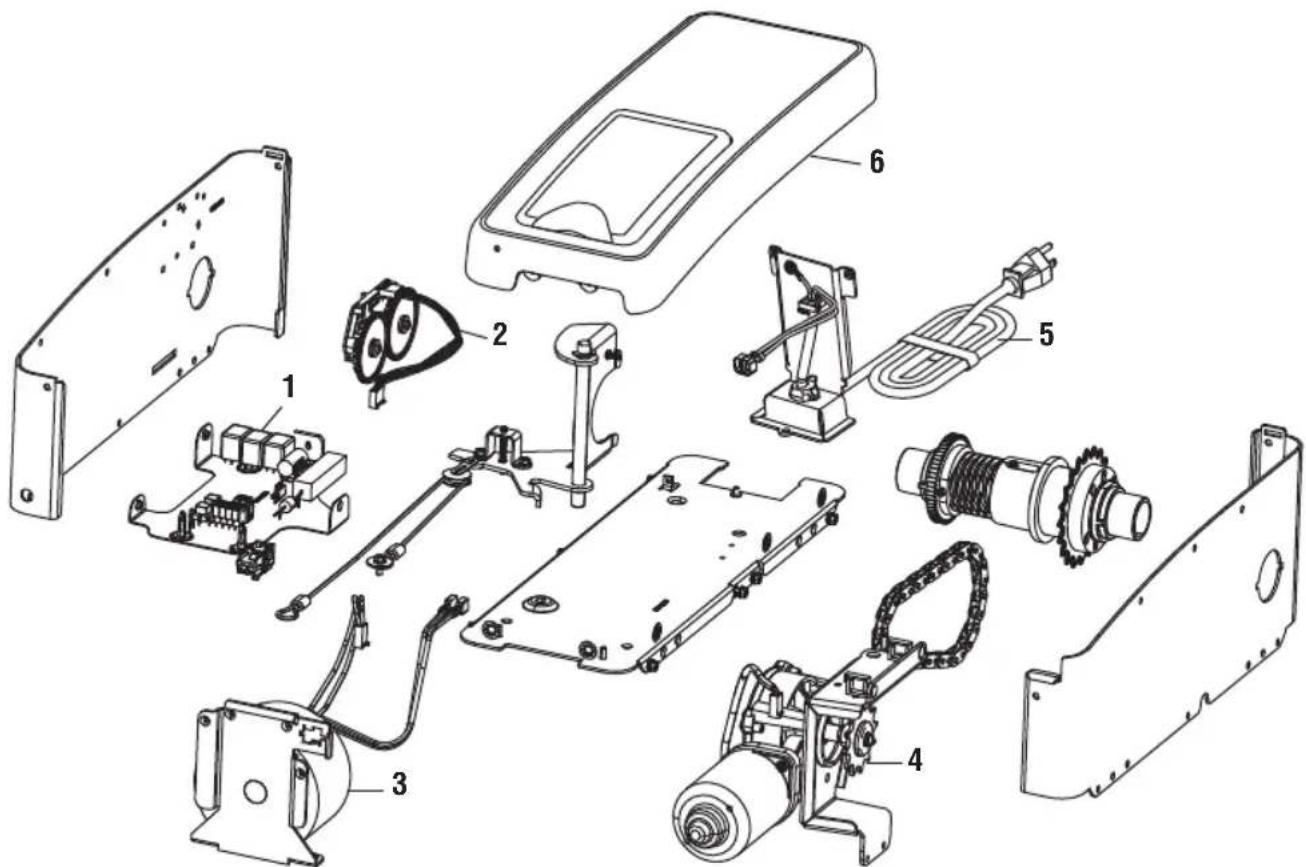
| KEY PART NO. NO. DESCRIPTION | KEY PART NO. NO. DESCRIPTION |
| 1 041DJ002 Logic board complete with plate | 4 041A6095 Motor with bracket |
| 2 041B8861 Travel Module | 5 041B0122 Power cord |
| 3 041C0168 Transformer | 6 041A6348-3 Cover |
Contact Information
Visit us online at:
support.chamberlaingroup.com
CHAMBERLAIN
Installation (suite)
support.chamberlaingroup.com