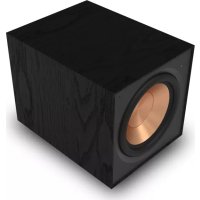
R101SW - Subwoofer KLIPSCH - Free user manual and instructions
Find the device manual for free R101SW KLIPSCH in PDF.



| Product Type | Active subwoofer |
| Brand | Klipsch |
| Model | R101SW |
| Dimensions (H x W x D) | 36.8 x 34.3 x 41.9 cm |
| Weight | 12.7 kg |
| Power Supply | Mains, 230 V / 50 Hz |
| Amplifier Power | 200 W RMS |
| Speaker | 10 inches (25.4 cm) |
| Frequency Response | 27 Hz - 125 Hz |
| Inputs | Left L/LFE and Right (RCA) |
| Controls | Gain, low-pass filter (50-160 Hz), phase (0/180°), Auto/On/Off |
| Finish | Durable vinyl |
| Care and Cleaning | Dust with dry cloth or vacuum brush. Avoid abrasive products and solvents. |
| Safety | Disconnect before any connection. Use a suitable mains socket. |
| Spare parts and repairability | Contact the retailer or www.klipsch.com for parts and repairs. |
| General Information | Online registration recommended: www.klipsch.com/register |
Frequently Asked Questions - R101SW KLIPSCH
User questions about R101SW KLIPSCH
0 question about this device. Answer the ones you know or ask your own.
Ask a new question about this device
Download the instructions for your Subwoofer in PDF format for free! Find your manual R101SW - KLIPSCH and take your electronic device back in hand. On this page are published all the documents necessary for the use of your device. R101SW by KLIPSCH.
USER MANUAL R101SW KLIPSCH
text_image
PAUL W. KLIPSCH CAK EST. 1946 HOPE, AR|
一
1
[Non-Text]
[Non-Text]
[Non-Text]
[Non-Text]
[Non-Text]
[Non-Text]
[Non-Text]
[Non-Text]
[Non-Text]
[Non-Text]
[Non-Text]
[Non-Text]
|
一
[Non-Text]
[Non-Text]
[Non-Text]
[Non-Text]
[Non-Text]
[Non-Text]
[Non-Text]
[Non-Text]
[Non-Text]
[Non-Text]
[Non-Text]
[Non-Text]
[Non-Text]
[Non-Text]
[Non-Text]
[Non-Text]
—
|
[Non-Text]
[Non-Text]
[Non-Text]
[Non-Text]
[Non-Text]
[Non-Text]
[Non-Text]
[Non-Text]
[Non-Text]
[Non-Text]
[Non-Text]
[Non-Text]
REFERENCE SUBWOOFERS
ENGLISH
natural_image
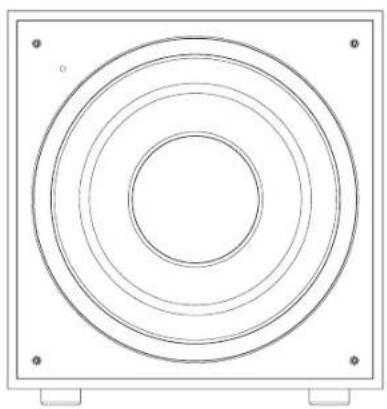
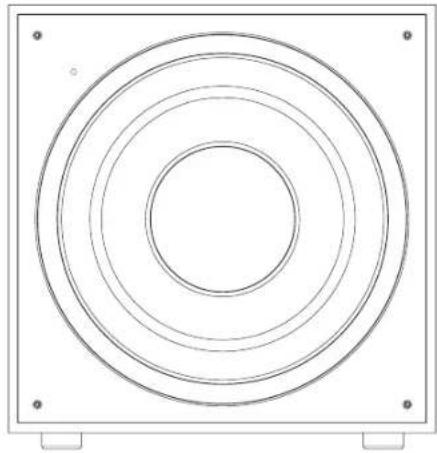
Simple line drawing of concentric circles inside a square frame (no text or symbols)R-101SW R-121SW
natural_image
Simple line drawing of concentric circles inside a square frame (no text or symbols)INSPECTION
We want your new speaker system to look as good as it did leaving the factory! Please check promptly for any transit damage. Carefully unpack your new speaker system and verify the components against the packing list. In extreme circumstances, items may have become
damaged in transit. If any damage is discovered, notify the delivery service and dealer where the system was purchased. Make a request for inspection, and follow their instructions for evaluation. Be sure to keep the product's original shipping carton.
POSITIONING YOUR REFERENCE SUBWOOFER
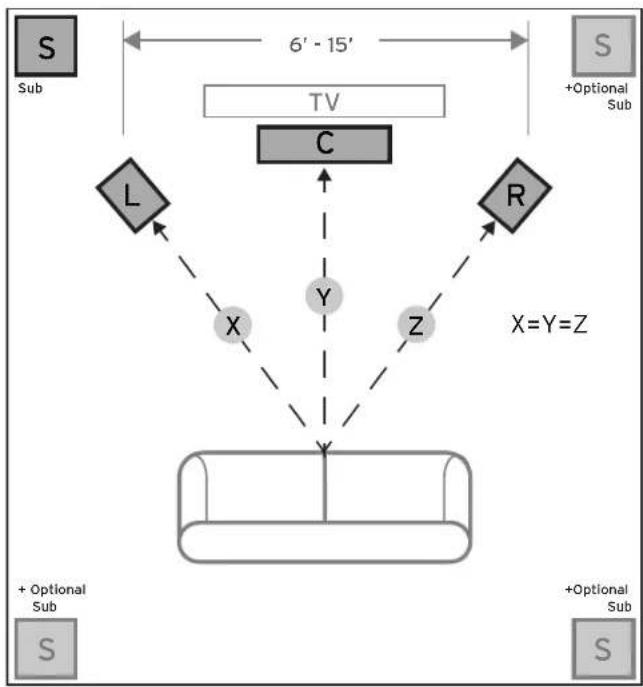
Klipsch powered subwoofers are designed to reproduce deep bass and deliver the impact that makes your movies and music come alive. For optimum performance, place your subwoofer in a corner of the room on the same wall as your front channel speakers. (refer to Figure 1). Please note that room placement can have a dramatic effect on the performance of your powered subwoofer. Corner placement, as suggested above, will increase the amount of bass output, while placing the subwoofer along the middle of a wall, or out in the room will decrease the amount of bass output. Experiment with a number of different placement options and control settings to find the one that best suits your particular room and taste. When choosing your subwoofer's location, keep in mind that you will need to connect the subwoofer's built-in amplifier to an AC power outlet.
flowchart
graph TD
    A["Sub"] -->|6' - 15'| B["TV"]
    B --> C["C"]
    C --> D["L"]
    C --> E["R"]
    D --> F["X"]
    E --> G["Z"]
    F --> H["Y"]
    G --> H
    H --> I["X=Y=Z"]
    style A fill:#f9f,stroke:#333
    style B fill:#ccf,stroke:#333
    style C fill:#cfc,stroke:#333
    style D fill:#fcc,stroke:#333
    style E fill:#cff,stroke:#333
    style F fill:#ffc,stroke:#333
    style G fill:#ffc,stroke:#333
    style H fill:#cfc,stroke:#333
    style I fill:#fcc,stroke:#333
FIGURE 1
SPEAKER PLACEMENT IN LISTENING AREA
CONNECTIONS AND CONTROLS
CAUTION: Ensure that the subwoofer is unplugged from the AC wall outlet before making any connections.
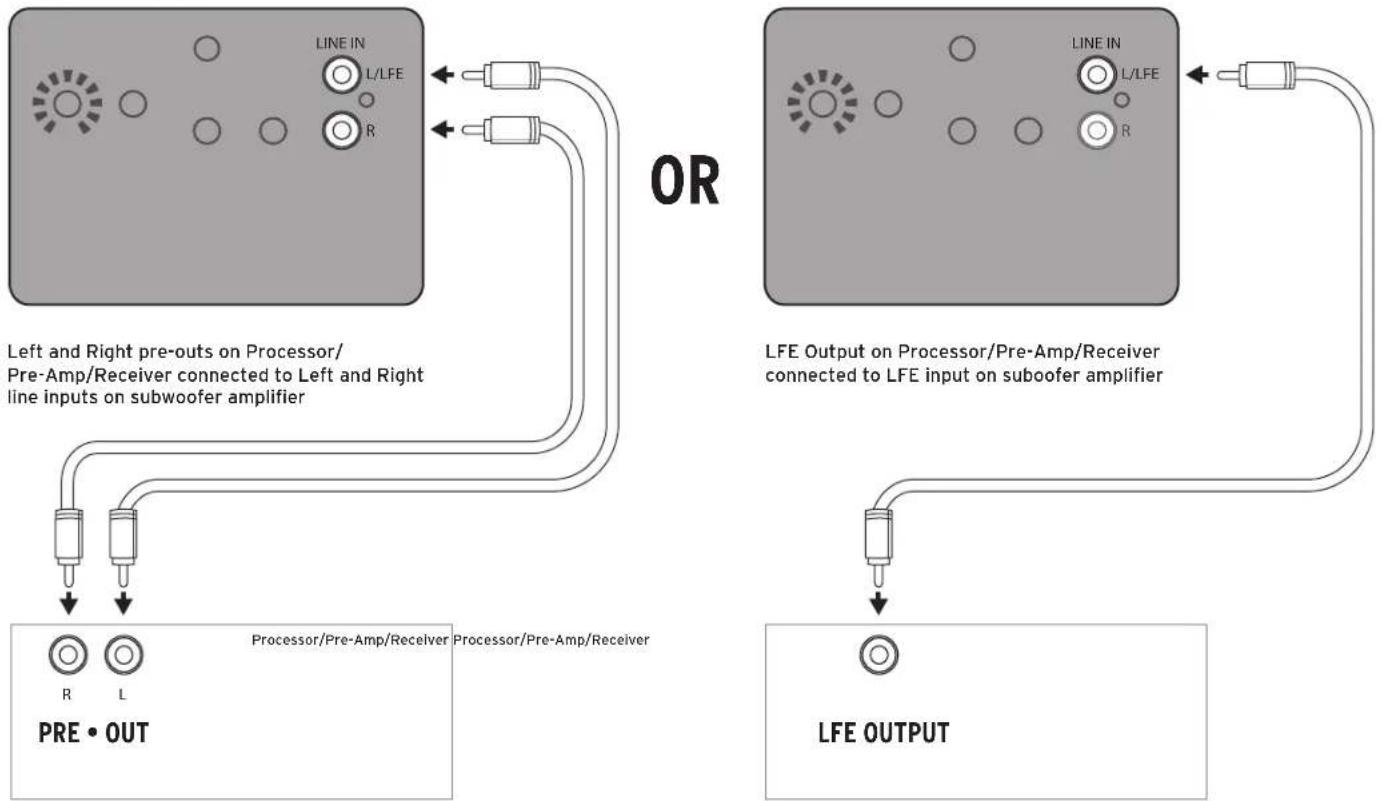
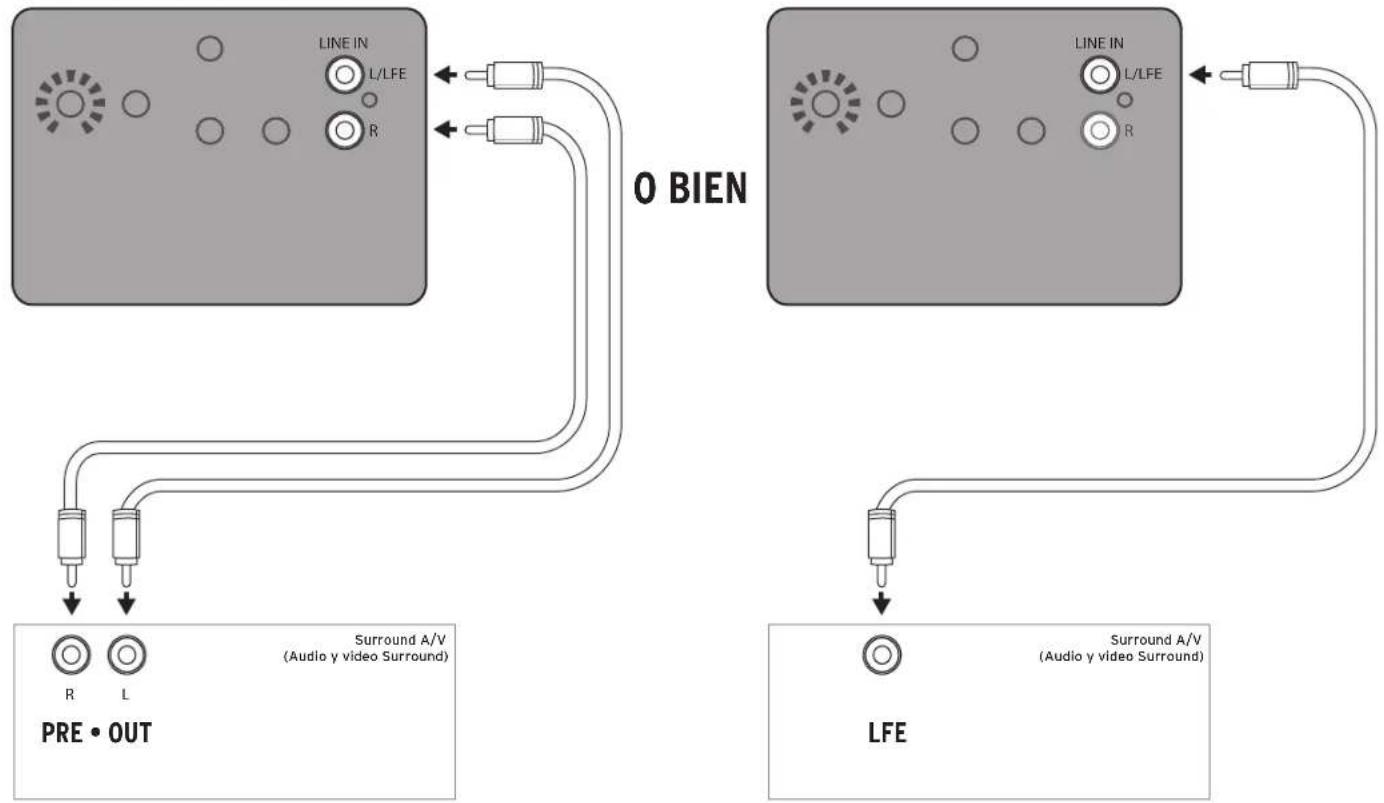
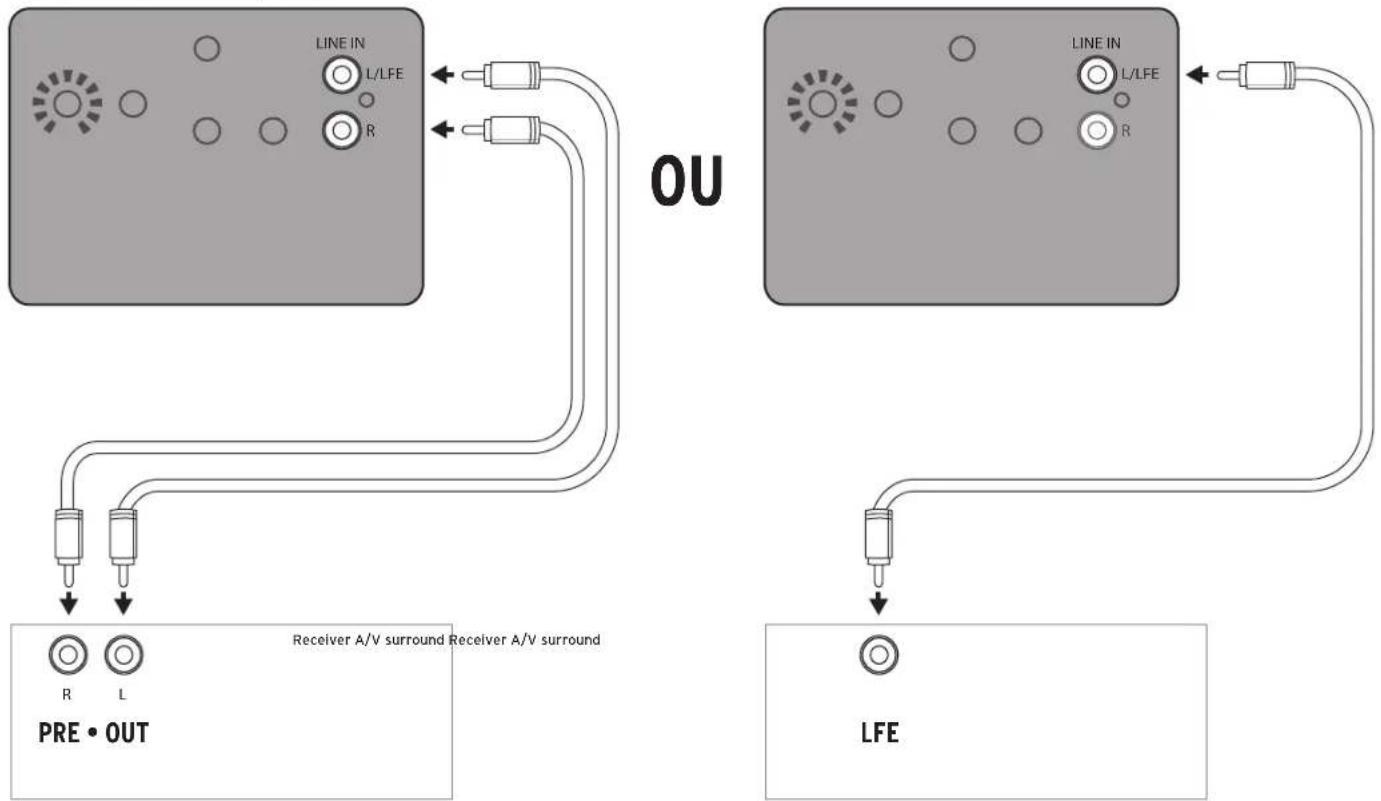
"LINE IN" Connection - Most of today's surround receivers (and pre-amplifiers) have a line level subwoofer output labeled Subwoofer Pre Out, Sub Out, SW Out, etc. If you have this output, connect one end of a subwoofer cable to it and connect the other end of the cable into the subwoofer line input labeled LEFT/LFE. This connection allows the subwoofer to operate with both music and surround sound movies (refer to your receiver manual). In absence of a subwoofer output on your receiver, as an alternative hookup, you can connect Left and Right channel Pre-Amp Outputs from your receiver (if provided) to the Left/LFE and Right input on the subwoofer.
"LOWPASS" Control - The crossover point chosen determines where low bass frequencies are "handed off" from the speakers to the subwoofer. If setting the crossover point in the receiver, turn the Lowpass Filter knob on the subwoofer to the farthest point right (160Hz). Set the crossover point based on the size of the main left/right speakers you are using in the system. As a general rule, for larger, floorstanding speakers, set the crossover point between 50Hz-90Hz. If using small bookshelf or "satellite" speakers for the mains, set the crossover point between 90Hz-150Hz. The smaller the speaker, the higher the setting until the bass frequencies blend well between the speakers and your subwoofer once your system is completely hooked up. If your receiver does not have a crossover point setting, set the Lowpass Filter on the subwoofer instead within the same recommended settings (see receiver manual for additional speaker setup info).
Level - If your subwoofer is connected to a Subwoofer Output of a surround receiver, first set the subwoofer volume level control in the receiver to the "half way" or "0 dB" position. Then increase the volume (or gain) of the subwoofer up until the subwoofer's volume level matches the output of your main speakers. After this setup is completed, the volume control on your system's main amplifier or pre-amplifier will be the volume control for both your subwoofer and speakers together. If your subwoofer is connected to the L/R Pre-Amp Outputs of a receiver there will be no subwoofer volume in that receiver to set before setting the subwoofer's gain control.
"PHASE" 0/180 - This control is used to acoustically match the subwoofer's output to your main speakers. Select the position either 0^ or 180^ in which your subwoofer has more output at the listening position.
Off/Auto/On - When this switch is in the "AUTO" position, the subwoofer will automatically turn "on" when it senses a signal. It will automatically go into "standby mode" after 15-20 minutes with no signal. When the switch is set to the "On" position, the subwoofer will remain on until manually switched to another settings. When this switch is in the "OFF" position, the subwoofer will remain "off" until the switch is manually turned back to the "AUTO" or "ON" position.
Power LED indicator - Located on the front baffle, this LED indicates the operating status of the built-in amplifier. The LED will light green when the amplifier is on and receiving a signal. If the LED is dark and not lit, the amplifier is off. For more information on the controls mentioned in this manual and on bass management, see your dealer or visit www.klipsch.com
FIGURE 2
LINE LEVEL CONNECTIONS
flowchart
graph TD
    A["Left and Right pre-outs on Processor/Pre-Amp/Receiver connected to Left and Right line inputs on subwoofer amplifier"] --> B["OR"]
    C["Pre • OUT"] --> B
    D["LFE OUTPUT"] --> E["OR"]
    F["OR"] --> G["LFE OUTPUT"]
    style A fill:#f9f,stroke:#333
    style C fill:#f9f,stroke:#333
    style D fill:#f9f,stroke:#333
    style F fill:#f9f,stroke:#333
CARE AND CLEANING
Your subwoofer has a durable vinyl finish that should only require dry dusting or cleaning with a dry cloth. Avoid the use of abrasive or solvent-based cleaners and harsh detergents. The brush attachment of your vacuum should remove any dust from your subwoofer enclosure.
PRODUCT REGISTRATION
Register your product online at www.klipsch.com/register
- Keep up-to-date on new products and promotions.
- Your personal information will never be resold.
- This registration information is not used for warranty purposes.
Please retain your receipt for warranty claims.
CAISSONS DE GRAVES REFERENCE
FRENCH

natural_image
Pure concentric circle diagram with no text, numbers, or symbolsR-101SW R-121SW
natural_image
Concentric circles arranged in a square frame with mounting holes (no text or symbols)INSPECTION
natural_image
Simple line drawing of concentric circles inside a square frame (no text or symbols)R-101SW R-121SW
natural_image
Concentric circles arranged in a square frame with mounting holes (no text or symbols)INSPEKTION
SUBWOOFERS REFERENCE
SPANISH

natural_image
Pure concentric circle diagram with no text, numbers, or symbolsR-101SW R-121SW
natural_image
Concentric circles arranged in a square frame with mounting holes (no text or symbols)INSPECCIÓN
FIGURA 2
CABLEADO DE LOS SUBWOOFERS R-101SW Y R-121SW
flowchart
graph TD
    A["Device 1: LINE IN L/LFE"] -->|O BIEN| B["Device 2: LINE IN L/LFE"]
    B -->|O BIEN| C["Device 3: LFE"]
    C -->|O BIEN| D["Device 4: LFE"]
    D -->|O BIEN| E["Device 5: LFE"]
    E -->|O BIEN| F["Device 6: LFE"]
    F -->|O BIEN| G["Device 7: LFE"]
    G -->|O BIEN| H["Device 8: LFE"]
    H -->|O BIEN| I["Device 9: LFE"]
    I -->|O BIEN| J["Device 10: LFE"]
    J -->|O BIEN| K["Device 11: LFE"]
    K -->|O BIEN| L["Device 12: LFE"]
    L -->|O BIEN| M["Device 13: LFE"]
    M -->|O BIEN| N["Device 14: LFE"]
    N -->|O BIEN| O["Device 15: LFE"]
    O -->|O BIEN| P["Device 16: LFE"]
    P -->|O BIEN| Q["Device 17: LFE"]
    Q -->|O BIEN| R["Device 18: LFE"]
    R -->|O BIEN| S["Device 19: LFE"]
    S -->|O BIEN| T["Device 20: LFE"]
    T -->|O BIEN| U["Device 21: LFE"]
    U -->|O BIEN| V["Device 22: LFE"]
    V -->|O BIEN| W["Device 23: LFE"]
    W -->|O BIEN| X["Device 24: LFE"]
    X -->|O BIEN| Y["Device 25: LFE"]
    Y -->|O BIEN| Z["Device 26: LFE"]
    Z -->|O BIEN| AA["Device 27: LFE"]
    AA -->|O BIEN| AB["Device 28: LFE"]
    AB -->|O BIEN| AC["Device 29: LFE"]
    AC -->|O BIEN| AD["Device 30: LFE"]
    AD -->|O BIEN| AE["Device 31: LFE"]
    AE -->|O BIEN| AF["Device 32: LFE"]
    AF -->|O BIEN| AG["Device 33: LFE"]
    AG -->|O BIEN| AH["Device 34: LFE"]
    AH -->|O BIEN| AI["Device 35: LFE"]
    AI -->|O BIEN| AJ["Device 36: LFE"]
    AJ -->|O BIEN| AK["Device 37: LFE"]
    AK -->|O BIEN| AL["Device 38: LFE"]
    AL -->|O BIEN| AM["Device 39: LFE"]
    AM -->|O BIEN| AN["Device 40: LFE"]
    AN -->|O BIEN| AO["Device 41: LFE"]
    AO -->|O BIEN| AP["Device 42: LFE"]
    AP -->|O BIEN| AQ["Device 43: LFE"]
    AQ -->|O BIEN| AR["Device 44: LFE"]
    AR -->|O BIEN| AS["Device 45: LFE"]
    AS -->|O BIEN| AT["Device 46: LFE"]
    AT -->|O BIEN| AU["Device 47: LFE"]
    AU -->|O BIEN| AV["Device 48: LFE"]
    AV -->|O BIEN| AW["Device 49: LFE"]
    AW -->|O BIEN| AX["Device 50: LFE"]
CUIDADO Y LIMPIEZA
SUBWOOFERS REFERENCE
PORTGUESE
natural_image
Simple line drawing of concentric circles inside a square frame (no text or symbols)R-101SW R-121SW

natural_image
Pure concentric circle diagram with no text, numbers, or symbolsINSPEÇÃO
FIGURA 2
CONEXÃO DO SUBWOOFER R-101SW, R-121SW
flowchart
graph TD
    subgraph OU
        A["LINE IN L/LFE"] --> B["R"]
        C["Line IN L/LFE"] --> D["R"]
        E["Line IN L/LFE"] --> F["R"]
        G["Line IN L/LFE"] --> H["R"]
        I["Line IN L/LFE"] --> J["R"]
        K["Line IN L/LFE"] --> L["R"]
        M["Line IN L/LFE"] --> N["R"]
        O["Line IN L/LFE"] --> P["R"]
        Q["Line IN L/LFE"] --> R["R"]
        S["Line IN L/LFE"] --> T["R"]
        U["Line IN L/LFE"] --> V["R"]
        W["Line IN L/LFE"] --> X["R"]
        Y["Line IN L/LFE"] --> Z["R"]
        AA["Line IN L/LFE"] --> AB["R"]
        AC["Line IN L/LFE"] --> AD["R"]
        AE["Line IN L/LFE"] --> AF["R"]
        AG["Line IN L/LFE"] --> AH["R"]
        AI["Line IN L/LFE"] --> AJ["R"]
        AK["Line IN L/LFE"] --> AL["R"]
        AM["Line IN L/LFE"] --> AN["R"]
        AO["Line IN L/LFE"] --> AP["R"]
        AQ["Line IN L/LFE"] --> AR["R"]
        AS["Line IN L/LFE"] --> AT["R"]
        AU["Line IN L/LFE"] --> AV["R"]
        AW["Line IN L/LFE"] --> AX["R"]
        AY["Line IN L/LFE"] --> AZ["R"]
        BA["Line IN L/LFE"] --> BB["R"]
        BC["Line IN L/LFE"] --> BD["R"]
        BE["Line IN L/LFE"] --> BF["R"]
        BG["Line IN L/LFE"] --> BH["R"]
        BI["Line IN L/LFE"] --> BJ["R"]
        BK["Line IN L/LFE"] --> BL["R"]
        BM["Line IN L/LFE"] --> BN["R"]
        BO["Line IN L/LFE"] --> BP["R"]
        BQ["Line IN L/LFE"] --> BR["R"]
        BS["Line IN L/LFE"] --> BT["R"]
        BU["Line IN L/LFE"] --> BV["R"]
        BW["Line IN L/LFE"] --> BX["R"]
        BY["Line IN L/LFE"] --> BZ["R"]
        CA["Line IN L/LFE"] --> CB["R"]
        CC["Line IN L/LFE"] --> CD["R"]
        DE["Line IN L/LFE"] --> DF["R"]
        DG["Line IN L/LFE"] --> DH["R"]
        DI["Line IN L/LFE"] --> DJ["R"]
        DK["Line IN L/LFE"] --> DL["R"]
        DV["Line IN L/LFE"] --> DVB["LFE"]
CUIDADO E LIMPEZA
natural_image
Pure concentric circle diagram with no text, numbers, or symbolsR-101SW R-121SW
natural_image
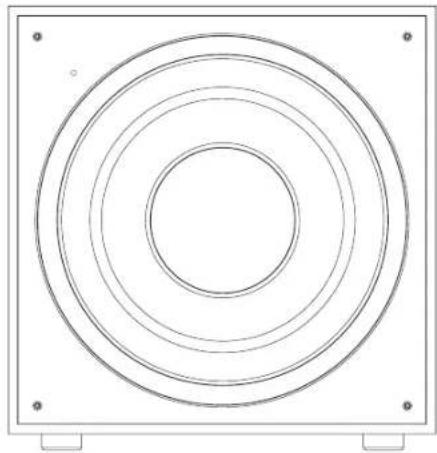
Concentric circles arranged in a square frame with mounting holes (no text or symbols)ISPEZIONE
natural_image
Simple line drawing of concentric circles inside a square frame (no text or symbols)R-101SW R-121SW

natural_image
Simple line drawing of concentric circles inside a square frame (no text or symbols)开箱检查
natural_image
Pure concentric circle diagram with no text, numbers, or symbolsR-101SW R-121SW
natural_image
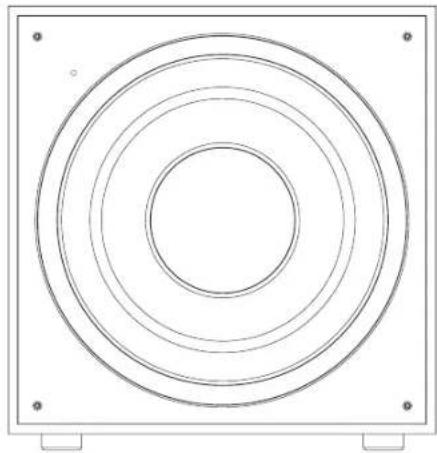
Concentric circles arranged in a square frame with mounting holes (no text or symbols)点検
flowchart
graph TD
    S["サブウェーファー"] --> TV["TV"]
    TV --> C["C"]
    TV --> R["R"]
    C --> X["X"]
    C --> Y["Y"]
    C --> Z["Z"]
    X --> Y
    Y --> Z
    R --> Y
    style TV fill:#f9f,stroke:#333
    style X fill:#ccf,stroke:#333
    style Y fill:#cfc,stroke:#333
    style Z fill:#fcc,stroke:#333
    note right of TV "オプションのサブウェーファー"
    note right of X=Y=Z
    note right of S
    note right of S
    note right of S
    note right of S
    note right of S
    note right of S
    note right of S
    note right of S
    note right of S
    note right of S
    note right of S
    note right of S
    note right of S
    note right of S
    note right of S
    note right of S
    note right of S
    note left of TV
    note left of X
    note left of Y
    note left of Z
    note left of S
    note left of S
    note left of S
    note left of S
    note left of S
KEEPERS OF THE SOUND
3502 WOODVIEW TRACE, INDIANAPOLIS, IN, USA
KLIPSCH.COM
©2021: Klipsch Group, Inc. Klipsch Group, Inc. is a wholly-owned subsidiary of voxx International Corporation.
Kipsch and Keepers of the Sound are trademarks of Klipsch Group, Inc., registered in the United States and other countries.