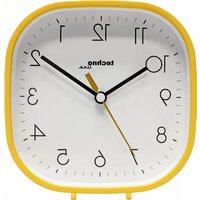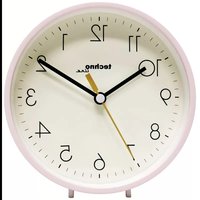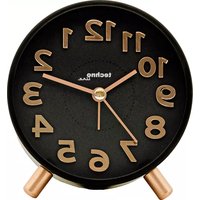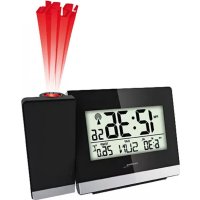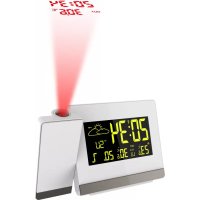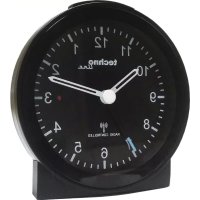
WT 768 - Alarm clock radio TECHNOLINE - Free user manual and instructions
Find the device manual for free WT 768 TECHNOLINE in PDF.


| Product type | Analog alarm clock with hands display |
| Brand | TECHNOLINE |
| Model | WT 768 |
| Dimensions (L x W x H) | Approx. 12 x 8 x 5 cm |
| Weight (with battery) | Approx. 200 g |
| Power supply | 1 AAA LR03 alkaline battery (non-rechargeable) |
| Radio-controlled reception | DCF-77 (77.5 kHz), range ~1500 km, Europe only |
| Time setting | Automatic via DCF-77 signal or manual via M.SET button |
| Alarm | Beep sound with 5-minute snooze function |
| Light function | Integrated, activated by SNOOZE/LIGHT button |
| Automatic alarm stop | After approx. 2 minutes, resumes after 12 hours |
| Reset | RESET button at the back |
| Intended use | Indoor only, domestic use |
| Maintenance and cleaning | Clean with a soft dry cloth; do not immerse, avoid moisture and dust |
| Battery safety | Use only alkaline batteries, observe polarity, do not recharge, remove if depleted |
| Operating temperature | Room temperature, avoid extremes and direct sunlight |
| Repairability | Not user-serviceable; do not open the case |
| General information | Analog alarm clock with hands, DCF-77 reception, snooze and light function |
Frequently Asked Questions - WT 768 TECHNOLINE
User questions about WT 768 TECHNOLINE
0 question about this device. Answer the ones you know or ask your own.
Ask a new question about this device
Download the instructions for your Alarm clock radio in PDF format for free! Find your manual WT 768 - TECHNOLINE and take your electronic device back in hand. On this page are published all the documents necessary for the use of your device. WT 768 by TECHNOLINE.
USER MANUAL WT 768 TECHNOLINE
natural_image
Simple line drawing of a trash bin with diagonal lines crossing through it, no text or symbols present.natural_image
Pure electrical circuit lines without any symbolsWT 768 - Radio controlled alarm clock instruction manual
Start the clock
Insert 1 x Micro AAA LR03 battery into the battery compartment and make sure the battery polarity (+/-) is as indicated. The hands (minute, hour) are adjusting to 12 o'clock position and the alarm clock enters into signal reception mode.
EN1
Signal reception mode
The time base for the radio controlled time is a Cesium Atomic Clock operated by the Physikalisch Technische Bundesanstalt Braunschweig which has a time deviation of less than one second in one million years. The time is coded and transmitted from Mainflingen near Frankfurt via frequency signal DCF-77 (77.5 kHz) and has a transmitting range of approximately 1,500 km. The radio controlled alarm clock receives this signal and converts it to show the precise time in summer or wintertime.
EN2
Environmental reception effects
The clock obtains the accurate time with wireless technology. Same as all wireless devices, the reception is maybe affected by the following circumstances:
- long transmitting distance
• nearby mountains and valleys - near freeway, railway, airports, high voltage cable etc.
- near construction site
- among tall buildings
• inside concrete buildings
EN3
- near electrical appliances (computers, TV's, etc) and metallic structures
• inside moving vehicles
Place the clock at a location with optimal signal, i.e. close to a window and away from metal surfaces or electrical appliances.
a. Automatic signal reception: The automatic signal reception starts
by inserting the battery. After 2 to 5 minutes the hands will be adjusted to the correct radio controlled time according to the DCF-77 reception signal. Then, the time will calibrate several
EN4
times a day with the DCF-77 signal reception signal (also independent setting of summer- and winter time).
b. Manual signal reception: Press and hold the REC button longer than 3 seconds to start the manual signal reception. The hands (minute, hour) are adjusting to 12 o'clock position and the clock enters into signal reception mode. If the signal is successfully received, the hands adjust automatically to the correct radio controlled time. This procedure takes approximately 2 to 5 minutes. If the signal reception is failed, the alarm clock takes the previously set time again. After the next successful signal
EN5
reception the time will be adjusted to the correct radio controlled
time according to the DCF-77 reception signal.
Note: The DCF-77 reception is only available in Europe.
Manual time setting
Press and hold the M.SET button until the desired time is set.
Alarm time setting
Turn the alarm set knob in indicated direction until the desired alarm time is set.
EN6
Turn on/ off the alarm
Turn the ON/OFF switch to the ON position, the alarm will ring with a beep alarm when the set alarm time is reached. Turn it to the OFF position, the alarm will not ring.
Note: If the alarm is not interrupted or turned off, it stops automatically after 2 minutes and rings again after 12 hours.
Snooze alarm & light
Press the SNOOZE/LIGHT button (at the top of the case) to activate the snooze alarm after 5 minutes and turn on the light.
EN7
Reset
If the clock shows an incorrect time or after changing the battery, press the RESET button on the case back panel to re-start the alarm clock. The hands (minute, hour) are adjusting again to 12 o'clock position and the clock enters into signal reception mode. In successful signal reception the time will be adjusted to the correct radio controlled time according to the DCF-77 reception signal.
Precautions
- This main unit is intended to be used only indoors.
- Do not subject the unit to excessive force or shock.
EN8
- Do not expose the unit to extreme temperatures, direct sunlight, dust or humidity.
- Do not immerse in water.
- Avoid contact with any corrosive materials.
- Do not dispose this unit in a fire as it may explode.
- Do not open the inner back case or tamper with any components of this unit.
Batteries safety warnings
- Use only alkaline batteries, not rechargeable batteries.
- Install batteries correctly by matching the polarities (+/-).
- Always replace a complete set of batteries.
- Never mix used and new batteries.
- Remove exhausted batteries immediately.
- Remove batteries when not in use.
EN9
- Do not recharge and do not dispose of batteries in fire as the batteries may explode.
- Ensure batteries are stored away from metal objects as contact may cause a short circuit.
- Avoid exposing batteries to extreme temperature or humidity or direct sunlight.
- Keep all batteries out of reach from children. They are a choking hazard.
Use the product only for its intended purpose!
Consideration of duty according to the battery law
natural_image
Simple line drawing of a trash bin with crossed lines indicating no text or symbols (no readable text or labels)Old batteries do not belong to domestic waste because they could cause damages of health and environment.
EN10
You can return used batteries free of charge to your dealer and collection points. As end-user you are committed by law to bring back needed batteries to distributors and other collecting points!
Consideration of duty according to the law of electrical devices
natural_image
Pure electrical circuit lines without any symbolsThis symbol means that you must dispose of electrical devices separated from the General household waste when it reaches the end of its useful life. Take your unit to your local waste collection point or recycling centre.
This applies to all countries of the European Union, and to other European countries with a separate waste collection system.
EN11
natural_image
Simple line drawing of a trash bin with no text or symbolsnatural_image
Pure electrical circuit lines without any symbolsnatural_image
Simple line drawing of a trash bin with crossed lines indicating no waste or plastic (no text or symbols)natural_image
Pure electrical circuit lines without any symbolsnatural_image
Simple line drawing of a trash bin with crossed lines indicating no waste or plastic (no text or symbols)natural_image
Pure electrical circuit lines without any symbolsIT11