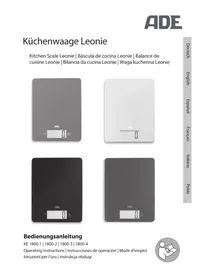
Leonie KE 18001 - Kitchen scales ADE - Free user manual and instructions
Find the device manual for free Leonie KE 18001 ADE in PDF.

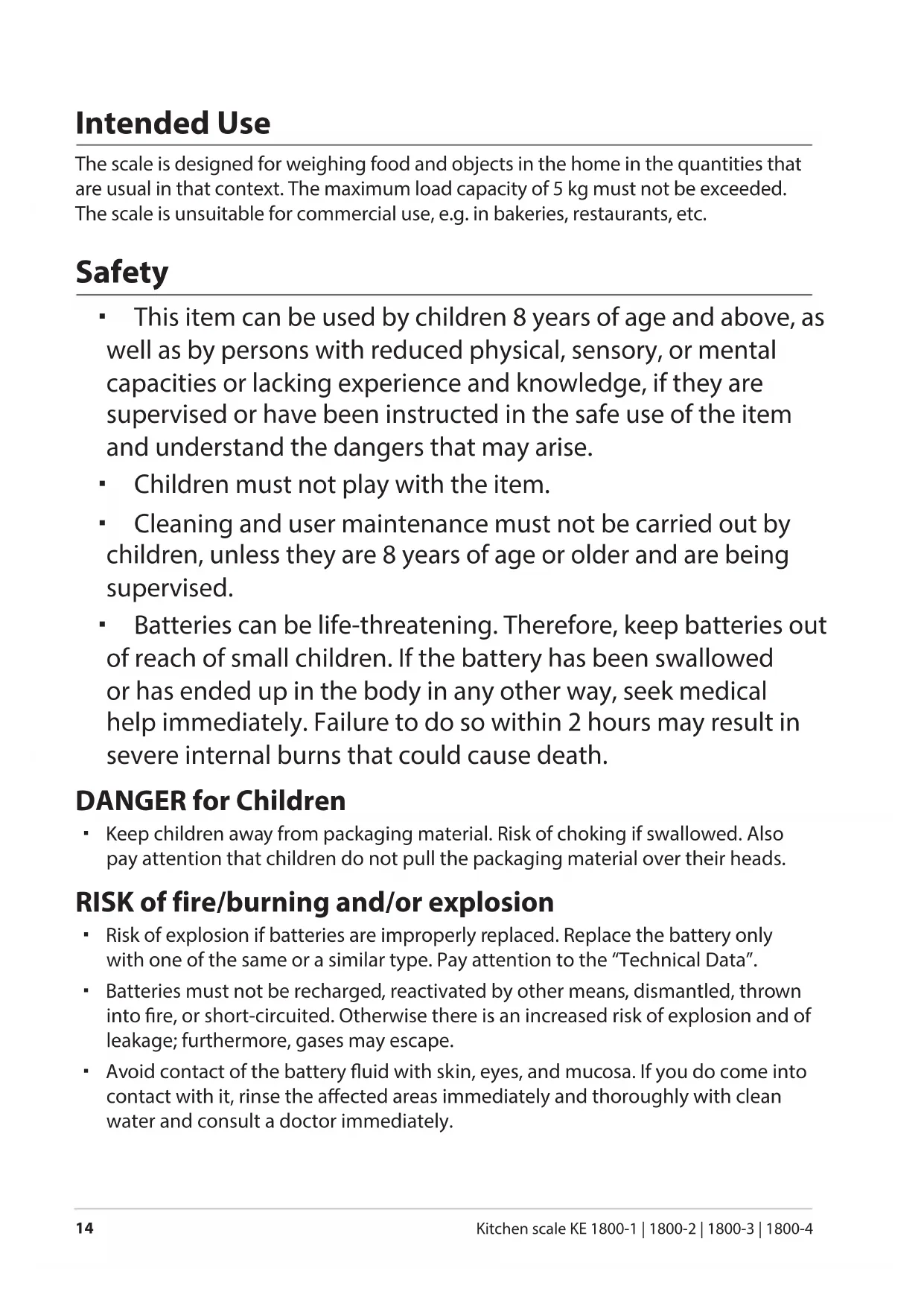


| Product Type | Kitchen Scale |
| Brand | ADE |
| Model | Leonie KE 18001 |
| Dimensions (L x W x H) | 170 x 220 x 9 mm |
| Weight | Approx. 370 g |
| Power Supply | 1 CR2032 battery / 3 V |
| Maximum Capacity | 5 kg |
| Accuracy | 1% +/- |
| Graduations | 1 g |
| Measurement Units | kg, g, oz, lb oz |
| Functions | Weighing, zero setting, tare, auto-off after 2 minutes |
| Power On | Press firmly on the weighing surface for 2 seconds |
| Child Safety | Can be used by children aged 8 and up under supervision |
| Cleaning | Soft damp cloth, do not immerse |
| Warranty | 2 years |
| Package Contents | Scale, CR2032 battery, instruction manual |
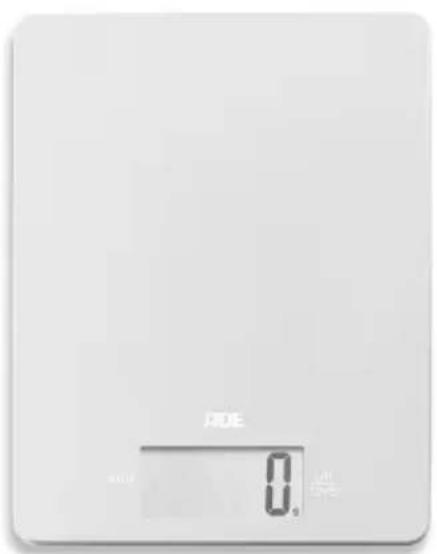
| Available Colors | Red, yellow, gray, black |
| Distributor | Waagen-Schmitt GmbH, Hamburg, Germany |
Frequently Asked Questions - Leonie KE 18001 ADE
User questions about Leonie KE 18001 ADE
0 question about this device. Answer the ones you know or ask your own.
Ask a new question about this device
Download the instructions for your Kitchen scales in PDF format for free! Find your manual Leonie KE 18001 - ADE and take your electronic device back in hand. On this page are published all the documents necessary for the use of your device. Leonie KE 18001 by ADE.
USER MANUAL Leonie KE 18001 ADE
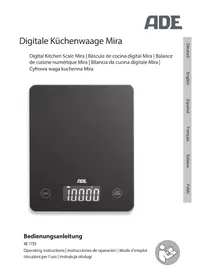
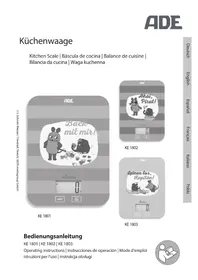
Bedienungsanleitung
KE 1800-1 | 1800-2 | 1800-3 | 1800-4
Operating instructions | Instrucciones de operación | Mode d'emploi Istruzioni per l'uso | Instrukcja obsługi

natural_image
Icon of a person using a laptop inside a circle (no text or symbols)22089 Hamburg, Germany
You have chosen to purchase a high-quality product from the ADE brand, which combines intelligent functions with an exceptional design. These kitchen scales are a practical companion for kitchen and household. The many years of experience of the ADE brand ensure a high technical standard and proven quality.
We hope you are happy with your scales and wish you success when weighing!
Your ADE Team
General Information
About this manual

This operating manual describes how to safely use and care for your products. Keep this operating manual in a safe place in case you would like to refer to it later. If you pass this item on to someone else, pass on this manual as well.
Failure to observe the recommendations in this operating manual can lead to injuries or damage to your product.
Explanation of symbols

This symbol, combined with the word DANGER, warns against serious injury.

This symbol, combined with the word WARNING, warns against moderate and mild injuries.

This symbol, combined with the word NOTE, warns against material damage.

This symbol signifies additional information and general advice.
Table of Contents
General Information....12
Intended Use....14
Safety 14
Overview 16
Scope of Delivery....16
Start-up 17
Removing iso-strips 17
Inserting/changing battery 17
Operation....18
Weighing....18
Resetting the scale to zero 18
Using the tare function (TARA)....18
Switching off the scale....18
Resetting the scale....19
Cleaning....19
Fault/Remedy....19
Technical Data 20
Declaration of Conformity....20
Warranty 20
Disposal....21
The scale is designed for weighing food and objects in the home in the quantities that are usual in that context. The maximum load capacity of 5 kg must not be exceeded.
The scale is unsuitable for commercial use, e.g. in bakeries, restaurants, etc.
Safety
- This item can be used by children 8 years of age and above, as well as by persons with reduced physical, sensory, or mental capacities or lacking experience and knowledge, if they are supervised or have been instructed in the safe use of the item and understand the dangers that may arise.
- Children must not play with the item.
- Cleaning and user maintenance must not be carried out by children, unless they are 8 years of age or older and are being supervised.
- Batteries can be life-threatening. Therefore, keep batteries out of reach of small children. If the battery has been swallowed or has ended up in the body in any other way, seek medical help immediately. Failure to do so within 2 hours may result in severe internal burns that could cause death.
DANGER for Children
- Keep children away from packaging material. Risk of choking if swallowed. Also pay attention that children do not pull the packaging material over their heads.
RISK of fire/burning and/or explosion
- Risk of explosion if batteries are improperly replaced. Replace the battery only with one of the same or a similar type. Pay attention to the "Technical Data".
- Batteries must not be recharged, reactivated by other means, dismantled, thrown into fire, or short-circuited. Otherwise there is an increased risk of explosion and of leakage; furthermore, gases may escape.
- Avoid contact of the battery fluid with skin, eyes, and mucosa. If you do come into contact with it, rinse the affected areas immediately and thoroughly with clean water and consult a doctor immediately.
BEWARE of material damage
- Place the scale on a stable, even surface.
- Do not overload the scale. Pay attention to the "Technical Data".
- Place objects on the scale exclusively for the purpose of weighing.
- Protect the scale from sharp jolts and vibrations.
- Remove the battery from the scale once it has been used or when you are no longer using the scale. You will thus avoid damage that may result from the leakage of battery acid.
- When inserting and changing batteries, pay attention to the correct polarity (+/-).
- Do not subject the battery to any extreme conditions, by – for example – storing it on radiators or under direct sunlight. Increased risk of leakage!
- Clean the battery and device contacts, as needed, before inserting the battery.
- Do not make any modifications to the item. Only allow repairs to be carried out at a specialist workshop. Repairs carried out incorrectly can considerably endanger the user.
- Do not place the scale in the vicinity of devices that emit electromagnetic radiation, such as mobile phones, wireless devices, and the like. This can lead to incorrect display indicators or malfunctions.
- Do not place any objects on the scale when you are – for example – storing them in a cupboard. The sensitive measuring electronics in the scale could be damaged by heavy objects.
- There are feet on the underside of the scale. Since surfaces are made from various materials and are treated with diverse care products, the possibility cannot be completely excluded that some of these substances contain ingredients that attack and soften the feet of the device. If necessary, place an anti-slip underlay beneath the scale.
Symbol on the scales
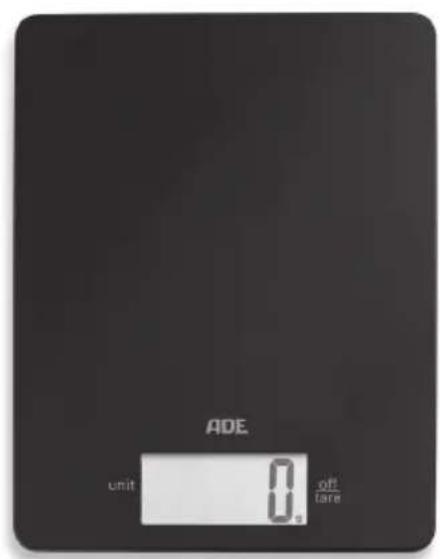
The scales switch on if you press on the weighing surface with a little force for 2 seconds.

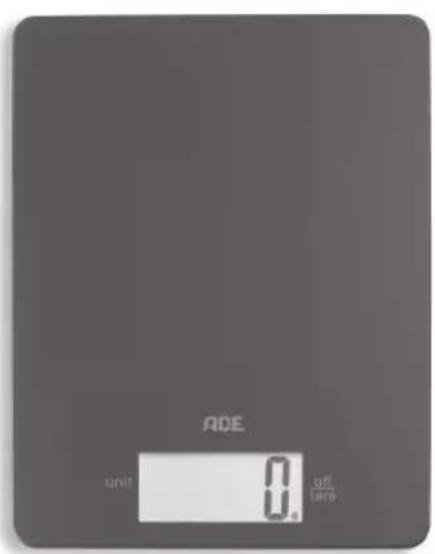
1 Battery compartment (underside)
2 Weighing surface
3 off tare: Switch off the scales, reset value (weighing function)
4 Display
5 unit: Choosing the unit of measurement
Scope of Delivery
- Kitchen scales
- Battery type CR2032, 3 ¥
- Operating Manual
Removing iso-strips
When the scale are delivered, the battery is already inserted and fitted with iso-strips to prevent it from discharging ahead of time. In order to start up the scale, you must remove the iso-strips. The battery compartment is located on the underside of the device.
- Slide the battery compartment cover slightly out of the scale.
- Pull out the iso-strips.
- Push the battery compartment cover back into place.
Inserting/changing battery
For use you require 1 battery of type CR2032, 3 V.
- Slide the battery compartment cover open to the outside.
- Remove the old battery.
- Slide the batteries against the contact springs under the large, square retaining tabs and then press them downwards. The battery will then snap under the opposite retaining lugs so that it sits firmly in its holder.
Pay attention to the correct polarity (+/-). The plus pole (+) must point upwards. - Slide the battery compartment cover fully open again.

Suggestions for changing the battery:
- Be sure to change the battery if the display shows "Lo" or nothing.
- Only use the type of battery that is specified in the "Technical Data".
- Dispose of batteries in an environmentally appropriate way (see "Disposal").
Weighing
- Place the scale on an even, firm, and dry surface. Carefully position the scale in order to avoid hard impacts to the sensors/feet and therefore to avoid damage.
- Switch on the scales by pressing with a little force on the weighing surface for 2 seconds..
- Choose the desired unit of measurement by repeatedly touching unit.
You can choose between "kg" (kilogramme), "g" (gramme), "oz" (ounce), and "lb" (pound). Pay attention to the indicator on the display.
- If you want to weigh something in a container, now place the container without anything in it onto the weighing surface. Otherwise, proceed as described in point 6.
- Press off tare. "0" is shown on the display.
- Put the substance to be weighed in the container or place it on the weighing surface. The measured weight is shown on the display.
- Read off the measured weight and remove the item or substance from the container or the weighing surface.
Resetting the scale to zero
If the display still shows a minus value (symbol) even though the weighing surface is empty (for example, if the scale is not optimally positioned or a TARE value is still displayed; see next section), you must reset the scale to zero.
- Briefly press off tare 1x.
Using the tare function (TARA)
This function is practical, for example, when baking, if you would like to add another ingredient to the ingredients already on the scale.
- Press off tare in order to set the scale back to "0".
The zero display will flash several times, followed by continuous display. The scale is ready.
- Add the new substance.
The weight of the added substance is shown on the display.
- Repeat the process whenever you want to add more ingredients. The process can be repeated as often as needed until the capacity limit (5 kg) is reached.
Switching off the scale
- Hold down off tare until the indicator on the display goes out.

The scale automatically switch off if they are not used for approx. 2 minutes.
Resetting the scale
Reset the scale to factory settings if unusual or obviously incorrect values are shown on the display.
- Remove the batteries from the battery compartment and wait a moment.
- Re-insert the batteries.
Pay attention to the correct polarity of the batteries (+/-). The plus pole (+) must point upwards.
After switching the scale on, you can start weighing as usual.
Cleaning

NOTE on material damage
-Do not immerse the scale in water or other liquids.
- Do not under any circumstances use harsh, scraping, or abrasive cleaning agents or the like to clean the scale. If you do, the surface could be scratched.
The scale should be cleaned immediately after use, especially if they have come into contact with fat or oil, spices, vinegar, and other strongly spiced and/or coloured foodstuffs.
- Wipe down the scale as needed using a lightly dampened, soft cloth. Avoid contact with citric acid.
Fault/Remedy
| Fault Possible Cause | |
| No function | Battery empty or inserted the wrong way around? |
| The scale appear to be displaying false weighing results. | Is the scale standing on a firm, even surface?Is a device that can cause electromagnetic disturbances located in the vicinity of the scale?Remove the battery from the scale and wait a moment. Reinsert the battery. |
| “EEEE” is shown on the display. | The maximum capacity of the scale (5 kg) has been exceeded. |
| “Lo” is shown on the display. | The battery is empty (see “Inserting/ changing the battery”). |
Model: Kitchen scale "Leonie", KE 1800-1 (red), KE 1800-2
(yellow), KE 1800-3 (grey), KE 1800-4 (black),
Battery: 1x CR2032/3 V

Rated current: < 3 mA
Measuring range: max. 5 kg
Variance: 1 % +/-
Indicator division: 1 g
Weight: approx. 370 g
Dimensions of scale: 170 x 220 x 9 mm
Distributor (no service address): Waagen-Schmitt GmbH
Hammer Steindamm 27-29
22089 Hamburg, Germany
Our products are constantly being developed and improved. For this reason, design and technical modifications are possible at any time.
Declaration of Conformity
Waagen-Schmitt GmbH hereby declares that the kitchen scale from KE 1800-1 to KE 1800-4 comply with EU directives 2014/30/EU and 2011/65/EU.
This declaration loses its validity if modifications are made to the product without our approval.
Hamburg, March 2019
Waagen-Schmitt GmbH

Warranty
The company Waagen-Schmitt GmbH guarantees for 2 years from the purchase date the cost-free rectification of defects on the basis of material or fabrication errors through repair or exchange.
In the event of a warranty claim, please return the product with the proof of purchase (stipulating the reason for claim) to your dealer.
Disposing of the packaging

Dispose of the packaging with similar materials. Put cardboard with waste paper, foil with recyclable materials.
Disposing of the product
Dispose of the product in accordance with the regulations that apply in your country.

Devices must not be disposed of in normal household waste
At the end of its life, the product must be disposed of in an appropriate way. In this way, valuable materials contained in the device will be recycled and the burden on the environment avoided. Hand in the old device at a collection point for electronic waste or at a recycling depot.
For more information, contact your local waste disposal firm or your local administrative body.

Recyclable and disposable batteries do not belong in household waste
All batteries must be handed in at a collection point in your community, suburb, or at the retailer. Such batteries can thus be disposed of in an environmentally friendly way.
- Bedienungsanleitung
- General Information
- About this manual
- Explanation of symbols
- Table of Contents
- Safety
- DANGER for Children
- RISK of fire/burning and/or explosion
- BEWARE of material damage
- Symbol on the scales
- Scope of Delivery
- Removing iso-strips
- Inserting/changing battery
- Weighing
- Resetting the scale to zero
- Using the tare function (TARA)
- Switching off the scale
- Resetting the scale
- Cleaning
- NOTE on material damage
- Fault/Remedy
- Declaration of Conformity
- Warranty
- Disposing of the packaging
- Disposing of the product
- Devices must not be disposed of in normal household waste
- Recyclable and disposable batteries do not belong in household waste
Brand : ADE
Model : Leonie KE 18001
Category : Kitchen scales