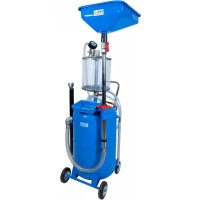
GOA 65 L - Industrial vacuum cleaner Güde - Free user manual and instructions
Find the device manual for free GOA 65 L Güde in PDF.



| Brand | Güde |
| Model | GOA 65 L |
| Product Type | Industrial oil vacuum |
| Tank Capacity | 65 L (estimated) |
| Power Supply | Compressed air (pneumatic) |
| Recommended Inlet Pressure | 3–5 bars |
| Maximum Vacuum Pressure | 0.5 bar |
| Maximum Oil Temperature | 20 °C |
| Main Functions | Oil suction, oil drainage, oil recovery |
| Recovery Tank | Rotating with integrated sieve |
| Level Gauge | With oil level indicator (plexiglass chamber) |
| Suction Probes Supplied | 3 probes: 2 flexible (Ø 6/8 mm), 1 metallic (Ø 6 mm), length 70 cm |
| Suction Hose | Length 1.4 m |
| Drain Hose | Length 2.0 m |
| Wheels | 2 fixed wheels + 2 swivel castors |
| Handle | Sliding |
| Manometer | Included for vacuum control |
| Maintenance and Cleaning | Clean regularly according to use; check tightness of connections and seals |
| Safety | Wear safety glasses, gloves, safety shoes; do not use in explosive atmospheres |
| Spare Parts and Repairability | Use only original parts; contact customer service for repairs |
| Minimum User Age | 16 years |
Frequently Asked Questions - GOA 65 L Güde
User questions about GOA 65 L Güde
0 question about this device. Answer the ones you know or ask your own.
Ask a new question about this device
Download the instructions for your Industrial vacuum cleaner in PDF format for free! Find your manual GOA 65 L - Güde and take your electronic device back in hand. On this page are published all the documents necessary for the use of your device. GOA 65 L by Güde.
USER MANUAL GOA 65 L Güde
natural_image
Icon of an open book inside a black circle (no text or symbols)Deutsch D - 3-6
Translation of original operating instructions
Masonry chaser
Français F - 11-14
EC-DECLARATION OF CONFORMITY
natural_image
Line drawing of a vacuum cleaner with a funnel and control panel (no text or symbols)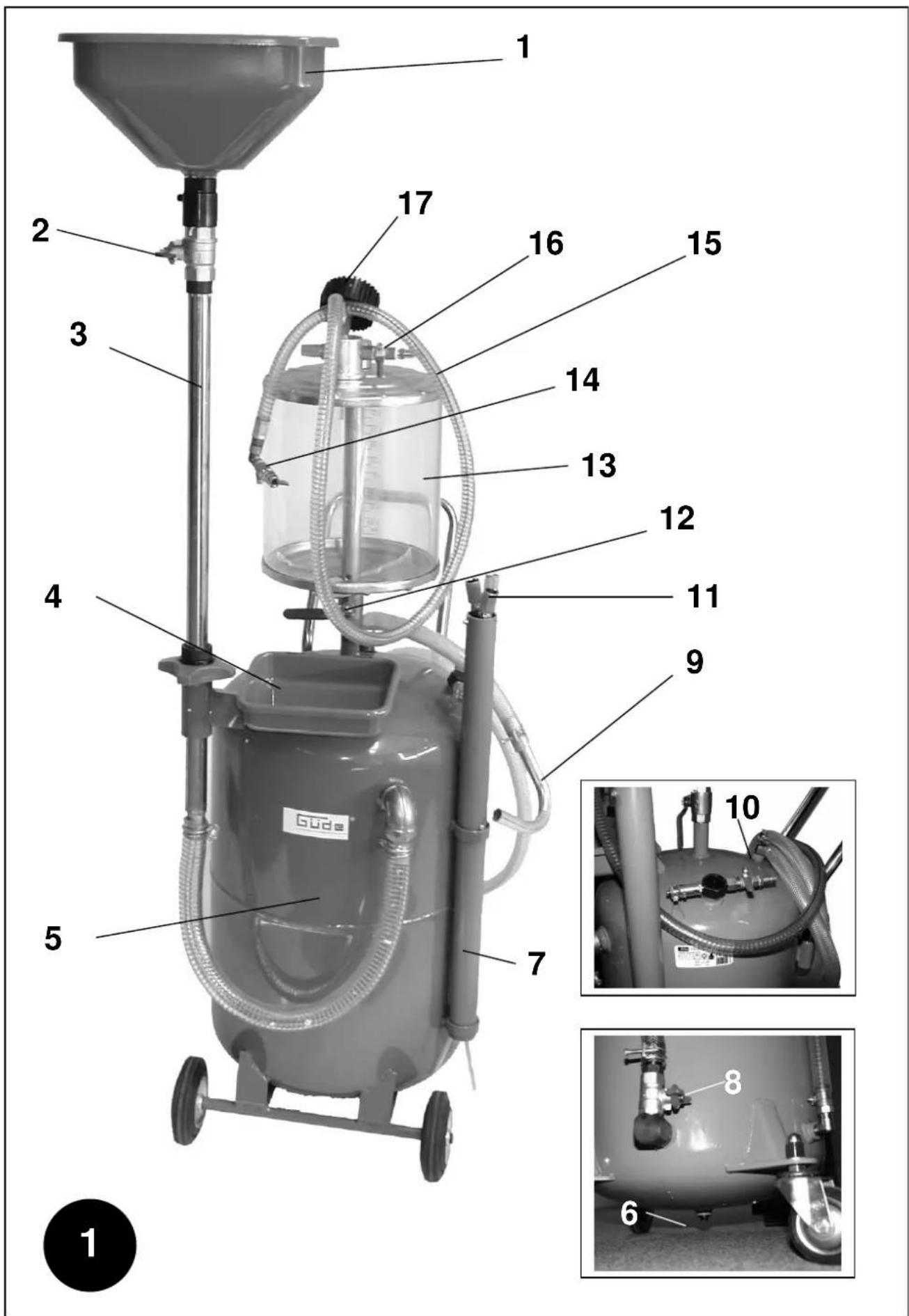
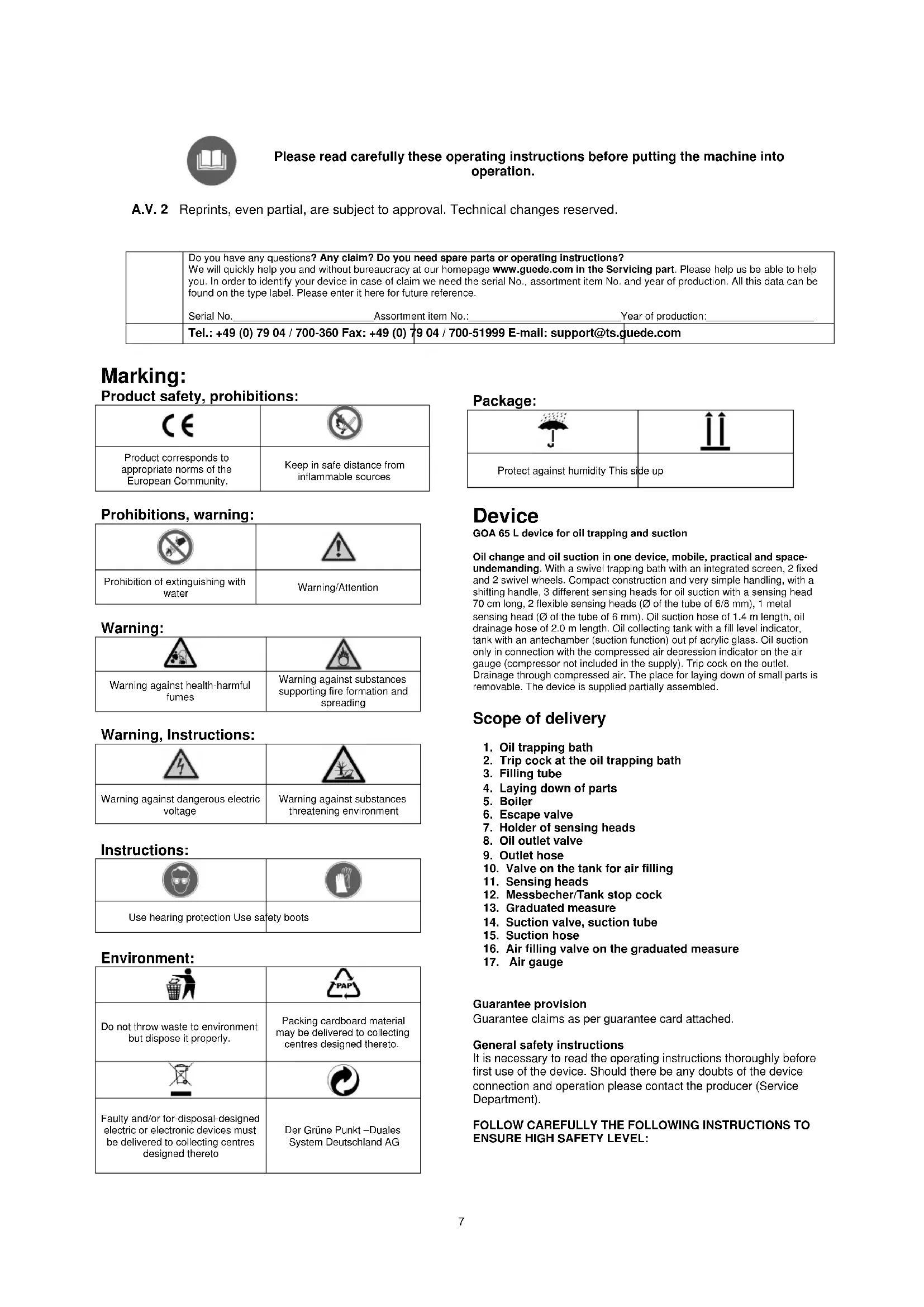
A.V. 2 Reprints, even partial, are subject to approval. Technical changes reserved.
| Do you have any questions? Any claim? Do you need spare parts or operating instructions?We will quickly help you and without bureaucracy at our homepagewww.guede.com in the Servicing part. Please help us be able to help you. In order to identify your device in case of claim we need the serial No., assortment item No. and year of production. All this data can be found on the type label. Please enter it here for future reference.Serial No._Assortment item No.: Year of production:_ | ||
| Tel.: +49 (0) 79 04 / 700-360 Fax: +49 (0) 79 04 / 700-51999 E-mail: support@ts.guede.com | ||
Marking:
Product safety, prohibitions:
| CE | |
| Product corresponds to appropriate norms of the European Community. | Keep in safe distance from inflammable sources |
Prohibitions, warning:
| Prohibition of extinguishing with water | Warning/Attention |
Warning:
| Warning against health-harmful fumes | Warning against substances supporting fire formation and spreading |
Warning, Instructions:
| Warning against dangerous electric voltage | Warning against substances threatening environment |
Instructions:
| Use hearing protection Use safety boots | |
Environment:
 |  | |||
| Do not throw waste to environment but dispose it properly. | Packing cardboard material may be delivered to collecting centres designed thereto. | |||
 | [wcxG] | |||
| Faulty and/or for-disposal-designed electric or electronic devices must be delivered to collecting centres designed thereto | Der Grüne Punkt –Duales System Deutschland AG | |||
Package:
 |  | ||
| Protect against humidity This side up | |||
Device
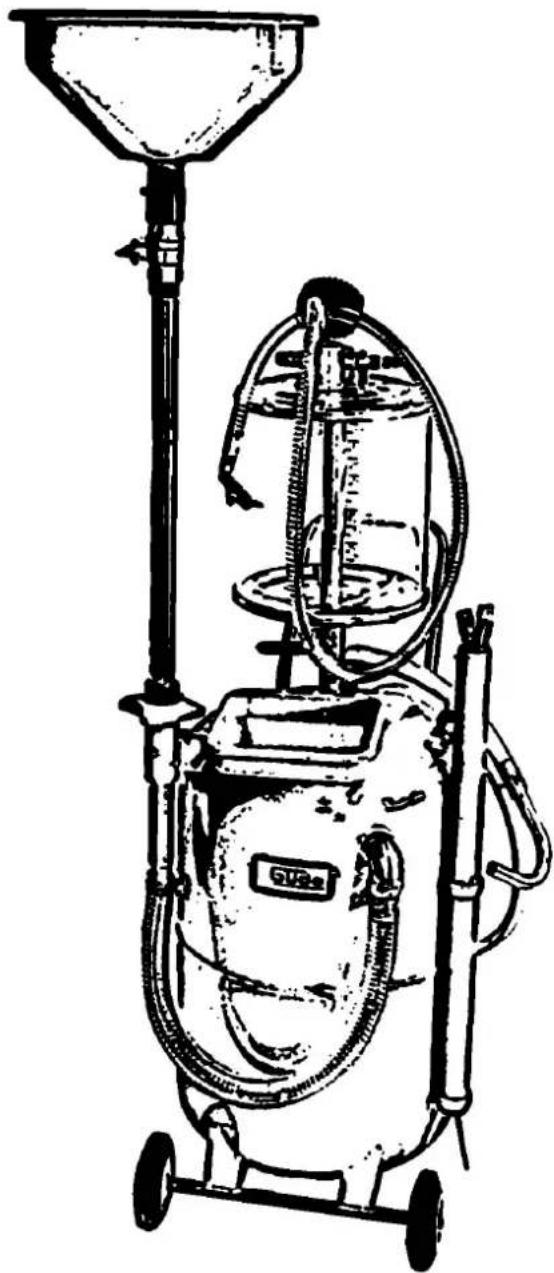
GOA 65 L device for oil trapping and suction
Oil change and oil suction in one device, mobile, practical and space-undemanding. With a swivel trapping bath with an integrated screen, 2 fixed and 2 swivel wheels. Compact construction and very simple handling, with a shifting handle, 3 different sensing heads for oil suction with a sensing head 70 cm long, 2 flexible sensing heads (∅ of the tube of 6/8 mm), 1 metal sensing head (∅ of the tube of 6 mm). Oil suction hose of 1.4 m length, oil drainage hose of 2.0 m length. Oil collecting tank with a fill level indicator, tank with an antechamber (suction function) out pf acrylic glass. Oil suction only in connection with the compressed air depression indicator on the air gauge (compressor not included in the supply). Trip cock on the outlet. Drainage through compressed air. The place for laying down of small parts is removable. The device is supplied partially assembled.
Scope of delivery
- Oil trapping bath
- Trip cock at the oil trapping bath
- Filling tube
- Laying down of parts
- Boiler
- Escape valve
- Holder of sensing heads
- Oil outlet valve
- Outlet hose
- Valve on the tank for air filling
- Sensing heads
- Messbecher/Tank stop cock
- Graduated measure
- Suction valve, suction tube
- Suction hose
- Air filling valve on the graduated measure
- Air gauge
Guarantee provision
Guarantee claims as per guarantee card attached.
General safety instructions
It is necessary to read the operating instructions thoroughly before first use of the device. Should there be any doubts of the device connection and operation please contact the producer (Service Department).
FOLLOW CAREFULLY THE FOLLOWING INSTRUCTIONS TO ENSURE HIGH SAFETY LEVEL:

Attention:
- Check the completeness, functionality and tightness before putting the device into operation!
- Never put a faulty or functionless device into operation!
- Contact the producer or have the device checked by a qualified mechanic.
• Always work with necessary caution and care!
- Do not use excessive force in any case!
- Use the suction device only in well-ventilated rooms.
- Do not inhale health-dangerous fumes!
- Do not smoke near the device!
- Do not operate the device near heat sources such as heating bodies and open fire sources or near flying sparks.
- Use suitable safety clothes, e.g. safety gloves, safety boots, protective glasses, etc. at all works with the device.
- Keep your workplace clean and tidy. Workplaces and work-tables not properly maintained increase the risk of accidents and injuries.
- Pay attention to surrounding conditions you work in. Do not use any electric tools and machine tools in a humid or wet environment. Ensure sufficient lighting. Do not expose the tools to rain or high air humidity. Do not switch the device on in an environment with easily flammable liquids or gases.
- Do not let foreign persons come near the device. Visitors and spectators, especially children and ill persons, should remain in a safe distance from the workplace.
- Ensure safe storing of devices. Tools that are not used must be stored at a dry and as high as possible place or they must be stored at an inaccessible place.
- Always use correct tools for each work. Do not use e.g. any small tools or accessories for works that must be executed with heavy equipment. Use tools explicitly for purposes they have been designed to. Do not overload the device!
- Avoid unintentional device switch-on.
- Pay attention to damaged parts. Check the device before use. Are there any parts damaged? At small damage consider whether the device will work perfectly and safely despite this small damage.
- Use only approved construction parts. Use only identical spare parts at maintenance and repair. Contact an approved service centre for spare parts.
- Warning! Use of accessories and extensions not explicitly recommended in these instructions may result in a threat to persons and objects.
Safety instructions for first putting into operation
• Device operation is prohibited to children.
- After unpacking check whether the device and all its parts are in a perfect state.
• Always wear protective glasses, protective gloves and protective boots
Always wear protective glasses, protective gloves and protective boots. Never turn the suction or outlet hose towards your body or other persons or animals. The sucked liquid could be health-harmful (follow the producer's safety list instructions).
- Putting the device out of operation
Disconnect the device from pneumatic energy source, carefully release the working pressure and all liquid from the device before any works relating to repairs, inspection, maintenance, cleaning or change of construction parts (use suitable containers or original packages).
- Unintentional device switch-on
Do not transport the device when connected to power source (compressed air) or when filled.
• Proper storing of the device
When the device is not used it must be disconnected from the power network, stored at a dry place where it is also protected against weather conditions. The device must be stored out of reach of children.
- Working clothes
Do not wear a loose clothes or jewellery as they could get caught to device parts or working liquids.

• Careful maintenance of the machine
It is necessary to thoroughly clean the device according to load. The device could be damaged by sediments.
The pressure guidance needs to be regularly checked. If damaged, the device must be immediately repaired by the customer service shop. It is necessary to ensure the device exterior showed no visible damage. You can also contact the nearest customer service shop.
- Attention
Work carefully and use common sense. Do not use the device when you are tired. The device must never be used if the user is impaired or intoxicated and thus tired.
- Check any faulty and untight construction parts
If the protective equipment or any other construction parts have been damaged the device must be checked before putting the device into operation to ensure safe operation.
All damaged construction parts must be repaired, replaced or exchanged by the customer service as described in the operating instructions.
- Correct use of the device
Follow all instructions specified in the manual when operating the device. Prevent children or persons not familiarised with the device working from using the device.
- Do not operate the device unattended.
- Do not use the device if faulty.
If the device makes any weird sounds or has strong vibrations or if it seems to be faulty during work it must be immediately switched off; the reason needs to be identified by the nearest customer service shop.
- Use exclusively original spare parts
When spare parts from other producers are used the claim to guarantee provision expires and such use of spare parts from other producers may lead to device failure. The original spare parts are available at contract dealers.
- Do not make any alterations to the device
Do not make any alterations to the device. Contact the customer service shop for any sort of repairs. Any non-approved alteration may negatively influence the device output, cause serious injury if the alteration is made by persons without necessary technical skills.
Do not leave the device switched on unattended as it could become a source of danger.
If the safety or protective equipment is repaired, they must be properly fitted in after the repair is finished.
- It is absolutely necessary to know the occupational health and safety regulations valid at the appropriate place of use as well as all other generally recognised safety rules.
- You must unconditionally check the safety equipment before using the device. Make sure the only slightly damaged parts really work as they should.
- If not provided otherwise in these operating instructions the damaged parts and safety equipment must be repaired or replaced by an authorised service centre.
- Have any damaged switches, etc. replaced by an authorised service centre.
- The device corresponds to appropriate safety provisions. Repairs may only be carried out by qualified staff in an authorised service centre using original spare parts failing which there is a risk of injury.
Behaviour in case of emergency
Introduce the first aid measure corresponding to the injury and ask for a qualified medical help as quickly as possible.
Secure the injured person against other harms and bring him/her to peace.
Use in accordance with provisions
The machine corresponds to valid EC Directives for machines
• The machine has been designed according to the technology state and safety technological rules. Despite this fact there may be risks for health and life of the user or third parties or the device and other tangible parts may negatively be affected.
- Use the machine only in a technically perfect state and in accordance with provisions for machine operation with respecting the safety importance and existing dangers in the given field of activity! It is especially necessary to immediately remove (or have removed) faults that could negatively influence the safety!
- The device is only designed for engine oil suction at maximum temperature of 20^ .
- Any use outside the frame of the given use is evaluated as not corresponding to the appropriate provisions. The producer does not warrant for damages caused by incorrect use; the risk is in this case bore by the user only.
- Safety and working regulations and maintenance regulations issued by the producer including dimensions stated in the Technical Data need to be observed.
- Appropriate regulations for occupational health and also other generally recognised safety technical rules must be respected.
- The device may only be used, maintained or repaired by persons well familiarised with the device and instructed of all dangers connected therewith. Alterations made wilfully on the machine eliminate producer's warranty for damages caused by such acting.
- The device may only be used with original accessories from the device producer.
Unreasonable local lighting. Faulty lighting represents a high safety risk.
Always ensure sufficient lighting at works with the device.
Disposal
The disposal instructions are based on icons placed on the device or its package. Description of their meaning can be found in the "Marking".
Requirements for operator
The operator should carefully read the operating instructions before use of the device.
Qualification
No special qualification is needed for use of the device apart from detailed training by a qualified person.
Minimum age
The device may only be operated by persons of minimum 16 years of age.
An exception is device use by a youngster during job preparation when the device is used in order to obtain necessary skills under supervision of the trainer.
Transportation and storing
The device must be stored in a thorough state and outside of reach of unauthorised persons at longer storing.
The device must never be stored or transported lying or being filled.
Assembly / First putting into operation
-
Assemble the device according to the scheme drawing with all joints correctly tightened with a strip sealant or sealing cement.
-
Make sure all joints are tight.
-
Ensure the air supply tube attached in the upper part of the measuring housing to the gladhand must be connected with the oil filter and air regulator. Before you carry out the test turn the globe valve handle to a horizontal position, disconnect the suction valve, connect the pipe tubes for air distribution with the gladhand, adjust the input air pressure – the air gauge indicator starts to move. As soon as the indicator reaches 5 bar disconnect the air supply valve at the top of the measuring housing and keep the pressure for one hour. Check the air gauge. If it shows consistent pressure the equipment is tightened correctly.
-
Switch the equipment off:
-
air supply valve in the upper part of the tank,
-
oil drainage hose valve,
-
valve under oil bath.
-
Turn the valve lever under the measuring housing to a vertical position. Open the valve in the upper part of the measuring housing, keep the air supply open for 3 – 5 minutes and check the pressure value variance. The pressure should not be lower than 5.5 bar. Keep that pressure for one hour. Should the pressure indicated on the air gauge change everything is all right.
Oil suction
-
Choose dimension of the suction nozzle according to your needs. There are 2 nozzles with a diameter of 6 mm or 1 nozzle with a diameter of 8 mm available.
-
Use lubricant for tightening of the suction cover rubber ring.
-
Insert the suction cover of the suction valve from the suction tube (14) to the gladhand of the sensing head selected (11).
-
Close all valves (16,2,14,12,10,8), connect the air supply gladhand on the upper valve (16) of the measuring house, connect the valve (16) of the air supply and adjust the input air pressure to appropriate value of (3 - 5) bar. The vacuum state size will always be adjusted according to needs of the operating staff. The maximum vacuum value should not be higher than 0.5 bar. You may empty the air or disconnect the air supply or delay (disconnect) the oil suction during oil suction. Switch on the valve (14) of the oil suction ducting, the oil will be sucked to the tank (13). Monitor the oil level state in the measuring housing. The oil level should not exceed the STOP position.
-
Oil flow (drainage) from the measuring housing to the oil tank. First of all, close all valves.
Open the valve (12) under the measuring housing. The oil will flow from the measuring housing to the oil tank. In order to make the procedure faster you may (10) carefully open the valve so that the tank vented.
Oil drainage
-
Make sure you close all valves before oil draining.
-
Shift the steel pipe knee (9) for oil ducting to the oil tank hole. Open the valve for oil drainage (8) under the tank.
-
Close the valve (2) under the oil bath.
-
Connect the pipe for air supply (connection of pressure regulator is necessary) to the valve (10) in the upper part of the tank, adjust the air pressure from the compressor to 0.5 bar, open the valve for air suction (10) (air supply) and the oil will empty to the oil storing tank.
Oil collection
-
Close all valves, open the valve (2) under the oil bath and air valve (10) in the upper part of the tank, adjust the oil bath to a suitable height, shift the equipment to a position under the device the oil is drained from.
-
Open the oil bath and drain the oil (identical vertical position).
Troubles, Cause, Troubleshooting
| Troubles Cause Troubleshooting | ||
| No vacuum is generated. Air escape. | The ball on the valve seat is corroded. | First check the storing container whether the air is emptied there. If it is not the case check the sealing. If air escapes at the sealing tighten the connected auxiliary part or replace the sealing. If the ball is corroded then replace the entire unit.All valves should be closed at checking. |
| The pressure control valve indicator quickly drops after vacuum has been generated. | Air escape. See points described above. | |
| The air gauge shows sufficient depression but the oil is not sucked. | The rubber ring from the oil suction connection is worn.The oil suction sensing head is damaged.Oil temperature is too low.Check the oil suction valve whether it is all right.Check the oil suction ducting whether it is not damaged. | Replace the packing ring on the suction hose.Replace the cover of the oil suction sensing head.Wait until the temperature gets to normal levels.Open the valve on the oil suction ducting.If the ducting is clogged clean it out. |

EC-Declaration of Conformity
We, hereby declare the conception and construction of the below mentioned appliances correspond - at the type of construction being launched - to appropriate basic safety and hygienic requirements of EC Directives. In case of any change to the appliance not discussed with us the Declaration expires.
Declaration CE de conformité



- Marking:
- Device
- Scope of delivery
- Guarantee provision
- General safety instructions
- FOLLOW CAREFULLY THE FOLLOWING INSTRUCTIONS TO ENSURE HIGH SAFETY LEVEL:
- Attention:
- Safety instructions for first putting into operation
- • Always wear protective glasses, protective gloves and protective boots
- - Putting the device out of operation
- - Unintentional device switch-on
- • Proper storing of the device
- - Working clothes
- • Careful maintenance of the machine
- - Attention
- - Check any faulty and untight construction parts
- - Correct use of the device
- - Do not operate the device unattended.
- - Do not use the device if faulty.
- - Use exclusively original spare parts
- - Do not make any alterations to the device
- Behaviour in case of emergency
- Use in accordance with provisions
- The machine corresponds to valid EC Directives for machines
- Unreasonable local lighting. Faulty lighting represents a high safety risk.
- Disposal
- Requirements for operator
- Qualification
- Minimum age
- Transportation and storing
- Assembly / First putting into operation
- Oil suction
- Oil drainage
- Oil collection
- EC-Declaration of Conformity
- Declaration CE de conformité
Brand : Güde
Model : GOA 65 L
Category : Industrial vacuum cleaner