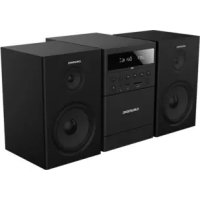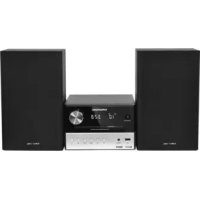
CMS 3000 BT DAB - Hi-Fi System GRUNDIG - Free user manual and instructions
Find the device manual for free CMS 3000 BT DAB GRUNDIG in PDF.



| Product type | Hi-Fi system with CD player, FM/DAB+ radio, Bluetooth, and USB port |
| Brand | Grundig |
| Model | CMS 3000 BT DAB |
| Device dimensions (W x H x D) | 180 x 121 x 231 mm |
| Device weight | 1.67 kg |
| Speaker dimensions (W x H x D) | 155 x 129 x 254 mm |
| Speaker weight | 1.07 kg |
| Power supply | 220-240 V~, 50/60 Hz, nominal consumption 20 W, standby ≤1 W |
| Output power | 2 x 15 W sinusoidal, impedance 4 Ω |
| FM tuner | Range 87.5 - 108 MHz, RDS |
| DAB/DAB+ tuner | Range 174.928 - 239.200 MHz |
| Bluetooth | Version A2DP, range up to 9 m, frequency 2402-2480 MHz, max. emitted power 2.05 dBm |
| CD player | Audio CD, CD-R/RW MP3/WMA, max. 99 folders and 999 tracks |
| USB port | USB 2.0 type A, FAT32/16, charging 5V 1A |
| Auxiliary audio input | 3.5 mm jack (AUDIO IN) |
| Remote control | Yes, with AAA batteries (2 x 1.5 V) |
| Main functions | FM/DAB+ radio, Bluetooth, CD, USB, alarm, sleep timer, clock, preset equalizer |
| Cleaning and maintenance | Disconnect before cleaning, use a soft dry cloth; do not use liquids or sprays |
| Safety | Class 1 laser, avoid exposure to water and heat, do not block ventilation |
| Repairability and spare parts | Do not open the casing; contact customer service for repairs |
| General information | Compliant with WEEE and RoHS, CE declaration available at www.grundig.com |
Frequently Asked Questions - CMS 3000 BT DAB GRUNDIG
User questions about CMS 3000 BT DAB GRUNDIG
0 question about this device. Answer the ones you know or ask your own.
Ask a new question about this device
Download the instructions for your Hi-Fi System in PDF format for free! Find your manual CMS 3000 BT DAB - GRUNDIG and take your electronic device back in hand. On this page are published all the documents necessary for the use of your device. CMS 3000 BT DAB by GRUNDIG.
USER MANUAL CMS 3000 BT DAB GRUNDIG
natural_image
Black musical note symbol on white background (no text or numbers)CMS 3000 BT DAB+
CMS 1050 BT DAB+
M 1050 BT DAB+ W
DE - EN - FR
text_image
GRUNDIG A GRUNDIG Connected Audio Home System AUDIO IN B ▶ II SPEAKER OUT + R- + L - DAB ANTENNA S/N: L AC ~DEUTSCH 03-21
ENGLISH 22-35
FRENCH 36-51
text_image
COMPACT disc DIGITAL AUDIOFM 87,5 ...108,0 MHz
CLASS 1 LASER PRODUCT
Please note the following instructions:
■ The hi-fi system is designed for the playback of audio signals. All other uses are expressly prohibited.
If you want to set up the hi-fi system on wall shelves or in cupboards, please ensure that it is adequately ventilated. There must be at least 10 cm of space at the side, above and behind the hi-fi system.
- Do not cover the hi-fi system with newspapers, table cloths, curtains, etc.
- When setting up the hi-fi system, remember that furniture is often coated with various types of varnish and plastic, which often contain chemical additives. These additives may cause corrosion to the feet of the unit. This may leave stains on the surface of the furniture which can be difficult or impossible to remove.
If the hi-fi system is exposed to sudden changes in temperature, for example when taken from the cold into a warm room, wait at least two hours before using it.
■ The hi-fi system is designed for use in dry rooms. If you do use it outdoors, make sure it is protected from moisture such as dripping or splashing water.
■ Only use the hi-fi system in a moderate climate.
- Do not place the hi-fi system close to heating units or in direct sunlight, as this will impair cooling.
- Do not place any vessels containing liquids, such as vases, on the hi-fi system.
- Do not insert any foreign objects in the CD compartment.
- Do not place any objects such as burning candles on the hi-fi system.
If malfunctions occur due to brief mains overloads or static electricity charges, reset the device. To do this, pull out the power plug and connect it again after a few seconds.
- Do not open the hi-fi system casing under any circumstances. Warranty claims are excluded for damage resulting from improper handling.
■ Thunderstorms are a danger to all electrical devices. Even if the hi-fi system is switched off, it can be damaged by a lightning strike to the mains. Always remove the power plug during a thunder storm.
- Do not expose the battery to extreme heat, such as for example sunlight, radiators, fire, etc.
Note:
- Do not connect any other equipment while the device is switched on. Also switch off the other equipment before connecting it.
- Only plug the device into the mains socket after you have connected the external devices. Make sure the mains plug is freely accessible.
Caution: high-frequency radiation
The device must be registered and operated in accordance with this operating manual. The device has an integrated antenna; it must be operated with other antennas or transmitters.
The hi-fi system controls
See the figure on page 3.
The front of the device
A The hi-fi system displays.
Press briefly to switch the device in and out of standby mode.
Press to activate CLOCK mode.
VOLUME Adjusts the audio volume.
B CD compartment.

USB port type A for connecting a USB memory stick or an MP3 player.
AUDIO IN Audio signal input (Audio In) for connecting an external device.
In external data media mode: starts and pauses playback.
In external data media mode: ends playback.
In tuner mode: press to start auto scan.
In tuner mode: press briefly to change the pre set stations down. In external data media mode: reverse track selection; press and hold down to search for a certain passage back wards.
▶▶▶▶ In tuner mode: press briefly to change the pre set stations up. In external data media mode: forward track selection, press and hold down to search for a certain passage forwards.

Selects the input sources Tuner, Bluetooth, AUDIO IN, Disc and USB, DAB

Opens and closes the CD compartment.
The back of the device
SPEAKER Terminals for connecting the OUTPUT (4 Ω) loudspeaker cables. + R- + L - R = right channel, L = left channel.
DAB ANTENNA Antenna socket for the auxiliary antenna or the roof antenna supplied.
AC \~ Socket for mains cable.
Note:
■ The only way to completely disconnect the hi-fi system from the mains supply is to pull out the plug.
The remote control
Switches the hi-fi system to standby mode and from standby mode to the last input source selected.
SLEEP Activates sleep timer mode, sets the time for the sleep timer.
▲ Opens and closes the CD compartment.
INTRO In external data media mode: for playing brief introductions to tracks.
Selects the input sources Tuner, Bluetooth, AUDIO IN, Disc and USB, DAB
INFO In tuner mode: opens RDS information. In external data media mode: switches the display between the current track number and the elapsed playing time and displays the ID3 tag information, if available.
REP In external data media mode: to repeat a track, the CD, the album or the playlist; plays back tracks in random order
EQ Selects different sounds settings.
Press briefly to change the preset stations down. In external data media mode: reverse track selection; press and hold down to search for a certain passage back wards. In standby and timer mode: for setting the hours.
▶II In external data media mode and in Bluetooth mode: starts play back; pauses playback.
Press briefly to change preset stations up. In external data media mode: forward track selection, press and hold down to search for a certain passage forwards. In standby and timer mode: for setting the minutes.
TUN - +
10 - + In tuner mode: press and hold down to start the reverse or forwards frequency search; press briefly to change the frequency backwards or forwards in steps. In external data media mode: press briefly to select the track in 10 steps.
In external data media mode: ends playback.
FOLD - + In external data media mode: select albums
MEMORY PROG
In tuner mode: activates the memory function; saves radio stations to presets.
In external data media mode: activates the Create playlist function; stores the track when creating a playlist.
- VOL + Adjust the volume.
CLOCK In standby mode: for setting the hours/minutes.
ALARM In tuner mode:
Switches the hi-fi system speakers to and from mute mode. In external data media mode: Switches the hi-fi system speakers to and from mute mode. In timer mode: for setting the alarm.
Connecting the loudspeakers
1 Insert the wires of the loudspeaker cable into the »SPEAKER OUTPUT (4 Ω) R L« fasteners on the hi-fi system.
Note:
- Observe the left and right channels (L = left channel, R = right channel).
Connecting the antenna
1 Plug the roof antenna cable into the antenna socket »FM ANTENNA« on the hi-fi system.
Note:
If no roof antenna is available, use the auxiliary antenna supplied. When suitably positioned and with adequate signal, this antenna provides adequate reception of FM channels. Do not shorten the auxiliary antenna.
Connecting an MP3 player or a USB memory stick
Caution:
■ The hi-fi system must be switched off while the USB connection is being made. If it is not switched off, data can be lost.
1 Connect the USB interface of the MP3 player to the »« socket of the hi-fi system with a standard USB cable;
or
insert the USB plug of the USB memory stick into the USB interface » « of the hi-fi system.
Connecting external devices
Note:
■ Switch the hi-fi system off before you connect external devices.
1 Use standard audio cables (3,5mm) to connect the audio outputs of the external device to the »AUDIO IN« sockets on the hi-fi system.
Connecting the power cord
Notes:
- Check that the mains voltage on the type plate (on the bottom of the hi-fi system) corresponds to your local mains supply. If this is not the case, contact your specialist dealer.
■ All the other devices/loudspeakers must be connected before you connect the power cord.
1 Plug the power cord into the wall socket.
Caution:
■ The hi-fi system is connected to the mains with the power cord. Pull out the power plug if you want to completely disconnect the hi-fi system from the mains.
■ Make sure the power plug is easily accessible during operation and not hindered by other objects.
Activating the battery in the remote control
1 Open the battery compartment by pressing down on the catch and then remove the lid.
2 Observe the polarity marked on the base of the battery compartment when inserting the batteries (micro batteries, 1 x 1.5 V, R 03/UM 4/AAA).
3 Close the battery compartment.
Notes:
- Do not expose the batteries to extreme heat, caused for example by direct sunlight, heaters or fire.
■ Remove the batteries when they are flat or when you know that the hi-fi system will not be used for a long period of time. The manufacturer accepts no liability for damage caused by leaking batteries.
Environmental note:
■ Batteries, including those which do not contain heavy metal, should not be disposed of with household waste. Always dispose of used batteries in accordance with local environmental regulations.
Switching on and off
The only way to disconnect the hi-fi system from the mains supply is to pull out the plug.
1 Switch on the hi-fi by pressing »♡«.
- The last input source used is automatically selected.
2 Switch the hi-fi system to standby mode by pressing »♡«.
CLOCK mode
The hi-fi system switches to standby in the CLOCK-mode after 15 minutes. This lowers the power consumption to below 1 W.
Automatic Standby
The device switches to standby mode automatically after 15 minutes if:
- the device is in the stop position;
- there is no audio signal detected at the »AUDIO IN« socket;
- the Bluetooth auxiliary devices is not sending an audio signal.
To use the device, switch it back on.
Adjusting the volume
1 Turn the control knob on the hi-fi system or press »- VOL +« on the remote control to change the volume.
Selecting sound settings
You can choose between preset sound settings.
1 Select the sound setting using »EQ« on the remote control.
Muting
You can switch the hi-fi speakers to and from mute mode with this function.
1 Activate mute with » « on the remote control.
2 Deactivate mute with » « on the remote control.
Displaying the time
1 Display the time with »CLOCK« on the remote control.
Automatic station search for FM radio stations
1 Switch on the hi-fi system by pressing »◀«.
- The device searches for up to 40 stations with strong reception and stores them automatically. After the search has finished, you will hear the station stored at preset 01.
Notes:
- You can cancel the automatic station search by pressing »■«.
■ You can restart the automatic station search by pressing briefly »AUTO« until the frequency display changes to rapid run-through.
Setting and storing radio stations manually
1 Set the radio station by briefly pressing » TUNE+ « or » TUNE- « repeatedly.
- Display: the frequency changes in steps of 50 kHz;
or
press and hold down » TUNE+ « or » TUNE-« until the frequency changes to rapid run-through.
2 Once find a favorite radio station, long press » MEMORY/PROG « button 3 seconds. Raadio preset is starting from 01
3 Select preset station number from 01 to 40 by press » TUNE + / TUN - « and then press » PLAY/PAUSE « to confirm. » STORED « word is displayed on the screen.
4 Repeat step 1,2 to complete more radio storage.
Displaying RDS station information
If the device receives an RDS station, the station name appears in the display together with »RDS«. If no information is available, the reception frequency appears in the display.
Additional information can be displayed.
1 To display information on the current RDS station, press »INFO« repeatedly.
- The following displays appear in sequence: The name of the radio station. The current programme type (PTY), e.g. »Pop music«. »[No PTY]« appears if information is not available. The time. The radio text. The frequency.
DAB Operation
Digital Audio Broadcasting (DAB) is a way of broadcasting radio digitally through a network of transmitter. It provides you with more choice, better sound quality and more information.
1 Press »→« repeatedly to select the DAB source.
2 In DAB mode, press » REPEAT/MENU « button to access DAB menu, press » ▶ II « to confirm menu operation.
- Full scan: Scan and store all the available DAB radio stations.
- Manual: Tune to a DAB station manually.
- Prune: Remove all the invalid stations from the station list.
- System: Adjust system settings.
4 To select an option, press »▶II« to confirm.
5 To tune to a station from the available station list, press » TUN - 10- « or » TUN+ 10+ « repeatedly to navigate through the available stations in DAB mode.
6 Press repeatedly » INFO « to show different DAB information in DAB mode.
7 Save a station as a preset by long pressing » MEMORY/PROG «, selecting the preset with »TUN+/TUN- « and the press »PLAY/PAUSE « to save.
Setting the time
1 To set the time in standby mode, press and hold »CLOCK« for about 2 seconds.
- Display: »24 HOUR«.
2 Select the hour format (12 or 24 hours) by pressing »◀◀◀◀« or »▶▶ « and confirm with »CLOCK«.
- The hours flash.
3 Set the hours by pressing »◀◀◀◀« or »▶▶◀ and confirm with »CLOCK«.
- The minutes flash.
4 Set the minutes by pressing »◀◀◀◀« or »▶▶▶▶▶« and confirm with »CLOCK«.
- Display: the current time.
Notes:
■ Some RDS stations transmit an RDS time signal. If the selected RDS station transmits time information, the time can be updated automatically.
Press »INFO« repeatedly until the time is displayed. If »ROS CLK« displayed, the time signal has not yet been received. Please wait until the time is displayed.
■ The time must be reset after a power failure or after disconnecting from the mains.
Setting the alarm
1 To set the alarm in standby mode, press and hold »ALARM« for about 2 seconds.
- Display: »TIMER«.
2 The alarm programs displays; »DISC«, »USB« or »TUNER«. Press »◀◀◀◀◀◀◀◀◀◀◀◀◀◀◀◀◀◀◀◀◀◀◀◀◀◀◀◀◀◀◀◀◀◀◀◀◀◀◀◀◀◀◀◀◀◀◀◀◀◀◀◀◀◀◀◀◀◀◀◀◀◀◀◀◀◀◀◀◀◀◀◀◀◀◀◀◀◀◀◀◀◀◀◀◀◀◀◀◀◀◀◀◀◀◀◀◀◀◀◀▶▶▶▶▶▶▶▶▶▶▶▶▶▶▶▶▶▶▶▶▶▶▶▶▶▶▶▶▶▶▶▶▶▶▶▶▶▶▶▶▶▶▶▶▶▶▶▶▶▶▶▶▶▶▶▶▶▶▶▶▶▶▶▶▶▶▶▶▶▶▶▶▶▶▶▶▶▶▶▶▶▶▶▶▶▶▶▶▶▶▶▶▶▶▶▶▶▶▶▶>
- The hours flash.
3 Set the hours by pressing »◀◀◀◀« or »▶▶◀ and confirm with »ALARM«.
- The minutes flash.
4 Set the minutes by pressing »◀◀◀◀◀◀◀◀◀◀◀◀◀◀◀◀◀◀◀◀◀◀◀◀◀◀◀◀◀◀◀◀◀◀◀◀◀◀◀◀◀◀◀◀◀◀◀◀◀◀◀◀◀◀◀◀◀◀◀◀◀◀◀◀◀◀◀◀◀◀◀◀◀◀◀◀◀◀◀◀◀◀◀◀◀◀◀◀◀◀◀◀◀◀◀◀◀◀◀◀▶▶▶▶▶▶▶▶▶▶▶▶▶▶▶▶▶▶▶▶▶▶▶▶▶▶▶▶▶▶▶▶▶▶▶▶▶▶▶▶▶▶▶▶▶▶▶▶▶▶▶▶▶▶▶▶▶▶▶▶▶▶▶▶▶▶▶▶▶▶▶▶▶▶▶▶▶▶▶▶▶▶▶▶▶▶▶▶▶▶▶▶▶▶▶▶▶▶▶▶>
- The volume flash.
5 The volume displays »VOL 12«. Select the volume with »|◀◀◀◀« or »▶▶▶▶ and confirm with »ALARM«.
- The volume can be selected »VOL 01« to »VOL 31«.
6 The symbol »TIMER« will then display down on the right screen to confirm the programming of the alarm.
Notes:
If you want to disable the alarm, press once the »ALARM« button and the symbol »TIMER« will disappear from the screen.
Using CDs

text_image
COMPACT DISC DIGITAL AUDIOThe device is suitable for music CDs displaying the logo shown here (CD-DA) and for CD-Rs and CD-RWs with audio data.
text_image
(MPa)■ The device cannot play CD-ROM, CD-I, CDV, VCD, DVD or computer CDs.
In MP3/WMA mode, the terms "album" and "file" are very important. "Album" corresponds to a folder on a PC, "file" to a file on a PC or a CD-DA track. An MP3/WMA CD may not contain more than 999 tracks/folders in total.
- When burning CD-R and CD-RWs with audio files, various problems may arise which could lead to problems with playback. This can be caused by faulty software or hardware settings or by the CD being used. Should such problems arise, contact the customer services of your CD burner or software manufacturer or look for relevant information, for example on the Internet.
■ When you are making audio CDs, observe all legal guidelines and ensure that the copyright of third parties is not infringed.
■ Always keep the CD compartment closed to prevent dust from collecting on the laser optics. The CD compartment closes automatically after a short time.
- Do not attach adhesive labels to CDs. Keep the surfaces of CDs clean.
■ You can play standard 12 cm CDs as well as 8 cm CDs on your device. An adapter is not necessary.
Operation with an MP3 player or USB memory stick
The »« socket is not compatible with USB hubs and cannot be connected directly to a PC.
The USB interface of this device is a standard interface. All currently-known MP3 chip concepts were taken into account when it was developed. Due to rapid progress in MP3 technology and new manufacturers appearing every day, the compatibility of MP3 players/USB memory sticks can only be partially guaranteed.
If USB operation is impaired or is not possible, this does not indicate a malfunction of the device.
■ Bi-directional data transfer as defined for ITE devices in EN 55022/EN 555024 is not possible.
■ USB transfer is not in itself an operating mode. It is only an additional function.
■ Never remove a MP3 player/USB memory stick during playback. This can result in damage to the data and the devices.
No warranty claims are accepted for damage incurred as a result of this.
Charging a USB Device
Your Micro HiFi System include a USB port at the back. This allows you to charge a USB Device using the Micro HiFi System.
1 Connect your USB using the USB cable into the »5V 1A« socket.
- The USB Device will begin to charge.
Notes:
■ The Micro HiFi System switches off automatically after approx. 15 minutes.
■ Power output of the USB port is 1A. If your device require more power may not charge through this USB port.
■ Charging function may not be support for all smartphones, tablets or electronic devices.
Caution:
■ To ensure the device is splashproof, close the rubber cover of the sockets tightly.
Selecting the input source
1 Select the input source (»CD« or »USB«) by pressing »CD« or »USB«.
- Playback starts automatically.
Note:
If no data medium is inserted/connected, the message »NO DISC« or »NO USB« appears.
Inserting/connecting music data media
Inserting the disc
1 Press »▲« to open the CD compartment.
- The CD compartment opens.
2 Put in the disc with its label facing upwards.
3 Press »▲« to close the CD compartment.
- The disc is read.
- Display in MP3/WMA mode: the total number of albums and tracks.
- Display in CD-DA mode: the total number of tracks and the total playing time.
4 Playback starts automatically.
Connecting an MP3 player or a USB memory stick
1 Switch the device to standby mode by pressing »♡«.
2 Connect the USB interface of the MP3 player to the »« socket of the hi-fi system with a standard USB cable;
or
insert the USB plug of the USB memory stick into the USB interface » « of the hi-fi system.
3 Switch on the device from standby by pressing »◀«.
- Display: the total number of albums and tracks.
Playback
Pausing and resuming playback
1 Press »▶II« to pause playback.
- Display: the playing time flashes.
2 Resume playback with »▶II«.
- Display: number of folders and tracks or track information and the elapsed playing time.
Resuming playback
1 Pause playback by selecting another input source or press »◀«.
- If you select the data medium again, play-back continues from the point at which it stopped.
Stopping playback
1 To stop playback, press » ■ «.
- When playback starts again, it begins from the first track.
Repeating the current track
1 Press »REP« briefly during playback.
Selecting another track or folder
When you play music CDs, you can select the track; when you play MP3/WMA files, you can also select folders.
1 Press » « or »» « repeatedly during playback until the number of the track you want appears in the display;
or
select the folder by pressing »FOLD - +«, then select the track with»◀◀◀◀◀ or
▶ ▶ << .
- Playback of the selected track starts automatically.
Searching for a passage within a track
1 During playback, press »◀◀◀◀« or »▶▶◀ and hold down until the passage has been found.
2 Playback begins if you release »◀◀◀◀« or »▶▶◀.
Displaying track information (for MP3/WMA)
If information about the artist, album and track are available on the data medium, this is displayed (ID3 tag).
1 Press »INFO« repeatedly to display information.
Repeat functions
Repeating a track (Repeat One)
1 Press »REP« once during playback on the remote control.
- Display: »REP« flashes, the current track is repeated.
2 To stop the function, press »REP« so repeatedly until the display »OFF« disappears.
Repeating all the tracks of a folder (Repeat Folder) (MP3/WMA only)
1 Press »REP« twice during playback.
- Display: »REP FOLD«
- Display: »REP« flashes, all the tracks in the current folder are played back repeatedly.
2 To stop the function, press »REP« repeatedly until the display »OFF« disappears.
Repeating all tracks on the data medium (Repeat All)
1 Press »REP« three times during playback.
- Display: »REP ALL«.
- Display: »REP« and »ALL« flashes, all the tracks in the current folder are played back repeatedly.
2 To stop the function, press »REP« repeatedly until the display »OFF« disappears.
Playing back tracks in random order (Random)
1 Press »REP« four times during playback.
- Display: »SHUFFLE«.
- Display: »SHUF« flashes, all tracks on the data medium are played back once in random order.
2 Press »REP« to switch off the random function.
- The display »OFF«.disappears.
Playing the start of each track (intro)
1 Press »INTRO« during playback.
- Intro playback starts automatically.
- The first ten seconds of all the tracks or all the remaining tracks on the data medium are played.
2 To quit this function, press »INTRO« again.
Creating a playlist
You can create a track memory of up to 20 tracks for the current data medium in any
order you choose and then play them back in that sequence. A track may be saved more than once.
The entries can only be made in stop mode.
Selecting and storing tracks
1 Press » « on the remote control to end play-back.
2 Press »MEMORY PROG« to open the function.
- Display: »001 PR« lights up, »01« flashes.
3 Select the folder by pressing »FOLD - +«, then select the track with »◀◀ ◀◀◀ « or »▶▶ ▶◀ and save it with »MEMORY PROG«.
- Display: »002 PR« lights up, »02« flashes.
4 To store more tracks, repeat step 3.
Playing back a playlist
1 Start playlist playback with »▶II«.
- Playback begins with the first programmed track.
3 To play the playlist again, press »MEMORY PROG« in the stop position, followed by »▶II«.
Deleting the playlist
To delete the playlist, press » ■ « twice in the stop position;
or
open the CD compartment;
or
select a different input source.

Bluetooth®
Compatible with the following devices
Your Micro HiFi System can be connected to any commercially available Bluetooth-compatible devices that comply with the A2DP standard. This includes smartphones, laptops and tablet PCs, for example.
Selecting the Bluetooth input source
1 Select the Bluetooth input source by pressing
» « on the device or » « on the remote control.
- Display: »BT«.
Finding and connecting a Bluetooth auxiliary device
1 Activate the Bluetooth function on the Bluetooth auxiliary device.
2 Start the search function on the Bluetooth auxiliary device.
- After a short time, your Grundig connected Hifi System will be displayed on the Bluetooth auxiliary device.
3 Select the Grundig connected Hifi System on the Bluetooth auxiliary device and connect to it.
4 When the Bluetooth auxiliary device is connected to your device, »BT« is displayed on the Micro HiFi System
Note:
- Your Micro HiFi System can only receive and play the audio signal from one Bluetooth device; however, up to 8 Bluetooth auxiliary devices can be logged on.
Activating a Bluetooth auxiliary device that is logged on
Notes:
- You only have to log Bluetooth auxiliary devices on once.
- When the Bluetooth auxiliary device leaves and then moves back into signal range of the Micro HiFi System the auxiliary device logs on automatically.
■ The Micro HiFi System automatically con-nects to the last Bluetooth auxiliary device that was logged on.
If the Bluetooth auxiliary device is not recognised, it has to be activated again via its own menu.
Playback from the Bluetooth auxiliary device
1 Start playback on the Bluetooth auxiliary device.
2 Set the preferred volume with the control knob on the hi-fi system or press »- VOL +« on the remote control
3 End playback on the Bluetooth auxiliary device.
Notes:
- Various functions can also be controlled on the Micro HiFi System Press »▶II« to pause playback, press »▶II« again to resume playback; press »◀◀◀◀« to select the previous track and »▶▶« for the next track.
Note that the data transmission range can be as much as 9 m, depending on the Bluetooth device that is used and the structure of the building.
Logging out the Bluetooth auxiliary device
1 Log out the Bluetooth device.
- The display changes to »NO BT«.
Logging the Bluetooth device back on
1 If you move out of data transmission range or switch off Bluetooth mode, the Bluetooth auxiliary device is logged out.
2 To log back on, select your Micro HiFi System again on the Bluetooth auxiliary device.
Note:
If it is not possible to connect to a Bluetooth auxiliary device that was registered previously, remove your Micro HiFi System from the Bluetooth auxiliary device's device list and repeat the search and connection procedure.
INFORMATION
Compliance with the WEEE Directive and Disposing of the Waste Product:
This product complies with EU WEEE Directive (2012/19/EU). This product bears a classification symbol for waste electrical and electronic equipment (WEEE).
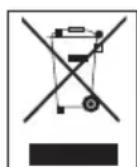
This symbol indicates that this product shall not be disposed with other household wastes at the end of its service life. Used device must be returned to official collection point for recycling of electrical and electronic devices. To find these collection systems please contact to your local authorities or retailer where the product was purchased. Each household performs important role in recovering and recycling of old
appliance. Appropriate disposal of used appliance helps prevent potential negative consequences for the environment and human health.
Compliance with RoHS Directive
The product you have purchased complies with EU RoHS Directive (2011/65/EU). It does not contain harmful and prohibited materials specified in the Directive.
Package information

Packaging materials of the product are manufactured from recyclable materials in accordance with our National Environment Regulations. Do not dispose of the packaging materials together with the domestic or other wastes. Take them to the packaging material collection points designated by the local authorities.
Technical data
This device is noise-suppressed according to the applicable EU directives.
This product fulfils the European directives 2014/53/EU, 2009/125/ EC and 2011/65/EU.
You can find the CE declaration of conformity for the device in the form of a pdf file on the Grundig Homepage www.grundig.com/downloads/doc.
The type plate is located on the bottom of the hi-fi system.
System
Power supply
Operating voltage: 220 - 240 V
Mains frequency: 50/60 Hz
Rated power consumption: 20 W
Power consumption (ECO mode): ≤ 1 W
Amplifier unit
Output:
Sine wave power: 2 x 15 W
Loudspeaker impedance: 4 Ω
Signal-to-noise ratio: ≥ 60dBA
Receiver unit
Reception range:
DAB/DAB+: 174,928 ... 239,200 MHz
FM: 87.5 ...108.0 MHz
BT frequency : 2402 - 2480 MHz
BT maximum output power: 2.05 dBm
CD unit
Frequency response: 50Hz ... 20kHz
Noise voltage ratio: ≥ 60dBA
MP3/WMA
Folder and track:
Max. 99 folders and 999 tracks per CD
File system/folder management:
ISO 9660 Level 1 compatible
USB
USB 2.0 for FAT 32/16 format
Dimensions and weight
Device dimensions:
W×H×D 180×121×231mm
Device weight: 1.67 kg
Loudspeaker dimensions:
W x H x D 155 x 254 x 129mm
Loudspeaker weight: 1.07 kg
Technical and design modifications are reserved.
General information on laser devices
CLASS 1 LASER PRODUCT
This device is a CLASS 1 LASER PRODUCT.
This means that the laser is designed in
such a way as to ensure that the maximum permissible emission value cannot be exceeded under any circumstances.
Caution:
If operating devices or methods other than those specified here are employed, it may lead to dangerous exposure to emissions.
This device emits laser radiation. Because of the danger of eye injuries, the unit may only be opened or serviced by trained personnel.
If settings other than those stated here are used or other procedures are carried out, this may lead to dangerous exposure to radiation.
text_image
COMPACT DISC DIGITAL AUDIOPRODUIT LASER DE CLASSE 1