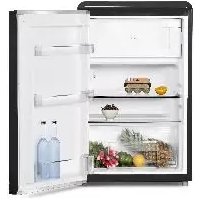
Oldtimer OT 11010 - Fridge SIBIR - Free user manual and instructions
Find the device manual for free Oldtimer OT 11010 SIBIR in PDF.



| Product type | Refrigerator with freezer compartment (***) |
| Brand | SIBIR |
| Model | Oldtimer OT 11010 |
| Power supply | 220-240 V ~ 50 Hz |
| Lamp power | Max 10 W, E14 socket |
| Refrigerant type | Isobutane (R600a), flammable |
| Climate class | SN / N / ST / T (from +10°C to +43°C) |
| Temperature adjustment | Rotary thermostat 7 positions (0 to 7) |
| Interior lighting | LED, energy efficiency class G (2 sources) |
| Door reversibility | Yes, user-reversible |
| Defrosting | Manual, recommended once a month |
| Maintenance | Clean the interior at least once a month with a soft cloth and mild detergent |
| Safety | Earthing mandatory, do not damage the cooling circuit |
| Freezer compartment capacity | 3-star freezer (***) ≤ -18°C |
| Included accessories | Door bins, vegetable crisper, glass shelf, bottle holder, plastic spacers |
| Adjustable feet | Yes, for leveling |
| Required ventilation space | 10 mm on sides and rear, 20 mm on top |
| Intended use | Household, not built-in |
Frequently Asked Questions - Oldtimer OT 11010 SIBIR
User questions about Oldtimer OT 11010 SIBIR
0 question about this device. Answer the ones you know or ask your own.
Ask a new question about this device
Download the instructions for your Fridge in PDF format for free! Find your manual Oldtimer OT 11010 - SIBIR and take your electronic device back in hand. On this page are published all the documents necessary for the use of your device. Oldtimer OT 11010 by SIBIR.
USER MANUAL Oldtimer OT 11010 SIBIR
natural_image
Line drawing of a simple refrigerator with a handle and top panel (no text or symbols)CE
OT 11010 FR / OT 11010 BL
User manual
Please read the following instructions carefully before using this device. Please keep these instructions for future reference.
Bedienungsanleitung
Please read the following operating instructions carefully before connecting your new device, they contain important information on safety, how to use, install and keep your device in working order. Please keep these instructions for future reference.
-
This device can be used by children from 8 years old and by people with reduced physical, sensory or mental capacities or a lack of experience and knowledge provided that they have been placed under supervision or that they have been instructed in the safe use of the device and understand the dangers involved. Children must not play with the device. Cleaning and user maintenance should not be made by children without supervision.
-
Before plugging in the appliance, make sure that the voltage of the mains socket in your home matches that shown on the rating plate.
-
Do not damage the cooling system. This warning is only valid for devices whose cooling circuit is accessible by the user.
-
Make sure the unit is unplugged before cleaning.
-
To clean this unit, use a damp cloth or glass cleaner. Never use detergent or solvent.
-
When defrosting has been carried out, or when the refrigerator ceases to be used, clean the appliance to prevent the spread of odor. Too much gel can affect refrigeration.
-
It is recommended to use this appliance without an extension cord.
-
To ensure good ventilation of the appliance, which is essential for its proper functioning, it is recommended to have a minimum clearance (or space) of 10mm on the sides and at the rear and 20mm on the top.
-
Do not place any hot food or drink in the appliance.
-
In order to save electricity consumption, keep air circulation around the appliance and discard food wrappers before putting them in the refrigerator as soon as possible.
-
Do not store toxic materials such as ether, methanol, gasoline, etc., which are volatile and can burn or explode.
-
Do not place flammable materials in the refrigerator unless they have been authorized by the manufacturer.
- Close the door after use to avoid temperature loss.
- This product should not be used outdoors and should not be exposed to rain.
- The appliance must be placed on a flat and stable surface.
- The appliance must be positioned so that the socket is easily accessible.
- Do not place heavy objects on the refrigerator and do not wet it.
- To avoid the risk of electric shock, never use this appliance with wet hands or bare feet on a wet surface.
- Do not use the appliance outdoors or in a humid place.
-
Do not move the unit when it is full to avoid tipping.
-
The power cable must be plugged into a grounded outlet. Never pull on the cable to disconnect the appliance, grasp the plug and pull it out from the socket.
- Never lift the device by the power cable.
- Keep the power cable away from heated surfaces.
- Do not attempt to repair, adjust, or replace any part of this appliance yourself. In the event of a malfunction, contact the after-sales service.
- Children should be supervised to ensure that they do not play with the appliance.
-
If the power cable is damaged, it must be replaced by the manufacturer, its after-sales service or similarly qualified persons in order to avoid any danger.
-
It is recommended to regularly examine the power cable for any signs of damage, and the device should not be used if the cable is damaged.
-
The appliance is fitted with an earthed plug to protect you from any electrical risks and must be connected to a socket outlet with an earth contact.
-
The appliances are not intended to be operated by means of an external timer or by a separate remote control system.
-
CAUTION: Keep the ventilation openings in the enclosure of the appliance, in its exterior part or in its built-in structure clear.
-
CAUTION: Do not damage the refrigeration circuit.
-
CAUTION: Do not use
mechanical devices or other means to accelerate the defrosting process, other than those recommended by the manufacturer. - CAUTION: Do not use electrical
appliances inside the food storage compartment, unless
they are not of the type recommended by the manufacturer. - This appliance is intended for use in household applications.
- WARNING: When positioning the unit, make sure that the power cord is not pinched or damaged.
- WARNING: Do not place multiple outlet mobile bases or portable power supplies on the back of the appliance.
- Children aged 3 to 8 are allowed to load and unload refrigeration devices.
- To avoid contamination of food, please observe the following instructions:
- Prolonged opening of the door can lead to a significant increase in the temperature in the compartments of the appliance.
- Regularly clean surfaces that may come into contact with food and accessible drainage systems.
- Store raw meat and fish in suitable containers in the refrigerator, so that they do not come into contact with and drip on other foods.
- The two-star compartments for frozen products are suitable for storing frozen food, for storing or making ice cream and for making ice cubes.
- The one, two and three star compartments are not suitable for freezing fresh food.
- If the refrigeration appliance is left empty for long periods of time, turn it off, defrost, clean, dry and leave the door open to prevent mold growth in the appliance.
-
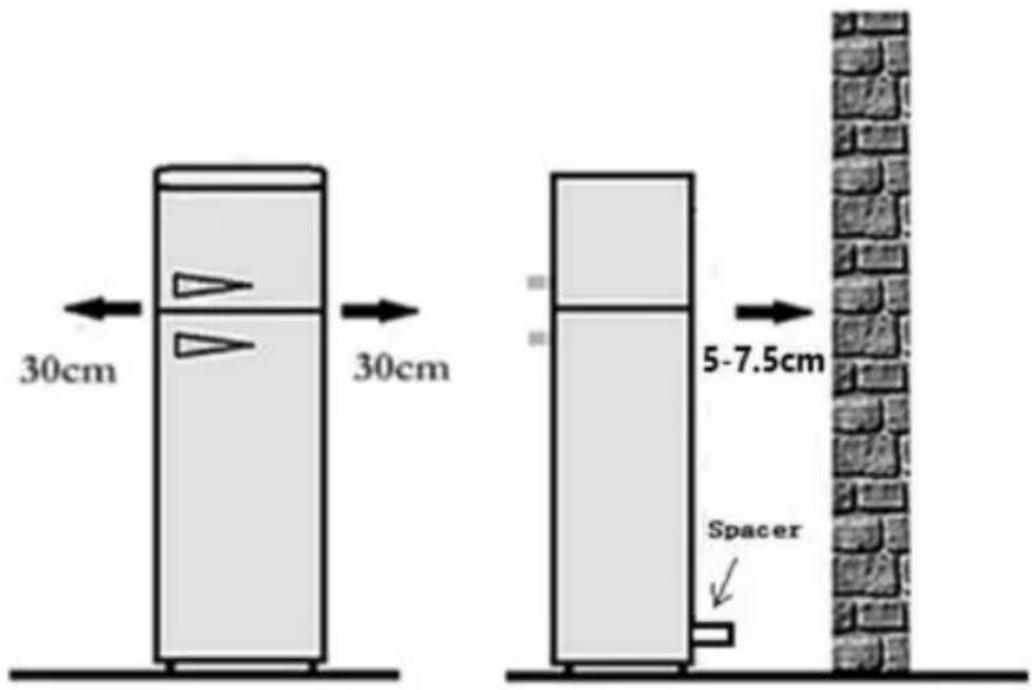
Place the device against a wall with a clear distance of no more than 75 mm and more than 50 mm.
-
This refrigeration appliance is not intended for use as a built-in appliance.
-
Recommended storage time for frozen foods in the freezer. These times vary depending on the type of food. Foods that you freeze can be stored for 1 to 12 months (minimum at -18 °C).
| Food | Storage time |
| Bacon, casseroles, milk | 1 month |
| Bread, ice cream, sausages, pies, prepared shellfish, oily fish | 2 months |
| Non-oily fish, shellfish, pizza, scones and muffins | 3 months |
| Ham, cakes, biscuits, beef and lamb chops, poultry pieces | 4 months |
| Butter, vegetables (blanched), eggs whole and yolks, cooked crayfish, minced meat (raw), pork (raw) | 6 months |
| Fruit (dry or in syrup), egg whites, beef (raw), whole chicken, lamb (raw), fruit cakes | 12 months |
- When freezing fresh food with an "best before / best before / best date" you should freeze it before that date has expired.
- Check that the food has not already been frozen. This is because frozen foods that have thawed completely should not be refrozen.
Once thawed, food should be eaten quickly.
- To avoid spoilage of food due to transfer of germs: Store unpackaged animal and plant products separately in drawers. This also applies to different kinds of meat.
- If food must be kept together due to lack of space: wrap it.
- Never store fruits and vegetables on a balcony with meat or fish.
| Food | Storage time |
| Butter | 90 days |
| Hard cheese | 110 days |
| Milk | 7 days |
| Sausages, cold cuts | 9 days |
| Meat | 7 days |

Suitable for food
Refrigerant
text_image
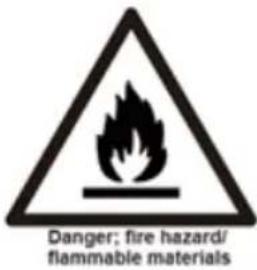
Danger; fire hazard/ flammable materialsDanger ; risk of fire / flammable materials
The refrigerant gas contained in the circuit of this device is isobutane (R 600à), a low-polluting but flammable gas. When transporting and installing the appliance, take care not to damage any part of the refrigeration circuit.
WARNING: When positioning the device, make sure that the power cord is not trapped or damaged.
WARNING: Do not place multiple outlet mobile bases or portable power supplies on the back of the device.
Replaceable light source (LED only) by a professional. This product contains two light sources of energy efficiency class G.
DESCRIPTION OF THE DEVICE
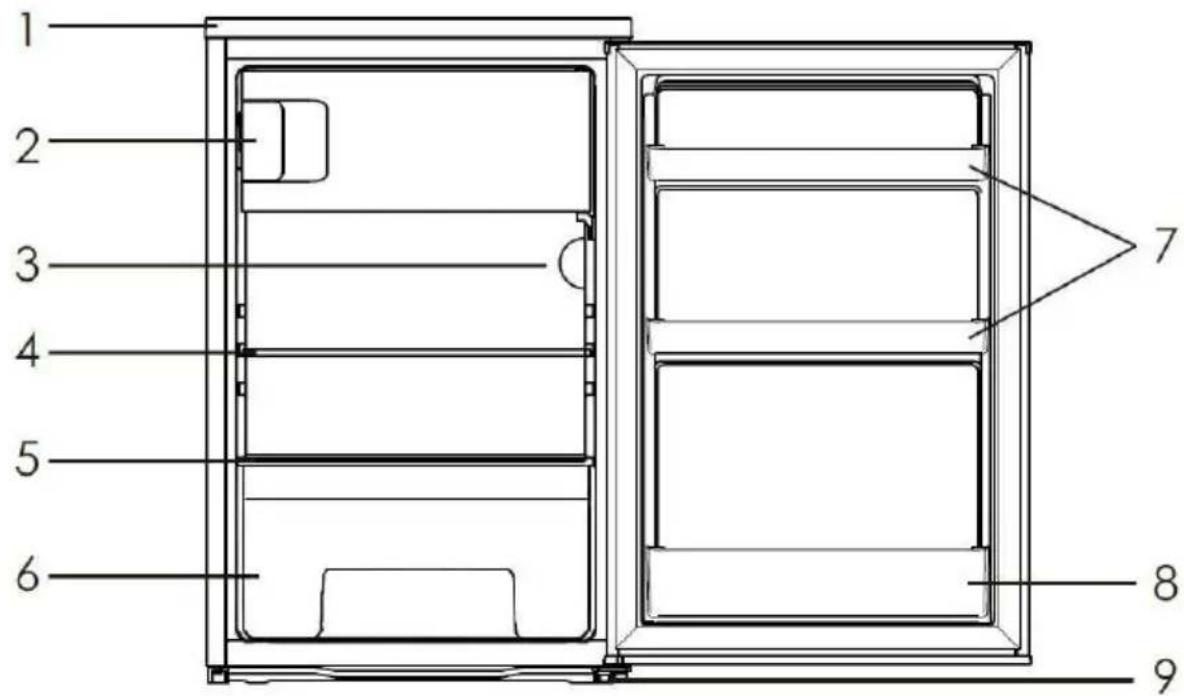
text_image
1 2 3 4 5 6 7 8 9-
Top cover
-
Freezer compartment
-
Thermostat
-
Glass shelf
-
Vegetable tray cover
-
Vegetable bin
-
Door balustrade
-
Bottle holder
-
Adjustable feet
TRANSPORT AND START-UP
When transporting, take the device by the base and gently tilt it up to a maximum of 45^ . Never lift the appliance by the door handle. Do not put the device upside down or horizontally. Push the refrigerator on the roller legs to move it.
INSTALLATION
Install the refrigerator on a flat and stable surface to avoid possible noise and vibrations from the appliance.
The refrigerator should be placed so that the outlet is easily accessible.
Choose a dry, well-ventilated place. Leave a space of at least 10mm all around the refrigerator and 20mm on the top.
Do not install the refrigerator in a corrosive atmosphere. Wait 12 to 24 hours before plugging in the appliance.
WARNING !
When you install your refrigeration appliance, it is important to take into account the climatic class of the product. To find out which climate class your refrigerator belongs to, please check the data plate as shown below: The refrigeration appliance is operating correctly within the ambient temperature range shown in the table, depending on the climate class.
| Class | Symbol A | Average ambient temperature °C |
| temperate enlarged | SN | from + 10 to + 32 |
| temperate | N | from + 16 to + 32 |
| subtropical | ST | from + 16 to + 38 |
| Tropical | T | from + 16 to + 43 |
PLACE
The device must be installed away from heat sources such as radiators, boilers, direct sunlight, etc.
Make sure that air can circulate freely behind the cabinet. To ensure optimum performance, if the appliance is placed under an overhanging wall unit, the minimum distance between the top of the booth and the wall unit must be at least 100 mm.
Ideally, the device should not be placed under a surface mounted wall unit. Precise leveling is ensured by one or more adjustable feet at the base of the cabinet.
For refrigeration devices with a climatic class:
- extended temperate (SN): this refrigeration appliance is intended for use at ambient temperatures between 10 °C and 32 °C;
- temperate (N): this refrigeration appliance is intended for use at ambient temperatures between 16 °C and 32 °C;
- subtropical (ST): this refrigeration appliance is intended for use at ambient temperatures between 16 °C and 38 °C;
- tropical (T): this refrigeration appliance is intended for use at ambient temperatures between 16 °C and 43 °C.
Meaning of the labeling \* of freezers:
- 1- (*), 2- (**), and 3-star (*** ) freezers are not suitable for freezing fresh food.
- The 2 star (**) and 3 star (***) freezers are suitable for storing frozen food (pre-frozen) and ice cream or for making ice cream and ice cubes.
| COMPARTMENTS | STARS (*) | TARGET STORAGE TEMPERATURE | SUITABLE FOOD |
| FREEZER | (***)* | ≤ -18 °C | ➢Suitable for seafood (fish, shrimps, shellfish), freshwater and meat products.➢Recommended storage period: 3 months1Suitable for freezing fresh food. |
| FREEZER | *** | ≤ -18 °C | ➢Suitable for seafood (fish, shrimps, shellfish), freshwater and meat products.➢Recommended storage period: 3 months1Not suitable for freezing fresh food. |
| FREEZER | ** | ≤ -12 °C | ➢Suitable for seafood (fish, shrimps, shellfish), freshwater and meat products.➢Recommended storage period: 2 months1Not suitable for freezing fresh food. |
| FREEZER | * | ≤ -6 °C | ➢Suitable for seafood (fish, shrimps, shellfish), freshwater and meat products.➢Recommended storage period: 1 month1Not suitable for freezing fresh food. |
| 0*-COMPARTMENT | — | -6 °C - 0 °C | ➢Suitable for fresh meat products (pork, beef, chicken, etc.) and processed food consumed or processed within the same day or within the next three days after storage (max.).1Not suitable for freezing food or for storing frozen food. |
Warning ! The appliance must be able to be disconnected from the electrical network; the plug must therefore be easily accessible after installation.
USE
Before first use, clean all parts of the refrigerator with a soft cloth dampened in lukewarm water and a mild detergent. Rinse them thoroughly with clean water and dry them with a dry cloth.
Note: The electrical parts of the refrigerator can only be cleaned with a dry cloth.
Place the thermostat knob in position "3", then turn on the appliance. The compressor is running and the interior light of the refrigerator comes on. Close the door. After 30 minutes, if the temperature in the refrigerator drops significantly, it shows that the refrigeration system is working properly. When the refrigerator has been running for a while, the temperature will adjust to the setting made, provided you do not leave the door open for too long. If the above steps have been completed successfully, the setup operations are complete. The refrigerator is operating normally.
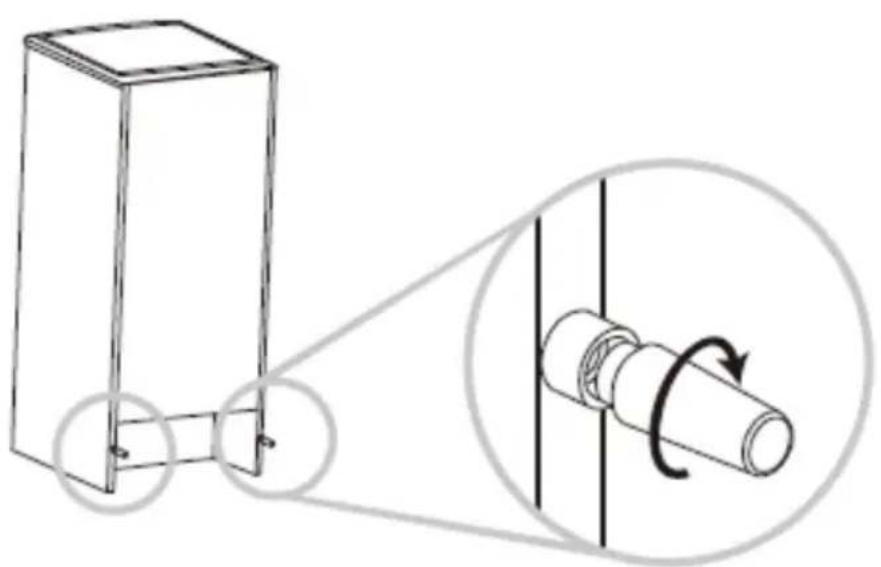
The device is supplied with two plastic tips (in the plastic bag in the user manual). After installing these end caps, the unit can no longer be pushed against the wall to ensure adequate ventilation. Insert the end caps into the corresponding openings on the back of the device, then screw them on.
natural_image
Technical diagram showing a rectangular block connected to a cylindrical component with a rotating arrow indicating rotation (no text or symbols present)Place the device against a wall with a free distance not exceeding 50-75mm.
text_image
30cm 30cm 5-7.5cm SpacerTEMPERATURE CONTROL
The temperatures in the refrigerator compartment and the freezer compartment are controlled by the thermostat located at the top of the refrigerator compartment.
Turn the thermostat knob to adjust the temperature inside the refrigerator. There are 7 temperature settings on the thermostat: from "0" to "7". The first setting "0" means "OFF" while the 7^th setting "7" indicates the lowest temperature in the refrigerator. Turn the thermostat knob from position "1" to "7", the temperature gradually decreases.
Set the thermostat knob to position "3" or "4" during normal use.
FOOD STORAGE
• How to use the freezer compartment?
Place fresh foods such as fish, meat in the freezer compartment to preserve their taste and nutrients.
Wrap foods that need to be frozen in aluminum foil or in airtight plastic boxes.
Do not put fresh food in direct contact with other already frozen food.
If you buy frozen food, please keep it in the freezer compartment as soon as possible.
Never refreeze a thawed product.
- How to use the refrigerator compartment?
Eggs and bottles must be placed in the spaces reserved for this purpose.
Vegetables and fruits should be put in the vegetable drawer. The jars should be placed in the shelves on the refrigerator door.
Other foods which are perishable or which may give off a bad odor in the refrigerator should be packaged separately.
- Food placement
Be careful not to over-place food in the refrigerator. Food should be wrapped separately in aluminum foil or in airtight plastic boxes. In order to save energy consumption, do not place hot food in the refrigerator.
Wait until they are well cooled before storing them. Never put vegetables or fruit in the freezer compartment.
DEFROST
When the appliance has been in operation for a long time, the underside of the freezer compartment may become covered with a film of frost. This leads to increased power consumption and decreases the efficiency of your device. Your freezer compartment should be defrosted once a month.
When defrosting, unplug the appliance, open the door and remove all food. Then store the food in a cool place. Use a plastic scraper to remove the frost. Then wipe the freezer compartment with a soft, dry cloth.
Note: Never use a metal utensil to defrost the freezer compartment to avoid damaging it.
WARNING: Do not use any mechanical device or other means to accelerate defrosting other than those recommended by the manufacturer.
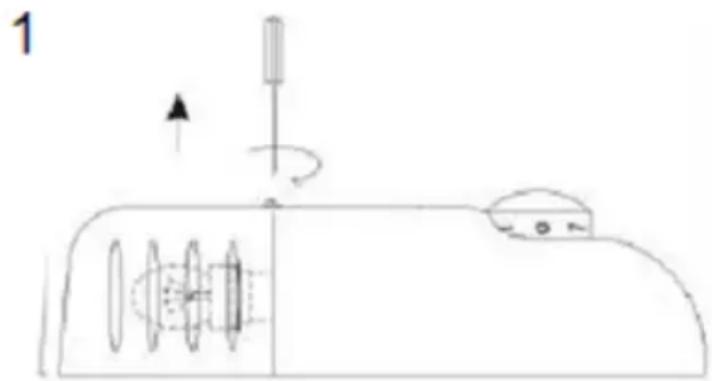
Lamp replacement
If the light no longer works, check if the bulb is properly screwed in. If the light still does not work, it is necessary to change the bulb.
- Use a new bulb of Max 10W E14 (220-240V \~). Unplug the device;
- Open the lamp cover (1);
- Unscrew the defective bulb counterclockwise; Screw the new bulb clockwise; Replace the lamp cover;
- Reconnect the device.
natural_image
Diagram of a mechanical device with rotating components and directional arrows (no text or symbols)MAINTENANCE AND CLEANING
- The device should be cleaned at least once a month.
- Before cleaning, be sure to switch off and unplug the appliance.
- Remove all accessories. Wash them in lukewarm water with a mild detergent (dish soap for example), rinse with bleach and dry thoroughly.
- Wipe the inside and outside of the refrigerator with a damp, soft cloth.
- If the device is too dirty, clean it with a soft cloth dampened with a little mild detergent, rinse the device thoroughly and dry it with a soft cloth.
If you need to go on vacation or not use the device for a long time, please do the following:
- Switch off the appliance and unplug it from the socket.
- Remove all food.
- Clean and dry the inside of the appliance by following the above instructions.
- Leave the appliance door open to avoid any bad odors.
Cleaning
Before cleaning, be sure to switch off and unplug the appliance.
Use a soft cloth soaked in water or non-abrasive detergent to clean the device. Then wipe off the moisture with a soft, dry cloth. Remember to clean the water collection tray located at the back, above the glass cover.
REVERSE DOOR OPENING DIRECTION
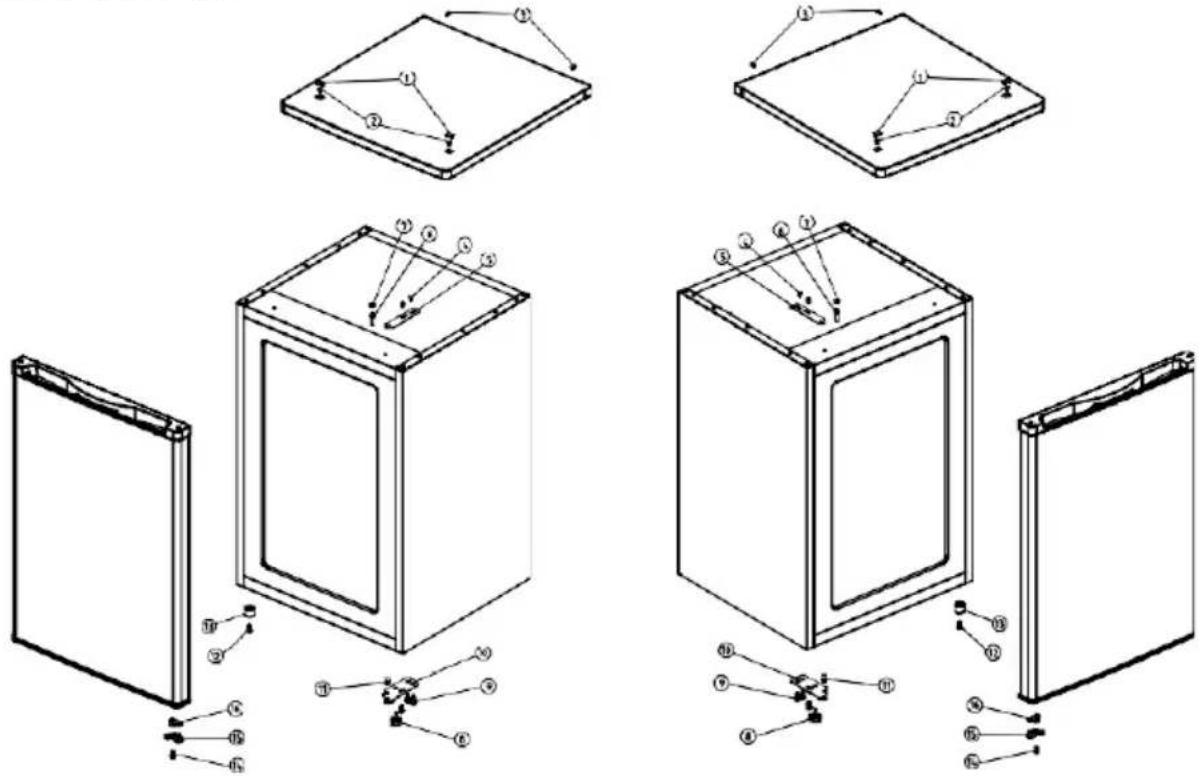
The refrigerator was built with the door hinges on the right. If you want to change the opening direction of the door, be sure to follow the following instructions:
- Remove the cover (1). Remove the four screws (2) (3) and remove the top cover
- Remove the two screws (4) that hold the top hinge (5) and remove this top hinge (5).
- Unscrew the nut (7) and remove the pin (6). Reverse the hinge at the top (5) and secure the pin (6) and nut (7).
- Lift the door up and place it on a padded surface to avoid scratching it.
- Remove the foot (8). Remove the three screws (9) that hold the bottom hinge
(10) and be sure to remove this bottom hinge (10). - Loosen the screw (12) and remove the foot (13), then move it to the right side.
-
Remove the pin (11) and reverse the direction of the bottom hinge (10). Install the bottom hinge (10) in the left side with three screws (9).
-
Insert the pin (11) on the bottom hinge (10).
- Remove the hinge pin (14) (15) (16) located at the bottom of the door. On the other side of the door, insert the replacement hinge pin that comes with this unit.
- Put the door in place and make sure the door is securely fastened to the bottom hinge (10).
- Secure the top hinge (5) with two screws (4).
- Secure the top cover with four screws (2) (3) then place the covers (1) on the screws (2).
text_image
Technical diagram showing exploded view of a device's internal structure with numbered components and connection points.figure 1 figure 2
Figure 1: the position of the components before the door inversion
Figure 2: the position of the components after the door inversion
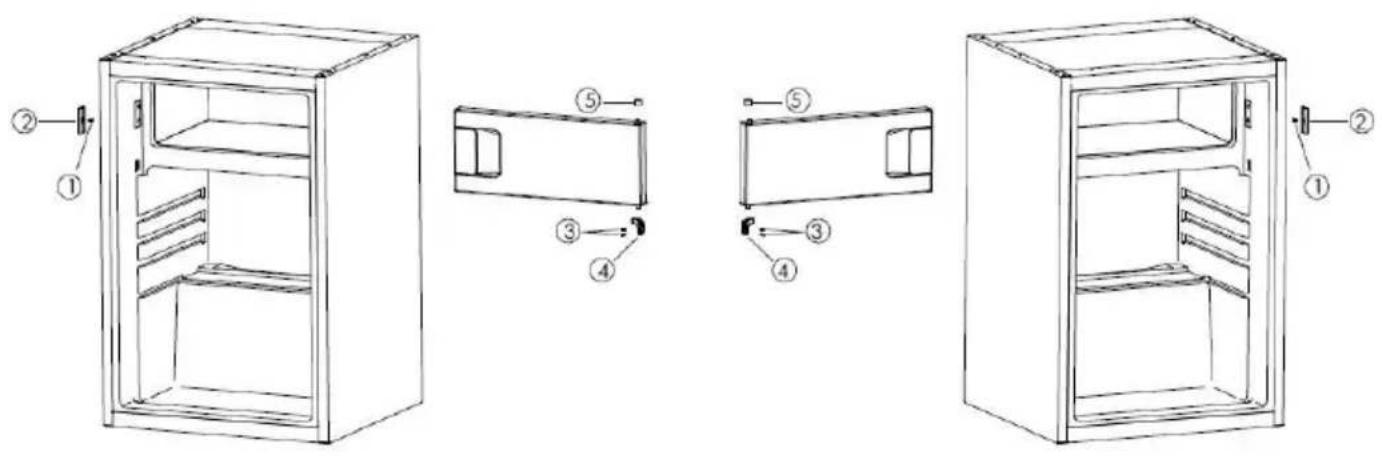
If you also want to change the opening direction of the internal freezer compartment door, be sure to follow the instructions below:
- Remove the screw (1) and remove the lock button (2).
- Remove the two screws (3) that hold the bottom axle cover (4) and remove this cover.
- Remove the door and place it on a padded surface to avoid scratching it.
- Remove the top axle cover (5) and move it to the opposite position.
- Rotate the door 180° and place it on the top axle cover.
- Secure the lower axle cover (4) with the two screws (3).
- Secure the locking button (2) with a screw (1).
figure 1 figure 2
text_image
Technical line drawing of a refrigerator with labeled components for assembly or installation.Figure 1: the position of the components before the door inversion
Figure 2: the position of the components after the door inversion
ADVICE - ENERGY SAVING
- Install the appliance in a cool, dry and suitably ventilated room.
- Take care not to expose the device to direct sunlight and never place it near a direct source of heat (near a radiator, for example).
- Never block the appliance's ventilation openings or grids.
- Let the food cool before placing it in the appliance.
- Place frozen products in the refrigerator to defrost them.
- The low temperature of frozen products will help to cool the food in the refrigerator.
- Do not leave the appliance doors open for too long when storing or removing food from the appliance.
- When you freeze food or want to store it in the freezer, place it directly in the upper freezer compartment.
REPAIR
| Symptom Reason | Solution | |
| The device does not work | No power supply | Make sure the device is plugged in properly and the wall outlet is working normally |
| The fuse has blown. | Replace the fuse | |
| The device makes a lot of noise | The device is not parallel to the ground. The appliance is too close to the wall or the interior accessories of the refrigerator are placed incorrectly. | Stabilize the base of the refrigerator by adjusting the position of the feet. Move the device away from the wall. Correctly place the interior accessories of the refrigerator. |
| The appliance does not reach the desired temperature. | The door is opened too often or has been left open for a long time. | Close the door and do not open it too frequently. |
| The refrigerator is too close to the wall. | Move the unit away from the wall to ensure proper. | |
| The refrigerator is too full. | Remove food from the appliance. | |
| The temperature is incorrectly regulated. | Turn the thermostat knob to position “3” or higher. | |
| The device emits bad odors. | Food has expired inside the refrigerator. | Throw away expired foods and wrap other foods. |
| The interior of the appliance needs to be cleaned. | Clean the inside of the appliance. | |
If your device shows other symptoms than those described above, please call the authorized service center of the store or the dealer.
The following symptoms are not failures:
- The sound of coolant flowing through the pipes can be heard, this is normal.
- Moisture on the exterior surface of the unit during wet seasons is not a problem, just wipe the surfaces with a soft, dry cloth.
- The compressor and condenser may heat up more during periods of high heat.
- The door frame is a little warm, it means the condenser is working to remove moisture from the air.
WARRANTY EXCLUSIONS:
The warranty does not cover wear parts of the product, nor problems or damage resulting from:
(1) Surface deterioration due to normal wear and tear of the product;
(2) Defects or deterioration due to contact of the product with food or liquids and due to corrosion caused by rust or the presence of insects;
(3) Any unauthorized incident, abuse, misuse, modification, disassembly or repair;
(4) Any improper maintenance operation, use not in accordance with the instructions concerning the product or connection to an incorrect voltage;
(5) Any use of accessories not supplied or approved by the manufacturer.
The warranty will be void if the nameplate and / or serial number of the product is removed.
DISPOSAL
natural_image
Symbol of a trash bin crossed with no text or numbers, representing waste sorting or restriction (no text present)
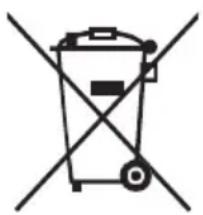
The European Directive 2012/19 / EU on Waste Electrical and Electronic Equipment (WEEE), requires that used household appliances not be thrown into the normal stream of municipal waste. Used devices must be collected separately in order to optimize the recovery rate and recycling of the materials they are made of and reduce the impact on human health and the environment.
The crossed-out wheeled bin symbol is affixed to all products to remind you of the obligations of separate collection. Consumers should contact the local authorities or their dealer regarding the procedure to follow for the removal of their device.
DIESES GERÄT IST NUR FÜR DEN HAUSHALT BESTIMMT!
natural_image
Warning symbol of a flame inside a triangle (no text or numbers)natural_image
Technical diagram showing a 3D rectangular block connected to a cylindrical component with a rotating arrow indicating rotational motion (no text or symbols present)natural_image
Diagram of a mechanical device with rotating components and directional arrows (no text or symbols)ESSENSLAGER
text_image
Technical diagram showing exploded view of a device with labeled components and connection pointsnatural_image
Symbol of a trash bin with crossed lines indicating no waste or restriction, plus a solid black rectangle below (no text or symbols)text_image
Warning sign depicting a flame symbol with hazard symbol inside a trianglenatural_image
Diagram showing a rectangular box connected to a cylindrical component with a rotating arrow indicating rotation (no text or symbols present)natural_image
Pure mechanical diagram showing a lever and gear mechanism without any text or symbolsFR - 20
ENTRETIEN ET NETTOYAGE
text_image
Technical diagram showing exploded view of a device's internal components with numbered labels for each part.text_image
Technical line drawing of a refrigerator with labeled components including doors, doors, and doors with numbered parts.natural_image
Symbol of a trash bin crossed with two crossed lines, representing no waste or discharge (no text or labels)