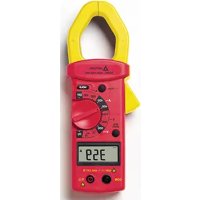
AC68C - Measuring equipment Amprobe - Free user manual and instructions
Find the device manual for free AC68C Amprobe in PDF.


| Product Type | TRMS (True RMS) AC/DC Digital Clamp Meter |
| Brand | Amprobe |
| Model | AC68C |
| Dimensions | 76 x 228 x 39 mm |
| Weight | 465 g (with battery) |
| Power Supply | 9 V battery type 6LR61 or equivalent |
| Typical Battery Life | Approximately 30 minutes auto power off |
| Display | LCD 3-3/4 digits (3999 counts) with function, unit and polarity indicators |
| Sampling Rate | 2 measurements per second (nominal) |
| Overrange Indication | "OL" displayed |
| Low Battery Indication | "BT" symbol |
| Main Functions | AC/DC current (clamp), AC/DC voltage, resistance, frequency, continuity test (buzzer), diode test, peak hold, data hold |
| AC/DC Current Ranges | 400 A (resolution 0.1 A) and 600 A (resolution 1 A) |
| AC/DC Voltage Ranges | 400 V (resolution 0.1 V) and 600 V (resolution 1 V) |
| Resistance Range | 4 kΩ (resolution 1 Ω) |
| Frequency Ranges | 4 kHz (current/voltage) and 20 kHz (voltage only) |
| Overload Protection | 800 A in current, 660 Vrms in voltage |
| Electrical Safety | CAT III 600 V, double insulation, per EN61010-1 |
| Electromagnetic Compatibility | Complies with EU directives 89/336/EEC and 73/23/EEC |
| Operating Conditions | Temperature 0 to 40 °C, humidity <80% RH non-condensing |
| Storage Conditions | Temperature -10 to 60 °C, humidity <70% RH (battery removed) |
| Maximum Altitude | 2000 m |
| Maintenance and Cleaning | Wipe with a soft cloth and mild detergent; dry completely before use |
| Repairability | Repair only by an Amprobe authorized service center; battery replacement by user |
| Spare Parts | Standard fuses and batteries; test leads available as accessories |
| Warranty | 1 year against defects in materials and workmanship |
Frequently Asked Questions - AC68C Amprobe
User questions about AC68C Amprobe
0 question about this device. Answer the ones you know or ask your own.
Ask a new question about this device
Download the instructions for your Measuring equipment in PDF format for free! Find your manual AC68C - Amprobe and take your electronic device back in hand. On this page are published all the documents necessary for the use of your device. AC68C by Amprobe.
USER MANUAL AC68C Amprobe
Limited Warranty and Limitation of Liability
Your Amprobe® product will be free from defects in material and workmanship for 1 year from the date of purchase. This warranty does not cover fuses, disposable batteries or damage from accident, neglect, misuse, alteration, contamination, or abnormal conditions of operation or handling. Resellers are not authorized to extend any other warranty on Amprobe®s behalf. To obtain service during the warranty period, return the product with proof of purchase to an authorized Amprobe® Test Tools Service Center or to a Amprobe® dealer or distributor. See Repair Section above for details. THIS WARRANTY IS YOUR ONLY REMEDY. ALL OTHER WARRANTYIS - WHETHER EXPRESS, IMPLIED OR STAUTORY - INCLUDING IMPLIED WARRANTYIS OF FITNESS FOR A PARTICULAR PURPOSE OR MERCHANTABILITY, ARE HEREBY DISCLAIMED. MANUFACTURER SHALL NOT BE LIABLE FOR ANY SPECIAL, INDIRECT, INCIDENTAL OR CONSEQUENTIAL DAMAGES OR LOSSES, ARISING FROM ANY CAUSE OR THEORY. Since some states or countries do not allow the exclusion or limitation of an implied warranty or of incidental or consequential damages, this limitation of liability may not apply to you.
True RMS AC/DC Clamp Multimeter
Contents
Symbols. 1
Introduction 1
Warnings and Precautions 2
Unpacking and Inspection 2
Instrument Familiarization (See inside front cover) 2
Measuring Procedures. 3
Specifications 6
Troubleshooting 8
Battery Replacement. 9
Repair 10
Symbols
| Δ | Refer to the manual | Δ | Dangerous Voltage |
| ☐ | Double insulated | BT | Battery |
| = | Direct Current | = | Earth Ground |
| ~ | Alternating Current | ||||| | Audible tone |
| CE | Complies with EU directives | CULUS | Underwriters Laboratories, Inc. |
Introduction
The AC68C is a true rms digital clampmeter that measures both AC and DC current as well as AC and DC voltage, Resistance, Frequency, Continuity and Diode Test.
Warnings and Precautions
The AC68C Digital Clampmeter conforms to EN61010-2-032, EN61010-1, CAT III- 600V, class 2 and pollution deg. 2; and UL3111-1. It is recommended for use with local level power distribution, appliances, portable equipment, etc., where only smaller transient overvoltages may occur, and not for primary supply lines, overhead lines, and cable systems.
- Do not exceed the maximum overload limits per function (see specifications) nor the limits marked on the instrument itself. Never apply more than 600Vdc /ac rms between the test lead and earth ground.
- Inspect the DMM, test leads and accessories before every use. Do not use any damaged part.
- Never ground yourself when taking measurements. Do not touch exposed circuit elements or test probe tips.
- Do not operate the instrument in an explosive atmosphere.
Exercise extreme caution when: measuring voltage >20V // current >10mA // AC power line with inductive loads // AC power line during electrical storms // current, when the fuse blows in a circuit with open circuit voltage >600V // servicing CRT equipment. - Always measure current in series with the load - NEVER ACROSS a voltage source. Check fuse first. Never replace a fuse with one of a different rating.
- Remove test leads before opening the case.
Unpacking and Inspection
Your shipping carton should include:
Digital clamp meter 1
Carrying case 1
Test lead set (one black, one red) 1
One 9V battery (installed) 1
Manual
If any of the items are damaged or missing, return the complete package to the place of purchase for an exchange.
1
Instrument Familiarization (See inside front cover)
Transformer Jaws: Designed to pick up the current flowing through the conductor.
Jaw Opening Lever: Press lever to open transformer jaws.
Release pressure to close the jaws.
Digital Display: 3-3/4 digit LCD (max. reading 3999), with decimal point, AC/DC, polarity, unit and low battery (BT) indicators.
Function/Range Selector: Selects the desired function and range.
Changing position turns instrument back on after Auto-OFF.
Peak Hold Button: Toggles on and off. Captures the maximum peak value of a current or voltage surge (motor start-up). "PEAK" is shown on LCD.
Data Hold Button: Toggles on and off. Holds reading for all functions and ranges. Always release HOLD before taking a new measurement. "HOLD" is shown on LCD.
DCA ZERO Button: Push this button to zero the display before measuring DC current.
Input Terminals: Always connect black test lead (negative) to black COM input jack and red test lead to red "VΩ" input jack for voltage, frequency, resistance, continuity, and diode measurements
Measuring Procedures
General
- Make sure that the selected function and range are suitable for the measurement to be taken.
- If the measured current is higher than the selected range for a longer period of time, overheating may occur, compromising the safety and operation of inner circuits.
- Do not measure currents on high voltage conductors (>600V) to avoid risks of discharge and/or incorrect readings.
- When measuring current, make sure that the test leads are removed from the meter terminals.
- The most accurate current reading will be obtained by placing the conductor in the center of the jaws (aligned with the centering marks on the transformer jaws).
DC Current Measurement
- Set the function/range selector to the appropriate A = position (400 or 600 A).
- Press the DCA ZERO button to make sure that the display is zero-reading.
- Open spring-loaded clamp by pressing the lever on left side of meter.
- Position clamp around one wire or conductor and release the clamp lever. Make sure that the clamp is entirely closed. The clamp must be positioned around only one conductor. If it is placed around two or more current carrying conductors, the reading is FALSE.
- Read the displayed value. The direction of the current corresponds to the indication of the pointer on the jaw. Polarity inversion is indicated by a -i (minus) symbol on the display.
AC Current Measurement
- Set the function/range selector to the appropriate A ~ position (400 or 600 A).
- Open spring-loaded clamp by pressing the lever on left side of meter.
- Position clamp around one wire or conductor and release the clamp lever. Make sure that the clamp is entirely closed. The clamp must be positioned around only one conductor. If it is placed around two or more current carrying conductors, the reading is FALSE.
- Read the displayed value.
DC and AC Voltage Measurement
Warning
The maximum input voltage for DC or AC Volts is 600 Vrms. Do not attempt to take any voltage measurement that exceeds 600 Vrms to avoid electrical shock hazard or damage to the instrument.
- Set the function/range selector to the appropriate V = (600V) or V (400 or 600V) position.
- Connect the black test lead to the "COM" terminal and the red test lead to the "VΩ" terminal. Connect probe tips to the circuit and read the value.
Frequency Measurement
Note: Both ammeter and voltmeter can be used for frequency measurement. The clamp-on Ammeter detects the frequency of the current circulating in the cable or bus-bar under test (the current must be greater than 1 A in the 400 A range and greater than 15 A in the 600 A range). The Voltmeter detects the frequency of the voltage applied to the leads.
- In either set-up (current or voltage measurement), set the function/range switch to the Hz position.
- Read the frequency value on the display.
Resistance Measurement
Warning
Before taking any in-circuit resistance measurement, remove power from the circuit being tested and discharge all capacitors.
- Set the function/range selector to the 4k position.
- Connect the black lead to the COM terminal and red lead to the "VΩ" terminal.
- Connect the test leads to the resistance or circuit to be measured and read the value on the display.
Continuity Measurement
Warning
Before taking any in-circuit continuity measurement, remove power from the circuit being tested and discharge all capacitors.
- Set the function/range selector to the position.
- Connect the black lead to the COM terminal and red lead to the "VΩ" terminal.
- Connect the test leads to the circuit to be tested. Continuity (resistance ≤ 40 is indicated by a continuous beep tone.
Diode Test
- Set the function/range selector to the position.
- Connect the black lead to the COM terminal and red lead to the "VΩ" terminal.
- Connect the red test lead to the anode, and the black test lead to the cathode of the diode to be tested.
- Read the forward voltage value on the display (approx. 0.6V for a silicon diode or 0.4V for a germanium diode). An open diode is indicated by "OL".
- Reverse test lead connections to the diode to perform a reverse bias test. "OL" indicates a good diode.
Notes: "OL" for both reverse and forward bias tests indicates an open diode. A low voltage reading for both bias tests indicates a shorted diode. If the diode is shunted by a resistor of 1000 ohms or less, it must be removed from the circuit before taking the measurement. Bipolar transistor junctions may be tested in the same manner described above as emitter-base and base-collector junctions are diode junctions.
Peak Hold Measurement
Proceed as for voltage or current measurement (AC or DC).
Before actually taking the measurement, press the PEAK button.
"PEAK" is shown on the display. After taking a measurement, the displayed reading is the maximum peak value of a surge in the voltage or current.
Data Hold
Proceed as for voltage or current measurement (AC or DC). While taking a measurement, press the HOLD button. "HOLD" is shown on the display and the current meter reading is maintained, even after disconnecting the test leads from the circuit or removing the conductor from the clamp. Press HOLD again to deactivate before taking a new measurement.
Specifications
General Specifications
Display: 3-3/4 Digit LCD, max. reading of 3999. Function and unit indication.
Overrange indication: "OL" indicated.
Polarity indication: automatic; positive implied; negative indicated.
Zero adjustment: automatic for all functions and ranges except DC current (Zero adjustment button).
Ranging: manual function and range selection with rotary selector switch. Autoranging for frequency measurement.
Special functions: Data Hold, Peak Hold
Operating principle: dual slope integration
Sampling rate: 2 /sec, nominal.
Maximum voltage between any terminal and earth ground: 600 V
Low Battery Indication: BT when battery voltage drops below operating voltage.
Auto Power Off: Approx. 30 minutes after no function change.
Environmental Conditions
Operating temperature: 0^ to +40^, < 80% R.H., noncondensing
Storage temperature: -10 °C to +60 °C, <70 % R.H., battery removed.
Power source: Single 9 V battery (NEDA 1604,1EC 6F22)
Battery life: Alkaline 200 hours.
Maximum jaw opening: 40 mm (1.57 inches)
Pollution degree: Level II
Altitude: < 2000 meters
Size (WxLxH): 76x228x39 mm (3"x9"x1.5")
Weight: 465 gr (incl. battery)
Accessories: Test leads, battery, manual and carrying case.
Safety: Meets EN61010-1 Cat III 600V. EN61010-2-03, UL3111-1, CSA22.2, No 1010-1
EMC: Meets EN55011, EN61000-4-2,4
EMC: This product complies with requirements of the following
European Community Directives: 89/336/EEC (Electromagnetic
Compatibility) and 73/23/EEC (Low Voltage) as amended by
93/68/EEC (CE Marking). However, electrical noise or intense electromagnetic fields in the vicinity of the equipment may disturb the measurement circuit. Measuring instruments will also respond to unwanted signals that may be present within the measurement circuit. Users should exercise care and take appropriate precautions to avoid misleading results when making measurements in the presence of electronic interference.
Electrical Specifications
Accuracy is ± (%reading + nbr digits) at 23^± 5^, < 80%
R.H. The current error is specified within the largest circle that can be drawn inside the jaw.
DC Current
Range Resolution Accuracy Overload Prot.
400 A 0.1 A ± (2 %rdg + 5 dgt) 800 A
600 A 1 A ± (2 %rdg + 5 dgt) 800 A
AC Current, Trms
Range Resolution Accuracy Overload Freq.
Prot.
Responses
400 A 0.1 A ± (2 %rdg + 5 dgt) 800 A 40-450 Hz
600 A 1 A ± (2 %rdg + 5 dgt) 800 A 40-450 Hz
Conversion: Ac coupled Trms
Crest Factor (Non-Sinusoidal) (50 - 60Hz)
1-3: ± 0.5 % 3-5: ± 3% 5-7: ± 6%
DC Voltage
Range Resolution Accuracy Input.
Overload
Imped.
660 Vrms
600 V 1 V ± (0.75 %rdg + 2 dgt) 1 MΩ
AC Voltage Trms - Frequency response: 40-450 Hz
Range Resolution Accuracy Input Overload
Imped.
Prot.
400 V 0.1 V ± (1.2 %rdg + 10 dgt) 1 MΩ
660 Vrms
600 V 1 V ± (1.2 %rdg + 10 dgt) 1 MΩ
660 Vrms
Conversion: Ac coupled Trms
Crest Factor (Non-Sinusoidal) (50 - 60Hz)
1-3: ± 0.5 % 3-5: ± 3 %5-7: ± 6 %
Frequency (Hz) - Autoranging for current and voltage
Range Resolution Accuracy Sensitivity Overload
Prot.
4k Hz 1 Hz ± (0.5 %rdg + 5 dgt) 1 V/5 A 660 Vrms /800
20 kHz* 0.01 Hz ± (0.5 %rdg + 5 dgt) 5 V 660 Vrms * - Voltage input only
Resistance
Range Resolution Accuracy Open Overload circuit.volts Prot. 4 kΩ 1 ± (1 %rdg + 5 dgt) ≤ 0.5 VDC 660 Vrms
Diode Test
Range Resolution Accuracy Open Overload circ(volts Prot. + 0.001V± (1% rdg + 2dgt) 3.0 VDC max 660 Vrms
Max short circuit current: 0.8mA (typical)
Audible Continuity Test
Range Accuracy Open circ(volts Overload Prot. 40Ω ≤0.5V 3.0 VDC max 660 Vrms
Max short circuit current: 0.8mA (typical)
Peak Hold Measurement, AC Voltage (50 Hz - 60 Hz)
Range Resolution Accuracy Input Overload Prot.
400 V 0.1 V ± (1.5 %rdg +10 dgt) 1 MΩ 660 Vrms
600 V 1 V ± (1.5 %rdg +10 dgt) 1 MΩ 660 Vrms
Peak Hold Measurement, AC Current (50 Hz - 60 Hz)
Range Resolution Accuracy Overload Prot. 400 A 0.1 A ± (2% rdg + 10dgt) 800 A 600 A 1 A ± (2% rdg + 10dgt) 800 A
Troubleshooting
In case of malfunction during the operation of the meter, the following steps should be performed in order to isolate the cause of the problem:
- Check the battery.
- Review the operating instructions for possible mistakes in operating procedure.
- Check the clamp against a known current source. Use the voltage function to measure a known voltage (AC and DC).
- Check the test leads for continuity (voltage and resistance). Except for the replacement of the battery, repair of the clamp should be performed only by a Factory Authorized Service Center or by other qualified instrument service personnel. Front panel and case can be cleaned with a mild solution of detergent and water. Apply sparingly with a soft cloth and let dry completely before using. Do not use aromatic hydrocarbons or chlorinated solvents for cleaning.
Battery Replacement
4 !WARNING
To avoid electrical, shock remove the test leads from both the meter and the test circuit before accessing the battery.
- Replace the battery as soon as the low-battery symbol BT is displayed.
- Set the function/range switch to OFF and remove the test leads.
- Position the meter face down. Remove the screw and lift off the back cover.
- Replace the battery with an equivalent 9V battery.
- Reassemble the instrument.
Repair
All test tools returned for warranty or non-warranty repair or for calibration should be accompanied by the following: your name, company's name, address, telephone number, and proof of purchase. Additionally, please include a brief description of the problem or the service requested and include the test leads with the meter. Non-warranty repair or replacement charges should be remitted in the form of a check, a money order, credit card with expiration date, or a purchase order made payable to Amprobe® Test Tools.
In-Warranty Repairs and Replacement - All Countries Please read the warranty statement and check your battery before requesting repair. During the warranty period any defective test tool can be returned to your Amprobe® Test Tools distributor for an exchange for the same or like product. Please check the "Where to Buy" section on www.amprobe.com for a list of distributors near you. Additionally, in the United States and Canada In-Warranty repair and replacement units can also be sent to a Amprobe® Test Tools Service Center (see below for address).
Non-Warranty Repairs and Replacement - US and Canada Non-warranty repairs in the United States and Canada should be sent to a Amprobe® Test Tools Service Center. Call Amprobe® Test Tools or inquire at your point of purchase for current repair and replacement rates.
In USA
Amprobe® Test Tools
Everett, WA 98203
Tel: 888-993-5853
Fax: 425-446-6390
In Canada
Amprobe® Test Tools
Mississauga, ON L4Z 1X9
Tel: 905-890-7600
Fax: 905-890-6866
Non-Warranty Repairs and Replacement - Europe European non-warranty units can be replaced by your Amprobe® Test Tools distributor for a nominal charge. Please check the "Where to Buy" section on www.amprobe.com for a list of distributors near you.
European Correspondence Address*
Amprobe® Test Tools Europe
P.O.Box 1186
5602 BD Eindhoven
The Netherlands
^* (Correspondence only - no repair or replacement available from this address. European customers please contact your distributor.)
AC68C
True RMS AC/DC Clamp Multimeter
Users Manual
Mode d'emploi
Bedienungshandbuch
- Manual de Uso

Alimentation: Pile 9 V (NEDA 1604,1EC 6F22)
Autonomie: Alkaline 200 heures.
Ouverture max. de la Prince: 40 mm
1-3:±0.5% 3-5:±3% 5-7:±6%
Tension Continue
1-3: ±0.5% 3-5: ±3% 5-7: ±6%
4 kΩ 1 Ω ± (1 %lect + 5 dgt) 0.5 VDC Ouv. surcharge 660 Vrms
Test de Diodes
Gamme Résolution Precision Tens.Circ. Prot.
Ouv.
0.001 V ± (1 %lect + 2 dgt) 3.0 VDC max 660 Vrms
1-3: ±0.5% 3-5: ±3% 5-7: ±6%
Gleichspannung
1-3: ±0.5% 3-5: ±3% 5-7: ±6%
4 kHz 1 Hz ± (0.5%vMW + 5 Dgt) 1 V/5 A 660 Vrms/800 A
Amprobe Test Tools Amprobe Test Tools
Everett, WA 98203 Mississauga, ON L4Z 1X9
Tel.: 888-993-5853 Tel.: 905-890-7600
Fax: 425-446-6390 Fax: 905-890-6866
1-3: ±0.5% 3-5: ±3% 5-7: ±6%
Tensión CC
600 V 1 V ± (0.75 %lect + 2 dgt) 1 MΩ 660 Vrms
1-3: ±0.5% 3-5: ±3% 5-7: ±6%
4 kHz 1 Hz ± (0.5 %lect + 5 dgt) 1 V/5 A 660 Vrms
/800 A
20 kHz *0.01 Hz ± (0.5 %lect + 5 dgt) 5 V 660 Vrms


- Limited Warranty and Limitation of Liability
- True RMS AC/DC Clamp Multimeter
- Contents
- Introduction
- Warnings and Precautions
- Unpacking and Inspection
- Instrument Familiarization (See inside front cover)
- Measuring Procedures
- General
- DC Current Measurement
- AC Current Measurement
- Warning
- Frequency Measurement
- Resistance Measurement
- Before taking any in-circuit resistance measurement, remove power from the circuit being tested and discharge all capacitors.
- Continuity Measurement
- Before taking any in-circuit continuity measurement, remove power from the circuit being tested and discharge all capacitors.
- Diode Test
- Data Hold
- Specifications
- General Specifications
- Electrical Specifications
- DC Current
- AC Current, Trms
- DC Voltage
- Resistance
- Audible Continuity Test
- Peak Hold Measurement, AC Voltage (50 Hz - 60 Hz)
- Peak Hold Measurement, AC Current (50 Hz - 60 Hz)
- Troubleshooting
- !WARNING
- To avoid electrical, shock remove the test leads from both the meter and the test circuit before accessing the battery.
- Repair
- AC68C
- Users Manual
- Tension Continue
- Test de Diodes
- Gleichspannung
- Tensión CC
Brand : Amprobe
Model : AC68C
Category : Measuring equipment