
INFC8 TO32X - Refrigerator INDESIT - Free user manual and instructions
Find the device manual for free INFC8 TO32X INDESIT in PDF.
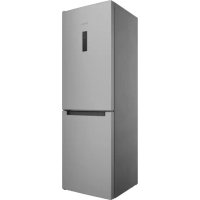



| Product type | Refrigerator-freezer |
| Brand | Indesit |
| Model | INFC8 TO32X |
| Interior lighting | LED (energy efficiency class F or G depending on model) |
| Defrost | Automatic in the refrigerator compartment |
| Shelves and door bins | Removable |
| Door reversibility | Possible via after-sales service |
| Freezing capacity | Quantity of fresh food that can be frozen in 24 hours indicated on the rating plate |
| Maximum storage (freezer -18°C) | Up to 12 months for fruits and vegetables, 5-7 months for poultry |
| Refrigerator storage (0-3°C) | Fruits and vegetables: 15 days; meats and fish: 3-5 days |
| Cleaning | With a cloth and warm water + neutral detergent; do not use abrasives or steam cleaners |
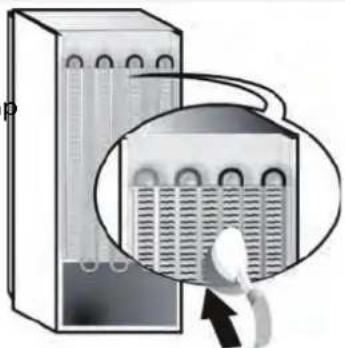
| Condenser | Regular cleaning with a vacuum cleaner at the back of the appliance |
| Safety | Unplug before maintenance; do not use flammable liquids |
| Spare parts | Available for 7 to 10 years depending on regulations |
| After-sales service | Contact customer service with model, service number, description of the problem |
| First use | Wait 2 hours after installation before plugging in; 4-6 hours to reach temperature |
| Preset temperature | Ideal settings preset at the factory |
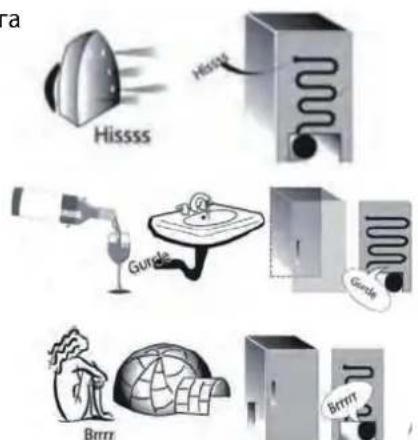
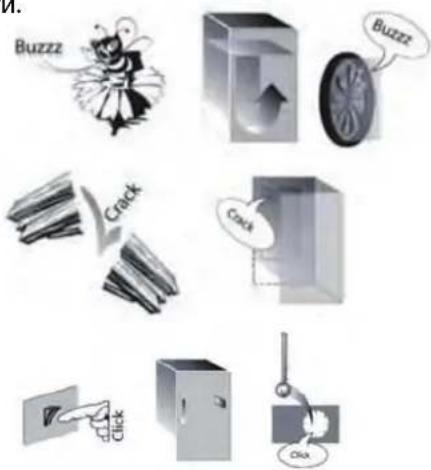
| Operating noises | Hissing, gurgling, rumbling, humming, cracking, clicking (normal) |
| Prolonged non-use | Unplug, empty, defrost, clean, leave doors ajar |
Frequently Asked Questions - INFC8 TO32X INDESIT
User questions about INFC8 TO32X INDESIT
0 question about this device. Answer the ones you know or ask your own.
Ask a new question about this device
Download the instructions for your Refrigerator in PDF format for free! Find your manual INFC8 TO32X - INDESIT and take your electronic device back in hand. On this page are published all the documents necessary for the use of your device. INFC8 TO32X by INDESIT.
USER MANUAL INFC8 TO32X INDESIT
Light systems (depending on the model) 2
Shelves and door balconies 2
Door 2
How to use the appliance 3
First time use 3
Refrigerator compartment and food storage 3
How to store fresh food and beverages 3
Freezer compartment and food storage 3
Removing the freezer drawer container 3
Tips for freezing and storing fresh food 3
4
Food shelf life at different temperatures 4
Functional sounds 4
Recommendation in case of no use of the appliance 5
Cleaning and maintenance 6
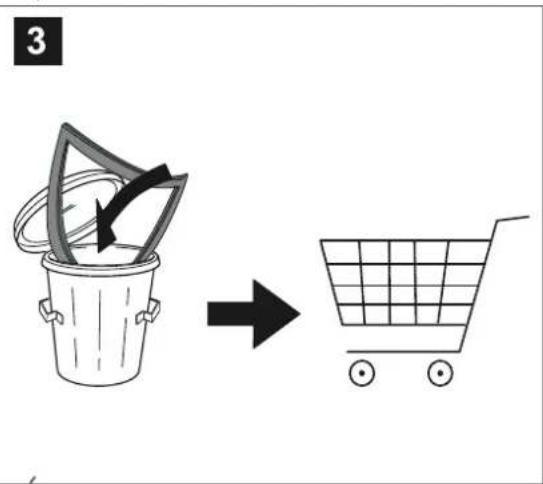
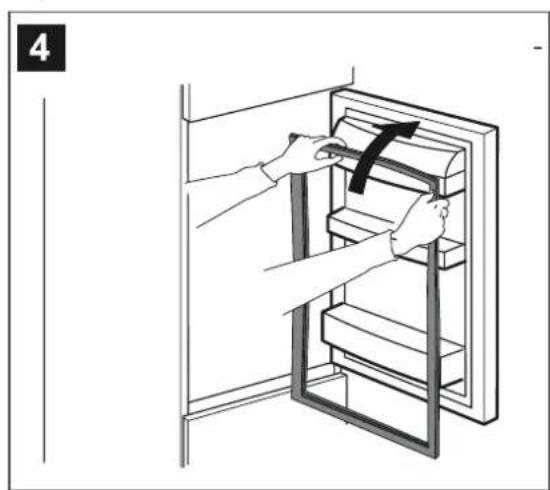
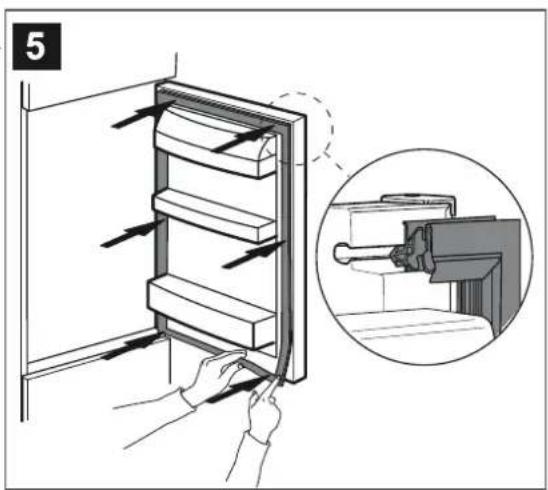
Gasket replacement 7
After-sales service 8
General Information
LED light
If the LED light system does not work, please contact the Service to replace it.
Important: The refrigerator compartment light switches on when the refrigerator door is opened. If the door is kept open for more than 8 minutes the light will be automatically switched off.
Light systems (depending on the model)
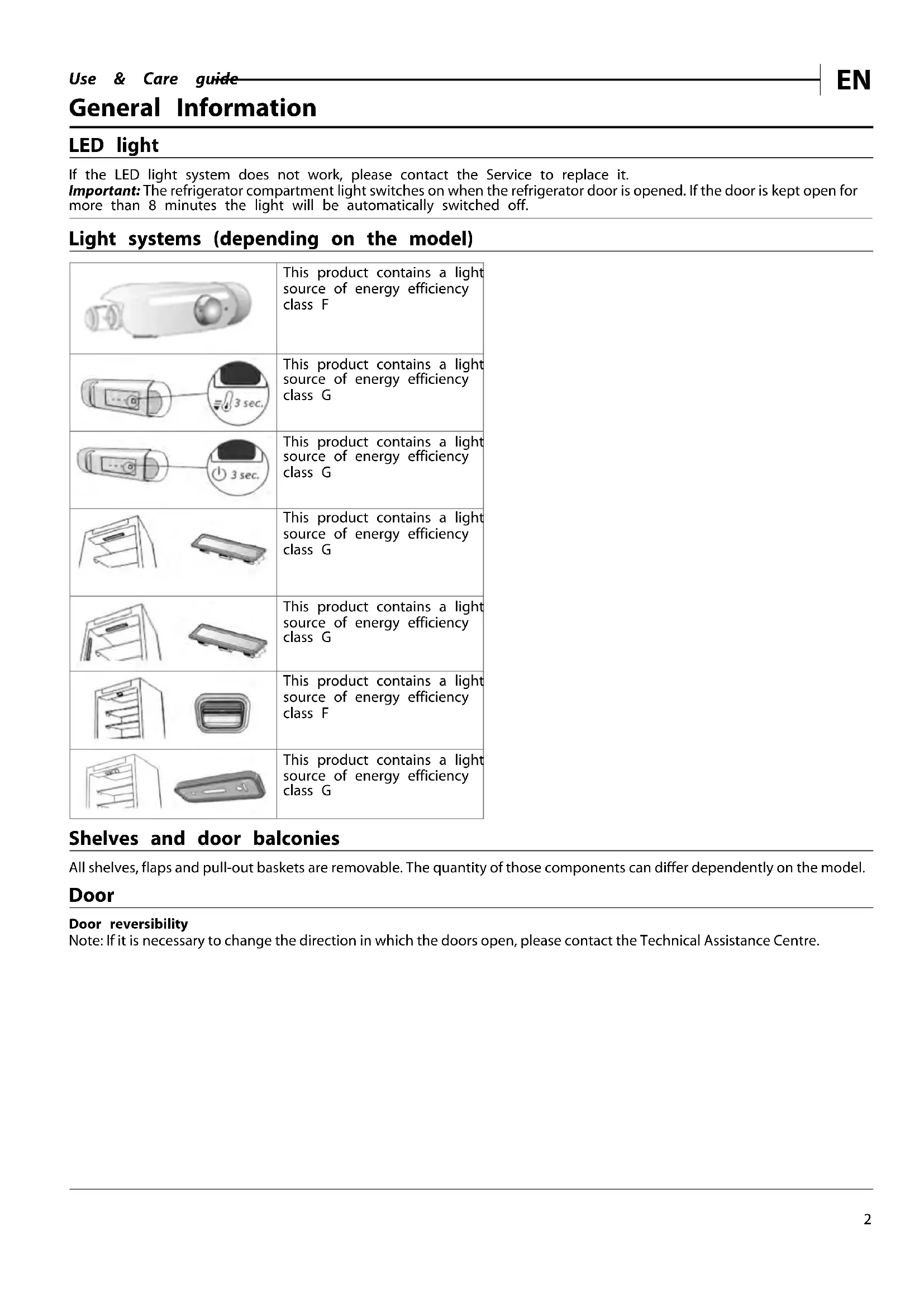
| This product contains a light source of energy efficiency class F |
| This product contains a light source of energy efficiency class G |
| This product contains a light source of energy efficiency class G |
| This product contains a light source of energy efficiency class G |
| This product contains a light source of energy efficiency class G |
| This product contains a light source of energy efficiency class G |
Shelves and door balconies
All shelves, flaps and pull-out baskets are removable. The quantity of those components can differ dependently on the model.
Door
Door reversibility
Note: If it is necessary to change the direction in which the doors open, please contact the Technical Assistance Centre.
How to use the appliance
First time use
After installation, wait at least two hours before connecting the appliance to the power supply. Once connected, it will start working automatically. The ideal temperature settings are preset from the factory. After turning the appliance on, wait 4-6 hours for it to reach the correct food storage temperature.
Refrigerator compartment and food storage
The refrigerator compartment allows for the storage of fresh food and drink. The refrigerator compartment defrosts completely automatically. The occasional presence of drops of water on the internal back wall of the compartment is a sign of the automatic defrosting phase. The defrosting water is channelled into a drain and then collected in a container, where it evaporates.
Note: the ambient temperature, how often the doors are opened and the position of the appliance may affect the internal temperatures in the two compartments. Set the temperatures depending on these factors. In very humid conditions, condensation may form in the refrigerator compartment, especially on the glass shelves. In this case, it is recommended that you close containers with liquids in (e.g. a pot of stock), wrap up food with a high water content (e.g. vegetables) and turn on the fan, if there is one. All of the drawers, door shelves and shelves can be removed.
Air ventilation
The natural circulation of air in the refrigerator compartment results in zones with different temperatures. Insufficient ventilation results in an increase in energy consumption and reduction of the refrigerating performance.
How to store fresh food and beverages
Foods which give off a large amount ethylene gas (apples, apricots, pears, peaches, avocado, figs, prunes, blueberries, mellons, beans) and those that are sensitive to this gas, such as fruit vegetables and salad, should always be separated or wrapped so as not to reduce the storage life; for example do not store tomatoes together with kiwi fruits or cabbage. Do not store food too close together to enable sufficient air circulation. Use recyclable plastic, metal, aluminum and glass containers and cling film to wrap foods. If you have a little quantity of food to store in the refrigerator, we recommend to use the shelves above the crisper for fruits and vegetables since this is the coolest area of the compartment. Always use closed containers for liquids and for food that may give off or be tainted by odor or flavor transfer or cover them. To avoid bottles falling over, you can use the bottle holder (available on selected models).
Freezer compartment and food storage
The freezer compartment allows for the storage of frozen food and the freezing of fresh food. The quantity of fresh food that can be frozen in a specific time period is indicated on the rating plate. Arrange the fresh food in the freezing area inside the freezer compartment, leaving enough space around it to allow air to circulate freely. Avoid fresh food to come into direct contact with frozen food. Load limits are determined by baskets, flaps, drawers, shelves etc. Make sure that these components can still close easily after loading. To optimize freezing speed and get more storage space, the freezer compartment can be used without the freezer drawers.
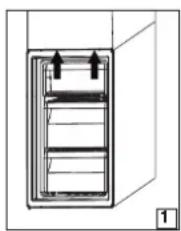
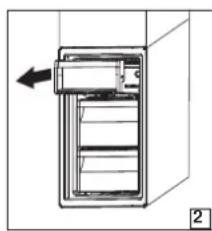
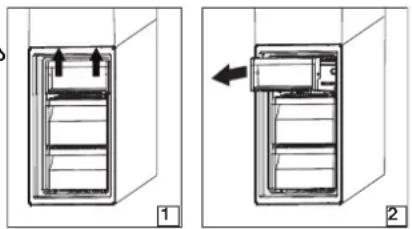
Removing the freezer drawer container
- Open the freezer door.
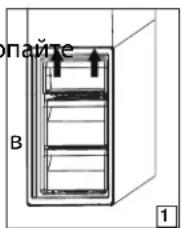
- Pull the upper container upwards by the right and left corners (1).
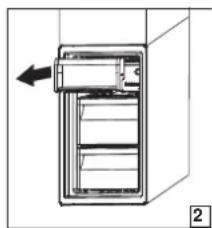
- Remove the drawer (2).
- Install the upper container in the reverse order.
Tips for freezing and storing fresh food
We recommend to label and date all your frozen food. Adding a label will help you to identify foods and to know they should be used before their quality deteriorates. Do not re-freeze defrosted food. - Before freezing, wrap and seal fresh food in: aluminium foil, cling film, air and water-tight plastic bags, polythene containers with lids or freezer containers suitable for freezing fresh food. - Food must be fresh, mature and of prime quality in order to obtain high quality frozen food. - Fresh vegetables and fruit should preferably be frozen as soon as they are picked to maintain the full original nutritional value, consistency, colour and flavor. Some meat, especially game, should be hung before it is frozen. - Always leave hot food to cool before placing in the freezer. Eat fully or partially defrosted foods immediately. Do not refreeze unless the food is cooked after it has thawed. Once cooked, the thawed food can be refrozen. - Do not freeze bottles with liquid.
Frozen food: shopping tips
When purchasing frozen food products:
- Ensure that the packaging is not damaged (frozen food in damaged packaging may have deteriorated). If the package is swollen or has damp patches, it may not have been stored under optimal conditions and defrosting may have begun.
- When shopping, buy frozen foods at the end of your trip and transport them in a thermally insulated cool bag.
- Once at home, place the frozen foods immediately in the freezer.
- If food has defrosted even partially, do not refreeze it. Consume within 24 hours.
- Avoid or reduce temperature variations to the minimum. Respect the best-before date on the package.
- Always observe the storage information on the package.
Food shelf life at different temperatures
| FROZEN COMPARTMENT | |||
| Product Storage period (-12°C) Recommended Storage | Storage period (-24°C) | ||
| period (-18°C) | |||
| Butter or margarine 1 month | 6 months | 9 months | |
| Fish 1 month | months | ||
| Fruits (except citrus) & Vegetables | 1 month | 8-12 months | 12 months |
| Meat- Ham- sausage Roasts (beef-pork- lamb) Steaks or chops (beef-lamb-pork) | 1 month | 2 months | 8-12 months 4 months |
| 4 months | |||
| Milk, Fresh fluid, Cheese, Ice cream or sherbet | 1 month | 1-3 months | 5 months (not recommended for ice cream) |
| Poultry (chicken-turkey) | month | 5-7 months | 9 months |
| UNFROZEN COMPARTMENT | |||
| Product | Storage period 0-3°C | Storage period (3-6°C) | Storage period 6-8°C |
| Cans, drinks, eggs, sauces, pickles, butter, jam | 3-4 weeks | 3-4 weeks | 3-4 weeks |
| Tropical fruit | Not recommended 2-4 weeks | 3-4 weeks | |
| Cheese, milk, dairy food, deli food, yoghurt | i2-5 days | 2-5 days | 2-5 days |
| Cold cuts, desserts, meat and fish and home-cooked food | B-5 days | 1-2 days | Not recommended |
| Store vegetables and fruits (excluding tropical fruits and citrus) | 15 days | 10-12 days | 4-7 days |
Functional sounds
Sounds coming from your appliances are normal since it has a number of fans and engines to regulate performances that switch on and off automatically.
Some of the functional sounds can be reduced through:
- Leveling the appliance and installing it on an even surface.
- Separating and avoiding contact between the appliance and furniture.
- Checking if the internal components are correctly placed.
- Checking if bottles and containers are not in contact with each other.
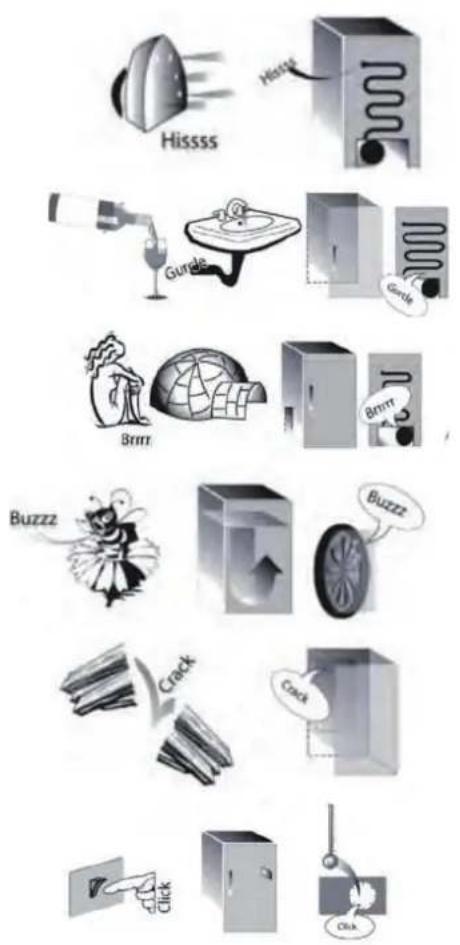
Some of the functional sounds you might hear
- A hissing sound when switching on the appliance for the first time or after a long pause.
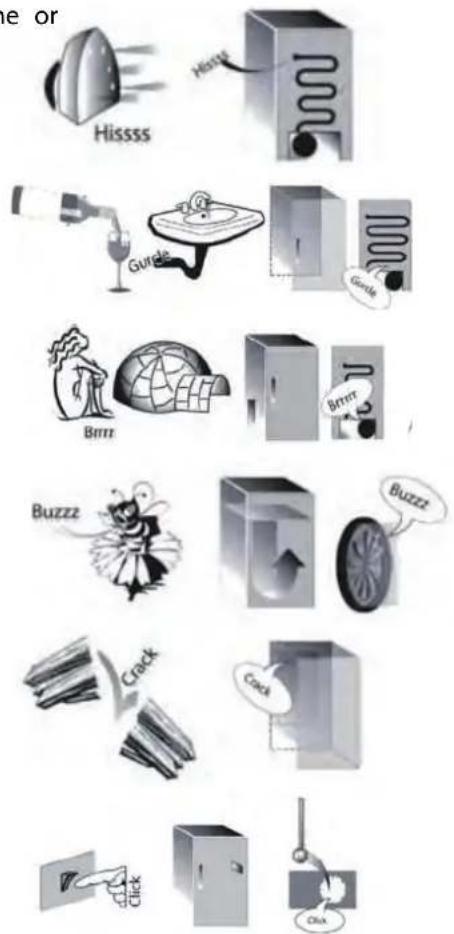
- A gurgling sound when refrigerant fluid enters into the pipes.
- BRRR sound is from the compressor running.
- Buzzing sound when water valve or fan start working.
- A cracking sound when compressor starts.
- The Click is from the thermostat which adjusts how often the compressor is running.
Recommendation in case of no use of the appliance
In the event of non-use of the appliance
Disconnect the appliance from the power supply, empty it, defrost it (if necessary) and clean it.
Keep the doors slightly ajar to let air circulate inside the compartments. By doing this, you avoid the development of mould and bad odours.
In the event of an interruption to the power supply
Keep the doors closed so the food stays cold for as long as possible. Do not re-freeze food that has partially defrosted. If there is a prolonged power cut, the black out alarm may also activate (in products with electronics).
Cleaning and maintenance
Before any cleaning or maintenance operation, unplug the appliance from the mains or disconnect the electrical power supply.
Never use abrasives. Never clean refrigerator parts with flammable fluids.
Do not use steam cleaners.
The buttons and control panel display must not be cleaned with alcohol or alcohol-derived substances, but with a dry cloth.
Periodically clean the appliance with a cloth and a solution of lukewarm water and neutral detergent specifically for refrigerator interiors. Clean the outside of the appliance and the door seal with a damp cloth and dry with a soft cloth. - The condenser placed in the rear of the appliance should be cleaned regularly using a vacuum cleaner.
Important:
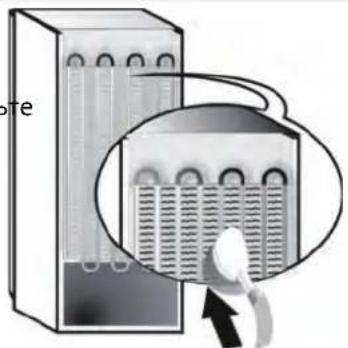
The buttons and control panel display must not be cleaned with alcohol or alcohol-derived substances, but with a dry cloth. The refrigeration system pipes are located near the defrost pan and can become hot. Periodically clean them with a vacuum cleaner.
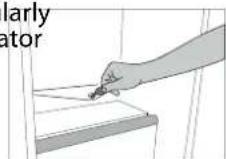
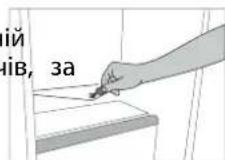
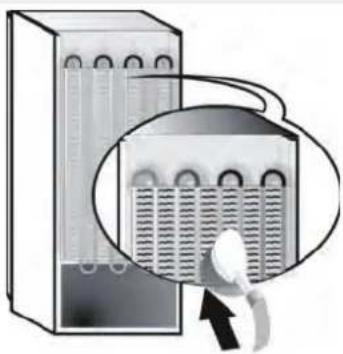
To ensure the constant and correct flow of the defrosting water, regularly clean the inside of the drain situated in the back wall of the refrigerator compartment near the fruit and vegetable drawer using the utensil provided *.
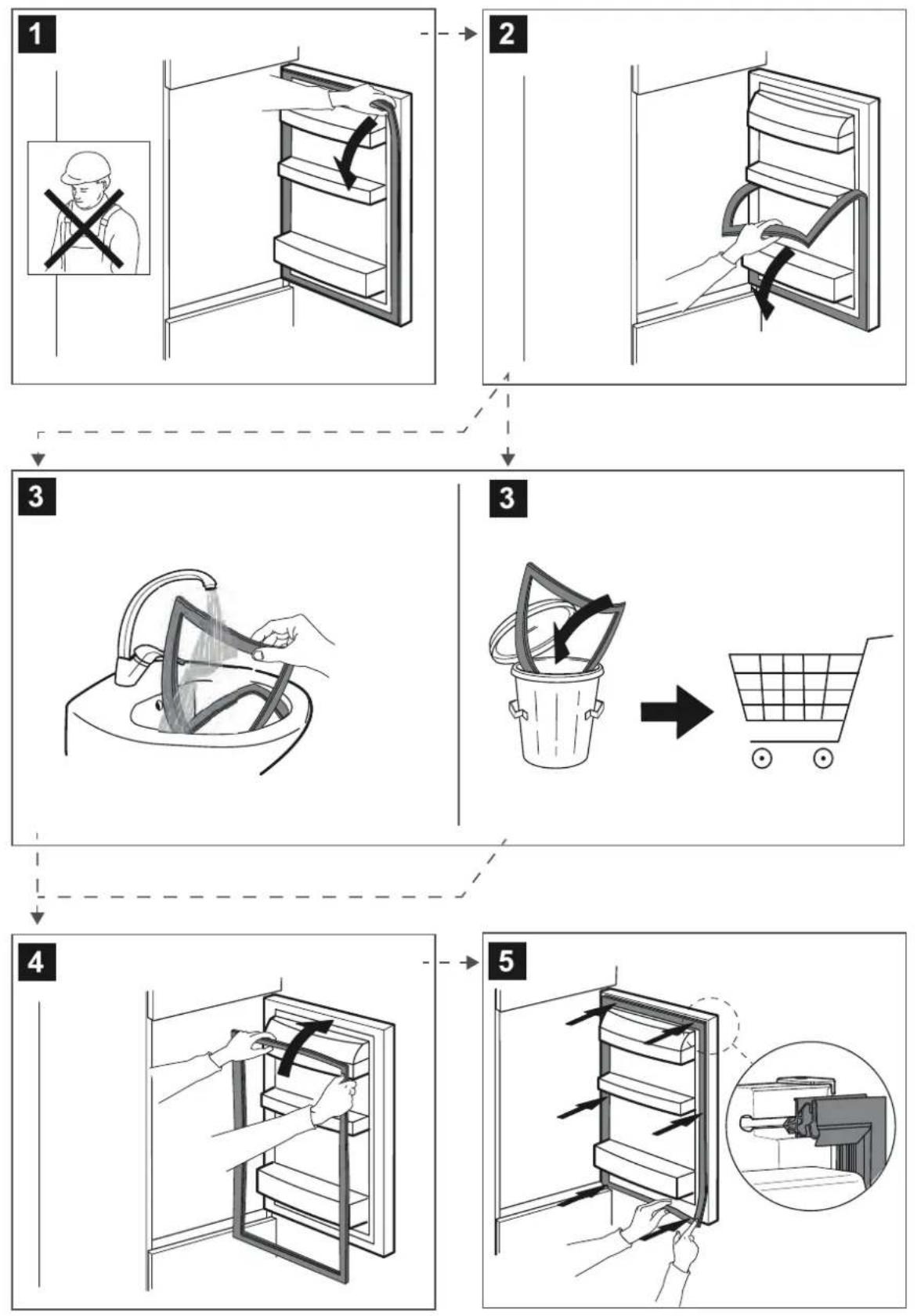
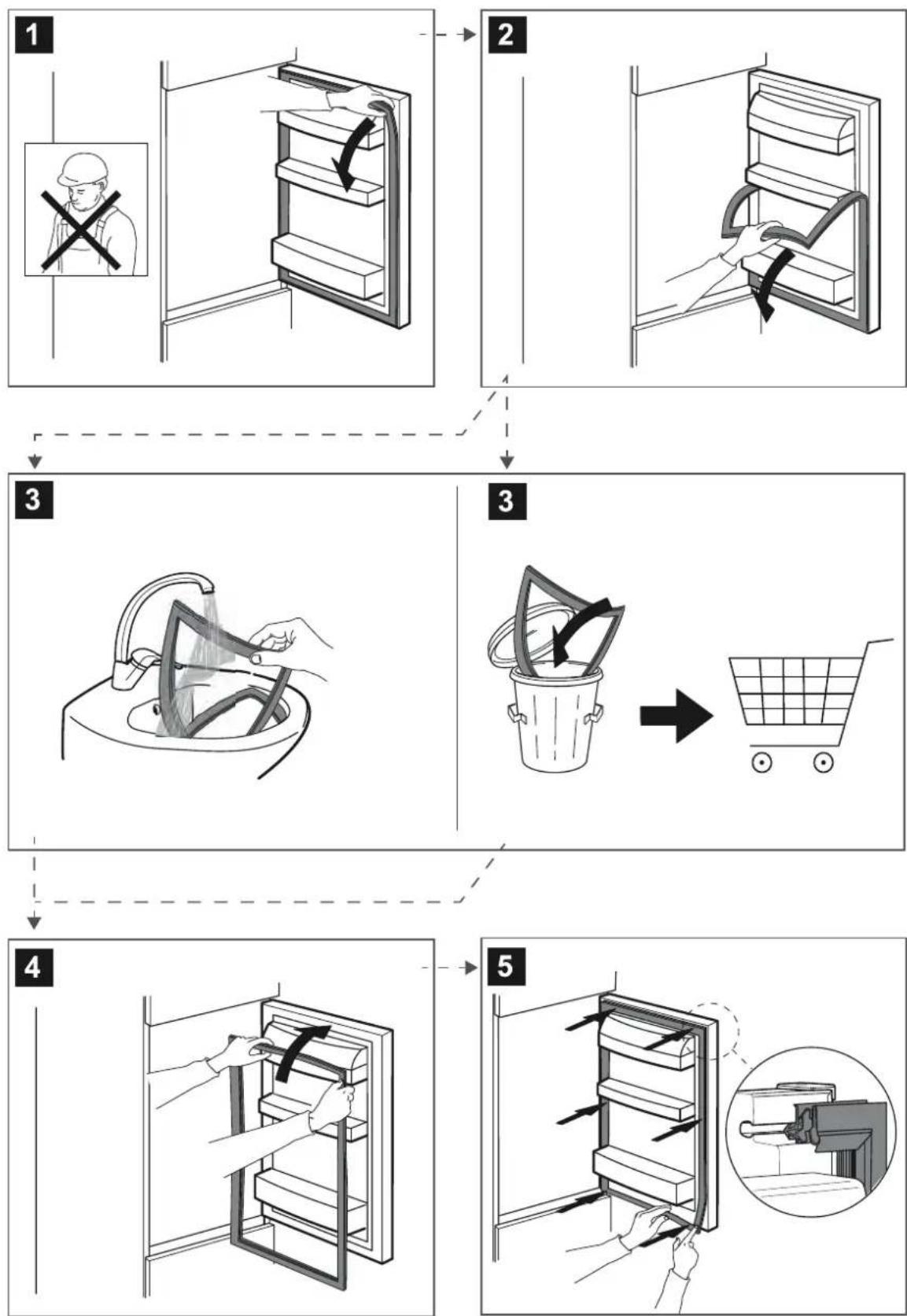
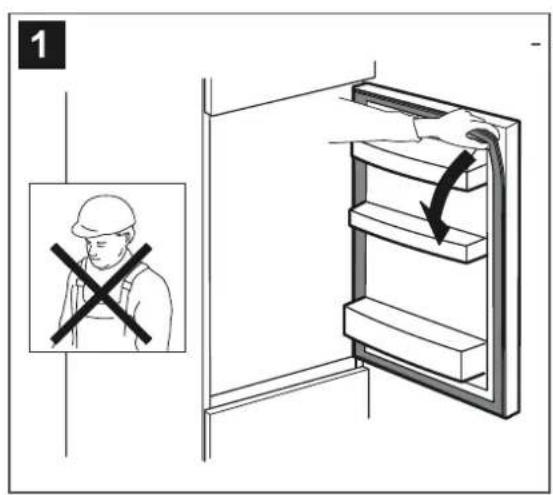
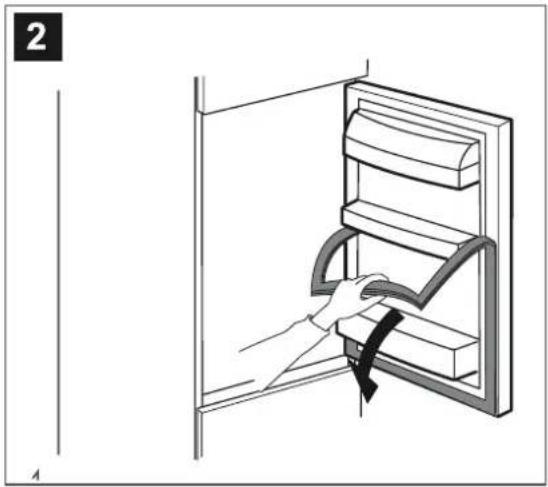
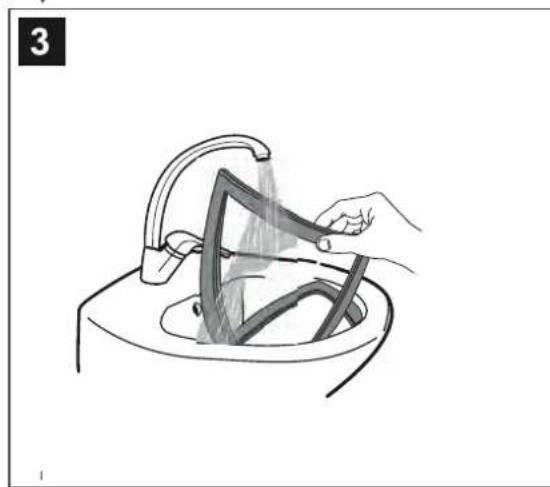
Gasket replacement
After-sales service
BEFORE CALLING THE AFTER-SALES SERVICE
- See if you can solve the problem by yourself with the help of the suggestions given in the TROUBLESHOOTING.
- Switch the appliance off and back on again to see if the fault persists.
IF AFTER THE ABOVE CHECKS THE FAULT STILL OCCURS, GET IN TOUCH WITH THE NEAREST AFTER-SALES SERVICE.
To receive assistance, call the number shown on the warranty booklet.
When contacting our Client After sales service, always specify:
a brief description of the fault; - the type and exact model of the appliance;
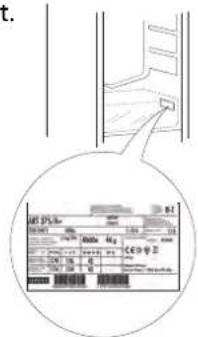
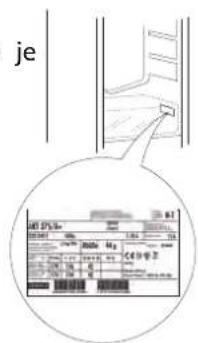
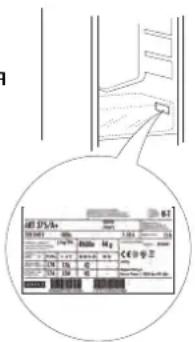
- the service number (number after the word Service on the rating
plate). The service number is also indicated on the guarantee booklet.
- your full address;
- your telephone number.
If any repairs are required, please contact an authorised aftersales service (to guarantee that original spare parts will be used and repairs carried out correctly).
Spare parts will be available for a period of either up to 7 or up to 10 years, according to the specific Regulation requirements.
Cleaning and maintenance
The appliance draws in air into the compartment for obtaining zones with different temperatures. Insufficient ventilation in the compartment leads to increased consumption and energy, and reduced cooling.
How to store fresh food and drinks
Foods that release large amounts of ethylene (apples, apricots, pears, peaches, avocados, figs, plums, onions, and garlic) and foods that are sensitive to this gas, such as bananas, greens, and lettuce, should be separated or wrapped in foil to prevent their premature ripening. For example, do not store bananas, onions, or greens together. Do not store food uncovered near each other to allow sufficient air circulation. Use plastic, metal, aluminum, and glass containers that can be recycled, as well as cling film for wrapping food. If you have a small amount of food to store and the refrigerator is not full, we recommend using the drawers for vegetables and greens, as this is the coolest part of the compartment. Also, use airtight containers for leftovers and for foods that release odors, as they can absorb or impart flavors, or cover them. To prevent bottles from falling, you can use the bottle rack (if provided).
Removing the container from the freezer compartment
- Open the freezer door. Hold the container by the handle and the front side (1) and lift it upwards. Remove the drawer (2).
- Install the upper container by repeating the steps in reverse order.
Tips for freezing and storing fresh food
- Before freezing, place the label and date on all frozen foods. The label will help you
- identify the food and know when it should be used, while its quality is preserved.
- Freeze only fresh food.
- Do not freeze food in: aluminum foil, cling film, airtight bags, plastic containers with lids, or containers for ice. These are suitable for freezing fresh food. Food must be fresh, ripe, and of high quality to achieve high quality frozen food.
- Fresh vegetables and fruits should be frozen immediately after harvesting to preserve
- their nutritional value, consistency, color, and taste. Some meats, especially beef, should be
- wrapped when freezing. Allow hot foods to cool before placing them in the freezer. Consume the frozen food within the indicated period. Do not refreeze unless the food has been cooked after thawing. Once cooked, thawed food can be refrozen. Do not freeze bottles with liquids.
Frozen food: tips for shopping
Freezing and storing food:
- The packaging and the package are frozen, so that the stored product may fall apart. If the packaging looks inflated or with wet spots, it may not have been stored under optimal conditions and the defrosting may have started. When shopping, buy frozen food at the end of your shopping trip and transport it in a cool bag. After purchasing, immediately place the frozen food in the freezer. If the food has partially defrosted, do not refreeze it. Consume within 24 hours.
- Avoid temperature fluctuations as much as possible. Observe the date of freezing and the expiry date on the packaging. Follow the storage instructions on the packaging.
Organoleptic qualities of food at different temperatures
| OTDEJIENHE 3A 3AMPA3EHN XPAHIN | |||
| Пrodukt Пераюн на сбхраене (-12°C) | Пroduktычileн на сбхраене (-18°C) | Пrodukt на сбхраене (-24°C) | |
| Масло пли маргарин 1 месц 6 месц 9 месц | |||
| Риба 1 месц 1-3 месц 6 месц | |||
| Плodove (сизлочени на сизурови) & Зеленьци | 1 месц 8-12 месц 12 месц | ||
| Месо -шунka - наденики Пechени месо (robehdo-cbincko-a rgeshko)Стековши Котлети (robehdo-a rgeshko-cbincko) | 1 месц 2 месц | 8-12 месц4 месц | 12 месц |
| Мяяко, пессни наптук, сирени, садонед плишербет | 1 месц 1-3 месц 5 месц (he ce песорьчва) | 3a садонedi) | |
| Птице месо (пileшко-pnyшко) | 1 месц 5-7 месц 9 месц | ||
| OTDEJIENHE 3A HE3AMPA3EHN XPAHIN | |||
| Пюдунг Порнон на сбхраенhoe 0-3°C | Пюдунг на сбхраенhoe (3-6°C) | Пюдунг на сбхраенhoe 6-8°C | |
| Консерви, нашики, яйca, сосове, тушии, масло, konфотюр | 3-4 седимци 3-4 седимци | 3-4 седимци | |
| Тропчески плodove He ce | прөрөрьчы 2-4 седимци | 3-4 седимци | |
| Сирени, м借贷о, мleteни пюдунги, деникешихрали, кисел м借贷о | 2-5 дни 2-5 дни 2-5 дни | ||
| Стudени колбаси, Decesрtni, месо, риба, DOMaшно сrotвахи xрали | 3-5 дни 1-2 дни He ce пөрөрьчы | ||
| За сбхданhoe на плodoveи зеленчци (сизліочени на Trропчески и сүлүрсови плodove) | 15 дни 10-12 дни 4-7 дни | ||
Sound functions
The noises from the appliance are normal, as it operates with a fan and a motor for regulating its functioning, which switch on and off automatically.
Some of these noises may be reduced by:
- Leveling the appliance and mounting it on a flat surface.
- Separating and avoiding contact between the appliance and furniture.
- Check that the internal components are correctly placed.
- Check that the bottles and containers do not touch each other.
Some of the noises during operation that you may hear
- Clicking when the appliance is switched on for the first time or after a pause.
- Gurgling when the coolant flows through the pipes.
- A "BPPP" sound when the compressor operates.
- Before cleaning, close the fan cover for operation.
- Before cleaning, make sure the compressor is switched off.
- Cleaning is done by the thermostat, which regulates the frequency of compressor operation.
Procedure in case of non-use of the device
In case of non-use of the device
Disconnect the device from the power supply, empty it, perform the decommissioning procedure and (if necessary) clean it. Leave the door open for a while to allow air circulation inside the compartment. This prevents the formation of mold and mildew.
In case of prolonged disuse
Keep the doors closed so that the interior remains as cold as possible. Do not block partially open compartments. In case of prolonged disuse, the door alarm can be activated (on devices with electronic components).
Brief description of the malfunction; exact type and model of the device;
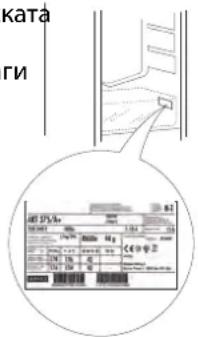
- Service number (the number on the service label on the data plate). The service number is also indicated in the warranty book and on your invoice; carefully read the water before opening the door.
SERVICE 0000 000 00000
If any repair is necessary, please contact the after-sales service department to ensure that original spare parts are used and repairs are carried out correctly.
Spare parts will be available for a period of 7 to 10 years, in accordance with the specific requirements of the regulations.
Technical information
LED lighting
If the LED lighting system does not work, contact the Service Center to replace it. Warning: The lamp of the appliance switches on when the appliance door is first opened. If the door remains open for more than 8 minutes, the lamp switches off automatically.
BEFORE CONTACTING AFTER-SALES SERVICE
- Check if you can solve the problem yourself with the help of the tips given in the TROUBLESHOOTING section.
- Turn the appliance off and on and check if the fault is still present.
IF AFTER THE ABOVE CHECKS THE FAULT STILL EXISTS, CONTACT THE NEAREST AFTER-SALES SERVICE
To get help, call the number given in the warranty booklet.
When contacting our after-sales service for customers, you need to provide:
- a brief description of the problem;
- the type and exact model of the appliance;
SERVICE
- the service number (the number after the word Service on the data plate). The service number is also given in the warranty booklet: your full address; Always drain the water before opening the door.
If any repairs are needed, contact an authorized after-sales service (to ensure that original spare parts are used and that repairs are carried out correctly).
Spare parts are available for a period of 7 to 10 years, in accordance with the specific requirements of the provision.
Instructions for use
INSTRUCTIONS FOR USE
CONTENTS
Shelves and door bins 2
Door 2
Use of the appliance 3
First use 3
Refrigerator compartment and food storage 3
Shelves and door bins
Freezer compartment
Freezing and storage of fresh food . . . . . . . . . . . .
Frozen food: proper use and storage 4
Storage time of products at different temperatures 4
Noises during operation 5
Recommendations for using the device 6
Maintenance and technical service 7
Replacing the sealing gasket 8
Troubleshooting and service 9
Basic information
Light indicator
If the interior lighting does not work, contact the customer service center. Important: The interior lighting of the refrigerator compartment turns on when the door is opened. If the door remains open for more than 8 minutes, the light turns off automatically.
Lighting system (depending on model)
When the device is not in use
Disconnect the device from the power supply, remove all products from it, defrost and clean if necessary. Leave the door slightly open to ensure air circulation inside. This will prevent the formation of mold and unpleasant odors.
In case of power supply interruption
Keep the door closed to keep the products cold longer. Do not refreeze partially thawed products. If the power is off for a long time, an alarm may sound (in models equipped with electronics).
Care and technical maintenance
Before performing cleaning or maintenance, disconnect the device from the power supply or unplug it from the socket.
Never use abrasive cleaning agents. Never use sharp objects to clean the refrigerator.
3a60pOHaETbC3aCTOCOByBaTu napooUCHnKn.
Khonk Ta ducnne naheni KepybaHH He moXHa npotnpaPiuHAMn, aKi MCTaTb cnpT, a nuwe cyxoO raHc
- Perioquho MnTe npnla3a donomoro raHupkn Ta po3uHy TeNoBn 3 HeTpalbHM MnHm 3ac06om (oc6nBO, kkuo MOBa Ipe BHytpiHi qactnH XOJOnHbHnka). 30BHIHIO NOBExHIO npnady u yuihIOBaY dna DBepaT OCH3a DonOMoroIO BOIoroI raHupKn, a NOTIM BntPi cyxoIO.
- IotpiioHO peryIapno qnCTHTKoHdEHCATOp, po3TaObaHn Ha 3aHi CTINi npNAdy, BkOpNCTOByUOn nnococ.
Baxlueo:
KHOKN Ta dncnne nane He moXHa npotnpaPi dHAMn, kI MiCTb cnpT, a IInwe cyxo raHupkoio. Tpy6n ciCTeMn OxonoJKeHHa PO3aUoBaHI NO6n3y NiDOnHy dIra 36OpY PO3MOpOKeHOrO NbOdy Ta MoKybHarpiBaTncr. NepiouHNo uCtictb zu Tpy6n 3a DonomoroIO nnococa.
Дя 3a6e3neueHH 6e3nepeKoHOrO Ta npabNlbHOrO CTiKaHHraTanoI BOJn peYnApHO OuyuTe dpehaxHn OTBip, PO3aUOBaHn Ha 3aHi nCTIHcXoJIoNbHOrO BiDineHH 6In KOnTeHepa Iry φpykTiB i OBOUIB, 3a DONOMORIO npnlaDn, 10 NOCTaHaETbC B KOMnEKeT*.
3amHa yuilbHOBaIbHOi npoklaKn
PicnnpoJxHe 06cnyroByBaHn
NEPIHIX TEJIFOHOYBATU YCEHTP NICJNPOADXHORO OBCNYROBYAHHH
- Ipebeipte, uMozha BpiuHn np6neMy camocTiHo 3a donomoroI npad, HabeHeHx y po3diI NOCiBHK I3 UCYHEHHA HECnPABHOCTEi.
- BvmkhHtB npnlaad i 3HOBy yBimKhHtB noro, o6 nepeBipuTn, nn HecnpaBicTB 3aIIuAeTbcra.
JAKUO NICJBAUNIEBKA3AHOI NEPEBIPK INHCPABHICTb HE 3HUKHE, 3BEPHITbC DO HAIJIINXQTO CEHTPY NICJNPODAHXHO OBCNYROBYBAHH
Дя OTpmaHЯ ДОнOMOrn 3BepHiTbCra 3a HOMePOM, lo Bka3aHn y rapaHTiHOMy TaIOnHi.
Плд ус 3В'ЯЗКу 3 Нашим Сербicom nicларpoДЖHorO 06СNYROByBaHHa 3aBXdN yTOUHIOIte:
KOPOTKIN ONIC HecnpaBHOCTI; TnPi ToUHy MoDJIb npJnaIaIy;
- cepBichn Homep (Homep nicna CnoBa Service Ha nacnopTHi Ta6nnuqi). CepBichn Homep TAKOX Bka3aHO B rapaHTINOMy
- NOBHy aDpeCy CBORo Micr npOxNBaHHra
- Nepw HIX BiIDKPNBn DBePcra Ta 3aBXKn 3NBAIte BODy.
KIO noTpi6eH peMOHT, 3BepHITbCg Do ABTOPn3OBAHOro CEHTpy nICnInpOaXHOro O6cnyROByBaHH (IO6 rapaHTyBaTH npabNlbHicThpeMOHTy Ta BkOpNCtAHHr OpurHaJIbHNx 3anuactH).
3anachi yactnH 6ydybT doctynH BiPOnOBK TepmiHy do 7 a6o do 10 pokIB, BiNObiHO do KOHKpeTHNX HopMaTHBHX
User manual
USER MANUAL
CONTENTS
Instructions for use and maintenance 2 General information 2 LED lighting 2 Lighting systems (depending on model) 2 Shelves and door shelves 2 Door 2 How to use the appliance 3 When using for the first time 3 Refrigerator compartment and food storage 3 How to store fresh food and drinks 3 Freezer compartment and food storage 3 Removing the freezer drawer 3 Advice on freezing and storing fresh food 4 Frozen food: purchasing and storage advice 4 Storage time at different temperatures 4 Functional sounds 5 Recommendations when the appliance is not in use 6 Cleaning and maintenance 7 Replacing the gasket 8 After-sales service 9
General information
LED lighting
If the LED lighting system does not work, contact the Service department to replace it. Note: The refrigerator compartment lighting turns on when the refrigerator door is opened. If the door remains open for more than 8 minutes, the light will turn off automatically.
Lighting systems (depending on model)
6m8m 3o5680mmn amSymdmdoom
a 1
a a a a a a a a a a a a a a a a a a a a a a a a
:J 1
ginaeae aegi gaiell elgul bua
j j 1
J 1
1
.2
.3
Jall gagall jolal plaoa llaic jj C
JaaI g yssll lae 5
J 6
jlll puiu
jglal pslil
a 1
Therefore, m: x = 1 or 3x + 4y + 1 = 0
Therefore, P 12
- LIGHT SYSTEMS (DEPENDING ON THE MODEL)
- SHELVES AND DOOR BALCONIES
- DOOR
- HOW TO USE THE APPLIANCE
- FIRST TIME USE
- REFRIGERATOR COMPARTMENT AND FOOD STORAGE
- HOW TO STORE FRESH FOOD AND BEVERAGES
- FREEZER COMPARTMENT AND FOOD STORAGE
- REMOVING THE FREEZER DRAWER CONTAINER
- TIPS FOR FREEZING AND STORING FRESH FOOD
- FOOD SHELF LIFE AT DIFFERENT TEMPERATURES
- FUNCTIONAL SOUNDS
- RECOMMENDATION IN CASE OF NO USE OF THE APPLIANCE
- CLEANING AND MAINTENANCE
- GASKET REPLACEMENT
- AFTER-SALES SERVICE
- GENERAL INFORMATION
- LED LIGHT
- DOOR REVERSIBILITY
- AIR VENTILATION
- FROZEN FOOD: SHOPPING TIPS
- SOME OF THE FUNCTIONAL SOUNDS CAN BE REDUCED THROUGH
- SOME OF THE FUNCTIONAL SOUNDS YOU MIGHT HEAR
- IN THE EVENT OF NON-USE OF THE APPLIANCE
- IN THE EVENT OF AN INTERRUPTION TO THE POWER SUPPLY
- IMPORTANT
- BEFORE CALLING THE AFTER-SALES SERVICE
- IF AFTER THE ABOVE CHECKS THE FAULT STILL OCCURS, GET IN TOUCH WITH THE NEAREST AFTER-SALES SERVICE
- HOW TO STORE FRESH FOOD AND DRINKS
- REMOVING THE CONTAINER FROM THE FREEZER COMPARTMENT
- FROZEN FOOD: TIPS FOR SHOPPING
- ORGANOLEPTIC QUALITIES OF FOOD AT DIFFERENT TEMPERATURES
- SOUND FUNCTIONS
- PROCEDURE IN CASE OF NON-USE OF THE DEVICE
- IN CASE OF NON-USE OF THE DEVICE
- IN CASE OF PROLONGED DISUSE
- TECHNICAL INFORMATION
- LED LIGHTING
- BEFORE CONTACTING AFTER-SALES SERVICE
- IF AFTER THE ABOVE CHECKS THE FAULT STILL EXISTS, CONTACT THE NEAREST AFTER-SALES SERVICE
- INSTRUCTIONS FOR USE
- CONTENTS
- USE OF THE APPLIANCE
- SHELVES AND DOOR BINS
- MAINTENANCE AND TECHNICAL SERVICE
- BASIC INFORMATION
- LIGHT INDICATOR
- LIGHTING SYSTEM (DEPENDING ON MODEL)
- WHEN THE DEVICE IS NOT IN USE
- IN CASE OF POWER SUPPLY INTERRUPTION
- CARE AND TECHNICAL MAINTENANCE
- BAXLUEO
- AMHA YUILBHOBAIBHOI NPOKLAKN
- PICNNPOJXHE 06CNYROBYBAHN
- NEPIHIX TEJIFOHOYBATU YCEHTP NICJNPOADXHORO OBCNYROBYAHHH
- JAKUO NICJBAUNIEBKA3AHOI NEPEBIPK INHCPABHICTB HE 3HUKHE, 3BEPHITBC DO HAIJIINXQTO CEHTPY NICJNPODAHXHO OBCNYROBYBAHH
- USER MANUAL
- LIGHTING SYSTEMS (DEPENDING ON MODEL)
- M8M 3O5680MMN AMSYMDMDOOM
Brand : INDESIT
Model : INFC8 TO32X
Category : Refrigerator