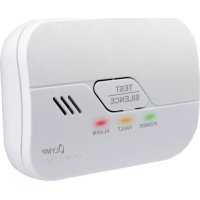
KM 210 - Alarm system OLYMPIA - Free user manual and instructions
Find the device manual for free KM 210 OLYMPIA in PDF.



| Product Type | Carbon monoxide (CO) detector |
| Dimensions | 120 x 37 x 80 mm |
| Weight | 143 g |
| Power supply | 2 AA 1.5 V batteries |
| Sensor type | Electrochemical |
| Audible signal | 85 dB (at 1 m) |
| Visual signal | 3 LEDs (green: Power, yellow: Error, red: Alarm) |
| Lifetime | 10 years |
| Applied standards | EN 50291-1:2010+A1:2012 |
| Tolerated ambient conditions | -10 °C to +40 °C, 30% to 90% RH |
| Main functions | CO detection, test/mute, self-test, silent mode, battery status indicator |
| End-of-life indicator | Yes (yellow LED flashes + 3 beeps every 30 s) |
| Low battery indicator | Yes (yellow LED flashes + 1 beep every 30 s) |
| Silent mode | Yes (temporarily disables the alarm) |
| Maintenance | Clean surface with damp cloth, clean openings with brush, monthly test |
| Package contents | Detector, mounting hardware (2 screws and 2 wall plugs), 2 AA batteries, instruction manual |
Frequently Asked Questions - KM 210 OLYMPIA
User questions about KM 210 OLYMPIA
0 question about this device. Answer the ones you know or ask your own.
Ask a new question about this device
Download the instructions for your Alarm system in PDF format for free! Find your manual KM 210 - OLYMPIA and take your electronic device back in hand. On this page are published all the documents necessary for the use of your device. KM 210 by OLYMPIA.
USER MANUAL KM 210 OLYMPIA
natural_image
Simple line drawing of a light bulb with radiating lines (no text or symbols)natural_image
Simple line drawing of a light bulb with radiating lines (no text or symbols)natural_image
Simple line drawing of a light bulb with radiating lines (no text or symbols)natural_image
Simple line drawing of a light bulb with radiating lines (no text or symbols)Warnung!
natural_image
Simple line drawing of a light bulb with radiating lines (no text or symbols)natural_image
Simple line drawing of a light bulb with radiating lines (no text or symbols)natural_image
Simple line drawing of a glowing light bulb with radiating lines (no text or symbols)natural_image
Simple line drawing of a light bulb with radiating lines (no text or symbols)natural_image
Simple line drawing of a light bulb with radiating lines (no text or symbols)natural_image
Simple line drawing of a light bulb with radiating lines (no text or symbols)natural_image
Symbol of a trash bin with crossed lines indicating no waste, and a solid black rectangle below (no text or labels)natural_image
Recycling symbol with three chasing arrows forming a triangle (no text or labels)ENGLISH

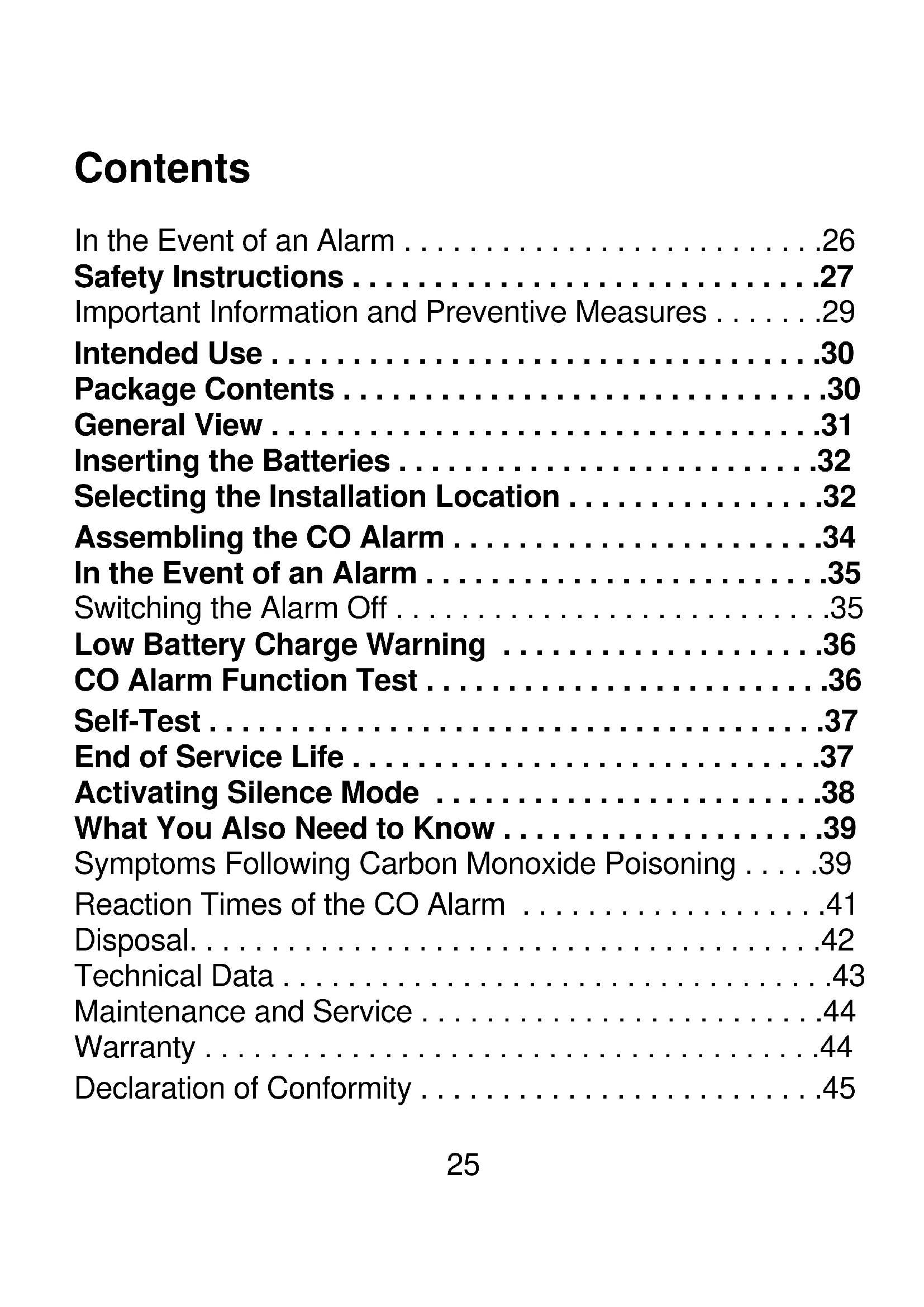
Contents
In the Event of an Alarm ....26
Safety Instructions .....27
Important Information and Preventive Measures .....29
Intended Use ....30
Package Contents ....30
General View ....31
Inserting the Batteries .....32
Selecting the Installation Location .....32
Assembling the CO Alarm ....34
In the Event of an Alarm ....35
Switching the Alarm Off ....35
Low Battery Charge Warning ....36
CO Alarm Function Test ....36
Self-Test ....37
End of Service Life ....37
Activating Silence Mode ....38
What You Also Need to Know ....39
Symptoms Following Carbon Monoxide Poisoning .....39
Reaction Times of the CO Alarm ....41
Disposal. 42
Technical Data 43
Maintenance and Service ....44
Warranty 44
Declaration of Conformity 45
In the Event of an Alarm
Danger! Risk of suffocation through carbon monoxide! Carbon monoxide is a highly flammable, invisible, odourless gas.

Open doors and windows to ventilate areas affected.
Clear the source of the danger where this is immediately obvious and you do not put your own life at risk.
You and others at risk must move away from the danger area.
Inform the fire service and wait for any instructions.
Do not enter the building or residence in which the carbon monoxide alarm has been triggered until the fire service has inspected the affected area.
Take advantage of medical help for persons suffering from headache, drowsiness, nausea or other symptoms which indicate carbon monoxide poisoning.
Safety Instructions

natural_image
Simple icon of a person using a laptop inside a circle (no text or symbols)Read the operating manual thoroughly and observe all the information contained when using the carbon monoxide alarm. Keep the operating manual close by for future reference.

natural_image
Simple line drawing of a light bulb with radiating lines (no text or symbols)Pay attention to this symbol. This symbol indicates passages of text providing useful information.
Warning! Carbon monoxide can have fatal effects. Carbon monoxide concentrations in the blood interfere with the capability of the body's oxygen supply. Depending on the concentration level, carbon monoxide can have fatal effects within minutes. Observe the information in Sections In the Event of an Alarm on Page 26, Important Information and Preventive Measures on Page 29 and What You Also Need to Know on Page 39.
Warning! Carbon monoxide is a highly flammable, invisible, odourless gas. Take every alarm seriously. Avoid producing sparks or flames should you hear the alarm! If the alarm is triggered, do not smoke or light a candle. Do not switch on any lights and do not unplug any electrical connections. Follow the instructions provided in Section In the Event of an Alarm on Page 26.

Warning! Risk of suffocation! Children can swallow small parts, packaging and protective foils. Keep the product and packaging out of reach of children!

Warning! Risks to health and the environment from batteries! Improper handling of batteries can put your health and the environment at risk. Never open, damage or swallow batteries or allow them to pollute the environment. Batteries may contain toxic, ecologically hazardous heavy metals.

Caution! Hearing damage through loud alarm signal! The alarm signal is loud and could cause hearing damage. Only use the device in the recommended installation locations. Do not remain in the vicinity of the acoustic alarm for a longer period when it has been triggered.
Important! Property damage through environmental influences! Harmful environmental influences, such as exposure to smoke, dust, vibration, chemicals, moisture, heat and direct sunlight, could damage the device or impair the function. Prevent exposing the device to environmental influences such as smoke, dust, vibration, chemicals, moisture, heat or direct sunlight.
Important! For technical reasons, the sensors must not be operated in excess of ten years.
As result of chemical wear of the sensor, the CO alarm does not work properly after the service life of ten years specified. Replace the device after ten years even if the outer appearance does not indicate any signs of wear. Avoid direct contact with vapours emanating from adhesives, paints and cleaning agents to prevent the sensor ageing or deteriorating more quickly.
Important Information and Preventive Measures
Throughout this operating manual, carbon monoxide is abbreviated to CO.
- The CO alarm does not detect smoke, fire or gases other than CO. Install other appropriate alarms to provide protection from smoke or heat development.
- The most frequent sources of CO development are gas devices, vehicle engines, electricity generators, heat-producing appliances, such as ovens or fireplaces, which do not work properly or are not used correctly and the use of grilling devices in closed rooms.
- Have gas thermostats, gas boilers and other devices and heaters run on gas, as well as air supplies and exhausts, serviced at regular intervals by specialists.
Intended Use
The KM 210 carbon monoxide alarm - subsequently referred to as CO alarm - serves for detecting different concentrations of carbon monoxide in the ambient air. A condition for complying with the intended use is that the equipment is installed correctly and the information in the manual is observed and maintained. Any other use is considered unintended use. Unauthorised modifications or reconstructions are not permitted.
Only use the CO alarm indoors. The CO alarm is not intended for use in industrial environments, business offices, boats, caravans and camping vans.
Package Contents
Please check the contents of the package carefully. If anything is missing or has been damaged during transport, DO NOT put the CO alarm into operation!
- KM 210 CO alarm
• Assembly material (2 screws, 2 dowels)
• 2 batteries (AA batteries, 1.5 V) - Operating manual
General View
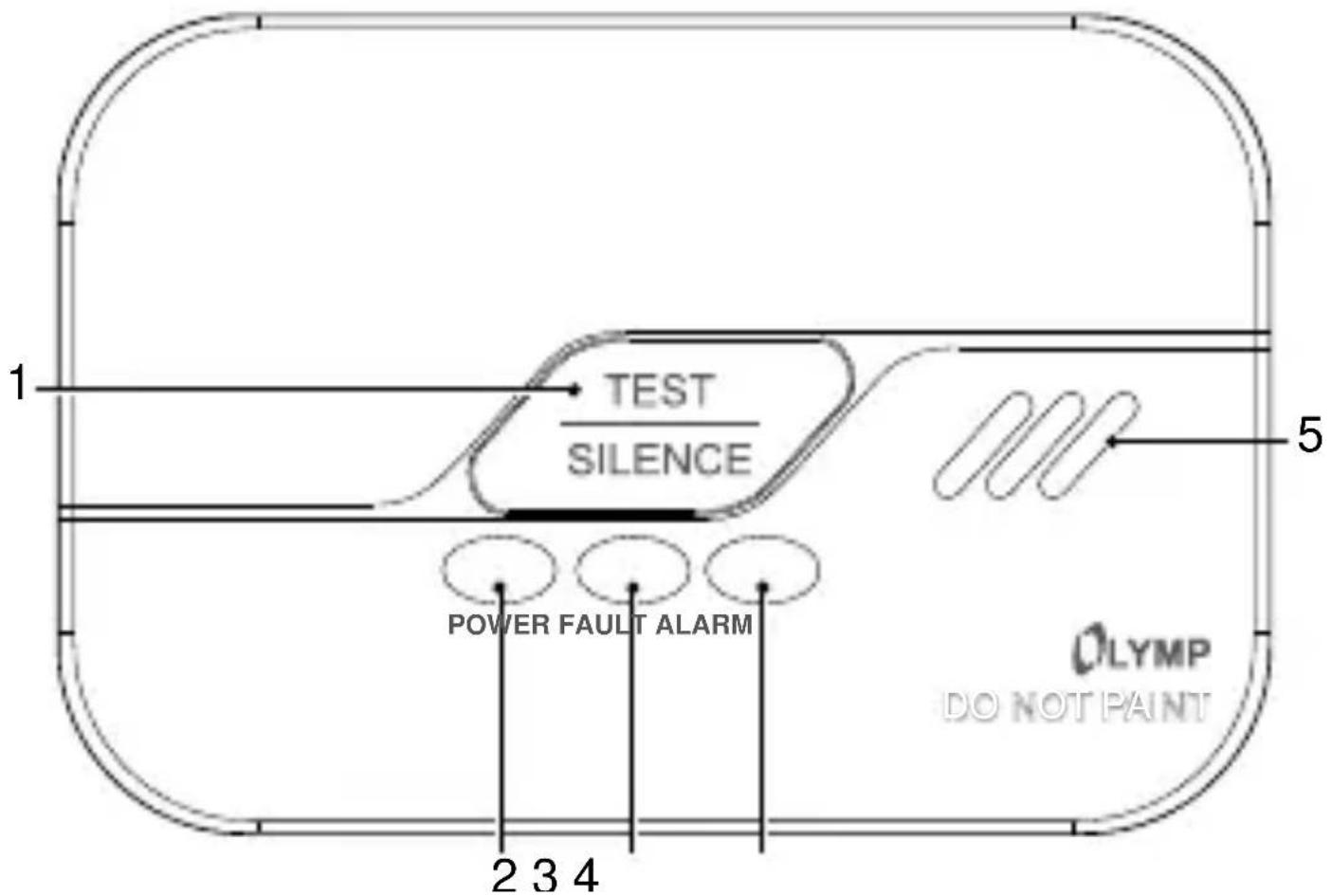
1 Test/Silence button
2 Power LED
3 Fault LED
4 Alarm LED
5 Loudspeaker
Inserting the Batteries
The battery compartment is located on the rear side of the CO alarm.
1 Open the battery compartment.
2 Insert two appropriate batteries in the battery compartment, ensuring correct polarity.

natural_image
Simple line drawing of a light bulb with radiating lines (no text or symbols)After inserting the batteries, the CO alarm is activated automatically and is ready to operate after about 30 seconds. The Power LED flashes every 30 seconds.
3 Close the battery compartment.
4 Assemble the CO alarm.

natural_image
Simple line drawing of a light bulb with radiating lines (no text or symbols)Observe the information below and in Section Important Information and Preventive Measures on Page 29.
Selecting the Installation Location
CO alarms should be assembled
• at least in every bedroom
- in every room with a heating appliance (pay particular attention to the information below)
- at the room height at which it is normally breathed (applies to rooms without a heating appliance, otherwise see below)
- so that the LEDs are visible and the Test/Silence button can be operated

natural_image
Simple line drawing of a light bulb with radiating lines (no text or symbols)Although carbon monoxide has a similar density as the ambient air, it is normally expelled as part of a hot gas mixture and therefore tends to ascend until it cools down.
Assemble CO alarms in rooms containing a heating appliance
- at a height above windows and doors
- at least 300 mm from a wall and 150 mm from the ceiling
- at a distance of between 1 and 3 ~m to potential sources of carbon monoxide
Do not assemble CO alarms
- near a window or door because fresh air flowing in could cause a delay in the alarm triggering
• in the direct vicinity of a cooking area - in closed containers or concealed areas
• in the vicinity of extractor fans - in wet or damp areas
• directly above sources of heat - outside the permissible ambient conditions (refer to Technical Data)
Assembling the CO Alarm
When assembling the device, pay attention to maintaining at least 100 cm distance to doors, windows or ventilation ducts.
Warning! Risk of serious injuries through damaging cables or pipes! During installation, pay attention to the possibility of cables and pipes running in the walls. We are not deemed liable for installation errors. If in doubt, contact a specialist!
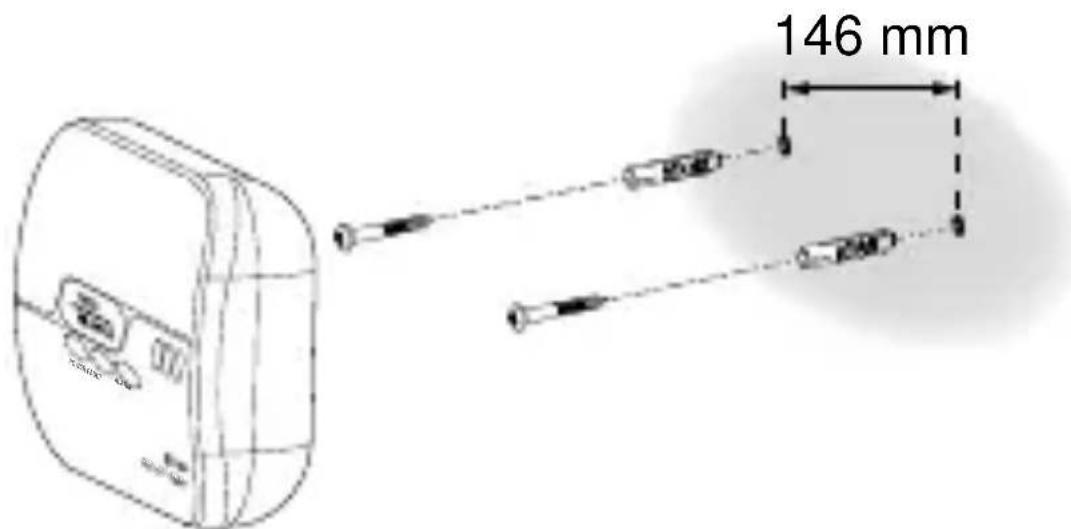
1 Ensure that there are no electric cables, gas or water pipes near the installation location.
1 Drill two holes, about 146 mm apart, at the intended installation location.
2 Insert the dowels and screws supplied in the drill holes.
3 Fit the CO alarm on the screws.
In the Event of an Alarm
If the CO alarm detects a critical concentration of carbon monoxide, the alarm is triggered and the Alarm LED flashes.
Switching the Alarm Off
1 Press the Test/Silence button to switch the alarm off. The CO alarm now works normally again, the Power LED flashes every 50 seconds and the Alarm LED goes out.
Warning! Carbon monoxide is a highly flammable, invisible, odourless gas. Take every alarm seriously. Follow the instructions provided in Section In the Event of an Alarm on Page 26.

natural_image
Simple line drawing of a light bulb with radiating lines (no text or symbols)The alarm stops automatically when the concentration of carbon monoxide drops below a safe threshold value.
Low Battery Charge Warning
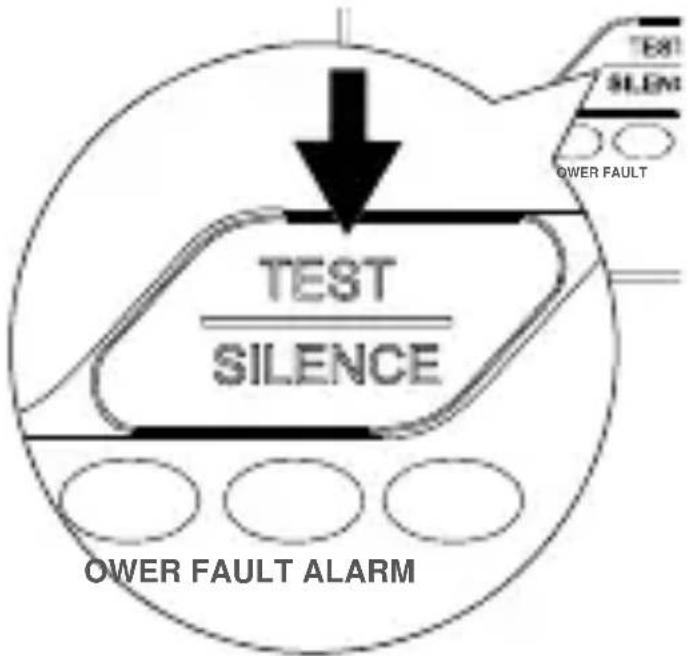
When the batteries in the CO alarm are almost empty, the Alarm LED flashes accompanied by a short acoustic signal every 30 seconds. The CO alarm continues to operate without any limitations during this period.
1 Replace the used batteries in the CO alarm with new ones of the same type immediately.

natural_image
Simple line drawing of a light bulb with radiating lines (no text or symbols)Further information is available in Sections Inserting the Batteries on Page 32 and Technical Data on Page 43.
CO Alarm Function Test
Complete a function test of the CO alarm at regular intervals - at least once a month.
1 Press the Test/Silence button. The Alarm flashes quickly and you will hear a longer acoustic signal.

natural_image
Simple line drawing of a light bulb with radiating lines (no text or symbols)If the function test indicates that the CO alarm is not working properly, there is no guarantee that the CO concentration is being monitored adequately. Replace the CO alarm immediately in such cases.
Self-Test
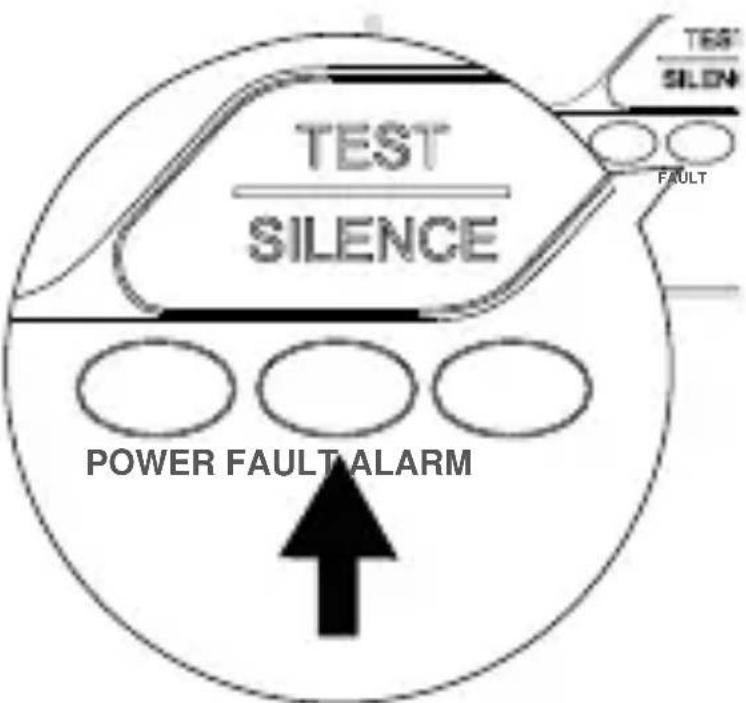
The CO alarm performs a self-test every 10 seconds. If the CO alarm detects a fault, the Fault LED flashes every 15 seconds followed by a short acoustic signal.

natural_image
Simple line drawing of a light bulb with radiating lines (no text or symbols)If the self-test indicates that the
CO alarm is not working properly, there is no guarantee that the CO concentration is being monitored adequately. Replace the CO alarm immediately in such cases.
End of Service Life
The CO alarm automatically detects and signals the end of its useful service life.
In this case, the Fault LED flashes every 30 seconds followed by three short acoustic signals.

natural_image
Simple line drawing of a light bulb with radiating lines (no text or symbols)When the CO alarm indicates the end of its service life, replace the CO alarm immediately.
Activating Silence Mode
You can activate Silence mode when you want to switch off the alarm signal of the CO alarm for a time.
1 Press the Test/Silence button twice. The Power LED and Alarm LED flash simultaneously every 10 seconds.
2 If you want to deactivate Silence mode manually, press the Test/Silence button. You will hear a short acoustic signal and
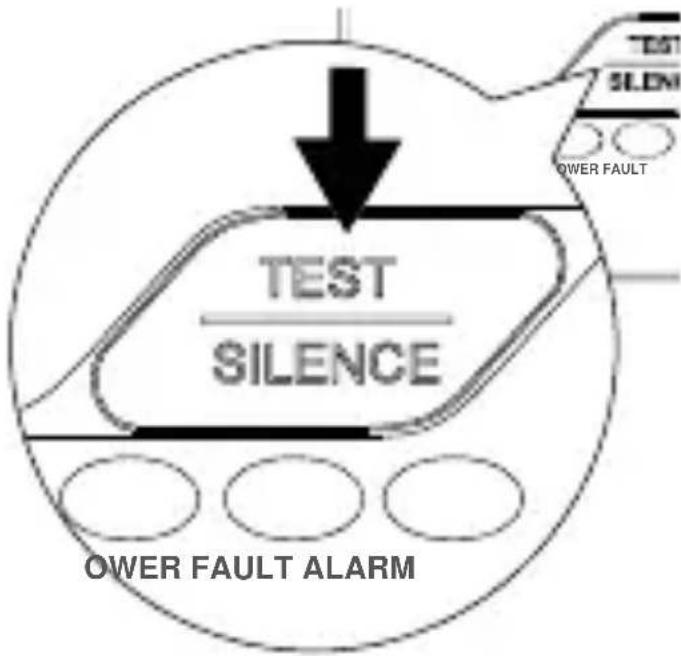
the Power LED flashes every 50 seconds. Silence mode is deactivated.
Silence mode is also deactivated if
- the CO alarm detects a critical concentration of carbon monoxide while Silence mode is active or
• after two minutes without any incidents occurring.
What You Also Need to Know
Please pay attention to this section in order to find out more about the risks of carbon monoxide poisoning or the reaction times of the CO alarm.
Symptoms Following Carbon Monoxide Poisoning
The following table indicates the symptoms which frequently occur according to the exposure to carbon monoxide.

natural_image
Simple line drawing of a light bulb with radiating lines (no text or symbols)The symptoms could occur more quickly in the case of unborn children, infants, pregnant women, senior citizens and people with heart or respiratory problems.
30 ppm Maximum permissible concentration to which one may be exposed, uninterrupted, for 8 hours ("maximum allowable concentration")
150 ppm Slight headache after approx. 1.5 hours
200 ppm Slight headache, tiredness, dizziness, nausea after approx. 2 to 3 hours
Concentration\* Exposure and Symptoms
400 ppm Headache in the forehead after 1 to 2 hours, life-threatening after 3 hours
800 ppm Dizziness, nausea and cramp after approx. 45 minutes, unconsciousness within 2 hours, fatal within 2 to 3 hours
1600 ppm Severe headache, dizziness and nausea within 20 minutes, fatal within 1 hour
3200 ppm Severe headache, dizziness and nausea within 5 to 10 minutes, fatal within 25 to 30 minutes
6400 ppm Severe headache, dizziness and nausea within 1 to 2 minutes, fatal within 10 to 15 minutes
12800 ppm Fatal within 1 to 3 minutes
* The concentration indicates the levels of carbon monoxide in the ambient air in ppm (parts per million).
Reaction Times of the CO Alarm
The following table indicates the reaction times of the CO alarm according to the levels of carbon monoxide.
Take each alarm seriously and follow the instructions in Section In the Event of an Alarm on Page 26.
Concentration\* Time Until CO Alarm is Triggered
Up to 50 ppm Approx. 2 hours
Up to 100 ppm Approx. 1 to 1.5 hours
Up to 300 ppm Approx. 10 to 40 minutes
From 300 ppm Max. 3 minutes
* The concentration indicates the levels of carbon monoxide in the ambient air in ppm (parts per million).
Disposal

In order to dispose of your device, take it to a collection point provided by your local public waste authorities (e.g. recycling centre).
According to laws on the disposal of electronic and electrical devices, owners are obliged to dispose of old electronic and electrical devices in a separate waste container. The symbol indicates that the device must not be disposed of in normal domestic waste!
Risks to health and the environment from batteries! Never open, damage or swallow batteries or allow them to pollute the environment. Batteries may contain toxic, ecologically hazardous heavy metals.
Remove the batteries from the equipment before disposing of the device. You are legally obliged to dispose of batteries at shops which sell batteries or at collection points provided by the public waste authorities. Disposal is free of charge. The symbol indicates that batteries must not be disposed of in normal domestic waste and that they must be brought to collection points provided by local public waste authorities.

natural_image
Recycling symbol with three chasing arrows forming a triangle (no text or labels)Packaging materials must be disposed of according to local regulations.
Technical Data
| Feature | |
| Batteries 2 x AA, 1.5 V | |
| Sensor type Electrochemical | |
| Visual indicator | 3 LEDs (green: Power, yellow: Fault, red: Alarm) |
| Applicable standards | EN 50291-1:2010+A1:2012 |
| Volume (alarm) | 85 dB (at a distance of 1 m) |
| Service life 10 years | |
| Special features | Regular self-test, acoustic and optical signal for low battery charge |
| Permissible ambient conditions | -10 °C to +40 °C at 30% to 90% rel. humidity |
| Dimensions 120 x 37 x 80 mm | |
| Weight 143 g | |
Maintenance and Service
Precipitations of dust and such could impair the function of the CO alarm and lead to malfunctions.
1 Clean the surface of the housing regularly with a soft, moistened, lint-free cloth.
2 Clean the gas inlets with a brush.
3 Complete a function test at regular intervals, once a month at the latest.
4 Pay attention that the gas inlets are not covered by paint or adhesive material.
Warranty
Dear Customer,
we are delighted that you have chosen this equipment.
In the case of a defect, please return the device together with the receipt and original packing material to the point-of-sale.
Declaration of Conformity
The CE mark on the device confirms its conformity. The Declaration of Conformity for this product, together with other information, is available at
http://productip.com/?f=99611

Français
Table des matières
natural_image
Simple line drawing of a light bulb with radiating lines (no text or symbols)1 Touche Test/Muet (Test/Silence)
natural_image
Simple line drawing of a light bulb with radiating lines (no text or symbols)natural_image
Simple line drawing of a light bulb with radiating lines (no text or symbols)natural_image
Simple line drawing of a light bulb with radiating lines (no text or symbols)natural_image
Warning symbol of a flame inside a triangle (no text or numbers)natural_image
Simple line drawing of a light bulb with radiating lines (no text or symbols)natural_image
Simple line drawing of a light bulb with radiating lines (no text or symbols)natural_image
Simple line drawing of a light bulb with radiating lines (no text or symbols)natural_image
Simple line drawing of a light bulb with radiating lines (no text or symbols)natural_image
Simple line drawing of a light bulb with radiating lines (no text or symbols)natural_image
Simple line drawing of a light bulb with radiating lines (no text or symbols)natural_image
Symbol of a trash bin with crossed lines indicating no waste or restriction, plus a solid black rectangle below (no text or labels)natural_image
Recycling symbol with three chasing arrows forming a triangle (no text or labels)Italiano

Indice
natural_image
Simple line drawing of a light bulb with radiating lines (no text or symbols)natural_image
Simple line drawing of a light bulb with radiating lines (no text or symbols)natural_image
Simple line drawing of a light bulb with radiating lines (no text or symbols)natural_image
Simple line drawing of a light bulb with radiating lines (no text or symbols)natural_image
Simple line drawing of a light bulb with radiating lines (no text or symbols)natural_image
Simple line drawing of a light bulb with radiating lines (no text or symbols)natural_image
Simple line drawing of a light bulb with radiating lines (no text or symbols)natural_image
Simple line drawing of a light bulb with radiating lines (no text or symbols)natural_image
Simple line drawing of a light bulb with radiating lines (no text or symbols)natural_image
Simple line drawing of a light bulb with radiating lines (no text or symbols)natural_image
Symbol of a trash bin with no text or numbers presentnatural_image
Recycling symbol with three chasing arrows forming a triangle (no text or labels)Operating Manual for
KM 210 Carbon Monoxide Alarm

- Warnung!
- ENGLISH
- Contents
- In the Event of an Alarm
- Safety Instructions
- Important Information and Preventive Measures
- Intended Use
- Package Contents
- General View
- Inserting the Batteries
- Selecting the Installation Location
- Assembling the CO Alarm
- Switching the Alarm Off
- Low Battery Charge Warning
- CO Alarm Function Test
- Self-Test
- End of Service Life
- Activating Silence Mode
- What You Also Need to Know
- Symptoms Following Carbon Monoxide Poisoning
- Concentration\* Exposure and Symptoms
- Reaction Times of the CO Alarm
- Concentration\* Time Until CO Alarm is Triggered
- Disposal
- Technical Data
- Maintenance and Service
- Warranty
- Declaration of Conformity
- Français
- Table des matières
- Italiano
- Indice
Brand : OLYMPIA
Model : KM 210
Category : Alarm system