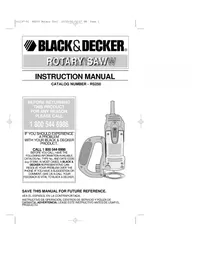
RS250 - Electric saw BLACK & DECKER - Free user manual and instructions
Find the device manual for free RS250 BLACK & DECKER in PDF.



| Product Type | Electric Saw |
| Brand | Black & Decker |
| Model | RS250 |
| Supply Voltage | 120 V ~ (AC) |
| Frequency | 60 Hz |
| Double Insulation | Yes |
| Switch | Slide on/off (I/O positions) |
| Collets Supplied | 3.2 mm (1/8") and 6.4 mm (1/4") |
| Depth Guide | Yes, adjustable |
| Dust Blower | Yes, adjustable |
| Recommended Use | Wood, plywood, laminate, drywall, ceramic tiles |
| Safety | Double insulation; wear goggles, mask, ear protection; unplug before adjustments |
| Maintenance | Clean with compressed air; lifelong lubrication; replaceable brushes at authorized center |
| Replacement Parts | Bits, collets, brushes (available at authorized centers) |
| Warranty | 2 years for residential use |
| Optional Accessories | Special bits (universal, drywall, tile), flexible shaft |
| Recommended Extension Cord | AWG gauge according to length (see table in manual) |
| Plug Type | Polarized (one blade wider) |
| Use | Indoor only, well-ventilated area |
Frequently Asked Questions - RS250 BLACK & DECKER
User questions about RS250 BLACK & DECKER
0 question about this device. Answer the ones you know or ask your own.
Ask a new question about this device
Download the instructions for your Electric saw in PDF format for free! Find your manual RS250 - BLACK & DECKER and take your electronic device back in hand. On this page are published all the documents necessary for the use of your device. RS250 by BLACK & DECKER.
USER MANUAL RS250 BLACK & DECKER
PHONE. IF YOU HAVE A SUGGESTION OR
COMMENT, GIVE US A CALL. YOUR
FEEDBACK IS VITAL TO BLACK & DECKERS
SAVE THIS MANUAL FOR FUTURE REFERENCE.
VEA EL ESPANOL EN LA CONTRAPORTADA.
INSTRUCTIVO DE OPERACION. CENTROS DE SERVICIO Y POLIZA DE
GARANTIA. ADVERTENCIA: L'ASE ESTE INSTRUCTIVO ANTES DE USAR EL
PRODUCTO.
WARNING: Read and understand all instructions. Failure to follow all instructions listed below may result in electric shock, fire and/or serious personal injury.
SAVE THESE INSTRUCTIONS
Work Area
- Keep your work area clean and well lit. Cluttered benches and dark areas invite accidents.
- Do not operate power tools in explosive atmospheres, such as in the presence of flammable liquids, gases, or dust. Power tools create sparks which may ignite the dust or fumes. Use in well ventilated areas only.
- Keep bystanders, children, and visitors away while operating a power tool. Distractions can cause you to lose control.
Electrical Safety
- Double insulated tools are equipped with a polarized plug (one blade is wider than the other.) This plug will fit in a polarized outlet only one way. If the plug does not fit fully in the outlet, reverse the plug. If it still does not fit, contact a qualified electrician to install a polarized outlet. Do not change the plug in any way. Double insulation eliminates the need for the three wire grounded power cord and grounded power supply system.
- Avoid body contact with grounded surfaces such as pipes, radiators, ranges and refrigerators. There is an increased risk of electric shock if your body is grounded.
- Don't expose power tools to rain or wet conditions. Water entering a power tool will increase the risk of electric shock.
- Do not abuse the cord. Never use the cord to carry the tools or pull the plug from an outlet. Keep cord away from heat, oil, sharp edges or moving parts. Replace damaged cords immediately. Damaged cords increase the risk of electric shock.
- When operating a power tool outside, use an outdoor extension cord marked "W-A" or "W." These cords are rated for outdoor use and reduce the risk of electric shock.
Personal Safety
- Stay alert, watch what you are doing and use common sense when operating a power tool. Do not use
tool while tired or under the influence of drugs, alcohol, or medication. A moment of inattention while operating power tools may result in serious personal injury.
- Dress properly. Do not wear loose clothing or jewelry. Contain long hair. Keep your hair, clothing, and gloves away from moving parts. Loose clothing, jewelry, or long hair can be caught in moving parts. Air vents cover moving parts and should be avoided.
- Avoid accidental starting. Be sure switch is off before plugging in. Carrying tools with your finger on the switch or plugging in tools that have the switch on invites accidents.
- Remove adjusting keys or wrenches before turning the tool on. A wrench or key that is left attached to a rotating part of the tool may result in personal injury.
- Do not overreach. Keep proper footing and balance at all times. Proper footing and balance enables better control of the tool in unexpected situations.
- Use safety equipment. Always wear eye protection. Dust mask, non-skid safety shoes, hard hat, or hearing protection must be used for appropriate conditions.
Tool Use and Care
- Use clamps or other practical way to secure and support the workpiece to a stable platform. Holding the work by hand or against your body is unstable and may lead to loss of control.
- Do not force tool. Use the correct tool for your application. The correct tool will do the job better and safer at the rate for which it is designed.
- Do not use tool if switch does not turn it on or off. Any tool that cannot be controlled with the switch is dangerous and must be repaired.
- Disconnect the plug from the power source before making any adjustments, changing accessories, or storing the tool. Such preventative safety measures reduce the risk of starting the tool accidentally.
- Store idle tools out of reach of children and other untrained persons. Tools are dangerous in the hands of untrained users.
- Maintain tools with care. Keep cutting tools sharp and clean. Properly maintained tools, with sharp cutting edges are less likely to bind and are easier to control.
- Check for misalignment or binding of
moving parts, breakage of parts, and any other condition that may affect the tools operation. If damaged, have the tool serviced before using. Many accidents are caused by poorly maintained tools.
- Use only accessories that are recommended by the manufacturer for your model. Accessories that may be suitable for one tool, may become hazardous when used on another tool.
Service
- Tool service must be performed only by qualified repair personnel. Service or maintenance performed by unqualified personnel could result in a risk of injury.
- When servicing a tool, use only identical replacement parts. Follow instructions in the Maintenance section of this manual. Use of unauthorized parts or failure to follow Maintenance Instructions may create a risk of electric shock or injury.
Specific Safety Rules
- Hold tool by insulated gripping surfaces when performing an operation where the cutting tool may contact hidden wiring or its own cord. Contact with a "live" wire will make exposed metal parts of the tool "live" and shock the operator.
The label on your tool may include the following symbols.
V.....volts
A.....amperes
Hz......hertz
W.....watts
min.....minutes
...alternating current
......direct current
no .........no load speed
Class II Construction
.../min.....revolutions or reciprocation per minute
.earthing terminal
..safety alert symbol
AWARNING: Some dust created by power sanding, sawing, grinding, drilling, and other construction activities contains chemicals known to cause cancer, birth defects or other reproductive harm. Some examples of these chemicals are:
-
lead from lead-based paints,
crystalline silica from bricks and cement and other masonry products, and -
arsenic and chromium from chemically-treated lumber (CCA).
Your risk from these exposures varies, depending on how often you do this type of work. To reduce your exposure to these chemicals: work in a well ventilated area, and work with approved safety equipment, such as those dust masks that are specially designed to filter out microscopic particles.
- Avoid prolonged contact with dust from power sanding, sawing, grinding, drilling, and other construction activities. Wear protective clothing and wash exposed areas with soap and water. Allowing dust to get into your mouth, eyes, or lay on the skin may promote absorption of harmful chemicals.
ACAUTION: Wear appropriate hearing protection during use. Under some conditions and duration of use, noise from this product may contribute to hearing loss.
ACAUTION: Do not touch the bit or collet nut during or immediately after cutting material. The bit and collet nut may be hot enough to burn bare skin.
WARNING: After changing bits or making any adjustments, make sure the collet nut is securely tightened to avoid injury.
WARNING: Do not press spindle lock while motor is running. The operator may lose control and drop the tool. Personal injury or serious tool damage may result.
WARNING: Shut off all live electric circuits to any areas where cut outs will be made, to avoid fire or serious personal injury.
Always wear eye protection. Dust mask or hearing protection must be used for appropriate conditions. Using personal safety devices is recommended. WORK SAFE.
- Always operate the tool with the depth guide in place. The guide keeps the bit from plunging too deeply through the material. A minimum of penetration should be maintained to eliminate the danger of cutting into electric wiring.
- Do not lay the tool down until the motor has come to a complete stop. The spinning motor may cause the tool to roll off a table or into a piece of material damaging the bit.
- Be sure your cutting bits are sharp
and in good condition. Damaged bits can cause the tool to jump injuring the operator.
- I'f your tool fails to function properly, take it to an authorized service center. There are no user serviceable parts inside this tool and it should only be opened by trained service personnel.
TO MAINTAIN SAFE TOOL CONTROL
Make sure the work surface is free of nails or screws. Cutting into a nail or screw may cause the tool to jump, damaging the bit.
- Never operate the tool with one hand while holding the workpiece with the other hand. Always clamp the material and guide the tool with both hands.
- Do not cut material lying on a hard surface. Clearance behind material to be cut must be allowed for protruding bit.
- Disconnect plug from power supply before making adjustments, changing bits, or cleaning tool.
- Do not start the tool with bit engaged in the material. The bit may grab the material.
USE OF EXTENSION CORDS
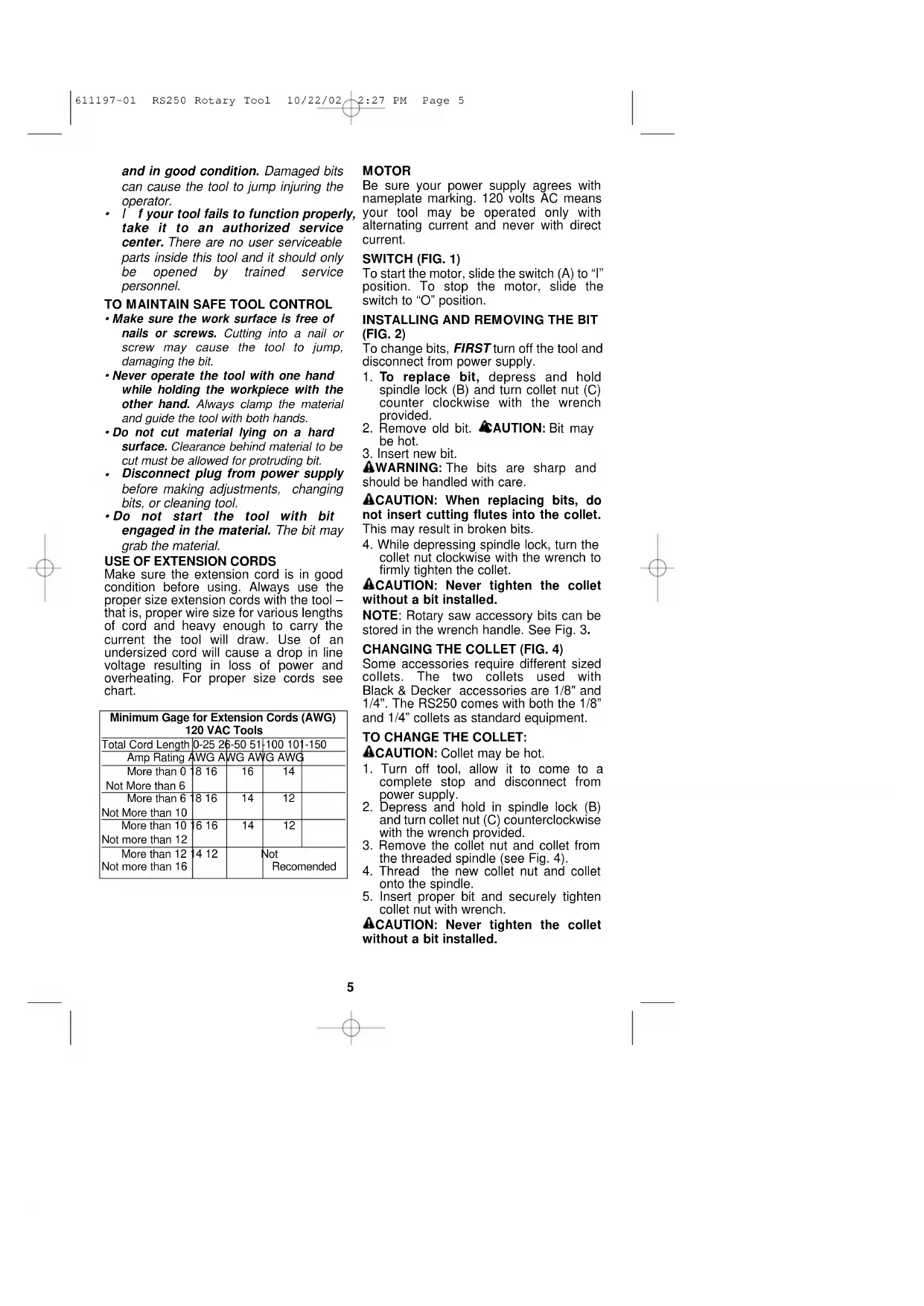
Make sure the extension cord is in good condition before using. Always use the proper size extension cords with the tool that is, proper wire size for various lengths of cord and heavy enough to carry the current the tool will draw. Use of an undersized cord will cause a drop in line voltage resulting in loss of power and overheating. For proper size cords see chart.
| Minimum Gage for Extension Cords (AWG)120 VAC Tools | ||||
| Total Cord Length | 0-25 26-50 51-100 101-150 | |||
| Amp Rating | AWG | AWG | AWG | AWG |
| More than 0 | 18 | 16 | 14 | |
| Not More than 6 | ||||
| More than 6 | 18 | 14 | 12 | |
| Not More than 10 | ||||
| More than 10 | 16 | 14 | 12 | |
| Not more than 12 | ||||
| More than 12 | 14 | 12 | NotRecommended | |
| Not more than 16 | ||||
MOTOR
Be sure your power supply agrees with nameplate marking. 120 volts AC means your tool may be operated only with alternating current and never with direct current.
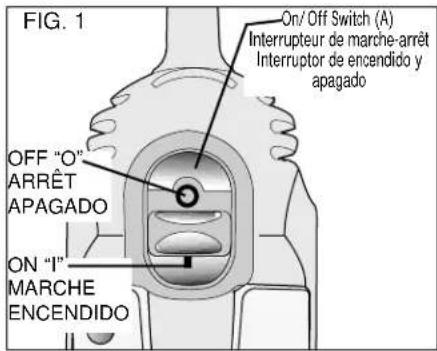
SWITCH (FIG. 1)
To start the motor, slide the switch (A) to "I" position. To stop the motor, slide the switch to "O" position.
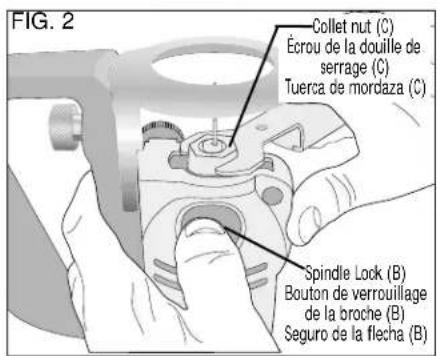
INSTALLING AND REMOVING THE BIT (FIG. 2)
To change bits, FIRST turn off the tool and disconnect from power supply.
- To replace bit, depress and hold spindle lock (B) and turn collet nut (C) counter clockwise with the wrench provided.
- Remove old bit. CAUTION: Bit may be hot.
- Insert new bit.
WARNING: The bits are sharp and should be handled with care.
CAUTION: When replacing bits, do not insert cutting flutes into the collet. This may result in broken bits.
- While depressing spindle lock, turn the collet nut clockwise with the wrench to firmly tighten the collet.
CAUTION: Never tighten the collet without a bit installed.
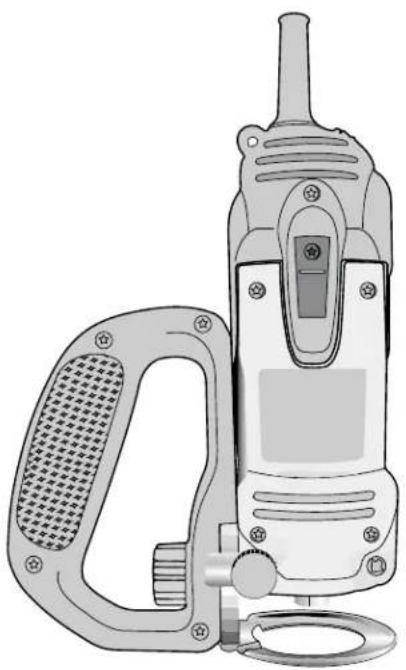
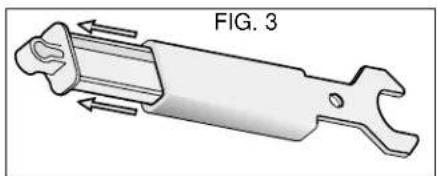
NOTE: Rotary saw accessory bits can be stored in the wrench handle. See Fig. 3.
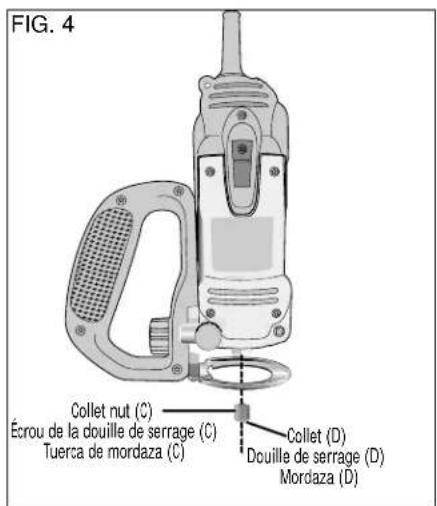
CHANGING THE COLLET (FIG. 4)
Some accessories require different sized collets. The two collets used with Black & Decker accessories are 1/8" and 1/4". The RS250 comes with both the 1/8" and 1/4" collets as standard equipment.
TO CHANGE THE COLLET:
ACAUTION: Collet may be hot.
1. Turn off tool, allow it to come to a complete stop and disconnect from power supply.
2. Depress and hold in spindle lock (B) and turn collet nut (C) counterclockwise with the wrench provided.
3. Remove the collet nut and collet from the threaded spindle (see Fig. 4).
4. Thread the new collet nut and collet onto the spindle.
5. Insert proper bit and securely tighten collet nut with wrench.
CAUTION: Never tighten the collet without a bit installed.
CAUTION: Remove bit from collet before installing or removing depth guide or handle.
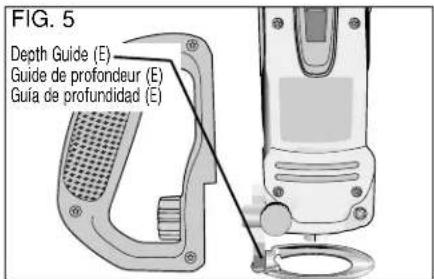
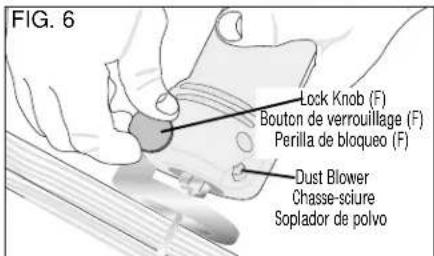
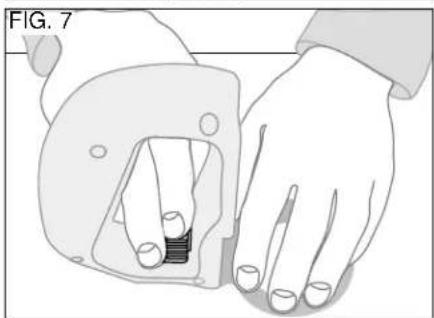
Keep depth guide ((E) Fig. 5) in place at all times during operation of the tool. For best results, adjust the guide using lock knob ((F) Fig. 6) to allow the bit to protrude a minimum of 1/8 past the material to be cut. Whenever the handle has been removed and is being reattached, it is recommended that the depth guide and handle be aligned together. Loosely attach handle to depth guide and place both on a flat surface. Hold down the base of the depth guide to keep it even with the flat surface and tighten the knob of the handle as shown in Figure 7.
Operation
GENERAL CUTTING
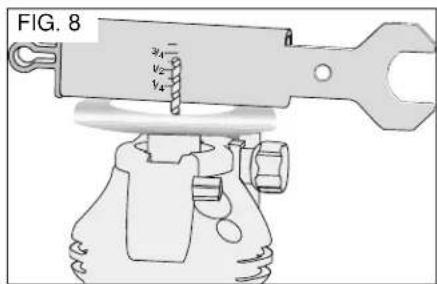
A handy scale on the wrench (Fig.8) can be used to help determine the cutting depth. When plunge cutting, hold the tool firmly with both hands, insert the bit into the material at a 45^ angle. Slowly bring the tool to a 90^ angle to start the cut. When cutting from the edge of the workpiece, hold the tool 90^ to the work surface. With depth guide in contact with work surface, slowly bring bit into contact with edge. The depth guide should be kept in contact with the material being cut at all times. Move the tool in a clockwise direction using slow steady pressure to continue the cut. When the cut is completed allow the tool to come to a complete stop before lifting it from the material.
DUST BLOWER
To aid visibility when cutting, your rotary saw is equipped with a dust blower (Fig.6) which can be used to keep the work area clear of dust as you saw. It can also be turned to block the air flow if desired.
CUTTING A HOLE FOR AN
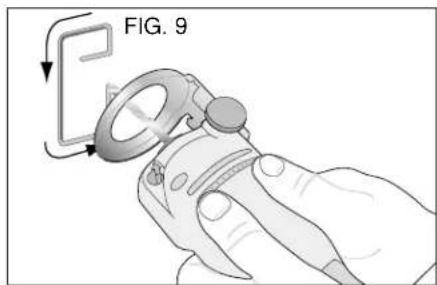
ELECTRICAL OUTLET (FIG. 9)
WARNING: Shut off all live electric circuits to any areas where cut outs will be made.

Install the followpoint bit shown here. It is designed specifically for use with cutting out outlet boxes.
- Push any wiring deeply into the outlet
box to avoid damage from the cutting bit.
- Before hanging the sheet covering the outlet, mark the approximate location of the center of the outlet on the wall board. Check the cutting bit depth against the side of the board to be sure it will cut entirely through the material.
- Tack the sheet in place with a few fasteners avoiding the stud holding the outlet. This allows the wall board to flex slightly around the protruding fixture box.
- Turn the rotary saw on. Holding the tool firmly with both hands, (Fig. 9) plunge the bit straight into the center of the outlet.
- Cut to the right until the edge of the box is touched. Pull out just enough for the bit to clear the edge of the box. Plunge in again holding the bit gently against the outside of the box.
- Follow the outside of the box (counterclockwise) as shown keeping slight pressure against the box. This will minimize wandering and give you a clean precise cut.
NOTE: This is opposite of the recommended clockwise direction for general cutting.
- Remove the waste and dust from the outlet. Finish fastening the sheet of wall board.
MAINTENANCE
The tool should be cleaned with a blast of air often, to eject as much dust as possible. This will increase the life of the brushes and bearings inside the motor. Always use appropriate safety equipment when using compressed air to clean a tool. The brushes in this tool are replaceable and can be accessed through the panels on either side of the tool housing. Black and Decker recommends that brush replacement be performed by a company owned or authorized service center.
Although the tool's plastic case is solvent resistant, you should never use solvents or harsh chemicals to clean it. Wipe the non-metallic parts of the tool with a dry cloth.
IMPORTANT: To assure product SAFETY and RELIABILITY, repairs, maintenance and adjustment should be performed by authorized service centers or other qualified service personnel, always using identical replacement parts.
LUBRICATION
All bearings are factory lubricated for the life of the tool.
SERVICE INFORMATION
Black & Decker offers a full network of company-owned and authorized service locations throughout North America. All Black & Decker Service Centers are staffed with trained personnel to provide customers with efficient and reliable power tool service.
Whether you need technical advice, repair, or genuine factory replacement parts, contact the Black & Decker location nearest you.
To find your local service location, refer to the yellow page directory under "Tools—Electric" or call: 1-800-544-6986
AVAILABLE BLACK AND DECKER ACCESSORIES
Always use appropriate bit for the application and material being cut. Do not use this tool with drill and screwdriver bits. Available bits are:
GENERAL PURPOSE BITS - for wood, plywood, laminates and foam.
DRYWALL BITS - for use in drywall only. Using on wood will rapidly dull the bit.
TILE BITS -for ceramic tile. Recommended accessories for use with your tool are available from your local dealer or authorized service center. If you need assistance regarding accessories, please call:1-800-544-6986
WARNING: The use of any accessory not recommended for use with this tool could be hazardous.
FULL TWO-YEAR HOME USE WARRANTY
Black & Decker (U.S.) Inc. warrants this product for two years against any defects in material or workmanship. The defective product will be replaced or repaired at no charge in either of two ways.
The first, which will result in exchanges only, is to return the product to the retailer from whom it was purchased (provided that the store is a participating retailer). Returns should be made within the time period of the retailer's policy for exchanges (usually 30 to 90 days after the sale). Proof of purchase may be required. Please check with the retailer for their specific return policy regarding returns that are beyond the time set for exchanges.
The second option is to take or send the product (prepaid) to a Black & Decker owned or authorized Service Center for repair or replacement at our option. Proof of purchase may be required. Black & Decker owned and authorized Service Centers are listed under "Tools-Electric" in the yellow pages of the phone directory.
This warranty does not apply to accessories. This warranty gives you specific legal rights and you may have other rights which vary from state to state and province to province. Should you have any questions, contact the manager of your nearest Black & Decker Service Center. This product is not intended for commercial use
Imported by
Black & Decker (U.S.) Inc.,
701 E. Joppa Rd
Towson, MD 21286 U.S.A.

www.blackanddecker.com
1-800-544-6986

BLACK&DECKER®
SGIECIRGOLAIREE
GUIDE D'UTILISATION
No de catalogue RS250
AVANT DE RETOURNER
CE PRODUIT POUR
QUELQUE RAISON QUE
CE SOIT, APPELEZ
BLACK & DECKER AU
1800 544-6986.
SI VOUS EPROUVEZ UN PROBLÈME AVEC L'OUTIL, COMPOSEZ LE 1 800 544-6986. AVANT D'APPELER, VEUILLEZ VOUS ASSURER D'AVoir L'INFORMATION SUIVANTE À PORTÉE DE LA MAIN : LE NUMERO DE CATALOGUE, LE NUMERO DE PRODUIT ET LE CODE DE DATATION (P. EX., 0130M). DANS LA MAJORITE DES CAS, LE REprésentANT DE BLACK & DECKER SERA EN MESURE DE RÉSQUIDRE LE PROBLEME PAR TELEPHONE. VEUILLEZ NOUS FAIRE PART DE VOS QUESTIONS OU DE VOS COMMENTAIRES EN COMPOSANT LE MEME NUMERO, CAR CEUX-CI AIDENT A ASSURER LA QUALITE DE NOTRE SERVICE.
Black & Decker Canada Inc.
100 Central Ave
PRODUCTO BLACK & DECKER,
FAVOR LLAMAR AL
1-800-544-6986
ANTES DE LLAMAR, TENGALA
INTERRUPTOR (FIG. 1)
Cat. # RS250 Part # 611197-01 (OCT-02-1) Copyright © 2002 Black & Decker Printed in U.S.A.

- SAVE THIS MANUAL FOR FUTURE REFERENCE.
- SAVE THESE INSTRUCTIONS
- Work Area
- Electrical Safety
- Personal Safety
- Tool Use and Care
- Service
- Specific Safety Rules
- TO MAINTAIN SAFE TOOL CONTROL
- USE OF EXTENSION CORDS
- MOTOR
- SWITCH (FIG. 1)
- INSTALLING AND REMOVING THE BIT (FIG. 2)
- CAUTION: When replacing bits, do not insert cutting flutes into the collet. This may result in broken bits.
- CAUTION: Never tighten the collet without a bit installed.
- CHANGING THE COLLET (FIG. 4)
- TO CHANGE THE COLLET:
- Operation
- GENERAL CUTTING
- DUST BLOWER
- CUTTING A HOLE FOR AN
- ELECTRICAL OUTLET (FIG. 9)
- MAINTENANCE
- LUBRICATION
- SERVICE INFORMATION
- AVAILABLE BLACK AND DECKER ACCESSORIES
- FULL TWO-YEAR HOME USE WARRANTY
- BLACK&DECKER®
- SGIECIRGOLAIREE
- GUIDE D'UTILISATION
- INTERRUPTOR (FIG. 1)
Brand : BLACK & DECKER
Model : RS250
Category : Electric saw