BDCJS20B - Electric saw BLACK & DECKER - Free user manual and instructions
Find the device manual for free BDCJS20B BLACK & DECKER in PDF.




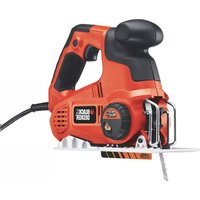
| Product Type | Cordless Jigsaw |
| Brand | Black & Decker |
| Model | BDCJS20B |
| Rated Voltage | 20 V MAX (36 V initial max) |
| Power Source | 20 V lithium-ion battery pack (sold separately) |
| Variable Speed | Yes, variable speed trigger |
| Bevel Cutting | 0° to 45° (left and right) |
| Tool-Free Blade Change | Yes, locking lever |
| Visual Guiding System | Sightline® for line tracking |
| Rip / Circle Guide | Available as accessory (sold separately) |
| Cutting Capacity (wood) | Not specified (estimated: up to 50 mm depending on blade) |
| Cutting Capacity (metal) | Not specified (estimated: up to 6 mm depending on blade) |
| Safety | Lock-off button, insulated gripping surfaces, eye/ear protection recommended |
| Maintenance | Clean with mild soap and damp cloth; do not immerse |
| Repairability | Repair by authorized center, use genuine parts |
| Warranty | 2-year limited for household use |
| Package Contents | Saw, blade, instruction manual; battery and charger not included |
| Weight | Not specified (estimated: 1.5–2.0 kg without battery) |
| Dimensions (L × W × H) | Not specified |
Frequently Asked Questions - BDCJS20B BLACK & DECKER
User questions about BDCJS20B BLACK & DECKER
0 question about this device. Answer the ones you know or ask your own.
Ask a new question about this device
Download the instructions for your Electric saw in PDF format for free! Find your manual BDCJS20B - BLACK & DECKER and take your electronic device back in hand. On this page are published all the documents necessary for the use of your device. BDCJS20B by BLACK & DECKER.
USER MANUAL BDCJS20B BLACK & DECKER
CATALOG NUMBER BDCJS20B
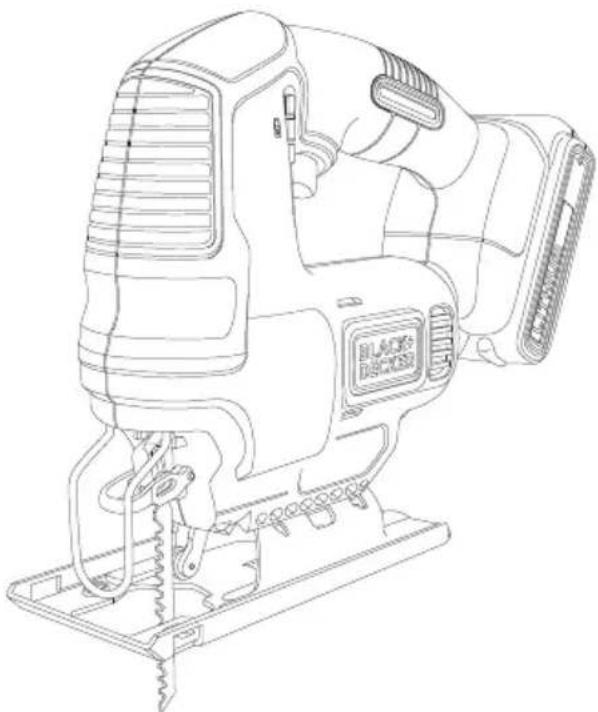
Thank you for choosing BLACK+DECKER!
PLEASE READ BEFORE RETURNING THIS PRODUCT FOR ANY REASON.
If you have a question or experience a problem with your BLACK+DECKER purchase, go to http://www.blackanddecker.com/instantanswers If you can't find the answer or do not have access to the Internet, call 1-800-544-6986 from 8 a.m. to 5 p.m. EST Mon. - Fri. to speak with an agent. Please have the catalog number available when you call.
SAVE THIS MANUAL FOR FUTURE REFERENCE.
VEA EL ESPANOL EN LA CONTRAPORTADA. INSTRUCTIVO DE OPERATION, CENTROS DE SERVICIO Y POLIZA DE GARANTIA. ADVERTENCIA: LÉASE ESTE INSTRUCTIVO ANTES DE USAR EL PRODUCTO. *Maximum initial battery pack voltage (measured without a workload) is 20 volts. Measured under a workload, nominal voltage is 18.
SAFETY GUIDELINES - DEFINITIONS
It is important for you to read and understand this manual. The information it contains relates to protecting YOUR SAFETY and PREVENTING PROBLEMS. The symbols below are used to help you recognize this information.
DANGER: Indicates an imminently hazardous situation which, if not avoided, will result in death or serious injury.
WARNING: Indicates a potentially hazardous situation which, if not avoided, could result in death or serious injury.
CAUTION: Indicates a potentially haz ard ous situation which, if not avoided, may result in minor or mod er ate injury.
NOTICE: Used without the safety alert symbol indicates potentially hazardous situation which, if not avoided, may result in property damage.
General Power Tool SafetyWarnings
WARNING: Read all safety warnings and all instructions. Failure to follow the warnings and instructions may result in electric shock, fire and/or serious injury.
SAVE ALL WARNING AND INSTRUCTIONS FOR FUTURE REFERENCE
The term "power tool" in the warnings refers to your mains-operated (corded) power tool or battery-operated (cordless) power tool.
1) WORK AREA SAFETY
a) Keep work area clean and well lit. Cluttered or dark areas invite accidents.
b) Do not operate power tools in explosive atmospheres, such as in the presence of flammable liquids, gases or dust. Power tools create sparks which may ignite the dust or fumes.
c) Keep children and bystanders away while operating a power tool. Distractions can cause you to lose control.
2) ELECTRICAL SAFETY
a) Power tool plugs must match the outlet. Never modify the plug in any way. Do not use any adapter plugs with earthed (grounded) power tools. Unmodified plugs and matching outlets will reduce risk of electric shock.
b) Avoid body contact with earthed or grounded surfaces such as pipes, radiators, ranges and refrigerators. There is an increased risk of electric shock if your body is earthed or grounded.
c) Do not expose power tools to rain or wet conditions. Water entering a power tool will increase the risk of electric shock.
d) Do not abuse the cord. Never use the cord for carrying, pulling or unplugging the power tool. Keep
cord away from heat, oil, sharp edges or moving parts. Damaged or entangled cords increase the risk of electric shock.
e) When operating a power tool outdoors, use an extension cord suitable for outdoor use. Use of a cord suitable for outdoor use reduces the risk of electric shock.
f) If operating a power tool in a damp location is unavoidable, use a ground fault circuit interrupter (GFCI) protected supply. Use of a GFCI reduces the risk of electric shock.
3) PERSONAL SAFETY
a) Stay alert, watch what you are doing and use common sense when operating a power tool. Do not use a power tool while you are tired or under the influence of drugs, alcohol or medication. A moment of inattention while operating power tools may result in serious personal injury.
b) Use personal protective equipment. Always wear eye protection. Protective equipment such as dust mask, nonskid safety shoes, hard hat, or hearing protection used for appropriate conditions will reduce personal injuries.
c) Prevent unintentional starting. Ensure the switch is in the off position before connecting to power source and/or battery pack, picking up or carrying the tool. Carrying power tools with your finger on the switch or energizing power tools that have the switch on invites accidents.
d) Remove any adjusting key or wrench before turning the power tool on. A wrench or a key left attached to a rotating part of the power tool may result in personal injury.
e) Do not overreach. Keep proper footing and balance at all times. This enables better control of the
power tool in unexpected situations.
f) Dress properly. Do not wear loose clothing or jewelry. Keep your hair, clothing and gloves away from moving parts. Loose clothes, jewelry or long hair can be caught in moving parts.
g) If devices are provided for the connection of dust extraction and collection facilities, ensure these are connected and properly used. Use of dust collection can reduce dust-related hazards.
4) POWER TOOL USE AND CARE
a) Do not force the power tool. Use the correct power tool for your application. The correct power tool will do the job better and safer at the rate for which it was designed.
b) Do not use the power tool if the switch does not turn it on and off. Any power tool that cannot be controlled with the switch is dangerous and must be repaired.
c) Disconnect the plug from the power source and/or the battery pack from the power tool before making any adjustments, changing accessories, or storing power tools. Such preventive safety measures reduce the risk of starting the power tool accidentally.
d) Store idle power tools out of the reach of children and do not allow persons unfamiliar with the power tool or these instructions to operate the power tool. Power tools are dangerous in the hands of untrained users.
e) Maintain power tools. Check for misalignment or binding of moving parts, breakage of parts and any other condition that may affect the power tool's operation. If damaged, have the power tool repaired before use. Many accidents are caused by poorly maintained power tools.
f) Keep cutting tools sharp and clean. Properly maintained cutting tools with sharp cutting edges are less likely to bind and are easier to control.
g) Use the power tool, accessories and tool bits, etc. in accordance with these instructions, taking into account the working conditions and the work to be performed. Use of the power tool for operations different from those intended could result in a hazardous situation.
5) BATTERY TOOL USE AND CARE
a) Recharge only with the charger specified by the manufacturer. A charger that is suitable for one type of battery pack may create a risk of fire when used with another battery pack.
b) Use power tools only with
specifically designated battery packs. Use of any other battery packs may create a risk of injury and fire.
c) When battery pack is not in use, keep it away from other metal objects like paper clips, coins, keys, nails, screws, or other small metal objects that can make a connection from one terminal to another. Shorting the battery terminals together may cause burns or a fire.
d) Under abusive conditions, liquid may be ejected from the battery, avoid contact. If contact accidentally occurs, flush with water. If liquid contacts eyes, additionally seek medical help. Liquid ejected from the battery may cause irritation or burns.
6) SERVICE
a) Have your power tool serviced by a qualified repair person using only identical replacement parts. This will ensure that the safety of the power tool is maintained.
JIG SAW SAFETY WARNINGS
- Hold power tool by insulated gripping surfaces, when performing an operation where the cutting accessory may contact hidden wiring. Cutting accessory contacting a "live" wire may make exposed metal parts of the power tool "live" and could give the operator an electric shock.
- Use clamps or another practical way to secure and support the workpiece to a stable platform. Holding the work by hand or against your body leaves it unstable and may lead to loss of control.
- Keep hands away from cutting area. Never reach underneath the material for any reason. Hold front of saw by grasping the contoured gripping area. Do not insert fingers or thumb into the vicinity of the reciprocating blade and blade clamp. Do not stabilize the saw by gripping the shoe.
- Keep blades sharp. Dull blades may cause the saw to swerve or stall under pressure.
- Use extra caution when cutting overhead and pay particular attention to overhead wires which may be hidden from view. Anticipate the path of falling branches and debris ahead of time.
- When cutting pipe or conduit ensure that they are free from water, electrical wiring, etc.
WARNING: Some dust created by power sanding, sawing, grinding, drilling, and other construction activities contains chemicals known to cause cancer, birth defects or other
reproductive harm. Some examples of these chemicals are:
- lead from lead-based paints,
crystalline silica from bricks and cement and other masonry products, and - arsenic and chromium from chemically-treated lumber (CCA).
Your risk from these exposures varies, depending on how often you do this type of work. To reduce your exposure to these chemicals: work in a well ventilated area, and work with approved safety equipment, such as those dust masks that are specially designed to filter out microscopic particles.
- Avoid prolonged contact with dust from power sanding, sawing, grinding, drilling, and other construction activities. Wear protective clothing and wash exposed areas with soap and water. Allowing dust to get into your mouth, eyes, or lay on the skin may promote absorption of harmful chemicals.
WARNING: ALWAYS use safety glasses. Everyday eyeglasses are NOT safety glasses. Also use face or dust mask if drilling operation is dusty. ALWAYS WEAR CERTIFIED SAFETY EQUIPMENT:
ANSI Z87.1 eye protection (CAN/CPA Z94.3),
ANSI S12.6 (S3.19) hearing protection,
NOSH/OSHA respiratory protection.
WARNING: Use of this tool can generate and/or disperse dust, which may cause serious and permanent respiratory or other injury. Always use NIOSH/OSHA approved respiratory protection appropriate for the dust exposure. Direct particles away from face and body.
CAUTION: Wear appropriate hearing protection that conforms to ANSI S12.6 (S3.19) during use. Under some conditions and duration of use, noise from this product may contribute to hearing loss.
SAVE THESE INSTRUCTIONS
SYMBOLS
The label on your tool may include the following symbols. The symbols and their definitions are as follows:
V.....volts
A. amperes
Hz......hertz
W.....watts
min.........minutes
or AC......alternating current
= = = or DC...direct current
no load speed
Class I Construction (grounded)
...earthing terminal
..safety alert symbol
Class II Construction (double insulated)
.../min or rpm...revolutions or reciprocation per minute
Read instruction manual before use
.Use proper eye protection
O....Use proper hearing protection
Use proper respiratory protection
SFPM......surface feet per minute
SPM......... Strokes per minute
- When using an extension cord, be sure to use one heavy enough to carry the current your product will draw. An undersized cord will cause a drop in line voltage resulting in loss of power and overheating. The table shows the correct size to use depending on cord length and nameplate ampere rating. If in doubt, use the next heavier gauge. The smaller the gauge number, the heavier the cord.
| Minimum Gage for Cord Sets | |||||
| Volts | Total Length of Cord in Feet | ||||
| 120V | 0-25 | 26-50 | 51-100 | 101-150 | |
| 240V | 0-50 | 51-100 | 101-200 | 201-300 | |
| AmpereRating | |||||
| More | Not more | American Wire Gage | |||
| Than | Than | ||||
| 0 | 6 | 18 | 16 | 14 | |
| 6 | 10 | 18 | 16 | 14 | 12 |
| 10 | 12 | 16 | 16 | 14 | 12 |
| 12 | 16 | 14 | 12 | Not Recommended | |
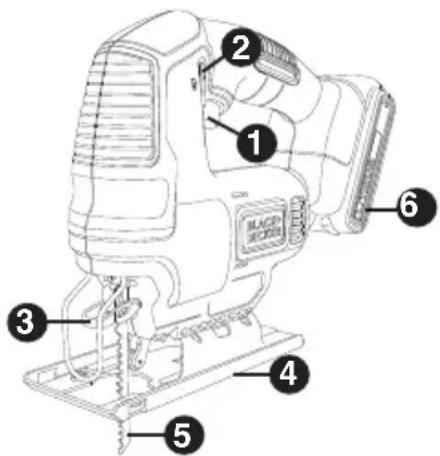
FUNCTIONAL DESCRIPTION
- Variable speed switch
- Lock-off button
- Saw blade locking lever
- Shoe
- Blade
- Battery (sold separately)
OPERATING INSTRUCTIONS
INSTALLING AND REMOVING THE BATTERY PACK FROM THE TOOL
CAUTION: Make certain the lock-off button is engaged to prevent switch actuation before removing or installing battery.
NOTE: This jig saw only accepts 20v MAX* BLACK+DECKER battery packs.
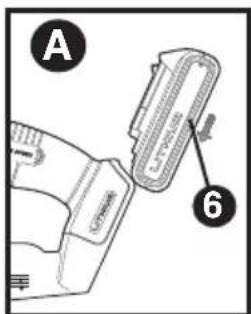
TO INSTALL BATTERY PACK: Insert battery pack (6) firmly into tool until an audible click is heard as shown in Figure A. Ensure battery pack is fully seated and fully latched into position.
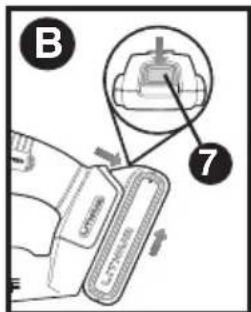
TO REMOVE BATTERY PACK: Depress the battery release button (7) as shown in Figure B and pull battery pack out of tool.
ASSEMBLY
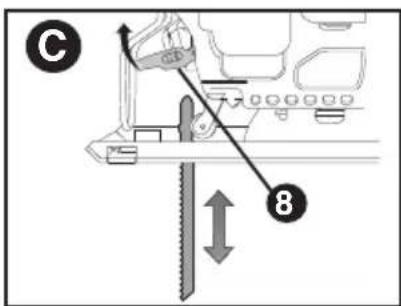
WARNING: Laceration Hazard. Before attempting any of the following operations, make sure that the tool is switched off and the battery is removed, and that the saw blade has stopped. Used saw blades can be hot. FITTING THE SAW BLADE (FIGURE C)
- Hold the saw blade (5) as shown, with teeth facing forward.
- Push the locking lever (3) away from the shoe (4).
- Insert the shank of the saw blade into the blade holder (8) as far as it will go.
- Release the lever.
USE
WARNING: To reduce the risk of injury, never use the tool when the saw shoe is loose or removed.
ADJUSTING THE SHOE PLATE FOR BEVEL CUTS (FIGURE D-F)
The shoe (4) can be set to make either a straight cut or a left or right bevel cut up to an angle of 45^ .
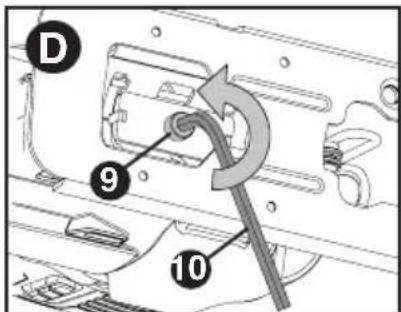
- Loosen the shoe retaining bolt (9) with the hex key (10) to unlock the shoe plate (Figure D).
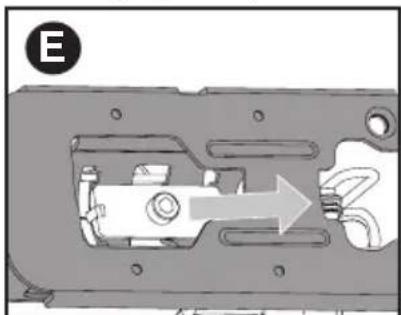
- Slide the shoe forward to release it from the 0^ detent (Figure E).
- Rotate the shoe plate to the desired bevel angle (Figure F).
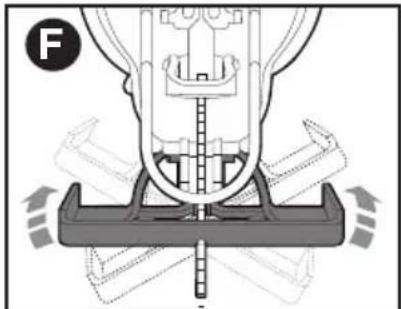
- Slide the shoe plate backwards to engage the left or right detent for a 45^ angle.
- Tighten the shoe retaining bolt with the hex key to lock the shoe into position.
To reset the shoe plate for straight cuts:
Loosen the retaining bolt.
Pull the shoe forward, rotate to the center and push it back into the 0^ location.
- Tighten the retaining bolt.
Switching On and Off (Figure G)
This tool is equipped with a lock-off button (2). The button must be disengaged for the jig saw to turn on. To disengage the button, depress the button on the side of the handle that shows the unlock symbol.
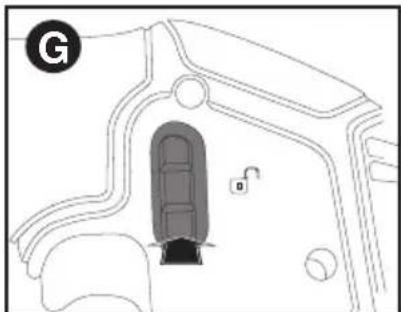
- To switch the tool on, press the variable speed switch (1). The tool speed depends on how far you depress the switch.
- To switch the tool off, release the variable speed switch.
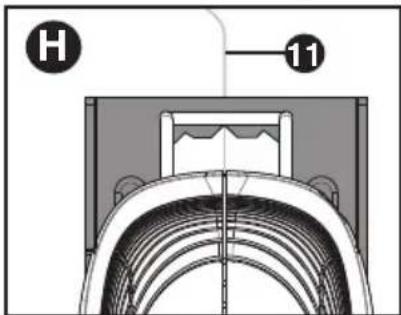
How to Use the Sightline® Feature (figure H)
- Use a pencil to mark the cutting line.
Position the jig saw over the line (11).
Viewing from directly above the jig saw, the line of cut can be easily followed.
HINTS FOR OPTIMUM USE General
- Use a high speed for wood, a medium speed for aluminum and PVC and a low speed for metals other than aluminum. Specific materials also require specialty blades (sold separately).
Sawing laminates
As the saw blade cuts on the upward stroke, splintering may occur on the surface closest to the shoe plate.
Use a fine-tooth saw blade.
- Saw from the back surface of the workpiece.
- To minimize splintering, clamp a piece of scrap wood or hardboard to both sides of the workpiece and saw through this sandwich.
Sawing metal
- Be aware that sawing metal takes much more time than sawing wood.
Use a saw blade suitable for sawing metal. - When cutting thin metal, clamp a piece of scrap wood to the back surface of the workpiece and cut through this sandwich.
- Spread a film of oil along the intended line of cut.
Rip / Circle Cutting (Figure I - J)
Ripping and circle cutting without a pencil line are easily done with the rip fence / circle guide (not included - available at extra cost).
Using the screw supplied with the accessory guide, position as shown in figure 1 and thread the screw into the shoe to clamp the fence securely.
When ripping, position as shown in figure I and slide the rip fence under the screw from either side of the saw. Set the cross bar at desired distance from blade and tighten screw. Forripping, the cross bar should be down and against the straight edge of the workpiece as shown.
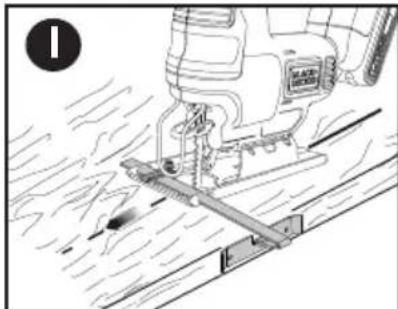
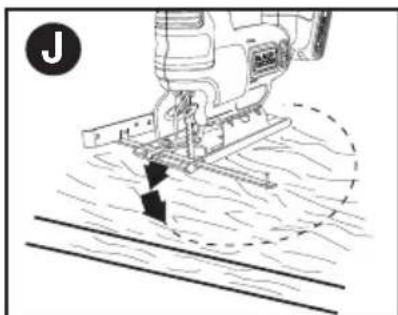
When circle cutting, adjust rip fence so that distance from blade to hole in fence arm is at the desired radius and tighten screws. Place saw so that hole in fence arm is over center of circle to be cut (drill hole for blade or cut inward from edge of material to get blade into position). When saw is properly positioned, drive a small nail through hole in fence arm. Using rip fence as a pivot arm, begin cutting circle. For circle cutting, the cross bar should be up, as shown in figure J.
Pocket Cutting (FIGURE K)
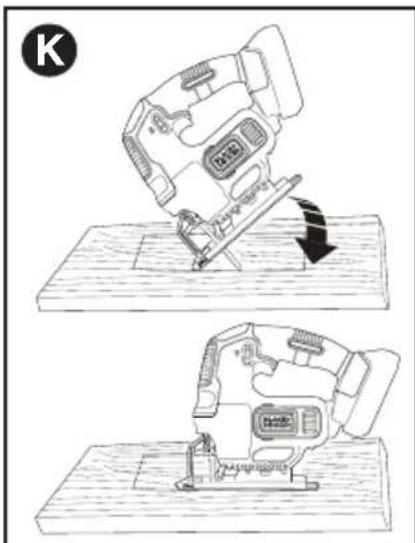
A pocket cut is an easy method of making an inside cut. The saw can be inserted directly into a panel or board without first drilling a lead or pilot hole. In pocket cutting, measure the surface to be cut and mark clearly with a pencil. Next tip the saw forward until the front end of the shoe sits firmly on the work surface and the blade clears the work through its full stroke. Switch the tool on and allow it to attain maximum speed. Grip the saw firmly and lower the back edge of tool slowly until the shoe sits flate on the surface. Hold the shoe flat against the wood and continue cutting. Do not remove blade from cut while it is still moving. Blade must come to a complete stop.
MAINTENANCE
Use only mild soap and damp cloth to clean the tool. Never let any liquid get inside the tool; never immerse any part of the tool into a liquid.
IMPORTANT: To assure product SAFETY and RELIABILITY, repairs, maintenance and adjustment should be performed by authorized service centers or other qualified service organizations, always using identical replacement parts.
ACCESSIONS
WARNING: The use of any accessory not recommended for use with this tool could be hazardous.
Recommended accessories for use with your tool are available from your local dealer or authorized service center. If you need assistance regarding accessories, please call: 1-800-544-6986.
SERVICE INFORMATION
All BLACK+DECKER Service Centers are staffed with trained personnel to provide customers with efficient and reliable power tool service. Whether you need technical advice, repair, or genuine factory replacement parts, contact the BLACK+DECKER location nearest you. To find your local service location, call: 1-800-544-6986 or visit
www.blackanddecker.com
LIMITED TWO-YEAR HOME USE WARRANTY
Black & Decker (U.S.) Inc. warrants this product for two years against any defects in material or workmanship. The defective product will be replaced or repaired at no charge in either of two ways. The first, which will result in exchanges only, is to return the product to the retailer from whom it was purchased (provided that the store is a participating retailer). Returns should be made within the time period of the retailer's policy for exchanges (usually 30 to 90 days after the sale). Proof of purchase may be required. Please check with the retailer for their specific return policy regarding returns that are beyond the time set for exchanges. The second option is to take or send the product (prepaid) to a BLACK+DECKER owned or authorized Service Center for repair or replacement at our option. Proof of purchase may be required. This warranty does not apply to accessories. This warranty gives you specific legal rights and you may have other rights which vary from state to state or province to province. Should you have any questions, contact the manager of your nearest BLACK+DECKER Service Center. This product is not intended for commercial use.
FREE WARNING LABEL
REPLACEMENT: If your warning labels become illegible or are missing, call 1-800-544-6986 for a free replacement.
LATIN AMERICA: This warranty does not apply to products sold in Latin America. For products sold in Latin America, check country specific warranty information contained in the packaging, call the local company or see the website for warranty information.
TROUBLESHOOTING
Problem
- Unit will not start. installation.
Possible Cause
-
Battery pack not installed properly.
-
Battery pack not charged.
requirements. -
Check battery pack charging
-
Attachment is not secured. is fully pushed into the Power
-
Make certain the attachment
Possible Solution
Check battery pack
- Plug charger into a working outlet. Refer to "Important Charging Notes" for more details.
erypack to a surrounding airtemperature of above
-
Allow battery pack to cool down.
-
Place on charger and allow to charge.
-
Battery pack will not charge. - Battery pack not inserted into charger. charger until LED illuminates.
-
Charger not plugged in.
-
Surrounding air temperature
too hot or too cold.
40 degrees F (4,5^) or below 105 degrees F (+40,5^)
Unit shuts off abruptly.
-
Battery pack has reached its maximum thermal limit.
-
Out of charge. (To maximize the life of the battery pack it is designed to shutoff abruptly when the charge is depleted.)
-
Place on charger and allow to charge.
For assistance with your product, visit our website www.blackanddecker.com for the location of the service center nearest you or call the BLACK+DECKER help line at 1-800-544-6986.
Imported by: Black & Decker (U.S.) Inc., 701 E. Joppa Rd. Towson, MD 21286 U.S.A.
BlackandDecker.com
1-800-544-6986
BLACK+ DECKER
SCIE SAUTEUSE À VITESSE VARIABLE DE 40V MAX*
MODE D'EMPLOI
NUMERO DE CATALOGUE
BDEJS300
5) Battery tool use and care
a) Recharge only with the charger specified by the manufacturer. A charger that is suitable for one type of battery pack may create a risk of fire when used with another battery pack.
b) Use power tools only with specifically designated battery packs. Use of any other battery packs may create a risk of injury and fire.
c) When battery pack is not in use, keep it away from other metal objects like paper clips, coins, keys, nails, screws, or other small metal objects that can make a connection from one terminal to another. Shorting the battery terminals together may cause burns or a fire.
d) Under abusive conditions, liquid may be ejected from the battery, avoid contact. If contact accidentally occurs, flush with water. If liquid contacts eyes, additionally seek medical help. Liquid ejected from the battery may cause irritation or burns.
6) Réparation
--- courant continue
REEMPLACEMENT Gratisuit DES
Black & Decker Canada Inc.
100 Central Ave.
Col. Americana, S. Juarez
Guadalajara, Jalisco
Tel. 01 33 38 25 69 78
Col. Fracc. Universidad
Chihuahua, Chihuahua
Tel. 01 614 413 64 04
Fernando González Armenta
Bolivia No. 605
Col. Felipe Carrillo Puerto
Cd. Madero, Tamaulipas
Tel. 01 833 221 34 50
- SAFETY GUIDELINES - DEFINITIONS
- General Power Tool SafetyWarnings
- SAVE ALL WARNING AND INSTRUCTIONS FOR FUTURE REFERENCE
- 1) WORK AREA SAFETY
- 2) ELECTRICAL SAFETY
- 3) PERSONAL SAFETY
- JIG SAW SAFETY WARNINGS
- reproductive harm. Some examples of these chemicals are:
- SAVE THESE INSTRUCTIONS
- SYMBOLS
- FUNCTIONAL DESCRIPTION
- OPERATING INSTRUCTIONS
- INSTALLING AND REMOVING THE BATTERY PACK FROM THE TOOL
- ASSEMBLY
- USE
- ADJUSTING THE SHOE PLATE FOR BEVEL CUTS (FIGURE D-F)
- To reset the shoe plate for straight cuts:
- Switching On and Off (Figure G)
- How to Use the Sightline® Feature (figure H)
- HINTS FOR OPTIMUM USE General
- Sawing laminates
- Sawing metal
- Rip / Circle Cutting (Figure I - J)
- Pocket Cutting (FIGURE K)
- MAINTENANCE
- ACCESSIONS
- SERVICE INFORMATION
- LIMITED TWO-YEAR HOME USE WARRANTY
- FREE WARNING LABEL
- TROUBLESHOOTING
- Problem
- Possible Cause
- Possible Solution
- BLACK+ DECKER
- SCIE SAUTEUSE À VITESSE VARIABLE DE 40V MAX*
- REEMPLACEMENT Gratisuit DES
Brand : BLACK & DECKER
Model : BDCJS20B
Category : Electric saw