ManualGo.com
 HM100TC - Compressor SCHEPPACH - Free user manual and instructions
Find the device manual for free HM100TC SCHEPPACH in PDF.



Download the instructions for your Compressor in PDF format for free! Find your manual HM100TC - SCHEPPACH and take your electronic device back in hand. On this page are published all the documents necessary for the use of your device. HM100TC by SCHEPPACH.
USER MANUAL HM100TC SCHEPPACH
Compressor Translation of the original instruction manual
34. Schraube (Handgriff)
35. Beilagscheibe (Handgriff)
36. Federring (Handgriff)
37. Mutter (Handgriff)
Description of the symbols on the device The use of symbols in this handbook is designed to direct your attention to possible risks. You must make sure that you understand the safety symbols and explanations accompanying them. Warnings themselves cannot remove risks and cannot substitute correct action for the prevention of accidents. Read and follow the operating and safety instructions before you start working with this power tool. Wear respiratory protection. Wear ear-muffs. The impact of noise can cause damage to hearing. Beware of hot parts! Warning! The equipment is remote-controlled and may start-up without warning. Beware of electrical voltage! Caution! Before using for the rst time, check the oil level! Do not expose the machine to rain. The device may only be stationed, stored and operat- ed in dry ambient conditions. Sound power level specied in dB www.scheppach.com / service@scheppach.com / +(49)-08223-4002-99 / +(49)-08223-4002-58
Table of contents: Page:
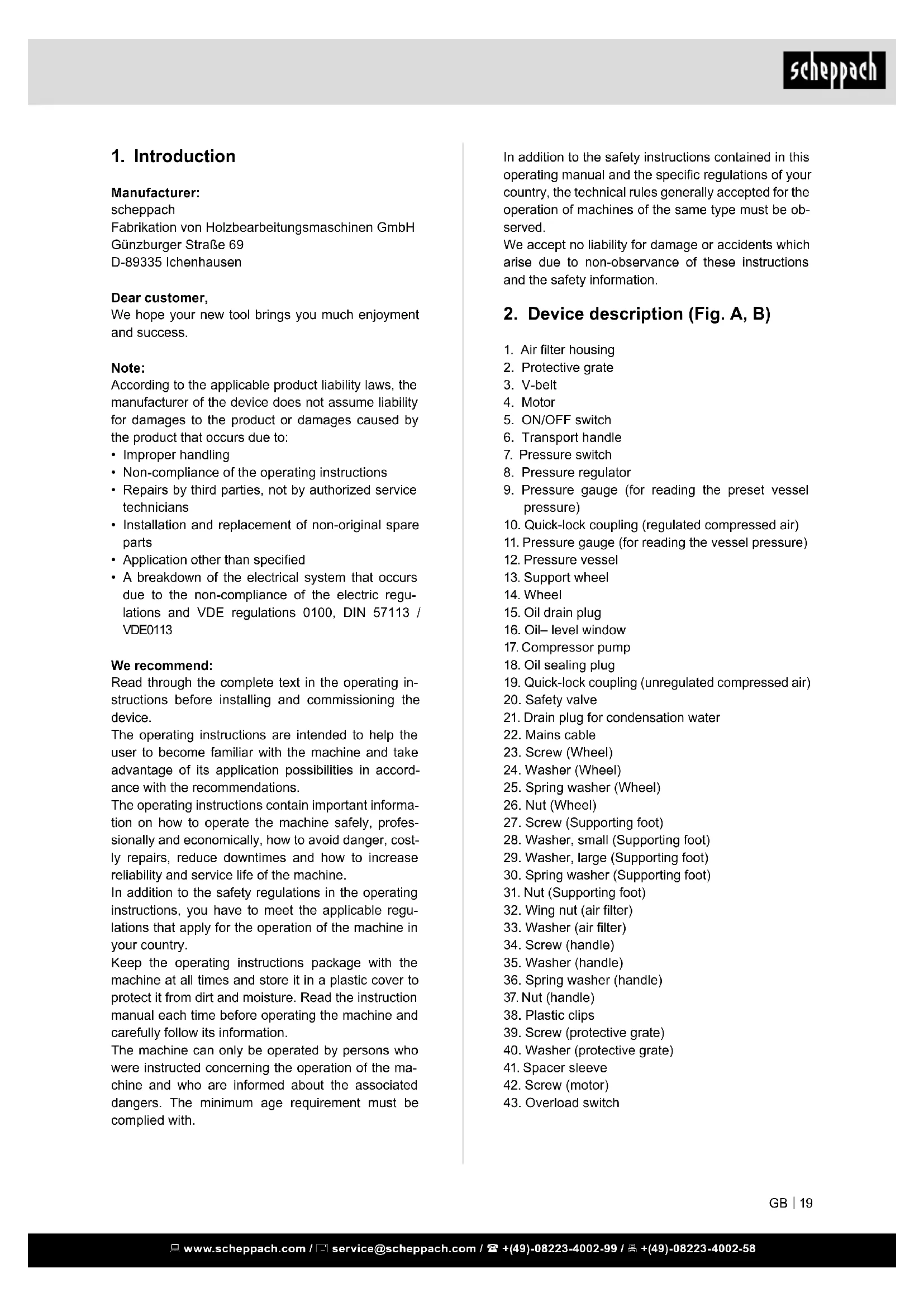
In addition to the safety instructions contained in this operating manual and the specic regulations of your country, the technical rules generally accepted for the operation of machines of the same type must be ob- served. We accept no liability for damage or accidents which arise due to non-observance of these instructions and the safety information.
9. Pressure gauge (for reading the preset vessel
10. Quick-lock coupling (regulated compressed air)
11. Pressure gauge (for reading the vessel pressure)
18. Oil sealing plug
19. Quick-lock coupling (unregulated compressed air)
21. Drain plug for condensation water
28. Washer, small (Supporting foot)
29. Washer, large (Supporting foot)
30. Spring washer (Supporting foot)
31. Nut (Supporting foot)
32. Wing nut (air lter)
33. Washer (air lter)
39. Screw (protective grate)
Manufacturer: scheppach Fabrikation von Holzbearbeitungsmaschinen GmbH Günzburger Straße 69 D-89335 Ichenhausen Dear customer, We hope your new tool brings you much enjoyment and success. Note: According to the applicable product liability laws, the manufacturer of the device does not assume liability for damages to the product or damages caused by the product that occurs due to:
- Non-compliance of the operating instructions
- Repairs by third parties, not by authorized service technicians
- Installation and replacement of non-original spare parts
- Application other than specied
- A breakdown of the electrical system that occurs due to the non-compliance of the electric regu- lations and VDE regulations 0100, DIN 57113 / VDE0113 We recommend: Read through the complete text in the operating in- structions before installing and commissioning the device. The operating instructions are intended to help the user to become familiar with the machine and take advantage of its application possibilities in accord- ance with the recommendations. The operating instructions contain important informa- tion on how to operate the machine safely, profes- sionally and economically, how to avoid danger, cost- ly repairs, reduce downtimes and how to increase reliability and service life of the machine. In addition to the safety regulations in the operating instructions, you have to meet the applicable regu- lations that apply for the operation of the machine in your country. Keep the operating instructions package with the machine at all times and store it in a plastic cover to protect it from dirt and moisture. Read the instruction manual each time before operating the machine and carefully follow its information. The machine can only be operated by persons who were instructed concerning the operation of the ma- chine and who are informed about the associated dangers. The minimum age requirement must be complied with. www.scheppach.com / service@scheppach.com / +(49)-08223-4002-99 / +(49)-08223-4002-58
The safety, work and maintenance instructions of the manufacturer as well as the dimensions indicated in the Technical Data section must be adhered to. Please note that our equipment has not been de- signed for use in commercial, trade or industrial appli- cations. Our warranty will be voided if the equipment is used in commercial, trade or industrial businesses or for equivalent purposes.
5. Safety information
General safety information Attention! The following basic safety measures must be observed when using electric tools for pro- tection against electric shock, and the risk of inju- ry and re. Read all these notices before using the electric tool and keep the safety instructions for later reference. Service and maintenance
1. Regular cleaning, maintenance and lubrica-
tion. Always pull the electrical plug before any adjustment, maintenance or repair.
2. Have your device repaired only by qualied
experts and only with original replacement parts. This ensures the continued safety of the device. Safe work
1. Keep the work area orderly
- Disorder in the work area can lead to accidents.
2. Take environmental inuences into account
- Do not expose electric tools to rain. - Do not use electric tools in a damp or wet envi- ronment. There is a risk of electric shock! - Make sure that the work area is well-illuminated. - Do not use electric tools where there is a risk of re or explosion.
3. Protect yourself from electric shock
- Avoid physical contact with earthed parts (e.g. pipes, radiators, electric ranges, cooling units).
4. Keep children away
- Do not allow other persons to touch the equip- ment or cable, keep them away from your work area.
5. Securely store unused electric tools
- Unused electric tools should be stored in a dry, elevated or closed location out of the reach of children.
6. Do not overload your electric tool
- They work better and more safely in the speci- ed output range.
7. Wear suitable clothing
- Do not wear wide clothing or jewellery, which can become entangled in moving parts.
3. Scope of delivery
- Open the packaging and remove the device care- fully.
- Remove the packaging material as well as the packaging and transport bracing (if available).
- Check that the delivery is complete.
- Check the device and accessory parts for transport damage. m ATTENTION! The device and packaging materials are not toys! Children must not be allowed to play with plas- tic bags, lm and small parts! There is a risk of swallowing and suffocation!
- Translation of original operating manual
The compressor is designed to generate compressed air for compressed-air driven tools which can be driv- en with an air volume of up to approx. 220 l/min (e.g. tire inator, blow-out pistol and paint spray gun). The compressor may only be operated in a dry and well ventilated indoor space. The equipment is to be used only for its prescribed purpose. Any other use is deemed to be a case of misuse. The user / operator and not the manufacturer will be liable for any damage or injuries of any kind caused as a result of this. An element of the intended use is also the obser- vance of the safety instructions, as well as the as- sembly instructions and operating information in the operating manual. Persons who operate and maintain the machine must be familiar with the manual and must be informed about potential dangers. In addition, the applicable accident prevention regula- tions must be strictly observed. Other general occupational health and safety-related rules and regulations must be observed. The liability of the manufacturer and resulting dam- ages are excluded in the event of modications of the machine. The machine may be operated only with original parts and original accessories of the manufacturer. www.scheppach.com / service@scheppach.com / +(49)-08223-4002-99 / +(49)-08223-4002-58
15. Have your electric tool repaired by a qualied
electrician - This electric tool conforms to the applicable safety regulations. Repairs may only be per- formed by an electrician using original spare parts. Otherwise accidents can occur.
- For your own safety you must only use the ac- cessories and additional units listed in the oper- ating instructions or recommended or specied by the manufacturer. The use of mounted tools or accessories other than those recommended in the operating instructions or catalogue may place your personal safety at risk.
- Wear ear muffs when you use the compressor.
18. Replacing the power cable
- To prevent hazards, leave the replacement of damaged power cables strictly to the manufac- turer or a qualied electrician. There is a risk of electric shock!
- Directly after inating tires, check the pressure with a suitable pressure gauge, for example at your lling station.
20. Roadworthy compressors for building site oper-
ations - Make sure that all lines and ttings are suitable for the maximum permissible operating pressure of the compressor.
21. Place of installation
- Set up the compressor on an even surface.
22. Supply hoses at pressures above 7 bar should be
equipped with a safety cable (e.g. a wire rope).
23. Avoid over-stressing the piping system by using
exible hose connections to prevent kinking.
24. Use a residual current circuit breaker with a trig-
ger current of 30 mA or less. Using a residual cur- rent circuit breaker reduces the risk of an electric shock.
ADDITIONAL SAFETY INSTRUCTIONS
Observe the corresponding operating manuals of the respective compressed air tools / com- pressed air attachments! The following general warnings must also be observed. Safety instructions for working with compressed air and blasting guns
- Ensure there is sufcient distance to the product, at least 2.50 m, and keep the compressed air tools / compressed air attachments away from the com- pressor during operation.
- The compressor pump and lines can become very hot during operation. Touching these parts will burn you. - Rubber gloves and non-slip shoes are recom- mended when working outdoors. - Tie long hair back in a hair net.
8. Do not use the cable for purposes for which it is
not intended - Do not use the cable to pull the plug out of the outlet. Protect the cable from heat, oil and sharp edges.
9. Take care of your tools
- Keep your compressor clean in order to work well and safely. - Follow the maintenance instructions. - Check the connection cable of the electric tool regularly and have it replaced by a recognised specialist when damaged. - Check extension cables regularly and replace them when damaged.
10. Pull the plug out of the outlet
- During non-use of the electric tool or prior to maintenance and when replacing tools such as saw blades, bits, milling heads.
11. Avoid inadvertent starting
- Make sure that the switch is switched off when plugging the plug into an outlet.
12. Use extension cables for outdoors
- Only use approved and appropriately identied extension cables for use outdoors. - Only use cable reels in the unrolled state.
13. Remain attentive
- Pay attention to what you are doing. Remain sensible when working. Do not use the electric tool when you are distracted.
14. Check the electric tool for potential damage
- Protective devices and other parts must be care- fully inspected to ensure that they are fault-free and function as intended prior to continued use of the electric tool. - Check whether the moving parts function faultlessly and do not jam or whether parts are damaged. - All parts must be correctly mounted and all conditions must be fullled to ensure fault-free operation of the electric tool. - Damaged protective devices and parts must be properly repaired or replaced by a recognised workshop, insofar as nothing different is speci- ed in the operating manual. - Damaged switches must be replaced at a cus- tomer service workshop. - Do not use any faulty or damaged connection cables. - Do not use any electric tool on which the switch cannot be switched on and off. www.scheppach.com / service@scheppach.com / +(49)-08223-4002-99 / +(49)-08223-4002-58
Operation of pressure vessels
- Anyone who operates a pressure vessel must keep this in good working order, operate and monitor it correctly, perform the necessary maintenance and servicing works immediately and implement safety measures as required according to the cir- cumstances.
- The regulatory authority can instruct necessary monitoring measures in individual cases.
- A pressure vessel must not be operated if it ex- hibits a defect that poses a danger to personnel or third parties.
- Check the pressure vessel for rust and damage each time before use. The compressor shall not be operated if the pressure vessel is damaged or rusty. If you discover damage, please contact the customer service workshop. Do not lose these safety instructions WARNING! This electric tool generates an electro- magnetic eld during operation. This eld can im- pair active or passive medical implants under cer- tain conditions. In order to prevent the risk of serious or deadly injuries, we recommend that persons with medical implants consult with their physician and the manufacturer of the medical implant prior to operat- ing the electric tool. Residual risks The machine has been built according to the state of the art and the recognised technical safety require- ments. However, individual residual risks can arise during operation.
- Health hazard due to electrical power, with the use of improper electrical connection cables.
- Residual risks can be minimised if the „safety instructions“ and the „Proper use“ are observed along with the whole of the operating instructions.
- Residual risks can be minimised if the „safety in- structions“ and the „Proper use“ are observed along with the whole of the operating instructions
Pressure vessel capacity 100 l Operating pressure 10 bar Theoretical intake capacity 550 l/min Theoretical delivery rate 350 l/min Protection category IP20 Device weight 81 kg
- The air which is sucked in by the compressor must be kept free of impurities that could cause res or explosions in the compressor pump.
- When releasing the hose coupling, hold the hose coupling piece with your hand. This way, you can protect yourself against injury from the rebound- ing hose.
- Wear safety goggles and a respirator when work- ing with the compressed air pistol. Dusts are harm- ful to health! Injuries can be easily caused by for- eign objects and blown away parts.
- Do not blow at people with the blow-out pistol and do not clean clothes while being worn. Risk of in- jury! Safety instructions when using spraying attach- ments (e.g. paint sprayers)
- Keep the spray attachment away from the com- pressor when lling so that no liquid comes into contact with the compressor.
- Never spray in the direction of the compressor when using the spraying attachments (e.g. paint sprayers). Moisture can lead to electrical hazards!
- Do not process any paints or solvents with a ash point below 55 °C. Risk of explosion!
- Do not heat up paints or solvents. Risk of explosion!
- If hazardous liquids are processed, wear protective lter units (face guards). Also, adhere to the safety information provided by the manufacturers of such liquids.
- The details and designations of the Ordinance on Hazardous Substances, which are displayed on the outer packaging of the processed material, must be observed. Additional protective measures are to be undertaken if necessary, particularly the wearing of suitable clothing and masks.
- Do not smoke during the spraying process and/or in the work area. Risk of explosion! Paint vapours are easily combustible.
- Never set up or operate the equipment in the vicini- ty of a re place, open lights or sparking machines.
- Do not store or eat food and drink in the work area. Paint vapours are harmful to your health.
- The work area must exceed 30 m³ and suf cient ventilation must be ensured during spraying and drying.
- Do not spray against the wind. Always adhere to the regulations of the local police authority when spraying combustible or hazardous materials.
- Do not process media such as white spirit, butyl alcohol and methylene chloride with the PVC pres- sure hose. These media will destroy the pressure hose.
- The work area must be separated from the com- pressor so that it cannot come into direct contact with the working medium. www.scheppach.com / service@scheppach.com / +(49)-08223-4002-99 / +(49)-08223-4002-58
Oil (15W 40) 0,9 l Max. installation height (üNN) 1000 m Belt type A-1400 Reserve technical changes! S1 operating mode (continuous duty) The noise emission values were measured in ac- cordance with EN ISO 3744. Wear hearing protection. The effects of noise can cause a loss of hearing. m Warning: Noise can have serious effects on your health. If the machine noise exceeds 85 dB (A), please wear suitable hearing protection. Sound power level L
- When complaints the dealer must be informed im- mediately. Subsequent complaints will not be ac- cepted.
- If possible, store the packaging until the warranty period has expired.
- Read the operating instructions to make yourself familiar with the device prior to using it.
- Only use original parts for accessories as well as for wearing and spare parts. Spare parts are avail- able from your specialized dealer.
- Specify our part numbers as well as the type and year of construction of the device in your orders.
m IMPORTANT! You must fully assemble the appliance before using it for the rst time! You require the following for assembly:
- Open-ended spanner 15 mm (not included in the scope of supply)
- Open-ended spanner 17 mm (not included in the scope of supply)
- Open-ended spanner 27 mm (not included in the scope of supply)
- Allen key 6 mm (not included in the scope of supply)
8.1 Fitting the wheels (Fig. C)
Insert the screw (23) through the wheel (14). Now in- sert the screw (23) through the mount on the pressure vessel (12). Now fasten the screw (23) with the wash- er (24), the spring washer (25) and nut (26). Repeat the process on the other side of the pressure vessel (12).
8.2 Fitting the support wheel (Fig. D)
Fit the washer (28) on the screw (27). Then insert the screw (27) through the support wheel (13). The sup- port wheel (13) is subsequently tted on the mount on the pressure vessel (12). Fasten the support wheel (13) with the washer (29), the spring washer (30) and nut (31).
8.3 Fitting the air lter (3x) (Fig. E)
Remove the transport protection from the air lter mount (if applicable). Remove the wing nut (32) and washer (33) from the threaded pin on the compressor pump. Fit the air lter housing (1) with the paper lter on the threaded pin. Refasten the air lter housing (1) with the washer (33) and wing nut (32). Repeat the process with all air lters. Fasten the air lter with the inlet opening facing down- wards, to avoid excessive contamination.
8.4 Fitting the transport handle (Fig. F)
Fasten the transport handle (6) to the pressure vessel (12) as shown. To do so, t a washer (35) on a screw (34). Guide the screw through an elongated hole on the pressure vessel (12) and fasten the screw with a washer (35), spring washer (36) and nut (37). Repeat this process three times.
8.5 Compressor oil (g. L)
- Remove the oil sealing plug (y) of the oil lling opening (20).
- Fill the included compressor oil into the crank housing and insert the included oil sealing plug (18) into the oil lling opening.
- Check the oil level using the marks on the sight glass (16). The oil level should be within the red circle.
9. Before starting the equipment
- Before you connect the equipment to the mains supply make sure that the data on the rating plate are identical to the mains data.
- Fill the crank housing with oil as described in 8.5.
- Check the equipment for damage which may have occurred in transit. Report any damage immediate- ly to the transport company which was used to de- liver the compressor.
- Install the compressor near the point of consump- tion. www.scheppach.com / service@scheppach.com / +(49)-08223-4002-99 / +(49)-08223-4002-58
- Make sure that the intake air is dry and dustfree.
- Do not install the compressor in a damp or wet room.
- The compressor may only be used in suitable rooms (with good ventilation and an ambient tem- perature from +5 °C to 40 °C). There must be no dust, acids, vapors, explosive gases or inamma- ble gases in the room.
- The compressor is designed to be used in dry rooms. It is prohibited to use the compressor in ar- eas where work is conducted with sprayed water.
- The oil level in the compressor pump has to be checked before putting the equipment into opera- tion.
- The compressor may only be used outdoor briey when the ambient conditions are dry.
- The compressor must always be kept dry and must not be left outdoors after work is complete.
m IMPORTANT! You must fully assemble the appliance before using it for the rst time!
10.1 On/off switch (Fig. G)
Pull the ON/OFF switch (5) upwards to switch on the compressor. To switch off the compressor, press the ON/OFF switch down.
10.2 Pressure adjustment: (Fig. A; B)
The pressure at the manometer (9) is adjusted with the pressure regulator (8). The pressure set can be utilised by connecting to the quick-coupling (10). The boiler pressure is read off at the manometer (11). The boiler pressure is taken at the quick-coupling (19).
10.3 Pressure switch position (Fig. A)
The pressure switch (7) is set in the factory. Switch- on pressure approx. 8 bar, switch-off pressure ap- prox. 10 bar
10.4 Overload switch
The motor is equipped with an overload switch. If the compressor is overloaded, the overload switch switches off automatically to protect the compressor against overheating. If the overload switch has trig- gered, switch the compressor off at the on/off switch (5) and wait until the compressor has cooled down. Then press the overload switch (43) and restart the compressor.
10.5 Relieving the overpressure after work is
complete Release the excess pressure by switching off the compressor and using the compressed air which is still left in the pressure vessel, e.g. with a com- pressed air tool running in idle mode or with a blow- out pistol.
11. Electrical connection
The electrical motor installed is connected and ready for operation. The connection complies with the applicable VDE and DIN provisions. The customer‘s mains connection as well as the ex- tension cable used must also comply with these regulations. When working with spray attachments and during temporary use outdoors, the device must be connected to a residual current circuit breaker with a trigger current of 30 mA or less. Important information In the event of an overloading the motor will switch itself off. After a cool-down period (time varies) the motor can be switched back on again. Damaged electrical connection cable The insulation on electrical connection cables is of- ten damaged. This may have the following causes:
- Passage points, where connection cables are passed through windows or doors.
- Kinks where the connection cable has been im- properly fastened or routed.
- Places where the connection cables have been cut due to being driven over.
- Insulation damage due to being ripped out of the wall outlet.
- Cracks due to the insulation ageing. Such damaged electrical connection cables must not be used and are life-threatening due to the insulation damage. Check the electrical connection cables for damage regularly. Make sure that the connection cable does not hang on the power network during the inspection. Electrical connection cables must comply with the applicable VDE and DIN provisions. Only use con- nection cables with the marking „H05VV-F“. The printing of the type designation on the connec- tion cable is mandatory. www.scheppach.com / service@scheppach.com / +(49)-08223-4002-99 / +(49)-08223-4002-58
Cover the electrical tool in order to protect it from dust and moisture. Store the operating manual with the electrical tool.
You require the following for maintenance:
- Open-ended spanner 14 mm (2 units - not included in the scope of supply)
- Allen key 4 mm (not included in the scope of supply) m Important! Pull out the power plug before doing any cleaning and maintenance work on the equipment. Risk of injury from electric shock! m Important! Wait until the equipment has cooled down complete- ly! Risk of burns! m Important! Always depressurize the equipment before carrying out any cleaning and maintenance work! Risk of in- jury!
15.1 Changing the V-belt (Fig. H to K)
To change the V-belt on the compressor, please be sure to disconnect the device from the mains. Once the compressor has been successfully disconnect- ed from the mains, remove the protective grate by turning the plastic clips (42) 90° using pliers. Then remove the screw (39) including washers (40) and spacer sleeve (41), which connects the protective grate (2) with the motor (4) using a 4mm Allen key. Now undo the four screws (42) on the motor (4) with two size 14 spanners, so that you can subsequently slide the motor. It is now possible to change the V-belt (3). After successfully changing the V-belt, perform the same steps in reverse order to bring the device back into operational condition. Make sure the motor is bolted at a right angle to the running direction, in or- der to guarantee fault-free running of the V-belt.
15.2 Maintenance work on the pressure vessel
Important! To ensure a long service life of the pressure vessel (12) , drain off the condensed water by opening the drain valve (21) each time after using. Release the vessel pressure rst (see 9.5). . Open the drain screw by turning counter-clockwise (looking at the screw from the bottom of the compressor) so that all the condensed water can run out of the pressure vessel. Then close the drain screw again (turn it clockwise). Check the pressure vessel for signs of rust and dam- age each time before using.
m Important! Pull out the power plug before doing any cleaning and maintenance work on the equipment. Risk of injury from electric shock! m Important! Wait until the equipment has cooled down complete- ly! Risk of burns! m Important! Always depressurize the equipment before carrying out any cleaning and maintenance work! Risk of in- jury! We recommend that you clean the device immediate- ly each time you have nished using it.
- Keep the equipment free of dirt and dust as far as possible. Wipe the equipment with a clean cloth or blow it down with compressed air at low pressure.
- We recommend that you clean the equipment im- mediately after you use it.
- Clean the equipment regularly with a damp cloth and some soft soap. Do not use cleaningagents or solvents; these may be aggressive to the plastic parts in the equipment. Ensure that no water can get into the interior of the equipment.
- You must disconnect the hose and any spraying tools from the compressor before cleaning. Do not clean the compressor with water, solvents or the like.
To change the position of the device, lift the transport handle and pull the device to the new location. When transporting the device in a vehicle it must be secured to the loading bed with straps.
m Important! Pull out the mains plug and ventilate the equipment and all connected pneumatic tools. Switch off the compressor and make sure that it is secured in such a way that it cannot be started up again by any unau- thorized person. Store the device and its accessories in a dark, dry and frost-proof place that is inaccessible to children. The optimum storage temperature is between 5 and 30˚C. Store the electrical tool in its original packaging. www.scheppach.com / service@scheppach.com / +(49)-08223-4002-99 / +(49)-08223-4002-58
15.6 Cleaning the air lter
The air lter prevents dust and dirt being sucked in. It is necessary to clean this lter at least every 300 operating hours. A blocked air lter signicantly reduces the compres- sor power. Remove the air lter by opening the wing nut (32) on the air lter housing (1). Remove the wing nut (32) and washer (33). Then draw out the air lter housing (1). Draw the air lter housing (1) apart. You can now remove the air lter. Carefully knock out the air lter and the parts of the lter housing. These components must then be blown out with com- pressed air (approx. 3 bar) and reassembled in re- verse order.
15.7 Connections and repairs
Connections and repairs of electrical equipment may only be carried out by an electrician. Please provide the following information in the event of any enquiries:
- Type of current for the motor
- Machine data - type plate
- Motor data - type plate Service information Please note that the following parts of this product are subject to normal or natural wear and that the fol- lowing parts are therefore also required for use as consumables. Wear parts*: Air lters, belts, cylinders, pistons, pis- ton rings, Plastic clips
- Not necessarily included in the scope of delivery!
16. Disposal and recycling
The equipment is supplied in packaging to prevent it from being damaged in transit. The raw materials in this packaging can be reused or recycled. The equip- ment and its accessories are made of various types of material, such as metal and plastic. Defective com- ponents must be disposed of as special waste. Ask your dealer or your local council. Old devices must not be disposed of with house- hold waste! This symbol indicates that this product must not be disposed of together with domestic waste in compliance with the Directive (2012/19/EU) pertaining to waste electrical and electronic equipment (WEEE). This product must be disposed of at a designated collection point. Do not use the compressor with a damaged or rusty pressure vessel. If you discover any damage, then please contact the customer service workshop. m Important! The condensed water from the pressure vessel will contain residual oil. Dispose of the condensed water in an environmentally compatible manner at a suita- ble collection point.
15.3 Safety valve (Fig. B)
The safety valve (20) has been set for the highest per- mitted pressure of the pressure vessel. It is not permit- ted to adjust the safety valve or remove the connec- tion lock (20.2) between the exhaust nut (20.1) and its cap (20.3). Actuate the safety valve every 30 operating hours but at least 3 times a year, to ensure that it works when required. Turn the perforated exhaust nut (20.1) coun- terclockwise to open it and use your hands to pull the valve rod outwards over the perforated exhaust nut (20.1) to open the safety valve outlet. Now, the valve audibly releases air. Then, tighten the exhaust nut clockwise again.
15.4 Checking the oil level at regular intervals
(Fig. F) Place the compressor on a level and straight surface. The oil level must be at the centre of the oil sight glass (16) (red dot).
15.5 Changing the oil (Fig. L)
The rst oil lling must be changed after 10 operating hours; afterwards perform an oil change every 50 op- erating hours. Switch the motor off and unplug the mains plug from the power outlet. Remove the oil drain screw (15). Ad- ditionally open the oil ller plug (18). To prevent the oil from running out in an uncontrolled manner, hold a small metal chute under the opening and collect the oil in a vessel. If the oil does not drain out completely, we recommend tilting the compressor slightly. When the oil has drained out, re-t the oil drain plug (15). Dispose of the old oil at a drop-off point for old oil. To ll in the correct quantity of oil, make sure that the compressor stands on an even surface. Remove the oil ller plug (18) and add new oil through the oil ller opening, until the oil level in the oil sight glass (16) has reached the correct quantity (red dot). Do not exceed the maximum lling quantity. Overll- ing the equipment may result in damage. Reinsert the oil ller plug (18) in the oil ller opening. www.scheppach.com / service@scheppach.com / +(49)-08223-4002-99 / +(49)-08223-4002-58
The table below contains a list of error symptoms and explains what you can do to solve the problem if your tool fails to work properly. If the problem persists after working through the list, please contact your nearest service workshop. Fault Possible cause Remedy The compressor does not start. No supply voltage. Check the supply voltage, the power plug and the socket-outlet. Insufcient supply voltage. Make sure that the extension cable is not too long. Use an extension cable with large enough wires. Outside temperature is too low. Never operate with an outside temperature of below +5° C. Motor is overheated. Allow the motor to cool down. If necessary, remedy the cause of the overheating. The compressor starts but there is no pressure. The safety valve leaks. Have a service center replace the safety valve. The seals are damaged. Check the seals and have any damaged seals replaced by a service center. The drain plug for condensation water leaks. Tighten the screw by hand. Check the seal on the screw and replace if necessary. The compressor starts, pressure is shown on the pressure gauge, but the tools do not start. The hose connections have a leak. Check the compressed air hose and tools and replace if necessary. A quick-lock coupling has a leak. Check the quick-lock coupling and replace if neces- sary. Insufcient pressure set on the pressure regulator. Increase the set pressure with the pressure regulator. This can occur, for example, by handing it in at an authorised collecting point for the recycling of waste electrical and electronic equipment. Improper han- dling of waste equipment may have negative conse- quences for the environment and human health due to potentially hazardous substances that are often contained in electrical and electronic equipment. By properly disposing of this product, you are also con- tributing to the effective use of natural resources. You can obtain information on collection points for waste equipment from your municipal administration, public waste disposal authority, an authorised body for the disposal of waste electrical and electronic equipment or your waste disposal company. www.scheppach.com / service@scheppach.com / +(49)-08223-4002-99 / +(49)-08223-4002-58