ManualGo.com
HVNCVT2 - Measuring equipment Klein Tools - Free user manual and instructions
Find the device manual for free HVNCVT2 Klein Tools in PDF.



Download the instructions for your Measuring equipment in PDF format for free! Find your manual HVNCVT2 - Klein Tools and take your electronic device back in hand. On this page are published all the documents necessary for the use of your device. HVNCVT2 by Klein Tools.
USER MANUAL HVNCVT2 Klein Tools
- 230kV HVNCVT2-1390108ART.indd 1 7/20/2015 3:25:27 PM2 Dwg Name: HVNCVT-2-1390108ART Dwg No: 1390107 ECO No: 19485 Pkg Dwg Ref: 1290179 Rev: A Color Reference: CEN-PACK-003-A SYMBOLS Warning or Caution Risk of Electrical Shock Double Insulated GENERAL SPECIFICATIONS The Broad-Range High-Voltage Non-Contact Tester (HVNCVT2) is an instrument for verifying the live or de-energized status of conductors and other exposed electrical equipment. The tester warns against dangerous voltage in several different ranges without contacting the energized conductor. Only use with hot sticks and rubber gloves meeting industry standards. Verify the rotary switch setting before measuring voltage, to ensure it is on the correct setting for your application. Always follow approved work safety practices and clearances per OSHA Sub-parts R & V and all company work rules. For Minimum Approach Distances (MAD), see OSHA Tables R-6 and R-7 (pages 8 & 9) in this manual.
- Operating Temperature: 14° to 122°F (-10° to 50°C) @ 85% relative humidity
- Storage Temperature: -4° to 140°F (-20° to 60°C) @ 85% relative humidity
- Dimensions: Tester: 10" x 4.25" x 4.25" (254 x 108 x 108 mm) Case: 13.5" x 8.75" x 4.75" (343 x 222 x 121 mm)
- Weight: 1.32 lbs. (600 g)
- Power Source: Three 1.5V "C" cell batteries Specifications subject to change. ENGLISH HVNCVT2-1390108ART.indd 2 7/20/2015 3:25:27 PM3 Dwg Name: HVNCVT-2-1390108ART Dwg No: 1390107 ECO No: 19485 Pkg Dwg Ref: 1290179 Rev: A Color Reference: CEN-PACK-003-A Dwg Name: HVNCVT-2-1390108ART Dwg No: 1390107 ECO No: 19485 Pkg Dwg Ref: 1290179 Rev: A Color Reference: CEN-PACK-003-A WARNINGS To ensure safe operation and service of the tester, follow these instructions. Failure to observe these warnings can result in severe injury or death.
- Use extreme caution when testing live electrical circuits due to risk of injury from electrical shock.
- Always use hot sticks and rubber gloves meeting industry standards.
- Follow approved work safety practices and clearances per OSHA Sub-parts R & V and your company work rules.
- Always test on a known live circuit to verify tester functionality prior to use.
- Do not exceed the limits marked on the instrument itself. Never test voltage more than 230kV AC RMS.
- Never ground yourself when taking measurements. Do not touch exposed circuit elements.
- Observe the proper safety precautions when working with voltage above 30V AC RMS to avoid electrical shock hazard.
- Do not assume equipment or conductors are, or will remain, de-energized. Always install proper grounding devices before starting procedure.
- Do not operate tester in an explosive atmosphere.
- Do not expose tester to rain or moisture. This increases the risk of fire or electric shock.
- Do not rely on this tester for shielded wire or cable with concentric neutrals.
- Do not let the unit make contact with live line voltage. Do not touch any exposed wiring, connections or other energized parts of an electrical circuit.
- 3-phase feeder cables with conductors close to each other may self-cancel the electric field and not be detected by the device. Verify that the phase conductors are separated by at least 15" (381 mm) before testing for AC voltage.
- Do not use in an area with mixed high voltages. In the presence of mixed voltages, the tester may become unreliable.
- Always ensure tester is directly under the conductor being tested. If other live voltage is nearby, tester may detect adjacent voltage. HVNCVT2-1390108ART.indd 3 7/20/2015 3:25:27 PM4 Dwg Name: HVNCVT-2-1390108ART Dwg No: 1390107 ECO No: 19485 Pkg Dwg Ref: 1290179 Rev: A Color Reference: CEN-PACK-003-A
3. Battery compartment
4. Hot stick connection point
Anyone using this instrument should be knowledgeable and trained about the risks involved with measuring medium and high voltage. They must also understand the importance of taking safety precautions as well as testing the instrument before and after using it to ensure that it is in good working condition. EXAMPLES OF APPLICATIONS:
- Non-contact detection of live AC voltage
- Finding faults in cables
- Checking and detecting live high voltage cables
- Checking grounding equipment
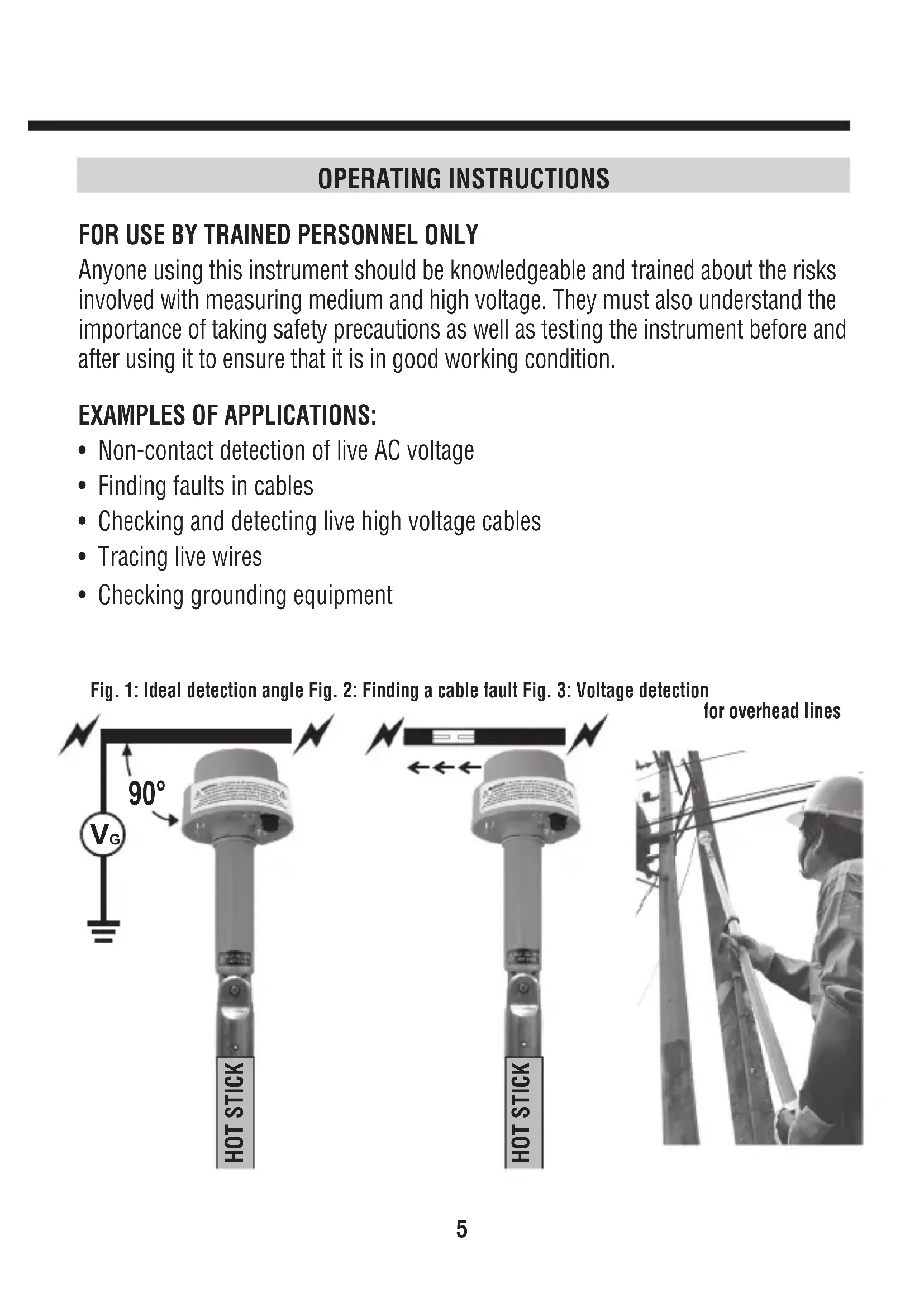
90° HOT STICK HOT STICK Fig. 1: Ideal detection angle Fig. 2: Finding a cable fault Fig. 3: Voltage detection for overhead linesHVNCVT2-1390108ART.indd 5 7/20/2015 3:25:28 PM6 Dwg Name: HVNCVT-2-1390108ART Dwg No: 1390107 ECO No: 19485 Pkg Dwg Ref: 1290179 Rev: A Color Reference: CEN-PACK-003-A ENGLISH OPERATING INSTRUCTIONS Prior to use, always inspect the tester for visible signs of damage. If there is any sign of damage, or if the tester does not operate correctly, discontinue use. Always test on a known live circuit to verify tester functionality. The tester should be used as an indication only. Tester should be kept clean and dry. If it is not, wipe with a clean, dry lint-free cloth. TEST FUNCTION Turn the sensitivity selector knob
to TEST in order to perform a self-test on the unit. Look for a steady red light from all 3 LEDs
and listen for a steady high-pitched sound. This self-test function confirms battery sufficiency, system integrity, and operation/active mode. Always test on known live circuit to verify tester functionality prior to use. If the 3 red LEDs do not glow and the beep sound is not present, replace batteries. 240V AC (Secondary Test) Perform a second test function prior to use by turning the sensitivity selector knob
to 240V and placing the dome near a low voltage live conductor. If a low voltage live conductor is not available, rub the dome against an item of clothing to generate static. Look for a blinking red light from all 3 LEDs
and listen for a beeping sound. See Fig. 1 on page 5 for ideal detection angle. Always test on known live circuit to verify tester functionality prior to use. If the 3 red LEDs do not glow and the beep sound is not present, replace batteries. OPERATION Before using the unit, a hot stick must be attached. Only use with hot sticks and rubber gloves meeting industry standards. Always follow approved work safety practices and clearances per OSHA Sub-parts R & V and all company work rules. Turn the sensitivity selector knob
to the appropriate setting. It is recommended to start with a lower test setting than the actual working voltage, then gradually increase the setting until the voltage is detected. Gradually move the tester towards the live conductor until the warning signal is triggered. See Fig. 1 on page 5 for ideal detection angle. Always maintain the minimum approach distances listed in OSHA Tables R-6 and R-7 on pages 8 & 9 in this manual.
3. Battery compartment
4. Hot stick connection point
to the appropriate setting for the energized cable being detected. Move the detector along (but not touching) the cable, listening for rapid beeping or steady sound and looking for the rapidly blinking or steady red light from all 3 LEDs
FOR VOLTAGES OF 72.5 kV AND LESS
Nominal voltage (kV) phase-to-phase Distance Phase-to-ground exposure Phase-to-phase exposure ft. m ft. m
Avoid Contact Avoid Contact Avoid Contact Avoid Contact
Employers may use the minimum approach distances in this table provided the worksite is at an elevation of 3,000 feet (900 meters) or less. If employees will be working at elevations greater than 3,000 feet (900 meters) above mean sea level, the employer shall determine minimum approach distances by multiplying the distances in this table by the correction factor in OSHA's Table R-5 Altitude Correction Factor, corresponding to the altitude of the work. For single-phase systems, use voltage-to-ground. OPERATING INSTRUCTIONS Always follow approved work safety practices and clearances per OSHA Sub-parts R & V and all company work rules. For Minimum Approach Distances (MAD), see OSHA Tables R-6 and R-7 below.
Nominal voltage (kV) phase-to-phase Distance Phase-to-ground exposure Phase-to-phase exposure ft. m ft. m
Employers may use the minimum approach distances in this table provided the worksite is at an elevation of 3,000 feet (900 meters) or less. If employees will be working at elevations greater than 3,000 feet (900 meters) above mean sea level, the employer shall determine minimum approach distances by multiplying the distances in this table by the correction factor in OSHA's Table R-5 Altitude Correction Factor, corresponding to the altitude of the work. Employers may use the phase-to-phase minimum approach distances in this table provided that no insulated tool spans the gap and no large conductive object is in the gap. The clear live-line tool distance shall equal or exceed the values for the indicated voltage ranges.
Required Garments Required Protective Equipment
Long-sleeve shirt and pants or coverall. Flash suit hood or face shield
. Jacket, parka, rainwear or hard hat liner (AN). Hard hat. Safety glasses or safety goggles (SR). Hearing protection (ear canal inserts). Heavy duty leather gloves
Leather footwear (AN).
Long-sleeve shirt and pants or coverall. Flash suit hood or face shield
and balaclava. Jacket, parka, rainwear or hard hat liner (AN). Hard hat. Safety glasses or safety goggles (SR). Hearing protection (ear canal inserts). Heavy duty leather gloves
Leather footwear (AN).
Arc-rated clothing system
. Jacket, parka, rainwear or hard hat liner (AN). Hard hat. Safety glasses or safety goggles (SR). Hearing protection (ear canal inserts). Leather footwear (AN).
Arc-rated clothing system
Long sleeve shirt (AR). Pants (AR)
. Jacket, parka, rainwear or hard hat liner (AN). Hard hat. Safety glasses or safety goggles (SR). Hearing protection (ear canal inserts). Leather footwear (AN). AN = as needed (optional) AR = as required SR = selection required One of the 3 basic methods is used to determine an HRC for a job task. Arc rating is defined in article 100 NFPA 70E 2015 Edition. Face shields are to have wrap-around guarding to protect not only the face but also the forehead, ears and neck, or alternatively, an arc-rated flash suit hood is required to be worn. If rubber insulating gloves with leather protectors are used, additional leather or arc-rated gloves are not required. The combination of rubber insulating gloves with leather protectors satisfies the arc flash protection requirement.
HVNCVT2-1390108ART.indd 10 7/20/2015 3:25:29 PM11 Dwg Name: HVNCVT-2-1390108ART Dwg No: 1390107 ECO No: 19485 Pkg Dwg Ref: 1290179 Rev: A Color Reference: CEN-PACK-003-A Dwg Name: HVNCVT-2-1390108ART Dwg No: 1390107 ECO No: 19485 Pkg Dwg Ref: 1290179 Rev: A Color Reference: CEN-PACK-003-A CLEANING Be sure tester is turned off and wipe with a clean, dry lint-free cloth. Do not use abrasive cleaners or solvents. STORAGE If the tester is not to be used for periods of longer than 60 days, remove the batteries and store separately from the tester. WARRANTY www.kleintools.com/warranty DISPOSAL / RECYCLE Do not place equipment and its accessories in the trash. Items must be properly disposed of in accordance with local regulations. Please see www.epa.gov or www.erecycle.org for additional information. CUSTOMER SERVICE KLEIN TOOLS, INC. 450 Bond Street Lincolnshire, IL 60069 hisupport@kleintools.com www.kleintools.com MAINTENANCE BATTERY REPLACEMENT
1. Unscrew the tester handle (battery compartment) from the tester head.
2. Remove the 3 batteries.
3. Replace with 3 new batteries (1.5V “C” type). Batteries should be placed in the
handle with the negative (-) end down into the handle first, and the positive (+) end upwards towards the head.