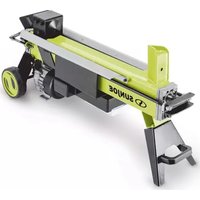
24VX2LS6T - Log splitter Sun Joe - Free user manual and instructions
Find the device manual for free 24VX2LS6T Sun Joe in PDF.



| Product Type | Cordless Hydraulic Log Splitter |
| Brand | Sun Joe |
| Model | 24VX2LS6T |
| Motor | 1800 W Brushless |
| Splitting Force | 5.4 metric tons |
| Max Log Diameter | 25.4 cm |
| Max Log Length | 52 cm |
| Hydraulic Pressure | 2900 psi (20 MPa) |
| Hydraulic Tank Capacity | 4.2 liters |
| Power Supply | Two 24 V lithium-ion batteries (4.0 Ah each) |
| Rated Battery Voltage | 24 V DC (48 V max.) |
| AC Charger | 120 V, 60 Hz, 160 W |
| Charge Time | 1 hr 50 min |
| Duty Cycle (S3) | 5 min on / 10 min off |
| Net Weight | 39.5 kg |
| Warranty | 2 years |
| Safety | Lever guard, on/off button, safety lock, emergency stop |
| Maintenance | Drain AW32 hydraulic oil every 150 hrs, lubrication, sharpening the splitting wedge |
| Recommended Use | Flat and level surface, protected from rain |
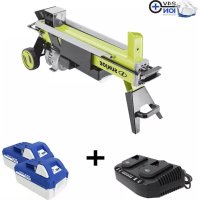
| Included Accessories | 2 x 24 V 4.0 Ah batteries, dual charger, crank, handle, manual |
Frequently Asked Questions - 24VX2LS6T Sun Joe
User questions about 24VX2LS6T Sun Joe
0 question about this device. Answer the ones you know or ask your own.
Ask a new question about this device
Download the instructions for your Log splitter in PDF format for free! Find your manual 24VX2LS6T - Sun Joe and take your electronic device back in hand. On this page are published all the documents necessary for the use of your device. 24VX2LS6T by Sun Joe.
USER MANUAL 24VX2LS6T Sun Joe
All Operators Must Read These Instructions Before Use
Always follow these safety guidelines. Failure to do so may result in serious bodily injury or death.
General Safety
WARNING! This machine is not intended for use by children or by unassisted, unsupervised persons whose physical, sensory or mental capabilities prevent them from using it safely. Children should be supervised to ensure that they do not play with the machine.
Before starting up your log splitter, please check it carefully for any defects. If you find any, do not start up your machine. Instead, contact your authorized Snow Joe + Sun Joe dealer or call the Snow Joe + Sun Joe customer service center at 1-866-SNOWJOE (1-866-766-9563).
WARNING! When using the log splitter, basic safety precautions should always be followed to reduce the risk of fire, electric shock, and personal injury. These include:
- Stay alert - Watch what you are doing. Use common sense. Do not operate the machine when you are tired or under the influence of drugs, alcohol, or other medication. Never leave a running machine unattended.
- Know your machine - Know how to start and stop the machine. Make sure that all controls and safety features are in place and functioning properly. Only use your hands to operate the controls.
- Avoid unintentional starting - Ensure the power button is in the off-position (not pressed) before installing the battery packs, or picking up or carrying the machine. Transporting the machine with your finger on the power button or energizing the machine while the power button is pressed may lead to accidents.
Usage - Do not use this log splitter for any job except for what it's intended for. - Moving parts - Keep hands and feet away from moving parts and partially split logs during operation. Contact with moving parts may result in injury.
-
Personal protective equipment - Always wear safety glasses and gloves while operating the machine.
-
Dress properly - Do not wear loose clothing or jewelry as such articles can become caught in moving parts. Tie up long hair.
- Avoid slipping - Maintain proper footing and balance at all times to avoid slipping or falling. Wear non-slip footwear to improve your footing on slippery surfaces.
- Avoid water - Do not use the log splitter in rain or in damp or wet locations. Do not allow water or any other liquids to get on the machine.
- Noise and vibrations - If the log splitter should start to vibrate abnormally, stop the machine and inspect it thoroughly for damage.
- One-person operation - Only one person should operate, load or unload the log splitter at any given time.
Log Splitting
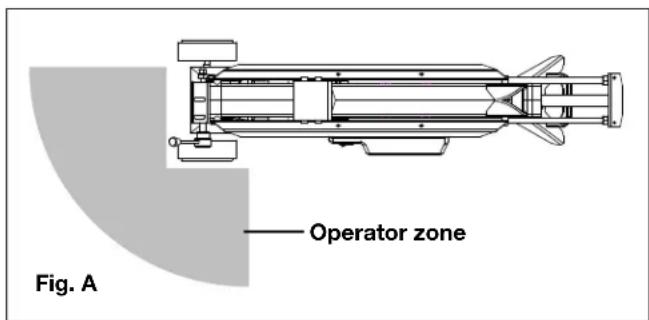
Operator zone - Operate the log splitter from the operator zone to reduce the risk of injury (Fig. A).
- Logs - Do not split oversized logs. Always split in the direction of the grain. Ensure that the logs are cut as square as possible and are free of protruding limbs.
- Splitting non-squared-off logs - When splitting logs that were not cut square, place the tapered end towards the splitting wedge and rotate the log so that the tip of the tapered end faces down before attempting to split it.
Foreign objects - Do not split logs that may contain foreign objects such as nails, wires or bullets. - Overload - Do not overload the log splitter or attempt to split more than one log at a time, unless the log pusher has been fully extended and a second log is needed to complete the separation of the first log. If a log has not split after 5 seconds, stop the machine and remove the log.
Operation - Do not force the log into the splitting wedge; allow the log splitter to do the work and only split one log at a time.
- Loading - When loading a log, place your hands on the sides of the log, not on the ends. Never place your hands or any part of your body between the log and any part of the log splitter. When the log pusher is moving, do not attempt to load or secure a log with your hands.
- Jam - If a log becomes jammed, release the power button and control lever. Wait until the log pusher has stopped moving before clearing jammed material.
High-Pressure Hydraulics
High fluid pressures are developed in hydraulic log splitters. Pressurized hydraulic fluid escaping through a pin hole opening can puncture skin and cause severe blood poisoning. Heed the following instructions at all times.
- Do not operate a log splitter with frayed, kinked, cracked or damaged hoses, fittings, or tubing.
- Remove the batteries and relieve the hydraulic pressure before changing or adjusting fittings, hoses, tubing, or other system components.
- Do not adjust the pressure settings of the pump or valve.
- Do not check for leaks with your hand. Leaks can be located by passing cardboard or wood over the suspected area and looking for discoloration. If injured by discharged hydraulic fluid, see a doctor immediately. A serious infection or reaction may develop without proper medical treatment.
Work Area Safety
- Work area - Always inspect the area where the machine is to be used and operate it in a well-lit environment. Keep the work area clear of debris for safe, secure footing. Make sure the log splitter is on a flat, level surface. Chock the wheels to prevent unintended movement.
- Avoid dangerous environments - Do not operate the machine in gaseous or explosive environments or use it near flammable or combustible materials.
- Keep children, bystanders, and pets away All bystanders, including pets, should be kept at least 16.5 ft (5 m) from the log splitter while it is in operation.
Maintenance + Storage
WARNING! Do not use detergents, acids, alkaline solutions, bleaches or solvents such as acetone to clean your log splitter. These substances may damage the plastic parts of the machine.
-
Inspect before use - Visually inspect for any loose fasteners or worn, missing or damaged parts. Make sure all nuts and bolts are tight to assure the equipment is in safe working condition.
-
Replacement parts - When servicing, use only identical replacement parts. Replace or repair damaged parts immediately. Contact the Snow Joe ^® + Sun Joe ^® customer service center at 1-866-SNOWJOE (1-866-766-9563) for assistance.
- Store indoors - When not in use, the machine should be stored indoors in a dry place inaccessible by children.
- Manual - Refer to the manual for important details if the machine is to be stored for an extended period of time.
Battery & Charger Safety Instructions
We pay a great deal of attention to the design of every battery pack to ensure that we supply you with batteries that are safe, durable and have a high energy density. The battery cells have a wide range of safety devices. Each individual cell is initially formatted and its electrical characteristic curves are recorded. This data is then used exclusively to assemble the best possible battery packs.
Despite all the safety precautions, caution must always be exercised when handling batteries. The following points must be obeyed at all times to ensure safe use. Safe use can only be guaranteed if undamaged cells are used. Incorrect handling of the battery packs can cause cell damage.
IMPORTANT! Analyses confirm that incorrect use and poor care of high-performance batteries are the main factors responsible for product damage and/or personal injury.
WARNING! Use only approved replacement batteries; other batteries may damage the machine and cause it to malfunction, which can lead to serious personal injury.
WARNING! Do not use a battery pack or machine that is damaged or modified. Damaged or modified batteries may exhibit unpredictable behavior resulting in fire, explosion or risk of injury.
Have your battery packs serviced by a qualified repair person using only identical replacement parts. This will ensure that the safety of the battery packs is maintained.
CAUTION! To reduce the risk of injury, use only official 24V iON+ designated chargers with the 24V iON+ battery packs. The use of other batteries or chargers poses a risk of fire, personal injury and damage. Do not modify or attempt to repair the machine or the battery packs except as indicated in the instructions for use and care. Do not wire a battery pack to a power supply or car cigarette lighter, as such misuse will permanently disable or damage the battery packs.
WARNING! To reduce the risk of electric shock, always unplug the charger before performing any cleaning or maintenance. Do not allow water to flow into the charger. Use a Ground Fault Circuit Interrueter (GFCI) to reduce shock hazards.
- Remove the batteries - To reduce the risk of fire, turn off the log splitter and remove the batteries when not in use, when clearing jammed material, before making adjustments, before changing accessories, before storing, or before performing any maintenance.
- Avoid dangerous environments - Do not charge the battery packs in rain, snow or in damp or wet locations. Do not use the battery packs or charger in the presence of explosive atmospheres (gaseous fumes, dust or flammable materials) because sparks may be generated when inserting or removing the battery packs, which could lead to a fire.
- Charge in a well-ventilated area - Do not block the charger vents. Keep them clear to allow for proper ventilation. Do not allow smoking or open flames near a charging battery pack. Vented gases may explode.
NOTE: The safe temperature range for the batteries are 41^ (5^) to 105^ (40.5^) . Do not charge the batteries outside in freezing weather; charge them at room temperature.
- Maintain charger cord - When unplugging the charger, pull the plug, not the cord from the receptacle to reduce the risk of damage to the power cord. Never carry the charger by its cord. Keep the cord away from heat, oil and sharp edges. Make sure the cord will not be stepped on, tripped over or subjected to damage or stress when the charger is in use. Do not use a charger with a damaged cord or plug. Replace a damaged charger immediately.
- Do not use an extension cord unless it is absolutely necessary - Using the wrong, damaged or improperly wired extension cord poses a risk of fire and electric shock. If an extension cord must be used, plug the charger into a properly wired 16 gauge or larger extension cord with the female plug matching the male plug on the charger. Make sure that the extension cord is in good electrical condition.
- Do not expose the machine or battery packs to fire - Exposure to fire or temperatures above 265^ (130^) may cause the battery packs to explode, causing personal injury or damage. Toxic fumes and materials are created when battery packs are ignited.
- Do not crush, drop or damage battery packs - Do not use the battery packs or charger if they have sustained a sharp blow, been dropped from a height of more than 3 feet (1 meter), run over or have been damaged in any way. Even if the housing of a battery pack appears to be undamaged, the battery cells inside the battery may have suffered serious damage. In such instances, please read the waste disposal information for proper battery disposal.
-
Do not disassemble - Incorrect reassembly may pose a serious risk of electric shock, fire or exposure to toxic battery chemicals. If the batteries or charger are damaged, contact an authorized Snow Joe + Sun Joe dealer or call the Snow Joe + Sun Joe customer service center at 1-866-SNOWJOE (1-866-766-9563) for assistance.
-
Battery chemicals cause serious burns - If damaged, battery chemicals may be discharged from the battery. Battery chemicals from a lithium-ion battery will react violently with air; avoid contact. If skin is exposed to battery chemicals, wash the affected area with soap and water. If eyes are exposed to battery chemicals, immediately flush with water for 20 minutes and seek medical attention. Remove and dispose of contaminated clothing.
- Risk of short circuit - A battery pack will short circuit if a metal object makes a connection between the positive and negative contacts on the battery pack. Do not place a battery pack near anything that may cause a short circuit, such as paperclips, coins, keys, screws, nails and other metallic objects. A short-circuited battery pack poses a risk of fire and severe personal injury.
- Store your battery packs and charger in a cool, dry place - Ideally, store the battery packs at 59^ (15^) and charged to at least 40% . Do not store the battery packs or charger where temperatures may exceed 105^ (40.5^) , such as in direct sunlight or inside a vehicle, or where temperatures may drop below 41^ (5^) .
NOTE: Prevent the battery packs from freezing. Battery packs that were stored below 32^ (0^) for more than 60 minutes must be discarded.
- Charge before use - The battery packs supplied with your machine are only partially charged. The battery packs have to be fully charged before using the log splitter for the first time.
- Battery Aging - Lithium-ion batteries are subject to a natural aging process. A battery pack must be replaced at the latest when its capacity falls to just 80% of its capacity when new. Weakened cells in an aged battery pack are no longer capable of meeting the high power requirements needed for the proper operation of your machine, and therefore pose a safety risk.
- Do not exhaustively discharge battery packs – A complete discharge will damage the battery cells. The most common cause of exhaustive discharge is lengthy storage. Stop working as soon as the performance of a battery falls noticeably or the electronic protection system triggers. For optimum battery performance, charge the battery packs frequently. Place the battery packs in storage only after they have been fully charged.
- Do not overload battery packs - Protect the log splitter and batteries from overloading. Overloads will quickly result in overheating and cell damage inside the battery housing even if it is not apparent externally. For safety reasons, the integrated protective cutoff will activate to switch off the equipment. After regular use, allow the battery packs to cool to room temperature before recharging them.
IMPORTANT! Do not attempt to turn on the machine if the protective cutoff has been activated. This may damage the battery packs.
- Outlet voltage - Please check the data marked on the rating label of the battery charger. Be sure that the voltage of the power supply matches that marked on the rating label. Never connect it to a different mains voltage.
- Charger use - Do not use the supplied battery charger to charge other types of battery packs or tools.
- Do not overcharge battery packs - Do not exceed the maximum charging times. Frequently overcharging the battery packs will result in cell damage. Do not leave batteries in the charger for days on end.
- Battery pack abnormalities - Do not use batteries that have suffered swelling or deformation or those that exhibit other atypical symptoms (gassing, hissing, cracking, etc.).
- Electrostatic discharge - When handling batteries, be wary of electrostatic charge. Electrostatic discharges can damage the electronic protection system and the battery cells. To avoid electrostatic discharges, never touch the battery terminals.
Safety Symbols
The following table depicts and describes safety symbols that may appear on this machine. Read, understand, and follow all instructions on the product before attempting to assemble and operate.
| Symbols Descriptions Symbols Descriptions | |||
| READ THE OPERATOR'S MANUAL - Read, understand, and follow all instructions in the user manual before attempting to assemble and operate. | ! | SAFETY ALERT - Indicates a precaution, a warning, or a danger. | |
| Wear protective gloves and footwear when using the machine and handling debris. | For protection against injury, wear eye protection. | ||
| WARNING! Do not expose the unit to rain or wet conditions. Keep dry. | Moving parts can crush and cut hands and fingers. Keep hands clear of the log pusher, splitting wedge, and logs while splitting. | ||
| Keep your hands away from splits and cracks that may open in the log. Do not remove jammed logs with your hands. | WARNING! Always be aware of the movement of the log splitter. | ||
| Store indoors. Never store the log splitter outdoors. | Keep bystanders and children a safe distance away. | ||
Know Your Cordless Hydraulic Log Splitter
Read the owner's manual and safety instructions carefully before operating the log splitter. Compare the illustration below to the product in order to become familiar with the location of the various controls and adjustments. Save this manual for future reference.
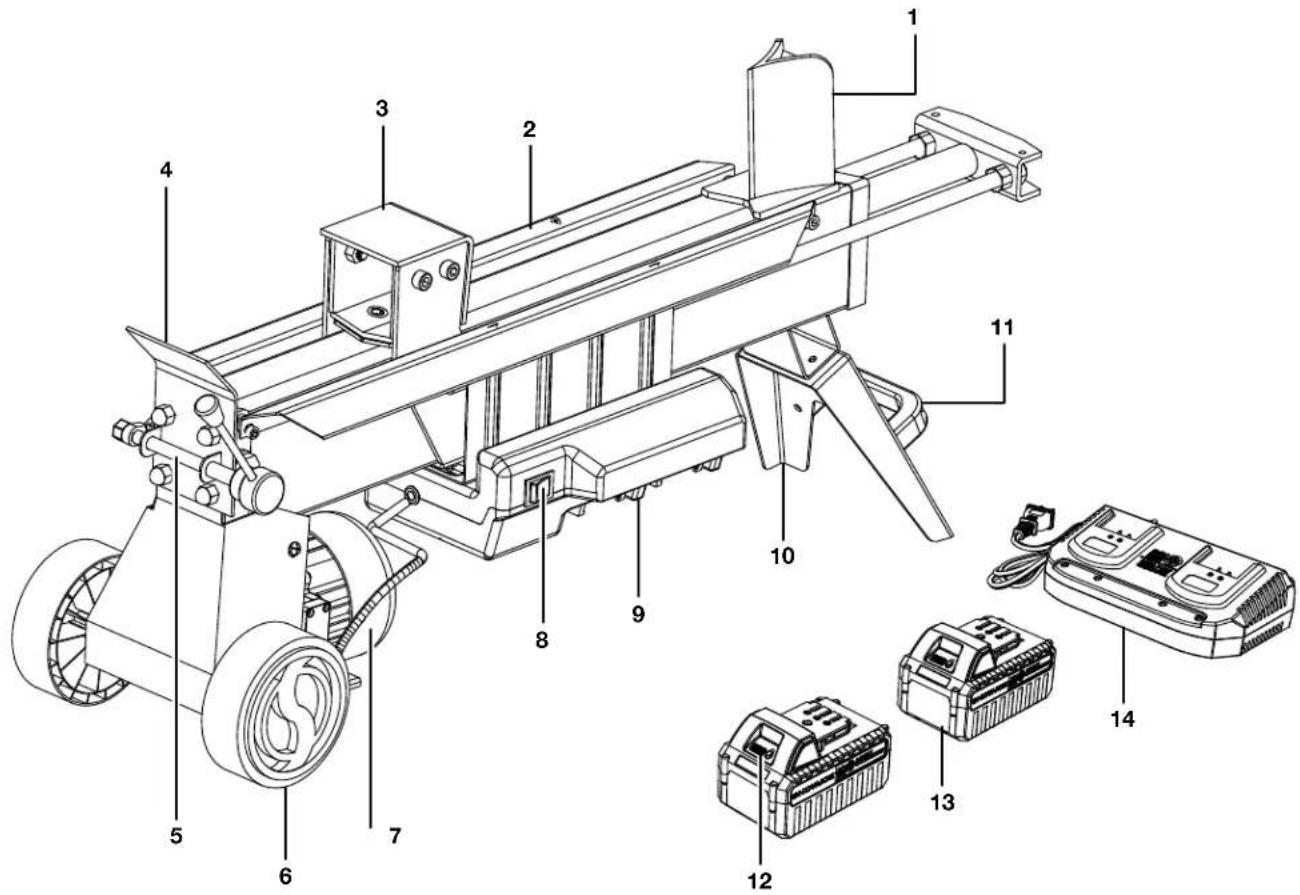
-
Splitting wedge
-
Control lever
-
Battery compartment
-
24V iON+ lithium-ion battery (24VBAT) featuring exclusive EcoSharp® technology
-
Log rail
6.Wheel
-
Front stand
-
24V iON+ lithium-ion battery charger (24VCHRG-DPC)
-
Log pusher
7.Motor
-
Handle
-
Control lever guard
-
Power button
-
Battery level indicator
Technical Data
Brushless Motor 1800 W
Max Battery Voltage* 24V DC
Duty Cycle (S3) 5 min on | 10 min off
Battery Capacity. 4.0 Ah (each)
Max Log Size. 10 in. (Diameter) | 20.5 in. (Length)
Charger Input 120V AC | 60 Hz | 160 W
25.4 cm (Diameter) | 52 cm (Length)
Charger Output 26V DC | 2.2 A (each socket)
Splitting Force 6 Tons
Charge Time Max. 1 hr 50 min
Hydraulic Tank Capacity. 1.1 Gallons (4.2 L)
Net Weight .87.1 lbs (39.5 kg)
Hydraulic Pressure 2900 PSI (20 MPa)
Generates 48V max with two 24V lithium-ion batteries. Initial no-load voltage, when fully charged, peaks at 24V nominal voltage under typical load is 21.6V.
Unpacking
Carton Contents
Log splitter
- Handle
Grip
Control lever
M6 socket head screw (x2)
- Washer (x2)
- Lock nut (x2)
24V iON+ lithium-ion battery (x2)
24V iON+ lithium-ion dual port charger
- Manual with registration card
- Carefully remove the log splitter and check to see that all of the above items are supplied.
- Inspect the product carefully to make sure no breakage or damage occurred during shipping. If you find damaged or missing parts, DO NOT return the unit to the store. Instead, please call the Snow Joe ^念 + Sun Joe customer service center at 1-866-SNOWJOE (1-866-766-9563).
NOTE: Do not discard the shipping carton and packaging materials until you are ready to use the log splitter. The packaging is made of recyclable materials. Properly dispose of these materials in accordance with local regulations or save the packaging for long-term product storage.
IMPORTANT! The equipment and packaging materials are not toys. Do not let children play with plastic bags, foils, or small parts. These items can be swallowed and pose a suffocation risk!
Battery + Charger Operation
The equipment is powered by two lithium-ion batteries. The battery packs are completely sealed and maintenance free.
Battery Charge Level Indicator
Each battery pack is equipped with a push button for checking the charge level. Simply press the push button to read off the battery charge level from the LEDs of the battery indicator:
| Lights Light Indicators | |
| ○ | Charge level button |
| The battery is at 30% capacity | |
| The battery is at 60% capacity | |
| The battery is fully charged | |
NOTE: If the battery indicator button does not appear to be working, charge the battery.
NOTE: Immediately after using the battery pack, the battery indicator button may display a lower charge than it will if checked a few minutes later. The battery cells "recover" some of their charge after resting.
WARNING! Only charge Sun Joe 24V iON+ lithium-ion battery packs with compatible Sun Joe 24V iON+ lithium-ion chargers. Other types of chargers may cause personal injury and damage.
To reduce the risk of electric shock, do not allow water to enter into the charger.
Charging the Batteries
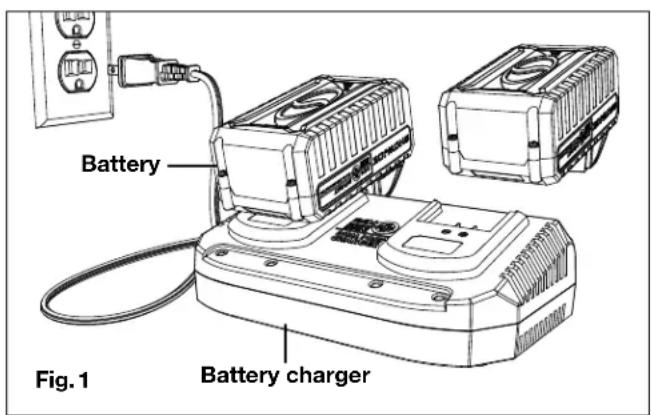
- Check that the mains voltage is the same as that marked on the rating label of the battery charger. Then, plug the charger into an AC power outlet. Slide the batteries into the charger to commence charging (Fig. 1).
NOTE: The green LED indicates either a powered on charger or a fully charged battery. The red LED indicates a charging battery.

- Remove the battery once fully charged.
NOTE: A fully discharged battery at room temperature will fully charge in 1 hr 50 mins.
IMPORTANT! Never allow a battery pack to become fully discharged, as this will cause irreversible damage to the battery.
Assembly
WARNING! Accidental starting may result in serious personal injury; always remove the battery packs from the tool before assembly.
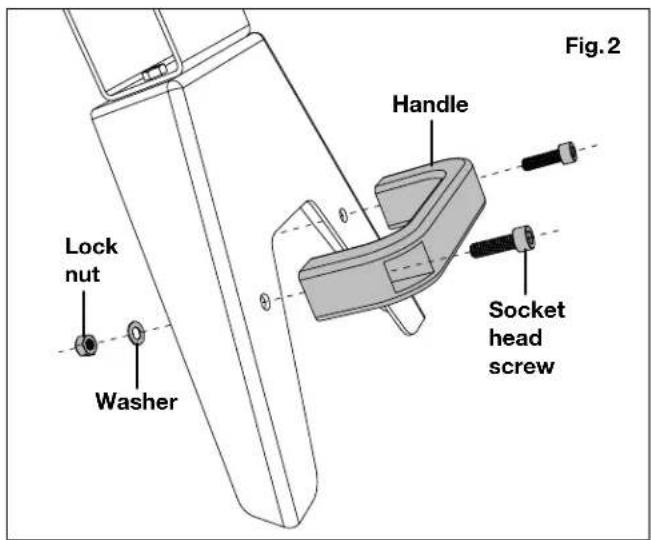
- Install the handle onto the front stand using the included set of socket head screws, washers and lock nuts (Fig. 2).
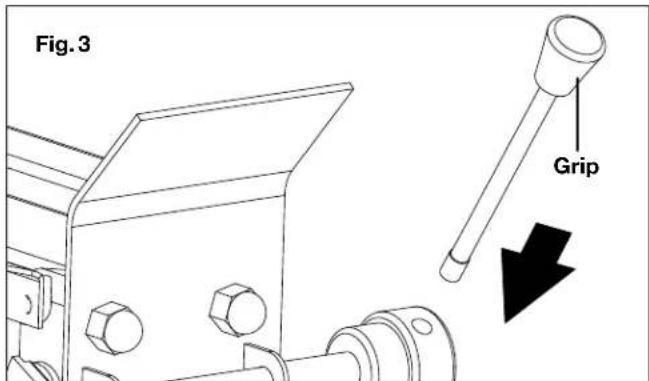
- Screw the grip into the control lever at the back of the log splitter (Fig.3).
Operation
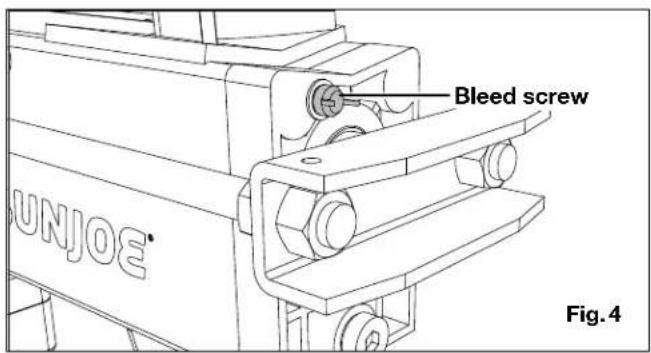
- Before using the log splitter, loosen the bleed screw three or four turns counter-clockwise to allow air to bleed out of the hydraulic system (Fig. 4).
NOTE: To avoid hydraulic oil leaking, tighten the bleed screw before transporting the machine.
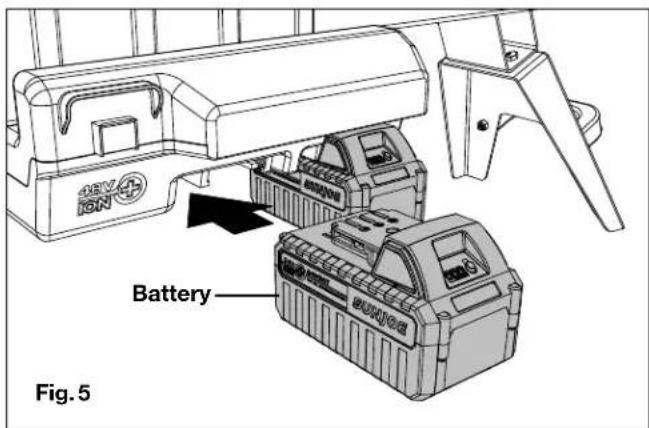
- Slide both batteries into the battery compartment (Fig. 5).
- Load a single log lengthwise onto the log rail. Always split along the grain of the wood and not against.
NOTE: Do not exceed the maximum log diameter of 10 in. (25.4 cm) or the maximum log length of 20.5 in. (52 cm).
WARNING! Never load or unload logs while the log pusher is moving.
- To start splitting, push the power button with your right hand and pull the control lever with your left hand simultaneously (Fig. 6).
NOTE: Knots, green woods or hard woods may present additional resistance for the log splitter. Do not force the machine if the log does not split on the first attempt.
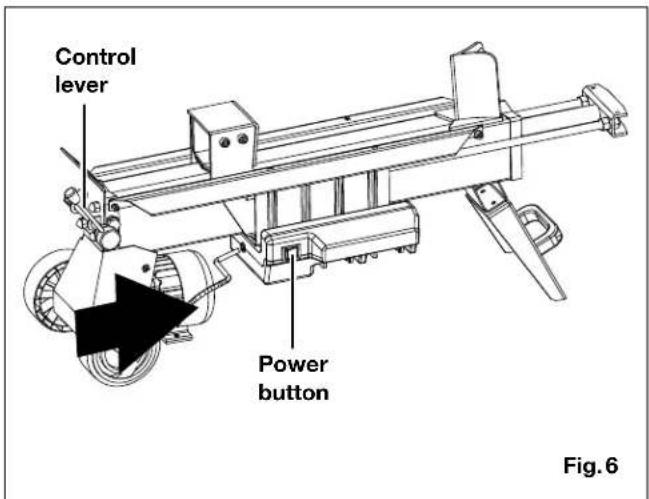
- The log pusher will move forward and force the log into the splitting wedge.
- Release both the power button and the control lever. Wait until the log pusher has completely returned to its original position and stopped moving before removing any material.
- To split a log further, place the piece of wood onto the log rail and repeat steps 4-6.
Removing a Jammed Log
If a log becomes stuck on the splitting wedge and will not completely split, follow the directions below to remove the log.
WARNING! Do not attempt to remove the jammed log with your hands or knock it out of the splitting wedge. This may cause serious injury or damage to the machine.
-
Release both the power button and the control lever. Wait until the log pusher has completely returned to its original position and stopped moving.
-
Insert a wooden wedge under the jammed log (Fig. 7).
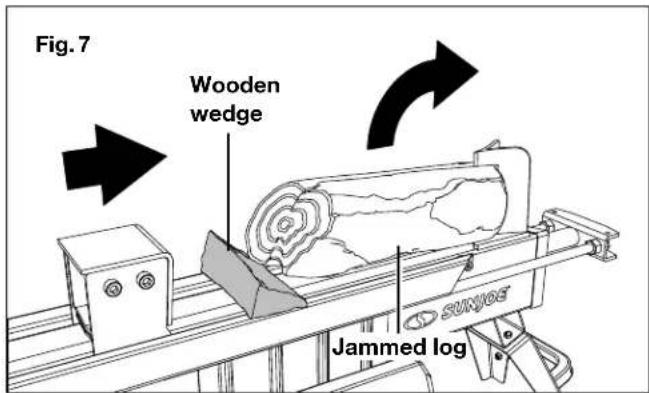
- Push the power button and pull the control lever simultaneously to start the log splitter. Allow it to push the wooden wedge completely under the jammed log.
- Repeat steps 2-3 using progressively larger wedges until the jammed log is free.
Care + Maintenance
WARNING! Always remove the batteries and ensure all built-up pressure has dissipated before inspecting, cleaning, or performing any other maintenance task.
WARNING! Only perform the repairs and maintenance work described in this manual. Any other work must be performed by a qualified technician.
Periodically apply a light coat of rust-resistant oil, such as 3-in-1 oil or WD-40, to the springs to keep them in proper working order.
Periodically check for any loose fasteners or worn, missing or damaged parts.
Periodically clean and lubricate parts.
- Sharpen the splitting wedge as needed. Use a flat file or angle grinder, take off burrs and smooth rough sections of the cutting edge.
Replacing the Hydraulic Oil
After every 150 hours of use, the hydraulic oil needs to be replaced with AW32 anti-wear hydraulic oil. To replace the hydraulic oil, follow the instructions below.
-
Make sure all moving parts have come to a complete stop before removing the batteries from the log splitter.
-
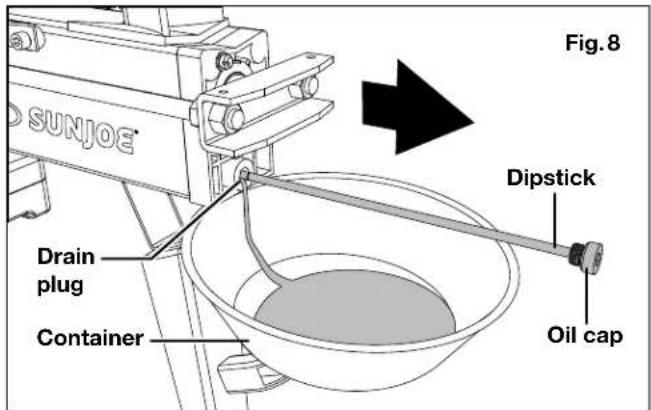
Place a container under the drain hole. Then, using a 5/16 in. (8 mm) hex key, unscrew the oil cap (with the dipstick attached) and tilt the log splitter forwards to allow the oil to drain from the tank (Fig. 8).
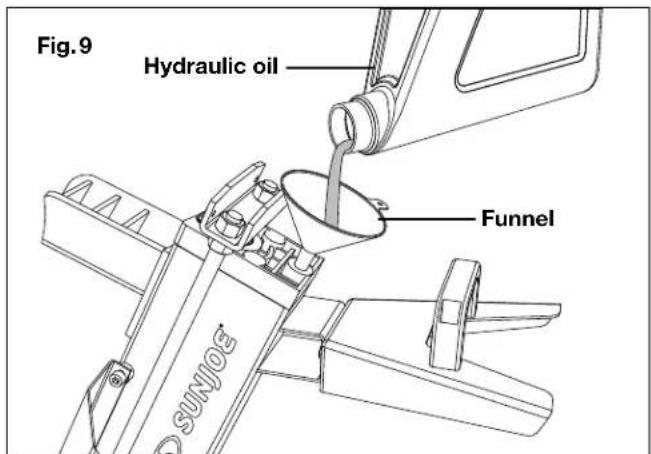
- Tilt the log splitter up vertically and place a funnel into the drain hole. Then fill the hydraulic tank with new AW32 anti-wear hydraulic oil (Fig. 9).
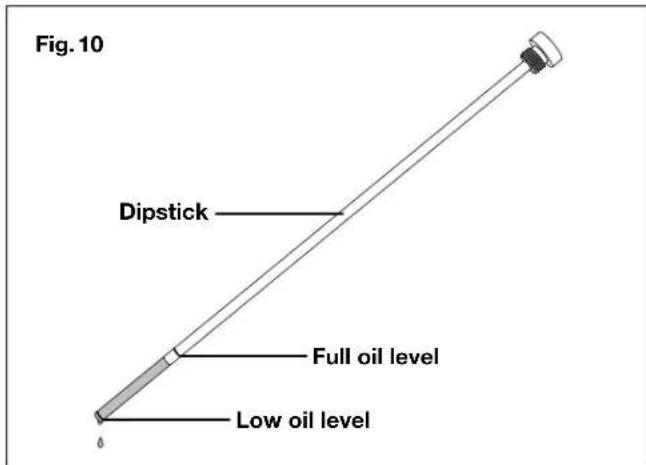
- To check the oil level, wipe the dipstick with a cloth, and with the log splitter tilted vertically, insert the dipstick fully into the drain plug, then pull it back out. The oil residue should sit between the top notch indicating full oil level, and the bottom notch indicating low oil level (Fig. 10).
Storage
- Remove the batteries from the tool before storing.
- Store the tool and its accessories in a dry, frost-free, and well-ventilated place out of the reach of children.
The ideal storage temperature is between 50^ (10^) and 86^ (30^) .
Battery + Charger Storage
- Store the battery packs and charger at room temperature and away from moisture. Do not store in damp locations where corrosion of terminals may occur.
Permanent damage may occur if the battery packs are stored for extended periods of time at high temperatures (over 105^ / 40.5^ ). - Unplug the battery charger and battery packs when not in use. Recharge the battery packs every 6 months to 50% capacity to maintain optimal battery performance.
Battery Caution + Disposal
Always dispose of your battery packs according to federal, state, and local regulations. Contact a recycling agency in your area for recycling locations.
CAUTION! Even discharged battery packs contain some energy. Before disposing, use electrical tape to cover the terminals to prevent the battery pack from shorting, which may cause a fire or explosion.
WARNING! To reduce the risk of injury or explosion, never burn or incinerate a battery pack even if it is damaged, dead, or completely discharged. When burned, toxic fumes and materials are emitted into the surrounding environment.
Recycling + Disposal
The product comes in a package that protects it against damage during shipping. Keep the package until you are sure that all parts have been delivered and the product is functioning properly. Recycle the package afterwards or keep it for long-term storage.
WEEE symbol. Waste electrical products should not be disposed of with household waste. Please recycle where facilities exist. Check with your local authority or local store for recycling regulations.
Service + Support
If your Sun Joe® 24V-X2-LS6T Cordless Hydraulic Log Splitter requires service or maintenance, please call 1-866-SNOWJOE (1-866-766-9563) for assistance.
Model + Serial Numbers
When contacting the company, reordering parts, or arranging service from an authorized dealer, you will need to provide the model and serial numbers, which can be found on the decal located on the housing of the unit. Copy these numbers into the space provided below.
Record the following numbers from the housing or registration card of your new product:
Model#:
214V1X121-1S6T1111
Serial #:
1 1 1 1 1 1 1 1 1 1 1 1 1 1
24VCHRG-DPC
Federal Communications Commission (FCC)
WARNING! Any changes or modifications to this unit not expressly approved by the party responsible for compliance could void the user's authority to operate the equipment.
This device complies with part 15 of the FCC rules. Operation is subject to the following two conditions: (1) this device may not cause harmful interference, and (2) this device must accept any interference received, including interference that may cause undesired operation.
Class B device:
NOTE: This equipment has been tested and found to comply with the limits for a Class B digital device, pursuant to part 15 of the FCC Rules.
These limits are designed to provide reasonable protection against harmful interference in a residential installation.
This equipment generates, uses and can radiate radio frequency energy and, if not installed and used in accordance with the instructions, may cause harmful interference to radio communications.
However, there is no guarantee that interference will not occur in a particular installation.
If this equipment does cause harmful interference to radio or television reception, which can be determined by turning the equipment off and on, the user is encouraged to try to correct the interference by one or more of the following measures:
Reorient or relocate the receiving antenna.
- Increase the separation between the equipment and receiver.
- Connect the equipment to an outlet on a circuit different than the one the receiver is currently connected to.
- Consult the dealer or an experienced radio/TV technician for help.
Optional Accessories
WARNING! Only use authorized Snow Joe ^密 + Sun Joe ^密 replacement parts and accessories. NEVER use replacement parts or accessories that are not intended for use with this log splitter. Contact Snow Joe ^密 + Sun Joe ^密 if you are unsure whether it is safe to use a particular replacement part or accessory with your log splitter. The use of any other attachment or accessory can be dangerous and could cause injury or mechanical damage.
| Accessories Item Model | ||
| 1 | 24V iON+ 4.0 Ah Lithium-Ion Battery 24VBAT | |
| 2 | 24V iON+ 5.0 Ah Lithium-Ion Battery 24VBAT-XR | |
| 3 | 24V iON+ 8.0 Ah Lithium-Ion Battery 24VBAT-XR8 | |
| 4 | 24V iON+ Lithium-ion Dual-Port Battery Charger | 24VCHRG-DPC |
| 5 | 24V iON+ Lithium-ion High Speed Dual-Port Battery Charger | 24VCHRG-HS-DPC |
| Visit sunjoe.com for more options | ||
NOTE: Accessories are subject to change without any obligation on the part of Snow Joe ^圆 + Sun Joe. Accessories can be ordered online at sunjoe.com or via phone by contacting the Snow Joe ^圆 + Sun Joe ^圆 customer service center at 1-866-SNOWJOE (1-866-766-9563).
SNOW JOE ^® + SUN JOE ^® CUSTOMER PROMISE
ABOVE ALL ELSE, Snow Joe, LLC ("Snow Joe") is dedicated to you, our customer. We strive to make your experience as pleasant as possible. Unfortunately, there are times when a Snow Joe®, Sun Joe®, or Aqua Joe® product ("Product") does not work or breaks under normal operating conditions. We think it's important that you know what you can expect from us. That's why we have a Limited Warranty ("Warranty") for our Products.
OUR WARRANTY:
Snow Joe warrants new, genuine, powered and non-powered Products to be free from defects in material or workmanship when used for ordinary household use for a period of two years from the date of purchase by the original, end-user purchaser when purchased from Snow Joe or from one of Snow Joe's authorized sellers with proof of purchase. Because Snow Joe is unable to control the quality of its Products sold by unauthorized sellers, unless otherwise prohibited by law, this Warranty does not cover Products purchased from unauthorized sellers. If your Product does not work or there's an issue with a specific part that is covered by the terms of this Warranty, Snow Joe will elect to either (1) send you a free replacement part, (2) replace the Product with a new or comparable product at no charge, or (3) repair the Product. How cool is that!
This Warranty gives you specific legal rights, and you may also have other rights which vary from State to State.
PRODUCT REGISTRATION:
Snow Joe strongly encourages you to register your Product. You can register online at snowjoe.com/register, or by printing and mailing in a registration card available online from our website, or calling our Customer Service Department at 1-866-SNOWJOE (1-866-766-9563), or by e-mailing us at help@snowjoe.com. Failure to register your Product will not diminish your warranty rights. However, registering your Product will allow Snow Joe to better serve you with any of your customer service needs.
WHO CAN SEEK LIMITED WARRANTY COVERAGE:
This Warranty is extended by Snow Joe to the original purchaser and original owner of the Product.
WHAT IS NOT COVERED?
This Warranty does not apply if the Product has been used commercially or for non-household or rental applications. This Warranty also does not apply if the Product was purchased from an unauthorized seller. This Warranty also does not cover cosmetic changes that do not affect performance. Wearing parts like belts, augers, chains and tines are not covered under this Warranty, and can be purchased at snowjoe.com or by calling 1-866-SNOWJOE (1-866-766-9563).