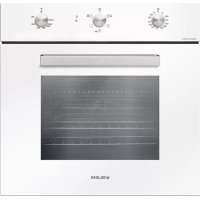
GFS52WHS3 - Oven Glem Gas - Free user manual and instructions
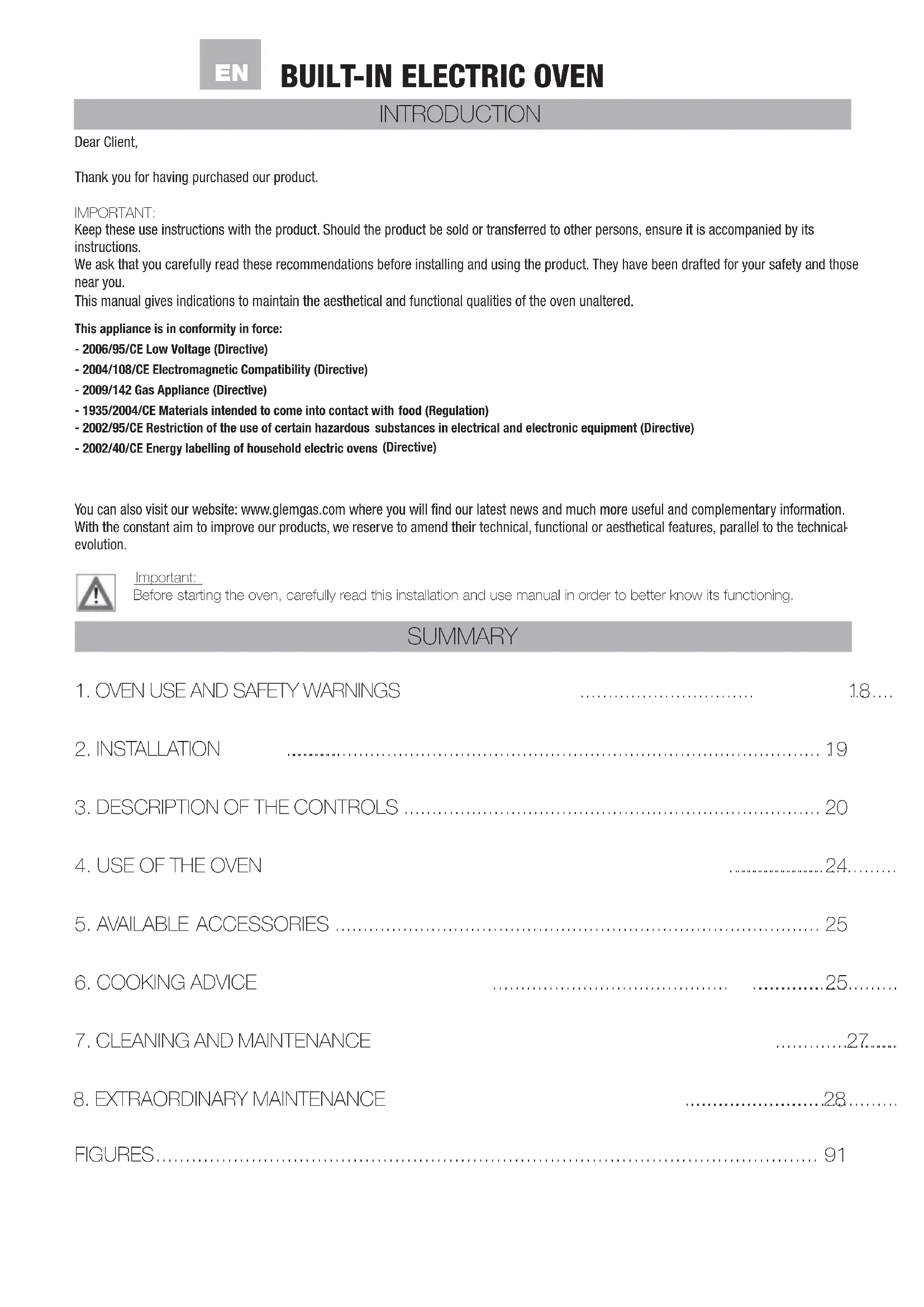
Find the device manual for free GFS52WHS3 Glem Gas in PDF.



| Product Type | Built-in Oven |
| Brand | Glem Gas |
| Model | GFS52WHS3 |
| Dimensions (W x H x D) | 595 x 595 x 550 mm |
| Interior Volume | 68 liters |
| Net Weight | Approximately 35 kg |
| Power Supply | 230 V ~ 50 Hz |
| Total Power | 2500 W |
| Number of Functions | 12 cooking modes including static, fan, grill, rotisserie |
| Thermostat | Adjustable from 50°C to 250°C with heating indicator |
| Timer | Mechanical 60 min and electronic 120 min with automatic shut-off |
| Electronic Programmer | Yes, with audible alarm and delayed programming |
| Interior Lighting | Removable 15W/25W T300° bulb |
| Included Accessories | Grid, drip tray, rotisserie (depending on model) |
| Number of Shelf Guides | 5 guides (4 levels for wire shelves) |
| Removable Door | Yes, with lift-off hinges |
| Removable Door Seal | Yes, for easy cleaning |
| Interior Material | High temperature resistant enamel |
| Cleaning Type | Manual, with non-abrasive products |
| Cooling Ventilation | Yes (depending on model) |
| Energy Efficiency Class | A (estimated) |
| Standards Complied With | CE, Low Voltage, EMC, Gas Appliances, Food Contact |
| Manufacturer | Glem Gas |
Frequently Asked Questions - GFS52WHS3 Glem Gas
User questions about GFS52WHS3 Glem Gas
0 question about this device. Answer the ones you know or ask your own.
Ask a new question about this device
Download the instructions for your Oven in PDF format for free! Find your manual GFS52WHS3 - Glem Gas and take your electronic device back in hand. On this page are published all the documents necessary for the use of your device. GFS52WHS3 by Glem Gas.
USER MANUAL GFS52WHS3 Glem Gas
MANUAL DE USO E MANUTENÇÂO
HANDLEIDING VOOR GEBRUIK EN ONDERHOUD
Thank you for having purchased our product.
IMPORTANT:
Keep these use instructions with the product. Should the product be sold or transferred to other persons, ensure it is accompanied by its instructions.
We ask that you carefully read these recommendations before installing and using the product. They have been drafted for your safety and those near you.
This manual gives indications to maintain the aesthetical and functional qualities of the oven unaltered.
This appliance is in conformity in force:
- 2006/95/CE Low Voltage (Directive)
- 2004/108/CE Electromagnetic Compatibility (Directive)
- 2009/142 Gas Appliance (Directive)
- 1935/2004/CE Materials intended to come into contact with food (Regulation)
- 2002/95/CE Restriction of the use of certain hazardous substances in electrical and electronic equipment (Directive)
- 2002/40/CE Energy labelling of household electric ovens (Directive)
You can also visit our website: www.glemgas.com where you will find our latest news and much more useful and complementary information.
With the constant aim to improve our products, we reserve to amend their technical, functional or aesthetical features, parallel to the technical evolution.

Important:
Before starting the oven, carefully read this installation and use manual in order to better know its functioning.
SUMMARY
- OVEN USE AND SAFETY WARNINGS 1.8...
- INSTALLATION 19
3.DESCRIPTION OF THE CONTROLS 20 - USE OF THE OVEN 24
- AVAILABLE ACCESSORIES 25
- COOKING ADVICE 25
7.CLEANING AND MAINTENANCE 27 - EXTRAORDINARY MAINTENANCE 28
FIGURES 91
INSTRUCTIONS FOR THE INSTALLER:
They indicate the operations for the QUALIFIED ENGINEER who will have to carry out the installation, commissioning and testing of the appliance.

INSTRUCTIONS FOR THE USER:
indicate the ovens' use recommendations, the controls description and the correct cleaning and maintenance operations.
PRESENTATION
1. Oven use and safety warnings
- Warning: this appliance and accessible parts may heat up during use. Be careful not to touch heating elements. The appliance should be kept out of the reach of children younger than 8 years unless supervised at all times.
The appliance can only be used by children older than 8 years and by people with reduced phisical, sensory, mental capabilities or lack of experience or knowledge only if strictly supervised whilst using it or have been shown how to use it in a safe way and understand the hazards involved. Do not let the children play with the appliance. Children mus not be allowed to clean the appliance unsupervised. - Warning: the accessible parts may get hot when in use: keep the children well away from the appliance
- Never use steam or high pressure equipment to clean the oven; this may cause problems to the electrical safety devices.
- Wire shelves and drip trays must be positioned inside the oven utilizing the special guides in a proper way (the oven is equipped with 5 guides to position the drip trays and the wire shelves at different levels or 4 levels on lateral side racks as described in detail on chapters 5 and 6).
- Disconnect the oven from the mains before every intervention which requests access to the live parts.
- Make sure that the appliance is switched off before replacing the oven light in order to avoid electrical scocks.
- Do not utilize abrasive sponges or sharp scrapers to clean the oven glass door as this may scratch the surface causing the glass to shatter.
This appliance is exclusively intended for non-professional use. Do not use the appliance for commercial or industrial purposes or for any other purpose for which it was not conceived.
This appliance has been conceived for domestic and private use. It is exclusively intended for cooking food products. Therefore, any liability for uses different to those indicated is declined. None of the components of this oven are made with asbestos. Do not amend and try to amend the technical features of this appliance, as this might present a danger for yourselves and for those near you.
Before using the oven for the first time, heat it up empty for about 15 min. Ensure the room is ventilated. You may smell a particular odour or notice a small emission of smoke. THIS IS NORMAL. - The appliance becomes hot during use. Do not touch the thermoelements inside the oven. Do not go near the hot upper elements with the hands when inserting or removing the pans or pan supports from the oven, use thermal kitchen gloves.
When cooking food, only use plates or pans resistant to high temperatures.
Never place aluminium foil directly on to the oven support surface, as the accumulated heat may cause the enamel to deteriorate.
Do not lay heavy objects on the oven door and ensure that children do not sit on it.
When cleaning the inside, ensure the oven is cold and, moreover, that it is switched off.
- The alcohol vapours inside the hot cooking compartment may catch fire. Do not cook food containing large quantities of beverages with a high alcohol content. Only use small quantities of beverages with a high alcohol content. Open the door of the appliance carefully.
1.1 Respecting the environment
The packaging materials of this appliance can be recycled. Participate in recycling by contributing to safeguard the environment. Throw the
different materials in the appropriate containers at your disposal in your town/city.
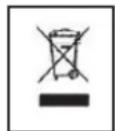
This appliance contains recyclable materials. They are marked with this logo indicating that the appliances used must not be disposed of with urban waste. They are therefore compliant with the European Directive 2002/96/EC on waste of electrical and electronic equipment.
Contact your town/city or your dealer to know the collection points nearest to you.
We thank you for your collaboration in safeguarding the environment.
2. INSTALLATION
2.1 Electrical connection
Ensure that the voltage corresponds to that indicated in the plaque located on the oven door frame.
The cables for the connection to the mains must be protected from direct contact with the oven's metal casing.
The plaque must never be removed.
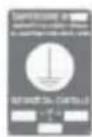
Attention: the ground connection must be compliant with law.
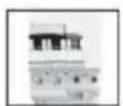
If using a fixed direct connection to the electrical network, it is necessary to provide a proper device which assures the disconnection from the mains with a distance of contact opening which allows complete disconnection in conditions of overvoltage category III, in accordance with the rules of installation.
Avoid using reductions or adaptors as they may cause overheating or burning.
After installation, carry out a brief oven check, following the instructions reported further down.
In case the appliance does not function, disconnect it from the mains and contact the after-sales assistance centre nearest to you.
Do not attempt to repair the appliance.

ATTENTION:
The manufacturer declines every responsibility for damages suffered by persons and things, caused by the non compliance of the above prescriptions or deriving from the tampering of even a single part of the appliance and the use of non original spare parts.
2.2 Oven positioning
The oven is pre-arranged for built-in purposes.
The sizes must respect the quota indicated in figures 1 and 2.
The upper/rear part of the cabinet must have an opening of at least 80-90 mm deep, as indicated in figure 1.
Tighten the 4 screws by firstly inserting them inside the bush and then inside the frame (figures 1 Ref. A, B).
For installations underneath the "top" surface, ensure that the rear/ lower part of the cabinet has an opening similar to that shown in figure 2. (reference C).
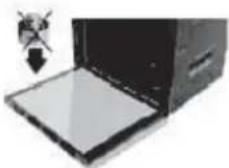
Do not use the door as a lever to insert the oven inside the cabinet.
Do not put pressure on the open door.
3. Description of the controls
Act on the control devices placed on the oven panel to select the various functions with the knob. KEY

Oven light

Lower heating element plus fan

Grill heating element Plus Roasting jack and plus fan

Upper and lower heating element

Upper heating element plus Grill

Grill heating element Plus Roasting jack

Lower heating element

Upper and lower heating element plus fan

Upper heating element Plus Grill and plus Roasting jack

Grill heating element

Pre-heating

Grill heating element Plus fan

Roasting jack

Ventilated heating element

Upper heating element Plus Grill and plus fan

Defrosting

Pizza function
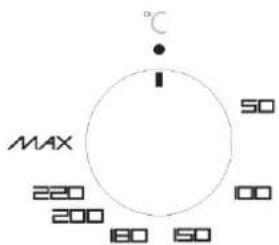
THERMOSTAT:
Cooking temperature is chosen turning the knob clockwise to the desired value, between 50^ and MAX.
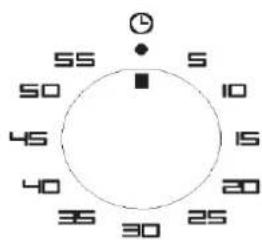
MECHANICAL MINUTE COUNTER:
The minute counter can be regulated for a maximum period of one hour. The regulation knob must be turned clockwise until the 60 minute position, and then placed at the desired time, rotating it anti-clockwise.
When the pre-set time is over, an acoustic signal goes off, which stops automatically. The minute counter does not interrupt the oven functioning when the acoustic signals goes off.
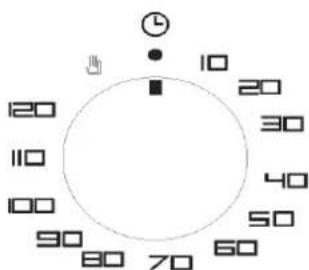
120 MINUTE MECHANICAL COOKING END TIMER:
Place the thermostat knob on the desired time, and then rotate the knob of the timer clockwise to the desired time (max 120 minutes).
When the timer returns to the starting "0" position, an acoustic signal will communicate that the oven has turned off automatically.
If cooking time is greater than 2 hours, or if you desire to use the oven manually, rotate the knob to the position.
THERMOSTAT SIGNALER (ORANGE):

When the light turns on, it means that the oven is pre-heating.
When the light turns off while cooking it means that the oven has reached the pre-set temperature.
Regular intermittence indicates that the temperature inside the oven is maintained constantly at the set level.
TURN ON SIGNALER (GREEN) (if provided):

This light switches on when the oven is operating and it remains on during the whole coking period.
The light switches off when the oven turns off.
3.1 Cooking with roasting-jack (IF PROVIDED):
In electric ovens it is possible to use the roasting-jack coupled with the functioning of the grill or of the oven.

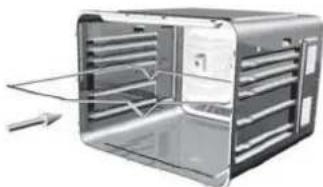
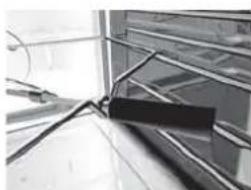
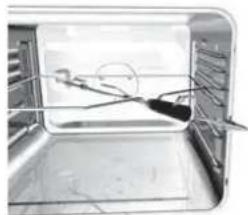
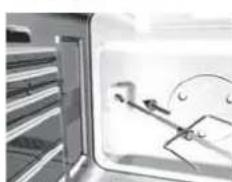
Place the food to be cooked on the spit-pole, blocking it with the two forks, being careful not to strain the starter with too heavy loads, and then proceed as follows:
1) Place the frame inside the third guide starting from the bottom.
2) Position the pulley on to the frame so that it remains driven.
3) Remove the plastic handle by unscrewing it.
4) Introduce the frame with the food on the spit-pole until the pole point is inside the hole located on the oven rear wall.
5) Once cooking is completed, tighten the plastic handle to the spit to be able to extract it.

Position a pan on the first guide from the bottom and pour some water to limit the formation of smoke.
3.2 ELECTRONIC PROGRAMMER (fig. 3)
FUNCTIONS LIST

Increase of the number on the display

Decrease of the number on the display

Setting of cooking duration and end
3.2.1 Switching on:
Once it is on, the time of the day and the AUTO icon flash on the screen and the oven will be deactivated by the timer. To unblock it, enter the manual setting mode.
Then set the correct time of the day.
Manual setting mode:
Press MENU (fig. 4).
3.2.2 Time setting:
The time can be set only when the cooking programs are not on.
While setting, the point between the hours and the minutes flashes.
Press + and/or - to set the time (fig. 6).

when the time has been set, wait five seconds or press + and - simultaneously to exit this mode.
3.2.3 Alarm (Buzzer)
1) Press MENU and the icon of the alarm flashes in minutes format (ex.: 5 min.) (fig. 7).
2) Press the + or - buttons to set the alarm (fig. 8).
3) After five seconds the screen will display the time of the day. (fig. 9).
When time is up, the buzzer will begin to ring.
Press any button to deactivate it.
3.2.4 Automatic cooking
To start cooking immediately, only the duration of cooking needs
Example: we want to cook for 2h and 15^ starting now:
1) The actual time is 18:30. (fig. 10).
2) Press MENU twice to enter the "cooking duration" function. (fig. 11).
3) Press the + or - buttons to set the cooking duration, For example 2h and 15'. (fig. 12).
Within 5 seconds, the screen will display again the current time and the AUTO icon which It remains fixed on the screen fig. 13.
ISet the desired cooking function.
Cooking will start and stop when the set buzzer time has passed (in this case 2h and 15').
If you do not wish to start cooking immediately, you can program the time in which you want cooking to end.
After having set the duration of cooking as previously explained, press MENU 3 times entering the cooking end function.
(fig.14).
Example: We want the food to be cooked at 20:45:
1) Press MENU 3 times until "End" and the time of the end of cooking appear on the screen. In the example, the time for the end of cooking will be: (18:30 + 2:15 = 20:45) (fig. 15)
2) Press + or - to program the time for the end of cooking (fig. 16).
3) After a few seconds the actual time will appear on the screen. (fig. 17).
Example recapitulation:
Having programmed the timer so that the food is ready at 21:30 and since the duration of 2h 15' was previously set, cooking will begin at 19:15, it will last 2 hours and 15 minutes and it will end at 21:30.
The figure 18 shows how the screen is displayed when cooking starts
The figure 19 shows how the screen is displayed when cooking ends
The timer blocks the oven until entering manual setting mode (see paragraph 3.2.1)

The buzzer will ring for 7 minutes if it is not deactivated by pressing any button.
3.2.5 End of cooking
3 types of different tones can be selected:
1) Maintain the button pressed to listen to the pre-defined tone;
2) Release the key and keep it pressed again to listen to the successive tone;
3) The last tone you will listen to will remain set/memorised until it is reprogrammed.
4. OVEN USE
This oven combines the qualities of the traditional "static" natural convention ovens with those of the modern "ventilated" forced convention ovens. It is a very versatile appliance which, easily and safely, allows to choose amongst different cooking methods. By acting on the knobs on the panel, the selection of different programs and the desired temperature is obtained.
To make the best use of your oven we ask that you carefully read the instruction book.
4.1 General warnings and recommendations
When using the oven for the first time, it is opportune to heat it at its maximum temperature (250^) for as long as it is necessary to burn any residue manufacture oils, which might confer unpleasant odours to food.

When cooking, do not cover the bottom of the oven with aluminium foil or tinfoil and do not lean pots and pans to avoid damaging the enamel layer.
Should you wish to use baking paper, position it so that it does not interfere with the hot air circulation inside the oven.
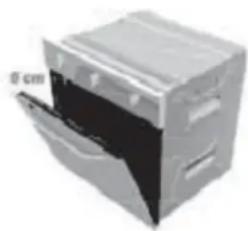
To avoid that any steam contained inside the oven is a nuisance, open the door in 2 phases:
keep it half opened (5 cm opening) for 5 seconds, and then open it completely.
Should it be necessary to intervene on the food, leave the door open as little as possible to avoid that the temperature inside the oven decreases to the point of jeopardising the cooking.
4.2 Cooling ventilation (if provided)
Some oven models are equipped with a cooling fan which starts to function when the oven is on and reaches a certain temperature.
The functioning of the fan causes a normal air flow which exits above the oven facade and which may continue for a short time even after the oven has been switched off.
4.3 Internal lighting lamp
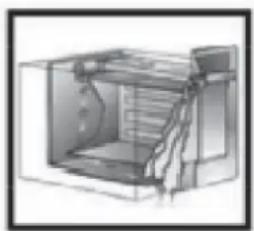
The lamp inside the oven is switched on by rotating the functions knob on any of these.
5. AVAILABLE ACCESSORIES
The oven has 5 guides for the positioning of the pots and pans at different heights or 4 levels wire racks..
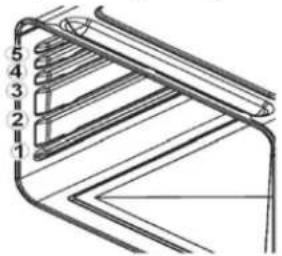
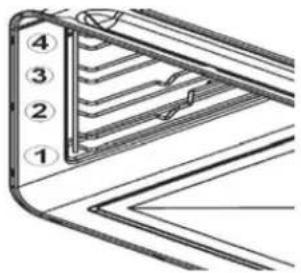
PAN SUPPORT Used as support for containers with food for cooking. Caution: the pan support must be inserted in the direction indicated in the following image.
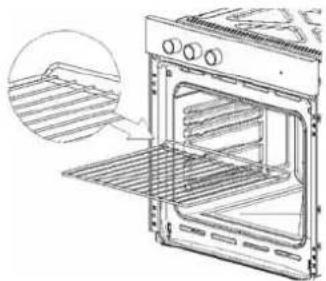
BAKING PAN: Used for cooking food.
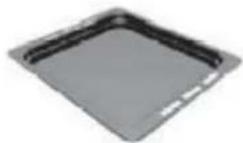

Not all accessories are present on certain models.
It is possible to request the original accessories, in the model provided, through the authorised after-sales assistance centres.
6. COOKING ADVICE
For the best results, it is recommended to preheat the oven at the desired temperature before introducing the food. When the orange light turns off, pre-heating is complete.
Pre-heating is not necessary for gres food.
In case of frozen meat, we recommend decreasing the coking temperature by approx 20^ , increasing the coking time by 10/15 minutes.
In the phases preceding cooking ensure that only the indispensable accessories are present inside the oven (it's normally sufficient to have the pan support on which, after pre-heating, the container or the pan with the food to be cooked will be placed).
In order to obtain excellent cooking results, it is indispensable for every type of dish, to choose the FUNCTION, the TEMPERATURE, the TIME and the insertion level of the guides inside the oven, depending on the type of model purchased and its available functions:
- Functions: The number of functions may vary depending on the model; by rotating the knob on the desired function, different cooking styles are obtained.
- Temperature: It is set by rotating the knob on the desired temperature.
- Cooking times: They usually depend on the type and quantity of dishes to be cooked, on the different food habits and the personal taste and experience.
- Insertion levels: 5 guides (1 lower, 3 central, 1 upper) in the ovens with moulded cavity and 4 levels (1 inferior, 2 central, 1 upper) in the ovens with side racks.
INSTRUCTIONS FOR THE USER
The indications supplied on the recipes are generally sufficient to obtain satisfying cooking results.
The central levels of insertion are usually suitable for most cooking as it is in this part of the oven that, prior to thermostat control, the perfect stabilisation of the set temperature happens.
In electric ovens, the higher the insertion level of the pans or pan supports in the oven the nearer the heat source (higher burnishing of the upper part of the dishes and food grilling).
The food portioning and the use of different material and thickness food containers (terracotta, glass, aluminium, steel) can determine cooking times different to those indicated in the recipe books.
Forced ventilation cooking produces high humidity removal from food and is usually recommended for cakes with whisked mix, multiple cooking and very thick portions.
In delicate cooking with leavening, avoid or reduce to a minimum, the opening of the oven door, in order not to alter the heating thermostat cycles.
In cooking using the grill carried out on the pan support or using the roasting-jack, place a pan containing some decilitres of water on the step underneath, to limit grease sprays or excess smoke.
For a significant energy saving during long cooking times, use the residue heat by switching off the oven a few minutes before the average indication of the recipe, keeping the oven door closed.
The perfect insulation of the oven compartment will equally allow the dishes to reach the ideal cooking.
Temperatures and coking times indicative sheet
| kind of food | Temp. ℃ | Guide (°) | Cooking time in minutes | Personal suggestion |
| Desserts in molds with liquid pastry Savoury cakes and pastry | 175 | 2 | 55-65 | |
| Sublime cake | 175 | 3 | 60-70 | |
| Short crust pastry cakes in molds Cakes base | 200 | 3 | 08-10 | |
| Ricotta cake base | 200 | 3 | 25-35 | |
| Fruit cace base | 200 | 3 | 25-35 | |
| Desserts in molds with risen dough Cakes base | 180 | 3 | 30-45 | |
| Soft bread 1kg flour | 200 | 3 | 25-35 | |
| Cookies Short crust pastry Pancakes dough Biscuits pastry | 200 | 3 | 10-15 | |
| 200 | 2 | 35-45 | ||
| 200 | 3 | 15-20 | ||
| Pasta Lasagna | 225 | 2 | 40-50 | |
| Meat(Cooking time per cm. of thickness) | ||||
| Long cook roast | 200 | 2 | 120-150 | |
| Short cook roast | 200 | 2 | 60-90 | |
| Mearballs | 200 | 2 | 30-40 | |
| White meat Duck 1 1/2 kg Goose 3 kg Chicken Turkey 5Kg | 200 | 2 | 120-180 | |
| 200 | 2 | 150-210 | ||
| 200 | 2 | 60-90 | ||
| 175 | 2 | 240-260 | ||
| Game Hare Leg of roe deer Leg of deer | 200 | 2 | 60-90 | |
| 200 | 2 | 90-150 | ||
| 175 | 2 | 90-180 | ||
| Vegetables Roast potatoes Vegetable pudding | 220 | 2 | 30-40 | |
| 200 | 2 | 40-50 | ||
| Fish Trout Sea bream Pagellus Pizza | 200 | 2 | 40-50 | |
| 200 | 2 | 40-50 | ||
| 240 | 3 | 10-20 | ||
| Grill Cutlet Sausages Spit-roasted chicken Spit-roasted veal 0,6Kg | 4 | 8-12 | ||
| 4 | 10-12 | |||
| - | 25-35 | |||
| - | 50-60 | |||
| (*) The number stated in the column "Guides" is referred to the level starting from the bottom of the oven cavity. Do not position trays on the oven base and don't cover the same with aluminium foil as the accumulated heat may cause the enamel to deteriorate. | ||||
| THE ABOVE METIQNED DATA ARE INDICATIVE BECAUSE COOKING MODE AND TEMPERATURES MAY CHANGE ACCORDING TO THE QUANTITY AND THE QUALITY OF THE FOOD. | ||||
The Grill
During the cooking on the wire chromed shelf or with the turnspit, place a tray including some decilitres of water on the level below in order to avoid fat splashes and excessive smoke.
For a significant energy efficiency during the long cooking it is advised to exploit the remaining heat by switching off the oven some minutes before the expected cooking time keeping the oven door closed.
Grilling tips:
| Dishes | Cooking time (minutes) | |
| Above | Below | |
| Thin meat | 6 | 4 |
| Normal meat | 8 | 5 |
| Fish (es. trout, salmon) | 15 | 12 |
| Sausages | 12 | 10 |
| Toast | 5 | 2 |
Turn the food midway through cooking. Do not use any aluminium paper to wrap the dishes or to cover the containers because the reflected heat might set fire to the paper or damage the grill.

WARNING:
When the cookings are performed with the GRILL function, the oven door must be kept CLOSED and the temperature does not exceed 200^ .
ATTENTION:
During cooking of particularly humid dishes (vegetables flan, meat or fish stews, fruit cakes) water steam generates inside the oven.
Pay attention when opening the door!
To limit the steam leaking, use the precaution of opening the door in two phases: move the door by a few cm and, after a few seconds, open it completely.
It is appropriate to know that such water steam, in the minutes after cooking, during cooling of the oven, determines the formation of condense and, therefore, water drops falling on the internal glass of the door and enamelled walls.
For good oven maintenance it is necessary to remove this slight presence of water using an absorbing cloth or an abrasive sponge at the end of every cooking process, having as characteristic a high presence of humidity.

The oven door must be kept close during the cooking process.
7. CLEANING AND MAINTENANCE

Disconnect the oven from the mains before every intervention which requests access to the live parts.
7.1 Cleaning the stainless steel
For a good preservation of the stainless steel, it must be cleaned regularly at the end of every use, once it has cooled down.
7.2 Daily routine cleaning
To clean and preserve the stainless steel surfaces, always use only specific products without abrasives.
Use instructions: pour the product on to a damp cloth and wipe the internal surface of the oven, accurately rinse and dry with a soft cloth.
7.3 Food or residue stains
Never use metal sponges or sharp scrapers, the surfaces may be damaged.
Use normal products for steel, non abrasive, eventually using tools made of plastic or wood material.
Accurately rinse and dry with a soft cloth.
Avoid letting sugary food residue dry inside the oven (ex. jam, chocolate, etc.).
In time they may ruin the enamel coating the inside of the oven.

For a good preservation of the oven it must be cleaned regularly after it has cooled down.
For easier cleaning, extract all removable parts.
7.4 Cleaning the oven (without self-cleaning panels)
Clean the oven pan support and the side guides with hot water and non abrasive detergents, rinse and dry (fig. 20).
The door can be removed for easier cleaning (see point 8.2 dismantling of the door).
7.5 Glass door
To clean use kitchen absorbent paper, in case of persistent dirt, wash with a damp cloth and common detergent.
Do not use abrasive detergents or sharp metal scrapers to clean the glass door, since they may scratch the glass surface and cause it to break.
We recommend keeping the glass of the door as clean as possible.
8. EXTRAORDINARY MAINTENANCE
The oven requires small maintenance interventions should, in time, those parts subject to wear, such as gaskets, lamp, etc, require replacing. Instructions for these types of interventions are supplied below.
Disconnect the oven from the mains before every intervention which requests access to the live parts.
8.1 Replacement of the internal lighting lamp
Remove protection cover "A" by unscrewing it anti-clockwise, replace lamp "B" with a similar one.
Mount the protection once again and screw it clockwise until it is tight (fig. 21).
Only use oven lamps (T300^) 15W or 25W depending on models.
Never touch the lamp with bare fingers, always use protective gloves.
Only use lamps obtained from authorised after-sales centres.
8.2 Dismantling of the door
Lift levers "2" up to the ledge with hinges "1" and hold the door at the two sides with both hands near the same hinges.
Lift the door upwards forming an angle of approx. 45^ and carefully extract it.
For the mounting, place hinge "2" in the appropriate grooves, therefore leave the door to lean downwards, ensure it remains blocked in grooves "3", then release levers "1" (fig. 22).
8.3 Dismantling of oven door gaskets
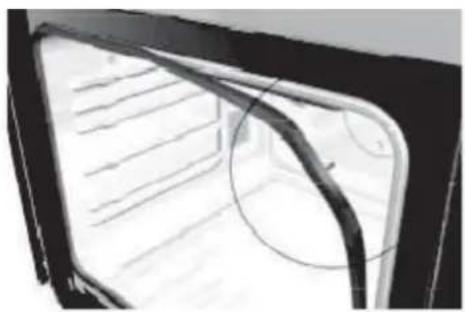
To better clean the oven, the door gasket can be removed.
With the door dismantled, lift the tongues located at the angles, as shown in the figure.
Once cleaning is completed, re-mount the gaskets keeping the longest side horizontal and place the tongues in the respective holes, starting from the upper ones.
NOTES
INTRODUCTION
Chere Cilente/ Cher Client,
5. ACCESSORIES DISPONIBLES
CONTROLELAMPJE THERMOSTAAT (ORANJE):
CONTROLELAMPJE INSCHAKELING (GROEN) (INDIEN AANWEZIG):

5. BESCHIKBARE ACCESSORIES
MELDER THERMOSTAT (ORANGE):

EN The crossed-bin symbol on the product indicates that Waste deriving from Electrical and Electronic Equipment (WEEE) must not be thrown away with general waste (i.e. with the "mixed municipal waste"), but handled separately so as to be reused or be subjected to specific treatment to remove and safely dispose of any substances that are harmful to the environment and extract the raw materials that can be recycled. In every member state of the European Union, WEEE should therefore be delivered to specialised Collection Centres in accordance with the provisions of the laws and regulations in force. The WEEE can also be handed over to the retailer when a new appliance is purchased, who is obliged to accept this free of charge ("one to one" basis). The unlawful disposal of the product by the user will result in administrative sanctions.