DWMT70777 - Paint spray DEWALT - Free user manual and instructions
Find the device manual for free DWMT70777 DEWALT in PDF.



| Brand | DEWALT |
| Model | DWMT70777 |
| Product Type | Gravity Feed HVLP Spray Gun |
| Feed | Compressed Air (Gravity) |
| Nozzle Size | 1.5 mm |
| Cup Capacity | 591.4 ml (20 oz) |
| Spray Pattern Width | >165 mm (6.5 in) |
| Minimum Working Pressure | 103 kPa (15 PSI) |
| Maximum Working Pressure | 206 kPa (30 PSI) |
| Average Air Consumption (at 206 kPa) | 5.0 l/s (10.5 SCFM) |
| Net Weight | 0.7 kg (1.7 lb) |
| Air Inlet Size | 1/4 in NPT (6.35 mm) |
| Recommended Hose Size | 10 mm (3/8 in) inner diameter |
| Spray Pattern Type | Adjustable (round or fan pattern) by rotating air cap |
| Functions | Air flow control (button F), fluid control (button I), spray pattern width adjustment (button H) |
| Hanging Hook | Yes, integrated into body |
| Filter | Yes, removable, to protect against contaminants |
| Safety | Wear safety glasses, hearing protection, and mask; do not point at self or others; avoid ignition sources |
| Maintenance | Clean after each use with appropriate solvent; lubricate with refined mineral oil or castor oil |
| Warranty | 1 year (per manual) |
| Customer Service | 1-800-4-DEWALT (USA) |
Frequently Asked Questions - DWMT70777 DEWALT
User questions about DWMT70777 DEWALT
0 question about this device. Answer the ones you know or ask your own.
Ask a new question about this device
Download the instructions for your Paint spray in PDF format for free! Find your manual DWMT70777 - DEWALT and take your electronic device back in hand. On this page are published all the documents necessary for the use of your device. DWMT70777 by DEWALT.
USER MANUAL DWMT70777 DEWALT
If you have questions or comments, contact us.
Gravity Feed Spray Gun HVLP
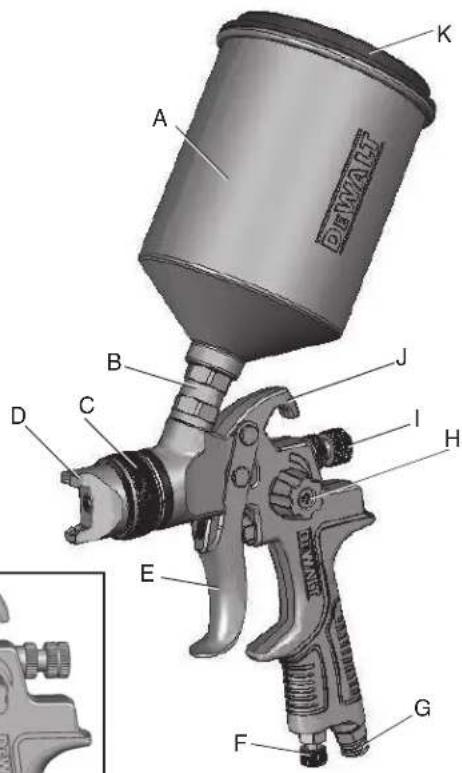
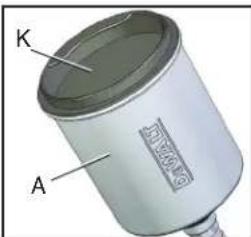
K. Spray Gun Cup Lid
F. Air Volume Control Knob
L. Air Valve Nut
SPECIFICATIONS
| MODEL | DWMT70777 |
| FEED TYPE | Gravity |
| NOZZLE SIZE | 1.5MM |
| CUP CAPACITY | 20Oz. (600ML) |
| PATTERN LENGTH | >6.5" (165MM) |
| MIN. WORKING PRESSURE | 15PSI |
| MAX. WORKING PRESSURE | 30PSI |
| AVERAGE AIR CONSUMPTION (@30PSI) | 10.5 SCFM (5.0 L/s) 3.5 CFM (1.65 L/s) |
| NET WEIGHT | 1.7 LBS (0.7Kg.) |
| AIR INTLET SIZE | 1/4" NPS(M) |
| RECOMMENDED HOSE SIZE | 3/8" (10MM) |
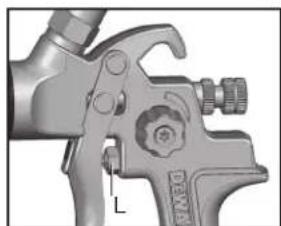
FIG.1
FIG.2
Definitions: Safety Guidelines
The definitions below describe the level of severity for each signal word. Please read the manual and pay attention to these symbols.
DANGER : Indicates an imminently hazardous situation which, if not avoided, will result in death or serious injury.
WARNING: Indicates a potentially hazardous situation which, if not avoided, could result in death or serious injury.
CAUTION: Indicates a potentially hazardous situation which, if not avoided, may result in minor or moderate injury.
CAUTION: Used without the safety alert symbol indicates a potentially hazardous situation which, if not avoided, may result in property damage.
IF YOU HAVE ANY QUESTIONS OR COMMENTS ABOUT THIS OR ANY DEWALT TOOL, CALL US TOLL FREE AT: 1-800-4-DeWaLT (1-800-433-9258)
IMPORTANT SAFETY INSTRUCTIONS
WARNING: This product contains chemicals, known to the State of California to cause cancer, and birth defects or other reproductive harm. Wash hands after handling.
SAVE THESE INSTRUCTIONS
WARNING:

Improper operation or maintenance of this product could result in serious injury and property damage. Read and understand all warnings and operating instructions before using this equipment. When using air tools, basic safety precautions should always be followed to reduce the risk of personal injury.
WARNING:

Read and understand this instruction manual and tool labels before installing, operating or servicing this tool. Keep these instructions in a safe accessible place.

Operators and others in work area must wear ANSI Z87.1 CAN/ CSA Z94.3 approved safety glasses with side shields.

Operators and others in work area must wear ear protection.

Oil daily for optimal performance.
WARNING:
- All persons in the work area must always wear approved eye and hearing protection and approved respiratory protection when this spray gun is in operation.
- Never aim spray gun at anyone. Do not spray near sparks, open flame, lit cigarettes, pilot lights, space heaters or any other potential ignition source, DO NOT SMOke IN WORK AREA.
- Only persons well acquainted with these rules of safe operation should be allowed to use the air tool.
- Follow manufacturers instructions and safety information to ensure safe handling and proper use of paints, laquers, thinners, base coats, etc. Do not use latex or other heavy paints. They are not recommended for this spray gun.
Always keep work area free from obstructions and well ventilated.
Always disconnect spray gun from air source before disassembly. - To avoid creating an explosive atmosphere, work only in well ventilated areas.
Always use respiratory protection to prevent inhalation of harmful fumes and materials.
CAUTION:
- Before disassembly or removal of any part of gun or attached components, shut off compressor, release pressure by depressing trigger, and disconnect power source. NEVER assume system pressure is zero!
WARNING: RISK Of ExPIOSION OR FIRE
WHaT can HaPPen How To PreVenT IT
- When paints or materials are sprayed, they are broken into very small particles and mixed with air. This will cause certain paints and materials to become extremely flammable and could result in serious injury or death.
-
The solvents 1,1,1-Trichloroethane and Methylene Chloride can chemically react with the aluminum used in most spray equipment, and this gun and cup, to produce an explosion hazard and could result in serious injury or death.
-
Never spray near open flames or pilot lights in stoves or heaters.
- Never smoke while spraying.
- Provide ample ventilation when spraying indoors.
- Read the label or data sheet for the material you intend to spray.
- Never use any type of spray coating material containing these solvents.
- Never use these solvents for equipment cleaning or flushing.
If in doubt as to whether a material is compatible, contact your material supplier.

WARNING: RISK TO BREATHING (ASPHYXIATION) WHaT can HaPPen How To PreVenT IT
Some paints, coatings and solvents may cause lung damage, and burns if inhaled or allowed to come into contact with skin or eyes.
Use a NIOSH approved mask or respirator and protective clothing designed for use with your specific application and spray materials. Some masks provide only limited protection against toxic materials and harmful paint solvent. Consult with a Safety Expert or Industrial Hygienist if uncertain about your equipment or materials.


WARNING: RISK OF INJECTION
WHaT can HaPPen HoW To PreVenT IT
Spray guns operate at pressures and velocities high enough to penetrate human and animal flesh, which could result in amputation or other serious injury.
! See a physician immediately!
- Never place hands in front of nozzle.
- Direct spray away from self and others.
- Seek immediate medical attention if direct spray contacts exposed body parts.
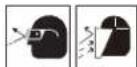
WARNING: RISK FROM FLYING OBJECTS! IT can HaPPen How To PreVenT IT
Certain parts are under pressure whenever the gun is connected to a pressurized air line. These parts may be propelled if the gun is disassembled.
- Compressed air may propel dirt, metal shavings, etc. and possibly cause an injury.
Prolonged exposure to air spray can result in permanent damage to hearing.
- Disconnect the gun from the air line, or completely depressurize the air line whenever the gun is to be disassembled.
- Never point any nozzle or sprayer toward a person or part of the body.
Always wear anSI Z87.1 can/cSa Z94.3 approved safety glasses with side shields.
Always wear hearing protection when operating spray equipment.
FEATURES
SPRAY GUN BODY
The body of the spray gun is designed to be well-balanced and lightweight. The spray gun body is a pro-grade high volume low pressure (HVLP) design.
SPRAY GUN CUP
The cup (A) of the spray gun can hold 600~mL (20 oz) and has a removable snap in lid (K). The design of the spray gun cup lid (K) includes an accessible tab for easy removal from the spray gun cup (A).
MATERIAL FILTER
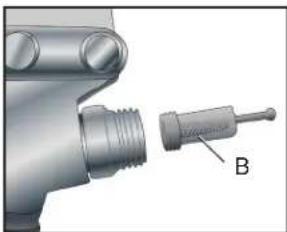
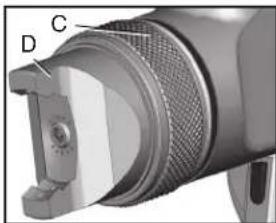
The material filter (B) is used to protect against contaminants and small particles. It is located inside of the spray gun, between the spray gun cup (A) and air cap AIR CAP HORNS
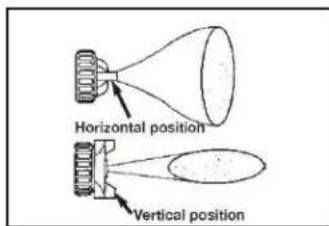
The position of the air cap (C) horns (D) allow two spray patterns. See Fig.2.
AIR VOLUME CONTROL KNOB
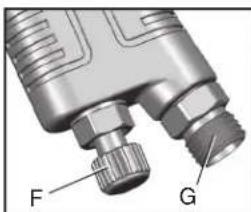
The air volume control knob (F) controls the air flow and allows for a MAX of 30 PSI to reduce over-spray and efficient air consumption.
AIR INLET
The tool's air inlet (G) located at the bottom of the handle is used for connecting an air supply that has a standard 1/4" NPT American thread.
FLUID CONTROL KNOB
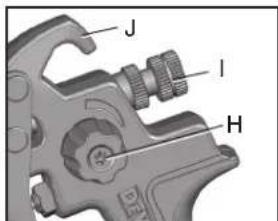
The fluid control knob (I) allows control of the material amount released (the density of the "fan spray").
PATTERN CONTROL KNOB
The pattern control knob (H) allows the width of the "fan spray" to be adjusted.
FIXED HOOK
The spray gun includes a fixed hook (J) on the body to allow for convenient hanging when stored.
INSTALLATION
Air Supply
The recommended hook-up is shown in Figure A. Pneumatic tools operate on a wide range of air pressures. For maximum efficiency and longer tool life, the pressure of the air supplied to these tools MUST not exceed the rated PSI at the tool when the tool is running. Using a higher than rated pressure will cause faster wear and drastically shorten the tool's life. A higher air pressure can also cause an unsafe condition and explosion.
The inside diameter of the hose should be increased to compensate for unusually long air hoses (over 25 feet). Minimum hose diameter should be 3/8 I.D. and fittings should have 1/4 NPT thread.
The use of air line lubricators and air line filters is recommended to prevent water in the line that can damage the tool. Drain the air tank daily. Clean the air inlet filter screen on at least a weekly schedule to remove accumulated dirt or other matter that can restrict air flow.
The tool's air inlet used for connecting an air supply has standard 1/4" NPT American thread.
Safety Rules For Pneumatic Tools
1) Inspect the air hose for cracks or other problems. Replace the hose if worn.
2) Never point an air hose at another person.
3) Disconnect the tool when not in use, or before performing service or changing accessories.
4) Use proper hoses and fittings. Never use quick change couplings attached to the tool. Instead, add a hose and coupling between the tool and the air supply.
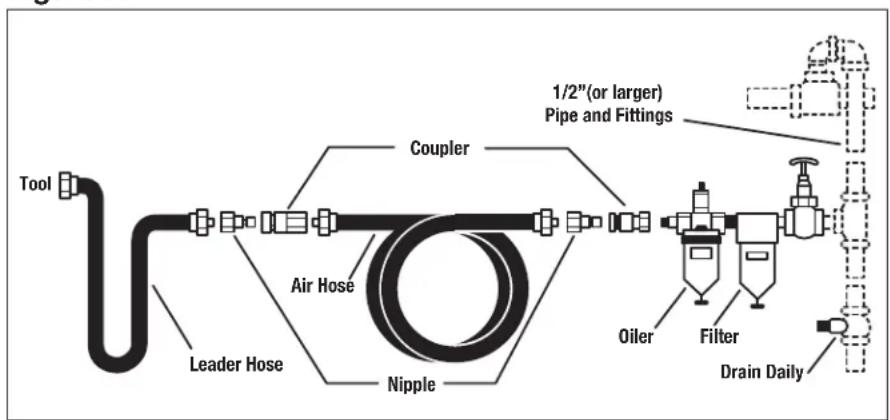
Figure A
OPERATING PROCEDURES
WARNING: Do not attempt to unclog (back flush) the spray gun by squeezing the trigger while holding your finger in front of the fluid nozzle.
CAUTION: Pressure may vary according to viscosity of material used. Maximum working pressure of the gun is 30 PSI. Do not exceed pressure limit of gun or any other component in system!
CAUTION: Prior to daily operation, make certain that all connections and fittings are secure. Check hose and all connections for a weak or worn condition that could render system unsafe. All replacement components such as hose or fittings must have a working pressure equal to or greater than system pressure.
Prior to shipment, this spray gun was treated with an anticorrosive agent. Before use, make sure that it is carefully flushed with thinner.
- Loosen the air cap (C) and rotate the horns (D) to achieve the desired spray pattern. Tighten the air cap.
- Attach spray gun cup (A) to the gun handle. NOTE: The (B) filter supplied is optional to protect against contaminants and small particles. See parts list for filter orientation.
CAUTION: do not use latex or other heavy paints. - Attach air supply line to 1/4" NPS air inlet. CAUTION: NEVER point spray gun at self or any other person. Accidental discharge of material may result in serious injury.
- Adjust air pressure on the air compressor. CAUTION:DO NOTexceed 30 PSI.
- Depress the spray gun trigger (E) fully to spray material. NOTE: Depressing the trigger partially will cause only air to be released.
ADJUST SPRAY GUN:
- Turn the fluid control knob (I) counterclockwise to increase the amount of material released, or clockwise to decrease.
- Turn the pattern control knob (H) counterclockwise to increase the width of the "fan spray", or clockwise to decrease the width of the spray.
- Turn the air volume control knob (F) counterclockwise to increase the air quantity, or clockwise to decrease the air flow.
CAUTION: Care should be exercised when handling spray gun to avoid damage to the orifice of the air cap and tip of fluid nozzle. Damage to these parts results in irregular spray patterns.
MAINTENANCE
WARNING: Shut off air compressor, release all pressure by depressing trigger, and disconnect power source before disassembly or removal of any part of the gun or attached components.
CAUTION: Always exercise extreme care when using any solvent or thinner. Never clean the gun near fire, flame, or any source of heat or sparks. Properly dispose of used cleaning materials.
CAUTION: DO NOT soak the entire spray gun in solvent or thinner for a long period of time as this will destroy lubricants and possibly impair operation. NEVER use lye or caustic alkaline solution for cleaning. Such solutions will attack aluminum alloy parts of the gun.
MAINTENANCE CONTINUED
It is important that the spray gun be cleaned after each use.
Cleaning
- Empty material from gravity feed cup and replace with a suitable solvent or thinner.
- Operate trigger until all material traces have disappeared and gun is thoroughly clean.
- Clean air cap with a brush.
- Wipe the exterior of the spray gun with a solvent soaked cloth or use cleaning brush(es) provided to remove any accumulated material.
IMPORTANT: Make certain that the air cap and fluid nozzle are kept clean at all times. If necessary, remove these two components and soak them in solvent. DO NOT use hard objects to clean clogged holes. The smallest amount of damage may cause irregular spray pattern.
NOTE: If the fluid nozzle is to be removed for thorough cleaning, squeeze the trigger to prevent damage of the fluid needle tip when unscrewing the nozzle.
Lubrication
Lubrication procedures must be observed after thoroughly cleaning the gun to ensure effective, high quality performance of spray gun.
- Lubricate working points with straight mineral oil, or castor oil.
- Periodically, place a few drops of oil on tapered sections of the fluid nozzle to ensure easy operation of the air cap. When spraying water base materials, coat the fluid nozzle inside and outside with straight mineral oil after each use.
- Outer diameter of the needle sleeve in the fluid needle assembly must be lubricated occasionally with straight mineral oil.
SERVICE INFORMATION
Please have the following information available for all service calls: Model Number
Date and Place of Purchase
FULL THREE YEARS WARRANTY
DEWALT heavy duty industrial tools are warranted for 3 years from date of purchase. We will repair, without charge, any defects due to faulty materials or workmanship. For warranty repair information, call 1-800-4-DEWALT. This warranty does not apply to accessories or damage caused where repairs have been made or attempted by others. This warranty gives you specific legal rights and you may have other rights which vary in certain states or provinces.
Latin America: This warranty does not apply to products sold in Latin America. For products sold in Latin America, see country specific warranty information contained either in the packaging, call the local company or see website for warranty information.
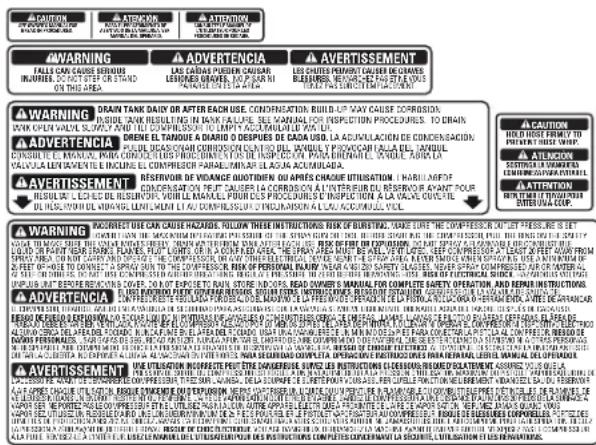
FREE WARNING LABEL REPLACEMENT: If your warning labels become illegible or are missing, call 1-800-4-DEWALT for a free replacement.
TROUBLESHOOTING GUIDE
This section provides a list of the more frequently encountered malfunctions, their cause and corrective actions. The operator or maintenance personnel can perform some corrective actions, and others may require the assistance of a qualified DEWALT technician or your dealer.
| Defective Pattern | Likely cause Suggested | Remedy |
| Heavy top or bottom pattern | 1. Dirty or damaged air cap2. Dirty or damaged fluid tip | 1. Rotate air cap 180°. If the pattern follows the air cap, the problem is in the air cap. Clean and inspect the air cap. If the pattern is not corrected, replacement is necessary.2. If pattern doesn't follow the air cap, the problem is with the fluid tip. Clean and inspect the tip for dried paint, dirt or damage. If the pattern is not corrected, replacement is necessary. |
| Split pattern | Air pressure too high for material viscosity being sprayed. | 1. Reduce air pressure.2. Tum pattern control knob clockwise to decrease fan width. Tum fluid needle adjusting nut counterclockwise to increase fluid flow. |
| 1. Dirty or distorted air horn holes.2. One of the air horn holes completely obstructed. | 1. Rotate air cap 180°. If the pattern follows the air cap, the problem is in the air cap.2. Clean and inspect the horn holes. If the horn holes are distorted, replacement is necessary. |
| Defective Pattern | Likely cause Suggested Remedy | |
| Gun splitting | Air getting into paint stream somewhere. Example: Same symptoms as a cup running out paint. | 1. Check and tighten fluid needle packing nut. 2. Tighten fluid tip. 3. Check fluid tip seat for damage. 4. Check for poor gun to cup seating. 5. Check that cup is correctly fastened on the gun. |
| Spitting, irregular or fluttering spray | 1. Fluid nozzle cracked or worn 2. Leak at thread of fluid nozzle 3. Leak at fluid needle 4. Needle packing worn out 5. Insufficient fluid in cup 6. Vent hole in container cover clogged | 1. Tighten or replace 2. Tighten fluid nozzle 3. Tighten compression nut assembly or replace needle packing 4. Replace packing 5. Fill cup with fluid 6. Clean out |
| Air back pressuring into cup. | Excessive air blowing back into cup. | 1. Tighten fluid tip. 2. Check fluid tip seat. 3. Check for damaged fluid seat on tip or seat on gun head. |
| Unatomized or spattered spray | 1. Material too heavy 2. Insufficient air pressure 3. Fluid pressure too high 4. Dried material on top of fluid nozzle or air jets of air cap | 1. Thin material or use larger orifice fluid nozzle set 2. Increase pressure to within limit 3. Reduce pressure 4. Clean |
TROUBLESHOOTING GUIDE
This section provides a list of the more frequently encountered malfunctions, their cause and corrective actions. The operator or maintenance personnel can perform some corrective actions, and others may require the assistance of a qualified DEWALT technician or your dealer.
| Defective Pattern | Likely cause Suggested Remedy | |
| Inadequate air delivery | 1. Air needle partially closed2. Dried material in air jets or air cap3. Obstruction in air line | 1. Open control knob2. Clean3. Remove obstruction |
| Excessive fog 1. Air pressure too high for viscosity of fluid | 1. Reduce air pressure and/or open fluid control knob | |
| Material leaking from fluid inlet of cup. | 1. Loose cup or foreign substances on/ between cup thread and fluid inlet | 1. Tighten and clean or replace it |
| Material leaking from nozzle when trigger is released | 1. Wom fluid needle2. Dried material in tip of nozzle3. Loose packing nut | 1. Replace2. Clean3. Tighten needle packing nut by turning counterclockwise |
| Defective Pattern | Likely cause Suggested Remedy | |
| A. | Dried material is clogging side-port “A” and causing side-port “B” to blow spray towards the clogged side | Soak side-ports in thinner to clean clog. DO NOT poke any opening with hard objects. |
| B. | 1. Dried material at fluid nozzle “C” restricts air flow 2. Loose air nozzle 3. Air pressure set too high | 1. Remove air nozzle. Wipe off fluid tip using a cloth soaked in thinner or by soft brush 2. Fasten nozzle securely 3. Reduce air pressure |
GLOSSARY
CFM: Cubic feet per minute.
SCFM: Standard cubic feet per minute; a unit of measure of air delivery.
PSI: Pounds per square inch; a unit of measure of pressure.
Code Certification: Products that bear one or more of the following marks: UL, CUL, ETL, CETL, have been evaluated by OSHA certified independent safety laboratories and meet the applicable Underwriters Laboratories Standards for Safety.
RPM: Revolutions per minute; is a measure of the frequency of a rotation
BPM: Beats per minute.
NPT: National pipe thread (tapered thread); is a U.S. standard for tapered threads used on threaded pipes and fittings.
ID: Inner diameter
DWMT70777 PISTOLET DE PULVÉRISATION HVBP À ALIMENTATION PAR GRAVITE
IF YOU HAVE ANY QUESTIONS OR COMMENTS ABOUT THIS OR ANY DEWALT TOOL, CALL US TOLL FREE AT: 1-800-4-DeWaLT (1-800-433-9258)
DIRECTIVES DE SECURITÉ IMPORTANTES
DeWALT Industrial Tool Co., 701 Joppa Road, Baltimore, MD 21286
Part No. DWMT70777 70100723 Copyright © 2014 DEWALT
The following are trademarks for one or more DeWALT power tools: the yellow and black color scheme; the "D" shaped air intake grill; the array of pyramids on the handgrip; the kit box configuration; and the array of lozenge-shaped humps on the surface of the tool.