RM2570 - Grass trimmer REMINGTON - Free user manual and instructions
Find the device manual for free RM2570 REMINGTON in PDF.



| Product type | String trimmer |
| Brand | Remington |
| Model | RM2570 |
| Engine | 2-stroke, air-cooled |
| Displacement | 25 cc |
| Fuel | Gasoline/oil mixture (40:1) |
| Fuel tank capacity | 296 ml |
| Cutting diameter | 43.18 cm |
| Cutting line diameter | 2.41 mm |
| Cutting mechanism | Bump Head |
| Weight (without fuel) | 4.5 - 5 kg |
| Spark plug | Champion RDJ7J or equivalent |
| Electrode gap | 0.635 mm |
| Usage | Occasional household use |
| Warranty | 2 years |
| Safety | Protective guard, emergency stop, hearing and eye protection required |
| Maintenance | Clean air filter every 10 h, spark plug every 25 h |
| Compatible accessories | Coupler for optional accessories (edger attachment, etc.) |
Frequently Asked Questions - RM2570 REMINGTON
User questions about RM2570 REMINGTON
0 question about this device. Answer the ones you know or ask your own.
Ask a new question about this device
Download the instructions for your Grass trimmer in PDF format for free! Find your manual RM2570 - REMINGTON and take your electronic device back in hand. On this page are published all the documents necessary for the use of your device. RM2570 by REMINGTON.
USER MANUAL RM2570 REMINGTON
Starting and Stopping 9
Operation 10
Maintenance 12
Cleaning and Storage 16
Troubleshooting 17
Warranty 18
SAVE THESE INSTRUCTIONS
SERVICE
DO NOT RETURN THIS UNIT TO THE RETAILER. PROOF OF PURCHASE WILL BE REQUIRED FOR WARRANTY SERVICE.
For assistance regarding the assembly, controls, operation or maintenance of the unit, please call the Customer Support Department at 1-866-206-2707 in the United States or 1-877-696-5533 in Canada. Additional information about the unit can be found on our website at www.remingtonpowertools.com.
For service, please call the Customer Support Department to obtain a list of authorized service dealers near you. Service on this unit, both within and after the warranty period, should only be performed by an authorized and approved service dealer. When servicing, use only identical replacement parts.
All information, illustrations, and specifications in this manual are based on the latest product information available at the time of printing. We reserve the right to make changes at any time without notice.
Copyright © 2014 MTD SOUTHWEST INC, All Rights Reserved.
IMPORTANT: Read this manual thoroughly before using this product. Follow all instructions.
SAFETY
The purpose of safety symbols is to attract your attention to possible dangers. The safety symbols, and their explanations, deserve your careful attention and understanding. The safety warnings do not by themselves eliminate any danger. The instructions or warnings they give are not substitutes for proper accident prevention measures.
SYMBOL MEANING

DANGER:
Failure to obey a safety DANGER signal WILL result in serious injury or death to yourself or to others.

WARNING:
Failure to obey a safety WARNING signal CAN result in serious injury to yourself or to others.

CAUTION:
Signals a MODERATE hazard.
Failure to obey a safety CAUTION signal MAY result in property damage or injury to yourself or to others.
NOTE: Advises you of information or instructions vital to the operation or maintenance of the equipment.
SPARK ARRESTOR NOTE
NOTE: For users on U.S. Forest Land and in the states of California, Maine, Oregon and Washington. All U.S. Forest Land and the state of California (Public Resources Codes 4442 and 4443), Oregon and Washington require, by law that certain internal combustion engines operated on forest brush and/or grass-covered areas be equipped with a spark arrester, maintained in effective working order, or the engine be constructed, equipped and maintained for the prevention of fire. Check with your state or local authorities for regulations pertaining to these requirements. Failure to follow these requirements could subject you to liability or a fine. This unit is factory equipped with a spark arrester. If it requires replacement, contact your local service dealer to install the appropriate muffler assembly.

CALIFORNIA PROPOSITION 65
WARNING:
chemical known to the State of California to cause cancer, birth defects or other reproductive harm.
Read the operator's manual and follow all warnings and safety instructions. Failure to do so can result in serious injury to the operator and/or bystanders.
- IMPORTANT SAFETY INSTRUCTIONS
READ ALL INSTRUCTIONS BEFORE OPERATING

WARNING:
WARNING: When using the unit, all safety rules must be followed. Please read these instructions before operating the unit in order to ensure the safety of the operator and any bystanders. Please keep these instructions for later use.
- Read the instructions carefully. Be familiar with the controls and proper use of the unit.
- Do not operate this unit when tired, ill or under the influence of alcohol, drugs or medication.
- Children must not operate the unit. Teens must be accompanied and guided by an adult.
- All guards and safety attachments must be installed properly before operating the unit.
- Inspect the unit before use. Replace damaged parts. Check for fuel leaks. Make sure all fasteners are in place and secure. Replace parts that are cracked, chipped, or damaged in any way. Do not operate the unit with loose or damaged parts.
- Only use the trimming line described in the Specifications section of this manual. Never use metal-reinforced line, wire, chain or rope. These can break off and become dangerous projectiles.
-
Do not replace the cutting head with rigid or metal blades. Doing so could result in serious injury.
-
Be aware of risk of injury to the head, hands and feet.
- Carefully inspect the area before starting the unit. Remove rocks, broken glass, nails, wire, string and other objects that may be thrown or become entangled with the unit.
- Clear the area of children, bystanders and pets; keep them outside a 50-foot (15 m) radius, at a minimum. Even then, they are still at risk from thrown objects. Encourage bystanders to wear eye protection. If you are approached, stop the unit immediately.
- Squeeze the throttle control and check that it returns automatically to the idle position. Make all adjustments or repairs before using the unit.
- This unit is intended for occasional, household use only.
SAFETY WARNINGS FOR GAS UNITS

WARNING: Gasoline is highly flammable and its vapors can explode if ignited. Take the following precautions:
- Store fuel only in containers specifically designed and approved for the storage of such materials.
- Always stop the engine and allow it to cool before filling the tank. Never remove the fuel tank cap or add fuel when the engine is hot. Always loosen the fuel tank cap slowly to relieve any pressure in the tank before fueling.
- Always mix and add fuel in a clean, well-ventilated outdoor area where there are no sparks or flames. DO NOT smoke.
- Never operate the unit without the fuel cap securely in place.
- Avoid creating a source of ignition for spilled fuel. Wipe up any spilled fuel from the unit immediately, before starting the unit. Move the unit at least 30 ft. (9.1 m) from the fueling source and site before starting the engine. DO NOT smoke.
- Never start or run the unit inside a closed room or building. Breathing exhaust fumes can kill. Operate this unit only in a well ventilated outdoor area.
WHILE OPERATING
- Wear safety glasses or goggles that meet current ANSI / ISEA Z87.1 standards and are marked as such. Wear ear/hearing protection when operating this unit. Wear a face mask or dust mask if the operation is dusty.
- Wear heavy long pants, boots, gloves and a long sleeve shirt. Do not wear loose clothing, jewelry, short pants, sandals or go barefoot. Secure hair above shoulder level.
- The cutting head shield must always be in place while operating the unit. Do not operate the unit without both trimming lines extended and the proper line installed. Do not extend the trimming line beyond the length of the shield.
- The cutting head should remain stationary when the engine idles. If it does not, refer to Adjusting the Idle Speed.
- Adjust the handle to provide the best grip, if applicable.
- Make sure the attachment is not in contact with anything before starting the unit.
- Use the unit only in daylight or good artificial light.
- Avoid accidental starting. Be in the starting position whenever pulling the starter rope. The operator and unit must be in a stable position while starting. Refer to Starting and Stopping.
- Use the right tool. Only use this tool for its intended purpose.
- Always hold the unit with both hands when operating. Keep a firm grip on both handles or grips.
- Do not overreach. Always keep proper footing and balance. Take extra care when working on stairs, steep slopes or inclines. To avoid serious injury, do not operate the unit while on a ladder or a roof.
- Keep hands, face, and feet away from all moving parts. Do not touch or try to stop moving parts.
- Do not touch the engine, gear housing or muffler. These parts get extremely hot from operation, even after the unit is turned off.
- Do not operate the unit faster than the speed needed to do the job.
Do not run the unit at high speed when not in use. - Do not force the unit. It will do a better, safer job when used at the intended rate.
-
Always stop the unit when operation is delayed or when walking from one location to another.
-
Before setting the unit down, always make sure the engine is off and all moving parts have stopped.
- If you strike or become entangled with a foreign object, stop the unit immediately and check for damage. Do not operate the unit before repairing damage. Do not operate the unit with loose or damaged parts.
- Turn the engine to off and disconnect the spark plug for maintenance or repair.
- Use only original equipment manufacturer (OEM) replacement parts and accessories for this unit. These are available from your authorized service dealer. Use of any other parts or accessories could lead to serious injury to the user, or damage to the unit, and void the warranty.
- Keep the unit clean. Carefully remove vegetation and other debris that could block moving parts.
- To reduce fire hazard, replace a faulty muffler and spark arrestor. Keep the engine and muffler free from grass, leaves, excessive grease or carbon build up.
- If the unit starts to vibrate abnormally, stop the unit immediately. Inspect the unit for the cause of the vibration. Vibration is generally an indicator of trouble.
OTHER SAFETY WARNINGS
- Maintain the unit with care.
- All service, other than the maintenance procedures described in this manual, should be performed by an authorized service dealer.
- Never remove, modify or make inoperative any safety device furnished with the unit.
-
Before inspecting, servicing, cleaning, storing, transporting or replacing any parts on the unit:
-
Stop the unit.
-
Make sure all moving parts have stopped.
- Allow the unit to cool.
-
Disconnect the spark plug wire.
-
Secure the unit while transporting.
-
Never store the unit with fuel in the tank, inside a building where fumes may reach an open flame (pilot lights, etc.) or sparks (switches, electrical motors, etc.).
- Store the unit in a dry place, secured or at a height to prevent unauthorized use or damage. Keep the unit out of the reach of children.
- Never douse or squirt the unit with water or any other liquid. Keep handles dry and clean (free from debris, oil and grease). Clean the unit after each use. Refer to Cleaning and Storage. Do not use solvents or strong detergents.
- Keep these instructions. Refer to them often and use them to instruct other users. If you loan this unit to others, also loan them these instructions.
SAVE THESE INSTRUCTIONS
SAFETY &INTERNATIONAL SYMBOLS
This operator's manual describes safety and international symbols and pictographs that may appear on this product. Read the operator's manual for complete safety, assembly, operating and maintenance and repair information.
SYMBOL MEANING SYMBOL MEANING
| · SAFETY ALERT SYMBOL Indicates danger, warning or caution. May be used in conjunction with other symbols or pictographs. | |
| · READ OPERATOR'S MANUAL WARNING: Read the operator's manual(s) and follow all warnings and safety instructions. Failure to do so can result in serious injury to the operator and/or bystanders. | |
| · WEAR EYE AND HEARING PROTECTION WARNING: Thrown objects and loud noise can cause severe eye injury and hearing loss. Wear eye protection meeting current ANSI / ISEA Z87.1 standards and ear protection when operating this unit. Use a full face shield when needed. | |
| · UNLEADED FUEL Always use clean, fresh unleaded fuel. | |
| · OIL Refer to operator's manual for the proper type of oil. | |
| · DO NOT USE E85 FUEL IN THIS UNIT WARNING: It has been proven that fuel containing greater than 10% ethanol will likely damage this engine and void the warranty. |
| I | ON/OFF STOP CONTROL ON / START / RUN |
| O | ON/OFF STOP CONTROL OFF or STOP |
| D | PRIMER BULB Push primer bulb, fully and slowly, 10 times. |
| H N H | CHOKE CONTROL 1. • FULL choke position 2. • PARTIAL choke position 3. • RUN choke position |
| THROW OBJECTS AND ROTATING CUTTER CAN CAUSE SEVERE INJURY WARNING: Small objects can be propelled at high speed, causing injury. Keep away from the rotating rotor. | |
| KEEP BYSTANDERS AWAY WARNING: Keep all bystanders, especially children and pets, at least 50 feet (15 m) from the operating area. | |
| HOT SURFACE WARNING: Do not touch a hot muffler or cylinder. You may get burned. These parts get extremely hot from operation. When turned off, they remain hot for a short time. | |
| SHARP BLADE WARNING: Sharp blade on trimmer attachment shield. To prevent serious injury, do not touch the line cutting blade. |
KNOW YOUR UNIT
APPLICATIONS
As a trimmer:
Cutting grass and light weeds
- Edging
- Decorative trimming around trees, fences, etc.
Other optional accessories may be used with this unit.
- 3/8" Socket
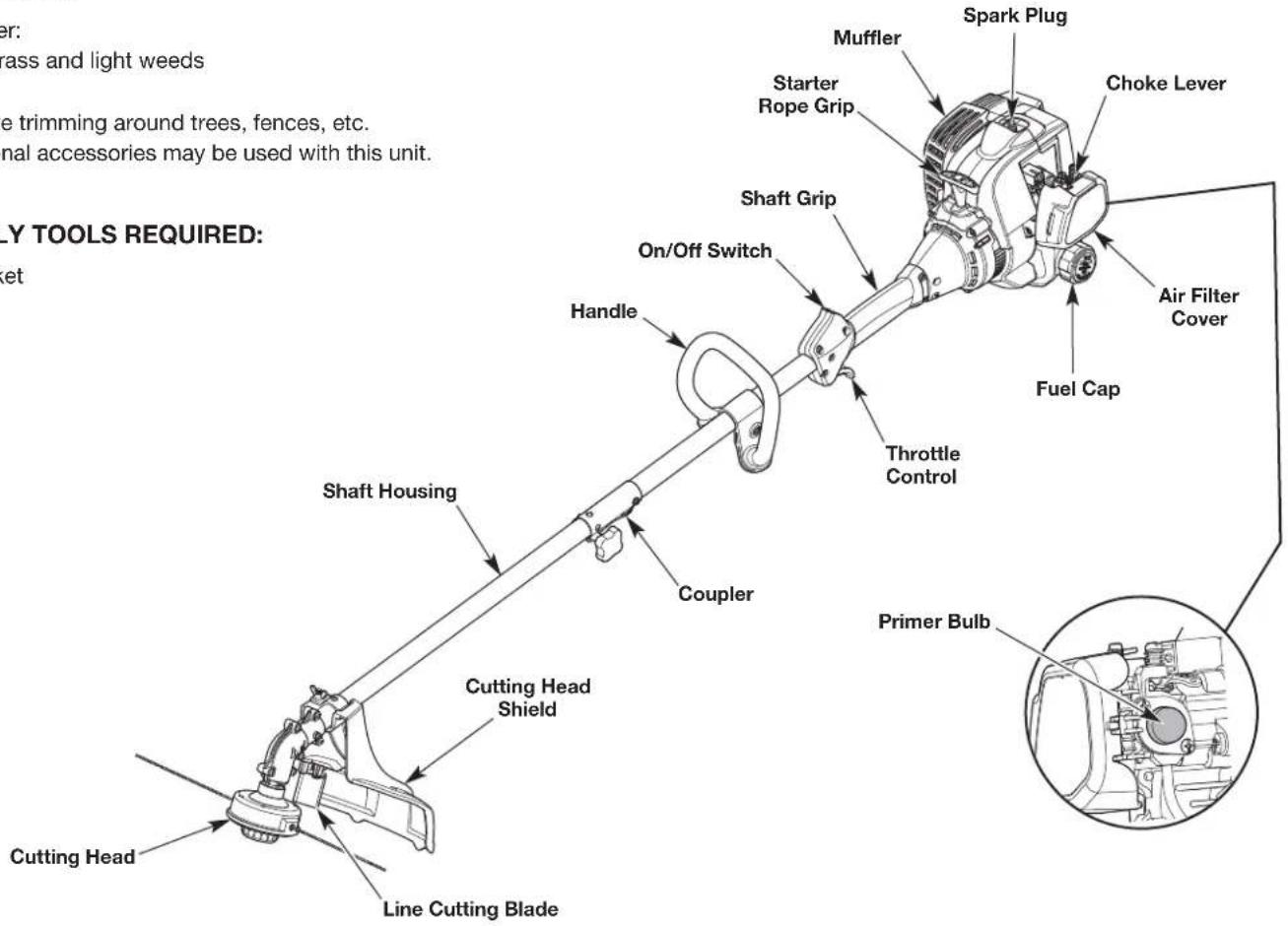
ASSEMBLY TOOLS REQUIRED:
SPECIFICATIONS*
Engine Type.. Air-Cooled, 2-Cycle
Displacement 25 cc (1.52 cu. in.)
Spark Plug Gap 0.025 in. (0.635 mm)
Spark Plug Champion® RDJ7J or equivalent plug
Lubrication. Fuel/Oil Mixture
Fuel/Oil Ratio 40:1
Fuel Tank Capacity 10 oz. (296 ml)
Approximate Unit Weight (No fuel). 10 - 11 lbs. (4.5 - 5 kg)
Trimmer Mechanism . Bump Head
Trimming Line Diameter. 0.095 in. (2.41 mm)
Cutting Path Diameter 17 in. (43.18 cm)
ASSEMBLY
INSTALLING THE CUTTING HEAD SHIELD

WARNING: To prevent serious personal injury, never operate the unit without the cutting head shield in place.
- Remove the wing nut and washer from the cutting head shield.
- Insert the short tab (the one without a hole) on the mount bracket into the slot on the cutting head shield (Fig. 1).
- Rotate the cutting head shield until the bolt on the cutting head shield protrudes through the hole on the mount bracket (Fig. 1).
- Place the washer onto the bolt (Fig. 2).
- Screw the wing nut onto the bolt until the cutting head shield is firmly in place (Fig. 2).
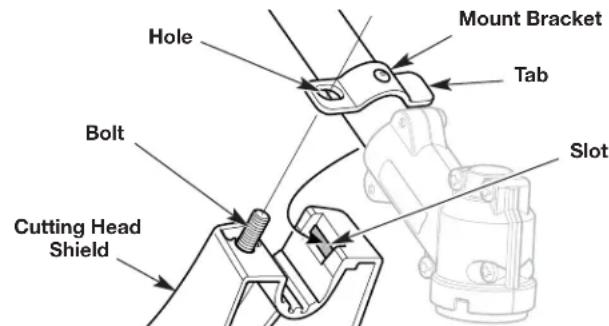
Fig. 1
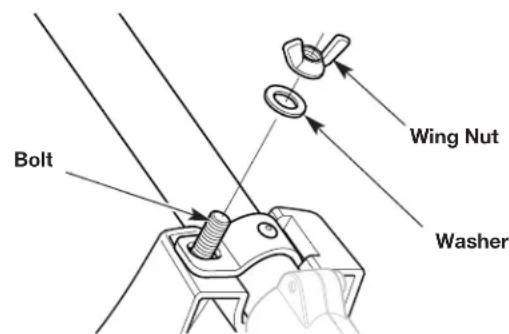
Fig. 2
INSTALLING AND ADJUSTING THE HANDLE
Installing the Handle
- Push the handle down onto the shaft housing (Fig. 3). The bolt hole in the handle should be to the right.
- Insert the bolt into the bolt hole and push it through (Fig. 3). Tighten the bolt with a 3/8 socket, but do not tighten the bolt completely.
- While holding the unit in the operating position (Fig. 10), move the handle to the location that provides the best grip. Place it a minimum of 6 inches (15.24cm) from the end of the shaft grip (Fig. 3).
- Tighten the bolt with a 3/8 socket until the handle is secure.
Adjusting the Handle
If the handle requires adjustment:
- Loosen the bolt with a 3/8" socket (Fig. 3).
- While holding the unit in the operating position (Fig. 10), move the handle to the location that provides the best grip. Place it a minimum of 6 inches (15.24cm) from the end of the shaft grip (Fig. 3).
- Tighten the bolt with a 3/8 socket until the handle is secure.
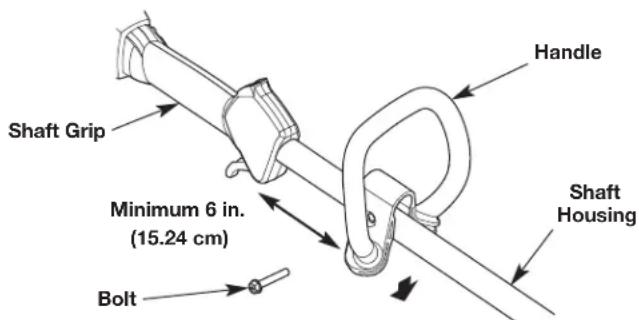
Fig. 3

WARNING: Before using any attachment, read and understand the manual that came with the attachment. Follow all safety information contained within.

WARNING: To avoid serious personal injury and damage to the unit, shut the unit off before removing or installing an attachment.
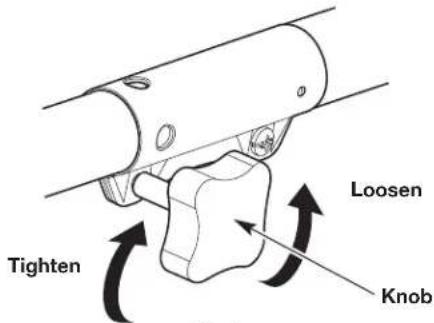
Fig. 4
The coupler enables the use of various optional attachments.
Installing the Attachment
- Remove the hanger cap from the attachment. Keep the hanger cap for use when storing the attachment. If present, remove the gray spacer from the coupler.
- Set the unit on a flat, level surface.
- Turn the knob counterclockwise to loosen the coupler (Fig. 4).
- Align the release button with the guide recess (Fig. 6).
- Push the attachment straight into the coupler (Fig. 5) until the release button snaps firmly into the primary hole (Fig.6).
- Turn the knob clockwise to tighten the coupler (Fig. 4).

CAUTION: Before operating the unit, make sure the release button is fully snapped into the primary hole and the knob is securely tightened.

CAUTION: Unless specified otherwise, the release button should be snapped into the primary hole only. Using the wrong hole could lead to personal injury or damage to the unit.

Fig. 5
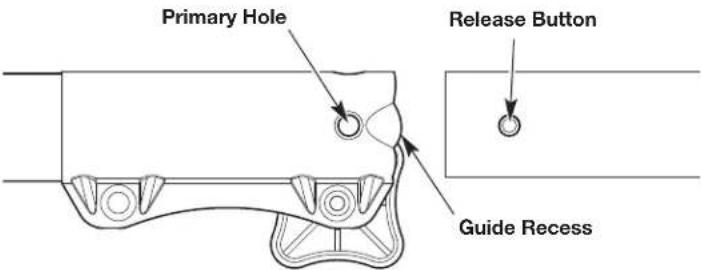
Fig. 6
Removing the Attachment
- Set the unit on a flat, level surface.
- Turn the knob counterclockwise to loosen the coupler (Fig. 4).
- Press and hold the release button (Fig. 6).
- Pull the attachment straight out of the coupler (Fig. 5).
OIL AND FUEL
OIL AND FUEL MIXING INSTRUCTIONS
The use of old and/or improperly mixed fuel is the most common cause of performance problems. Use only fresh, clean unleaded gasoline. Follow the instructions carefully for the proper gasoline/oil mixture.
Definition of Blended Fuels
Today's fuels are often a blend of gasoline and oxygenates such as ethanol, methanol or MTBE (ether). Alcohol-blended fuel absorbs water. As little as 1% water in the fuel can make fuel and oil separate, forming acids when stored. ALWAYS use fresh fuel (less than 30 days old).
NOTE: Dispose of old fuel according to federal, state and local regulations.
Using Blended Fuels
If using a blended fuel:
- Always use the fresh fuel mix explained in your operator's manual
- Use the fuel additive STA-BIL® or an equivalent
- Always agitate the fuel mix before fueling the unit
- Drain the tank and run the engine dry before storing the unit

WARNING: DO NOT USE E85 FUEL IN THIS UNIT. It has been proven that fuel containing greater than 10% ethanol will likely damage this engine and void the warranty.
Using Fuel Additives
The bottle of 2-cycle oil provided with this unit contains a fuel additive to help inhibit corrosion and minimize gum deposits. Always use the brand of 2-cycle oil that came with this unit. If this is unavailable, use a 2-cycle oil designed for air-cooled engines and mix it with a fuel additive, such as STA-BIL Fuel Stabilizer or an equivalent. Add 0.8 oz. (23 ml) of fuel additive per gallon of fuel, according to the instructions on the container. NEVER add fuel additives directly to the unit's fuel tank.
Mixing the Fuel
NOTE: This unit comes with a 3.2 oz. (95 ml) bottle of 2-cycle oil. To obtain the correct fuel mixture described below, pour the entire bottle into one gallon of unleaded gasoline.

CAUTION: For proper engine operation and maximum reliability, pay strict attention to the gasoline and oil mixing instructions on the 2-cycle oil bottle. Using improperly mixed fuel can severely damage the engine.
Thoroughly mix the proper ratio of unleaded gasoline with 2-cycle engine oil. Do not mix them directly in the unit's fuel tank. Use a separate fuel can. Use a 40:1 gasoline/oil ratio. See the table below for specific gasoline and oil mixing ratios.
| Unleaded gasoline | 2-cycle oil |
| 1 gallon U.S. (3.8 liters) | 3.2 fl. oz. (95 ml) |
| 1 liter 25 ml |
MIXING RATIO - 40:1
FUELING THE UNIT

WARNING: Gasoline is extremely flammable. Ignited vapors may explode. Always stop the engine and allow it to cool before filling the fuel tank. Do not smoke while filling the tank. Keep sparks and open flames at a distance from the area.

WARNING: Remove the fuel cap slowly to avoid injury from fuel spray. Never operate the unit without the fuel cap securely in place.

WARNING: Add fuel in a clean, well ventilated outdoor area. Wipe up any spilled fuel immediately. Avoid creating a source of ignition for spilled fuel. Do not start the engine until fuel vapors dissipate.
- Position the unit with the fuel cap facing up.
- Remove the fuel cap.
- Place the fuel container spout into the fill hole on the fuel tank and fill the tank.
NOTE: Do not overfill the tank.
- Wipe up any fuel that may have spilled.
- Reinstall the fuel cap.
- Move the unit at least 30 ft. (9.1 m) from the fuel container and the fueling site before starting the engine.
STARTING AND STOPPING

WARNING: Operate this unit only in a well-ventilated outdoor area. Carbon monoxide exhaust fumes can be lethal in a confined area.

WARNING: Avoid accidentally starting the unit. To avoid serious injury, the operator and the unit must be in a stable position when pulling the starter rope (Fig. 9).
STARTING INSTRUCTIONS
- Mix gasoline with oil. Refer to Oil and Fuel Mixing Instructions.
- Fill the fuel tank. Refer to Fueling the Unit.
NOTE: There is no need to turn the unit on. The On/Off switch is in the ON (1) position at all times (Fig. 7). - Slowly press and release the primer bulb 10 times (Fig. 8). If fuel cannot be seen in the primer bulb, press and release the primer bulb until fuel is visible.
- Move the choke lever to Position 1 (Fig. 8).
- Crouch in the starting position (Fig. 9).
- Squeeze the throttle control (Fig. 7) and pull the starter rope with a controlled and steady motion 5 times (Fig. 9).
NOTE: SQUEEZE and HOLD the throttle control for ALL further steps.
- Continue to squeeze the throttle control. Move the choke lever to Position 2 (Fig. 8).
- Continue to squeeze the throttle control. Pull the starter rope with a controlled and steady motion 3 to 5 times to start the engine.
- Continue to squeeze the throttle control. Allow the engine to warm up for 30 to 60 seconds.
- Continue to squeeze the throttle control. Move the choke lever to Position 3 (Fig. 8) and continue warming the engine for an additional 60 seconds. The unit may be used during this time.
NOTE: The engine is properly warmed up when it accelerates without hesitation.
IF... the engine hesitates, return the choke lever to Position 2 (Fig. 8) and continue the warm-up.
IF... the engine does not start, begin the starting procedure with step 3.
IF... the engine fails to start after a few attempts, move the choke lever to Position 3 and squeeze the throttle control. Pull the starter rope with a controlled and steady motion 3 to 8 times. The engine should start. If it does not, repeat this instruction.
IF... the engine is already warm, begin the starting procedure with step 7.
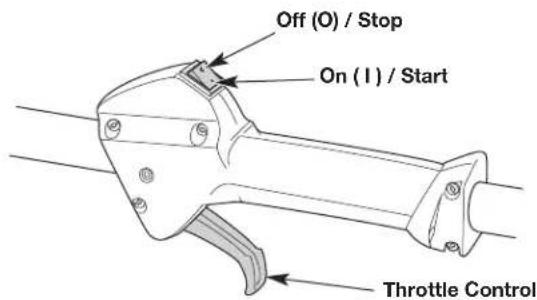
Fig. 7
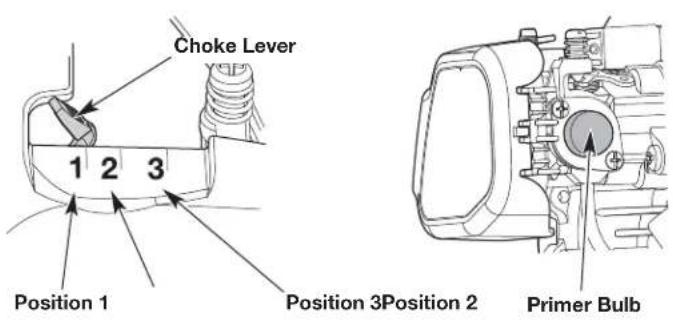
Fig. 8
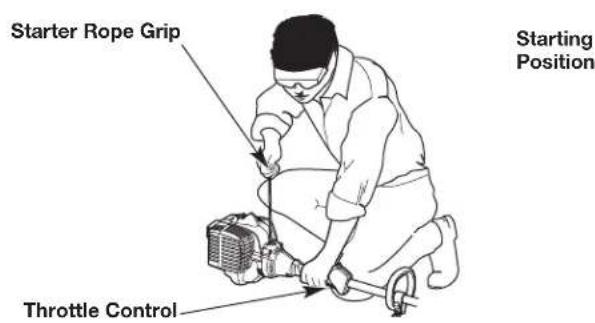
Fig. 9
STOPPING INSTRUCTIONS
- Release the throttle control and allow the engine to idle.
- Press and hold the On/Off switch in the OFF (O) position until the engine comes to a complete stop (Fig. 7).
OPERATION
HOLDING THE UNIT

WARNING: Always wear eye, hearing, hand, foot and body protection to reduce the risk of injury when operating this unit.

WARNING: To prevent serious personal injury, avoid arm contact with the engine while operating the unit. The engine may be extremely hot.
- Stand in the operating position (Fig. 10). Stand up straight. Do not bend over.
- Keep feet apart and firmly planted.
- Hold the shaft grip with the right hand. Keep the right arm slightly bent.
- Hold the handle with the left hand. Keep the left arm straight.
- Hold the unit at waist level.
- Position the cutting head a few inches above the ground.
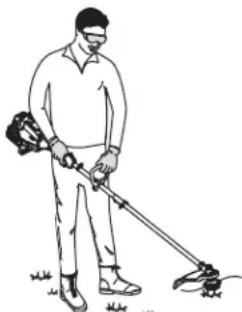
Fig. 10
ADJUSTING THE TRIMMING LINE LENGTH
This unit is equipped with a bump head. Trimming line can be released from the cutting head without stopping the engine.
To release more line, lightly tap the bump knob on the ground (Fig. 11) while operating the unit at high speed. For best results, tap the bump knob on bare ground or hard soil. Attempting to release line in tall grass may stall the engine.
NOTE: Do not rest the cutting head on the ground while the unit is running.
Each time the bump knob is tapped, about 1 inch (25.4 mm) of trimming line is released.
NOTE: Always keep the trimming line fully extended. Line release becomes more difficult when the cutting line gets shorter. A blade in the cutting head shield will cut the line to the proper length if any excess line is released.

CAUTION: Do not remove or alter the line cutting blade assembly. Excessive line length will make the unit overheat. This may lead to serious personal injury or damage to the unit.
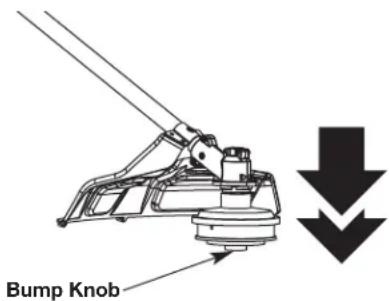
Fig. 11
TIPS FOR BEST RESULTS
- To direct clippings away from the operator, tilt the cutting head slightly down to the left; cut from right to left whenever possible.
- Do not trim wet grass or weeds.
NOTE: Some line breakage will occur from:
- Entanglement with foreign matter
Normal line fatigue - Attempting to cut thick vegetation
- Forcing the line into objects such as walls or fence posts
DECORATIVE TRIMMING
When trimming around trees, posts, fences, etc., rotate the whole unit so that the cutting head is at a 30^ angle to the ground (Fig. 12).
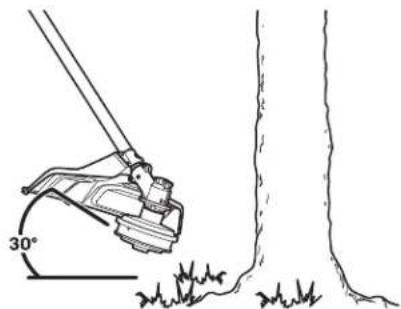
Fig. 12
EDGING
The trimmer attachment can be used for edging (Fig. 13). Alternatively, bladed lawn edge attachments can also be purchased for use with this unit.
Rotating the Trimmer Attachment

WARNING: To avoid serious personal injury and damage to the unit, shut the unit off before rotating the attachment.
When edging around sidewalks, flowerbeds, etc., rotate the trimmer attachment 90^ inside the coupler. DO NOT rotate the entire unit 90^ .
- Turn the knob counterclockwise to loosen the coupler (Fig. 4). Refer to Operating the Coupler in the Assembly section.
- Press and hold the release button (Fig. 6).
- Rotate the attachment until the release button snaps firmly into the 90^ edging hole (Fig. 14).
- Turn the knob clockwise to tighten the coupler (Fig. 4).

CAUTION: Only snap the release button into the 90^ edging hole when edging with the trimmer attachment. Using the 90^ edging hole with other attachments could lead to personal injury or damage to the unit.
Maintaining the Trimming Line
Hard surfaces, such as sidewalks, can cause the trimming line to wear down quickly or break.
- Frequently check and adjust the trimming line length. Refer to Adjusting the Trimming Line Length. Always keep the trimming line fully extended.
DO NOT force the unit. Make shallow cuts in as many passes as are necessary to achieve the desired depth. Cut at a slow, even pace.
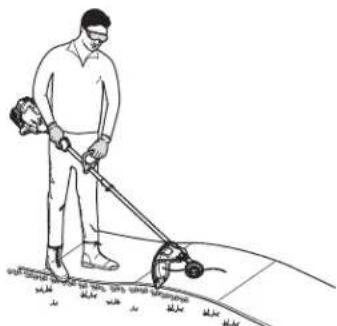
Fig. 13

Fig. 14
MAINTENANCE

WARNING: To prevent serious injury, never perform maintenance or repairs while the unit is running. Always allow the unit to cool before servicing or repairing the unit. Disconnect the spark plug wire to prevent the unit from starting accidentally.
MAINTENANCE SCHEDULE
Perform these required maintenance procedures at the frequency stated in the table. These procedures should also be a part of any seasonal tune-up.
NOTE: Some maintenance procedures may require special tools or skills. If you are unsure about these procedures, take the unit to an MTD authorized service dealer.
NOTE: Maintenance, replacement, or repair of the emission control devices and system may be performed by an MTD authorized service dealer.
NOTE: Please read the California/EPA statement that came with the unit for a complete listing of terms and coverage for the emissions control devices, such as the spark arrester, muffler, carburetor, etc.
| FREQUENCY MAINTENANCE REQUIRED | |
| Every 10 hours | Clean and re-oil the air filter. Refer to Maintaining the Air Filter. |
| Every 25 hours | Check the spark plug condition and gap. Refer to Maintaining the Spark Plug. |
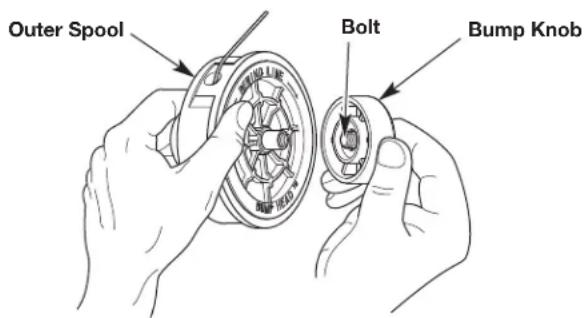
Fig. 15
REPLACING THE TRIMMING LINE
Only use the trimming line described in the Specifications section. Other types of trimming line may cause the unit to overheat or fail.

WARNING: Never use metal-reinforced line, wire, chain or rope. These can break off and become dangerous projectiles.
NOTE: Always use the correct line length when installing trimming line. The line may not release properly if the line is too long.
Part 1 - Removing the Inner Reel
- Hold the outer spool with one hand and unscrew the bump knob counterclockwise (Fig. 15).
NOTE: The outer spool will remain attached to the unit. - Inspect the bolt inside the bump knob to make sure it moves freely. Replace the bump knob if it is damaged.
- Remove the inner reel from the outer spool (Fig. 16).
- Remove the spring from the inner reel (Fig. 16).
- Use a clean cloth to clean the inner reel, spring, shaft and inner surface of the outer spool.
- Check the indexing teeth and holding slots for wear (Fig. 17). If necessary, remove burrs or replace the inner reel and outer spool.
Proceed to Part 2 - Winding New Trimming Line onto the Inner Reel.
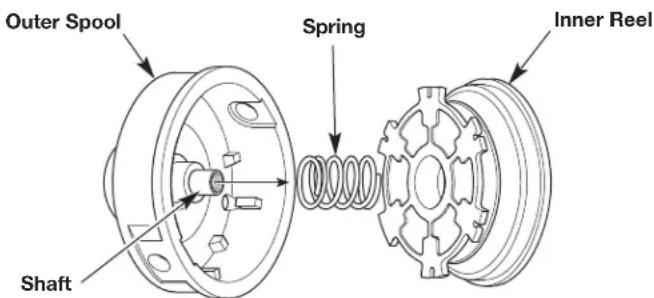
Fig. 16
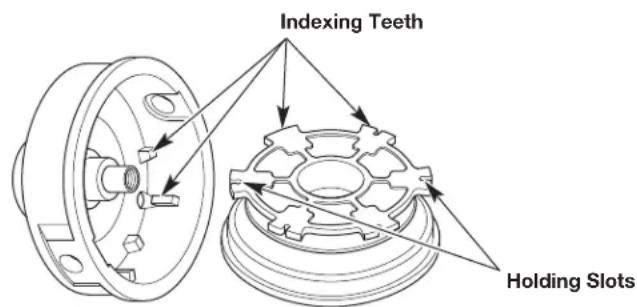
Fig. 17
Part 2 - Winding New Trimming Line onto the Inner Reel
- If using single line, refer to Winding Single Line.
- If using split line, refer to Winding Split Line.
- If using a prewound inner reel, proceed to Part 3 - Installing the Inner Reel.
Winding Single Line
- Cut one 12-foot (3.7 m) length of new single trimming line. Fold the line in half to create a loop in the middle.
- Insert the loop into the slot in the split wall (Fig. 18). Wind the line tightly in the direction shown on the bottom of the inner reel until about 6 inches (150 mm) of line remains. Keep the top half of the line above the split wall and the bottom half of the line below the split wall.
- Insert the two 6-inch sections into the two .095 holding slots (Fig. 20).
NOTE: Failure to wind the line in the direction indicated will cause the cutting head to operate incorrectly.
Proceed to Part 3 - Installing the Inner Reel.
Winding Split Line
- Cut one 6-foot (1.8 m) length of new split line trimming line. Split each end about 6 inches (150 mm).
- Using one split end, insert one line into the top hole and the other line into the bottom hole in the inner reel (Fig. 19).
- Wind the line tightly in the direction shown on the bottom of the inner reel. The split wall will automatically divide the line. Wind the line until it is completely divided and about 6 inches (150 mm) of line remains.
NOTE: Failure to wind the line in the direction indicated will cause the cutting head to operate incorrectly.
- Insert the two 6-inch sections into the two .095 holding slots (Fig. 20).
Proceed to Part 3 - Installing the Inner Reel.
Part 3 - Installing the Inner Reel
- Pass the two line ends through the eyelets in the outer spool. Place the spring inside the inner reel. Insert the inner reel into the outer spool. Push the inner reel and outer spool together (Fig. 21).
NOTE: The spring must be assembled on the inner reel before reassembling the cutting head. - While holding the inner reel and outer spool together, firmly pull the two line ends to release them from the holding slots.
- While holding the inner reel and outer spool together, screw the bump knob on clockwise. Tighten the bump knob securely.
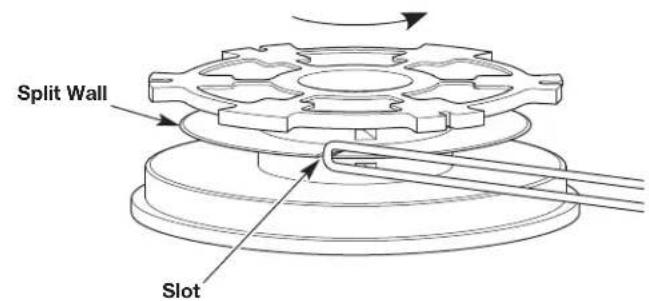
Fig. 18
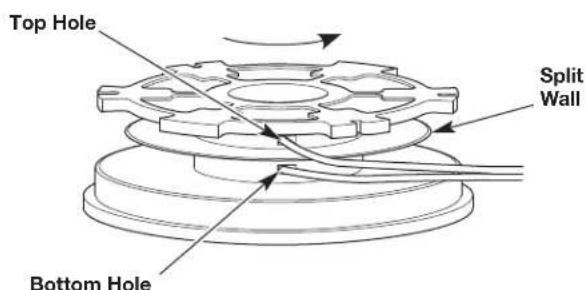
Fig. 19
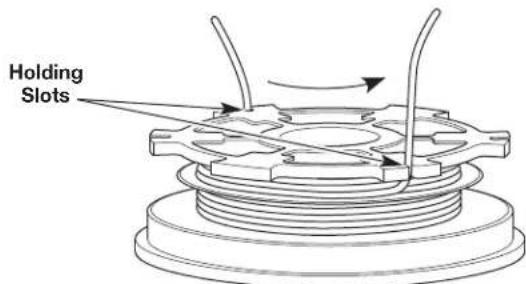
Fig. 20
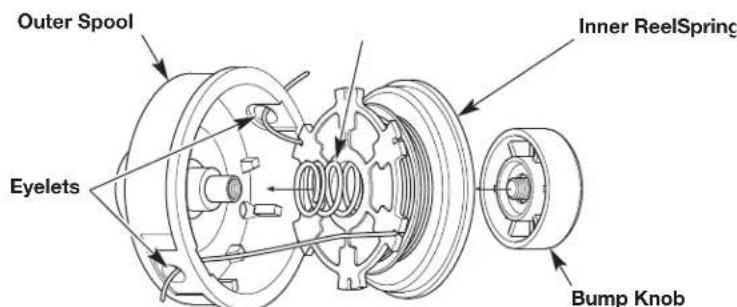
Fig. 21
MAINTAINING THE AIR FILTER

WARNING: To avoid serious personal injury, always stop the engine and allow it to cool before cleaning or maintaining the unit.
Failure to maintain the air filter can result in poor performance or can cause permanent damage to the engine. Engine failure due to improper air filter maintenance is not covered by the product warranty.
Cleaning the Air Filter
- Open the air filter cover: press in the lock tab and swing the air filter cover to the right (Fig. 22).
- Remove the air filter from inside the air filter cover (Fig. 22).
- Wash the air filter in detergent and water. Rinse the air filter thoroughly and allow it to dry.
- Lightly coat the air filter with clean SAE 30 oil.
- Squeeze the air filter to spread and remove excess oil.
- Reinstall the air filter inside the air filter cover (Fig. 22).
NOTE: Operating the unit without the air filter and air filter cover will Void the warranty.
7. Close the air filter cover: swing the air filter cover to the left and press it closed until the lock tab snaps into place (Fig. 22).
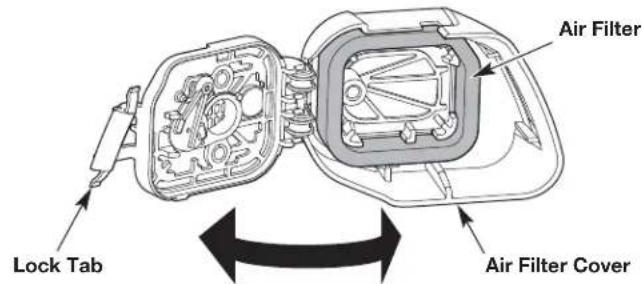
Fig. 22
ADJUSTING THE IDLE SPEED

WARNING: The cutting head may spin during idle speed adjustments. Wear protective clothing and observe all safety instructions to prevent serious personal injury.
If the engine will not idle properly:
- Drain the fuel tank and add fresh, properly-mixed fuel. Refer to Oil and Fuel.
- Clean the air filter. Refer to Maintaining the Air Filter.
If the engine still will not idle properly, adjust the idle speed: - Start the engine. Refer to Starting and Stopping.
-
Release the throttle control and let the engine idle.
-
If the engine stops, increase the idle speed. Use a small Phillips screwdriver to turn the idle speed screw clockwise, 1/8 of a turn at a time, until the engine idles smoothly (Fig. 23).
- If the cutting head spins when the engine idles, reduce the idle speed. Turn the idle speed screw counterclockwise, 1/8 of a turn at a time, until the cutting head stops moving (Fig. 23).
If the engine still will not idle properly, and any of the following conditions are true, take the unit to an authorized service dealer:
the engine hesitates or stalls on acceleration
- there is a loss of engine power
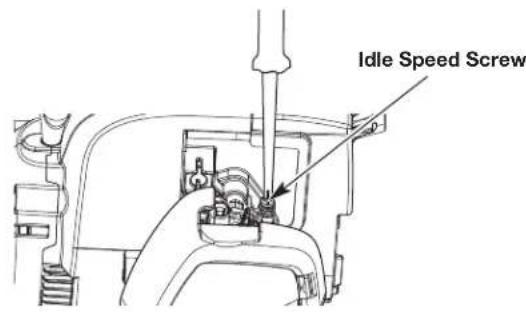
Fig. 23
MAINTAINING THE SPARK PLUG
- Stop the engine and allow it to cool. Grasp the spark plug boot firmly and pull it from the spark plug.
- Clean around the spark plug. Remove the spark plug from the cylinder head with a 5/8-inch socket, turning counterclockwise.

WARNING: Do not sand blast, scrape or clean spark plug electrodes. Grit in the engine could damage the cylinder.
- Inspect the spark plug. If the spark plug is cracked, fouled or dirty, replace it with a replacement part #753-06193, a Champion RDJ7J or an equivalent spark plug.
- Use a feeler gauge to set the air gap at 0.025 in. (0.635 mm) (Fig. 24).
- Install the spark plug in the cylinder head. Tighten the spark plug with a 5/8-inch socket, turning it clockwise until snug.
NOTE: If using a torque wrench, torque to:
110-120 in.■b. (12.3-13.5 N·m). Do not over tighten.
- Reattach the spark plug boot.
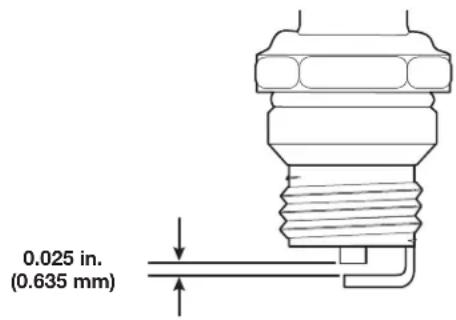
Fig. 24
CLEANING AND STORAGE
CLEANING

WARNING: To avoid serious personal injury, always stop the engine and allow it to cool before cleaning or maintaining the unit.
Use a small brush to clean the outside of the unit. Do not use strong detergents. Household cleaners that contain aromatic oils such as pine and lemon, and solvents such as kerosene, can damage plastic. Wipe off any moisture with a soft cloth.
STORAGE
- Never store a fueled unit where fumes may reach an open flame or spark.
- Allow the engine to cool before storing.
- Lock up the unit to prevent unauthorized use or damage.
- Store the unit in a dry, well-ventilated area.
- Store the unit out of the reach of children.
- To suspend the attachment from a hook, install the hanger cap onto the attachment. Make sure the release button is securely locked into one of the holes on the hanger cap.
Short-term Storage (1-2 weeks)
- Store the unit in a horizontal position. If this is not possible, store the unit vertically with the engine at the top.
Long-term Storage
- Remove the fuel cap, tip the unit and drain the fuel into an approved container. Reinstall the fuel cap.
- Start the engine and allow it to run until it stalls. This ensures that all fuel has been drained from the carburetor.
- Allow the engine to cool. Remove the spark plug and put 5 drops of any high-quality motor oil or 2-cycle oil into the cylinder. Pull the starter rope slowly to distribute the oil. Reinstall the spark plug.
- Thoroughly clean the unit and inspect it for any loose or damaged parts. Repair or replace damaged parts and tighten loose screws, nuts or bolts.
Preparing the Unit for Use after Long-term Storage
- Remove the spark plug and drain all of the oil from the cylinder.
NOTE: Do not use fuel that has been stored for more than 30 days. Dispos of old fuel according to federal, state and local regulations.
| TROUBLESHOOTING | |
| PROBLEM SOLUTION | |
| THE ENGINE WILL NOT START | |
| The fuel tank is empty Fill the fuel tank with properly mixed fuel | |
| The primer bulb was not pressed enough Press the primer bulb 10 times or until fuel is visible | |
| The engine is flooded | Move the choke lever to Position 3, squeeze the throttle control and pull the starter rope |
| The fuel is old (over 30 days) and/or improperly mixed Drain the fuel | tank and add fresh, properly mixed fuel |
| The spark plug is fouled Replace the spark plug | |
| THE ENGINE WILL NOT IDLE | |
| The air filter is dirty Clean or replace the air filter | |
| The fuel is old (over 30 days) and/or improperly mixed Drain the fuel | tank and add fresh, properly mixed fuel |
| The idle speed is incorrect Adjust the idle speed | |
| THE ENGINE WILL NOT ACCELERATE | |
| The fuel is old (over 30 days) and/or improperly mixed Drain the fuel | tank and add fresh, properly mixed fuel |
| The cutting head is bound with grass Stop the engine and clean the cutting head | |
| The air filter is dirty Clean or replace the air filter | |
| THE ENGINE LACKS POWER OR STALLS | |
| The fuel is old (over 30 days) and/or improperly mixed Drain the fuel | tank and add fresh, properly mixed fuel |
| The air filter is dirty Clean or replace the air filter | |
| The spark plug is fouled Replace the spark plug | |
| THE CUTTING HEAD WILL NOT ADVANCE LINE | |
| The cutting head is bound with grass Stop the engine and clean the cutting head | cutting head |
| The cutting head is out of line Refill the cutting head with new line | |
| The inner reel is bound up Rewind the line | |
| The cutting head is dirty Clean the inner reel and outer spool | |
| The line is welded Open the cutting head and remove the welded section | |
| The line is twisted Rewind the line | |
| Not enough line is extended | Stop the unit, push the bump knob and pull the line until 4 inches (102 mm) is outside of the cutting head |
| THE CUTTING LINE ADVANCES UNCONTROLLABLY | |
| There is oil, cleaner or lubricant in the cutting head Clean and thoroughly dry the cutting head | |
If further assistance is required, contact an authorized service dealer.
MANUFACTURER'S LIMITED WARRANTY FOR:
REMINGTON
The limited warranty set forth below is given by Remington LLC (Remington) with respect to new merchandise purchased and used in the United States, its possessions and territories.
Remington warrants this product against defects in material and workmanship for a period of two (2) years commencing on the date of original purchase and will, at its option, repair or replace, free of charge, any part found to be defective in material or workmanship. This limited warranty shall only apply if this product has been operated and maintained in accordance with the Operator's Manual furnished with the product, and has not been subject to misuse, abuse, commercial use, neglect, accident, improper maintenance, alteration, vandalism, theft, fire, water or damage because of other peril or natural disaster. Damage resulting from the installation or use of any accessory or attachment not approved by Remington for use with the product(s) covered by this manual will void your warranty as to any resulting damage. This warranty is limited to ninety (90) days from the date of original retail purchase for any Remington product that is used for rental or commercial purposes, or any other income-producing purpose.
HOW TO OBTAIN SERVICE: Warranty service is available, WITH PROOF OF PURCHASE THROUGH YOUR LOCAL AUTHORIZED SERVICE DEALER. To locate the dealer in your area, visit our website at www.remingtonpowertools.com, check for a listing in the Yellow Pages, call 1-866-206-2707 or 1-877-696-5533 in Canada, or write to P.O. Box 361032, Cleveland, OH 44136. No product returned directly to the factory will be accepted unless prior written permission has been extended by the Customer Service Department of Remington.
This limited warranty does not provide coverage in the following cases:
A. Tune-ups - Spark Plugs, Carburetor Adjustments, Filters
B. Wear items - Bump Knobs, Outer Spools, Cutting Line, Inner Reels, Starter Pulley, Starter Ropes, Drive Belts, Saw Chains, Guide Bars, Cultivator Tines, Blades.
C. Remington does not extend any warranty for products sold or exported outside of the United States of America, its possessions and territories, except those sold through Remington's authorized channels of export distribution.
Remington reserves the right to change or improve the design of any Remington Product without assuming any obligation to modify any product previously manufactured.
No implied warranty, including any implied warranty of merchantability or fitness for a particular purpose, applies after the applicable period of express written warranty above as to the parts as identified. No other express warranty or guaranty, whether written or oral, except as mentioned above, given by any person or entity, including a dealer or retailer, with respect to any product shall bind Remington. During the period of the Warranty, the exclusive remedy is repair or replacement of the product as set forth above. (Some states do not allow limitations on how long an implied warranty lasts, so the above limitation may not apply to you.)
The provisions as set forth in this Warranty provide the sole and exclusive remedy arising from the sales. Remington shall not be liable for incidental or consequential loss or damages including, without limitation, expenses incurred for substitute or replacement lawn care services, for transportation or for related expenses, or for rental expenses to temporarily replace a warranted product. (Some states do not allow limitations on how long an implied warranty lasts, so the above limitation may not apply to you.)
In no event shall recovery of any kind be greater than the amount of the purchase price of the product sold. Alteration of the safety features of the product shall void this Warranty. You assume the risk and liability for loss, damage, or injury to you and your property and/or to others and their property arising out of the use or misuse or inability to use the product.
This limited warranty shall not extend to anyone other than the original purchaser, original lessee or the person for whom it was purchased as a gift.
How State Law Relates to this Warranty: This warranty gives you specific legal rights, and you may also have other rights which vary from state to state.
To locate your nearest service dealer, dial 1-866-206-2707 in the United States or 1-877-696-5533 in Canada.
REMINGTON LLC
P.O.Box 361032
Cleveland, OH 44136
REMINGTON
Service technique 19
Sécurité 20
Lubrification. Mélange carburant/huile
Rapport carburant/huile 40:1