ManualGo.com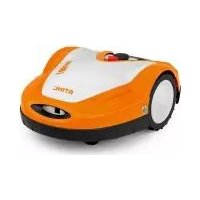
iMow RMI 632 P - Lawn mower STIHL - Free user manual and instructions
Find the device manual for free iMow RMI 632 P STIHL in PDF.



Download the instructions for your Lawn mower in PDF format for free! Find your manual iMow RMI 632 P - STIHL and take your electronic device back in hand. On this page are published all the documents necessary for the use of your device. iMow RMI 632 P by STIHL.
USER MANUAL iMow RMI 632 P STIHL
DEFRNLIT EN 0478 131 9954 E - EN Dear Customer, Thank you for choosing STIHL. We develop and manufacture our quality products to meet our customers' requirements. The products are designed for reliability even under extreme conditions. STIHL also stands for premium service quality. Our specialist dealers guarantee competent advice and instruction as well as comprehensive service support. We thank you for your confidence in us and hope you will enjoy working with your STIHL product. Dr. Nikolas Stihl
IMPORTANT: READ BEFORE USE AND
KEEP IN A SAFE PLACE. Printed on chlorine-free bleached paper. Paper is recyclable. Cover is halogen free.
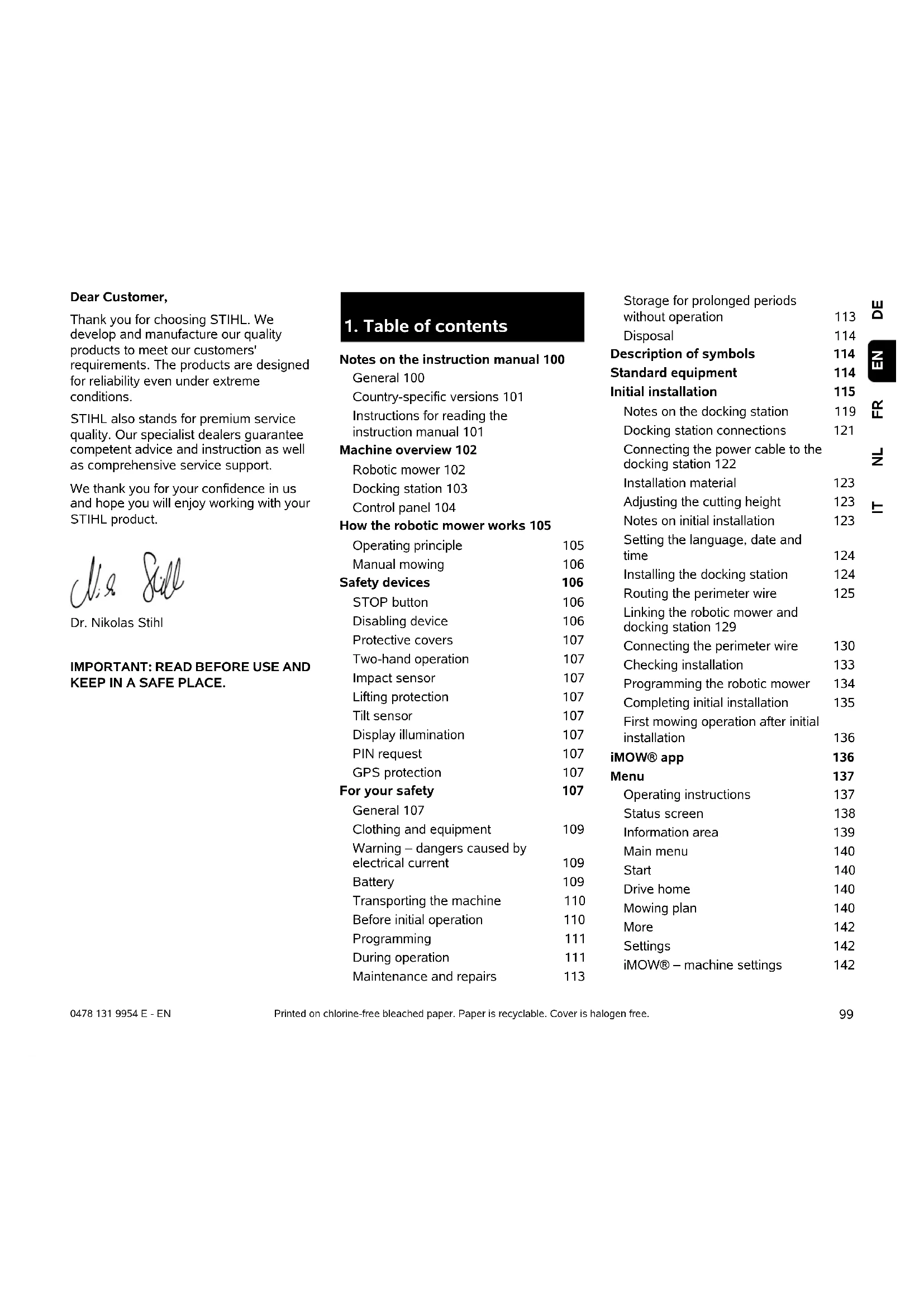
1. Table of contents
Notes on the instruction manual 100 General 100 Country-specific versions 101 Instructions for reading the instruction manual 101 Machine overview 102 Robotic mower 102 Docking station 103 Control panel 104 How the robotic mower works 105 Operating principle 105 Manual mowing 106 Safety devices 106 STOP button 106 Disabling device 106 Protective covers 107 Two-hand operation 107 Impact sensor 107 Lifting protection 107 Tilt sensor 107 Display illumination 107 PIN request 107 GPS protection 107 For your safety 107 General 107 Clothing and equipment 109 Warning – dangers caused by electrical current 109 Battery 109 Transporting the machine 110 Before initial operation 110 Programming 111 During operation 111 Maintenance and repairs 113 Storage for prolonged periods without operation 113 Disposal 114 Description of symbols 114 Standard equipment 114 Initial installation 115 Notes on the docking station 119 Docking station connections 121 Connecting the power cable to the docking station 122 Installation material 123 Adjusting the cutting height 123 Notes on initial installation 123 Setting the language, date and time 124 Installing the docking station 124 Routing the perimeter wire 125 Linking the robotic mower and docking station 129 Connecting the perimeter wire 130 Checking installation 133 Programming the robotic mower 134 Completing initial installation 135 First mowing operation after initial installation 136 iMOW® app 136 Menu 137 Operating instructions 137 Status screen 138 Information area 139 Main menu 140 Start 140 Drive home 140 Mowing plan 140 More 142 Settings 142 iMOW® – machine settings 1420478 131 9954 E - EN
This instruction manual constitutes original manufacturer's instructions in the sense of EC Directive 2006/42/EC. STIHL is continually striving to further develop its range of products; we therefore reserve the right to make alterations to the form, technical specifications and equipment level of our standard equipment. For this reason, the information and illustrations in this manual are subject to alterations. This instruction manual may describe models that are not available in all countries. This instruction manual is protected by copyright. All rights reserved, especially the right of reproduction, translation and processing using electronic systems. Setting the rain sensor 143 Setting the status screen 143 Installation 143 Setting starting points 144 Safety 145 Service 146 Information 146 Perimeter wire 148 Planning routing of the perimeter wire 148 Making a sketch of the mowing area 149 Routing the perimeter wire 149 Connecting the perimeter wire 149 Wire clearances – use iMOW® Ruler 150 Acute corners 151 Confined areas 151 Installing linking sections 151 No-go areas 151 Secondary areas 152 Corridors 153 Guide loops for offset drive home 154 Accurate mowing along edges 155 Sloping terrain along the perimeter wire 156 Installing reserve wire 156 Using wire connectors 156 Narrow edge clearances 157 Docking station 157 Docking station controls 157 Notes on mowing 158 General 158 Mulching 158 Active times 158 Mowing duration 159 Home area (RMI 632 C, RMI 632 PC) 159 Manual mowing 159 Operating the machine 159 Preparation 159 Removing and installing the control panel 159 Adapting the programming 160 Automatic mowing 161 Mowing independently of active times 161 Manual mowing 162 Docking the robotic mower 162 Charging the battery 162 Maintenance 163 Maintenance schedule 163 Cleaning the machine 163 Checking the mowing blade wear limits 164 Removing and installing the mowing blade 164 Sharpening the mowing blade 165 Removing and installing the carrier plate 165 Finding a wire break 166 Storage and winter break 167 Removing the docking station 168 Standard spare parts 168 Accessories 169 Minimising wear and preventing damage 169 Environmental protection 169 Removing the battery 170 Transport 172 Lifting or carrying the machine 172 Securing the machine (lashing) 172 Declaration of conformity 172 EU declaration of conformity – Cordless electric robotic mower (RMI) with docking station (ADO) 172 UKCA-Declaration of Conformity STIHL RMI 632.1, RMI 632.1 P,
2. Notes on the instruction
STIHL supplies machines with different plugs and switches, depending on the country of sale. Machines with European plugs are shown in the illustrations. Machines with other types of plug are connected to the mains in a similar way.
2.3 Instructions for reading the
instruction manual Illustrations and texts describe specific operating steps. All symbols which are affixed to the machine are explained in this instruction manual. Viewing direction: Viewing direction when "left" and "right" are used in the instruction manual: the user is standing behind the machine and is looking forwards in the direction of travel. Section reference: References to relevant sections and subsections for further descriptions are made using arrows. The following example shows a reference to a section: (Ö 3.) Designation of text passages: The instructions described can be identified as in the following examples. Operating steps which require intervention on the part of the user: ● Release bolt (1) using a screwdriver, operate lever (2)... General lists: – Use of the product for sporting or competitive events Texts with added significance: Text passages with added significance are identified using the symbols described below in order to especially emphasise them in the instruction manual: Texts relating to illustrations: Some Illustrations which are necessary for use of the machine can be found at the front of this instruction manual. The camera symbol serves to link the figures on the illustration pages with the corresponding text passages in the instruction manual. Illustrations with text passages: Operating steps relating directly to the illustration can be found immediately after the illustration, with a corresponding reference to the item numbers. Example: The control pad (1) serves for navigation in the menus. Settings are confirmed and menus opened using the OK button (2). Menus can be exited again using the Back button (3). Danger Risk of accident and severe injury to persons. A certain type of behaviour is necessary or must be avoided. Warning Risk of injury to persons. A certain type of behaviour prevents possible or probable injuries. Caution Minor injuries or material damage can be prevented by a certain type of behaviour. Note Information for better use of the machine and in order to avoid possible operating errors. 10478 131 9954 E - EN
1 Movably mounted hood (Ö 5.5), (Ö 5.6) 2 Charging contacts: Connecting contacts to the docking station 3 Rear wheel 4 Carrying handle (Ö 21.1) 5 Removable control panel (Ö 3.3), (Ö 15.2) 6 Rotary handle for cutting height adjustment (Ö 9.5) 7 STOP button (Ö 5.1) 8 Front wheel 9 Mowing deck 10 Dual-ground mowing blade (Ö 16.4) 11 Carrier plate103 DEFRNLIT EN 0478 131 9954 E - EN
1 Floor plate 2 Cable guides for retaining the perim- eter wire (Ö 9.11) 3 Power supply unit 4 Removable cover (Ö 9.2) 5 Charging contacts: Connecting contacts to the robotic mower 6 Control panel with button and LED (Ö 13.1) 7 Button 8 LED display0478 131 9954 E - EN
4.1 Operating principle
The robotic mower (1) is designed for the automatic mowing of lawns. It mows the lawn in randomly selected paths. In order for the robotic mower to detect the borders of the mowing area A, a perimeter wire (2) must be routed around that area. A wire signal generated by the docking station (3) flows through this perimeter wire. Solid obstacles (4) in the mowing area are reliably detected by the robotic mower by means of an impact sensor. Areas (5) that the robotic mower is not to enter and obstacles that need to be avoided must be separated from the remaining mowing area using the perimeter wire. When automatic mowing is switched on, the robotic mower independently leaves the docking station and mows the lawn during the active times (Ö 11.7). The robotic mower automatically travels to the docking station to recharge the battery. If the mow plan type "Standard" is selected, the robotic mower mows and charges throughout the entire active time. If the mow plan type "Dynamic" is selected, the number and duration of mowing and charging operations within the active times are adapted fully automatically. When automatic mowing is switched off and for mowing operations independent of active times, a mowing operation can be activated using the Mow button or in the "Start" menu. (Ö 11.5)
The STIHL robotic mower can be operated reliably and without interference in close vicinity to other robotic mowers. The wire signal meets the EGMF (European Garden Machinery Federation) standard with regard to electromagnetic emissions.
With the robotic mower (1), it is also possible to mow the lawn as with a manually operated lawn mower. For this purpose, remove the control panel (2), select the "Manual mowing" option in the "More" menu, activate the mowing blade and self-propulsion and walk behind the robotic mower. (Ö 15.6) The machine is equipped with several safety devices for safe operation and for the prevention of improper use.
When the red STOP button on the top of the robotic mower is pressed, operation of the machine is stopped immediately. The mowing blade comes to a standstill within a few seconds and the message "STOP button pressed" appears on the display. The robotic mower cannot be operated and is safe while the message is active. (Ö 24.) When automatic mowing is switched on, following confirmation of the message with OK, the system enquires whether automatic operation is to be continued. If the response is Yes, the robotic mower continues to mow the mowing area in accordance with the mowing plan. If the response is No, the robotic mower remains stationary in the mowing area and automatic mowing is switched off. (Ö 11.7)
5.2 Disabling device
The robotic mower must be disabled prior to any maintenance or cleaning work, prior to transportation and prior to inspection. The robotic mower cannot be operated when the disabling device is activated. Activating the disabling device: – Press and hold the STOP button –in the "More" menu, –in the "Safety" menu. Activating the disabling device via the "More" menu: ● In the "More" menu, select the "Lock iMOW®" entry and confirm with the OK button. (Ö 11.8) Activating the disabling device via the "Safety" menu: ● In the "More" menu, open the "Settings" and "Safety" submenus. (Ö 11.15) ● Select the "Disab. device" entry and confirm with the OK button. Deactivating the disabling device: ● When required, wake up the machine by pressing any button. ● Unlock the robotic mower using the illustrated button combination. For this purpose, press the Mow button and the OK button in the sequence illustrated. The impact sensor and edge limitation are disabled during manual mowing.
Risk of injury! If a safety device is found to be defective, the machine must not be operated. Consult a specialist dealer; STIHL recommends STIHL specialist dealers. Pressing and holding the STOP button also activates the disabling device. (Ö 5.2)107 DEFRNLIT EN 0478 131 9954 E - EN
5.3 Protective covers
The robotic mower is equipped with protective covers that prevent inadvertent contact with the mowing blade and the clippings. These include, in particular, the hood.
5.4 Two-hand operation
During manual mowing, the mowing blade can only be activated if the OK button is pressed and held with the right thumb and the Mow button is then pressed with the left thumb. Once activated, only the Mow button must remain pressed in order to continue mowing.
The robotic mower is equipped with a movable hood which serves as an impact sensor. During automatic operation, it immediately comes to a standstill if it contacts a solid obstacle which has a specific minimum height (10 cm) and is firmly attached to the ground. It then turns to face another direction and continues mowing. If the impact sensor is triggered too frequently, the mowing blade is also stopped.
5.6 Lifting protection
If the robotic mower is lifted by the hood or at the carrying handle, mowing is stopped immediately. The mowing blade comes to a standstill within a few seconds.
If the permissible slope inclination is exceeded during operation, the robotic mower immediately changes its direction of travel. In the event of a rollover, the self- propulsion and mowing motor are switched off.
5.8 Display illumination
The display illumination is activated during operation. Thanks to this illumination, the robotic mower is easily recognisable, even in darkness.
When the PIN request is activated, an alarm signal sounds when the robotic mower is lifted unless the PIN code is entered within one minute. (Ö 11.15) The robotic mower can only be operated in conjunction with the docking station supplied. A further docking station must be linked with the robotic mower. (Ö 11.15)
The models RMI 632 C, RMI 632 PC are equipped with a GPS receiver. When GPS protection is activated, the owner of the machine is notified if the machine is operated outside the home area. The PIN code is also requested on the display. (Ö 14.5)
These safety regulations must be observed when working with the machine. Read the entire instruction manual before using the machine for the first time. Keep the instruction manual in a safe place for future reference. These safety precautions are essential for your safety, however the list is not exhaustive. Always use the machine in a reasonable and responsible manner and be aware that the user is responsible for accidents involving third parties or their property. The term "use" covers all work on the robotic mower, the docking station and the perimeter wire. A "user" is defined as: – A person who reprograms the robotic mower or changes the existing programming. Impacts against obstacles occur with a certain force. Sensitive obstacles, e.g. light objects such as small flower pots, can therefore be knocked over or damaged. STIHL recommends removing obstacles or blocking them off by means of no-go areas. (Ö 12.9) STIHL recommends that one of the safety levels "Low", "Medium" or "High" be set. This ensures that unauthorised people cannot operate the robotic mower using other docking stations and are unable to change settings or the programming. Recommendation: Always activate GPS protection. (Ö 11.15)
– A person who performs work on the robotic mower. – A person who activates or operates the machine. – A person who installs or removes the perimeter wire or docking station. The use of the iMOW® app also falls under the term "use" for the purpose of this instruction manual. The machine must only be operated by persons who are well rested and in good physical and mental condition. If your health is impaired, you should consult your doctor to determine whether working with the machine is possible. The machine should not be operated after the consumption of alcohol, drugs or medications which impair reactions. Make sure that you are familiar with the controls and use of the machine. The machine must only be used by persons who have read the instruction manual and are familiar with operation of the machine. The user should seek expert and practical instruction prior to initial operation. The user must receive instruction on safe use of the machine from the vendor or another expert. During this instruction, the user should be made aware that the utmost care and concentration are required for working with the machine. Residual risks persist even if you operate this machine according to the instructions. Only give or lend the machine to persons who are familiar with this model and how to operate it. The instruction manual forms part of the machine and must always be provided to persons operating it. Make sure that the user is physically, sensorily and mentally capable of operating the machine and working with it. If the user is physically, sensorily or mentally impaired, the machine must only be used under supervision or following instruction by a responsible person. Make sure that the user is of legal age or being trained under supervision in a profession in accordance with national regulations. Children must be kept away from the machine and mowing area during mowing operation. Dogs and other pets must be kept away from the machine and mowing area during mowing operation. For safety reasons, any modification to the machine, except the proper installation of accessories or attachments approved by STIHL, is forbidden and results in voiding of the warranty cover. Information regarding approved accessories and attachments can be obtained from your STIHL specialist dealer. In particular, any tampering with the machine which increases the power output or speed of the motors is forbidden. It is not permissible to make any modifications to the machine that could lead to increased noise emissions. For safety reasons, the machine software must never be modified or tampered with. Particular care is required during use in public green spaces, parks, sports fields, along roads and in agricultural and forestry businesses. It is not permitted to transport objects, animals or persons, particularly children, on the machine. Never allow people, particularly children, to ride or sit on the robotic mower. Caution – risk of accident! The robotic mower is intended for automatic lawn care and for manual lawn mowing. Its use for other purposes is not permitted and may be dangerous or result in damage to the machine. Due to the physical danger to the user, the machine must not be used for the following applications (incomplete list): – for trimming bushes, hedges and shrubs, – for cutting creepers, – for the care of lawn roofs and balcony boxes, – for shredding or chipping tree or hedge cuttings, – for clearing paths (vacuuming, blowing), – for levelling earth mounds, e.g. mole hills. Risk of death from suffocation! Packaging material is not a toy - danger of suffocation! Keep packaging material away from children. Caution - risk of accident!109 DEFRNLIT EN 0478 131 9954 E - EN
6.2 Clothing and equipment
Wear sturdy footwear with high- grip soles and never work barefoot or when wearing e.g. sandals – when moving the robotic mower from one place to another using the control panel, – when approaching the robotic mower during operation, – when mowing the lawn manually. (Ö 15.6) Wear suitable work clothes during installation, maintenance operations and all other work on the machine and docking station. Never wear loose clothes which may become caught on moving parts – do not wear jewellery, ties or scarves. In particular, wear long trousers – when approaching the robotic mower during operation, – when mowing the lawn manually. Always wear thick gloves during maintenance and cleaning operations, when laying and removing wires and when securing the docking station. In particular, protect the hands when working on the mowing blade and when driving in the fixing pins or the docking station pegs. Long hair must always be tied up and secured (headscarf, cap, etc.) when working on the machine. Suitable safety glasses must be worn when driving in the fixing pins and the docking station pegs.
6.3 Warning – dangers caused by
electrical current Only use an original power supply unit. The power supply unit must not be used: – if it is damaged or worn, – if the cables are damaged or worn. Check the power cable in particular for damage and ageing. Maintenance and repair work on power cables and power supply units must only be performed by specially qualified technicians. Danger of electric shock! Do not connect a damaged cable to the mains and only touch a damaged cable once it has been disconnected from the mains. The electric cable on the power supply unit must not be modified (e.g. shortened). The cable between the power supply unit and docking station must not be extended. The power supply unit plug must only be connected to the docking station electronics in dry and clean condition. The power supply unit and cable must not be left on wet ground for prolonged periods. Danger of electric shock! Damaged cables, connectors and plugs, or electric cables which do not conform with regulations may not be used. Always ensure that the power cables used are adequately protected by a fuse. Detach electric cables at the plug and socket and not by pulling on the electric cable. Only connect the machine to a power supply that is protected by means of a residual current-operated protective device with a release current of a maximum of 30 mA. Your electrician can provide further information. If the power supply unit is connected to the mains supply outside a building, the socket must be approved for outdoor use. Your electrician can provide further information about country-specific legislation. It must be noted that current fluctuations can damage the machine when it is connected to a power generator.
Only use original batteries. The battery is intended exclusively for fixed installation in a STIHL robotic mower. There, it is optimally protected and is
Risk of electric shock! Particularly important for electrical safety are an intact power cable and mains plug on the power supply unit. Damaged cables, connectors and plugs, or electric cables that do not conform to regulations must not be used, to prevent any risk of electric shocks. Therefore, check the electric cable regularly for signs of damage or ageing (brittleness).0478 131 9954 E - EN
charged when the robotic mower is in the docking station. No other charger must be used. The use of an unsuitable charger can result in danger due to electric shock, overheating or escaping corrosive battery fluid. Never open the battery. Do not drop the battery. Never use a defective or deformed battery. Store the battery out of reach of children. Only use or store the battery at temperatures from -10°C to max. +50°C. Protect the battery against rain and moisture – do not immerse in liquids. Do not subject the battery to microwaves or high pressure. Never connect the battery terminals with metallic objects (short-circuit). The battery can be damaged through short circuits. Keep the unused battery away from metallic objects (e.g. nails, coins, jewellery). Do not use metallic transport containers – explosive and fire hazard! Fluid may escape from the battery due to improper use – avoid contact! In the case of inadvertent contact, rinse with water. Seek medical attention if the fluid comes into contact with the eyes. Escaping battery fluid can cause skin irritation and burns. Do not insert any objects in the ventilation slots of the battery. For further safety instructions, see http://www.stihl.com/safety-data-sheets
6.5 Transporting the machine
Before transporting, and especially before lifting the robotic mower, activate the disabling device. (Ö 5.2) Allow the machine to cool down before transporting. Avoid contact with the mowing blade when lifting and carrying the machine. The robotic mower must only be lifted at the carrying handle. Never reach under the machine. Take the weight of the machine into account and use suitable loading aids (lifters) if required. Secure the machine and other machine parts being transported (e.g. docking station) on the load floor using fastening materials (straps, ropes, etc.) of an adequate size at the fastening points described in this instruction manual. (Ö 21.) When transporting the machine, always observe regional legislation, especially regarding load security and the transport of objects on load floors. Do not leave the battery inside a vehicle and never expose it to direct sunlight. Lithium-ion batteries must be treated with special care during transport. In particular, short-circuit protection must be ensured. Transport the battery either in the original packaging or in the robotic mower.
6.6 Before initial operation
It must be ensured that all persons who use the machine are familiar with the instruction manual. Carefully follow the instructions for installing the docking station (Ö 9.) and perimeter wire (Ö 12.). The perimeter wire and the power cable must be securely fastened to the ground so that they do not present a tripping hazard. Avoid routing the perimeter wire and power cable over edges (e.g. edges of pathways or paving stones). When routing the perimeter wire and power cable on ground into which the supplied fixing pins cannot be driven (e.g. paving stones, pathways), a cable duct must be used. Correct routing of the perimeter wire and power cable must be regularly checked. To prevent the risk of stumbling, always drive in the fixing pins all the way. Do not install the docking station in a place where it is difficult to see and could become a tripping hazard (e.g. around the corner of a house). If possible, install the docking station out of the reach of pests such as ants or slugs – in particular avoid the area around anthills and composting units. Areas in which the robotic mower cannot operate safely (e.g. due to danger of falling) must be blocked off through appropriate routing of the perimeter wire. STIHL recommends that the robotic mower is only operated on lawns and surfaced paths (e.g. paved drives). The robotic mower does not detect any sudden drops such as edges, steps, swimming pools or ponds. If the perimeter Explosive hazard! Protect the battery against direct sunlight, heat and fire – never throw it into a fire.111 DEFRNLIT EN 0478 131 9954 E - EN wire is routed along potential sudden drops, a clearance of at least 1m must be maintained between the perimeter wire and the danger area for safety reasons. Regularly inspect the area on which the machine is to be used and remove any sticks, stones, wires, bones and all other foreign objects that could be thrown up by the machine. After installing the perimeter wire, particularly remove all tools from the mowing area. Broken or damaged fixing pins must be removed from the lawn and disposed of. Regularly check the area to be mown for uneven areas and level them out. Never use the machine with damaged safety devices or with safety devices removed. The switch and safety devices installed in the machine must not be removed or bypassed. All faulty, worn or damaged parts must be replaced before using the machine. Replace any illegible or damaged danger signs and warnings on the machine. Your STIHL specialist has a supply of replacement stickers and all the other spare parts. Before initial operation, it must be ensured – that the machine is in good operational condition. This means that the covers and guards must be in place and in good condition. – that the docking station is in a safe operating condition. Here, all covers must be properly installed and be in good condition. – that the power supply unit has been connected to a properly installed socket. – that the insulation of the electric cable and the mains plug on the power supply unit is in good condition. – that the entire machine (housing, hood, fastening elements, mowing blade, blade shaft, etc.) is neither worn nor damaged. – that the mowing blade and the blade fastening are in proper condition (secure seating, damage, wear). (Ö 16.3) – that all screws, bolts, nuts and other fastening elements are in place and properly tightened. Tighten any loose screws, bolts and nuts prior to initial operation (observe tightening torques). Carry out any necessary work or consult a specialist dealer. STIHL recommends STIHL specialist dealers.
Observe local regulations regarding permitted operating times for gardening power tools with motors and programme the active times accordingly. (Ö 14.3) In particular, programming must also be adapted so that no children, spectators or animals are in the area to be mown during operation. Changing the programming using the iMOW® app in the case of the RMI 632 C, RMI 632 PC models can result in activities that will not be expected by other people. Changes to the mowing plan must therefore be communicated in advance to all affected people. The robotic mower must not operate at the same time as a sprinkler system. Adapt the programming accordingly. Ensure that the correct date and the correct time are set on the robotic mower. Correct the settings if necessary. Incorrect values may cause the robotic mower to start up unintentionally.
6.8 During operation
Keep others, particularly children and animals, out of the danger area. Never allow children to approach or play with the robotic mower. Starting a mowing operation using the iMOW® app in the case of the RMI 632 C, RMI 632 PC models may not be expected by third parties. Affected people must therefore be notified in advance about possible activity of the robotic mower. Never allow the robotic mower to operate if you know that animals or people, particularly children, are in the vicinity. When operating the robotic mower in public places, signs with the following notice must be affixed around the mowing area: "Warning! Automatic lawn mower! Keep away from the machine! Children must be supervised!" Risk of injury! Worn or damaged parts (e.g. blunt blades) can affect the safety of the machine and result in injury to the user.0478 131 9954 E - EN
Caution – risk of injury! Never put hands or feet on or underneath rotating parts. Never touch the rotating blade. Before thunderstorms, or if there is a danger of lightning strikes, disconnect the power supply unit from the mains. The robotic mower must not be operated. The robotic mower must never be tilted or lifted when the motor is running. Never attempt to change settings on the machine when one of the motors is running. For safety reasons, the machine must not be used on slopes with an inclination of more than 24° (45 %). Risk of injury! A slope inclination of 24° corresponds to a vertical height increase of 45 cm for a 100 cm horizontal distance. Beware of the cutting tool running on for several seconds before coming to a standstill. Press the STOP button (Ö 5.1) during running operation: – before making or changing settings in the menu, – before adapting the programming, – before removing the control panel. Activate the disabling device (Ö 5.2) – before lifting or carrying the machine, – before transporting the machine, – before removing blockages, – before carrying out any work on the mowing blade, – before checking or cleaning the machine, – after hitting a foreign object or if the robotic mower begins to vibrate excessively. In these cases, check the machine, in particular the cutting unit (blade, blade shaft, blade fastening) for damage and carry out the necessary repairs before restarting and working with the machine. Before leaving the machine unattended, the safety settings of the robotic mower must be adapted so that it cannot be operated by unauthorised persons. (Ö 11.15) Never operate the machine in the vicinity of naked flames. Manual mowing: Exercise care when starting the machine and observe the instructions in the "Manual mowing" section. (Ö 15.6) Only work during the day or with good artificial light. Never mechanically fix buttons on the machine, especially the Mow button. The user must always remain behind the machine. Always keep your feet a safe distance from the blade. To prevent the risk of injury due to slipping, stumbling, etc., never run when mowing. Be particularly careful when turning the robotic mower around or pulling it towards you backwards. The risk of accidents is higher if the ground is damp due to increased danger of slipping. Particular caution should be exercised during working in order to prevent slipping. If possible, avoid manual mowing when the ground is damp. Always ensure good stability on slopes and avoid mowing on excessively steep slopes. Only mow at right-angles to the slope and never up or down the slope and ensure that you always stand over the robotic mower, in order to avoid being run over in the case of loss of control of the machine. Objects hidden in the turf (lawn sprinkler systems, posts, water valves, foundations, electrical wires, etc.) must be avoided. Never run over any such foreign objects. Never steer against obstacles intentionally. The impact sensor is disabled during manual mowing. Do not lean forward and always ensure that you maintain your balance and a firm footing on inclines when operating the machine and its peripherals. Always walk, do not run. Risk of injury! Strong vibration is normally an indication of a fault. In particular, the robotic mower must not be operated with a damaged or bent blade shaft or mowing blade. If you do not have the appropriate expertise, have the necessary repairs carried out by a specialist dealer (STIHL recommends STIHL specialist dealers).113 DEFRNLIT EN 0478 131 9954 E - EN
6.9 Maintenance and repairs
Before starting cleaning, repair or maintenance operations, activate the disabling device and park the robotic mower on firm and level ground. Disconnect the mains plug of the power supply unit before performing any work on the docking station and the perimeter wire. Allow the robotic mower to cool down for approx. 5 minutes before performing any maintenance operations. The power cable must only be repaired or replaced by authorised electricians. Following any work on the machine, check and, if necessary, correct the programming of the robotic mower before putting it back into operation. In particular, the date and time must be set. Cleaning: The complete machine must be cleaned carefully at regular intervals. (Ö 16.2) Never spray water (particularly high- pressure cleaners) onto motor components, seals, electric components or bearing points. This may result in damage and expensive repairs. Do not clean the machine under running water (e.g. using a garden hose). Do not use aggressive cleaning agents. These can damage plastics and metals, impairing the safe operation of your STIHL machine. Maintenance operations: Only maintenance operations described in this instruction manual may be carried out. Have all other work performed by a specialist dealer. If you do not have the necessary expertise or auxiliary equipment, please always contact a specialist dealer. STIHL recommends that you have maintenance operations and repairs performed exclusively by a STIHL specialist dealer. STIHL specialist dealers regularly attend training courses and are provided with technical information. Only use tools, accessories or attachments approved for this machine by STIHL or technically identical parts. Otherwise, there may be a risk of accidents resulting in personal injury or damage to the machine. If you have any questions, please consult a specialist dealer. The characteristics of original STIHL tools, accessories and spare parts are optimally adapted to the machine and the user's requirements. Genuine STIHL spare parts can be recognised by the STIHL spare parts number, by the STIHL lettering and, if present, by the STIHL spare parts symbol. On smaller parts, only the symbol may be present. Always keep warning and information stickers clean and readable. Damaged or missing stickers must be replaced by new, original plates from your STIHL specialist dealer. If a component is replaced with a new component, ensure that the new component is provided with the same stickers. Only perform work on the cutting unit when wearing protective gloves and exercising extreme care. Ensure that all screws and nuts, especially all screws and fastening elements of the cutting unit, are securely tightened, so that the machine is in a safe operating condition. Check the entire machine for wear or damage on a regular basis, particularly before extended periods when the machine is not in use (e.g. over winter). For safety reasons, worn or damaged parts must be replaced immediately to ensure that the machine is always in a safe operating condition. Components or guards that are removed for maintenance operations must be properly reinstalled immediately.
6.10 Storage for prolonged periods
without operation Before putting into storage – Charge the battery (Ö 15.8) – Set the highest safety level (Ö 11.15) – Place the robotic mower in hibernation (Ö 11.16) Ensure that the machine is protected from unauthorised use (e.g. by children). Store the machine in good operational condition. Thoroughly clean the machine before storage (e.g. winter break). Allow the machine to cool for approx. 5 minutes before storing it in an enclosed space. The storage room must be dry, frost-free and lockable. Never store the machine close to naked flames or powerful heat sources (e.g. oven).0478 131 9954 E - EN
Waste products can be harmful to people, animals and the environment. They must consequently be disposed of properly. Consult your recycling centre or your specialist dealer for information on the proper disposal of waste products. STIHL recommends STIHL specialist dealers. Risk of injury due to the mowing blade! Always store an old lawn mower in a safe place prior to scrapping. Ensure that the machine and particularly the mowing blade are kept out of the reach of children. Ensure that old machines are properly disposed of. Render the machine unusable prior to disposal. In particular, remove the power cable of the power supply unit, as well as the battery and control panel of the robotic mower in order to prevent accidents. The battery must be disposed of separately from the machine. Ensure that batteries are disposed of safely and in an environmentally friendly manner. Warning! Read the instruction manual before initial use. Warning! Keep a safe distance from the machine during operation. Keep other persons out of the danger area. Warning! Never touch the rotating blade. Warning! Disable the machine before lifting it and before working on it. Warning! Do not climb onto or sit on the machine. Warning! Never touch the rotating blade. Warning! Keep children away from the machine and mowing area during mowing operation. Warning! Keep dogs and other pets away from the machine and mowing area during mowing operation.
7. Description of symbols
8. Standard equipment
Item Designation Qty. A Robotic mower 1 B Docking station 1 C Power supply unit 1 D iMOW® Ruler 2 E Peg for docking station 4 F Puller for carrier plate 1 G Corridor template 1 Instruction manual 1115 DEFRNLIT EN 0478 131 9954 E - EN For a quick, easy and robust installation, read and comply with the specifications and instructions, especially the wire clearance of 33 cm during routing. (Ö 12.) It is possible to increase the mown area by routing the perimeter wire closer to the edge. (Ö 12.17) For reliable operation, the wire clearance must be adapted to the on- site conditions during routing. iMOW® quick guide A separate quick guide on installing the docking station and routing the perimeter wire is enclosed with the robotic mower to assist you. More detailed information can be found in the respective chapters of this instruction manual. Always use the quick guide in combination with the instruction manual for the robotic mower.
iMOW® quick guide Reduced view of page 1:117 DEFRNLIT EN 0478 131 9954 E - EN iMOW® quick guide Reduced view of pages 2 and 3:0478 131 9954 E - EN
9.1 Notes on the docking station
Requirements for the docking station location: – Protected, shady. Direct sunlight can lead to increased temperatures in the machine and longer battery charging times. A canopy top available as an accessory can be mounted on the docking station. This provides better protection for the robotic mower against the weather. – Easily visible. The docking station should be easily visible in its chosen location to prevent the risk of tripping over it. – In the immediate vicinity of a suitable socket. The mains connection must be close enough to the docking station that the respective power cables can be connected to both the docking station and the mains connection – do not change the power cable of the power supply unit. A socket with overvoltage protection is recommended. – Free from sources of interference. Metal, iron oxides and magnetic or electrically conductive materials as well as old perimeter wire installations can interfere with the mower's operation. It is recommended to remove these sources of interference. – Level and flat. Uneven ground has a significant influence on the robotic mower's docking. It must be ensured that the ground underneath the docking station floor plate is level and flat. Level or flatten the ground if necessary. Preparatory measures: ● Mow the lawn using a conventional lawn mower prior to initial installation (ideal grass height max. 6 cm). ● In the case of a hard and dry surface, water the mowing area lightly in order to make it easier to drive in the fixing pins. Mowing areas must not overlap. Maintain a minimum clearance of ≥ 1m between the perimeter wires of two mowing areas. The docking station must not be inclined by more than 8 cm rearwards or 2 cm forwards. Never bend the floor plate. Any unevenness must be removed under the floor plate so that it fully contacts the ground. Installation options: The docking station can be installed internally and externally.0478 131 9954 E - EN
Internal docking station: The docking station (1) is installed within the mowing area (A), right at the edge. There must be a free, level area (2) with a radius of at least 1 m in front of the docking station (1). Remove any bumps or depressions. Route the perimeter wire (2) in front of and behind the docking station (1) for 0.6 m in a straight line and at right angles to the floor plate. Then follow the edge of the mowing area with the perimeter wire. External docking station: The docking station (1) is installed outside the mowing area (A). Space requirement for external docking station: The docking station (1) can be installed as illustrated with a corridor (2) for docking and undocking to take place correctly. The areas around the docking station and outside of the perimeter wire must be flat and freely travellable. Remove any bumps or depressions. The corridor (2) is installed using the corridor template (3). (Ö 12.11) Minimum clearance from the floor plate to the start of the corridor: ≥ 50 cm Width of the free area to the side: 44 cm Maximum clearance to the mowing area: ≤ 12 m In conjunction with an external docking station, guide loops must be installed for offset drive home. (Ö 12.12)121 DEFRNLIT EN 0478 131 9954 E - EN Installing the docking station on a wall: If the docking station is installed on a wall, a recess (1) must be made on the left or right of the floor plate using a pliers to make space for the power cable (2).
9.2 Docking station connections
Removing the cover: Pull the cover (1) apart slightly on the left and right as illustrated and remove upwards. Opening the panel: Fold the panel (1) forwards. Hold the panel in the opened position as the hinge springs will close it automatically. The connections for the perimeter wire (1) and the power cable (2) are protected against the weather when the panel is closed.0478 131 9954 E - EN
Closing the panel: Fold the panel (1) rearwards – do not pinch any cables. Fitting the cover: Fit the cover (1) onto the docking station and allow it to engage – do not pinch any cables.
9.3 Connecting the power cable to the
docking station ● Remove the docking station cover and open the panel. (Ö 9.2) Connect the connector of the power supply unit (1) to the connector of the docking station (2). Guide the power cable through the cable guide (1) on the panel. ● Close the panel. (Ö 9.2) Press the power cable into the cable guide (1) as illustrated and guide through the strain relief (2) and the cable duct (3) to the power supply unit. ● Close the docking station cover. (Ö 9.2) Note: The plug and connection socket must be clean.123 DEFRNLIT EN 0478 131 9954 E - EN
9.4 Installation material
If the perimeter wire is not routed by the specialist dealer, additional installation material not included in the standard equipment will be required to be able to operate the robotic mower. (Ö 18.) The installation kits contain perimeter wire on a reel (1) as well as fixing pins (2) and wire connectors (3). The standard equipment in the installation kits may include additional parts not required for the installation.
9.5 Adjusting the cutting height
Lowest cutting height: Level S1 (20 mm) Highest cutting height: Level 8 (60 mm) Press and turn the rotary knob (1). It engages again when released. The marking (2) indicates the set cutting height.
9.6 Notes on initial installation
An installation assistant is available for installation of the robotic mower. This program guides you through the entire initial installation process: ● Setting the language, date and time ● Installing the docking station ● Routing the perimeter wire ● Connecting the perimeter wire ● Linking the robotic mower and docking station ● Checking installation ● Programming the robotic mower ● Completing initial installation The installation assistant must be worked through in its entirety. Only then is the robotic mower ready for operation. Preparatory measures: ● Mow the lawn using a conventional lawn mower prior to initial installation (ideal grass height max. 6 cm). ● In the case of a hard and dry surface, water the mowing area lightly in order to make it easier to drive in the fixing pins. ● RMI 632 C, RMI 632 PC: The robotic mower must be activated by a STIHL specialist dealer and assigned to the owner's e-mail address. (Ö 10.) Set the cutting height to at least level 5 in the first weeks (until the grass has grown over the perimeter wire) to guarantee reliable operation. Levels S1, S2, S3 and S4 are special heights for very level lawns (ground unevenness < +/- 1 cm). The rotary knob can be removed upwards from the adjustment element. This design is implemented for safety reasons: it ensures that the machine cannot be lifted and carried by the rotary knob. An installation video is available at the www.stihl.com homepage. Your STIHL specialist dealer can provide you with further information on installing the robotic mower. The installation assistant is re- activated following a reset (reset to factory defaults). (Ö 11.16)0478 131 9954 E - EN
9.7 Setting the language, date and time
● Pressing any button on the control panel activates the machine and thus the installation assistant. Select the required display language and confirm with the OK button. Confirm your language selection with the OK button or select "Change" and repeat the language selection. ● If necessary, enter the 9-digit serial number of the robotic mower. This number is printed on the identification plate (sticker in compartment under control panel). Set the current date using the control pad and confirm with the OK button. Set the current time using the control pad and confirm with the OK button.
9.8 Installing the docking station
● Connect the power cable to the docking station. (Ö 9.3) ● Route the power cable under the floor plate when the docking station is installed at a wall. (Ö 9.1) When navigating through the menus, follow the instructions in the "Operating instructions" section. (Ö 11.1) You can select options, menu items and buttons using the control pad. You can open submenus and confirm selections using the OK button. Use the Back button to leave the active menu or jump one step back in the installation assistant. If errors or faults occur during the initial installation, a corresponding message appears on the display. (Ö 24.) Read the "Notes on the docking station" section (Ö 9.1) and study the installation examples (Ö 27.) in this instruction manual.125 DEFRNLIT EN 0478 131 9954 E - EN Fix the docking station (B) into position at the chosen location using four pegs (H). ● Install the power supply unit outside the mowing area, protected from direct sunlight, humidity and moisture – fasten to a wall if necessary. ● Route all power cables outside the mowing area, in particular out of reach of the mowing blade, and fasten them to the ground or accommodate in a cable duct. ● Unreel power cables in the vicinity of the docking station in order to avoid interference with the wire signal. ● Connect the mains plug. ● After completing this installation work, press the OK button on the control panel. Lift the robotic mower slightly by the carrying handle (1) to relieve the weight on the drive wheels. Push the machine, resting on its front wheels, into the docking station. Then press the OK button on the control panel.
9.9 Routing the perimeter wire
For smaller mowing areas with a wire length of less than 80 m, the accessory AKM 100 must be installed together with the perimeter wire. If the wire lengths are too short, the docking station flashes SOS and no wire signal is output. Correct operation of the power supply unit is only ensured at an ambient temperature between 0° C and 40° C. The red LED on the docking station flashes rapidly as long as no perimeter wire is connected. (Ö 13.1) With external docking station: Define at least one starting point outside the corridor to the docking station after initial installation is complete. Define the starting frequency so that 0 of 10 mowing operations (0/10) are started at the docking station (starting point 0). (Ö 11.14) If the battery is discharged, a plug symbol appears instead of the battery symbol at the top right corner of the display after docking and the battery is charged while the perimeter wire is being routed. (Ö 15.8) Please read and observe the entire "Perimeter wire" section before performing wire routing. (Ö 12.) In particular, plan the routing, observe the wire clearances and install no-go areas, reserve wire, linking sections, secondary areas and corridors during wire routing.0478 131 9954 E - EN
Draw the wire routing in the garden sketch. Content of the sketch: – Contour of the mowing area including important obstacles, borders and any no-go areas which the robotic mower must not mow. (Ö 12.1) – Position of the docking station (Ö 9.1) – Position of the perimeter wire After a short while, the perimeter wire becomes overgrown and is no longer visible. Make a note of the routing of the wire around obstacles in particular. – Position of the wire connectors After a short while, the wire connectors used are no longer visible. Their position should be noted in order to replace them as required. (Ö 12.16) The perimeter wire must be routed in a continuous loop around the entire mowing area. Maximum length: 500 m Route the perimeter wire starting at the docking station. A distinction must be made between an internal docking station and an external docking station here. Starting routing with an internal docking station: Fasten the perimeter wire (1) to the ground on the left or right as appropriate, next to the floor plate, directly next to a wire outlet, using a fixing pin (2). Provide a free wire end (1) with a length of approx. 1.5 m. Route the perimeter wire (2) in front of and behind the docking station (1) for 0.6 m in a straight line and at right angles to the floor plate. Then follow the edge of the mowing area with the perimeter wire. Only use genuine fixing pins and genuine perimeter wire. Installation kits with the necessary installation material are available as an accessory from STIHL specialist dealers. (Ö 18.) The robotic mower must not be more than 35 m from the perimeter wire at any point, as this would prevent the wire signal being picked up.127 DEFRNLIT EN 0478 131 9954 E - EN Starting routing with an external docking station: Fasten the perimeter wire (1) to the ground on the left or right as appropriate, behind the floor plate, directly next to a wire outlet, using a fixing pin (2). Provide a free wire end (1) with a length of approx. 2m. Route the perimeter wire (2) in front of and behind the docking station (1) with 50 cm of clearance and at right angles to the floor plate. A corridor can then be installed (Ö 12.11) or the edge of the mowing area followed with the perimeter wire. A freely travellable area with a minimum width of 44 cm must be available to the side of the floor plate (3). Wire routing in the mowing area: Route the perimeter wire (1) around the mowing area and around any obstacles (Ö 12.9) and fasten it to the ground using fixing pins (2). Check the clearances using the iMOW® Ruler. (Ö 12.5) If offset drive home (passage) is used, the perimeter wire must be routed at least 1.5 m in front of and behind the docking station in a straight line and at right angles to the floor plate. (Ö 11.13) Further information on installation of the external docking station is contained in the "Installation examples" section. (Ö 27.) The robotic mower must not be more than 35 m from the perimeter wire at any point, as this would prevent the wire signal being picked up.0478 131 9954 E - EN
Avoid routing at acute angles (less than 90°). In acutely angled lawn corners, fasten the perimeter wire (1) to the ground with fixing pins (2) as illustrated. After a 90° corner, at least the length of an iMOW® Ruler must be routed in a straight line before the next corner is installed. When routing around high obstacles such as wall corners or high flowerbeds (1), the wire clearance must be maintained at the corners to prevent the robotic mower from scraping against the obstacle. Route the perimeter wire (2) with the aid of the iMOW® Ruler (3) as illustrated. ● If necessary, extend the perimeter wire using the wire connectors supplied. (Ö 12.16) ● In the case of several adjacent mowing areas, install secondary areas (Ö 12.10) or join the mowing areas with corridors. (Ö 12.8) Last fixing pin with internal docking station: Drive in the last fixing pin (1) on the left or right next to the floor plate, directly next to the wire outlet. Cut off the perimeter wire (2) to a free length of approx. 1.5 m. Last fixing pin with external docking station: Drive in the last fixing pin (1) on the left or right behind the floor plate, directly next to the wire outlet. Cut off the perimeter wire (2) to a free length of approx. 2 m. Completing wire routing: ● Check the fastening of the perimeter wire to the ground. One fixing pin per metre is sufficient as a rough guide. The perimeter wire must always lie on the lawn. Drive the fixing pins fully into the ground. ● After completing this installation work, press the OK button on the control panel. If the battery is not sufficiently charged to work through the remaining steps of the installation assistant, an appropriate message is displayed. In this case, leave the robotic mower in the docking station and continue charging the battery. Jumping to the next step of the installation assistant with the OK button is only possible once the necessary battery voltage is available.129 DEFRNLIT EN 0478 131 9954 E - EN Lift the robotic mower slightly by the carrying handle (1) and relieve the weight on the drive wheels. Push the machine, resting on its front wheels, into the docking station. Then press the OK button on the control panel.
9.10 Linking the robotic mower and
docking station Checking the wire signal may take several minutes. The red STOP button on top of the machine terminates the link, the previous installation assistant step is called up. Normal reception Wire signal OK: The text "Wire signal OK" appears on the display. The robotic mower and docking station are correctly linked. Continue initial installation by pressing the OK button. Interrupted reception The robotic mower receives no wire signal: The text "No wire signal" appears on the display. The robotic mower receives a faulty wire signal: The text "Check wire signal" appears on the display. The robotic mower receives a reversed-polarity wire signal: The text "Connections swapped or iMOW® outside" appears on the display. Possible cause: – Temporary malfunction – Robotic mower is not docked – Perimeter wire has been connected incorrectly (reversed polarity) – Docking station is switched off or not connected to mains supply – Faulty plug connections – Minimum perimeter wire length not reached – A coiled power cable in the vicinity of the docking station – Perimeter wire ends excessively long or not sufficiently twisted together – Perimeter wire break – Extraneous signals such as a mobile phone or the signal from another docking station – Live underground cables, reinforced concrete or disruptive metals in the ground under the docking station – Maximum length of the perimeter wire exceeded (Ö 12.1) Remedy: – Repeat linking without other corrective action – Dock the robotic mower (Ö 15.7) – Connect the perimeter wire ends correctly (Ö 9.11) The robotic mower can only be operated if it correctly receives the wire signal emitted by the docking station. (Ö 11.15) RMI 632 C, RMI 632 PC: "Standard" energy mode is activated following successful linking. (Ö 11.10)0478 131 9954 E - EN
– Check the docking station mains connection, roll out the power cable in the vicinity of the docking station, do not set down coiled – Check the seating of the wire ends in the terminal block, shorten excessively long wire ends and twist the wire ends together (Ö 9.11) – For smaller mowing areas with a wire length of less than 80 m, the accessory AKM 100 must be installed together with the perimeter wire (Ö 9.9) – Check the LED indicator on the docking station (Ö 13.1) – Repair the wire break – Switch off mobile phones or nearby docking stations – Change the position of the docking station or remove interference sources under the docking station – Use a perimeter wire with larger cross section (special accessory) Following the appropriate corrective action, repeat linking by pressing the OK button.
9.11 Connecting the perimeter wire
Place the robotic mower (1) within the mowing area, behind the docking station (2) as illustrated, then press the OK button. Disconnect the power supply unit plug from the mains, then press the OK button. Remove the cover. (Ö 9.2) Then press the OK button on the control panel. Contact your specialist dealer if the measures described above do not result in a correct wire signal.131 DEFRNLIT EN 0478 131 9954 E - EN Perimeter wire with internal docking station: Insert the perimeter wire (1) into the cable guides in the floor plate and guide it through the socket (2). Perimeter wire with external docking station: Route the perimeter wire (1) in the area (2) under the floor plate. To do this, guide the wire into the wire outlets (3, 4) – loosen the pegs if necessary. Insert the perimeter wire (1) into the cable guides in the floor plate and guide it through the socket (2). Connecting the perimeter wire: Note: Make sure that the contacts are clean (not corroded, dirty, etc).0478 131 9954 E - EN
Shorten the left wire end (1) and right wire end (2) to the same length. Length from the wire outlet to the wire end: 40 cm Strip the left wire end (1) to the specified length X using a suitable tool and twist the wire strands. X = 10-12 mm Twist the free wire ends (1) together as illustrated. ● Open the panel and hold. (Ö 9.2) Thread a grommet (1) onto each of the two wire ends (2). 1 Fold open the left clamping lever (1). 2 Insert the stripped wire end (2) into the terminal block as far as it will go. 3 Close the clamping lever (1). Strip the right wire end (1) to the specified length X using a suitable tool and twist the wire strands. X = 10-12 mm 1 Fold open the right clamping lever (1). 2 Insert the stripped wire end (2) into the terminal block as far as it will go. 3 Close the clamping lever (1).133 DEFRNLIT EN 0478 131 9954 E - EN Fit the grommets over the terminal blocks. Check the seating of the wire ends in the terminal block: the two wire ends must be firmly fastened. ● Close the panel. (Ö 9.2) Close the cover of the cable duct (1). ● After completing this installation work, press the OK button on the control panel. Install the cover. (Ö 9.2) Then press the OK button on the control panel. Connect the power supply unit plug to the mains, then press the OK button. When the perimeter wire is correctly installed and the docking station is connected to the mains power supply, the LED (1) illuminates.
9.12 Checking installation
Start edge following by pressing the OK button – this does not activate the mowing blade. Note the "Docking station controls" section, particularly if the LED does not illuminate as described. (Ö 13.1) The robotic mower alternately follows the edge of the mowing area in both directions during running operation after initial installation. Edge following should therefore also be checked in both directions during initial installation.0478 131 9954 E - EN
As the robotic mower follows the edge, walk behind it and ensure – that the robotic mower follows the edge of the mowing area as planned, – that the clearances to obstacles and the borders of the mowing area are correct, – that docking in and out takes place correctly. The distance covered is shown on the display – this metric specification is required for setting starting points at the edge of the mowing area. (Ö 11.14) ● Read off the displayed value at the required location and write it down. Manually set starting points after initial installation. The following of edges is automatically interrupted by obstacles, during operation on excessively steep slopes or by pressing the STOP button. ● If edge following has been interrupted automatically, correct the position of the perimeter wire and remove any obstacles. ● Check the position of the robotic mower before continuing edge following. The machine must either be located on the perimeter wire or within the mowing area with the front facing the perimeter wire. Continuation following interruption: After an interruption, continue edge following with Yes. No ends following of the perimeter wire and the next step of the installation assistant is called up. The robotic mower docks after one complete circuit around the mowing area. Then a second edge-following run is started in the opposite direction. Automatic completion of edge following: The next step of the installation assistant is called up when the robotic mower docks following the second complete circuit.
9.13 Programming the robotic mower
Enter the size of the lawn and confirm with OK. RMI 632 C, RMI 632 PC: Edge following is used to define the home area of the robotic mower. (Ö 14.5) If the robotic mower is not receiving a GPS signal before starting edge following, the text "Waiting for GPS" appears on the display. The robotic mower starts edge following after a few minutes despite no GPS signal being received. Recommendation: Do not cancel edge following. Possible problems when following the edge of the mowing area or when docking may not be recognised. Edge following can be repeated following initial installation if necessary. (Ö 11.13) Installed no-go areas and secondary areas must not be included when calculating the size of the mowing area.135 DEFRNLIT EN 0478 131 9954 E - EN A new mowing plan is being calculated. The procedure can be cancelled using the red STOP button on the top of the machine. Confirm the message "Confirm each day individually or change active time" by pressing the OK button. The active times for Monday are displayed and the menu item Confirm active times is enabled. All the active times are confirmed with OK and the next daily plan is displayed. The displayed active times can be changed. For this purpose, select the required time interval using the control pad and open with OK. (Ö 11.7) If additional active times are required, select the menu item New active time and open with OK. Specify the start and end times of the new active time in the selection window and confirm with OK. Up to three active times per day are possible. If all the displayed active times are to be deleted, select the menu item Delete all active times and confirm with OK. The mowing plan is displayed after the active times for Sunday have been confirmed. The displayed mowing plan is confirmed with OK and the final step of the installation assistant is called up. If changes are necessary, select Change and individually adapt active times.
9.14 Completing initial installation
In the case of small mowing areas, not all the week days are used for mowing. In this case, no active times are displayed and the menu item "Delete all active times" is omitted. Days without active times must also be confirmed with OK. During the active times, third parties must keep out of the danger area. The active times should be adapted accordingly. Moreover, the applicable local regulations on the use of robotic mowers as well as the information in the "For your safety" section (Ö 6.) must be observed and the active times changed accordingly in the "Mowing plan" menu as required, either immediately or after completion of initial installation. (Ö 11.7) In particular, you should check the times of the day and night at which it is permissible to use the machine with the responsible authorities. Remove all foreign bodies (e.g. toys, tools) from the mowing area.0478 131 9954 E - EN
Complete initial installation by pressing the OK button. RMI 632 C, RMI 632 PC: To be able to use all the functions of the robotic mower, the iMOW® app must be installed on a smartphone or tablet with an Internet connection and GPS receiver, and started. (Ö 10.) Close the dialog window by pressing the OK button.
9.15 First mowing operation after initial
installation If completion of initial installation occurs during an active time, the robotic mower will begin to mow the mowing area immediately. If completion of the initial installation occurs outside the active time, a mowing operation can be started by pressing the OK button. If you do not wish the robotic mower to mow, select "No". The models RMI 632 C, RMI 632 PC can be operated using the iMOW® app. The app is available for the most popular operating systems in respective app stores. Activation: In order for the app and robotic mower to be able to exchange data, the machine must be activated with the owner's e-mail address by the specialist dealer. An activation link is sent to the e-mail address. The iMOW® app should be installed on a smartphone or tablet with an Internet connection and GPS receiver. The e-mail recipient is defined as the administrator and primary user; this person has full access to all functions. Data traffic: Data transmission from the robotic mower to the Internet (M2M service) is included in the purchase price. Data transmission does not take place continuously and can therefore take a few minutes. The transmission of data from the app to the Internet will result in costs that must be borne by the user; these costs will be determined by the contract with the mobile phone provider or Internet provider. Main functions of the app: After initial installation, the safety level "None" is activated. Recommendation: Set the safety level to "Low", "Medium" or "High". This ensures that unauthorised people cannot change any settings or operate the robotic mower using other docking stations. (Ö 11.15) RMI 632 C, RMI 632 PC: In addition, activate GPS protection. (Ö 11.15)
Further information is available on the web.imow.stihl.com/systems/ homepage. The regulations in the "For your safety" section apply in particular to all users of the iMOW® app. (Ö 6.) Keep the e-mail address and password safe so that the iMOW® app can be reinstalled should the smartphone or tablet be changed (e.g. if the mobile phone is lost). GPS protection is only available without e-mail and SMS notification without a mobile radio connection and app.137 DEFRNLIT EN 0478 131 9954 E - EN – Viewing and editing the mowing plan – Starting mowing – Switching automatic mowing on and off – Sending the robotic mower to the docking station – Changing the date and time – Calling up machine information and the location of the robotic mower
11.1 Operating instructions
● Remove the control panel if necessary. (Ö 15.2) The control pad (1) serves for navigation in the menus. Settings are confirmed and menus opened using the OK button (2). Menus can be exited again using the Back button (3). The main menu comprises 4 submenus, displayed as buttons. The selected submenu has a black background and is opened using the OK button. The second menu level is displayed as a list. You move up and down through the submenus by pressing the control pad. Active menu entries have a black background. The scroll bar at the right edge of the display indicates that further entries can be displayed by pressing the control pad downwards or upwards. Submenus are opened by pressing the OK button. The "Settings" and "Information" submenus are displayed tabs. Tabs are selected by pressing the control pad to the left or right, submenus by pressing the control pad downwards or upwards. Active tabs and menu entries have a black background. Options are listed in the submenus. Active list entries have a black background. Pressing the OK button opens a selection or a dialog window. Changing the mowing plan, starting a mowing operation, switching automatic mowing on and off, sending the robotic mower home and changing the date and time can result in activities that will not be expected by other people. Affected people must therefore always be notified in advance about possible activities of the robotic mower.
Selection window: Settings can be changed by pressing the control pad. The current value is highlighted in black. The OK button confirms all the values. Dialog window: If changes have to be saved or messages confirmed, a dialog window appears on the display. The active button has a black background. In the case of selection options, the relevant button can be activated by pressing the control pad to the left or right. The selected option is confirmed and the higher-level menu called up using the OK button.
The status screen appears – when standby mode of the robotic mower is ended by pressing a button, – when the Back button is pressed in the main menu, – during running operation. There are two configurable fields in the top display area. Various information regarding the robotic mower and the mowing operations can be displayed here. (Ö 11.10) Status information with no running activity – RMI 632, RMI 632 P: The text "iMOW® ready for op." is displayed in the bottom area of the screen together with the symbol shown and the automatic mowing status. (Ö 11.7) Status information with no running activity – RMI 632 C, RMI 632 PC: The name of the robotic mower (Ö 10.) and the text "iMOW® ready for op." are displayed in the bottom area of the screen together with the symbol shown, the automatic mowing status (Ö 11.7) and information on GPS protection (Ö 11.15). Status information during running activities – all models: The text "iMOW® mowing lawn" and a corresponding symbol are shown on the display during a running mowing operation. The text and symbol are adapted to the respective active operation.139 DEFRNLIT EN 0478 131 9954 E - EN The text "Attention – iMOW® starting" and a warning symbol are displayed before the mowing operation. Edge mowing: While the robotic mower mows the edges of the mowing area, the text "Mowing edge" is displayed. Drive to docking station: When the robotic mower returns to the docking station, the relevant reason is indicated on the display (e.g. Battery discharged, Mowing completed). Battery charging: The text "Charging battery" appears during charging of the battery. Approach starting point: When the robotic mower approaches a starting point when a mowing operation starts, the text "Approaching starting point" is displayed. RMI 632 C, RMI 632 PC: Travel to desired zone: When the robotic mower approaches a desired zone when a mowing operation starts, the text "Approaching desired zone" is displayed. Message screen – all models: Errors, faults or recommendations are displayed together with warning symbol, date, time and message code. If several messages are active, they appear alternately. (Ö 24.)
11.3 Information area
The following information is shown in the top right corner of the display:
1. Charge state of the battery or charging
The battery symbol serves to indicate the charge state. No bars – battery discharged 1 to 5 bars – battery partially discharged 6 bars – battery fully charged During charging, the mains plug symbol is shown instead of the battery symbol.
2. Automatic mowing status:
When automatic mowing is switched on, the Automatic symbol appears.
The current time is indicated in 24-hour format.
4. Mobile radio signal:
The signal strength of the mobile radio connection is indicated using 4 bars. The more bars visible, the better the reception. A reception symbol with a small x indicates that there is no connection with the Internet. A question mark is shown during initialisation of the radio module (checking hardware and software, e.g. after switching on the robotic mower). Flashing of the display illumination and a signal tone additionally indicate the impending start of the mowing motor. The mowing blade is only activated a few seconds after the robotic mower has been set into motion. The message and status information appear alternately if the robotic mower is ready for operation.0478 131 9954 E - EN
The main menu is displayed, – when the status screen (Ö 11.2) is left by pressing the OK button, – when the Back button is pressed in the second menu level.
Mowing time Starting pt. Mowing on
Automatic mowing Mowing duration Active times New mowing plan
The mowing time can be defined.
The starting point where the robotic mower starts mowing can be selected. This selection is only available if starting points are defined and if the robotic mower is in the docking station.
The area to be mown can be selected. This selection is only available if there is a secondary area installed.
The robotic mower travels back to the docking station and charges the battery. If automatic mowing is switched on, the robotic mower will mow the mowing area again at the next possible active time.
Automatic mowing On - Automatic mowing is switched on. The robotic mower mows the lawn until the next active time. Off - All active times are disabled. Pause today - The robotic mower suspends automatic mowing until the next day. This selection is only available if there are more active times scheduled on the current day. Mowing duration The weekly mowing duration can be set. This setting is only possible with the mow plan type "Dynamic". The preset value is adapted to the size of the mowing area. (Ö 14.4) Follow the instructions in the "Adapting the programming" section. (Ö 15.3) Active times RMI 632 C, RMI 632 PC: The robotic mower can also be sent back to the docking station using the app. (Ö 10.) RMI 632 C, RMI 632 PC: The mowing duration can also be set using the app. (Ö 10.)141 DEFRNLIT EN 0478 131 9954 E - EN The saved mowing plan can be called up via the "Active times" menu in the "Mowing plan" menu. The rectangular blocks beneath the respective days represent the saved active times. Mowing is possible in active times marked in black. Grey blocks represent active times without mowing operations – e.g. in the case of a disabled active time. If the active times for an individual day need to be edited, the day must be activated via the control pad (press to the left or right) and the Active times submenu must be opened. Mowing is permitted during ticked active times; these times are marked in black in the mowing plan. Mowing is not permitted during unticked active times; these times are marked in grey in the mowing plan. The saved active times can be individually selected and edited. The New active time menu item can be selected provided fewer than 3 active times per day have been saved. An additional active time must not overlap with other active times. If the robotic mower is not to mow on the selected day, the menu item Delete all active times should be selected. Changing active times: The selected active time for automatic mowing can be disabled or enabled using Active time off and Active time on respectively. The time window can be changed with Change active time. If the selected active time is no longer required, the menu item Delete active time should be selected. New mowing plan The command New mowing plan deletes all stored active times. The step "Program the robotic mower" of the installation assistant is called up. (Ö 9.13) When automatic mowing is switched off, the entire mowing plan is disabled and all active times are shown in grey. Follow the instructions in the "Notes on mowing – Active times" section. (Ö 14.3) In particular, third parties must keep out of the danger area during the active times. RMI 632 C, RMI 632 PC: Active times can also be edited using the app. (Ö 10.) If the time windows for the necessary mowing and charging operations are not sufficient, active times must be extended or added, or the mowing duration must be reduced. A corresponding display message appears. If completion of the reprogramming occurs during an active time, the robotic mower begins an automatic mowing operation after the individual daily plans have been confirmed.0478 131 9954 E - EN
Activates the disabling device. Press the illustrated button combination to unlock. (Ö 5.2)
Following activation, the robotic mower mows the edge of the mowing area. After completing one circuit, it travels back to the docking station and charges the battery.
The blade can be activated and the lawn mown manually by pressing the OK button and Mow button. Steering is performed using the control pad. (Ö 15.6)
Adapt and test the installation (Ö 11.13)
Adapt the safety settings (Ö 11.15)
Maintenance and service (Ö 11.16)
The menu is protected by the dealer code. Your specialist dealer performs a variety of maintenance and service operations with the aid of this menu.
Standard: The robotic mower mows the lawn throughout the entire active time. Mowing operations are only interrupted for charging. The mow plan type Standard is preset. Dynamic: The number and duration of mowing and charging times are adapted fully automatically within the active times.
The rain sensor can be set so that mowing is interrupted or does not start when it is raining. ● Setting the rain sensor (Ö 11.11)
Select the information that is to appear in the status screen. (Ö 11.2) ● Setting the status screen (Ö 11.12)
Set the current time. The set time must correspond to the actual time in order to prevent inadvertent mowing by the robotic mower.
Set the current date. The set date must correspond to the actual calendar date in order to prevent inadvertent operation of the robotic mower.
Set the required display language. The language selected during initial installation is set as the default.
(RMI 632 C, RMI 632 PC): In Standard, the robotic mower is connected to the Internet at all times and can be reached using the app. (Ö 10.) In ECO, radio communication is deactivated during rest periods to reduce energy consumption; the robotic mower cannot be reached using the app. The most recent available data is shown in the app.
11.11 Setting the rain sensor
In order to set the 5-stage sensor, press the control pad to the left or right. The current value is displayed in the "Settings" menu by means of a line diagram. Moving the control influences – the sensitivity of the rain sensor, – the time the robotic mower waits for the sensor surface to dry following rain. In the case of medium sensitivity, the robotic mower is ready for operation under normal ambient conditions. Move the bar further to the left for mowing at a higher humidity. If the bar is moved all the way to the left, the robotic mower will mow even in wet external conditions and will not interrupt the mowing operation if rain drops land on the sensor. Move the bar further to the right for mowing at a lower humidity. If the bar is moved all the way to the right, the robotic mower will only mow if the rain sensor is completely dry.
11.12 Setting the status screen
In order to configure the status screen, select the left or right screen with the control pad and confirm with OK. Charge state: Shows the battery symbol with the charge state in percent Rem. time: The remaining mowing duration during the current week in hours and minutes. This display is only available with the mow plan type "Dynamic". Time and date: Current time and current date Start time: Start of the next planned mowing operation. During a running active time, the text "Robotic mower active" is displayed. Mowing ops: Total number of mowing operations performed Mowing hours: Total duration of all mowing operations performed Distance: Total distance covered Network (RMI 632 C, RMI 632 PC): Signal strength of the mobile radio connection with network ID. A small x or question mark indicates that the robotic mower is not connected to the Internet. (Ö 11.3), (Ö 11.17) GPS reception (RMI 632 C, RMI 632 PC): GPS coordinates of the robotic mower. (Ö 11.17)
Switch offset drive home on and off. When the passage is activated, the robotic mower travels back home to the docking station, offset at a distance, along the perimeter wire. Three versions can be selected: Off – Default setting The robotic mower travels along the perimeter wire. Narrow – 40 cm The robotic mower alternately travels along the perimeter wire or offset by 40 cm. Wide – 40 - 80 cm The distance to the perimeter wire is selected randomly within this passage during each drive home.
The robotic mower either starts the mowing at the docking station (default setting) or at a starting point. Starting points are to be defined – if partial areas are to be travelled to in a targeted manner because they are insufficiently mowed, In conjunction with an external docking station as well as with corridors and confined areas, guide loops must be installed for offset drive home. (Ö 12.12) Observe a minimum wire clearance of 2 m for offset drive home.0478 131 9954 E - EN
– if areas can only be accessed via a corridor. At least one starting point must be defined in these partial areas. RMI 632 C, RMI 632 PC: The starting points can be assigned a radius. If the robotic mower starts mowing at the relevant starting point, it always mows within a circle around the starting point first. Once it has mown this partial area, it continues mowing in the remaining area. ● Setting starting points (Ö 11.14)
Enable secondary areas. Inactive – Default setting Active – Setting if secondary areas are to be mown. The mowing area (main area/secondary area) must be selected in the "Start" menu. (Ö 12.10)
Define the mowing frequency. Never – The edges are never mown. Once – Default setting, the edges are mown once a week. Twice/Three times/Four times/Five times– The edges are mown twice/three times/four times/five times per week.
Start edge following for checking correct wire routing. The step "Check installation" of the installation assistant is called up. (Ö 9.12)
6. New installation:
The installation assistant is started again, the existing mowing plan is deleted. (Ö 9.6)
11.14 Setting starting points
To set, either ● learn starting points
● select the required starting point and define it manually. Learn start points: After pressing the OK button, the robotic mower begins a new learning run along the perimeter wire. If it is not docked, it first travels to the docking station. All the existing starting points are deleted. During travel, up to 4 starting points can be specified by pressing the OK button. Interrupting the learning procedure: Manually – by pressing the STOP button. Automatically – by obstacles at the edge of the mowing area. ● If the learning run has been interrupted automatically, correct the position of the perimeter wire and remove any obstacles. ● Check the position of the robotic mower before continuing the learning run. The machine must either be located on the perimeter wire or within the mowing area with the front facing the perimeter wire. Ending the learning procedure: Manually – following an interruption. Automatically – after docking. The new starting points are saved following confirmation with OK. Starting frequency: The starting frequency defines how often a mowing operation is to begin from a starting point. The default setting is 2 of 10 mowing operations (2/10) at each starting point. ● Change the starting frequency as required after learning. ● If the learning procedure has been aborted prematurely, send the robotic mower to the docking station using the "Drive home" menu. (Ö 11.6) ● RMI 632 C, RMI 632 PC: A radius from 3 m to 30 m around each starting point can be defined after learning. The stored starting points are not assigned any radius as standard. To check correct wire routing around no-go areas, position the robotic mower in the mowing area with the front facing the no-go area and start edge following. The home area of the robotic mower is defined during edge following. If necessary, a home area already stored in the memory is extended. (Ö 14.5) RMI 632 C, RMI 632 PC: The home area of the robotic mower is defined during the learning run. If necessary, a home area already stored in the memory is extended. (Ö 14.5)145 DEFRNLIT EN 0478 131 9954 E - EN Setting starting point 1 to 4 manually: Determine the distance of the starting points from the docking station and define the starting frequency. The distance corresponds to that covered from the docking station to the starting point in metres, measured in a clockwise direction. The starting frequency can be between 0 of 10 mowing operations (0/10) and 10 of 10 mowing operations (10/10). RMI 632 C, RMI 632 PC: A radius from 3 m to 30 m around the starting point can be defined.
9. Link iMOW® and dock
The disabling device is activated with OK; the robotic mower can no longer be operated. The robotic mower must be disabled prior to any maintenance or cleaning work, prior to transportation and prior to inspection. (Ö 5.2) ● To deactivate the disabling device, press the illustrated button combination (Mow button and OK button).
Four safety levels can be set; various locks and safety devices are activated, depending on the level. – None: The robotic mower is unprotected. – Low: The PIN request is active; a PIN code must be entered in order to link the robotic mower and docking station, and to reset the machine to the default settings. – Medium: As "Low", but the time lock is also active. – High: Entry of a PIN code is always required. ● Select the required level and confirm with OK; enter the 4-digit PIN code if necessary. PIN request: If the mower is tilted for longer than 10 seconds, the PIN request appears. If the PIN code is not entered within one minute, an alarm sounds and automatic mowing is switched off. Connection lock: PIN code request prior to linking the robotic mower and docking station. Reset lock: PIN code request prior to resetting the machine to the factory defaults. Time lock: PIN code request for changing a setting if no PIN code has been entered for more than one month. Setting prot.: PIN code request when settings are changed.
(RMI 632 C, RMI 632 PC): For switching position monitoring on and off. (Ö 5.10)
The 4-digit PIN code can be changed if required. ● First enter the old PIN code and confirm with OK. ● Then enter the new 4-digit PIN code and confirm with OK. Starting points with radius: When the mowing operation is started at the respective starting point, the robotic mower starts by mowing the partial area within the circular segment around the starting point. Only then does it mow the rest of the mowing area. The docking station is defined as starting point 0; mowing operations are started from here as standard. The starting frequency corresponds to the calculated residual value of 10 out of 10 operations. Recommendation: Set the safety level to "Low", "Medium" or "High". Recommendation: Always switch on GPS protection. Before switching on, enter the mobile phone number of the owner in the app (Ö 10.) and set the safety level "Low", "Medium" or "High" on the robotic mower. The "Change PIN code" menu item is only displayed in the safety levels "Low", "Medium" or "High".0478 131 9954 E - EN
For switching on and off the acoustic signal that sounds when the mowing blade is activated.
For switching on and off the acoustic signal that sounds when the robotic mower hits an obstacle.
For switching on and off the acoustic click that sounds when a menu is opened and a selection is confirmed with OK.
When the keylock is switched on, the buttons on the control panel can only be operated if the Back button is pressed and held and the control pad is then pressed forwards. The keylock is activated 2 minutes after the last button has been pressed.
9. Link iMOW® and dock:
Following initial operation, the robotic mower can only be operated in conjunction with the docking station supplied. Following a replacement of the docking station or of electronic components in the robotic mower or for initial operation of the robotic mower on an additional mowing area using a different docking station, the robotic mower and docking station must be linked. ● Install the docking station and connect the perimeter wire. (Ö 9.8), (Ö 9.11) Lift the robotic mower slightly by the carrying handle (1) and relieve the weight on the drive wheels. Push the machine, resting on its front wheels, into the docking station. ● After pressing the OK button, enter the PIN code. The robotic mower will then search for the wire signal and save it automatically. This process takes several minutes. (Ö 9.10)
Installation of a new mowing blade is confirmed with OK. The counter is reset.
If the red LED on the docking station flashes rapidly, there is a break in the perimeter wire. (Ö 13.1) ● Finding a wire break (Ö 16.7)
OK places the robotic mower in hibernation. The settings are kept, the time and date are reset. ● Charge the battery fully before hibernation. ● When resuming operation, wake up the machine by pressing any button.
The robotic mower is reset to the factory defaults with OK, the installation assistant is restarted. (Ö 9.6) ● Enter the PIN code after pressing the OK button.
List of all active errors, faults and recommendations; shown together with the times of occurrence. During trouble-free operation, the text "No Recommendation: Write down the new PIN code. If the PIN code is entered incorrectly 5 times, a 4-digit master code is required, otherwise automatic operation is switched off. To create the master code, contact your STIHL specialist dealer or contact iMOW® Support directly at support@imow.stihl.com. Please provide the 9-digit serial number and the 4-digit date, which are shown on the iMOW® display. No PIN code is required in the safety level "None". No PIN code is required in the safety level "None".147 DEFRNLIT EN 0478 131 9954 E - EN messages" appears. The message details are displayed by pressing the OK button. (Ö 24.)
List of the last activities of the robotic mower. Details of the events (additional text, time and code) can be displayed by pressing the OK button.
Information on the robotic mower – Charge state: Battery charge in percent – Rem. time: The remaining mowing duration during the current week in hours and minutes. This display is only available with the mow plan type "Dynamic". – Date and time – Start time: Start of the next planned mowing operation – Mowing ops: Total number of completed mowing operations – Mowing hours: Duration of all completed mowing operations in hours – Distance: Total distance covered in metres – Ser.-No.: Serial number of the robotic mower. This is also to be found on the rating plate in the compartment beneath the control panel. – Service: Date of the last service carried out by the STIHL specialist dealer –Battery: Serial number of the battery –Software: Installed machine software
Information on the lawn – Mowing area in square metres: This value is entered during initial installation or new installation. (Ö 9.6) – Round time: Duration of one circuit around the mowing area in minutes and seconds – Starting points 1 – 4: Distance of the relevant starting point from the docking station in metres, measured in a clockwise direction. (Ö 11.14) – Circumference: Circumference of the mowing area in metres – Edge mowing: Frequency of edge mowing per week. (Ö 11.13)
5. Radio module status
(RMI 632 C, RMI 632 PC): Information on the radio module – Satellites: Number of satellites within range – Position: Current position of the robotic mower; available if the satellite connection is strong enough – Signal strength: Signal strength of the mobile radio connection; the more plus characters shown (max. "++++"), the better the connection. –Network: Network ID, comprising country code (MCC) and provider code (MNC) – Mobile phone number: Mobile phone number of the owner; is entered in the app (Ö 10.) –IMEI: Hardware number of the radio module –IMSI: International mobile subscriber identity –SW: Software version of the radio module –Ser.-No.: Serial number of the radio module – Modem SN: Serial number of the modem If certain activities occur too frequently, detailed information is available from your specialist dealer. Errors during normal operation are documented in the messages.0478 131 9954 E - EN
Check the installation of the perimeter wire before it is finally secured in place. (Ö 9.12) Adjustments to the wire routing are generally necessary in the vicinity of corridors, confined areas or no-go areas. Deviations can occur – if the technical limits of the robotic mower are reached, for example with very long corridors or when routing the perimeter wire in the vicinity of metal objects or above metal under the lawn (e.g. water pipes and power supply lines), – if the mowing area is structurally altered for using the robotic mower.
12.1 Planning routing of the perimeter
wire ● Determine the location of the docking station.(Ö 9.1) ● Either remove obstacles from the mowing area or include no-go areas. (Ö 12.9) ● Perimeter wire: The perimeter wire must be routed in a continuous loop around the entire mowing area. Maximum length: 500 m ● Corridors and secondary areas: For automatic mowing, join all parts of the mowing area by means of corridors.(Ö 12.11) If there is insufficient space to do so, secondary areas must be installed. (Ö 12.10) ● Observe the clearances when routing the perimeter wire (Ö 12.5): for adjoining areas that can be travelled on (stepped area height of less than +/- 1 cm, e.g. paths): 0cm for corridors: 27 cm for high obstacles (e.g. walls, trees): 33 cm minimum wire clearance in confined areas: 54 cm or water features and potential sudden drops (edges, steps): 100 cm ● Corners: Avoid routing at acute angles (less than 90°). ● Guide loops: If offset drive home (passage) is to be used, guide loops must be installed for corridors or for the external docking station. (Ö 12.12) ● Reserve wire: Reserve wire should be installed at several points to make it easier to subsequently change the routing of the perimeter wire. (Ö 12.15)
Before routing the perimeter wire, particularly prior to initial installation, read the entire section and plan the wire routing in detail. Perform initial installation using the installation assistant. (Ö 9.6) Should you require support, your STIHL specialist dealer will be pleased to assist you with preparation of the mowing area and installation of the perimeter wire. The wire clearances specified in this instruction manual are adapted to the routing of the perimeter wire on the lawn area. The perimeter wire can also be buried up to a depth of 10 cm (e.g. using a cable-laying machine). Burial in the ground generally influences signal reception, particularly if flagstones or paving stones are laid over the perimeter wire. The robotic mower may travel along at a greater offset to the perimeter wire, requiring more space in corridors, confined areas and when travelling along edges. Adapt the wire routing if necessary. Study the installation examples at the end of this instruction manual. (Ö 27.) Include no-go areas, corridors, secondary areas, guide loops and reserve wire during routing of the perimeter wire in order to prevent subsequent corrections. For smaller mowing areas with a wire length of less than 80 m, the accessory AKM 100 must be installed together with the perimeter wire. (Ö 9.9)149 DEFRNLIT EN 0478 131 9954 E - EN Mowing areas must not overlap. Maintain a minimum clearance of ≥ 1m between the perimeter wires of two mowing areas.
12.2 Making a sketch of the
mowing area During installation of the robotic mower and docking station, it is recommended to make a sketch of the mowing area. A page has been provided at the start of this instruction manual for this purpose. The sketch should be modified in the event of subsequent changes. Content of the sketch: – Contour of the mowing area including important obstacles, borders and any no-go areas which the robotic mower must not mow. (Ö 27.) – Position of the docking station (Ö 9.8) – Position of the perimeter wire After a short while, the perimeter wire is overgrown and is no longer visible. Make a note of the routing of the wire around obstacles in particular. (Ö 12.3) – Position of the wire connectors After a short while, the wire connectors used are no longer visible. Their position should be noted in order to replace them as required. (Ö 12.16)
12.3 Routing the perimeter wire
● Install the docking station. (Ö 9.8) ● Route the perimeter wire around the mowing area and any obstacles beginning at the docking station (Ö 12.9) and fasten it to the ground using fixing pins. Check the clearances using the iMOW® Ruler. (Ö 12.5) Follow the instructions in the "Initial installation" section. (Ö 9.9) ● Connect the perimeter wire. (Ö 9.11) The perimeter wire (1) is routed above ground and attached with additional fixing pins (2) in case of unevenness. This prevents the wire being cut by the mowing blade.
12.4 Connecting the perimeter wire
● Disconnect the mains plug and then remove the docking station cover. ● Insert the perimeter wire into the cable guides of the floor plate, guide it through the socket, strip the ends and connect to the docking station. Follow the instructions in the "Initial installation" section. (Ö 9.11) ● Install the docking station cover and then connect the mains plug. ● Check the wire signal. (Ö 11.13) ● Check docking. (Ö 15.7) If necessary, correct the position of the perimeter wire in the area of the docking station. Coiled up residual pieces of perimeter wire can cause malfunctions and must be removed.
Only use genuine fixing pins and genuine perimeter wire. Installation kits with the necessary installation material are available as an accessory from the STIHL specialist dealer. (Ö 18.) The routing direction (clockwise or counterclockwise) is freely selectable according to requirements. Never pull out fixing pins using the perimeter wire – always use a suitable tool (e.g. universal pliers). Make a sketch of the perimeter wire routing. (Ö 12.2) Note: Avoid excessive tensile stress on the perimeter wire to prevent wire breaks. In particular when using a wire routing machine, make sure that the perimeter wire unwinds loosely from the spool.0478 131 9954 E - EN
iMOW® Ruler The perimeter wire (1) can be routed without clearance along obstacles that can be travelled on such as patios and paths. The robotic mower then travels with one rear wheel outside the mowing area. Maximum stepped area to the turf: +/- 1cm Measuring wire clearances with the iMOW® Ruler: To ensure the correct clearance from the perimeter wire to the edge of the lawn and to obstacles, the iMOW® Ruler should be used for measuring the distances. High obstacle: Clearance between a high obstacle and the perimeter wire. The robotic mower must run completely within the mowing area and must not touch the obstacle. Through the clearance of 33 cm, the robotic mower travels along the perimeter wire without bumping into the obstacle in the corner around a high obstacle. Wire routing around high obstacles: When routing around high obstacles (1) such as wall corners or high flowerbeds, the wire clearance must be maintained at the corners to prevent the robotic mower from scraping against the obstacle. Route the perimeter wire (2) with the aid of the iMOW® Ruler (3) as illustrated. Wire clearance: 33 cm When routing the perimeter wire (1) at an internal corner at a high obstacle, measure the wire clearance with the iMOW® Ruler (2). Wire clearance: 33 cm Measuring the height of obstacles: The robotic mower can cross adjoining areas such as paths if the height of the stepped area is less than +/- 1 cm. Height difference to obstacle that can be travelled on (1) is less than +/- 1 cm: route the perimeter wire (2) without clearance to the obstacle. Take care not to damage the perimeter wire when tending to the lawn edge. If necessary, install the perimeter wire at a slight distance (2 - 3 cm) from the lawn edge. If necessary, set the cutting height so that the mowing deck of the robotic mower does not hit the obstacles. If the lowest cutting height is set, the robotic mower can consequently only clear lower stepped areas than specified.151 DEFRNLIT EN 0478 131 9954 E - EN
The perimeter wire is routed as illustrated in acutely angled lawn corners (45° - 90°). The two angles must have a clearance of at least 33 cm so that the robotic mower can follow the edge. Corners smaller than 45° should not be included in the wire routing.
The robotic mower travels automatically in all confined areas, provided the minimum wire clearance is maintained. Narrower areas of the mowing area must be blocked off through appropriate routing of the perimeter wire. If two mowing areas are linked via a narrow passage that can be travelled on, a corridor can be installed. (Ö 12.11) Robotic mower The minimum wire clearance is 54 cm. This results in the following space requirements in confined areas: – between high obstacles with a height +/- 1 cm, such as walls 120 cm, – between adjoining areas that can be travelled on with a stepped area height of less than +/- 1 cm, such as paths 54 cm.
12.8 Installing linking sections
The robotic mower ignores the perimeter wire signal if the wires are routed parallel and close together. Linking sections must be installed – where secondary areas are to be installed. (Ö 12.10) – where no-go areas are necessary. (Ö 12.9) In linking sections, the perimeter wire (1) must be routed parallel, the wires must not cross and must be close to one another. Attach the linking section to the ground with a sufficient number of fixing pins (2).
No-go areas have to be installed – around obstacles that the robotic mower must not touch, – around obstacles that are not sufficiently sturdy, If confined areas are to be installed, switch off offset drive home (passage) (Ö 11.13) or install guide loops. (Ö 12.12) STIHL recommends laying linking sections together with the relevant no-go areas or secondary areas during wire routing. In the case of retrospective installation, the wire loop must be cut and linking sections must then be integrated using the wire connectors supplied. (Ö 12.16)0478 131 9954 E - EN
– around obstacles that are too low. Minimum height: 10 cm STIHL recommends ● blocking off obstacles by means of no- go areas or removing them, ● checking no-go areas after initial installation or after changes to the wire installation using the "Test edge" command. (Ö 11.13) Clearance for routing the perimeter wire around a no-go area: 33 cm The robotic mower travels along the perimeter wire (1) around the obstacle (2) without bumping into it. To guarantee robust operation, no-go areas should be more or less round and not oval, angular or inwardly curved. No-go areas must have a minimum diameter of 66 cm. The clearance to the edge loop (X) must be greater than 54 cm. In order for docking to take place smoothly, no no-go area must be installed within a radius of at least 2m around the docking station (1). Route the perimeter wire (1) from the edge to the obstacle with the correct clearance (use iMOW® Ruler) around the obstacle (2) and attach it to the ground with a sufficient number of fixing pins (3). Then route the perimeter wire back to the edge again. The perimeter wire must be routed parallel in a linking section. It is important to observe the routing direction around the no-go area (Ö 12.8)
12.10 Secondary areas
Secondary areas are parts of the mowing area that cannot be mown fully automatically by the robotic mower because access is not possible. In this manner, several separate mowing areas can be surrounded with a single perimeter wire. The robotic mower must be manually taken from one mowing area to another. The mowing operation is initiated via the "Start" menu (Ö 11.5). Recommendation: No-go areas should have a maximum diameter of 2 - 3 m.153 DEFRNLIT EN 0478 131 9954 E - EN The docking station (1) is installed in the mowing area A, which is cut fully automatically in accordance with the mowing plan. The secondary areas B and C are connected to the mowing area A via the linking sections (2). The perimeter wire must be routed in the same direction in all areas – do not cross perimeter wires in the linking areas. ● Activate secondary areas in the "More – Settings – Installation" menu. (Ö 11.13)
If several mowing areas have to be mown (e.g. mowing areas in front of and behind the house), these can be linked by installing a corridor. This allows all the mowing areas to be mown automatically. Requirements: – Minimum width (space requirement): between solid obstacles: 108 cm between paths that can be travelled on: 27 cm. – The corridor can be travelled on freely. – At least 1 starting point must be defined in the area of the second mowing area. (Ö 11.14) The docking station (1) is installed in mowing area A. Mowing area B is linked to mowing area A by means of a corridor (2). The perimeter wire (3) can be continuously followed by the robotic mower. In order to mow mowing area B, starting points (4) must be defined. (Ö 11.14) Individual mowing operations can then be started at the starting points, depending on the setting (starting frequency). Start and end of the corridor: In corridors, the lawn is only mown along the path of the perimeter wire. If necessary, activate automatic edge mowing or mow the corridor area manually on a regular basis. (Ö 15.6), (Ö 11.13) If corridors are to be installed, switch off offset drive home (passage) (Ö 11.13) or install guide loops. (Ö 12.12) The specified wire clearances and the corridor template are adapted to the routing of the perimeter wire on the lawn area. The dimensions will deviate if the perimeter wire is routed very deeply, e.g. under stone paving. Check the function and adapt the wire routing if necessary. In longer corridors, a slightly increased space requirement should be taken into account depending on the ground conditions. Longer corridors should always be installed as centrally as possible between obstacles.0478 131 9954 E - EN
The perimeter wire (1) must be routed in a funnel shape as illustrated at the start and end of a corridor. This installation prevents the robotic mower from accidentally driving into the corridor during mowing. Use the corridor template (2) supplied for installing the funnel-shaped entrance and exit areas. Installing the corridor: Wire clearance in corridors: 27 cm This results in the following space requirements: – between high obstacles (1 cm – e.g. walls): 108 cm, – between paths or areas that can be travelled on with a stepped area height of less than +/- 1 cm: 27 cm. In corridors, the perimeter wire (1) must be routed parallel and attached to the ground with a sufficient number of fixing pins (2). At the start and end of the corridor, funnel- shaped entrance and exit areas must be installed.
12.12 Guide loops for offset drive home
If offset drive home is activated, guide loops must be provided – if an external docking station has been installed
– if there are corridors or confined areas in the mowing area. Function: When the robotic mower follows the perimeter wire offset at a distance, it The dimensions are very much dependent on the environment and the terrain. For corridors with a funnel-shaped start or end, always check whether the robotic mower can pass through it. Route the perimeter wire roughly one device length to the left and right of the corridor entrance. The length of a corridor including entrance and exit should be at least 84 cm.155 DEFRNLIT EN 0478 131 9954 E - EN crosses one of these guide loops during the drive home. It then travels to the perimeter wire and on to the docking station. Guide loops with an external docking station: To the right and left of the access to the external docking station, two guide loops (1) have to be installed at an angle of 90° to the perimeter wire. Minimum clearance to access: 2m Guide loops with corridors: To the right and left of the corridor access, two guide loops (1) have to be installed at an angle of 90° to the perimeter wire. These must always be located in the part of the mowing area that can only be accessed via a corridor. Minimum clearance to corridor access:
Installation of a guide loop: Guide loops must not be installed in the vicinity of corners. Minimum clearance to corners: 2m Install the guide loop in the mowing area as shown. The perimeter wire (1) must be fastened to the ground with two fixing pins at the edge A and must not be crossed. Minimum length: 100 cm Wire routing pin to pin B. ● Attach the guide loop to the ground with a sufficient number of fixing pins.
12.13 Accurate mowing along edges
Minimum width of edging stones: Route the perimeter wire at a clearance of 33 cm to the obstacle. To ensure that the lawn edge is mown completely, the edging stones must have a width of at least 26 cm. If wider edging stones are laid, the lawn edge is cut even more precisely. If several consecutive corridors are installed, guide loops must be installed in each of the relevant mowing areas. A strip with a width of up to 26 cm is left unmown along high obstacles. If necessary, edging stones can be laid around high obstacles.0478 131 9954 E - EN
12.14 Sloping terrain along the
perimeter wire In order for the robotic mower to automatically mow a slope in the mowing area (incline up to 15°) without any trouble, the perimeter wire must be installed in the slope with a minimum clearance to the edge of the slope. A clearance of at least 100 cm must be observed for water features and sudden drops like edges and steps. Slope with an incline of 5° - 15°: If there is a slope with an incline of 5° - 15° in the mowing area, the perimeter wire can be routed past the top edge of the slope in the slope as shown. The minimum clearance (0,5 m) from the top edge of the slope to the perimeter wire must be taken into account for trouble-free operation of the robotic mower. Slope with an incline > 15°: If there is a slope with an incline > 15° on which a perimeter wire is to be installed in the mowing area, it is recommended that the perimeter wire (1) be routed in the flat area before the top edge of the slope. The top edge and area of the slope are not mown.
12.15 Installing reserve wire
Reserve wire installed at regular intervals makes it easier to make any necessary corrections such as subsequently changing the position of the docking station or the routing of the perimeter wire. In particular, reserve wire should be installed near difficult passages. Route perimeter wire (1) as illustrated between 2 fixing pins spaced approx. 1 m apart. Attach the reserve wire to the ground in the centre using a further fixing pin.
12.16 Using wire connectors
In order to extend the perimeter wire or to connect loose wire ends, only the gel-filled wire connectors available as accessories may be used. They prevent premature wear (e.g. corrosion of the wire ends) and ensure optimal connections. Make a note of the positions of the wire connectors on the sketch of the mowing area. (Ö 12.2) Note: For a robust installation, it is recommended to route the perimeter wire on a maximum slope of 10° (17%). The wire can be routed on a slope of 15° (27%), however this can significantly increase the effort and level of adjustment involved in routing the wire. Slopes should also always be noted in garden sketches.157 DEFRNLIT EN 0478 131 9954 E - EN Insert loose, unstripped wire ends (1) to the stop in the wire connector (2). Press the wire connector together using suitable pliers – ensure correct engagement. Attach the perimeter wire strain relief to the ground with two fixing pins as illustrated.
12.17 Narrow edge clearances
It is possible to reduce the wire clearance to a high obstacle to 27 cm on a straight section (not at corners). This will result in a larger mown area. Sufficient clearance (at least 5 cm) between the robotic mower and obstacles must be ensured for edge following (Ö 9.12), (Ö 11.13). If necessary, increase the wire clearance to the obstacles. Narrow edge clearances at the internal corner: Route the perimeter wire (1) as illustrated at the internal corner. Use the iMOW® Ruler (2). Narrow edge clearances at the external corner: Route the perimeter wire (1) as illustrated at the external corner. Use the iMOW® Ruler (2).
13.1 Docking station controls
A circular red LED (1) provides information on the status of the docking station and the wire signal. Function button (2): Narrow edge clearances should always be noted in the garden sketch. (Ö 12.2)
– Switching docking station on and off – Activating Homecall – Activating find wire break LED does not illuminate: – Docking station and wire signal are switched off. LED illuminates continuously: – Docking station and wire signal are switched on. – Robotic mower is not docked. LED flashes slowly (2 seconds on – briefly off): – Robotic mower is docked, battery is charging if required. – Docking station and wire signal are switched on. LED flashes rapidly: – Perimeter wire is interrupted – wire break or wire is not correctly connected to the docking station.(Ö 16.7) LED illuminates for 3 seconds, followed by 1 second pause: – Homecall was activated. LED gives 3 short flashes, 3 long flashes, 3 short flashes, followed by approx. 5 second pause (SOS signal): – Error in the docking station. Switching the docking station on and off: The docking station is switched on and off automatically during automatic operation. If the robotic mower is not docked, briefly pressing the button activates the docking station. The wire signal remains active for 48 hours if the robotic mower has not previously docked. Pressing the button for 2 seconds switches off the docking station. Activating Homecall: Briefly press the button twice within 2 seconds during a mowing operation. The robotic mower ends the running mowing operation, searches for the perimeter wire and returns to the docking station to recharge the battery. No further mowing operation takes place in the current active time.
The robotic mower is designed for the automatic mowing of lawns. The grass is kept short through continuous mowing. The result is a perfect, thick lawn. Lawns that have not previously been mown using a conventional lawn mower will only be mown neatly following several mowing operations. Especially in the case of high grass, a good cutting pattern is only achieved after a few mowing operations. In hot, dry conditions, the lawn should not be kept too short as it will otherwise be burnt by the sun and become unsightly. The cutting pattern will be better with a sharp blade than with a blunt one; the blade should therefore be replaced regularly.
The robotic mower is a mulching mower. During mulching, the grass clippings are further shredded in the mowing deck housing after cutting. They then fall back into the turf, where they remain and decompose. The finely shredded clippings return organic nutrients to the lawn, serving as a natural fertiliser. Fertiliser requirements are thereby reduced significantly.
In the mow plan type "Standard", the robotic mower mows throughout the entire active time, only interrupted by charging operations. In the mow plan type "Dynamic", the robotic mower is allowed to leave the docking station at any time during the active times and mow the lawn. During these times, mowing operations, charging operations and rest periods take place. The robotic mower automatically distributes the mowing and charging operations between the available time windows. During installation, active times are automatically distributed over the entire week. Time reserves are taken into account – this ensures perfect lawn care, even if individual mowing operations cannot take place, (e.g. due to rain). Homecall remains active until the robotic mower is docked. Homecall can also be ended by pressing the button on the docking station twice again.
14.4 Mowing duration
The mowing duration specifies how many hours per week the lawn is to be mown. It can be extended or reduced in the weekly settings (Ö 11.7). The mowing duration corresponds to the time during which the robotic mower mows the lawn. Times during which the battery is charged are not part of the mowing duration. During initial installation, the robotic mower automatically calculates the mowing duration based on the specified size of the mowing area. This reference value is based on a normal lawn under dry conditions. Mowing performance: For 100 m
, the robotic mower needs on average:
14.5 Home area (RMI 632 C,
RMI 632 PC) The robotic mower identifies its location using the built-in GPS receiver. During each edge following run to check the correct wire routing (Ö 9.12) and when learning the starting points (Ö 11.14), the robotic mower stores the coordinates of the most westerly, easterly, southerly and northerly point. This area is defined as the home area and the robotic mower can be used here. The coordinates are updated each time edge following is repeated. When GPS protection is activated, the owner of the machine is notified if the machine is operated outside the home area. The PIN code is also requested on the robotic mower display.
Do not activate the mowing blade or set the lowest cutting height in high grass. The robotic mower load must never cause the mowing motor speed to drop significantly. If the speed drops or the robotic mower slows down, select a higher cutting height setting.
● Install the docking station (Ö 9.8) ● Route (Ö 9.9) and connect (Ö 9.11) the perimeter wire ● Remove foreign bodies (e.g. toys, tools) from the mowing area ● Charge the battery (Ö 15.8) ● Set the time and date (Ö 11.10) ● Check the mowing plan and adapt if necessary – in particular it must be ensured that third parties keep away from the danger area during active times. (Ö 11.7)
15.2 Removing and installing the
control panel The control panel can be removed from the robotic mower as required in order to perform manual mowing or to e.g. change the programming. Automatic operation of the robotic mower is only possible when the control panel is inserted. Removing the control panel: ● In running operation, press the STOP button before removing the control panel. During the active times, third parties must keep out of the danger area. The active times should be adapted accordingly. Moreover, the applicable local regulations on the use of robotic mowers as well as the information in the "For your safety" section (Ö 6.) must be observed and the active times changed accordingly in the "Mowing plan" menu as required. (Ö 11.7) In particular, you should check the times of the day and night at which it is permissible to use the machine with the responsible authorities. RMI 632, RMI 632 C: 70 minutes RMI 632 P, RMI 632 PC: 65 minutes
15. Operating the machine
An installation assistant is available for initial installation. (Ö 9.) The robotic mower should be charged and operated at an ambient temperature between +5°C and +40°C. Cut very high grass short using a conventional lawn mower prior to use of the robotic mower (e.g. following a lengthy break).0478 131 9954 E - EN
Lift the rear of the control panel (1) with a slight tug and remove it from the robotic mower. It remains connected to the machine via a spiral cable. Inserting the control panel: Stow the spiral cable (1) in the housing compartment. Tilt the control panel backwards slightly, insert the retainers (2) in the recesses in the housing (3), then press down the control panel at the front and allow to engage.
15.3 Adapting the programming
Current programmes can be seen in the mowing plan or, in the case of the RMI 632 C, RMI 632 PC models, in the iMOW® app. (Ö 10.) The mowing plan is calculated based on the size of the mowing area during installation or during the creation of a new mowing plan. The active times and the mowing duration can be changed individually. With the mow plan type Standard the robotic mower mows and charges precisely within the active times, with the mow plan type Dynamic the necessary mowing operations are automatically distributed over the possible active times. If required, several mowing or charging operations can run during an active time. If required, the edge of the mowing area can be cut automatically at regular intervals. (Ö 11.13) Up to three different active times per day are possible. (Ö 11.7) If the robotic mower has to travel to specific areas of the mowing area, starting points must be defined. (Ö 11.14) Changing the active times: (Ö 11.7) – Additional active times for further mowing operations – Adapting the time window, e.g. to prevent mowing during the morning or night. – Omitting individual active times because the mowing area is e.g. being used for a party. Extending the mowing duration: (Ö 11.7) – There are areas which are not mown sufficiently, e.g. because the mowing area has many corners. If the mow plan type Dynamic is selected, not all the active times may be necessary for optimal lawn care under certain circumstances (e.g. warm weather or generous time window).161 DEFRNLIT EN 0478 131 9954 E - EN – Intensive grass growth during the growing period – Particularly dense lawn Reducing the mowing duration: (Ö 11.7) – Reduced grass growth due to heat, cold or dryness Creation of a new mowing plan: (Ö 11.7) – The size of the mowing area has been changed. New installation: (Ö 9.6) – New location of the docking station. – Initial operation on a new mowing area.
15.4 Automatic mowing
● Switching on automatic mowing: When automatic mowing is switched on, the Automatic symbol appears next to the battery symbol on the display. (Ö 11.7) ● Starting mowing operation: With the mow plan type Standard, the robotic mower sets off at the beginning of each active time and mows the lawn. With the mow plan type Dynamic, the mowing operations are automatically distributed between the available active times. (Ö 11.7) ● Ending mowing operation: When the battery is discharged, the robotic mower automatically travels back to the docking station. (Ö 15.7) A running mowing operation can be ended manually at any time using the STOP button or the "Drive home" menu. (Ö 5.1) Activating Homecall on the docking station also ends the running mowing operation immediately. (Ö 13.1) RMI 632 C, RMI 632 PC: The mowing operation can also be ended using the app – send the robotic mower to the docking station. (Ö 10.)
15.5 Mowing independently of active
times ● Activate the docked robotic mower by pressing a button. This also switches on the docking station. Mowing areas with docking station: ● Immediate mowing: Call up the "Start" menu (Ö 11.5) or press the Mow button. The mowing operation starts immediately and continues until the selected time. A starting point can be selected, if available. ● RMI 632 C, RMI 632 PC: Start mowing using the app. (Ö 10.) The mowing operation starts at the selected start time and continues until the selected end time. A starting point can be selected, if available. ● Ending mowing manually: A running mowing operation can be ended at any time using the STOP button or the "Drive home" menu (Ö 11.6). (Ö 5.1) Activating Homecall on the docking station also ends the running mowing operation immediately. (Ö 13.1) RMI 632 C, RMI 632 PC: The mowing operation can also be ended using the app – send the robotic mower to the docking station. (Ö 10.) Secondary areas: ● Carry or steer the robotic mower to the secondary area. ● Activate the secondary area. (Ö 12.10) ● Immediate mowing: Call up the "Start" menu (Ö 11.5) or press the Mow button. The mowing operation starts immediately and continues until the selected time. ● Ending mowing: When the selected end time is reached, the robotic mower travels to the perimeter wire and comes to a standstill. Return the machine to the docking station to recharge the battery and confirm the displayed message. (Ö 24.) A running mowing operation can be ended manually at any time using the STOP button. (Ö 5.1) Mowing areas that the robotic mower reaches via a corridor are only mown if starting points have been defined in the relevant area. If necessary, the robotic mower charges the battery in the interim and then continues the mowing operation until the selected end time. If the battery runs flat before the selected end time, the mowing operation is shortened accordingly.0478 131 9954 E - EN
● Charge the battery if necessary (Ö 15.8) ● Remove the control panel (Ö 15.2) ● Activate the "Manual mowing" submenu in the "More" menu (Ö 11.8) ● Move and steer the robotic mower using the control pad. Two forward speeds are available: Slow (press button lightly), Fast (press button firmly). ● Always ensure sufficient distance between the mowing deck and your feet before activating the mowing blade – always walk behind the robotic mower. (Ö 4.2) ● To activate the mowing blade, press and hold the OK button with your right thumb, then press and hold the Mow button with your left thumb and release the OK button. The mowing blade rotates for as long as the Mow button is pressed. ● During manual mowing, keep the Mow button pressed down with your left hand and operate the control pad with your right hand. ● To deactivate the mowing blade, release the Mow button. ● Charge the battery after manual mowing. (Ö 15.8)
15.7 Docking the robotic mower
Docking during automatic operation: The robotic mower automatically travels to the docking station when the active time ends or when the battery is discharged. Forcing docking: ● If necessary, insert the control panel (Ö 15.2) ● If necessary, switch on the docking station (Ö 13.1) ● Activate drive home. (Ö 11.6) During a mowing operation, Homecall can also be activated on the docking station. ● RMI 632 C, RMI 632 PC: Send the robotic mower to the docking station in the app. (Ö 10.) Manual docking: ● Steer the robotic mower to the docking station using the control panel – remove the control panel for this purpose (Ö 15.2) and activate the "Manual mowing" submenu in the "More" menu (Ö 11.8).
● Push the robotic mower into the docking station by hand. Lift the robotic mower slightly by the carrying handle (1) and relieve the weight on the drive wheels. Push the machine, resting on its front wheels, into the docking station. ● If necessary, insert the control panel (Ö 15.2)
15.8 Charging the battery
Automatic charging: During mowing, charging occurs automatically when the robotic mower docks into the docking station at the end of the mowing operation. Starting charging manually: ● Following use in secondary areas, return the robotic mower to the mowing area and dock it. (Ö 15.7) ● Dock the robotic mower following interruption of a mowing operation. (Ö 15.7) The impact sensor and edge limitation are disabled during manual mowing. After docking, no further mowing operation takes place in the current active time. Only charge the battery via the docking station. Never remove the battery and charge it using an external charger.163 DEFRNLIT EN 0478 131 9954 E - EN ● If necessary, end standby mode of the robotic mower by pressing a button. Charging starts automatically. Charging: During charging, the text "Charging battery" is displayed in the status screen. A plug symbol appears instead of the battery symbol in the information area of the display in all the other menus. The charging time varies and is automatically adapted to the subsequent period of use. Charge state: The momentary charge state can be seen in the status screen when the relevant display is selected. (Ö 11.12) In all other menus, the battery symbol in the information area of the display serves to indicate the charge state. (Ö 11.3) If the battery charge is too low, the corresponding battery symbol appears. In this case, place the robotic mower in the docking station to recharge.
16.1 Maintenance schedule
The maintenance intervals are based on the operating hours among other factors. The relevant "Mowing hours" counter can be called up in the "More - Information" menu. (Ö 11.17) The specified maintenance intervals must be strictly observed. Maintenance operations on days with active times: ● Visually inspect the general condition of the machine and the docking station. ● Check the display – check the current time and the start of the next mowing operation. ● Check the mowing area and remove foreign bodies, etc. as required. ● Check that the battery is being charged. (Ö 15.8) Weekly maintenance operations: ● Clean the machine. (Ö 16.2) ● Visually inspect the mowing blade, blade fastening and mowing deck for damage (notches, cracks, fractures, etc.) and wear. (Ö 16.3) Every 200 hours: ● Replace the mowing blade. (Ö 16.4) Annual maintenance operations: ● STIHL recommends an annual inspection by a STIHL specialist dealer during the winter months. Here, maintenance of the battery, electronics and software in particular is performed.
16.2 Cleaning the machine
Treating the machine carefully will protect it against damage and extend its service life. In the event of charging problems, a corresponding message appears on the display. (Ö 24.) The battery is only charged when the voltage falls below a certain value.
Risk of injury! Carefully read the section "For your safety" (Ö 6.), particularly the subsection "Maintenance and repairs" (Ö 6.9), and follow all safety instructions exactly before performing any maintenance or cleaning operations on the machine. Activate the disabling device prior to any maintenance or cleaning work. (Ö 5.2) Disconnect the mains plug before performing any maintenance operations on the docking station. Always wear gloves when carrying out any maintenance work, particularly when working on the mowing blade. In order for your specialist dealer to perform all the maintenance operations correctly, set the safety level to "None" or give your specialist dealer the appropriate PIN code.0478 131 9954 E - EN
Cleaning and maintenance position: Place the machine on a firm, level and flat surface for cleaning the upper side of the machine (hood, remote control). To clean the underside of the machine (mowing blade, mowing deck), tilt the robotic mower onto its left side as illustrated and lean it against a wall. ● Clean off dirt with a brush or a cloth. In particular, clean the mower blade, the charging contacts of the robotic mower and the docking station. ● Remove accumulated clipping deposits in the housing and in the mowing deck beforehand using a stick. ● If necessary, use a special cleaner (e.g. STIHL special cleaner). ● Regularly remove the carrier plate and remove grass residues. (Ö 16.6)
16.3 Checking the mowing blade wear
limits ● Activate the disabling device. (Ö 5.2) ● Tilt the robotic mower onto its side and lean it securely against a stable wall. Carefully clean the mowing deck and mowing blade. (Ö 16.2) Check the blade width A and blade thickness B using a slide calliper. A > 25 mm B > 1,3 mm The blade must be replaced if the measured values are achieved at one or more points or are outside the permissible limits.
16.4 Removing and installing the
mowing blade ● Activate the disabling device (Ö 5.2) and wear gloves. ● Tilt the robotic mower onto its side and lean it securely against a stable wall. Carefully clean the mowing deck and mowing blade. (Ö 16.2) Make sure that the rotary knob is properly installed before cleaning as otherwise water can get into the machine. The carrier plate must be cleaned frequently in wet weather. Dirt deposits between the carrier plate and the mowing deck housing create friction, leading to increased power consumption. Risk of injury! A worn mowing blade may break off and cause serious injuries. The instructions for blade maintenance must therefore always be observed. Mowing blades are subject to differing degrees of wear depending on the location and duration of use. If you use the machine on sandy ground or use it frequently under dry conditions, the mowing blade will be subjected to greater loads and will wear more quickly than normal. Replace the mowing blade at least every 200 operating hours – do not resharpen. (Ö 16.5) The mowing blade is designed for a service life of 200 hours.165 DEFRNLIT EN 0478 131 9954 E - EN Removing the blade: Push in both tabs (1) on the carrier plate with one hand and hold. Remove the fastening nut (2) with your other hand. Remove the mowing blade together with the fastening nut. Installing the mowing blade: ● Clean the blade, carrier plate and fastening nut prior to installation. Fit the mowing blade (1) on the carrier plate (2) as illustrated. Ensure the correct position of the retainers (3) in the mowing blade. Screw on the fastening nut (1) as far as possible. Several clicks are audible during tightening. Ensure secure seating of the mowing blade by shaking carefully. ● Following installation of a new mowing blade, confirm the blade replacement in the "More - Service" menu. (Ö 11.16)
16.5 Sharpening the mowing blade
Never re-sharpen blades. STIHL recommends always replacing a blunt blade with a new one.
16.6 Removing and installing the
carrier plate ● Activate the disabling device (Ö 5.2) and wear gloves. ● Tilt the robotic mower onto its side and lean it securely against a stable wall. Carefully clean the mowing deck and mowing blade. (Ö 16.2) Removing the carrier plate: ● Remove the mowing blade. (Ö 16.4) Risk of injury! Check the blade for damage before installation. The blade must be replaced if notches or cracks are detected or if it is worn. (Ö 16.3) The carrier plate and the fastening nut must also be replaced if damaged (e.g. broken, worn). The fastening nut in particular must engage cleanly in the carrier plate. Only new mowing blades are balanced with the necessary precision and guarantee proper functioning of the machine as well as low noise emissions. The carrier plate can be removed in order to clean the mowing deck.0478 131 9954 E - EN
Insert the puller (I) into the carrier plate as shown and turn counterclockwise to the stop. Support the machine with one hand. Remove the carrier plate (1) by pulling on the puller (I). Installing the carrier plate: Thoroughly clean the blade shaft (1) and the mounting on the carrier plate (2). Push the carrier plate as far as possible onto the blade shaft. ● Install the mowing blade. (Ö 16.4)
16.7 Finding a wire break
The wire break search can be performed either with the control panel removed or inserted. The control panel should be inserted for the fine search. ● Before finding the wire break, the button on the docking station must be pressed once (LED continues to flash rapidly). ● Remove the docking station cover and open the panel. (Ö 9.2) 1 Fold open the left clamping lever (1). 2 Remove the wire end (2) from the terminal block and then close the clamping lever again. ● Open the panel and fit the docking station cover. (Ö 9.2) The following instructions describe how to search for a wire break in a clockwise direction, i.e. the perimeter wire is followed in a clockwise direction starting at the docking station. If necessary, the search can also be carried out counterclockwise, but in this case the right wire end must be removed from the terminal block. ● Remove the control panel if necessary. (Ö 15.2) ● In the "More - Service" menu, select the "Find wire break" entry and confirm with OK. (Ö 11.16) In the event of a wire break, the red LED on the docking station flashes rapidly. (Ö 13.1) A corresponding message appears on the display of the robotic mower. If a wire break cannot be found as described, contact your specialist dealer.167 DEFRNLIT EN 0478 131 9954 E - EN Searching with the control panel removed: Starting at the docking station, follow the edge of the mowing area clockwise with the robotic mower (1). Steer the machine using the control pad for this purpose and ensure that the perimeter wire (2) runs under the wire sensor. The wire sensors are installed in a protected position on the left and right at the front of the robotic mower. During the wire break search, the signal strength is indicated on the display; the wire sensors are in the ideal position above the perimeter wire when this value is at its highest. The Wire signal OK symbol appears on the display when the wire sensors are correctly receiving the wire signal. In the area of the wire break, the signal strength drops and the Check wire signal symbol appears on the display. ● Bridge the break with the aid of a wire connector (Ö 12.16). If necessary, re- route the perimeter wire in the area of the break. ● Reconnect the left wire end. (Ö 9.11) ● Once the wire break has been correctly rectified, the red LED illuminates. (Ö 13.1) Fine search with the control panel inserted: Lift the robotic mower slightly by the carrying handle (1) and relieve the weight on the drive wheels. Push the machine, resting on its front wheels, and follow the perimeter wire (2). The further procedure corresponds to the search with the control panel removed.
16.8 Storage and winter break
Note the following points when storing the robotic mower (e.g. winter break, temporary storage): ● Charge the battery (Ö 15.8) ● Place the robotic mower in hibernation (Ö 11.16) ● Disconnect the power supply unit plug from the mains ● Carefully clean all external parts of the robotic mower and the docking station Cover the docking station with a suitable bucket, fasten the bucket in place. ● Store the robotic mower on its wheels in a dry, closed and dust-free room. Make sure that the machine is kept out of reach of children. ● Always store the robotic mower in good operational condition. ● Keep all screws tightly fastened, replace danger signs and warnings on the machine that have become illegible, check the entire machine for wear and damage. Replace all worn or damaged parts. ● Any machine faults must be completely remedied prior to storage. Resuming operation of the robotic mower following storage for a long period: Never place or store objects on the robotic mower. The temperature in the storage room should not fall below 5°C.0478 131 9954 E - EN
● Prepare the mowing area: Remove foreign objects and cut high grass short using a conventional lawn mower. ● Uncover the docking station and connect the power supply unit to the mains supply. ● Charge the battery (Ö 15.8) ● Link the robotic mower and docking station. (Ö 9.10) ● Remove obstacles and foreign bodies in the edge area. Start edge following and check whether corridors and confined areas can be travelled on. (Ö 11.13) ● Check the mowing plan and change as necessary. (Ö 11.7) ● Switch on automatic mowing (Ö 11.7) ● RMI 632 C, RMI 632 PC: If necessary, activate Standard energy mode (Ö 11.10) and switch on GPS protection. (Ö 11.15)
16.9 Removing the docking station
The docking station can also be removed if the robotic mower is to be stored for long periods (e.g. winter break). ● Prepare the robotic mower for storage for a long period (Ö 16.8) ● Disconnect the power supply unit plug from the mains ● Remove the docking station cover and open the panel (Ö 9.2) 1 Fold open the right clamping lever (1). 2 Remove the right wire end (2) from the terminal block. Close the clamping lever (1) again. 3 Fold open the left clamping lever (3). 4 Remove the left wire end (4) from the terminal block. Close the clamping lever (3) again. ● Close the panel (Ö 9.2) ● Guide the right and left wire ends out of the docking station separately from each other ● Fit the docking station cover (Ö 9.2) Pull out the pegs (1), remove the docking station (2) from the lawn with the power supply unit connected, clean thoroughly (with a moist cloth) and put into storage. ● Store the robotic mower together with the docking station and the power supply unit in the normal position and in a dry, closed and dust-free room. Dock the robotic mower in the docking station. Make sure that the machine is kept out of reach of children. ● Protect the terminals of the perimeter wire from environmental influences (e.g. wrap with suitable insulating tape). ● Reinstall the docking station in the same way as during initial installation – in particular connect the right and left perimeter wire ends on the correct sides. (Ö 9.1) Mowing blade:
The date and time may need to be corrected following storage for a long period. Appropriate selection windows are displayed during initial operation. If the selection windows are not automatically displayed, check the date and time in the "Settings" menu and correct if necessary. (Ö 11.10)
– STIHL Kit L for mowing areas from 2,000 m
– Fixing pins STIHL AFN 075 – Perimeter wire STIHL ARB 501: Length: 500 m Diameter: 3,4 mm – Wire connectors STIHL ADV 010 – Small-area module STIHL AKM 100 Additional accessories are available for the machine. Further information is available from your STIHL specialist dealer, on the internet (www.stihl.com) or in the STIHL catalogue. Important information on maintenance and care of the product group robotic mower, cordless (STIHL RMI) STIHL assumes no liability for material or personal damage caused by the non- observance of information contained in the operating instructions, in particular with regard to safety, operation and maintenance, or which arise through the use of unauthorised attachment or spare parts. Please always observe the following important information for the prevention of damage or excessive wear to your STIHL machine:
Some parts of the STIHL machine are subject to normal wear even when used properly and must be replaced in due time depending on type and duration of use. These include: – Mowing blade –Battery –Tyres
2. Compliance with the information in
this instruction manual The STIHL machine must be used, maintained and stored with the care described in this instruction manual. Any damage caused by non-compliance with the safety, operating and maintenance instructions is the sole responsibility of the user. This applies in particular to: – Incorrect handling of the battery (charging, storage) – Incorrect electrical connection (voltage) – Product modifications not approved by STIHL – Use of tools or accessories which are not approved or suitable for the machine, or are of inferior quality – Improper use of the product – Use of the product for sporting or competitive events – Resultant damage due to continued use of the product with defective components.
3. Maintenance operations
All operations listed in the section "Maintenance" must be performed regularly. If these maintenance operations cannot be carried out by the user, a specialist dealer must be commissioned to perform them. STIHL recommends that you have maintenance operations and repairs performed exclusively by a STIHL specialist dealer. STIHL specialist dealers regularly attend training courses and are provided with technical information. If these operations are neglected, faults may arise which are the responsibility of the user. These include: – damage to the machine as a result of inadequate or incorrect cleaning, – corrosive and other resultant damage caused by incorrect storage, – damage to the machine through the use of inferior-quality spare parts, – damage due to untimely or inadequate maintenance or damage due to maintenance or repair work not performed in the workshops of specialist dealers. The machine, its packaging and accessories are all produced from recyclable materials and must be disposed of accordingly.
For safety reasons, only accessories approved by STIHL may be used with the machine.
19. Minimising wear and
By disposing of materials separately, and in an environmentally friendly manner, valuable resources can be re-used. For this reason, the machine should be disposed of for recycling at the end of its useful life. Pay particular attention to the information in the "Disposal" section during disposal. (Ö 6.11) Waste products such as batteries must always be disposed of properly. Observe local regulations. Do not dispose of lithium-ion batteries with domestic waste. Please hand them in to a specialist dealer or at a hazardous waste collection point.
20.1 Removing the battery
● Activate the disabling device. (Ö 5.2) Remove the screws (1) from the cover (2). Remove the (2) cover upwards. Remove the rotary knob (1) upwards. Remove the control panel (1) and set down to the rear. Unscrew the screws (1) and remove.171 DEFRNLIT EN 0478 131 9954 E - EN Place the upper housing (1) to one side. Detach the cable connector (1). Remove the cables (1) and (2) from the cable guides. Remove the screws (1) and the battery cover (2). Remove the battery (1). Risk of injury! Do not cut cables at the battery. Risk of short circuit! Always disconnect the cables and remove together with the battery.0478 131 9954 E - EN
21.1 Lifting or carrying the machine
Lift and carry the lawn mower by the carrying handle (1). Always ensure sufficient distance between the mowing blade and your body, particularly your feet and legs.
21.2 Securing the machine (lashing)
Secure the lawn mower on the load floor. Fasten the machine as illustrated using suitable fastening materials (straps, ropes) for this purpose. Secure any other machine components being transported (e.g. docking station, small components) against slipping.
22.1 EU declaration of conformity –
Cordless electric robotic mower (RMI) with docking station (ADO) Manufactured by: STIHL Tirol GmbH Hans Peter Stihl-Strasse 5 6336 Langkampfen Austria ANDREAS STIHL AG & Co. KG declares under our sole responsibility that complies with the relevant provisions of Directives 2006/42/EC, 2011/65/EU, 2006/66/EC, 2014/53/EU and has been developed and manufactured in accordance with the versions of the following standards valid on the date of manufacture: EN 50636-2-107, EN 60335-1 Ed 5, EN 55014-1, EN 55014-2, EN 61000-3-2, EN 61000-3-3 Additionally for RMI 632.1 C, RMI 632.1 PC:
The notified body TÜV Rheinland LGA Products GmbH, No. 0197, has reviewed the conformity according to Annex III Module B of the Directive 2014/53/EU and
Risk of injury! Before transporting, carefully read the section "For your safety" (Ö 6.), particularly the subsection "Transporting the machine" (Ö 6.5), and follow all safety instructions – always activate the disabling device. (Ö 5.2)
22. Declaration of conformity
design: Lawn mower, automatic and cordless manufacturer's brand: STIHL type: RMI 632.1 RMI 632.1 P RMI 632.1 C RMI 632.1 PC serial number: 6309 design: Docking station manufacturer's brand: STIHL type: ADO 601.1 serial number: 6309173 DEFRNLIT EN 0478 131 9954 E - EN issued the following EU type examination certificate: RT 60146449 0001 Storage of technical documentation: Andreas STIHL AG & Co. KG Product approval The year of manufacture and machine number (serial number) are indicated on the machine. Waiblingen, 02.11.2020 ANDREAS STIHL AG & Co. KG p.p. Dr. Jürgen Hoffmann, Head of Product Data, Product Regulations and Approval
22.2 UKCA-Declaration of Conformity
STIHL RMI 632.1, RMI 632.1 P, RMI 632.1 C, RMI 632.1 PC Cordless, Electric Robotic Mower Hereby, Andreas Stihl AG & Co. KG declares that the radio equipment type STIHL RMI 632.1, RMI 632.1 P, RMI 632.1 C, RMI 632.1 PC is in compliance with the relevant statutory requirements.The full text of the declaration of conformity is available at the following internet address: www.stihl.com/conformity.
28,8 V Cutting height 20 - 60 mm Protection class III Type of protection IPX4 In accordance with EN 50636-2-107: Sound pressure level
3dB(A) In accordance with 2000/14/EG / S.I. 2001/1701: Measured sound power level L
Transporting STIHL batteries: STIHL batteries meet the requirements specified in UN manual ST/SG/AC.10/11/Rev.5 Part III, subsection 38.3. The user may carry STIHL batteries to the place of use of the machine without further restrictions during road transport. Country-specific legislation must be observed in the case of air or sea transport. For further transport instructions, see http://www.stihl.com/safety-data-sheets REACH: REACH is an EC Directive for the registration, evaluation, authorisation and restriction of chemicals. For information on compliance with the REACH Directive (EC) No. 1907/2006, see www.stihl.com/reach Messages provide information on active errors, faults and recommendations. They are displayed in a dialog window and can be called up after pressing the OK button in the "More - Information - Messages" menu. (Ö 11.17) Recommendations and active messages also appear in the status screen. (Ö 11.2) The message code, the time of occurrence, the priority and the frequency of occurrence can be called up in the message details. – Recommendations are awarded the priority "Low" or "Info", they appear in the status screen alternately with the text "iMOW® ready for op". The robotic mower can still be operated, automatic operation continues. – Faults are awarded the priority "Medium" and require action on the part of the user. The robotic mower can only be operated again once the fault has been rectified. – In the case of errors awarded the priority "High", the text "Contact your specialist dealer" appears on the display. The robotic mower can only be operated again once the error has been rectified by a STIHL specialist dealer. Message: 0001 – Data updated Press OK to release Possible cause: – Machine software has been updated – Voltage loss – Software or hardware error Remedy: – After the OK button is pressed, the robotic mower operates with the default settings – check and correct the settings (date, time, mowing plan) Message: 0100 – Battery discharged Battery voltage too low Possible cause: – Battery voltage too low Remedy: – Place robotic mower in docking station to recharge battery (Ö 15.8) Message: 0180 – Temperature low Main circuit board Possible cause: – Temperature inside robotic mower too low Remedy: – Allow robotic mower to warm up Frequency 50/60 Hz Voltage U
42 V Protection class I Type of protection IP67
Power supply unit: If a message is still active despite the proposed remedial action, please contact your STIHL specialist dealer. Errors that can only be rectified by a STIHL specialist dealer are not listed in the following. Should an error of this kind occur, please communicate the 4-digit error code and the error text to your specialist dealer. RMI 632 C, RMI 632 PC: Messages that impair normal operation are also reported to the app. (Ö 10.) The robotic mower enters standby after the message is sent and disables radio communication to preserve the battery.175 DEFRNLIT EN 0478 131 9954 E - EN Message: 0181 – Temperature high Main circuit board Possible cause: – Temperature inside robotic mower too high Remedy: – Allow robotic mower to cool down Message: 0183 – Temperature high Charge control circuit board Possible cause: – Temperature inside robotic mower too high Remedy: – Allow robotic mower to cool down Message: 0185 – Temperature high Drive control circuit board Possible cause: – Temperature inside robotic mower too high Remedy: – Allow robotic mower to cool down Message: 0186 – Temperature low Battery Possible cause: – Battery temperature too low Remedy: – Allow robotic mower to warm up Message: 0187 – Temperature high Battery Possible cause: – Battery temperature too high Remedy: – Allow robotic mower to cool down Message: 0302 – Drive motor fault Temperature range exceeded Possible cause: – Temperature in left drive motor too high Remedy: – Allow robotic mower to cool down Message: 0305 – Drive motor fault Left wheel is stuck Possible cause: – Overload at left drive wheel Remedy: – Clean robotic mower (Ö 16.2) – Level out any uneven areas (holes, depressions) in mowing area Message: 0402 – Drive motor fault Temperature range exceeded Possible cause: – Temperature in right drive motor too high Remedy: – Allow robotic mower to cool down Message: 0405 – Drive motor fault Right wheel is stuck Possible cause: – Overload at right drive wheel Remedy: – Clean robotic mower (Ö 16.2) – Level out any uneven areas (holes, depressions) in mowing area Message: 0502 – Mowing motor fault Temperature range exceeded Possible cause: – Temperature in mowing motor too high Remedy: – Allow robotic mower to cool down Message: 0505 – Mowing motor fault Mowing motor overloaded Possible cause: – Dirt between carrier plate and mowing deck housing – Mowing motor cannot be switched on – Mowing motor overloaded Remedy: – Clean mowing blade and mowing deck (Ö 16.2) Clean carrier plate (Ö 16.6) – Set higher cutting height (Ö 9.5) – Level out any uneven areas (holes, depressions) in the mowing area0478 131 9954 E - EN
Message: 0701 – Battery temperature Outside temperature range Possible cause: – Temperature in battery too low or too high Remedy: – Allow robotic mower to warm up or cool it down – observe permissible temperature range of battery (Ö 6.4) Message: 0703 – Battery discharged Battery voltage too low Possible cause: – Battery voltage too low Remedy: – Place robotic mower in docking station to recharge battery (Ö 15.8) Message: 0704 – Battery discharged Battery voltage too low Possible cause: – Battery voltage too low Remedy: – Place robotic mower in docking station to recharge battery (Ö 15.8) Message: 1000 – Rollover Allowed inclination exceeded Possible cause: – Tilt sensor has detected a rollover Remedy: – Place robotic mower on its wheels, check for damage and confirm message with OK Message: 1010 – iMOW® raised Press OK to release Possible cause: – Robotic mower has been lifted by hood Remedy: – Check movement of hood and confirm message with OK Message: 1030 – Hood fault Check hood Then press OK Possible cause: – No hood detected Remedy: – Check hood (movement, firm seating) and confirm the message with OK Message: 1100 – Control panel Control panel removed during travelling Possible cause: – Control panel has been removed during automatic operation Remedy: – Confirm the message with OK – automatic operation resumes once the control panel has been inserted Message: 1120 – Hood blocked Check hood then press OK Possible cause: – Permanent collision detected – Uneven areas around or underneath docking station floor plate Remedy: – Free robotic mower, remove obstacle or change routing of perimeter wire if necessary – then confirm message with
– Check movement of hood and confirm message with OK – Level out uneven areas and confirm message with OK (Ö 9.1) Message: 1125 – Remove obstacle Check wire routing Possible cause: – Perimeter wire routed inaccurately Remedy: – Check routing of the perimeter wire, check clearances using the iMOW® Ruler (Ö 12.5) Message: 1130 – Stuck Free iMOW® then press OK Possible cause: – Robotic mower has become stuck – Drive wheels are spinning Remedy: – Free robotic mower, level out mowing area or change routing of perimeter wire if necessary – then confirm message with OK – Clean drive wheels, if necessary prevent operation during rain – then confirm message with OK (Ö 11.11)177 DEFRNLIT EN 0478 131 9954 E - EN Message: 1135 – Outside Place the iMOW® on the mowing area Possible cause: – Robotic mower is located outside mowing area Remedy: – Return robotic mower to mowing area Message: 1140 – Too steep Check wire routing Possible cause: – Tilt sensor has detected slope inclination exceeding 22° Remedy: – Change routing of perimeter wire, block off lawns with slope inclinations exceeding 22° Message: 1160 – Handle actuated Press OK to release Possible cause: – The robotic mower has been lifted by carrying handle Remedy: – Confirm the message with OK Message: 1170 – No signal Switch on docking station Possible cause: – Docking station is switched off – No reception of wire signal during operation – Robotic mower is located outside mowing area – Docking station or electronic components were replaced Remedy: – Switch on docking station and give mowing command – Check power supply to docking station – Check LED on docking station – the red LED must be permanently illuminated during operation (Ö 13.1) – Return robotic mower to mowing area – Link robotic mower and docking station (Ö 11.15) Message: 1180 – Dock iMOW® Automatic docking not possible Possible cause: – The docking station was not found – The start or end of a corridor was installed incorrectly Remedy: – Check LED on the docking station, switch on the docking station if necessary (Ö 13.1) – Check docking (Ö 15.7) – Check funnel-shaped entrance and exit areas of the corridor (Ö 12.11) Message: 1190 – Docking error Docking station occupied Possible cause: – Docking station occupied by a second robotic mower Remedy: – Dock robotic mower once docking station is unoccupied again Message: 1200 – Mowing motor fault Mowing motor start not possible after 5 attempts Possible cause: – Dirt between carrier plate and mowing deck housing – Mowing motor cannot be switched on – Mowing motor overloaded Remedy: – Clean mowing blade and mowing deck (Ö 16.2) Clean carrier plate (Ö 16.6) – Set higher cutting height (Ö 9.5) – Level out any uneven areas (holes, depressions) in the mowing area Message: 1210 – Drive motor fault Wheel stuck Possible cause: – Overload at a drive wheel Remedy: – Clean robotic mower (Ö 16.2) – Level out any uneven areas (holes, depressions) in mowing area Message: 1220 – Rain detected Mowing interrupted Possible cause: – Mowing operation has been interrupted or not started due to rain Remedy: – No action necessary; adjust rain sensor if required (Ö 11.11)0478 131 9954 E - EN
Message: 1230 – Docking error Dock iMOW® Possible cause: – Docking station has been located, automatic docking not possible Remedy: – Check docking, if necessary dock robotic mower manually (Ö 15.7) – Check perimeter wire – ensure correct routing in area of docking station (Ö 9.9) Message: 2000 – Signal problem Dock iMOW® Possible cause: – Wire signal faulty, fine tuning necessary Remedy: – Place robotic mower in docking station – then press OK Message: 2020 – Recommendation Annual service by spec. dealer required Possible cause: – Machine service recommended Remedy: – Have the annual service carried out by a STIHL specialist dealer Message: 2030 – Battery Allowed operating time reached Possible cause: – Battery replacement necessary Remedy: – Have the battery replaced by a STIHL specialist dealer Message: 2031 – Charging failure Check charging contacts Possible cause: – Charging cannot be started Remedy: – Check docking station and robotic mower charging contacts and clean if necessary – then confirm message with
Message: 2032 – Battery temperature Outside temperature range Possible cause: – Temperature in battery during charging too low or too high Remedy: – Allow robotic mower to warm up or cool it down – observe permissible temperature range of battery Message: 2040 – Battery temperature Outside temperature range Possible cause: – Temperature in battery when starting mowing operation too low or too high Remedy: – Allow robotic mower to warm up or cool it down – observe permissible temperature range of battery (Ö 6.4) Message: 2050 – Adapt mowing plan Extend active times Possible cause: – Active times have been shortened/deleted or the mowing duration has been extended – the stored active times are insufficient for the necessary mowing operations. Remedy: – Extend the active times (Ö 11.7) or shorten the mowing duration (Ö 11.7) Message: 2060 – Mowing completed Press OK to release Possible cause: – Mowing in secondary area successfully completed Remedy: – Return robotic mower to mowing area and dock to charge battery (Ö 15.7)179 DEFRNLIT EN 0478 131 9954 E - EN Message: 2070 – GPS signal No reception at edge Possible cause: – The entire edge of the mowing area is in a dead spot Remedy: – Repeat edge following (Ö 11.13) – Contact a STIHL specialist dealer for a detailed diagnosis Message: 2071 – GPS signal No reception at starting pt. 1 Possible cause: – Starting point 1 is in a dead spot Remedy: – Change the position of starting point 1 (Ö 11.14) Message: 2072 – GPS signal No reception at starting pt. 2 Possible cause: – Starting point 2 is in a dead spot Remedy: – Change the position of starting point 2 (Ö 11.14) Message: 2073 – GPS signal No reception at starting pt. 3 Possible cause: – Starting point 3 is in a dead spot Remedy: – Change the position of starting point 3 (Ö 11.14) Message: 2074 – GPS signal No reception at starting pt. 4 Possible cause: – Starting point 4 is in a dead spot Remedy: – Change the position of starting point 4 (Ö 11.14) Message: 2075 – GPS signal No reception in desired zone Possible cause: – The desired zone is in a dead spot Remedy: – Redefine the desired zone (Ö 10.) Message: 2076 – GPS signal Desired zone not found Possible cause: – The desired zone could not be found during edge following Remedy: – Redefine the desired zone. Make sure that the desired zone and perimeter wire overlap (Ö 10.) Message: 2077 – Desired zone Desired zone outside home area Possible cause: – The desired zone is outside the stored home area Remedy: – Redefine the desired zone (Ö 10.) Message: 2090 – Radio module Contact your specialist dealer Possible cause: – Communication with the radio module interrupted Remedy: – No action required, firmware will be automatically updated if necessary – Contact your STIHL specialist dealer if the problem persists Message: 2095 – Radio module Contact your specialist dealer Possible cause: – Communication with the GPS antenna interrupted Remedy: – No action required, firmware will be automatically updated if necessary – Contact your STIHL specialist dealer if the problem persists Message: 2100 – GPS protect. Outside home area Machine disabled Possible cause: – Robotic mower was removed from home area Remedy: – Return robotic mower to home area and enter PIN code (Ö 5.10)0478 131 9954 E - EN
Message: 2110 – GPS protect. New location New installation req. Possible cause: – Robotic mower was operated on a different mowing area. Wire signal of second docking station is already stored. Remedy: – Perform new installation (Ö 11.13) Message: 2400 – iMOW® successfully reset to factory default Possible cause: – Robotic mower has been reset to factory default Remedy: – Confirm message with OK Message: 4000 – Voltage fault Battery overvoltage or undervoltage Possible cause: – Battery overvoltage or undervoltage Remedy: – No action required, firmware will be automatically updated if necessary – Contact your STIHL specialist dealer if the problem persists Message: 4001 – Temperature fault Outside temperature range Possible cause: – Temperature in battery or inside machine too low or too high Remedy: – Allow robotic mower to warm up or cool it down – observe permissible temperature range of battery (Ö 6.4) Message: 4002 – Rollover see message 1000 Message: 4003 – Hood lifted Check hood Then press OK Possible cause: – Hood has been lifted Remedy: – Check the hood and confirm the message with OK Message: 4004 – Drive braking time exceeded Press OK to release Possible cause: – Error in the programme sequence – Wire routing incorrect – Obstacles in the area of the perimeter wire Remedy: – Confirm message with OK – Check wire routing, especially in the area of the corners, using the iMOW® Ruler (Ö 12.5) – Remove obstacles Message: 4005 – Blade braking time exceeded Please OK to release Possible cause: – Error in the programme sequence – Signal collapse (e.g. due to a power failure) during automatic mowing Remedy: – Confirm message with OK – Check power supply to the docking station – the red LED must be illuminated permanently during operation; then press the OK button (Ö 13.1) Message: 4006 – Charging interrupted Press OK to release Possible cause: – Error in programme sequence – Power failure during charging – Robotic mower rolled out of docking station Remedy: – Confirm message with OK – Check power supply to docking station – the red LED flashes slowly when robotic mower is docked (Ö 13.1) – Check that docking station is in correct position (Ö 9.1) Message: 4008 – Control panel recogn. faulty Press OK to release Possible cause: – Control panel not correctly inserted Remedy: – Insert the control panel – Confirm message with OK181 DEFRNLIT EN 0478 131 9954 E - EN Message: 4009 – Hood sensor faulty Press OK to release Possible cause: – Hood displaced Remedy: – Check position of the hood – Check movement of the hood and clean hood mounting if necessary – Confirm message with OK Message: 4016 – STOP button sensor value deviation Press OK to release Possible cause: – Error in the programme sequence Remedy: – Confirm message with OK Message: 4027 – STOP button pressed Press OK to release Possible cause: – STOP button has been pressed Remedy: – Confirm message with OK Support and help on use Support and help on use are available from a STIHL specialist dealer. Contact options and further information can be found at https://support.stihl.com or https://www.stihl.com. Fault: The robotic mower operates at the wrong times Possible cause: – Date and time incorrectly set – Active times incorrectly set – Machine has been operated by unauthorised persons Remedy: – Set time and date (Ö 11.10) – Set active times (Ö 11.7) – Set safety level to "Medium" or "High" (Ö 11.15) Fault: The robotic mower fails to operate during an active time Possible cause: – Battery is charging – Automatic mowing switched off – Active time switched off – Rain detected – If mow plan type "Dynamic" is activated: weekly mowing duration has been reached, no further mowing operations required that week – Message is active – Control panel not correctly inserted – Docking station not connected to power supply – Outside allowed temperature range – Power failure Remedy: – Allow the battery to finish charging (Ö 15.8) – Switch on automatic mowing (Ö 11.7) – Release the active time (Ö 11.7) – Set the rain sensor (Ö 11.11) – No further action necessary, mowing operations are automatically distributed over the week in the mow plan type "Dynamic" – if necessary, start the mowing operation in the "Start" menu (Ö 11.5) – Rectify the displayed fault and confirm the message with OK (Ö 24.) – Insert the control panel (Ö 15.2) – Check power supply to the docking station (Ö 9.3) – Allow the robotic mower to warm up or cool down – standard temperature range for operation of the robotic mower: +5°C to +40°C. Detailed information is available from your specialist dealer. # – Check the power supply. When the robotic mower detects a wire signal again after a periodic check, it resumes the interrupted mowing operation. This means that it can take several minutes before mowing operation is automatically resumed following the power failure. The intervals between the individual periodic checks increase, the longer the power failure lasts. Fault: The robotic mower fails to mow after the "Start" menu has been called up Possible cause: – Insufficient battery charge – Rain detected – Control panel not correctly inserted – Message is active – Homecall activated on the docking station Remedy: – Charge the battery (Ö 15.8) – Set the rain sensor (Ö 11.11) – Insert the control panel (Ö 15.2)
– Rectify the displayed fault and confirm the message with OK (Ö 24.) – End Homecall or call up the "Start" menu again following docking Fault: The robotic mower is not working and nothing is shown in the display Possible cause: – Machine is in standby – Battery defective Remedy: – Press any button to wake up robotic mower – status screen appears (Ö 11.2) – Replace battery (#) Fault: The robotic mower is noisy and vibrates Possible cause: – Mowing blade is damaged – Mowing deck is very dirty Remedy: – Replace mowing blade – remove any obstacles from lawn (Ö 16.4), (#) – Clean mowing deck (Ö 16.2) Fault: Poor mulching or mowing result Possible cause: – Grass is too high in relation to cutting height – Lawn is extremely wet – Mowing blade is blunt or worn – Active times insufficient, mowing duration too short – Size of mowing area set incorrectly – Mowing area with very high grass – Long periods of rain Remedy: – Adjust cutting height (Ö 9.5) – Adjust rain sensor (Ö 11.11) Change active times (Ö 11.7) – Replace mowing blade (Ö 16.4), (#) – Extend or add active times (Ö 11.7) Extend mowing duration (Ö 11.7) – Create new mowing plan (Ö 11.7) – For neat mowing results, the robotic mower needs up to 2 weeks, depending on the size of the mowing area – Allow mowing in rain (Ö 11.11) Extend active times (Ö 11.7) Fault: Display in a foreign language Possible cause: – Language setting has been changed Remedy: – Set the language (Ö 11.10) Fault: Brown (earthy) patches appear in the mowing area Possible cause: – Mowing duration is too long in relation to the mowing area – Perimeter wire has been routed with excessively tight radii – Size of mowing area set incorrectly Remedy: – Reduce the mowing duration (Ö 11.7) – Correct the routing of the perimeter wire (Ö 12.) – Create a new mowing plan (Ö 11.7) Fault: Mowing operations are significantly shorter than usual Possible cause: – Grass is very high or too wet – Machine (mowing deck, drive wheels) is very dirty – Battery has reached end of service life Remedy: – Adjust the cutting height (Ö 9.5) Set the rain sensor (Ö 11.11) Change the active times (Ö 11.7) – Clean the machine (Ö 16.2) – Replace the battery – observe corresponding recommendation in the display (#), (Ö 24.) Fault: The robotic mower is docked, the battery is not charging Possible cause: – Battery does not need to be charged – Docking station not connected to power supply – Incorrect docking – Charging contacts corroded – Power supply unit defective Remedy: – No action necessary – battery charging occurs automatically below a certain voltage – Check power supply to the docking station (Ö 9.8) – Place the robotic mower in the mowing area and send it back to the docking station (Ö 11.6), check for correct docking – if necessary, correct the position of the docking station (Ö 9.1) – Replace the charging contacts (#)183 DEFRNLIT EN 0478 131 9954 E - EN – Disconnect the power supply and contact your STIHL specialist dealer
Fault: Docking not working Possible cause: – Uneven entry area to docking station – Uneven areas around or underneath docking station floor plate – Docking station floor plate bent – Dirty drive wheels or dirty floor plate – Perimeter wire incorrectly routed in area of docking station – Ends of perimeter wire not cut Remedy: – Level out entry area to docking station (Ö 9.1) – Level out uneven areas around or underneath docking station floor plate (Ö 9.1) – Ensure that floor plate is level and flat (Ö 9.1) – Clean drive wheels and docking station floor plate (Ö 16.2) – Re-route perimeter wire – ensure correct routing in area of docking station (Ö 9.9) – Cut perimeter wire as described and route it without excess length – do not roll up protruding ends (Ö 9.11) Fault: The robotic mower travels past the docking station or docks at an angle Possible cause: – Wire signal affected by environmental influences – Perimeter wire incorrectly routed in area of docking station Remedy: – Link robotic mower and docking station again – ensure that robotic mower is in correct alignment to docking station (Ö 11.15) – Re-route perimeter wire – ensure correct routing in area of docking station (Ö 9.9) Check for correct connection of perimeter wire ends in docking station (Ö 9.11) Fault: The robotic mower has crossed the perimeter wire Possible cause: – Perimeter wire incorrectly routed, clearances are not correct – Slope inclination of mowing area too steep – Interference affecting robotic mower Remedy: – Check routing of perimeter wire (Ö 11.13), check clearances using iMOW® Ruler (Ö 12.5) – Check routing of perimeter wire; block off areas with excessively steep slope inclinations (Ö 11.13) – Contact your STIHL specialist dealer
Fault: The robotic mower frequently becomes stuck Possible cause: – Cutting height too low – Drive wheels dirty – Depressions or obstacles in mowing area Remedy: – Increase cutting height (Ö 9.5) – Clean drive wheels (Ö 16.2) – Fill up holes in mowing area, install no- go areas around obstacles such as exposed roots, remove obstacles (Ö 12.) Fault: The impact sensor is not activated when the robotic mower hits an obstacle Possible cause: – Low obstacle (height less than 10 cm) – The obstacle is not firmly attached to the ground – e.g. fallen fruit or tennis ball Remedy: – Remove the obstacle or block it off with a no-go area (Ö 12.9) – Remove the obstacle Fault: Driving tracks at edge of mowing area Possible cause: – Excessively frequent edge mowing – Excessive mowing duration – Starting points in use – Battery is charged very frequently towards the end of its service life – Offset drive home (passage) not switched on Remedy: – Switch off edge mowing or reduce it to once per week (Ö 11.13) – Reduce the mowing duration – Start all mowing operations at the docking station in suitable mowing areas (Ö 11.14)0478 131 9954 E - EN
– Replace the battery – observe corresponding recommendation on the display (#), (Ö 24.) – Switch on offset drive home (passage) (Ö 11.13) Fault: Unmown grass at edge of mowing area Possible cause: – Edge mowing switched off – Perimeter wire routed inaccurately – Grass is out of reach of mowing blade Remedy: – Mow the edge once or twice per week (Ö 11.13) – Check routing of the perimeter wire (Ö 11.13), check clearances using the iMOW® Ruler (Ö 12.5) – Cut the unmown areas regularly using a suitable grass trimmer Fault: No wire signal Possible cause: – Docking station switched off – no LED illuminates – Docking station not connected to mains supply – no LED illuminates – Perimeter wire not connected to the docking station – red LED flashes (Ö 13.1) – Break in perimeter wire – red LED flashes (Ö 13.1) – Robotic mower and docking station are not linked – Electronics fault– LED flashes SOS (Ö 13.1) Remedy: – Switch on the docking station (Ö 13.1) – Check power supply to the docking station (Ö 9.8) – Connect the perimeter wire to the docking station (Ö 9.11) – Find the wire break (Ö 16.7), then repair perimeter wire using wire connectors (Ö 12.16) – Link robotic mower and docking station (Ö 11.15) – Contact your specialist dealer (#) Fault: LED on the docking station flashes SOS Possible cause: – Minimum perimeter wire length not reached – Electronics fault Remedy: – Install the accessory (AKM 100) (#) – Contact your specialist dealer (#) Fault: The robotic mower is not receiving any GPS signal Possible cause: – Connection to satellites is currently being established – 3 or fewer satellites within range – Machine is in a dead spot Remedy: – No further action required; it can take a few minutes for connection to be established – Avoid or remove obstacles that might be blocking signal (e.g. trees, canopies) Fault: The robotic mower cannot establish a mobile radio connection Possible cause: – Mowing area is in a dead spot – Radio module is not activated Remedy: – Have the radio module activated by a STIHL specialist dealer (#) Fault: The robotic mower cannot be reached using the app Possible cause: – Radio module inactive – Robotic mower is in standby mode – No Internet connection – Robotic mower is not associated with correct e-mail address Remedy: – The radio module is switched off during linking, then it is reactivated and the robotic mower can be reached again – Activate robotic mower by pressing button, set "Standard" energy mode (Ö 11.10) – Connect machine on which app is installed to Internet – Correct e-mail address (Ö 10.)185 DEFRNLIT EN 0478 131 9954 E - EN
Please hand this instruction manual to your STIHL specialist dealer in the case of maintenance operations. He will confirm the service operations performed in the pre-printed boxes.
26. Service schedule
Service performed on Next service date 20478 131 9954 E - EN
Rectangular mowing area with one tree and swimming pool Docking station: Location (1) directly next to the house A No-go area: Installation around the free-standing tree (3), based on a linking section installed at right angles to the edge. Pool: For safety reasons (specified wire clearance), the perimeter wire (2) is routed around the pool B. Wire clearances: (Ö 12.5) Clearance to the edge: 33 cm Clearance to adjoining area that can be travelled on (e.g. footpath) with a stepped area height of less than +/- 1 cm: 0cm Clearance around the tree: 33 cm Clearance to the pond: 100 cm Programming: No further adaptation is necessary following definition of the size of the mowing area. Points to note: Unmown areas around the swimming pool must be mown manually on a regular basis or cut using a suitable lawn trimmer.
Divided mowing area with a pond and a free-standing tree Docking station: Location (1) directly next to the house A No-go area: Installation around the free-standing tree, based on a linking section installed at right angles to the edge. Pond: For safety reasons (specified wire clearance), the perimeter wire (2) is routed around the pond B. Wire clearances: (Ö 12.5) Clearance to the edge: 33 cm Clearance to adjoining area that can be travelled on (e.g. footpath) with a stepped area height of less than +/- 1 cm: 0cm Around the tree: 33 cm Clearance to the pond: 100 cm Corridor: Installation of a corridor (3). Wire clearance: 27 cm (Ö 12.11) Guide loops: Installation of two guide loops (4) for using the offset drive home function.(Ö 11.13) Minimum clearance from the corridor entrance: 2m Note the minimum clearance to corners. (Ö 12.12) Programming: Define the total size of the mowing area, program two starting points (5) (close to the docking station and in the contorted corner near the pond) (Ö 11.14) Points to note: Unmown areas, e.g. around the pond must be mown manually on a regular basis or cut using a suitable lawn trimmer.189 DEFRNLIT EN 0478 131 9954 E - EN Divided mowing area – the robotic mower cannot travel independently from one mowing area to the other. Docking station: Location (1) directly next to the houses A No-go areas: Installation around the free-standing tree and around the vegetable patch B based on a linking section installed at right angles to the edge. Wire clearances: (Ö 12.5) Clearance to adjoining area that can be travelled on (e.g. patio) with a stepped area height of less than +/- 1 cm: 0cm Clearance to high obstacles: 33 cm Clearance to the tree: 33 cm Minimum wire clearance in the confined areas behind the vegetable patch: 54 cm Secondary area: Installation of a secondary area C, linking section (3) on the patio accommodated in a cable duct. Programming: Define the size of the mowing area (without secondary area), program one starting point (4) in the confined area for using the offset drive home function (Ö 11.13) – starting frequency 2 of 10 operations (Ö 11.14) Points to note: Bring the robotic mower to the secondary area several times per week and activate the "Start" menu. (Ö 11.5) Take the mowing performance into account. (Ö 14.4) If necessary, install two separate mowing areas with 2 docking stations.0478 131 9954 E - EN