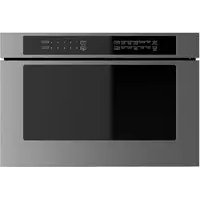
JMDFS24GS - Microwave Oven JENN-AIR - Free user manual and instructions
Find the device manual for free JMDFS24GS JENN-AIR in PDF.


| Product Type | Microwave Oven – Microwave Drawer |
| Brand | JENN-AIR |
| Model | JMDFS24GS |
| Power Supply | 120 V, 60 Hz, AC only, 15 or 20 A, fuse or circuit breaker |
| Microwave Power | Maximum power 1000 W (estimate based on typical specifications) |
| Capacity | Approximately 1.2 cu ft (34 L) – estimate for standard microwave drawer |
| Controls | Digital display, touch keys, control lock |
| Cooking Functions | Manual cooking, multi-stage cooking (up to 4), automatic start, reheat, defrost, keep warm, melt/soften/heat, sensor cooking, popcorn, beverage center |
| Automatic Programs | Sensor reheat, sensor cook, sensor popcorn, automatic defrost |
| Detection Type | Humidity sensor |
| Clock and Timer | 12-hour clock, adjustable timer in minutes and seconds |
| Special Functions | Demo mode, adjustable audible signals, built-in help |
| Care and Cleaning | Clean cavity, vent cover, exterior, control panel, and glide rails; non-abrasive products recommended |
| Safety | Control lock, overheat protection, microwave exposure precautions |
| Replacement Parts and Repairability | After-sales service by Jenn-Air (1-800-JENNAIR), 2-year limited warranty, original parts recommended |
| General Information | User and care guide available in French, 40 pages |
Frequently Asked Questions - JMDFS24GS JENN-AIR
User questions about JMDFS24GS JENN-AIR
0 question about this device. Answer the ones you know or ask your own.
Ask a new question about this device
Download the instructions for your Microwave Oven in PDF format for free! Find your manual JMDFS24GS - JENN-AIR and take your electronic device back in hand. On this page are published all the documents necessary for the use of your device. JMDFS24GS by JENN-AIR.
USER MANUAL JMDFS24GS JENN-AIR
For questions about features, operation/performance, parts, accessories, or service in the U.S.A., call 1-800-JENNAIR (1-800-536-6247) or visit our website at www.jennair.com.
In Canada, call 1-800-JENNAIR (1-800-536-6247) or visit our website at www.jennair.ca.
Precautions to Avoid Possible Exposure to
Excessive Microwave Energy 4
Electrical Requirements 5
PARTS AND FEATURES 5
MICROWAVE DRAWER CONTROLS 6
Display 6
Standby Mode. 6
Before First Use 6
Clock 6
Start 6
Add 1 Min. 6
Stop/Clear 6
Open/Close 6
Timer. 6
Control Lock. 6
Setup 6
Tones. 7
Demo Mode. 7
Help 7
MICROWAVE DRAWER USE. 7
Food Characteristics. 7
Cooking Guidelines 8
Cookware and Dinnerware 8
Aluminum Foil and Metal 8
Microwave Cooking Power. 9
Manual Cooking 9
Cooking in Stages 9
Auto Start 9
Doneness Adjustment. 10
Reheat (non-sensor) 10
Beverage Center 10
Defrost. 10
Keep Warm. 11
Melt/Soften/Warm 11
Sensor Cooking Information 12
Sensor Reheat 12
Sensor Popcorn 12
Sensor Cook. 13
MICROWAVE DRAWER CARE 14
General Cleaning. 14
TROUBLESHOOTING 15
ASSISTANCE OR SERVICE 16
In the U.S.A. 16
In Canada. 16
WARRANTY 17
SECURITE DU TIROIR A MICRO-ONDES 18
Your safety and the safety of others are very important.
We have provided many important safety messages in this manual and on your appliance. Always read and obey all safety messages.
This is the safety alert symbol.
This symbol alerts you to potential hazards that can kill or hurt you and others.
All safety messages will follow the safety alert symbol and either the word "DANGER" or "WARNING."
These words mean:
DANGER
You can be killed or seriously injured if you don't immediately follow instructions.
WARNING
You can be killed or seriously injured if you don't follow instructions.
All safety messages will tell you what the potential hazard is, tell you how to reduce the chance of injury, and tell you what can happen if the instructions are not followed.
IMPORTANT SAFETY INSTRUCTIONS
When using electrical appliances basic safety precautions should be followed, including the following:
WARNING: To reduce the risk of burns, electric shock, fire, injury to persons, or exposure to excessive microwave energy:
- Read all instructions before using the microwave oven.
Read and follow the specific "PRECAUTIONS TO AVOID POSSIBLE EXPOSURE TO EXCESSIVE MICROWAVE ENERGY" found on page 4.
The microwave oven must be grounded. Connect only to properly grounded outlet. See "GROUNDING INSTRUCTIONS" found on page 5 and in the provided Installation Instructions.
Install or locate the microwave oven only in accordance with the provided Installation Instructions.
Some products such as whole eggs in the shell and sealed containers - for example, closed glass jars - are able to explode and should not be heated in the microwave oven.
Use the microwave oven only for its intended use as described in this manual. Do not use corrosive chemicals or vapors in the microwave oven. This type of oven is specifically designed to heat, cook, or dry food. It is not designed for industrial or laboratory use.
As with any appliance, close supervision is necessary when used by children. - Do not operate the microwave oven if it has a damaged cord or plug, if it is not working properly, or if it has been damaged or dropped.
The microwave oven should be serviced only by qualified service personnel. Call an authorized service company for examination, repair, or adjustment.
See door surface cleaning instructions in the "Microwave Printer Care" section.
To reduce the risk of fire in the oven cavity:
- Do not overcook food. Carefully attend the microwave oven when paper, plastic, or other combustible materials are placed inside the oven to facilitate cooking.
- Remove wire twist-ties from paper or plastic bags before placing bags in oven.
- If materials inside the oven ignite, keep oven door closed, turn oven off, and disconnect the power cord, or shut off power at the fuse or circuit breaker panel.
- Do not use the cavity for storage purposes. Do not leave paper products, cooking utensils, or food in the cavity when not in use.
Liquids, such as water, coffee, or tea are able to be overheated beyond the boiling point without appearing to be boiling. Visible bubbling or boiling when the container is removed from the microwave oven is not always present. THIS COULD RESULT IN VERY HOT LIQUIDS SUDDENLY BOILING OVER WHEN THE CONTAINER IS DISTURBED OR A SPOON OR OTHER UTENSIL IS INSERTED INTO THE LIQUID.
To reduce the risk of injury to persons:
- Do not overheat the liquid.
- Stir the liquid both before and halfway through heating it.
- Do not use straight-sided containers with narrow necks.
- After heating, allow the container to stand in the microwave oven for a short time before removing the container.
-
Use extreme care when inserting a spoon or other utensil into the container.
-
Oversized foods or oversized metal utensils should not be inserted in the microwave oven as they may create a fire or risk of electric shock.
- Do not clean with metal scouring pads. Pieces can burn off the pad and touch electrical parts involving a risk of electric shock.
SAVE THESE INSTRUCTIONS
IMPORTANT SAFETY INSTRUCTIONS
- Do not store any materials, other than manufacturer's recommended accessories, in this oven when not in use.
- Do not store anything directly on top of the microwave oven when the microwave oven is in operation.
- Do not cover or block any openings on the microwave oven.
-
Do not store this microwave oven outdoors. Do not use the microwave oven near water - for example, near a kitchen sink, in a wet basement, or near a swimming pool, or similar locations.
-
Do not immerse cord or plug in water.
- Keep cord away from heated surfaces.
- Do not let cord hang over edge of table or counter.
Do not mount over a sink. - Do not cover any part of the oven with metal foil. This will cause overheating of the oven.
SAVE THESE INSTRUCTIONS
PRECAUTIONS TO AVOID POSSIBLE EXPOSURE TO EXCESSIVE MICROWAVE ENERGY
(a) Do not attempt to operate this oven with the door open since open-door operation can result in harmful exposure to microwave energy. It is important not to defeat or tamper with the safety interlocks.
(b) Do not place any object between the oven front face and the door or allow soil or cleaner residue to accumulate on sealing surfaces.
(c) Do not operate the oven if it is damaged. It is particularly important that the oven door close properly and that there is no damage to the:
(1) Door (bent),
(2) Hinges and latches (broken or loosened),
(3) Door seals and sealing surfaces.
(d) The oven should not be adjusted or repaired by anyone except properly qualified service personnel.
WARNING
Electrical Shock Hazard
Plug into a grounded 3 prong outlet.
Do not remove ground prong.
Do not use an adapter.
Do not use an extension cord.
Failure to follow these instructions can result in death, fire, or electrical shock.
Observe all governing codes and ordinances.
Required:
A 120 V, 60 Hz, AC-only, 15 A or 20 A electrical supply with a fuse or circuit breaker.
Recommended:
A time-delay fuse or time-delay circuit breaker
A separate circuit serving only this microwave drawer
GROUNDING INSTRUCTIONS
For all cord connected appliances:
The microwave oven must be grounded. In the event of an electrical short circuit, grounding reduces the risk of electric shock by providing an escape wire for the electric current. The microwave oven is equipped with a cord having a grounding wire with a grounding plug. The plug must be plugged into an outlet that is properly installed and grounded.
WARNING: Improper use of the grounding plug can result in a risk of electric shock. Consult a qualified electrician or serviceman if the grounding instructions are not completely understood, or if doubt exists as to whether the microwave oven is properly grounded.
Do not use an extension cord. If the power supply cord is too short, have a qualified electrician or serviceman install an outlet near the microwave oven. A short power supply cord is provided to reduce the risks resulting from becoming entangled in or tripping over a longer cord.
SAVE THESE INSTRUCTIONS
This device complies with Part 18 of the FCC Rules.
This device complies with Industry Canada ICES-001.
PARTS AND FEATURES
This manual may cover several different models. The model you have purchased may have some or all of the features shown here. The appearance of your particular model may differ slightly from the illustrations in this manual.
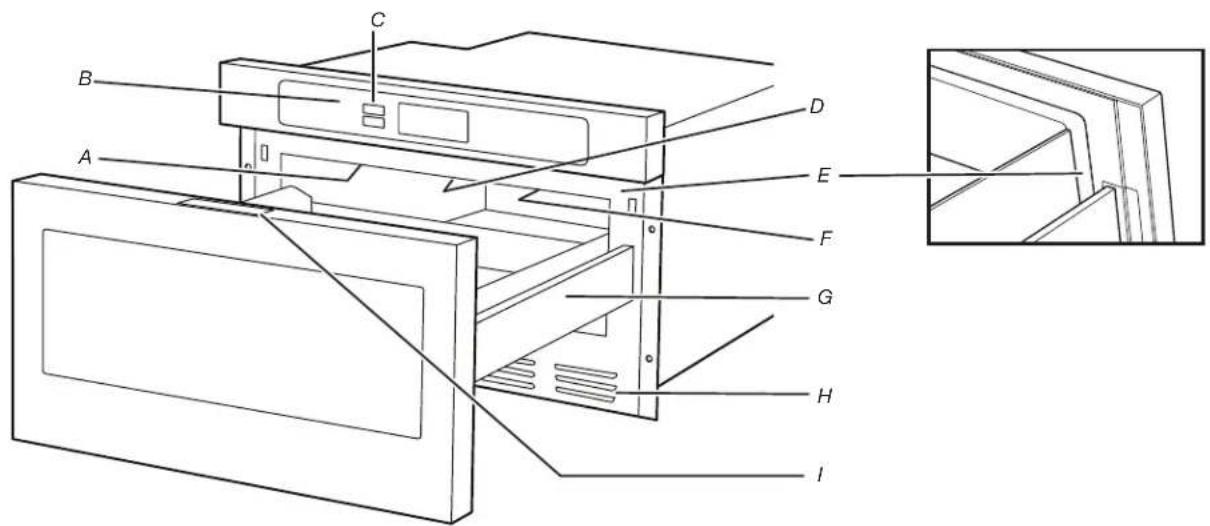
A. Microwave inlet cover - DO NOT REMOVE
B. Control Panel
C. OPEN and CLOSE controls
D. Name plate: open the microwave drawer fully. The label is beyond the back wall of the microwave cavity facing up from the flat surface.
E. Microwave drawer sealing surfaces
F. Microwave drawer light
G. Microwave drawer guides
H. Vent
I. Cooking Guide label
MICROWAVE DRAWER CONTROLS
This manual may cover several different models. The model you have purchased may have some or all of the features shown here. The appearance of your particular model may differ slightly from the illustrations in this manual.

Display
When the microwave drawer is in use, the display shows cooking power, quantities, weights, and/or prompts. When it is not in use, the display shows the time of day.
Standby Mode
This microwave will go into standby mode after a period of inactivity. The backlight of the display will automatically dim after 3 minutes if the unit has not been in operation. If the display is in standby mode, simply touch the control panel or open/close the door to return the backlight to maximum brightness.
Before First Use
When the microwave drawer is first plugged in, the message "Enjoy your microwave touch clear and touch clock" will scroll in the display. You will need to clear the message to set the clock.
Clear display:
- Touch Stop/Clear.
If the prompt "Enjoy your microwave touch clear and touch clock" appears at any other time, a power failure has occurred. Clear the display, and reset the clock.
NOTE: The microwave drawer can be programmed with the drawer open except when using Start/Add 1 Min.
Clock
This is a standard 12-hour clock (12:00-11:59).
To Set Clock:
- Touch Timer/clock, then number pad 2.
- Enter time in hours and minutes.
- Touch Timer/clock again to complete the setting.
Start
The Start control (Start/Add 1 Min) begins any cooking function. If cooking is interrupted, touching Start will resume the preset non-sensor function.
NOTE: To avoid unintentional operation of the microwave drawer, the Start control will work only if a cooking cycle has ended, the drawer has been closed or Stop has been touched within the last 3 minutes.
Add 1 Min
The Add 1 Min control (Start/Add 1 Min) starts the microwave drawer at 100% power for 1 minute. Each additional touch of the control will Add 1 Minute of cook time.
Cook time may be added in 1-minute increments to a cooking cycle at the current power level by touching Add 1 Min during the cycle. The Add 1 Min function cannot be used during Reheat, Defrost, or any sensor cycles.
NOTE: To avoid unintentional operation of the microwave drawer, the Add 1 Min control will work only if a cooking cycle has ended, the drawer has been closed, or Stop has been touched within the past 3 minutes.
Stop/Clear
The Stop control (Stop/Clear) clears any incorrect command, pauses cooking, and cancels most functions with one touch of the control. Touch Stop twice to cancel a running cooking cycle. The microwave drawer will also turn off when the drawer is opened. Close the drawer, and touch Start to resume the non-sensor cycle.
Open/Close
Touch the Open or Close pad on the control panel to open or close the drawer.
When opening or closing the drawer quickly, food in the microwave drawer may be spilled. To clean, refer to the "General Cleaning" section in "MicrowaveDrawer Care".
Timer
The Timer can be set in minutes and seconds, and counts down the set time.
NOTE: The Timer does not start or stop the microwave drawer.
To Set Timer:
- Touch Timer/clock, then number pad 1.
- Enter time in minutes and seconds.
- Touch Timer/clock again to start Timer.
Timer may be canceled at any time by touching Stop/Clear.
Control Lock
The Control Lock shuts down the control panel pads to avoid unintended operation of the microwave drawer. When the control is locked, only the Control Lock control will function.
To Lock/Unlock Control: Touch and hold Control Lock for 3 seconds. The display will indicate the lock status.
Setup
The Setup control (Setup/Custom Help) provides access to the following settings:
Tones: Sound off or on. See the "Tones" section.
■Reminder tones: Reminder signal off or on. See the "Tones" section.
Auto start: See the "Auto Start" section.
■Demo Mode: Demo Mode on or off. See the "Demo Mode" section.
Tones
End of Cycle Tones
Tones sound at the end of any cooking cycle unless turned off.
To Turn Off/On Sound: Touch Setup twice, then touch Start.
Reminder Tones
Tones sound every 10 seconds for 1 minute, then every three minutes up to 1 hour. Touch Stop to stop the tones.
To Turn Off/On Reminder: Touch Setup three times, then touch Start.
Demo Mode
The Demo Mode is ideal for learning how to use the microwave drawer. When Demo Mode is active, functions can be entered, with real displays and tones, without actually turning on the microwave generator (magnetron). While functions are operating in Demo Mode, the light comes on, and the display counts down the time quickly.
To activate Demo Mode: Touch Setup five times, then touch and hold Start for 3 seconds.
To deactivate Demo Mode: Touch Setup five times, then touch Start.
Help
Tips are available for all automatic functions. To view tips, touch Setup/Custom Help while "HELP" is lit in the display.
MICROWAVE DRAWER USE
A magnetron in the microwave drawer produces microwaves which reflect off the metal floor, walls, and ceiling and pass through the turntable and appropriate cookware to the food. Microwaves are attracted to and absorbed by fat, sugar, and water molecules in the food, causing them to move, producing friction and heat, which cooks the food.
To avoid damage to the microwave drawer, do not lean on or allow children to swing on the microwave drawer door.
To avoid damage to the microwave drawer, do not operate microwave drawer when it is empty.
Clothes, flowers, fruit, herbs, wood, gourds, paper, including brown paper bags and newspaper, should not be dried in microwave drawer.
The vent under the drawer must not be blocked. During microwaving, steam may come out of the right side of the vent.
It is normal for the exterior of the microwave drawer to be warm to the touch when cooking or reheating.
Paraffin wax will not melt in the microwave drawer because it does not absorb microwaves.
Use oven mitts or pot holders when removing containers from microwave drawer.
- Keep the microwave inlet cover clean: food residue can cause arcing and/or fires (see the "Microwave Printer Cavity" section in "Microwave Printer Care").
Baby bottles and baby food jars should not be heated in microwave drawer. Transfer baby food to a small microwave-safe dish and heat, stirring often.
■Pierce skins of potatoes, apples, squash, hot dogs, and sausages so that steam escapes while cooking.
■Do not overcook potatoes. At the end of the recommended cook time, potatoes should be slightly firm. Let potatoes stand for 5 minutes to finish cooking.
■Do not cook or reheat whole eggs inside the shell. Steam buildup in whole eggs may cause them to burst, requiring significant cleanup of microwave drawer. Cover poached eggs and allow a standing time.
Food Characteristics
When microwave cooking, the amount, size and shape, starting temperature, composition and density of the food affect cooking results.
Amount of Food
The more food heated at once, the longer the cook time needed. Check for doneness and add small increments of time if necessary.
Size and Shape
Smaller pieces of food will cook more quickly than larger pieces, and uniformly shaped foods cook more evenly than irregularly shaped food.
Starting Temperature
Room temperature foods will heat faster than refrigerated foods, and refrigerated foods will heat faster than frozen foods.
Composition and Density
Foods high in fat and sugar will reach a higher temperature, and will heat faster than other foods. Heavy, dense foods, such as meat and potatoes, require a longer cooking time than the same size of a light, porous food, such as cake.
Cooking Guidelines
Cooking Time
Monitor the cooking time. Cook for the shortest amount of time indicated and add more as needed. Food severely overcooked can smoke or ignite.
To test for doneness, insert a thermometer in a thick or dense area away from fat or bone. Do not leave the thermometer in the food during cooking, unless it is approved for microwave use.
Use the following chart when checking for doneness:
| FOOD | RECOMMENDED TEMPERATURE |
| Fish 145°F (63°C) | |
| Pork | 160°F (71°C) |
| Ground beef/veal/lamb | |
| Egg dishes | |
| Leftovers | 165°F (74°C) |
| Refrigerated deli and carry-out “fresh” food | |
| Whole, pieces, and ground turkey/chicken/duck |
Covering
Covering food helps retain moisture, shorten cook time, and reduce spattering. Use the lid supplied with cookware. If a lid is not available, wax paper, paper towels, or plastic wrap approved for microwave drawers may be used. Plastic wrap should be turned back at one corner to provide an opening to vent steam. Condensation on the door and cavity surfaces is normal during heavy cooking.
Stirring and Turning
Stirring and turning redistribute heat evenly to avoid overcooking the outer edges of food. Stir from outside to center. If possible, turn food over from bottom to top.
Arranging
If heating irregularly shaped or different sized foods, arrange the thinner parts and smaller sized items toward the center. If cooking several items of the same size and shape, place them in a ring pattern, leaving the center of the ring empty.
Piercing
Before heating, use a fork or small knife to pierce or prick foods that have a skin or membrane, such as potatoes, egg yolks, chicken livers, hot dogs, and sausage. Prick in several places to allow steam to vent.
Shielding
Use small, flat pieces of aluminum foil to shield the thin pieces of irregularly shaped foods, bones and foods such as chicken wings, leg tips and fish tail. See the "Aluminum Foil and Metal" section first.
Standing Time
Food will continue to cook by the natural conduction of heat even after the microwave cooking cycle ends. The length of standing time depends on the volume and density of the food.
Cookware and Dinnerware
Cookware and dinnerware must fit on the turntable. Always use oven mitts or pot holders when handling because any dish may become hot from heat transferred from the food. Do not use cookware and dinnerware with gold or silver trim. Use the following chart as a guide, then test before using.
MATERIAL RECOMMENDATIONS
| Aluminum Foil, Metal | See "Aluminum Foil and Metal" section. |
| Browning Dish Bottom must be at least 3/16" (5 mm) above the turntable. Follow manufacturer's recommendations. | |
| Ceramic Glass, Glass | Acceptable for use. |
| China, Earthenware | Follow manufacturer's recommendations. |
| Melamine Follow manufacturer's recommendations. | |
| Paper: Towels, Dinnerware, Napkins | Use nonrecycled and those approved by the manufacturer for microwave drawer use. |
| Plastic: Wraps, Bags, Covers, Dinnerware, Containers | Use those approved by the manufacturer for microwave drawer use. |
| Pottery and Clay Follow manufacturer's recommendations. | |
| Silicone Bakeware Follow manufacturer's recommendations. | |
| Straw, Wicker, Wooden Containers | Do not use in microwave drawer. |
| Wax Paper Acceptable for use. | |
To Test Cookware or Dinnerware for Microwave Use:
- Place cookware or dinnerware in microwave drawer with 1 cup (250 mL) of water beside it.
- Cook at 100% cooking power for 1 minute.
Do not use cookware or dinnerware if it becomes hot and the water stays cool.
Aluminum Foil and Metal
Always use oven mitts or pot holders when removing dishes from the microwave drawer.
Aluminum foil and some metal can be used in the microwave drawer. If not used properly, arcing (a blue flash of light) can occur and cause damage to the microwave drawer.
When using aluminum foil, only use small, flat pieces placed smoothly on the food. Foil should not come closer than one inch to any surface of the microwave drawer.
OK for Use
Racks and bakeware supplied with the microwave drawer (on some models), aluminum foil for shielding, and approved meat thermometers may be used with the following guidelines:
- To avoid damage to the microwave drawer, do not allow aluminum foil or metal to touch the inside cavity walls, ceiling, or floor.
To avoid damage to the microwave drawer, do not allow contact with another metal object during microwave cooking.
Do Not Use
Metal cookware and bakeware
Gold, silver, and pewter
Nonapproved meat thermometers
Skewers
Twist ties
Oil liners such as sandwich wrappers
Staples
■Objects with gold or silver trim or a metallic glaze
Non-heat-resistant glass
Plastics that are not microwave safe, such as margarine tubs
Recycled paper products and brown paper bags.
Microwave Cooking Power
Many recipes for microwave cooking specify which cooking power to use by percent, name, or number. For example, 70% = Medium-High. When using the microwave drawer at power levels below 100% , you may hear the magnetron cycling on and off: this is normal microwave operation. Use the following chart as a general guide for the suggested cooking power of specific foods.
| PERCENT/NAME | POWERLEVELPADTOUCH | USE |
| 100%, High(default setting) | Once Quick-heating convenience offoods with high water content,such as soups, beverages andmost vegetables. | |
| 90% Twice Cooking small tender piecesof meat, ground meat, poultrypieces, and fish fillets.Heating cream soups. | ||
| 80% Three | times | Heating rice, pasta, or stirrablecasseroles.Cooking and heating foods thatneed a cook power lower thanhigh. For example, whole fish andmeatloaf. |
| 70%, Medium-High | Four times | Reheating a single serving offood. |
| 60% Five | times | Cooking sensitive foods such ascheese and egg dishes, pudding,and custards.Cooking non-stirrable casseroles,such as lasagna. |
| 50%, Medium Six times Cooking ham, whole poultry,and pot roasts.Simmering stews. | ||
| 40% Seven | times | Melting chocolate.Heating bread, rolls, and pastries. |
| 30%, Medium-Low, Defrost | Eighttimes | Defrosting bread, fish, meats,poultry, and precooked foods. |
| 20% Nine | times | Softening butter, cheese, and icecream. |
| 10%, Low Ten times Taking chill out of fruit. | ||
| 0% Eleven | times | Sensor operation; no cookpower. |
Manual Cooking
To Use:
- Place food in the microwave drawer, and close the drawer.
- Enter the cook time in minutes and seconds. If cooking with 100% power, skip Step 3.
- Touch Power Level repeatedly to set the desired cooking power. See "Microwave Cooking Power".
- Touch Start.
When the cycle ends, "END" will appear in the display, and the end-of-cycle tones will sound, followed by reminder tones.
- Touch Stop or open the drawer to clear the display.
Cook time may be added in 1-minute increments during the cycle by touching Add 1 Min.
Cooking in Stages
The microwave drawer can be set to cook at different cooking powers for various lengths of time, up to four stages.
To Cook in Stages:
- Place food in the microwave drawer, and close the drawer.
- Enter the length of time to cook during the first stage.
- Touch Power Level repeatedly to set the desired cooking power for the 1st stage. See "Microwave Cooking Power".
- Repeat steps 2 and 3 for additional stages.
- Touch Start.
When the cycle ends, "END" will appear in the display, and end-of-cycle tones will sound, followed by reminder tones.
- Touch STOP or open the drawer to clear the display.
NOTES:
Cook time may be added in 1-minute increments during the cycle by touching Add 1 Min.
To see the cook power during operation, touch Power Level.
■Keep Warm can be added even if four stages have been set.
Auto Start
WARNING
Food Poisoning Hazard
Do not let food sit in oven more than one hour before or after cooking.
Doing so can result in food poisoning or sickness.
The Auto Start function allows you to program a cook cycle to start at a set time.
To Use Auto Start:
- Place food in the microwave drawer, and close the drawer.
- Touch Setup/Custom Help four times.
- Touch Start.
- Enter the cooking start time in hours and minutes.
- Touch Timer/Clock.
- Enter length of time to cook in minutes and seconds.
- Touch Power Level repeatedly to set the desired cooking power. See the "Microwave Cooking Power" section.
- Touch Start.
When the cycle ends, "END" will appear in the display, and end-of-cycle tones will sound, followed by reminder tones.
- Touch Stop or open the drawer to clear the display.
Doneness Adjustment
Doneness may be adjusted for every cooking program except Keep Warm. During programming, touch Power Level after food and quantity selections are made. Touch Power Level once for "MORE", or twice for "LESS".
Reheat (non-sensor)
Times and cooking power have been preset for reheating specific food types. Use the following chart as a guide.
FOOD NO. QUANTITY/INSTRUCTIONS
| Fresh Rolls/ Muffins | 1 1-8 pieces, 2 oz (57 g) each*. Place on paper towel. |
| Frozen Rolls/ Muffins | 2 1-8 pieces, 2 oz (57 g) each*. Place on paper towel. |
*For smaller rolls, two rolls may be counted as one piece. For larger or refrigerated rolls, one roll may be counted as 2 pieces.
To Use Reheat:
- Place food in the microwave drawer, and close the drawer.
- Touch Reheat.
- Select food item by entering its number (see chart and/or cooking guide label).
- Enter quantity. Doneness may be adjusted at this time by touching Power Level.
- Touch Start.
When the cycle ends, "END" will appear in the display, and end-of-cycle tones will sound, followed by reminder tones.
6. Touch Stop or open the drawer to clear the display.
Beverage Center
Beverage Center enables you to reheat coffee or tea to restore it to a more suitable drinking temperature, or to make instant coffee or tea.
FOOD NO. QUANTITY/INSTRUCTIONS
| Reheat beverage | 1 0.5-2 cups (125-500 mL). Choose cook time by touching number 1 for each 0.5 cup. For example, for 1 cup of coffee, you would touch 1 twice. |
| Hot water 2 1-6 cups (250-1500 mL). Use this setting for heating cold tap water to a temperature below the boiling point to make instant coffee or tea. Choose cook time by touching number 2 for each 1 cup of water. For example, 2 cups of water, you would touch 2 twice. | |
To Use Beverage Center:
- Place container with beverage or water in the microwave drawer, and close the drawer.
- Touch Beverage Center.
- Touch 1 for reheating your cooled beverage, or 2 for heating water for coffee or tea.
- Select quantity by re-touching 1 or 2 (depending on selection) until the correct quantity is reached. Doneness may be adjusted at this time by touching Power Level.
- Touch Start.
Defrost
The automatic defrost function can be used, or the microwave drawer can be manually set to defrost.
Unwrap foods and remove lids (for example, from fruit juice containers) before defrosting.
Shallow packages will defrost more quickly than deep blocks.
Separate food pieces as soon as possible during or at the end of cycle for more even defrosting.
When using plastic containers from the freezer, defrost only long enough to remove the food from the plastic in order to place it in a microwave-safe dish.
Use small pieces of aluminum foil to shield parts of food such as chicken wings, leg tips and fish tails. See the "Aluminum Foil and Metal" section first.
The automatic defrost function should not be used for food left outside the freezer for more than 20 minutes and frozen ready-made food.
Times and cooking power have been preset for defrosting certain food types. Use the following chart as a guide.
FOOD NO. QUANTITY/INSTRUCTIONS
| Ground meat | 1 0.5-2.0 lbs (227-907 g). Remove wrap and place in microwave-safe baking dish. Do not cover. |
| Steaks/Chops | 2 0.5-3.0 lbs (227 g-1.4 kg). Remove wrap and place in microwave-safe baking dish. Do not cover. |
| Boneless poultry | 3 0.5-2.0 lbs (227-907 g). Remove wrap and place in microwave-safe baking dish. Do not cover. |
| Bone-in poultry | 4 0.5-3.0 lbs (227 g-1.4 kg). Remove wrap and place breast side up in microwave-safe baking dish. Do not cover. |
| Roast 5 2.0-4.0 lbs (907 g-1.8 kg). Remove wrap and place fat side down in microwave-safe baking dish. After each stage, turn roast over and shield the warm portions with aluminum foil. Let stand, covered, for 30 to 60 minutes. | |
| Casserole/ Soup | 6 1-6 cups (250 mL-1.5 L). Remove wrap and place in microwave-safe baking dish. Do not cover. |
To Use the Defrost Control:
- Place food, uncovered, in the microwave drawer, and close the drawer.
- Touch Defrost.
- Select food item by entering its number (see chart and/or cooking guide label).
- Enter the weight in tenths of a pound for Meat or Poultry, or enter volume in cups for Casserole/Soup. See chart for quantity limits.
Doneness may be adjusted at this time by touching Power Level.
5. Touch Start. The display will count down the defrost time. During defrosting, tones will sound to indicate it is time to check, turn, rearrange or separate food. Open drawer, turn food if necessary, close door and touch Start to resume defrosting.
When the cycle ends, "LET STAND COVERED" will appear in the display, and end-of-cycle tones will sound, followed by reminder tones.
- Touch Stop or open the drawer to clear the display.
To Defrost Manually: Follow directions in the "Manual Cooking" section, and use 30% cooking power. See the "Microwave Cooking Power" chart.
Keep Warm
WARNING
Food Poisoning Hazard
Do not let food sit in oven more than one hour before or after cooking.
Doing so can result in food poisoning or sickness.
Hot cooked food can be kept warm in the microwave drawer. Keep Warm can be used by itself, or it can be programmed to follow a manual cooking cycle.
Cover plates of food and foods that were covered while being cooked.
■For best results, do not cover baked goods such as pastries, pies, turnovers, etc.
- Keep Warm cannot be used with Sensor Popcorn, Sensor Reheat, Sensor Cook, Defrost, or Reheat.
To Use:
- Place hot cooked food in the microwave drawer and close the drawer.
- Touch Keep Warm.
- Enter warm time in minutes and seconds, up to 30 minutes.
- Touch Start. The display will count down the warm time. "KEEP WARM" will appear in the display intermittently during countdown. When the cycle ends, "END" will appear in the display, and end-of-cycle tones will sound, followed by reminder tones.
- Touch Stop or open the drawer to clear the display.
To add to end of cooking cycle: Touch Keep Warm while setting a manual cooking cycle before touching Start.
Melt/Soften/Warm
Melt, Soften, and Warm automatically determine the correct heating time and microwave power level for melting, softening, and warming the foods shown in the chart below.
FOOD NO. QUANTITY/INSTRUCTIONS
| Melt Place butter in a microwave-safe dish and cover with plastic wrap. | |
| Butter 1 2 tbsp-1/2 cup (30-125 mL). After touching MELT, touch 1 twice for 2 tbsp (30 mL), or three times for 1/2 cup (125 mL). | |
| Chocolate 2 1 cup (250 mL) chips or 1 square. After touching MELT, touch 2 twice for 1 cup (250 mL) chips, or three times for 1 square. | |
| Soften Do not cover. | |
| Ice cream 1 1 pint or 1/2 gallon (0.5-2 L). After touching SOFTEN, touch 1 twice for 1 pint (0.5 L), or three times for 1/2 gallon (2 L). | |
| Cream cheese | 2 3-8 oz (85-225 g). After touching SOFTEN, touch 2 twice for 3 oz (85 g), or three times for 8 oz (225 g). |
| Warm Place food in a microwave-safe dish. Do not cover. | |
| Syrup 1 1/4-1/2 cup (63-125 mL). After touching WARM, touch 1 twice for 1/4 cup (63 mL), or three times for 1/2 cup (125 mL). | |
| Dessert toppings | 2 1/4-1/2 cup (63-125 mL). After touching WARM, touch 2 twice for 1/4 cup (63 mL), or three times for 1/2 cup (125 mL). |
To Use Melt, Soften, or Warm:
- Place food in the microwave drawer and close the drawer.
- Select Melt, Soften, or Warm, depending on the food item.
- Select food item by entering its number (see chart below).
- Select quantity by re-touching 1 or 2 (depending on selection) until the correct quantity is reached.
Doneness may be adjusted at this time by touching Power Level.
- Touch Start.
Sensor Cooking Information
A sensor in the microwave drawer detects humidity released from the food as it heats and adjusts the cook time accordingly.
Many sensor cycles require the covering of foods. Microwave-safe containers or steamers with loose-fitting lids are recommended. The loose-fitting lid allows enough steam to escape to be detected by the sensor. When covering foods with plastic wrap, be sure to leave a large enough vent opening to allow the steam to escape.
Sensor cooking options include Sensor Popcorn, Sensor Cook, and Sensor Reheat.
NOTES:
The microwave drawer should be plugged in for at least 3 minutes before using any sensor setting.
The microwave drawer cavity and the exterior of the cooking container should be dry.
The room temperature should not exceed 95ircF (35ircC)
Once the sensor cycle begins, the food name will appear on the display. If the drawer is opened during this time, sensing will stop and the program will be canceled. When sensing is complete, a remaining time will appear on the display. Once the time is displayed, you may open the drawer to stir or season food, if desired.
Check food temperature after cycle is complete. If additional time is needed, continue to cook using the manual settings.
Except when using Sensor Popcorn, if the sensor does not detect humidity properly, "ERROR" will be displayed, and the microwave drawer will turn off.
The sensor works with foods at normal storage temperature. If your food is frozen, it will need to be defrosted before using a sensor cycle.
Sensor Reheat
The sensor in the microwave drawer determines the reheating time based on the weight of the food being heated.
Sensor Reheat will detect humidity and reheat food items from 4 to 36 oz (113-1020 g).
To Use Sensor Reheat:
- Place food, loosely covered, in the microwave drawer, and close the drawer.
- Touch Sensor Reheat.
- Touch Start.
When the cycle ends, "LET STAND COVERED" will appear in the display, and end-of-cycle tones will sound, followed by reminder tones.
- Touch Stop or open the drawer to clear the display.
Sensor Popcorn
The sensor in the microwave drawer determines the appropriate popping time of commercially packaged microwavable popcorn. This function is programmed to detect popping times for 3.5-oz (99 g), 3.0-oz (85 g) and 1.75-oz (50 g) bags.
NOTE: During Popcom function, as with all microwave cooking functions, the microwave drawer should be attended at all times. Listen for popping to slow to one pop every 1 or 2 seconds, then stop the cycle.
- To avoid damage to the microwave drawer, do not use regular paper bags or glassware.
■Pop only one package of popcorn at a time.
■Follow manufacturer's instructions when using a microwave popcorn popper.
For best cooking results, do not try to pop unpopped kernels.
Use fresh bags of popcorn for optimal results.
Cooking results may vary by brand and fat content. For bag sizes not listed in this section, follow directions on the package.
- Cooking results may vary based on location of bag on the floor of the microwave drawer. Try changing bag location to achieve best results.
To Use Sensor Popcorn:
- Place popcorn bag in the microwave drawer, and close the drawer.
- Touch SENSOR POPCORN once for Regular (2.85-3.5 oz [81-99 g]), or twice for Snack (1.2-1.6 oz [34-45 g]).
Doneness may be adjusted at this time by touching Power Level.
- Touch Start.
When the cycle ends, "END" will appear in the display, and end-of-cycle tones will sound, followed by reminder tones. - Touch Stop or open the drawer to clear the display.
Sensor Cook
The sensor in the microwave drawer detects humidity released from the food and automatically sets a cooking time based on the selected food category.
Use the following chart as a guide for Sensor Cooking.
NOTE: When covering foods, make sure the vent opening is large enough for moisture to escape. This will allow the sensor to accurately determine cooking time.
FOOD NO. AMOUNT INSTRUCTIONS
| Fresh vegetables: quick | 1 0.25-2.0 lbs (113-907 g) | Rinse and place in microwave-safe container. Cover with lid for tender vegetables. Cover with plastic wrap and vent for tender-crisp vegetables. Stir and let stand, covered, 2-5 minutes after cooking. |
| Fresh vegetables: longer | 2 0.25-1.5 lbs (113-680 g) | Place in microwave-safe container and add 1-4 tbs (30-60 mL) water. Cover with lid for tender vegetables. Cover with plastic wrap and vent for tender-crisp vegetables. Stir and let stand, covered, 2-5 minutes after cooking. |
| Frozen vegetables 3 0.25-1.25 lbs | (113-567 g) | Remove from package. Place in microwave-safe container. Do not add water. Cover with lid or plastic wrap, and vent. Stir and let stand, covered, 2-3 minutes after cooking. |
| Frozen entrées 4 6-17 oz | (170-482 g) | Remove from outer package and follow package directions for covering. If entree is not in microwave-safe container, place on plate, cover with plastic wrap, and vent. |
| Baked potatoes | 5 1-6 medium, 10-13 oz | Pierce each one several times with a fork. Place on paper towel, at least 1" (2.5 cm) apart. After cooking, remove from microwave drawer, wrap in foil, and let stand 5-10 minutes. |
| Sweet potatoes | 6 (283-369 g) each | |
| Ground meat 7 0.25-2.0 lbs | (113-907 g) | Crumble meat into a microwave-safe container. Cover with plastic wrap, and vent. Microwave drawer will stop midway through cooking; stir, re-cover, and touch Start to resume cooking. After cooking, stir and let stand, covered, for 2-3 minutes. Place patties on microwave-safe rack, and cover with wax paper. Microwave drawer will stop midway through cooking; turn patties over, re-cover, and touch Start to resume cooking. Let stand 2-3 minutes, covered, after cooking. |
| Fish/ Seafood 8 0.25-2.0 lbs | (113-907 g) | Thin fillets and shrimp: Place in microwave-safe plate or dish with low sides. Cover with plastic wrap, and vent. Thick fillets and steak: place in microwave-safe casserole dish. Cover with plastic wrap, and vent. Adjust doneness to "MORE". |
| White rice | 9 0.5-2 cups | Follow measurements on package for ingredient amounts. Place rice and liquid (see chart below) in a deep microwave-safe bowl or casserole. Cover with loose-fitting lid or plastic wrap. Let stand 5 minutes after cooking, or until liquid is absorbed. Stir. |
| Brown rice | 10 (125-500 mL) dry medium or long grain rice |
To Use Sensor Cook:
- Place food, loosely covered, in the microwave drawer, and close the drawer.
- Touch Sensor Cook.
- Select food item by entering its number (see chart or cooking guide label). See chart for quantity limits.
Doneness may be adjusted at this time by touching Power Level.
- Touch Start.
The cycle may pause for turning or stirring of food. Stir or turn food, then touch Start to resume cooking.
When the cycle ends, the end-of-cycle tones will sound, followed by reminder tones.
- Touch Stop or open the drawer to clear the display.
MICROWAVE DRAWER CARE
General Cleaning
IMPORTANT: Before cleaning, make sure all controls are off and the microwave drawer is cool. Always follow label instructions on cleaning products.
Soap, water, and a soft cloth or sponge are suggested unless otherwise noted.
MicrowaveDrawer Cavity
To avoid damage to the microwave drawer cavity, do not use soap-filled scouring pads, abrasive cleaners, steel-wool pads, gritty washcloths or some recycled paper towels.
To avoid damage to stainless steel models, rub in direction of grain.
The area where the microwave drawer and frame touch when closed should be kept clean.
Average soil
■Mild, nonabrasive soaps and detergents:
Rinse with clean water and dry with soft, lint-free cloth.
Heavy soil
■Mild, nonabrasive soaps and detergents:
Heat 1 cup (250 mL) of water for 2 to 5 minutes in microwave drawer. Steam will soften soil. Rinse with clean water and dry with soft, lint-free cloth.
Odors
Lemon juice or vinegar:
Heat 1 cup (250 mL) of water with 1 tbs (15 mL) of either
lemon juice or vinegar for 2 to 5 minutes in microwave drawer.
Microwave Inlet Cover
To avoid arcing and microwave drawer damage, the microwave inlet cover (see "Parts and Features") should be kept clean.
Wipe with wet cloth.
MicrowaveDrawer Exterior
The area where the microwave drawer and frame touch when closed should be kept clean.
■Mild, nonabrasive soaps and detergents:
Rinse with clean water and dry with soft, lint-free cloth.
Glass cleaner and paper towels or nonabrasive plastic scrubbing pad:
Apply glass cleaner to towel, not directly to surface.
Stainless Steel (on some models)
To avoid damage to microwave drawer and exterior, do not use soap-filled scouring pads, abrasive cleaners, steel-wool pads, gritty washcloths or some paper towels. Rub in direction of grain.
Stainless Steel Cleaner and Polish (not included):
See "Assistance or Service" section to order.
Liquid detergent or all-purpose cleaner:
Rinse with clean water and dry with soft, lint-free cloth.
Vinegar for hard water spots.
Control Panel
Sponge or soft cloth and water:
Dampen sponge with water and wipe panel. Dry with soft
cloth.
To avoid damage to the control panel, do not use chemical or abrasive cleansers.
Microwave Printer Guides
To keep drawer opening and closing smoothly, remove crumbs from guides, and clean often.
Dry, soft cloth
TROUBLESHOOTING
First try the solutions suggested here. If you need further assistance or more recommendations that may help you avoid a service call, refer to the warranty page in this manual or visit https://producthelp.jennair.com. In Canada, visit http://www.jennair.ca.
Contact us by mail with any questions or concerns at the address below.
In the U.S.A.:
JennAir Brand Home Appliances
Customer eXperience Center
553 Benson Road
Benton Harbor, MI 49022-2692
Please include a daytime phone number in your correspondence.
In Canada:
JennAir Brand Home Appliances
Customer eXperience Centre
200 - 6750 Century Ave.
Mississauga, Ontario L5N 0B7
Problem Possible Causes and/or Solutions
| Nothing will operate | A household fuse has blown, or a circuit breaker has tripped: Replace the fuse or reset the circuit breaker. If the problem continues, call an electrician. |
| Microwave drawer will not operate | The magnetron is not working properly: Try to heat 1 cup (250 mL) of cold water for 2 minutes at 100% cooking power. If water does not heat, try the steps below. If microwave drawer still does not operate, call for service. See “Assistance or Service” section.The electronic microwave drawer control is not set correctly: See the “MicrowaveDrawer Control” section.The Control Lock is on (on some models): See “Control Lock” section.The Demo Mode is active (on some models): See “Demo Mode” section. |
| Microwave drawer makes a humming noise | This is normal and occurs when the power supply switches the magnetron on and off. |
| Microwave drawer front looks wavy | This is normal and will not affect performance. |
| Display is showing “ERROR” during sensor cooking | The sensor is not detecting humidity. Check the food and the cover, then start the program again. See the “Sensor Cooking” section. |
| Fan is running slower than usual | The microwave drawer has been stored in a cold area: The fan will run slower until the microwave drawer warms up to normal room temperature. |
| Cooking times seem too long | Cooking power not set properly: See “Microwave Cooking Power” section.Large amounts of food being heated: Larger amounts of food need longer cooking times. |
| Radio, TV or cordless phone interference | The radio or TV receiver is near the microwave drawer: Move the receiver away from the microwave drawer, or adjust the radio or TV antenna.The microwave drawer door and sealing surfaces are dirty: Make sure these areas are clean.The cordless phone frequency is 2.4 GHz: Some 2.4 GHz-based cordless phones and home wireless networks may experience static or noise while the microwave drawer is on. Use a corded phone, a different frequency cordless phone, or avoid using these items during microwave drawer operation. |
ASSISTANCE OR SERVICE
If you need service
Please refer to the warranty page in this manual.
If you need replacement parts
If you need to order replacement parts, we recommend that you use only factory specified parts. These factory specified parts will fit right and work right because they are made with the same precision used to build every new JennAir® appliance.
To locate factory specified parts in your area, call us or your nearest JennAir designated service center.
In the U.S.A.
Call the Customer eXperience Center toll-free: 1-800-JENNAIR (1-800-536-6247).
Our consultants provide assistance with:
■Features and specifications on our full line of appliances.
■Installation information.
Use and maintenance procedures.
Repair parts sales.
■Specialized customer assistance (Spanish speaking, hearing impaired, limited vision, etc.).
Referrals to local dealers, repair parts distributors and service companies. JennAir designated service technicians are trained to fulfill the product warranty and provide afterwarranty service anywhere in the United States.
To locate the JennAir designated service company in your area, you can also look in your telephone directory Yellow Pages.
For further assistance
If you need further assistance, you can write with any questions or concerns at:
JennAir Brand Home Appliances
Customer eXperience Center
553 Benson Road
Benton Harbor, MI 49022-2692
Please include a daytime phone number in your correspondence.
In Canada
Call the JennAir Canada LP Customer eXperience Centre toll-free: 1-800-JENNAIR (1-800-536-6247).
Our consultants provide assistance with:
Use and maintenance procedures.
Repair parts sales.
Referrals to local dealers, repair parts distributors and service companies. JennAir designated service technicians are trained to fulfill the product warranty and provide afterwarranty service anywhere in Canada.
For further assistance
If you need further assistance, you can write with any questions or concerns at:
JennAir Brand Home Appliances
Customer eXperience Centre
200-6750 Century Ave
Mississauga, ON L5N 0B7
Please include a daytime phone number in your correspondence.
JENNAIR® COOKING LIMITED WARRANTY
ATTACH YOUR RECEIPT HERE. PROOF OF PURCHASE IS REQUIRED TO OBTAIN WARRANTY SERVICE.
Please have the following information available when you call the Customer eXperience Center:
Name, address and telephone number
■Model number and serial number
A clear, detailed description of the problem
Proof of purchase including dealer or retailer name and address
IF YOU NEED SERVICE:
- Before contacting us to arrange service, please determine whether your product requires repair. Some questions can be addressed without service. Please take a few minutes to review the Troubleshooting section of the Use and Care Guide or visit producthelp.jennair.com.
- All warranty service is provided exclusively by our authorized JennAir Service Providers. In the U.S. and Canada, direct all requests for warranty service to:
JennAir Customer eXperience Center
1-800-JENNAIR (1-800-536-6247).
If outside the 50 United States or Canada, contact your authorized JennAir dealer to determine whether another warranty applies.
TWO YEAR LIMITED WARRANTY
WHAT IS COVERED WHAT IS NOT COVERED
For two years from the date of purchase, when this major appliance is installed, operated, and maintained according to instructions attached to or furnished with the product, JennAir brand of Whirlpool Corporation or Whirlpool Canada LP (hereafter "JennAir") will pay for factory specified replacement parts and repair labor to correct defects in materials or workmanship that existed when this major appliance was purchased or, at its sole discretion, replace the product. In the event of product replacement, your appliance will be warranted for the remaining term of the original unit's warranty period.
YOUR SOLE AND EXCLUSIVE REMEDY UNDER THIS LIMITED WARRANTY SHALL BE PRODUCT REPAIR AS PROVIDED HEREIN. Service must be provided by a JennAir designated service company. This limited warranty is valid only in the United States or Canada and applies only when the major appliance is used in the country in which it was purchased. This limited warranty is effective from the date of original consumer purchase. Proof of original purchase date is required to obtain service under this limited warranty.
- Commercial, non-residential, multiple-family use, or use inconsistent with published user, operator or installation instructions.
- In-home instruction on how to use your product.
- Service to correct improper product maintenance or installation, installation not in accordance with electrical or plumbing codes or correction of household electrical or plumbing (i.e. house wiring, fuses or water inlet hoses).
- Consumable parts (i.e. light bulbs, batteries, air or water filters, preservation solutions, etc.).
- Defects or damage caused by the use of non-genuine JennAir parts or accessories.
- Conversion of products from natural gas or propane gas.
- Damage from accident, misuse, abuse, fire, floods, acts of God or use with products not approved by JennAir.
- Repairs to parts or systems to correct product damage or defects caused by unauthorized service, alteration or modification of the appliance.
- Cosmetic damage including scratches, dents, chips, and other damage to the appliance finishes unless such damage results from defects in materials and workmanship and is reported to JennAir within 30 days.
- Discoloration, rust or oxidation of surfaces resulting from caustic or corrosive environments including but not limited to high salt concentrations, high moisture or humidity or exposure to chemicals.
- Food or medicine loss due to product failure.
- Pick-up or delivery. This product is intended for in-home repair.
- Travel or transportation expenses for service in remote locations where an authorized JennAir servicer is not available.
- Removal or reinstallation of inaccessible appliances or built-in fixtures (i.e. trim, decorative panels, flooring, cabinetry, islands, countertops, drywall, etc.) that interfere with servicing, removal or replacement of the product.
- Service or parts for appliances with original model/serial numbers removed, altered or not easily determined.
The cost of repair or replacement under these excluded circumstances shall be borne by the customer.
DISCLAIMER OF IMPLIED WARRANTY
IMplied warranties, including any implied warranty of merchantability or implied warranty of fitness for a particular purpose, are limited to two years or the shortest period allowed by law. Some states and provinces do not allow limitations on the duration of implied warranties of merchantability or fitness, so this limitation may not apply to you. This warranty gives you specific legal rights, and you also may have other rights that vary from state to state or province to province.
DISCLAIMER OF REPRESENTATIONS OUTSIDE OF WARRANTY
JennAir makes no representations about the quality, durability, or need for service or repair of this major appliance other than the representations contained in this warranty. If you want a longer or more comprehensive warranty than the limited warranty that comes with this major appliance, you should ask JennAir or your retailer about buying an extended warranty.
LIMITATION OF REMEDIES: EXCLUSION OF INCIDENTAL AND CONSEQUENTIAL DAMAGES
YOUR SOLE AND EXCLUSIVE REMEDY UNDER THIS LIMITED WARRANTY SHALL BE PRODUCT REPAIR AS PROVIDED HEREIN. JennAir SHALL NOT BE LIABLE FOR INCIDENTAL OR CONSEQUENTIAL DAMAGES. Some states and provinces do not allow the exclusion or limitation of incidental or consequential damages, so these limitations and exclusions may not apply to you. This warranty gives you specific legal rights, and you also may have other rights that vary from state or province to province.
03/17
SECURITE DU TIROIR À MICRO-ONDES
JennAir Brand Home Appliances
Customer eXperience Center
553 Benson Road
Benton Harbor, MI 49022-2692
JennAir Brand Home Appliances
Customer eXperience Centre
200-6750 Century Ave.
Mississauga, Ontario L5N 0B7
JennAir Brand Home Appliances
Customer eXperience Center
553 Benson Road
Benton Harbor, MI 49022-2692
JennAir Brand Home Appliances
Customer eXperience Centre
200-6750 Century Ave.
Mississauga, ON L5N 0B7
- PARTS AND FEATURES 5
- MICROWAVE DRAWER CONTROLS 6
- MICROWAVE DRAWER USE. 7
- MICROWAVE DRAWER CARE 14
- TROUBLESHOOTING 15
- ASSISTANCE OR SERVICE 16
- WARRANTY 17
- SECURITE DU TIROIR A MICRO-ONDES 18
- Your safety and the safety of others are very important.
- DANGER
- WARNING
- IMPORTANT SAFETY INSTRUCTIONS
- SAVE THESE INSTRUCTIONS
- PRECAUTIONS TO AVOID POSSIBLE EXPOSURE TO EXCESSIVE MICROWAVE ENERGY
- Required:
- Recommended:
- GROUNDING INSTRUCTIONS
- PARTS AND FEATURES
- MICROWAVE DRAWER CONTROLS
- Display
- Standby Mode
- Before First Use
- Clear display:
- Clock
- To Set Clock:
- Start
- Add 1 Min
- Stop/Clear
- Open/Close
- Timer
- To Set Timer:
- Control Lock
- Setup
- Tones
- End of Cycle Tones
- Reminder Tones
- Demo Mode
- Help
- MICROWAVE DRAWER USE
- Food Characteristics
- Amount of Food
- Size and Shape
- Starting Temperature
- Composition and Density
- Cooking Guidelines
- Cooking Time
- Covering
- Stirring and Turning
- Arranging
- Piercing
- Shielding
- Standing Time
- Cookware and Dinnerware
- To Test Cookware or Dinnerware for Microwave Use:
- Aluminum Foil and Metal
- OK for Use
- Do Not Use
- Microwave Cooking Power
- Manual Cooking
- To Use:
- Cooking in Stages
- To Cook in Stages:
- NOTES:
- Auto Start
- Food Poisoning Hazard
- To Use Auto Start:
- Doneness Adjustment
- Reheat (non-sensor)
- To Use Reheat:
- Beverage Center
- To Use Beverage Center:
- Defrost
- To Use the Defrost Control:
- Keep Warm
- Melt/Soften/Warm
- FOOD NO. QUANTITY/INSTRUCTIONS
- To Use Melt, Soften, or Warm:
- Sensor Cooking Information
- Sensor Reheat
- To Use Sensor Reheat:
- Sensor Popcorn
- To Use Sensor Popcorn:
- Sensor Cook
- To Use Sensor Cook:
- MICROWAVE DRAWER CARE
- General Cleaning
- MicrowaveDrawer Cavity
- Average soil
- Heavy soil
- Odors
- Microwave Inlet Cover
- MicrowaveDrawer Exterior
- Stainless Steel (on some models)
- Control Panel
- Microwave Printer Guides
- TROUBLESHOOTING
- ASSISTANCE OR SERVICE
- If you need service
- If you need replacement parts
- In the U.S.A.
- Our consultants provide assistance with:
- For further assistance
- In Canada
- JENNAIR® COOKING LIMITED WARRANTY
- IF YOU NEED SERVICE:
- TWO YEAR LIMITED WARRANTY
- WHAT IS COVERED WHAT IS NOT COVERED
- DISCLAIMER OF IMPLIED WARRANTY
- DISCLAIMER OF REPRESENTATIONS OUTSIDE OF WARRANTY
- LIMITATION OF REMEDIES: EXCLUSION OF INCIDENTAL AND CONSEQUENTIAL DAMAGES
- SECURITE DU TIROIR À MICRO-ONDES
Brand : JENN-AIR
Model : JMDFS24GS
Category : Microwave Oven