IDV 75 (ZA) - Tumble drier INDESIT - Free user manual and instructions
Find the device manual for free IDV 75 (ZA) INDESIT in PDF.


User questions about IDV 75 (ZA) INDESIT
0 question about this device. Answer the ones you know or ask your own.
Ask a new question about this device
Download the instructions for your Tumble drier in PDF format for free! Find your manual IDV 75 (ZA) - INDESIT and take your electronic device back in hand. On this page are published all the documents necessary for the use of your device. IDV 75 (ZA) by INDESIT.
USER MANUAL IDV 75 (ZA) INDESIT
Where to install the tumble dryer
Ventilation
Electrical connections
Levelling the tumble dryer
Before you start your dryer
Description of the tumble dryer, 4
Front side
Rear side
Control panel
How to carry out a drying cycle, 5
Starting a drying programme
Drying settings, 6
Drying times
Drying programmes and options
Laundry, 7
Sorting laundry
Care labels
Special items
Warnings and suggestions, 8
General safety
Saving energy and respecting the environment
Care and maintenance, 9
Disconnecting the power supply
Cleaning the filter after each cycle
Checking the drum after each cycle
Cleaning the tumble dryer
Troubleshooting, 10
Assistance and Guarantee, 11-12-13
Spare parts
Information on recycling and disposal

symbol reminds you to read this instruction manual.
! Keep this manual at hand for immediate reference whenever necessary. Always store this manual close to the tumble dryer and remember to pass it on to any new owners when selling or transferring the appliance, so they may familiarise with the warnings and suggestions herein contained.
! Read these instructions carefully: the following pages contain important information on installation and useful suggestions for operating the appliance.
INDESIT
EN
EN
Where to install the tumble dryer
- Install the dryer far from gas ranges, stoves, radiators or hobs, as flames may damage it. If the dryer is installed below a worktop, ensure there are 10mm between the upper panel of the dryer and any objects above it, and 15mm between the sides of the machine and the walls or furniture units adjacent to it. This ensures adequate air circulation.
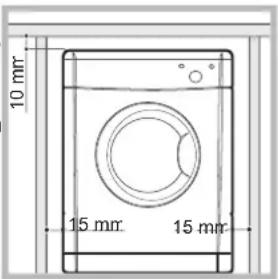
Make sure the air inlets on the rear panel are not blocked or obstructed.
- You should also make sure that the room in which the tumble dryer is installed is not damp, and that it is adequately ventilated.
- ! We do not recommend that the dryer is installed in a cupboard but the dryer must never be installed behind a lockable door, a sliding door or a door with a hinge on the opposite side to that of the dryer door.
Ventilation
This appliance gently dries laundry by taking in cold, clean and relatively dry air, heating it and passing it through the fabric. To facilitate the drying process, damp air is expelled at the rear, through a ventilation hose. When the dryer is in use, there has to be adequate ventilation to avoid a back flow of gases into the room from appliances burning other fuels, including open fires.
Mobile ventilation system
When using the tumble dryer with the mobile ventilation system, a ventilation hose must be connected. The hose should be securely fastened to the ventilation hole at the rear of the appliance (see "Description of the tumble dryer"). We recommend the hose is connected to an outlet near the tumble dryer, if possible. If it cannot be installed in a permanent spot, the tumble dryer will still function perfectly well if the ventilation hose is passed through a partially-opened window.
!Make sure you do not point the ventilation hose towards the air inlet, which is located on the rear of the appliance.
! The ventilation hose should not exceed a maximum length of 2.4 metres; it should also be shaken frequently to remove any fluff, dust or water deposits inside it. Make sure you do not crush the hose.
Fixed ventilation system
We recommend the ventilation hose is connected to a ventilation system for windows or doors, available from the retailer which originally sold you the appliance or from your local spare parts stockist.
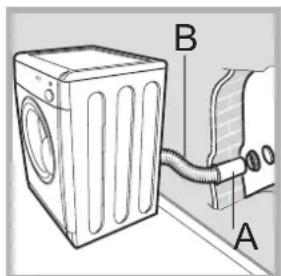
Wall ventilation hole
- Leave an opening in the wall to the left of the tumble dryer installation site.
- Make the hose as short and straight as possible, in order to prevent any moisture from condensing and leaking back into the appliance.
- The hole in the wall
must also be straight and pointing downwards, so that the flow of air coming out is not impeded.
Areas A and B should be checked frequently, to prevent the accumulation of fluff or debris, particularly if the tumble dryer is used very often. The hose adaptor must be fitted correctly, in order to prevent damp air from coming back into the room.
Window ventilation hole
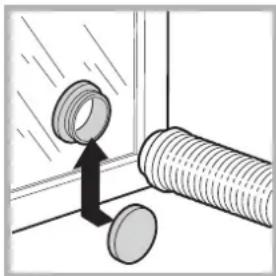
The ventilation hole should be directly behind the dryer in order to keep the hose as short as possible.
!Make sure you do not push the tumble dryer too far backwards, as this could lead to the ventilation hose being crushed, bent or even disconnected.
! There should be no cuts, kinks or "U"-shaped bends in the hose, as these could impede ventilation or trap condensation.
Ventilation through an open window
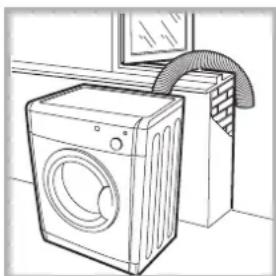
The end of the hose must be facing downwards, in order to prevent the hot, damp air from forming condensation in the room or the tumble dryer.
! Make sure that the tumble dryer is adequately ventilated, and that the end of the ventilation hose is not pointing towards the air inlet pipe on the rear of the appliance.
The ventilation hose must always be fitted to ensure optimum performance.
! Make sure that the ventilation hose and the air inlet vents are not obstructed or blocked.
! Do not let the tumble dryer recirculate exhaust air.
! Improper use of the tumble dryer may result in fire hazards.
The air emitted by the tumble dryer must not be expelled in the same duct as used for the fumes produced by different appliances which burn gas or other fuels.
! Do not discharge the exhaust air into an extraction system or any duct with an extractor fan. This will affect the way the thermal controls operate and can result in a fire hazard.
Electrical connections
Before plugging the appliance into the socket, check the following:
Make sure your hands are dry.
- The socket must have an earth connection.
- The socket must be able to withstand the machine's maximum power output as indicated on the data plate (see Description of the tumble dryer).
- The power supply voltage must fall within the values indicated on the data plate (see Description of the tumble dryer).
- The socket must be compatible with the dryer's plug.
Should this not be the case, replace the plug or the socket.
! Do not use extension cords.
The dryer must not be installed outdoors, even if the space is sheltered. It can be very dangerous if exposed to rain or storms.
! Once installed, the dryer's electrical wire and plug must be within reach.
The power cord must not be bent or squashed.
If the plug being replaced is a non-rewirable type, then the cut-off plug must be disposed of safely. DO NOT leave it where it can be inserted into a socket and create a shock hazard.
The power cord should be checked periodically and replaced by a cord specially prepared for this dryer and fitted only by authorized technicians (see Service). New or longer power cords are supplied at an extra charge by authorized dealers.
The manufacturer denies any responsibility should any of these rules not be followed.
If in doubt about any of the above consult a qualified electrician.
Levelling the tumble dryer
The tumble dryer should be installed level in order to operate correctly.
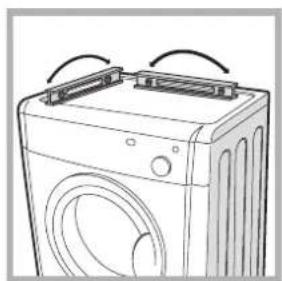
After installing the tumble dryer in its permanent position, make sure it is level; check its side-to-side levelling first, followed by front-to-back.
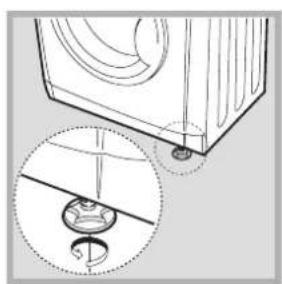
If the tumble dryer is not perfectly level, use a wooden block to support it while you adjust the two front feet, up or down as necessary.
Before you start your dryer
Once the tumble dryer is installed, clean the inside of the drum before operating it and remove any dirt accumulated during transportation.
| Product Data | |
| Rated capacity of cotton laundry for the "standard cotton programme" at full load - kg | 7.0 |
| Energy efficiency class B | |
| The weighted Annual Energy Consumption (AEC)* kWh 472.5 | |
| This household tumble drier is a Non-automatic | |
| This household tumble drier is a Vented | |
| Energy consumption full load; Edry - kWh 4.06 | |
| Energy consumption partial load; Edry½ - kWh 2.11 | |
| Power consumption: off-mode (Po) - Watts 0.06 | |
| Power consumption: left-on mode (l) - Watts N/A | |
| Duration of the 'left-on mode' for power management system - minutes | N/A |
| The Standard Cotton Programme** suitable for drying normal wet cotton laundry that it is the most efficient programme in terms of energy consumption for cotton used at full and partial load. | |
| Prog. Time - weighted (Tl) full & partial load - minutes 81 | |
| Full load (Tdry) - minutes 108 | |
| Partial load (Tdry½) - minutes 61 | |
| Condensation efficiency class N/A | |
| Average condensation efficiency - % | |
| full load (Cdry) 0 | |
| partial load (Cdry½) | 0 |
| weighted (Cl) full & partial load | 0 |
| Airborne acoustical noise emissions - dB(A) re 1 pW | 69 |
This is the test cycle in accordance with Regulation 392/2012.
See our website for all product fiche data:
http://www.indesit.com/indesit/.
*Consumption per year is based on 160 drying cycles of the standard cotton programme at full and partial looad, and the consumption of the low-power modes. Actual energy consumption per cycle will depend on how the appliance is used.
**The Standard Cotton Programme is Hight Heat
Description of the tumble dryer

Front side Rear side
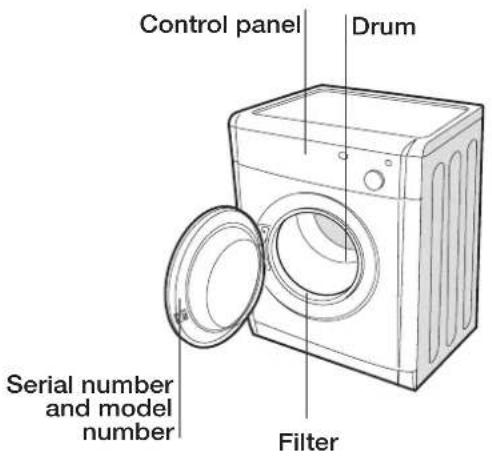
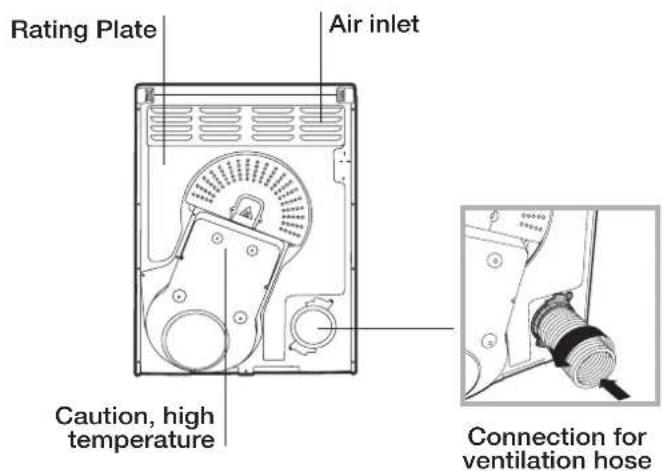
Control panel

Drying time selector knob
This is used to set the drying time: turn the knob in a clockwise direction until the indicator is set to the desired drying time (see Drying settings). Do not attempt to turn the knob anticlockwise.
High Heat button
It can be used to customise the selected programme in accordance with your own requirements.
START button
Press the button to begin drying.
Starting a drying programme
- Plug the dryer into the power supply socket.
- Select a suitable drying programme for the type of laundry (see Laundry).
- Open the door, ensure that the filter is clean and securely placed.
- Load the machine, making sure that no piece of laundry gets between the door and the door seal. Close the door.
- Turn the "Drying time selector" knob until the indicator is pointing towards the most suitable drying time for the type of fabric in that load. Use the table to check the relationship between fabric type and load capacity (see Drying settings), and make sure you are familiar with the instructions provided for each type of fabric (see Laundry). Do not attempt to turn the knob anticlockwise.
-
If necessary, set the temperature using the HIGH HEAT button.
-
Press the START button to start the drying cycle.
Laundry can be checked while the drying programme runs and any garments already dry can be removed, while drying continues for the remaining items. After closing the door, press the START button to resume machine operation. - The final COOL TUME phase (i.e. the fabrics are cooled) activates during the last few minutes of the drying programme; always allow this phase to terminate.
- Open the door, remove the laundry then clean the filter and replace it.
- Disconnect the dryer from the power supply.

Drying times
The drying time depends on the size of the load and on the type of fabric it contains (see Table).
The COOL TUMBLE cycle runs during the final 10 minutes of the programme.
! For large loads, select the High Heat option if available.
| Fabric | Load | ||||||
| 1 kg 2 kg | 3 kg 4 kg 5 kg | 6 kg 7 kg | |||||
| Cotton - high heat | 20 or 30 minutes | 35 or 45 minutes | 45 or 60 minutes | 60 or 70 minutes | 70 or 80 minutes | 80 or 100 minutes | 90 or 120 minutes |
| Synthetics - higt heat | 20 or 30 minutes | 35 or 45 minutes | 45 or 60 minutes | --- | |||
| Acrylics - low heat | 25 or 40 minutes | 40 or 60 minutes | --- | ||||
Drying times are approximate and may vary depending on the following:
- Amount of water retained by items after the spin cycle: towels and delicate items retain a lot of water.
- Fabrics: items of the same fabric, but with different texture and thickness may have different drying times.
- Amount of laundry: single items and small loads will take a short time to dry.
- Drying: if items are to be ironed, they can be removed from the dryer while still slightly damp. Items that require complete drying can be left longer.
- Temperature of the room: the lower the temperature of the room, the longer it will take for the dryer to dry clothing.
- Bulk: certain bulky items require special care during the drying process. We suggest removing these items and replacing them in the dryer once they have been shaken out: repeat this procedure several times during the course of the drying cycle.
! Do not over-dry items.
All fabrics contain natural dampness which helps to keep them soft and fluffy.
Drying programmes and options
Refresh
A short programme suitable for refreshing fibres and garments through the emission of cool air. It lasts about 10 minutes.
!As this is not a drying programme, it is not to be used for garments that are still wet.
High Heat button
The high heat button selects the drying temperature. When the button is out low heat is selected and when it is pushed in high heat is selected
Sorting laundry
- Check the symbols on the care labels of the various garments to verify whether the garments can be safely tumble dried.
- Sort laundry according to the type of fabric.
- Empty all pockets and check for loose buttons.
- Close zips and hooks and fasten belts and strings without tightening them.
- Wring out garments to remove the maximum amount of water possible.
Do not load the dryer when garments are dripping wet.
Maximum load sizes
Do not overload the drum.
The following values indicate the weight of dry garments:
Natural fibres: maximum 7 kg
Synthetic fibres: maximum 3 kg
! Do not overload the dryer as this may result in reduced drying performance.
Typical weights
Note: 1 kg = 1000 g
| Garments | ||
| Blouse | Cotton Other | 150 g 100 g |
| Dress | Cotton Other | 500 g 350 g |
| Jeans | 700 g | |
| 10 Nappie | 1,000 g | |
| Shirt | Cotton Other | 300 g 200 g |
| T-shirt | 125 g | |
| Household linen | ||
| Duvet cover (double bed) | Cotton Other | 1,500 g 1,000 g |
| Large tablecloth | 700 g | |
| Small tablecloth | 250 g | |
| Tea cloth | 100 g | |
| Bath towel | 700 g | |
| Hand towel | 350 g | |
| Double bed sheet | 500 g | |
| Single bed sheet | 350 g | |
When mixing synthetic fibres with cotton garments, the latter may still be damp at the end of the drying cycle. If this happens, simply put them through a short drying cycle.
Care labels
Always check the care labels, especially when placing garments in the tumble dryer for the first time. Below are the most commonly used symbols:
May be tumble dried.
Do no tumble dry.
Tumb dry - high heat.
Tumble dry - low heat.
Items not suitable for tumble drying:
- Items containing rubber parts or similar materials, or plastic film covering (pillows, cushions or PVC sports jackets), any type of inflammable object or objects containing inflammable substances (used towels containing hairspray).
Glass fibres (certain types of draperies). - Items which have been previously dry cleaned.
- Items marked with the ITLC symbol ("Special garments"), which may be washed using special household products. Follow instructions carefully.
Large bulky items (duvets, sleeping bags, pillows, cushions, etc.) that expand when dried and hamper air circulation inside the tumble dryer.
Special items
Blankets and bedcovers: acrylic items (Acilian, Courtelle, Orion, Dralon) must be dried with great care at low heat. Avoid drying for long periods.
Creased or pleated garments: read the drying instructions supplied by the manufacturer.
Starched garments: do not dry together with non-starched items. Remove the maximum amount of starch solution possible before placing these items in the dryer. Do not over-dry: starch turns powdery leaving garments limp - this defeats its purpose.
EN
This appliance has been designed and built according to international safety standards. These warnings are given for safety reasons and must be followed carefully.
General safety
- This tumble dryer is not intended for use by persons (including children) with reduced physical, sensory or mental capabilities, or lack of experience and knowledge, unless they have been given supervision or instruction concerning use of the appliance by a person responsible for there safety.
- This tumble dryer has been designed for home, and not professional, use.
- Do not touch the appliance while barefoot or with wet hands or feet.
- Unplug the machine by pulling on the plug, not the cord.
- Children must not be in proximity of the dryer when in use. After using the dryer, turn it off and unplug it. Keep the door closed to make sure that children do not use it as a toy.
Children should be supervised to ensure that they do not play with the dryer. - The appliance must be installed correctly and have proper ventilation. The air intake vents behind the machine, the outlet vents and the vent tube should never be obstructed (see Installation).
- Never direct the vent tube outlet towards the air intake at the back of the machine.
- Never allow the tumble dryer to recycle exhaust air.
- Never use the dryer on carpeting where the pile height would prevent air from entering the dryer from the base.
- Check to see if the dryer is empty before loading it.
The back of the dryer could become very hot. Never touch it while in use. - Do not use the dryer unless the filter, is securely in place (see Maintenance).
- Do not overload the dryer (see Laundry for maximum loads).
- Do not load items that are dripping wet.
- Carefully check all instructions on clothing labels (see Laundry).
- Do not tumble dry large, very bulky items.
- Do not tumble dry acrylic fibres at high temperatures.
- Complete each programme with its Cool Tumble Phase.
- Do not turn off the dryer when there are still warm items inside.
- Clean the filter after each use (see Maintenance).
- Clean the condenser unit at regular intervals (see Maintenance).
- Do not allow lint to collect around the dryer.
- Never climb on top of the dryer. It could result in damage.
- Always follow electrical standards and requirements (see Installation).
- Always buy original spare parts and accessories (see Service).
To minimise the risk of fire in your tumble dryer, the following should be observed:
- Tumble dry items only if they have been washed with detergent and water, rinsed and been through the spin cycle. It is a fire hazard to dry items that HAVE NOT been
washed with water.
- Do not dry garments that have been treated with chemical products.
- Do not tumble dry items that have been spotted or soaked with vegetable or cooking oils, this constitutes a fire hazard. Oil-affected items can ignite spontaneously, especially when exposed to heat sources such as a tumble dryer. The items become warm, causing an oxidisation reaction with the oil, Oxidisation creates heat. If the heat cannot escape, items can become hot enough to catch fire. Piling, stacking or storing oil-effected items can prevent heat from escaping and so create a fire hazard. If it is unavoidable that fabrics containing vegetable or cooking oil or those that have been contaminated with hair care products be placed in a tumble dryer they should first be washed with extra detergent - this will reduce, but not eliminate the hazard. The cool tumble phase should be used to reduce the temperature of the items. They should not be removed from the dryer and piled or stacked while hot.
- Do not tumble dry items that have previously been cleaned in or washed in, soaked in or soiled with petrol/gasoline, dry cleaning solvents or other flammable or explosive substances. Highly flammable substances commonly used in domestic environments including cooking oil, acetone, denatured alcohol, kerosene, spot removers, turpentine, waxes and wax removers. Ensure these items have been washed in hot water with an extra amount of detergent before being dried in the tumble dryer.
- Do not tumble dry items containing foam rubber (also known as latex foam), or similarly textured rubber like materials. Foam rubber materials can, when heated, produce fire by spontaneous combustion.
- Fabric softener or similar products should not be used in a tumble dryer to eliminate the effects of static electricity unless the practice is specifically recommended by the manufacturer of the fabric softener product.
- Do not tumble dry undergarments that contain metal reinforcements eg. bras with metal reinforcing wires. Damage to the tumble dryer can result if the metal reinforcements come loose during drying.
- Do not tumble dry rubber, plastic articles such as shower caps or babies waterproof covers, polythene or paper.
- Do not tumble dry rubber backed articles, clothes fitted with foam rubber pads, pillows, galoshes and rubber coated tennis shoes.
- Remove all objects from pockets, especially lighters.
WARNING: Never stop the dryer before the end of the drying cycle unless all items are quickly removed and spread out so that the heat is dissipated.
Save energy and respect the environment
- Wring out all items to eliminate excess water before tumble drying (if you use a washing machine first, select a high spin cycle). Doing this will save time and energy during drying.
- Always dry full loads - you save energy: single items or small loads take longer to dry.
- Clean the filter after each use to contain energy consumption costs (see Maintenance).
Disconnecting the power supply
! Disconnect the dryer when not in use or during cleaning and maintenance operations.
Cleaning the filter after each cycle
The filter is a fundamental component of the dryer: its function is to collect lint and fluff that form during drying. Clean the filter once drying is completed, by rinsing it under running water or cleaning it with a vacuum cleaner. Should the filter become clogged, the flow of air inside the dryer will be seriously hampered: drying times becomes longer and more energy is consumed. Moreover, the dryer may become damaged.

The filter is located behind of the dryer seal (see Picture).
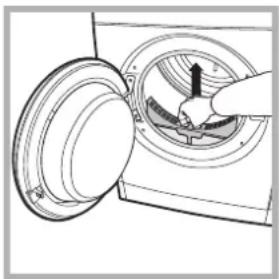
Removing the filter:
- Pull the filter's plastic handle upwards (see Picture).
- Clean the fluff off the filter and replace it correctly. Ensure that the filter is pushed fully home.
! Do not use the dryer unless the filter has been replaced in its holder.
Checking the drum after each cycle
Rotate the drum manually to remove smaller items (handkerchiefs) that could have been left inside the dryer.
Cleaning the drum
! Avoid using abrasives, steel wool or stainless steel cleaning agents to clean the drum.
A coloured film may appear on the stainless steel drum surface: it may be caused by a combination of water and/or cleaning agents such as wash-softeners. This coloured film does not affect the dryer's performance.
Cleaning the tumble dryer
- The external metal and plastic parts and the rubber parts can be cleaned with the aid of a damp cloth.
- Periodically check the vent hose and all other parts of the venting system and remove any accumulations of fluff and lint.
Do not use solvents or abrasives.
!Have the dryer checked regularly by authorised technical personnel in order to ensure that the electrical and mechanical parts work safely (see Assistance).

If you feel that the dryer is not working properly, consult the following troubleshooting suggestions before contacting the Technical Assistance Centre (see Assistance).
Problem:
Possible causes / Solutions:
The dryer does not start.
- The plug has not been inserted far enough into the socket to make contact.
- There has been a power cut.
- The fuse has blown. Try connecting another appliance to the same socket.
- If an extension cord is used, try connecting the dryer plug directly into the socket.
The door has not been closed properly.
The programme has not been set correctly (see How to carry out a drying cycle). - The START button has not been pressed (see How to carry out a drying cycle).
Drying times are too long.
The filter has not been cleaned (see Care and maintenance).
An incorrect drying time was selected for the type of load (see Laundry).
The items are too wet (see Laundry).
- The dryer is overloaded (see Laundry).
- The flexible ventilation hose may be blocked (see Installation).
The air inlet may be blocked or obstructed (see Installation).
- The fixed ventilation flap, on the protective weatherproof cover, may be obstructed (see Installation).
The dryer is noisy during the first few minutes of operation.
- This is normal, especially if the dryer has not been used for a long time. If the noise persists during the entire cycle, contact the Technical Assistance Centre.
Before contacting the Technical Assistance Centre:
- Follow the troubleshooting guide to check whether problems can be solved personally (see Troubleshooting).
- If not, switch the dryer off and contact the Technical Assistance Centre closest to you.
Provide the following data when contacting the Technical Assistance Centre:
- name, address and postal code
- telephone number
- type of malfunction
- date of purchase
the appliance model (Mod.)
the dryer's serial number (S/N)
This information can be found on the data plate located behind the door.
Spare parts
This dryer is a complex machine. Attempting to repair it personally or employing an unqualified service agent may put the safety of people at risk, damage the machine or invalidate the spare parts guarantee.
Always contact a qualified technician when experiencing problems with this machine.
Information on recycling and disposal
As part of our continual commitment towards environmental protection, we reserve the right to use recycled quality components to reduce costs for our customers and to minimise materials wastage.
- Disposing of the packaging materials: follow local regulations to allow for recycling of packaging materials.
- In order to minimise the risk of injury to children, remove the door and plug, then cut the power supply cord flush with the appliance. Dispos of these parts separately to prevent the appliance from being connected to a power supply socket.
Disposal of old household appliances

European Directive 2012/19/EC concerning Waste Electrical and Electronic Equipment (WEEE) states that household appliances should not be disposed of using the normal solid urban waste cycle. Exhausted appliances should be collected separately in order to optimise the cost of re-using and recycling materials comprising the machine, while preventing potential damage to public health and the environment. The crossed-out wheeled bin symbol appears on all products to remind
owners of the obligations regarding separate waste collection.
Owners should contact their local authorities or appliance dealers for further information concerning the correct disposal of household appliances.

This appliance conforms to the following EC directives:
- 2006/95/EC (Low Voltage Directive)
- 2004/108/EC (Electromagnetic Compatibility Directive).
ES
Espanol
Indices
Instalación, 14-15
Donde instalar la secadora
Aireación
Conexión electrica
I'evacuation de I'air.
- Description of the tumble dryer, 4
- How to carry out a drying cycle, 5
- Drying settings, 6
- Laundry, 7
- Warnings and suggestions, 8
- Care and maintenance, 9
- Troubleshooting, 10
- Assistance and Guarantee, 11-12-13
- EN
- Where to install the tumble dryer
- Ventilation
- Mobile ventilation system
- Fixed ventilation system
- Wall ventilation hole
- Window ventilation hole
- Ventilation through an open window
- Electrical connections
- Levelling the tumble dryer
- Before you start your dryer
- Description of the tumble dryer
- Front side Rear side
- Control panel
- Drying time selector knob
- START button
- Starting a drying programme
- Drying times
- Drying programmes and options
- Refresh
- High Heat button
- Sorting laundry
- Maximum load sizes
- Typical weights
- Care labels
- Items not suitable for tumble drying:
- Special items
- General safety
- To minimise the risk of fire in your tumble dryer, the following should be observed:
- WARNING: Never stop the dryer before the end of the drying cycle unless all items are quickly removed and spread out so that the heat is dissipated.
- Save energy and respect the environment
- Disconnecting the power supply
- Cleaning the filter after each cycle
- Checking the drum after each cycle
- Cleaning the drum
- Cleaning the tumble dryer
- Problem:
- Possible causes / Solutions:
- The dryer does not start.
- Drying times are too long.
- The dryer is noisy during the first few minutes of operation.
- Before contacting the Technical Assistance Centre:
- Provide the following data when contacting the Technical Assistance Centre:
- Spare parts
- Information on recycling and disposal
- Disposal of old household appliances
- Indices
- Instalación, 14-15
Brand : INDESIT
Model : IDV 75 (ZA)
Category : Tumble drier