ST1000 U - Memory reader Cherry - Free user manual and instructions
Find the device manual for free ST1000 U Cherry in PDF.

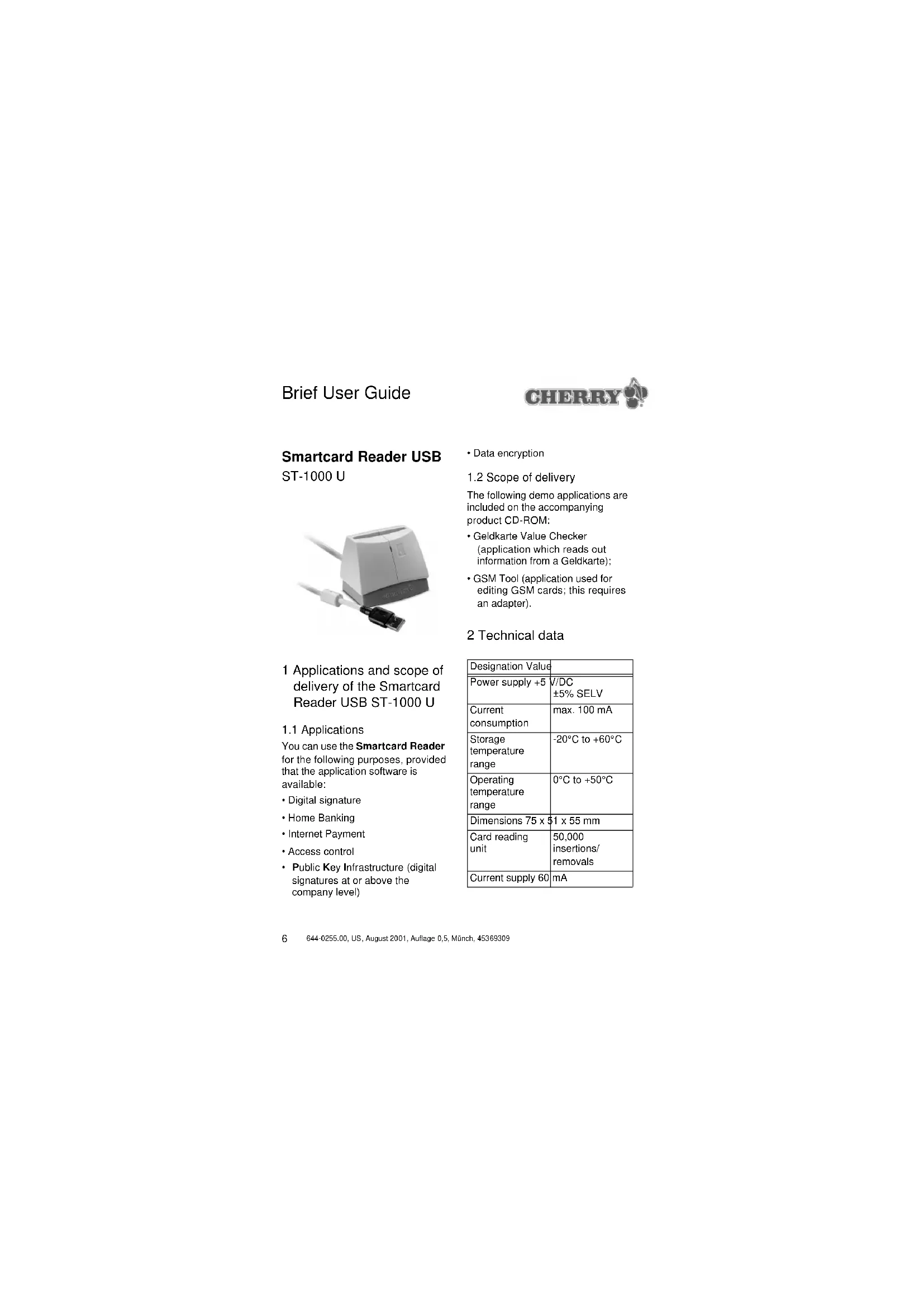


| Product type | USB smart card reader |
| Brand | Cherry |
| Model | ST1000 U (ST-1000 U) |
| Dimensions | 75 x 51 x 55 mm |
| Supply voltage | +5 V/DC ±5% SELV |
| Current consumption | max. 100 mA |
| Operating temperature | 0°C to +50°C |
| Storage temperature | -20°C to +60°C |
| Interface | USB |
| Transmission speed to PC | UHCI 60 kbit/s / OHCI 1 Mbit/s |
| Transmission speed to card | 9 600 – 115 200 baud |
| Supported protocols | T=0, T=1, T=14; SLE4418, SLE4428, SLE4432, SLE4442; others on request |
| Operating systems | Windows 98/ME/NT/2000, Linux |
| Drivers | PC/SC, CT-API |
| Number of insertion cycles | 50 000 cycles |
| Indicator light | DUO LED (green: detection, red: data exchange) |
| Application areas | Digital signature, Home Banking, Internet payment, Access control, PKI, Data encryption |
| Package contents | ST1000 U reader, CD-ROM with demo applications (Geldkarte Value Checker, GSM Tool) |
| Care and cleaning | Clean with a soft dry cloth. Avoid any liquids. |
| Safety | CE compliant (Low Voltage Directive 73/23/EEC and EMC Directive 89/336/EEC), Class B |
| Spare parts and repairability | Contact Cherry support for any repair or spare parts. |
Frequently Asked Questions - ST1000 U Cherry
User questions about ST1000 U Cherry
0 question about this device. Answer the ones you know or ask your own.
Ask a new question about this device
Download the instructions for your Memory reader in PDF format for free! Find your manual ST1000 U - Cherry and take your electronic device back in hand. On this page are published all the documents necessary for the use of your device. ST1000 U by Cherry.
USER MANUAL ST1000 U Cherry
natural_image
Close-up of a computer mouse with USB cable and connector (no visible text or symbols)natural_image
Close-up of a computer mouse with USB cable (no visible text or symbols)- Data encryption
1.2 Scope of delivery
The following demo applications are included on the accompanying product CD-ROM:
• Geldkarte Value Checker (application which reads out information from a Geldkarte):
• GSM Tool (application used for editing GSM cards; this requires an adapter).
2 Technical data
1 Applications and scope of delivery of the Smartcard Reader USB ST-1000 U
1.1 Applications
You can use the Smartcard Reader for the following purposes, provided that the application software is available:
- Digital signature
• Home Banking - Internet Payment
- Access control
- Public Key Infrastructure (digital signatures at or above the company level)
| Designation Value | |
| Power supply +5 | V/DC ±5% SELV |
| Current consumption | max. 100 mA |
| Storage temperature range | -20°C to +60°C |
| Operating temperature range | 0°C to +50°C |
| Dimensions 75 x 51 x 55 mm | |
| Card reading unit | 50,000 insertions/removals |
| Current supply 60 | mA |
CHERRY

| Designation Value | |
| Transfer speed to PC | UHCI 60 KBit/secOHCI 1 MBit/sec |
| Transfer speed to card | 9,600 to 115,200 baud |
| Protocols T=0, T= | 1, T=14;SLE4418,SLE4428,SLE4432,SLE4442;other protocols available upon request |
| Driver PC/SC, CT-API | |
| Operating systems | Windows 98/MEWindows NT/2000Linux |
Pin assignment
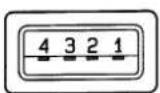
| VCC | pin 1 |
| -DATA | pin 2 |
| +DATA | pin 3 |
| Ground | pin 4 |
| Shielding | shell |
3 Connecting the smartcard reader to the PC
3.1 Windows NT 4.0
How to connect the smartcard reader to your PC under Windows NT
- Connect the USB connector of the smartcard reader to the USB port of your PC.
3.2 Windows 98/ME/2000
How to connect the smartcard reader to your PC under Windows 98/ME/2000
1 Connect the USB connector of the smartcard reader to the USB port of your PC.
The message New hardware component found is displayed on the screen. The dialog box Required Files then appears, informing you of the files which are needed.
2 Install the software as described in How to install the software under Windows 98/ME/2000.
CHERRY

4 Installing the software
Note: Using the current driver
When installing, you should always use the most current driver. The current driver can be found on the Internet at the following addresses:
- http://support.cherry.de
- www.omnikey.de.
4.1 Windows NT 4.0
Note: USB under Windows NT 4.0
As standard, Windows NT 4.0 does not support USB technology. However, a special USB driver which allows you use the USB port with the product is installed with the Smartcard Reader software.
Precondition:
- Windows NT 4.0 Service Pack 3 or higher must be installed to your PC.
- If USB support can be activated in the BIOS, it must be activated in BIOS Setup.
Note
The software for installation under Windows NT is not included on the Cherry CD. You must download the software from the Cherry GmbH web page.
How to install the software under Windows NT 4.0
1 Bring up the http://support.cherry.de web page.
2 Log in or register yourself.
The Cherry Internet Support System – CISS page is opened.
3 Click the Software download entry.
The page Software download is opened.
4 From the list Product designation select the entry ST-1000 U.
5 From the list Language, select the language in which you wish to use the software.
6 From the list Operating system, select the entry MS Windows NT 4.0.
7 Download the software.
8 Unpack the software.
9 Double-click the Setup.exe file.
10Select the entry CardMan 2020.
11 Follow the installation instructions on the screen.
12Restart the PC when the installation is complete.

4.2 Windows 98/ME/2000
How to install the software under Windows NT 98/ME/2000
Precondition: The smartcard reader must be connect to your PC.
1 Place the Cherry CD in your CD-ROM drive.
2 If the CD-ROM starts automatically, cancel this by pressing the ESC key.
3 From the Copy files from list in the dialog box Required Files, select the file *.inf under CD-ROM Drive/Software/ST-1000U.
4 Click on the button OK.
5 Follow the installation instructions on the screen.
5 Using the smartcard reader
5.1 Inserting a smartcard into the reader
Note: The smartcard is to be inserted with the contact surfaces toward the front
You must always insert the smartcard into the reader with the contact surfaces toward the front.
Note: Insertion resistance
In order to be able to read the smartcard, you must push the smartcard into the reader, overcoming the insertion resistance.
5.2 Explanation of LED meanings
When the reader is being used, a two-colored LED (DUO LED) functions as a status indicator.
• The green LED illuminates when the device is detected by the operating system (enumeration).
• The red LED illuminates when data is being transferred to or from the smartcard.
6 Support
We offer free support for problems which occur during installation of the Smartcard Reader and the software.
Under http://support.cherry.de, you can contact the CHERRY INTERNET SUPPORT SYSTEM (CISS). There, you can submit your questions to us directly around the clock and seven days a week.
If you do not have an Internet connection, please contact us at the following address or under the following telephone or fax numbers:

CHERRY GmbH
Cherrystrasse
D-91275 Auerbach
Hotline:
Tel.: +49(0)9643-18-206
Fax: +49(0)9643-18-545.
We are available to help you
Monday to Thursday from 07:15 to
16:00 and Friday from 07:15 to
13:30.
natural_image
Close-up of a white computer mouse with two USB cables (no visible text or symbols)natural_image
Close-up of a beige computer mouse with attached USB cable (no visible text or symbols)natural_image
Close-up of a white computer mouse with attached USB cable (no visible text or symbols)2 CE Declaration of Conformity
We, Cherry GmbH, declare that the Smartcard Reader (ST-1000U) is in conformance with: Low Voltage Directive 73/23/EEC tested in accordance with EN 60950. Also that the the EMC-Directive 89/336/EEC has been fulfilled to EN 61000-4-2 (1995), EN 61000-4-3 (1996), ENV 50204 (1995), EN 61000-4-6 (1996), within EN 55024 (1998) and EN 55022 (1998) Class B.
Tested in accordance with Cherry's standard test procedure.
6 Federal Communications Commission (FCC) Radio Frequency Interface Statement
Information to the user: This equipment has been tested and found to comply with the limits for Class B digital device, pursuant to Part 15 of the FCC Rules. These limits are designed to provide reasonable protection against harmful interference in a residential installation. This equipment generates, uses and can radiate radio frequency energy and, if not installed and used in accor-
dance with the instructions, may cause harmful interference to radio communications. If this equipment does cause harmful interference to radio or television reception, which can be determined by turning the equipment off and on, the user is encouraged to try to correct the interference by one or more of the following measures:
- Reorient or relocate the receiving antenna
- Increase the separation between the equipment and receiver
- Connect the equipment into an outlet on a circuit different from that to which the receiver is connected
- Consult the dealer or an experienced radio/TV technician for help
Caution: Cherry is not responsible for any radio or television interference caused by unauthorized modifications of this equipment or the substitution or attachment of connecting cables and equipment other than those specified by Cherry! Such unauthorized modifications, substitutions, or attachments may void the user's authority to operate the equipment. The correction of interferences caused by such unauthorized modifications, substitutions, or attachments will be the responsibility of the user. Use only

shilded interface cables to ensure compliance.
7 Canadian Radio Interface Regulations
This digital apparatus does not exceed the Class A limits for radio noise emissions from digital apparatus set out in the Radio Interference Regulations of the Canadian Department of Communications.

- Scope of delivery
- Applications
- CHERRY
- Installing the software
- Note: Using the current driver
- Windows NT 4.0
- Note: USB under Windows NT 4.0
- Precondition:
- Note
- How to install the software under Windows NT 4.0
- Windows 98/ME/2000
- How to install the software under Windows NT 98/ME/2000
- Using the smartcard reader
- Inserting a smartcard into the reader
- Note: The smartcard is to be inserted with the contact surfaces toward the front
- Note: Insertion resistance
- Explanation of LED meanings
- Support
- CE Declaration of Conformity
- Federal Communications Commission (FCC) Radio Frequency Interface Statement
- Canadian Radio Interface Regulations
Brand : Cherry
Model : ST1000 U
Category : Memory reader