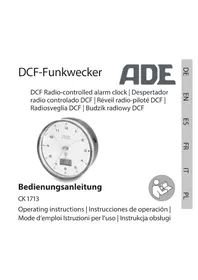
CK 1713 - Alarm Clock ADE - Free user manual and instructions
Find the device manual for free CK 1713 ADE in PDF.




| Brand | ADE |
| Model | CK 1713 |
| Product type | DCF77 signal-controlled alarm clock radio |
| Power supply | 1 LR03 (AAA) battery 1.5 V |
| Time reception | DCF77 signal (77.5 kHz) - Automatic time setting |
| Display | Analog display with hands + digital screen for date and temperature |
| Dial illumination | Yes, via SNOOZE/LIGHT button (duration ~5 seconds) |
| Alarm function | With progressive beep and automatic stop after 30 minutes |
| Snooze function | Yes, repeats every 5 minutes |
| Manual time setting | Yes, via M.Set button |
| Temperature display | Yes, in °C (range -10°C to 60°C) |
| Date display | Yes, in day/month format |
| Reset | Yes, via Reset button (pointed object) |
| Daylight saving time change | Automatic via DCF77 reception |
| Cleaning | Soft, dry or slightly damp cloth; do not immerse |
| Safety | Keep out of reach of children; replace battery with same type; avoid exposure to flames |
| Warranty | 2 years, material or manufacturing defects (repair or replacement) |
| Package contents | Alarm clock, 1 LR03 AAA battery, instruction manual |
| Dimensions | Approx. 12 x 10 x 6 cm (estimated) |
| Weight | Approx. 200 g (estimated with battery) |
Frequently Asked Questions - CK 1713 ADE
User questions about CK 1713 ADE
0 question about this device. Answer the ones you know or ask your own.
Ask a new question about this device
Download the instructions for your Alarm Clock in PDF format for free! Find your manual CK 1713 - ADE and take your electronic device back in hand. On this page are published all the documents necessary for the use of your device. CK 1713 by ADE.
USER MANUAL CK 1713 ADE
22089 Hamburg, Germany
You have chosen to purchase a high-quality product from the brand ADE, which combines intelligent functions with an exceptional design. With this radio-controlled alarm clock, you always have the exact time in view. The many years of experience of the brand ADE ensures a high technical standard and proven quality.
We wish you easy timing at any time!
Your ADE Team
General information
About this manual

This operating manual describes how to safely use and care for your products.
Z
Keep this operating manual in a safe place in case you would like to refer to it later. If you pass this item on to someone else, pass on this manual as well. Failure to observe the recommendations in this operating manual can lead to injuries or damage to your product.

Pull the protective film off the display.
Explanation of symbols

This symbol, combined with the word DANGER, warns against serious injury.

This symbol, combined with the word WARNING, warns against moderate and mild injuries.

This symbol, combined with the word NOTE, warns against material damage.

This symbol signifies additional information and general advice.
Table of Contents
General information 29
Intended Use. 32
Safety 32
Overview 36
Scope of delivery 38
Start-up 38
Receiving the time signal 39
Use 41
About the time signal
transmitter DCF77 44
Alarm. 45
Other functions 47
Cleaning. 48
Fault and remedy 48
Technical Data 49
Declaration of Conformity 50
Guarantee 51
Disposal. 51
Intended Use
This radio-controlled alarm clock receives its time signal from the German time signal transmitter DCF77. The alarm clock is designed exclusively for private use in dry indoor areas.
Safety
-
This item can be used by children 8 years of age and above, as well as by persons with reduced physical, sensory, or mental capacities or lacking experience and knowledge, if they are supervised or have been instructed in the safe use of the item and understand the dangers that may arise.
Children must not play with the item. -
Cleaning and user maintenance must not be carried out by children, unless they are 8 years of age or older and are being supervised.
- Batteries, when swallowed, can be life-threatening. Keep the item and batteries out of reach of small children. If batteries have been swallowed, seek medical help immediately.
DANGER for Children
- Keep children away from packaging material. Risk of choking if swallowed.
RISK of fire/burning and/or explosion
-
There is a risk of explosion if batteries are replaced incorrectly. Replace batteries only with the same or equivalent battery type. Observe the "Technical Data".
-
Batteries must not be recharged, reactivated by other means, dismantled, thrown into fire, or short-circuited. Otherwise there is an increased risk of explosion and leakage; furthermore, gases may escape!
-
Avoid contact of the battery fluid with skin, eyes, and mucosa. In case of contact, rinse the affected areas right away with plenty of clean water and consult a doctor immediately.
BEWARE of material damage
-
Protect the alarm clock from strong shocks, vibrations and moisture.
-
Remove the battery from the unit when it is exhausted or when the alarm clock will not be used for a longer period of time. This prevents damage that may be caused by leakage.
-
When inserting and changing batteries, pay attention to the correct polarity (+/-).
- Do not expose batteries to extreme conditions, for example, by storing them on radiators or under direct sunlight. Increased risk of leakage!
- Clean the battery and device contacts, as needed, before inserting the battery.
- Use only batteries of the same type.
- Do not make any changes to the item. Only allow repairs to be carried out at a specialist workshop. Repairs carried out incorrectly can considerably endanger the user.
Overview
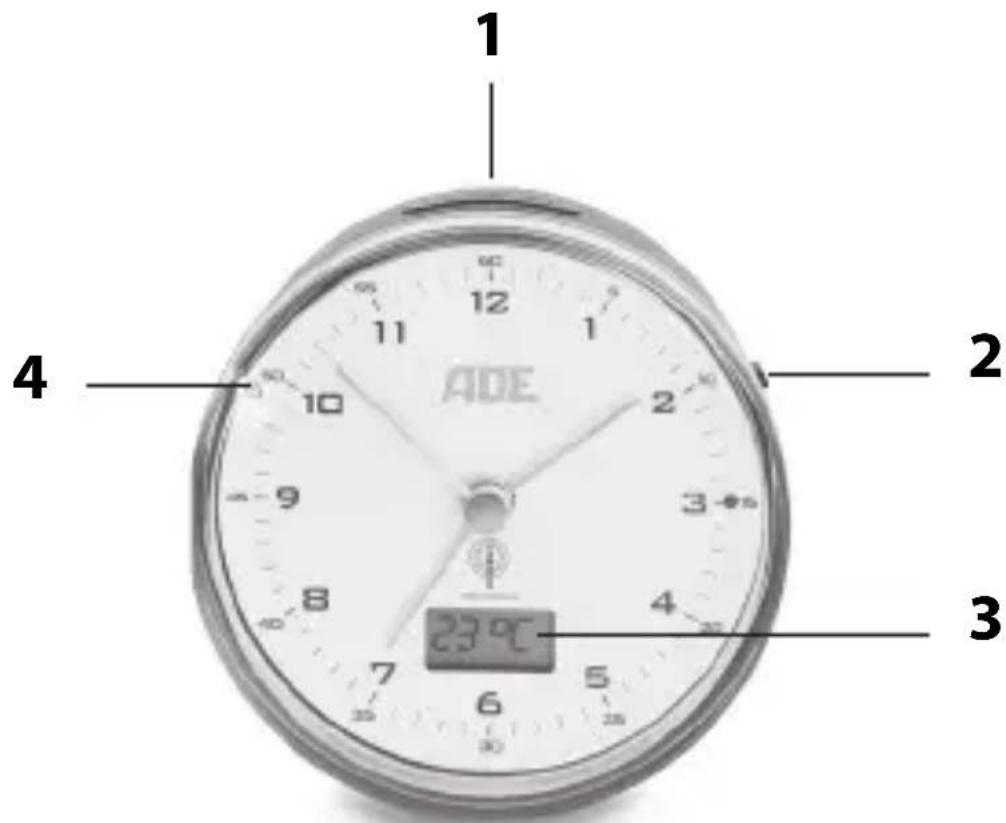
1 SNOOZE/LIGHT button
2 Alarm switch ON/OFF
3 Date and temperature display
4 Dial lighting
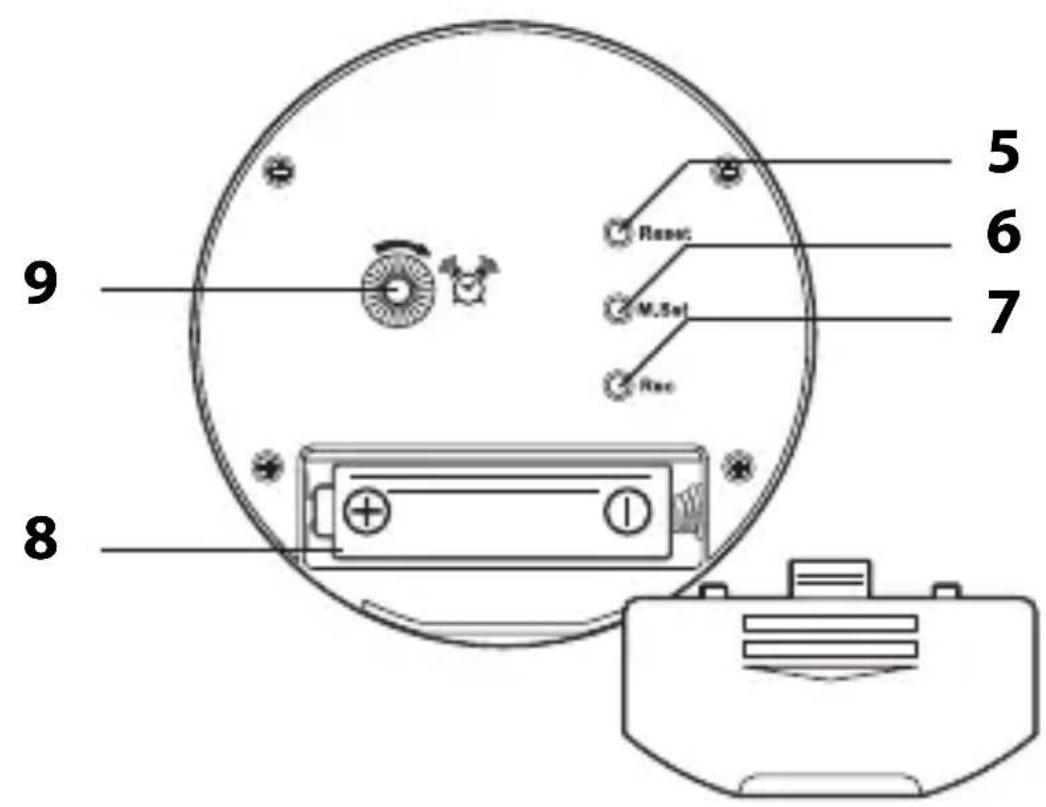
5 Reset button
6 M.Set button
7 Rec button
8 Battery compartment for 1x LR03 (AAA), 1.5 V
9 Alarm setting knob
Scope of delivery
- Radio-controlled alarm clock
- Battery type LR03 (AAA), 1.5 - (1 ×
- Operating Manual
Start-up
To use the device, you will need a LR03 (AAA),
1.5 V battery.
- Slide the battery compartment cover downwards.
- Insert the batteries as shown on the bottom of the battery compartment. Pay attention to the correct polarity (+/-) .
- Replace the battery compartment cover and slide it upwards. Battery compartment lid must engage audibly.
Once the battery has been inserted, the alarm clock switches to receiving mode; see next chapter.
Notes on changing the battery:
-
The battery must be changed when the hands stop moving.
-
Only use the battery type specified in the "Technical Data".
-
Dispose of old batteries in an environmentally friendly manner, see "Disposal".
Receiving the time signal
After inserting the battery:
-
Beep sounds
-
Clock hands start to turn and show "12 o'clock" shortly thereafter.
-
Display shows temperature.
-
Alarm clock switches to time signal reception.
As soon as the time signal has been received with sufficient strength, the hands begin to turn again and then indicate the current time. This process can last a few minutes.
From now on the radio-controlled alarm clock automatically switches to receiving mode several times a day and compares its own time with that received by the time signal transmitter. If there is a difference, the time displayed on the alarm clock will be automatically corrected. If no sufficiently strong signal has been received, the radio-controlled alarm clock will cancel the reception process. In this case:
-
Check whether the location of the radio-controlled alarm clock is suitable; see "Tips for good reception".
-
To restart the reception process, remove the battery and reinsert it.
- Set the time manually, if necessary; see "Set the time manually".
Use
Dial lighting
- Press the SNOOZE/LIGHT button to turn the dial lighting on for approx. 5 seconds.
Temperature and date display
The room temperature in ^ C and the date in the Day/Month format are displayed alternately for approx. 20 seconds on the small display.
Restart radio transmission
- Press and hold the REC button for a few seconds.
- Release the button as soon as the clock hands start to turn.
The radio wall clock then indicates "12 o'clock". The alarm clock now tries to receive a radio signal within the next minutes.
- If the alarm clock receives a sufficiently strong radio signal, the hands will be adjusted to the correct time.
- If the alarm clock fails to receive a sufficiently strong radio signal, it will revert to the previously displayed time.
Set the time manually
If no radio reception is possible, you can set the time manually.
- Press and hold the M.SET button. The hands begin to turn.
- Release the button just before the correct time is displayed.
- Press the M. SET button again to set the alarm clock to the correct time. Each tap adjusts the radio-controlled alarm clock one minute ahead.

When M.SET is not pressed for 30 seconds, the currently set time is stored and you have to repeat the process.
Tips for good reception
- Set up the radio-controlled alarm clock as close to a window as possible.
- Maintain a distance from TV sets, computers and monitors. In addition, the alarm clock should not be in the immediate vicinity of base stations of cordless telephones.
- The reception is generally better at night. If the alarm did not receive a signal during the day, it may well be that the signal is received at night, immediately and at full strength.
-
The weather, e.g. a heavy storm, can cause interference with the reception.
-
Temporary shutoffs of the transmitter can sometimes happen, e.g. because of maintenance work.
About the time signal transmitter DCF77
This radio-controlled alarm clock receives its radio signals from the time signal transmitter DCF77. This broadcasts the precise and official time of the Federal Republic of Germany on the long-wave frequency of 77.5 kHz. The transmitter is located in Mainflingen near Frankfurt am Main and, with its range of up to 2000 km, supplies the majority of radio-controlled clocks in western Europe with the necessary radio signals. Once the radio-controlled alarm clock is powered by the battery, it switches to receiving mode and searches for
the signal from the DCF77 transmitter. If the time signal has been received with sufficient strength, the hands set themselves to the correct time. The radio-controlled alarm clock switches on several times a day and synchronises the time with the radio signal from the transmitter DCF77. In the event the signal is not received, e.g. during a strong storm, the device continues to run precisely and then switches to receiving mode again at the next scheduled time.
Alarm
Setting the alarm time
- Use the knob to set the small hand to the desired alarm time. Turn only in the indicated direction of rotation!
- Set the alarm switch to the ON position.
Being awakened
At the set time you will be woken by an alarm signal, which will become more intense as the waking time increases.
Auto-stop function
If you do not press a button, the alarm switches off automatically after 30 minutes. After 12 hours, the alarm will be triggered again.
Repeat alarm (snoopze function)
- Press the SNOOZE/LIGHT button 1x when the alarm sounds.
After 5 minutes, the device switches on again and wakes you up again. This procedure can be repeated multiple times.
Turn the alarm off
-Set the alarm switch to the OFF position.
Other functions
Switching between summer and winter time
The switchover from summer to winter time or vice versa takes place automatically in case of good time signal reception.
Reset the radio-controlled alarm clock to the default settings
If the time is repeatedly displayed incorrectly, you can reset the alarm clock to the default settings (reset function). A reset is required only in exceptional cases.
-Using a thin object (e.g. an unwound
paperclip) press down on the RESET button. A beep will sound and the clock hands will turn to 12:00, with the alarm clock eventually switching to receiving mode.
Cleaning

Do not immerse the alarm clock in water or other liquids. Do not use rough, scratching or abrasive cleaning agents.
-If necessary, use a soft, dry cloth, or a slightly moistened one to wipe the alarm clock.
Fault and remedy
No function.
- Battery empty or inserted the wrong way around?
Temperature indication appears too high.
- Check whether the radio-controlled alarm clock is exposed to direct sunlight.
Technical Data
Model: DCF Radio-controlled
alarm clock CK 1713
Battery: 1x LR03 (AAA), 1.5 V
Rated current: < 180 A
Measuring range: approx. -10 °C - 60 °C
Distributor (no service address):
Waagen-Schmitt GmbH
Hammer Steindamm 27-29
22089 Hamburg, Germany
Our products are constantly being developed
and improved. For this reason, design and
technical modifications are possible at any time.
Declaration of Conformity
Waagen-Schmitt GmbH hereby declares that the radio-controlled alarm clock CK 1713 is in compliance with EU directives 2014/53/EU and 2011/65/EU.
The full text of the EU declaration of conformity is available at the following internet address: www.ade-germany.de/doc
This declaration loses its validity if any modification is made to the alarm clock that has not been agreed with us in advance.
Hamburg, june 2018
Waagen-Schmitt GmbH

Guarantee
The company Waagen-Schmitt GmbH guarantees for 2 years from the purchase date the cost-free rectification of defects on the basis of material or fabrication errors through repair or exchange. In the event of a guarantee claim, please return the product with the proof of purchase (stipulating the reason for claim) to your dealer.
Disposal
Disposing of the packaging

Dispose of the packaging with similar materials. Put cardboard with waste paper, films with recyclable materials.
Disposing of the product
Dispose of the product in accordance with the regulations that apply in your country.
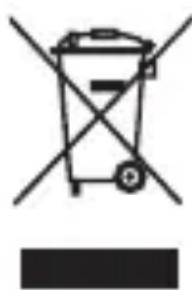
Devices must not be disposed of in normal household waste.
At the end of its life, the product must be disposed of in an appropriate way. In this way, valuable materials contained in the device will be recycled and the burden on the environment avoided. Hand in the old device at a collection point for electronic waste or at a recycling depot.
For more information, contact your local waste disposal firm or your local administrative body.
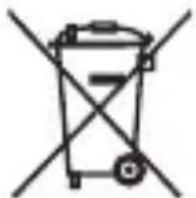
Recyclable and disposable batteries do not belong in household waste
All batteries must be handed in at a collection point in your community, suburb, or at the retailer. Such batteries can thus be disposed of in an environmentally friendly way.
;Estimada/o cliente!
Piles: 1x LR03 (AAA), 1,5 V
- General information
- About this manual
- Explanation of symbols
- Table of Contents
- Intended Use
- Safety
- DANGER for Children
- RISK of fire/burning and/or explosion
- BEWARE of material damage
- Overview
- Scope of delivery
- Start-up
- Receiving the time signal
- Use
- Dial lighting
- Temperature and date display
- Restart radio transmission
- Set the time manually
- Tips for good reception
- About the time signal transmitter DCF77
- Alarm
- Setting the alarm time
- Being awakened
- Auto-stop function
- Repeat alarm (snoopze function)
- Turn the alarm off
- Other functions
- Switching between summer and winter time
- Reset the radio-controlled alarm clock to the default settings
- Cleaning
- Fault and remedy
- No function.
- Temperature indication appears too high.
- Technical Data
- Declaration of Conformity
- Guarantee
- Disposal
- Disposing of the packaging
- Disposing of the product
- Devices must not be disposed of in normal household waste.
- Recyclable and disposable batteries do not belong in household waste
- ;Estimada/o cliente!
Brand : ADE
Model : CK 1713
Category : Alarm Clock