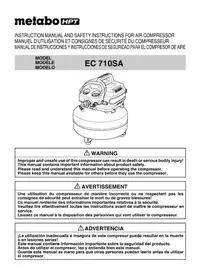
USER MANUAL EC 710SA METABO
natural_image
Line drawing of a mechanical air compressor device with no visible text or symbols

WARNING
Improper and unsafe use of this compressor can result in death or serious bodily injury!
This manual contains important information about product safety.
Please read and understand this manual before operating the compressor.
Please keep this manual available for others before they use the compressor.

AVERTISSEMENT
Read and understand all of the operating instructions, safety precautions and warnings in the Instruction Manual before operating or maintaining this compressor.
Most accidents that result from compressor operation and maintenance are caused by the failure to observe basic safety rules or precautions. An accident can often be avoided by recognizing a potentially hazardous situation before it occurs, and by observing appropriate safety procedures.
Basic safety precautions are outlined in the “SAFETY” section of this Instruction Manual and in the sections which contain the operation and maintenance instructions.
Hazards that must be avoided to prevent bodily injury or machine damage are identified by WARNINGS on the compressor and in this Instruction Manual.
Never use this compressor in a manner that has not been specifically recommended by metabo HPT, unless you first confirm that the planned use will be safe for you and others.
MEANINGS OF SIGNAL WORDS
| WARNING | indicates a potentially hazardous situations which, if ignored, could result in death or serious personal injury. |
| CAUTION | indicates a potentially hazardous situations which, if not avoided, may result in minor or moderate injury, or may cause machine damage. |
| NOTE | emphasizes essential information. |
SAFETY
IMPORTANT SAFETY INSTRUCTIONS FOR USE OF THE COMPRESSOR
WARNING: Death or serious bodily injury could result from improper or unsafe use of compressor. To avoid these risks, follow these basic safety instructions:
READ ALL INSTRUCTIONS
Never place your hands, fi ngers or other body parts near the compressor's moving parts.
Never insert your fingers or other objects into the shroud ventilator. Such an action invites the danger of injuries or electric shocks.
2. NEVER OPERATE WITHOUT ALL GUARDS IN PLACE.
Never operate this compressor without all guards or safety features in place and in proper working order. If maintenance or servicing requires the removal of a guard or safety features, be sure to replace the guard or safety features before resuming operation compressor.
3. ALWAYS WEAR PROTECTION.
Risk of injury. Always wear ANSI Z87.1 safety glasses with side shields or equivalent eye protection. Compressed air must never be aimed at anyone or any part of the body. Use ear protection as air flow noise is loud when draining.
4. PROTECT YOURSELF AGAINST ELECTRIC SHOCK.
Prevent body contact with grounded surfaces such as pipes, radiators, ranges and refrigeration enclosures.
This compressor must be properly grounded. Don't expose compressor to rain. Never operate the compressor in damp or wet locations.
To reduce risk of electric shock, do not remove shroud.
5. DISCONNECT THE COMPRESSOR.
Always disconnect the compressor from the power source and remove the compressed air from the air tank before servicing, inspecting, maintaining, cleaning, replacing or checking any parts.
6. AVOID UNINTENTIONAL STARTING.
Do not carry the compressor while it is connected to its power source or when the air tank is filled with compressed air. Be sure the power switch in the "OFF" position before connecting the compressor to its power source.
7. STORE COMPRESSOR PROPERLY.
When not in use, the compressor should be stored in indoor dry place. Keep out of reach of children. Lock-out the storage area.
8. KEEP WORK AREA CLEAN.
Cluttered areas invite injuries. Clear all work areas of unnecessary tools, debris, furniture, etc.
9. CONSIDER WORK AREA ENVIRONMENT.
Keep work area well lit and well ventilated.
Operate the compressor in an open area at least 18 inches (457 mm) away from any wall or object on which restrict the flow of fresh air to the ventilation openings. Do not place rags or other objects on or near these openings.
Risk of fire or explosion. Do not carry and operate the compressor or any other electrical device near the spray area. Do not use compressor in the presence of fl ammable liquids or gases.
Never place objects against or on top of compressor.
Compressor produces sparks during operation. Never use compressor in sites containing lacquer, paint, benzine, thinner, gasoline, gases, adhesive agents, and other materials which are combustible or explosive.
Always operate the compressor in a stable and secure position to prevent accidental mo the unit. Never operate the compressor on a roof or other elevated positon. Never use on a ladder or unstable support. Use an additional air hose to reach high locations.
This compressor contains some components parts that tend to produce arcs or sparks, and therefore, when located in a garage, it should be in a room or enclosure provided for this purpose, and should be 18 inches (457 mm) or more above the floor.
10. KEEP COMPRESSORS AS FAR FROM THE SPRAYING AREA AS POSSIBLE.
Risk of fire or explosion. Do not spray flammable liquid in a confined area. The spray area must be well ventilated. Do not smoke while spraying or spray where parks or a flame is present. Use spray gun hose
at least 25 feet (7.6 m) long and keep the compressor/motor at least 20 feet (6.1 m) away from vapours. Do not use this air compressor to spray chemicals. Your lungs can be damaged by toxic fumes.
A respirator may be necessary in dusty environments or when spraying paint. Do not carry while painting.
11. KEEP CHILDREN AWAY.
Do not let visitors contact compressor extension cord.
All visitors should be kept safely away from work area.
12. DRESS PROPERLY.
Do not wear loose clothing or jewelry. They can be caught in moving parts.
Wear protective hair covering to contain long hair.
13. DON'T ABUSE CORD.
Never yank it to disconnect from receptacle.
Keep cord from heat, oil and sharp edges.
14. MAINTAIN COMPRESSOR WITH CARE.
Follow maintenance chart (refer to page 13).
Inspect cords periodically and if damaged, have repaired by authorized service center. Inspect extension cords periodically and replace if damaged.
15. OUTDOOR USE EXTENSION CORDS.
When compressor is used outdoors, use only extension cords intended for use outdoors and so marked.
16. STAY ALERT.
Watch what you are doing. Use common sense. Never stand on the compressor. Do not allow the compressor to operate unattended. Do not operate compressor when you are tired. Compressor should never be used by you if you are under the influence of alcohol, drugs or medication that makes you drowsy.
17. CHECK DAMAGED PARTS AND AIR LEAK.
Before further use of the compressor, a guard or other part is damaged should be carefully checked to determine that it will operate properly and perform its intended function. Check for alignment of moving parts, binding of moving parts, bre mounting, air leak, and any other conditions that may affect its operation.
A guard or other part that is damaged should be properly repaired or replaced by a metabo HPT authorized service center.
Have defective pressure switches replaced by a metabo HPT authorized service center.
Do not use compressor if switch does not turn it on and off.
18. NEVER USE COMPRESSOR FOR APPLICATIONS EXPER THAN THOSE SPECIFIED.
Never use compressor for applications other than in that specific ed in the Instruction Manual.
Following all safety precautions in this manual and the manufacturer's instructions in the application manual.
Never use compressed air for breathing or respiration.
19. HANDLE COMPRESSOR CORRECTLY.
Operate the compressor according to the instructions provided herein. Never allow the compressor to be operated by children, individuals unfamiliar with its operation or unauthorized personnel.
20. KEEP ALL SCREWS, BOLTS AND GUARDS TIGHTLY IN PLACE.
Keep all screws, bolts, and guards tightly mounted.
Check their conditions periodically.
21. KEEP MOTOR AIR VENT CLEAN.
The motor air vent must be kept clean so that air can freely flow at all times. Check for dust build-up frequently.
22. OPERATE COMPRESSOR AT THE RATED VOLTAGE.
Operate the compressor at voltages specified on their nameplates.
If using the compressor at a higher voltage than the rated voltage, it will result in abnormally the revolution and may damage the unit and burn out the motor.
If compressor is connected to a circuit protected by fuse, use time delay fuses. Time delay fuses should be marked "D" in Canada and "T" in the U.S.
23. NEVER USE A COMPRESSOR WHICH IS DEFECTIVE OR OPERATING ABNORMALLY.
If the compressor appears to be operating unusually, making strange noises or vibration, or otherwise appears defective, stop using it immediately and arrange for repairs by a metabo HPT authorized service center.
24. DO NOT WIPE PLASTIC PARTS WITH SOLVENT.
a Solvents such as gasoline, thinner, benzine, carbon tetrachloride, and alcohol may damage and crack plastic parts. Do not wipe them with such solvents.
Wipe plastic parts with a soft cloth lightly dampened with soapy water and dry thoroughly.
Replacement parts not manufactured by metabo HPT may void your warranty and can lead to malfunction
and resulting injuries. Genuine metabo HPT parts are available from your dealer.
26. DO NOT MODIFY THE COMPRESSOR.
Do not modify the compressor. Do not drill into, weld, patch or modify the air tanks. Do not make adjustments to the components that control tank pressure. Do not make alterations to the factory operating pressure settings. Do not operate at pressures or speeds in excess of the manufacturer's recommendations. Always contact the metabo HPT authorized service center for any repairs. Unauthorized modification may not only impair the compressor performance but may also result in accidents or injury to repair people who do not have the required knowledge and technical expertise to perform the repair operations correctly.
27. TURN OFF THE POWER SWITCH WHEN THE COMPRESSOR IS NOT USED.
When the compressor is not used, turn off the power switch, disconnect the plug from the power source and open the drain cock to discharge the compressed air from the air tank.
To reduce the risk of burns, do not touch the delivery pipe, check valve or pump.
These areas can remain hot for at least 45 minutes after this compressor is shutdown.
Allow compressor to cool prior to servicing.
29. DO NOT DIRECT AIR STREAM AT BODY.
Risk of injury. Do not direct air stream at persons or animals.
30. DRAIN TANK.
Risk of bursting. Water will condense in the air tank. If not drained, water will corrode and weaken the air tank causing a risk of air tank rupture.
Drain tank daily or after 4 hours of use. To drain the air tank, open valves slowly and tilt compressor to empty accumulated water.
Keep face and the other body parts away from outlet of drain.
Use ANSI Z87.1 safety glasses with side shields when draining as debris can be kicked up into face.
31. DO NOT STOP COMPRESSOR BY PULLING OUT THE PLUG.
This could result in damage to the unit.
Use the power switch.
Too much air pressure causes a hazardous risk of bursting.
Check the manufacturer's maximum pressure rating for air tools and accessories. The regulator outlet pressure must never exceed the maximum pressure on rating.
33. THE SAFETY VALVE MUST WORK PROPERLY.
Risk of bursting. Before starting the compressor, pull the ring on the safety valve to make sure that the safety valve operates smoothly. If the safety valve does not work properly, over-pressurization may occur, causing air tank rupture or an explosion. Do not use compressor if the safety valve is stuck or does not operate smoothly. Have defective safety valve replaced by a metabo HPT authorized service center.
34. USE OF THIS PRODUCT WILL EXPOSE YOU TO CHEMICALS KNOWN TO THE STATE OF CALIFORNIA.
Some dust created by this product contains chemicals known to State of California to cause cancer, birth defects or other reproductive harm. Some examples of these chemicals are:
– compounds in fertilizers
- compounds in insecticides, herbicides and pesticides
- arsenic and chromium from chemically treated lumber
To reduce your exposure to these chemicals, wear approved safety equipment such as dust masks that are specially designed to filter out microscopic particles. Use of this product will expose you to chemicals known to the State of California to cause cancer, birth defects and other reproductive harm.
Avoid inhaling vapors and dust, and wash hands after using. This product contains chemicals, including lead, known to the State of California to cause cancer, and birth defects or other reproductive harm. Wash hands after handling.
REPLACEMENT PARTS
When servicing use only identical replacement parts.
Repairs should be conducted only by a metabo HPT authorized service center.
SAFETY —Continued
GROUNDING INSTRUCTIONS
This compressor should be grounded while in use to protect the operator from electric shock. The compressor is equipped with a three-conductor cord and three-prong grounding type plug to fit the proper grounding type receptacle. The green (or green and yellow) conductor in the cord is the grounding wire. Never connect the green (or green and yellow) wire to a live terminal. If your unit is for use on less than 150 volts, it has a plug that looks like that shown in sketch (A) in Figure on the right. An adapter, see sketches (B) and (C), is available for connecting sketch (A) type plugs to two-prong receptacles. The green-colored rigid ear, lug, or the like extending from the adapter must be connected to a permanent ground, such as a properly grounded outlet box.
NOTE: The grounding adaptor, sketch (C), is prohibited in Canada by Canadian Electrical Code Part 1. Therefore, the instructions for its use are not applicable in Canada.
We recommend that you never disassemble the compressor or try to do any rewiring in the electrical system. Any repairs should be performed only by metabo HPT Service Centers. Should you be determined to make a repair yourself, remember that the green colored wire is the "grounding" wire. Never connect this green wire to a "live" terminal. If you replace the plug on the power cord, be sure to connect the green wire only to the grounding (longest) prong on a 3-prong plug.
If in doubt, call a qualified electrician and have the receptacle checked for ground.

EXTENSION CORD
Use only three-wire extension cords that have three-prong grounding-type plugs and three-pole receptacles that accept the compressor's plug. Replace or repair damaged cord.
Make sure your extension cord is in good condition. When using an extension cord, be sure to use one heavy enough to carry the current your product will draw. An undersized cord will cause a drop in line voltage resulting in loss of power and overheating. Table shows the correct size to use depending on cord length and name plate ampere rating. If in doubt, use the next heavier gage. The smaller the gage number, the heavier the cord.
| Total Length of Cord in Feet (Meter) |
| 0 – 25(0 – 7.6) | 26 – 50(7.9 – 15.2) | 51 – 100(15.5 – 30.5) |
| Ampere Rating Wire size (A. W. G) |
| More Than | Not More Than | | |
| 0 – 6 | 16 | 14 | 12 |
| 6 – 10 | 14 | 14 | 10 |
| 10 – 12 | 14 | 14 | 10 |
| 12 – 16 | 14 | 12 | Not Recommended |

WARNING:
Avoid electrical shock hazard. Never use this compressor with a damaged or frayed electrical cord or extension cord. Inspect all electrical cords regularly. Never use in or near water or in any environment where electric shock is possible.
SAVE THESE INSTRUCTIONS
AND
MAKE THEM AVAILABLE TO
The information contained in this Instruction Manual is designed to assist you in the safe operation and maintenance of the compressor.
Some illustrations in this Instruction Manual may show details or attachments that differ from those on your own compressor.
NAME OF PARTS

Fig. 1
SPECIFICATIONS
| Model EC 710SA | |
| Motor Single-Phase, universal motor | |
| Power Source Single-Phase, 120 V AC 60 Hz | |
| Running Horse Power 1.2 HP (0.86 kW) | |
| Current 12 A | |
| Tank Capacity 6 gal. (22.7 ltr) | |
| Maximum Pressure 150 PSI (10.3 bar) | |
| Free Air Delivery | at 40 PSI (2.8 bar) 3.8 CFM (106.6 ltr/min) |
| at 90 PSI (6.2 bar) 2.8 CFM (79.3 ltr/min) |
| Lubrication Oil-less | |
APPLICATIONS
Air compressors are utilized in a variety of air system applications.
Match hoses, connectors, air tools, and accessories to the capabilities of the air compressor.
You may use this tool for purposes listed below:
Operating air powered tools requiring less than 2.8 CFM @ 90 PSI or 3.8 CFM @ 40 PSI.
Powering pneumatic nail guns, inflating tires, cleaning / blowing with pressurized air.

WARNING:
Always follow all safety rules recommended by the manufacturer of your tool, in addition to all safety rules for the air compressor.
Following these rules will reduce the risk of serious personal injury.
PRIOR TO OPERATION
1. Power source
Ensure that the power source to be utilized conforms to the power source requirements specified on the product nameplate.
NOTE: If compressor is connected to a circuit protected by fuse, use time delay fuses.
Time delay fuses should be marked "D" in Canada and "T" in the U.S.
2. Power switch
Ensure that the power switch is in the "OFF" position (Fig. 2). If the plug is connected to a receptacle while the power switch is in the "ON" position, the compressor will start operating immediately and can cause serious injury.
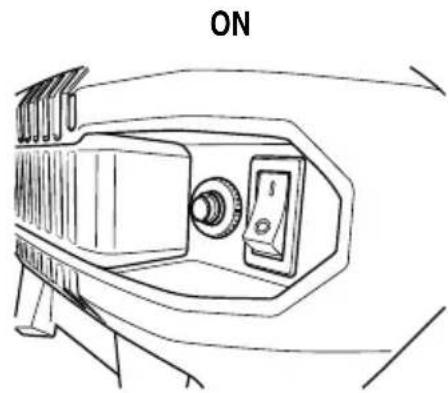
natural_image
Line drawing of a mechanical component with a switch and lever (no text or symbols)
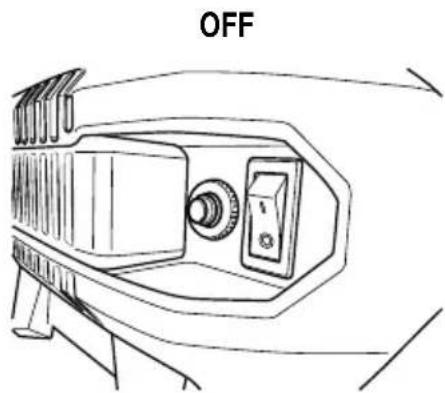
Fig. 2
3. Extension cord
When the work area is far away from the power source, use an extension cord of sufficient thickness and rated capacity (refer page 6). The extension cord should be kept as short as practicable.

WARNING: Damaged cord must be replaced or repaired.
4. Confirm the power receptacle
If the power receptacle only loosely accepts the plug, the receptacle must be repaired. Contact a licensed electrician to make appropriate repairs.
If such a faulty receptacle is used, may cause overheating, resulting in a serious hazard.
5. To check the safety valve.
Before starting compressor, pull the ring on the safety valve to make sure that the safety valve operates smoothly. (Fig. 3) Do not use compressor if the safety valve is stuck or does not operate smoothly. Have defective safety valve replaced by a metabo HPT authorized service center.

Fig. 3
⚠ WARNING: Drain tank to release air pressure before pull the ring on the safety valve.
⚠ WARNING: Risk of bursting.
If the safety valve does not work properly, over-pressurization may occur, causing air tank rupture or an explosion.
6. Right running position
Always operate the compressor in a stable and secure position to prevent accidental the unit. Never operate the compressor on a roof or other elevated positon. Never use on a ladder or unstable support. Use an additional air hose to reach high locations.
Operate the compressor in an open area at least 18 in. (45 cm) away from any wall or object that could restrict the flow of fresh air to the ventilation openings. Do not place rags or other objects on or near these openings.
⚠ WARNING: A portable compressor can fall from a table, workbenc or roof causing damage to the compressor and could result in serious injury or death.
NOTE: When operating or storing the compressor, set 3 rubber bumpers downward on the floor (Refer to Fig. 1).
7. Temperature
Operating temperatures are between 32^ F and 104^ F ( 0^ C and 40^ C).
CAUTION: Never operate in temperatures below 32°F (0°C) or above 104°F (40°C).
8. Air hose
Check the air hose for weak or worn condition before each use, making certain all connections are secure. Do not use it if a defect is found. Purchase a new air hose or notify a metabo HPT authorized service center for examination or repair.
Make sure the air hose is free of obstructions or snags.
If it is entangled or snarled, the air hose can cause loss of balance or footing and may become damaged. Keep the air hose away from sharp objects, chemical spills, oil, solvents, and wet floors.
9. Breaking in the pump.
(1) Turn the knob of the pressure reducer fully clockwise to open air flow.
(2) Place the power switch in the "OFF" position and insert the plug into the receptacle.
(3) Open the drain cock completely.
(4) Turn the air compressor "ON" and run it for 10 minutes to break in the pump parts.
(5) Place the power switch in the "OFF" position.
(6) Close the drain cock.
movement of TRANSPORT
Turn off the power switch, and disconnect the plug from the power source before transport the compressor. Transport the compressor in the correct manner.
When transporting the compressor, grasp the handle.
WARNING: Risk of unsafe
Ensure proper footing and
use caution when carrying
compressor to avoid a loss of
balance.
Do not carry while painting.
OPERATION
1. Start-up
Insert the plug into the receptacle and start the compressor using the power switch. (Refer to Fig. 2).
WARNING: Do not stop or start the compressor by use of the plug. Always use "ON/OFF" button located on the power switch.
The operation of the compressor is automatic and is controlled by the power switch which stops it when the pressure in the air-tank reaches the maximum level and restart it when the air pressure drops during use to the restart level.
The motor has a thermal protector. The thermal protector will stop the motor when the temperature is too high for any reason.
The motor must be allowed to cool down before restarting.
CAUTION: Wear appropriate personal hearing protection during use. Under some conditions and duration of use, noise from this product may contribute to hearing loss.
2. Adjustment of outlet pressure
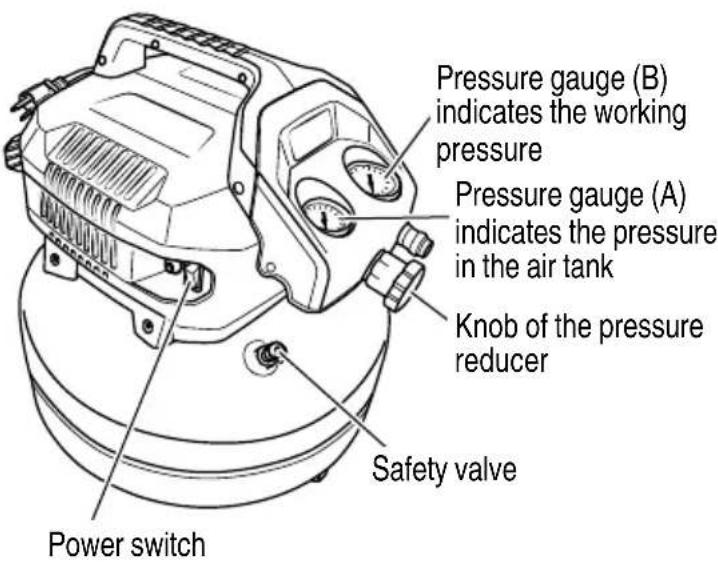
Pull the knob of the pressure reducer to allow the knob to rotate. Then, adjust the outlet pressure to the required level by turning the knob of the pressure reducer clockwise to increase the outlet pressure and counterclockwise to decrease it.
A pressure gauge (B) is provided to show when the required pressure is reached.
When adjusting the pressure, check and make sure that a pressure gauge (A) for the tank has the pressure level that is higher than that of the pressure to be adjusted.
It is also imperative that you make adjustment by slowly starting up the pressure from the level that is lower than the pressure to be adjusted.
After adjusting the outlet pressure, push in the knob of the pressure reducer to lock the knob and use the tool.
WARNING: Check the manufacturer's maximum pressure rating for nailers, staplers and accessories. Compressor outlet pressure must be regulated so as to never exceed the maximum pressure rating of the nailers, staplers and accessories.
WARNING: Make sure the air flow to the pressure reducer is completely closed (the pressure gauge (B) attached reads 0 psi) before attaching and disconnecting the air hose and applications.

3. Shutdown
(1) Place the power switch in the "OFF" position. (Refer to Fig. 2).
(2) Unplug the plug from power source.
(3) Open the drain cock located at the lower part of the tank (Fig. 5). Tank pressure should be below 10 psi when draining the tank.

WARNING: Risk of bursting. When the tank gets corroded, there is a risk of breakdown. Water will condense in the air tank. If not drained, water will corrode and weaken the air tank causing a risk of air tank rupture. Drain tank daily or after 4 hours of use. The drain contains moisture in the air, abrasion particles, rust, etc..
To drain tank open valve slowly and tilt compressor to empty accumulated water. Keep face and e from drain cock.

Fig. 5
4. About the thermal protection
The thermal protection operates to stop the motor when a problem such as a motor overload, etc. occurs.
If the motor stops during operating, reset by pushing the Reset switch (Refer to Fig. 6).
If the motor does not start or if it stops immediately, proceed as follows.
(1) Place the power switch in the "OFF" position and disconnect the plug from the receptacle (Fig. 2).
(2) Check for the following possible causes first: lack of proper ventilation, or an outside-air or room temperature that is too high.
(3) If the extension cord does not conform to the specifications given on page 6 replace with an extension cord such as that shown on page 6. If the capacity of the power supply is insufficient, increase the power supply capacity to remove the cause of a flow of excessive current (over-current).
(4) Wait approximately 30 minutes.
(5) Start up. If the motor still stops during operation, please contact the metabo HPT authorized service center.

Fig. 6
MAINTENANCE

WARNING:
Disconnect the compressor from the power source and remove the compressed air from the air tank before performing the maintenance operations. Allow the compressor to cool before performing the maintenance operations.
1. Draining tank
Drain tank daily or after 4 hours of use. Open drain cock and tilt compressor to empty accumulated water (Refer to Fig. 5). Tank pressure should be below 10 psi when draining the tank.
2. Maintenance chart:
MAINTENANCE CHART
| PROCEDURE AFTER USE DAILY WEEKLY | | | |
| Drain condensation in air tank × × | | | |
| Inspect guards/shrouds × | | | |
| Check for unusual noise/vibration × | | | |
| Check for air leaks × | | | |
| Clean exterior of compressor × | | | |
| Check safety valve × | | | |
SERVICE AND REPAIRS
All quality compressors will eventually require servicing or replacement of parts because of wear and tear from normal use. To assure that only genuine replacement parts will be used, all service and repairs must be performed by a metabo HPT AUTHORIZED SERVICE CENTER, only.
NOTE: Specifications are subject to change without any obligation on the part of the metabo HPT.
natural_image
Simple line drawing of two electrical outlets with arrows pointing to them (no text or symbols)
Adaptador
Tornillo de metal
natural_image
Line drawing of a hand holding a screwdriver (no text or symbols)
Shinagawa Intercity Tower A, 15-1, Konan 2-chome, Minato-ku, Tokyo 108-6020, Japan
Distributed by
Koki Holdings America Ltd.
1111 Broadway Ave,
Braselton, Georgia, 30517
Koki Holdings America Ltd. Canadian Branch
3405 American Drive, Units 9-10, Mississauga, ON, L4V 1T6