
PL914 - Saw POULAN - Free user manual and instructions
Find the device manual for free PL914 POULAN in PDF.


| Brand | Poulan |
| Model | PL914 |
| Product type | Gas chainsaw |
| Engine | PR5020 (LDAV50MC), 50.2 cm³, 2.1 kW / 9000 rpm |
| Fuel | Unleaded gasoline 87 AKI min mixed with synthetic 2-stroke oil 50:1 (2.6 oz oil per 1 gal gasoline) |
| Fuel tank | 425 cm³ |
| Chain oil tank | 295 cm³, automatic pump, flow 13 ml/min at 9000 rpm |
| Chain and bar | Bar 50 cm (20 in), chain 3/8", gauge 1.3 mm, sprocket 7 teeth |
| Weight | 5.9 kg (13.0 lb) without bar and chain, empty tanks |
| Sound level | Sound pressure 104 dB(A) at ear, sound power 122 dB(A) guaranteed Europe |
| Vibrations | Front handle 8.70 m/s², rear handle 9.78 m/s² |
| Idle speed | 2800-3200 rpm |
| Spark plug | Husqvarna HQT-1 or Brisk PR17YC, gap 0.6 mm |
| Safety | Chain brake (manual and inertia), hand guard, low kickback chain and bar, throttle lock |
| Maintenance | Air filter every 5 h, spark arrestor screen every 25 h, spark plug annually |
| Usage | Felling, limbing, bucking |
| Warranty | Consult the manual or dealer |
Frequently Asked Questions - PL914 POULAN
User questions about PL914 POULAN
0 question about this device. Answer the ones you know or ask your own.
Ask a new question about this device
Download the instructions for your Saw in PDF format for free! Find your manual PL914 - POULAN and take your electronic device back in hand. On this page are published all the documents necessary for the use of your device. PL914 by POULAN.
USER MANUAL PL914 POULAN
NOTE: Your product may differ slightly from the item shown.
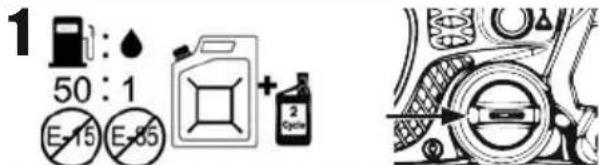
Mix 2.6 oz. of full synthetic 2-Cycle Oil with 1 gallon of fresh seasonal gasoline for a 50:1 mixture. Shake well. Pour into fuel tank. CAUTION: Do not use alternate fuels such as ethanol blends above 10% by volume (E-15, E-85) or any methanol blended fuel.
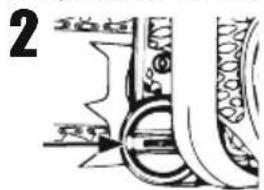
Add bar and chain oil to oil tank until full.
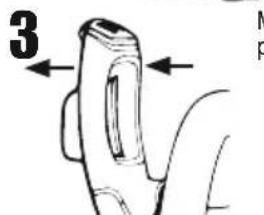
Make sure chain brake is locked by pushing forward on handguard.
Slowly press primer (air purge) bulb 10 times.
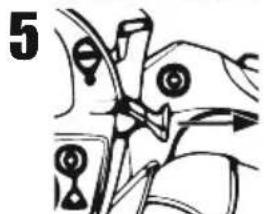
Pull blue choke lever out fully.
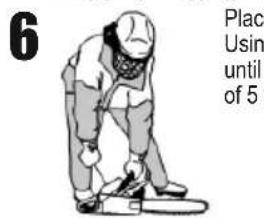
the right foot in rear handle as shown.
The right hand, pull starter rope sharply
the machine attempts to start, or a maximum of
times.
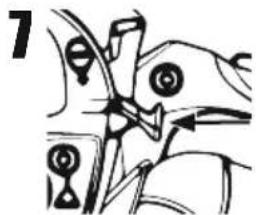
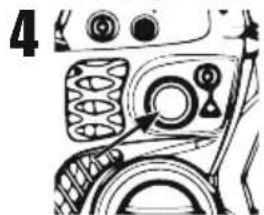
Push blue choke lever to half choke position.
Pull starter rope until engine starts.
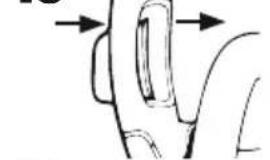
10 Make sure chain brake is unlocked by pulling back on handguard.
12 Press red switch to STOP position when finished using saw.
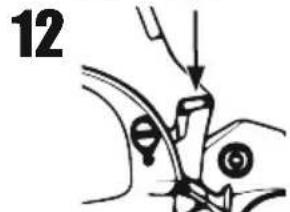
Press red switch to STOP position when finished using saw.
STARTING A WARM ENGINE
4 + 5 + 7 + 8
NOTE: If the product does not restart, the problem could be overheated fuel. To fix this problem, try the following procedure:
- Set the product in a cool area away from direct sunlight.
- Allow the product to cool for at least 20 minutes.
- Press primer (air purge) bulb repeatedly for 10-15 seconds.
- Follow the cold starting procedure.
Repeat this procedure if the problem still exists.
NOTE: Always use fresh seasonal fuel and shorten operation time during unseasonably warm weather.
IMPORTANT:
- Never let your saw chain come in contact with soil/dirt during operation. This will completely dull your chain and will require installation of a new chain.
- Check your chain tension prior to each time you start the chainsaw. Check tension on a new chain after the first 15 minutes of operation. See the manual for chain tensioning instructions.
SYMBOLS
| This machine can be dangerous! Careless or improper use can cause serious injury. | |
| Please read the operator's manual carefully and make sure you understand the instructions before using the machine. | |
| Always use: • eye protection such as non-fogging, vented goggles or face screen • an approved safety helmet • sound barriers (ear plugs or mufflers) to protect your hearing | |
| Never operate a chain saw holding it with one hand only. | |
| Both of the operator's hands must be used to operate the chain saw. | |
| Contact of the guide bar tip with any object must be avoided. | |
| Measured maximum kickback value. | 45 |
| A-weighted sound pressure level at 7,5 meters (25 feet) according to Australia NSW "Protection of the Environment Operations (Noise Control) Regulation 2008". This data is specified on the label. | XX NOISE dB A |
| Noise emission to the environment according to the European Community's Directive. This data is specified in the TECHNICAL DATA section and on the label. | XXX dB |
| This product is in accordance with applicable EC directives. | CE |
| This product is in accordance with applicable EAC directives. | EAC |
| This product is in accordance with the Australian electromagnetic compatibility (EMC) regulations. | |
| Use unleaded gasoline and two-stroke oil mixed at a ratio of 2% (50:1). | + |
| 50:1 gasoline to oil ratio. | 50:1 |
| Chain oil fill. | STOP |
| The engine is stopped by switching the ignition off using the stop switch. | |
| Primer. | |
| Choke control. | |
| Chain brake. | |
| Unlock chain brake. | |
| Lock chain brake. | |
| Chain brake: • not locked (left) • locked (right) | ←右 |
| Chain direction of rotation. | # |
| Chain tensioner. | + |
Other symbols/decals on the machine refer to special certification requirements for certain markets.
The Emissions Compliance Period referred to on the Emission Compliance label indicates the number of operating hours for which the engine has been shown to meet Federal emissions requirements.
Maintenance, replacement, or repair of the emission control devices and system may be performed by any nonroad engine repair establishment or individual.

WARNING! The engine exhaust from this product contains chemicals known to the State of California to cause cancer, birth defects or other reproductive harm.
KNOW YOUR MACHINE
READ THIS INSTRUCTION MANUAL AND SAFETY RULES BEFORE OPERATING YOUR CHAIN SAW. Compare the illustrations with your unit to familiarize yourself with the location of the various controls and adjustments. Save this manual for future reference.
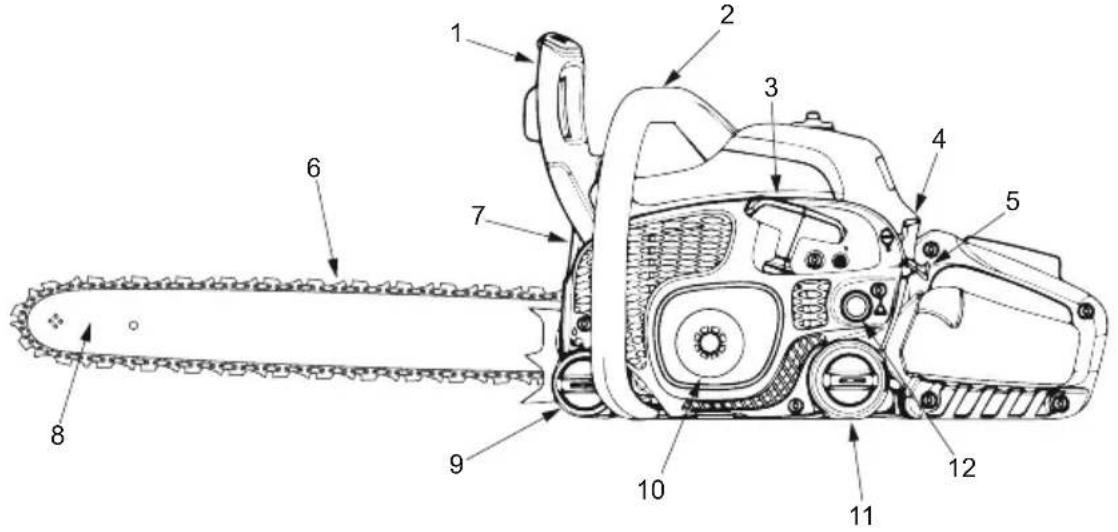
- Front Hand Guard/Chain Brake
- Front Handle
- Starter Rope
- ON/STOP Switch
- Choke/Fast Idle Lever
-
Chain
-
Muffler
- Guide Bar
- Bar & Chain Oil Cap
- Starter Housing
11.Fuel Cap - Primer Bulb
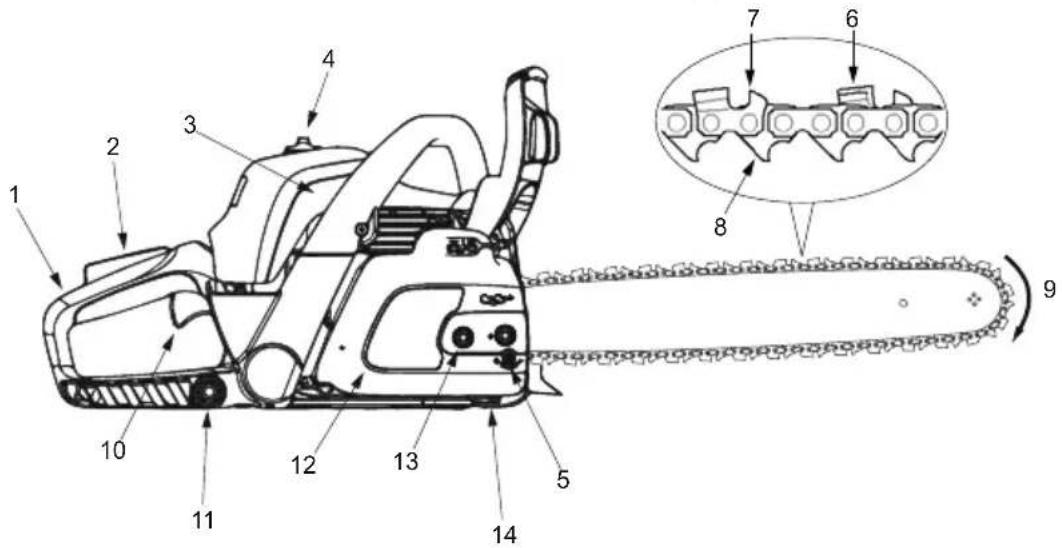
- Rear Handle
- Throttle Lockout
- Cylinder Cover
- Air Filter Cover
- Adjustment Screw
- Cutters
-
Depth Gauge
-
Drive Links
- Direction of Travel
- Throttle Trigger
- Chain Adjustment Tool (Bar Tool)
- Clutch Cover
- Bar Nuts
- Chain Catcher
SAFETY
WARNING! Always disconnect spark plug wire and place wire where it cannot contact spark plug to prevent accidental starting when setting up, transporting, adjusting or making repairs except carburetor adjustments.
INTRODUCTION
A chainsaw is a high-speed wood-cutting tool. Special safety precautions must be observed to reduce the risk of accidents.
Failure to follow all safety rules and precautions can result in serious injury.
If situations occur which are not covered in this manual, use care and good judgment. If you need assistance, contact your authorized service dealer or call customer support.
PLANNING AHEAD
- Read this manual carefully until you completely understand and can follow all safety rules, precautions, and operating instructions before attempting to use the unit.
- Restrict the use of your saw to adult users who understand and can follow safety rules, precautions, and operating instructions found in this manual.
- Wear protective gear. Always use steel-toed safety footwear with non-slip soles; snug-fitting clothing; safety chaps; heavy-duty, non-slip gloves; eye protection such as non-fogging, vented goggles or face screen; an approved safety hard hat; and sound barriers (ear plugs or mufflers) to protect your hearing. Regular users should have hearing checked regularly as chainsaw noise can damage hearing. Secure hair above shoulder length.
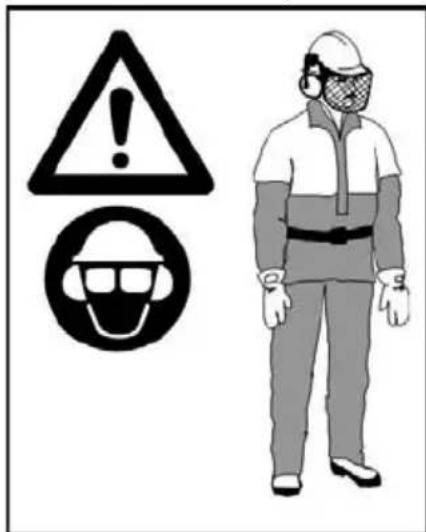
- Keep all parts of your body away from the chain when the engine is running.
- Keep children, bystanders, and animals a minimum of 10 meters (30 feet) away from the work area. Do not allow other people or animals to be near the chainsaw when starting or operating the chainsaw.
- Do not handle or operate a chainsaw when you are fatigued, ill, or upset, or if you have taken alcohol, drugs, or medication. You must be in good physical condition and mentally alert. Chainsaw work is strenuous. If you have any condition that might be aggravated by strenuous work, check with your doctor before operating a chainsaw.
- Carefully plan your sawing operation in advance.
Do not start cutting until you have a clear work area, secure footing, and, if you are felling trees, a planned retreat path.
OPERATING YOUR SAW
- Do not operate a chainsaw with one hand. Serious injury to the operator, helpers, bystanders or any combination of these persons may result from one-handed operation. A chainsaw is intended for two-handed use.
- Operate the chainsaw only in a well-ventilated outdoor area.
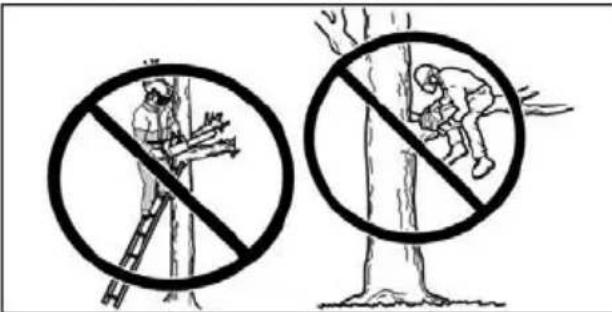
- Do not operate saw from a ladder or in a tree.
- Make sure the chain will not make contact with any object while starting the engine. Never try to start the saw when the guide bar is in a cut.
- Do not put pressure on the saw at the end of the cut. Applying pressure can cause you to lose control when the cut is completed.
- Stop the engine before setting the saw down.
- Do not operate a chainsaw that is damaged, improperly adjusted, or not completely and securely assembled. Always replace bar, chain, hand guard, or chain brake immediately if it becomes damaged, broken or is otherwise removed.
- Exposure to vibrations through prolonged use of gasoline powered hand tools could cause blood vessel or nerve damage in the fingers, hands, and joints of people prone to circulation disorders or abnormal swellings. Prolonged use in cold weather has been linked to blood vessel damage in otherwise healthy people. If symptoms occur such as numbness, pain, loss of strength, change in skin color or texture, or loss of feeling in the fingers, hands, or joints, discontinue the use of this tool and seek medical attention. An anti-vibration system does not guarantee the avoidance of these problems. Users who operate power tools on a continual and regular basis must monitor closely their physical condition and the condition of this tool.
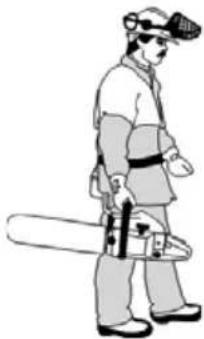
- With the engine stopped, hand-carry the chainsaw with the muffler away from your body, and the guide bar and chain to the rear, preferably covered with a scabbard.
MAINTAINING YOUR SAW
- Have all chainsaw service performed by a qualified service dealer with the exception of the items listed in the maintenance section of this manual. For example, if improper tools are used to remove or hold the flywheel when servicing the clutch, structural damage to the flywheel can occur and cause the flywheel to burst.
Make certain the saw chain stops moving when the throttle trigger is released. For correction, refer to Carburetor Adjustment. - Never modify your saw in any way.
- Keep the handles dry, clean, and free of oil or fuel mixture.
- Keep fuel and oil caps, screws, and fasteners securely tightened.
- Use only genuine accessories and replacement parts as recommended.
Certain regions require by law that many internal combustion engines are to be equipped with a spark arresting screen. If you operate a chainsaw in a locale where such regulations exist, you are legally responsible for maintaining the operating condition of these parts. Failure to do so is a violation of the law. Refer to the MAINTENANCE section for maintenance of the spark arresting screen.
HANDLING FUEL
- Do not smoke while handling fuel or while operating the saw.
- Eliminate all sources of sparks or flame in the areas where fuel is mixed or poured. There should be no smoking, open flames, or work that could cause sparks. Allow engine to cool before refueling.
Always have fire extinguishing tools available if you should need them. - Mix and pour fuel in an outdoor area on bare ground; store fuel in a cool, dry, well ventilated place; and use an approved, marked container for all fuel purposes. Wipe up all fuel spills before starting saw.
- Move at least 3 meters (10 feet) from fueling site before starting engine.
- Turn the engine off and let saw cool in a noncombustible area, not on dry leaves, straw, paper, etc. Slowly remove fuel cap and refuel unit.
- Store the unit and fuel in an area where fuel vapors cannot reach sparks or open flames from water heaters, electric motors or switches, furnaces, etc.
UNDERSTANDING KICKBACK
WARNING! Avoid kickback which can result in serious injury. Kickback is the backward, upward or sudden forward motion of the guide bar occurring when the saw chain near the upper tip of the guide bar contacts any object such as a log or branch, or when the wood closes in and pinches the saw chain in the cut. Contacting a foreign object in the wood can also result in loss of chainsaw control.
ROTATIONAL KICKBACK
Rotational kickback can occur when the moving chain contacts an object at the upper tip of the guide bar. This contact can cause the chain to dig into the object, which stops the chain for an instant. The result is a lightning fast, reverse reaction which kicks the guide bar up and back toward the operator.
PINCH KICKBACK
Pinch kickback can occur when the wood closes in and pinches the moving saw chain in the cut along the top of the guide bar and the saw chain is suddenly stopped. This sudden stopping of the chain results in a reversal of the chain force used to cut wood and causes the saw to move in the opposite direction of the chain rotation. The saw is driven straight back toward the operator.
PULL-IN
Pull-in can occur when the moving chain contacts a foreign object in the wood in the cut along the bottom of the guide bar and the saw chain is suddenly stopped. This sudden stopping pulls the saw forward and away from the operator and could easily cause the operator to lose control of the saw.
REDUCING THE CHANCE OF KICKBACK
- Recognize that kickback can happen. With a basic understanding of kickback, you can reduce the element of surprise which contributes to accidents.
- Never let the moving chain contact any object at the tip of the guide bar.
- Keep the working area free from obstructions such as other trees, branches, rocks, fences, stumps, etc. Eliminate or avoid any obstruction that your saw chain could hit while you are cutting. When cutting a branch, do not let the guide bar contact branch or other objects around it.
- Keep your saw chain sharp and properly tensioned. A loose or dull chain can increase the chance of kickback occurring. Follow manufacturer's chain sharpening and maintenance instructions. Check tension at regular intervals with the engine stopped, never with the engine running. Make sure the bar nuts are securely tightened after tensioning the chain.
- Begin and continue cutting at full speed. If the chain is moving at a slower speed, there is greater chance of kickback occurring.
- Use wedges made of plastic or wood. Never use metal to hold the cut open.
Cut one log at a time. - Use extreme caution when re-entering a previous cut.
- Do not attempt cuts starting with the tip of the bar (plunge cuts).
- Watch for shifting logs or other forces that could close a cut and pinch or fall into chain.
- Do not twist the saw as the bar is withdrawn from an undercut when bucking.
- Use the reduced-kickback guide bar and low-kickback chain specified for your saw.
MAINTAINING CONTROL
- Keep a good, firm grip on the saw with both hands when the engine is running and don't let go. A firm grip will help you reduce kickback and maintain control of the saw. Keep the fingers of your left hand encircling and your left thumb under the front handlebar. Keep your right hand completely around the rear handle whether you are right handed or left handed. Keep your left arm straight with the elbow locked.
- Position your left hand on the front handlebar so it is in a straight line with your right hand on the rear handle when making bucking cuts. Never reverse right and left hand positions for any type of cutting.
-
Stand with your weight evenly balanced on both feet.
-
Stand slightly to the left side of the saw to keep your body from being in a direct line with the cutting chain.
- Do not overreach. You could be drawn or thrown off balance and lose control of the saw.
- Do not cut above shoulder height. It is difficult to maintain control of saw above shoulder height.
KICKBACK SAFETY FEATURES
WARNING! The following features are included on your saw to help reduce the hazard of kickback; however, such features will not totally eliminate this danger.
As a chainsaw user, do not rely only on safety devices. You must follow all safety precautions, instructions, and maintenance in this manual to help avoid kickback and other forces which can result in serious injury.
REDUCED KICKBACK GUIDE BAR
The reduced-kickback guide bar is designed with a small radius tip which reduces the size of the kickback danger zone on the bar tip.
LOW-KICKBACK CHAIN
A low-kickback chain is designed with a contoured depth gauge and guard link which deflect kickback force and allow wood to gradually ride into the cutter.
FRONT HAND GUARD
The front hand guard is designed to reduce the chance of your left hand contacting the chain if your hand slips off the front handlebar.
The distance and "in-line" position of the hands provided by the front and rear handles work together to give balance and resistance in controlling the pivot of the saw back toward the operator if kickback occurs.
CHAIN BRAKE
The chain brake is designed to stop the chain in the event of kickback.
NOTE: We do not represent and you should not assume that the chain brake will protect you in the event of a kickback. Do not rely upon any of the devices built into your saw. You should use the saw properly and carefully to avoid kickback.
Repairs on a chain brake should be made by an authorized servicing dealer. Take your unit to the place of purchase if purchased from a servicing dealer, or to the nearest authorized master service dealer.
ASSEMBLY
Protective gloves (not provided) should be worn during assembly.
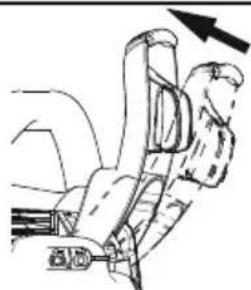
NOTE: Chain brake must be unlocked before clutch cover can be removed or reinstalled on the chain saw. To unlock chain brake, pull the front hand guard back toward the front handle as far as possible (see illustration).
(If not already attached)
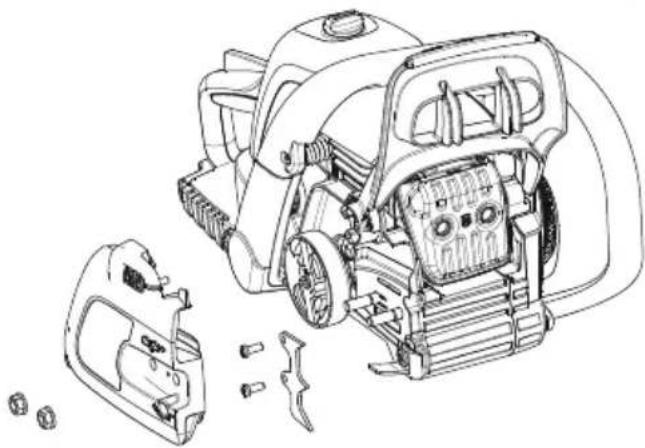
The bumper spike may be used as a pivot when making a cut.
- Move ON/STOP switch to the STOP position.
- Unlock chain brake.
- Loosen and remove the chain brake nuts and the clutch cover from the saw.
NOTE: If clutch cover can not be easily removed from the chain saw, ensure chain brake is unlocked by pulling the front hand guard back toward the front handle as far as possible.
- Attach the bumper spike with the two screws as shown.
ATTACHING THE BAR & CHAIN
(If not already attached)
WARNING: If received assembled, repeat all steps to ensure your saw is properly assembled and all fasteners are secure. Always wear gloves when handling the chain. The chain is sharp and can cut you even when it is not moving!
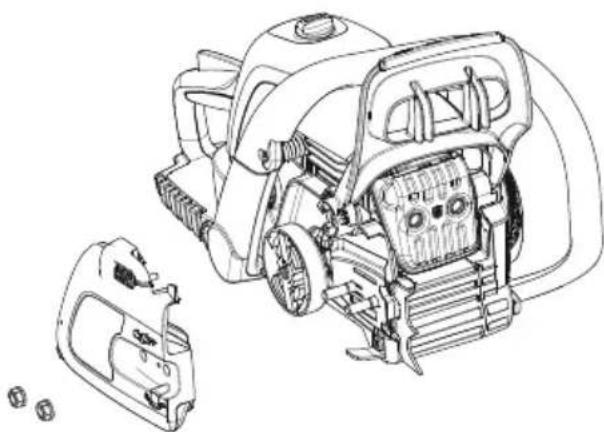
- Move ON/STOP switch to the STOP position.
- Unlock chain brake.
- Loosen and remove the bar nuts and the clutch cover from the saw.
NOTE: If clutch cover can not be easily removed from the chain saw, ensure chain brake is unlocked by pulling the front hand guard back toward the front handle as far as possible.
- Remove the plastic shipping spacer (if present).
- An adjustment pin and screw is used to adjust the tension of the chain. It is very important when assembling the bar that the adjustment pin (A) passes through the lower bar pin hole (B). Turning the screw (C) will move the adjustment pin up and down the screw. Locate this adjustment pin before you begin mounting the bar onto the saw. See following illustration.
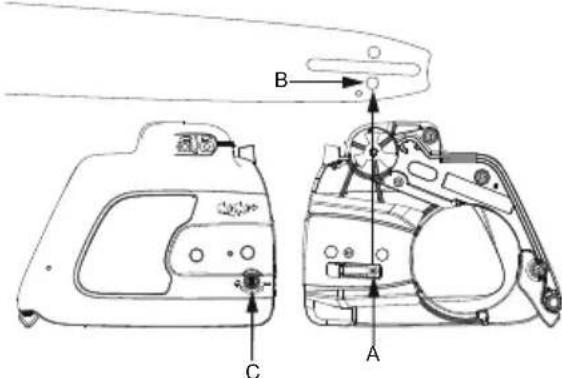
- Use the screwdriver end of the bar tool to turn the adjustment screw counterclockwise. Turn the screw until the adjustment pin (A) is located all the way to the right side of the adjustment travel pocket as shown in view above. This should allow the pin to be near the correct position.
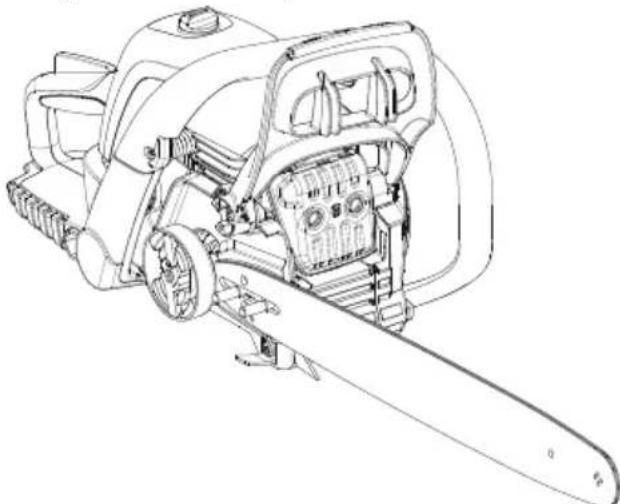
- Slide guide bar on bar bolts until guide bar stops against clutch drum sprocket.
- Carefully remove the chain from the package. Hold chain with the drive links as shown.
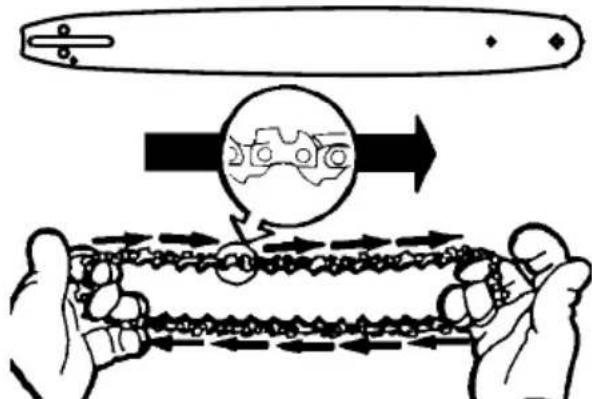
- Place chain over and behind clutch drum, fitting the drive links in the clutch drum sprocket.
- Fit bottom of drive links between the teeth in the sprocket in the nose of the guide bar.
- Fit chain drive links into bar groove.
- Pull guide bar forward until chain is snug in guide bar groove. Ensure all drive links are in the bar groove.
- Now, install clutch cover making sure the adjustment pin is positioned in the lower bar pin hole. Remember this pin moves the bar forward and backward as the screw is turned.
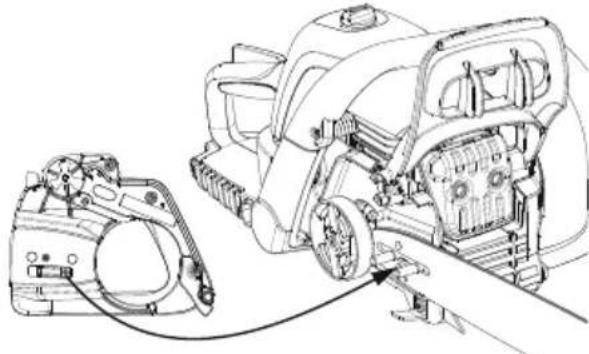
- Install bar nuts and finger tighten only. Once the chain is tensioned, you will need to tighten bar nuts.
CHAIN TENSION
(Including units with chain already installed)
WARNING: Wear protective gloves when handling chain. The chain is sharp and can cut you even when it is not moving.
NOTE: When adjusting chain tension, make sure the bar nuts are finger tight only. Attempting to tension the chain when the bar nuts are tight can cause damage.
CHECKING THE TENSION
Use the screwdriver end of the chain adjustment tool (bar tool) to move chain around guide bar. If the chain does not rotate, it is too tight. If the chain is too loose, it will sag below the bar.
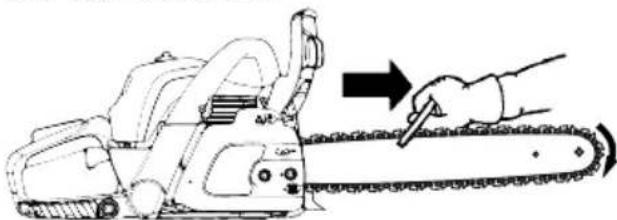
ADJUSTING THE TENSION
Chain tension is very important. Chains stretch during use. This is especially true during the first few times you use your saw. Always check chain tension each time before you start the chain saw.
- Loosen bar nuts until they are finger tight against the clutch cover.
- Turn adjustment screw clockwise until chain solidly contacts bottom of guide bar rail.
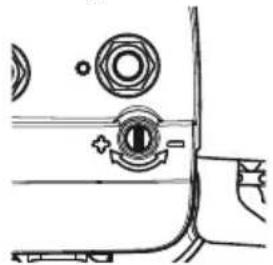
- Using bar tool, roll chain around guide bar to ensure all links are in bar groove.
- Lift up tip of guide bar to check for sag. Release tip of guide bar, then turn adjustment screw 1/4 turn clockwise. Repeat until sag does not exist.

- While lifting tip of guide bar, tighten bar nuts securely with the bar tool.
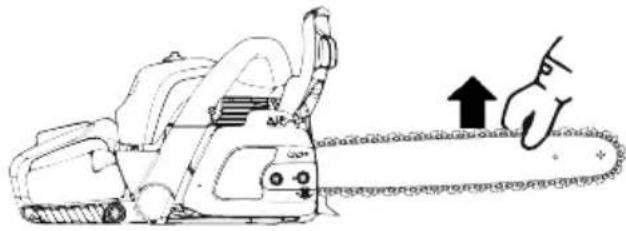
- Use the screwdriver end of the bar tool to move chain around guide bar.
- If chain does not rotate, it is too tight. Slightly loosen bar nuts and loosen chain by turning the adjustment screw 1/4 turn counterclockwise. Retighten bar nuts.
- If chain is too loose, it will sag below the guide bar. DO NOT operate the saw if the chain is loose.
NOTE: The chain is tensioned correctly when the weight of the chain does not cause it to sag below the guide bar (with the chain saw sitting in an upright position), but the chain still moves freely around the guide bar.
WARNING: If the saw is operated with a loose chain, the chain could jump off the guide bar and result in serious injury to the operator and/or damage the chain making it unusable. If the chain jumps off the guide bar, inspect each drive link for damage. Damaged chain must be repaired or replaced.
FUEL HANDLING
FUELING ENGINE
WARNING: Remove fuel cap slowly when refueling.
IMPORTANT: This equipment is designed to operate on unleaded gasoline with a minimum 87 octane (AKI), with ethanol blended up to 10% maximum by volume (E-10). Before operation, gasoline must be mixed with a good quality synthetic 2-cycle air-cooled engine oil designed to be mixed at a ratio of 50:1.
DO NOT USE automotive oil or marine oil. These oils will cause engine damage. When mixing fuel, follow instructions printed on container. Once oil is added to gasoline, shake container momentarily to assure that the fuel is thoroughly mixed. Always read and follow the safety rules relating to fuel before fueling your unit. Purchase fuel in quantities that can be used within 30 days to assure fuel freshness.
CAUTION: Never use straight gasoline in your unit. This will cause permanent engine damage and void the limited warranty. Do not use alternate fuels such as ethanol blends above 10% by volume (E-15, E-85) or any methanol blended fuel. Use of these fuels can cause major engine performance and durability problems.
| Gasoline, gallons Two | stroke oil, ounces |
| 1 | 2.6 |
| 2 | 5.2 |
| 5 | 13 |
| 10 26 |
BAR AND CHAIN LUBRICATION
The bar and chain require continuous lubrication. Lubrication is provided by the automatic oiler system when the oil tank is kept filled. Lack of oil will quickly ruin the bar and chain.
Too little oil will cause overheating shown by smoke coming from the chain and/or discoloration of the bar. In freezing weather oil will thicken, making it necessary to thin bar and chain oil with a small amount (5 to 10% ) of #1 Diesel Fuel or kerosene. Bar and chain oil must be free flowing for the oil system to pump enough oil for adequate lubrication.
Bar and chain oil is recommended to protect your unit against excessive wear from heat and friction. If bar and chain oil is not available, use a good grade SAE 30 oil.
- Never use waste oil for bar and chain lubrication.
Always stop the engine before removing the oil cap.
STARTING AND STOPPING
CHAIN BRAKE
Ensure chain brake is unlocked by pulling the front hand guard back toward the front handle as far as possible. The chain brake must be unlocked before cutting with the saw.
WARNING: The chain must not move when the engine runs at idle speed. If the chain moves at idle speed refer to CARBURETOR ADJUSTMENT within this manual.
WARNING: Avoid contact with the muffler. A hot muffler can cause serious burns.
To stop the engine move the ON/STOP switch to the STOP position.
To start the engine hold the saw firmly on the ground as illustrated. Make sure the chain is free to turn without contacting any object.
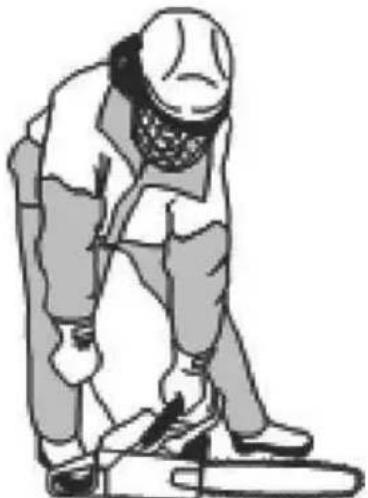
WARNING: Do not attempt to throw or dropstart the chain saw. Doing so will put the operator at risk of serious injury due to loss of control of the chain saw.
IMPORTANT: When pulling the starter rope, do not use the full extent of the rope as this can cause the rope to break. Do not let starter rope snap back. Hold the handle and let the rope rewind slowly.
NOTE: For cold weather starting, start the unit at FULL CHOKE; allow the engine to warm up before squeezing the throttle trigger.
NOTE: Do not attempt to cut material with the choke lever in the FULL CHOKE position.
HELPFUL TIP: If your engine still does not start after following these instructions, please call customer support.
STARTING A COLD ENGINE
NOTE: In the following steps, when the choke lever is pulled out to the full extent, the correct throttle setting for starting is set automatically.
The chain brake must be locked when the chain saw
is started. Lock the brake by moving the front hand guard forward.
- Move ON/STOP switch to the ON position.
- Grip the front handle with your left hand. Hold the chain saw on the ground by placing your right foot through the rear handle.
NOTE: There is a simplified start reminder with illustrations to describe each step on the rear edge of the saw.
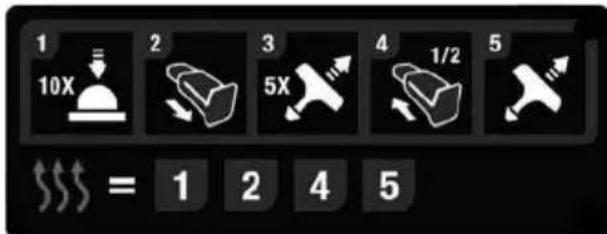
- Press the primer 10 times. The bulb does need not to be completely filled with fuel.
- Pull the choke lever out to the full choke position.
- Pull the starter handle with your right hand and pull out the starter cord slowly until you feel a resistance (as the starter pawls engage) then pull firmly and rapidly 5 times.
NOTE: If the engine sounds as if it is trying to start before the 5th pull, stop pulling and immediately proceed to the next step.
- Push the choke lever to the half choke position.
- Pull the starter handle firmly and rapidly until the engine starts.
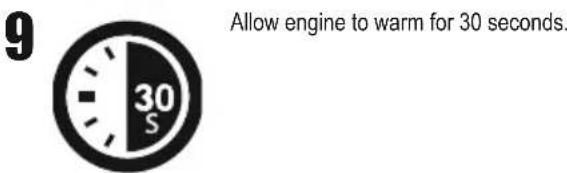
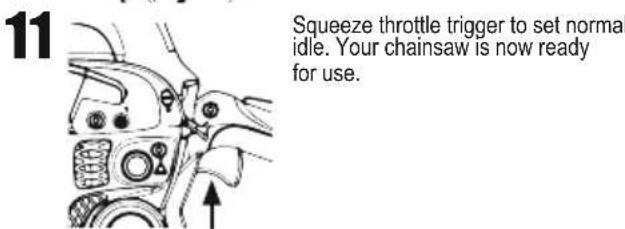
Allow the engine to run for approximately 30 seconds. Then, squeeze and release the throttle trigger to allow engine to return to idle speed.
NOTE: Ensure chain brake is unlocked by pulling the front hand guard back toward the front handle as far as possible. The chain brake must be unlocked before cutting with the saw. The chain saw is now ready for use.
STARTING A WARM ENGINE
Follow steps 1,2,4 and 5 in the cold engine starting instructions.
WARNING! Long term inhalation of the engine's exhaust fumes, chain oil mist and dust from sawdust can represent a health risk.
DIFFICULT STARTING
(or starting a flooded engine)
The engine may be flooded with too much fuel if it has not started after 10 pulls. Floxed engines can be cleared of excess fuel by pushing the choke lever in completely (to the OFF CHoke position) and then following the warm engine starting procedure.
Ensure the ON/STOP switch is in the ON position. Starting could require pulling the starter rope handle many times depending on how badly the unit is flooded. If engine fails to start, refer to the TROUBLESHOOTING TABLE or call customer support.
STOPPING
Stop the engine by pushing the start/stop switch down.
WARNING! To avoid involuntary start up, the spark plug cap must always be removed from the spark plug when the machine is unsupervised.
CHAIN BRAKE
WARNING: If the brake band is worn too thin it may break when the chain brake is triggered. With a broken brake band, the chain brake will not stop the chain. The chain brake should be replaced by an authorized service dealer if any part is worn to less than 0.5mm (0.020 in) thick. Repairs on a chain brake should be made by an authorized service dealer.
Take your unit to the place of purchase if purchased from a servicing dealer, or to the nearest authorized master service dealer.
This saw is equipped with a chain brake. The brake is
designed to stop the chain if kickback occurs.
The inertia-activated chain brake is locked if the front hand guard is pushed forward, either manually (by hand) or automatically (by sudden movement).
If the brake is already locked, it is unlocked by pulling the front handguard back toward the front handle as far as possible.
When cutting with the saw, the chain brake must be unlocked.
NOTE: The chain brake must be checked several times daily. The engine must be running when performing this procedure.
This is the only instance when the saw should be placed on the ground with the engine running.
Place the saw on firm ground. Grip the rear handle with your right hand and the front handle with your left hand. Apply full throttle by fully depressing the throttle trigger. Activate the chain brake by turning your left wrist against the hand guard without releasing your grip around the front handle. The chain should stop immediately.
WORKING TECHNIQUES
PRACTICING YOUR CUTS
Practice cutting a few small logs using the following techniques to get the "feel" of using your saw before you begin a major sawing operation.
- Squeeze the throttle trigger and allow the engine to reach full speed before cutting.
- Begin cutting with the saw frame against the log.
- Keep the engine at full speed the entire time you are cutting.
- Allow the chain to cut for you. Exert only light downward pressure. If you force the cut, damage to the guide bar, chain, or engine can result.
- Release the throttle trigger as soon as the cut is completed, allowing the engine to idle. If you run the saw at full throttle without a cutting load, unnecessary wear can occur to the chain, guide bar, and engine. It is recommended that the engine not be operated for longer than 30 seconds at full throttle.
- To avoid losing control when cut is complete, do not put pressure on saw at end of cut.
- Stop the engine before setting the saw down after cutting.
FELLING A TREE
PLANNING
WARNING! Check for broken or dead branches which can fall while cutting causing serious injury. Do not cut near buildings or electrical wires if you do not know the direction of tree fall, nor cut at night since you will not be able to see well, nor during bad weather such as rain, snow, or strong winds, etc. If the tree makes contact with any utility line, the utility company should be notified immediately.
Carefully plan your sawing operation in advance.
Clear the work area. You need a clear area all around the tree so you can have secure footing.
The chainsaw operator should keep on the uphill side of the terrain as the tree is likely to roll or slide downhill after it is felled.
Study the natural conditions that can cause the tree to fall in a particular direction.
Natural conditions that can cause a tree to fall in a particular direction include:
The wind direction and speed.
- The lean of the tree. The lean of a tree might not be apparent due to uneven or sloping terrain. Use a plumb or level to determine the direction of tree lean.
Weight and branches on one side.
- Surrounding trees and obstacles.
Look for decay and rot. If the trunk is rotted, it can snap and fall toward the operator. Check for broken or dead branches which can fall on you while cutting.
Make sure there is enough room for the tree to fall. Maintain a distance of 2-1/2 tree lengths from the nearest person or other objects. Engine noise can drown out a warning call.
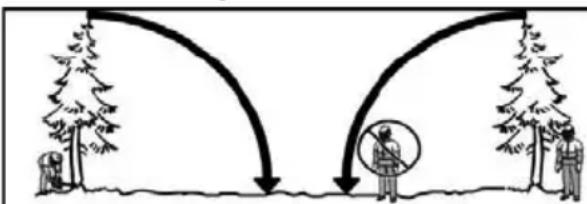
Remove dirt, stones, loose bark, nails, staples, and wire from the tree where cuts are to be made.
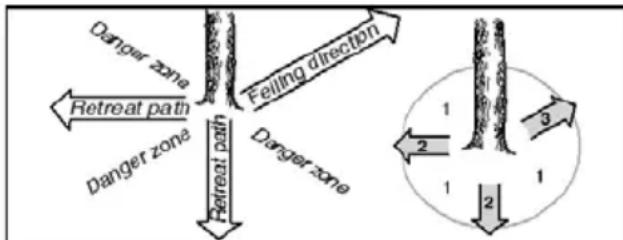
Plan a clear retreat path to the rear and diagonal to the line of fall. Note the danger zone (1), retreat path (2), and felling direction (3) in the following diagram.
USING THE NOTCH METHOD
The notch method is used to fall large trees. A notch is cut on the side of the tree in the desired direction of fall. After a felling cut is made on the opposite side of tree, the tree will tend to fall into the notch.
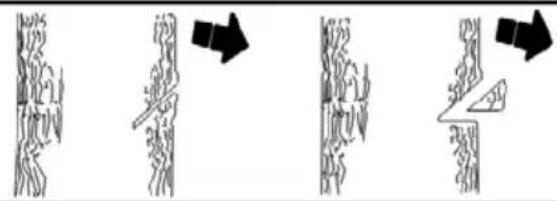
NOTE: If the tree has large buttress roots, remove them before making the notch. If using saw to remove buttress roots, keep saw chain from contacting ground to prevent dulling of the chain.
Make the notch cut by cutting the top of the notch first. Cut through 1/3 of the diameter of the tree. Next complete the notch by cutting the bottom of the notch. Once the notch is cut remove the notch of wood from the tree.
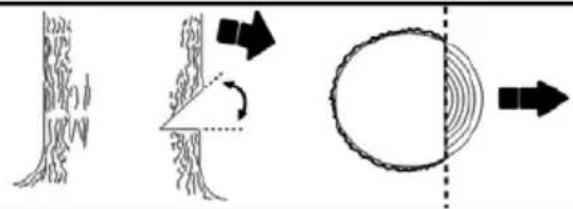
After removing the wood from the notch, make the felling cut on the opposite side of the notch. This is done by making a cut about 5 centimeters (2 inches) higher than the center of the notch. This will leave enough uncut wood between the felling cut and the notch to form a hinge. This hinge will help prevent the tree from falling in the wrong direction.
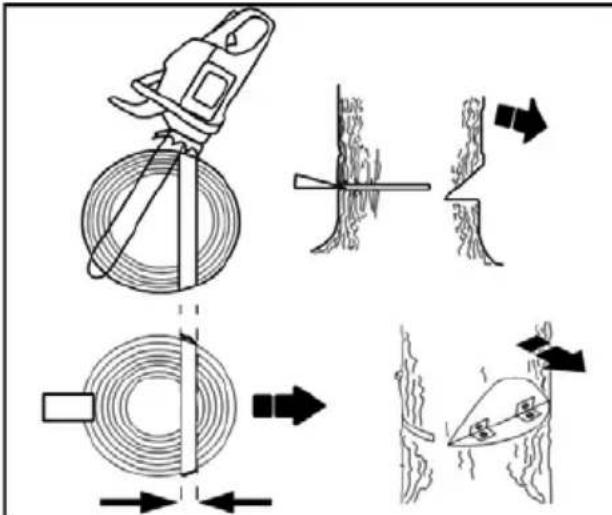
NOTE: Before felling cut is complete, use wedges to open the cut if necessary to control the direction of fall. To avoid kickback and chain damage, use wood or plastic wedges, but never steel or iron wedges.
Be alert to signs that the tree is ready to fall: cracking sounds, widening of the felling cut, or movement in the upper branches.
As tree starts to fall, stop saw, put it down, and get away quickly on your planned retreat path.
DO NOT cut down a partially fallen tree with your saw. Be extremely cautious with partially fallen trees that may be poorly supported. When a tree doesn't fall completely, set the saw aside and pull down the tree
with a cable winch, block and tackle, or tractor.
CUTTING A FALLEN TREE (BUCKING)
Bucking is the term used for cutting a fallen tree to the desired log size.
WARNING! Do not stand on the log being cut. Any portion can roll causing loss of footing and control. Do not stand downhill of the log being cut.
IMPORTANT POINTS:
Cut only one log at a time.
Cut shattered wood very carefully; sharp pieces of wood could be flung toward operator.
- Use a sawhorse to cut small logs. Never allow another person to hold the log while cutting and never hold the log with your leg or foot.
- Do not cut in an area where logs, limbs, and roots are tangled such as in a blown down area. Drag the logs into a clear area before cutting by pulling out exposed and cleared logs first.
Make sure the chain will not strike the ground or any other object during or after cutting.
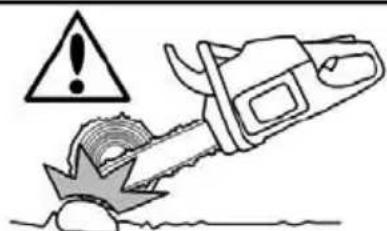
WARNING! If saw becomes pinched or hung in a log, don't try to force it out. You can lose control of the saw resulting in injury and/or damage to the saw. Stop the saw, drive a wedge of plastic or wood into the cut until the saw can be removed easily. Restart the saw and carefully reenter the cut. To avoid kickback and chain damage, do not use a metal wedge. Do not attempt to restart your saw when it is pinched or hung in a log.
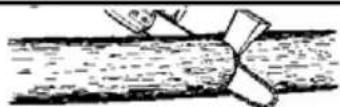
TYPES OF BUCKING CUTS
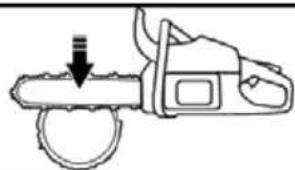
Overcutting begins on the top side of the log with the bottom of the saw against the log. When overcutting use light downward pressure.
Undercutting involves cutting on the underside of the log with top of saw against the log. When undercutting use light upward pressure. Hold saw firmly and maintain control. The saw will tend to push back toward you.
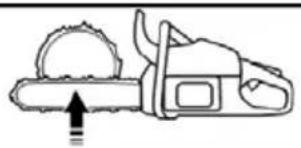
WARNING! Never turn saw upside down to undercut. The saw cannot be controlled in this position.
Always make your first cut on the compression side of the log. The compression side of the log is where the pressure of the log's weight is concentrated.
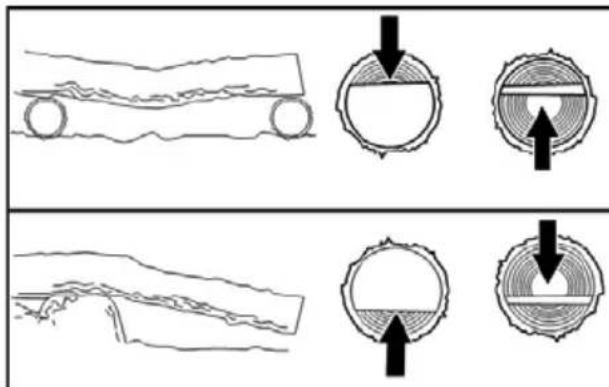
BUCKING WITHOUT A SUPPORT
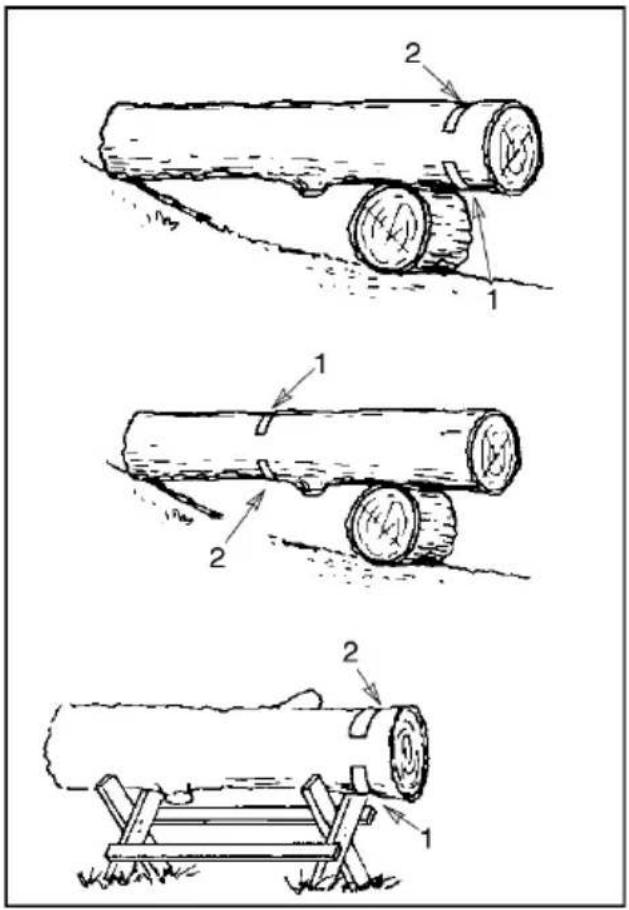
- Overcut through 1/3 of the diameter of the log.
- Roll the log over and finish with a second overcut.
NOTE: Watch for logs with a compression side to prevent the saw from pinching.
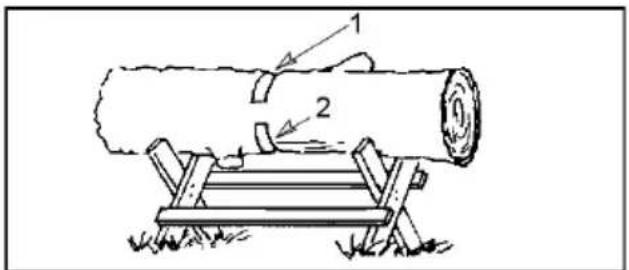
BUCKING USING A LOG OR SUPPORT STAND
- Make the first cut on the compression side of the log. Your first cut should extend 1/3 of the diameter of the log.
- Finish with your second cut.
LIMBING AND PRUNING
WARNING! Be alert for and guard against kickback. Do not allow the moving chain to contact any other branches or objects at the nose of the guide bar when limbing or pruning. Allowing such contact can result in serious injury.
WARNING! Never climb into a tree to limb or prune. Do not stand on ladders, platforms, a log, or in any position which can cause you to lose your balance or control of the saw.
IMPORTANT POINTS
- Work slowly, keeping both hands firmly gripped on the saw. Maintain secure footing and balance.
- Watch out for springpoles. Springpoles are small size limbs which can catch the saw chain and whip toward you or pull you off balance. Use extreme caution when cutting small size limbs or slender material.
- Be alert for springback. Watch out for branches that are bent or under pressure. Avoid being struck by the branch or the saw when the tension in the wood fibers is released.
- Keep a clear work area. Frequently clear branches out of the way to avoid tripping over them.
LIMBING
Always limb a tree after it is cut down. Only then can limbing be done safely and properly.
Leave the larger limbs underneath the felled tree to support the tree as you work.
Start at the base of the felled tree and work toward the top, cutting branches and limbs. Remove small limbs with one cut.
Keep the tree between you and the chain. Cut from the side of the tree opposite the branch you are cutting.
Remove larger, supporting branches with the cutting techniques described in BUCKING WITHOUT A SUPPORT.
Always use an overcut to cut small and freely hanging limbs. Undercutting could cause limbs to fall and pinch the saw.
PRUNING
WARNING! Limit pruning to limbs shoulder height or below. Do not cut if branches are higher than your shoulder. Get a professional to do the job.
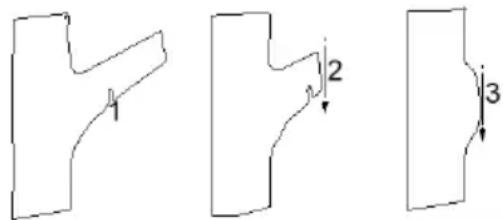
- Make the first cut one-third of the way through the bottom of the limb.
- Make the second cut all the way through the limb.
- Make the third overcut leaving a 2.5 to 5 centimeter (1 to 2 inch) collar from the trunk of the tree.
MAINTENANCE
WARNING: Disconnect the spark plug before performing maintenance except for carburetor adjustments.
We recommend all service and adjustments not listed in this manual be performed by an authorized or Master Service Dealer.
GENERAL RECOMMENDATIONS
The warranty on this unit does not cover items that have been subjected to operator abuse or negligence. To receive full value from the warranty, the operator must maintain the unit as instructed in this manual. Various adjustments will need to be made periodically to properly maintain your unit.
IMPORTANT: Have all repairs other than the recommended maintenance described in the instruction manual performed by an authorized service dealer.
If any dealer other than an authorized service dealer performs work on the product, the company may not pay for repairs under warranty. It is your responsibility to maintain and perform general maintenance.
MAINTENANCE SCHEDULE
Before each use
- Check fuel mixture level
- Check bar lubrication
Check chain tension - Check chain sharpness
- Check for damaged parts
- Check for loose caps
-
Check for loose fasteners
-
Check for loose parts
Every 5 hours*
- Inspect and clean air filter
Inspect and clean chain brake
Inspect and clean guide bar
Every 25 hours*
Inspect and clean spark arresting screen and muffler
Yearly
- Replace spark plug
- Replace fuel filter
- Replace air filter
- Each hour of operation is approximately 2 tanks of fuel.
MAINTENANCE PROCEDURES
CHECK FOR DAMAGED OR WORN PARTS
Contact an authorized service dealer for replacement of damaged or worn parts.
NOTE: It is normal for a small amount of oil to appear under the saw after engine stops. Do not confuse this with a leaking oil tank.
- ON/STOP Switch - Ensure ON/STOP switch functions properly by moving the switch to the STOP position. Make sure engine stops; then restart engine and continue.
- Fuel Tank - Do not use saw if fuel tank shows signs of damage or leaks.
- Oil Tank - Do not use saw if oil tank shows signs of damage or leaks.
CHECK FOR LOOSE FASTENERS AND PARTS
Bar Nuts
- Chain
Muffler
Cylinder Shield
Air Filter
- Handle Screws
Vibration Mounts
- Starter Housing
- Front Hand Guard
CHECK CHAIN SHARPNESS
A sharp chain makes wood chips. A dull chain makes a sawdust powder and cuts slowly. See CHAIN SHARPENING.
GUIDE BAR
Conditions which require guide bar maintenance:
- Saw cuts to one side or at an angle.
- Saw has to be forced through the cut.
- Inadequate supply of oil to bar/chain.
Check the condition of guide bar each time chain is sharpened. A worn guide bar will damage the chain and make cutting difficult.
After each use, ensure ON/STOP switch is in the STOP position, then clean all sawdust from the guide bar and sprocket hole.
To maintain guide bar:
- Move ON/STOP switch to STOP.
- Loosen and remove bar nuts and clutch cover. Remove bar and chain from saw.
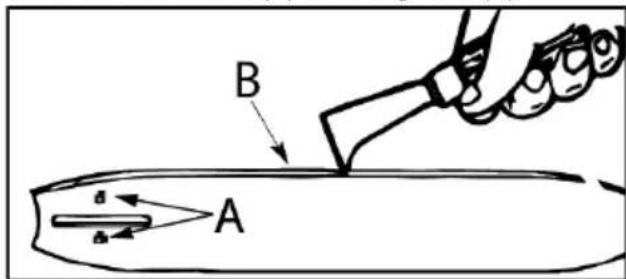
- Clean the oil holes (A) and bar groove (B).
- Burring of guide bar rails is a normal process of rail wear. Remove these burrs with a flat file.
- When rail top is uneven, use a flat file to restore square edges and sides.
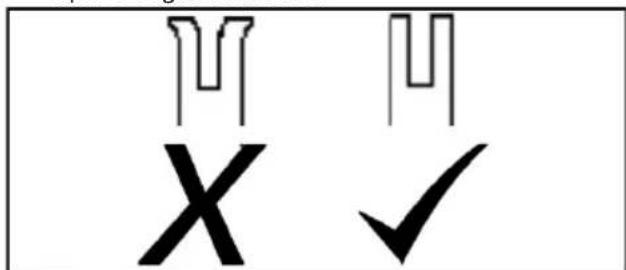
Replace guide bar when the groove is worn, the guide bar is bent or cracked, or when excess heating or burring of the rails occurs. If replacement is necessary, use only the guide bar specified for your saw in the repair parts list or on the decal located on the chainsaw.
CHECK FUEL MIXTURE LEVEL
See FUELING ENGINE under the OPERATION section.
LUBRICATION
See GUIDE BAR AND CHAIN OIL under the OPERATION section.
INSPECT AND CLEAN THE UNIT AND DECALS
After each use, inspect complete unit for loose or damaged parts. Clean the unit and decals using a damp cloth with a mild detergent.
Wipe off unit with a clean dry cloth.
WARNING: Do not clean filter in gasoline or other flammable solvent to avoid creating a fire hazard or producing harmful emissions.
A dirty air filter decreases the life and performance of the engine and increases fuel consumption and harmful emissions. Always clean your air filter after 10 tanks of fuel or 5 hours of operation, whichever comes first. Clean more frequently in dusty conditions. A used air filter can never be completely cleaned. It is advisable to replace your air filter with a new one after every 50 hours of operation, or annually, whichever comes first.
- Loosen knob on air filter cover. Remove air filter cover.
- Press down on wire clamp to release air filter. Remove air filter.
- Clean the air filter using hot soapy water. Rinse with clean cool water. Air dry completely before reinstalling.
- Reinstall air filter and reposition wire clamp.
NOTE: Ensure air filter is correctly installed and fully seated in pocket before repositioning wire clamp and reinstalling air filter cover.
- Reinstall air filter cover. Tighten knob securely.
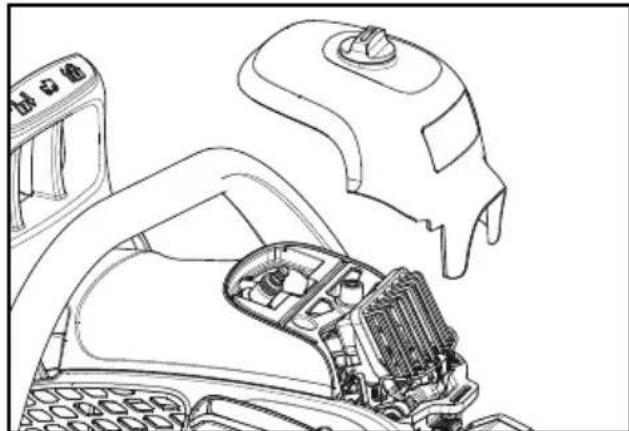
INSPECT MUFFLER AND SPARK ARRESTING SCREEN
As the unit is used, carbon deposits build up on the muffler and spark arresting screen, and must be removed to avoid creating a fire hazard or affecting engine performance.
Replace the spark arresting screen if breaks occur.
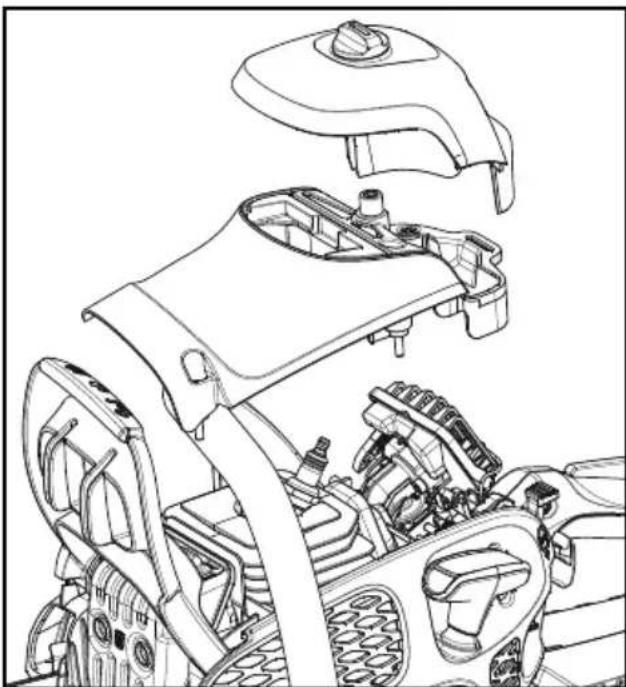
CLEANING THE SPARK ARRESTING SCREEN
- Cleaning is required every 25 hours of operation or annually, whichever comes first.
- Loosen knob on air filter cover. Remove air filter cover.
- Loosen 3 screws on cylinder cover. Remove the cylinder cover.
- Loosen and remove the screw from the muffler exhaust outlet cover.
- Remove spark arresting screen. Handle screen carefully to prevent damage.
- Clean the spark arresting screen gently with a wire brush. Replace screen if breaks are found.
- Replace any broken or cracked muffler parts.
- Reinstall spark arresting screen.
- Reinstall screw in muffler exhaust outlet cover.
- Reinstall the cylinder cover and 3 screws. Tighten securely.
- Reinstall air filter cover. Tighten knob securely.
REPLACE SPARK PLUG
The spark plug should be replaced each year to ensure the engine starts easier and runs better. Ignition timing is fixed and nonadjustable.
- Loosen knob on air filter cover. Remove air filter cover.
- Pull off the spark plug boot.
- Remove spark plug from cylinder and discard.
- Replace with specified spark plug and tighten securely with a socket wrench.
- Reinstall the spark plug boot.
- Reinstall air filter cover. Tighten knob securely.
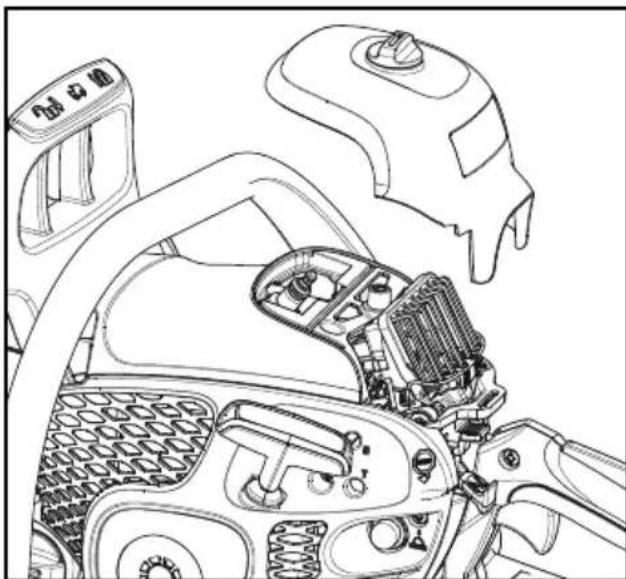
CARBURETOR ADJUSTMENT
WARNING: The chain will be moving during most of this procedure. Wear your protective equipment and observe all safety precautions. The chain must not move at idle speed.
The carburetor has been carefully set at the factory. Adjustments may be necessary if you notice any of the following conditions:
- Chain moves at idle. See IDLE SPEED-T adjustment procedure.
- Saw will not idle. See IDLE SPEED-T adjustment procedure.
Idle Speed-T
Allow engine to idle. If the chain moves, idle is too fast. If the engine stalls, idle is too slow. Adjust speed until engine runs without chain movement (idle too fast) or stalling (idle too slow). The idle speed screw is located in the area above the primer bulb and is labeled T.
- Turn idle screw (T) clockwise to increase engine speed.
- Turn idle screw (T) counterclockwise to decrease engine speed.
If you require further assistance or are unsure about performing this procedure, contact your authorized service dealer or call customer support.
COOLING SYSTEM
To keep the working temperature as low as possible, the machine is equipped with a cooling system.
The cooling system consists of:
Air intake on the starter
Air guide plate
- Fins on the flywheel
Cooling fins on the cylinder
Cylinder cover (directs cold air over the cylinder)
Clean the cooling system with a brush after each use, more often in demanding conditions. A dirty or blocked cooling system results in the machine overheating which causes damage to the piston and cylinder.
CHAIN SHARPENING
The cutter
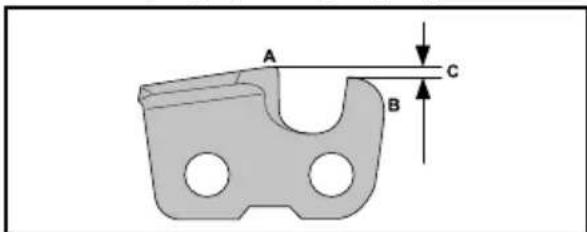
The cutting part of the saw chain is called the cutter and consists of a cutting tooth (A) and the depth gauge (B).
The cutters cutting depth is determined by the difference in height between the two, the depth gauge setting (C).
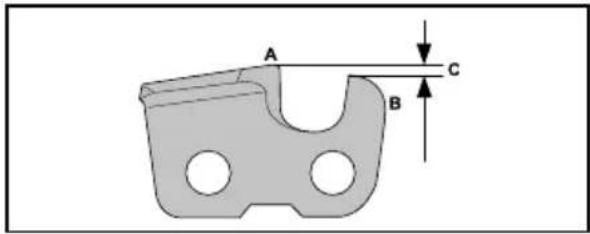
When you sharpen a cutting tooth there are four important factors to remember:
Filing angle.
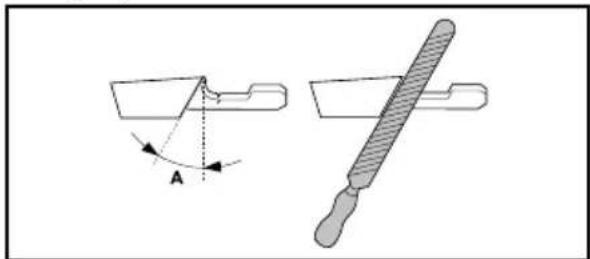
- Cutting angle.
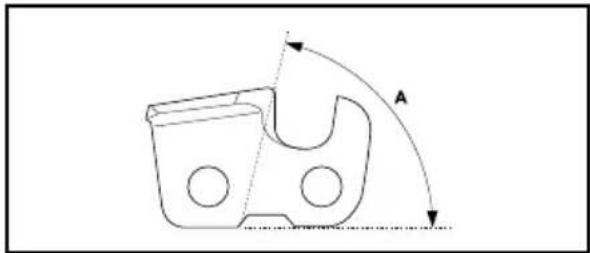
- File position.
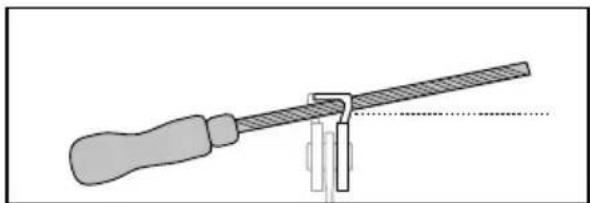
- Round file diameter.
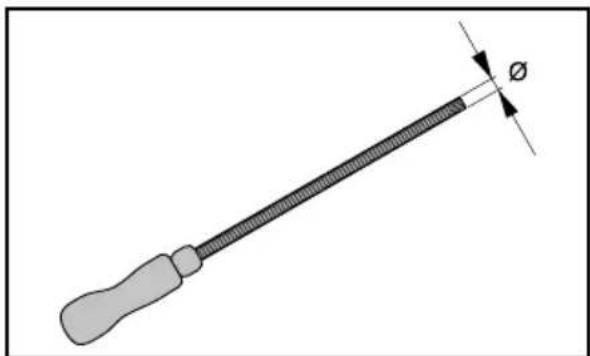
To sharpen the cutting teeth
Use a round file and a file gauge to sharpen the cutting teeth. See the TECHNICAL DATA section of this manual for information on the recommended dimension of the file and gauge for the saw chain installed on your product.
- Make sure that the saw chain is correctly tensioned. A slack chain will move sideways, making it more difficult to sharpen correctly.
- File all teeth on one side first. File the cutting teeth from the inside face and reduce the pressure on the return stroke.
- Turn the product over and file the teeth on the other side.
- File all the teeth to the same length. When the length of the cutting teeth is reduced to 4mm (5/32") the saw chain is worn out and must be replaced.
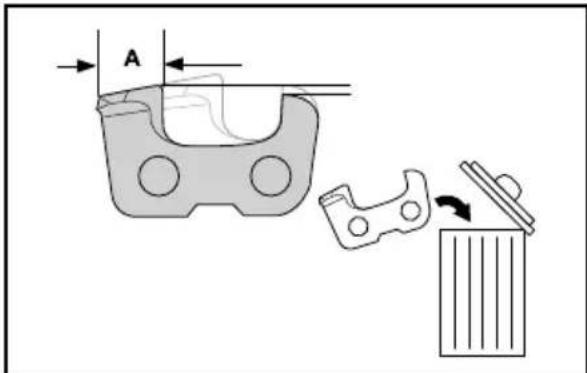
To adjust the depth gauge setting
Sharpen the cutting teeth before you adjust the depth gauge setting. When you sharpen the cutting tooth (A), the depth gauge setting (C) will decrease. To maintain optimal cutting performance, the depth gauge (B) has to be filed down to achieve the recommended depth gauge setting. See the TECHNICAL DATA section of this manual to find the correct depth gauge setting for your particular chain.
NOTE: This recommendation assumes that the length of the cutting teeth is not reduced excessively.
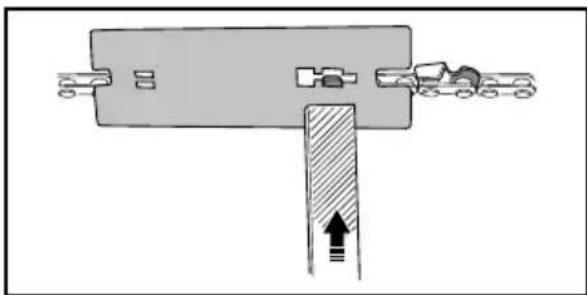
Use a flat file and depth gauge tool to adjust the depth gauge.
- Put the depth gauge tool above the saw chain. Detailed information regarding how to use the depth gauge tool will be found on the package of the depth gauge tool.
- Use the flat file to file off the tip of the depth gauge that protrudes through the depth gauge tool. The depth gauge setting is correct when you no longer feel resistance as you draw the file along the depth gauge tool.
TROUBLESHOOTING
TROUBLESHOOTING TABLE
WARNING: Always stop unit and disconnect spark plug before performing all of the recommended remedies below except remedies that require operation of the unit.
| TROUBLE CAUSE REMEDY | ||
| Engine will not start or will run only a few seconds after starting. | 1. Ignition switch off.2. Engine flooded.3. Fuel tank empty.4. Spark plug not firing.5. Fuel not reaching carburettor. | 1. Move ignition switch to ON.2. See "Difficult Starting" in STARTING AND STOPPING Section.3. Fill tank with correct fuel mixture.4. Install new spark plug.5. Check for dirty fuel filter; replace.Check for kinked or split fuel line; repair or replace. |
| Engine will not idle properly. 1. Idle speed requires adjustment.2. Carburettor requires adjustment. | 1. See "Carburettor Adjustment" in the MAINTENANCE Section.2. Contact an authorized service dealer. | |
| Engine will not accelerate, lacks power, or dies under a load. | 1. Air filter dirty.2. Spark plug fouled.3. Chain brake engaged.4. Carburettor requires adjustment. | 1. Clean or replace air filter.2. Clean or replace plug and regap.3. Disengage chain brake.4. Contact an authorized service dealer. |
| Engine smokes excessively. 1. Too much oil mixed with gasoline. | 1. Empty fuel tank and refill with correct fuel mixture. | |
| Chain moves at idle speed. 1. Idle speed requires adjustment.2. Clutch requires repair. | 1. See "Carburettor Adjustment" in the MAINTENANCE Section.2. Contact an authorized service dealer. | |
| Clutch cover will not fit properly. | 1. Chain brake is engaged. | 1. See "Resetting the Chain Brake" in the TROUBLESHOOTING section. |
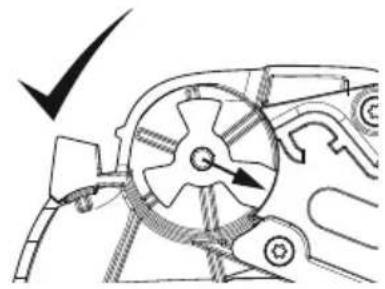
If the clutch cover is removed accidentally while the chain brake is locked, the chain brake must be unlocked so the clutch cover can be assembled without binding to the clutch drum.
Align the notches on the bar tool so that they fit over the brake rotating link.
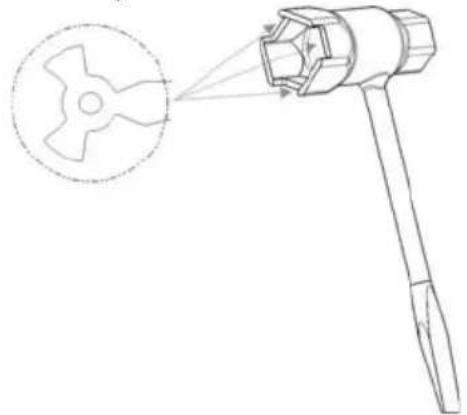
CAUTION: The chain brake spring is under tension. Use care when resetting the brake.
To reset the brake, rotate the link clockwise until it stops. NOTE: do not hold the brake band while attempting to reset it.
The front link will be in its downward rotated position when the chain brake is unlocked.
STORAGE
Perform the following steps after each use:
- Allow the engine to cool, and secure the unit before storing or transporting.
- Store chain saw and fuel in a well ventilated area where fuel vapors cannot reach sparks or open flames from water heaters, electric motors or switches, furnaces, etc.
- Store chain saw with all guards in place and position chain saw so that any sharp object cannot accidentally cause injury.
- Store chain saw well out of the reach of children.
SEASONAL STORAGE
Prepare your unit for storage at the end of the season or if it will not be used for 30 days or more.
If your chain saw is to be stored for a period of time:
Clean saw thoroughly before storage.
- Store in a clean dry area.
Lightly oil external metal surfaces and guide bar.
Oil the chain and wrap it in heavy paper or cloth.
FUEL SYSTEM
Under FUELING ENGINE in the OPERATION section of this manual, see message labeled.
IMPORTANT regarding the use of gasohol in your chain saw.
Fuel stabilizer is an acceptable alternative in minimizing the formation of fuel gum deposits during storage. Add stabilizer to the petrol in the fuel tank or fuel storage container.
Follow the mix instructions found on stabilizer containers. Run engine at least 5 minutes after adding stabilizer.
ENGINE
- Remove spark plug and pour 1 teaspoon of 2-cycle engine oil through the spark plug opening. Slowly pull the starter rope 8 to 10 times to distribute oil.
- Replace spark plug with new one of recommended type and heat range.
Clean air filter. -
Check entire unit for loose screws, nuts, and bolts. Replace any damaged, broken, or worn parts.
-
At the beginning of the next season, use only fresh fuel having the proper petrol to oil ratio.
OTHER
- Do not store petrol from one season to another.
- Replace your petrol container if it starts to rust.
TECHNICAL DATA
| PR5020 (LDAV50MC) | |
| Engine | |
| Cylinder displacement, cm3 | 50,2 |
| Cylinder bore, mm 44 | |
| Stroke, mm 33 | |
| Idle speed, rpm 2800-3200 | |
| Power, kW 2,1/9000 | |
| Ignition system | |
| Spark plug | Husqvarna HQT-1 • Brisk PR17YC |
| Electrode gap, mm 0,6 | |
| Fuel and lubrication system | |
| Fuel tank capacity, cm3 | 425 |
| Oil pump capacity at 9,000 rpm, ml/min 13 | |
| Oil tank capacity, cm3 | 295 |
| Type of oil pump Automatic | |
| Weight | |
| Chain saw without bar or chain, empty tanks | 5,9 kg (13,0 lb) |
| Noise emissions (see note 1) | |
| Sound power level, measured dB(A) 102 | |
| Sound power level, measured dB(A) - Australia 84 | |
| Sound power level, guaranteed LwA dB(A) - Europe 122 | |
| Sound levels (see note 2) | |
| Equivalent sound pressure level at the operator's ear, dB(A) 104 | |
| Equivalent vibration levels, a hveq (see note 3) | |
| Front handle, m/s2 | 8.70 |
| Rear handle, m/s2 | 9.78 |
| Chain/bar | |
| Standard bar length | 20 in (50 cm) |
| Recommended bar lengths 20 in (50 cm) | |
| Usable cutting length 20 in (50 cm) | |
| Pitch | 3/8 |
| Thickness of drive links | 1,3 mm (.050 in) |
| Type of drive sprocket/number of teeth | Spur/7 |
| Chain speed at max. power, m/sec | 27,8 |
| Note 1: Noise emissions in the environment measured as sound power (LwA) in conformity with EC directive 2000/14/EC. | |
| Note 2: Equivalent sound pressure level, according to ISO 22868, is calculated as the time-weighted energy for different sound pressure levels under various working conditions. Typical statistical dispersion for equivaiable sound pressure level is a standard deviation of 1 dB (A). | |
| Note 3: Equivalent vibration level, according to ISO 22867, is calculated as the time-weighted energy total for vibration levels under various working conditions. Reported data for equivaiable vibration level has a typical statistical dispersion (standard deviation) of 1 m/s2. | |
GUIDE BAR AND SAW CHAIN COMBINATIONS
The following cutting attachments are approved for the models covered in this manual.
| Model | Bar | Chain P/N | CKA without chain brake | |
| P/N | Length | |||
| PR5020 | 578133803 | 20 in (50 cm) | 545196401 | 17 |
SAW CHAIN FILING AND SAW CHAIN COMBINATIONS
| Chain type | Round file size | Depth gauge setting | Top plate cutting angle | Side plate angle | Top plate filing angle | File guide angle |
| US 83 G | 7/32" (5.5 mm) | .025" (0.635 mm) | 60° | 60° | 25° | 10° |
REEMPLAZO DE LA BUJIA
Note: If the machine does not start after 5 pulls, repeat the procedure for starting a cold engine.



- STARTING A WARM ENGINE
- 4 + 5 + 7 + 8
- IMPORTANT
- SYMBOLS
- KNOW YOUR MACHINE
- SAFETY
- INTRODUCTION
- PLANNING AHEAD
- OPERATING YOUR SAW
- MAINTAINING YOUR SAW
- HANDLING FUEL
- UNDERSTANDING KICKBACK
- ROTATIONAL KICKBACK
- PINCH KICKBACK
- PULL-IN
- REDUCING THE CHANCE OF KICKBACK
- MAINTAINING CONTROL
- KICKBACK SAFETY FEATURES
- REDUCED KICKBACK GUIDE BAR
- LOW-KICKBACK CHAIN
- FRONT HAND GUARD
- CHAIN BRAKE
- ASSEMBLY
- (IF NOT ALREADY ATTACHED)
- ATTACHING THE BAR & CHAIN
- CHAIN TENSION
- CHECKING THE TENSION
- ADJUSTING THE TENSION
- FUEL HANDLING
- FUELING ENGINE
- BAR AND CHAIN LUBRICATION
- STARTING AND STOPPING
- STARTING A COLD ENGINE
- DIFFICULT STARTING
- (OR STARTING A FLOODED ENGINE)
- STOPPING
- WORKING TECHNIQUES
- PRACTICING YOUR CUTS
- FELLING A TREE
- PLANNING
- USING THE NOTCH METHOD
- CUTTING A FALLEN TREE (BUCKING)
- IMPORTANT POINTS
- TYPES OF BUCKING CUTS
- BUCKING WITHOUT A SUPPORT
- BUCKING USING A LOG OR SUPPORT STAND
- LIMBING AND PRUNING
- LIMBING
- PRUNING
- MAINTENANCE
- GENERAL RECOMMENDATIONS
- MAINTENANCE SCHEDULE
- BEFORE EACH USE
- EVERY 5 HOURS
- EVERY 25 HOURS
- YEARLY
- MAINTENANCE PROCEDURES
- CHECK FOR DAMAGED OR WORN PARTS
- CHECK FOR LOOSE FASTENERS AND PARTS
- CHECK CHAIN SHARPNESS
- GUIDE BAR
- CHECK FUEL MIXTURE LEVEL
- LUBRICATION
- INSPECT AND CLEAN THE UNIT AND DECALS
- INSPECT MUFFLER AND SPARK ARRESTING SCREEN
- CLEANING THE SPARK ARRESTING SCREEN
- REPLACE SPARK PLUG
- CARBURETOR ADJUSTMENT
- IDLE SPEED-T
- COOLING SYSTEM
- CHAIN SHARPENING
- THE CUTTER
- TO SHARPEN THE CUTTING TEETH
- TO ADJUST THE DEPTH GAUGE SETTING
- TROUBLESHOOTING
- TROUBLESHOOTING TABLE
- STORAGE
- SEASONAL STORAGE
- FUEL SYSTEM
- ENGINE
- OTHER
- TECHNICAL DATA
- GUIDE BAR AND SAW CHAIN COMBINATIONS
- REEMPLAZO DE LA BUJIA
Brand : POULAN
Model : PL914
Category : Saw