 ManualGo.com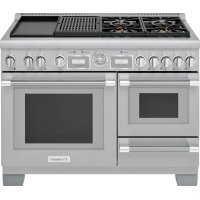
PRD48WCSGU - Cooker THERMADOR - Free user manual and instructions
Find the device manual for free PRD48WCSGU THERMADOR in PDF.



Download the instructions for your Cooker in PDF format for free! Find your manual PRD48WCSGU - THERMADOR and take your electronic device back in hand. On this page are published all the documents necessary for the use of your device. PRD48WCSGU by THERMADOR.
USER MANUAL PRD48WCSGU THERMADOR
2.3 Power requirements and grounding .......................... 8
5 Gas requirements and connections ...................... 16
7 Electrical requirements and connection for DUAL FUEL and INDUCTION models .................... 19
7.3 Installing a three-wire connection............................ 20
8.1 Installing the low backguard (purchased
8.4 Adjusting the toe kick panel - Pro Harmony®
models .................................................................... 23
8.5 Installing the leg covers - Pro Grand® models ........ 24
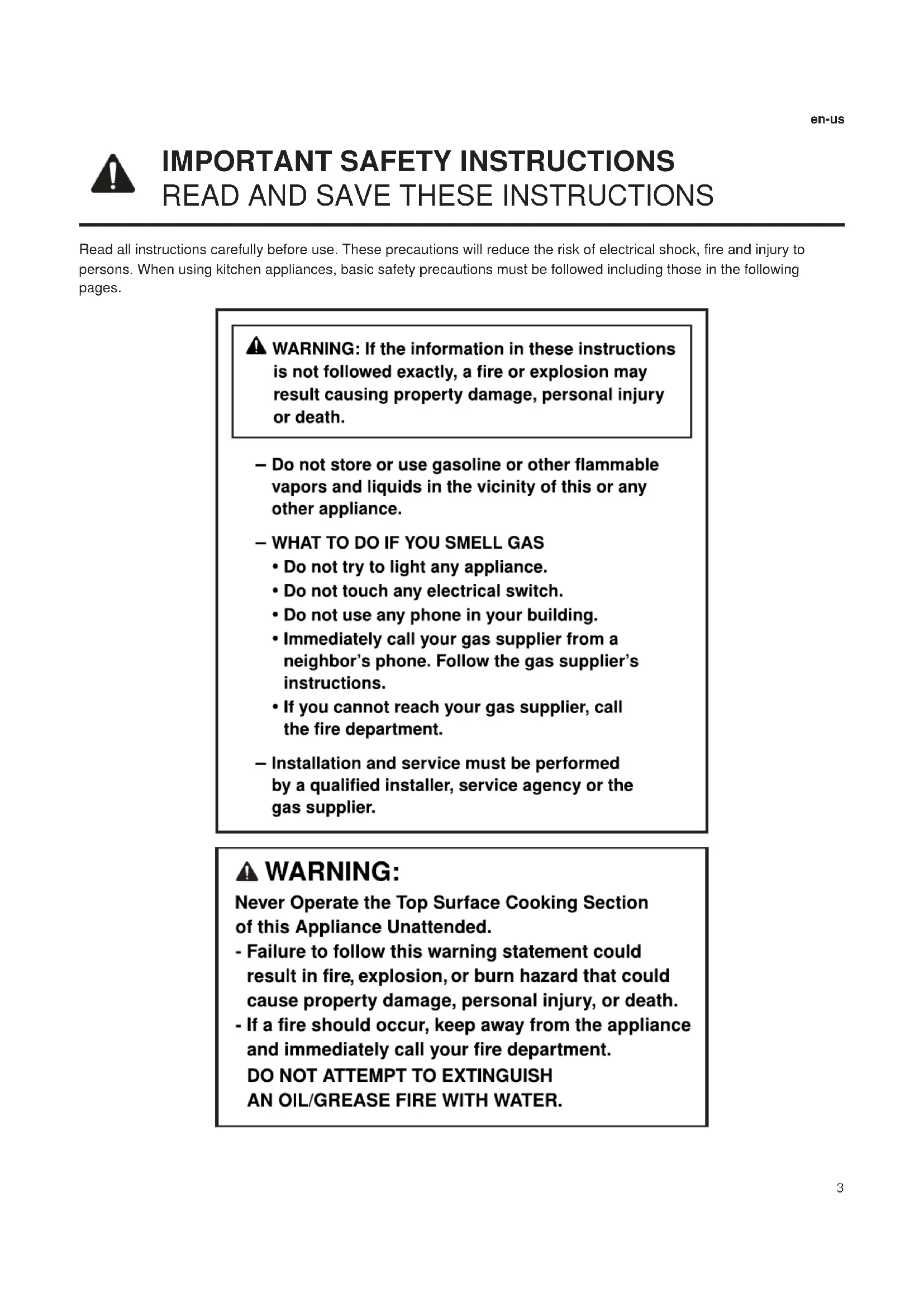
Read all instructions carefully before use. These precautions will reduce the risk of electrical shock, fire and injury to persons. When using kitchen appliances, basic safety precautions must be followed including those in the following pages.
1.1 Safety definitions Here you can find explanations of the safety signal words used in this manual. WARNING This indicates that death or serious injuries may occur as a result of non-observance of this warning. CAUTION This indicates that minor or moderate injuries may occur as a result of non-observance of this warning. NOTICE: This indicates that damage to the appliance or property may occur as a result of non-compliance with this advisory. Note:This alerts you to important information and/or tips. 1.2 General safety instructions All product manuals may be downloaded online at www.thermador.com/us/support/owner-manuals.
INSTRUCTIONS WITH THE UNIT FOR THE OWNER. OWNER: Please retain these instructions for future reference. Read all safety instructions before operating the appliance. Have the installer show you where the electric circuit breaker and the gas supply shut-off valve are located so you know how and where to turn off the gas and electricity to the appliance. Examine the appliance after unpacking it. In the event of transport damage, do not plug it in. WARNING If the information in this manual is not followed exactly, fire or shock may result causing property damage or personal injury. Do not repair, replace or remove any part of the appliance unless specifically recommended in the manuals. Improper installation, service or maintenance can cause injury or property damage. ▶ Refer to this manual for guidance. ▶ All other servicing should be done by an authorized service provider. WARNING
DANGER OF TIPPING ON RANGES
▶ All ranges can tip and injury can result. To prevent accidental tipping of the range, attach it to the floor, wall, or cabinet by installing the anti-tip bracket supplied. ▶ A child or adult can tip the range over and be killed or seriously injured. Verify that the anti-tip bracket is securely installed. Ensure the anti-tip bracket is engaged when the range is moved. ▶ DO NOT operate the range without the anti-tip bracket in place. Failure to follow the instructions in this manual can result in death or serious burns to children and adults. ▶ If the range is moved for cleaning, service, or any other reason, ensure that the anti-tip bracket is properly reengaged when the range is pushed back into place. In the event of abnormal usage (such as a person standing, sitting, or leaning on an open door), failure to take this precaution can result in tipping of the range. Personal injury might result from spilled hot liquids or from the range itself. ▶ Check for proper installation and use of anti-tip bracket. Carefully tip range forward pulling from the back to ensure that the anti-tip bracket engages the range and prevents tip-over. Range should not move more than 1'' (2.5cm). Disconnect electrical and gas supply before servicing. Never modify or alter the construction of the appliance. ▶ For example, do not remove leveling legs, panels, wire covers or anti-tip brackets/screws. The appliance should only be used if installed by a qualified technician in accordance with these installation instructions and all applicable regulations and codes. The manufacturer is not responsible for any damage resulting from incorrect installation or the failure to follow appropriate local codes and regulations. To eliminate the risk of burns or fire by reaching over heated surface units, cabinet storage space located above the surface units should be avoided. ▶ If cabinet storage is to be provided, the risk can be reduced by installing a hood that projects horizontally a minimum of 5" (127mm) beyond the bottom of the cabinet.
▶ Verify that cabinets above the cooktop are a maximum of 13" (330mm) deep. WARNING DO NOT install this appliance outdoors. WARNING Remove all tape and packaging before using the appliance. ▶ Dispose of packaging in an environmentally responsible manner. ▶ Never allow children to play with packaging material. ▶ Store small parts safely as they can be a choke hazard. WARNING To avoid possible burn or fire hazard, a backguard designed specifically for this appliance should be installed whenever the appliance is used. CAUTION This unit is designed as a cooking appliance. Based on safety considerations, never use it for warming or heating a room. Doing so may result in carbon monoxide poisoning and overheating the appliance. 1.3 Appliance handling safety WARNING Unit is heavy and requires at least two people or proper equipment to move. ▶ Do not lift appliance by door handle. ▶ Do not lift the appliance by the oven control panel. ▶ Remove the door for easier handling and installation. See instructions in this manual. WARNING Hidden surfaces may have sharp edges. ▶ Use caution when reaching behind or under appliance. ▶ Wear gloves to avoid cutting fingers on sharp edges during installation. 1.4 Electrical safety ¡ Installer - show the owner the location of the circuit breaker or fuse. Mark it for easy reference. ¡ If required by the National Electrical Code (or Canadian Electrical Code), this appliance must be installed on a separate branch circuit. ¡ The appliance, when installed, must be electrically grounded in accordance with local codes or, in the absence of local codes, with the National Electrical Code, NFPA 70 latest edition, or the Canadian Electrical Code, CSA C22.1 latest edition. ¡ Refer to the rating plate for more information. WARNING Before installing, turn power OFF at the service panel. ▶ Lock service panel to prevent power from being turned ON accidentally. For appliances equipped with a cord and plug, do not cut or remove the ground prong. ▶ It must be plugged into a matching grounding type receptacle to avoid electrical shock. ▶ If there is any doubt as to whether the wall receptacle is properly grounded, the customer should have it checked by a qualified electrician. WARNING
ELECTRIC SHOCK HAZARD
▶ Disconnect power before installing or servicing. Before turning power ON, be sure that all controls are in the OFF position. ▶ DO NOT remove connections. ▶ DO NOT use an extension cord. ▶ Improper grounding can result in a risk of electric shock. ▶ Failure to follow these instructions can result in death, fire, or electrical shock. GROUNDING INSTRUCTIONS ▶ This appliance must be grounded. ▶ Grounding reduces the risk of electric shock by providing a safe pathway for electric current in the event of a short circuit. ▶ Be sure your appliance is properly installed and grounded by a qualified technician. ▶ Installation, electrical connections and grounding must comply with all applicable codes. Do not use an extension cord. If the power supply cord is too short, have a qualified electrician install an outlet near the appliance. Before you turn on power supply, make sure all controls are in the OFF position.
1.5 Gas safety Requirements for gas supply: ¡ Verify the type of gas supplied to the location. Ensure that the appliance is connected to the type of gas for which it is certified. ¡ Install a gas shutoff valve near the appliance. It must be easily accessible in an emergency. ¡ Leak testing must be conducted by the installer according to the instructions in this manual. ¡ The appliance and its individual shutoff valve must be disconnected from the gas supply piping system during any pressure testing at pressures in excess of ½psi (3.5kPa). ¡ The appliance must be isolated from the gas supply piping system by closing its individual manual shutoff valve during any pressure testing of the gas supply piping system at test pressures equal to or less than ½psi (3.5kPa). ¡ A metal flex line or fixed metal pipe shall be used to connect gas to the appliance. If a metal gas line cannot be used, consult your local certified electrician or local electric codes for proper grounding. ¡ Natural gas — 7 inch water column. (17.4 mbar) min., 14 inch (34.9 mbar) maximum. ¡ Propane gas — 11 inch water column. (27.4 mbar) min., 14 inch (34.9 mbar) maximum. This appliance is capable of being safely placed in operation in the event of a power failure. Only the standard top burners can be manually lit. Always keep appliance area clear from combustible materials, gasoline and other flammable vapors and liquids. CAUTION When connecting the unit to propane gas, make certain the propane gas tank is equipped with its own high pressure regulator in addition to the pressure regulator supplied with the appliance. The maximum gas pressure to this appliance must not exceed 14.0" water column (34.9 mbar) from the propane gas tank to the pressure regulator. IMPORTANT SAFETY NOTICE: Burning gas cooking fuel generates some by-products which are on the list of substances which are known by the State of California to cause cancer or reproductive harm. To minimize exposure to these substances, always operate this unit according to the instructions contained in this booklet and provide good ventilation. Propane gas installation ¡ The propane gas tank must be equipped with its own high pressure regulator. In addition, the regulator supplied with this unit must also be used. ¡ The appliance is shipped from the factory for use with natural gas. It must be converted for use with propane. A qualified technician or certified installer must do the conversion. For Massachusetts installations ¡ Installation must be performed by a qualified or licensed contractor, plumber or gas fitter qualified or licensed by the state, province or region where this appliance is being installed. ¡ Shut-off valve must be a “T” handle gas cock. ¡ Flexible gas connector must not be longer than 36inches. Installer - show the owner where the gas shut-off valve is located. 1.6 Safety codes and standards This appliance complies with the latest version of one or more of the following standards: ¡ UL 858 - Household Electric Ranges ¡ ANSI Z21.1 / CSA 1.1 Household Cooking Gas Appliances ¡ CAN/CSA C22.2 No. 61 - Household Cooking Ranges
USC Applicable codes: ¡ Check local building codes for the proper method of appliance installation. ¡ Local codes vary. The installer is responsible for ensuring that the installation, gas and electrical connections, and grounding comply with all applicable codes. The manufacturer is not responsible for improper installation or the failure to follow appropriate local codes and regulations. ¡ The installation of appliances designed for manufactured (mobile) home installation must conform with the Manufactured Home Construction and Safety
Standard, Title 24 CFR, Part 3280 [formerly the Federal Standard for Mobile Home Construction and Safety, Title 24, HUD {Part 280}] or with local codes where applicable. ¡ The installation of appliances designed for Recreational Park Trailers must conform with state or other codes or, in the absence of such codes, with the ANSI A119.5 Park Model Recreational Vehicle Standard. ¡ In the absence of local codes the appliance should be installed in accordance with the National Electrical Code NFPA 70 current issue and National Gas Code NFPA 54/ ANSI Z223.1 – current issue. In Canada, installation must be in accordance with the Canadian Electrical Code, CSA C22.1-02 and the latest editions of the CSA B149.1 Natural Gas and Propane Installation Code and the CSA B149.2 Propane Storage and Handling Code and/or local codes. It is the responsibility of the owner and the installer to determine if additional requirements and/or standards apply to specific installations. 1.7 Ventilation recommendations We strongly recommend the installation of a ventilation hood above this appliance. The hood must be installed according to instructions furnished with the hood. WARNING The appliance should not be installed with a ventilation system that blows air downward toward the burners. This type of ventilation system may cause ignition and combustion problems with the gas cooking appliance resulting in personal injury or unintended operation.
1.8 REAR CLEARANCE REQUIREMENTS
To avoid staining on the back wall, high temperature, non- porous construction materials suitable for use in a cooking environment are recommended. IMPORTANT: There is a possibility to discolor the back wall under certain cooking conditions. Models suitable for 0" rear clearance to combustible surfaces: ¡ PCG305xx ¡ PRG305xx ¡ PRG304xx ¡ PRD305xx ¡ PRD304
, is 0" when using the included Island Trim. *Clearances of less than 6" (152mm) should be approved by the local codes and/or by the local authority having jurisdiction. ΔClearances from non-combustible materials are not part of the ANSI Z21.1 scope and are not certified by CSA. 1.9 State of California Proposition 65 Warnings This product may contain a chemical known to the State of California, which can cause cancer or reproductive harm. Therefore, the packaging of your product may bear the following label as required by California:
IMPORTANT SAFETY INSTRUCTIONS
READ AND SAVE THESE INSTRUCTIONSen-us Before you begin Before you begin 2 Before you begin Before you begin This Installation Guide covers several models. All graphics are representative. Your appliance may vary in appearance and features. 2.1 Parts included After unpacking all the parts, check for any damage in transit and for completeness of delivery. ¡ Anti-tip bracket ¡ 1½" (38mm) cross-head screws (4) ¡ Terminal lugs; for use with hard-wired installations (not required for Canadian installations) ¡ White jumper wire (3-wire adapter) 2.2 Tools and parts needed Prepare these tools and accessories before you start to install your appliance. Tools ¡ Pencil ¡ Measuring tape ¡ Level ¡ Safety glasses ¡ Safety gloves ¡ Hand or electric drill ¡ ³⁄₁₆" (4.76mm) drill bit ¡ ⅛" (3.17mm) drill bit ¡ T20 star bit screwdriver ¡ T30 star bit screwdriver ¡ Cross head screwdriver ¡ Cloth or cardboard to protect floor ¡ Furniture dolly or sled ¡ Gas models only: ¡ ⁷⁄₁₆" (11mm) box end wrench or ratchet and socket ¡ 12" (305mm) adjustable wrench Additional parts needed ¡ Drywall / concrete anchors ¡ 40 or 50Amp power supply cord kit with strain relief; depending on local codes. (Dual fuel models only: Not necessary for Canadian installations, cord is preinstalled at factory.) ¡ Rope/twine ¡ Gas models only: ¡ NPT flare adapters (2) ¡ Pipe compound/tape ¡ ¾" (19mm) Flex line NOTICE: There is a possibility to discolor the back wall under certain cooking conditions. 2.3 Power requirements and grounding The outlet must be properly grounded in accordance with all applicable codes. 2.4 Ventilation requirements WARNING The appliance should not be installed with a ventilation system that blows air downward toward the burners. This type of ventilation system may cause ignition and combustion problems with the gas cooking appliance resulting in personal injury or unintended operation. ¡ Refer to the “Ventilation Planning Guide” for approved ventilation combinations. ¡ It is strongly recommended that this appliance be installed in conjunction with a Thermador vent hood. Due to the high heat capability of this appliance, particular attention should be paid to the hood and duct work installation to assure it meets local building codes. ¡ Downdraft ventilation should not be used. The “Ventilation Planning Guide” indicates the ventilation hood options and blower capacity guidelines that are recommended for use. ¡ Due to the high heat of the rangetop burners, installing a microwave oven with a ventilation system over the rangetop is not recommended on any model other than the 30" 5–burner and induction ranges. Refer to the Over the Range or Rangetop (OTR) manufacturer’s installation manual for clearances. ¡ Ventilation hoods and blowers are designed for use with single wall ducting. However, some local building codes or inspectors may require double wall ducting. Consult local building codes and/or local agencies before starting to assure that hood and duct installation will meet local requirements. NOTICE: Most range hoods contain combustible components which must be considered when planning the installation. Preparing for the ventilation
1. Select hood and blower models.
– For wall installations, the hood width must, at a minimum, equal the width of the range/rangetop. Where space permits, a hood larger in width than the range/rangetop may be desirable for improved ventilation performance. – For island installations, the hood width should overhang the width of the range/rangetop by a minimum of 3'' (76 mm) on each side.
2. Consider hood placement.
– For best smoke elimination, the lower edge of the hood should be installed 30" (762 mm) above the range cooking surface. – If the hood contains any combustible materials (i.e. a wood covering), it must be installed a minimum of 36" (914 mm) above the cooking surface.Installation requirements en-us
3. Consider make-up air.
– Due to the high volume of ventilation air, a source of outside replacement air is recommended. This is particularly important for tightly sealed and insulated homes. – A qualified heating and ventilating contractor should be consulted. Installation requirements 3 Installation requirements Installation requirements Read these instructions to prepare the installation space for your appliance. 3.1 Location requirements The appliance is a free standing unit. If the appliance is to be placed adjacent to cabinets, the clearances shown in this section are required. The same clearances apply to island installations, except for the overhead cabinets, which must have a space wide enough to accept the island hood. CAUTION To prevent possible damage to cabinets and cabinet finishes: ▶ Use only materials and finishes that will not discolor or divide into layers. ▶ Materials should be able to withstand temperatures up to 194°F (90°C). ▶ Heat and moisture resistant adhesive must be used if the product is to be installed in laminated cabinetry. ▶ Check with the product manufacturer to ensure materials meet these requirements. Specifications: ¡ The gas and electrical supply should be within the zones shown in the image on clearance requirements.
"Gas and electric requirements", Page12 ¡ Any opening in the wall behind the appliance and in the floor under the appliance shall be sealed. ¡ The upper shaded area behind the appliance indicates an opportunity to discolor the back wall under certain cooking conditions. ¡ There must be a minimum of 5" (127mm) side clearance from the appliance to combustible vertical surfaces above the 36" (914mm) counter height. ¡ Within the 5" (127 mm) side clearance to combustible vertical surfaces above 36" (91.4cm), the maximum wall cabinet depth must be 13" (330mm). ¡ Wall cabinets within this 5" (127mm) side clearance must be 18" (457mm) above the 36" (914mm) high countertop. ¡ The maximum depth of the cabinets hanging on either side of the hood is 13" (330mm). ¡ There is a 36" (914mm) minimum clearance required between the top of the cooking surface and the bottom of an unprotected cabinet. A 30" (762mm) clearance can be used when the bottom of the wood or metal cabinet is protected by not less than ¼" (6mm) of a flame retardant material covered with not less than No. 28 MSG sheet steel, 0.015" (0.38mm) thick stainless steel, 0.024" (0.61mm) aluminum, or 0.02" (0.51mm) thick copper. ¡ DO NOT obstruct oven vents. ¡ The appliance height is adjustable. The level of the range top must be at the same level or above the counter top level. ¡ To provide proper ventilation of the range DO NOT remove the range feet. Rear clearance requirements To avoid staining on the back wall, high temperature, non- porous construction materials suitable for use in a cooking environment are recommended. IMPORTANT: There is a possibility to discolor the back wall under certain cooking conditions. Models suitable for 0" rear clearance to combustible surfaces: ¡ PCG305xx ¡ PRG305xx ¡ PRG304xx ¡ PRD305xx ¡ PRD304
, is 0" when using the included Island Trim. *Clearances of less than 6" (152mm) should be approved by the local codes and/or by the local authority having jurisdiction. ΔClearances from non-combustible materials are not part of the ANSI Z21.1 scope and are not certified by CSA.en-us Installation requirements
Cabinet clearance requirements with island trim A 13" (330mm)
Induction, 60" and 48" 8-burner ranges: 0" (0 mm) All other ranges: 6" (152mm)
30" - 36" (762mm - 914mm) D 18" (457mm) E Induction ranges: 0" (0mm) All other ranges: 5" (127mm) F Depending on model: ¡ 30" (762mm) ¡ 36" (914mm) ¡ 48" (1219mm) ¡ 60" (1524mm) G 35⅞" - 36¾" (911mm - 933mm) H 23⅞" (606mm) Δas defined in the “National Fuel Gas Code” (ANSI Z223.1, Current Edition). Clearances from non- combustible materials are not part of the ANSI Z21.1 scope and are not certified by CSA. Clearances of less than 6" (152mm) should be approved by the local codes and/or by the local authority having jurisdiction. There is a possibility to discolor the back wall under certain cooking conditions. Cabinet clearance requirements with low backguard (purchased separately) A 13" (330mm)
30" - 36" (762mm - 914mm) D 18" (457mm) E Induction ranges: 0" (0mm) All other ranges: 5" (127mm) F Depending on model: ¡ 30" (762mm) ¡ 36" (914mm) ¡ 48" (1219mm) G 35⅞" - 36¾" (911mm - 933mm) H 23⅞" (606mm) Δas defined in the “National Fuel Gas Code” (ANSI Z223.1, Current Edition). Clearances from non- combustible materials are not part of the ANSI Z21.1 scope and are not certified by CSA. Clearances of less than 6" (152mm) should be approved by the local codes and/or by the local authority having jurisdiction. There is a possibility to discolor the back wall under certain cooking conditions.Installation requirements en-us
Cabinet clearance requirements with OTR microwave for 30" 5-burner and induction ranges A 13" (330mm)
min. 30" (762mm) to non-combustible material above the cooking surface. Refer to OTR manufacturer's installation manual for clearances. D 18" (457mm) E Induction ranges: 0" (0mm) All other ranges: 5" (127mm) F 30" (762mm) G 35⅞" - 36¾" (911mm - 933mm) H 23⅞" (606mm) Δas defined in the “National Fuel Gas Code” (ANSI Z223.1, Current Edition). Clearances from non- combustible materials are not part of the ANSI Z21.1 scope and are not certified by CSA. Clearances of less than 6" (152mm) should be approved by the local codes and/or by the local authority having jurisdiction. There is a possibility to discolor the back wall under certain cooking conditions. Side clearances ¡ The dimensions shown are with the included island trim. A low backguard option is available (purchased separately). ¡ For an island trim install, the counter surface should have a cantilever edge meeting the back section of the island trim. ¡ If an inner wall is used under the cantilever counter top there should be a ⅛" (3mm) gap from the rear of the appliance. ¡ The shaded area behind the appliance indicates the minimum clearance to combustible surfaces. Combustible materials cannot be located within this area with the island trim. Pro Harmony® ranges ¡ There is a 44⅞" (1140mm) total clearance ¡ There is a 23⅞" (606mm) maximum recess depthen-us Installation requirements
Pro Grand® ranges ¡ There is a 48¾" (1238mm) total clearance ¡ There is a 25⅛" (638mm) maximum recess depth 3.2 Gas and electric requirements ¡ IMPORTANT: If not already present, install a gas shut- off valve in an easily accessible location. Make sure all users know where and how to shut off the gas supply to the appliance. ¡ A metal flex line or fixed metal pipe shall be used to connect gas to the appliance. If a metal gas line cannot be used, consult your local certified electrician or local electric codes for proper grounding. ¡ Any opening in the wall behind the appliance and any opening in the floor under the appliance must be sealed. ¡ The appliance must be connected only to the type of gas for which it is certified. If the appliance is to be connected to propane gas, ensure that the propane gas supply tank is equipped with its own high pressure regulator in addition to the pressure regulator supplied with the appliance. ¡ The gas and electrical supplies must be within the zones as indicated in the image in this section. ¡ A manual gas shut-off valve must be installed external to the appliance, in a location accessible from the front, for the purpose of shutting off the gas supply. The supply line must not interfere with the back of the unit. ¡ The appliance is supplied with its own pressure regulator that has been permanently mounted within the appliance body. ¡ For nearly-flush installation to the back wall, the gas supply line and electrical cord should not go above 9" (229mm) above the floor. ¡ When the power supply cord or conduit is connected to the mating receptacle or terminal block cover, the combined plug and receptacle, or terminal block cover and conduit connector should protrude no more than 2" (51mm) from the rear wall. ¡ The installer should inform the owner of the location of the gas shut-off valve. Make sure all users know where and how to shut off the gas supply to the appliance.Prior to installation en-us
Range model Gas zone A Electric zone
X C D E All Pro Harmony® series 4" (102mm) 6" (152mm) 5" (127mm) N/A N/A 2" (51mm) 36"/48" Pro Grand® series 4" (102mm) 6" (152mm) 8" (203mm) 4" (102mm) 3" (76mm) 2" (51mm) 60" Pro Grand® series 4" (102mm) 6" (152mm) 8" (203mm) 4" (102mm) 3" (76mm) 1" (25mm) Prior to installation 4 Prior to installation Prior to installation Carry out these steps to prepare your appliance for installation. 4.1 Installing the anti-tip bracket The range can tip forward, potentially causing injury and damage, if the anti-tip bracket is not properly installed. Do not operate the range without the anti-tip bracket in place. WARNING
DANGER OF TIPPING ON RANGES
▶ All ranges can tip and injury can result. To prevent accidental tipping of the range, attach it to the floor, wall, or cabinet by installing the anti-tip bracket supplied. ▶ A child or adult can tip the range over and be killed or seriously injured. Verify that the anti-tip bracket is securely installed. Ensure the anti-tip bracket is engaged when the range is moved. ▶ DO NOT operate the range without the anti-tip bracket in place. Failure to follow the instructions in this manual can result in death or serious burns to children and adults. ▶ If the range is moved for cleaning, service, or any other reason, ensure that the anti-tip bracket is properly reengaged when the range is pushed back into place. In the event of abnormal usage (such as a person standing, sitting, or leaning on an open door), failure to take this precaution can result in tipping of the range. Personal injury might result from spilled hot liquids or from the range itself. ▶ Check for proper installation and use of anti-tip bracket. Carefully tip range forward pulling from the back to ensure that the anti-tip bracket engages the range and prevents tip-over. Range should not move more than 1'' (2.5cm). WARNING
ELECTRICAL SHOCK HAZARD
▶ Use extreme caution when drilling holes into the wall or floor as there may be concealed electrical wires. ▶ Identify the electrical circuits that could be affected by the installation of the anti-tip bracket, then turn off power to these circuits. ▶ Failure to follow these instructions may result in electrical shock or other personal injury. Note ¡ The hardware provided is for mounting through standard thickness wood studs. The installer is responsible for providing hardware for other types of mounting situations. ¡ Contact a qualified installer or contractor to determine the proper method for drilling holes through the wall or floor material, such as ceramic tile, hardwood or other. ¡ The anti-tip bracket may be attached to a solid wood surface having a minimum wall thickness of ¾" (19mm). ¡ The thickness of the wall or floor may require the use of longer screws, available at your local hardware store.en-us Prior to installation
¡ In all cases, at least two (2) of the anti-tip bracket mounting screws must be fastened to a solid wood surface. ¡ Use appropriate anchors when fastening the mounting bracket to any material other than hardwood or metal.
1. Remove the anti-tip bracket from the literature packet,
inside the box that was on top of the appliance.
2. Place the anti-tip bracket on the floor as shown. It may
be placed on either the left or the right side.
3. Measure and mark the distance stated for your
appliance model. Center the anti-tip bracket on the marking.
"Anti-tip bracket location", Page14
4. For walls, wall studs, or floors composed of solid wood
or metal, drill ⅛" (3mm) pilot holes.
5. Secure the anti-tip bracket to the floor and/or the wall
stud using the (4) 1½" (38mm) cross-head screws provided.
6. When installing the appliance, ensure that the
adjustable leg slides under the anti-tip bracket. Anti-tip bracket location 30", 36" and 48" ranges Note:The image shows all possible screw locations. Use at least 2 of the 4 screws provided. Model Value for "X" 30" Pro Harmony® 1¾" (45mm) 36" Pro Harmony® 2³⁄₁₆" (56mm) 36" Pro Grand® 3⅞" (98mm) 48" steam models only 1⅝" (41mm) 48" all other models 1¾" (45mm) 60" ranges Note:The image shows all possible screw locations. Use at least 2 of the 4 screws provided. Model Value for "X" 60" 2" (51mm) 4.2 Unpacking and moving the appliance CAUTION Take the following precautions when handling the appliance during installation. ▶ DO NOT lift the unit by the oven door’s handle, as this may damage the door hinges and cause the door to fit incorrectly. ▶ DO NOT lift the unit by the range’s control panel.▶ The unit is heavy and should be handled accordingly. Proper safety equipment such as gloves and adequate manpower of at least two people must be used in moving the unit to avoid injury and to avoid damage to the unit or the floor. ▶ Rings, watches, and any other loose items that may damage the unit or otherwise might become entangled with the unit should be removed. ▶ Hidden surfaces may have sharp edges. Use caution when reaching behind or under the unit. ▶ DO NOT use a hand truck or appliance dolly on the back or front of the unit. Handle from the side only. Unpacking the appliance NOTICE: DO NOT remove the control panel foam until the unit is completely installed. DO NOT lift on the control panel at any point during the installation.
1. Remove the outer carton and packing materials from
the shipping pallet.
2. Leave the protective film over brushed-metal surfaces,
to protect finish from scratches, until the range is installed in its final position.
3. Remove the grates, burner caps and oven racks to
facilitate handling.Prior to installation en-us
4. If desired, the oven doors and the warming drawer (if
equipped) may be removed ,
"Removing the warming drawer", Page15
Moving the appliance Due to the weight, a furniture dolly with soft wheels or an air lift should be used to move this unit. The weight must be supported uniformly across the bottom.
1. To remove the pallet bolts in the front and in the back,
use a ⁷⁄₁₆" (11mm) wrench or ratchet and socket to remove the pallet bolt from the bottom of the pallet.
2. Lift the range and remove it from the pallet. Use
additional help as required to remove it from the pallet.
3. Transport the range by furniture dolly close to its final
location. The unit should not be dollied from the front. DO NOT slide the range across an unprotected floor.
4. The range can then be tipped back and supported on
the rear legs while the dolly is carefully removed. THE FLOOR UNDER THE LEGS SHOULD BE
PROTECTED BEFORE PUSHING THE UNIT INTO
POSITION. 4.3 Removing the oven door It is recommended to remove the oven door to reduce the weight of the appliance and to facilitate its handling and installation. WARNING Failure to follow these instructions when removing the oven door may lead to personal injury or product damage. ▶ Make sure oven is cool and power to the oven has been turned off before removing the door. Failure to do so could result in electrical shock or burns. ▶ The oven door is heavy and parts of it are fragile. Use both hands to remove the oven door. ▶ The door front is glass. Handle it carefully to avoid breakage. ▶ Grasp only the side of the oven door. Do not grasp the handle. It may swing in your hand and cause damage or injury. Failure to grasp the oven door firmly and properly could result in personal injury or product damage. ▶ To avoid injury from hinge bracket snapping closed, be sure both levers are securely in place before removing the door. ▶ Do not force the door open or closed. The hinge could be damaged and cause damage or injury. ▶ Do not lay the removed door on sharp or pointed objects as this could break the glass. Lay it on a flat, smooth surface, positioned so that the door cannot fall over.
1. Be sure to read the above WARNING before attempting
2. Open the door fully.3. Flip the hinge clips for both sides of the door. A
screwdriver may be required to carefully pry the clip.
4. Close the door gently until it stops against the hinge
clips. The open hinge clips will hold the door open at a slight angle, about 30°, from the closed position.
5. Grasp the door firmly on the ends of the door. Lift the
door up and out. There will be some spring resistance to overcome. 4.4 Removing the warming drawer
1. On the top of the warming drawer door, remove the
three (3) T-20 screws.en-us Gas requirements and connections
2. Rotate the warming drawer door out and then pull down
to disengage from the retainer tabs. Gas requirements and connections 5 Gas requirements and connections Gas requirements and connections CAUTION The appliance must be isolated from the gas supply piping system by closing its individual manual shutoff valve during any pressure testing of the gas supply piping system at test pressures equal to or less than ½psi (3.5kPa). When connecting unit to propane gas, make certain the propane gas tank is equipped with its own high pressure regulator in addition to the pressure regulator supplied with the appliance. The pressure of the gas supplied to the appliance regulator must not exceed 14" water column (34.9mbar). WARNING DO NOT use a flame of any kind to check for gas leaks. IMPORTANT: Do not ground to a gas pipe. Verify the type of gas being used at the installation site. Make certain the range matches the type of gas available at this location. The gas supply connections shall be made by a competent technician and in accordance with local codes or ordinances. In the absence of local codes, the installation must conform to the National Fuel Gas Code ANSI Z223.1/NFPA54- current issue. 5.1 High altitude installation ¡ This appliance has been tested for operation up to an altitude of 10,100ft (3,078m) elevation above sea level. ¡ A high altitude kit is required for natural gas above 5,400ft (1,646m) elevation above sea level, and for propane (LP) above 10,000ft (3,048m) elevation above sea level. ¡ If desired, for altitudes above 2,000ft (610m) elevation above sea level, adjustments can be made to the rangetop burners with an adjustment kit. If flame performance is satisfactory, adjustment will not be required. ¡ See Customer Service information about service,parts, and accessories. → Page27 5.2 Gas requirements Natural gas requirements: ¡ Inlet connection: ½" NPT internal (min. ¾" diameter flex line) ¡ Supply pressure: 7" min. to 14" max. water column (17.4 to 34.9mbar) ¡ Manifold pressure: 5" water column (12.5mbar) Propane gas requirements: ¡ Inlet connection: ½" NPT internal (minimum ¾" diameter flex line) ¡ Supply pressure: 11" min. to 14" max. water column (27.4mbar to 34.9mbar) ¡ Manifold pressure: 10" water column (24.9mbar) 5.3 Connecting the gas supply
1. Make sure the gas supply is turned off at the manual
shut-off valve before connecting the appliance.
2. Use a ¾" (19mm) flex line to connect between the gas
supply and the appliance gas inlet. The gas supply line connection is located at the lower right portion. The appliance gas inlet connection is ½" (12.7mm) NPT. ‒ Use caution to avoid crimping the ¾" (19mm) flex line when making bends. Suggested length of flex line is 48" (1219mm); however, please check local codes for your area's requirements before installation. A ¾" (19mm) external threads ½" (12.7mm) internal threads B ¾" (19mm) flex line
3. Use pipe sealing compound or Teflon® tape on the pipe
threads. DO NOT apply sealing compound or tape to flare fittings. Take care not to apply excessive pressure when tightening the fittings.Electrical requirements and connection for GAS models en-us
4. Leak testing of the appliance shall be in accordance
with the following instructions: ‒ Turn on gas and check supply line connections for leaks using a soap and water solution. ‒ Bubbles forming indicate a gas leak. Repair all leaks immediately. Checking the gas line for leaks Leak testing must be conducted by the installer according to the following instructions. WARNING DO NOT use a flame of any kind to check for gas leaks.
1. Turn on gas.2. Apply a non-corrosive leak detection fluid to all joints
and fittings in the gas connection between the shut-off valve and the appliance. Also check gas fittings and joints in the appliance if the connections may have been disturbed during installation. a Bubbles appearing around fittings and connections indicate a leak.
3. If a leak appears, turn off the supply line gas shut-off
valve and tighten the connections.
4. Retest for leaks by turning on the supply line gas shut-
off valve. a When the leak check is complete and no bubbles appear, the test is complete.
5. Wipe off all soap solution or detection fluid residue.
a Do not continue the installation until all leaks are eliminated. Electrical requirements and connection for GAS models 6 Electrical requirements and connection for GAS models Electrical requirements and connection for GAS models WARNING Before installing, turn power OFF at the service panel. ▶ Lock service panel to prevent power from being turned ON accidentally. WARNING Always disconnect appliance from the electric supply either by disconnecting power cord or shutting off the breaker at the service panel before servicing the appliance. WARNING This appliance must be properly grounded. Electrical grounding instructions ▶ This appliance is equipped with a three-prong grounding plug for your protection against shock hazard and should be plugged directly into a properly grounded receptacle. DO NOT cut or remove the grounding prong from this plug. CAUTION Improper grounding or reverse polarization will cause malfunction, such as continuous sparking of the burner igniters. This can damage the appliance and can create a condition of shock hazard. ▶ If the dedicated circuit is not correctly grounded and polarized, it is the responsibility and obligation of the installer and user to have the existing receptacle changed to a properly dedicated grounded and polarized receptacle. ▶ This must be accomplished by a qualified electrician in accordance with all applicable local codes and ordinances. In the absence of local codes and ordinances, the receptacle replacement shall be in accordance with the National Electrical Code. INSTALLER - show the owner the location of the circuit breaker. Mark it for easy reference. 6.1 Electrical supply circuit requirements The cord supplied with the gas ranges having an electric griddle requires a NEMA 5-20 receptacle. All other gas units require a NEMA 5-15 receptacle. Model Voltage Dedicated circuit Phase Pxx305Wx 120 VAC 15Amps Single Pxx366Wx 120 VAC 15Amps Singleen-us Electrical requirements and connection for GAS models
Model Voltage Dedicated circuit Phase Pxx364WDx 120 VAC 20Amps Single Pxx364WLx 120 VAC 20Amps Single Pxx486WDx 120 VAC 20Amps Single Pxx486WLx 120 VAC 20Amps Single ¡ Before you plug in an electrical cord, be sure all controls are in the OFF position. ¡ A neutral supply wire must be provided from the power source (breaker) because critical range components, including the surface burner spark reignition modules, require it to operate safely and properly. ¡ All 120volt models must be plugged into a mating 3- prong, grounding-type receptacle. The receptacle must be connected to a properly dedicated grounded and polarized electrical power supply rated at 120VAC, single phase, 60Hz. ¡ Observe all governing codes and ordinances when grounding. In the absence of these codes or ordinances observe National Electrical Code ANSI/ NFPA 70 current issue, or the relevant Canadian Electrical Code, CSA C22.1 latest edition. Power cord connection WARNING To avoid risk of fire or electrical shock: ▶ Do not allow the power cord to go beneath the range while moving the appliance to its permanent position. ▶ The power cord can become dislodged underneath the product, exposing it to high temperatures which can cause the power cord to melt. ▶ Follow the instructions carefully. Restraining the power cord
1. Wrap the power cord two loops, approximately 7"
(178mm) diameter each, behind the appliance.
2. On the bottom left, route the power cord through the
3. Before placing the appliance in its final location, ensure
there is enough slack to allow the cord to reach the power outlet, approximately 28" – 30" (711 – 762mm). Note:Plug styles may vary. Setting the power cord guard - 36" and 48" Pro Grand® models
1. At the base of the range, loosen the two (2) T-20
starhead screws securing the power cord guard.
2. Slide the power cord guard down, as shown below, and
re-secure the screws. This will further prevent the power cord from entering the area under the base of the range.Electrical requirements and connection for DUAL FUEL and INDUCTION models en-us Electrical requirements and connection for DUAL FUEL and INDUCTION models 7 Electrical requirements and connection for DUAL FUEL and INDUCTION models Electrical requirements and connection for DUAL FUEL and INDUCTION models The ranges are to be connected to a 240/208 VAC power supply. WARNING An improper 240/208 VAC power supply will cause malfunction, damage to this appliance, and possibly create a condition of shock hazard. If the correct power supply circuit is not provided, it is the responsibility and obligation of the installer and user to have a proper power supply connected. ▶ This must be accomplished by a qualified electrician in accordance with all applicable local codes and ordinances. It is the responsibility of the installer to ensure compliance of local codes. In the absence of local codes and ordinances, the power supply connection shall be in accordance with the National Electrical Code. This appliance must be properly grounded. Before installing, turn power OFF at the service panel. ▶ Lock service panel to prevent power from being turned ON accidentally. WARNING Always disconnect appliance from the electric supply either by disconnecting power cord or shutting off the breaker at the service panel before servicing the appliance. ¡ Electrical installations and grounding must be in accordance with all local codes and ordinances, and/or the National Electrical Code, as applicable. ¡ A neutral supply wire must be provided from the power source (breaker) because critical range components require it to operate safely and properly. ¡ Mount the receptacle securely to a wall stud, then seal around the receptacle's housing. ¡ Observe all governing codes and ordinances when grounding. In the absence of these codes or ordinances observe National Electrical Code ANSI/ NFPA70 current issue. See the following information in this section for grounding method. ¡ Electrical wiring diagrams and schematics have been placed in the toe kick panel area of the range for access by a qualified service technician. → Page21 ¡ Dual Fuel models must be connected to the power supply utilizing one of the described methods. For all methods of connection, the length of the cord or conduit/wiring must allow the appliance to be slid completely out of the cabinet without having to unplug or disconnect the appliance from the power supply. ¡ The recommended minimum free length of cord or conduit is 4ft (1.2m). ¡ When using a receptacle it may be necessary to recess the receptacle's housing into the rear wall. Refer to Local Electrical Code to determine the minimum volume for all electrical / junction boxes. Follow all local electrical codes and ordinances, and/or the National Electrical Code, as applicable. Required dedicated circuit Models Voltage US Canada Frequency Phase All double oven and induction ranges 240/208 50AMP 50AMP 60Hz. Single All single oven non-induction ranges except PRD364WIGx 240/208 30AMP 40AMP 60Hz. Single PRD364WIGx 240/208 40AMP 40AMP 60Hz. Single 7.1 Preparation for power connection WARNING Risk of Electric Shock or Fire. Grounding through the neutral conductor is prohibited for new branch-circuit installations (1996 NEC), mobile homes, and recreational vehicles, or in an area where local codes prohibit grounding through the neutral conductor.en-us Electrical requirements and connection for DUAL FUEL and INDUCTION models
7.2 Installing a four-wire connection Requirements ¡ This appliance must be connected to a dedicated circuit (see required dedicated circuit). → Page19 ¡ This appliance must be connected to the power supply with a listed (UL, CSA, ...), 3-POLE, 4-CONDUCTOR cord kit rated 250VOLTS, 50AMPERES and marked for use with ranges. ¡ It is the responsibility of the installer to provide the proper wiring components (cord, wires, etc.) and complete the electrical connection as dictated by local codes and ordinances, and/or the National Electrical Code. ¡ The cord kit is required to be attached to the range terminal block with a strain relief which will fit a 1" (25.4mm) diameter hole. ¡ If not already equipped, the cord must also have ¼" (6mm) faston closed-loop lugs attached to the free ends of the individual conductors.
1. Disconnect the electrical power at the breaker box.2. Locate the terminal block on the rear of the appliance
and remove the cover.
3. Remove the upper nuts only from the terminal block
studs. DO NOT remove the lower nuts which secure the range's internal wiring leads.
4. If applicable, remove the 4-wire power cord from the
5. Mount the strain relief into the 1" (25.4 mm) diameter
hole in the back panel located below the terminal block. Route the wires up through the strain relief.
6. Remove the green ground screw and serrated washer
located beneath the terminal block.
7. Secure the neutral, white wire of the supply circuit to the
center stud of the terminal block with a nut.
8. Secure the L2 (red) and L1 (black) power leads to the
outside terminal studs (brass colored) with nuts.
9. Secure the green ground lead to the range chassis
using the green ground screw and serrated washer. Be sure that neutral and ground terminals do not touch.
a Red / L2 b Green / ground c White / neutral d Black / L1
11. Tighten all connections and nuts securely, including the
12. Reinstall the terminal block cover.
7.3 Installing a three-wire connection Requirements ¡ This appliance must be connected to a dedicated circuit (see required dedicated circuit). → Page19 ¡ Where local codes and ordinances permit grounding through neutral, and conversion of supply to 4-wire is impractical, the appliance may be connected to the power supply with a listed (UL, CSA, ...) 3-POLE, 3- CONDUCTOR cord kit rated 250 VOLTS, 50AMPERES, and marked for use with ranges. ¡ It is the responsibility of the installer to provide the proper wiring components (cord, wires, etc.) and complete the electrical connection as dictated by local codes and ordinances, and/or the National Electrical Code. ¡ The cord kit is required to be attached to the range terminal block with a strain relief which will fit a 1" (25.4mm) diameter hole. ¡ If not already equipped, the cord must also have ¼" (6mm) faston closed-loop lugs attached to the free ends of the individual conductors.
1. Disconnect the electrical power at the breaker box.2. Locate the small bag with white jumper wire located in
the literature packet.
3. Locate the terminal block on the rear of the appliance
and remove the cover.
4. Remove the upper nuts only from the terminal block
studs. DO NOT remove the lower nuts which secure the range's internal wiring leads.
5. If applicable, remove the 4-wire power cord from the
appliance.Installation procedure en-us
6. Mount the strain relief into the 1" (25.4 mm) diameter
hole in the back panel located below the terminal block. Route the wires up through the strain relief.
7. Secure the neutral, grounded wire of the supply circuit,
to the center stud (silver colored) of the terminal block.
8. Secure the L2 (red) and L1 (black) power leads to the
outside terminal studs (brass colored) with nuts.
9. Remove the green ground screw and serrated washer
located beneath the terminal block. Screw one end of the included white jumper wire to the chassis beneath the terminal block with the green ground screw. Secure the other end of the wire to the center stud of the terminal block with a nut.
a Red / L2 b Ground link white jumper wire provided in small bag c White / neutral d Black / L1
10. Tighten all connections and nuts securely, including the
11. Reinstall the terminal block cover.
7.4 Electric wiring diagrams and schematics The electric wiring diagrams and schematics are attached behind the toe kick panel, and should not be removed except by a service technician, then replaced after service. Installation procedure 8 Installation procedure Installation procedure 8.1 Installing the low backguard (purchased separately) Installation methods will vary upon need. Before you begin read these instructions carefully. Observe all local codes and ordinances. WARNING Fingers or hands could get pinched when installing the backguard. Severe injury could result. ▶ Use extreme caution and wear thick protective gloves to avoid potential laceration to finger or hand while sliding the backguard down onto the range. WARNING To reduce the risk of fire or injury to persons, check to make sure all packaging has been removed from accessory devices before use.en-us Installation procedure
1. Remove the T-20 star-head screws in the front face of
the included island trim.
2. Remove the T-20 star-head screws securing the trim to
the side panels, and the T-20 star-head screws securing the piece to the back panel. Lift up to fully remove.
3. Align the back panel of the new accessory with the
flanges on the range side panel’s right and left rear corners. The backguard is inserted inside the guide channels on the back of the range.
4. Make sure the backguard’s front face is outside the
flange on the front side of the range.
5. Re-install screws removed previously.
8.2 Placing the range CAUTION Unit is heavy and requires at least two persons or proper equipment to move. It is recommended to wear protective clothing during the lifting process. ▶ Wear gloves and long sleeves to protect hands and forearms from abrasion and potential scratches. ▶ Take off watches and jewelry. ▶ Wear work shoes for foot protection. NOTICE: To avoid risk of damage to the range oven door, do not lift, push, or pull the range by holding the door handle. Requirement:You have removed the oven door.
CAUTION DO NOT attempt to lift the unit by holding the oven's upper heating element. Lift the range off of the packaging base. Reach inside the top of the oven cavity to locate a ridged area near the front of the oven.
2. Make sure that the circuit breaker is off and then plug
the range cord into the electrical outlet.
3. Protect the floor and cabinetry.Installation procedure en-us
4. Slide the range into the opening. Be careful not to
damage countertops, floors, or warming drawer front. Do not apply pressure to the cooktop when sliding the range into position.
5. Install the oven door.6. Check proper installation.
8.3 Adjusting the leveling legs For proper performance, the range must be level. Priority should be placed on ensuring that the oven cavity is also level for optimum cooking performance. NOTICE: The top edges of the range’s side panels must be on the same or higher level as the adjacent countertop. ▶ DO NOT operate the range if sides are lower than the adjacent cabinet. If the range is operated while at a lower height relative to the adjacent cabinet, the cabinet could be exposed to excessive temperatures, causing damage to the cabinet and countertop. 1. Remove plastic protective coating from the side walls.2. Line up the range in front of the opening.3. Measure the countertop heights first with a tape measure and add an additional 1/16'' - 1/8'' (2-3 mm).
4. Rotate the legs using a 12" (305mm) adjustable wrench
on the flat sides of each foot.
5. Leveling legs should be adjusted so that the range
sides are at the same or higher level as the adjacent cabinet. Adjust the legs accordingly prior to pushing the range back to its final location. It may be necessary to reposition the electrical cord as the range is pushed back to its final position. This may be accomplished by carefully pulling on a rope or twine looped around the electrical supply line as the range is pushed back into its final installed position.
6. As the range is moved into its final, installed position,
verify that the anti-tip bracket is in a position to engage the range. ‒ Look under the range to verify that both back legs are resting solidly on the floor. ‒ Verify that one range leg is retained by the anti-tip bracket. Leveling leg adjustment for 60" models
1. Height adjustments of the two rear caster legs are made
by turning the 5/16'' socket located behind the front frame. – Rotation direction will vary depending on which side of the appliance is being adjusted. – The oven doors must be removed in order to access the leveling socket for the rear wheels (see “Door removal and adjustment”). On models with a warming drawer, the socket for the left caster may be accessed by pulling the warming drawer open.
2. With the range in the installed position, the final height
adjustments are made to the two front legs to ensure proper alignment to the counter top.
3. Lower the center leveling foot of the unit to help support
the appliance weight. 8.4 Adjusting the toe kick panel - Pro Harmony® models
1. Remove the toe kick panel screws using a T-20 star-
2. Relocate the toe kick panel at one of the five screw hole
positions. Reinstall the star-head screw.
3. Repeat with the remaining toe kick panel screws,
assuring the toe kick panel is level.en-us Installation procedure
The toe kick panel should maintain a minimum ½'' (12.7mm) clearance above the floor. 8.5 Installing the leg covers - Pro Grand® models
1. Remove plastic coverings from the stainless steel
2. Beneath the range, wrap the leg cover assembly around
the leg. Insert the leg cover tabs into the tab slots, as shown.
3. Repeat for all visible legs.
Tip:If additional leg covers are required, you can order them from Customer Service by calling 1-800-735-4328 at no charge for up to one year after purchase date of the appliance. 8.6 Reinstalling the oven door
1. Hold the door firmly in both hands.
2. Hold the door at a 30° angle from the closed position.
Insert hinges centered evenly into the hinge slots. The hinges will securely hook into the slots when properly installed. DONOT force, bend or twist the door.
3. Open door fully to expose hinges, levers, and slots.
4. Flip the hinge until seated on the bracket. A screwdriver
may be required to carefully push the clip.
5. Close and open the door slowly to ensure it is correctly
and securely in place. Checking door fit and adjustment
1. Open and close the door slowly to test the movement
and the fit of the door to the oven cavity. DO NOT force the door to open or close. If the door is properly installed, it should move smoothly and rest straight on the front of the range when closed.
2. The range must be level for proper alignment of the
oven doors. Refer to the section on adjusting the leveling legs.
3. Verify that the hinges are properly seated into the hinge
slots, and that the hinge clips are fully engaged into the slots.
4. If door or handle appears slightly tilted:
‒ Rotate the large star-head screw located directly above the hinge receiver with a T-30 star-head driver. Rotate each screw respective to its side and direction the door needs to be adjusted. Note:The steam oven door is not adjustableInstallation procedure en-us
8.7 Burner cap placement The burner caps must be properly placed for the cooktop to function properly. If the burner cap is not properly placed, one or more of the following may occur: ¡ Burner flames are too high ¡ Flames shoot out of the burners ¡ Stainless steel discolorations ¡ Burners do not ignite ¡ Burner flames light unevenly ¡ Burner emits gas odor WARNING To prevent flare-ups do not use the cooktop without all burner caps and all burner grates properly positioned. CAUTION To prevent burns, do not touch burner caps or grates while hot. ▶ Turn the cooktop off and allow the burners to cool. Your rangetop has sealed Star® burners. There are no burner parts under the rangetop to clean, disassemble or adjust. Placing the burner caps Each cap has a letter (B, D, or F) cast in the underside of the cap that corresponds to a letter (B, D, or F) cast in the burner base that is attached to the appliance.
1. Place each burner cap on its correct burner base per its
corresponding letter designation.
2. Place the burner cap gently on top of base so that the
prongs of the burner base fit snugly into the groove of the burner cap.
3. Check each burner to make sure there is no gap
between the burner cap and burner base. ‒ Gently try to move the burner caps from side to side to check if the caps are properly placed on the burner bases. ‒ When properly placed, each burner cap rests flat on top of its burner base, and completely covers the star-shape of the burner base when viewed from the top. 8.8 Placing the burner grates For proper combustion do not use the rangetop without the burner grates in place.
1. Place the burner grates flat-side down and align them
into the rangetop recess.
2. The burner grates should rest flush against each other
and against the sides of the recess. 8.9 Preparing the electric griddle WARNING To avoid risk of injury, never operate the griddle without the griddle plate installed.
1. Check the griddle plate adjustment by pouring two
tablespoons of water on the back of the griddle plate.en-us Testing the operation
2. If the water does not flow to the front of the griddle, the
griddle plate needs to be adjusted. ‒ Lift off the griddle plate.‒ Adjust the two screws under the back of the griddle plate. Start with one half turn counterclockwise of the screws. ‒ Replace the griddle plate and check the result.‒ For further adjustment apply one-quarter turn until the water slowly flows into the grease tray. Testing the operation 9 Testing the operation Testing the operation Check if your unit is working properly after you have completed the installation steps. WARNING Before you plug in an electrical cord, be sure all controls are in the OFF position.
1. Turn on power at the breaker.
a The basic settings open automatically.
2. Select a setting with the left < or >.3. Change the desired option with the right < or >.
4. Press ENTER to confirm the selection or SETTINGS to
discard the changes. a The display changes to standby mode.
5. To test the oven select the BAKE mode. See the User
Manual for detailed operating instructions.
6. Verify that the oven light comes on and the oven begins
7. To test the door lock set the SELF CLEAN mode.
Confirm that the door locks when the lock icon appears in the display. 9.1 Testing the rangetop burners Each burner must be tested for proper lighting and proper flame characteristics on the lowest and highest power level.
1. Test all rangetop burners for proper ignition.‒ Push down the knob and turn it counter-clockwise to
the ignition symbol . ‒ Verify that the igniter/spark module clicks.‒ Once the air has been purged from the supply lines, verify that the burner lights within four (4) seconds. When the burner lights, turn the knob back to the off position. ‒ If any of the burners do not ignite, do not continue testing. Call Customer Service.
2. Test all rangetop burners for flame characteristics on
the lowest setting. ‒ Push down the knob and turn it counter-clockwise to the ignition symbol . Keep it pushed down until the burner ignites. ‒ Turn the knob quickly to the lowest setting.‒ Verify that the flame is a minimum height of approximately ¼" (6mm). ‒ Verify that the flame is steady. The flame should not go out, lift or blow off of the burner. It should carry over, or surround the entire burner. ‒ Verify that the flame is the right color.
"Flame characteristics", Page26 ‒ If the flame goes out, does not carry over properly or is too large, contact Customer Service.
3. Test all rangetop burners for flame characteristics on
the highest setting. ‒ Push down the knob and turn it counter-clockwise to the ignition symbol . Keep it pushed down until the burner ignites. ‒ Turn the knob to the highest setting.‒ Verify that the flame is steady. The flame should not go out, lift or blow off of the burner. It should carry over, or surround the entire burner. ‒ Verify that the flame is the right color.
"Flame characteristics", Page26 ‒ If the flame burns yellow or does not carry over properly, contact Customer Service. 9.2 Flame characteristics The color of the flame tells you if the gas supply is properly adjusted. Note:Allow the appliance to operate for 4 to 5minutes before evaluating the flame. Some yellow streaking is normal during the initial startup.Installer checklist en-us
Flame Image Measure Completely or mostly yellow Verify that the regulator is set for the correct fuel. Retest after adjustment. Yellow tips on outer cone Normal for LP gas Soft blue Normal for natural gas Installer checklist 10 Installer checklist Installer checklist Final check. Specified clearances maintained to cabinet surfaces. Unit level – front to back – side to side. Burner caps positioned properly on burner bases. All packaging material removed. Kick panel in place and screws secure. Verify flame at each burner. Flame may need to burn for several minutes to remove impurities from the gas lines. Verify that the ExtraLow® feature works and relights around the entire burner. INSTALLER: Leave the HomeConnect® instruction leaflet with the owner of the appliance. In order to utilize the full feature potential of the appliance, the owner should download the HomeConnect® (America) app on their smart device and pair the appliance to the home's Wi-Fi device. (Does not apply to 30" Range models.) Gas supply Gas Connection: ¾" (19mm) N.P.T. with a min. ¾" (19mm) diameter flex line. The appliance is connected only to the type of gas for which it is certified for use. Manual gas shut off valve installed in an accessible location (without requiring removal of range). Owner is aware of location of the gas shut-off valve. Unit tested and free of gas leaks. If used on propane gas, verify that the propane gas supply is equipped with its own high pressure regulator in addition to the pressure regulator supplied with the appliance. Gas supply pressure does not exceed 14" W.C. (34.9mbar). Refer to the Use and Care Guide for information about cleaning and protect exterior surfaces. Electrical Receptacle with correct over-current protection is provided for service cord connection. Proper ground connection. Owner is aware of location of the main circuit breaker. Operation Bezels centered on burner knobs, and knobs turn freely. Each burner lights satisfactorily, both individually and with other burners operating. Oven door hinges seated and hinge locks in proper position. Oven handle and door is level and centered. Door opens and closes properly. Burner grates correctly positioned, level, and do not rock. INSTALLER: Write the model number and serial number in the Use and Care Guide. Leave the Use and Care Guide and Installation Guide with the owner of the appliance. Troubleshooting See the Use and Care Guide for troubleshooting information. Customer Service 11 Customer Service Customer Service With any warranty repair, we will make sure your appliance is repaired by an authorized service provider using genuine replacement parts. We use only genuine replacement parts for all repairs. Detailed information on the warranty period and terms of warranty can be found in the Statement of Limited Product Warranty, from your retailer, or on our website. If you contact Customer Service, you will need the model number (E-Nr.) and the production number (FD) of your appliance. USA:en-us Customer Service
1-800-735-4328 www.thermador.com/support www.thermador.com/us/accessories CA: 1-800-735-4328 www.thermador.ca www.thermador.ca/en/support/filters-cleaners-accessories For assistance with connecting to HomeConnect®, you can also view instructions here: www.home-connect.com/us/en/help-support/set-up 11.1 Model number (E-Nr.) and production number (FD) You can find the model number (E-Nr.) and the production number (FD) on the appliance's rating plate. Making a note of your appliance's details and the Customer Service telephone number will enable you to find them again quickly. 11.2 Rating plate location Depending on your model, the rating plates are located above the main oven or behind the kick plate. Rating platefr-ca