 ManualGo.com
LMSWHD050AV3018 - Fridge DAIKIN - Free user manual and instructions
Find the device manual for free LMSWHD050AV3018 DAIKIN in PDF.



Download the instructions for your Fridge in PDF format for free! Find your manual LMSWHD050AV3018 - DAIKIN and take your electronic device back in hand. On this page are published all the documents necessary for the use of your device. LMSWHD050AV3018 by DAIKIN.
USER MANUAL LMSWHD050AV3018 DAIKIN
Monoblock for Refrigeration LMSW Wine-Block System Wall Mounted
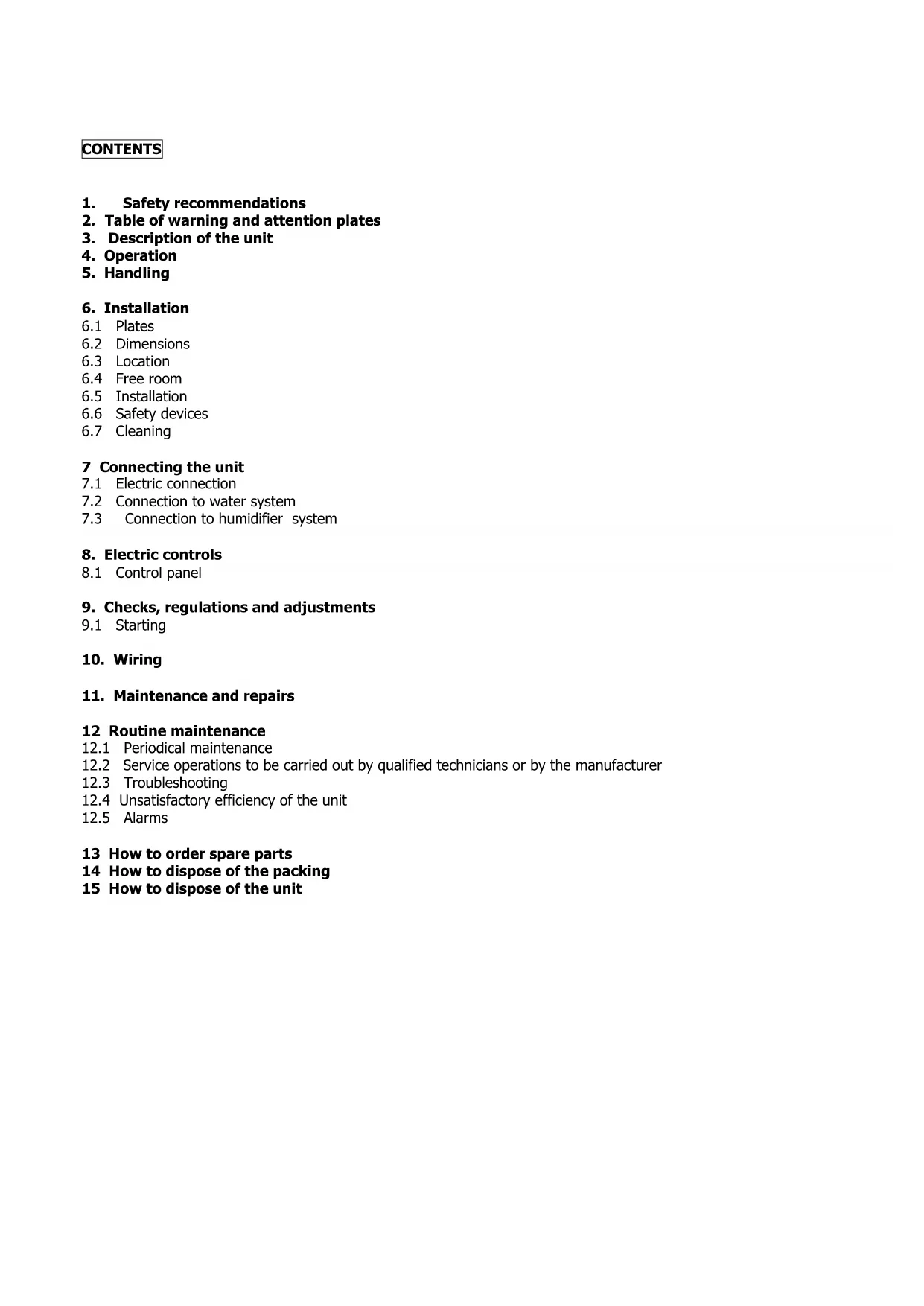
1. Safety recommendations
Table of warning and attention plates
3. Description of the unit
7 Connecting the unit
7.1 Electric connection
7.2 Connection to water system
9. Checks, regulations and adjustments
11. Maintenance and repairs
12.2 Service operations to be carried out by qualified technicians or by the manufacturer
12.3 Troubleshooting
12.4 Unsatisfactory efficiency of the unit
13 How to order spare parts 14 How to dispose of the packing 15 How to dispose of the unitT hank you for choosing Daikin. Please read these instructions carefully. They provide details and advice on the correct method of installing, using and maintaining this unit, in order to obtain maximum reliability, efficiency and long life. 1 SAFETY RECOMMENDATIONS When installing and using the unit please follow the recommendations listed here below. Installation shall be carried out in strict compliance with the diagrams and instructions supplied by the manufacturer. Damages due to improper connections are excluded. The electric system available where the unit is installed shall meet the relevant standards in force. Maintenance shall be effected by trained personnel or by the manufacturer according to the provisions supplied by EN378. WARNING Use safety gloves to protect your hands from possible cuts.
The user is strongly recommended to contact the manufacturer before attempting any intervention on the unit and any use not corresponding to the manufacturer’s indications (in particular as for the field of application) and to enquire about the possible dangers and contra-indications connected with an improper use of the machine. The unit shall be used following these instructions and sticking to the destination of use indicated by the supplier. Any incorrect use can result in damages to the unit and represents a serious danger for people’s health.
ATTENTION The unit is not suitable for working in explosive environments. Therefore the use of the unit in an explosion-dangerous atmosphere is absolutely forbidden.
ATTENTION The unit is not suitable for working in salty environments. In such a case protect condenser and evaporator with appropriate means.
When maintenance involves operations on the refrigerating circuit, empty the system and let it reach the atmospheric pressure. WARNING Do not discharge the refrigerant in the atmosphere. It must be recovered by specialized technicians using suitable equipment.
Quantity and quality of the refrigerant to be charged are indicated on the data plate. Do not use refrigerants of different kind (especially inflammable fluids, for example hydrocarbons) or air. Do not modify or alter the refrigerating circuit or its components (for example: welding on compressor body) The final user shall protect the system from external fire dangers.2 TABLE OF WARNING AND ATTENTION PLATES
Refrigerant Condensate drain line Attention: hot or cold parts Attention: switch off before operating on the unit.
Attention: danger of electrocution
Connect this cable to a circuit breaker, never to the main line directly.
Direction of rotation Colours of supply cable wires
Attention – important : clean the condenser periodically by blowing air from the inside outwards. Stop the unit before cleaning.3 DESCRIPTION OF THE UNIT The LMSW series includes air-cooled or water-cooled (optional)units built on the basis of the single-block principle. They consist of:
1. a condensing unit placed outside the cold room;
2. an insulated separation panel
3. an evaporator placed inside the cold room;
4. an electric control panel placed on the condensing unit;
4 OPERATION LMSW single blocks are compression units where cold is produced by vaporizing a liquid refrigerant (HFC type) at low pressure in a heat exchanger (evaporator). The resulting vapour is brought again into the liquid state by mechanical compression at a higher pressure, followed by cooling in another heat exchanger (condenser). The compressor is hermetic, with reciprocating motion, supplied with single-phase or three-phase power. 5 HANDLING The unit can be handled by lifting and transport means. WARNING Make sure that no one is in transit in the operating area of the lifting/transport means to prevent any possible accidents to people.
If the unit is in a wooden case or crate, sling the packing properly before handling it.
Lifting speed shall be such as not to make the packed unit oscillate dangerously and possibly fall.6 INSTALLATION
The unit is supplied with warning and attention plates as listed in the relevant table.
To obtain optimal operation of the unit act as follows: A) Place the unit in a well ventilated room, far from heat sources. B) Limit the number of door openings. C) Make sure that the unit has good air supply and discharge. D) Fit a drain pipe to the defrost water drain connection in the lower part of the unit. Note: LMSW units are equipped with automatic evaporation of defrost water; drain is just a precaution in case of troubles.6.4 Free room When installing the unit leave enough free room to allow opening, correct use and easy maintenance in safe conditions.
A) Prepare a opening with suitable dimensions in the cold room wall (see pictures above). B) Position the unit onto the cold room wall inserting the evaporator section in the opening. C) Fix the unit using the screws supplied.
Hole Inject silicone on the whole conveyor perimeter6.6 Safety devices The following mechanical safety devices are supplied:
1. Fixed upper and side protections for evaporator and condensing unit, secured by locking screws.
2. External fan protections placed on the evaporating and condensing units, secured with screws.
The following electrical safety devices are supplied: a. Protection of fans (belonging to motors) against high power absorption; with automatic reset. b. High pressure switch (only for special components) to protect against excessive pressure; with automatic reset.
WARNING Above devices have been developed to safeguard the operator’s safety.6.7 Cleaning Clean the unit carefully. Remove any dust, foreign substances and dirt possibly deposited during handling. Use detergents and degreasers. ATTENTION Solvents are not allowed.
ATTENTION Before connecting the unit make sure that mains voltage and frequency correspond to the values shown in the data plate. Voltage tolerance: +/- 10% compared to nominal value.
7.1 Electric connection
Connect the unit after checking the panel components. ATTENTION Connection to the electric line shall be effected applying a suitable safety device (a circuit breaker or a ground fault interrupter) selected by the installer on the basis of the line involved and of the absorption indicated on the unit plate. If a cold room includes more units, each unit shall be provided with its own safety device. Connect the unit paying attention to the colours of the supply cable wires: a) 230V/1/50-60Hz 3 wires Blue = Neutral Yellow/Green = Ground Brown = Phase b) 230V/3/50-60Hz 4 wires Blue = Phase Yellow/Green = Ground Grey = Phase Black = Phase c) 400/3/50 Hz 5 wires Blue = Neutral Yellow/Green = Ground Brown = Phase Grey = Phase Black = Phase
WARNING Any defective electrical part should be replaced by trained personnel exclusively. The electric connection should be effected by qualified personnel.
7.2 Connection to water system
This connection is only necessary if the unit has a water-cooled condenser. It is effected by following the indications of the tags positioned by the inlet and outlet pipes. Connection pipes should never be smaller in diameter than those on the unit. A minimum water pressure of 1 bar is required for correct operation of the unit.
7.3 Connection to humidifier system
Connect humidifier water supply pipe: it is necessary to use a pipe with a diameter of at least 10mm., and pressure in the water circuit must be between 1.5 and 3.0 ATM. Install a pressure reducer and a filter before water inlet. WARNING To prevent water from spilling out of the humidification tray, on first starting set the pressure reducer to minimum value and close the water cock inside the unit.Checking operation When starting the unit check that the Automatic Humidification System operates correctly. Act as follows: a) set the pressure reducer to minimum value and close the water cock inside the unit (see above); b) when the unit is operating, increase the humidity set value so that humidification is required (note: the set cold room temperature must have already been reached); c) check operation of the humidification heater; d) when the tray is empty and the heater operating, check that water solenoid valve lets water flow out; e) open water cock slowly, letting water flow out sufficiently but slowly; f) when the humidification thermostat bulb is immersed, check that the solenoid valve is de-energised. Periodically check that no excessive scales form on humidification heater and on thermostat bulb which could result in: a) burnt humidification heater, b) malfunctioning of humidification thermostat with consequent uncontrolled water level in tray. In case of scales clean the parts involved using special scale-removing products available on the market.
WARNING Cleaning operations must be carried out only when the unit is off.
By holding it pressed for 3s the defrost is started..
Switch ON and OFF the instrument.
Each LED function is described in the following table.LED2 LED3 LED4 Temperature Display Humidity Display
ON - ALARM signal Led 4 ON - Instrument in stand by. - In “Pr2” indicates that the parameter is also present in “Pr1”. ON °C ON The compressor is running FLASHING - Anti-short cycle delay enabled LED 3 ON The defrost is enabled LED 3 FLASHING Drip time in progress LED 2 FLASHING Programming Phase (flashing with LED3) ON Heating enabled (temp) FLASHING Temperature Set programming phase ON Fan is running ON RH% ON Dehumidifying enabled ON Humidifying enabled (umid) FLASHING Humidity Set programming phase
9 CHECKS, REGULATIONS AND ADJUSTMENTS
Before turning the unit on, check that: - locking screws are tight - electrical connections have been carried out correctly. In the event that the unit has been opened: - no tools were left inside - assembly is correct - there are no gas leaks - front cover is secured correctly
Before starting the unit act as follows: WARNING To control the humidification, it’s necessary put into the tray under the evaporator
1.5 liters of water (for LMSW*030-050 models, 2 liters for LMSW*060-075 models).
- Start the unit. He display is on and present the label OFF - Start the unit pushing the ON/OFF key. How to see and modify the set point (temperature and humidity)
1. Push and immediately release the SET key: the display will show the Set point valueand the
or arrows within 10s.
1. Push the DEF key for more than 3 seconds and a manual defrost will start.
How to lock the keyboard
and keys pressed together for more than 3 the “POn” message will be displayed and the keyboard is unlocked..
2. The “POF” message will be displayed and the keyboard is locked. At this point it is only possible the
viewing of the set point or the MAX o Min temperature stored and to switch ON and OFF the light, the auxiliary output and the instrument.
To unlock the keyboard Keep the and keys pressed together for more than 3s. ON/OFF function By pushing the ON/OFF key, the instrument shows “OFF” for 5 sec. and the ON/OFF LED is switched ON. During the OFF status, all the relays are switched OFF and the regulations are stopped; N.B. During the OFF status the LED4 button is lighted.
A wiring diagram, specific for the units of the LMSW series, is enclosed with these use and maintenance instructions.
11. MAINTENANCE AND REPAIRS
Suitable maintenance is crucial for obtaining longer life, perfect working conditions and high efficiency of the unit as well as for ensuring the safety features provided by the manufacturer. 12 ROUTINE MAINTENANCE Good operation of the unit requires the condenser to be cleaned periodically (frequency of cleaning depends on the environment where the unit is installed). Turn off the unit and clean it by blowing air from the inside outwards. Should no air jet be available, use a long-haired brush and work on the outside of the condenser. In case of water-cooled condensers have the unit cleaned by a plumber with special descaling agents. WARNING Use safety gloves to protect your hands from possible cuts.
WARNING Disconnect the unit before working on it.
Periodical maintenance Periodically check wear condition of electrical contacts and remote switches; if necessary replace them.
12.2 Service operations to be carried out by qualified technicians or by the manufacturer
Following operations shall be carried out by qualified technicians or by the manufacturer exclusively. Under no circumstances the user is allowed to: replace electrical components work on the electric equipment repair mechanical parts work on the refrigerating system work on the control panel, ON/OFF and emergency switches work on protection and safety devices.12.3 Troubleshooting
During operation following troubles may occur:
1. Compressor stops. The unit is equipped with an overheating device which stops the compressor every
time the max. allowable temperature of motor windings is exceded. Possible causes are: - insufficient ventilation of the room where the unit is installed; - anomaly in mains voltage; - faulty operation of condenser fan. Device reset is automatic.
2. Display does not light up. Check:
- if there is power to the unit; - if mains cable is properly connected; - fuses inside the electric panel
3. Unit does not start operating when pressing ON/OFF key (the display is turned on): check
microswitch connection keeping in mind that the switch contact must be closed when the door is closed.
12.4 Unsatisfactory efficiency of the unit:
If no defects are found in the unit check that: cold room doors are perfectly tight; there is no cold dispersion; the cold room is used wisely; no unfrozen liquids or foodstuffs are placed in the low temperature room; the evaporator is ice-free. We recommend installation of the machines far from the doors especially when the cold room is expected to be opened many times a day.
Removal of protections during machine operation is absolutely forbidden. They have been developed to safeguard the operator’s safety.
Message Cause “P1” Temperature probe failure “P3” Humidity probe failure “HA” High temperature alarm “LA” Low temperature alarm “HHA” High humidity alarm “HLA” Low humidity alarm “dA” Door switch alarm
The alarm message is displayed until the alarm condition recoveries. All the alarm messages are showed alternating with the room temperature except for the “P1” which is flashing. To reset the “EE” alarm and restart the normal functioning press any key, the “rSt” message is displayed for about 3s. Silencing buzzer Once the alarm signal is detected the buzzer, if present, can be silenced by pressing any key. Alarm recovery Probe alarms : “P1” (and), “P3” ; they automatically stop 10s after the probe restarts normal operation. Check connections before replacing the probe. Temperature alarms “HA” and “LA” automatically stop as soon as the thermostat temperature returns to normal values or when the defrost starts or when the door is open Humidity alarms “HHA” and “LHA” automatically stop as soon as the humidity returns to normal values. Door switch alarm “dA” stop as soon as the door is closed.13 HOW TO ORDER SPARE PARTS When ordering spare parts make reference to the special number of the unit written on the unit plate. WARNING Worn parts should be replaced only by qualified personnel or by the manufacturer.
14 HOW TO DISPOSE OF THE PACKING
Wooden, plastic, polystyrene packing shall be disposed of according to the regulations in force in the country where the unit is used.
15 HOW TO DISPOSE OF THE UNIT
Do not discharge scrapped components in the environment. They should be disposed of by companies dealing with special waste collection and recovery, according to the regulations in force in the country where the unit is used.
WARNING Do not discharge the refrigerant in the atmosphere. It should be disposed of by companies dealing with special waste collection and recovery.INDEX