 ManualGo.com
JEHSCU0500CM3 - Fridge DAIKIN - Free user manual and instructions
Find the device manual for free JEHSCU0500CM3 DAIKIN in PDF.



Frequently Asked Questions - JEHSCU0500CM3 DAIKIN
Download the instructions for your Fridge in PDF format for free! Find your manual JEHSCU0500CM3 - DAIKIN and take your electronic device back in hand. On this page are published all the documents necessary for the use of your device. JEHSCU0500CM3 by DAIKIN.
USER MANUAL JEHSCU0500CM3 DAIKIN
2. Safety and Health 2
3. Installation & commissioning 2
4. Decommissioning & Disposal 9
6. Service and Maintenance 9
7. F gas Regulations 10
2. Safety and Health
3. Installation & Commissioning
General Information Important Note Only a qualified refrigeration engineer who is familiar with refrigeration systems and components, including all controls should perform the installation and start-up of the system. To avoid potential injury, use care when working around coil surfaces or sharp edges of metal cabinets. All piping and electrical wiring should be installed in accordance with all applicable codes, ordinances and local by-laws. This appliances is not intended for use by persons (including children) with reduced physical, sensory or mental capabilities, or lack of experience and knowledge, unless they have been given supervision or instruction concerning use of the appliance by a person responsible for their safety. Children should be supervised to ensure tha t they do not play with the appliance. ● Ensure the unit received is the correct model for the intended application.● Ensure refrigerant, voltage, are suitable for the proposed application and environment.● Installation and maintenance are to be performed only by qualified personnel who are familiar with local codes and regulations, and experienced with this type of equipment.● The condensing unit is delivered with a nitrogen holding charge.
All specifications are subjected to change by the manufacturer without prior notice. The English text is the original instruction. Other languages are the translations of the original instructions.
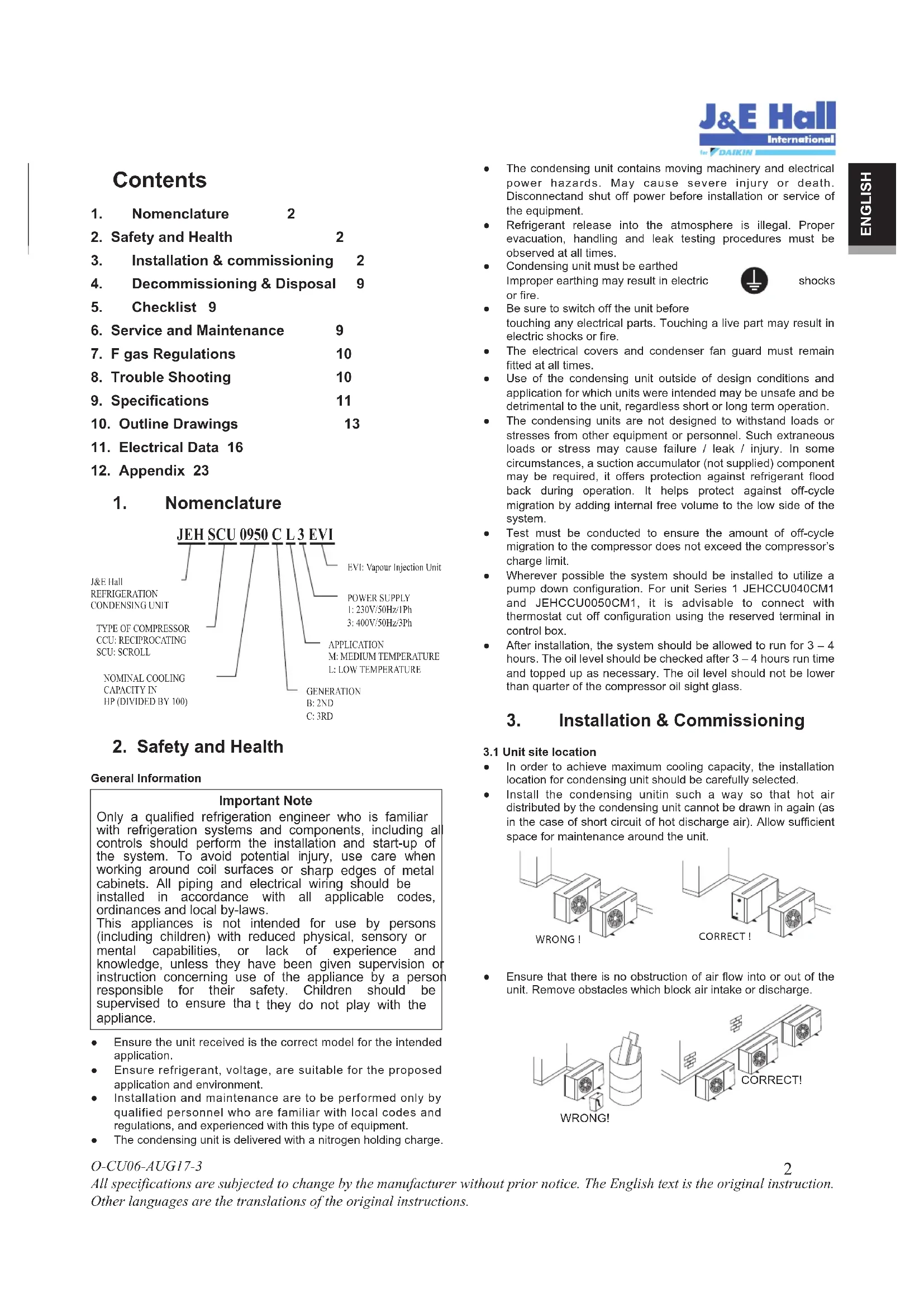
EVI: Vapour Injection UnitPOWER SUPPLY1: 230V/50Hz/1Ph3: 400V/50Hz/3PhAPPLICATIONM: MEDIUM TEMPERATUREL: LOW TEMPERATUREGENERATIONB: 2NDC: 3RDNOMINAL COOLINGCAPACITY INHP (DIVIDED BY 100)TYPE OF COMPRESSORCCU: RECIPROCATINGSCU: SCROLLJ&E HallREFRIGERATIONCONDENSING UNIT ● The condensing unit contains moving machinery and electrical power hazards. May cause severe injury or death. Disconnectand shut off power before installation or service of the equipment. ● Refrigerant release into the atmosphere is illegal. Proper evacuation, handling and leak testing procedures must be observed at all times.● Condensing unit must be earthed Improper earthing may result in electric shocks or fire.● Be sure to switch off the unit before touching any electrical parts. Touching a live part may result in electric shocks or fire.● The electrical covers and condenser fan guard must remain fitted at all times.● Use of the condensing unit outside of design conditions and application for which units were intended may be unsafe and be detrimental to the unit, regardless short or long term operation.● The condensing units are not designed to withstand loads or stresses from other equipment or personnel. Such extraneous loads or stress may cause failure / leak / injury. In some circumstances, a suction accumulator (not supplied) component may be required, it offers protection against refrigerant flood back during operation. It helps protect against off-cycle migration by adding internal free volume to the low side of the system.● Test must be conducted to ensure the amount of off-cycle migration to the compressor does not exceed the compressor’s charge limit. ● Wherever possible the system should be installed to utilize a pump down configuration. For unit Series 1 JEHCCU040CM1 and JEHCCU0050CM1, it is advisable to connect with thermostat cut off configuration using the reserved terminal in control box. ● After installation, the system should be allowed to run for 3 – 4 hours. The oil level should be checked after 3 – 4 hours run time and topped up as necessary. The oil level should not be lower than quarter of the compressor oil sight glass. 3.1 Unit site location ● In order to achieve maximum cooling capacity, the installation location for condensing unit should be carefully selected. ● Install the condensing unitin such a way so that hot air distributed by the condensing unit cannot be drawn in again (as in the case of short circuit of hot discharge air). Allow sufficient space for maintenance around the unit. ● Ensure that there is no obstruction of air flow into or out of the unit. Remove obstacles which block air intake or discharge.CORRECT !WRONG !WRONG! CORRECT!
ENGLISHO-CU06-AUG17-3
All specifications are subjected to change by the manufacturer without prior notice. The English text is the original instruction. Other languages are the translations of the original instructions.
● Braze without over filling to ensure there is no excess solder into the tube. ● To prevent oxidation, blow nitrogen through pipework when brazing. ● Install insulation on all suction lines after pressure test. ● Adequately support all pipe work at a maximum of 2 meter intervals. ● For the condition where the outdoor condensing unit is above the indoor unit, the height difference between units shall be less than 25 m and install oil trap on suction pipe every 4 m height. The suction pipe must always be fitted with U-trap at the bottom. ● For the condition where the outdoor condensing unit is below the indoor unit, the height difference between units shall be less than 4 m. Pipe trap shall be installed upward on outlet of indoor unit (suction pipe). ● The recommended piping length is 25 m or less. ● Additional oil might be required in case field piping is long or with many oil traps. Check the oil level of the compressor to decide to add the oil after minimum 2 hours operation. ● It is recommended as well to install the MOP (Maximum Operation Pressure), expansion valve for medium evaporating temperature units, if the working suction pressure during start procedure especially after defrost cycle, is out of the limit, as refer to the table provided. Recommend compressor working pressure range:
3.5 Pressure testing
● Make sure unit are isolated when pressure test on field piping, always use an inert, dry gas such as Nitrogen. Check for leak if there is reduction in holding pressure. ● The pressure differential between the high and low side of system shall not exceeded below value. ● Test pressures used in factory as shown follows.
● Make sure that all isolation valves are open. ● Perform a leak test of the system using nitrogen mixed with the approved refrigerant for the unit. ● Do not use CFC for leak testing the condensing unit which intended for used with HFC refrigerants. ● The use of leak testing fluids is not recommended as this may interact with the lubricants own additives. ● The location must be well ventilated, so the unit can draw in and distribute plenty of air thus lowering the condensing temperature. ● To optimize the unit running conditions, the condenser coil must be cleaned at regular intervals.
3.2 Installation Clearance
● The installation location should allow sufficient space for air flow and maintenance around the unit. ● To allow sufficient space for doing service or installation.
3.3 Compressor handling
To ensure compressor reliability, the condensing unit and the compressor must not be tilt greater than an angle of 45°.Otherwise, the compressor can fall from its 3 compressor housing spring, which results in noisyvibrations during operationand possible to breakdown.
satisfactory operation and performance, the following points should be noted for field piping arrangements, ● Couples one indoor unit with one outdoor condensing unit only. ● Release all the pre-charged nitrogenbefore pipework connection. ● Connecting pipe size for suction and liquid line must same as attaches to the condensing unit. Correct line sizing will minimize the pressure drop and maintain sufficient gas velocity for proper oil return. ● Pipework routes must be as simple and as short as possible. Avoid low points on pipework where oil can accumulate. ● Use only clean, dehydrated refrigeration grade copper tube with large radius elbows. The piping shall be kept with enough bending radius. Air Inlet Air Discharge Obstacle Obstacle > 1.5 m Springs to absorb vibrations Important Note Line sizing should only be determined by qualified personnel. All local codes of practice must be observed in the installation of refrigerant piping.
All specifications are subjected to change by the manufacturer without prior notice. The English text is the original instruction. Other languages are the translations of the original instructions.
- M: Medium temperature; L: Low temperature The low pressure cut off pressure is the setting of cut in minus the differential.
3.9 Fan speed controller setting
The fan speed controller control the condensing head pressure via speed regulating according to the ambient temperature. The setting for fan cut off should be set higher than the recommended value in table below, to maintain enough liquid sub cooling ahead of TXV for low ambient application.
3.7 Vacuum - moisture removal
Air and moisture reduce service life and increase condensing pressure causing abnormally high discharge temperatureslikely to destroy the oil’s lubricating properties. The risk of acid formation is also increased by air and moisture and copper plating can be gener- ated in this way. All these phenomena can cause mechanical and electrical failure.
3.8 Safety pressure switch settings
The pressure switch fitted to condensing units with auto reset for low pressure andmanual reset for high pressure are NOT factory preset. High pressure safety (Manual reset) The high pressure safety switch is required to protectthe compressor from working out of its envelope. The high pressure switch shall set equal or lower than below values depending on the type of refrigerant, application and the ambient condition. Low pressure safety (Auto reset) The low pressure safety switch is used to avoid compressor operate at too low suction pressure or a vacuum condition. The low pressure safety cut out should never be set lower than value shown in following table. If pump down is used, the electrical circuitry should be arranged so that compressor restart is triggered by demand from thermostat rather than a reset low pressure switch. Important Note Moisture prevents proper functioning of the compressor and the refrigeration system. Important Note Ensure that a good quality vacuum pump is used to pull a minimum vacuum of -0.1 barg (250 microns) or less. Ensure that no pressure increase during 1 hour or more after stop vacuuming. If pressure increase, there is moisture or leakage along the pipeline.
1. Low pressure (LP) setting spindle
2. Differential setting spindle, LP
5. High pressure (HP) setting spindle
8. Differential spring
Low Pressure siderange adjusting screwClockwise:Decrease cut inpressure settingAnticlockwise:Increase cut inpressure setting Differential adjusting screwClockwise:Increase differentialpressure settingAnticlockwise:Decrease differentialpressure setting Low pressure side connectorHigh pressure side connectorHigh Pressure siderange adjusting screwClockwise:Increase cut offPressure settingAnticlockwise:Decrease cut offpressure settingManual reset switch Important Note There must be no more than 10 compressor starts per hour. A higher number reduces the service life of the compressor. If necessary, use an anti-short-cycle timer in the control circuit. Minimum a 2 minutes runtime after each start of compressor and a 3 minute idle time after each stop & start are recommended. Only during the pump down cycle may the compressor run for much shorter intervals.
ENGLISHO-CU06-AUG17-3
All specifications are subjected to change by the manufacturer without prior notice. The English text is the original instruction. Other languages are the translations of the original instructions.
Cut off: Fan motor stops when the pressure decreases below the value Pmin. Note: F.V.S. = Full Voltage Set Point (pressure setting for maximum speed) E.P.B. = Effective Proportional Band (6 bar) Pmin = (F.V.S. – 6)
3.10 Commissioning of the Condensing Unit
Please make sure that all manual service valves are fully opened before starting the system for the first time. This includes external and internal shut off valves as well as liquid receiver valve in the unit. The ball valve open position is shown as below:
Clockwise: Increase pressure set point Anticlockwise: Decrease pressure set point 360° = 1 turn Approx. 1.5 barg
Verification of proper rotation direction is made by observing that suction pressure drops and discharge pressure rises when the compressor is energized. Reverse rotation of a scroll compressor also results in substantially reduced current draw. Suction tempera- ture will be high, discharge temperature will be low and the compres- sor may generate abnormal noise.
3.12 Earthing of Condensing Unit
CAJ4461YCAJ4476YCAJ4492YCAJ4511YCAJ4517ZTAJ4517ZMTZ18-5VMMTZ18-4VMMTZ28-5VMMTZ28-4VMMTZ36-5VMMTZ36-4VMZB15KQE-PFJZB15KQE-TFDZB19KQE-PFJZB19KQE-TFDZB21KQE-PFJZB21KQE-TFDZB26KQE-TFDZB29KQE-TFDZB38KQE-TFDZB45KQE-TFDZB48KQE-TFDZB58KCE-TFDZB76KCE-TFDNOT APPLICABLE(BRAZED - CONNECTION)NOT APPLICABLE(BRAZED - CONNECTION)NOT APPLICABLE(BRAZED - CONNECTION)NOT APPLICABLE(BRAZED -CONNECTION)1''-14 UNS(70-80N.m)1-3/4''-12UNF(135-160 N.m)1-1/4''-12UNF(110-135 N.m)1-1/4''-12UNF(110-135 N.m)1''-14 UNS(70-80N.m)1-1/4''-12UNF(110-135 N.m)1''-14 UNS(70-80N.m)JEHCCU0115CL1JEHSCU0200CL3JEHSCU0300CL3JEHSCU0400CL3JEHSCU0500CL3JEHSCU0600CL3JEHSCU0750CL3JEHSCU0950CL3 EVICAJ2446ZZF06K4E-TFDZF09K4E-TFDZF13K4E-TFDZF15K4E-TFDZF18K4E-TFDZF25K5E-TFDZF18KVE-TFD-EVI The fan speed controller is factory set to 19 bar for operation with R4*** series refrigerant to ensure compressor always operates within envelope at all declared working condition. Higher energy efficiency as shown in eco design sheet can be obtained with the setting shown in below table: For model in Series 1: For model in Series 2, 3 and 4: *Factory default setting Refrigerant Setting (bar) Cut in Setting (bar) Differential R404A 16*
(Series 3 & 4) R134a
(JEHSCU0950CL3 EVI) Medium Temp Low Temp ENGLISH3.14 Series 4 EVI Unit
3.14.1 Piping Size Selection
Sizing of liquid and suction lines for EVI model will be different from standard scroll models. Piping sizes of this model need to follow the recommended correction coefficient of cooling capacity. This is vital as if the pipework selected is oversized, especially for the suction pipe, the gas velocity will be decreased at low mass flow rate / low evaporating temperature, causing oil return problems. Undersized suction lines will also cause decreased capacity due to increased pressure drop. The correction factor of refrigerant R404A is shown as below table: (Watts)
All specifications are subjected to change by the manufacturer without prior notice. The English text is the original instruction. Other languages are the translations of the original instructions.
The liquid pipe connecting CCU service valve to the evaporator must be well insulated with recommended wall thickness of minimum ¾’’.
3.14.2 Expansion Valve Selection
The lower liquid temperature of the EVI unit can increase evaporator expansion valve capacities. Selection of the expansion valve needs to be done based on the expected amount of sub-cooling shown in below tables: For instance, At condition of Te -35°C, Ta +32°C Refrigerant R404A Published cooling capacity = 5.9kW. Cooling capacity = Correction factor x Published cooling capacity = 0.63 x 5.9 kW = 3.707kW Therefore, the pipe sizes should be selected against the corrected capacity of 3.71kW. The correction factor of refrigerant R407A is shown as below table: (Watts)
The correction factor of refrigerant R407F is shown as below table: The correction factor of refrigerant R448A/R449A is shown as below table: (A.) R404A Amount of Sub-cooling (K) Ta\Te
(B.) R407A Amount of Sub-cooling (K) Ta\Te
(C.) R407F Amount of Sub-cooling (K) Ta\Te
(D.) R448A/R449A Amount of Sub-cooling (K) Ta\Te
ENGLISH3.14.3 Controller EXD-HP1 The controller EXD-HP1 used in the Series 4 EVI unit operates as an economizer control. The setting of controller is preset by the factory and is password protected. Users are not allowed to change any settings in the controller.
3.14.2 Electrical Installation
● Do not operate system before all cable connections are completed. ● Refer to wiring diagram for electrical connections. ● Class II category transformer is required for 24VAC power supply ● Do not connect any EXD-HP1 input to main voltage as it will permanently damage the controller. ● When connecting wires of expansion valve and pressure sensor, consider color coding as follow:
Safety Instructions:
1. Read installation instruction carefully. Failure to
comply can result in device failure, system damage or personal injury.
2. Only person having appropriate knowledge and
skill are allowed to manipulate the controller.
3. Disconnect all voltages from system before
All specifications are subjected to change by the manufacturer without prior notice. The English text is the original instruction. Other languages are the translations of the original instructions.
● In standard mode the superheat is shown at the display. In case of liquid injection and economizer function this changes to discharge temperature. ● To display other data of EXD-HP1 press “SEL” button for 1 second until index number according to below table appears. Release “SEL” button and the next variable data will appears. By repeating the procedure variable data can be displayed in sequence as measured superheat (K) → Measured suction pressure (bar) → valve position (%) → Measured suction gas temperature (°C) → Calculated saturated temperature (°C)
- Measured discharge temperature (°C) (if economizer function is selected) → REPEATING
3.14.4 Digital Input Di1/Di2
● The digital input Di1 is the interface between controller EXD-HP1 and system controller if Modbus communication has not been used. ● The digital status is dependent to operation of system’s compressor or demand.
3.14.5 Manual mode operation
Warning: All alarms are disabled during manual control. We do not
recommend unattended operation of system during manual control. Manual alarm reset clearing functional alarms (except hardware error) Variable data Default Superheat, K Suction pressure, bar Valve position, % Suction gas temperature, °C Saturation temperature, °C Discharge temperature, °C Controller EXD-HP1
Operating Condition Compressor starts Compressor stops Digital input status Closed (Start) Open (Stop) ON: Data display Circuit 1 ON: Data display Circuit 2 ON: alarm OFF: no alarm ON: ModBus communication Next parameter/ value (higher) Next parameter/ value (lower) Selecting/ confirming Parameters setting/saving Blinking: valve is closing ON: valve is fully close Blinking: valve is opening ON: valve is fully open ● Press and together for 5 seconds to access to manual mode operation.● List of parameters in scrolling sequence by pressing button PRG Code Parameter description and choices1Ho Manual mode operation; circuit 1 0
Manual mode operation; circuit 20 = disabled;Valve opening (%)Valve opening (%)0 = disabled;1 = Enabled1 = Enabled 1HP 2Ho 2HP Min MaxFactorysettingFieldsetting● Press and together for 5 seconds. When the clearing is done, “CL” message appears for 2 seconds.PRG SEL
ENGLISHO-CU06-AUG17-3
All specifications are subjected to change by the manufacturer without prior notice. The English text is the original instruction.Other languages are the translations of the original instructions.
Note: When multiple alarms occur, the highest priority alarm is displayed until being cleared. Then the next highest alarm is displayed until all alarms are cleared. Only then will parameters will be shown again Alarm code Description Related parameter Valve What to do? Requires manual reset after resolving alarm
Pressure sensor 1/2 error Fully close Check wiring connection and measure the signal 4 to 20 mA No
Yes Yes Yes Check wiring connection and measure the resistance of sensor Check wiring connection and measure the resistance of sensor Check wiring connection and operation of valve Check the system Check the system for cause of low pressure such as refrigerant loss Check valve opening/ check liquid flow for flash gas free/check discharge hot gas temperature sensor Check the system for cause of low pressure such as insufficient load on evaporator Check wiring connection and measure the resistance of winding Fully close Fully close Fully close Fully close Fully close Operating Operating Operating Operating Operating Temperature sensor 1/2 error Discharge hot gas temperature sensor 3 error Discharge hot gas temperature above limit 1P4/2P4: 1 1P4/2P4: 2 1uL/2uL: 1 1uL/2uL: 2 1uH/2uH: 1 1P9/2P9: 1 1P9/2P9: 2 Freeze protection Low superheat (<0.5K) High superheat Low pressure EXM/EXL electrical connection error 1E0/2E0 1E1/2E0 1Ed 1AII/2AII 1Ad
AP blinking ENGLISH4 Decommissioning & Disposal
6. Service and Maintaintenance
All specifications are subjected to change by the manufacturer without prior notice. The English text is the original instruction. Other languages are the translations of the original instructions.
The condensing units are designed to give long life operation with minimum maintenance. However, they should be routinely checked and the following service schedule is recommended under normal circumstances: The removal of the top, side and front panels ensures that all parts are accessible.
1. Compressor – Inspect at regular intervals
● Check for refrigerant leaks on all joints and fittings. ● Ensure that no abnormal noise or vibration is detected during test run. ● Check the compressor oil levels and top up if required. The oil level should not be lower than quarter of the compressor oil sight glass. Not applicable to AE/AJ compressor.
2. Condenser Coil – Clean and inspect at regular intervals
● Remove surface dirt, leaves, fibers, etc. with a vacuum cleaner (preferably with a brush or other soft attachment rather than a metal tube), compressed air blown from the inside out, and/or a soft bristle (not wire!) brush. Do not impact or scrape the coil with the vacuum tube, air nozzle, etc. It may be beneficial to blow or vacuum out the rinse water from MCHE to speed drying and prevent pooling.
3. Power Supply – Inspect at regular intervals
● Check the running current and voltage for the condensing unit. ● Check the electrical wiring and tighten the wires onto the terminal blocks if necessary. Under normal circumstances: ● Clean condenser coil every three months ● To assure no leakage ● Check and verify operation of all safety devices every three months, ensure crankcase heater is operational ● Check sight glass and operating conditions ● Check security of compressor mountings and the bolts that hold down the unit each year
4. Compact Brazed Heat Exchanger (BPHE)
** For JEHSCU0950CL3 EVI Unit ONLY ● Any soldering process done on the heat exchanger needs to be brazed with minimum 45% silver solder at maximum 450°C ( 840°F) when soft soldering and 450-800°C (840-1470°F) when hard soldering. ● Do not direct flame at BPHE and use wet rag to avoid overheating of BPHE. At the end of the unit’s useful life, a suitably qualified engineer should decommission it. The refrigerant and compressor oil are classed as hazardous waste and as such must be reclaimed and disposed of in the correct manner, including completion of waste transfer paperwork. The unit components must be disposed of or recycled as appropriate in the correct manner. ● Ensure the high low pressure controls are configured properly. ● Ensure crankcase heater is energized minimum 12 hours prior to start up and permanently energized. ● Check the refrigerant is correct for intended use. ● Check all electrical connections. ● Check all electrical termination and circuits are correct. ● Check compressor oil level via compressor sight glass, the oil level should not be lower than quarter of sight glass. ● Check the TXV capacity sizing based on indoor unit capacity. Check TXV applicable refrigerant. Check position and condition of the sensing bulb fixing ● Observed the system pressures during the charging and initial operation process. ● Ensure that suction pressure will decrease, discharge pressure will increase. No abnormal noise from the compressor. ● Continue to charge the system until sight glass is clear. Make sure that high pressure is > 14 barg for R404A and > 8 barg for R134a when doing this charge adjustment operation. Continuous flow of clear refrigerant through the sight glass, with perhaps an occasional bubble at very high temperature indicates the refrigerant is at optimum. ● Check the compressor’s discharge and suction pressure, to ensure it is within operating range. Discharge temperature should be within 50 to 90 °C and pressure should be around 15 to 26 barg (for system charged with R404A) and 8 to 16 barg (for system charged with R134a). ● Check the current of condensing unit and ensure it is below the motor circuit breaker setting value. ● Check condenser fan, ensure warm air blowing off the condenser coil. ● Check evaporator blower, ensure it’s discharging cool air. ● Check suction superheat and adjust expansion valve to prevent liquid flood back to the compressor. Recommended 5 to 20 K of suction superheat. ● Do not leave the system unattended until the system has reached its normal operating condition and the oil charge has properly adjusted itself to maintain the proper level in the sight glass. ● Check periodically the compressor performance and all the moving components during the first day of operation. ● Check the liquid line sight glass and expansion valve operation. If there is an indication that the system is low on refrigerant, thoroughly check the system for leaks before adding refrigerant. Important Note Warning! – Disconnect the mains electrical supply before servicing or opening the unit Warning! – Ensure there is no refrigerant in refrigerant circuit before dismantle it Warning! – If the supply cord is damaged, it must be replaced by the qualified service agent in order to avoid a hazard. Important Note For scroll compressor: wiring for 3 phases must be controlled. Supply phase sequence L1, L2 and L3 will affect the rotating direction of scroll compressor and damage the compressor. Service technician should be present at initial start- up to verify that the supply power is properly phased and that compressor is rotating in the correct direction. ENGLISHIts functioning relies on fluorinated greenhouse gases
7. F-Gas Information
● From 1/1/2015, a new F-Gas Regulation (EU) No 517/2014 comes into force repealing Regulation (EC) No 842/2006. This will affect system labelling, information supplied within documentation and also the way in which thresholds for frequen-cy of leak testing.● For systems with a charge below 3kg, the changes to the leak checking regime will not apply until 2017. Currently, there is no requirement for regular leak testing of systems with a total charge below 3kg.● Changes to leak testing requirements are as follows:
All specifications are subjected to change by the manufacturer without prior notice. The English text is the original instruction. Other languages are the translations of the original instructions.
● This product is factory charged with N2. ● The refrigerant system will be charged with fluorinated greenhouse gases. Do not vent gases into the atmosphere.The GWP (Global Warming Potential) values of refrigerants which are specified for use in this equipment along with the three new thresholds for leak testing requirements based on TCO2Eq (Tonnes CO2 Equivalent) are as follows:
This troubleshooting guide describes some common condensing unit failure. Consult qualified personnel before any corrective actions are taken. OLD LEGISLATION NEW LEGISLATIONLEAK CHECKINGFREQUENCYEvery 12 months but can beincreased to 24 months iffitted with a fixed leakdetection system. Every 6 months but can beincreased to 12 months iffitted with a fixed leakdetection system. Every 6 months ‐ howeverautomatic leak detectionsystem is mandatory whichrequires servicing every12 months. 5‐50 TCO2Eq 3‐30 kgs 50‐500TCO2Eq 30‐300 kgs 500+ TCO2Eq 300+ kgsImportant information regarding the refrigerant usedRefrigerant Charge - kg
GWP (1) Refrigerant R404A R407A R407F R134a R448A R449A 3921.6 2107 1824.5 1430 1387 1397 Please fill in with indelible ink, on the refrigerant charge label supplied with the product. The total refrigerant charge & the TCO equivalent for charged refrigerant.The filled out label must be adhered in the proximity of the product charging port. Failure Possible CausesFan does not workCompressor doesnot startInsufficient cooling● Improper wiring● Improper wiring● System stopped because of tripped of safety device.● Incorrect TXV size and SH setting● Miss matching of indoor unit● Low refrigerant charge● Condenser coil dirty● Obstacle blocking air inlet/outlet● Improper thermostat setting● Compressor rotating direction is incorrect Important Note Warning! – Immediately shut off power of the unit if there is any event of accident or breakdown. Contains Fluorinated Greenhouse Gases Charge R404A R407A R407F R448A R449A R134a
Model Series COP/SEPR Compressor Oil type
Electrical Data Airflow (m³/h) Receiver Connection Dimensions Weight (kg) Sound pressure dB(A)
(A) R404A Nominal Current
(A) R407A Nominal Current
(A) R407F Nominal Current
(A) R134a Lock Rotor current (A) MFA
(Liter) Suction (inch) Liquid (inch) Width (mm)
Refer to condition: Outside ambient temperature= 32°C. Evaporation temperature = -10°C (medium temperature application).
MFA = Maximum Fuse Amps Sound pressure level measured in anechoic room Oil A = Uniqema Emkarate RL32CF Oil B = Polyester oil 160PZ Oil C = Polyester oil (Copeland Ultra 22 CC. Copeland Ultra 32 CC. Copeland Ultra 32-3MAF. Mobil EAL Arctic 22 CC. Uniqema Emkarate RL32CF) Note: condensing units are pre-charged with oil as stated in table
All specifications are subjected to change by the manufacturer without prior notice. The English text is the original instruction.Other languages are the translations of the original instructions.
ENGLISHO-CU06-AUG17-3
All specifications are subjected to change by the manufacturer without prior notice. The English text is the original instruction.Other languages are the translations of the original instructions.
Low Temperature ReceiverR404A R407A R407F R448A R449A Type Displacement (m³/h) Oil Charge (Liter) Power Input Nominal Current (A) R404A Nominal Current (A) R407A Lock Rotor current (A) MFA
(A) Volume (Liter) Suction (inch) Liquid (inch) Width (mm) Depth (mm) Height (mm) JEHCCU0115CL1 1 0,96 N/A N/A N/A N/A CAJ2446Z 4,55 0,887 Oil A
10 meterCOP/SEPR Connection Oil C
Refer to condition: Outside ambient temperature= 32°C, Evaporation temperature = -35°C (low temperature application)
MFA = Maximum Fuse Amps
Sound pressure level measured in anechoic room
Oil A = Uniqema Emkarate RL32CF
Oil C = Polyester oil (Copeland Ultra 22 CC. Copeland Ultra 32 CC. Copeland Ultra 32-3MAF. Mobil EAL
Arctic 22 CC. Uniqema Emkarate RL32CF) Note: condensing units are pre-charged with oil as stated in table ENGLISH10. Outline drawings
All specifications are subjected to change by the manufacturer without prior notice. The English text is the original instruction. Other languages are the translations of the original instructions.
All specifications are subjected to change by the manufacturer without prior notice. The English text is the original instruction. Other languages are the translations of the original instructions.
All specifications are subjected to change by the manufacturer without prior notice. The English text is the original instruction. Other languages are the translations of the original instructions.
Series 4 Medium Temperature Low Temperature
ENGLISHO-CU06-AUG17-3
All specifications are subjected to change by the manufacturer without prior notice. The English text is the original instruction. Other languages are the translations of the original instructions.
Important Note: All wiring and connections to the condensing unit must be made in accordance to the local codes. Single Phase
All specifications are subjected to change by the manufacturer without prior notice. The English text is the original instruction. Other languages are the translations of the original instructions.
All specifications are subjected to change by the manufacturer without prior notice. The English text is the original instruction. Other languages are the translations of the original instructions.
All specifications are subjected to change by the manufacturer without prior notice. The English text is the original instruction. Other languages are the translations of the original instructions.
All specifications are subjected to change by the manufacturer without prior notice. The English text is the original instruction. Other languages are the translations of the original instructions.
JEHSCU0200CM3, JEHSCU0250CM3, JEHSCU0300CM3, JEHSCU0350CM3,
All specifications are subjected to change by the manufacturer without prior notice. The English text is the original instruction. Other languages are the translations of the original instructions.
All specifications are subjected to change by the manufacturer without prior notice. The English text is the original instruction. Other languages are the translations of the original instructions.
All specifications are subjected to change by the manufacturer without prior notice. The English text is the original instruction. Other languages are the translations of the original instructions.
All specifications are subjected to change by the manufacturer without prior notice. The English text is the original instruction. Other languages are the translations of the original instructions.
JEHSCU0200CM3, JEHSCU0250CM3, JEHSCU0300CM3, JEHSCU0350CM3,
12mm in./6mmÉvasement
Huile B = Polyester oil 160PZ
Huile B = Polyester oil 160PZ
JEHSCU0200CM3, JEHSCU0250CM3, JEHSCU0300CM3, JEHSCU0350CM3,
12mm in./6mmafvanger
JEHSCU0200CM3, JEHSCU0250CM3, JEHSCU0300CM3, JEHSCU0350CM3,
12mm in./6mmÉvasement
JEHSCU0200CM3, JEHSCU0250CM3, JEHSCU0300CM3, JEHSCU0350CM3,
3.4 Tubature in loco
JEHSCU0200CM3, JEHSCU0250CM3, JEHSCU0300CM3, JEHSCU0350CM3,
JEHSCU0200CM3, JEHSCU0250CM3, JEHSCU0300CM3, JEHSCU0350CM3,
(JEHSCU0950CL3 EVI) POLSKI 2, 3
All specifications are subjected to change by the manufacturer without prior notice. The English text is the original instruction.Other languages are the translations of the original instructions.
JEHSCU0200CM3, JEHSCU0250CM3, JEHSCU0300CM3, JEHSCU0350CM3,