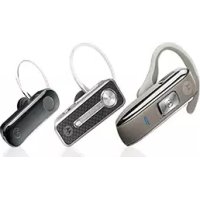
HS810 - Earphones MOTOROLA - Free user manual and instructions
Find the device manual for free HS810 MOTOROLA in PDF.


| Product Type | Bluetooth Wireless Earpiece |
| Brand | Motorola |
| Model | HS810 |
| Wireless Technology | Bluetooth, range 10 m (33 ft) |
| Supported Bluetooth Profiles | Headset Profile and Hands-Free Profile |
| Talk Time | 5 hours |
| Standby Time | 100 hours (micro-rail open) |
| Charging Time | Approximately 2 hours |
| Power Supply | Built-in rechargeable battery, AC charger |
| Key Features | Hands-free calls, voice dialing, call rejection, call hold, call transfer, volume control |
| Indicators | LED (charging, pairing, standby, call) and audible tones |
| Included Accessories | AC charger, adjustable ear hook |
| Replacement Parts and Repairability | Removable and replaceable ear hook and speaker cover |
| Maintenance | Clean with a soft, dry cloth; do not use chemical products |
| Safety | Compliant with FCC and IC standards; do not modify the device |
Frequently Asked Questions - HS810 MOTOROLA
User questions about HS810 MOTOROLA
0 question about this device. Answer the ones you know or ask your own.
Ask a new question about this device
Download the instructions for your Earphones in PDF format for free! Find your manual HS810 - MOTOROLA and take your electronic device back in hand. On this page are published all the documents necessary for the use of your device. HS810 by MOTOROLA.
USER MANUAL HS810 MOTOROLA
The Motorola Wireless Headset HS810 with Bluetooth ^® technology defies traditional expectations. This third generation product by Motorola makes connectivity invisible and reliable. It is astonishingly advanced, yet intuitive and simple to use. It is decidedly smaller than its predecessors, yet more eye-catching than ever. And although you are no longer connected by wires, you are intrinsically connected to a growing group of leading-edge technology pioneers who are embracing the global Bluetooth movement.
Innovation is a recognized part of Motorola's 75-year heritage. A company that understands the way the world is moving...and then jumps in to intelligently shape its direction. Motorola consumer products with Bluetooth wireless technology are challenging the expected and defying the traditional rules. Connectivity is bringing us together—need it be hampered by wires? Technology is making life more integrated—must it be complicated?
Motorola is actively creating Bluetooth solutions for work, for play, for home, for life—everywhere around the globe. Welcome to the movement. And thank you for choosing the Motorola Wireless Headset HS810!
Contents
Safety and General Information ....3
Introduction....6
What Is Bluetooth Wireless Technology?....6
How Can I Use My Wireless Headset? 6
Headset Features 7
Using Your Headset 8
Charging Your Headset 8
Wearing the Headset 10
Pairing Your Headset and Phone 12
Controlling Headset Volume 14
Placing and Receiving Calls 15
Using Your Headset Indicators 17
2
Safety and General Information
IMPORTANT INFORMATION ON SAFE AND EFFICIENT OPERATION. READ THIS INFORMATION BEFORE USING YOUR DEVICE.
Users are not permitted to make changes or modify the device in any way. Changes or modifications not expressly approved by the party responsible for compliance could void the user's authority to operate the equipment. See 47 CFR Sec. 15.21.
This device complies with part 15 of the FCC Rules. Operation is subject to the following two conditions: (1) This device may not cause harmful interference, and (2) this device must accept any interference received, including interference that may cause undesired operation. See 47 CFR Sec. 15.19(3).
Electromagnetic Interference/Compatibility
Note: Nearly every electronic device is susceptible to electromagnetic interference (EMI) if inadequately shielded, designed, or otherwise configured for electromagnetic compatibility.
Facilities
To avoid electromagnetic interference and/or compatibility conflicts, turn off your device in any facility where posted notices instruct you to do so. Hospitals or health care facilities may be using equipment that is sensitive to external RF energy.
Safety and General Information
Aircraft
When instructed to do so, turn off your device when on board an aircraft. Any use of a device must be in accordance with applicable regulations per airline crew instructions.
Medical Devices
Hearing Aids
Some devices may interfere with some hearing aids. In the event of such interference, you may want to consult with your hearing aid manufacturer to discuss alternatives.
Other Medical Devices
If you use any other personal medical device, consult the manufacturer of your device to determine if it is adequately shielded from RF energy. Your physician may be able to assist you in obtaining this information.
Industry Canada Notice to Users
Operation is subject to the following two conditions: (1) This device may not cause interference and (2) This device must accept any interference, including interference that may cause undesired operation of the device Ref IC RSS 210 Sec. 5.11. The term "IC:" before the certification/registration
4
Safety and General Information
number only signifies that registration was performed based on a Declaration of Conformity indicating that Industry Canada technical specifications were met. It does not imply that Industry Canada approved the equipment. See Ref IC Self-Marking 6(f) and RSP-100 Sec. 4.
FCC Notice to Users
This equipment has been tested and found to comply with the limits for a Class B digital device, pursuant to part 15 of the FCC Rules. These limits are designed to provide reasonable protection against harmful interference in a residential installation. This equipment generates, uses and can radiate radio frequency energy and, if not installed and used in accordance with the instructions, may cause harmful interference to radio communications. However, there is no guarantee that interference will not occur in a particular installation. If this equipment does cause harmful interference to radio or television reception, which can be determined by turning the equipment off and on, the user is encouraged to try to correct the interference by one or more of the following measures:
- Reorient or relocate the receiving antenna.
- Increase the separation between the equipment and the receiver.
- Connect the equipment to an outlet on a circuit different from that to which the receiver is connected.
- Consult the dealer or an experienced radio/TV technician for help.
Introduction
What Is Bluetooth Wireless Technology?
Bluetooth wireless technology propels you into a new dimension in connectivity.
Bluetooth devices communicate without wires, using built-in radio transceivers that operate on a globally available radio frequency to ensure worldwide compatibility. Your Bluetooth Wireless Headset can communicate with other Bluetooth devices within a range of approximately 10 meters (33 feet).
How Can I Use My Wireless Headset?
Your Wireless Headset equipped with Bluetooth technology lets you connect with other similarly equipped devices such as a Motorola V600 with integrated Bluetooth technology.
- Use your phone hands free.
- Handle incoming and outgoing calls with the headset multifunction control button (MFB).
- Use voice activation to make calls.
Note: The HS810 supports both Headset and Hands Free Bluetooth Profiles for increased functionality and compatibility with more products. Consult your User's Guide for more information.
6
Introduction
Headset Features
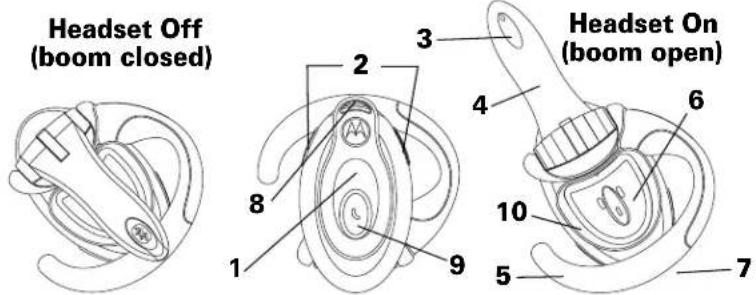
1—Headset Indicator LED Provides visual cue about headset status.
2—Volume Control Buttons Adjusts speaker (receive) volume up and down.
3—Microphone Picks up your voice input.
4—Boom Contains microphone and controls power (On/Off) status of headset.
5—Earhook Attaches headset to ear.
6—Speaker Plays the sound you receive on the call.
7—Charging Port Receives the plug for your battery charger.
8—Lanyard Loop Lets you attach a lanyard to the headset, so you can wear the headset around your neck and always keep it near.
9—Multifunction Button ☑ Controls several headset functions.
10—Removable Speaker Shroud Helps channel sound to the ear. Shroud may be removed if it causes discomfort.
Using Your Headset
Charging Your Headset
When to Charge
First-Time Use—Before you can use your headset, you need to charge its self-contained battery for two hours.
Recharging—When you hear five rapid high tones through the headset speaker, repeated at 20-second intervals, the headset battery needs to be recharged.
Over extended periods of time, batteries gradually wear down and require longer charging times. This is normal. The more you talk on the phone with the headset, the less standby time your battery has.

The rechargeable batteries that power this product must be disposed of properly and may need to be recycled. Contact your local recycling center for proper disposal methods. Never dispose of
batteries in a fire because they may explode.
8
Using Your Headset
How to Charge
Step
1 Plug the Motorola charger into the headset, with the charger's release tab facing down and the headset facing up.
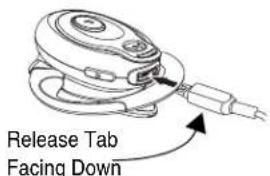
2 Plug the other end of the charger into an electrical outlet.
During charging, the headset indicator turns on and remains lit until charging is complete. The headset will not function while charging. Your headset requires approximately two hours to receive a full charge.
3 When charging is complete (indicators off), remove the charger from the electrical outlet, press the release tab, and detach the charger cord from the headset.
Note: You can also use a Motorola Original Vehicle Power Adapter to charge the headset while in your vehicle.
A fully charged headset battery provides approximately:
- talk time -5 hours
- standby time (boom open) -100 hours
Using Your Headset
Wearing the Headset
Placing the Headset on Your Ear
When packaged, the headset is configured for wear on the right ear.
Step
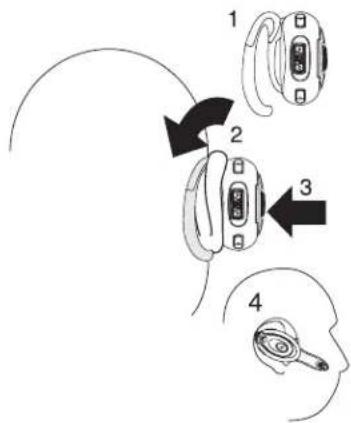
1 Open the boom, then open the earhook (45° from the headset).
2 Loop the earhook over your ear.
3 Press the headset to your ear.
4 Point the boom toward your mouth.
flowchart
graph TD
    A["Step 1: Earplate with two buttons"] --> B["Step 2: Earphone with two buttons"]
    B --> C["Step 3: Earphone with one button"]
    C --> D["Step 4: Head with earpiece"]
10
Using Your Headset
Changing for Wear on the Left Ear
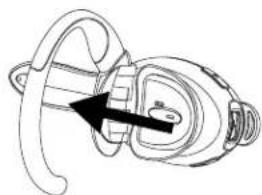
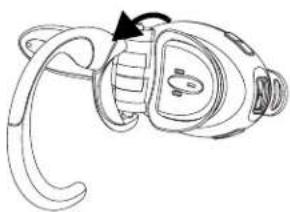
When packaged, the headset is configured for wear on the right ear. To change it for wear on your left ear:
Step
1 Open the boom, then open the earhook (90° from the headset).
natural_image
Line drawing of a handheld ear ear device with a black arrow pointing to the ear (no text or symbols present)2 Gently lift and pull the top of the earhook up and off the upper hinge pin. Then pull it away to remove it.
natural_image
Line drawing of a stylized bird head with curved wings and a black arrow indicating rotation (no text or symbols)3 Flip the headset over.
4 Hook the bottom of the earhook onto the lower hinge pin, then lift and pull the top of the earhook over the upper hinge pin.
5 To change the volume button orientation, see "Controlling Headset Volume" on page 15.
Using Your Headset
Pairing Your Headset and Phone
Note: You must pair your headset and phone before you can make a call.
"Pairing" creates a link between devices equipped with Bluetooth wireless technology and allows the phone to remember the headset's unique ID. Once your headset and phone are paired, your headset automatically connects to your phone any time you open the boom.
Pairing
With the headset and phone in close proximity:
Step Result
1 Put the headset into pairing mode. The headset indicator turns on.
a With the headset's boom closed, press and hold the Multifunction Button Ⓤ until the headset indicator turns on (about 3 seconds).
b Release the button, then open the headset boom.
The indicator remains lit.
12
Using Your Headset
Step Result
2 Perform a device discovery from the phone.
For details on device discovery for your phone, refer to the user's guide for the phone.
When the scan is complete, the phone displays the devices found.
3 Select the Motorola HS810 from the discovered devices list and confirm following the on screen prompts.
4 When prompted by the phone, enter the passkey 0000 and confirm to pair the headset with the phone.
The device ID is now stored in the phone's memory.
Pairing is successful when the headset indicator flashes 10 times rapidly.
Paired Link to Additional Devices
Your headset can store pairing information for up to eight different devices equipped with Bluetooth wireless technology. Devices are stored in a "Paired Device List" in memory in chronological order. When an attempt to pair to more than eight devices is made, the oldest paired device is removed from the list.
Any of the eight paired devices can initiate a paired connection to the headset.
Using Your Headset
The headset will only automatically initiate a paired connection (via opening the boom) with the last device it was connected to. If you want to connect the headset to another device in the paired device list, you must initiate the connection from that device. Whichever of the eight devices initiates a connection to the headset afterwards, that device then becomes the "last connected" device.
Controlling Headset Volume
Increasing and Decreasing Volume
To increase speaker volume, press the top volume button repeatedly until you reach the desired volume level.
To decrease speaker volume, press the bottom volume button repeatedly until you reach the desired volume level.
Volume Orientation Technology
To change the volume button orientation for left or right ear:
Step
1 With the headset's boom closed, press and hold the Multifunction Ⓞ button until the headset indicator turns on (about 3 seconds).
2 Press the volume button that you want to use as the volume up. The headset indicator will flash several times to indicate success.
Repeat the above steps anytime to change the volume button orientation.
14
Using Your Headset
Placing and Receiving Calls
Your headset supports both Hands Free and Headset Profiles. Accessing call functions depends on which profile your phone supports.
Note: Some phones do not support all features listed. Please consult you phone user's guide.
You can activate call functions for both Hands Free and Headset Profiles according to the following table:
| Device Status Action | ||||
| Function | Phone | Headset | Hands Free Profile | Headset Profile |
| Enter Pairing (Configuration) Mode | On Off | (boom closed) | Press & hold ⚙ until LED remains lit. Release ⚙, open boom. | |
| Make a Voice Dial Call | On in idle On | Short press | Ⓧ, speak name, phone dials call | Press ⚙, speak name, phone dials call |
| Dial a Number | On-user dials number | On N/A | Press | Ⓧ, call is sent |
| Redial a Number | On-Voice dialing turned on or off | On- (Idle) | Long press ⚙ | Press ⚙, (recalls last phone number) Press ⚙, (call is sent) |
| End a Call | On-in call | On Short | press ⚙ | Press ⚙ |
Using Your Headset
| Device Status Action | ||||
| Function | Phone | Headset | Hands Free Profile | Headset Profile |
| Put Active Call On Hold | On-in call On | Long press | ◎ | N/A |
| Receive a Call | On-phone rings | On Short press (call is answered) | ◎ (call is answered) | Press (call is answered) |
| Reject a Call On | On-phone rings | On Long press | ◎ | N/A |
| Answer 2nd incoming call | On-in call, 2nd call coming in | On Long press, places 1st call on hold, answers incoming call | ◎, | N/A |
| Toggle between two active calls | On-in call, 2nd call on hold | On Long press | ◎ | N/A |
| Transfer call from phone to Headset | On-in call On | Short press (call transferred to headset) | ◎, (call transferred to headset) | Press (call transferred to headset) |
Note: If the link is abnormally disconnected (e.g., out of range) the headset tries to reestablish the link.
16
Using Your Headset
Using Your Headset Indicators Headset Indicator (LED)
With charger plugged in:
Headset Indicator Headset
| ON charging in progress |
| OFF charging complete |
With no charger attached:
Headset Indicator Headset
OFF power off
| ON (steady) pairing mode | |
| 10 rapid flashes | pairing successful |
| flashes at a 3-second interval(.1 seconds ON 2.9 seconds OFF) | standby (not on a call) |
| pulses at an 8-second interval(2.0 seconds ON, 6.0 seconds OFF) | connected (on a call) |
Note: When the wireless headset is paired to the phone and there is no activity for 5 minutes, the blue flashing LED turns off. Any button press on the headset will reawaken the headset and the flashing resumes. If you press the up and down volume buttons simultaneously during a call, the pulsing LED turns off for the duration of that call.
Using Your Headset
Audio Tones
| Audio Tone Headset Status | |
| single high tone when pressing volume button | volume maximum or minimum reached |
| five rapid high tones, repeated every 20 seconds | low battery |
| no audio indications; deteriorating audio quality | out of range |
| series of 4 tones, low to high audio link open (Headset mode),active call (Hands Free mode) | |
| ring tone incoming call | |
| single high tone pairing confirmation | |
| single low tone initiate voice activation | |
| dual high/low tone voice tag not recognized | |
| single high tone end call | |
| series of 4 tones, high to low audio link closed (Headset mode),call ended (Hands Free mode) | |
| fast high/low tone every 5 seconds (max. & min. volume confirm beep) | no network/service |
| no tone power ON/OFF | |
Bienvenue
flowchart
graph TD
    A["Step 1: Earplate with two buttons"] --> B["Step 2: Earbell with one button"]
    B --> C["Step 3: Earbell with one button"]
    C --> D["Step 4: Earlobe with one button"]
natural_image
Line drawing of a handheld ear ear device with a black arrow pointing to the ear (no text or symbols present)natural_image
Line drawing of a stylized bird head with curved limbs and a curved handle, no text or symbols presentflowchart
graph TD
    A["Step 1: Earplate with two buttons"] --> B["Step 2: Earbell with two buttons"]
    B --> C["Step 3: Earlobe with two buttons"]
    C --> D["Step 4: Earlobe with two buttons"]
natural_image
Line drawing of a mechanical component with an arrow indicating direction (no text or symbols)natural_image
Line drawing of a bird's head and neck with a curved handle and a small inset showing internal anatomy (no text or symbols)
- Contents
- Safety and General Information
- IMPORTANT INFORMATION ON SAFE AND EFFICIENT OPERATION. READ THIS INFORMATION BEFORE USING YOUR DEVICE.
- Electromagnetic Interference/Compatibility
- Facilities
- Aircraft
- Medical Devices
- Hearing Aids
- Other Medical Devices
- Industry Canada Notice to Users
- FCC Notice to Users
- Introduction
- What Is Bluetooth Wireless Technology?
- How Can I Use My Wireless Headset?
- Headset Features
- Using Your Headset
- Charging Your Headset
- When to Charge
- How to Charge
- Step
- Wearing the Headset
- Placing the Headset on Your Ear
- Changing for Wear on the Left Ear
- Pairing Your Headset and Phone
- Pairing
- Step Result
- Paired Link to Additional Devices
- Controlling Headset Volume
- Increasing and Decreasing Volume
- Volume Orientation Technology
- Placing and Receiving Calls
- Using Your Headset Indicators Headset Indicator (LED)
- Bienvenue
Brand : MOTOROLA
Model : HS810
Category : Earphones