DWE46172 - Power tool accessory DEWALT - Free user manual and instructions
Find the device manual for free DWE46172 DEWALT in PDF.


| Product type | Dust collection shroud for concrete finishing grinders |
| Brand | DeWALT |
| Model | DWE46172 |
| Compatible wheel diameter | 178 mm (7 in) |
| Intended use | Grinding, leveling and polishing concrete surfaces, removal of paints and adhesives |
| Recommended wheel type | Dry diamond cup grinding wheel |
| Vacuum connection | Universal connector DWV9000 (31.8 mm and 63.5 mm diameters) |
| Main material | Reinforced plastic and metal |
| Approximate weight | 0.5 kg |
| Dimensions (L x W x H) | 200 x 180 x 90 mm |
| Power supply | None (mechanical accessory) |
| Main functions | Dust collection, protection against accidental contact with the wheel |
| Safety | Mandatory use of personal protective equipment (goggles, mask, hearing protection) |
| Maintenance and cleaning | Clean ventilation openings with dry compressed air at least once a week |
| Spare parts and repairability | Repairs only by DeWALT authorized service center, use identical replacement parts |
| Warranty | 3-year limited warranty, 1-year free maintenance contract, 90-day money-back guarantee |
| General information | Professional accessory, do not use in wet or flammable environments |
Frequently Asked Questions - DWE46172 DEWALT
User questions about DWE46172 DEWALT
0 question about this device. Answer the ones you know or ask your own.
Ask a new question about this device
Download the instructions for your Power tool accessory in PDF format for free! Find your manual DWE46172 - DEWALT and take your electronic device back in hand. On this page are published all the documents necessary for the use of your device. DWE46172 by DEWALT.
USER MANUAL DWE46172 DEWALT
7^ (178 mm) Concrete Surface Grinding Shroud
Definitions: Safety Alert Symbols and Words
This instruction manual uses the following safety alert symbols and words to alert you to hazardous situations and your risk of personal injury or property damage.
D. IGER: Indicates an imminently hazardous situation which, if not avoided, will result in death or serious injury.
WtNING: Indicates a potentially hazardous situation which, if not avoided, could result in death or serious injury.
CAITON: Indicates a potentially hazardous situation which, if not avoided, may result in minor or moderate injury.
(Without word) Indicates a safety related message.
NOTICE: Indicates a practice not related to personal injury which, if not avoided, may result in property damage.
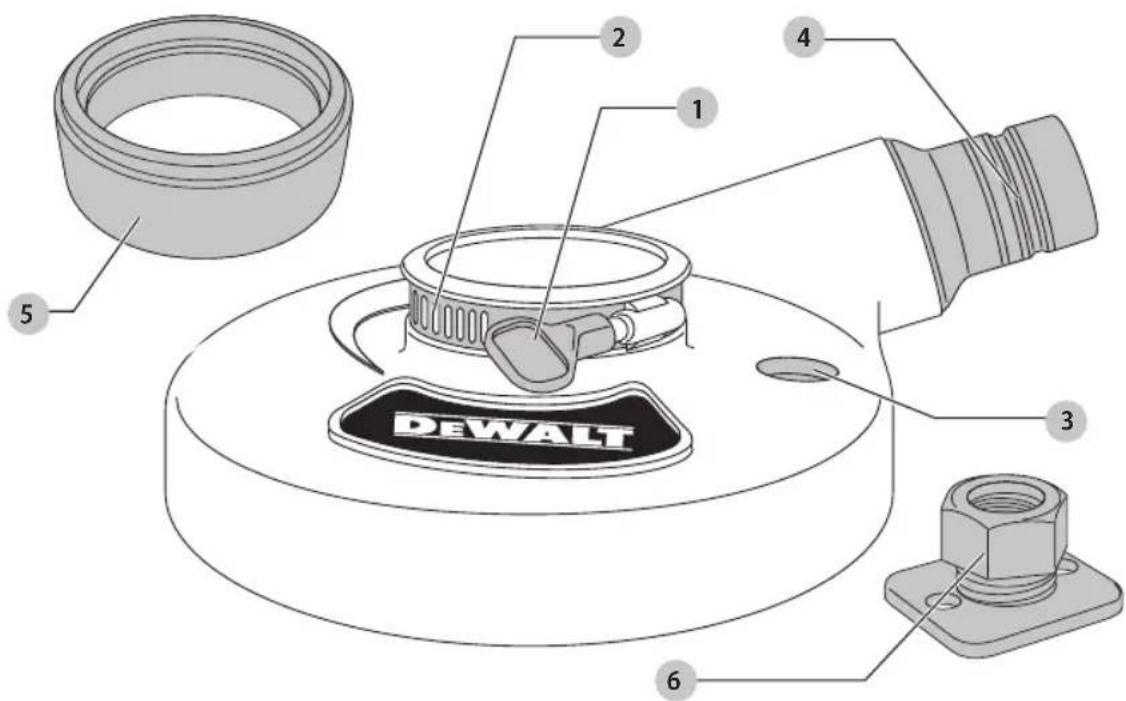
Fig. A
1 Hose clamp screw
2 Hose clamp
3 Intake vent
4 Dust port for universal connector
5 Gear case adaptor
6 Adaptor for non-hubbed diamond wheels
WARNING! Read all safety warnings and all instructions. Failure to follow the warnings and instructions may result in electric shock, fire and serious injury.

WARNING: To reduce the risk of injury, read the instruction manual.
If you have any questions or comments about this or any DEWALT tool, call us toll free at: 1-800-4-DEWALT (1-800-433-9258).
English
GENERAL POWER TOOL SAFETY WARNINGS
WARNING! Read all safety warnings and all instructions. Failure to follow the warnings and instructions may result in electric shock, fire and/or serious injury.
SAVE ALL WARNING AND INSTRUCTIONS FOR FUTURE REFERENCE
The term "power tool" in the warnings refers to your mains-operated (corded) power tool or battery-operated (cordless) power tool.
1) Work Area Safety
a) Keep work area clean and well lit. Cluttered or dark areas invite accidents.
b) Do not operate power tools in explosive atmospheres, such as in the presence of flammable liquids, gases or dust. Power tools create sparks which may ignite the dust or fumes.
c) Keep children and bystanders away while operating a power tool. Distractions can cause you to lose control.
2) Electrical Safety
a) Power tool plugs must match the outlet. Never modify the plug in any way. Do not use any adapter plugs with earthed (grounded) power tools. Unmodified plugs and matching outlets will reduce risk of electric shock.
b) Avoid body contact with earthed or grounded surfaces such as pipes, radiators, ranges and refrigerators. There is an increased risk of electric shock if your body is earthed or grounded.
c) Do not expose power tools to rain or wet conditions. Water entering a power tool will increase the risk of electric shock.
d) Do not abuse the cord. Never use the cord for carrying, pulling or unplugging the power tool. Keep cord away from heat, oil, sharp edges or moving parts. Damaged or entangled cords increase the risk of electric shock.
e) When operating a power tool outdoors, use an extension cord suitable for outdoor use. Use of a cord suitable for outdoor use reduces the risk of electric shock.
f) If operating a power tool in a damp location is unavoidable, use a ground fault circuit interrupter (GFCI) protected supply. Use of a GFCI reduces the risk of electric shock.
3) Personal Safety
a) Stay alert, watch what you are doing and use common sense when operating a power tool. Do not use a power tool while you are tired or under the influence of drugs, alcohol or medication. A moment of inattention while operating power tools may result in serious personal injury.
b) Use personal protective equipment. Always wear eye protection. Protective equipment such as dust mask, non-skid safety shoes, hard hat, or hearing protection used for appropriate conditions will reduce personal injuries.
c) Prevent unintentional starting. Ensure the switch is in the off position before connecting to power source and/or battery pack, picking up or carrying the tool. Carrying power tools with your finger on the switch or energizing power tools that have the switch on invites accidents.
d) Remove any adjusting key or wrench before turning the power tool on. A wrench or a key left attached to a rotating part of the power tool may result in personal injury.
e) Do not overreach. Keep proper footing and balance at all times. This enables better control of the power tool in unexpected situations.
f) Dress properly. Do not wear loose clothing or jewelry. Keep your hair, clothing and gloves away from moving parts. Loose clothes, jewelry or long hair can be caught in moving parts.
g) If devices are provided for the connection of dust extraction and collection facilities, ensure these are connected and properly used. Use of dust collection can reduce dust-related hazards.
4) Power Tool Use and Care
a) Do not force the power tool. Use the correct power tool for your application. The correct power tool will do the job better and safer at the rate for which it was designed.
b) Do not use the power tool if the switch does not turn it on and off. Any power tool that cannot be controlled with the switch is dangerous and must be repaired.
c) Disconnect the plug from the power source and/or the battery pack from the power tool before making any adjustments, changing accessories, or storing power tools. Such preventive safety measures reduce the risk of starting the power tool accidentally.
d) Store idle power tools out of the reach of children and do not allow persons unfamiliar with the power tool or these instructions to operate the power tool. Power tools are dangerous in the hands of untrained users.
e) Maintain power tools. Check for misalignment or binding of moving parts, breakage of parts and any other condition that may affect the power tool's operation. If damaged, have the power tool repaired before use. Many accidents are caused by poorly maintained power tools.
f) Keep cutting tools sharp and clean. Properly maintained cutting tools with sharp cutting edges are less likely to bind and are easier to control.
g) Use the power tool, accessories and tool bits, etc. in accordance with these instructions, taking
English
into account the working conditions and the work to be performed. Use of the power tool for operations different from those intended could result in a hazardous situation.
5) Service
a) Have your power tool serviced by a qualified repair person using only identical replacement parts. This will ensure that the safety of the power tool is maintained.
Additional Safety Rules for Surface Grinding Shroud
- The shroud must be securely attached to the power tool and positioned for maximum safety, so the least amount of wheel is exposed towards the operator. The shroud is designed to collect dust and help protect the operator from accidental contact with the wheel.
- Do not use accessories which are not specifically designed and recommended by the tool manufacturer. Just because the accessory can be attached to your power tool, it does not assure safe operation.
- Only use dry diamond surface cup wheels with this surface grinding shroud. The surface grinding shroud is not intended to be used with standard grinding, cut-off, cup wheels or wire brushes.
- The rated speed of the accessory must be at least equal to the maximum speed marked on the power tool. Accessories running faster than their rated speed can break and fly apart.
- Hold power tool by insulated gripping surfaces only, when performing an operation where the cutting accessory may contact hidden wiring or its own cord. Cutting accessory contacting a "live" wire may make exposed metal parts of the power tool "live" and could give the operator an electrical shock.
Always use side handle. Tighten the handle securely. The side handle should always be used to maintain control of the tool at all times. - Do not use a damaged accessory. Before each use inspect the accessory such as diamond wheel for chips and cracks, backing pad for cracks and tear or excess wear. If power tool or accessory is dropped, inspect for damage or install an undamaged accessory. After inspecting and installing an accessory, position yourself and bystanders away from the plane of the rotating accessory and run the power tool at maximum no-load speed for one minute. Damaged accessories will normally break apart during this test time.
-
When starting the tool with a new or replacement wheel, hold the tool in a well protected area and let it run for one minute. If the wheel has an undetected crack or flaw, it should burst in less than one minute. Never start the tool with a person in line with the wheel. This includes the operator.
-
Wear personal protective equipment. Depending on application, use face shield, safety goggles or safety glasses. As appropriate, wear dust mask, hearing protectors, gloves and workshop apron capable of stopping small abrasive or workpiece fragments. The eye protection must be capable of stopping flying debris generated by various operations. The dust mask or respirator must be capable of filtrating particles generated by your operation. Prolonged exposure to high intensity noise may cause hearing loss.
- Position the cord clear of the spinning accessory. If you lose control, the cord may be cut or snagged and your hand or arm may be pulled into the spinning accessory.
- Never lay the power tool down until the accessory has come to a complete stop. The spinning accessory may grab the surface and pull the power tool out of your control.
- Do not run the power tool while carrying it at your side. Accidental contact with the spinning accessory could snag your clothing, pulling the accessory into your body.
- Regularly clean the power tool's air vents. The motor's fan will draw the dust inside the housing and excessive accumulation of powdered metal may cause electrical hazards.
- Do not operate the power tool near flammable materials. Sparks could ignite these materials.
- Do not use accessories that require liquid coolants. Using water or other liquid coolants may result in electrocution or shock.
DO NOT use wire brushes with this surface grinding shroud.
DO NOT use abrasive wheels.
DO NOT grind or cut metal with a diamond cup wheel. Fragments could loosen and fly apart. - ALWAYS use with a dust collector.
WARNING: Before beginning the work, check to determine the hazard classification of the dust produced. Use an industrial dust extractor vacuum of the appropriate, officially approved safety class that is in compliance with your local dust hazard control regulations.
WARNING: Always wear proper personal hearing protection. Under some conditions and duration of use, noise from this product may contribute to hearing loss.
Additional Safety Information
WARNING: ALWAYS use safety glasses. Everyday glasses are NOT safety glasses. Also use face or dust mask if cutting operation is dusty. ALWAYS WEAR CERTIFIED SAFETY EQUIPMENT:
ANSI Z87.1 eye protection (CAN/CSA Z94.3)
ANSI S12.6 (S3.19) hearing protection,
- NIOSH/OSHA/MSHA respiratory protection.
WARNING: Some dust created by power sanding, grinding, grinding, and other construction
ENGLISH
activities contains chemicals known to the State of California to cause cancer, birth defects or other reproductive harm. Some examples of these chemicals are:
- lead from lead-based paints,
crystalline silica from bricks and cement and other masonry products, and - arsenic and chromium from chemically-treated lumber.
Your risk from these exposures varies, depending on how often you do this type of work. To reduce your exposure to these chemicals: work in a well ventilated area, and work with approved safety equipment, such as those dust masks that are specially designed to filter out microscopic particles.
- Avoid prolonged contact with dust from power sanding, sawing, grinding, drilling, and other construction activities. Wear protective clothing and wash exposed areas with soap and water. Allowing dust to get into your mouth, eyes, or lay on the skin may promote absorption of harmful chemicals.
WARNING: Use of this tool can generate and/ or disperse dust, which may cause serious and permanent respiratory or other injury. Always use NIOSH/OSHA approved respiratory protection appropriate for the dust exposure. Direct particles away from face and body.
WARNING: Always wear proper personal hearing protection that conforms to ANSI S12.6 (S3.19)
during use. Under some conditions and duration of use, noise from this product may contribute to hearing loss.
CAUTION: When not in use, place tool on its side stable surface where it will not cause a tripping or falling hazard. Some tools with large battery packs will stand upright on the battery pack but may be easily knocked over.
Air vents often cover moving parts and should be avoided. Loose clothes, jewelry or long hair can be caught in moving parts.
- An extension cord must have adequate wire size (AWG or American Wire Gauge) for safety. The smaller the gauge number of the wire, the greater the capacity of the cable, that is, 16 gauge has more capacity than 18 gauge. An undersized cord will cause a drop in line voltage resulting in loss of power and overheating. When using more than one extension to make up the total length, be sure each individual extension contains at least the minimum wire size. The following table shows the correct size to use depending on cord length and nameplate ampere rating. If in doubt, use the next heavier gauge. The lower the gauge number, the heavier the cord.
Minimum Gauge for Cord Sets
| Volts | Total Length of Cord in Feet(meters) | ||||
| 120 V 25 (7.6) | 50 (15.2) | 100 (30.5) | 150 (45.7) | ||
| 240 V 50 (15.2) | 100 (30.5) | 200 (61.0) | 300 (91.4) | ||
| Ampere Rating | American Wire Gauge | ||||
| More Than | Not More Than | ||||
| 06 18 | 16 16 14 | ||||
| 6 10 18 | 16 14 12 | ||||
| 10 12 | 16 16 14 12 | ||||
| 12 16 14 | 12 Not Recommended | ||||
The label on your tool may include the following symbols. The symbols and their definitions are as follows:
V volts
Hz.....hertz
min.........minutes
=or DC....direct current
Class I Construction (grounded)
...min..per minute
BPM...beats per minute IPM...impacts per minu
RPM.Revolutionsper minute
sfpm.....surface feet per minute
SPM.........strokes per minute
A. amperes
W... .watts
or AC....alternating current
or AC/DC....alternatingor direct current
Class1
Construction (double insulated)
n_0 . no load speed
n............rated speed
...earthing terminal
A . safety alert symbol
A.........visible radiation
wearrespiratory protection
weareye protection
. wearhearing protection
......readall documentation
SAVE THESE INSTRUCTIONS FOR FUTURE USE
COMPONENTS (FIG. A)
WARNING: Never modify the power tool or any part of it. Damage or personal injury could result.
Refer to Figure A at the beginning of this manual for a complete list of components.
INTENDED USE
Your concrete surface grinding shroud has been designed for dust removal of the following: grinding, leveling and polishing concrete surfaces. It can remove dust when removing surface paint, epoxy and glue. Using the appropriate grinder, diamond grinding wheel and dust extractor vacuum it can be used to remove the vast majority of static and airborne dust which without the use of the surface grinding shroud could otherwise contaminate the working environment or pose an increased health risk to the operator and those in close proximity. This concrete surface grinder should ALWAYS be used with a dust extractor vacuum designed for concrete dust removal.
DO not use under wet conditions or in presence of flammable liquids or gases.
The surface grinding shroud is a professional tool. DO NOT let children come into contact with the tool. Supervision is required when inexperienced operators use this tool. Recommended power tools to be used with this attachment are available at extra cost from your local dealer or authorized service center. Refer to Accessories for contact information.
ASSEMBLY AND ADJUSTMENTS
WARNING: To reduce the risk of serious personal injury, turn unit off and disconnect it from power source before making any adjustments or removing/installing attachments or accessories.
An accidental start-up can cause injury.
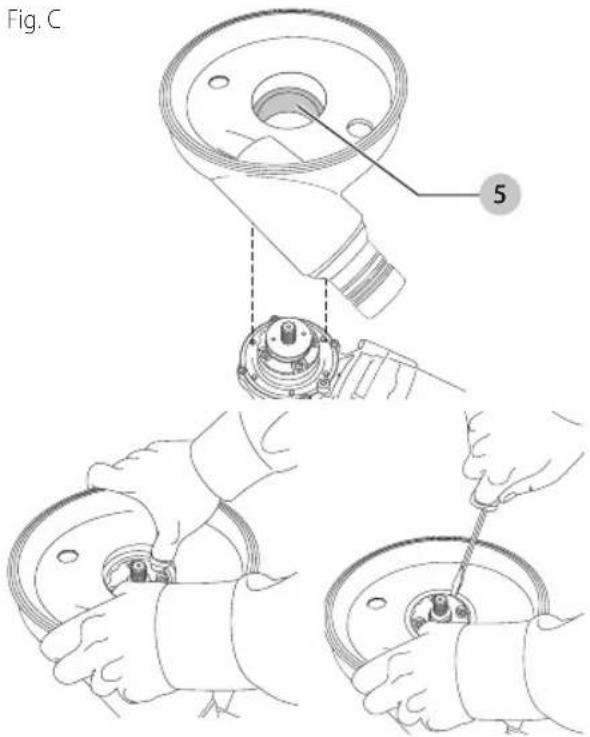
Mounting and Removing Surface Grinding Shroud (Fig. A-C)
NOTE: The shroud and adaptor 5 have a tight fit onto the grinder. Take extra care when mounting the shroud.
- Follow the mounting and removing guard instructions in the power tool manual to remove the existing guard from grinder.
- If present, remove the stop screw 8 from your DeWALT Grinding with a T40 star wrench. If a star wrench is unavailable, use a flat head screwdriver or a pair locking pliers to remove the screw.
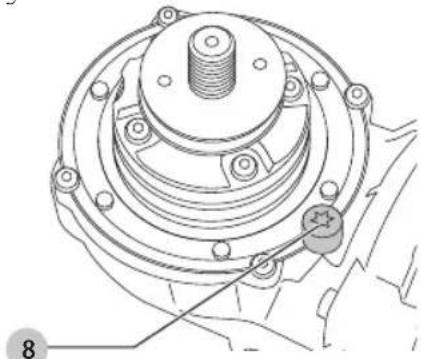
Fig. B
- With the beveled edge facing upward from the shroud collar, insert the gear case adaptor 5 partially into the collar as seen in Figure C.
- Aligning the adaptor and shroud with the gear casing, push the both down onto the gear case with your thumbs. You can also use a large flathead screwdriver to be sure the adaptor is seated correctly. Both the shroud and the adaptor should slide down onto the gear case at the same time.
- Position shroud to desired orientation, and tighten hose clamp screw 1 securely.
- To remove the shroud, repeat these steps in reverse.
NOTICE: If surface grinding shroud cannot be tightened by the hose clamp screw, do not use the tool and take the tool and surface grinding shroud to a service center to repair or replace the surface grinding shroud.
English
Mounting Dry Diamond Surface Cup Wheels (Fig. D)
Follow the mounting and using cutting wheels instructions in the tool manual and mount the grinding wheel. DO NOT use Type 1 cutting wheels or bonded abrasive wheels.
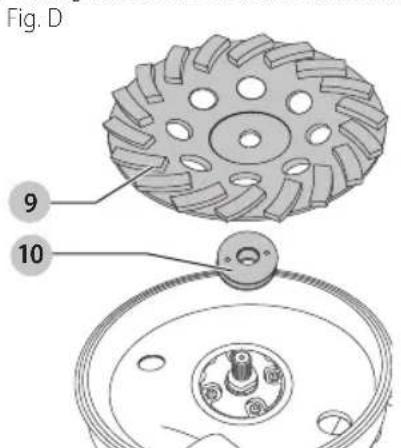
Dry diamond surface cup 9 wheels are recommended for use with this shroud. The inner soft mount washer 10 should be installed behind the wheel, allowing free tool removal and proper fit and alignment to shroud.
Hose Connection (Fig. E-F)
WARNING: Use only power tools recommended by E-NT with this attachment.
For more information about DwALT power tools compatible with this attachment, please contact your local dealer, call 1-800-4-DwALT (1-800-433-9258) or visit our website www DwALT.com.
WARNING: This attachment must be used with a dust motor system. ALWAYS wear certified safety face or dust mask.
NOTE: Ensure hose connection is secure.
ENGLISH
NOTE: The amount of dust retained by the dust extractor vacuum is dependent on its filter system. Refer to the dust extractor vacuum instruction manual for more information. All DrWALT dust collection shrouds are designed to connect and secure easily with the DwWALT universal DwV9000 connector. The DwV9000 connector comes pre-installed on some DrWALT dust extractors. Consult your local dealer for compatible extractors.
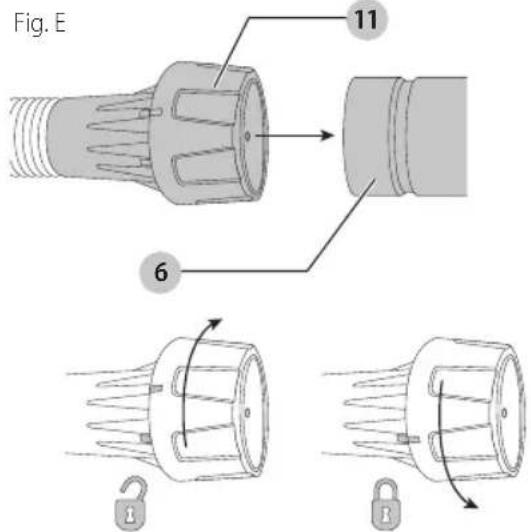
Connecting the DWV9000 Onto the Shroud (Fig. E)
NOTE: If the DWV9000 is not installed on your dust extractor hose refer to Installing the DWV9000 on a Dust Extraction Hose.
- With the DWV9000 connector 11 unlocked, slide it onto the shroud's dust port 6.
- Lock the DWV9000 connector to secure.
Installing the DWV9000 on a Dust Extraction Hose (Fig. F, G)
The DWV9000 is can be attached to a 1 - 1 / 4'' or 2 - 1 / 2'' (31.8 mm or 63.5 mm) dust extraction hose. The DWV9000 can be used with a 2 - 1 / 2'' (31.8 mm) hose with the use of the DWV9190 adaptor.
For 1 - 1 / 4'' (31.8 mm) hoses:
- Remove the existing hose connector by twisting clockwise, or if connector is permanently attached, remove by cutting.
- Install the universal DWV9000 connector 13 onto the hose by turning counterclockwise.
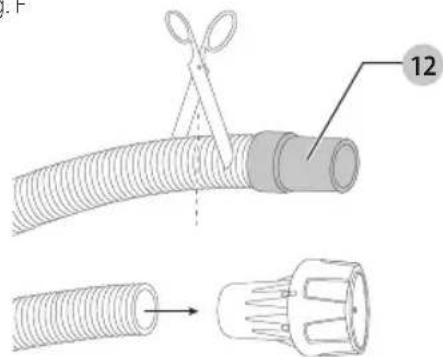
Fig. F
For 2 - 1 / 2^n (63.5 mm) hoses:
- Use a DWV9190 adaptor 13, and slide it onto the existing hose connector 12.
- Install the universal DWW9000 connector 11 onto the adaptor by turning counterclockwise.
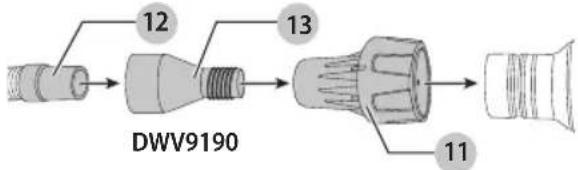
Fig. G
OPERATION
WARNING: To reduce the risk of serious personal injury, turn unit off and disconnect it from power source before making any adjustments or removing/installing attachments or accessories. An accidental start-up can cause injury.
WARNING: For your own safety, read the instruction manual for both the grinding tool and the dust extractor vacuum before using any accessory. Failure to heed these warnings may result in personal injury and serious damage to the tool and the accessory. When servicing this tool, use only identical replacement parts.
NOTE: The amount of dust retained by the dust extractor vacuum is dependent on its filter system. Refer to the dust extractor vacuum instruction manual for more information.
- Ensure all assembly instructions have been completed.
- Turn the dust extractor vacuum on as instructed in the dust extractor vacuum instruction manual.
- Turn the tool on as instructed in the tool instruction manual and allow it to reach full speed before making contact with work surface.
- Place the surface grinding shroud to flat work surface, such as a floor or wall, and begin grinding.
- When surface grinding is complete, turn the tool off and disconnect from the power source. Allow the tool to stop rotating before laying it down.
NOTE: The surface grinding shroud and dust extractor vacuum will only be effective when used with a diamond surface cup wheel on a flat surface.
MAINTENANCE
WARNING: To reduce the risk of serious personal injury, turn unit off and disconnect it from power source before making any adjustments or removing/installing attachments or accessories. An accidental start-up can cause injury.
Cleaning
WARNING: Blow dirt and dust out of all air vents with dry air at least once a week. To minimize the risk of eye injury, always wear ANSI Z87.1 approved eye protection when performing this.
WARNING: Never use solvents or other harsh chemicals for cleaning the non-metallic parts of the tool. These chemicals may weaken the plastic materials used in these parts. Use a cloth dampened only with water and mild soap. Never let any liquid get inside the tool; never immerse any part of the tool into a liquid.
Accessories
WARNING: Since accessories, other than those used by DeWALT, have not been tested with this product, use of such accessories with this tool could be hazardous. To reduce the risk of injury, only DeWALT recommended accessories should be used with this product.
Recommended accessories for use with your tool are available at extra cost from your local dealer or authorized service center. If you need assistance in locating any accessory, please contact DeWALT Industrial Tool Co., 701 East Joppa Road, Towson, MD 21286, call 1-800-4-DeWALT (1-800-433-9258) or visit our website: www.dewalt.com.
Repairs
The charger and battery pack are not serviceable.
WARNING: To assure product SAFETY and REECULI TY, repairs, maintenance and adjustment (including brush inspection and replacement) should be performed by a DrWALT factory service center or a DrWALT authorized service center. Always use identical replacement parts.
Register Online
Thank you for your purchase. Register your product now for:
- WARRAnTY sERViCE: Registering your product will help you obtain more efficient warranty service in case there is a problem with your product.
- COnFiRMAtiOn OF OwnERshiP: In case of an insurance loss, such as fire, flood or theft, your registration of ownership will serve as your proof of purchase.
FOR YOUR SAFETY: Registering your product will allow us to contact you in the unlikely event a safety notification is required under the Federal Consumer Safety Act.
Register online at www.dewalt.com/register.
Three Year Limited Warranty
DeWALT will repair, without charge, any defects due to faulty materials or workmanship for three years from the date of purchase. This warranty does not cover part failure due to normal wear or tool abuse. For further detail of warranty coverage and warranty repair information, visit www.dewalt.com or call 1-800-4-DeWALT (1-800-433-9258). This warranty does not apply to accessories or damage caused where repairs have been made or attempted by others. This warranty gives you specific legal rights and you may have other rights which vary in certain states or provinces.
In addition to the warranty, DeWALT tools are covered by our:
1 YEAR FREE sSERVICE
DrWALT will maintain the tool and replace worn parts caused by normal use, for free, any time during the first year after purchase.
90 DAY MOneY BACK gUARAnTEE
If you are not completely satisfied with the performance of yourDrWALT Power Tool, Laser, or Nailer for any reason, you can return it within 90 days from the date of purchase with a receipt for a full refund - no questions asked.
LATIn AMERiCA: This warranty does not apply to products sold in Latin America. For products sold in Latin America, see country specific warranty information contained in the packaging, call the local company or see website for warranty information.
FREE WARning LABEL REPLACEMENT: If your warning labels become illegible or are missing, call 1-800-4-DEWALT (1-800-433-9258) for a free replacement.
O protection auditive
minute
...lire toutla
A. .
documentation
W.....watts
CONSERVER CES CONSIGNES POUR UTILISATION ULTÉRIEURE
DESCRIPTION (FIG. A)

1 Hose clamp screw
2 Hose clamp
3 Intake vent
4 Dust port for universal connector
5 Gear case adaptor
6 Adaptor for non-hubbed diamond wheels
Dewalt Industrial Tool Co., 701 East Joppa Road, Towson, MD 21286
(SEP16)
Part No. N486866
DWE46172
Copyright © 2016 D'WALT
The following are trademarks for one or more DeWALT power tools: the yellow and black color scheme, the "D" shaped air intake grill, the array of pyramids on the handgrip, the kit box conFiguration, and the array of lozenge-shaped humps on the surface of the tool.