
543 XP G - Saw HUSQVARNA - Free user manual and instructions
Find the device manual for free 543 XP G HUSQVARNA in PDF.


| Brand | Husqvarna |
| Model | 543 XP G |
| Product type | Chainsaw for forestry services |
| Displacement | 43.1 cm³ |
| Max power | 2.2 kW (2.9 hp) at 9,600 rpm |
| Idle speed | 2,500 - 2,700 rpm |
| Weight | 4.7 kg (with heated handles) |
| Fuel tank capacity | 0.42 L |
| Chain oil tank capacity | 0.27 L |
| Spark plug | NGK CMR7H, gap 0.65 mm |
| Guaranteed sound power level | 113 dB(A) |
| Sound pressure level at ear | 101 dB(A) |
| Front handle vibrations | 4.5 m/s² |
| Rear handle vibrations | 4.2 m/s² |
| Recommended guide bar length | 33 - 46 cm (13 - 18 in) |
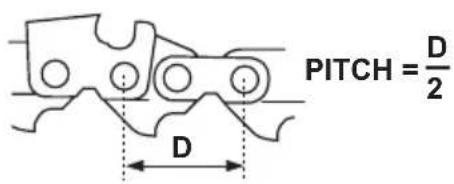
| Chain pitch | 0.325 in |
| Drive sprocket type | Rim / 7 teeth |
| Max chain speed | 24.6 m/s |
| Chain brake | With protective guard and inertia function |
| Anti-vibration system | 4 elements |
| Heated handles | Yes (model G) |
| Air cleaning | Centrifugal AirInjection™ |
| Carburetor adjustment | Screws L, H and T with ½ turn limitation |
Frequently Asked Questions - 543 XP G HUSQVARNA
User questions about 543 XP G HUSQVARNA
0 question about this device. Answer the ones you know or ask your own.
Ask a new question about this device
Download the instructions for your Saw in PDF format for free! Find your manual 543 XP G - HUSQVARNA and take your electronic device back in hand. On this page are published all the documents necessary for the use of your device. 543 XP G by HUSQVARNA.
USER MANUAL 543 XP G HUSQVARNA
Transportation and storage....34
Technical data.... 34
Accessories.... 35
Declaration of Conformity.... 38
Introduction
Intended use
This chainsaw for forest service is designed for forest work such as felling, limbing and cutting.
Note: National regulations can set limit to the operation of the product.
Product description
The Husqvarna 543 XP, 543 XPG are chainsaw models with a combustion engine.
Work is constantly in progress to increase your safety and efficiency during operation. Speak to your servicing dealer for more information.
Product overview
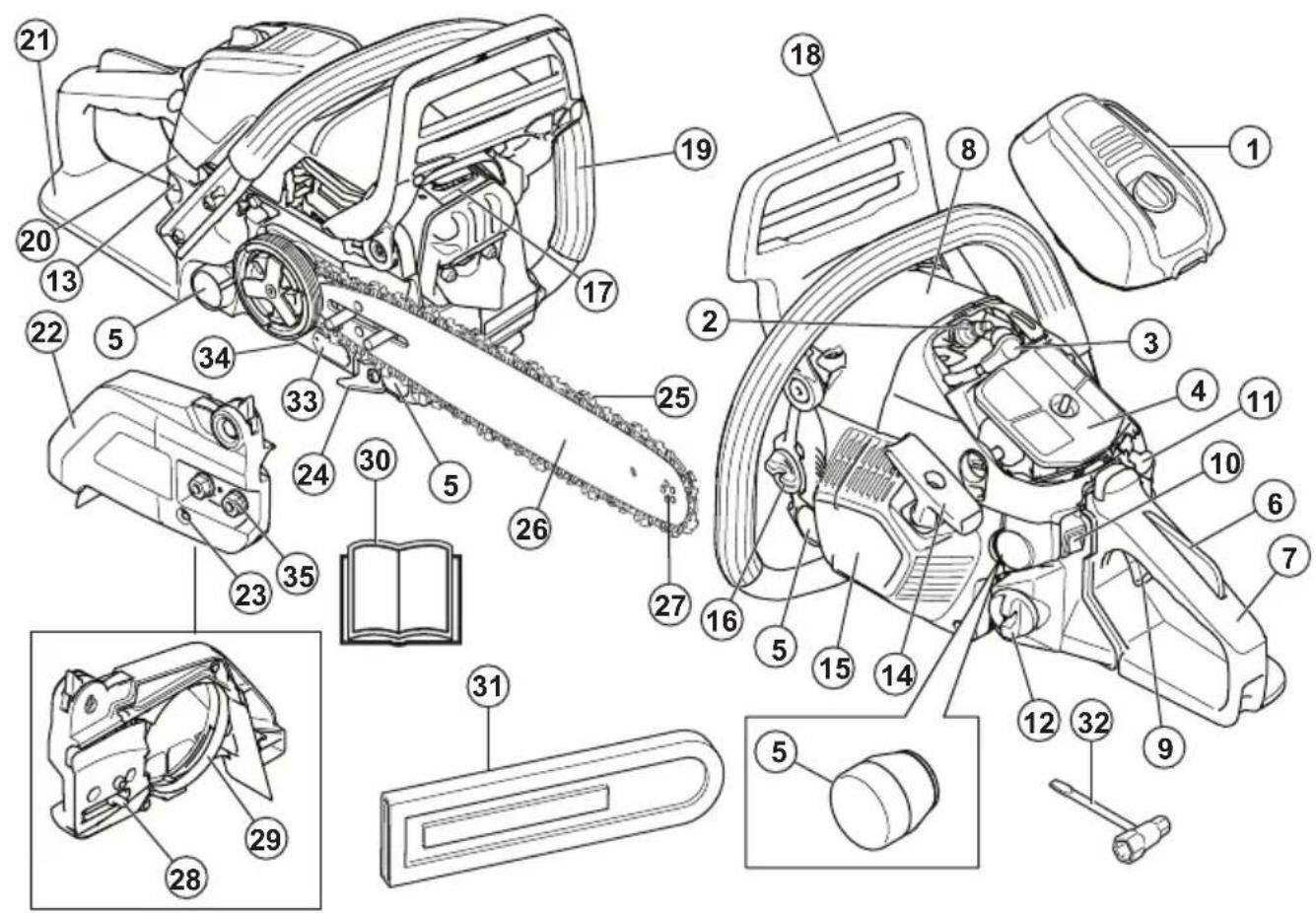
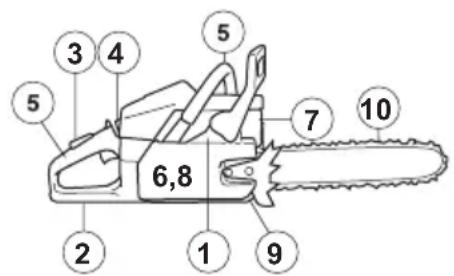
- Air filter cover
- Spark plug
- Spark plug cap
- Air filter
-
Vibration damping system, 4 units
-
Throttle trigger lockout
- Rear handle
- Information and warning decal
- Throttle trigger
-
Start/stop switch
-
Choke control
-
Fuel tank
-
Air purge bulb
-
Starter rope handle
-
Starter housing
-
Chain oil tank
-
Muffler
-
Chain brake and front hand guard
-
Front handle
-
Switch for heated handles (543 XPG)
-
Right hand guard
-
Clutch cover
-
Chain tensioning screw
-
Chain catcher
-
Saw chain
-
Guide bar
-
Bar tip sprocket
-
Chain adjuster pin
-
Brake band
-
Operator's manual
-
Transportation guard
-
Combination wrench
-
Product and serial number plate
-
Oil pump adjustment screw
-
Bar nuts
Symbols on the product

Careless or incorrect use of this product can result in serious or fatal injury to the operator or others.

Read the operator's manual carefully and make sure you understand the instructions before you use this product.

Always wear approved protective helmet, approved hearing protection and protective goggles or a visor.

This product is in accordance with applicable EC Directives.

This product conforms to the applicable UK regulations.

Noise emissions to the environment label as per EU and UK directives and regulations, and New South Wales legislation "Protection of the Environment Operations (Noise Control) Regulation 2017". The guaranteed sound power level
of the product is specified in Technical data on page 34.

Both of the operator's hands must be used to operate the chainsaw.
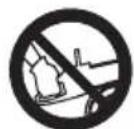
Never operate the chainsaw holding it with one hand only.

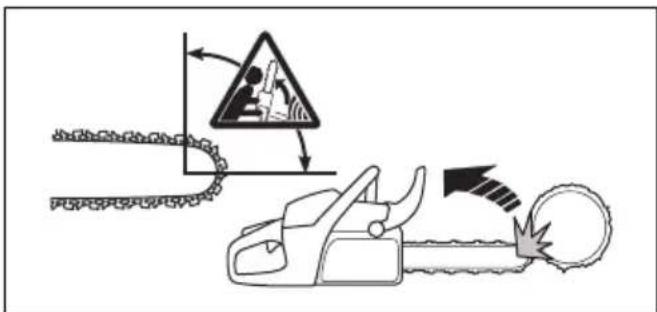
Never let the guide bar tip come in contact with any object.
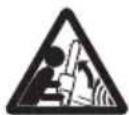
Warning! Kickback may occur when the nose or tip of the guide bar touches an object, and cause a lightning fast reverse reaction, kicking the guide bar up and towards the operator. May cause serious personal injury.
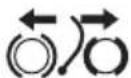
Chain brake, activated (right). Chain brake, not activated (left).

Choke lever in "open position".

Choke lever in "closed position".
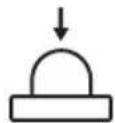
Air purge.

Refuelling.
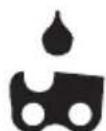
Chain oil fill.
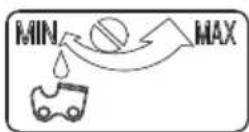
Adjustment of the oil pump.
Note: Other symbols/decals on the product refer to certification requirements for certain markets.
Safety
Safety definitions
Warnings, cautions and notes are used to point out specially important parts of the manual.

WARNING: Used if there is a risk of injury or death for the operator or bystanders if the instructions in the manual are not obeyed.

CAUTION: Used if there is a risk of damage to the product, other materials or the adjacent area if the instructions in the manual are not obeyed.
Note: Used to give more information that is necessary in a given situation.
General safety instructions

WARNING: Read the warning instructions that follow before you use the product.
- A chainsaw is a dangerous tool if used carelessly or incorrectly and can cause serious injury or death. It is very important that you read and understand the contents of this operator's manual.
- Under no circumstances may the design of the product be modified without the permission of the manufacturer. Do not use a product that appears to have been modified by others and only use accessories recommended for this product. Non-authorized modifications and/or accessories can result in serious personal injury or the death of the operator or others.
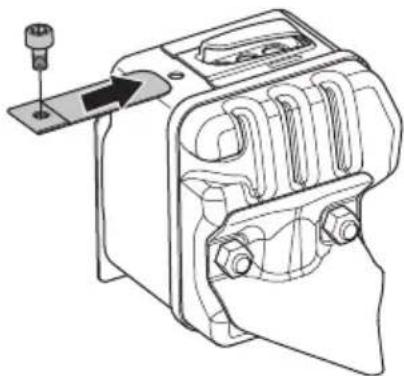
- A used muffler/spark arrester and spark arrester mounting face may contain deposits of combustion particles that may be carcinogenic. Avoid being exposed to these compounds when handling the muffler and/or spark arrester. Prior to any handling of the muffler and/or the spark arrester, refer to Muffler on page 7.
-
Long term inhalation of the engine's exhaust fumes, chain oil mist and sawdust can represent a health risk.
-
This product produces an electromagnetic field during operation. This field may under some circumstances interfere with active or passive medical implants. To reduce the risk of serious or fatal injury, we recommend persons with medical implants to consult their physician and the medical implant manufacturer before operating this product.
- The information in this operator's manual is never a substitute for professional skills and experience. If you get into a situation where you feel unsafe, stop and seek expert advice. Contact your servicing dealer or an experienced chainsaw user. Do not attempt any task that you feel unsure of!
Safety instructions for operation

WARNING: Read the warning instructions that follow before you use the product.
- Before using the product you must understand the effects of kickback and how to avoid them. Refer to Kickback information on page 12 for instructions.
- Never use a product that is faulty.
- Never use a product with visible damage to the spark plug cap and ignition cable. A risk of sparking arises, which can cause a fire.
- Never use the product if you are fatigued, while under the influence of alcohol or drugs, medication or anything that could affect your vision, alertness, coordination or judgement.
- Do not use the product in bad weather such as dense fog, heavy rain, strong wind, intense cold, etcetera. Working in bad weather is tiring and often brings added risks, such as icy ground, unpredictable felling direction, etcetera.
- Never start a product unless the guide bar, saw chain and all covers are fitted correctly. Refer to Assembly on page 9 for instructions. Without a bar
and saw chain attached to the product the clutch can come loose and cause serious injury.
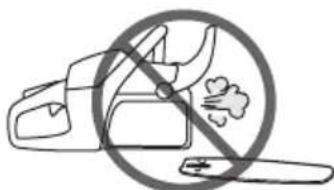
- Never start the product indoors. Exhaust fumes can be dangerous if inhaled.
- The exhaust fumes from the engine are hot and can contain sparks, which can start a fire. Never start the product near flammable material!
- Observe your surroundings and make sure that there is no risk of people or animals coming in contact with or affect your control of the product.
- Never allow children to use or be in the vicinity of the product. As the product is equipped with a spring-loaded start/stop switch and can be started by low speed and force on the starter handle, even small children under some circumstances can produce the force necessary to start the product. This can mean a risk of serious personal injury. Therefore remove the spark plug cap when the product is not under close supervision.
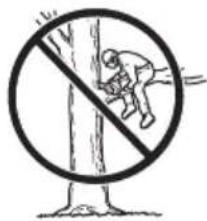
- You must have a steady stance in order to have full control of the product. Never work standing on a ladder, in a tree or where you do not have a firm ground to stand on.
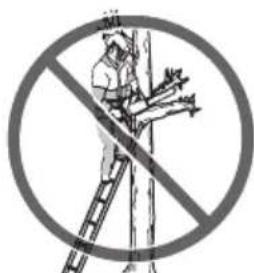
natural_image
Prohibition sign showing a worker on a ladder against a diagonal line, no text or symbols present- Lack of concentration can lead to kickback if the kickback zone of the bar accidentally touches a branch, nearby tree or some other object.
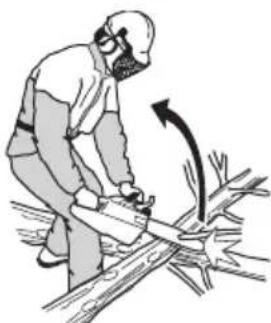
natural_image
Illustration of a worker in protective gear using a tool to cut wood or debris (no text or symbols visible)- Never use the product by holding it with one hand. This product is not safely controlled with one hand.
• Always hold the product with both hands. The right hand should be on the rear handle, and the left hand
on the front handle. All people, whether right or left handed, should use this grip. Use a firm grip with thumbs and fingers encircling the handles. This grip minimizes the risk of kickback and lets you keep the product under control. Do not let go of the handles!
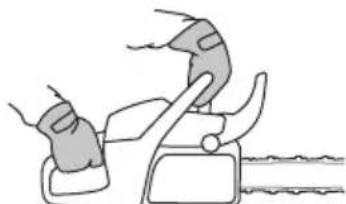
natural_image
Illustration of two hands operating a mechanical device with a curved handle (no text or symbols)- Never use the product above shoulder height.
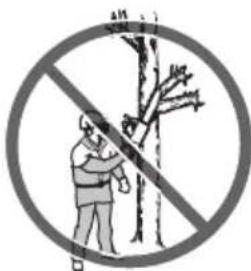
natural_image
Prohibition sign showing a person cutting tree branches (no text or symbols)- Do not use the product in a situation where you cannot call for help in case of an accident.
- Before moving your product, switch off the engine and lock the saw chain using the chain brake. Carry the product with the guide bar and saw chain pointing backwards. Fit a transportation guard to the guide bar before transporting the product or carrying it for any distance.
- When you put the product on the ground, lock the saw chain using the chain brake and ensure you have a constant view of the product. Switch the engine off before leaving your product for any length of time.
• Sometimes chips get stuck in the clutch cover causing the saw chain to jam. Always stop the engine before cleaning. - Running an engine in a confined or badly ventilated area can result in death due to carbon monoxide poisoning.
• The exhaust fumes from the engine are hot and may contain sparks which can start a fire. Do not start the product indoors or near flammable material. - Use the chain brake as a parking brake when you start the product and when you move short distances. Always carry the product in the front handle. This decreases the risk that you or a person near you get hit by the saw chain.
• Overexposure to vibration can lead to circulatory damage or nerve damage in people who have impaired circulation. Contact your doctor if you experience symptoms of overexposure to vibration. Such symptoms include numbness, loss of feeling, tingling, pricking, pain, loss of strength, changes in skin colour or condition. These symptoms normally
appear in the fingers, hands or wrists. These symptoms may be increased in cold temperatures.
- It is not possible to cover every conceivable situation you can face when using this product. Always exercise care and use your common sense. Avoid all situations which you consider to be beyond your capability. If you still feel uncertain about operating procedures after reading these instructions, you should consult an expert before continuing. Do not hesitate to contact your dealer or Husqvarna if you have any questions about the use of the product. We will willingly be of service and provide you with advice as well as help you to use your product both efficiently and safely. Attend a training course in chainsaw usage if possible. Your dealer, forestry school or your library can provide information about which training materials and courses are available.
Personal protective equipment

WARNING: Read the warning instructions that follow before you use the product.
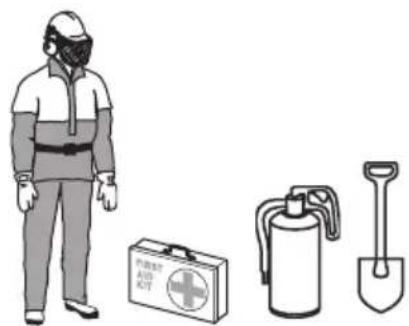
- Most chainsaw accidents occur when the saw chain touches the operator. You must use approved personal protective equipment during operation. Personal protective equipment does not give you full protection from injuries but it decreases the degree of injury if an accident occurs. Speak to your servicing dealer for recommendations about which equipment to use.
- Your clothing must be close-fitting but not limit your movements. Regularly do a check of the condition of the personal protective equipment.
- Use an approved protective helmet.
-
Use approved hearing protection. Long-term exposure to noise can result in permanent damage to the hearing.
-
Use protective glasses or a face visor to decrease the risk of injury from thrown objects. The product can throw objects, such as wood chips, small pieces of wood and more, at large force. This can result in serious injury, especially to the eyes.
- Use gloves with saw protection.
- Use pants with saw protection.
- Use boots with saw protection, steel toe-cap and non-slip sole.
• Always have a first-aid kit with you. - Risk of sparks. Keep fire extinguishing tools and a shovel near to prevent forest fires.
Safety devices on the product

WARNING: Read the warning instructions that follow before you use the product.
- Do not use a product with defective safety devices.
- Do a check of the safety devices regularly. Refer to Maintenance and checks of the safety devices on the product on page 23.
- If the safety devices are defective, speak to your Husqvarna servicing dealer.
Chain brake and front hand guard
Your product has a chain brake that stops the saw chain if you get a kickback. The chain brake decreases the risk of accidents, but only you can prevent them.
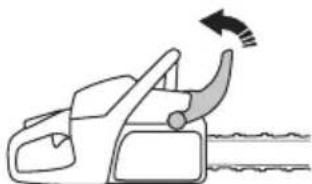
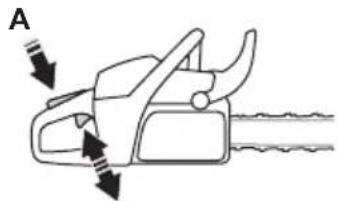
The chain brake engages (A) manually by your left hand or automatically by the inertia release mechanism. Push the front hand guard (B) forward to engage the chain brake manually.
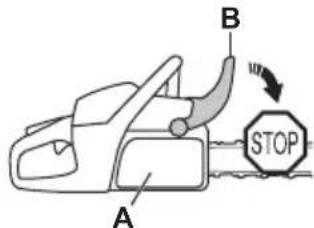
Pull the front hand guard rearward to disengage the chain brake.
natural_image
Line drawing of a manual car with motion arrow indicating airflow or motion direction (no text or symbols)Throttle trigger lockout
The throttle trigger lockout prevents accidental operation of the throttle trigger. If you put your hand around the handle and press the throttle trigger lockout (A),
it releases the throttle trigger (B). If you release the handle, the throttle trigger and the throttle trigger lockout move back to their initial positions. This function locks the throttle trigger at idle speed.
natural_image
Line drawing of a chain-linking device with arrows indicating motion direction (no text or symbols)B
Chain catcher
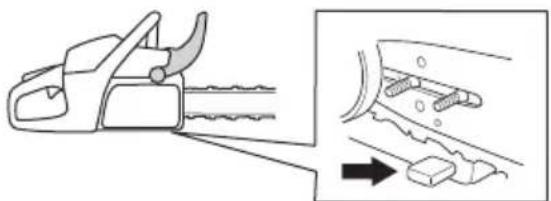
The chain catcher catches the saw chain if it breaks or comes loose. Correct saw chain tension and correctly applied maintenance on the saw chain and guide bar, decrease the risk of accidents.
natural_image
Diagram showing a chain saw cutting through a tool, with an inset view of the blade being inserted (no text or symbols present)Right hand guard
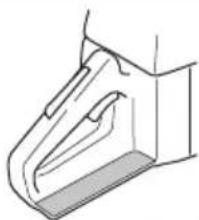
The right hand guard is a protection for your hand on the rear handle. The right hand guard gives you protection if the saw chain breaks or derails. The right hand guard also gives you protection from branches or twigs.
natural_image
Pure technical line drawing of a mechanical component without any text, numbers, or symbolsVibration damping system
The vibration damping system decreases vibration in the handles. Vibration damping units operate as a separation between the product body and the handle unit.
Refer to Product overview on page 2 for information about where the vibration damping system is on your product.
Start/stop switch
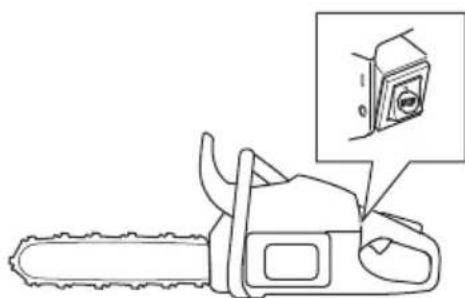
Use the start/stop switch to stop the engine.
natural_image
Line drawing of a chainsaw with an inset showing a close-up of the blade (no text or symbols)Muffler

WARNING: The muffler becomes very hot during/after operation and at idle speed. There is a risk of fire, especially when you operate the product near flammable materials and/or fumes.

WARNING: Do not operate a product without a muffler or with a defective muffler. A defective muffler can increase the noise level and the risk of fire. Keep fire extinguishing tools near. Do not use a product without, or with a broken, spark arrestor mesh if you must have a spark arrestor mesh in your area.
The muffler keeps the noise levels to a minimum and points the exhaust fumes away from the operator. In areas with a hot, dry weather there is a high risk of fire. Obey local regulations and maintenance instructions.
natural_image
Technical line drawing of an electrical component with no visible text or symbolsFuel safety

WARNING: Read the warning instructions that follow before you use the product.
• Make sure there is plenty of ventilation when refuelling or mixing fuel (petrol and two-stroke oil).
- Fuel and fuel vapour are highly flammable and can cause serious injury when inhaled or allowed to come in contact with the skin. For this reason observe caution when handling fuel and make sure there is adequate ventilation.
• Take care when handling fuel and chain oil. Be aware of the risks of fire, explosion and those associated with inhalation. - Do not smoke and do not place any hot objects in the vicinity of fuel.
• Always stop the engine and let it cool for a few minutes before refuelling. - When refuelling, open the fuel cap slowly so that any excess pressure is released gently.
- Tighten the fuel cap carefully after refuelling.
- Never refuel the machine while the engine is running.
• Always move the product at least 3 m (10 ft) away from the refuelling area and fuel source before starting.
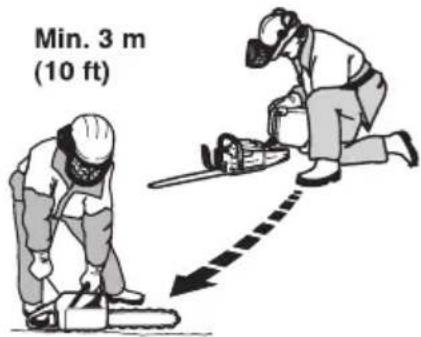
After refuelling, there are some situations where you must never start the product:
- If you have spilled fuel or chain oil on the product. Wipe off the spillage and allow remaining fuel to evaporate.
- If you have spilled fuel on yourself or on your clothes. Change your clothes and wash any part of your body that has come in contact with fuel. Use soap and water.
- If the product leaks fuel. Regularly do a check for leaks from the fuel tank, fuel cap and fuel lines.
Safety instructions for maintenance

WARNING: Read the warning instructions that follow before you do maintenance on the product.
- Do only the maintenance and servicing given in this operator's manual. Let professional servicing personnel do all other servicing and repairs.
- Regularly do the safety checks, maintenance and service instructions given in this manual. Regular maintenance increases the life of the product and decreases the risk of accidents. Refer to Maintenance on page 21 for instructions.
- If the safety checks in this operator's manual is not approved after you do maintenance, speak to your servicing dealer. We guarantee that there are professional repairs and servicing available for your product.
Safety instructions for the cutting equipment

WARNING: Read the warning instructions that follow before you use the product.
- Only use approved guide bar/saw chain combinations and filing equipment. Refer to Accessories on page 35 for instructions.
- Use protective gloves when you use or do maintenance on the saw chain. A saw chain that does not move can also cause injuries.
- Keep the cutting teeth correctly sharpened. Obey the instructions and use the recommended file gauge. A saw chain that is damaged or incorrectly sharpened increases the risk of accidents.
natural_image
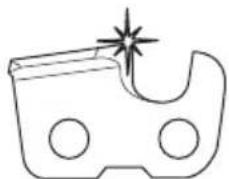
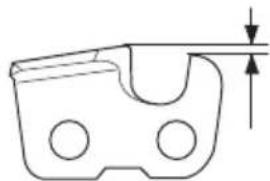
Simple line drawing of a VR headset with a starburst effect (no text or symbols)- Keep the correct depth gauge setting. Obey the instructions and use the recommended depth gauge setting. Too large depth gauge setting increases the risk of kickback.
natural_image
Pure technical line drawing of a mechanical part with no text or symbols• Make sure that the saw chain has the correct tension. If the saw chain is not tight against the guide bar, the saw chain can derail. An incorrect saw chain tension increases wear on the guide bar, saw chain and chain drive sprocket. Refer to To adjust the tension of the saw chain on page 30.
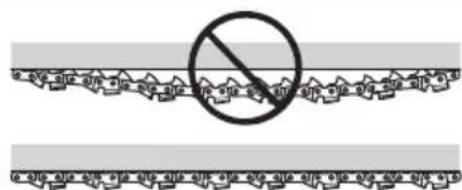
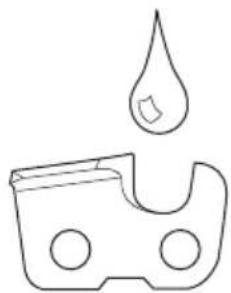
- Do maintenance on the cutting equipment regularly and keep it correctly lubricated. If the saw chain is
not correctly lubricated, the risk of wear on the guide bar, saw chain and chain drive sprocket increases.
natural_image
Simple line drawing of a droplet falling into a container with circular ports (no text or symbols)Assembly
Introduction

WARNING: Read and understand the safety chapter before you assemble the product.
To assemble the guide bar and saw chain
- Disengage the chain brake.
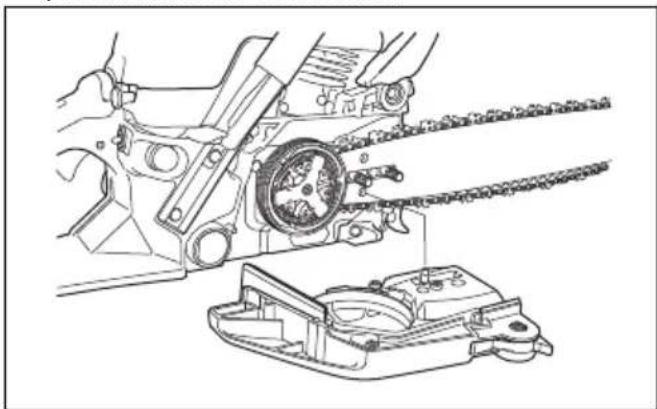
- Remove the bar nuts and the clutch cover. Remove the transportation guard (A).
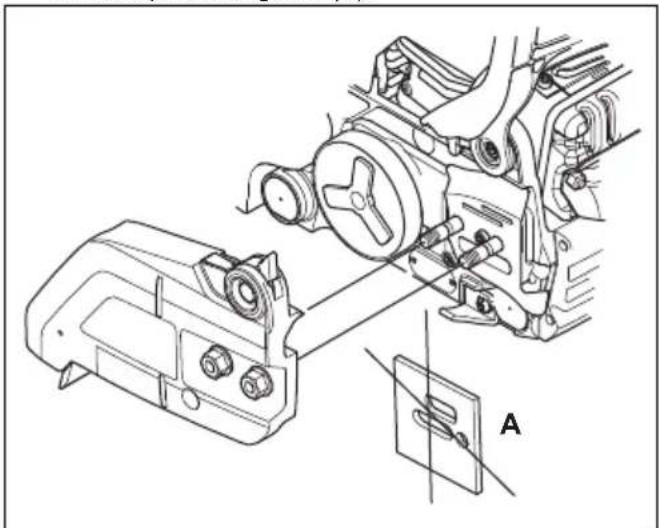
natural_image
Technical line drawing of a mechanical assembly with labeled component A (no text or symbols present)-
Assemble the guide bar onto the bar bolt. Move the guide bar to its most rear position.
-
Install the saw chain correctly around the drive sprocket and put it in the groove on the guide bar.
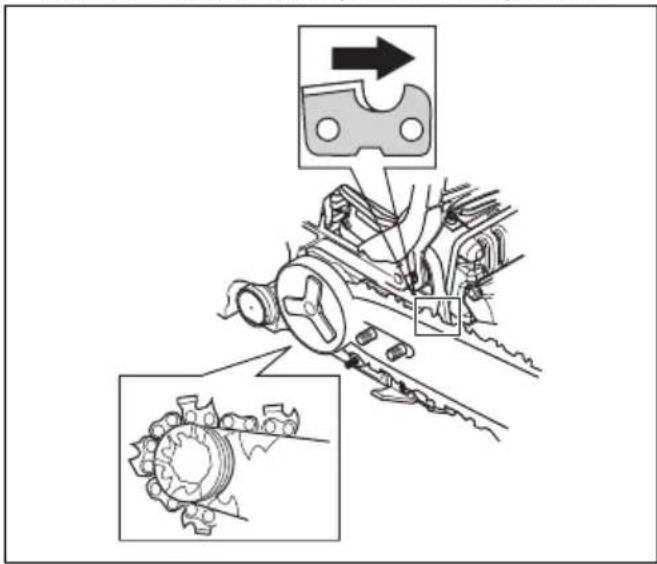

WARNING: Always use protective gloves when you assemble the saw chain.
- Make sure that the edges of the cutters point forward on the top edge of the guide bar.
- Align the hole in the guide bar with the chain adjuster pin and install the clutch cover.
natural_image
Technical line drawing of a mechanical assembly with gears and chains (no text or symbols)- Tighten the bar nut finger tight.
Operation
Introduction

WARNING: Read and understand the safety chapter before you use the product.
To do a function check before you use the product
- Make sure that the chain brake operates correctly and that it is not damaged.
- Make sure that the right hand guard is not damaged.
- Make sure that the throttle lockout operates correctly and that it is not damaged.
- Make sure that the start/stop switch operates correctly and that it is not damaged.
- Make sure that there is no oil on the handles.
- Make sure that the vibration damping system operates correctly and that it is not damaged.
- Make sure that the muffler is correctly attached and that it is not damaged.
- Make sure that all parts of the product are correctly attached and not damaged or missing.
- Make sure that the chain catcher is correctly attached.
- Do a check of the saw chain tension.
Fuel
This product has a two-stroke engine.

CAUTION: Incorrect type of fuel can result in engine damage. Use a mixture of gasoline and two-stroke oil.
Premixed fuel
- Use Husqvarna premixed alkylate fuel for best performance and extension of the engine life. This fuel contains less harmful chemicals compared to regular fuel, which decreases harmful exhaust fumes. The quantity of remains after combustion is
lower with this fuel, which keeps the components of the engine more clean.
To mix fuel
Gasoline
- Use good quality unleaded gasoline with a maximum of 10% ethanol contents.

CAUTION: Do not use gasoline with an octane grade less than 90 RON/87 AKI. Use of a lower octane grade can cause engine knocking, which causes engine damages.
Two-stroke oil
- For best results and performance use Husqvarna two-stroke oil.
- If Husqvarna two-stroke oil is not available, use a two-stroke oil of good quality for air-cooled engines. Speak to your servicing dealer to select the correct oil.

CAUTION: Do not use two-stroke oil for water-cooled outboard engines, also referred to as outboard oil. Do not use oil for four-stroke engines.
To mix gasoline and two-stroke oil
| Gasoline, liter Two-stroke oil, | liter |
| 2% (50:1) | |
| 5 0.10 | |
| 10 0.20 | |
| 15 0.30 | |
| 20 0.40 |

CAUTION: Small errors can influence the ratio of the mixture drastically when you mix small quantities of fuel. Measure the quantity of oil carefully and make sure that you get the correct mixture.
natural_image
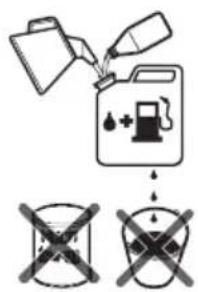
Illustration of a person in uniform holding an object, no text or symbols present- Fill half the quantity of gasoline in a clean container for fuel.
- Add the full quantity of oil.
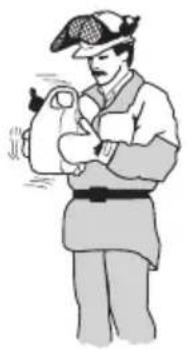
- Shake the fuel mixture.
- Add the remaining quantity of gasoline to the container.
- Carefully shake the fuel mixture.

CAUTION: Do not mix fuel for more than 1 month at a time.
To fill the fuel tank

WARNING: Obey the procedure that follows for your safety.
- Stop the engine and let the engine become cool.
- Clean the area around the fuel tank cap.

natural_image
Simple black icon of a fuel pump with a droplet and plus sign, no text or symbols present.- Shake the container and make sure that the fuel is fully mixed.
- Remove the fuel tank cap slowly to release the pressure.
- Fill the fuel tank.

CAUTION: Make sure that there is not too much fuel in the fuel tank. The fuel expands when it becomes hot.
- Tighten the fuel tank cap carefully.
- Clean fuel spillage on and around the product.
- Move the product 3 m/10 ft or more away from the refueling area and fuel source before you start the engine.
Note: To see where the fuel tank is on your product, refer to Product overview on page 2.
To do a run-in
- During the first 10 hours of operation, do not apply full throttle without load for extended periods.
To use the correct chain oil

WARNING: Do not use waste oil, which can cause injury to you and the environment. Waste oil also causes damage to the oil pump, the guide bar and the saw chain.

WARNING: The saw chain can break if the lubrication of the cutting equipment is not sufficient. Risk of serious injury or death to the operator.

WARNING: This product has a function that lets the fuel run out before the chain oil. Use the correct chain oil for this function to operate correctly. Speak to your servicing dealer when you select your chain oil.
- Use Husqvarna chain oil for maximum saw chain life and to prevent negative effects on the environment. If Husqvarna chain oil is not available, we recommend you to use a standard chain oil.
- Use a chain oil with good adherence to the saw chain.
- Use a chain oil with correct viscosity range that agrees with the air temperature.

CAUTION: If the oil is too thin, it runs out before the fuel. In temperatures below 0°C/32°F some chain oils become too thick, which can cause damage to the oil pump components.
- Use the recommended cutting equipment. Refer to Accessories on page 35.
- Remove the cap to the chain oil tank.
- Fill the chain oil tank with chain oil.
- Attach the cap carefully.
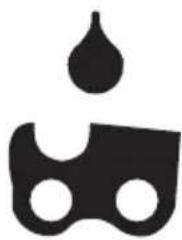
natural_image
Abstract black silhouette of a droplet above a stylized mask (no text or symbols)Note: To see where the chain oil tank is on your product, refer to Product overview on page 2.
Kickback information

WARNING: A kickback can cause serious injury or death to the operator or others. To decrease the risk you must know the causes of kickback and how to prevent them.
A kickback occurs when the kickback zone of the guide bar touches an object. A kickback can occur suddenly and with large force, which throws the product in the direction of the operator.
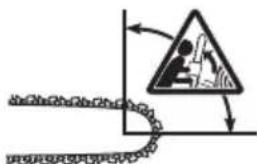
Kickback always occurs in the cutting plane of the guide bar. Usually, the product is thrown against the operator but can also move in a different direction. It is how you use the product when the kickback occurs that causes the direction of the movement.
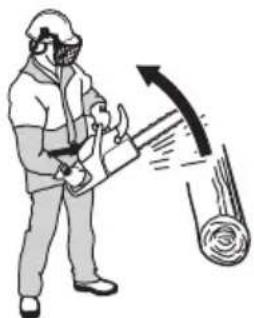
natural_image
Illustration of a person in protective gear using a tool to lift a cylindrical object with an arrow indicating upward motion (no text or symbols)A smaller bar tip radius decreases the force of the kickback.
Use a low kickback saw chain to decrease the effects of kickback. Do not let the kickback zone touch an object.

WARNING: No saw chain fully prevents kickback. Always obey the instructions.
Common questions about kickback
- Will the hand always engage the chain brake during a kickback?
No. It is necessary to use some force to push the front hand guard forward. If you do not use the force necessary, the chain brake will not be engaged. You must also hold the handles of the product stable with two hands during work. If a kickback occurs, it is possible that the chain brake does not stop the saw
chain before it touches you. There are also some positions in which your hand can not touch the front hand guard to engage the chain brake.
- Will the inertia release mechanism always engage the chain brake during kickback?
No. First, the chain brake must operate correctly. Refer to To do a check of the chain brake on page 23 for instructions about how to do a check of the chain brake. We recommend you to do this each time before you use the product. Second, the force of the kickback must be large to engage the chain brake. If the chain brake is too sensitive, it can engage during rough operation.
- Will the chain brake always protect me from injury during a kickback?
No. The chain brake must operate correctly to give protection. The chain brake must also be engaged during a kickback to stop the saw chain. If you are near the guide bar, it is possible that the chain brake does not have time to stop the saw chain before it hits you.

WARNING: Only you and the correct working technique can prevent kickbacks.
To start the product
To prepare to start with a cold engine

WARNING: The chain brake must be engaged when the product is started to decrease the risk of injury.
- Move the front hand guard forward to engage the chain brake.
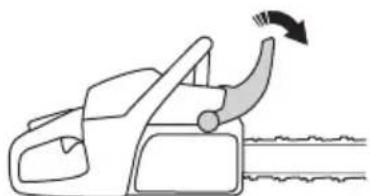
natural_image
Diagram of a manual car hood with motion arrow indicating rotation (no text or symbols)- Push the air purge bulb approximately 6 times or until fuel starts to fill the bulb. It is not necessary to fill the air purge bulb fully.
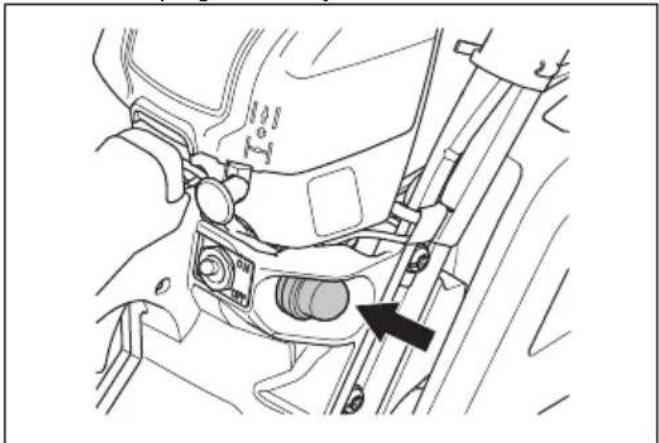
natural_image
Technical line drawing of a mechanical component with no visible text or symbols- Set the choke to choke position.
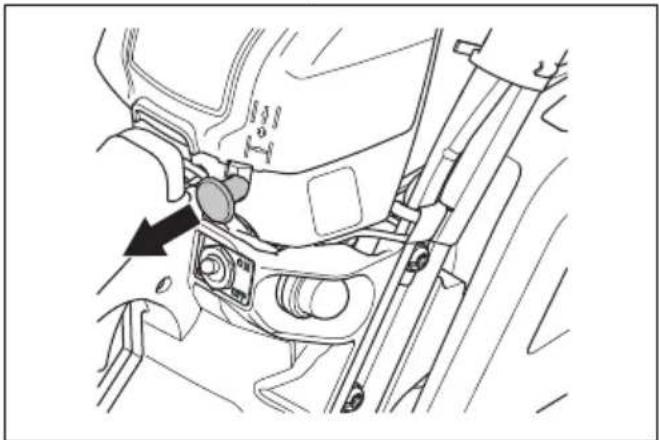
natural_image
Technical diagram of a mechanical assembly with no visible text or symbols- Continue to To start the product on page 13 for more instructions.
To prepare start with a warm engine

WARNING: The chain brake must be engaged when the product is started to decrease the risk of injury.
- Move the front hand guard forward to engage the chain brake.
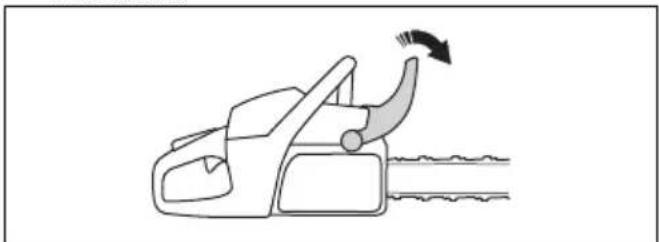
natural_image
Line drawing of a chain saw with motion arrow indicating clockwise motion (no text or symbols)- Push the air purge bulb approximately 6 times or until fuel starts to fill the bulb. It is not necessary to fill the air purge bulb fully.
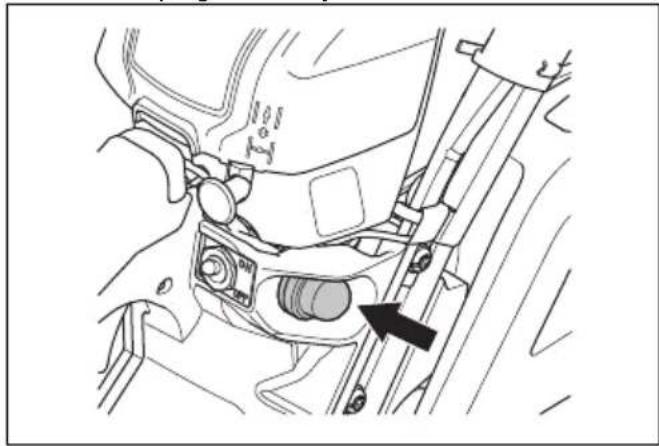
natural_image
Mechanical assembly diagram showing a valve mechanism with a black arrow pointing to a component (no text or labels present)Note: Do not set the choke to the choke position.
- Continue to To start the product on page 13 for more instructions.
To start the product

WARNING: You must keep your feet in a stable position when you start the product.

WARNING: If the saw chain rotates at idle speed, speak to your servicing dealer and do not use the product.
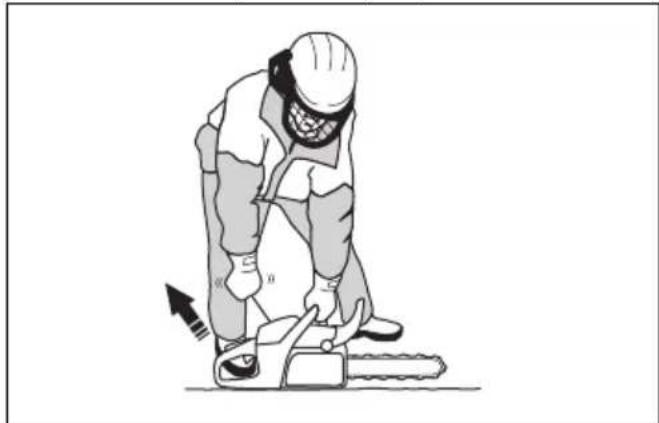
- Put the product on the ground.
- Put your left hand on the front handle.
- Put your right foot into the footgrip on the rear handle.
- Pull the starter rope handle slowly with your right hand until you feel resistance.

WARNING: Do not twist the starter rope around your hand.
- Pull the starter rope handle quickly and with force.
natural_image
Illustration of a worker using a chainsaw to cut a saw (no text or symbols present)
CAUTION: Do not pull the starter rope to full extension and do not let go of the starter rope handle. This can cause damage to the product.
a) If you start your product with a cold engine, pull the starter rope handle until the engine fires.
Note: You can identify when the engine fires through a "puff" sound.
b) Disengage the choke.
- Pull the starter rope handle until the engine starts.
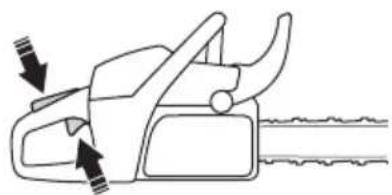
- Quickly disengage the throttle trigger lockout to set the product to idle speed.
natural_image
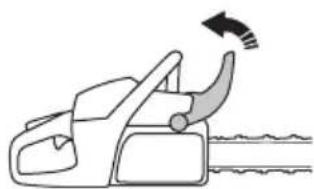
Line drawing of a chain-linking device with arrows indicating motion direction (no text or symbols)- Move the front hand guard rearward to disengage the chain brake.
natural_image
Simple line drawing of a mechanical device with a curved handle and arrow indicating motion (no text or symbols)- Use the product.
To stop the product
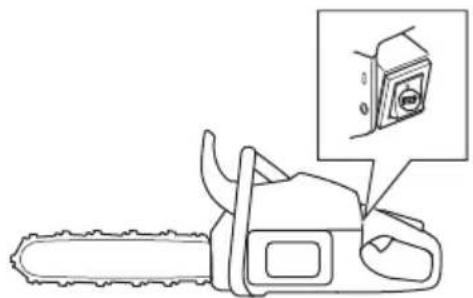
- Push the start/stop switch to position 0 to stop the engine.
natural_image
Line drawing of a chainsaw with an inset showing a close-up of the blade (no text or symbols)Pull stroke and push stroke
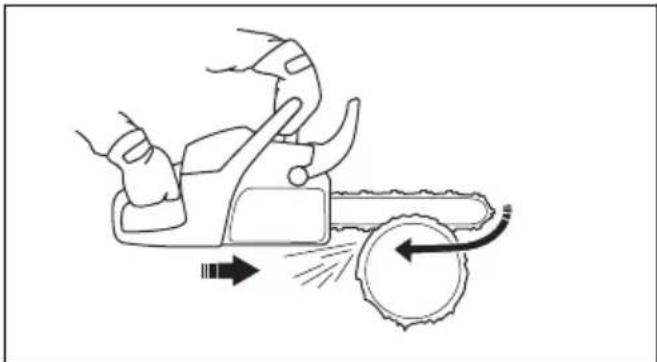
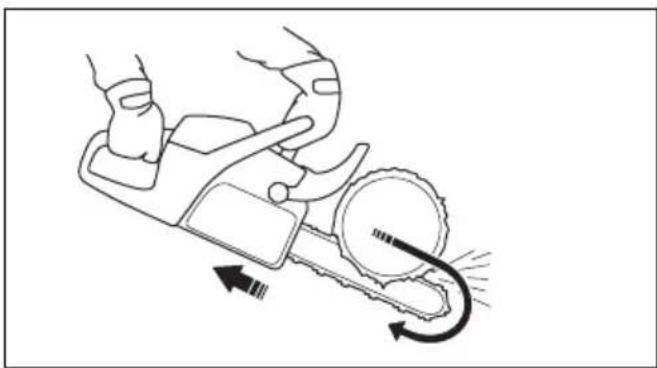
You can cut through wood with the product in 2 different positions.
• To cut on the pull stroke is when you cut with the bottom of the guide bar. The saw chain pulls through the tree when you cut. In this position you have
better control of the product and the position of the kickback zone.
natural_image
Line drawing of a hand using a chain mill to cut a circular saw (no text or symbols)• To cut on the push stroke is when you cut with the top of the guide bar. The saw chain pushes the product in the direction of the operator.
natural_image
Line drawing of a manual saw cutting process with motion arrows indicating clockwise motion (no text or symbols)
WARNING: If the saw chain is caught in the trunk, the product can be pushed at you. Hold the product tightly and make sure that the kickback zone of the guide bar does not touch the tree and causes a kickback.
To use the cutting technique

WARNING: Use full throttle when you cut and decrease to idle speed after each cut.

CAUTION: Engine damage can occur if the engine runs for too long at full throttle without load.
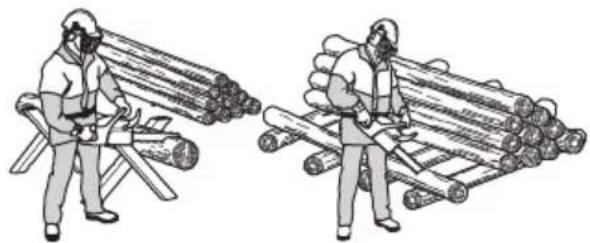
- Put the trunk on a saw horse or runners.
natural_image
Illustration of two workers handling stacked logs, one holding a log and the other standing with a ladder (no text or symbols)
WARNING: Do not cut trunks in a pile. That increases the risk of kickback and can result in serious injury or death.
- Remove the cut pieces from the cutting area.

WARNING: Cut pieces in the cutting area increase the risk of kickback and that you can not keep your balance.
To cut a trunk on the ground
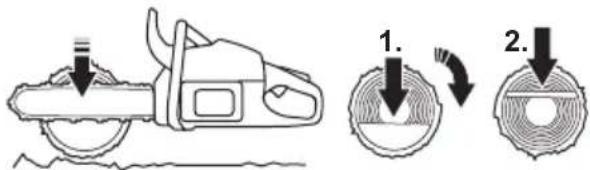
- Cut through the trunk on the pull stroke. Keep full throttle but be prepared for sudden accidents.
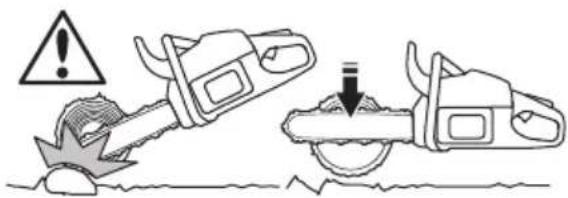

WARNING: Make sure that the saw chain does not touch the ground when you complete the kerf.
- Cut approximately 13 through the trunk and then stop. Turn the trunk and cut from the opposite side.
To cut a trunk that has support on one end

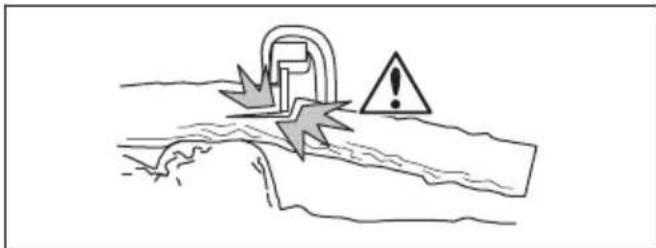
WARNING: Make sure that the trunk does not break during cutting. Obey the instructions below.
natural_image
Illustration of a landslide with a lightning bolt, a padlock, and an exclamation mark (no text or symbols)- Cut on the push stroke approximately 13 through the trunk.
- Cut through the trunk on the pull stroke until the two kerfs touch.
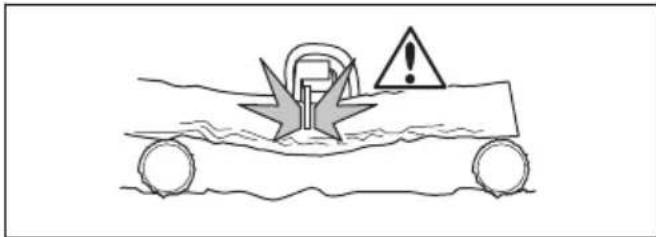
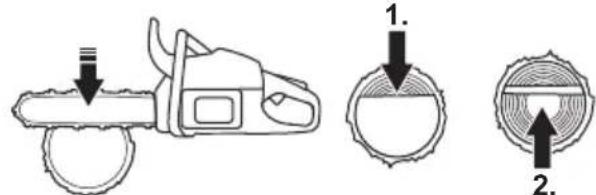
To cut a trunk that has support on two ends

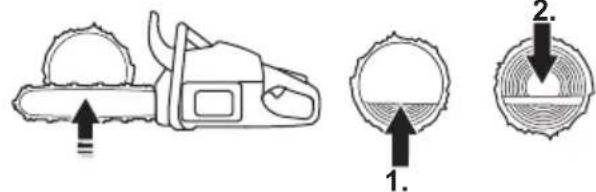
WARNING: Make sure that the saw chain does not get caught in the trunk during cutting. Obey the instructions below.
natural_image
Simple line drawing of a car with a warning sign and explosion effect (no text or symbols)- Cut on the pull stroke approximately 13 through the trunk.
- Cut through the remaining part of the trunk on the push stroke to complete the cut.

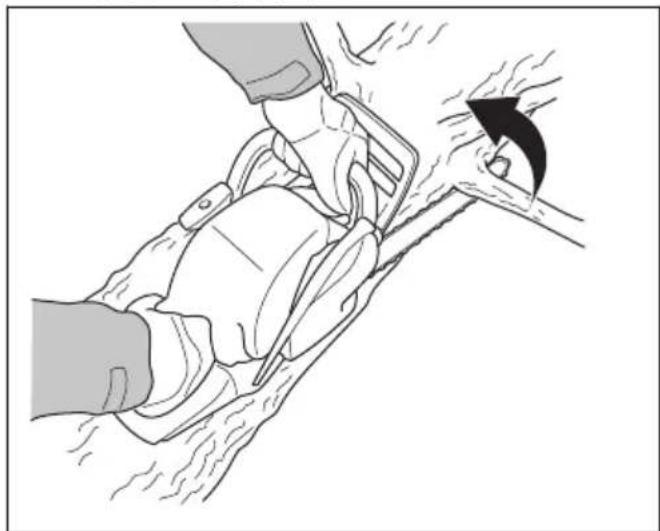
WARNING: Stop the engine if the saw chain gets caught in the trunk. Use a lever to open up the kerf and remove the product. Do not try to pull the product out by hand. This can result in injury when the product suddenly breaks free.
To use the limbing technique
Note: For thick branches, use the cutting technique. Refer to To use the cutting technique on page 14.

WARNING: There is a high accident risk when you use the limbing technique. Refer to Kickback information on page 12 for instructions how to prevent kickback.

WARNING: Cut limbs one by one. Be careful when you remove small limbs and do not cut bushes or many small limbs at the same time. Small limbs can get caught in the saw chain and prevent safe operation of the product.
Note: Cut the limbs piece by piece if it is necessary.
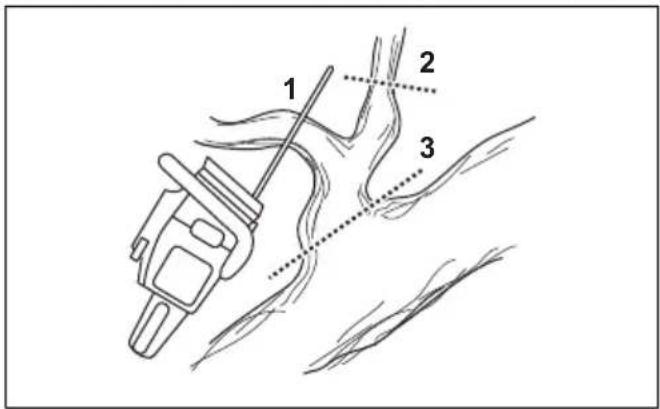
- Remove the limbs on the right side of the trunk.
a) Keep the guide bar on the right side of the trunk and keep the body of the product against the trunk.
b) Select the applicable cutting technique for the tension in the branch.
natural_image
Illustration of a hand using a cable to lift a car, showing the angle of motion (no text or symbols present)
WARNING: If you are not sure about how to cut the branch, speak to a professional chainsaw operator before you continue.
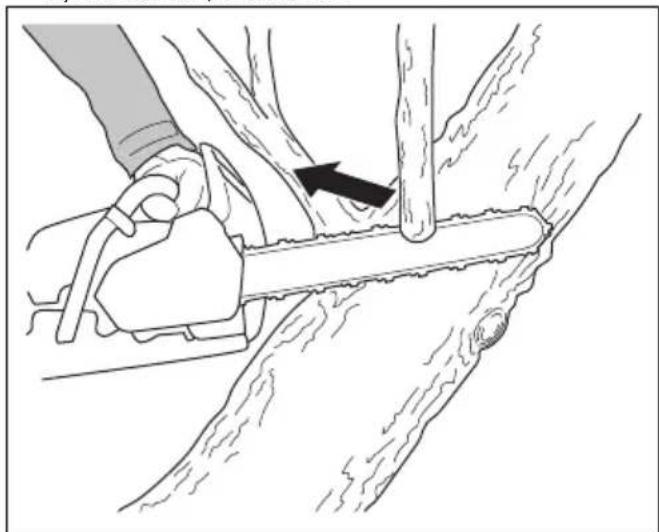
- Remove the limbs on the top of the trunk.
a) Keep the product on the trunk and let the guide bar move along the trunk.
b) Cut on the push stroke.
natural_image
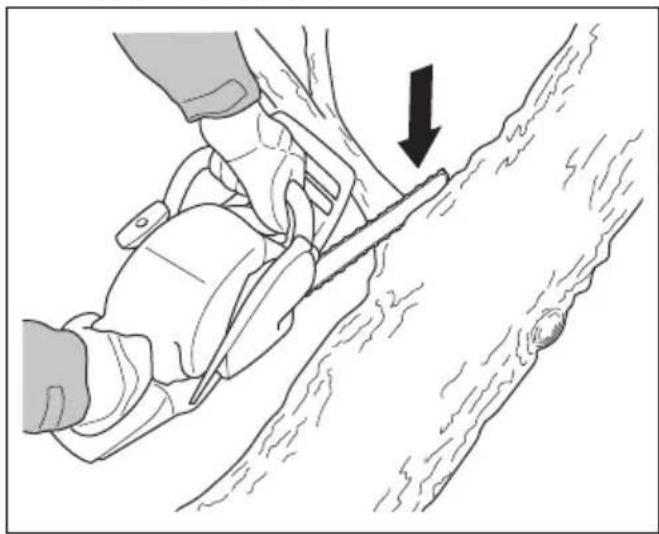
Illustration of a person using a power saw to cut tree bark, with a black arrow indicating the process (no text or symbols present)- Remove the limbs on the left side of the trunk.
a) Select the applicable cutting technique for the tension in the branch.
natural_image
Illustration of a person using a tool to cut tree bark with a downward arrow indicating the process (no text or symbols present)
WARNING: If you are not sure about how to cut the branch, speak to a professional chainsaw operator before you continue.
Refer to To cut trees and branches that are in tension on page 20 for instructions on how to cut branches that are in tension.
To use the tree felling technique

WARNING: You must have experience to fell a tree. If possible, engage in a training course in chainsaw operation. Speak to an operator with experience for more knowledge.
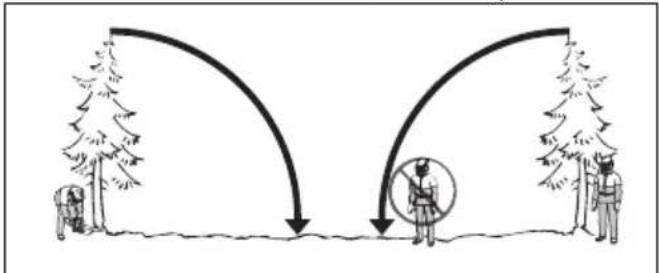
To keep a safe distance
- Make sure that persons around you keep a safe distance at a minimum of 2 1/2 tree lengths.
flowchart
graph TD
    A["Tree"] --> B["Human Figure"]
    B --> C["Tree with Circle"]
    C --> D["Human Figure"]
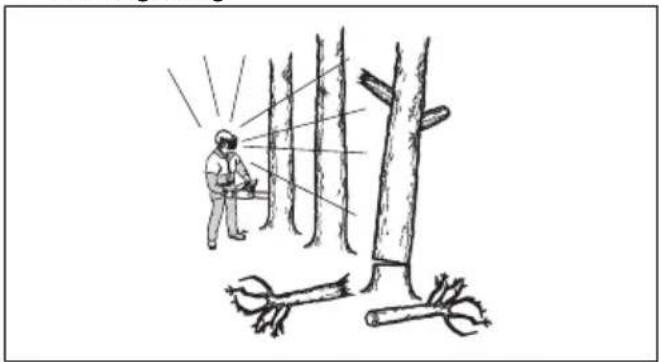
- Make sure that no person is in the risk zone before or during felling.
natural_image
Illustration of a person spraying tree roots with a light source, no text or symbols presentTo calculate the felling direction
- Examine in which direction it is necessary for the tree to fall. The goal is to fell it in a position where you can limb and cut the trunk easily. It is also important that you are stable on your feet and can move about safely.

WARNING: If it is dangerous or not possible to fell the tree in its natural direction, fell the tree in a different direction.
-
Examine the natural fall direction of the tree. For example the tilt and bend of the tree, wind direction, the location of the branches and weight of snow.
-
Examine if there are obstacles, for example other trees, power lines, roads and/or buildings around.
-
Look for signs of damage and rot in the stem.

WARNING: Rot in the stem can mean a risk that the tree falls before you complete the cutting.
-
Make sure the tree has no damaged or dead branches that can break off and hit you during felling.
-
Do not let the tree fall onto a different standing tree. It is dangerous to remove a caught tree and there is a high accident risk. Refer to To free a trapped tree on page 19.
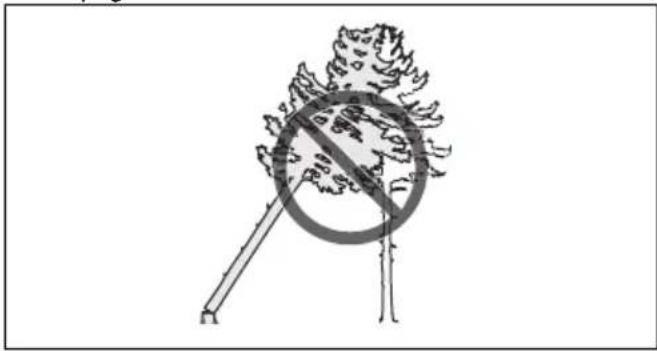
natural_image
Illustration of a magnifying glass over a tree with a diagonal line, no text or symbols present
WARNING: During critical felling operations, lift your hearing protection immediately when the sawing is complete. It is important that you hear sounds and warning signals.
To clear the trunk and prepare your path of retreat
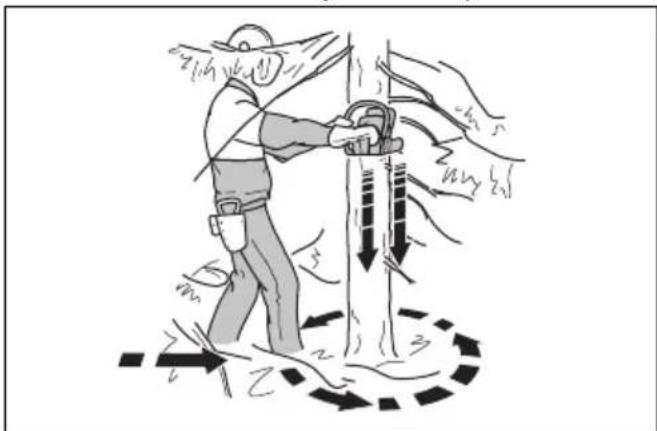
Cut off all branches from your shoulder height and down.
- Cut on the pull stroke from the top down. Make sure that the tree is between you and the product.
natural_image
Illustration of a person using a hammer to lift a vertical pole, with hands adjusting the pole and arrows indicating motion (no text or symbols)-
Remove undergrowth from the work area around the tree. Remove all cut off material from the work area.
-
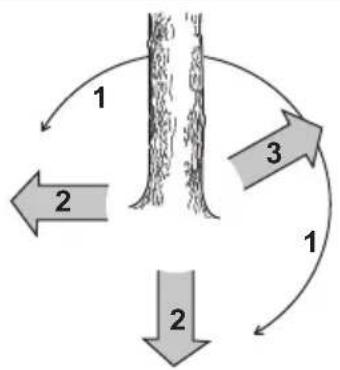
Do a check of the area for obstacles such as stones, branches and holes. You must have a clear path of retreat when the tree starts to fall. Your path of retreat must be approximately 135 degrees away from the felling direction.
-
The danger zone
-
The path of retreat
-
The felling direction
flowchart
graph TD
    A["Start"] --> B["Timber"]
    B --> C["Branch 1"]
    C --> D["Branch 2"]
    D --> E["Branch 3"]
    E --> F["End"]
To fell a tree
Husqvarna recommends you to make the directional cuts and then use the safe corner method when you fell a tree. The safe corner method helps you to make a correct felling hinge and control the felling direction.

WARNING: Do not fell trees with a diameter that is more than two times larger than the guide bar length. For this, you must have special training.
The felling hinge
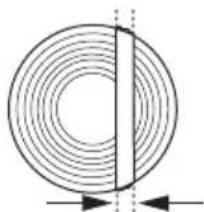
The most important procedure during tree felling is to make the correct felling hinge. With a correct felling hinge, you control the felling direction and make sure that the felling procedure is safe.
The thickness of the felling hinge must be equal and a minimum of 10% of the tree diameter.

WARNING: If the felling hinge is incorrect or too thin, you have no control of the felling direction.
natural_image
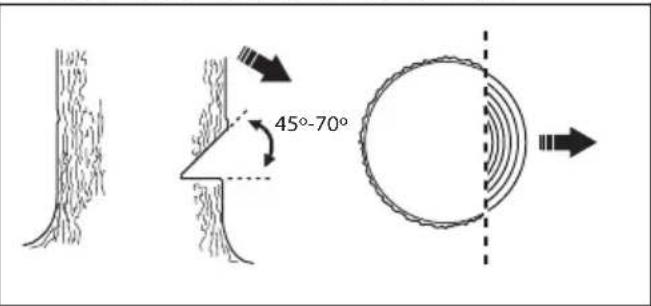
Diagram of concentric circular layers with a vertical bar and directional arrows, no text or symbols present.To make the directional cuts
- Make the directional cuts 14 of the diameter of the tree. Make a 45irc-70irc angle between the top directional cut and bottom directional cut.
a) Make the top directional cut. Align the felling direction mark (1) of the product with the felling direction of the tree (2). Stay behind the product and keep the tree on your left side. Cut with a pull stroke.
b) Make the bottom directional cut. Make sure that the end of the bottom directional cut is at the same point as the end of the top directional cut.
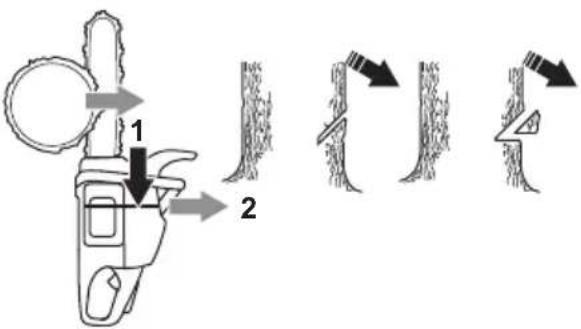
- Make sure that the bottom directional cut is horizontal and at a 90irc angle to the felling direction.
To use the safe corner method
The felling cut must be made slightly above the directional cut.
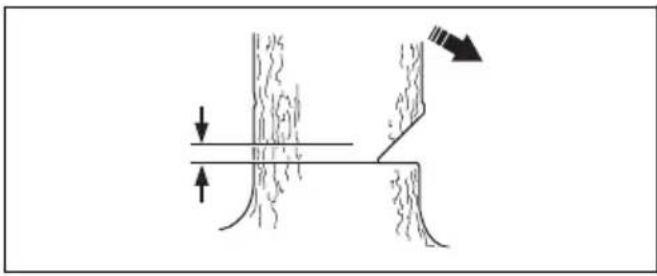
natural_image
Diagram showing a tree trunk with a horizontal line and a broken branch, indicating tree damage or erosion (no text or symbols present)
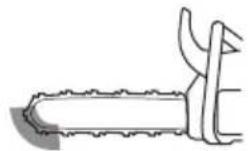
WARNING: Be careful when you cut with the guide bar tip. Start to cut with the lower section of the guide bar tip as you make a bore cut into the trunk.
- If the usable cutting length is longer than the tree diameter, do these steps (a-d).
a) Make a bore cut straight into the trunk to complete the felling hinge width.
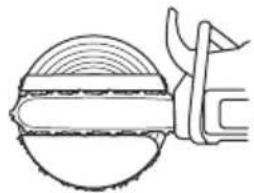
natural_image
Simple line drawing of a mechanical component or tool with no visible text or symbolsb) Cut on the pull stroke until 13 of the trunk is left.
c) Pull the guide bar 5-10 cm/2-4 in rearward.
d) Cut through the remaining of the trunk to complete a safe corner that is 5-10 cm/2-4 in wide.
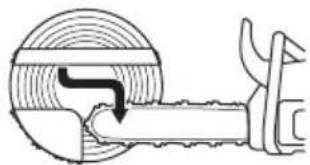
natural_image
Diagram of a mechanical component with a curved arrow indicating direction (no text or symbols)- If the usable cutting length is shorter than the tree diameter, do these steps (a-d).
a) Make a bore cut straight into the trunk. The bore cut must extend 3/5 of the tree diameter.
b) Cut on the pull stroke through the remaining trunk.
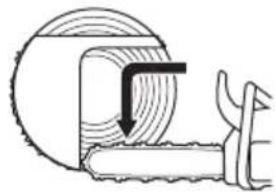
natural_image
Cross-sectional diagram of a mechanical component with layered structure and no visible text or symbolsc) Cut straight into the trunk from the other side of the tree to complete the felling hinge.
d) Cut on the push stroke, until 13 of the trunk is left, to complete the safe corner.
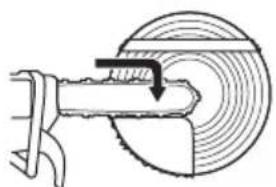
natural_image
Mechanical diagram showing a rotating shaft and wheel assembly with a hatched section indicating motion (no text or symbols)- Put a wedge in the kerf straight from behind.
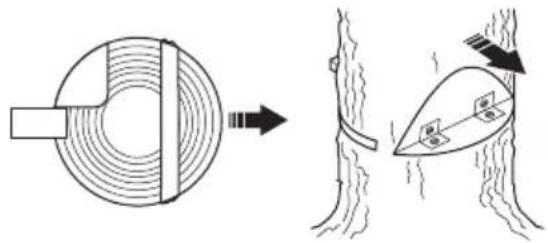
natural_image
Diagram showing a circular structure being lateralized into a tree with a curved attachment (no text or symbols)- Cut off the corner to make the tree fall.
Note: If the tree does not fall, hit the wedge until it does.
- When the tree starts to fall, use the path of retreat to move away from the tree. Move a minimum of 5 m/15 ft away from the tree.
To free a trapped tree

WARNING: It is very dangerous to remove a trapped tree and there is a high accident risk. Keep out of the risk zone and do not try to fell a trapped tree.
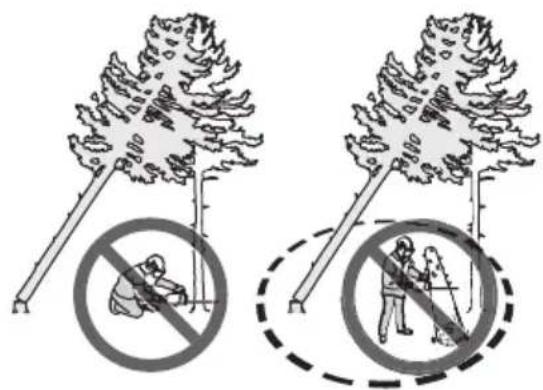
The safest procedure is to use one of the following winches:
- Tractor-mounted
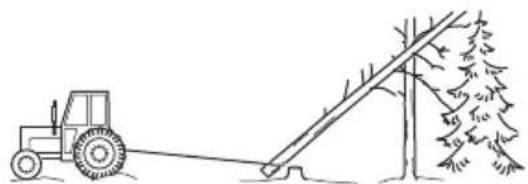
natural_image
Line drawing of a tractor pulling a tree with a lever (no text or symbols)- Portable
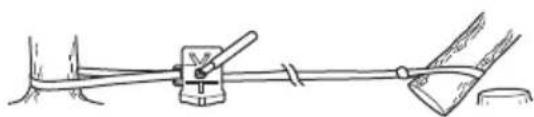
natural_image
Simple line drawing of a mechanical clamp or lever mechanism (no text or symbols)To cut trees and branches that are in tension
- Figure out which side of the tree or branch that is in tension.
- Figure out where the point of maximum tension is.
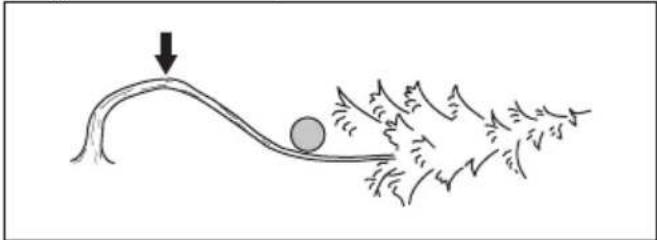
natural_image
Simple line drawing of a curved path with a ball and directional arrow, no text or symbols present- Examine which is the safest procedure to release the tension.
Note: In some situations the only safe procedure is to use a winch and not your product.
- Keep a position where the tree or branch can not hit you when the tension is released.
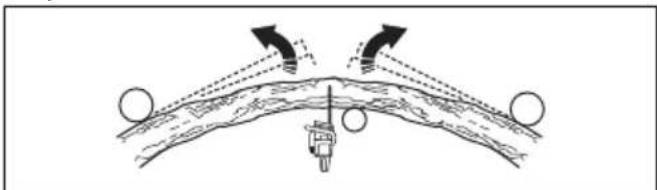
natural_image
Diagram of a mechanical or fluid system with two curved surfaces, directional arrows indicating flow or movement, and circular objects at the base (no text or symbols present)- Make one or more cuts of sufficient depth necessary to decrease the tension. Cut at or near the point of maximum tension. Make the tree or branch break at the point of maximum tension.
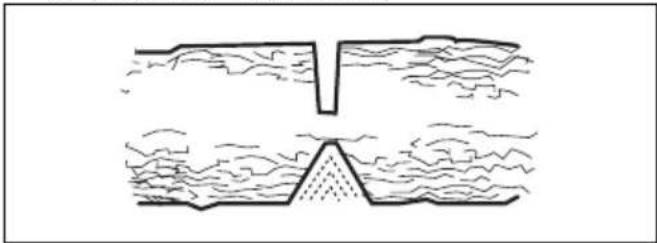
natural_image
Cross-sectional diagram of a geological or structural cross-section showing layered rock formations and terrain (no text or labels)
WARNING: Do not cut straight through a tree or branch that is in tension.

WARNING: Be very careful when you cut a tree that is in tension. There is a risk that the tree moves quickly before or after you cut it. Serious injury can occur if you are in an incorrect position or if you cut incorrectly.
- If you must cut across tree/branch, make 2 to 3 cuts, 1 in. apart and with a depth of 2 in.
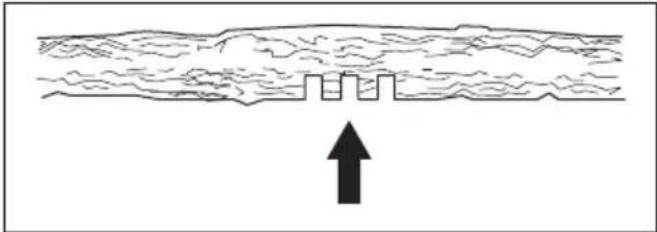
natural_image
Diagram showing a cross-section of layered geological strata with an upward arrow indicating a specific feature (no text or labels present)- Continue to cut more into the tree until the tree/ branch bends and the tension is released.
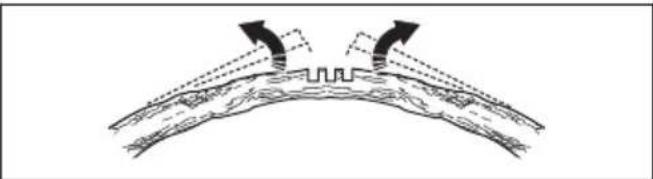
natural_image
Diagram of a curved structure with directional arrows indicating flow or movement (no text or symbols)- Cut the tree/branch from the opposite side of the bend, after the tension is released.
To use the product in cold weather

CAUTION: Snow and cold weather can cause operation problems. Risk of too low engine temperature or ice on the air filter and the carburetor.
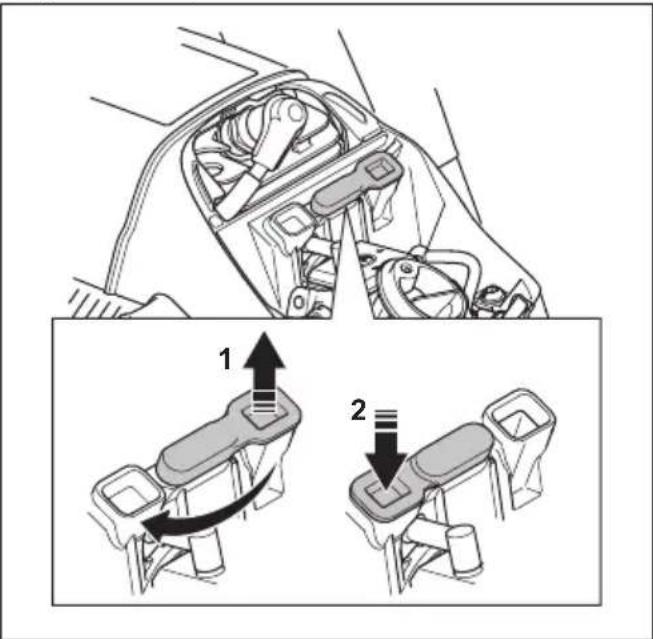
- In temperatures below 0irc C/ 32irc F, move the plug from position 1 to position 2.
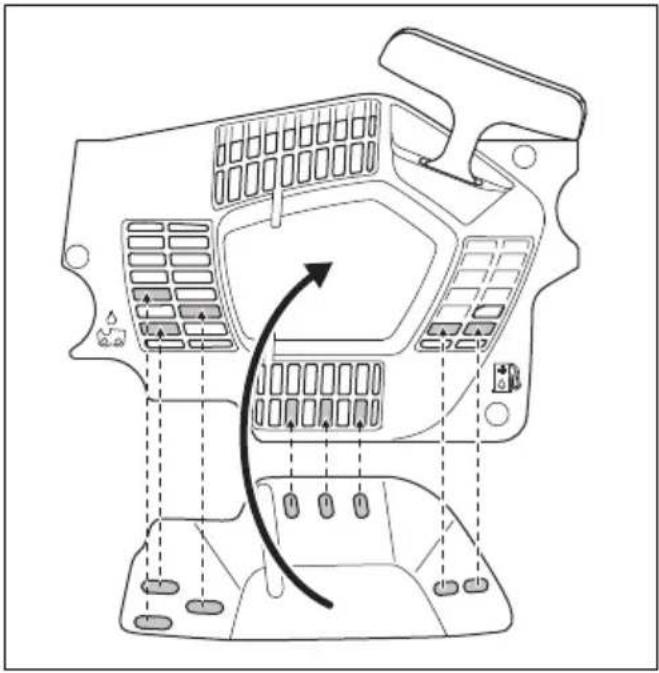
- For temperatures below -5ircC/23ircF or in conditions with snow, a winter cover is available. Assemble the winter cover on the starter housing. The winter cover decreases the flow of cool air and keeps snow away from the carburetor space.
natural_image
Technical line drawing of a vehicle's internal control panel with no visible text or symbols
CAUTION: Remove the winter cover if the temperature increases above -5ircC / 23ircF .
Put the winter plug in in position 1 if the temperature increases above 0irc C/32°F. Risk of too high engine temperature and damage to the engine.
Heated handles (543 XPG)
On models with the designation "G", the front and rear handles have electrical heating coils. A generator supplies power to the heating coils.
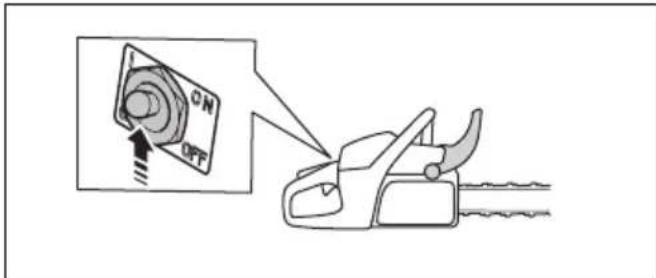
Push the switch to engage the heat in the handles. The heat is on when you can see the red mark on the switch.
Electrical carburetor heating (543 XPG)
Adjustment of the carburetor heating is done electrically through a thermostat. This keeps the correct carburetor temperature and prevents ice in the carburetor.
Maintenance
Introduction

WARNING: Read and understand the safety chapter before you do maintenance on the product.
Maintenance schedule
| Daily maintenance Weekly maintenance | Monthly maintenance | |
| Clean the external parts of the product and make sure that there is no oil on the handles. | Clean the cooling system. Refer to To clean the cooling system on page 32. | Do a check of the brake band. Refer to To do a check of the brake band on page 23. |
| Do a check of the throttle trigger and throttle trigger lockout. Refer to To do a check of the throttle trigger and throttle trigger lockout on page 23. | Do a check of the starter, starter rope and return spring. | Do a check of the clutch centre, clutch drum and clutch spring. |
| Make sure that there is no damage on the vibration damping units. | Lubricate the needle bearing. Refer to To lubricate the needle bearing on page 30. | Clean the spark plug. Refer to To do a check of the spark plug on page 27. |
| Clean and do a check of the chain brake. Refer to To do a check of the chain brake on page 23. | Remove burrs from the edges of the guide bar. Refer to To do a check of the front hand guard and the chain brake activation on page 23. | Clean the external parts of the carburetor. |
| Do a check of the chain catcher. Refer to To do a check of the guide bar on page 31. | Clean or replace the spark arrester screen on the muffler. Refer to To do a check of the chain catcher on page 24. | Do a check of the fuel filter and the fuel hose. Replace if necessary. |
| Turn the guide bar, do a check of the lubrication hole and clean the groove in the guide bar. Refer to To do a check of the guide bar on page 31. | Clean the carburetor area. Do a check | of all cables and connections. |
| Make sure that the guide bar and saw chain are getting sufficient oil. | Clean or replace the air filter. Refer to To clean the air filter on page 27. | Empty the fuel tank. |
| Do a check of the saw chain. Refer to To examine the cutting equipment on page 31. | Clean between the cylinder fins. Empty | the oil tank. |
| Sharpen the saw chain and do a check of its tension. Refer to To sharpen the saw chain on page 27. | ||
| Do a check of the chain drive sprocket. Refer to To do a check of the rim sprocket on page 30. | ||
| Clean the air intake on the starter. | ||
| Make sure that nuts and screws are tightened. | ||
| Do a check of the stop switch. Refer to To do a check of the start/stop switch on page 24. | ||
| Make sure that these are no fuel leaks from the engine, tank or fuel lines. | ||
| Make sure that the saw chain does not rotate when the engine is at idle speed. | ||
| Make sure that there is no damage on the right hand guard. | ||
| Make sure that the muffler is correctly attached, has no damages and that no parts of the muffler are missing. |
Maintenance and checks of the safety devices on the product
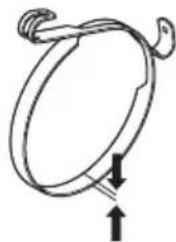
To do a check of the brake band
- Use a brush to remove wood dust, resin and dirt from the chain brake and clutch drum. Dirt and wear can decrease the function of the brake.
natural_image
Simple line drawing of a rope or rope loop with an arrow indicating direction (no text or symbols)- Do a check of the brake band. The brake band must be at a minimum of 0.6 mm/0.024 in thick at its thinnest point.
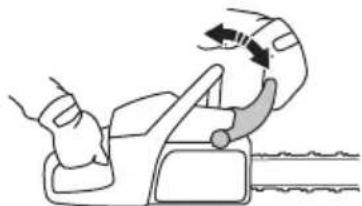
To do a check of the front hand guard and the chain brake activation
-
Make sure that the front hand guard is not damaged and that there are no defects, such as cracks.
-
Make sure that the front hand guard moves freely and that it is attached safely to the clutch cover.
natural_image
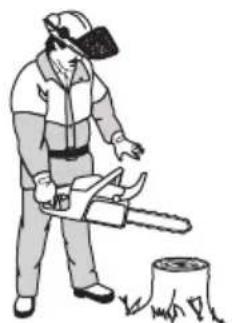
Illustration of a person using a car seatbelt device (no text or symbols visible)- Hold the product with 2 hands above a stump or other stable surface.

WARNING: The engine must be off.
- Let go of the front handle and let the guide bar tip fall against the stump.
natural_image
Illustration of a person using a power saw to cut tree bark (no text or symbols)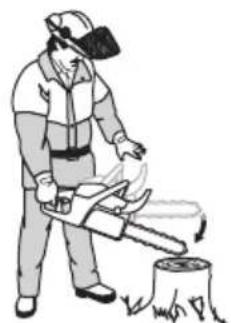
natural_image
Illustration of a person using a manual saw to cut tree bark (no text or symbols)- Make sure that the chain brake engages as the guide bar tip hits the stump.
To do a check of the chain brake
- Start the product. Refer to To start the product on page 12 for instructions.

WARNING: Make sure that the saw chain does not touch the ground or other objects.
-
Hold the product tightly.
-
Apply full throttle and tilt your left wrist against the front hand guard to engage the chain brake. The saw chain must stop immediately.
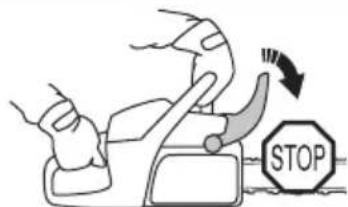

WARNING: Do not let go of the front handle.
To do a check of the throttle trigger and throttle trigger lockout
- Make sure that the throttle trigger and throttle trigger lockout move freely and that the return spring works correctly.
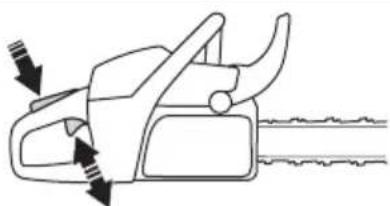
natural_image
Line drawing of a chain-linking device with arrows indicating motion direction (no text or symbols)- Press down the throttle trigger lockout and make sure that it goes back to its initial position when you release it.
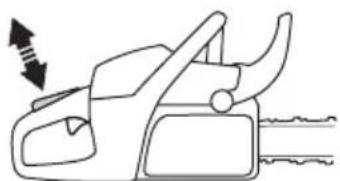
natural_image
Line drawing of a mechanical clamp or clip with an arrow indicating direction (no text or symbols)- Make sure that the throttle trigger is locked at the idle position when the throttle trigger lockout is released.
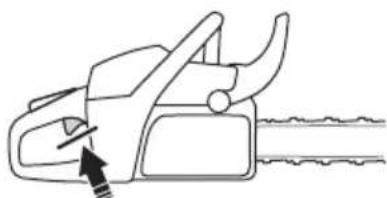
natural_image
Line drawing of a chain saw mechanism with an arrow indicating motion direction (no text or symbols)- Start the product and apply full throttle.
- Release the throttle trigger and make sure that the saw chain stops and stays stationary.

WARNING: If the saw chain rotates when the throttle trigger is in the idle position, speak to your servicing dealer.
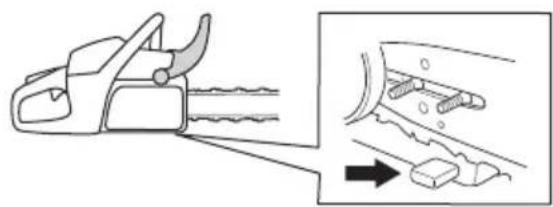
To do a check of the chain catcher
- Make sure that there is no damage on the chain catcher.
- Make sure that the chain catcher is stable and attached to the body of the product.
natural_image
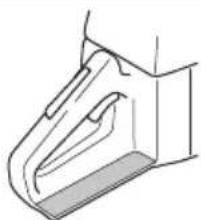
Diagram showing a manual chain attachment tool interacting with a car's side panel, with an arrow indicating the process (no text or symbols present)To do a check of the right hand guard
• Make sure that the right hand guard is not damaged and that there are no defects, such as cracks.
natural_image
Pure technical line drawing of a mechanical component (no text or symbols)To do a check of the vibration damping system
- Make sure that there are no cracks or deformation on the vibration damping units.
- Make sure that the vibration damping units are correctly attached to the engine unit and handle unit.
Refer to Product overview on page 2 for information about where the vibration damping system is on your product.
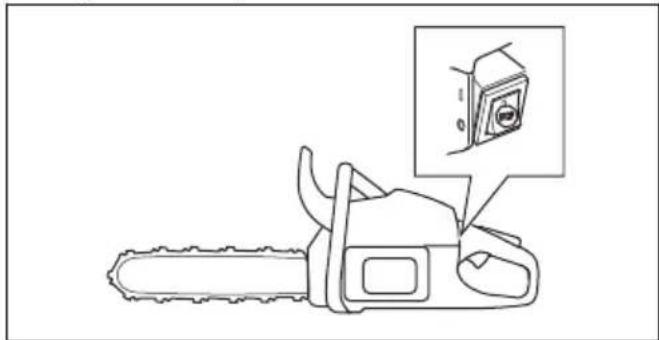
To do a check of the start/stop switch
-
Start the engine.
-
Push the start/stop switch to the STOP position. The engine must stop.
natural_image
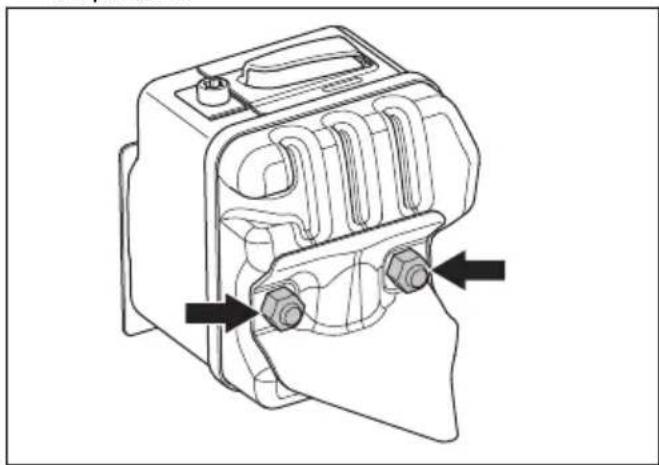
Line drawing of a chainsaw with an inset showing a close-up of the blade (no text or symbols)To do a check of the muffler

WARNING: Do not use a product that has a defective muffler or a muffler that is in bad condition.

WARNING: Do not use a product if the spark arrestor mesh on the muffler is missing or defective.
- Examine the muffler for damages and defects.
- Make sure that the muffler is correctly attached to the product.
natural_image
Technical line drawing of a mechanical component with two directional arrows indicating movement or force (no text or symbols present)- If your product has a special spark arrestor mesh, clean the spark arrestor mesh weekly.
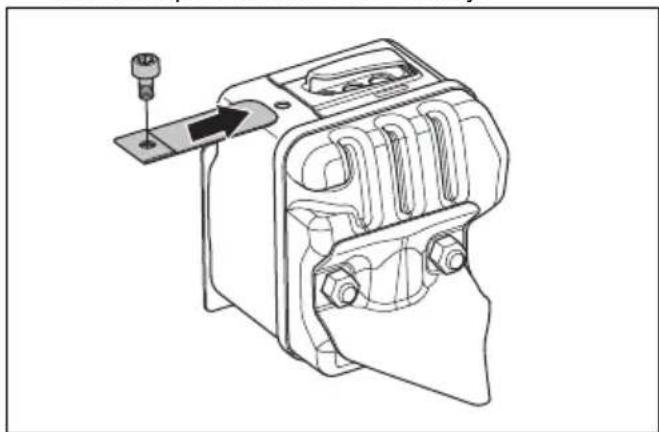
natural_image
Technical line drawing of an electrical contactor component with a screw and mounting bracket (no text or symbols)- Replace a damaged spark arrestor mesh.
Carburetor with adjustment limitations
Note: If you do not know which carburetor type that you have on your product, speak to your servicing dealer.
Carburetor adjustment
Because of environmental and emissions laws, your product has adjustment limitations on the carburetor adjuster screws. This decreases the harmful exhaust fumes from your product. You can only turn the adjustment screws maximum 12 turn.
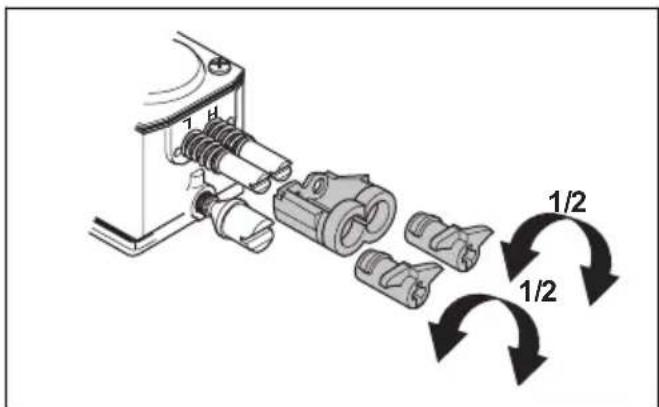
Basic adjustments and run-in
The basic carburetor adjustments are done at the factory. For the recommended idle speed, refer to Technical data on page 34.

CAUTION: Do not operate the product at too high speed during the first 10 hours of operation.

CAUTION: If the saw chain rotates at idle speed, turn the idle speed screw counterclockwise until the saw chain stops.
To adjust the low speed needle (L)
- Turn the low speed needle clockwise until stop.
Note: If the product has a bad acceleration capacity or if the idle speed is not correct, turn the low speed needle counterclockwise. Turn the low speed needle until the acceleration capacity and idle speed is correct.
To adjust the idle speed screw (T)
- Start the product.
- Turn the idle speed screw clockwise until the saw chain starts to rotate.
- Turn the idle speed screw counterclockwise until the saw chain stops.
Note: The idle speed is correctly adjusted when the engine runs correctly in all positions. The idle speed must also be safely below the speed at which the saw chain starts to rotate.

WARNING: If the saw chain does not stop when you turn the idle speed screw, speak to your servicing dealer. Do not use the product until it is correctly adjusted.
To adjust the high speed needle (H)
The engine is adjusted at the factory to operate at sea level. At higher altitudes, in different weather or different temperatures it can be necessary to adjust the high speed needle.
- Turn the high speed needle to make adjustments.

CAUTION: Do not turn the high speed needle screw across the adjustment limitation stop. This can cause damage to the piston and the cylinder.
To examine if the carburetor is correctly adjusted
• Make sure that the product has the correct acceleration capacity.
• Make sure that the product 4-cycles a little at full throttle.
• Make sure that the saw chain does not rotate at idle speed.
- If the product is not easy to start or has less acceleration capacity, adjust the low and high speed needles.

CAUTION: Incorrect adjustments can cause damage to the engine.
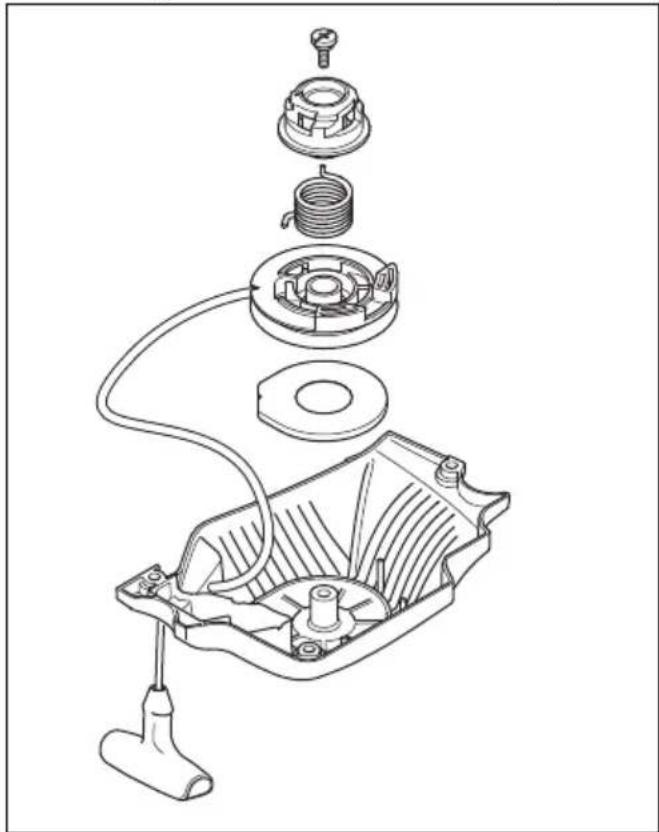
To replace a broken or worn starter rope
- Loosen the screws to the starter housing.
- Remove the starter housing.
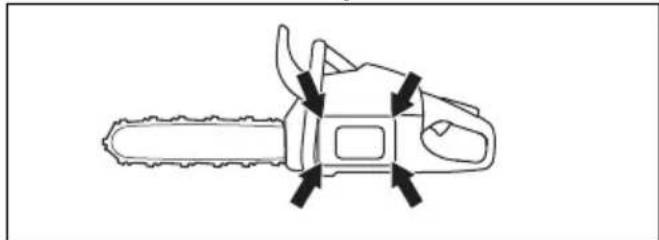
natural_image
Line drawing of a chain saw with arrows indicating force or movement (no text or symbols)- Pull out the starter rope approximately 30 cm/12 in and put it in the notch on the pulley.
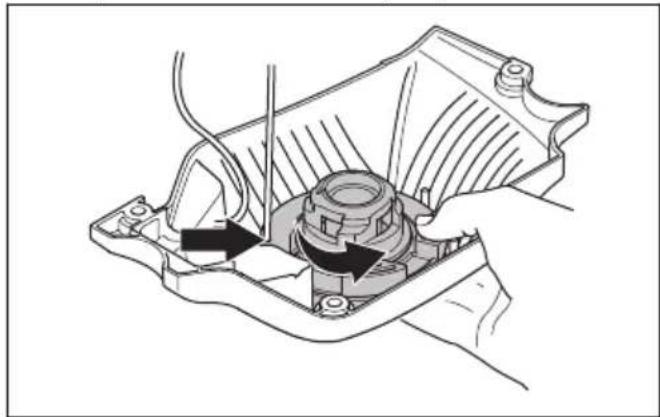
natural_image
Mechanical assembly diagram showing a motor component with two arrows indicating direction of motion (no text or symbols present)-
Let the pulley rotate slowly rearward to release the recoil spring.
-
Remove the center screw and remove the pulley.

WARNING: You must be careful when you replace the return spring or the starter rope. The recoil spring is in tension when it is wound up in the starter housing. If you are not careful, it can eject and cause injuries. Use protective glasses and protective gloves.
-
Remove the used starter rope from the handle and the pulley.
-
Attach a new starter rope to the pulley. Wind the starter rope approximately 3 turns around the pulley.
-
Pull the starter rope through the hole in the starter housing and the starter rope handle.
-
Attach the center screw in the center of the pulley.
-
Make a tight knot at the end of the starter rope.
natural_image
Exploded view diagram of a mechanical assembly showing internal components like gears, springs, and a motor (no text or labels)To tighten the recoil spring
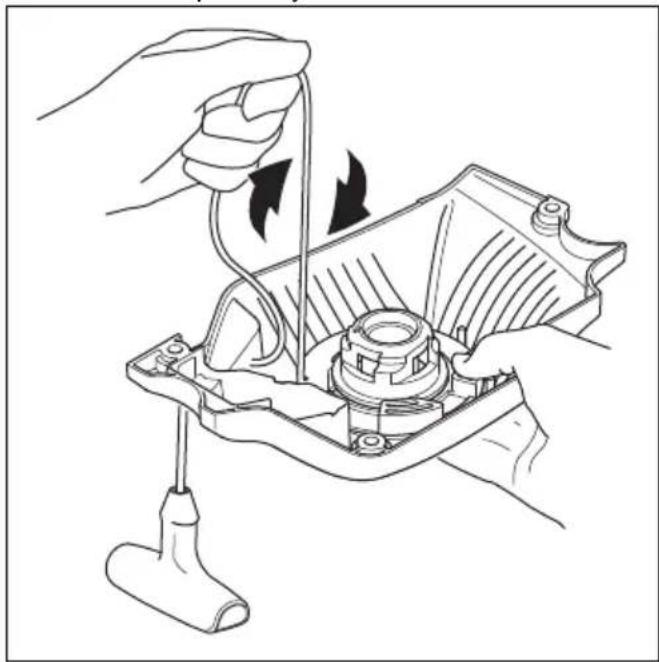
- Put the starter rope into the notch in the pulley.
- Turn the starter pulley approximately 2 turns clockwise.
- Make sure that you can turn the pulley 12 turn after the starter rope is fully extended.
natural_image
Line drawing of a mechanical assembly with hands holding a tool, showing motion arrows indicating movement (no text or symbols)To assemble the starter housing on the product
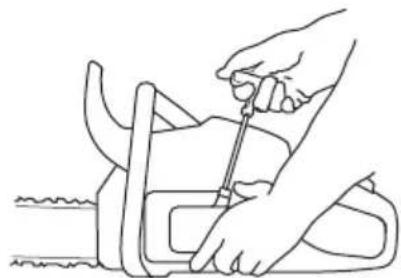
- Pull out the starter rope and put the starter in position against the crankcase.
- Slowly release the starter rope until the pulley engages with the pawls.
- Tighten the screws that hold the starter.
natural_image
Line drawing of a hand using a tool to cut a saw blade (no text or symbols)To clean the air filter
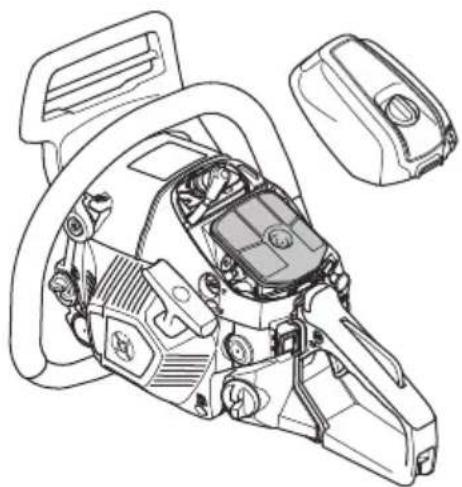
Clean the air filter regularly from dirt and dust. This prevents carburetor malfunctions, starting problems, loss of engine power, wear to engine parts and more fuel consumption than usual.
- Remove the cylinder cover and the air filter.
- Use a brush or shake the air filter clean. Use detergent and water to clean it fully.
Note: An air filter that is used for a long time can not be fully cleaned. Replace the air filter regularly and always replace a defective air filter.
- Attach the air filter and make sure that the air filter seals tightly against the filter holder.
natural_image
Technical line drawing of a mechanical device with internal components (no text or symbols)Note: Because of different work conditions, weather or season, your product can be used with different types of air filter. Speak to your servicing dealer for more information.
To do a check of the spark plug

CAUTION: Use the recommended spark plug. Refer to Technical data on page 34. An incorrect spark plug can cause damage to the product.
- If the product is not easy to start or to operate or if the product operates incorrectly at idle speed, examine the spark plug for unwanted materials. To decrease the risk of unwanted material on the spark plug electrodes, do these steps:
a) make sure that the idle speed is correctly adjusted.
b) make sure that the fuel mixture is correct.
c) make sure that the air filter is clean.
- Clean the spark plug if it is dirty.
- Make sure that the electrode gap is correct. Refer to, Technical data on page 34.
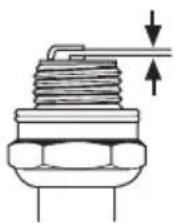
- Replace the spark plug monthly or more frequently if necessary.
To sharpen the saw chain
Information about the guide bar and saw chain

WARNING: Use protective gloves when you use or do maintenance on the saw chain. A saw chain that does not move can also cause injuries.
Replace a worn or damaged guide bar or saw chain with the guide bar and saw chain combination recommended by Husqvarna. This is necessary to keep the safety functions of the product. Refer to Accessories on page 35, for a list of replacement bar and chain combinations that we recommend.
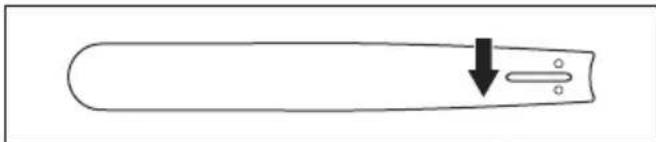
- Guide bar length, in/cm. Information about the guide bar length can usually be found on the rear end of the guide bar.
natural_image
Simple line drawing of a test tube with a downward arrow pointing to its internal structure (no text or symbols)• Number of teeth on bar tip sprocket (T).
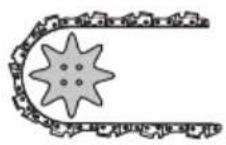
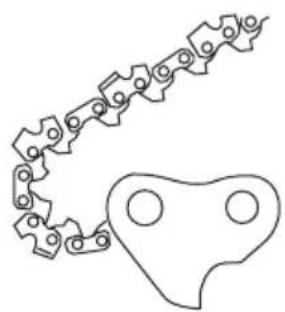
- Chain pitch, in. The distance between the drive links of the saw chain must align with the distance of the teeth on the bar tip sprocket and drive sprocket.
• Number of drive links. The number of drive links is decided by the type of guide bar.
natural_image
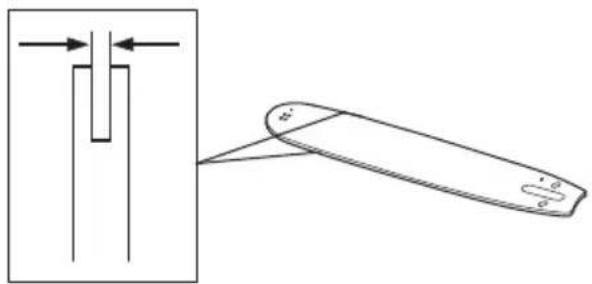
Pure mechanical linkage diagram without any text, numbers, or symbols- Bar groove width, in/mm. The groove width in guide bar must be the same as the chain drive links width.
natural_image
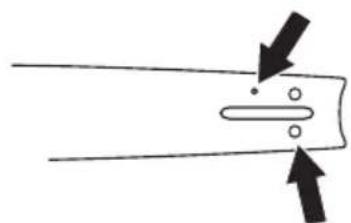
Diagram showing a vertical pipe with directional arrows and a curved object with labeled points (no text or symbols present)- Chain oil hole and hole for chain tensioner. The guide bar must align with product.
natural_image
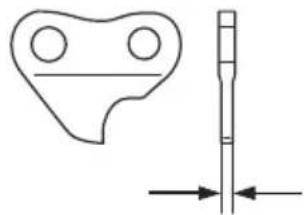
Pure diagram of a tool or component with arrows indicating direction (no text or symbols)- Drive link width, mm/in.
natural_image
Technical line drawing of a mechanical component with a vertical shaft and circular features (no text or symbols)General information about how to sharpen the cutters
Do not use a blunt saw chain. If the saw chain is blunt, you must apply more pressure to push the guide bar through the wood. If the saw chain is very blunt, there will be no wood chips but sawdust.
A sharp saw chain eats through the wood and the wood chips becomes long and thick.
The cutting tooth (A) and the depth gauge (B) together makes the cutting part of the saw chain, the cutter. The difference in height between the two gives the cutting depth (depth gauge setting).
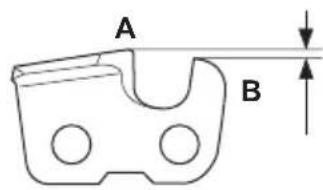
When you sharpen the cutter, think about the following:
- Filing angle.
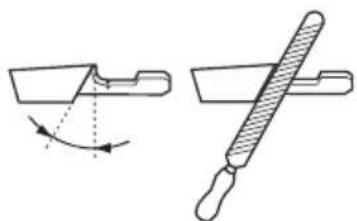
natural_image
Technical line drawing of a mechanical tool with two views: one showing a curved arrow indicating rotation, the other showing a straight handle (no text or symbols)- Cutting angle.
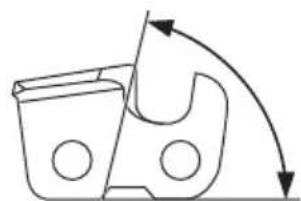
natural_image
Pure mechanical diagram showing a gear or cam mechanism with rotational arrows (no text or symbols)- File position.
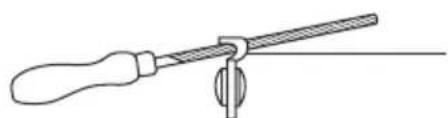
natural_image
Line drawing of a pair of scissors with a handle and base, no text or symbols present- Round file diameter.
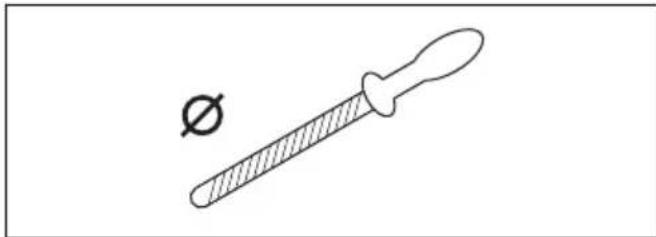
natural_image
Simple line drawing of a dropper with a small symbol (no text or labels)It is not easy to sharpen a saw chain correctly without the correct equipment. Use Husqvarna file gauge. This will help you to keep maximum cutting performance and the kickback risk at a minimum.

WARNING: The force of the kickback increases a lot if you do not follow the sharpening instructions.
Note: Refer to To sharpen the saw chain on page 27 for information about sharpening of the saw chain.
To sharpen the cutters
- Use a round file and a file gauge to sharpen the cutting teeth.
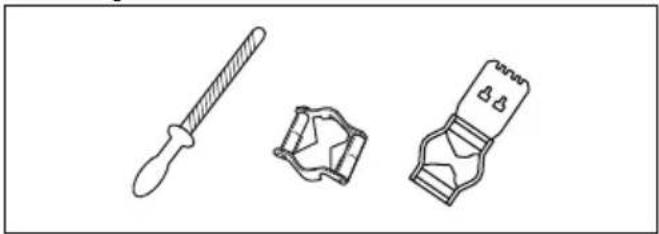
natural_image
Three technical illustrations of mechanical components: a dropper, a bracket, and a clamp device (no text or symbols)Note: Refer to Accessories on page 35 for information about which file and gauge that Husqvarna recommends for your saw chain.
- Apply the file gauge correctly on to the cutter. Refer to the instruction supplied with the file gauge.
- Move the file from the inner side of the cutting teeth and out. Decrease the pressure on the pull stroke.
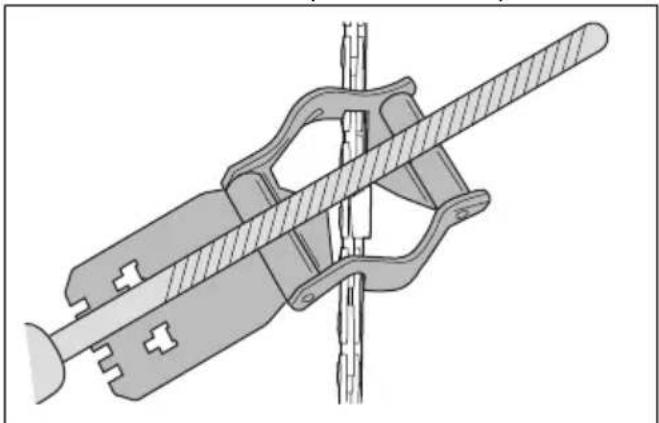
natural_image
Technical illustration of a mechanical clamp or bracket assembly (no text or symbols)- Remove material from one side of all the cutting teeth.
-
Turn the product around and remove material on the other side.
-
Make sure that all cutting teeth are the same length.
General information about how to adjust the depth gauge setting
The depth gauge setting (C) decreases when you sharpen the cutting tooth (A). To keep maximum cutting performance you must remove filing material from the depth gauge (B) to receive the recommended depth gauge setting. See Accessories on page 35 for instructions about how to receive the correct depth gauge setting for your saw chain.
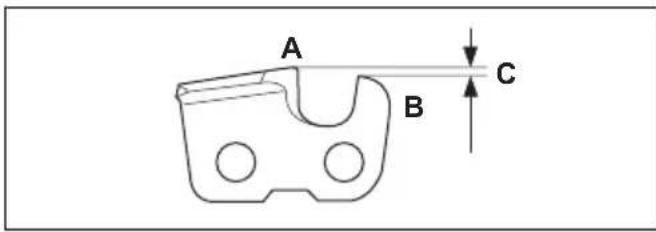

WARNING: The risk of kickback increases if the depth gauge setting is too large!
To adjust the depth gauge setting
Before you adjust the depth gauge setting or sharpen the cutters, refer to General information about how to adjust the depth gauge setting on page 29, for instructions. We recommend you to adjust the depth gauge setting after each third operation that you sharpen the cutting teeth.
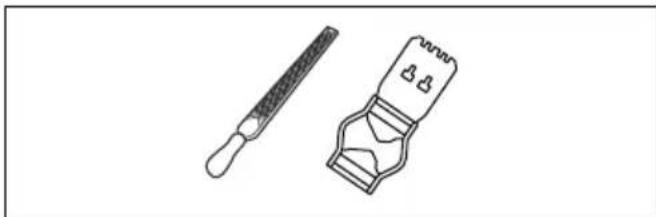
We recommend that you use our depth gauge tool to receive the correct depth gauge setting and bevel for the depth gauge.
natural_image
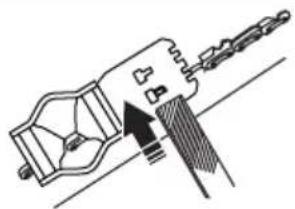
Technical line drawing of two tools: a gridded tool and a mechanical clamp (no text or symbols)- Use a flat file and a depth gauge tool to adjust the depth gauge setting. Only use Husqvarna depth gauge tool to get the correct depth gauge setting and bevel for the depth gauge.
- Put the depth gauge tool on the saw chain.
Note: See the package of the depth gauge tool for more information about how to use the tool.
- Use the flat file to remove the part of the depth gauge that extends through the depth gauge tool.
natural_image
Technical line drawing of a mechanical tool or component with an arrow indicating direction (no text or symbols present)To adjust the tension of the saw chain

WARNING: A saw chain with an incorrect tension can come loose from the guide bar and cause serious injury or death.
A saw chain becomes longer when you use it. Adjust the saw chain regularly.
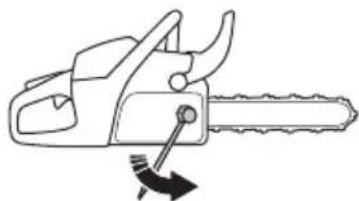
- Loosen the bar nuts that hold the clutch cover/chain brake. Use a wrench.
natural_image
Line drawing of a chainsaw with a lever and blade (no text or symbols)Note: Some models have only one bar nut.
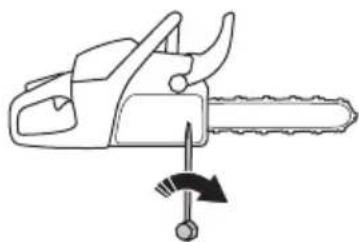
- Tighten the bar nuts by hand as tightly as you can.
- Lift the front of the guide bar and turn the chain tensioning screw. Use a wrench.
- Tighten the saw chain until it is tight against the guide bar but still can move easily.
natural_image
Line drawing of a chainsaw with a directional arrow indicating motion (no text or symbols)- Tighten the bar nuts using the wrench and lift the front of the guide bar at the same time.
- Make sure you can pull the saw chain around freely by hand and that it does not hang from the guide bar.
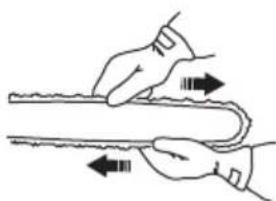
natural_image
Illustration of two hands holding a curved object with directional arrows indicating motion (no text or symbols)Note: Refer to Product overview on page 2 for the position of the chain tensioning screw on your product.
To do a check of the saw chain lubrication
- Start the product and let it operate at 34 throttle. Hold the bar approximately 20 cm/8 in above a surface of light color.
- If the saw chain lubrication is correct, you see a clear line of oil on the surface after 1 minute.
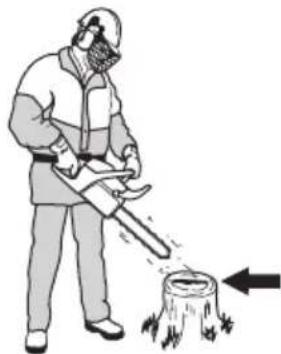
natural_image
Illustration of a person using a power tool to cut tree bark with a saw (no text or symbols)- If the saw chain lubrication does not operate correctly, do a check of the guide bar. Refer to To do a check of the guide bar on page 31 for instructions. Speak to your servicing dealer if the maintenance steps does not help.
To do a check of the rim sprocket
The clutch drum has a rim sprocket that can be replaced.
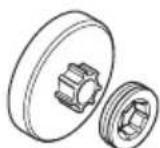
- Make sure that the rim sprocket is not worn. Replace if necessary.
- Replace the rim sprocket each time you replace the saw chain.
To lubricate the needle bearing
- Pull the front hand guard rearward to disengage the chain brake.
- Loosen the bar nuts and remove the clutch cover.
Note: Some models have only one bar nut.
-
Put the product on a stable surface with the clutch drum up.
-
Lubricate the needle bearing with a grease gun. Use engine oil or a bearing grease of high quality.
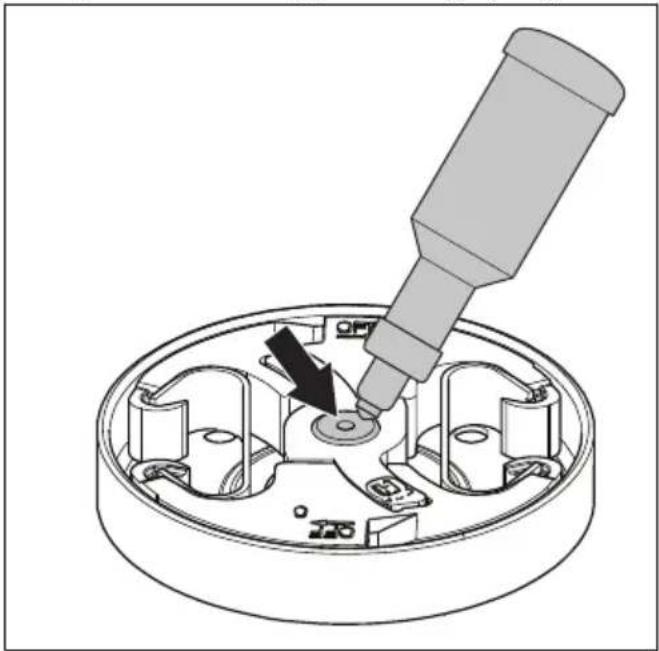
natural_image
Technical diagram of a mechanical assembly with a pipette inserted into a circular housing (no text or symbols)To examine the cutting equipment
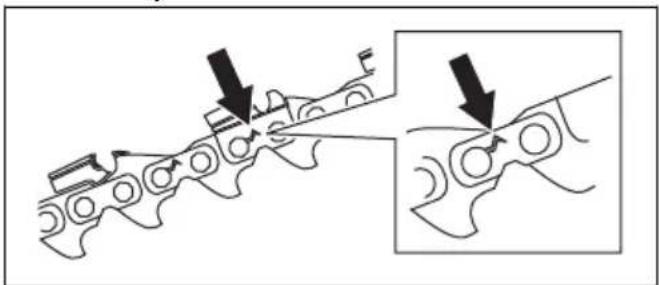
- Make sure that there are no cracks in rivets and links and that no rivets are loose. Replace if it is necessary.
natural_image
Mechanical assembly diagram showing two stages of toolpathing (no text or labels)- Make sure that the saw chain is easy to bend. Replace the saw chain if it is rigid.
- Compare the saw chain with a new saw chain to examine if the rivets and links are worn.
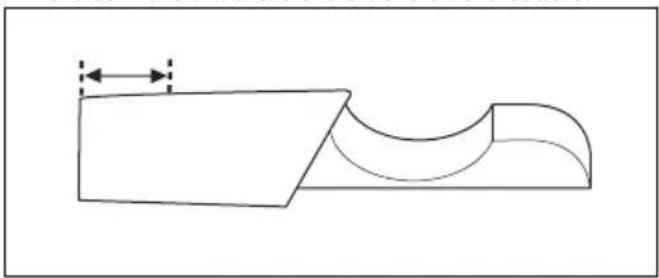
- Replace the saw chain when the longest part of the cutting tooth is less than 4 mm/0.16 in. Also replace the saw chain if there are cracks on the cutters.
natural_image
Pure geometric diagram showing a 3D shape with a curved cutout and a rectangular base, no text or symbols present.To do a check of the guide bar
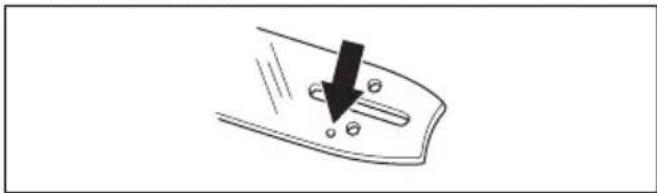
- Make sure that the oil channel is not blocked. Clean if it is necessary.
natural_image
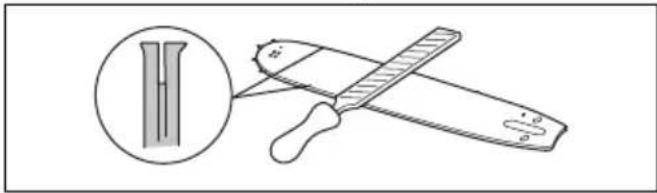
Simple line drawing of a switch mechanism with a black arrow indicating downward motion (no text or symbols)- Examine if there are burrs on the edges of the guide bar. Remove the burrs using a file.
natural_image
Diagram showing a tool interacting with a cylindrical object, with no visible text or symbols- Clean the groove in the guide bar.
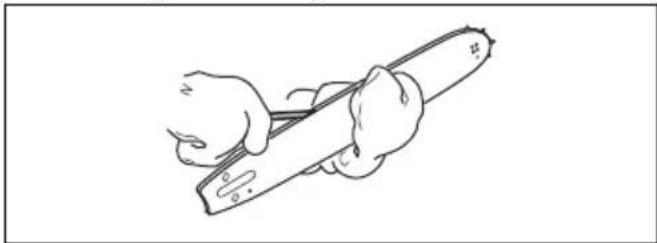
natural_image
Line drawing of a hand holding a long cylindrical object (no text or symbols)- Examine the groove in the guide bar for wear. Replace the guide bar if it is necessary.
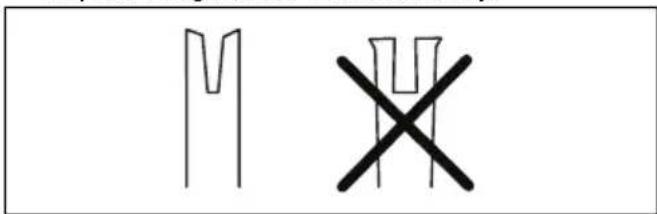
- Examine if the guide bar tip is rough or very worn.
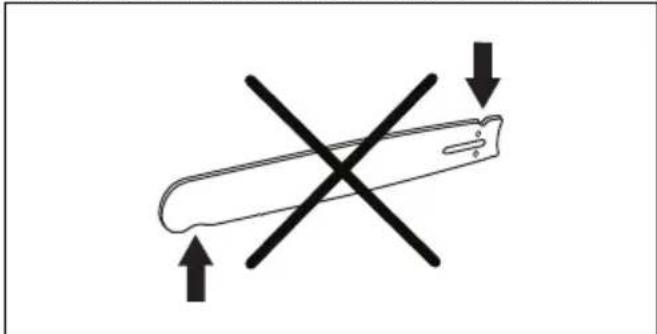
natural_image
Simple line drawing of a test tube with two crossed arrows indicating direction (no text or symbols)- Make sure that the bar tip sprocket turns freely and that the lubricating hole in the bar tip sprocket is not blocked. Clean and lubricate if it is necessary.
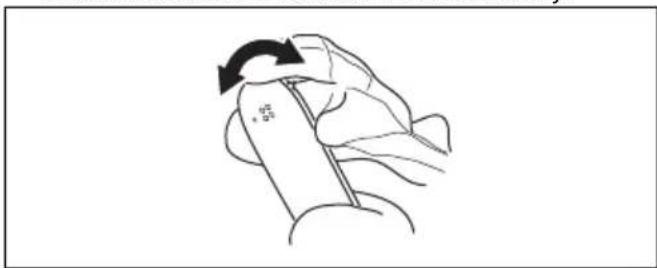
natural_image
Illustration of a hand holding a device with a curved arrow indicating rotation (no text or symbols)- Turn the guide bar daily to extend its life cycle.
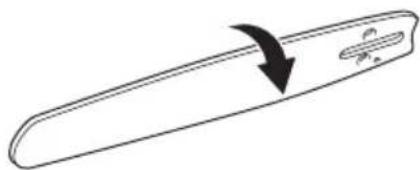
natural_image
Simple line drawing of a tool or plunger with an arrow indicating direction (no text or symbols)To do maintenance on the fuel tank and the chain oil tank
- Drain and clean the fuel tank and the chain oil tank regularly.
- Replace the fuel filter yearly or more frequently if necessary.

CAUTION: Contamination in the tanks causes malfunction.
To adjust the chain oil flow

WARNING: Stop the engine before you make adjustments to the oil pump.
- Turn the adjustment screw of the oil pump. Use a screwdriver or combination wrench.
a) Turn the adjustment screw clockwise to decrease the chain oil flow.
b) Turn the adjustment screw counterclockwise to increase the chain oil flow.
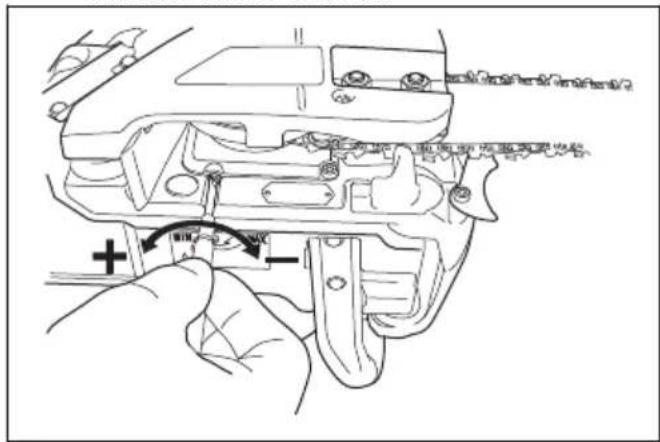
Recommended settings for the oil pump
• Guide bar length 33-38 cm/13-15 in: Minimum flow
• Guide bar length 38-41 cm/15-16 in: Medium flow
- Guide bar length -46 cm/-18 in: Maximum flow
Air cleaning system
AirInjection ™ is a centrifugal air cleaning system that removes dust and dirt before the particles are caught by
the air filter. AirInjection ™ extends the life of the air filter and the engine.
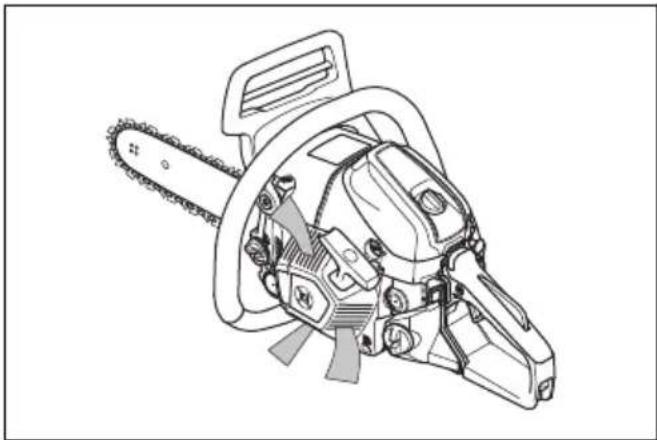
natural_image
Line drawing of a chain-linking device with gear and handle (no text or symbols)To clean the cooling system
The cooling system keeps the engine temperature down. The cooling system includes the air intake on the starter and the air guide plate, the pawls on the flywheel, the cooling fins on the cylinder, the cooling channel and the cylinder cover.
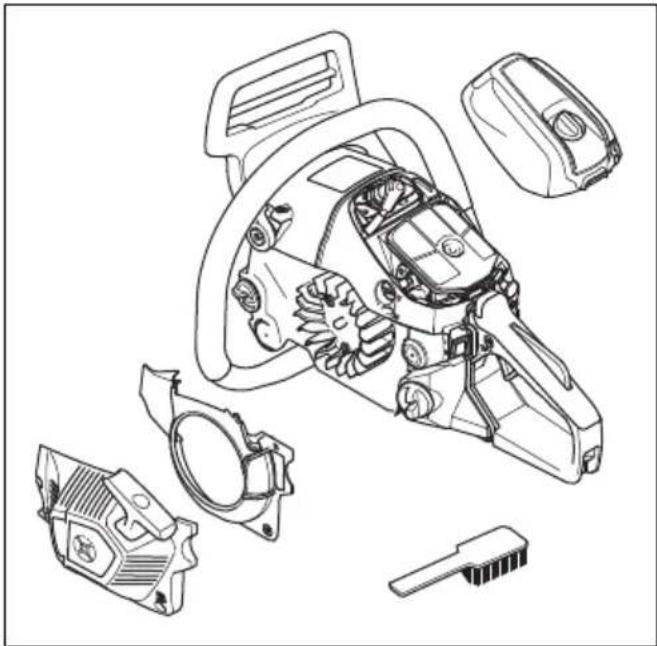
natural_image
Technical line drawing of a mechanical device with exploded view showing internal components (no text or labels)- Clean the cooling system with a brush weekly or more frequently if it is necessary.
- Make sure that the cooling system is not dirty or blocked.

CAUTION: A dirty or blocked cooling system can make the product too hot, which can cause damage to the product.
Troubleshooting
The engine does not start
| Product part to examine Possible cause | Action | |
| Starter pawls The starter pawls are blocked. Adjust or replace the starter pawls. | ||
| Clean around the pawls. | ||
| Speak to an approved service work-shop. | ||
| Fuel tank Incorrect fuel type. Drain the fuel tank and fill with cor- | rect fuel. | |
| The fuel tank is filled with chain oil. If you have tried to start the product, speak to your servicing dealer. If you have not tried to start the product, drain the fuel tank. | ||
| Ignition, no spark The spark plug is dirty or wet. Make sure that the spark plug is dry and clean. | ||
| The electrode gap is incorrect. Clean the spark plug. Make sure that the electrode gap and spark plug is correct, and that the correct spark plug type is the recommended or equivalent. | ||
| Refer to Technical data on page 34 for the correct electrode gap. | ||
| Spark plug and cylinder The spark plug is loose. Tighten the spark plug. | ||
| Engine is flooded because of repeated starts with full choke after ignition. Remove and clean the spark plug. Put the product on its side with the spark plug hole away from you. Pull the starter rope handle 6-8 times. Assemble the spark plug and start the product. Refer to To start the product on page 12. | ||
The engine starts but stops again
| Product part to examine | Possible cause Action | |
| Fuel tank Incorrect fuel type. Drain the | fuel tank and fill with cor- | rect fuel. |
| Carburetor The idle speed is not correct. | Speak to your servicing dealer. | |
| Air filter Clogged air filter. Clean or replace the air filter. | ||
| Fuel filter Clogged fuel filter. | Replace the fuel filter. | |
Transportation and storage
Transportation and storage
- For storage and transportation of the product and fuel, make sure that there are no leaks or fumes. Sparks or open flames, for example from electrical devices or boilers, can start a fire.
• Always use approved containers for storage and transportation of fuel. - Empty the fuel and chain oil tanks before transportation or before long-term storage. Discard the fuel and chain oil at an applicable disposal location.
- Use the transportation guard on the product to prevent injuries or damage to the product. A saw chain that does not move can also cause serious injuries.
- Remove the spark plug cap from the spark plug and engage the chain brake.
- Attach the product safely during transportation.
To prepare your product for long-term storage
- Stop the product and let it become cool before you disassemble it.
- Disassemble and clean the saw chain and the groove in the guide bar.

CAUTION: If the saw chain and guide bar are not cleaned, they can become rigid or blocked.
- Attach the transportation guard.
- Clean the product. Refer to Maintenance on page 21 for instructions.
- Do a complete servicing of the product.
Technical data
Technical data
| Husqvarna 543 XP Husqvarna 543 XPG | ||
| Engine | ||
| Cylinder displacement, cm3 | 43.1 43.1 | |
| Idle speed, rpm 2500-2700 2500-2700 | ||
| Maximum engine power acc. to ISO 8893, kW/hp @ rpm | 2.2/2.9 @ 9600 2.2/2.9 @ 9600 | |
| Ignition system1 | ||
| Spark plug NGK CMR7H NGK CMR7H | ||
| Electrode gap, mm 0.65 0.65 | ||
| Fuel and lubrication system | ||
| Fuel tank capacity, liter/ cm3 | 0.42/420 0.42/420 | |
| Oil tank capacity, liter/ cm3 | 0.27/270 0.27/270 | |
| Type of oil pump Adjustable Adjustable | ||
| Weight | ||
| Weight, kg 4.5 4.7 | ||
| Noise emissions | ||
| Sound power level, measured dB(A) 1 | 12 112 | |
| Sound power level, guaranteed LWA dB(A) | 113 113 | |
| Sound levels2 | ||
| Equivalent sound pressure level at the operator's ear, dB(A) | 101 101 | |
| Equivalent vibration levels, ahveq3 | ||
| Front handle, m/s2 | 4.5 4.5 | |
| Rear handle, m/s2 | 4.2 4.2 | |
| Saw chain/guide bar | ||
| Type of drive sprocket/number of teeth | Rim/7 Rim/7 | |
| Saw chain speed at 133% of maximum engine power speed, m/s. | 24.6 24.6 | |
Accessories
Recommended cutting equipment
Chainsaw models Husqvarna 543 XP, 543 XPG have been evaluated for safety according to EN ISO 11681-1:2011 (Machinery for forestry - Portable chainsaw safety requirements and testing) and fulfill the safety requirements when equipped with the below listed guide bar and saw chain combinations.
Kickback and guide bar nose radius
For sprocket nose bars the nose radius is specified by the number of teeth, such as 10T. For solid guide bars the nose radius is specified by the dimension of the nose radius. For a given guide bar length, you can use a guide bar with smaller nose radius than given.
Low kickback saw chain
A saw chain that is designated as Low kickback saw chain, meets the low kickback requirement specified in ANSI B175.1-2012.
| Guide bar Saw chain | ||||||
| Length, in/cm | Pitch, in Gauge, in | /mm Max. nose radius | Type Length, drive links (no.) | Low kickback | ||
| 13/33 0.325 0.0 | 50/1.3 10T Husq | varna H30 56 Yes | ||||
| 15/38 64 | ||||||
| 16/41 66 | ||||||
| 18/46 72 | ||||||
| Length, in/cm | Pitch, in Gauge, in | /mm Max. nose | radius | Type Length, drive links (no.) | Low kickback | |
| 13/33 0.325 0.0 | 50/1.3 10T Huso | varna | SP33G | 56 | ||
| 15/38 64 | ||||||
| 16/41 66 | ||||||
| 18/46 72 | ||||||
| 13/33 0.325 0.0 | 58/1.5 10T Huso | varna H25 56 Yes | ||||
| 15/38 64 | ||||||
| 16/41 66 | ||||||
| 18/46 72 | ||||||
| 13/33 0.325 0.0 | 58/1.5 11T Huso | varna | S35G | 56 Yes | ||
| 15/38 64 | ||||||
| 16/41 12T 66 | ||||||
| 18/46 R33 72 | ||||||
The usable cutting length is usually 1 in less than the nominal guide bar length.
Pixel
Pixel is a guide bar and saw chain combination that is more light weight and designated to offer more energy efficient use by cutting narrow cuts. Both guide bar and saw chain need to be Pixel to get these benefits. Pixel cutting equipment is marked with this symbol.

Filing equipment and filing angles
Use a Husqvarna file gauge to sharpen the saw chain. A Husqvarna file gauge makes sure that you get the correct filing angles. The part numbers are given in the table below.
If you are not sure how to identify the type of saw chain on your product, refer to www.husqvarna.com for more information.
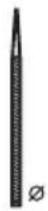 | 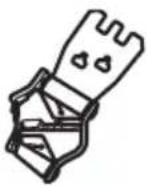 | 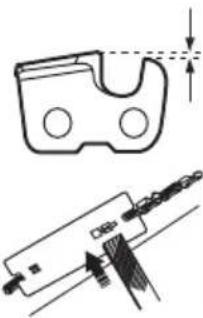 | 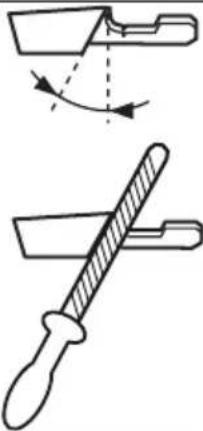 | 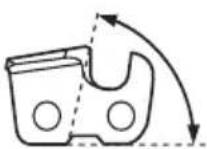 | |
| SP33G 3 / 16 | in / 4.8 mm 586 93 | 84-01 | 0.025 in / 0.65 mm | 30° | 80° |
| H30 3 / 16 in / 4.8 mm 505 69 81-08 | 0.025 in / 0.65 mm | 30° 85° | |||
| H25 3 / 16 in / 4.8 mm 505 69 81-09 | 0.025 in / 0.65 mm | 30° 85° | |||
| S35G 3 / 16 in / 4.8 mm 587 80 91-01 | 0.025 in / 0.65 mm | 30° 60° | |||
Declaration of Conformity
EU Declaration of Conformity
We, Husqvarna AB, SE-561 82 Huskvarna, Sweden, tel: +46-36-146500, declare on our sole responsibility that the product:
| Description Chainsaws for forest service | |
| Brand Husqvarna | |
| Type / Model 543 XP, 543 XPG | |
| Identification Serial numbers dating from 2022 and onwards | |
complies fully with the following EU directives and regulations:
| Regulation Description | |
| 2006/42/EC "relating to machinery" | |
| 2014/30/EU "relating to electromagnetic compatibility" | |
| 2000/14/EC "relating to the noise emissions in the environment" | |
| 2011/65/EU “on the restriction of the use of certain hazardous substances in electrical and electronic equipment” |
and that the following standards and/or technical specifications are applied: EN ISO 12100:2021, ISO 14982:2009, EN ISO 11681-1:2011, EN IEC 63000:2018.
Certificate Number: 0404/12/2360
Notified body: 0404, RISE SMP Svensk Maskinprovning AB Box 7035, SE-750 07 Uppsala, Sweden has carried out EC type examination in accordance with the machinery directive's (2006/42/EC) article 12, point 3b, annex IX on behalf of Husqvarna AB.
0404, RISE SMP Svensk Maskinprovning AB has certified conformity with the council's directive 2000/14/EC, conformity assessment procedure: Annex V.
For information relating to noise emissions, refer to Technical data on page 34.
Huskvarna, 2022-05-09
Stefan Holmberg, R&D Director, Technology Management, Husqvarna AB
Responsible for technical documentation

Shot = Jhulan
UK Declaration of Conformity
We, Husqvarna AB, SE-561 82 Huskvarna, Sweden, tel:
+46-36-146500, declare on our sole responsibility that
the product:
| Description Chainsaws | for forest service |
| Brand Husqvarna | |
| Type / Model 543 XP, | 543 XPG |
| Identification Serial numbers dating from 2022 and onwards | |
complies fully with the following UK regulations:
| Regulations |
| The Supply of Machinery (Safety) Regulations 2008 |
| Electromagnetic Compatibility Regulations 2016 |
| The Noise Emission in the Environment by Equipment for use Outdoors Regulations 2001, Schedule 8 |
| The Restriction of the Use of Certain Hazardous Substances in Electrical and Electronic Equipment Regulations 2012 |
and that the following standards and/or technical
specifications are applied: EN ISO 12100:2021,
ISO 14982:2009, EN ISO 11681-1:2011, EN IEC
63000:2018.
For information relating to noise emissions, refer to
Technical data on page 34.
Huskvarna, 2022-05-09
Stefan Holmberg, R&D Director, Technology
Management, Husqvarna AB
Responsible for technical documentation

UK Importer:
Husqvarna UK Ltd
Preston Road, Co. Durham
DL5 6UP
Inhalt
natural_image
Prohibition sign showing a worker climbing a rope with a diagonal line, no text or symbols presentnatural_image
Illustration of a person using a tool to cut wood or wood fragments, with an arrow indicating the process (no text or symbols present)natural_image
Illustration of a hand gripping a mechanical device with a curved handle (no text or symbols)natural_image
Line drawing of a manual chain saw with motion arrows indicating airflow (no text or symbols)Gashebelsperre
natural_image
Diagram showing a chain-linker being inserted into a car's side panel, with an arrow indicating the process (no text or symbols present)Rechtshandschutz
natural_image
Technical line drawing of a mechanical bracket component (no text or symbols)natural_image
Line drawing of a chainsaw with an inset showing a close-up of the blade (no text or symbols)Schalldämpfer

natural_image
Technical line drawing of an electrical contactor component with a screwdriver inserted (no text or symbols)natural_image
Simple line drawing of a VR headset with a starburst effect (no text or symbols)natural_image
Pure technical line drawing of a mechanical component with no text or symbolsnatural_image
Simple line drawing of a droplet falling into a container with circular ports (no text or symbols)Montage
Einleitung
natural_image
Technical line drawing of a mechanical assembly with labeled component A (no text or symbols present)
natural_image
Technical line drawing of a mechanical assembly with chain and gear components (no text or symbols)natural_image
Simple black icon of a fuel pump with a droplet and plus sign, no text or symbols present.natural_image
Abstract black-and-white graphic of a droplet above a stylized mask (no text or symbols)natural_image
Illustration of a person in protective gear using a tool to lift a rolled paper or cable (no text or symbols)natural_image
Diagram of a manual car with a curved arrow indicating motion or direction (no text or symbols)natural_image
Mechanical assembly diagram showing a valve mechanism with a black arrow pointing to a component (no text or symbols present)natural_image
Technical line drawing of a mechanical assembly with no visible text or symbolsnatural_image
Line drawing of a car hood with airflow direction arrow (no text or symbols)natural_image
Mechanical assembly diagram showing a valve mechanism with a black arrow pointing to a component (no text or symbols present)natural_image
Illustration of a person using a chain-linking tool (no text or symbols)
natural_image
Line drawing of a manual chain saw with arrows indicating motion (no text or symbols)natural_image
Line drawing of a manual tool emitting exhaust smoke (no text or symbols)natural_image
Line drawing of a chainsaw with an inset showing a close-up of the blade (no text or symbols)natural_image
Line drawing of a hand using a chainsaw to cut a circular saw (no text or symbols)natural_image
Line drawing of a manual cutting tool with motion arrows indicating cycle (no text or symbols)
natural_image
Illustration of two workers handling stacked logs, one in safety gear and the other in hard hat (no text or symbols)

natural_image
Illustration of a landslide with a warning sign and explosion symbol (no text or labels)natural_image
Simple line drawing of a car with a warning sign and explosion effect (no text or symbols)
natural_image
Illustration of a hand using a cable to lift a car, showing the angle of motion (no text or symbols present)
natural_image
Illustration of a hand using a saw to cut tree bark with a black arrow indicating the process (no text or symbols present)natural_image
Illustration of a hand using a tool to cut tree bark with a black arrow indicating the direction (no text or symbols present)
natural_image
Illustration of a person spraying tree roots with a light source, no text or symbols presentnatural_image
Illustration of a hand holding a magnifying glass over a flame (no text or symbols)
natural_image
Diagram of concentric circular layers with a vertical line and directional arrows, no text or symbols present.natural_image
Diagram showing a tree trunk with a horizontal line and an arrow indicating direction, no text or symbols present.
natural_image
Simple line drawing of a mechanical tool or bracket (no text or symbols)natural_image
Simple line drawing of a mechanical component or tool with layered structure (no text or symbols)natural_image
Technical line drawing of a mechanical component with a curved arrow indicating motion (no text or symbols)natural_image
Technical line drawing of a mechanical component with a circular housing and a curved bracket (no text or symbols)natural_image
Diagram showing a cross-section of layered geological strata with an upward arrow indicating a specific feature (no text or labels present)natural_image
Diagram showing airflow or particle movement between two curved surfaces with arrows indicating direction (no text or symbols)natural_image
Line drawing of a car interior panel with control buttons and a curved arrow indicating rotation (no text or symbols)
natural_image
Simple line drawing of a rope or rope loop with directional arrows indicating movement (no text or symbols)natural_image
Line drawing of a hand using a car seatbelt to lift a seatbelt, with no text or symbols present.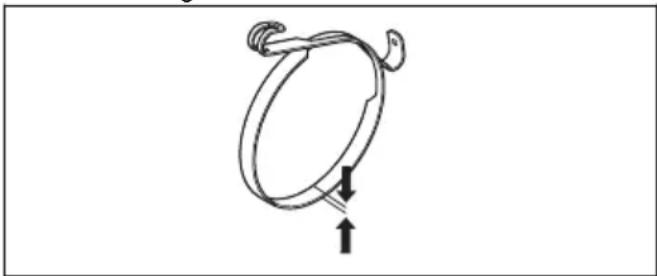
natural_image
Simple line drawing of a rope or rope loop with an arrow indicating direction (no text or symbols)natural_image
Illustration of two workers in protective gear using a saw and tree stump (no text or symbols)natural_image
Line drawing of a chain-linking device with directional arrows indicating motion (no text or symbols)natural_image
Line drawing of a mechanical tool or bracket with an arrow indicating motion direction (no text or symbols)natural_image
Line drawing of a hairpin with a black arrow indicating the blade direction (no text or symbols)natural_image
Diagram showing a chain saw tool interacting with a car's side panel, with an arrow indicating the process (no text or symbols present)natural_image
Pure technical line drawing of a mechanical component (no text or symbols)natural_image
Line drawing of a chainsaw with an inset showing a close-up of the blade (no text or symbols)natural_image
Technical line drawing of a mechanical device with two directional arrows indicating movement or force (no text or symbols present)natural_image
Technical line drawing of a mechanical component with a screw and mounting bracket (no text or symbols)natural_image
Line drawing of a chainsaw with arrows indicating force or movement (no text or symbols)natural_image
Mechanical assembly diagram showing a motor or gear assembly with no visible text or symbolsnatural_image
Exploded view diagram of a mechanical assembly showing internal components like gears, springs, and a motor (no text or labels)natural_image
Line drawing of a mechanical assembly with hands holding a tool, showing motion arrows indicating rotation (no text or symbols)natural_image
Line drawing of a hand using a tool to cut a saw blade (no text or symbols)natural_image
Technical line drawing of a mechanical device with internal components and housing (no text or symbols)natural_image
Simple line drawing of a cylindrical object with a downward arrow and two small circular features (no text or symbols)natural_image
Simple line drawing of a chain with a star-like symbol inside, no text or labels present.natural_image
Diagram showing a mechanical component with an arrow indicating direction, alongside a separate view of a curved object with labeled points (no text or symbols present)natural_image
Pure diagram of a mechanical or electrical component with arrows indicating direction (no text or symbols)natural_image
Pure technical diagram showing a mechanical part and a vertical rod with directional arrows (no text or symbols)natural_image
Technical line drawing of a mechanical tool with a curved component and a diagonal blade (no text or symbols)- Schnittwinkel.
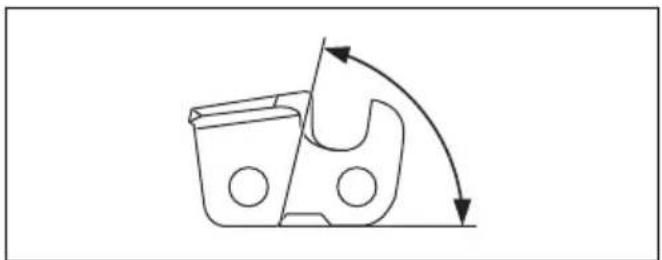
natural_image
Simple line drawing of a mechanical component with curved arrows indicating motion or force (no text or symbols)- Schärfposition.
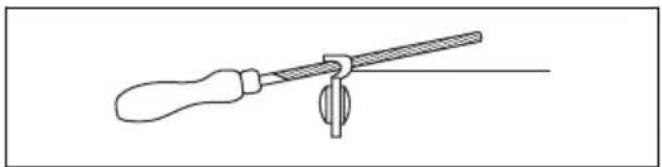
natural_image
Line drawing of a screwdriver holding a lever and pin (no text or symbols)natural_image
Simple line drawing of a dropper with a small symbol (no text or labels)natural_image
Three technical illustrations of mechanical components: a dropper, a bracket, and a clamp device (no text or symbols)natural_image
Technical illustration of a mechanical clamp or bracket assembly (no text or symbols visible)natural_image
Two mechanical tools: a radial tool and a clamped tool (no text or symbols visible)natural_image
Technical line drawing of a mechanical tool or connector with a threaded end and directional arrow (no text or symbols)natural_image
Line drawing of a chain saw with a hammer and gear (no text or symbols)natural_image
Line drawing of a chainsaw with a directional arrow indicating motion (no text or symbols)natural_image
Illustration of two hands holding a cylindrical object with directional arrows indicating motion (no text or symbols)natural_image
Illustration of a person using a saw to cut tree bark with a large arrow pointing to the root (no text or symbols present)natural_image
Technical diagram of a mechanical assembly with a pipette inserted into a circular housing (no text or symbols)natural_image
Mechanical assembly diagram showing two stages of toolpathing (no text or labels)natural_image
Pure technical line drawing of a mechanical part with no text or symbolsnatural_image
Simple line drawing of a switch mechanism with a black arrow indicating downward motion (no text or symbols)natural_image
Illustration of a cutting tool and a flat blade, showing a close-up of the blade (no text or symbols present)natural_image
Illustration of hands using a tool to cut a cylindrical object (no text or symbols visible)natural_image
Simple line drawing of a test tube with two crossed arrows indicating direction (no text or symbols)natural_image
Illustration of a hand holding a device with a curved arrow indicating rotation (no text or symbols)natural_image
Simple line drawing of a knife handle with an arrow indicating direction (no text or symbols)natural_image
Technical line drawing of a chain-linking device with visible gears and blades (no text or symbols)natural_image
Exploded view diagram of a mechanical device showing internal components like gears and housing (no text or labels)Contenido
natural_image
Simple line drawing of a crossed-out bag with a diagonal line through it, no text or symbols present.natural_image
Illustration of a worker cutting wood with a tool, showing sparks and motion (no text or symbols)natural_image
Illustration of a mechanical device with two hands operating it, no text or symbols presentnatural_image
Prohibition sign showing a person walking away from a tree with branches, enclosed in a circle (no text or symbols)natural_image
Simple line drawing of a person climbing a tree with a diagonal line (no text or symbols)natural_image
Line drawing of a manual chain saw with motion arrow indicating clockwise motion (no text or symbols)natural_image
Diagram showing a chain saw cutting down a component, with an inset close-up highlighting the mechanical assembly (no text or symbols present)natural_image
Technical line drawing of a mechanical component or bracket (no text or symbols)natural_image
Line drawing of a chainsaw with an inset showing a close-up of the blade (no text or symbols)Silenciador

natural_image
Technical line drawing of an electrical contactor or relay device with no visible text or symbolsnatural_image
Simple line drawing of a VR headset with a starburst effect (no text or symbols)natural_image
Technical line drawing of a mechanical component with a U-shaped groove and circular holes, showing a dimension arrow (no text or symbols)natural_image
Simple line drawing of a droplet falling into a container with a handle (no text or symbols)Montaje
Introducción

natural_image
Technical line drawing of a mechanical assembly with labeled component A (no text or symbols present)
natural_image
Technical line drawing of a mechanical assembly with chains and components (no text or symbols)natural_image
Simple black icon showing a droplet and a fuel pump with a flame symbol (no text or numbers)natural_image
Illustration of a person in protective gear using a tool to lift a rolled paper or cable (no text or symbols)natural_image
Diagram of a manual car hood with a curved arrow indicating motion (no text or symbols)natural_image
Technical line drawing of a mechanical assembly with no visible text or symbolsnatural_image
Technical line drawing of a mechanical component with no visible text or symbolsnatural_image
Line drawing of a manual chain attachment mechanism with motion arrow (no text or symbols)natural_image
Technical line drawing of a mechanical assembly with a black arrow pointing to a component (no text or symbols present)natural_image
Illustration of a person using a chainsaw to cut the blade (no text or symbols present)
natural_image
Line drawing of a mechanical tool with arrows indicating motion or force direction (no text or symbols)natural_image
Diagram of a mechanical device emitting exhaust smoke, showing airflow direction (no text or symbols)- Use el producto.
natural_image
Line drawing of a chainsaw with an inset showing a close-up of the blade (no text or symbols)natural_image
Line drawing of a person using a chain mill to cut a circular saw (no text or symbols)natural_image
Line drawing of a manual power saw cutting a blade, showing tool path and motion arrows (no text or symbols)
natural_image
Illustration of two workers handling stacked logs, one holding a log and the other inspecting (no text or symbols present)

natural_image
Illustration of a landslide with a lightning bolt, warning sign, and triangular warning symbol (no text or labels)natural_image
Simple line drawing of a car with warning symbols indicating hazard (no text or labels)
natural_image
Illustration of a hand gripping a bicycle seat with a gear shift and motion arrow (no text or symbols)
natural_image
Illustration of a person using a saw to cut tree bark with a tool, showing a black arrow indicating the process (no text or symbols present)natural_image
Illustration of a person using a power tool to cut tree bark, with a black arrow indicating the direction (no text or symbols present)
natural_image
Illustration of a person spraying wood at a tree with a worker in protective gear nearby (no text or symbols)
natural_image
Diagram of concentric circular layers with a vertical bar and directional arrows, no text or symbols present.
natural_image
Simple line drawing of a mechanical component with no text or symbolsnatural_image
Diagram of a mechanical or electrical component with a curved arrow indicating direction (no text or symbols)natural_image
Cross-sectional diagram of a mechanical component with layered structure (no text or labels)natural_image
Pure mechanical diagram showing a rotating shaft and circular component with a downward arrow (no text or symbols)natural_image
Diagram showing a circular structure with concentric rings and an arrow pointing to a tree branch, alongside a schematic diagram of a tree with arrows indicating movement or force (no text or symbols present)natural_image
Line drawing of a tractor pulling a tree with a lever (no text or symbols)- Portátil
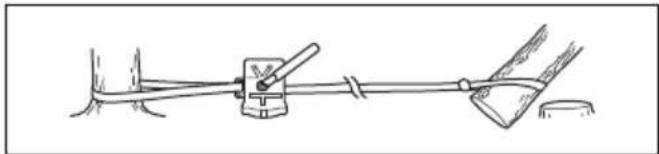
natural_image
Simple line drawing of a mechanical clamp or lever system with no text or symbolsnatural_image
Simple line drawing of a curved path with a ball and scattered debris, no text or symbols presentnatural_image
Diagram of a mechanical or fluid system with directional arrows and circular components, no text or symbols present.natural_image
Cross-sectional diagram of a geological or structural cross-section showing layered rock formations and terrain (no text or labels)
natural_image
Cross-sectional diagram of a layered geological or structural structure with an upward arrow indicating a specific layer (no text or symbols present)natural_image
Diagram of a curved structure with directional arrows indicating flow or movement (no text or symbols)natural_image
Line drawing of a vehicle's internal control panel with no text or symbols
natural_image
Simple line drawing of a rope tied with a loop, showing rope routing and directional arrows (no text or symbols)natural_image
Line drawing of a person using a car seatbelt device (no text or symbols)natural_image
Illustration of two workers using a tree stump to cut a saw, showing different manual techniques (no text or symbols present)natural_image
Line drawing of a chain-linking tool with directional arrows indicating motion (no text or symbols)natural_image
Line drawing of a mechanical clamp or bracket with directional arrows indicating motion (no text or symbols)natural_image
Line drawing of a mechanical tool or bracket with an arrow indicating direction (no text or symbols)natural_image
Diagram showing a chain saw cutting through a tool, with an inset view of a mechanical component (no text or symbols present)natural_image
Pure technical line drawing of a mechanical component without any text, numbers, or symbolsnatural_image
Line drawing of a chainsaw with an inset showing a close-up of the blade (no text or symbols)natural_image
Technical line drawing of a mechanical component with two bolted fasteners and a housing (no text or symbols)natural_image
Technical line drawing of a mechanical component with mounting bracket and internal parts (no text or symbols)natural_image
Line drawing of a chainsaw with arrows indicating force or movement (no text or symbols)natural_image
Mechanical assembly diagram showing a valve or connector with arrows indicating direction (no text or symbols present)natural_image
Exploded view diagram of a mechanical assembly showing internal components like spring, washer, and housing (no text or labels)natural_image
Line drawing of a mechanical assembly with hands operating a component (no text or symbols)natural_image
Line drawing of a hand using a tool to adjust or install a mechanical component (no text or symbols)natural_image
Technical line drawing of a mechanical device with internal components and housing (no text or symbols)natural_image
Simple line drawing of a test tube with a downward arrow pointing to a small internal component (no text or symbols)natural_image
Diagram of a mechanical chain with a central gear-like component (no text or symbols)natural_image
Diagram showing a mechanical component with an arrow indicating direction, alongside a separate view of a curved object with internal components (no text or symbols)natural_image
Pure diagram of a mechanical component with two arrows indicating direction (no text or symbols)natural_image
Technical line drawing of a mechanical component with a vertical shaft and circular features, no text or symbols presentnatural_image
Technical line drawing of a mechanical tool with a curved arrow indicating rotation (no text or symbols)- Ángulo de corte.
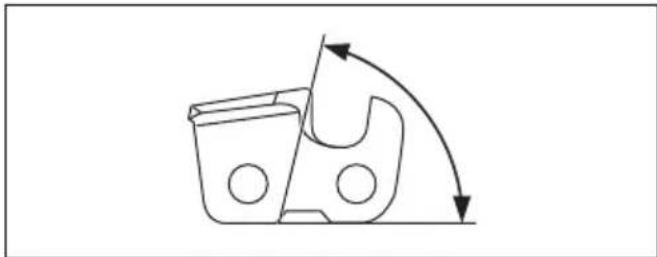
natural_image
Simple line drawing of a mechanical component with curved arrows indicating motion or force (no text or symbols)natural_image
Line drawing of a screwdriver holding a tool, no text or symbols presentnatural_image
Simple line drawing of a dropper with a small symbol (no text or labels)natural_image
Three technical illustrations of mechanical components: a dropper, a clamp, and a tool (no text or symbols)natural_image
Mechanical assembly diagram showing a clamp or bracket with diagonal bracing and mounting holes (no text or symbols)natural_image
Two types of tools: a flat tool and a mechanical clamp (no text or symbols)natural_image
Technical line drawing of a mechanical tool or device with no visible text or symbolsnatural_image
Line drawing of a chain saw with a lever and gear (no text or symbols)natural_image
Line drawing of a chainsaw with a directional arrow indicating motion (no text or symbols)natural_image
Illustration of two hands holding a cylindrical object with directional arrows indicating movement (no text or symbols)natural_image
Illustration of a person using a power tool to cut tree bark with a saw (no text or symbols)natural_image
Technical line drawing of a mechanical assembly with a pipette inserted into a circular housing (no text or symbols)natural_image
Diagram showing mechanical assembly with arrows indicating motion, no text or symbols presentnatural_image
Pure technical line drawing of a mechanical part with no text or symbolsnatural_image
Simple line drawing of a switch component with a black arrow pointing downward (no text or symbols)natural_image
Illustration of a knife cutting through a tool, with a magnified inset showing the blade and handle (no text or symbols)natural_image
Line drawing of a hand holding a cylindrical object with a handle, no text or symbols presentnatural_image
Simple line drawing of a test tube with two crossed arrows indicating direction (no text or symbols)natural_image
Illustration of a hand holding a pen with an arrow indicating rotation (no text or symbols)natural_image
Simple line drawing of a tool or blade with an arrow indicating direction (no text or symbols)natural_image
Technical line drawing of a chain-linking device with gear and mounting bracket (no text or symbols)natural_image
Exploded view diagram of a hairpin showing internal components and parts (no text or labels)natural_image
Prohibition sign showing a worker on a ladder with tools, enclosed in a circle (no text or symbols)natural_image
Illustration of a person using a saw to cut wood or metal, with a hammer indicating the process (no text or symbols present)natural_image
Simple line drawing of a mechanical device with two hands operating it (no text or symbols)natural_image
Simple line drawing of a person falling off a tree with a diagonal no-smoking symbol (no text or labels)natural_image
Line drawing of a car hood with airflow direction arrow (no text or symbols)natural_image
Line drawing of a chainocenter with labeled parts A and B (no text or symbols beyond labels)Attrape-chaine
natural_image
Diagram showing a chain-linker being inserted into a car's side panel with a directional arrow (no text or symbols)natural_image
Technical line drawing of a mechanical component or bracket (no text or symbols)natural_image
Line drawing of a chainsaw with an inset showing a close-up of the blade (no text or symbols)Silencieux

natural_image
Technical line drawing of a mechanical device with no visible text or symbolsSécurité carburant

natural_image
Simple line drawing of a VR headset with a starburst effect (no text or symbols)natural_image
Pure technical line drawing of a mechanical part with no text or symbolsnatural_image
Simple line drawing of a droplet falling into a container with two circular ports (no text or symbols)Montage
Introduction

natural_image
Technical line drawing of a mechanical assembly with labeled component A (no text or symbols present)
natural_image
Technical line drawing of a mechanical assembly with chains and components (no text or symbols)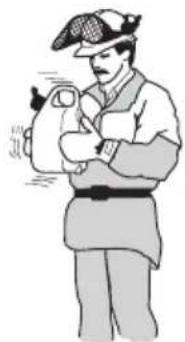
natural_image
Illustration of a person in uniform holding an object, no text or symbols presentnatural_image
Simple black-and-white icon showing a fuel pump with a droplet and plus sign (no text or symbols)natural_image
Abstract black-and-white graphic of a droplet above a stylized mask (no text or symbols)natural_image
Illustration of a person in protective gear using a tool to lift a rolled roller, with an arrow indicating motion (no text or symbols)natural_image
Line drawing of a manual car with a curved arrow indicating motion (no text or symbols)natural_image
Technical line drawing of a mechanical assembly with no visible text or symbolsnatural_image
Technical line drawing of a mechanical assembly with no visible text or symbolsnatural_image
Line drawing of a chain-linking device with a curved arrow indicating motion (no text or symbols)natural_image
Technical line drawing of a mechanical component with a black arrow indicating a specific part (no text or symbols present)natural_image
Illustration of a person using a chainsaw to cut the chain (no text or symbols present)
natural_image
Line drawing of a chain-linking device with arrows indicating motion direction (no text or symbols)natural_image
Simple line drawing of a car hood with airflow arrow indicating direction (no text or symbols)natural_image
Line drawing of a chainsaw with an inset showing a close-up of the gear (no text or symbols)natural_image
Illustration of a person using a chain mill to cut a circular saw (no text or symbols present)natural_image
Line drawing of a manual saw cutting a blade with motion arrows indicating direction (no text or symbols)
natural_image
Illustration of two workers handling large logs, one holding a tool and the other carrying a ladder (no text or symbols)

natural_image
Illustration of a landslide with a lightning bolt, warning sign, and triangular hazard symbol (no text or labels)natural_image
Simple line drawing of a car with a warning sign and explosion effect (no text or symbols)
natural_image
Illustration of a hand using a cable buckle to lift a car, showing the angle and motion direction (no text or symbols)
natural_image
Illustration of a hand using a power saw to cut tree bark with a black arrow indicating the process (no text or symbols present)natural_image
Illustration of a hand using a tool to cut tree bark with a black arrow indicating the direction (no text or symbols present)
flowchart
graph TD
    A["Tree"] --> B["Person with Circle"]
    B --> C["Tree"]
    style A fill:#f9f,stroke:#333
    style C fill:#bbf,stroke:#333
natural_image
Illustration of a person using a tree to spray or spray over a log stack, with no text or symbols present.natural_image
Simple line drawing of a magnifying glass over fire with smoke, no text or symbols present
natural_image
Diagram of concentric circular layers with a vertical bar and directional arrows, no text or symbols present.natural_image
Diagram showing a tree with roots and a horizontal line, accompanied by an arrow indicating direction (no text or symbols)
natural_image
Simple line drawing of a mechanical tool or bracket (no text or symbols)natural_image
Line drawing of a mechanical component with a dome-like base and curved handle (no text or symbols)natural_image
Cross-sectional diagram of a mechanical component with internal structure and directional arrow (no text or labels)natural_image
Cross-sectional diagram of a mechanical or electrical component with layered structure and internal channels (no text or symbols)natural_image
Technical diagram of a mechanical component with internal channels and a directional arrow (no text or labels)natural_image
Simple line drawing of a tractor pulling a tree with a lever (no text or symbols)- Mobile
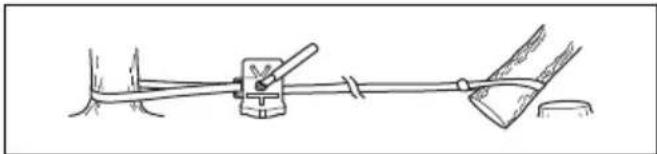
natural_image
Simple line drawing of a mechanical clamp or lever system with no text or symbolsnatural_image
Simple line drawing of a curved path with a ball and scattered particles, no text or symbols present.natural_image
Diagram of a mechanical or fluid system with directional arrows and circular components, no text or symbols present.natural_image
Cross-sectional diagram of a geological or structural cross-section showing layered rock formations and terrain (no text or labels)
natural_image
Diagram showing a cross-section of a layered structure with an upward arrow indicating direction (no text or symbols present)natural_image
Diagram showing two curved arrows pointing outward from a textured surface, with no visible text or symbols.natural_image
Line drawing of a car dashboard with control panel and air vent (no text or symbols)
natural_image
Simple line drawing of a rope tied with a hook, showing rope movement (no text or symbols)natural_image
Illustration of a hand gripping a mechanical component with a curved arrow indicating motion (no text or symbols)natural_image
Illustration of two workers in protective gear using a saw and tree stump (no text or symbols)natural_image
Line drawing of a chain-linking device with arrows indicating motion direction (no text or symbols)natural_image
Line drawing of a mechanical clamp or bracket with an arrow indicating direction (no text or symbols)natural_image
Line drawing of a mechanical tool or bracket with an arrow indicating motion direction (no text or symbols)natural_image
Diagram showing a chain saw cutting into a car's side panel, with an arrow indicating the process (no text or symbols present)natural_image
Technical line drawing of a mechanical component or bracket (no text or symbols)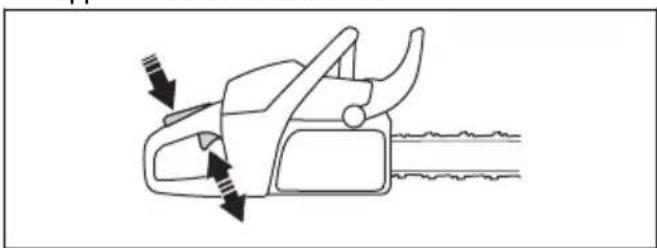
natural_image
Line drawing of a chain-linking device with arrows indicating motion direction (no text or symbols)natural_image
Line drawing of a chainsaw with an inset showing a close-up of the blade (no text or symbols)natural_image
Technical line drawing of a mechanical component with two arrows pointing to features (no text or symbols)natural_image
Technical line drawing of a mechanical component with a screw and mounting bracket (no text or symbols)natural_image
Line drawing of a chainsaw with arrows indicating cutting direction (no text or symbols)natural_image
Mechanical assembly diagram showing a motor or engine component with no visible text or symbolsnatural_image
Exploded view diagram of a mechanical assembly showing internal components like spring, housing, and motor (no text or labels)natural_image
Line drawing of a mechanical assembly with hands holding a tool and rotating components (no text or symbols)natural_image
Line drawing of a hand using a tool to cut a saw (no text or symbols present)natural_image
Technical line drawing of a mechanical device with internal components and housing (no text or symbols)natural_image
Technical line drawing of a spark plug with threaded shaft and mounting base (no text or symbols)natural_image
Simple line drawing of a test tube with a downward arrow indicating compression or dislocation (no text or symbols)natural_image
Simple line drawing of a chain with a central star-like shape (no text or symbols)natural_image
Diagram showing a mechanical component with arrows indicating direction, alongside a separate schematic of a device with a handle and base (no text or symbols)natural_image
Pure diagram of a mechanical or electrical component with arrows indicating direction (no text or symbols)natural_image
Technical drawing of a mechanical part with a vertical dimension line and directional arrow (no text or symbols)natural_image
Technical line drawing of a mechanical tool with two views: one showing a cut and rotation, the other showing a handle (no text or symbols)• L'angle d'impact.
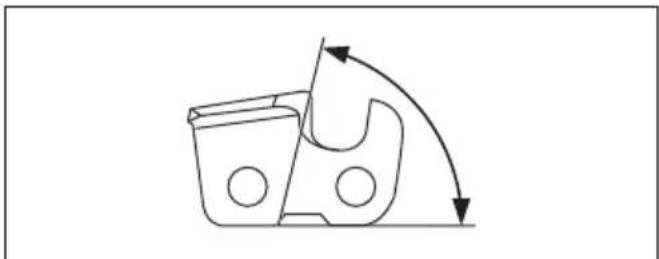
natural_image
Simple line drawing of a mechanical component with curved arrows indicating motion or force (no text or symbols)• La position de la lime.
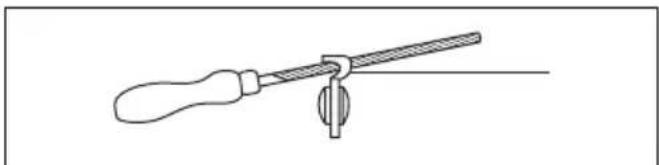
natural_image
Line drawing of a screwdriver holding a lever with a central knob (no text or symbols)natural_image
Simple line drawing of a dropper with a small symbol (no text or labels)natural_image
Three line drawings of mechanical parts: a tool, a plastic component, and a textured object (no text or symbols)natural_image
Technical illustration of a mechanical clamp or bracket assembly (no text or symbols)natural_image
Two types of tools: a flat tool and a mechanical device (no text or symbols visible)natural_image
Pure mechanical diagram showing a lever and gear mechanism without any text or symbolsnatural_image
Line drawing of a chain saw with a lever and arrow indicator (no text or symbols)natural_image
Line drawing of a chainsaw with a directional arrow indicating motion (no text or symbols)natural_image
Illustration of two hands holding a curved object with directional arrows indicating motion (no text or symbols)natural_image
Illustration of a person using a saw to cut tree bark with a hammer, no text or symbols presentnatural_image
Technical diagram of a mechanical assembly with a pipette inserted into a circular housing (no text or symbols visible)natural_image
Mechanical assembly diagram showing two stages of tool application (no text or labels)natural_image
Pure technical line drawing of a mechanical part with no text or symbolsnatural_image
Simple line drawing of a switch mechanism with a downward arrow (no text or symbols)natural_image
Illustration of a cutting tool with a magnified inset showing a cylindrical object (no text or symbols)natural_image
Line drawing of a hand holding a tool, no text or symbols presentnatural_image
Simple line drawing of a test tube with crossed x marks and downward arrows indicating compression or dislocation (no text or symbols)natural_image
Illustration of a hand holding a pen with a curved arrow indicating rotation (no text or symbols)natural_image
Simple line drawing of a pen-like object with an arrow indicating direction (no text or symbols)natural_image
Technical line drawing of a chain-linking device with visible gears and blades (no text or symbols)natural_image
Exploded view diagram of a mechanical device showing internal components and assembly (no text or labels)natural_image
Prohibition sign showing a worker on a ladder holding tools, enclosed in a circle with no text or symbols.natural_image
Illustration of a person using a power saw to cut wood or wood fragments, with an arrow indicating the process (no text or symbols present)natural_image
Illustration of a mechanical device with two hands operating it, no text or symbols presentnatural_image
Illustration of a person climbing a tree with a diagonal line (no text or symbols)natural_image
Line drawing of a manual chain saw with a curved blade and arrow indicating motion (no text or symbols)natural_image
Diagram showing a chain saw cutting down a piece with a magnified inset illustrating the process (no text or symbols present)natural_image
Technical line drawing of a mechanical component (no text or symbols)natural_image
Line drawing of a chainsaw with an inset showing a close-up of the blade (no text or symbols)Marmitta

natural_image
Technical line drawing of an electrical component with no visible text or symbolsnatural_image
Simple line drawing of a VR headset with a starburst effect (no text or symbols)natural_image
Technical line drawing of a mechanical component with a U-shaped groove and a vertical arrow indicating force or dimension (no text or symbols)natural_image
Simple line drawing of a droplet falling from a container with two circular holes (no text or symbols)Montaggio
Introduzione

natural_image
Technical line drawing of a mechanical assembly with labeled component A (no text or symbols present)
natural_image
Technical line drawing of a mechanical assembly with chains and components (no text or symbols)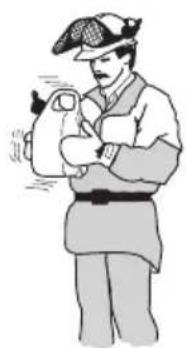
natural_image
Illustration of a person in traditional attire holding an object, no text or symbols presentnatural_image
Simple black-and-white icon showing a droplet and a fuel pump with a plus sign (no text or symbols)natural_image
Illustration of a person in protective gear using a tool to lift a cylindrical object with an arrow indicating motion (no text or symbols)natural_image
Line drawing of a car's side mirror and wheel, showing motion direction (no text or symbols)natural_image
Technical diagram of a mechanical assembly with no visible text or symbolsnatural_image
Technical line drawing of a mechanical component with no visible text or symbolsnatural_image
Line drawing of a manual chain attachment device with motion arrow indicating rotation (no text or symbols)natural_image
Technical line drawing of a mechanical assembly with no visible text or symbolsnatural_image
Illustration of a worker using a chainsaw to cut a tool, showing motion direction (no text or symbols)
natural_image
Line drawing of a mechanical tool with arrows indicating motion or force direction (no text or symbols)natural_image
Line drawing of a car hood with airflow arrow indicating direction (no text or symbols)natural_image
Line drawing of a chainsaw with an inset showing a close-up of the blade (no text or symbols)natural_image
Illustration of a hand using a chainsaw to cut a circular saw (no text or symbols present)natural_image
Line drawing of a manual cutting tool with motion arrows indicating movement (no text or symbols)
AVVERTENZA: Se la catena
natural_image
Illustration of two workers handling stacked logs, one holding a log and the other holding a log (no text or symbols present)

natural_image
Illustration of a landslide with a lightning bolt and warning symbol (no text or labels)natural_image
Simple line drawing of a car with warning symbols indicating hazard (no text or labels)
natural_image
Illustration of a car seatbelt being lifted by a hand, showing the angle and motion direction (no text or symbols)
natural_image
Illustration of a person using a power saw to cut tree bark, with a black arrow indicating the process (no text or symbols present)natural_image
Illustration of a hand using a tool to cut tree bark with a downward arrow indicating the process (no text or symbols present)
natural_image
Illustration of a person spraying tree roots with a light source, no text or symbols presentnatural_image
Illustration of a crossed-out circle with smoke or fire, no text or symbols present
natural_image
Diagram of concentric circular layers with a vertical bar and directional arrows indicating flow or force (no text or symbols)
natural_image
Simple line drawing of a mechanical component or tool with no visible text or symbolsnatural_image
Diagram of a mechanical device with a curved arrow indicating motion or force (no text or symbols)natural_image
Cross-sectional diagram of a mechanical component with layered structure and internal channels (no text or labels)natural_image
Mechanical assembly diagram showing a rotating shaft and housing with a curved arrow indicating motion (no text or symbols)natural_image
Diagram showing a circular structure transforming into a triangular structure with a flag, illustrating mechanical or structural change (no text or symbols present)natural_image
Simple line drawing of a tractor pulling a tree with a lever (no text or symbols)- Manuale
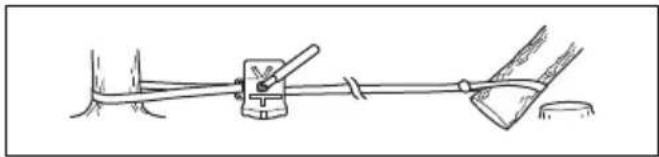
natural_image
Simple line drawing of a mechanical clamp or lever system with no text or symbolsnatural_image
Simple line drawing of a ball rolling down an uneven stream with a downward arrow, no text or symbols presentnatural_image
Diagram of a mechanical or structural system with two curved paths, directional arrows, and circular components (no text or symbols)natural_image
Cross-sectional diagram of a geological or structural cross-section showing layered rock formations and terrain (no text or labels)
natural_image
Diagram showing a cross-section of a layered structure with an upward arrow indicating a specific section (no text or symbols present)natural_image
Diagram of a curved structure with directional arrows indicating flow or movement (no text or symbols)natural_image
Line drawing of a vehicle's internal control panel with no text or symbols
natural_image
Simple line drawing of a circular object with a curved handle and an arrow indicating upward motion (no text or symbols)natural_image
Illustration of a hand using a car seatbelt to lift a vehicle (no text or symbols)natural_image
Illustration of a person using a power saw to cut tree bark (no text or symbols)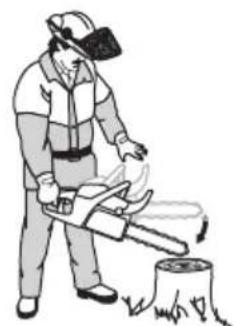
natural_image
Illustration of a person using a manual saw to cut tree bark (no text or symbols)natural_image
Line drawing of a chain-linking device with directional arrows indicating motion (no text or symbols)natural_image
Line drawing of a mechanical clamp or clip with an arrow indicating motion direction (no text or symbols)natural_image
Line drawing of a mechanical tool with an arrow indicating motion or force (no text or symbols)natural_image
Diagram showing a chain-linker being inserted into a car's side panel with a close-up view of the component (no text or symbols present)natural_image
Technical line drawing of a mechanical component or bracket (no text or symbols)natural_image
Line drawing of a chainsaw with an inset showing a close-up of the electrical outlet (no text or symbols present)natural_image
Technical line drawing of a mechanical device with internal components and mounting holes (no text or symbols)natural_image
Technical line drawing of a mechanical component with a screw and mounting bracket (no text or symbols)natural_image
Line drawing of a chainsaw with arrows indicating force or movement (no text or symbols)natural_image
Mechanical assembly diagram showing a motor or engine component with directional arrows indicating motion (no text or symbols present)natural_image
Exploded view diagram of a mechanical assembly showing internal components like gears, springs, and a motor (no text or labels)natural_image
Line drawing of a mechanical assembly with hands holding a tool, showing motion arrows indicating movement (no text or symbols)natural_image
Line drawing of a hand using a tool to cut a saw (no text or symbols present)natural_image
Technical line drawing of a mechanical device with internal components and housing (no text or symbols)natural_image
Simple line drawing of a test tube with a downward arrow indicating compression or dislocation (no text or symbols)natural_image
Simple line drawing of a chain with a star-like pattern inside, no text or symbols present.natural_image
Technical line drawing showing a mechanical component with a shaft and housing, no text or symbols presentnatural_image
Simple line drawing of a mechanical component with two arrows indicating direction (no text or symbols)natural_image
Technical diagram showing a mechanical part with a vertical scale and directional arrows (no text or labels)natural_image
Technical line drawing of a mechanical tool with two views: one showing a cut and rotation, the other showing a handle (no text or symbols)• Angolo di taglio.
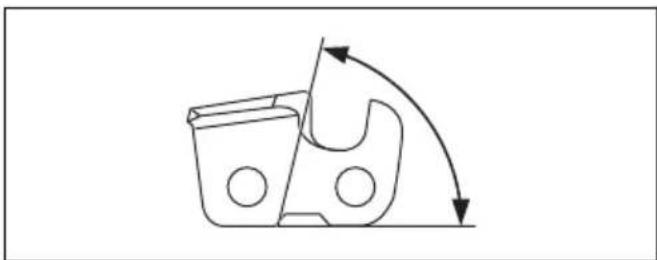
natural_image
Simple line drawing of a mechanical component with curved arrows indicating motion or force (no text or symbols)natural_image
Line drawing of a screwdriver holding a lever with a central pivot (no text or symbols)natural_image
Simple line drawing of a dropper with a small symbol (no text or labels)natural_image
Line drawings of three mechanical components: a dropper, a bracket, and a clip (no text or symbols)natural_image
Mechanical assembly diagram showing a linkage mechanism with no visible text or symbolsnatural_image
Two types of tools: a radial tool and a mechanical device (no text or symbols visible)natural_image
Technical line drawing of a mechanical component with no visible text or symbolsnatural_image
Line drawing of a chain saw with a directional arrow indicating motion (no text or symbols)natural_image
Line drawing of a chainsaw with a hammer and screwdriver (no text or symbols)natural_image
Illustration of two hands holding a curved object with directional arrows indicating movement (no text or symbols)natural_image
Illustration of a person using a saw to cut tree bark with a downward arrow (no text or symbols)natural_image
Technical line drawing of a mechanical component with two views: one showing a flanged wheel and the other a separate bolted part (no text or symbols)natural_image
Technical diagram of a mechanical assembly with a pipette inserted into a circular housing (no text or symbols)natural_image
Mechanical assembly diagram showing two views of a chain with arrows indicating motion (no text or symbols)natural_image
Pure technical line drawing of a mechanical part with no text or symbolsnatural_image
Simple line drawing of a switch component with a black arrow pointing to the left side (no text or symbols)natural_image
Illustration of a tool and a mechanical part, showing a cross-section view with no visible text or symbols.natural_image
Line drawing of a hand holding a cylindrical object with a ruler, no text or symbols presentnatural_image
Illustration of a hand holding a pen with a circular arrow indicating rotation (no text or symbols)natural_image
Simple line drawing of a tool or plunger with an arrow indicating direction (no text or symbols)natural_image
Technical line drawing of a chain-linking device with gear and mounting bracket (no text or symbols)natural_image
Technical line drawing of a mechanical device with exploded view showing internal components (no text or labels)natural_image
Illustration of a person using a saw to cut wood or wood fragments with a hammer and scale (no text or symbols)natural_image
Illustration of a hand operating a mechanical device with a tool (no text or symbols)natural_image
Simple line drawing of a person climbing a tree with a diagonal no-smoking symbol (no text or labels)natural_image
Line drawing of a car hood with airflow direction arrow (no text or symbols)Gashendelvergrendeling
natural_image
Line drawing of a chain-linker with labeled parts A and B (no text or symbols beyond labels)Kettingvanger
natural_image
Diagram showing a chain-linker being inserted into a car's side panel with a directional arrow (no text or symbols)natural_image
Technical line drawing of a mechanical component or bracket (no text or symbols)Trillingdempingssysteem
Start/stop-schakelaar
natural_image
Line drawing of a chainsaw with an inset showing a close-up of the blade (no text or symbols)Geluidemper

WAARSCHUWING: De
natural_image
Technical line drawing of an electrical contactor or relay device with no visible text or symbolsBrandstofveiligheid

natural_image
Simple line drawing of a VR headset with a starburst effect (no text or symbols)natural_image
Technical line drawing of a mechanical component with a U-shaped groove and a vertical arrow indicating force or dimension (no text or symbols)natural_image
Simple line drawing of a droplet falling into a mechanical component (no text or symbols)Montage
Inleiding

natural_image
Technical line drawing of a mechanical assembly with labeled component A (no text or symbols present)
natural_image
Technical line drawing of a mechanical assembly with gears and chains (no text or symbols)natural_image
Simple black-and-white icon of a fuel pump with a droplet and plus sign, no text or symbols present.natural_image
Abstract black-and-white graphic of a droplet above a stylized mask (no text or symbols)natural_image
Illustration of a person in protective gear using a tool to lift a roller, with an arrow indicating upward motion (no text or symbols)natural_image
Line drawing of a manual car hood with airflow direction arrow (no text or symbols)natural_image
Technical line drawing of a mechanical component with a black arrow pointing to a specific part (no text or symbols present)- Zet de chokehendel in de chokestand.
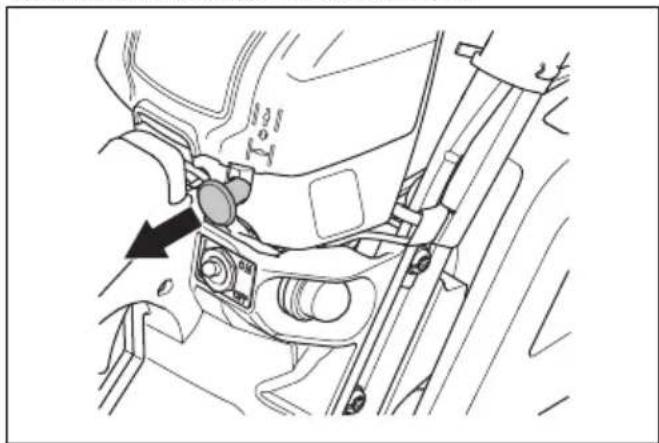
natural_image
Technical line drawing of a mechanical assembly with no visible text or symbolsnatural_image
Diagram of a car's side profile showing airflow direction (no text or symbols)natural_image
Technical line drawing of a mechanical assembly with no visible text or symbolsnatural_image
Illustration of a person using a chainsaw to cut the chain (no text or symbols present)
natural_image
Line drawing of a chain-linking device with arrows indicating motion (no text or symbols)natural_image
Diagram of a manual tool emitting exhaust smoke from a pipe (no text or symbols)natural_image
Line drawing of a chainsaw with an inset showing a close-up of the blade (no text or symbols)Trekslag en duwslag
natural_image
Illustration of a hand using a chainsaw to cut a circular saw (no text or symbols present)natural_image
Line drawing of a manual saw cutting a chain, showing blade and gear motion (no text or symbols)
natural_image
Illustration of two workers carrying large logs, one pulling a wooden log and the other handling stacked logs (no text or symbols)

natural_image
Illustration of a landslide with a lightning bolt and warning triangle (no text or symbols)natural_image
Simple line drawing of a car with a warning sign and explosion symbol (no text or labels)
natural_image
Illustration of a car seatbelt being lifted by a hand, showing the angle and motion direction (no text or symbols)
WAARSCHUWING: Als
natural_image
Illustration of a hand using a saw to cut tree bark with a black arrow indicating the process (no text or symbols present)natural_image
Illustration of a person using a tool to cut tree bark with a downward arrow indicating the process (no text or symbols present)
WAARSCHUWING: Als
flowchart
graph TD
    A["Tree"] --> B["Human Figure"]
    B --> C["Tree"]
    style A stroke:#000,stroke-width:2px
    style C stroke:#000,stroke-width:2px
    note1[" "] --> A
    note2[" "] --> C
natural_image
Illustration of a person using a tree spray gun to spray wood at a post (no text or symbols)natural_image
Illustration of a magnifying glass with a diagonal line and smoke, no text or symbols present
WAARSCHUWING: Bij
natural_image
Illustration of a worker using a tool to lift a vertical pipe, with arrows indicating flow direction (no text or symbols)natural_image
Diagram of concentric circular layers with a vertical bar and directional arrows, no text or symbols present.natural_image
Diagram showing a tree with roots and a horizontal line, accompanied by an arrow indicating direction (no text or symbols)
natural_image
Simple line drawing of a mechanical tool or bracket (no text or symbols)natural_image
Simple line drawing of a mechanical component or tool with no text or symbolsnatural_image
Diagram of a mechanical component with a curved arrow indicating direction (no text or symbols)natural_image
Technical line drawing of a mechanical component with layered structure (no text or symbols)natural_image
Mechanical diagram showing a rotating shaft and wheel assembly with a directional arrow (no text or labels)natural_image
Diagram showing a circular structure with internal channels and an arrow indicating direction, alongside a triangular diagram of a tree trunk with a leaf-like structure (no text or symbols)natural_image
Simple line drawing of a tractor pulling a tree with a lever (no text or symbols)• Draagbaar
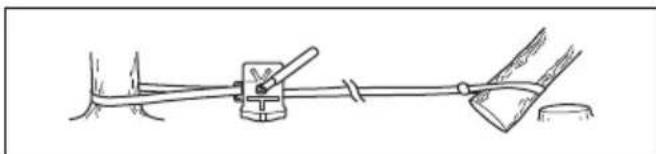
natural_image
Simple line drawing of a mechanical clamp or lever mechanism (no text or symbols)Bomen en takken zagen die onder spanning staan
natural_image
Simple line drawing of a curved path with a ball and directional arrow, no text or symbols present- Bepaal de veiligste methode om de spanning af te laten.
natural_image
Diagram of a mechanical or fluid system with directional arrows and circular components, no text or symbols present.natural_image
Cross-sectional diagram of a geological or structural cross-section showing layered rock formations and terrain (no text or labels)
natural_image
Diagram showing a cross-section of a layered structure with an upward arrow indicating direction (no text or symbols present)natural_image
Diagram showing wave propagation with arrows indicating direction (no text or symbols)natural_image
Line drawing of a vehicle's internal control panel with no text or symbols
natural_image
Simple line drawing of a rope tied with a hook, showing rope routing and directional arrows (no text or symbols)natural_image
Illustration of a hand using a tool to lift a car (no text or symbols present)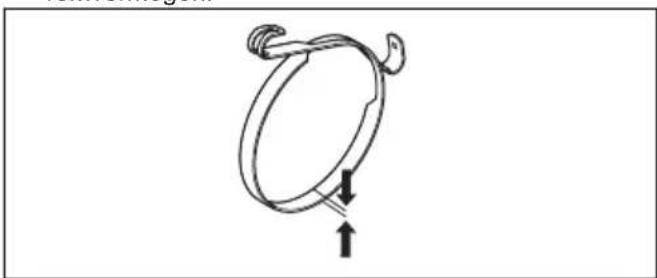
natural_image
Simple line drawing of a circular object with a loop and directional arrows, no text or symbols present.natural_image
Two identical illustrations of a person using a saw to cut tree stumps, showing mechanical components and tool path (no text or symbols)natural_image
Line drawing of a chain-linking device with directional arrows indicating motion (no text or symbols)natural_image
Line drawing of a mechanical tool or bracket with an arrow indicating motion direction (no text or symbols)- Controleer of de gashendel vergrendeld is in de stationaire stand wanneer de gashendelvergrendeling wordt losgelaten.
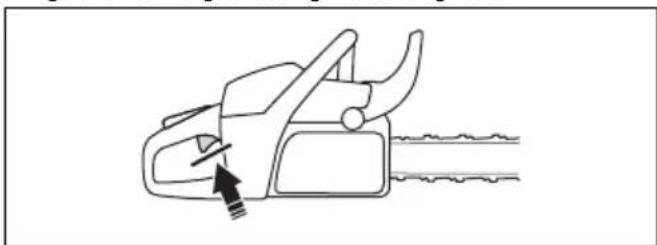
natural_image
Line drawing of a hairpin with a black arrow indicating the blade direction (no text or symbols)natural_image
Diagram showing a chain-linking tool interacting with a car, with an inset view of the tool's side view (no text or symbols present)Controleer de rechterhandbescherming
natural_image
Technical line drawing of a mechanical component or bracket (no text or symbols)Trillingsdempingssysteem controleren
natural_image
Line drawing of a chainsaw with an inset showing a close-up of the blade (no text or symbols)Geluidemper controleren

natural_image
Technical line drawing of a mechanical device with two bolted components and directional arrows indicating assembly or movement (no text or symbols)natural_image
Technical line drawing of a mechanical component with a screw and lever assembly (no text or symbols)natural_image
Line drawing of a chainsaw with arrows indicating force or movement (no text or symbols)natural_image
Mechanical assembly diagram showing a motor or gear component with directional arrows indicating motion (no text or symbols present)natural_image
Exploded view diagram of a mechanical assembly showing internal components like gears, springs, and a motor (no text or labels)natural_image
Technical line drawing of a mechanical assembly with hands operating a tool (no text or symbols present)natural_image
Line drawing of a hand using a tool to cut a saw (no text or symbols present)natural_image
Technical line drawing of a mechanical device with internal components and housing (no text or symbols)natural_image
Technical line drawing of a mechanical component with threaded body and mounting base (no text or symbols)natural_image
Simple line drawing of a cylindrical object with a downward arrow and two small circles inside, no text or symbols present.natural_image
Diagram showing a mechanical component with arrows indicating direction, alongside a separate view of a device with a curved handle (no text or symbols)natural_image
Simple line drawing of a mechanical component with two arrows indicating direction (no text or symbols)natural_image
Pure technical diagram showing a mechanical part and a vertical rod with directional arrows (no text or symbols)natural_image
Technical line drawing of a mechanical tool with two views: one showing a cut and rotation, the other showing a fillet or blade (no text or symbols)- Snijhoek.
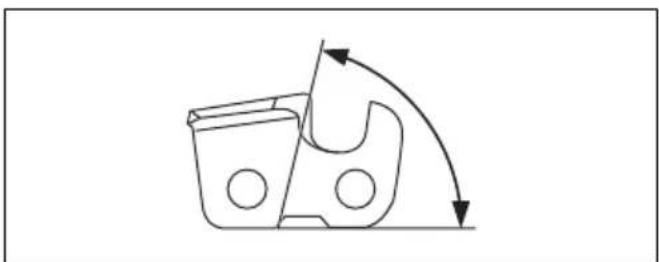
natural_image
Simple line drawing of a mechanical component with curved arrows indicating motion or force (no text or symbols)• Vijlpositie.
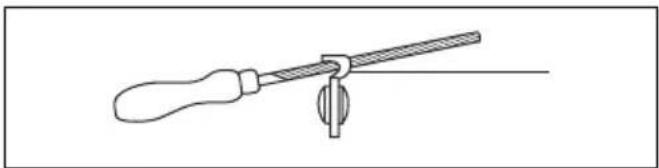
natural_image
Line drawing of a screwdriver holding a lever with a central knob (no text or symbols)natural_image
Simple line drawing of a dropper with a small symbol (no text or labels)natural_image
Line drawings of three mechanical components: a dropper, a bracket, and a clamp device (no text or symbols)natural_image
Mechanical assembly diagram showing a clamp or bracket with diagonal bracing and mounting bracket (no text or symbols)natural_image
Two mechanical tools: a radial tool and a textured device (no text or symbols visible)natural_image
Technical line drawing of a mechanical component with no visible text or symbolsnatural_image
Line drawing of a chainsaw with a directional arrow indicating motion (no text or symbols)natural_image
Line drawing of a chainsaw with a hammer and arrow indicating motion (no text or symbols)natural_image
Illustration of two hands holding a cylindrical object with directional arrows indicating motion (no text or symbols)natural_image
Illustration of a person using a power tool to clean tree stumps (no text or symbols)natural_image
Technical illustration of a mechanical assembly with a tool inserted into a circular housing (no text or symbols)Snijuitrusting controleren
natural_image
Mechanical assembly diagram showing two views of a chain with arrows indicating motion (no text or symbols)natural_image
Pure technical line drawing of a mechanical part with no text or symbolsnatural_image
Simple line drawing of a switch mechanism with a black arrow pointing to the button (no text or symbols)natural_image
Diagram showing a tool interacting with a vertical bar and a cutting tool, with no visible text or symbols.natural_image
Line drawing of a hand holding a cylindrical object, no text or symbols presentnatural_image
Illustration of a hand holding a device with a black arrow indicating rotation (no text or symbols)natural_image
Simple line drawing of a tool with an arrow indicating direction (no text or symbols)natural_image
Technical line drawing of a chain-linking device with gear and mounting bracket (no text or symbols)Koelsysteem reinigen
natural_image
Exploded view diagram of a mechanical device showing internal components like gears and housing (no text or labels)natural_image
Prohibition sign showing a worker climbing a rope with a diagonal line, no text or symbols present.natural_image
Illustration of a person using a saw to cut wood or wood fragments, with a hammer indicating the process (no text or symbols present)natural_image
Illustration of a mechanical device with two hands operating it, no text or symbols presentnatural_image
Prohibition sign showing a person walking under a tree with a diagonal line (no text or symbols)natural_image
Simple line drawing of a person climbing a tree with a diagonal line (no text or symbols)natural_image
Line drawing of a manual car with a curved blade and arrow indicating motion (no text or symbols)natural_image
Diagram showing a chain-linking device with motion lines and a close-up of its internal components (no text or symbols)natural_image
Technical line drawing of a mechanical bracket component (no text or symbols)natural_image
Line drawing of a chainsaw with an inset showing a close-up of the blade (no text or symbols)Silenciador

natural_image
Technical line drawing of a mechanical component with a screw and pin (no text or symbols)natural_image
Simple line drawing of a device with a starburst effect (no text or symbols)natural_image
Pure technical line drawing of a mechanical component with no text or symbolsnatural_image
Simple line drawing of a droplet falling into a container with a handle (no text or symbols)Montagem
Introdução

natural_image
Technical line drawing of a mechanical assembly with labeled component A (no text or symbols present)
natural_image
Technical line drawing of a mechanical assembly with chains and components (no text or symbols)natural_image
Simple black icon showing a droplet and a fuel pump with a plus sign (no text or symbols)natural_image
Illustration of a person in protective gear using a tool to lift a large cylindrical object, with an arrow indicating upward motion (no text or symbols present)natural_image
Diagram of a mechanical device with a curved arrow indicating rotation or motion (no text or symbols)natural_image
Technical diagram of a mechanical assembly with no visible text or symbolsnatural_image
Technical line drawing of a mechanical component with no visible text or symbolsnatural_image
Line drawing of a manual chain saw with motion arrow indicating clockwise motion (no text or symbols)natural_image
Technical line drawing of a mechanical assembly with no visible text or symbolsnatural_image
Illustration of a person using a chainsaw to cut the saw (no text or symbols present)
natural_image
Line drawing of a chain-linking device with arrows indicating motion direction (no text or symbols)natural_image
Diagram of a manual chain saw with motion arrow indicating clockwise motion (no text or symbols)- Utilize o produto.
natural_image
Line drawing of a chainsaw with an inset showing a close-up of the blade (no text or symbols)Corrente a puxar e corrente a empurrar
natural_image
Illustration of a hand using a chainsaw to cut a circular saw (no text or symbols present)natural_image
Line drawing of a manual saw cutting process with motion arrows indicating cycle (no text or symbols)
natural_image
Illustration of two workers handling stacked logs, one holding a log and the other inspecting a log (no text or symbols present)

natural_image
Line drawing of a chain saw cutting through a pipe with a downward arrow indicating the process (no text or symbols)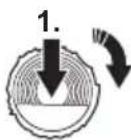
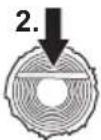
natural_image
Illustration of a landslide with a lightning bolt and warning triangle (no text or symbols)natural_image
Line drawing of a chain-linking machine with a gear and blade (no text or symbols)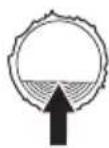
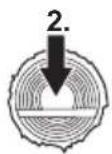
1.
natural_image
Line drawing of a chainsaw with a downward arrow indicating motion (no text or symbols)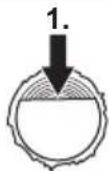
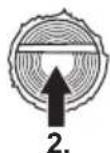

natural_image
Illustration of a car seatbelt being lifted by a hand, showing the angle and motion direction (no text or symbols)
natural_image
Illustration of a hand using a power saw to cut tree bark with a black arrow indicating the process (no text or symbols present)natural_image
Illustration of a person using a power tool to cut tree bark with a downward arrow indicating the process (no text or symbols present)
natural_image
Illustration of a person spraying tree roots with a light source, no text or symbols presentnatural_image
Simple line drawing of a tree with a circular object and a diagonal line, no text or symbols present.
natural_image
Diagram of concentric circular layers with a vertical bar and directional arrows, no text or symbols present.Cortes direcionais
natural_image
Diagram showing a geological or structural interaction with arrows indicating direction of movement (no text or symbols present)
natural_image
Simple line drawing of a mechanical component or tool with no visible text, numbers, or symbols.natural_image
Diagram of a mechanical tool with a circular component and a curved arrow indicating motion (no text or symbols)natural_image
Cross-sectional diagram of a mechanical component with layered structure (no text or labels)natural_image
Mechanical diagram showing a rotating shaft and wheel assembly with a directional arrow (no text or labels)natural_image
Diagram showing a circular structure transforming into a tree with an arrow indicating direction (no text or symbols)natural_image
Simple line drawing of a tractor pulling a tree with a lever (no text or symbols)- Portátil
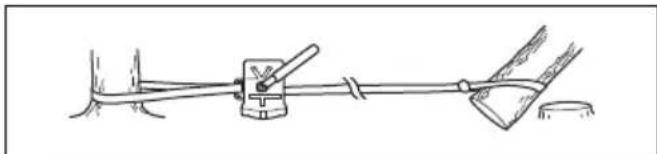
natural_image
Simple line drawing of a mechanical clamp or lever system with no text or symbolsnatural_image
Simple line drawing of a curved path with a ball and directional arrow, no text or symbols presentnatural_image
Diagram of a mechanical or fluid system with two curved surfaces, directional arrows, and circular objects (no text or symbols)natural_image
Cross-sectional diagram of a geological or structural cross-section showing layered rock formations and terrain (no text or labels)
natural_image
Cross-sectional diagram of a layered geological or structural structure with an upward arrow indicating a specific layer (no text or symbols present)natural_image
Diagram of a curved structure with directional arrows indicating flow or movement (no text or symbols)natural_image
Line drawing of a car air intake console with control panel and fan (no text or symbols)
natural_image
Simple line drawing of a rope tied with a loop, showing rope routing and directional arrows (no text or symbols)natural_image
Illustration of a hand pressing down on a car seatbelt, showing motion arrows (no text or symbols)natural_image
Illustration of two workers in protective gear using a saw and tree stump, no text or symbols presentnatural_image
Line drawing of a chain-linking device with arrows indicating motion direction (no text or symbols)natural_image
Line drawing of a mechanical tool with an arrow indicating motion direction (no text or symbols)natural_image
Line drawing of a chain-linking device with a black arrow indicating the blade direction (no text or symbols)natural_image
Diagram showing a chain saw cutting through a tool, with an inset close-up of the machining process (no text or symbols)natural_image
Technical line drawing of a mechanical component or bracket (no text or symbols)natural_image
Line drawing of a chainsaw with an inset showing a close-up of the blade (no text or symbols)natural_image
Technical line drawing of a mechanical component with two bolted parts and directional arrows indicating movement (no text or symbols)natural_image
Technical line drawing of an electrical contactor with a screw and mounting bracket (no text or symbols)- Substitua a rede retentora de faíscas danificada.
natural_image
Line drawing of a chainsaw with arrows indicating force or movement (no text or symbols)natural_image
Mechanical assembly diagram showing a motor or engine component with no visible text or symbolsnatural_image
Exploded view diagram of a mechanical assembly showing internal components like gears and housing (no text or labels)Apertar a mola de retorno
natural_image
Line drawing of a mechanical assembly with hands operating a component, showing motion arrows (no text or symbols)natural_image
Line drawing of a hand using a tool to cut a mechanical component (no text or symbols)natural_image
Technical line drawing of a mechanical device with internal components and housing (no text or symbols)natural_image
Simple line drawing of a test tube with a downward arrow indicating force or movement (no text or symbols)natural_image
Simple line drawing of a chain with a star-like symbol inside, no text or labels present.natural_image
Diagram showing a mechanical component with directional arrows and a separate view of a curved object (no text or symbols)natural_image
Simple line drawing of a mechanical component with two arrows indicating direction (no text or symbols)• Largura dos elos de acionamento, mm/pol.
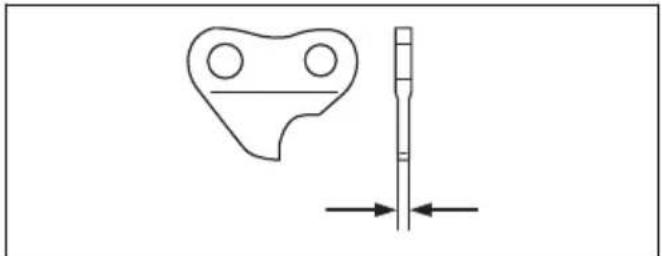
natural_image
Technical diagram showing a mechanical part with a vertical rod and directional arrows (no text or labels)natural_image
Technical line drawing of a mechanical tool with a curved arrow indicating rotation (no text or symbols)- Ângulo de corte.
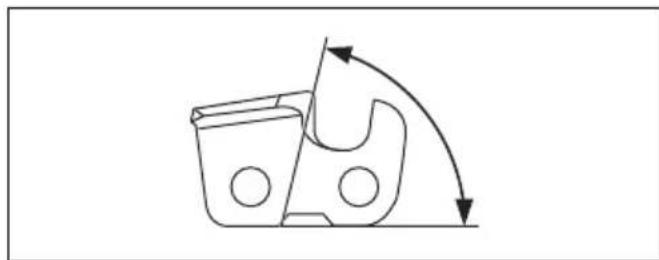
natural_image
Simple line drawing of a mechanical component with curved arrows indicating motion or force (no text or symbols)- Posição da lima.
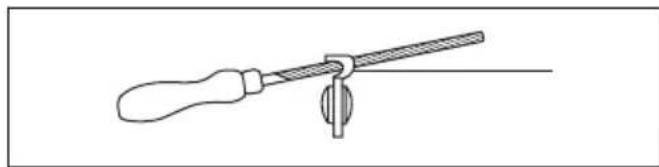
natural_image
Line drawing of a screwdriver holding a lever (no text or symbols)natural_image
Simple line drawing of a dropper with a small symbol (no text or labels)natural_image
Line drawings of three mechanical components: a dropper, a plastic clamp, and a tool holder (no text or symbols)natural_image
Mechanical assembly diagram showing a clamp or bracket with diagonal hatching and mounting holes (no text or symbols)natural_image
Two types of hair tools: a radial tool and a rectangular tool (no text or symbols visible)natural_image
Pure mechanical diagram showing a gear and shaft assembly without any text, numbers, or symbolsnatural_image
Line drawing of a chain saw with a hammer and gear (no text or symbols)natural_image
Line drawing of a chain saw with a directional arrow indicating motion (no text or symbols)natural_image
Illustration of two hands holding a cylindrical object with directional arrows indicating motion (no text or symbols)natural_image
Illustration of a person using a power tool to cut tree bark with a downward arrow (no text or symbols)natural_image
Technical illustration of a mechanical assembly with a tool inserted into a circular housing (no text or symbols)natural_image
Diagram showing mechanical assembly with two views of a chain (no text or symbols)natural_image
Pure geometric diagram showing a 3D shape with a curved cutout and a rectangular base, no text or symbols present.natural_image
Simple line drawing of a switch handle with a black arrow pointing to the button (no text or symbols)natural_image
Illustration of a pair of scissors cutting through a tool, with a magnified inset showing the blade (no text or symbols)natural_image
Line drawing of a hand holding a tool, no text or symbols presentnatural_image
Simple line drawing of a test tube with two crossed arrows indicating direction (no text or symbols)natural_image
Illustration of a hand holding a tool with an arrow indicating rotation (no text or symbols)natural_image
Diagram of a tool with an arrow indicating direction, showing a curved blade or handle (no text or symbols)natural_image
Technical line drawing of a chain-linking device with gear and mounting bracket (no text or symbols)natural_image
Exploded view diagram of a mechanical device showing internal components like gears and housing (no text or labels)natural_image
Simple line drawing of a crossed-out cigarette with smoke and a diagonal line (no text or symbols)natural_image
Prohibition sign showing a worker climbing a pole with a diagonal line (no text or symbols)natural_image
Illustration of a worker cutting wood with a tool, showing a curved arrow indicating motion (no text or symbols)natural_image
Illustration of a hand operating a mechanical device with no visible text or symbolsnatural_image
Prohibition sign showing a worker cutting tree branches (no text or symbols)natural_image
Simple line drawing of a car with airflow arrows indicating direction (no text or symbols)Zaklep ročice plina
natural_image
Diagram of a chainocenter with labeled parts A and B, showing blade and handle (no text or symbols beyond labels)Lovilnik verige
natural_image
Diagram showing a chain-linking tool interacting with a car, with an arrow indicating the process (no text or symbols present)Ščitnik desne roke
natural_image
Pure technical line drawing of a mechanical component (no text or symbols)Sistem za dušenje tresljajev
natural_image
Line drawing of a chainsaw with an inset showing a close-up of the blade (no text or symbols)Dušilnik

natural_image
Technical line drawing of a mechanical component with no visible text or symbolsPo dolivanju goriva v določenih primerih ne smete nikoli zagnati izdelka:
- Če ste izdelek polili z gorivom ali verižnim oljem. Obrišite žago in počakajte, da ostanki goriva izhlapijo.
- Če ste sebe ali svoja oblačila polili z gorivom. Umijte dele telesa, ki so prišli v stik z gorivom, in se preoblecite. Uporabljajte milo in vodo.
- Če gorivo izteka iz izdelka. Redno preverjajte tesnost posode za gorivo, pokrova za gorivo in dovodov goriva.
natural_image
Simple line drawing of a device with a spark and handle (no text or symbols)natural_image
Pure technical line drawing of a mechanical part with no text or symbolsnatural_image
Simple line drawing of a mechanical component with a droplet above it (no text or symbols)Montaža
Uvod

natural_image
Technical line drawing of a mechanical assembly with labeled component A (no text or symbols present)
natural_image
Technical line drawing of a mechanical assembly with chains and components (no text or symbols)- Z roko privijte matico meča.
Delovanje
Uvod

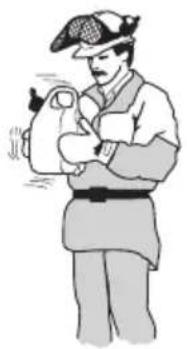
natural_image
Illustration of a person in uniform holding an object, no text or symbols present- Dolijte polovico bencina v čisto posodo za gorivo.
- Dodajte celotno količino olja.
- Pretresite mešanico goriva.
- V posodo dodajte še preostalo količino bencina.
- Temeljito pretresite mešanico goriva.

natural_image
Simple black-and-white icon showing a fuel pump with a droplet and plus sign (no text or symbols)- Pretresite posodo in tako poskrbite za ustrezno mešanje goriva.
- Odstranite pokrovček posode za gorivo, da sprostite pritisk.
- Napolnite posodo za gorivo.

natural_image
Abstract black silhouette of a stylized face with a droplet above it (no text or symbols)natural_image
Illustration of a person in protective gear using a tool to lift a rolled roller, with an upward arrow indicating motion (no text or symbols)natural_image
Line drawing of a manual saw blade with motion arrow indicating rotation (no text or symbols)natural_image
Technical line drawing of a mechanical component with a black arrow pointing to a circular feature (no text or symbols present)natural_image
Technical line drawing of a mechanical component with no visible text or symbolsnatural_image
Line drawing of a manual chain attachment mechanism with motion arrow (no text or symbols)natural_image
Technical line drawing of a mechanical component with no visible text or symbolsOpomba: Čoka ne nastavite v položaj za čok.
natural_image
Illustration of a person using a power saw to cut a chain (no text or symbols present)
natural_image
Line drawing of a chain-linking device with arrows indicating motion direction (no text or symbols)natural_image
Simple line drawing of a manual tool emitting exhaust smoke (no text or symbols)- Uporabite izdelek.
Izklop izdelka
- Za zaustavitev motorja pritisnite stikalo za vklop/izklop, da preklopite v položaj 0.
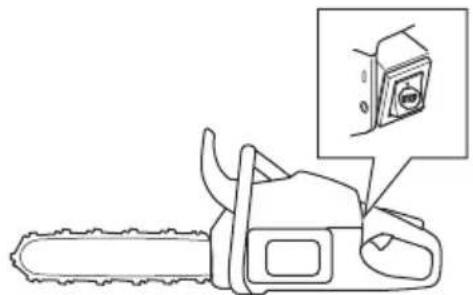
natural_image
Line drawing of a chainsaw with an inset showing a close-up of the blade (no text or symbols)Žaganje z vlečenjem in potiskanjem motorne žage
natural_image
Illustration of a hand using a chain mill to cut a circular saw (no text or symbols present)- Motorno žago potiskate, ko žagate z zgornjim delom meča. Veriga potiska izdelek v smeri upravljavca.
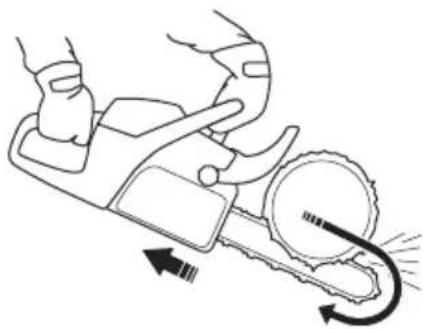
natural_image
Line drawing of a manual saw cutting process with motion arrows indicating direction (no text or symbols)
Tehnike žaganja

natural_image
Illustration of two workers handling stacked logs, no text or symbols present
natural_image
Illustration of a chain saw cutting down a blade with a warning symbol (no text or labels)
OPOZORILO: Ko dokončate zarezo, se veriga ne sme dotakniti tal.
- Zažagajte skozi približno 23 hloda in se ustavite. Hlod obrnite in zažagajte še z nasprotne strani.
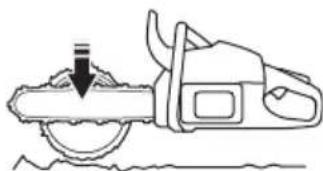
natural_image
Line drawing of a chainsaw with a downward arrow indicating force or motion (no text or symbols)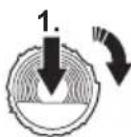
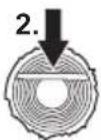
Žaganje hloda z oporo na enem koncu

OPOZORILO: Hlod se med žaganjem ne sme prelomiti. Upoštevajte spodnja navodila.
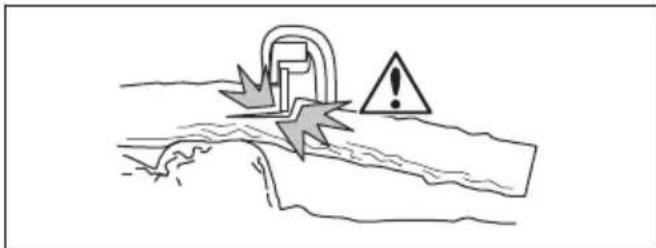
natural_image
Illustration of a landslide with a lightning bolt, warning sign, and hazard symbol (no text or labels)- Zažagajte skozi približno 13 hloda tako, da motorno žago potiskate.
- Nato skozi hlod zažagajte še z vlečenjem motorne žage k sebi, dokler se zarezi ne srečata.
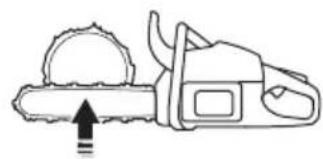
natural_image
Line drawing of a chainsaw with a gear and blade, showing motion direction (no text or symbols)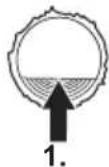

Žaganje hloda z oporo na dveh koncih

OPOZORILO: Veriga se med žaganjem ne sme zagozditi v hlodu. Upoštevajte spodnja navodila.
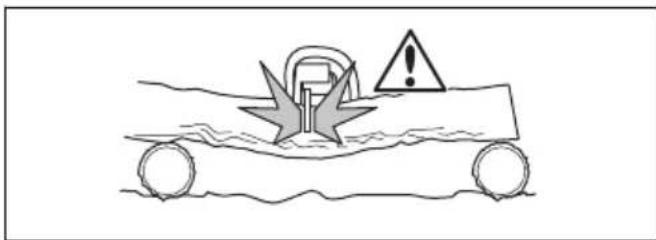
natural_image
Line drawing of a chainsaw with a downward arrow indicating motion (no text or symbols)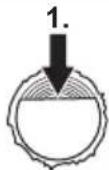
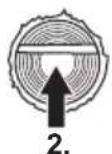

natural_image
Illustration of a hand using a belt buckle to lift a car, showing the angle and motion direction (no text or symbols)
OPOZORILO: Če niste prepričani, kako žagati vejo, se pred nadaljevanjem posvetujte s profesionalnim upravljavcem motorne žage.
- Odstranite veje z vrha hloda.
a) Držite izdelek na deblu in se z mečem premikajte po hlodu.
b) Žagajte s potiskanjem motorne žage.
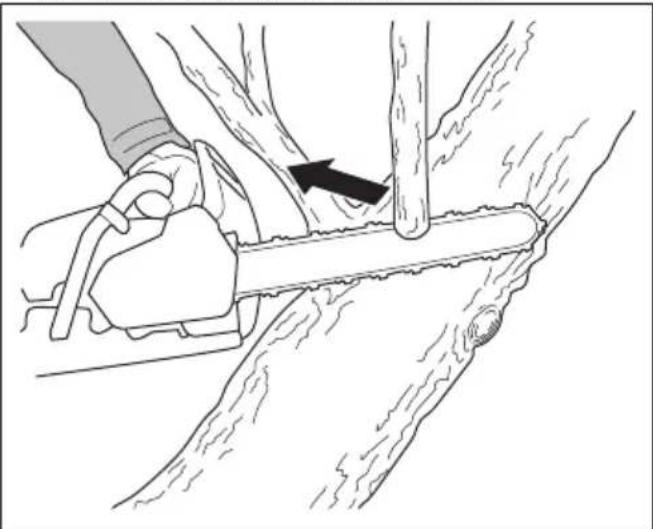
natural_image
Illustration of a person using a chainsaw to cut tree bark with a black arrow indicating the process (no text or symbols present)- Odstranite veje z leve strani hloda.
a) Glede na napetost v veji izberite ustrezno tehniko žaganja.
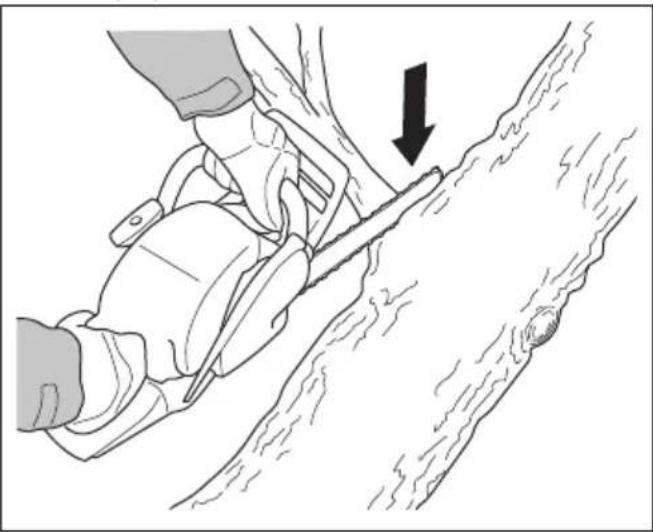
natural_image
Illustration of a person using a power tool to cut tree bark with a downward arrow indicating the process (no text or symbols present)
OPOZORILO: Če niste prepričani, kako žagati vejo, se pred nadaljevanjem posvetujte s profesionalnim upravljavcem motorne žage.
natural_image
Illustration of a person using a tree to spray or spray over a fallen log, with no text or symbols present.Ugotavljanje smeri podiranja
natural_image
Simple line drawing of a lollipop with a no-smoking symbol (no text or labels)
natural_image
Pure diagram of concentric circular lines with a vertical bar and directional arrows, no text or symbols present.Žaganje smernih rezov

OPOZORILO: Bodite previdni pri žaganju s konico meča. Začnite žagati s spodnjim delom konice meča, da v hlod naredite vrtalni rez.
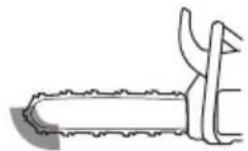
natural_image
Simple line drawing of a mechanical component with no text or symbolsb) Žagajte z vlečenjem motorne žage, dokler ne ostane 13 hloda.
c) Meč povlecite 5–10 cm (2–4 palce) nazaj.
d) Zažagajte skozi preostali del hloda, da dokončate varni kot, ki je širok 5–10 cm (2–4 palce).
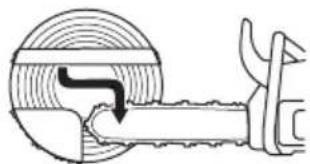
natural_image
Diagram of a mechanical tool with a curved arrow indicating motion or force (no text or symbols)natural_image
Cross-sectional diagram of a mechanical component with layered structure and internal channels (no text or labels)c) Zažagajte naravnost v hlod z druge strani, da dokončate ščetino.
d) Žagajte s potiskanjem motorne žage, dokler ne ostane ½ hloda, da dokončate varni kot.
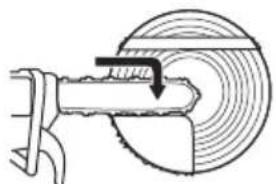
natural_image
Mechanical diagram showing a rotating shaft with a curved arrow indicating motion (no text or symbols)- Namestite klin v zarezo naravnost od zadaj.
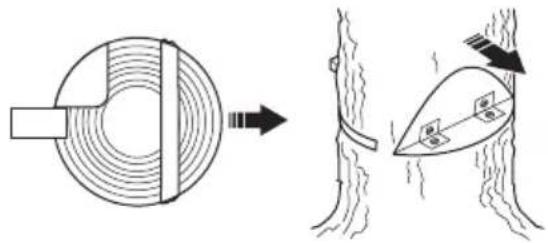
natural_image
Diagram showing a circular structure being lateralized into a tree with a curved structure attached, illustrating mechanical or structural change (no text or symbols present)natural_image
Line drawing of a tractor pulling a tree with a lever (no text or symbols)- Prenosen
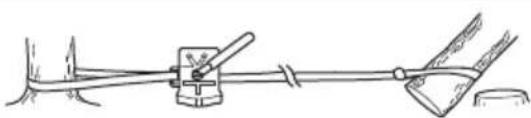
natural_image
Simple line drawing of a mechanical or electrical device with no visible text, numbers, or symbols.Žaganje napetih dreves in vej
natural_image
Diagram showing a curved path with a ball and scattered particles, no text or symbols presentnatural_image
Diagram of a mechanical or fluidic system with directional arrows and circular components, no text or symbols present.natural_image
Cross-sectional diagram of a geological or structural cross-section showing layered rock formations and terrain (no text or labels)
OPOZORILO: Ne žagajte naravnost skozi napeto drevo ali vejo.

natural_image
Cross-sectional diagram of a layered geological or structural structure with an upward arrow indicating a specific layer (no text or symbols present)- Nadaljujte z globljim žaganjem v drevo, dokler se drevo ali veja ne upogne in se napetost sprosti.
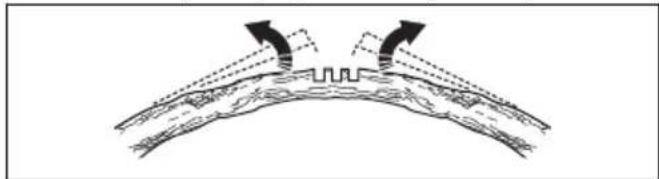
natural_image
Diagram of a curved structure with directional arrows indicating flow or movement (no text or symbols)- Ko se napetost sprosti, zažagajte z nasprotne strani krivine.
natural_image
Technical line drawing of a vehicle dashboard with control panel and air vent (no text or symbols)natural_image
Simple line drawing of a rope or rope loop with an arrow indicating direction (no text or symbols)- Preverite zavorni trak. Zavorni trak mora biti na najtanjši točki debel najmanj 0,6 mm/0,024 palca.
natural_image
Line drawing of a hand using a tool to interact with a device (no text or symbols present)- Izdelek držite z obema rokama nad štorom ali drugo stabilno površino.

OPOZORILO: Motor mora biti izklopljen.
natural_image
Illustration of a person using a saw to cut tree bark (no text or symbols)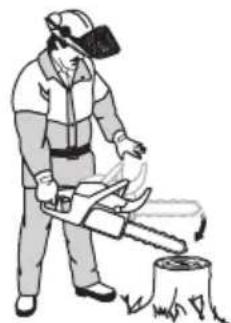
natural_image
Illustration of a person using a manual saw to cut tree bark (no text or symbols)- Preverite, ali se zavora verige aktivira, ko konica meča udari ob štor.
Preverjanje zavore verige
- Zaženite izdelek. Za navodila glejte poglavje Zagon izdelka na strani 284.

OPOZORILO: Prepričajte se, da se veriga ne dotika tal ali drugih predmetov.
natural_image
Line drawing of a chain-linking device with arrows indicating motion direction (no text or symbols)natural_image
Line drawing of a mechanical clamp or bracket with an arrow indicating direction (no text or symbols)natural_image
Line drawing of a mechanical tool or bracket with an arrow indicating motion direction (no text or symbols)-
Zaženite izdelek in pritisnite polni plin.
-
Sprostite ročico plina in se prepričajte, da se veriga ustavi in miruje.

natural_image
Diagram showing a chain-linking tool interacting with a car interior, with an inset highlighting the mechanical components (no text or symbols present)natural_image
Technical line drawing of a mechanical bracket component (no text or symbols)Preverjanje sistema za dušenje tresljajev
- Prepričajte se, da na elementih za blaženje tresljajev ni razpok ali deformacij.
- Prepričajte se, da so elementi za blaženje tresljajev ustrezno pritrjeni na motor in ročaj.
natural_image
Line drawing of a chainsaw with an inset showing a close-up of the blade (no text or symbols)Preverjanje dušilnika

natural_image
Technical line drawing of a mechanical device with two bolted components and directional arrows indicating assembly or movement (no text or symbols present)natural_image
Technical line drawing of a mechanical component with a screw and lever assembly (no text or symbols)- Poškodovan lovilnik isker zamenjajte.
natural_image
Line drawing of a chainsaw with arrows indicating force or movement (no text or symbols)- Izvlecite približno 30 cm/12 palcev zaganjalne vrvice in vrvico zataknite v zarezo na jermenici.
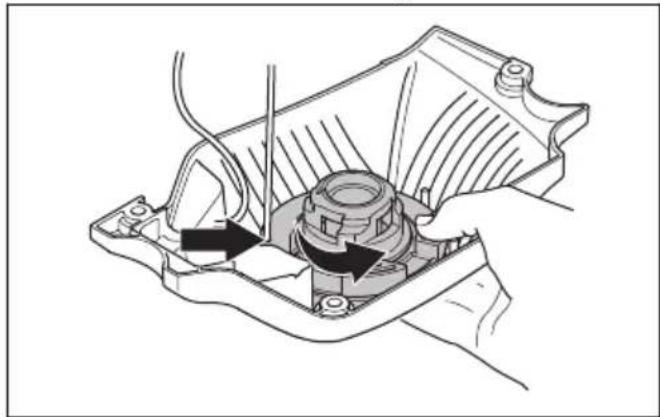
natural_image
Mechanical assembly diagram showing a motor component with arrows indicating motion direction (no text or symbols)-
Pustite, da se jermenica počasi zavrti nazaj, da se sprosti povratna vzmet.
-
Odstranite središčni vijak in jermenico.

natural_image
Exploded view diagram of a mechanical assembly showing internal components like gears, springs, and a motor (no text or labels)Napenjanje povratne vzmeti
- Zaganjalno vrvico zataknite v zarezo v jermenici.
- Jermenico zaganjalnika zavrtite za približno 2 obrata v smeri urinega kazalca.
- Prepričajte se, da lahko jermenico zavrtite še za ½ obrata, ko je zaganjalna vrvica popolnoma izvlečena.
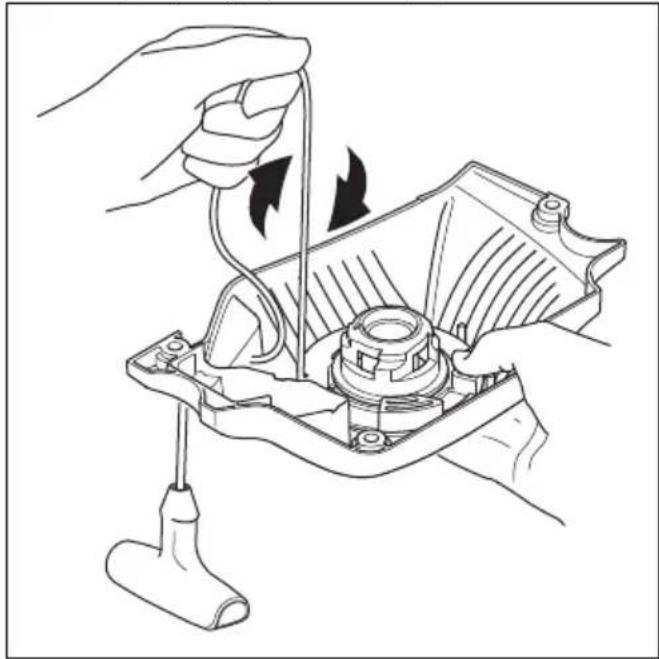
natural_image
Line drawing of a mechanical assembly with hands holding a tool, showing motion arrows indicating rotation (no text or symbols)natural_image
Line drawing of a hand using a tool to cut a saw blade (no text or symbols)natural_image
Technical line drawing of a mechanical device with internal components and housing (no text or symbols)natural_image
Simple diagram of a cylindrical object with a downward arrow and two small circular symbols inside, no text or labels present.natural_image
Diagram showing a mechanical component with arrows indicating direction, alongside a separate schematic view of a device or tool (no text or symbols present)natural_image
Pure diagram of a tool or component with arrows indicating direction (no text or symbols)- Širina gonilnega člena v mm/palcih.
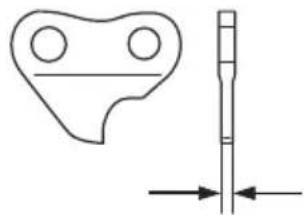
natural_image
Technical line drawing of a mechanical part with a vertical dimension and directional arrows (no text or symbols)Splošne informacije o brušenju rezil
natural_image
Technical line drawing of a mechanical tool with two views: one showing a curved arrow indicating rotation, the other showing a diagonal grooved blade (no text or symbols)- Kot rezanja.
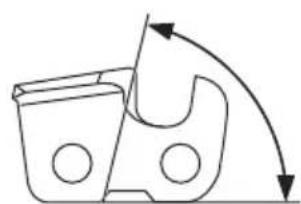
natural_image
Pure mechanical diagram showing a gear or cam mechanism with rotational arrows (no text or symbols)- Položaj pile.
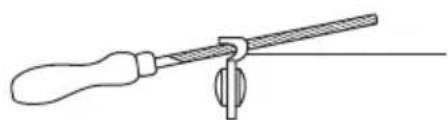
natural_image
Line drawing of a pair of scissors with a handle and base, no text or symbols present- Premer okrogle pile.
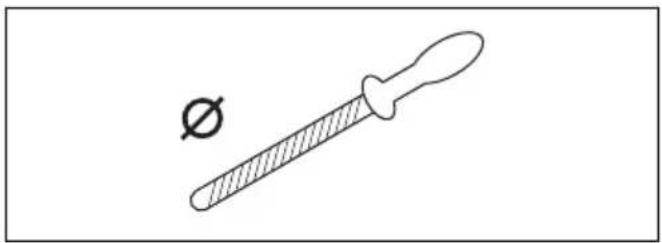
natural_image
Simple line drawing of a dropper with a small symbol (no text or labels)natural_image
Line drawings of three different cleaning tools: a pipette, a mechanical clamp, and a digital device (no text or symbols)natural_image
Technical illustration of a mechanical clamp or bracket assembly (no text or symbols)natural_image
Line drawing of two tools: a gridded tool and a mechanical clamp (no text or symbols)natural_image
Technical line drawing of a mechanical tool or component with an arrow indicating direction (no text or symbols present)natural_image
Line drawing of a chain saw with a lever and blade (no text or symbols)Opomba: Nekateri modeli imajo samo eno matico meča.
natural_image
Line drawing of a chainsaw with a directional arrow indicating motion (no text or symbols)natural_image
Illustration of two hands holding a curved object with directional arrows indicating motion (no text or symbols)natural_image
Illustration of a person in protective gear using a power tool to cut tree bark (no text or symbols)natural_image
Technical diagram of a mechanical assembly with a pipette inserted into a circular housing (no text or symbols)natural_image
Mechanical assembly diagram showing two stages of toolpathing (no text or labels)- Prepričajte se, da je verigo mogoče preprosto zviti. Če je veriga toga, jo zamenjajte.
- Verigo primerjajte z novo verigo, da ugotovite, će so kovice in členi obrabljeni.
- Zamenjajte verigo, ko je najdaljši del rezalnega zoba krajši od 4 mm/0,16 palca. Verigo prav tako zamenjajte, će so na rezilih razpoke.
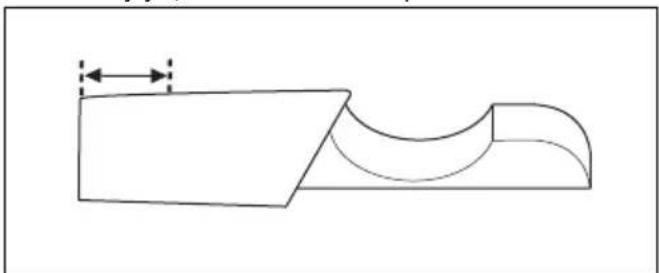
natural_image
Pure geometric diagram showing a rectangular shape with a curved cutout and a dashed line indicating a dimension (no text or symbols)Preverjanje meča
- Prepričajte se, da oljni kanal ni zamašen. Po potrebi ga očistite.
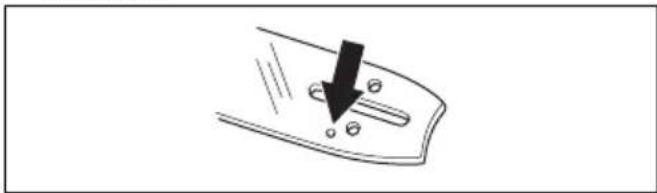
natural_image
Simple line drawing of a switch mechanism with a black arrow indicating the direction (no text or symbols)- Preglejte, ali so na robovih meča grobi ostanki. S pilo odstranite grobe ostanke.
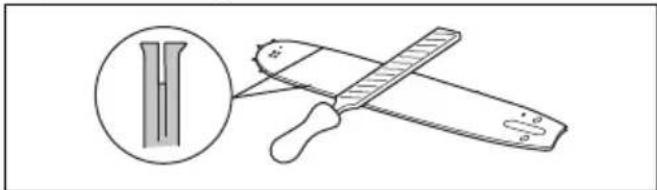
natural_image
Illustration of a knife and a cutting tool with a magnified inset showing the blade (no text or symbols)- Očistite utor v meču.
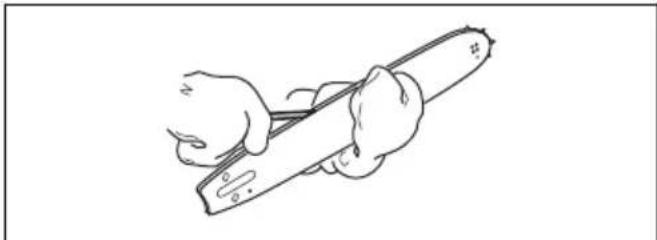
natural_image
Line drawing of a hand using a tool to cut a cylindrical object (no text or symbols)- Preverite, ali je utor v meču obrabljen. Po potrebi zamenjajte meč.
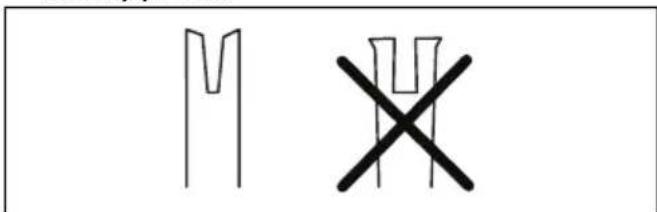
- Preverite, ali je konica meča groba ali zelo obrabljena.
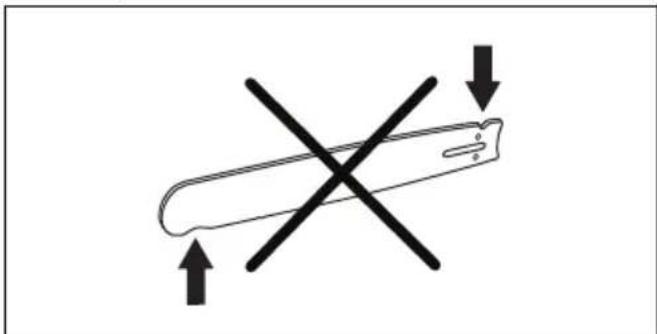
natural_image
Illustration of a hand holding a pen with a circular arrow indicating rotation (no text or symbols)natural_image
Simple line drawing of a tool or plunger with an arrow indicating direction (no text or symbols)natural_image
Line drawing of a chain-linking device with gear and handle (no text or symbols)natural_image
Exploded view diagram of a mechanical device showing internal components like gears and housing (no text or labels)- Hladilni sistem očistite s krtačo enkrat tedensko ali po potrebi pogosteje.
- Prepričajte se, da hladilni sistem ni umazan ali zamašen.



- Introduction
- Intended use
- Product description
- Product overview
- Symbols on the product
- Safety
- Safety definitions
- General safety instructions
- Safety instructions for operation
- Personal protective equipment
- Safety devices on the product
- Chain brake and front hand guard
- Throttle trigger lockout
- Chain catcher
- Right hand guard
- Vibration damping system
- Start/stop switch
- Muffler
- Fuel safety
- Safety instructions for maintenance
- Safety instructions for the cutting equipment
- Assembly
- To assemble the guide bar and saw chain
- Operation
- To do a function check before you use the product
- Fuel
- Premixed fuel
- To mix fuel
- Gasoline
- Two-stroke oil
- To fill the fuel tank
- To do a run-in
- To use the correct chain oil
- Kickback information
- Common questions about kickback
- To start the product
- To prepare start with a warm engine
- To stop the product
- Pull stroke and push stroke
- To use the cutting technique
- To cut a trunk on the ground
- To cut a trunk that has support on one end
- To cut a trunk that has support on two ends
- To use the limbing technique
- To use the tree felling technique
- To keep a safe distance
- To calculate the felling direction
- To clear the trunk and prepare your path of retreat
- To fell a tree
- The felling hinge
- To make the directional cuts
- To use the safe corner method
- To free a trapped tree
- To cut trees and branches that are in tension
- To use the product in cold weather
- Heated handles (543 XPG)
- Electrical carburetor heating (543 XPG)
- Maintenance
- Maintenance schedule
- Maintenance and checks of the safety devices on the product
- To do a check of the brake band
- To do a check of the front hand guard and the chain brake activation
- To do a check of the chain brake
- To do a check of the throttle trigger and throttle trigger lockout
- To do a check of the chain catcher
- To do a check of the right hand guard
- To do a check of the vibration damping system
- To do a check of the start/stop switch
- To do a check of the muffler
- Carburetor with adjustment limitations
- Carburetor adjustment
- Basic adjustments and run-in
- To adjust the low speed needle (L)
- To adjust the idle speed screw (T)
- To adjust the high speed needle (H)
- To examine if the carburetor is correctly adjusted
- To replace a broken or worn starter rope
- To tighten the recoil spring
- To assemble the starter housing on the product
- To clean the air filter
- To do a check of the spark plug
- To sharpen the saw chain
- General information about how to sharpen the cutters
- To sharpen the cutters
- General information about how to adjust the depth gauge setting
- To adjust the depth gauge setting
- To adjust the tension of the saw chain
- To do a check of the saw chain lubrication
- To do a check of the rim sprocket
- To lubricate the needle bearing
- To examine the cutting equipment
- To do a check of the guide bar
- To do maintenance on the fuel tank and the chain oil tank
- To adjust the chain oil flow
- Recommended settings for the oil pump
- Air cleaning system
- To clean the cooling system
- Troubleshooting
- Transportation and storage
- To prepare your product for long-term storage
- Technical data
- Accessories
- Recommended cutting equipment
- Kickback and guide bar nose radius
- Low kickback saw chain
- Pixel
- Filing equipment and filing angles
- Declaration of Conformity
- EU Declaration of Conformity
- UK Declaration of Conformity
- Inhalt
- Gashebelsperre
- Rechtshandschutz
- Montage
- Einleitung
- Contenido
- Montaje
- Introducción
- Sécurité carburant
- Montaggio
- Introduzione
- Gashendelvergrendeling
- Kettingvanger
- Trillingdempingssysteem
- Start/stop-schakelaar
- Geluidemper
- WAARSCHUWING: De
- Brandstofveiligheid
- Inleiding
- Trekslag en duwslag
- WAARSCHUWING: Als
- WAARSCHUWING: Bij
- Bomen en takken zagen die onder spanning staan
- Controleer de rechterhandbescherming
- Trillingsdempingssysteem controleren
- Geluidemper controleren
- Snijuitrusting controleren
- Koelsysteem reinigen
- Montagem
- Introdução
- Corrente a puxar e corrente a empurrar
- Cortes direcionais
- Apertar a mola de retorno
- Zaklep ročice plina
- Lovilnik verige
- Ščitnik desne roke
- Sistem za dušenje tresljajev
- Dušilnik
- Montaža
- Uvod
- Delovanje
- Izklop izdelka
- Žaganje z vlečenjem in potiskanjem motorne žage
- Tehnike žaganja
- Žaganje hloda z oporo na enem koncu
- Žaganje hloda z oporo na dveh koncih
- Ugotavljanje smeri podiranja
- Žaganje smernih rezov
- Žaganje napetih dreves in vej
- Preverjanje zavore verige
- Preverjanje sistema za dušenje tresljajev
- Preverjanje dušilnika
- Napenjanje povratne vzmeti
- Splošne informacije o brušenju rezil
- Preverjanje meča
Brand : HUSQVARNA
Model : 543 XP G
Category : Saw