B900SC - Bread maker BLACK & DECKER - Free user manual and instructions
Find the device manual for free B900SC BLACK & DECKER in PDF.


| Product Type | Horizontal automatic bread machine all-in-one |
| Brand | Black & Decker |
| Model | B900SC |
| Maximum capacity | 908 g (2 lb) |
| Number of cycles | 14 automatic programs (White, Whole Wheat, French, Fruit and Nut, Quick, Super Rapid Deluxe, Batter Bread, Dough, Pizza Dough, Jam, Pasta, etc.) |
| Delay timer | Up to 18 hours |
| Power failure memory | 60 minutes |
| Keep warm function | Yes, 60 minutes (except on certain cycles) |
| Crust control | Light, Medium, Dark |
| Loaf size | 454 g, 681 g, 908 g |
| Pan material | Non-stick |
| Viewing window | Yes |
| Power supply | 120 V ~ 60 Hz (polarized plug) |
| Wattage | 600 W (estimated) |
| Dimensions (approx.) | 30 x 25 x 35 cm |
| Weight (approx.) | 5 kg |
| Replacement parts | Bread pan (B900SC-02), kneading disk (B900SC-03), removable lid (B900SC-01) |
| Care and cleaning | Hand wash the pan and disk with warm soapy water; wipe the interior with a damp cloth; do not immerse the lid or put it in the dishwasher; do not use abrasive cleaners |
| Safety | Polarized plug, motor thermal protection, automatic shutdown in case of overheating |
| Warranty | 1 year limited (United States and Canada) |
| Included accessories | Bread pan, kneading disk, removable lid, recipe book |
Frequently Asked Questions - B900SC BLACK & DECKER
User questions about B900SC BLACK & DECKER
0 question about this device. Answer the ones you know or ask your own.
Ask a new question about this device
Download the instructions for your Bread maker in PDF format for free! Find your manual B900SC - BLACK & DECKER and take your electronic device back in hand. On this page are published all the documents necessary for the use of your device. B900SC by BLACK & DECKER.
USER MANUAL B900SC BLACK & DECKER
All-in-One Horizontal Automatic Breadmaker
Accessories/Parts (USA/Canada)
When using electrical appliances, basic safety precautions should always be followed including the following:
Read all instructions.
Do not touch hot surfaces. Use handles or knobs.
To protect against electrical shock do not immerse cord, plugs, or appliance in water or other liquid.
- Close supervision is necessary when any appliance is used by or near children.
Unplug from outlet when not in use and before cleaning. Allow to cool before putting on or taking off parts.
Do not operate any appliance with a damaged cord or plug, or after the appliance malfunctions or has been damaged in any manner. Contact Consumer Services for examination, repair or electrical or mechanical adjustment. Or, call the appropriate toll-free number on the cover of this manual.
The use of accessory attachments not recommended by the appliance manufacturer may cause fire, electric shock or injury.
Do not use outdoors.
- Do not let cord hang over edge of table or counter, or touch hot surfaces, including the stove.
Do not place on or near a hot gas or electric burner, or in a heated oven.
Extreme caution must be used when moving an appliance containing hot oil or other hot liquids.
To disconnect, press and hold the STOP Button for 2 seconds, remove plug from wall outlet.
Do not use appliance for other than intended use.
Avoid contacting moving parts.
SAVE THESE INSTRUCTIONS
This product is for household use only.
ADDITIONAL IMPORTANT SAFEGUARDS
Caution, hot surfaces: This appliance generates heat and escaping steam during use. Proper precautions must be taken to prevent the risk of burns, fires, or other injury to persons or damage to property.
Caution: During use, the internal parts of the Breadmaker and the area around the steam vents are HOT. Keep out of reach of children to avoid possible injury.
A person who has not read and understood all operating and safety instructions is not qualified to operate this appliance. All users of this appliance must read and understand this Owner's Manual before operating or cleaning this appliance.
If this appliance falls or accidentally becomes immersed in water, unplug it from the wall outlet immediately. Do not reach into the water!
- When using this appliance, provide adequate air space above and on all sides for air circulation. Do not operate this appliance while it is touching or near curtains, wall coverings, clothing, dishtowels or other flammable materials.
To reduce the risk of fire, do not leave this appliance unattended during use.
If this appliance begins to malfunction during use, immediately unplug the cord. Do not use or attempt to repair a malfunctioning appliance!
The cord to this appliance should only be plugged into a 120V AC electrical wall outlet.
Do not use this appliance in an unstable position.
SHORT CORD INSTRUCTIONS
A short power-supply cord is provided to reduce the risk resulting from becoming entangled in or tripping over a longer cord.
Do not use an extension cord with this product.
ELECTRIC POWER
If electric circuit is overloaded with other appliances, your breadmaker may not operate properly. The breadmaker should be operated on a separate electrical circuit from other operating appliances.
POLARIZED PLUG
This appliance has a polarized plug (one blade is wider than the other). To reduce the risk of electric shock, this plug is intended to fit into a polarized outlet only one way. If the plug does not fit fully in the outlet, reverse the plug. If it still does not fit, contact a qualified electrician. Do not attempt to modify the plug in any way.
POWER OUTAGE
60-Minute Power Failure Back-Up
Your All-in-One Horizontal Automatic Breadmaker has a 60-minute power failure back-up feature. If the electricity goes off, the memory will store the Course in process for up to 60 minutes. If the power comes back on within this time, the Course will resume where it left off. If the breadmaker loses power for more than 60 minutes and you are using any dairy products, perishables or meat in your bread, you should discard the contents of the recipe and start again with new fresh ingredients due to health and sanitary considerations.
For nonperishable recipes you may try starting the breadmaker at the beginning of the Course again. However, this may not always produce an acceptable loaf of bread. If you are not sure when the outage occurred, remove the dough ball from the bread pan and place in an oven-safe baking container. Allow to double in size and place in a preheated 350^ / 177^ oven for 30 to 45 minutes or until done. The bread will sound hollow when tapped on top of the loaf if it is done. Again, this may not always produce an acceptable loaf of bread.
If the bread has already begun to bake when the outage occurs, you must begin with new ingredients.
Important: Power failure back-up does not cover surges. If you experience frequent surges, please use a surge protector.
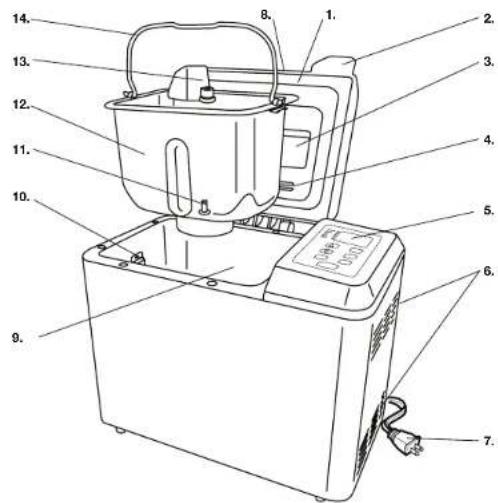
Product may vary slightly from what is illustrated.
† 1. Removable lid (Part # B900SC-01)
2. Handle
3. Viewing window
4. Air vent
5. Control panel
6. Steam vents
7. Electric cord with polarized plug
8. Course selection
9. Oven (baking chamber)
10. Bread pan clip
11. Drive shaft
† 12. Bread pan (Part # B900SC-02)
† 13. Kneading paddle (Part # B900SC-03)
14. Bread pan handle
† Note: Indicates consumer replaceable/removable parts
CONTROL PANEL
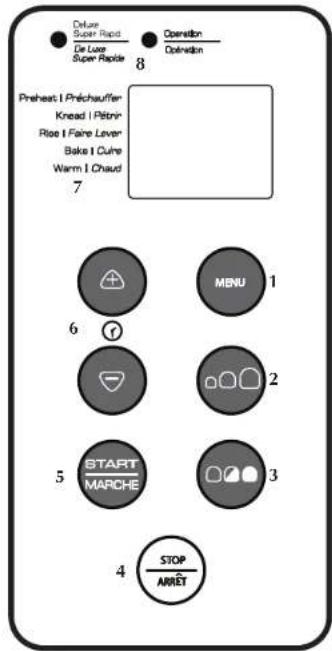
Selection Options
Select from these bread/dough courses:
- White
- Rapid white
- Whole wheat
- Rapid whole wheat
- French
- Rapid French
-
Fruit & nut
-
Rapid fruit & nut
- Deluxe super rapid
- Batter BreadsTM
- Dough
- Pizza dough
13.Jam - Pasta dough
1. Menu
Selects bread/dough Course you want. Each time Menu button is pressed, a new Course number will appear in the display window (Selections will be displayed in order listed).
2. Loaf Size
Selects loaf size: 1 lb, 112 lb. or 2 lb. Loaf size is preset to 2 lb.
3. Crust Control
Selects crust color: light, medium or dark. Crust color is preset to medium.
4. Stop
Press and hold for 2 seconds to clear display, reset baking Course or delay bake timer setting - or to simply stop baking.
5.Start
Press to start selected baking Course.
6.18-Hour Delay Bake Timer
Press to add or subtract time displayed in the display window. Hint: Hold buttons down to cycle quickly.
Increases in 10-minute intervals.
Decreases time in 10-minute intervals.
7. Display Window
Shows selection and timer setting.
8. Operation Light
Illuminates when START button is pressed; when cycle is completed and in Keep Warm phase, light will flash.
Important: When you press or , MENU, START or STOP buttons, you should hear a beep. This lets you know you've pressed hard enough and your selection was made.
How to Use
This product is for household use only.
Important: Your breadmaker has an intelligent fuse system designed to protect the motor from overheating. It will automatically shut off the motor if there is an overheat risk. If this occurs, unplug the appliance, wait a few seconds for it to cool down, and plug in again following the instructions.
GETTING STARTED
- Remove packing materials and any stickers.
- Place breadmaker on dry, stable surface away from heat and areas where cooking grease or water may splatter on unit. Do not place near edge of countertop.
Important: Your breadmaker will bake up at 2-lb. loaf. Do not put larger quantities of ingredients into bread pan. Bread will not mix and bake correctly and breadmaker may be damaged. (See MAXIMUM INGREDIENT AMOUNTS.)
- Before first use, operate on Rapid White Course program to burn off manufacturing oils. (Follow instructions in MAKING DOUGH & BAKING BREAD.)
Note: During first use, breadmaker may smoke and/or emit an odor from mineral oils used in manufacturing. This is normal.
MAXIMUM INGREDIENT AMOUNTS
- Bread courses: approximately 4 cups
- Batter bread and prepackaged cake mixes: 4 cups
Dough courses: 4% cups
Jam: 3 cups of fruit
BREAD PAN TIPS
Inserting bread pan
Note: Remember to insert kneading paddle first, then add all ingredients BEFORE inserting the bread pan into baking chamber.
- When inserting bread pan into breadmaker, make sure to seat firmly in place.
Removing bread pan
- To remove bread pan from baking chamber, hold handle with an oven mitt and lift gently.
Important: When you remove bread pan after baking, be sure to wear oven mitts to prevent burning. - After removing loaf (by turning bread pan upside down and shaking gently), check to see that kneading paddle is removed from loaf. If it is stuck in bread, use non-metal utensil to gently remove it, taking care not to scratch the kneading paddle.
KNEADING AND BAKING COURSES
Note: If, at any time during bread making process, you need to turn breadmaker OFF, press STOP button. Then unplug unit.
Note: During all courses except JAM, audible beep will sound to check dough ball and scrape ingredients from sides of bread pan, add additional ingredients like raisins, nuts or spices) or slur ingredients. Refer to KNEADING AND
BAKING COURSES charts to determine time that beep will sound.
Note: If bread is not removed immediately after baking and STOP button is not pressed, controlled 60-minute Keep Warm cycle will begin for each Course selection (except Deluxe Super Rapid, Batter Bread, Doughs and Jam). Although this will help prevent bread from becoming soggy, for best results, remove bread immediately after baking process is complete.
Course 1: White Bread
Used for breads that primarily use white flour, although some recipes may include small amounts of whole wheat flour.
Course 2: Rapid White
Decreases time for making white bread by approximately 1 hour. Choose recipe, then simply ADD additional 12 -tsp. of active dry or quick-acting yeast (whichever you are using) to recipe. Bread may be shorter and denser.
Course 3: Whole Wheat Bread
Used for recipes with significant amounts of whole wheat or rye flour, oats, or bran. Whole wheat Course begins with rest period during which flours or grains absorb liquid ingredients. Soaking causes flour or grain to soften and helps ingredients to combine. Generally, Whole wheat and multi-grain breads are shorter and denser than white, French or fruit & nut breads.
Course 4: Rapid Whole Wheat
Decreases time for making whole wheat bread by approximately 1 hour. Choose recipe, then simply ADD additional 12 -tsp. of active dry or quick-acting yeast (whichever you are using) to recipe. Bread may be shorter and denser.
Course 5: French Bread
Traditionally, French bread has crispier crust and lighter texture than white bread. Recipes usually do not include butter, margarine or milk.
Course 6: Rapid French
Decreases time for making French bread by approximately 1 hour. Choose recipe, then simply ADD additional 12 -tsp. of active dry or quick-acting yeast (whichever you are using) to recipe. Bread may be shorter and denser.
Course 7: Fruit & Nut Bread
Used for recipes that contain fruit juice, additional sugar or added sweet ingredients such as coconut flakes, raisins, dried fruit or chocolate. Baking temperature is reduced to prevent burning.
Course 8: Rapid Fruit & Nut
Decreases time for making fruit & nut breads by approximately 1 hour. Choose recipe, then simply ADD additional 12 -tsp. of active dry or quick-acting yeast (whichever you are using) to recipe. Bread may be shorter and denser.
Course 9: Deluxe Super Rapid
Bakes breads in as little as 59 minutes!
Course 10: Batter BreadsTM
Used for recipes that contain baking powder or baking soda, rather than yeast, to make bread or cake rise. Cake recipes made from scratch must be specially designed for this Course. Use this Course to prepare pre-packaged cake and quick bread mixes.
Course 11: Dough
Use to prepare dough for making bread or rolls which are shaped before baking in a conventional oven.
Course 12: Pizza Dough
Use to prepare dough that requires less kneading and rising such as pizza and focaccia dough.
Course 13: Jam
Add fruit, sugar, and lemon juice for homemade jam - a great topping for homemade bread, waffles and ice cream.
Course 14: Pasta Dough
Add your favorite ingredients when you effortlessly prepare fresh pasta dough. This Course is also useful for general purpose mixing.
KNEADING AND BAKING COURSE CHART
| Course Size | Color | Total time | Preheat | 1stknead | 2ndknead | Beep display | Rise Punch 2 | * rise Punch 3 | * rise Bake | Keep warm |
| 1. White | 2 lb, med dark light | 3:10 | - | 5 min | 20 min | 2:53 | 40 min | 10 sec | 25 min | 50 min |
| 3:20 | 3:03 | 50 min | ||||||||
| 3:00 | 2:43 | 40 min | ||||||||
| 1/1 lb, med dark light | 3:06 | - | 3 min | 22 min | 2:48 | 40 min | 10 sec | 25 min | 50 min | |
| 3:15 | 2:58 | 45 min | ||||||||
| 2:50 | 2:38 | 55 min | ||||||||
| 1 lb, med dark light | 3:00 | - | 3 min | 22 min | 2:43 | 40 min | 10 sec | 25 min | 50 min | |
| 3:10 | 2:53 | 40 min | ||||||||
| 2:50 | 2:33 | 50 min | ||||||||
| 2. Rapid White | 2 lb, med dark light | 2:10 | - | 5 min | 20 min | .53 | 15 min | 10 sec | 10 min | 30 min |
| 2:20 | 2:03 | 50 min | ||||||||
| 2:00 | 1:43 | 60 min | ||||||||
| 1/1 lb, med dark light | 2:06 | - | 3 min | 22 min | 1:48 | 15 min | 10 sec | 10 min | 30 min | |
| 2:15 | 1:58 | 45 min | ||||||||
| 1:55 | 1:38 | 55 min | ||||||||
| 1 lb, med dark light | 2:00 | - | 3 min | 22 min | 1:43 | 15 min | 10 sec | 10 min | 30 min | |
| 2:10 | 1:53 | 40 min | ||||||||
| 1:50 | 1:33 | 50 min | ||||||||
| 3. Whole Wheat | 2 lb, med dark light | 3:35 | 30 min | 5 min | 15 min | 2:53 | 50 min | 10 sec | 25 min | 45 min |
| 3:43 | 3:01 | 50 min | ||||||||
| 3:30 | 2:48 | 40 min | ||||||||
| 1/1 lb, med dark light | 3:32 | 30 min | 3 min | 17 min | 2:50 | 50 min | 10 sec | 25 min | 45 min | |
| 3:40 | 2:58 | 40 min | ||||||||
| 3:27 | 2:45 | 40 min | ||||||||
| 1 lb, med dark light | 3:30 | 30 min | 3 min | 17 min | 2:48 | 50 min | 10 sec | 25 min | 45 min | |
| 3:38 | 2:56 | 40 min | ||||||||
| 3:05 | 2:43 | 40 min | ||||||||
| 4. Rapid Whole Wheat | 2 lb, med dark light | 2:20 | 5 min | 5 min | 15 min | 2:03 | 30 min | 10 sec | 40 min | - |
| 2:28 | 2:11 | 45 min | ||||||||
| 2:15 | 1:58 | 50 min | ||||||||
| 1/1 lb, med dark light | 2:17 | 5 min | 3 min | 17 min | 2:00 | 33 min | 10 sec | 40 min | - | |
| 2:26 | 2:08 | 42 min | ||||||||
| 2:10 | 1:56 | 50 min | ||||||||
| 1 lb, med dark light | 2:15 | 5 min | 3 min | 17 min | 1:58 | 30 min | 10 sec | 40 min | - | |
| 2:23 | 2:06 | 40 min | ||||||||
| 2:10 | 1:53 | 50 min |
| 5. French 2 | 1b, med dark light | 2:20 | - | 5 min | 20 min | 3:13 | 40 min | 10 sec | 33 min | 10 sec | 60 min | 55 min | 65 min | ||
| 2:28 | - | - | 3 min | 3:23 | 40 min | 10 sec | 33 min | 10 sec | 60 min | 45 min | 60 min | ||||
| 1% b, med dark light | 2:17 | - | 3 min | 22 min | 3:10 | 40 min | 10 sec | 33 min | 10 sec | 60 min | 52 min | 60 min | |||
| 1lb, med dark light | 2:10 | - | 3 min | 22 min | 3:20 | 40 min | 10 sec | 33 min | 10 sec | 60 min | 42 min | 60 min | |||
| 2:15 | - | - | 22 min | 3:08 | 40 min | 10 sec | 33 min | 10 sec | 60 min | 50 min | 60 min | ||||
| 2:23 | - | - | 22 min | 3:19 | 40 min | 10 sec | 33 min | 10 sec | 60 min | 40 min | 60 min | ||||
| 6. Rapid French | 2 lb, med dark light | 2:25 | - | 5 min | 20 min | 2:08 | 20 min | 8 sec | 45 min | - | - | 55 min | 60 min | ||
| 2:35 | - | 3 min | 22 min | 2:18 | 20 min | 8 sec | 45 min | - | - | 65 min | 60 min | ||||
| 1% b, med dark light | 2:15 | - | - | 22 min | 1:58 | 20 min | 8 sec | 45 min | - | - | 55 min | 60 min | |||
| 2:22 | - | - | 22 min | 2:05 | 40 min | 10 sec | 25 min | 5 sec | 50 min | 60 min | 60 min | ||||
| 2:32 | - | - | 22 min | 2:15 | 40 min | 10 sec | 25 min | 5 sec | 50 min | 60 min | 60 min | ||||
| 2:12 | - | - | 22 min | 1:58 | 20 min | 8 sec | 45 min | - | - | 55 min | 60 min | ||||
| 2:20 | - | - | 22 min | 2:03 | 40 min | 10 sec | 25 min | 5 sec | 50 min | 60 min | 60 min | ||||
| 2:30 | - | - | 22 min | 2:13 | 40 min | 10 sec | 25 min | 5 sec | 50 min | 60 min | 60 min | ||||
| 2:10 | - | - | 22 min | 1:53 | 40 min | 10 sec | 25 min | 5 sec | 50 min | 60 min | 60 min | ||||
| 7. Fruit & Nut 2 | 1b, med dark light | 3:25 | - | 5 min | 20 min | 3:08 | 40 min | 10 sec | 25 min | 5 sec | 50 min | 65 min | 60 min | ||
| 3:35 | - | - | 22 min | 3:18 | 40 min | 10 sec | 25 min | 5 sec | 50 min | 75 min | 60 min | ||||
| 3:15 | - | - | 22 min | 2:58 | 40 min | 10 sec | 25 min | 5 sec | 50 min | 65 min | 60 min | ||||
| 1% b, med dark light | 3:22 | - | - | 22 min | 3:05 | 40 min | 10 sec | 25 min | 5 sec | 50 min | 65 min | 60 min | |||
| 3:32 | - | - | 22 min | 2:55 | 40 min | 10 sec | 25 min | 5 sec | 50 min | 65 min | 60 min | ||||
| 3:12 | - | - | 22 min | 3:03 | 40 min | 10 sec | 25 min | 5 sec | 50 min | 60 min | 60 min | ||||
| 3:20 | - | - | 22 min | 3:13 | 40 min | 10 sec | 25 min | - | - | 75 min | 60 min | ||||
| 3:30 | - | - | 22 min | 3:13 | 40 min | 10 sec | 25 min | - | - | 75 min | 60 min | ||||
| 3:10 | - | - | 22 min | 2:53 | 40 min | 10 sec | 25 min | - | - | 75 min | 60 min | ||||
| 8. Rapid Fruit & Nut | 2 lb, med dark light | 2:50 | - | 6 min | 20 min | 2:33 | 25 min | 10 sec | 55 min | - | - | 65 min | 60 min | ||
| 3:00 | - | - | 22 min | 2:43 | 25 min | 10 sec | 55 min | - | - | 75 min | 60 min | ||||
| 2:40 | - | - | 22 min | 2:30 | 25 min | 10 sec | 55 min | - | - | 65 min | 60 min | ||||
| 1% b, med dark light | 2:47 | - | - | 22 min | 2:40 | 20 min | 10 sec | 55 min | - | - | 75 min | 60 min | |||
| 2:57 | - | - | 22 min | 2:20 | 25 min | 10 sec | 55min | - | - | 75 min | 60 min | ||||
| 2:37 | - | - | 22 min | 2:28 | 25 min | 10 sec | 55min | - | - | 60 min | 60 min | ||||
| 2:45 | - | - | 22 min | 2:38 | - | - | - | - | - | 70 min | 60 min | ||||
| 2:55 | - | - | 22 min | 2:18 | - | - | - | - | - | 70 min | 60 min | ||||
| 9. Deluxe Super Rapid | 2 lb | 59 | - | 2 min | 12 min | 50 | 14 min | - | - | - | - | 31 min | - | ||
| 59 | - | 2 min | 12 min | 50 | 16 min | - | - | - | - | 20 min | - | ||||
| 59 | - | 2 min | 12 min | 50 | 18 min | - | - | - | - | 27 min | - | ||||
| 10. Batter Bread " | Medium Dark Light | 1:30 | - | 1 min | 3 min | 1:24 | 2 min | 2 min | 1 min | 2 min | - | 78 min | - | ||
| 1:40 | - | 1 min | 3 min | 1:34 | 2 min | 2 min | 1 min | 2 min | - | 89 min | - | ||||
| 1:20 | - | 1 min | 3 min | 1:14 | 2 min | 2 min | 1 min | 2 min | - | 89 min | - | ||||
| 11. Dough 2lb | 1% lb | 1:30 | - | 3 min | 27 min | 1:08 | 60 min | - | - | - | - | - | - | ||
| 1:27 | - | 3 min | 24 min | 1:05 | 60 min | - | - | - | - | - | - | ||||
| 1:24 | - | 3 min | 21 min | 1:02 | 60 min | - | - | - | - | - | - | ||||
| 12. Pizza Dough | 50 | -5 min 15 min 38:30 min - - - - - - - - - - - - - - - - - - - - - - - - - - - - - - - - - - - - - - - - - - - - - - - - - - - - - - - - - - - - - - - - - - - - - - - - - - - - - - - - - - - - - - - - - - - - - - - - - - - - | |||||||||||||
| 13. Jam | 1:05 | 15 min | - | - | - | - | - | - | - | - | -50 min (sill) | ||||
| 14. Pasta Dough | 14 | 1 min | 2 min:36 | -5 min 1 min 5 min - - - - - - - - - - - - - - - - - - - - - - - - - - - - - - - - - - - - - - - - - - - - - - - - - - - - - - - - - - - - - - - - - - - - - - - - - - - - - - - - - - - - - - - - - - - - - - - - - - | |||||||||||
Whole Wheat Courses have a rest period for up to 30 minutes before kneading begins. No movement occurs in the Bread Pan. This is normal.
*Jam Course has a rest period for 15 minutes before kneading begins. No movement occurs in the Bread Pan.
**Note: If bread is not removed immediately after baking, a controlled Keep Warm phase will begin for each selection (except Deluxe Super Rapid, Balter Breads,™ Doughs, Jam and Pasta Dough). While this will help reduce condensation between loaf and Bread Pan, it is best to remove bread as soon as possible after completion of the Baking phase.
KNOW YOUR INGREDIENTS
All-Purpose Flour
All-purpose flour is blend of refined hard and soft wheat flours ideally suited for making quick breads and cakes.
Bran
Bran (unprocessed) is coarse outer portion of wheat or rye grains that is separated from flour by sifting or bolting. It is often added to bread in small quantities for nutritional enrichment, heartiness and flavor. It is also used to enhance bread texture.
Bread Flour
Bread flour is a high gluten/protein flour that typically has higher gluten concentration than all-purpose flour. Using bread flour with will produce loaves with better volume and structure.
Cornmeal and Oatmeal
Cornmeal and oatmeal come from coarsely ground white or yellow corn and from rolled or steel-cut oats. They are used primarily to enhance flavor and texture of bread.
Cracked Wheat
Cracked wheat has very coarse texture. It comes from wheat kernels cut into angular fragments. It gives whole grain breads a nutty flavor and crunchy texture.
Rye Flour
Rye flour must always be mixed with high proportion of bread flour, as it does not contain enough gluten to develop structure for high, even-grained loaf.
Self-Rising Flour
Self-rising flour contains lavening ingredients that will interfere with bread and cake making. Self-Rising Flour is NOT RECOMMENDED for use.
7 Grain Cereal Blend
7 grain cereal blend is blend of cracked wheat, oats, bran, rye, cornmeal, flax seeds and hulled millet.
Vital Wheat Gluten
Gluten is manufactured from wheat flour that has been treated to remove nearly all of the starch to leave a very high protein content. (Gluten is the protein in wheat that makes dough elastic.) Gluten is available at most health food stores and in baking aisle in many markets. It is sometimes used in small portions with dense, low-gluten flours (such as whole wheat) to increase volume and lighten texture.
Whole Wheat Flour
Whole wheat flour is milled from the entire wheat kernel, which contains the bran and germ. This high fiber flour is richer in nutrients than all-purpose or bread flour. Breads made with this flour are usually smaller and heavier than white loaves. Many recipes mix whole wheat flour with bread flour or vital wheat gluten to produce high, light-textured bread.
Flour Storage
Keep flour in a secure, airtight container. Keep rye and whole wheat flours stored in a refrigerator, freezer or a cool area to prevent them from becoming rancid. Allow flour to come to room temperature before using.
Note: Flours, while visibly similar, can be very different by virtue of how they were ground, milled, stored, etc. You may have to experiment with different brands of flour to help you make the perfect loaf. See RECIPE TIPS to assist with these experiments.
Yeast
Active yeast, through a fermentation process, produces carbon dioxide gas necessary to make bread rise. Yeast feeds on carbohydrates in sugar and flour to produce this gas. Three different types of yeast are available: fresh (cake), active dry and quick-acting. Quick, rapid rise and breadmaker yeasts are quick-acting. Fresh (cake) yeast is NOT RECOMMENDED for use with your breadmaker.
Ensure your yeast is fresh by checking its expiration date. Once a package or jar of yeast is opened, it is important that the remaining contents be immediately resealed and refrigerated or frozen for future use. Often dough that fails to rise is due to stale yeast.
Note: Basic bread and dough recipes in this booklet were developed using active dry yeast. You may use chart below to substitute any quick-acting yeast (quick rise, fast rise or breadmaker yeast) for active dry yeast.
Conversion Chart for Quick Rise Yeast
14 tsp. active dry yeast = 12 tsp. quick-acting yeast
1 tsp. active dry yeast = 1/4 tsp. quick-acting yeast
1/2 tsp. active dry yeast = 1 tsp. quick-acting yeast
214 tsp. active dry yeast = 112 tsp. quick-acting yeast
1 tbsp. active dry yeast = 2 tsp. quick-acting yeast
Rapid Course Yeast Addition
Rapid Course settings for White, French, Whole Wheat and Fruit & Nut decrease time for making your favorite bread by approximately 1 hour. Choose recipe, then add an additional 12 tsp. of active dry or quick-acting yeast to the recipe. The bread may be shorter and denser.
Sugar
Sugar is important for color and flavor of breads. It also serves as food for yeast since it supports fermentation process. Recipes in this book that call for sugar require granulated sugar.
Important: Do not substitute powdered sugar or artificial sweeteners cannot be used as substitute, as yeast will not react properly with them.
Salt
Salt is necessary to balance flavor in breads and cakes; it also limits growth of yeast. Do not increase or decrease amount of salt shown in recipes.
Liquids
All liquids should be warm 80^ / 27^ for all recipes. Liquids, such as milk, water or a combination of powdered milk and water, can be used when making bread. Milk will improve flavor, provide velvety texture and soften the crust, while water alone will produce a crispier crust. Vegetable or fruit juices and potato water may be used for flavor variety.
Eggs
Eggs add richness and velvety texture to bread dough and cakes. When recipe calls for egg(s) at room temperature, large egg(s) should be used.
Fats
Shortening, butter and oil shorten, or tenderize, the texture of yeast breads. French bread gets unique crust and texture from the lack of fat added. However, breads that call for fat stay fresh longer. If butter is used directly from refrigerator, it should be cut into small pieces for easier blending during kneading process.
Baking Powder
Double acting baking powder is leavening agent used in quick breads and cakes. This type of leavening agent does not require rising time before baking, as chemical reaction works when liquid ingredients are added and again during baking process.
Baking Soda
Baking soda is another leavening agent, not to be confused or substituted for baking powder. It also does not require rising time before baking, as chemical reaction works during baking process.
Important: Ingredients must be measured with exacting accuracy to avoid affecting taste and texture of bread.
Special Glazes for Yeast Breads
Select 1 of the following special glazes to enhance your bread.
- Egg Glaze: Beat 1 large egg and 1 tablespoon of water together, brush generously over dough - prior to baking.
- Melted Butter Crust: Brush melted butter over just-baked bread for a softer, more tender crust.
Milk Glaze: For a softer, shiny crust, brush just-baked bread with milk or cream. - Sweet icing Glaze: Mix 1 cup sifted icing sugar with 1 to 2 tablespoons of milk until smooth to make a consistent glaze. Drizzle glaze over raisin bread or sweet breads when they are almost cool.
Note: If desired, generously sprinkle with your choice of poppy, sesame or caraway seeds after glazing.
Checking Dough Consistency
Although your breadmaker will mix, knead and bake bread automatically, when baking bread from scratch, it is necessary to learn to recognize condition of your dough. The ratio of flour to liquid is the most critical factor in any bread recipe, yet most easily remedied. After 5 to 8 minutes in Kead Stage, open breadmaker to check consistency of dough. Dough should be in a soft, tacky ball (feel sticky like scotch tape). If it is too dry, add ½-to-1 tsp. of liquid at a time. If it is too wet, add ½-to-1 tbsp. of flour at a time.
High-Altitude Baking
In high-altitude areas (over 3,000 feet) dough tends to rise faster, as there is less air pressure. Therefore, less yeast is necessary. For more information on High Altitude Baking guides contact:
Colorado Cooperative Extension Resource Center
Toll free: (877) 692-9358
E-mail: CERC@vines.colostate.edu
Website: www.ext.colostato/edu/depts/coopext
In dry climates, flour is drier and requires slightly more liquid.
In humid climates, flour is wetter and will absorb less liquid, so less liquid is required.
Slicing and Storing Bread
For best results, place bread on wire rack and allow to cool for 15 - 30 minutes before slicing. Use electric knife or serrated knife for even slices.
Store unused bread, tightly sealed (sealable plastic bags or plastic containers work well) at room temperature for up to 3 days. For longer storage, (up to 1 month) place bread in sealed container in freezer. Since homemade bread has no preservatives, it tends to dry out and become stale faster. Leftover or slightly hardened bread may be cut into 1-inch or 1-inch cubes and used in recipes to make croutons, bread pudding or stuffing.
MAKING DOUGH AND BAKING BREAD
Note: Depending on the Course or recipe used, some steps may not apply or there may be additional steps. Refer to the respective Course sections in this booklet for more detailed instructions.
Important: Add ingredients to bread pan in the order listed in the recipe.
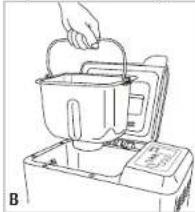
- Open lid and remove bread pan. Lift bread pan straight up and out using the handle (B).
Caution: Do not turn or shake bread pan while taking it out. If the bread pan is bent, temperature sensor may not work properly.
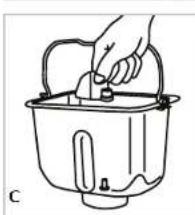
- Position kneading paddle on the drives shaft. Match flat side of drive shaft to flat part of hole in kneading paddle. Make sure paddle is secure (C).
- Place ingredients into the bread pan. For best results, add all liquid ingredients first, then add all dry ingredients.
Important: Always add yeast, baking powder or baking soda last.
- Make small indentation on top of dry ingredients (not so deep it reaches the wet layer) and add yeast/baking powder/baking soda.
Important: Indentation for yeast is important, especially when using the delay bake timer. It keeps yeast away from the wet ingredients until the kneading process begins. (Liquid ingredients will prematurely activate the yeast.)
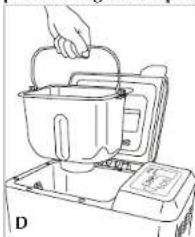
- Insert the bread pan into the baking chamber. Press down on rim of bread pan until it snaps securely into place (D).
Note: If bread pan does not snap securely into place, remove bread pan. Wearing oven mitts, place fingers behind bread pan clips and gently pull away from oven wall. Insert bread pan again. -
Close the lid. Plug into standard electrical outlet. Breadmaker will beep and three zeros will flash in display window.
-
Press MENU to choose desired Course. The operation light will illuminate. Each time MENU is pressed, unit and display will move to next Course.
-
Press CRUST to choose crust color. Breadmaker is preset for MEDIUM.
Note: CRUST will not be activated for the following courses:
- Batter Bread ^TM
Jam
Dough
Pizza Dough
- Pasta Dough
Note: When using Dough, Pizza Dough, Pasta Dough, Batter Bread™ or Jam courses, steps 7 and 8 are not needed.
- Press LOAF SIZE to select: 1, 1.5 LB, or 2.0 lb. Breadmaker is preset to 2 lb.
Note: Loan size cannot be activated for the following courses:
- Batter BreadsTM
Jam
Pizza Dough
- Pasta Dough
Note: Although breadmaker is capable of making 1.0 lb. loaves, we recommend baking 1.5 and 2.0 lb recipes for more uniform loaves of bread. This is especially true for breads that contain whole grains or other special ingredients such as sunflower or sesame seeds.
- Press START to begin kneading cycle. The operation light will illuminate. The TIME remaining will begin to count down in display window. LOAF SIZE and CRUST will be shown in display window.
Note: During kneading cycle, yeast will activate and viewing window may begin to fog. (This will clear eventually so you can view the progress.)
Note: For White, Whole Wheat, French, Fruit & Nut and Dough courses, breadmaker will beep before end of kneading cycle, at which time you may add any fruits or nuts, herbs, meat, garlic, etc. Opening lid will not stop kneading process. Add ingredients quickly and evenly over dough. Quickly close lid to prevent heat loss.
Note: If using Rapid Course or delay bake timer, add all ingredients at the beginning. Ingredients will be chopped into smaller pieces.
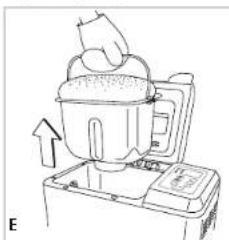
- When your bread is finished baking, breadmaker will beep and "0:00" will appear in display window. Press STOP and open lid. Using oven mitts, remove bread pan (E).
Important: Remember, bread pan and loaf are both very hot! Be careful not
to place either on tablecloth, plastic surface or other heat-sensitive surface that may scorch or melt.
Note: If bread is not removed immediately after baking and STOP is not pressed, the Keep Warm cycle will begin. Operation light will begin to flash. Breadmaker
will automatically turn off after 60 minutes. Although this will help prevent bread from becoming soggy, for best results, remove bread immediately after baking.
Note: Keep Warm cycle does not apply to the following courses:
16
- Deluxe Super Rapid
- Batter Bread's
Jam
Dough - Pizza Dough
-
Pasta Dough
-
Turn bread pan upside down and shake to release bread. Place bread upright on wire rack to cool 15-30 minutes before cutting. This allows steam to escape (F).
Caution: Be sure to remove kneading paddle from the bread.
Caution: Bread pan, kneading paddle and bread will be very hot.
- Always unplug breadmaker after each use.
USING 18-HOUR DELAY BAKE TIMER
Important: Delay baking does not activate in Deluxe Super Rapid, Jam or Pasta Dough Courses. Don't use delay bake timer if your recipe includes eggs, fresh milk, yogurt or other dairy products, meats, etc.
To preset your breadmaker, follow these steps:
- Add ingredients as usual, taking care not to let yeast and liquid ingredients contact one another.
- Close breadmaker lid and plug it in.
- Press MENU to choose Course. Time needed for selected Course appears in display window.
- Press to add time in 10-minute intervals. (Use to subtract time.) Amount of time set is shown in display window.
To fast forward time, continually press
To fast reverse, continually press
For example, if it is 8:00 AM and you want bread ready at 1:00 PM, press
until the display reads 5:00 – meaning it will finish baking in 5 hours. This is the hour difference between 8:00 AM and 1:00 PM.
Note: Actual baking times will not change.
- Press LOAF to choose loaf size, press CRUST to choose crust color, then press START to begin timer. The colon (: in time display begins to flash, letting you know timer is started. When your bread is finished baking breadmaker will becp and "0:00" will appear in display window. Press STOP and open lid.
- If you make an error after you've activated program and want to start over, press and hold STOP. Timer will clear and you can begin again.
BREAD RECIPES...EASY AS 1-2-3
We suggest starting your bread making with this White Bread recipe. Follow steps previously outlined in this Instruction Manual. These steps have been written to eliminate most common errors in breadmaker baking and may be helpful for any recipe.
WHITE BREAD
| Ingredients 1.0 lb. | 1 1/2 lb. 2.0 lb. | ||
| Water (80°F/27°C) 1/4 cup | + 1 tbsp. 1 cup 1 1/2 cups | ||
| Oil 1 tbsp. 2 tbsp. 2 1/2 tbsp. | |||
| Sugar 1 1/2 tbsp. 2 tbsp. 1/4 cup | cup | ||
| Dry milk 1 tbsp. 1 1/2 tbsp | 2 tbsp. | ||
| Bread flour 2 1/4 cups 3 cups | cups 4 cups | ||
| Active dry yeast 1 1/2 tsp. | 1 tsp. 2 1/4 tsp. | ||
| Select White Course | 1 | 1 | 1 |
| Select Rapid White | 2 | 2 | 2 |
| Active dry yeast 2 tsp. | 2 1/2 tsp. | 2 1/4 tsp. | |
White, Rapid White, Whole Wheat, Rapid Whole Wheat, French, Rapid French, Fruit & Nut, Rapid Fruit & Nut Course Method:
- Remove bread pan from breadmaker. Attach kneading paddle onto drive shaft. Have all ingredients ready. Make sure all ingredients, except water, are at room temperature.
- Measure water (80^ / 27^) and pour into bread pan.
- Measure oil and add to bread pan.
- Measure sugar, salt and dry milk; add to bread pan.
- Measure bread flour and add to bread pan. The Rapid setting for White Bread decreases time for making bread by approximately an hour. Add additional 12 tsp. of yeast when baking rapid breads.
- After making indentation in dry ingredients, carefully measure yeast and add to bread pan. If using delay bake timer, make absolutely sure yeast is on top of bread flour, away from liquids.
- Place bread pan into breadmaker. Push down on rim until it fits firmly into place. Close lid.
-
Press MENY; choose Course 1, White Bread. Press CRUST to choose crust color. Press LOAF to choose loaf size. If delay baking is desired, press and to add delay bake time, then press START. If no delay baking is desired, press START to begin immediately.
-
At beep during kneading process, check dough ball (see CHECKING DOUGH CONSISTENCY). It will be sticky to the touch. At this time, push down any dough or flour that may be on sides of bread pan. If desired, add additional ingredients (i.e., raisins, nuts, and spices). If necessary, stir ingredients. (See KNEADING AND BAKING COURSE CHART to check time beep will sound.)
- After ending beep sound, breadmaker will start 60-minute Keep Warm cycle. "0:00" will appear in display window; colon will begin to flash. The operation light will flash.
- Press STOP and use oven mitts to carefully remove bread pan. Light will go out when STOP is pressed.
Caution: Pan, kneading paddle and bread will be very hot. Use oven mitts!
- Turn bread pan upside down and shake several times to release bread. Do not use metal utensils. Remove kneading paddle and allow loaf to cool standing upright on wire rack approximately 15 - 30 minutes before slicing.
- Once bread has cooled (approximately 1 hour) store in an airtight container.
- Unplug unit and allow to cool completely before cleaning. (See CARE AND CLEANING INSTRUCTIONS.)
WHITE SOURDOUGH STARTER
| Ingredients | Amount |
| Active dry yeast | 2 1/4 tsp. |
| Water (110°F/43°C) | 2 cups |
| Bread flour | 3 1/2 cups |
| Sugar | 1 tbsp. |
In 4-qt. glass container, dissolve yeast in water (110^ / 43^) ; let stand 5 minutes, then add flour and sugar. Stir with plastic or wooden spoon until blended. Mixture will be thick; remaining lumps will dissolve during fermentation process. Cover loosely with plastic wrap and let stand in warm place for 5 days, stirring 3 times a day. Starter will "rise and fall" during fermentation period and become thinner as it stands. Sitting temperature of 80^ / 27^ is best for sour flavor to develop. When starter is developed, it is bubbly and may have yellow liquid layer on top; stir before using. It may be used for baking or placed in the refrigerator to use later; cover loosely.
To use starter, measure amount specified in recipe. After refrigeration, let container of starter come to room temperature before measuring - about 4 hours.
WHITE SOURDOUGH STARTER
| Ingredients Amount | |
| Active dry yeast 21/4 tsp. | |
| Water (110°F/43°C) 2 cups | |
| Bread flour 31/2 cups | |
| Sugar 1 tbsp. |
In 4-qt. glass container, dissolve yeast in water (110^ / 43^) ; let stand 5 minutes, then add flour and sugar. Stir with plastic or wooden spoon until blended. Mixture will be thick; remaining lumps will dissolve during fermentation process. Cover loosely with plastic wrap and let stand in warm place for 5 days, stirring 3 times a day. Starter will "rise and fall" during fermentation period and become thinner as it stands. Sitting temperature of 80^ / 27^ is best for sour flavor to develop. When starter is developed, it is bubbly and may have yellow liquid layer on top; stir before using. It may be used for baking or placed in the refrigerator to use later; cover loosely.
To use starter, measure amount specified in recipe. After refrigeration, let container of starter come to room temperature before measuring - about 4 hours.
WHITE SOURDOUGH BREAD
| Ingredients 1.0 | lb. \( 1\frac{1}{2}\mathrm{\;{lb}}.{2.0}\mathrm{\;{lb}} \) . | ||
| Water (80°F/27°C) 1/2 | cup + 1 tbsp. 3/4 cup | cup 3/4 cup + 1 tbsp. | |
| Starter (see above recipo) | \( 3/4 \) cup 1 cup | 1 1/4 cup | |
| Sugar 2 tsp. 1 tbsp. | tsp. | ||
| Salt | 1 tsp. | 1 1/2 tsp. | 2 tsp. |
| Bread flour | 2 cups | 3 cups | 4 cups |
| Active dry yeast \( 1\frac{1}{2} \) | 2 tsp. | 2 1/4 tsp. | |
| Select White Course | 1 | 1 | 1 |
| Select Rapid White | 2 | 2 | 2 |
| Active dry yeast | 2 tsp. | \( 2\frac{1}{2} \) tsp. | \( 2\frac{1}{4} \) tsp. |
CORNBREAD
| Ingredients | 1.0 lb. | 1 1/2 lb. | 2.0 lb. |
| Eggs, large; room temperature | 1 | 1 | 2 |
| plus enough water (80°F/27°C) to equal | 1/4 cup + 2 tbsp. | 1 cup + 3 tbsp. | 1 1/3 cups |
| Oil | 2 tbsp. 3 tbsp. | 1/4 cup | |
| Honey | 2 tbsp. | 3 tbsp. 1/4 cup | |
| Salt | 1 tsp. | 1 1/2 tsp. | 2 tsp. |
| Dry milk | 1 tbsp. | 2 tbsp. | 2 1/2 tbsp. |
| Bread flour | 2 cups 3 cups | 4 cups | |
| Cornmeal | 1/4 cup | 1/3 cup | 1/2 cup |
| Active dry yeast | 1 1/2 tsp. | 2 tsp. | 2 1/4 tsp. |
| Select White Course | 1 | 1 | 1 |
| Select Rapid White 2 | 2 | 2 | |
| Active dry yeast | 2 tsp. | 2 1/2 tsp. | 2 1/4 tsp. |
FAT-FREE WHITE BREAD
| Ingredients 1.0 lb. | 1 1/2 lb. | 2.0 lb. | |
| Water (80°F/27°C) 1/4 cup | + 1 tbsp. 1 cup + 3 tbsp. | 1 1/4 cups | |
| Applesauce 1 tbsp. 2 tbsp. | 3 tbsp. | ||
| Sugar 1 1/2 tbsp. 3 tbsp. | 1/4 cup | ||
| Salt 1 tsp. 1 1/2 tsp. 2 tsp. | |||
| Dry milk 1 tbsp. 1 1/2 tbsp | 2 tbsp. | ||
| Bread flour 2 1/4 cups 3 cups | 4 cups | ||
| Cornmeal 1/4 cup | 1/3 cup | 1/2 cup | |
| Active dry yeast 1 1/2 tsp. 2 tsp. | 2 1/4 tsp. | ||
| Select White Course | 1 | 1 | 1 |
| Select Rapid White 2 | 2 | 2 | |
| Active dry yeast | 2 tsp. 2 1/2 tsp. | 2 1/4 tsp. | |
EGG BREAD
| Ingredients | 1.0 lb. | 1 1/2 lb. | 2.0 lb. |
| Eggs, large; room temperature | 1 | 2 | 2 |
| plus enough water (80°F/27°C) to equal | 3/4 cup + 1 tbsp. | 1 cup + 1 tbsp. | 1 1/3 cups |
| Oil | 1 tbsp. | 1 1/2 tbsp. | 2 tbsp. |
| Sugar | 4 tsp. 2 tbsp. | 2 1/2 tsp. | |
| Salt | 1 tsp. | 1 1/2 tsp. | 2 tsp. |
| Dry milk | 2 tbsp. | 3 tbsp. | 1/4 cup |
| Bread flour | 2 cups + 2 tbsp. | 3 cups | 4 cups |
| Active dry yeast | 1 1/2 tsp. | 2 tsp. | 2 1/4 tsp. |
| Select White Course | 1 | 1 | 1 |
| Select Rapid White | 2 | 2 | 2 |
| Active dry yeast | 2 tsp. | 2 1/2 tsp. | 2 1/4 tsp. |
HONEY GRANOLA BREAD
| Ingredients | 1.0 lb. | 1 1/2 lb. | 2.0 lb. |
| Water (80°F/27°C) | ¼ cup + 3 tbsp. | 1 cup + 3 tbsp. | 1½ cups |
| Oil | 2 tbsp. | 3 tbsp. | ¼ cup |
| Honey | 2 tbsp. | 3 tbsp. | ¼ cup |
| Salt | 1 tsp. | 1½ tsp. | 2 tsp. |
| Dry milk | 2 tbsp. | 2½ tbsp. | 3 tbsp. |
| Bread flour | 2 cups | 3 cups | 4 cups |
| Granola cereal | ¾ cup | ¾ cup | 1 cup |
| Active dry yeast | 1½ tsp. | 2 tsp. | 2¼ tsp. |
| Select White Course | 1 | 1 | 1 |
| Select Rapid White | 2 | 2 | 2 |
| Active dry yeast | 2 tsp. 23 | 2½ tsp. 2¾ tsp. | |
POTATO BREAD
| Ingredients 1.0 lb. | \( 1\frac{1}{2} \) lb. | ||
| Eggs, large; room temperature | 1 2 2 | ||
| plus enough water (80°F/27°C) to equal | \( \frac{1}{4} \) cup + 2 tbsp. \( 1\frac{1}{4} \) cups \( 1\frac{1}{2} \) cups | ||
| Oil 1 tbsp. 2 tbsp. 3 tbsp. | |||
| Sugar 4 tsp. 2 tbsp. 3 tbsp. | |||
| Salt 1 tsp. 1 1/2 tsp. 2 tsp. | |||
| Dry milk 2 tbsp. 3 tbsp. | \( \frac{1}{4} \) cup | ||
| White pepper | 1/8 tsp. \( \frac{1}{4} \) tsp. | \( \frac{1}{4} \) tsp. | |
| Instant potato buds | \( \frac{1}{4} \) cup | \( \frac{1}{4} \) cup \( \frac{1}{2} \) cup | |
| Green onion tops, chopped | 1 tbsp. | \( 1\frac{1}{2} \) tbsp. | 2 tbsp. |
| Bread flour | 2 cups | 3 cups | 4 cups |
| Active dry yeast \( 1\frac{1}{2} \) tsp. | tsp. \( 2\frac{1}{4} \) tsp. | ||
| Select White Course | 1 1 1 | ||
| Select Rapid White | 2 2 2 | ||
| Active dry yeast | 2 tsp. \( 2\frac{1}{2} \) tsp. | \( 2\frac{1}{4} \) tsp. | |
WHOLE GRAIN BREAD
| Ingredients | 1.0 lb. 1 1/2 lb. | 2.0 lb. | |
| Water (80°F/27°C) | 1/4 cup | 1/3 cup | 1/2 cup |
| Cultured buttermilk (80°F/27°C) | 2/3 cup | 1 cup | 1 1/3 cups |
| Oil | 2 tsp. | 1 tbsp. | 1 tbsp. + 1 tsp. |
| Molasses | 3 tbsp. | 1/4 cup | 1/3 cup |
| Salt | 1 tsp. | 1 1/2 tsp. | 2 tsp. |
| Baking soda | 3/4 tsp. | 1 tsp. | 1 1/2 tsp. |
| Oat bran cereal, uncooked | 3 tbsp. | 1/4 cup | 1/3 cup |
| Cornmeal | 3 tbsp. | 1/4 cup | 1/3 cup |
| Rye flour | 3 tbsp. | 1/4 cup | 1/3 cup |
| Buckwheat flour | 3 tbsp. | 1/4 cup | 1/3 cup |
| Whole wheat flour | 1/3 cup | 1/2 cup | 1/3 cup |
| Bread flour | 1 1/4 cups | 2 cups | 3 cups |
| Active dry yeast | 1 1/2 tsp. | 2 tsp. | 2 1/4 tsp. |
| Select White Course | 1 | 1 | 1 |
| Select Rapid White | 2 | 2 | 2 |
| Active dry yeast 2 tsp. | 2 1/2 tsp. | 2 1/4 tsp. | |
SUNFLOWER & SESAME SEED WHOLE WHEAT BREAD
| Ingredients 1½ lb. | 2.0 lb. | |
| Eggs, large; room temperature | 1 | 1 |
| plus enough water (80°F/27°C) to equal | 1 cup + 2 tbsp. 1¼ cups | |
| Oil 2 tbsp. 3 tbsp. | ||
| Molasses 1 tbsp. 2 tbsp. | ||
| Sugar 1 tbsp. 2 tbsp. | ||
| Salt 1½ tsp. 2 tsp. | ||
| Bread flour 2½ cups 3 cups | ||
| Whole wheat flour ½ cup 1 cup | ||
| Sesame seeds 2 tbsp. 2½ tbsp. | ||
| Cumin seeds ¼ tsp. ¼ tsp. | ||
| Sunflower seeds (kernels) | 1½ tbsp. 2 tbsp. | |
| Active dry yeast 2 tsp. 2¼ tsp. | ||
| Select Whole Wheat Course | 3 | 3 |
| Select Rapid Whole Wheat | 4 | 4 |
| Active dry yeast 2½ tsp. | 2¾ tsp. | |
WHOLE WHEAT BREAD
| Ingredients | 1.0 lb. | \( 1\frac{1}{2}\mathrm{{lb}} \) . | 2.0 lb. |
| Egg whites | 1 | 1 | 1 |
| plus enough cultured buttermilk \( \left( {{80}^{ \circ }\mathrm{F}/{27}^{ \circ }\mathrm{C}}\right) \) to equal | 1 cup | 1 cup + 3 tbsp. | \( 1\frac{1}{2} \) cups |
| Oil | 2 tbsp. | 3 tbsp. | \( 1/4 \) cup |
| Molasses 2 tbsp. | 3 tbsp. | \( 1/4 \) cup | |
| Salt | 1 tsp. | \( 1\frac{1}{2} \) tsp. | 2 tsp. |
| Baking soda | \( 1/4 \) tsp. | \( 1/2 \) tsp. | \( 3/4 \) tsp. |
| Whole wheat flour | 2 cups | 3 cups | 4 cups |
| Active dry yeast | \( 1\frac{1}{2} \) tsp. | 2 tsp. | \( 2\frac{1}{4} \) tsp. |
| Select Whole Wheat Course | 3 | 3 | 3 |
| Select Rapid Whole Wheat | 4 | 4 | 4 |
| Active dry yeast | 2 tsp. | \( 2\frac{1}{2} \) tsp. | \( 2\frac{1}{4} \) tsp. |
CARAWAY RYE BREAD
| Ingredients | 1.0 lb. 1½ lb. | 2.0 lb. | |
| Eggs, large; room temperature | 1 1 2 | ||
| plus enough water (80°F/27°C) to equal | ¾ cup 1 cup | + 1 tbsp. 1 cups | |
| Oil 2 tbsp. 3 tbsp. ¼ cup | |||
| Honey 2 tbsp. 3 tbsp. ¼ cup | |||
| Salt 1 tsp. 1½ tsp. 2 tsp. | |||
| Dry milk 1 tbsp. 2 tbsp. 3 tsp. | |||
| Bread flour 1 cup 1½ cups | 2 cups | ||
| Whole wheat flour | ½ cup | ¾ cup | 1 cup |
| Caraway seeds | 1 tbsp. 2 tsp. | 3 tbsp. | |
| Active dry yeast | 1½ tsp. 2 tsp. | 2¼ tsp. | |
| Select Whole Wheat Course | 3 3 3 | ||
| Select Rapid Whole Wheat | 4 4 4 | ||
| Active dry yeast | 2 tsp. 2½ tsp. | 2¾ tsp. | |
ONION RYE BREAD
| Ingredients | 1.0 lb. | \( 1\frac{1}{2}\mathrm{{lb}}.{2.0} \) | lb. |
| Eggs, large; room temperature | 1 | 1 2 | |
| plus enough water (80°F/27°C) to equal | 3/4 cup + 2 tbsp. | 1 cup + 3 tbsp. | 1 cups + 2 tbsp. |
| Oil | 2 tbsp. | 3 tbsp. \( \frac{1}{4} \) cup | |
| Honey | 2 tbsp. | 3 tbsp. \( \frac{1}{4} \) cup | |
| Salt 1 tsp. 1 1/2 tsp. | tsp. 2 tsp. | ||
| Dry milk | 1 tbsp. | 2 tbsp. 3 tbsp. | |
| Bread flour | 1 cup | 1 1/2 cups | 2 cups |
| Whole wheat flour | \( \frac{1}{2} \) cup | 3/4 cup | 1 cup |
| Caraway seeds | 1 tbsp. | 2 tbsp. 3 tbsp. | |
| Dehydrated onion | 2 tbsp. | 3 tbsp. \( \frac{1}{4} \) cup | |
| Active dry yeast | 1 1/2 tsp. | 2 tsp. \( 2\frac{1}{4} \) tsp. | |
| Select Whole Wheat Course | 3 | 3 3 | |
| Select Rapid Whole Wheat | 4 | 4 4 | |
| Active dry yeast | 2 tsp. | \( 2\frac{1}{2} \) tsp. | \( 2\frac{1}{4} \) tsp. |
SEVEN GRAIN BREAD
| Ingredients 1½ lb. | 2.0 lb. | |
| Eggs, large; room temperature | 1 | 1 |
| plus enough water (80°F/27°C) to equal | 1 cup + 2 tbsp. 1½ cups | |
| Oil 2 tbsp. 3 tbsp. | ||
| Honey 2 tsp. 1 tbsp. | ||
| Salt 1½ tsp. 2 tsp. | ||
| Whole wheat flour 1½ cups | 2 cups | |
| Bread flour ½ cup 1 cup | ||
| Brown rice flour ¼ cup | 1/3 cup | |
| Spelt flour ¼ cup | 1/3 cup | |
| Buckwheat flour | ¼ cup | 1/3 cup |
| Rye flour | ¼ cup | 1/3 cup |
| Oatmeal | ¼ cup | 1/4 cup |
| Cornmeal | 2 tbsp. | 1/4 cup |
| Gluten | 3 tbsp. | 1/4 cup |
| Active dry yeast | 2 tsp. 2¼ tsp. | |
| Select Whole Wheat Course | 3 | 3 |
| Select Rapid Whole Wheat | 4 | 4 |
| Active dry yeast | 2½ tsp. | 2¼ tsp. |
TWO CHEESE BREAD
| Ingredients | 1.0 lb. | 1 1/2 lb. | 2.0 lb. |
| Eggs, large; room temperature | 1 | 1 1 | |
| plus enough water (80°F/27°C) to equal | 1/4 cup | 1 cup | 1 1/4 cups |
| Oil | 2 tsp. | 1 tbsp. | 1 1/2 tbsp. |
| Honey | 1 tsp. | 2 tsp. | 1 tbsp. |
| Salt | 1 tsp. | 1 1/2 tsp. | 2 tsp. |
| Dry milk | 2 tbsp. | 2 tbsp. | 3 tbsp. |
| Whole wheat flour | 1/4 cup | 1/2 cup | 3/4 cup |
| Bread flour | 1 1/4 cups | 2 1/2 cups | 3 1/4 cups |
| Grated cheddar cheese | 3/3 cup | 1 cup | 1 1/3 cups |
| Grated Parmesan cheese | 2 tbsp. | 3 tbsp. | 1/4 cup |
| Sesame seeds | 1 tsp. | 2 tsp. | 1 tbsp. |
| Active dry yeast | 1 1/2 tsp. | 2 tsp. | 2 1/4 tsp. |
| Select Whole Wheat Course | 3 | 3 3 | |
| Select Rapid Whole Wheat | 4 | 4 4 | |
| Active dry yeast | 2 tsp. | 2 1/2 tsp. | 2 1/4 tsp. |
PUMPERNICKEL BREAD
| Ingredients 1.0 lb. | \( 1\frac{1}{2}\mathrm{{lb}}.{2.0}\mathrm{{lb}} \) . | ||
| Eggs, large; room temperature | 112 | ||
| plus enough water (80°F/27°C) to equal | 3/4 cup + 1 tbsp. 1 | cup + 2 tbsp. 1 cup | + 6 tbsp. |
| Oil 2 tbsp. 3 tbsp. \( \frac{1}{4} \) cup | |||
| Honey 2 tbsp. 3 tbsp. \( \frac{1}{4} \) cup | cup | ||
| Salt 1 tsp. 1 1/2 tsp. 2 tsp. | |||
| Dry milk 1 tbsp. 2 tbsp. | 3 tbsp. | ||
| Bread flour 1 cup \( 1\frac{1}{2} \) cups 2 cups | |||
| Whole wheat flour \( \frac{1}{2} \) cup \( \frac{1}{4} \) cup | 1 cup | ||
| Rye flour | \( \frac{1}{2} \) cup | \( \frac{1}{3} \) cup | 1 cup |
| Caraway seeds | 1 tbsp. 2 tbsp. | 3 tbsp. | |
| Instant coffee granules | 1 tsp. | 2 tsp. | 1 tbsp. |
| Cocoa powder | 2 tbsp. 3 tbsp. | \( \frac{1}{4} \) cup | |
| Active dry yeast | 1 1/2 tsp. 2 tsp. | 2 1/4 tsp. | |
| Select Whole Wheat Course | 3 3 3 | ||
| Select Rapid Whole Wheat | 4 4 4 | ||
| Active dry yeast | 2 tsp. 2 1/2 tsp. | \( 2\frac{1}{4} \) tsp. | |
HEARTY NUT BREAD
| Ingredients | 1.0 lb. | \( 1\frac{1}{2}\mathrm{{lb}} \) . | 2.0 lb. |
| Water (80°F/27°C) | 1 cup | \( 1\frac{1}{4} \) cups | 1 cup + 7 tbsp. |
| Oil | 2 tsp. | 1 tbsp. | \( 1\frac{1}{2} \) tbsp. |
| Molasses | 3 tbsp. | \( 1/4 \) cup | \( 1/3 \) cup |
| Salt | 1 tsp. | \( 1\frac{1}{2} \) tsp. | 2 tsp. |
| Dry oatmeal, quick or regular | \( 1/3 \) cup | \( 1/2 \) cup | \( 2/3 \) cup |
| Whole wheat flour | \( 2/3 \) cup | 1 cup | \( 1\frac{1}{3} \) cups |
| Bread flour | \( 1/3 \) cups | 2 cups | \( {2}^{2}/3 \) cups |
| Walnuts,chopped | \( 2/3 \) cup | \( 3/4 \) cup | 1 cup |
| Active dry yeast | \( 1\frac{1}{2} \) tsp. | 2 tsp. | \( 2\frac{1}{4} \) tsp. |
| Select Whole Wheat Course | 3 | 3 | 3 |
| Select Rapid Whole Wheat | 4 | 4 | 4 |
| Active dry yeast | 2 tsp. | \( 2\frac{1}{2} \) tsp. | \( 2\frac{3}{4} \) tsp. |
FRENCH BREAD
| Ingredients 1.0 lb. | 1½ lb. 2.0 lb. | ||
| Water (80°F/27°C) 3/4 cup | + 2 tbsp. 1 cup + 2 | tbsp. 1½ cups | |
| Oil 1 tbsp. 1½ tbsp. 2 tbsp. | |||
| Sugar 1 tbsp. 1½ tbsp. 2 | tbsp. | ||
| Salt 1 tsp. 1½ tsp. 2 tsp. | |||
| Bread flour 2¼ cups 3½ | cups 4 cups | ||
| Active dry yeast | 1½ tsp. 2 tsp. | 2¼ tsp. | |
| Select French Course | 5 | 5 | 5 |
| Select Rapid French | 6 | 6 | 6 |
| Active dry yeast | 2 tsp. 2½ tsp. | 2¼ tsp. | |
ITALIAN HERB BREAD
| Ingredients 1.0 lb. | \( 1\frac{1}{2}\mathrm{{lb}} \) . | 2.0 lb. | |
| Water (80°F/27°C) | \( \frac{1}{4} \) cup + 2 tbsp. | 1 cup + 1 tbsp. | \( \frac{1}{4} \) cups \( + 2 \) tbsp. |
| Oil | \( 1\frac{1}{2} \) tbsp. | 2 tbsp. | 3 tbsp. |
| Sugar | 1 tbsp. 2 tbsp. | 3 tbsp. | |
| Salt | 1 tsp. | \( 1\frac{1}{2} \) tsp. | 2 tsp. |
| Dry milk | 1 tbsp. 2 tbsp. | 3 tbsp. | |
| Bread flour | \( 2\frac{1}{4} \) cups | 3 cups | 4 cups |
| Active dry yeast | \( 1\frac{1}{2} \) tsp. | 2 tsp. | \( 2\frac{1}{4} \) tsp. |
| Select French Course | 5 | 5 | 5 |
| Select Rapid French 6 | 6 | 6 | |
| Active dry yeast | 2 tsp. | \( 2\frac{1}{2} \) tsp. | \( 2\frac{1}{4} \) tsp. |
CINNAMON RAISIN BREAD
| Ingredients | 1.0 lb. | 1 1/2 lb. | 2.0 lb. |
| Water (80°F/27°C) | 3/4 cup | 1 cup 1 1/4 cup | ps + 2 tbsp. |
| Oil | 1 tbsp. | 1 1/2 tbsp. | 2 tbsp. |
| Brown sugar, firmly packed | 1 1/2 tbsp. 2 1/2 tbsp. | 3 | tbsp. |
| Salt | 1 tsp. | 1 1/2 tsp. | 2 tsp. |
| Dry milk | 1 tbsp. | 1 1/2 tbsp. | 2 tbsp. |
| Cinnamon | 1 tsp. | 2 tsp. | 1 tbsp. |
| Bread flour | 2 1/4 cups | 3 cups | 4 cups |
| Walnuts, chopped | 1/3 cup | 1/2 cup | 1/3 cup |
| Active dry yeast 1/7 tsp. | 2 tsp. | 2 1/4 tsp. | |
| Add: | |||
| Raisins | 1/3 cup | 1/2 cup | 1/3 cup |
| Select Fruit & Nut Course | 7 | 7 | 7 |
| Select Rapid Fruit & Nut | 8 | 8 | 8 |
| Active dry yeast | 2 tsp. | 2 1/2 tsp. | 2 1/4 tsp. |
CRUNCHY CRACKED WHEAT BREAD
Note: This recipe requires a few quick preparation instructions.
- Add cracked wheat to heatproof bowl. Pour in boiling water, stirring to prevent lumps.
- Let mixture stand for 20 minutes (at 80^ / 27^ ). Stir, pour into bread pan and add remainder of ingredients in order given.
| Ingredients 1.0 l | b. \( 1\overset{1}{2}\mathrm{{lb}}.{2.0}\mathrm{{lb}} \) . | ||
| Cracked wheat % cup | \( 4/4 \) cup 1 cup | ||
| Water, boiling 1 cup 1 \( 6/6 \) cups \( 1\overset{1}{4} \) cups | |||
| Oil 1% tbsp. 2 tbsp. 3 tsp. | |||
| Sugar 4 tsp. 2 tbsp. 3 tsp. | |||
| Salt 1 tsp. 1½ tsp. 2½ tsp. | |||
| Bread flour | 2 cups | 3 cups | 4 cups |
| Active dry yeast | \( 1\overset{1}{2} \) tsp. 2 tsp. | \( 2\overset{1}{4} \) tsp. | |
| Select Fruit & Nut Course | 7 | 7 | 7 |
| Select Rapid Fruit & Nut | 8 | 8 | 8 |
| Active dry yeast | \( 2\operatorname{tsp.}{2}\overset{1}{2}\operatorname{tsp.}{2}\overset{1}{4}\operatorname{tsp.} \) | ||
WHITE WHEAT BREAD
| Ingredients | 1.0 lb. 1 1/2 | lb. | 2 | 0 lb. |
| Water (80°F/27°C) | 3/4 cup | 1 cup + 2 tbsp. | 1 1/4 cups + 2 tbsp. | |
| Oil | 1 tbsp. 1 1/2 | tbsp. 2 tbsp. | ||
| Sugar | 2 tbsp. | 3 tbsp. | 1/4 cup | |
| Salt | 1 tsp. 1 1/2 | tsp. | 2 | tsp. |
| Dry milk | 1 tbsp. 1 1/2 | tbsp. 2 tbsp. | ||
| Bread flour | 1 1/4 cups | 2 1/4 cups | 3 1/2 cups | |
| Whole wheat flour | 1/4 cup | 1/4 cup | 1/2 cup | |
| Active dry yeast | 1 1/2 tsp. 2 tsp. | 2 1/4 tsp. | ||
| Ingredients | 1.0 lb. 11/2 | lb. | 2 | 0 lb. |
| Add: | ||||
| Sunflower seeds (kernels) | 2 tbsp. | 3 tbsp. | 1/4 cup | |
| Select Fruit & Nut Course | 7 | 7 | 7 | |
| Select Rapid Fruit & Nut | 8 | 8 | 8 | |
| Active dry yeast | 2 tsp. 21/2 | sp. | 23 | tsp. |
DRIED FRUIT BREAD
| Ingredients | 1.0 lb. | \( 1\frac{1}{2}\mathrm{{lb}} \) . | 2.0 lb. |
| Water (80°F/27°C) | \( \% \) cup | 1 cup + 1 tbsp. | \( 1\frac{1}{4} \) cups |
| Oil | \( 2\frac{1}{2} \) tbsp. | 3 tbsp. | \( \% \) cup |
| Brown sugar | \( 1\frac{1}{2} \) tbsp. | \( 2\frac{1}{2} \) tbsp. \( \% \) cup | |
| Salt | 1 tsp. \( 1\frac{1}{2} \) tsp. | 2 tsp. | |
| Dry milk | 1 tbsp. | \( 1\frac{1}{2} \) tbsp. | \( 2\frac{1}{2} \) tbsp. |
| Bread flour | \( 2\frac{1}{4} \) cups | 3 cups | 4 cups |
| Nutmcg | \( 1/2 \) tsp. | 1 tsp. | \( 1\frac{1}{2} \) tsp. |
| Active dry yeast | \( 1\frac{1}{2} \) tsp. 2 tsp. | \( 2\frac{1}{4} \) tsp. | |
| Add: | |||
| Dried fruit | \( 1/3 \) cup | \( {y}_{2} \) cup | \( {y}_{3} \) cup |
| Select Fruit & Nut Course | 7 | 7 | 7 |
| Select Rapid Fruit & Nut | 8 | 8 | 8 |
| Active dry yeast | 2 tsp. \( 2\frac{1}{2} \) tsp. | \( 2\frac{1}{4} \) tsp. | |
SOY CINNAMON RAISIN BREAD
Note: For best results, choose LIGHT crust.
| Ingredients 1½ lb. | |
| Water (80°F/27°C) 1 cup | |
| Oil 3 tbsp. | |
| Sugar 2 tbsp. | |
| Salt 1½ tsp. | |
| Dry milk ¼ cup | |
| Bread flour 2½ cups | |
| Cinnamon 1 tsp. | |
| Soy flour ½ cup | |
| Active dry yeast 2 tsp. | |
| Add: | |
| Raisins ½ cup | |
| Select Fruit & Nut Course | 7 |
| Select Rapid Fruit & Nut 8 | |
| Active dry yeast 2½ tsp. | |
DELUXE SUPER RAPID BREADS
We suggest starting super rapid bread baking with this Deluxe Super Rapid White Bread Recipe. Follow each step carefully, noticing that water temperatures must be 110 - 115^ / 43 - 46^
Important: Quick-acting yeast must be used in these recipes.
DELUXE SUPER RAPID WHITE BREAD
| Ingredients 1.0 lb. | 1 1/2 lb. 2.0 lb. | ||
| Water (110-115°F/43-46°C) | 1/4 cup + 2 tbsp. | 1 cup + 2 tbsp. | 1 1/4 cups |
| Oil | 1 1/2 tbsp. | 2 tbsp. | 2 1/2 tbsp. |
| Salt | 1/2 tsp. | 1/2 tsp. | 1/2 tsp. |
| Sugar | 1 tbsp. | 2 tbsp. | 3 tbsp. |
| Dry milk | 1 tbsp. | 2 tbsp. | 3 tbsp. |
| Bread flour | 2 cups | 3 cups | 4 cups |
| Super rapid yeast | 3 tsp. | 3 1/2 tsp. | 4 tsp. |
| Select Deluxe Super Rapid Course | 9 | 9 | 9 |
Deluxe Super Rapid Method:
- Remove bread pan from breadmaker. Attach kneading paddle onto drive shaft. Have all ingredients ready. Make sure all ingredients, except water, are at room temperature.
- Measure water (110 - 115°F/43 - 46°C) and pour into bread pan.
- Measure oil and add to bread pan.
- Measure and add sugar and salt to bread pan.
- Measure bread flour and add to bread pan. Smooth into all corners.
- Carefully measure super rapid type yeast and add to bread pan.
- Place bread pan into breadmaker. Push down on rim until it fits firmly into place. Close lid.
- Press MENU and choose Course 9, Deluxe Super Rapid. Press START.
-
At beep during kneading process, check dough ball. It will be sticky to the touch. At this time, push down any dough or flour that may be on the sides of bread pan. If desired, add additional ingredients (i.e., raisins, nuts, and spices). If necessary, stir ingredients. Refer to KNEADING AND BAKING COURSES chart to check display time beep will sound.
-
When your bread is finished baking, breadmaker will beep and "0:00" will appear in display window. Press STOP and open lid.
- Use oven mitts to carefully remove bread pan
Caution: The oven cavity, bread pan, kneading paddle and bread will be very hot. Always use oven mitts.
- Turn bread pan upside down and shake several times to release bread. Do not use metal utensils inside bread pan or breadmaker. Remove kneading paddle and allow loaf to cool, standing upright on wire rack approximately 15 - 30 minutes before cutting.
- When bread has cooled completely (approximately 1 hour) store in airtight container.
- Unplug unit and allow to cool completely before cleaning. Clean bread pan after each use.
Important: Do not immerse bread pan in water (see CARE AND CLEANING). Deluxe Super Rapid Course Hints for Best Results
- Dough ball for Deluxe Super Rapid Course should be very soft, sticky to the touch, loose ball with a smooth texture. Do not add extra flour.
- Check dough ball and, if necessary, use rubber spatula to push any flour or dough from sides of bread pan down into dough ball.
- As a result of increased temperatures during rise and bake process, loaf of bread produced from this Course may have dark, crisp crust with split in top of loaf.
- Super rapid type yeasts are special yeasts, widely available in major grocery stores specifically for 59-minute super bake and super rapid breads.
DELUXE SUPER RAPID COUNTRY WHITE BREAD
| Ingredients 1.0 lb. | \( 1\frac{1}{2}\mathrm{{lb}}.{2.0}\mathrm{{lb}} \) . | ||
| Cultured buttermilk \( \left( {100}^{a}\right. \) - 115°F/43°C-46°C) | \( \frac{1}{4} \) cup + 2 tbsp. 1 | cup + 2 tbsp. 1 | \( \frac{1}{2} \) cups |
| Oil 2 tsp. 1 tbsp. 2 tbsp. | |||
| Salt | \( \frac{1}{2} \) tsp. \( \frac{1}{2} \) tsp. | \( \frac{1}{2} \) tsp. | |
| Sugar | 1 tbsp. 2 tbsp | 3 tbsp. | |
| Instant potato granules | 3 tbsp. | \( \frac{1}{4} \) cup | \( \frac{1}{2} \) cup |
| Bread flour | 2 cups | 3 cups | 4 cups |
| Super rapid type yeast | 3 tsp. | \( 3\frac{1}{2} \) tsp. | 4 tsp. |
| Select Deluxe Super Rapid Course | 9 | 9 | 9 |
DELUXE SUPER RAPID ITALIAN BREAD
| Ingredients 1.0 lb. | \( 1\% \) lb. 2.0 lb. | ||
| Water (100°-115°F/43°-46°C) | 3/4 cup + 2 tbsp. 1 | cup + 2 tbsp. 1 | 1/3 cups |
| Oil 1 tbsp. 2 tbsp. 3 tbsp. | |||
| Salt \( 1/2 \) tsp. \( 1/2 \) tsp. \( 1/2 \) tsp. | |||
| Sugar 1 tbsp. 2 tbsp. 3 tbsp. | |||
| Dry milk 1 tbsp. 2 tbsp. 3 tbsp. | |||
| Bread flour 2 cups 3 cups 3 | 7/3 cups | ||
| Super rapid type yeast | 3 tsp. | \( 3\% \) tsp. | 4 tsp. |
| Select Deluxe Super Rapid Course | 9 | 9 | 9 |
DELUXE SUPER RAPID CINNAMON-RAISIN BREAD
| Ingredients | 1.0 lb. | \( 1\frac{1}{2}\mathrm{{lb}} \) . | 2.0 lb. |
| Water (100 \( {}^{a} - {115}^{\mathrm{d}}\mathrm{F}/{43}^{\mathrm{e}} \) - \( {46}^{ \circ }\mathrm{C} \) ) | \( \frac{1}{4} \) cup 1 cup | \( 1\frac{1}{4} \) cups. | |
| Oil | 2 tbsp. | 3 tbsp. | 3 tbsp. |
| Salt | \( \frac{1}{2} \) tsp. \( \frac{1}{2} \) tsp. | \( \frac{1}{2} \) tsp. | |
| Brown sugar, firmly packed | 2 tbsp. | 2 tbsp. | 3 tbsp. |
| Dry milk | 1 tbsp. | 2 tbsp. | 3 tbsp. |
| Bread flour | 2 cups 3 cups | 4 cups | |
| Cinnamon | \( \frac{1}{2} \) tsp. | 1 tsp. | 1 tsp. |
| Raisins | \( \frac{1}{2} \) cup | \( \frac{1}{2} \) cup \( \frac{3}{4} \) cup | |
| Walnuts,chopped | \( \frac{1}{4} \) cup | \( \frac{1}{3} \) cup | \( \frac{1}{3} \) cup |
| Super rapid type yeast | \( 3\frac{1}{2} \) tsp. | \( 3\frac{1}{2} \) tsp. | 5 tsp. |
| Select Deluxe Super Rapid Course | 9 | 9 | 9 |
BATTER BREADS
Batter Breads™ Course will mix and bake a prepackaged cake mix or quick bread.
SWEET CORN BREAD
| Ingredients 1 loaf | |
| Eggs, large, at room temperature | 2 |
| Milk (80°F/27°C) 1 cup | |
| Butter, melted ¼ cup | |
| Sugar ¾ cup | |
| Salt 1 tsp. | |
| All-purpose flour 2 cups | |
| Cornmeal 1 cup | |
| Double acting baking powder | 1 tbsp. |
| Select Batter BreadSTM Course | 10 |
Method:
- Remove bread pan from breadmaker. Attach kneading paddle onto shaft. Add ingredients to bread pan in order listed. Refer to MEASURING YOUR INGREDIENTS. Make sure all ingredients, except water, are at room temperature.
- Place bread pan into breadmaker. Push down on rim until it fits firmly into place. Close lid.
- Press MENU; choose Course 10, Batter Bread'sTM. Press CRUST to choose crust color. If delay bake is desired, press buttons to set delay bake timer, and then press START for delay; or, simply press START to begin immediately. Important: Don't use delay bake timer if your recipe includes eggs, fresh milk, yogurt or other dairy products, meats, fish or any other ingredients that may spoil.
-
At beep during kneading process, check dough. At this time, push down any dough or flour that may stuck to sides of bread pan. If desired, add additional ingredients (i.e., raisins, nuts, and spices). If necessary, stir ingredients. Refer to KNEADING AND BAKING COURSES chart to check display time beep will sound.
-
Before baking begins, remove bread pan from breadmaker. Remove kneading paddle from batter and place bread pan back into breadmaker to complete bake process. Removing paddle will help prevent tearing cake/loaf when it is removed from pan after baking.
- When bread is finished baking breadmaker will beep and "0:00" will appear in display window. Press STOP and open lid.
Caution: Oven caivity, bread pan, kneading paddle and bread will be very hot. Use oven mitts.
- Remove bread pan from breadmaker as soon as course is complete and allow cake or Batter Bread™ to remain in pan for 20 minutes on cooling rack before removing. Using oven mitts, take non metal spatula and gently loosen cake from sides of pan. Turn upside down to remove. Allow to cool 15 - 30 minutes before cutting.
- When bread has completely cooled (approximately 1 hour) store in air tight container.
- Unplug unit and allow to cool completely before cleaning. Clean bread pan after each use.
Batter Breads™ Course Hints for Best Results
- It is important that you assist breadmaker in stirring process during restime. Refer to KNEADING AND BAKING COURSE chart for appropriate time. Use a rubber spatula to gently scrape the ingredients from sides and corners of pan, and fold into wet mixture.
- Full size cake mix (16-oz or larger), quick bread or muffin mix (13-oz or larger) works well using Batter Bread'sTM Course. As with any other liquid ingredients, the liquid should be 80^ / 27^ and the eggs room temperature. Otherwise, add ingredients as listed on package instructions. 1-step angel food cake mixes may also be used. 2-step and swirl mix will work well using this program.
- Although delay bake timer is an option for this Course, our experience has shown recipes included do not mix well when delayed. You may find a few of your recipes may work well; therefore, we have given you delay as an option.
PINEAPPLE COCONUT POUND CAKE
| Ingredients 1 cake | |
| Eggs, large, at room temperature | 2 |
| Crushed pineapple, undrained | 1 cup |
| Butter, softened ¼ cup | |
| Sugar ¼ cup | |
| Salt ½ tsp. | |
| Coconut, grated ½ cup | |
| All-purpose flour 2 cups | |
| Baking powder 1 tbsp. | |
| Select Batter Breadsm Course | 10 |
Note: Stir, using a spatula to fold in any flour around sides of bread pan.
CHEDDAR LOAF BREAD
| Ingredients 1 loaf | |
| Eggs, large, at room temperature | 3 |
| Crushed pineapple, undrained | 1 cup |
| Shortening, room temp. 1/2 cup | |
| Cheddar cheese, shredded | 1 cup |
| Sugar 1/2 cup | |
| Salt 1/4 tsp. | |
| All-purpose flour 2 cups | |
| Baking powder 1 tbsp. | |
| Pecans, chopped 1/2 cup | |
| Select Batter BreadSTM Course | 10 |
Note: Stir, using a spatula to fold in any flour around sides of bread pan.
BANANA NUT CAKE
| Ingredients 1 loaf | |
| Whole eggs, large, at room temperature | 2 |
| Egg whites, at room temperature | 2 |
| Sour milk | 1/3 cup |
| Banana, mashed 1 1/2 cups | |
| Oil 6 tbsp. | |
| Sugar 1 cup | |
| Salt 1/4 tsp. | |
| Cream of tartar 1 1/2 tsp. | |
| All-purpose flour 2 cups | |
| Nuts, chopped 1/4 cup | |
| Baking soda 1/4 tsp. | |
| Baking powder 2 tsp. | |
| Select Batter Bread™ Course | 10 |
Note: Stir, using a spatula to fold in any flour around sides of bread pan.
BREAD /PIZZA/PASTA DOUGH COURSES
Dough Courses Method:
- Add ingredients to bread pan in order listed. Refer to MEASURING YOUR INGREDIENTS. Place bread pan into breadmaker. Push down on rim until it fits firmly into place. Close lid.
- Press MENU Button; choose Course 11, 12 or 14: Bread Dough, Pizza Dough or Pasta Dough. Press CRUST to choose crust color. If delay bake is desired, press buttons to set delay bake timer, and then press START for delay; or, simply press START to begin immediately.
Important: Don't use delay bake timer if your recipe includes eggs, fresh milk,
yogurt or other dairy products, meats, fish or any other ingredients that may spoil.
- When your dough is finished, breadmaker will beep and "0:00" will appear in display window. Press STOP and open lid. Remove dough from bread pan. Follow recipe shaping and baking instructions.
Dough Course Hints for Best Results
- If using delay bake timer, make sure yeast is on top of flour, away from liquids. Important: Never allow dough to remain in breadmaker after Course is complete; it may over rise and damage machine.
- Rising times for dough after it is shaped and placed in baking pan will vary due to recipe, temperature and humidity level of your kitchen. Optimum temperature of room for rising is 80^ - 85^ / 27^ - 29^ . Rising is most essential feature in bread making.
- Breadmaker allows dough to have first rise or fermentation before dough is removed. Fermentation conditions gluten, (becoming pliable and elastic with a soft, smooth quality) develops flavor and leavens product.
- Sometimes a double rising is beneficial especially for whole grain or 100% whole wheat bread. Let dough rise once in breadmaker. Remove from breadmaker, punch down, let rise again, punch down and let rest 10 minutes. Resting allows gluten to relax and makes handling easier. Shape as desired and allow to rise until doubled in volume. If only 1 rise is desired, remove from breadmaker, let rest, shape and rise as above.
Baker's Hint:
- Dough has doubled in volume when an indentation remains after tip of a finger is pressed lightly and quickly into dough. If indentation springs back, cover and let rise a few more minutes and check again.
MAKING DOUGHS: CRUST TREATMENTS
Important: For use only with the Dough Courses
Always allow optimum rising of shaped dough.
- Use pastry brush to apply glaze.
- Bake as directed.
Egg Yolk Glaze
For shiny golden crust, mix 1 slightly beaten egg or egg yolk with 1 tbsp. water or milk.
Egg White Glaze
For shiny, chewy crust, mix 1 slightly beaten egg white with 1 tbsp. water.
Lightly Floured
Sprinkle enough flour onto work area so dough can be handled without sticking.
Shaped Rolls:
Cloverleaf Rolls
Shape into ½-inch balls. Place 3 balls in each muffin tin and let rise until doubled in size.
Crisscross Rolls
Shape into balls, setting 2 aside. Combine balls and roll into a 1/8 -inch thick square. Cut strips 1/8 -inch wide and 2-inches long. Place 1 strip across top of each ball. Repeat process, placing second strip in opposite direction across top of each ball.
Traditional Rolls
Shape into balls. For "pull apart" rolls, place dough balls with sides touching. For "individual" rolls place dough balls 2-inches apart.
DOUGH COURSE RECIPES...AS EASY AS 1-2-3 DINNER ROLL DOUGH
| Ingredients 12 rolls | 18 rolls 24 rolls | ||
| Eggs, large, at room temperature | 1 1 1 | ||
| Plus enough water (80°F/27°C) to equal | ¾ cup ¼ cup | + 1 tbsp. 1 | ½ cups |
| Oil 2 tbsp. 3 tbsp. ¼ cup | |||
| Sugar 2 tbsp. 3 tbsp. ¼ cup | |||
| Salt 1 tsp. 1½ tsp. 2 tsp. | |||
| Bread flour 2 cups 3¼ cups | 4 cups | ||
| Active dry yeast | 1½ tsp. | 2 tsp | 2¼ tsp. |
| Select Dough Course | 11 | 11 | 11 |
Method:
- Place on lightly floured surface. Divide into pieces and shape.
- Place on greased baking sheet. Cover and let rise in a warm place for 30 minutes or until doubled in size.
- Bake at 350^ / 177^ for 15 to 25 minutes, or until done.
WHEAT DINNER ROLL DOUGH
| Ingredients | 9 rolls | 18 rolls |
| Water (80°F/27°C) | ¾ cup | 1½ cups |
| Oil | 1 tbsp. | 2 tbsp. |
| Brown sugar | 2 tbsp. | ¼ cup |
| Salt | 1 tsp. | 2 tsp. |
| Bread flour | 1¼ cups | 2½ cups |
| Whole wheat flour | 1 cup | 2 cups |
| Active dry yeast | 2 tsp. | 2¼ tsp. |
| Select Dough Course | 11 | 11 |
CHEEZY GARLIC ROLL DOUGH
| Ingredients 18 rolls | 24 rolls | |
| Eggs, large, at room temp. | 1 | 1 |
| Plus enough water (80°F/27°C) to equal | 1 cup 1 | 1/3 cups |
| Oil 2 tbsp. 3 tbsp. | ||
| Sugar | 1/3 cup 1/2 cup | |
| Salt 1½ tsp. 2 tsp. | ||
| Dry milk 1 tbsp. 2 tsp. | ||
| Bread flour 3½ cups 4½ cups | 1/2 tsp. | |
| Active dry yeast 2 tsp. 2¼ tsp. | ||
| Select Dough Course 11 1 | 1 | |
| Topping: | ||
| Parmesan cheese, grated 1/2 cup | 1/2 cup | 2/3 cup |
| Garlic, finely minced | 1½ tbsp. | 2 tbsp. |
| Butter, melted 3 tbsp. | ¼ cup | |
Method:
- Place on lightly floured surface. Divide into pieces and shape.
- Combine cheese and garlic. Dip pieces in melted butter and then in cheese-garlic mixture. Place in greased 9^ × 13^ baking dish. Cover and let rise in warm place for 45 minutes or until doubled in size.
- Bake at 325^ / 163^ for 35 to 40 minutes, or until done.
STICKY BREAKFAST BUN DOUGH
| Ingredients 12 rolls | |
| Eggs, large, at room temp. | 1 |
| Plus enough water (80°F/27°C) to equal | 1 1/4 cups |
| Oil | 3 1/2 tsp. |
| Sugar | 1/3 cup |
| Salt | 1 1/2 tsp. |
| Bread flour 3 1/2 cups | |
| Active dry yeast 2 tsp. | |
| Select Dough Course 11 | |
| Filling: | |
| Butter, softened | 1/2 cup |
| Sugar | 1/3 cup |
| Cinnamon | 1 tbsp. |
| Pecans, chopped | 1/2 cup |
| Topping: | |
| Butter, melted 3/4 cup | |
| Brown sugar 3/4 cup | |
| Pecan halves (optional) 1 cup | |
Method:
- Place on lightly floured surface, roll dough into 12^ × 16^ rectangle and spread with butter. Combine remaining filling ingredients and sprinkle over dough. Roll up tightly, jelly-roll style, starting with longest side and cut into 1^ slices.
- Combine topping mixture and spread into a 13^ × 9^ baking dish. If you are using optional pecan halves, line bottom of the pan. Place slices on mixture and let rise in a warm place for 30 minutes or until doubled in size.
- Bake at 350^ / 177^ for 35 minutes, or until done.Use oven mitts to carefully invert onto heat-proof tray; syrup will be very hot.
FRENCH BREAD DOUGH
| Ingredients 1 loaf | |
| Water (80°F/27°C) 1 1/4 cup | |
| Sugar 1 tsp. | |
| Salt 1 1/2 tsp. | |
| Bread flour 3 1/2 cups | |
| Active dry yeast 2 tsp. | |
| Select Dough Course 11 | |
| Glaze: | |
| Water 2 tsp. | |
| Salt 1/2 tsp. | |
Method 1: Place on lightly floured surface. Roll into large rectangle. Starting with longest side, roll up tightly, pressing seams to seal and tapering each end.
Method 2: Place loaf on greased baking sheet, cover and let rise in a warm place 40 minutes or until doubled in size.
Method 3: With knife, cut 3 diagonal slashes across top of loaf. Combine glaze ingredients and brush generously. Bake at 400^ / 205^ for 20 - 25 minutes until golden brown.
Variations:
French Onion Bread: Add 14 cup dehydrated onion to dough and shape according Method 1 described above.
French Loaf: Shape dough into 1 large round ball. Continue Methods 2 and 3 above.
French Roll: Shape or divide into 12 pieces. Roll each into ovals, pinch together ends of each roll and taper slightly. Place rolls on greased baking sheet; cover and let rise in warm place 25 - 30 minutes or until doubled in size. Bake at 400^/205^ for 15 - 20 minutes or until golden brown.
French Twists: Shape or divide into 18 equal pieces. Roll into 14-inch long ropes.
Fold each rope in half and twist, starting at fold. Place on greased baking sheet and brush with 13 cup melted butter. Cover and let rise in a warm place 25 - 30 minutes or until doubled in size. Brush with glaze and bake at 400^ / 205^ for 12 - 15 minutes or until golden brown.
Tip: If desired, brush with glaze and sprinkle loaves or rolls before baking with 1 of following: sesame seeds, poppy seeds, caraway seeds or cracked wheat.
CHALLAH BREAD DOUGH
| Ingredients Regular Large | ||
| Eggs, large, at room temp. | 1 | 1 |
| Plus enough water (80°F/27°C) to equal | 3/4 cup 1 cup + 1 tbsp. | |
| Oil 2 tbsp. 3 tsp. | ||
| Sugar 1½ tbsp. 2 tsp. | ||
| Salt 1 tsp. 1½ tsp. | ||
| Bread flour 2 cups 3¼ cups | ||
| Active dry yeast 1½ tsp. 2 | tsp. | |
| Select Dough Course 11 11 | ||
| Glaze: | ||
| Egg yolk, beaten 1 1 | ||
| Water | 1 tbsp. 1 tsp. | |
| Topping: | ||
| Poppy seeds | 1 tsp. | 1 tsp. |
Method:
- Place dough on lightly floured surface. Divide into thirds, making 3 (10-inch regular, 13-inch large) ropes with tapered ends. Pinch ropes together at 1 end, braid together. Pinch together at other end and secure braid.
- Transfer braided dough to greased baking sheet; cover and let rise in a warm place for 45 minutes or until doubled in size.
- Combine glaze ingredients and brush onto braid. Sprinkle with poppy seeds. Bake at 375^ / 190^ for 25 minutes or until done.
BAGEL DOUGH
| Ingredients | 8 bagels |
| Water (80°F/27°C) | 1 cup |
| Sugar | 1½ tbsp. |
| Salt | 1½ tsp. |
| Bread flour | 3 cups |
| Active dry yeast | 2 tsp. |
| Select Dough Course | 11 |
| Glaze: | |
| Egg, beaten | 1 |
| Toppings (optional) | Sesame seeds, poppy seeds, cracked wheat, dry cereal or dehydrated onions |
Method:
- Place on lightly floured surface. Divide into pieces. Roll each in smooth ball, making hole in center of each with thumbs. Gently pull to make 1-inch hole.
- Place on greased baking sheet. Cover and let rise in a warm place for 10 minutes.
- In 3-quart sauce pan, bring 2 quarts of water and 2 tablespoons sugar to boil. Place few bagels at a time in boiling water. Simmer 3 minutes, turning each bagel once. Remove with slotted spoon and put back on greased baking sheet
- Brush with egg and sprinkle with choice of toppings. Bake at 400^ / 204^ for 20 - 25 minutes or until done; cool on wire rack.
SOFT PRETZEL DOUGH
| Ingredients | 16 pretzels |
| Water (80°F/27°C) 1¼ cups | |
| Egg yolk, room temp. 1 | |
| Oil 1 tbsp. | |
| Sugar 2 tbsp. | |
| Salt | 1½ tsp. |
| White pepper | 1/4 tsp. |
| Bread flour | 3½ cups |
| Active dry yeast | 2¼ tsp. |
| Select Dough Course | 11 |
| Glaze: | |
| Egg white | 1 |
| Water | 1 tbsp. |
| Toppings (optional) | Kosher salt, sesame seeds |
Method:
-
On lightly floured surface cut dough into pieces. Roll each piece into 16-inch rope. Cross ends of the rope to make loop; twist crossed ends once and fold across loop.
-
Place on greased baking sheet 112 inches apart. Brush with glaze and sprinkle with toppings. Bake at 375^ / 190^ for 15 - 20 minutes or until done.
Variation:
Pepperoni Pretzel: Add 1 cup sliced pepperoni and 2 tbsp. Parmesan cheese to dough ingredients. Follow method of completion.
| Ingredients | 1 thick or 2 thin crusts | 2 thick or 4 thin crusts |
| Water (80°F/27°C) ¼ cup | cup 1 | ¾ cups |
| Oil 1 tbsp. 2 tsp. | ||
| Sugar 1 tbsp. 2 tsp. | ||
| Salt 1½ tsp. 2 tsp. | ||
| Dry milk 1 tbsp. 2 tsp. | ||
| Bread flour 2¼ cups | 4½ cups | |
| Active dry yeast 1 tsp. 2 tsp. | ||
| Select Pizza Dough Course | 12 12 |
Method:
- Place on lightly floured surface. Divide and press onto 12-inch pizza pan, raising edges.
- Spread pizza sauce over the dough and sprinkle with toppings.
- Bake at 425^ / 218^ for 20 minutes or until crust is golden brown around edges.
WHOLE WHEAT PIZZA CRUST DOUGH
| Ingredients | 2 thin crusts |
| Water (80°F/27°C) 1 cup | |
| Oil 2 tbsp. | |
| Sugar 1 tbsp. | |
| Salt 1 tsp. | |
| Whole wheat flour 1 cup | |
| Bread flour 1½ cups | |
| Active dry yeast 1 tsp. | |
| Select Pizza Dough Course | 12 |
Method:
- Place finished dough on lightly floured surface. Divide in half and press onto 12-inch pizza pan, raising edges. (Sprinkle each pan with 1 tbsp. of cornmeal if desired.) Generously prick dough with a fork. For 1 (12-inch thick) crust, do not divide.
- Bake at 425^ / 218^ for 10-12 minutes or until edges of crust begin to turn light golden brown. Remove, add toppings and return to oven to bake additional 15-20 minutes.
FOCACCIA DOUGH
| Ingredients 1 loaf | |
| Water (80°F/27°C) 1 cup | |
| Oil | 1/3 cup |
| Sugar 2 tsp | |
| Salt 1½ tsp. | |
| Bread flour 3 cups | |
| Dry Italian seasoning 1 tsp. | |
| Active dry yeast 2 tsp. | |
| Select Pizza Dough Course | 12 |
| Garlic-Cheese Topping: | |
| Olive oil ¼ cup | |
| Dried oregano 1½ tsp. | |
| Garlic, finely minced ¼ cup | |
| Parmesan cheese, grated | 1/3 cup |
| Salt ¼ tsp. | |
| Ingredients | 1 loaf |
| Greek-Style Topping: | |
| Olive oil | 1/4 cup |
| Dried oregano | 1 1/2 tsp. |
| Onion, thinly sliced | 1 cup |
| Feta cheese, crumbled | 1/3 cup |
| Black olives, sliced & drained | 1/4 cup |
| Salt 1/4 tsp. | |
Method:
- With oiled hands, evenly press dough into greased 9'' × 13'' pan. Using your fingertips, make indentations in dough.
- Cover, let rise in warm place for 20 minutes or until doubled in size. While dough is rising, select topping and prepare.
- In skillet, heat oil. For Garlic-Chese Topping, stir in oregano and garlic immediately; remove from heat. For Greek Topping, stir in oregano and onions; cook until onions are soft, but not brown (approximately 5 minutes).
- Spoon topping mixture evenly over dough. Sprinkle with remaining ingredients.
- Bake at 400^ / 205^ for 20 minutes or until done.
PASTA DOUGH...AS EASY AS 1-2-3
Pasta Dough Course allows you versatility to prepare many types of dough for your baking enjoyment.
BASIC PASTA DOUGH
| Ingredients 1 lb. | 2 lb. | |
| Milk (80°F/27°C) ¼ cup 1 | ½ cups | |
| Oil 6 tbsp. ¼ cup | ||
| Salt ¼ tsp. 1½ tsp. | ||
| Semolina (pasta) flour 2 c | cups 4 cups | |
| Select Pasta Dough Course | 14 14 | |
| Cooked pasta Makes 5 cu | ps Makes 10 cups |
Method:
- Remove bread pan from breadmaker. Attach kneading paddle onto drive shaft. Have all ingredients ready. Make sure all ingredients, except milk (80^ / 27^) , are at room temperature.
- Add milk and oil to bread pan.
- Measuring salt and semolina (pasta) flour into bread pan.
- Place bread pan into breadmaker. Push down on rim until it fits firmly into place. Close lid.
- Press MENU; choose Course14, Pasta Dough. Press START.
- At beep during kneading process, check dough ball. It will be slightly sticky
- To touch. At this time, push down any dough or flour that may be on sides of bread pan. Refer to KNEADING AND BAKING COURSE chart in to check display time beep will sound.
- Beep will sound when dough has finished mixing and "0:00" will appear in display window. Press STOP and remove dough from bread pan.
- Using rolling pin on lightly-floured surface, roll out dough to about 1/8-inch thickness. Cut dough into strips about 1/2-inch wide.
- Use 6 cups of boiling water for 1 lb. of dough and cook for 10 to 15 minutes or until tender. DO NOT OVER COOK. Drain well.
- Use in any of your favorite pasta recipes.
- Unplug unit and allow to cool completely before cleaning. Clean bread pan after each use.
EGG PASTA DOUGH
| Ingredients \( 1\frac{1}{2} \) Ib. | 2 Ib. | |
| Water (80°F/27°C) \( {}^{1/2} \) cup | + 1 tbsp. | \( {}^{3/4} \) cup + 1 tbsp. |
| Eggs, large, at room temp. | 3 | |
| Oil 1 tbsp. \( 1\frac{1}{2} \) tbsp. | ||
| Salt 1 tsp. \( 1\frac{1}{2} \) tsp. | ||
| Semolina (pasta) flour 1 cup | cup \( 1\frac{1}{2} \) cups | |
| All-purpose flour 2 cups \( 2\frac{1}{2} \) cups | ||
| Select Pasta Dough Course | 14 14 | |
| Cooked pasta Makes 8 cups Makes 10 cups |
SPINACH PASTA DOUGH
| Ingredients \( 1\frac{1}{2}\mathrm{{lb}} \) . | 2 lb. | |
| Water (80°F/27°C) \( \frac{3}{4} \) cup | + 2 tbsp. 1 cup + 1 tbsp. | |
| Oil 1 tbsp. \( 1\frac{1}{2} \) tsp. | ||
| Salt 1 tsp. \( 1\frac{1}{2} \) tsp. | ||
| Semolina (pasta) flour 1 cup | cup \( 1\frac{1}{2} \) cups | |
| All-purpose flour 2 cups \( 2\frac{1}{2} \) cups | ||
| Spinach (10-oz. pkg), cooked & finely chopped | 1 | 1 |
| Select Pasta Dough Course | 14 14 | |
| Cooked pasta Makes 8 cups Makes 10 cups | ||
Note: Both recipes will use same amount of spinach.
JAM COURSE
Jam Course Method:
- Remove bread pan from breadmaker. Attach kneading paddle to drive shaft. Have all ingredients ready. Clean fresh berries or fruit, cut into 12 -inch cubes. Drain fruit before crushing.
- Use liquid measuring cup to measure drained, crushed fruit.
- Use dry measuring cup to measure sugar.
- Use measuring spoon to measure lemon juice, if using.
- Place bread pan into breadmaker. Push down until it fits firmly into place. Close lid.
- Press MENU; Choose Course 13, Jam. Press START
- The breadmaker will preheat for 15 minutes before any movement occurs in bread pan. After preheating, jam will be heated and mixed for approximately 50 minutes. Entire Jam Course takes 1 hour, 5 minutes.
- When jam is finished, breadmaker will beep and "0:00" will appear in display window. Press STOP and open lid.
Caution: Oven cavity, bread pan, kneading paddle and bread will be very hot. Use oven mitts.
-
Remove bread pan from breadmaker.
-
Pour hot jam into heat-safe container. Leave on countertop to partially cool; stir occasionally.
- Pour partially-cool jam into refrigerator/freezer-sale container, leaving 12 of space at the top.
- Cover tightly to store. Jam will thicken upon cooling.
Jam Course Hints For Best Results
- Do not reduce sugar or use sugar substitutes. Exact amounts of sugar, fruit, and other ingredients are necessary for good set.
- Use only ripe fruit (not overripe or underripe) for best flavor.
- Do not puree fruit. Drain cubed fruit before crushing. Crush with potato masher or food processor. Jam should have bits of fruit in it.
- Recipes should not exceed 3 cups fruit.
- Be sure to measure fruit AFTER is crushed, not before.
- Remove stems, seeds or pits from fruit before crushing.
- You may use strawberries, blackberries, raspberries or other thin skinned berries. Fruit such as peaches, pears and apricots may be used, but should be peeled and have seeds removed.
- Frozen berries or fruit (no sugar added) may be substituted for fresh. Thaw and drain before measuring. For thinner jam, use juice as part of 3 cups of berry or fruit amount.
- Lemon juice adds necessary acid to berries or fruit.
- You may decrease amount of sugar, but it will produce a thinner result. More sugar will make it thicker. For best results, sugar substitutes are not recommended.
Average refrigerated life of jam is 2 weeks or up to several months frozen.
STRAWBERRY, BLACKBERRY, OR RASPERRY JAM
| Fresh or frozen (thawed) fruit | 3 cups |
| Sugar | 5 cups |
| Select Jam Course | 13 |
BLUEBERRY,APRICOT,PEACH OR PEAR JAM
| Fresh or frozen (thawed) fruit | 3 cups |
| Sugar | 5 cups |
| Lemon | 3 tbsp. |
| Select Jam Course | 13 |
Important: Do not exceed amounts given!
Care and Cleaning
This product contains no user serviceable parts. Refer service to qualified service personnel.
CLEANING
Important: Always unplug breadmaker and allow to cool competently prior to cleaning.
Bread pan and kneading paddle have nonstick surfaces, which make cleaning easier.
- After baking each loaf of bread, unplug breadmaker and discard any crumbs.
- Remove bread pan from oven chamber and kneading paddle from bread pan. Then, as needed, wash bread pan and kneading paddle inside and out with warm, soapy water. Avoid scratching nonstick surfaces.
Caution: Do not place bread pane in dishwahser, or soak it in water.
- If kneading paddle is stuck to drive shaft, pour warm water into bread pan for up to 30 minutes, to loosen it. Do not use excessive force.
- Wipe inside of lid and oven cavity with slightly damp cloth or sponge. If any residue has scorched on heating element or elsewhere, wipe with nonabrasive pad to clean. Lid can be removed for cleaning.
Important: Do not put lid in dishwasher, as it may cause warping. Do not immerse in water, as it contains sensitive electronic sensors.
- To clean glass in lid, use glass cleaner or mild detergent and damp cloth or plastic scouring pad. Do not use abrasive cleaners or scouring pads, as they may scratch glass.
- Do not use vinegar, bleach or harsh chemicals to clean breadmaker.
- Be sure breadmaker is completely cooled before storing.
- Oven chamber contains heating element and drive shaft. Therefore, when cleaning, NEVER pour water, solvents or cleaning solutions into this area.
STORAGE
- All removable parts should be thoroughly cleaned and dried.
- Store lid closed. Place bread pan into breadmaker with kneading paddle inside.
TROUBLESHOOTING
| Question Answer | |
| Why does height and shape of bread differ in each loaf? | Height and shape of bread may differ depending on the ingredients, room temperature and length of timer cycle. Also, accurate measurement of ingredients is essential to make delicious bread. |
| Bread has unusual aroma. Why? | Stale ingredients may have been used or too much yeast may have been used. Always use fresh ingredients. Accurate measurements are essential to make delicious bread. |
| Kneading paddle comes out with bread. | This can happen, as kneading paddle is detachable. Use a nonmetal utensil to remove it. Caution: Kneading paddle will be hot. |
| Bread has floured corners. | Sometimes flour in corner of bread pan may not have been completely kneaded into dough. Scrape it off loaf with knife. |
| Can ingredients be halved or doubled? | NO. If there is too little in bread pan, kneading paddle cannot knead well enough. If there is too much, bread rises out of bread pan. |
| Can fresh milk be used in place of dry milk? | YES. Be sure to decrease same measurement of water to equal liquid substitution. Fresh milk is not recommended when using delay bake timer, because it may spoil while sitting in bread pan. |
MISE EN GARDE IMPORTANTES
INSTRUCTIONS RELATIVES AU CORDON
3. Bouton Croute (Crust)
CONSEILS RELATIFS AU MOULE A PAIN
Colorado Cooperative Extension Resource Center
Sans frais:877692-9358
Courriel: CERC@vines.colostate.edu
Site Web: www.ext.colostate/edu/depts/coopext
PAIN AUX FRUITS SECS
For service, repair or any questions regarding your appliance, call the appropriate 800 number on the cover of this book. DO NOT return the product to the place of purchase. Also, please DO NOT mail product back to the manufacturer, nor bring it to a service center. You may also want to consult the website listed on the cover of this manual.
One-Year Limited Warranty (Applies only in the United States and Canada)
What does it cover?
- Any defect in material or workmanship provided; however, Applica's liability will not exceed the purchase price of the product.
For how long?
One year after the date of original purchase.
What will we do to help you?
- Provide you with a reasonably similar replacement product that is either new or factory refurbished.
How do you get service?
-
Save your receipt as proof of date of sale.
-
Check our on-line service site at www.prodprotect.com/applica, or call our toll-free number, 1-800-231-9786, for general warranty service.
If you need parts or accessories, please call 1-800-738-0245.
What does your warranty not cover?
-
Damage from commercial use
-
Damage from misuse, abuse or neglect
-
Products that have been modified in any way
-
Products used or serviced outside the country of purchase
Glass parts and other accessory items that are packed with the unit
-
Shipping and handling costs associated with the replacement of the unit
-
Consequential or incidental damages (Please note, however, that some states do not allow the exclusion or limitation of consequential or incidental damages, so this limitation may not apply to you.)
How does state law relate to this warranty?
- This warranty gives you specific legal rights, and you may also have other rights that vary from state to state or province to province.