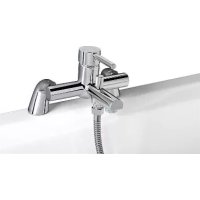
IAN 285707 - Faucet MIOMARE - Free user manual and instructions
Find the device manual for free IAN 285707 MIOMARE in PDF.


| Brand | Miomare |
| Model | IAN 285707 |
| Product type | Bathtub/shower mixer (mixing faucet) |
| Connection dimensions | 135 - 165 mm |
| Shower hose connection | G½ (approx. 21 mm) |
| Water connection nuts | Approx. 28.5 mm |
| Weight | Approx. 1.5 kg |
| Water supply | Pressurized water (compatible with pressure water heaters, boilers, etc.) |
| Main functions | Hot/cold water mixer, bathtub/shower diverter, adjustable temperature limit |
| Control | Single lever for flow and temperature |
| Temperature limit | Adjustable via adjusting ring (not activated at factory) |
| Maintenance and cleaning | Clean with clear water and mild detergent using a soft cloth; regularly unscrew the mixing nozzle to descale |
| Safety | Risk of electric shock in case of leakage; risk of burns if water is too hot; installation by a qualified technician recommended |
| Spare parts and repairability | Cartridge, seals, rings, screws; replaceable wear parts (seals, cartridge) |
| Warranty | 5 years from date of purchase |
| Package contents | Faucet body, 2 threaded screws, 2 escutcheons, 2 sealing rings, 2 nuts, control lever, tightening screw, plastic cap, cover ring, circlip, cartridge, adjusting ring, Allen key |
Frequently Asked Questions - IAN 285707 MIOMARE
User questions about IAN 285707 MIOMARE
0 question about this device. Answer the ones you know or ask your own.
Ask a new question about this device
Download the instructions for your Faucet in PDF format for free! Find your manual IAN 285707 - MIOMARE and take your electronic device back in hand. On this page are published all the documents necessary for the use of your device. IAN 285707 by MIOMARE.
USER MANUAL IAN 285707 MIOMARE
Assembly, operating and safety instructions
NL BE
BAD-/DOUCHEKRAAN
Bath and Shower Mixer Tap
Introduction
We congratulate you on the purchase of your new product. You have chosen a high quality product. Familiarise yourself with the product before using it for the first time. In addition, please carefully refer to the operating instructions and the safety advice below. Only use the product as instructed and only for the indicated field of application. Keep these instructions in a safe place. If you pass the product on to anyone else, please ensure that you also pass on all the documentation with it.
- Proper use
This product is suitable for all pressure-tight hot water systems such as central heating boilers, instantaneous water heaters, pressurised boilers and the like. It is not suitable for low-pressure water heaters such as wood or coal burning bath geysers, oil or gas bath geysers, open electrically heated water tanks. If in doubt please seek the advice of a plumber or heating engineer. Any use other than that described here or modification to the product is not permitted and may lead to damage to persons or property. There is also the risk of injury and loss of life. The product is intended for personal use only and not for medical or commercial use. The manufacturer accepts no liability for loss or damage arising from improper use.
Description of parts
12S- connectors
2 Rosettes
3 2 Sealing rings
4 1 Tap body
4a 1 Changeover button
4b 1 Threaded connector (for the shower hose)
4c 1 Mixer nozzle
5 2 Nuts (for S- connectors)
6 1 Control lever
7 1 Locking screw
8 1 Plastic cover
9 1 Cartridge end ring
10 1 Cartridge locking ring
11]Cartridge
12 1 Setting ring
13 1 Hexagon key
-Technicaldata
Connectionspacing:135-165mm
Connections (Shower hose): G 12
(approx. 21 mm)
Water connection nut: approx. 28.5 mm

Safety advice

RIS ADFAOX3SING!
OF LIFE OR ACCIDENT TO INFANTS AND CHILDREN! Neve
leave children unsupervised with the packaging materials. Danger of suffocation. Keep the product away from children. The product is not a toy.


CAUTION - RISK OF ELECTRIC
SHOCK! Leaks or the escape of
water can lead to danger to life from
electric shock. Check all connections for leaks carefully. In addition, ensure that all cables from electrical devices are correctly and safely installed.

CAUTION! RISK OF INJURY! Please ensure that no parts are damaged and that all parts are correctly assembled. Incorrect assembly could lead to injury. Please note that seals are wear parts and therefore will require to be replaced from time to time. Damaged parts could adversely affect safety and proper function.

CAUTION! RISK OF DAMAGE TO
PROPERTY! Have the installation done by experienced persons only. Leaks or escape of water can lead to serious damage to buildings or household fittings and furniture. Check all connections for leaks carefully.

Ensure that all seals are correctly seated to prevent leakage of water.
CAUTION! DANGER OF SCALDING!
When making the hot water setting please ensure that the temperature of the water is not too high.
Before installation, make yourself familiar with all the existing services, e.g. water connection and stopcocks.
Please read carefully through these operating instructions before installing and using the product. Keep all the safety advice and instructions in a safe place for future reference!
Installation
Installing the tap
Note: To protect the parts from scratches while being screwed together cover them with a damp cloth or use plastic clamps.
Before you start installation turn off the main water supply to prevent serious leakage of water.
Install the tap at the wall connection as shown in Figure A.
Connecting the accessories (shower head and shower hose)*:
Note: So that the parts do not get scratched while being screwed together, protect them with a damp cloth or use plastic clamps.
Screw an ordinary shower hose* firmly on to the thread 4b.
- Attach an ordinary shower head to the shower hose.
- Observe the installation instructions for the accessories.
* (not included)
Flushing the tap
The tap must be flushed through before first use to remove any dirt. To do this, follow these steps (see Fig. B):
Screw the mixer nozzle 4c off.
Before using the tap for the first time, open the main water supply. and allow the water to run for two minutes so that any residues are dissolved away.
Then screw the mixer nozzle on again.
Operation
Bringing into use
Note: If the tap has not been used for a long period flush the pipes through thoroughly in order to avoid stagnation and build-up of residues in the drinking water supply.
Open the main water supply.
Lift the control lever 6 and swivel it to the right or left to regulate the strength or temperature of the water flow.
Hot water:
Swivel the control lever to the left.
Cold water:
- Changeover knob water inlet bath/shower head
Swivel the control lever to the right.
Check that the mixer tap is working properly. To do this, swivel the lever into all the possible positions. Please check the connections regularly for leaks.
Filling the bath:
Press down the changeover button 4d. The water flows through the mixer nozzle 4d.
Showering:
- Lift up the changeover button. The water flows through the shower hose and the connected shower head.
Note: If you turn off the water flow using the control lever 6 then the fitting automatically switches to bath filling.
- Setting the temperature limiter
The cartridge [11] in this unit has a temperature limiter. This function is not activated in the factory (neutral setting).
CAUTION! Change the temperature limiter setting only after the tap has been installed.
Turn off the main water supply.
Remove the plastic cover carefully by a small flat screwdriver (see Fig. C).
Release the locking screw 7 by turning it anticlockwise using a hexagon key13.
CAUTION! Do not take the screw completely out; just loosen it until the control lever can be easily taken off.
Take off the control lever 6.
Loosen the cartridge end ring 9 by hand, then screw off the cartridge locking ring 10 by using a pipe wrench.
Now pull the setting ring 12 upwards with the help of a screwdriver.
Note: Do not remove the cartridge.
Place the setting ring in the desired position as shown in Fig. D.
Note: The setting can limit the turning angle of the handle, so that the amount of hot water can be limited.
Tighten the cartridge locking ring 10 onto the tap body 4 again by using a pipe wrench, then tighten the cartridge end ring 9 by hand.
Place the control lever 6 back on to the tap body 4 and tighten the locking screw by turning it clockwise using the hexagon socket screw key 13.
Press the plastic cover 8 into the opening.
Turn on the main water supply and check the temperature limiter.
- Maintenance and cleaning
- Tap care and cleaning
Please note that sanitary fittings require special care and attention. Therefore you should follow the following advice:
Never use corrosive or alcohol-based materials for cleaning, as these could damage the product.
Clean your fittings with clean water, mild detergent and a soft cloth or leather only.
Screw out the mixer nozzle 4c at regular intervals and remove lime deposits or foreign bodies.
Non-observation of the above care advice can be expected to result in damage to the surface of the fittings. In this event your rights under the warranty may be invalidated.
Disposal
The packaging is wholly composed of environmentally friendly materials that can be disposed of at a local recycling centre.
Contact your local refuse disposal authority for more details of how to dispose of your worn-out product.
Information
- Potability of mains water
Find out about the potability of your mains water supply. Your local water authority or water supply company will be able to inform you.
The following general recommendations apply to the potability of the water from your pipework:
Let the water run freely for a short time if it has been stagnating in the pipework for more than four hours. Do not use any of this stagnant water in the preparation of food or for drinking. This
applies particularly as far as babies and infants are concerned. Failure to observe this advice may result in risks to health. Fresh water can be readily distinguished from stagnant as fresh water is noticeably cooler.
- Do not use stagnant water from chromium-plated pipework for the preparation of food or for drinking or for personal hygiene if you are allergic to nickel. This water may contain high quantities of nickel and trigger an allergic reaction.
- Do not use water from lead pipework for preparing food or drink for babies or infants. Do not use it for preparing food or drink during pregnancy. Lead dissolves in drinking water and is particularly damaging to the health of babies and young children.
Warranty
The product has been manufactured to strict quality guidelines and meticulously examined before delivery. In the event of product defects you have legal rights against the retailer of this product. Your legal rights are not limited in any way by our warranty detailed below.
The warranty for this product is 5 years from the date of purchase. Should this product show any fault in materials or manufacture within 5 years from the date of purchase, we will repair or replace it - at our choice - free of charge to you.
The warranty period begins on the date of purchase. Please keep the original sales receipt in a safe location. This document is required as your proof of purchase. This warranty becomes void if the product has been damaged, or used or maintained improperly.
The warranty applies to defects in material or manufacture. This warranty does not cover product parts subject to normal wear, thus possibly considered consumables (e.g. batteries) or for damage to fragile parts, e.g. switches, rechargeable batteries or glass parts.