DW567K - Hammer DEWALT - Free user manual and instructions
Find the device manual for free DW567K DEWALT in PDF.


User questions about DW567K DEWALT
0 question about this device. Answer the ones you know or ask your own.
Ask a new question about this device
Download the instructions for your Hammer in PDF format for free! Find your manual DW567K - DEWALT and take your electronic device back in hand. On this page are published all the documents necessary for the use of your device. DW567K by DEWALT.
USER MANUAL DW567K DEWALT
D.WALT Industrial Tool Co., 701 East Joppa Road, Baltimore, MD 21286
DW567, DW567-220 Copyright © 1997
Printed in Italy (NOV00-1) Form No.329785-01
Questions? See us in the World Wide Web at www.dewalt.com
INSTRUCTION MANUAL
GUIDE D'UTILISATION
1"Heavy Duty SDS Rotary Hammers
Perceuses rotatives SDS 26mm (1 po) de service intensif
IF YOU HAVE ANY QUESTIONS OR COMMENTS ABOUT THIS OR ANY DEWALT TOOL, CALL US TOLL FREE AT:
1-800-4-DEWALT (1-800-433-9258)
General Safety Rules
WARNING! READ AND UNDERSTAND ALL INSTRUCTIONS.
Failure to follow all instructions listed below may result in electric shock, fire and/or serious personal injury.
SAVE THESE INSTRUCTIONS
WORK AREA
- Keep your work area clean and well lit. Cluttered benches and dark areas invite accidents.
- Do not operate power tools in explosive atmospheres, such as in the presence of flammable liquids, gases, or dust. Power tools create sparks which may ignite the dust or fumes.
- Keep bystanders, children, and visitors away while operating a power tool. Distractions can cause you to lose control.
ELECTRICAL SAFETY
- Grounded tools must be plugged into an outlet properly installed and grounded in accordance with all codes and ordinances. Never remove the grounding prong or modify the plug in any way. Do not use any adapter plugs. Check with a qualified electrician if you are in doubt as to whether the outlet is properly grounded. If the tools should electrically malfunction or break down, grounding provides a low resistance path to carry electricity away from the user. Applicable only to Class I (grounded) tools.
- Double insulated tools are equipped with a polarized plug (one blade is wider than the other.) This plug will fit in a polarized outlet only one way. If the plug does not fit fully in the outlet, reverse the plug. If it still does not fit, contact a qualified electrician to install a polarized outlet. Do not change the plug in any way. Double insulation
eliminates the need for the three wire grounded power cord and grounded power supply system. Applicable only to Class II (double insulated) tools.
- Avoid body contact with grounded surfaces such as pipes, radiators, ranges and refrigerators. There is an increased risk of electric shock if your body is grounded.
- Don't expose power tools to rain or wet conditions. Water entering a power tool will increase the risk of electric shock. Other liquids, such as perspiration present the same hazard.
- Do not abuse the cord. Never use the cord to carry the tools or pull the plug from an outlet. Keep cord away from heat, oil, sharp edges or moving parts. Replace damaged cords immediately. Damaged cords increase the risk of electric shock.
- When operating a power tool outside, use an outdoor extension cord marked "W-A" or "W." These cords are rated for outdoor use and reduce the risk of electric shock. When using an extension cord, be sure to use one heavy enough to carry the current your product will draw. An undersized cord will cause a drop in line voltage resulting in loss of power and overheating. The following table shows the correct size to use depending on cord length and nameplate ampere rating. If in doubt, use the next heavier gage. The smaller the gage number, the heavier the cord.
Minimum Gage for Cord Sets
Volts Total Length of Cord in Feet
120V 0-25 26-50 51-100 101-150
240V 0-50 51-100 101-200 201-300
| Ampere Rating | ||||||
| More Than | Not | more | AWG | |||
| 0 | - | 6 | 18 | 16 | 16 | |
| 6 | - | 10 | 18 | 16 | 14 | 12 |
| 10 | - | 12 | 16 | 16 | 14 | 12 |
| 12 | - | 16 | 14 | 12 | Not Recommended | |
PERSONAL SAFETY
- Stay alert, watch what you are doing and use common sense when operating a power tool. Do not use tool while tired or under the influence of drugs, alcohol, or medication. A moment of inattention while operating power tools may result in serious personal injury.
- Dress properly. Do not wear loose clothing or jewelry. Contain long hair. Keep your hair, clothing, and gloves away from moving parts. Loose clothing, jewelry, or long hair can be caught in moving parts. Air vents often cover moving parts and should also be avoided.
- Avoid accidental startling. Be sure switch is off before plugging in. Carrying tools with your finger on the switch or plugging in tools that have the switch on invites accidents.
- Remove adjusting keys or wrenches before turning the tool on. A wrench or key that is left attached to a rotating part of the tool may result in personal injury.
- Do not overreach. Keep proper footing and balance at all times. Proper footing and balance enables better control of the tool in unexpected situations.
- Use safety equipment. Always wear eye protection. Dust mask, non-skid safety shoes, hard hat, or hearing protection must be used for appropriate conditions.
TOOL USE AND CARE
- Use clamps or other practical way to secure and support the workplace to a stable platform. Holding the work by hand or against your body is unstable and may lead to a loss of control.
- Do not force tool. Use the correct tool for your application. The correct tool will do the job better and safer and the rate for which it is designed.
- Do not use tool if switch does not turn it on or off. Any tool that cannot be controlled with the switch is dangerous and must be repaired.
- Disconnect the plug from the power source before making any adjustments, changing accessories, or storing the tool. Such
preventative safety measures reduce the risk of starting the tool accidentally.
- Store Idle tools out of reach of children and other untrained persons. Tools are dangerous in the hands of untrained users.
- Maintain tools with care. Keep cutting tools sharp and clean. Properly maintained tools, with sharp cutting edges are less likely to bind and are easier to control.
- Check for misalignment or binding of moving parts, breakage of parts, and any other condition that may affect the tools operation. If damaged, have the tool serviced before using. Many accidents are caused by poorly maintained tools.
- Use only accessories that are recommended by the manufacturer for your model. Accessories that may be suitable for one tool, may become hazardous when used on another tool.
SERVICE
- Tool service must be performed only by qualified repair personnel. Service or maintenance performed by unqualified personnel could result in a risk of injury.
- When servicing a tool, use only identical replacement parts. Follow instructions in the Maintenance section of this manual. Use of unauthorized parts or failure to follow Maintenance Instructions may create a risk of electric shock or injury.
Additional Specific Safety Rules for Rotary Hammers
- Hold tool by Insulated gripping surfaces when performing an operation where the cutting tool may contact hidden wiring or its own cord. Contact with a "live" wire will make exposed metal parts of the tool "live" and shock the operator.
- Wear ear protectors when hammering for extended periods of time. Prolonged exposure to high intensity noise can cause hearing loss.
- Wear safety goggles or other eye protection. Hammering and drilling operations cause chips to fly. Flying particles can cause permanent eye damage.
Always use the slide handle supplied with the tool. Keep a firm grip on the tool at all times. Do not attempt to operate this tool without holding it with both hands. Operating this tool with one hand will result in loss of control. Breaking through or encountering hard materials such as re-bar may be hazardous as well.
- Do not use chisels in any of the rotation modes. Chisels may jam causing loss of control.
- Wear gloves when handling hammer bits and tools. Hammer bits and tools get hot during operation. Gloves and frequent rest periods will reduce the risk of vibration damage to hands and arms.
- Keep hands and body from between the tool and wall or post, etc., to avoid being crushed by the tool should it twist unexpectedly if the bit binds.
WARNING: Some dust created by power sanding, sawing, grinding, drilling, and other construction activities contains chemicals known to cause cancer, birth defects or other reproductive harm. Some examples of these chemicals are:
- lead from lead-based paints,
crystalline silica from bricks and cement and other masonry products, and - arsenic and chromium from chemically-treated lumber (CCA).
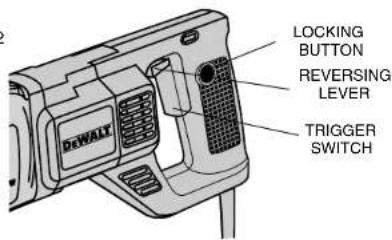
FIGURE 2
Your risk from these exposures varies, depending on how often you do this type of work. To reduce your exposure to these chemicals: work in a well ventilated area, and work with approved safety equipment, such as those dust masks that are specially designed to filter out microscopic particles.
The label on your tool may include the following symbols.
V.....volts
A .amperes
Hz .........hertz
W.....watts
min minutes
..alternating current
direct current
no .no load speed
Class II Construction
/min . . . . . . . . . . . . . . . . . . . . . . . . . . . . . . . . . . . . . . . . . . . revolutions per minute
BPM . . . . . . . . . . . . . . . . . . . . . . . . . . . . . . . . . . . . . . . . . . . . . . . . . . . . . . . . . . . . . . . . . . . . . . . . . . . . . . . . . . . . . . . . . . beats per minute
..safety alert symbol

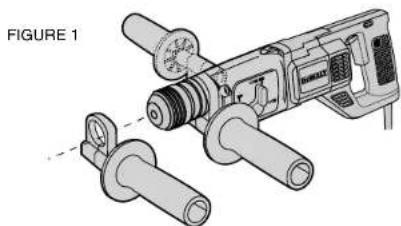
Side Handle
CAUTION: Always hold rotary hammer with both hands. A side handle is supplied with this rotary hammer. It clamps to the front of the gear case as shown in Figure 1 and can be rotated 360^ to permit right or left hand use. The side handle can be tightened by rotating the black plastic portion of the side handle clockwise and loosened by rotating it counterclockwise.
Switch
To start rotary hammer, depress the trigger switch (Figure 2). To stop rotary hammer, release the switch. To lock the trigger switch in the ON position for continuous operation, depress the trigger switch and push in the locking button. The tool will continue to run. To turn the tool OFF, from a locked ON condition, squeeze and release the trigger once. Before using the tool (each time), be sure that the locking button release mechanism is working freely. Do not lock the switch in the "ON" position when drilling by hand so that you can instantly release the trigger which if the bit binds in the hole.
Do not lock the switch ON when drilling by hand so that you can instantly release the trigger switch if the bit binds in the hole. The locking button is for use only when the rotary hammer is mounted in a drill press stand or other wise held stationary. Be sure to release the locking mechanism before disconnecting the plug from the power supply. Failure to do so will cause the rotary hammer to start
immediately the next time it is plugged in. Damage or injury could result.
The variable speed trigger switch permits speed control. The farther the trigger switch is depressed, the higher the speed of the hammerdrill.
NOTE: Use lower speeds for starting holes without a centerpunch, drilling in metal, plastics or ceramics, or driving screws. Higher speeds are better for drilling in wood and composition board and for using abrasive and polishing accessories.
The reversing lever is used to reverse the rotary hammer for backing out screws or jammed bits. It is located above the trigger, shown in Figure 2. To reverse the rotary hammer, turn it OFF and push the reversing lever to the left (when viewed from the chuck end). To position the lever for forward operation, turn the rotary hammer OFF and push the lever to the right.
CAUTION: When reversing to clear jammed bits, be ready for strong reactive torque.
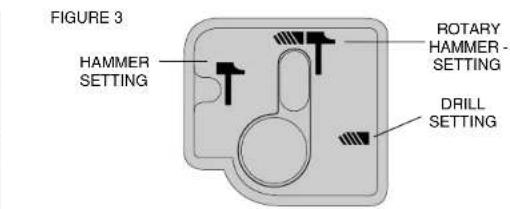
Hammer/Drill Selector (DW567)
To switch tool from the drill only mode to the rotary hammer or hammer only mode rotate the dial on the applicable symbol shown in Figure 3.
NOTE: The selector must be in either drill, rotary hammer or hammer mode at all times. There are no operable positions between the positions.
SDS Chuck
To insert bit, insert shank of bit about 3/4 into chuck. Push and rotate bit until it locks in place. The bit will be securely held.
To release bit, pull the collar back and remove the bit.
Operation
DRILLING
- Always unplug the drill when attaching or changing bits or accessories.
- Use sharp drill bits only. For WOOD, use twist drill bits, spade bits, power auger bits, or hole saws. For METAL, use steel twist drill bits or hole saws. For MASONRY, such as brick, cement, cinder block, etc., use carbide-tipped bits rated for percussion drilling. Be sure the material to be drilled is anchored or clamped firmly. If drilling thin material, use a wood "back-up" block to prevent damage to the material.
- Always apply pressure in a straight line with the bit. Use enough pressure to keep drill biting, but do not push hard enough to stall the motor or deflect the bit.
- Hold tool firmly to control the twisting action of the drill.
- IF DRILL STALLS, it is usually because it is being overloaded or improperly used. RELEASE TRIGGER IMMEDIATELY, remove drill bit from work, and determine cause of stalling. DO NOT CLICK TRIGGER ON AND OFF IN AN ATTEMPT TO START A STALLED DRILL — THIS CAN DAMAGE THE DRILL.
- To minimize stalling or breaking through the material, reduce pressure on drill and ease the bit through the last fractional part of the hole.
- Keep the motor running when pulling the bit back out of a drilled hole. This will help prevent jamming.
- With variable speed drills there is no need to center punch the point to be drilled. Use a slow speed to start the hole and accelerate by squeezing the trigger harder when the hole is deep enough to drill without the bit skipping out.
DRILLING IN METAL
An SDS to round shank adaptor chuck is required. Ensure that tool is in "rotation only" mode. (DW567 only. The DW565 has no "rotation only" mode). Start drilling with slow speed and increase to full
power while applying firm pressure on the tool. A smooth even flow of metal chips indicates the proper drilling rate. Use a cutting lubricant when drilling metals. The exceptions are cast iron and brass which should be drilled dry. The cutting lubricants that work best are sulphurized cutting oil or lard oil; bacon-grease will also serve the purpose.
NOTE: Large (5/16" to 1/2") holes in steel can be made easier if a pilot hole (5/32" to 3/16") is drilled first.
DRILLING IN WOOD
An SDS to round shank adaptor chuck is required. Ensure that tool is in "rotation only" mode. (DW567 only. The DW565 has no "rotation only" mode). Start drilling with slow speed and increase to full power while applying firm pressure on the tool. Holes in wood can be made with the same twist drills used for metal. These bits may overheat unless pulled out frequently to clear chips from the flutes. For larger holes, use spade bits, power auger bits, or hole saws. Work that is apt to splinter should be backed up with a block of wood.
DRILLING IN MASONRY
When drilling in masonry, use carbide tipped bits rated for percussion drilling and be certain that the bit is sharp. Use a constant and firm force on the tool to drill most effectively. A smooth, even flow of dust indicates the proper drilling rate.
Depth Rod
To adjust the depth rod, loosen the handle and move rod so that the distance between the end of the rod and the end of the bit equals the desired drilling depth. When drilling with depth rod, stop when end of rod reaches surface of material.
Maintenance
CLEANING & LUBRICATION
Use only mild soap and damp cloth to clean the tool. Never let any liquid get inside the tool; never immerse any part of the tool into a liquid. Self-lubricating bearings are used in the tool and periodic relubrication is not required. In the unlikely event that service is ever needed, take your tool to an authorized service location.
Accessories
Recommended accessories for use with your tool are available at extra cost from your distributor or local service center.
CAUTION: The use of any non-recommended accessory may be hazardous.
MAXIMUM RECOMMENDED CAPACITIES
MAXIMUM CAPACITY DW565, DW567 DW567-220
MASONRY 1" 1" 1"
STEEL N/A 1/2" 1/2"
WOOD N/A 1 1/2" 1 1/2"
OPTIMUM CAPACITY
MASONRY 5/32"-5/8" 5/32"-5/8" 5/32"-5/8"
Important
To assure product SAFETY and RELIABILITY, repairs, maintenance and adjustment (including brush inspection and replacement) should be performed by authorized service centers or other qualified service organizations, always using identical replacement parts.
Full Warranty
DeWALT heavy duty industrial tools are warranted for one year from date of purchase. We will repair, without charge, any defects due to faulty materials or workmanship. For warranty repair information, call 1-800-4-DeWALT. This warranty does not apply to accessories

or damage caused where repairs have been made or attempted by others. This warranty gives you specific legal rights and you may have other rights which vary in certain states or provinces. In addition to the warranty, DeWALT tools are covered by our:
30 DAY NO RISK SATISFACTION GUARANTEE
If you are not completely satisfied with the performance of your DeWALT heavy duty industrial tool, simply return it to the participating seller within 30 days for a full refund. Please return the complete unit, transportation prepaid. Proof of purchase may be required.
SI VOUS AVEZ DES QUESTIONS OU VOULEZ NOUS FAIRE PART DE VOS COMMENTAIES CONCERNANT CET OUTIL OU TOUT AUTRE OUTIL DEWALT, COMPOSEZ SANS FRAIS LE : 1800 433-9258.
25 ft. 50 ft. 75 ft. 100 ft. 125 ft. 150 ft. 175 ft.
25 ft. 50 ft. 75 ft. 100 ft. 125 ft. 150 ft. 175 ft.
7.6 m 15,2 m 22,9 m 30,5 m 38,1 m 45,7 m 53,3 m
astillarse,deeranafincarseconunbloque madera.
TALADRADO EN ALBANILERIA
BOSQUES DE CIDROS ACCESO RADIATAS NO.42
COL. BOSQUES DE LAS LOMAS.
05120 MEXICO, D
TEL:326-7100
DW567,DW567-22
Para增值服务ventas consulte