USER MANUAL PDP-506 PE & PDP-506FDE PIONEER
PLASMA DISPLAY SYSTEM SYSTEME D'ÉCRAN PLASMA PLASMA DISPLAY-SYSTEM
PDP-506FDE PDP-436FDE
Discover the benefits of registering your product online at www.pioneer.co.uk (or www.pioneer-eur.com).
Operating Instructions
Mode d'emploi
Bedienungsanleitung
This equipment complies with the requirements of Directives 89/336/EEC and 73/23/EEC as amended by 93/68/ EEC.
Replacement and mounting of an AC plug on the power supply cord of this unit should be performed only by qualified service personnel.
IMPORTANT
FOR USE IN THE UNITED KINGDOM.
The wires in this mains lead are coloured in
accordance with the following code:
Green and Yellow
Earth
Blue
: Neutral
Brown
:Live
If the plug provided is unsuitable for your socket outlets, the plug must be cut off and a suitable plug fitted.
The cut-off plug should be disposed of and must not be inserted into any 13 amp socket as this can result in electric shock. The plug or adaptor or the distribution panel should be provided with 13 A fuse. As the colours of the wires in the mains lead of this appliance may not correspond with coloured markings identifying the terminals in your plug, proceed as follows;
The wire which is coloured green and yellow must be connected to the terminal in the plug which is marked with the letter E or by the earth symbol ,or coloured green or green and yellow.
The wire which is coloured blue must be connected to the terminal which is marked with the letter N or coloured black.
The wire which is coloured brown must be connected to the terminal which is marked with the letter L or coloured red.
NOTE
After replacing or changing a fuse, the fuse cover in the plug must be replaced with a fuse cover which corresponds to the colour of the insert in the base of the plug or the word that is embossed on the base of the plug, and the appliance must not be used without a fuse cover. If lost replacement fuse covers can be obtained from your dealer.
Only 13 A fuses approved by B.S.I or A.S.T.A to B.S.1362 should be used.
P3-4-2-1-2-1_En
IMPORTANT
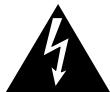
The lightning flash with arrowhead symbol, within an equilateral triangle, is intended to alert the user to the presence of uninsulated "dangerous voltage" within the product's enclosure that may be of sufficient magnitude to constitute a risk of electric shock to persons.
CAUTION
RISK OF ELECTRIC SHOCK DO NOT OPEN
CAUTION: TO PREVENT THE RISK OF ELECTRIC SHOCK, DO NOT REMOVE COVER (OR BACK). NO USER-SERVICEABLE PARTS INSIDE. REFER SERVICING TO QUALIFIED SERVICE PERSONNEL.

The exclamation point within an equilateral triangle is intended to alert the user to the presence of important operating and maintenance (servicing) instructions in the literature accompanying the appliance.
WARNING
This equipment is not waterproof. To prevent a fire or shock hazard, do not place any container filed with liquid near this equipment (such as a vase or flower pot) or expose it to dripping, splashing, rain or moisture.
D3-4-2-1-3_A_En
This product complies with the Low Voltage Directive (73/23/EEC, amended by 93/68/EEC), EMC Directives (89/336/EEC, amended by 92/31/EEC and 93/68/EEC).
WARNING
Before plugging in for the first time, read the following section carefully.
The voltage of the available power supply differs according to country or region. Be sure that the power supply voltage of the area where this unit will be used meets the required voltage (e.g., 230V or 120V) written on the rear panel.
D3-4-2-1-4_A_En
WARNING
This apparatus must be earthed.
WARNING
This product equipped with a three-wire grounding (earthed) plug - a plug that has a third (grounding) pin. This plug only fits a grounding-type power outlet. If you are unable to insert the plug into an outlet, contact a licensed electrician to replace the outlet with a properly grounded one. Do not defeat the safety purpose of the grounding plug. D3-4-2-1-6_A_En
The following symbols are found on labels attached to the product. They alert the operators and service personnel of this equipment to any potentially dangerous conditions.
WARNING
This symbol refers to a hazard or unsafe practice which can result in personal injury or property damage.
CAUTION
This symbol refers to a hazard or unsafe practice which can result in severe personal injury or death.
WARNING
To prevent a fire hazard, do not place any naked flame sources (such as a lighted candle) on the equipment.
D3-4-2-1-7a_A_En
VENTILATION CAUTION
When installing this unit, make sure to leave space around the unit for ventilation to improve heat radiation. For the minimum space required, see page 15.
WARNING
Slots and openings in the cabinet are provided for ventilation to ensure reliable operation of the product, and to protect it from overheating. To prevent fire hazard, the openings should never be blocked or covered with items (such as newspapers, table-cloths, curtains) or by operating the equipment on thick carpet or a bed.
CAUTION
The power switch does not completely separate the unit from the mains in off position. Therefore install the unit suitable places easy to disconnect the mains plug in case of the accident. The mains plug of unit should be unplugged from the wall socket when left unused for a long period of time.
STANDBY: When placed into the standby mode, the main power flow is cut and the unit is no longer fully operational.
STANDBY/ON Indicator
The indicator is lit red when the unit is in the standby mode and is lit blue when it is in the power-on mode.
Thank you for buying this Pioneer product.
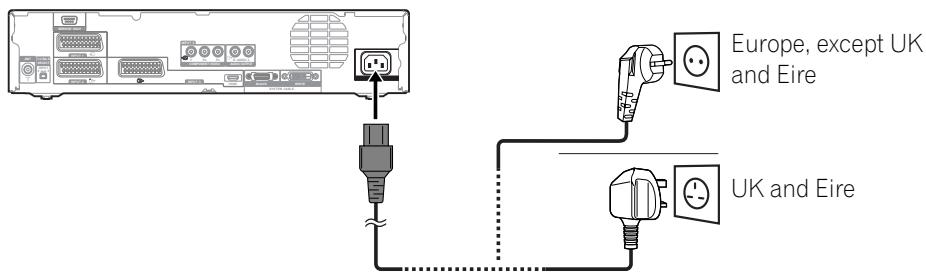
Please read through these operating instructions so you will know how to operate your model properly. After you have finished reading the instructions, put them away in a safe place for future reference. In some countries or regions, the shape of the power plug and power outlet may sometimes differ from that shown in the explanatory drawings. However the method of connecting and operating the unit is the same.
02 Safety Precautions
03 Supplied Accessories
Plasma Display 11
Media Receiver 11
04 Part Names
Plasma Display 12
Media Receiver 13
Remote control unit 14
05 Preparation
Installing the Plasma Display 15
Installing the Media Receiver 15
Preventing the Plasma Display from
Falling Over 16
Connecting the system cable 17
Routing cables 18
Preparing the remote control unit 19
Inserting batteries 19
Cautions regarding batteries 19
Allowed operation range of the remote control unit 19
Cautions regarding the remote control unit 19
Basic connections 20
Connecting to an antenna 20
Connecting the power cord 20
06 Watching TV
Turning on/ off the power 21
Changing channels 22
Tuning to your favourite channels 23
Changing the volume and sound 23
Freezing images 25
Using the menu 26
Menu operations 26
08 Basic Adjustment Settings
Setting up TV channels automatically ......27
Using Auto Installation 27
Setting up TV channels manually 27
Using Manual Adjust 27
Reducing video noise 28
Setting Child Lock 28
Selecting a decoder input terminal … 28
Labelling TV channels 29
Sorting preset TV channels 29
Clock setting 29
Language setting 30
AV Selection 30
Basic picture adjustments 31
Advanced picture adjustments 31
Using PureCinema 31
Using Colour Temp 32
Using CTI 32
Using Colour Management 32
Eliminating noise from images 33
Using the Dynamic Range Expander (DRE) functions 33
Using the 3DYC and I-P Mode 33
Sound adjustments 34
FOCUS 34
Front Surround 34
Power Control 35
09 Useful Adjustment Settings
Switching the vertical drive frequency … 36
Adjusting image positions 36
Selecting an input signal type 36
Colour system setting 36
Selecting a screen size manually 37
Selecting a screen size automatically .... 37
Selecting a screen size for received
4:3 aspect ratio signals 37
Changing the brightness at both sides
of the screen (Side Mask) 38
Sleep Timer 38
Using a password 38
Entering a password 38
Changing the password 39
Resetting the password function .... 39
Disabling the password function .... 39
10Enjoying through External Equipment
Watching a decoder image 40
Connecting a decoder 40
Displaying a decoder image 40
Watching a VCR image 40
Connecting a VCR 40
Displaying a VCR image 40
Using HDMI Input 41
Connecting HDMI equipment 41
Using i/o Link.A 42
Watching a DVD image 42
Connecting a DVD player 42
Displaying a DVD image 42
Enjoying a game console or watching
camcorder images 43
Connecting a game console or camcorder 43
Displaying an image from the game console or camcorder 43
Enjoying through audio equipment in
connection 43
Connecting audio equipment 43
11 Using the Teletext Functions
What is Teletext? 44
Operating the Teletext basics 44
Turning on and off Teletext 44
Selecting and operating Teletext pages 44
Displaying subpages 45
Displaying TOP Over View 45
Displaying subtitle pages 45
12 Appendix
Troubleshooting 46
Connecting pin assignments for
SCART 47
Specifications 48
In order to obtain maximum enjoyment from this Pioneer PureVision PDP-506FDE/PDP-436FDE Plasma Display System, please first read this information carefully.
With the Pioneer PureVision PDP-506FDE/PDP-436FDE, you can be assured of a high quality Plasma Display System with long-life and high reliability. To achieve images of exceptional quality, this Pioneer Plasma Display System incorporates state-of-the-art design and construction, as well as very precise and highly advanced technology.
The Pioneer PureVision PDP-506FDE/PDP-436FDE incorporates the latest in colour filter technology – Direct Colour Filter. This improves the colour / picture reproduction of these models as compared to previous models. It also eliminates the need for a physical glass panel to be placed in front of the plasma panel, which furthers Pioneer's continued goal of reducing environmental waste in consumer electronics, now during the manufacturing process and in the future during the recycling process.
Over the course of its lifetime, the luminosity of the Pioneer PDP-506FDE/PDP-436FDE Plasma Display System will diminish very slowly, such as with all phosphor-based screens (for example, a traditional tube-type television). To enjoy beautiful and bright images on your Pioneer Plasma Display System for a long time, please carefully read and follow the usage guidances below:
Usage guidelines
All phosphor-based screens (including conventional tube-type televisions) can be affected by displaying static images for a prolonged period. Plasma Display System's are no exception to this rule. After-image and permanent effects on the screen can be avoided by taking some basic precautions. By following the recommendations listed below, you can ensure longer and satisfactory results from your plasma:
- Whenever possible, avoid frequently displaying the same image or virtually still moving pictures (e.g. closed-captioned images or video game images which have static portions).
- Do not display Teletext for a prolonged period of time.
- Avoid viewing the On Screen Display for extended periods, from a decoder, DVD player, VCR and all other components.
- Do not leave the same picture freeze-framed or paused continuously over a long period of time, when using the still picture mode from a TV, VCR, DVD player or any other component.
- Images which have both very bright areas and very dark areas side by side should not be displayed for a prolonged period of time.
- When playing a game, the "GAME" mode setting within "AV Selection" is strongly recommended. However, please limit its use to less than 2 hours at a time.
- After playing a game or displaying any still image, it is best to view a normal moving picture in the "WIDE" or "FULL" screen setting for more than 3 times the length of the previous still moving image.
- After using the Plasma Display System, always switch the display to "STANDBY" mode.
Installation guidelines
The Pioneer PureVision PDP-506FDE/PDP-436FDE Plasma Display System incorporates a very thin design. To ensure safety, please take the proper measures to mount or install the Plasma Display, in order to prevent the unit from tipping over in the event of vibration or accidental movement.
This product should be installed by using only parts and accessories designed by PIONEER. Use of accessories other than the PIONEER stand or installation bracket may result in instability, and could cause injury. For custom installation, please consult the dealer where the unit was purchased. To ensure correct installation, experienced and qualified experts must install the unit. PIONEER will not be held responsible for accident or damage caused by the use of parts and accessories manufactured by other companies.
To avoid malfunction and overheating, make sure that the vents on the main unit are not blocked when installing to ensure proper heat emission:
- Distance the unit slightly from other equipment, walls, etc. For the minimum space required around the unit, see page 15.
- Do not fit the unit inside narrow spaces where ventilation is poor.
- Do not cover with a cloth, etc.
- Clean the vents on the sides and rear of the unit to remove dust build-up, by using a vacuum cleaner set to its lowest suction setting.
- Do not place the product on a carpet or blanket.
- Do not leave the product tilted over except the case of vertical installation of the Media Receiver.
- Do not reverse the product.
Using the unit without proper ventilation may cause the internal temperature to rise, and could result in possible malfunction. When the surrounding or internal temperature exceeds a certain degree, the display will automatically power off in order to cool the internal electronics and prevent hazardous occurrences.
Any malfunction may occur due to: an inappropriate installation site, improper assembly, installation, mounting, or operation of this product, modifications made to the product. However, PIONEER cannot be held responsible for such accidents or malfunction.

NOTE
The following are typical effects and characteristics of a phosphor-based matrix display and as such, are not covered by the manufacturer's limited warranties:
- Permanent residual images upon the phosphors of the panel.
- The existence of a minute number of inactive light cells.
- Panel generated sounds, examples: Fan motor noise, and electrical circuit humming / glass panel buzzing

CAUTION
PIONEER bears no responsibility for any damage arising from incorrect use of the product by you or other people, malfunctions when in use, other product related problems, and use of the product except in cases where the company must be liable.
Plasma Display protection function
When still images (such as photos and computer images) stay on the screen for an extended period of time, the screen will be slightly dimmed. This is because the protection function of the Plasma Display automatically adjusts the brightness to protect the screen when detecting still images; so this does not designate malfunction. The screen is dimmed when a still image is detected for about three minutes.
Plasma screens display information using pixels. Pioneer plasma display panels contain a very large number of pixels. (Depending on the panel size; over 2.3 million cells in case of a 43 inch display, over 2.9 million pixels in case of a 50 inch display, over 3.1 million cells in case of a 61 inch display). All Pioneer display panels are manufactured using a very high level of ultra-precision technology and undergo individual quality control.
In rare cases, some pixels can be permanently switched off, or on, resulting in either a black or coloured pixel permanently fixed on the screen.
This effect is common to all plasma displays because it is a consequence of the technology.
If the defective pixels are visible at a normal viewing distance of between 2.5 and 3.5 meters whilst viewing a normal broadcast (i.e. not a test card, still image or single colour display) please contact the supplying dealer.
If, however, they can only be seen close up or during single colour displays then this is considered normal for this technology.
Infrared rays
The Plasma Display releases infrared rays because of its characteristics. Depending on how the Plasma Display is in use, the remote controls of nearby equipment may be adversely affected or wireless headphones using infrared rays are interfered by noise. If this is the case, place that equipment at a location where its remote control sensor is not affected.
Radio interference
While this product meets the required specifications, it emits a small amount of noise. If you place such equipment as an AM radio, personal computer, and VCR close to this product, that equipment may be interfered. If this happens, place that equipment far enough from this product.
Plasma Display driving sound
The screen of the Plasma Display is composed of extremely fine pixels and these pixels emit light according to received video signals. This principle may make you hear buzz sound or electrical circuit hamming from the Plasma Display.
Also note that the rotation speed of the cooling fan motor increases when the ambient temperature of the Media Receiver becomes high. You may hear the sound of the fan motor at that time.
Do not attach such items as labels and tape to the product.
- This may result in the discolouration or scratch of the cabinet.
When not using the product for a long period of time
- If you do not use the product for a long period of time, the functions of the product may be adversely affected. Switch on and run the product occasionally.
Condensation
- Condensation may take place on the surface or inside of the product when the product is rapidly moved from a cold place to a warm place or just after a heater is switched on in winter morning, for example. When condensation takes place, do not switch on the product and wait until condensation disappears. Using the product with condensation may result in malfunction.
Cleaning the surface of the screen and the glossy surface of the front cabinet
- When cleaning the surface of the screen or the glossy surface of the front cabinet, gently wipe it with a dry soft cloth; the supplied cleaning cloth or other similar cloths (e.g., cotton and flannel). If you use a dusty or hard cloth or if you rub the screen hard, the surface of the product will be scratched.
- If you clean the surface of the screen with a wet cloth, water droplets on the surface may enter into the product, resulting in malfunction.
Cleaning the cabinet
- When cleaning the cabinet of this product, gently wipe it with a clean soft cloth (e.g., cotton and flannel). If you use a dusty or hard cloth or if you rub the cabinet hard, the surface of the cabinet will be scratched.
- The cabinet of this product is mostly composed of plastic. Do not use chemicals such as benzene or thinner to clean the cabinet. Using these chemicals may result in quality deterioration or coating removal.
- Do not expose the product to volatile gas or fluid such as pesticide. Do not make the product contact with rubber or vinyl products for a long period of time. The effect of plasticizer in the plastic may result in quality deterioration or coating removal.
- If you clean the surface of the cabinet with a wet cloth, water droplets on the surface may enter into the product, resulting in malfunction.
Handles at the rear of the Plasma Display
- Do not remove the handles from the rear of the Plasma Display.
- When moving the Plasma Display, ask another person for help and use the handles attached to the rear of the Plasma Display. Do not move the Plasma Display by holding only a single handle. Use the handles as shown.
- Do not use the handles to hang the product when installing or carrying the product, for example. Do not use the handles for the purpose of preventing the product from tilting over.

CAUTION
Panel sticking and after-image lag
- Displaying the same images such as still images for a long time may cause after-image lagging. This may occur in the following two cases.
1 After-image lagging due to remaining electrical load
When image patterns with very high peak luminance are displayed for more than 1 minute, after-image lagging may occur due to the remaining electric load. The after-images remaining on the screen will disappear when moving images are displayed. The time for the after-images to disappear depends on the luminance of the still images and the time they had been displayed.
2 After-image (lag image) due to burning
Avoid displaying the same image on the Plasma Display continuously over a long period of time. If the same image is displayed continuously for several hours, or for shorter periods of time over several days, a permanent after-image may remain on the screen due to burning of the fluorescent materials. Such images may become less noticeable if moving images are later displayed, but they will not disappear completely.
- The energy save function can be set to help prevent damage from screen burning (see page 35).

If you want to dispose this product, do not mix it with general household waste. There is a separate collection system for used electronic products in accordance with legislation that requires proper treatment, recovery and recycling.
Private households in the 25 member states of the EU, in Switzerland and Norway may return their used electronic products free of charge to designated collection facilities or to a retailer (if you purchase a similar new one).
For countries not mentioned above, please contact your local authorities for the correct method of disposal.
By doing so you will ensure that your disposed product undergoes the necessary treatment, recovery and recycling and thus prevent potential negative effects on the environment and human health.
Electricity is used to perform many useful functions, but it can also cause personal injuries and property damage if improperly handled. This product has been engineered and manufactured with the highest priority on safety. However, improper use can result in electric shock and/or fire. In order to prevent potential danger, please observe the following instructions when installing, operating and cleaning the product. To ensure your safety and prolong the service life of your product, please read the following precautions carefully before using the product.
- Read instructions — All operating instructions must be read and understood before the product is operated.
- Keep this manual in a safe place — These safety and operating instructions must be kept in a safe place for future reference.
- Observe warnings — All warnings on the product and in the instructions must be observed closely.
- Follow instructions — All operating instructions must be followed.
- Cleaning — Unplug the power cord from the AC outlet before cleaning the product. To clean the product, use the supplied cleaning cloth or other soft clothes (e.g., cotton, flannel). Do not use liquid cleaners or aerosol cleaners.
- Attachments — Do not use attachments not recommended by the manufacturer. Use of inadequate attachments can result in accidents.
- Water and moisture — Do not use the product near water, such as bathtub, washbasin, kitchen sink and laundry tub, swimming pool and in a wet basement.
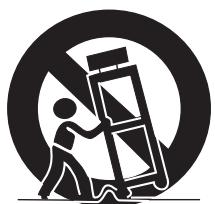
- Stand — Do not place the product on an unstable cart, stand, tripod or table. Placing the product on an unstable base can cause the product to fall, resulting in serious personal injuries as well as damage to the product. Use only a cart, stand, tripod, bracket or table recommended by the manufacturer or sold with the product. When mounting the product on a wall, be sure to follow the manufacturer's instructions. Use only the mounting hardware recommended by the manufacturer.
- When relocating the product placed on a cart, it must be moved with utmost care. Sudden stops, excessive force and uneven floor surface can cause the product to fall from the cart.
- Ventilation — The vents and other openings in the cabinet are designed for ventilation. Do not cover or block these vents and openings since insufficient ventilation can cause overheating and/or shorten the life of the product. Do not place the product on a bed, sofa, rug or other similar surface, since they can block ventilation openings. This product is not designed for built-in installation; do not place the product in an enclosed place such as a bookcase or rack, unless proper ventilation is provided or the manufacturer's instructions are followed.
- Power source — This product must operate on a power source specified on the specification label. If you are not sure of the type of power supply used in your home, consult your dealer or local power company.
-
Power cord protection — The power cords must be routed properly to prevent people from stepping on them or objects from resting on them. Check the cords at the plugs and product.
-
The plasma Display used in this product is made of glass. Therefore, it can break when the product is dropped or applied with impact. Be careful not to be injured by broken glass pieces in case the plasma Display breaks.
- Overloading — Do not overload AC outlets or extension cords. Overloading can cause fire or electric shock.
- Entering of objects and liquids — Never insert an object into the product through vents or openings. High voltage flows in the product, and inserting an object can cause electric shock and/or short internal parts. For the same reason, do not spill water or liquid on the product.
- Servicing — Do not attempt to service the product yourself. Removing covers can expose you to high voltage and other dangerous conditions. Request a qualified service person to perform servicing.
- Repair — If any of the following conditions occurs, unplug the power cord from the AC outlet, and request a qualified service person to perform repairs.
a. When the power cord or plug is damaged.
b. When a liquid was spilled on the product or when objects have fallen into the product.
c. When the product has been exposed to rain or water.
d. When the product does not operate properly as described in the operating instructions.
Do not touch the controls other than those described in the operating instructions. Improper adjustment of controls not described in the instructions can cause damage, which often requires extensive adjustment work by a qualified technician.
e. When the product has been dropped or damaged.
f. When the product displays an abnormal condition. Any noticeable abnormality in the product indicates that the product needs servicing.
18. Replacement parts — In case the product needs replacement parts, make sure that the service person uses replacement parts specified by the manufacturer, or those with the same characteristics and performance as the original parts. Use of unauthorized parts can result in fire, electric shock and/or other danger.
19. Safety checks — Upon completion of service or repair work, request the service technician to perform safety checks to ensure that the product is in proper operating condition.
20. Wall or ceiling mounting — When mounting the product on a wall or ceiling, be sure to install the product according to the method recommended by the manufacturer.
21. Heat sources — Keep the product away from heat sources such as radiators, heaters, stoves and other heat-generating products (including amplifiers).
22. Unplug the power cord from the AC outlet before installing the speakers.
23. Never expose the screen of the Plasma Display to a strong impact, for example, by hitting it. The screen may be broken, resulting in fire or personal injury.
24. Do not expose the Plasma Display to direct sunlight for a long period of time. The optical characteristics of the front protection panel changes, resulting in discolouration or warp.
25. The Plasma Display weighs about 31.8kg (70.1 lbs.) for the PDP-506PE and about 25.8kg (56.9 lbs.) for the PDP-436PE. Because it has small depth and is unstable, unpack, carry, and install the product with one more person at least and use the handles.
Installation Precautions
Observe the following precautions when installing with any items such as the optional stand.
When using the optional stand, brackets, or equivalent items
- Ask your dealer to perform the installation.
- Be sure to use the supplied bolts.
- For details, see the instruction manual that comes with the optional stand (or equivalent items).
When using other items
- Consult your dealer.
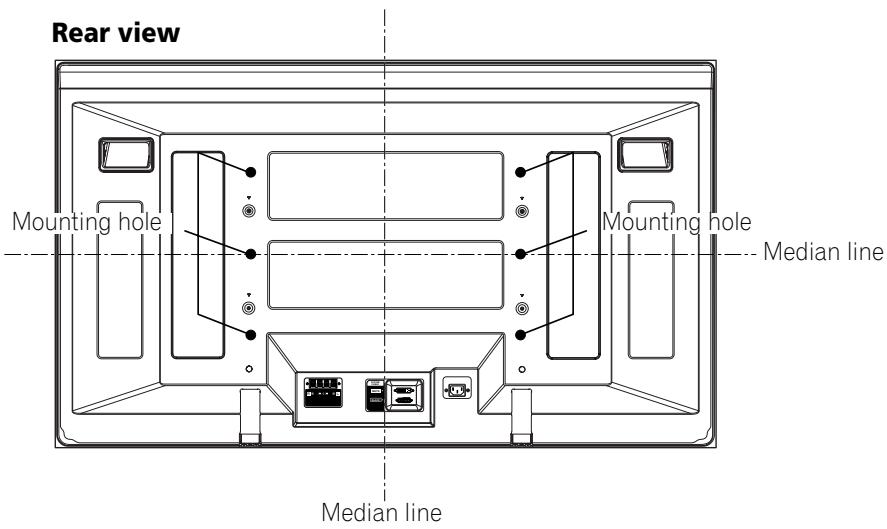
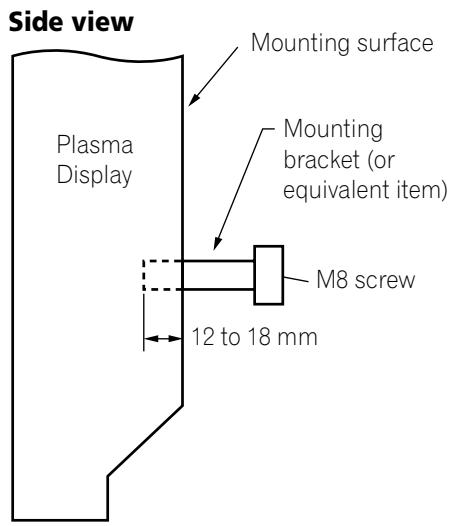
- The following six mounting holes can be used for the installation:

CAUTION
- Be sure to use four or more mounting holes symmetrical to the vertical and horizontal median lines.
- Use M8 screws, which go 12 to 18mm in depth from the mounting surface of the Plasma Display. See the side view above.
- Be careful not to block the ventilation opening at the rear of the Plasma Display.
- Be sure to install the Plasma Display on a flat surface because it contains glass.
- The screw holes other than the above are to be used only for the specified products. Never use them for mounting non-specified products.
- Do not mount or remove the Plasma Display to or from the stand, with speakers attached.

NOTE
- It is strongly recommended to use the optional PIONEER mounting products.
- PIONEER shall not be liable for any personal injury or product damage that results from the use of mounting items other than the optional PIONEER products.
Plasma Display
| Power cord (2 m) | Cleaning cloth |
| (For Europe, except UK and Eire) | (For UK and Eire) |
| Only the power cord that is appropriate in your country or region is supplied. |
| Speed clamp x 3 | Bead band x 3 | Cable tie | Warranty card |
| Power cord (2 m) | Remote control unit |
| (For Europe, except UK and Eire) | (For UK and Eire) |
| Only the power cord that is appropriate in your country or region is supplied. |
| AA size battery x 2 | System cable (3 m) | Two operating instructions |

NOTE
- Always use the power cord supplied with the Plasma Display and the one supplied with the Media Receiver for each respective unit.
Plasma Display
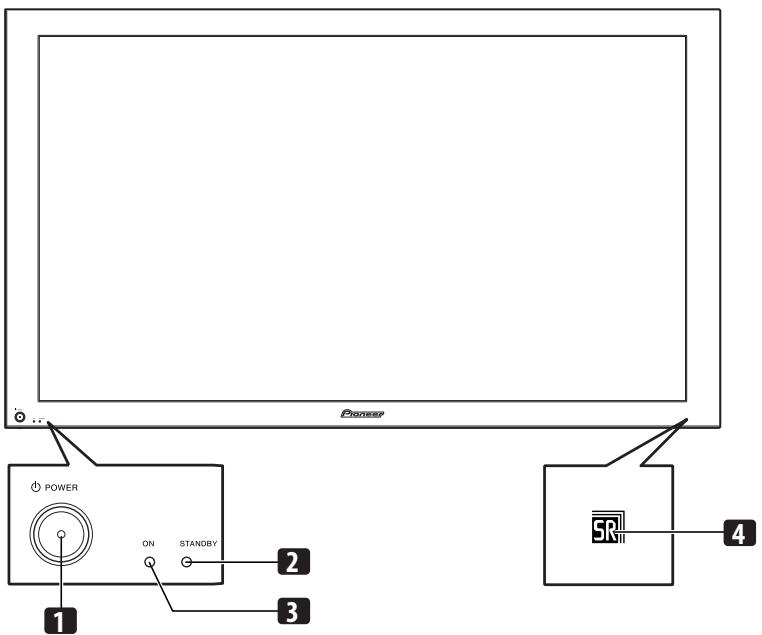
Front view
1 POWER button
2 STANDBY indicator
3 POWER ON indicator
4 Remote control sensor
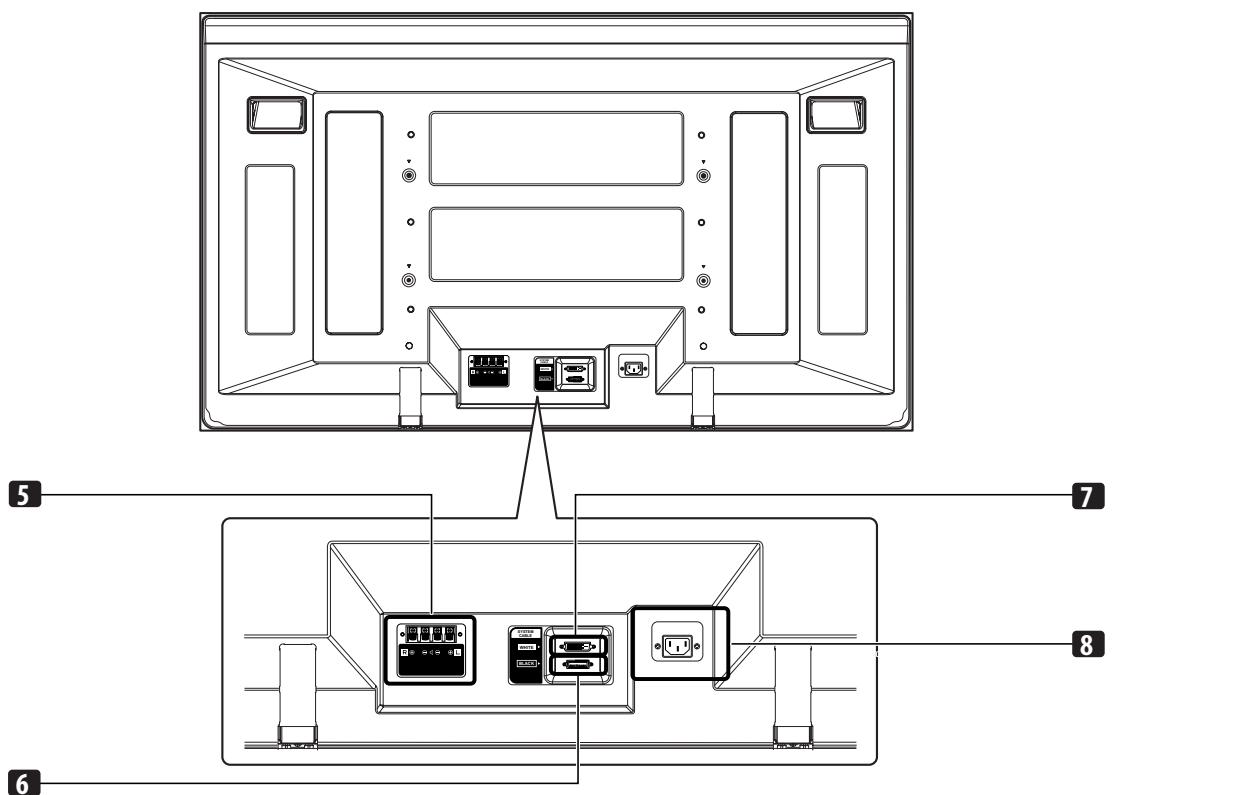
Rear view
5 SPEAKER (right/left) terminals
6 SYSTEM CABLE terminal (BLACK)
7 SYSTEM CABLE terminal (WHITE)
8 AC IN terminal
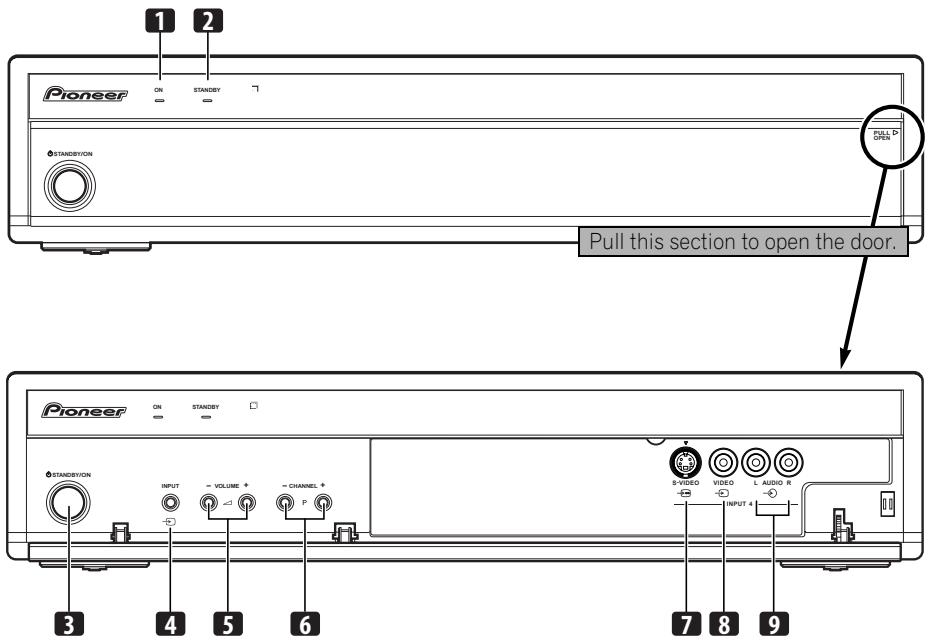
Front view
1 POWER ON indicator
2 STANDBY indicator
3 STANDBY/ON button
4 INPUT button
5 VOLUME + / - buttons
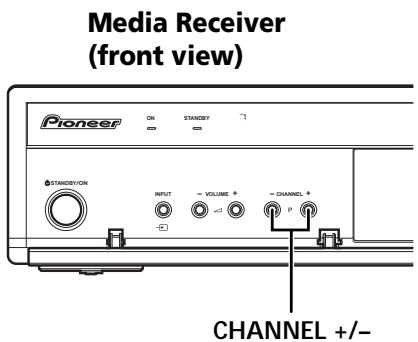
6 CHANNEL +/- buttons
7 INPUT 4 terminal (S-VIDEO)
8 INPUT 4 terminal (VIDEO)
9 INPUT 4 terminals (AUDIO)
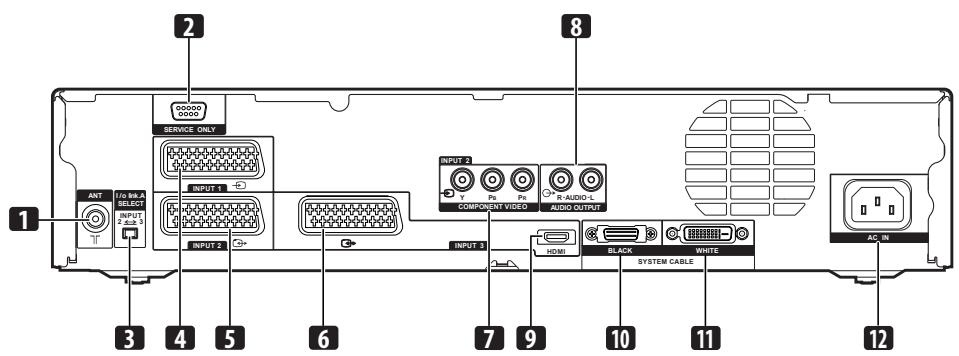
Rear view
1 ANT (Antenna) input terminal
2 RS-232C terminal (used for factory setup)
3 i/o link.A SELECT switch
4 INPUT 1 terminal (SCART)
5 INPUT 2 terminal (SCART)
6 INPUT 3 terminal (SCART)
7 INPUT 2 terminals
(COMPONENTVIDEO:Y,PB,PR)
8 AUDIO OUTPUT terminals
9 INPUT 3 terminal (HDMI)
10 SYSTEM CABLE terminal (BLACK)
11 SYSTEM CABLE terminal (WHITE)
12 AC IN terminal
Remote control unit
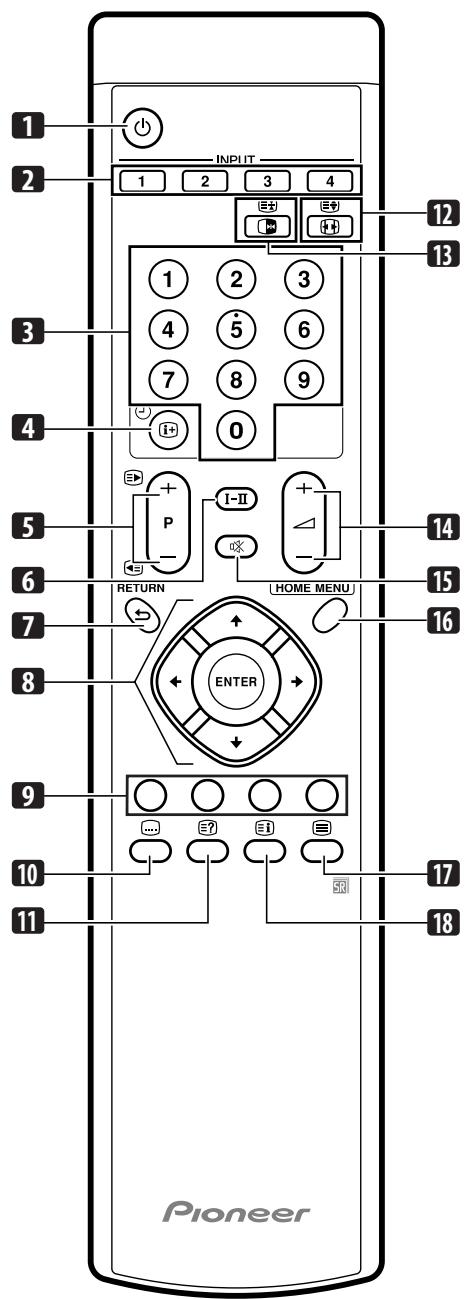

NOTE
- When using the remote control unit, point it at the Plasma Display.
1
Turns on the power to the Plasma Display or places it into the standby mode.
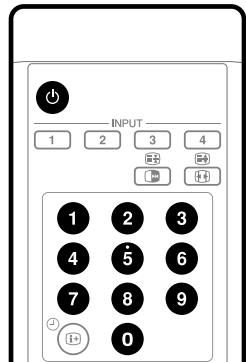
Selects an input source of the Plasma Display. (INPUT 1, INPUT 2, INPUT 3, INPUT 4)
3 0-9
TV/External input mode: Selects a channel.
TELETEXT mode: Selects a page.
4 i+
Displays the channel information.
TV/External input mode: Selects a channel.

TELETEXT mode: Selects a page.
6 I-II
Sets the sound multiplex mode.
7 RETURN
Restores the previous menu screen.
8 / / /
Selects a desired item on the setting screen.
ENTER
Executes a command.
9 Colour (RED/GREEN/YELLOW/BLUE)
TELETEXT mode: Selects a page.
10
Jumps to the teletext subtitle page.
11 ?
Displays hidden characters.
12
TV/External input mode: Selects the screen size.

TELETEXT mode: Switches Teletext images. (full/upper half/lower half)
13
TV/External input mode: Freezes a frame from a moving image. Press again to cancel the function.

TELETEXT mode: Stops updating Teletext pages. Press again to release the hold mode.
14 +/ -
Sets the volume.
15
Mutes the sound.
TV/External Input mode: Displays the Menu screen.
17
Selects the TELETEXT mode.
(all TV image, all TEXT image, TV/TEXT image)
18 3i
TELETEXT mode: Displays an Index page for the CEEFAX/
FLOF format. Displays a TOP Over View page for the TOP format.
Installing the Plasma Display
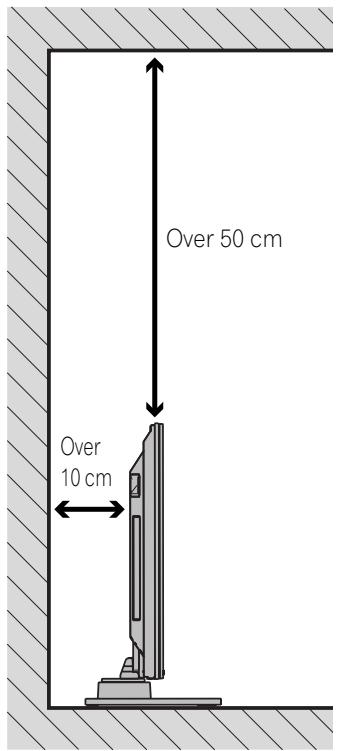
Location
- Avoid direct sunlight. Maintain adequate ventilation.
- The length of the system cable used to connect the Plasma Display and the Media Receiver is about 3m .
- Because the Plasma Display is heavy, be sure to have someone help you when moving it.

CAUTION
- If you place anything on the top of the Media Receiver, it will not receive enough ventilation and will not operate properly.

NOTE
- Allow enough space around the upper and back parts when installing to ensure adequate ventilation of the rear of the unit.
Using the optional PIONEER stand
For details on installation, refer to the instruction manual supplied with the stand.
Using the optional PIONEER speakers
For details on installation, refer to the instruction manual supplied with the speaker.

CAUTION
Operating Environment
Operating environment temperature and humidity: +0^ + + 40^ ; less than 85% RH (cooling vents not blocked) Do not install this unit in a poorly ventilated area, or in locations exposed to high humidity or direct sunlight (or strong artificial light)
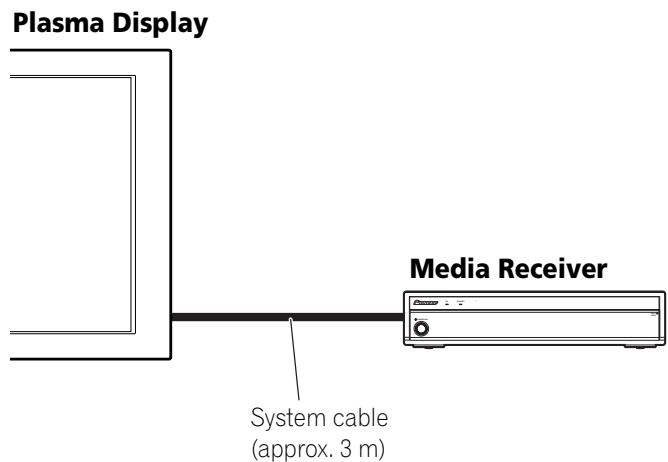

CAUTION
- Do not place a VCR or any other device on the top of the Media Receiver.
- When installing, allow enough space on the sides and above the Media Receiver.
- Do not block the side ventilation opening or the rear exhaust opening of the Media Receiver.
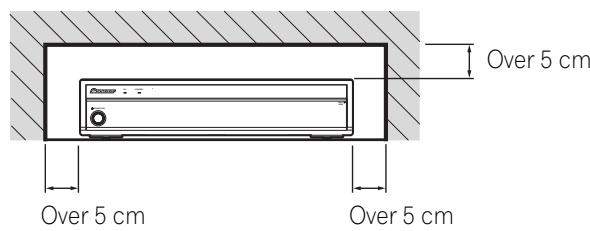
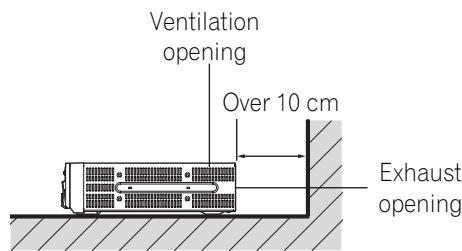

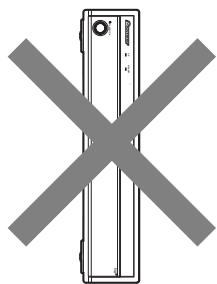
CAUTION
Placing the Media Receiver alone in the vertical position can result in product damage and malfunction.
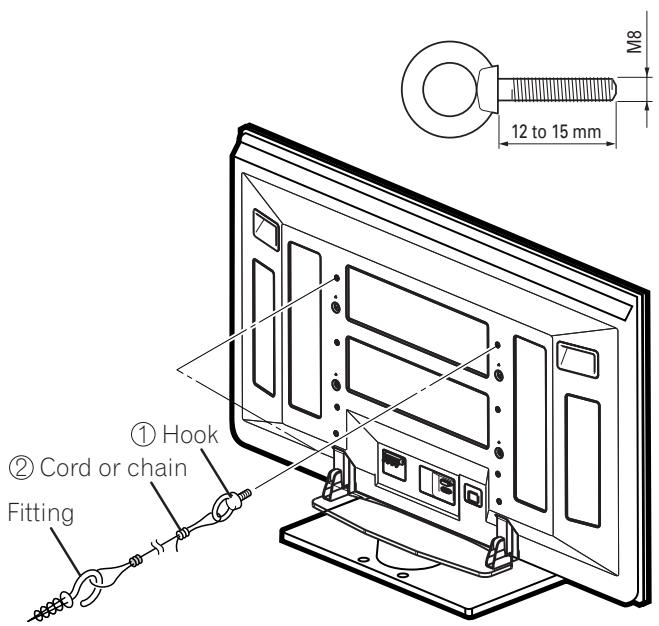
Preventing the Plasma Display from Falling Over
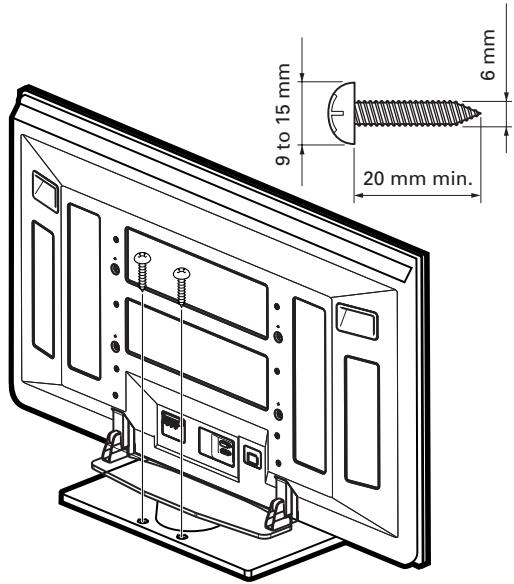
After installing the stand, be sure to take special care to ensure that the Plasma Display will not fall over.
Stabilizing on a table or floor
Stabilize the Plasma Display as shown in the diagram using screws that are available on the market.

NOTE
To stabilize the Plasma Display on a table or on the floor, use screws that have a nominal diameter of 6 mm and that are at least 20 mm long.

CAUTION
A table or an area of the floor with adequate strength should always be used to support the Plasma Display. Failure to do so could result in personal injury and physical damage.
When installing the Plasma Display, please take the necessary safety measures to prevent it from falling or overturning in case of emergencies, such as earthquakes, or of accidents.
If you do not take these precautions, the Plasma Display could fall down and cause injury.
The screws, hooks, chains and other fittings that you use to secure the Plasma Display to prevent it from overturning will vary according to the composition and thickness of the surface to which it will be attached.
Select the appropriate screws, hooks, chains, and other fittings after first inspecting the surface carefully to determine its thickness and composition and after consulting a professional installer if necessary.
Using a wall for stabilization
- Attach falling prevention bolts (hooks) to the Plasma Display.
- Use strong cords or chains to stabilize it appropriately and firmly to a wall, pillar, or other sturdy element.
- Perform this work in the same way on the left and right sides.

NOTE
Use hooks, ropes, chains, and fittings that are available on the market.
Recommended hook: Nominal diameter 8 mm Length 12 to 15 mm
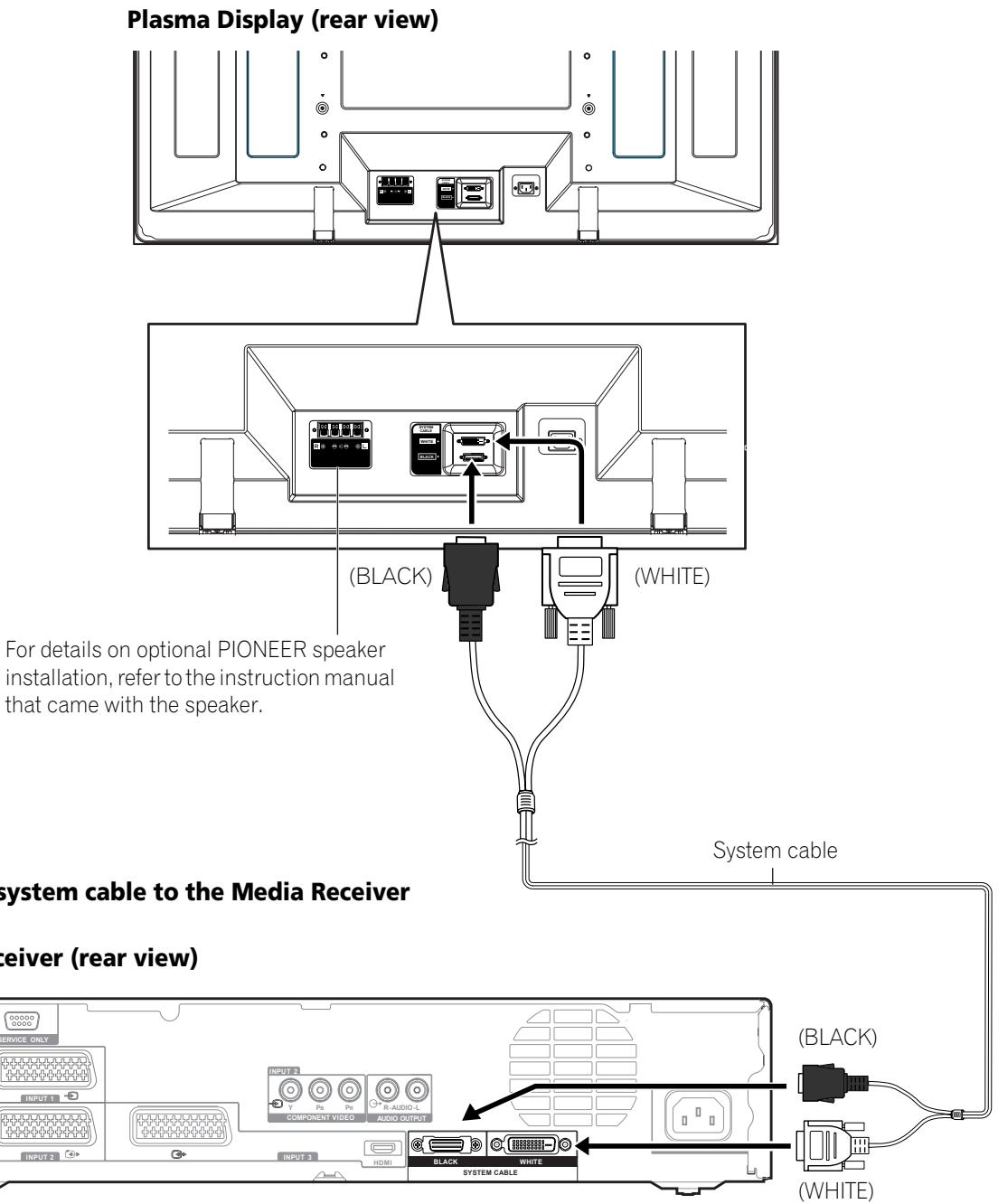
Connecting the system cable
Connecting the system cable to the Plasma Display
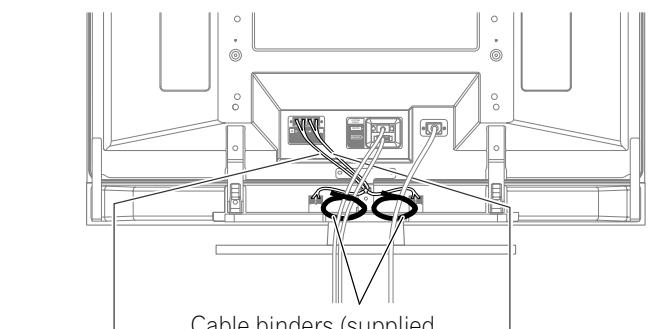
Routing cables
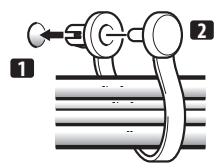
Speed clamps and bead bands are supplied for bunching cables. Once properly bunched, follow the steps below to route the cables.
When the speakers are installed on the sides
(rear view)
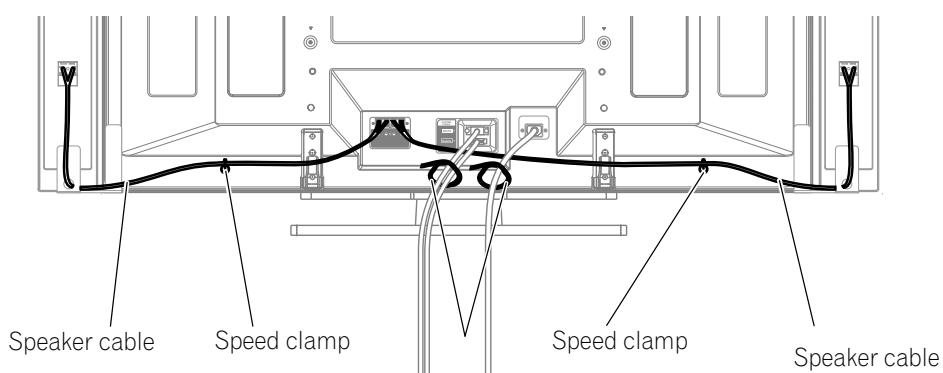
Cable binder (supplied with the stand)*
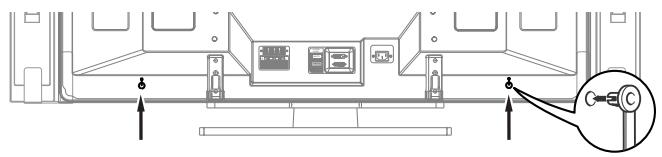
Attaching speed clamps to the main unit
Attach the speed clamps using the 2 holes marked with
below, depending on your routing system.
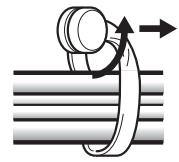
Attaching and removing speed clamps
Insert [1] into an appropriate hole on the rear of the Plasma Display and snap [2] into the back of [1] to lock the clamp.
Speed clamps are designed to be difficult to undo once in place. Please attach them carefully.
Use pliers to twist the clamp 90^ , pulling outward. The clamp may deteriorate over time and become damaged if removed.
When the speakers are installed at the bottom (PDP-436FDE only)
Speaker cable
Cable binders (supplied with the stand)*
Speaker cable

NOTE
Using the cable binders supplied with the stand, put the speaker and system cables together so that the cables are invisible from the front. At that time be careful not to apply any force to the connection sections of the cables.
Preparing the remote control unit
Inserting batteries
1 Open the battery cover.
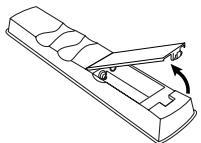
2 Load the supplied two AA size batteries while inserting their respective negative polarity (-) ends first.
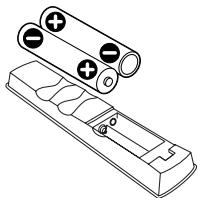
- Place batteries with their terminals corresponding to the (+) and (-) indicators in the battery compartment.
3 Close the battery cover.
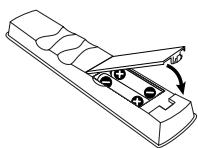
Cautions regarding batteries
Improper use of batteries can result in chemical leakage or explosion. Be sure to follow the instructions below.
- When you replace the batteries, use manganese or alkaline ones.
- Place the batteries with their terminals corresponding to the (+) and (-) indicators.
- Do not mix batteries of different types. Different types of batteries have different characteristics.
- Do not mix old and new batteries. Mixing old and new batteries can shorten the life of new batteries or cause chemical leakage in old batteries.
- Remove batteries as soon as they have worn out. Chemicals that leak from batteries can cause a rash. If you find any chemical leakage, wipe thoroughly with a cloth.
- The batteries supplied with this product may have a shorter life expectancy due to storage conditions.
- If you will not use the remote control unit for an extended period of time, remove the batteries from it.

CAUTION
- WHEN DISPOSING OF USED BATTERIES, PLEASE COMPLY WITH GOVERNMENTAL REGULATIONS OR ENVIRONMENTAL PUBLIC INSTRUCTION'S RULES THAT APPLY IN YOUR COUNTRY/AREA.
Allowed operation range of the remote control unit
Operate the remote control unit while pointing it toward the remote control sensor (SR) located at the bottom right of the front panel of the Plasma Display. The distance from the remote control sensor must be within 7 m and the angle relative to the sensor must be within 30 degrees in the right, left, upward, or downward direction.
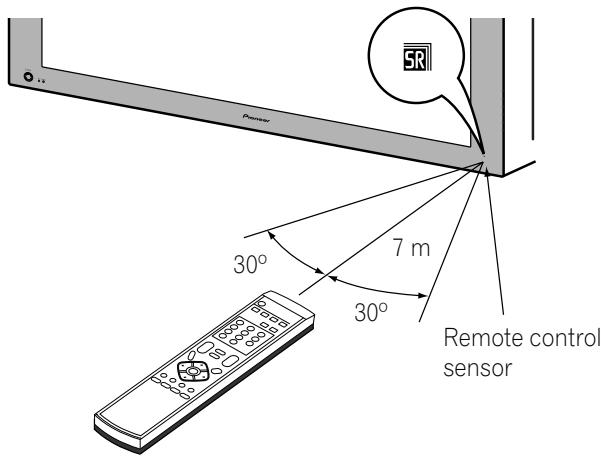
Cautions regarding the remote control unit
- Do not expose the remote control unit to shock. In addition, do not expose the remote control unit to liquids, and do not place in an area with high humidity.
- Do not install or place the remote control unit under direct sunlight. The heat may cause deformation of the unit.
- The remote control unit may not work properly if the remote control sensor of the Plasma Display is under direct sunlight or strong lighting. In such case, change the angle of the lighting or Plasma Display, or operate the remote control unit closer to the remote control sensor.
- When any obstacle exists between the remote control unit and the remote control sensor, the remote control unit may not function.
- As the batteries become empty, the remote control unit can function within a shorter distance from the remote control sensor. Replace the batteries with new ones early enough.
- The Plasma Display emits very weak infrared rays from its screen. If you place such equipment operated through infrared remote control as a VCR nearby, that equipment may not receive commands from its remote control unit properly or entirely. If this is the case, place that equipment at a location far enough from the Plasma Display.
- Depending on the installation environment, infrared rays from the Plasma Display may not allow this system to properly receive commands from the remote control unit or may shorten allowable distances between the remote control unit and the remote control sensor. The strength of infrared rays emitted from the screen differs, depending on images displayed on the screen.
Basic connections
Connecting to an antenna
To enjoy a clearer picture, use an outdoor antenna. The following is a brief explanation of the types of connections that are used for a coaxial cable.

Antenna cable (commercially available)

If your outdoor antenna uses a 75-ohm coaxial cable with a standard DIN45325 plug (IEC169-2), plug it into the antenna terminal at the rear of the Media Receiver.
Connecting the power cord
Plasma Display (rear view)
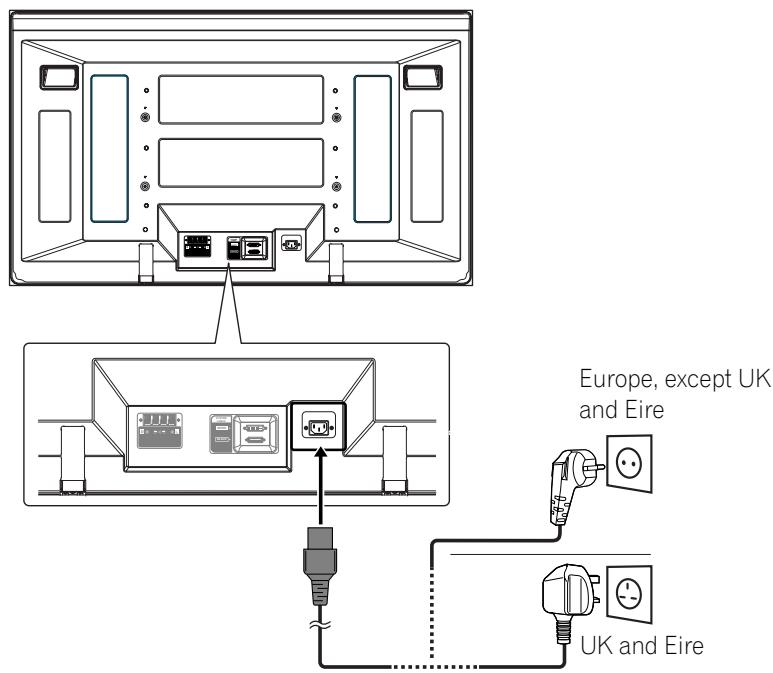
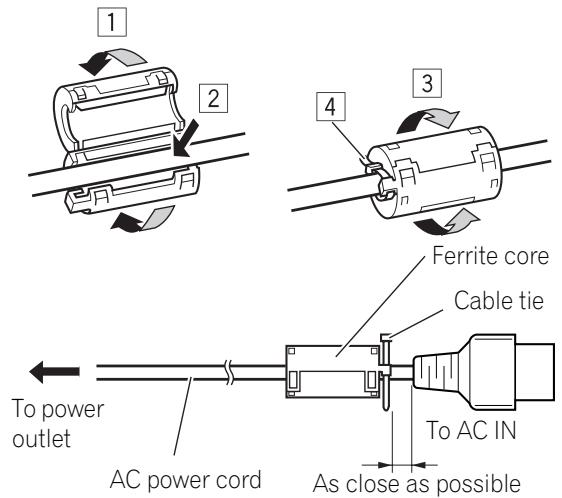
Attaching the ferrite core
To help prevent noise, attach the supplied ferrite core to the connector end of the power cord as shown. Use the supplied cable tie to prevent the ferrite core from slipping on the cable.

NOTE
- Disconnect the power cord from the power outlet, Plasma Display and Media Receiver when the system is not going to be used for a long period of time.
Unless you set up TV channels that you can watch under the current conditions, you cannot tune in those channels. For the procedure, see "Setting up TV channels automatically" on page 27.
Turning on/ off the power

NOTE
- When the Media Receiver is plugged into a power outlet, it is placed into the standby mode; the STANDBY indicator on its front panel should flash red. The Media Receiver stays in the standby mode unless it is unplugged from the power outlet.
To turn on the system, press POWER on the Plasma Display.
- The POWER ON indicators on the Plasma Display and Media Receiver light up in blue.
To turn off the system, press on the remote control unit or STANDBY/ON on the Media Receiver.
- The Plasma Display and Media Receiver are placed into the standby mode; their respective STANDBY/ON indicators light up in red.
- You can then turn on the system again by pressing or 0 to 9 on the remote control unit or STANDBY/ON on the Media Receiver. If you press 0 on the remote control unit, images come from the INPUT 1 source. If you press 1 to 9, TV images display.
You can also press POWER on the Plasma Display to turn off the system. However, you cannot then turn on the system again by pressing the buttons on the remote control unit and Media Receiver.

NOTE
- If you are not going to use the Plasma Display System for a long period of time, be sure to remove the power cord from the power outlet.
- When the system is placed into the standby mode, the main power flow is cut and the system is no longer fully operational. A minute flow of power feeds the system to maintain operation readiness.
The table below shows the operational status of the Plasma Display System. You can check the current status of the system with the indicators on the Plasma Display and Media Receiver.
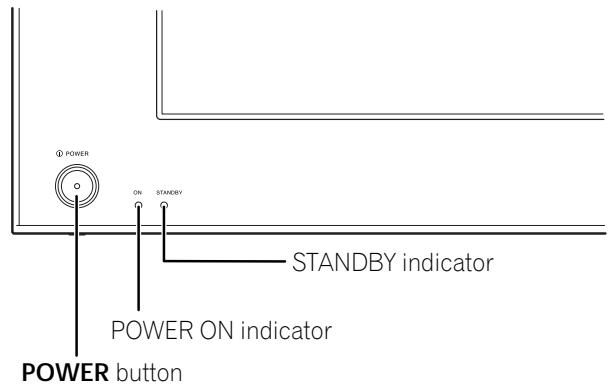
Plasma Display
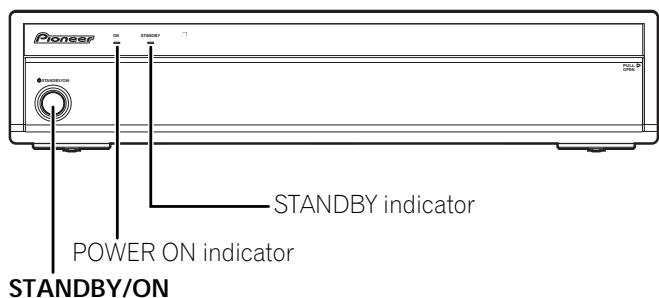
Media Receiver
| Indicator Status | System Status |
| Plasma Display | Media Receiver | |
| POWER ON | STANDBY | POWER ON | STANDBY |
| ● | ● | ● | ● | The power cords of both the Plasma Display and the Media Receiver have been disconnected. Or, the power cord of the Plasma Display has been connected but the POWER button of the Plasma Display is off. |
| ● | ● | ● | ● | Power to the system is on. |
| ● | ● | ● | ● | The system is in the standby mode. |
| ● | ●
Flashing | ● | ● | The power cord of the Media Receiver has been disconnected. |
| ● | ● | ● | ●
Flashing | Power to the Plasma Display is off. Or the power cord of the Plasma Display has been disconnected. |
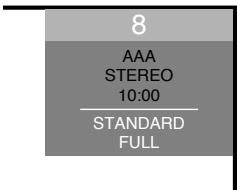
Channel display
Changing channels
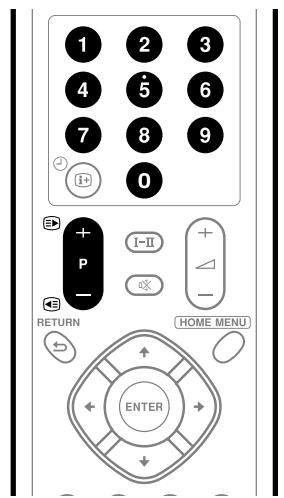
Using P + / P - on the remote control unit
- Press P+ to increase the channel number.
- Press P - to decrease the channel number.
When viewing Teletext information:
- Press P+ to increase the page number.
- Press P - to decrease the page number.
For Teletext, see "Using the Teletext Functions" on pages 44 and 45.

NOTE
- CHANNEL +/- on the Media Receiver operates the same as P+/P-.
- P + / P cannot pick up channels that are set to skip. For Channel Skip, see steps 13 and 14 under "Using Manual Adjust" (page 28).
Using 0 - 9 on the remote control unit
Select channels directly by pressing buttons 0 to 9.
EXAMPLE
To select channel 2 (1-digit channel), press 2.
- To select channel 12 (2-digit channel), press 1 then 2.
When viewing Teletext information:
View a page directly which is 3-digit page number from 100 to 899 by pressing buttons 0 to 9. See page 44.

NOTE
- In the standby mode, when you press 0, the power turns on and images come from the INPUT 1 source. Or, when you press any button from 1 to 9, TV images display.
Tuning to your favourite channels
If you have registered your favourite channels, selecting from the registered list may be the easiest way to tune to those channels.

NOTE
- You can register up to 16 channels as your favourite channels. For the registration, see steps 13 and 14 under "Using Manual Adjust" (page 28).
1 While watching broadcasts, press ENTER to call up the Favourite Channel List.
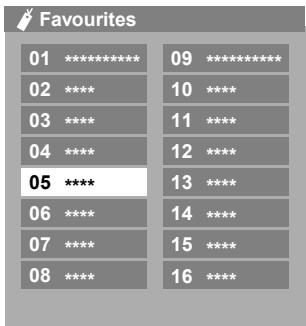
2 Select a favourite channel to tune in ( / , / then ENTER).
- Press RETURN to exit the Favourite Channel List.
Changing the volume and sound
Using + - on the remote control unit
To increase the volume, press + .
To decrease the volume, press

VOLUME + / - on the Media Receiver operates the same as
$$
\Delta^ {+ / -}
$$
Using on the remote control unit
mutes the current sound output.
1 Press X.
- "咪" appears on the screen.
2 Press again to cancel the mute mode.
- Pressing + also cancels the mute mode.
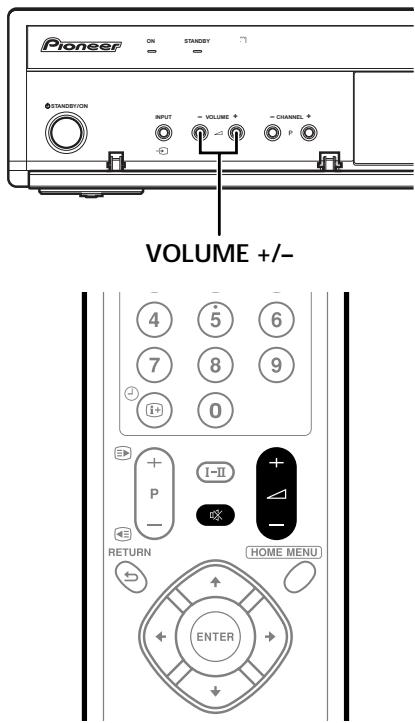
Media Receiver (front view)

Volume adjustment

Muting
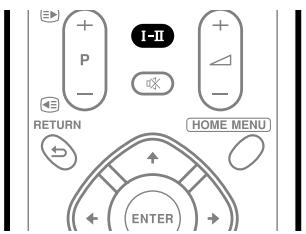
Using I-II on the remote control unit
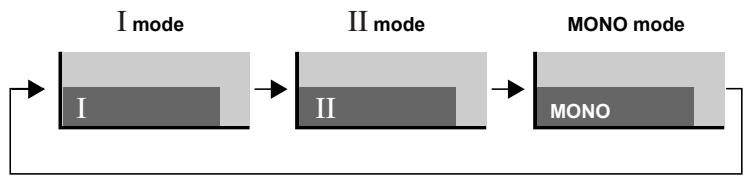
Each time you press I-III, MTS toggles as shown below.
| Setting |
| I | II | MONO |
| NICAM
Broadcasts | Stereo | 1
AAA
NICAM STEREO
10:00 | 1
AAA
NICAM STEREO
10:00 | 1
AAA
MONO
10:00 |
| Bilingual | 2
BBB
NICAM I
10:00 | 2
BBB
NICAM II
10:00 | 2
BBB
MONO
10:00 |
| Monaural | 3
CCC
NICAM MONO
10:00 | 3
CCC
NICAM MONO
10:00 | 3
CCC
MONO
10:00 |
| A2
Broadcasts | Stereo | 4
DDD
STEREO
10:00 | 4
DDD
STEREO
10:00 | 4
DDD
MONO
10:00 |
| Bilingual | 5
EEE
DUAL I
10:00 | 5
EEE
DUAL II
10:00 | 5
EEE
MONO
10:00 |
| Monaural | 6
FFF
MONO
10:00 | 6
FFF
MONO
10:00 | 6
FFF
MONO
10:00 |

NOTE
- In each of the sound multiplex mode selected using the I-II button, the display changes depending on broadcasting signals being received.
- Once the MONO mode is selected, the Plasma Display System sound remains mono even if the system receives a stereo broadcast. You must switch the mode back to I or II mode if you want to hear stereo sound again.
- Selecting a sound multiplex mode while the input source is INPUT 1 to 4 does not change the type of sound. In this case, sound is determined by the video source.
Freezing images
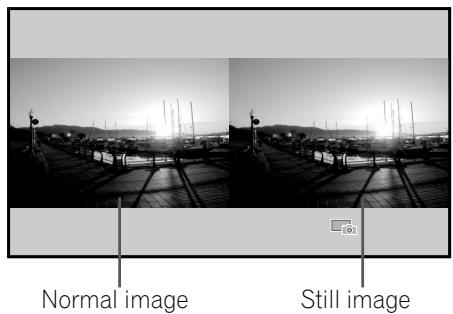
Use the following procedure to capture and freeze one frame from a moving image that you are watching.
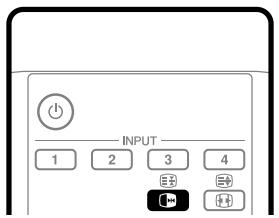
1 Press
- A still image appears on the right screen while a moving image is shown on the left screen.
2 Press again to cancel the function.

NOTE
- When this function is not available, a warning message appears.
Using the menu
| Home Menu | Item | Page |
| Picture | AV Selection | 30 |
| Contrast | 31 |
| Brightness | 31 |
| Colour | 31 |
| Tint | 31 |
| Sharpness | 31 |
| Pro Adjust | 31 |
| Reset | 31 |
| Sound | Treble | 34 |
| Bass | 34 |
| Balance | 34 |
| Reset | 34 |
| FOCUS | 34 |
| Front Surround | 34 |
| Power Control | Energy Save | 35 |
| No Signal off | 35 |
| No Operation off | 35 |
| Option | Position | 36 |
| Auto Size | 37 |
| 4:3 Mode | 38 |
| Side Mask | 38 |
| HDMI Input | 41 |
| Drive Mode | 36 |
| Colour System | 36 |
| Input Select | 36 |
| Setup | Auto Installation | 27 |
| Analogue TV Setup | 27 – 29 |
| Password | 38, 39 |
| Language | 30 |
The following describes the typical procedure for setting up the menus. For the actual procedures, see the appropriate pages that describe individual functions.
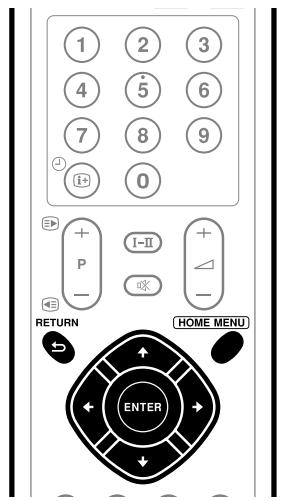
1 Press HOME MENU.
2 Press / to select a menu item, and then press ENTER.
3 Repeat step 2 until you access the desired submenu item.
- The number of menu layers differs depending on the menu items.
4 Press / to select an option (or parameter), and then press ENTER.
- For some menu items, press / instead of / .
5 Press HOME MENU to exit the menu.

NOTE
- You can return to the upper menu levels by pressing RETURN.
Setting up TV channels automatically
This section describes how to automatically search for and set up TV channels.
Using Auto Installation
When the Plasma Display System is switched on for the first time after purchase, the initial auto installation is initiated. You can automatically set language, country and channels in successive operations.
1 Select "Language" ( / ) .
2 Select a language ( / ) .
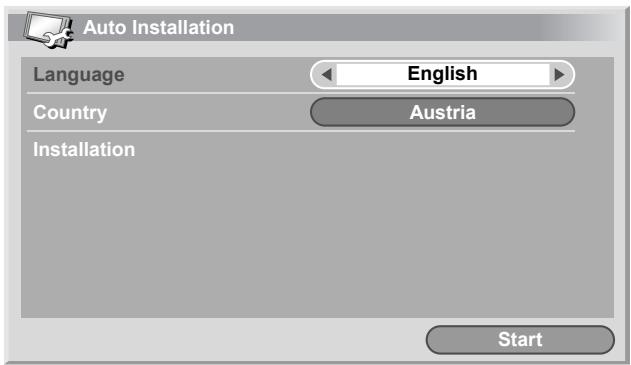
- You can select from among 14 languages; English, German, French, Italian, Spanish, Dutch, Swedish, Portuguese, Greek, Finnish, Russian, Turkish, Norwegian, and Danish.
3 Select "Country" ( / ) .
4 Select the country ( / ) .
5 Select "Start" ( / then ENTER).
- Auto Installation automatically starts.
- To quit Auto Installation in progress, press RETURN.

NOTE
- You can start Auto Installation from the Home menu after moving to another country, for example. Perform the following steps ① to ③ before starting Auto Installation.
① Press HOME MENU.
② Select "Setup" (▲/▼ then ENTER).
③ Select "Auto Installation" (▲/▼ then ENTER).
-
The password entry screen appears. Enter your 4-digit password using buttons 0 - 9.
-
If no channel is found, check the antenna connections, and then retry Auto Installation.
Setting up TV channels manually
This section describes how to set up TV channels manually.
Using Manual Adjust
Use Manual Adjust to set up TV channels manually.
1 Press HOME MENU.
2 Select "Setup" ( / then ENTER).
3 Select "Analogue TV Setup" (/ then ENTER).
- The password entry screen appears. Enter your 4-digit password using buttons 0 - 9. For the password, see "Using a password" on page 38.
4 Select "Manual Adjust" (▲/▼ then ENTER).
5 Select "Programme Entry" ( / ) .
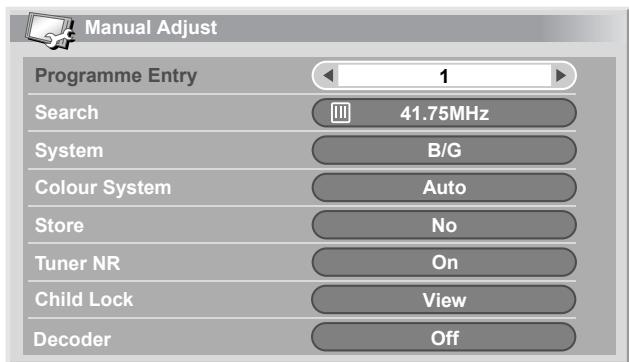
6 Select a programme number ( / ) .
- You can select 1 through 99.
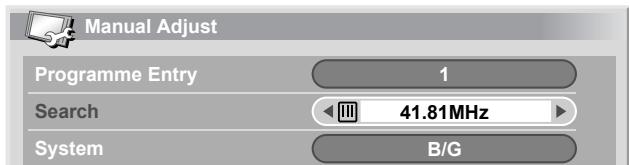
7 Select "Search" ( / ) .
8 Enter a frequency using buttons 0-9 and ENTER.
- You can also press / to enter a frequency.
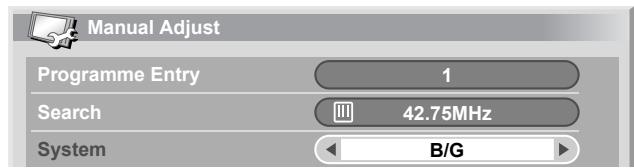
9 Select "System" (▲/▼).
10 Select a sound system ( / ) .
- You can select from among "B/G", "D/K", "I", "L", and "L".
11 Select "Colour System" ( / ) .
12 Select a colour system ( / ) .
- You can select from among "Auto", "PAL", "SECAM", and "4.43NTSC".

13 Select "Store" (▲/▼).
14 Select "Yes", "Yes (Listed)", or "No" () .
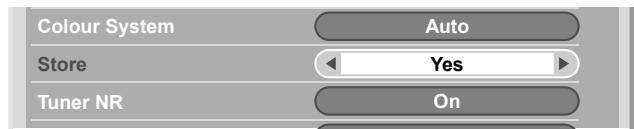
| Item | Description |
| Yes | You can select the channel using P+/P-. |
| Yes (Listed) | Select this option to register the channel as your favourite channel.
You can select the channel using the Favourite Channel list and P+/P-. |
| No | You cannot select the channel using P+/P-. |
- To set up for another channel, repeat steps 6 to 14.
15 Press HOME MENU to exit the menu.

NOTE
- The above procedure transfers and sets the selected channel information to the connected recording equipment such as a VCR or DVD recorder.
- Manual Adjust also allows you to make selections for "Tuner NR", "Child Lock", and "Decoder". See "Reducing video noise", "Setting Child Lock", and "Selecting a decoder input terminal".
Reducing video noise
For the individual channels, you can specify whether the Plasma Display System should reduce video noise depending on the levels of broadcasting signals.
1 Repeat steps 1 to 6 provided for "Using Manual Adjust".
- After selecting a channel (using Programme Entry), perform the following steps.
2 Select "Tuner NR" ( / ) .
3 Select "On" or "Off" ( / ) .
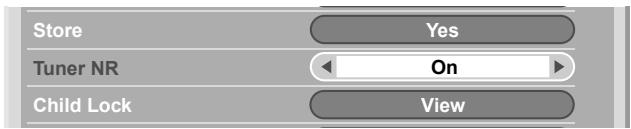
4 Press HOME MENU to exit the menu.

NOTE
- This function may not achieve a satisfactory result, depending on the conditions of broadcasting signals.
- When using a decoder with a decoder terminal selected, this function may fail to achieve a good result.
Setting Child Lock
Child Lock inhibits selected TV channels from being tuned and watched.
1 Repeat steps 1 to 6 provided for "Using Manual Adjust". After selecting a channel (using Programme Entry), perform the following steps.
2 Select "Child Lock" (▲/▼).
3 Select "Block" ( / ) .
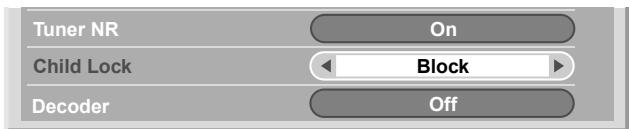
- The selection is switched between "View" and "Block".
4 Press HOME MENU to exit the menu.
If you have connected a decoder, select a decoder input terminal (INPUT1).
1 Repeat steps 1 to 6 provided for "Using Manual Adjust". After selecting a channel (using Programme Entry), do the following steps.
2 Select "Decoder" ( / ) .
3 Select "INPUT 1" ( / ) .
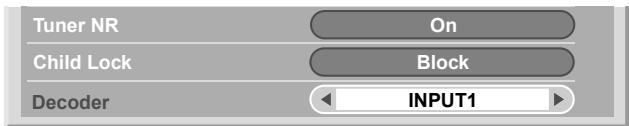
4 Press HOME MENU to exit the menu.

NOTE
- With "Off" (factory default) selected, you cannot watch any images from the decoder.
Labelling TV channels
You can name TV channels that you have set up, using up to five characters. This may help you easily identify the channels during selections.
1 Press HOME MENU.
2 Select "Setup" (/ then ENTER).
3 Select "Analogue TV Setup" (/ then ENTER).
- The password entry screen appears. Enter your 4-digit password using buttons 0 - 9.
4 Select "Label" ( / then ENTER).
5 Select "Programme Entry" (/) .
6 Select a programme number ( /)
- You can select 1 through 99.
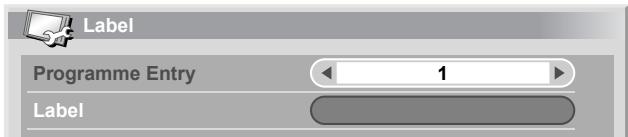
7 Select "Label" ( / then ENTER).
- The name entry screen appears.
8 Select the first character ( / , / then ENTER).
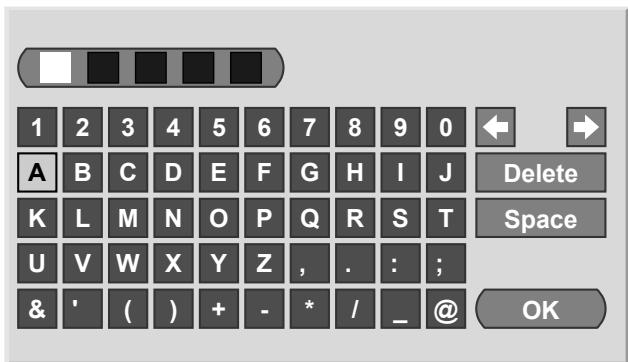
- The cursor moves to the second character.
9 Repeat step 8 to enter up to five characters.
- To correct entered characters, select [←] or [→] on the screen, and then press ENTER. The cursor moves to the preceding or subsequent character.
- To delete the current character, select [Delete] on the screen, and then press ENTER.
- To put a space for the current character, select [Space] on the screen, and then press ENTER.
10 To complete the name entry, press / or / to select [OK] on the screen, and then press ENTER.
11 Press HOME MENU to exit the menu.

NOTE
- The above procedure transfers and sets the selected channel information to the connected recording equipment such as a VCR or DVD recorder.
Sorting preset TV channels
Use the following procedure to change the sequence of the preset TV programmes.
1 Press HOME MENU.
2 Select "Setup" (/ then ENTER).
3 Select "Analogue TV Setup" ( / then ENTER).
- The password entry screen appears. Enter your 4-digit password using buttons 0 - 9.
4 Select "Sort" ( / then ENTER).
- The sort screen appears.
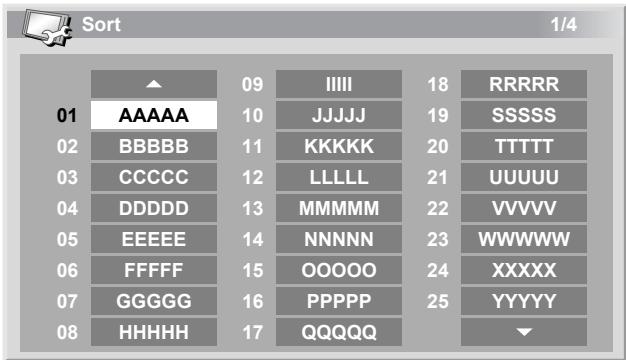
5 Select a channel to be shifted ( / , / then ENTER).
6 Select a new location ( / , / then ENTER).
7 Press HOME MENU to exit the menu.

NOTE
- To change a page on the Sort screen in step 6, select / on the screen with / to select a page, and then press ENTER.
- The above procedure transfers and sets only the shifted channel information to recording equipment such as a VCR or DVD recorder.
Clock setting
Use the following procedure to set the time correctly.
1 Press HOME MENU.
2 Select "Setup" (/ then ENTER).
3 Select "Analogue TV Setup" ( / then ENTER).
- The password entry screen appears. Enter your 4-digit password using buttons 0 - 9.
4 Select "Clock" ( / then ENTER).
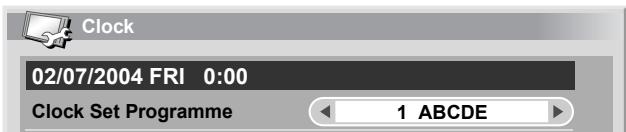
5 Select a TV channel to be used for auto clock setting ( / ) .
6 Press HOME MENU to exit the menu.

NOTE
- If the system fails to set the date and time through the selected TV channel, the "Time & Date" entry screen appears. Set the correct, current time.
- The system obtains and displays time by adding Universal Coordinated Time (UTC) and Local Time Offset (LTO) data received with broadcasting signals. If the system fails to display a correct time, check with your local broadcasting station.
Language setting
You can select the language to be used for on-screen display such as menus and instructions, from among 14 languages; English, German, French, Italian, Spanish, Dutch, Swedish, Portuguese, Greek, Finnish, Russian, Turkish, Norwegian, and Danish.
For the language to be used in the TELETEXT mode, you can select from among West Europe, East Europe, Greece/Turkey, Russia, and Arabia.
1 Press HOME MENU.
2 Select "Setup" ( / then ENTER).
3 Select "Language" (/ then ENTER).
4 Select "Menu" ( / ) .
5 Select a language ( / ) .
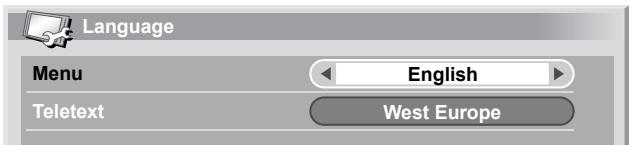
6 Select "Teletext" (/) .
7 Select a language ( / ) .
8 Press HOME MENU to exit the menu.
AV Selection
Select from the five viewing options, depending on the current environment (e.g., room brightness), the type of the current TV programme, or the type of images input from external equipment.
1 Press HOME MENU.
2 Select "Picture" (/ then ENTER).
3 Select "AV Selection" (▲/▼ then ENTER).
4 Select the desired option ( / then ENTER).
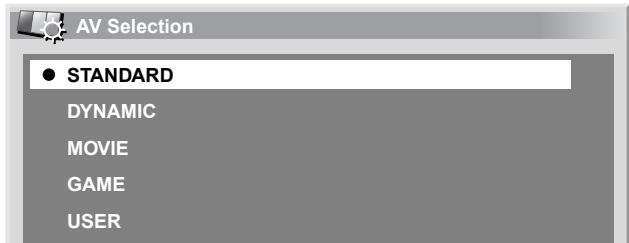
| Item | Description |
| STANDARD | For a highly defined image in a normally bright roomThis selection is shared by an external input and TV input sources. |
| DYNAMIC | For a very sharp image with the maximum contrastThis mode does not allow manual image quality adjustment.This selection is shared by an external input and TV input sources. |
| MOVIE | For a movieThis selection is shared by an external input and TV input sources. |
| GAME | Lowers image brightness for easier viewingThis selection is shared by an external input and TV input sources. |
| USER | Allows the user to customize settings as desired. You can set the mode for each input source. |
5 Press HOME MENU to exit the menu.

NOTE
- If you have selected "DYNAMIC", you cannot select "Contrast", "Brightness", "Colour", "Tint", "Sharpness", "Pro Adjust", and "Reset"; these menu items are dimmed.
Basic picture adjustments
Adjust the picture to your preference for the chosen AV Selection option (except DYNAMIC).
1 Press HOME MENU.
2 Select "Picture" (/ then ENTER).
3 Select an item to be adjusted ( / then ENTER).
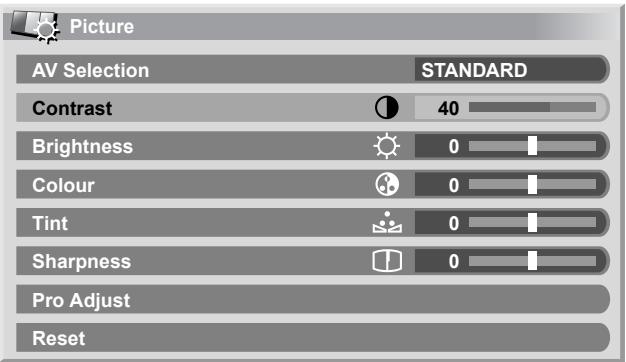
4 Select the desired level ( / ) .

- When an adjustment screen is in display, you can also change the item to be adjusted, by pressing / .
5 Press HOME MENU to exit the menu.
| Item | ← button | → button |
| Contrast | For less contrast | For more contrast |
| Brightness | For less brightness | For more brightness |
| Colour | For less colour intensity | For more colour intensity |
| Tint | Skin tones become purplish | Skin tones become greenish |
| Sharpness | For less sharpness | For more sharpness |

NOTE
- To perform advanced picture adjustments, select "Pro Adjust" in step 3 and then press ENTER. For the subsequent procedures see "Advanced picture adjustment".
- To restore the factory defaults for all items, press ↑/↓ to select "Reset" in step 3, and then press ENTER. A confirmation screen appears. Press ↑/↓ to select "Yes", and then press ENTER.
Advanced picture adjustments
The Plasma Display System provides various advanced functions for optimising the picture quality. For details on these functions, see the tables.
Using PureCinema
1 Press HOME MENU.
2 Select "Picture" (/ then ENTER).
3 Select "Pro Adjust" ( / then ENTER).
4 Select "PureCinema" (▲/▼ then ENTER).
5 Select the desired parameter ( / then ENTER). For the selectable parameters, see the table.
PureCinema
Automatically detects a film-based source (originally encoded at 24 frames/second), analyses it, then recreates each still film frame for high-definition picture quality.
| Selections | Off | Deactivates the PureCinema. |
| Standard | Produces smooth and vivid moving images (film specific) by automatically detecting recorded image information when displaying DVD or high-definition images (e.g., movies) having 24 frames per second. |
| ADV | Produces smooth and quality moving images (as shown on theatre screens) by converting to 72 Hz when displaying DVD images (e.g., movies) having 24 frames per second. |

NOTE
- "Standard" is not selectable when 480p or 720p@60Hz signals are input.
- "ADV" is not selectable when PAL, SECAM, 576i, or 1080i@50Hz signals are input.
- Neither "Standard" nor "ADV" is selectable when 576p, 720p@50Hz, or 1080p@24Hz signals are input.
Using Colour Temp
1 Press HOME MENU.
2 Select "Picture" (▲/▼ then ENTER).
3 Select "Pro Adjust" (▲/▼ then ENTER).
4 Select "Colour Detail" (▲/▼ then ENTER).
5 Select "Colour Temp" (/ then ENTER).
6 Select the desired parameter (/ then ENTER).
- If you have selected a desired parameter in this step, skip steps 7 and 8.
- You may rather want to perform fine adjustment. To do this, select "Manual" first and then press and hold ENTER for more than three seconds. The manual adjustment screen appears. Then go to step 7.
Colour Temp
Adjusts the colour temperature, resulting in a better white balance.
| Selections | High | White with bluish tone |
| Mid-High | Intermediate tone between High and Mid |
| Mid | Natural tone |
| Mid-Low | Intermediate tone between Mid and Low |
| Low | White with reddish tone |
| Manual | Colour temperature adjusted to your preference |
7 Select an item to be adjusted ( / then ENTER).
8 Select the desired level ( / ) .
| Item | | ← button | → button |
| R High | Fine adjustment for bright portions | For weaker red | For stronger red |
| G High | For weaker green | For stronger green |
| B High | For weaker blue | For stronger blue |
| R Low | Fine adjustment for dark portions | For weaker red | For stronger red |
| G Low | For weaker green | For stronger green |
| B Low | For weaker blue | For stronger blue |
- To perform adjustment for another item, press RETURN, and then repeat steps 7 and 8.
- You may press / to immediately change an item to be adjusted.
9 Press HOME MENU to exit the menu.
Using CTI
1 Press HOME MENU.
2 Select "Picture" ( / then ENTER).
3 Select "Pro Adjust" ( / then ENTER).
4 Select "Colour Detail" (/ then ENTER).
5 Select "CTI" ( / then ENTER).
6 Select the desired parameter ( / then ENTER).
CTI
Provides images with clearer colour contours. The CTI stands for Colour Transient Improvement.
| Selections | Off | Deactivates the CTI. |
| On | Activates the CTI. |
7 Press HOME MENU to exit the menu.
Using Colour Management
1 Press HOME MENU.
2 Select "Picture" (▲/▼ then ENTER).
3 Select "Pro Adjust" (▲/▼ then ENTER).
4 Select "Colour Detail" ( / then ENTER).
5 Select "Colour Management" (/ then ENTER).
6 Select an item to be adjusted ( / then ENTER).
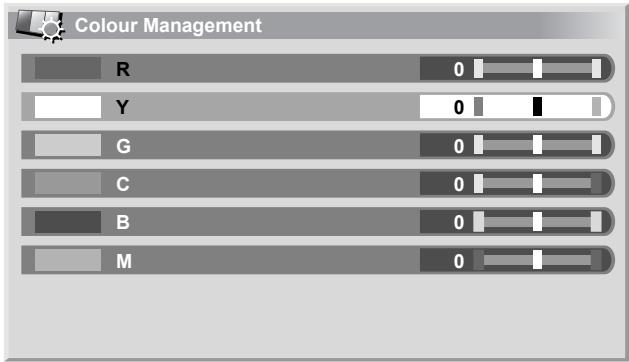
7 Select the desired level ( / ) .
| item | ← button | → button |
| R | Closer to magenta | Closer to yellow |
| Y | Closer to red | Closer to green |
| G | Closer to yellow | Closer to cyan |
| C | Closer to green | Closer to blue |
| B | Closer to cyan | Closer to magenta |
| M | Closer to blue | Closer to red |
- To perform adjustment for another item, press RETURN, and then repeat steps 6 and 7.
- You may press / to immediately change an item to be adjusted.
8 Press HOME MENU to exit the menu.
Eliminating noise from images
1 Press HOME MENU.
2 Select "Picture" (/ then ENTER).
3 Select "Pro Adjust" (▲/▼ then ENTER).
4 Select "NR" ( / then ENTER).
5 Select an item to be adjusted ( / then ENTER).
- You can select "DNR" or "MPEG NR".
6 Select the desired parameter (/ then ENTER).
DNR
| Eliminates video noise for clean crisp images. The DNR stands for Digital Noise Reduction. |
| Selections | Off | Deactivates the DNR. |
| High | Enhanced DNR |
| Mid | Standard DNR |
| Low | Moderate DNR |
MPEG NR
| Eliminates mosquito noise from video images when a digital TV channel is watched or a DVD is played, resulting in noise-free images. |
| Selections | Off | Deactivates the MPEG NR. |
| High | Enhanced MPEG NR |
| Mid | Standard MPEG NR |
| Low | Moderate MPEG NR |
7 Press HOME MENU to exit the menu.
Using the Dynamic Range Expander (DRE) functions
1 Press HOME MENU.
2 Select "Picture" ( / then ENTER).
3 Select "Pro Adjust" (▲/▼ then ENTER).
4 Select "DRE" (▲/▼ then ENTER).
5 Select an item to be adjusted ( / then ENTER).
- You can select "Dynamic Contrast", "Black Level", "ACL" or "Gamma".
6 Select the desired parameter (/ then ENTER).
Dynamic Contrast
| Emphasises the contrast on images so that the difference between brightness and darkness becomes more distinct. |
| Selections | Off | Deactivates the Dynamic Contrast. |
| High | Enhanced Dynamic Contrast |
| Mid | Standard Dynamic Contrast |
| Low | Moderate Dynamic Contrast |
Black Level
| Emphasises dark portion on images so that the difference between brightness and darkness becomes more distinct. |
| Selections | Off | Deactivates the Black Level. |
| On | Activates the Black Level. |
ACL
Performs such compensation that results in the optimum contrast characteristics for images.
| Selections | Off | Deactivates the ACL. |
| On | Activates the ACL. |
Gamma
Adjusts the gamma characteristics (image gradation characteristics).
| Selections | 1 | Selects gamma characteristics 1. |
| 2 | Selects gamma characteristics 2. |
| 3 | Selects gamma characteristics 3. |
7 Press HOME MENU to exit the menu.
Using the 3DYC and I-P Mode
1 Press HOME MENU.
2 Select "Picture" (/ then ENTER).
3 Select "Pro Adjust" ( / then ENTER).
4 Select "Others" ( / then ENTER).
5 Select an item to be adjusted ( / then ENTER).
- You can select "3DYC" or "I-P Mode".
6 Select the desired parameter (/ then ENTER).
3DYC
Optimises characteristics for separating brightness signals and colour signals. This works for both video and still images.
| Selections | Off | Deactivates the 3DYC. |
| High | Enhanced 3DYC |
| Mid | Standard 3DYC |
| Low | Moderate 3DYC |
I-P Mode
Perform optimum conversion from interlace signals to progressive signals. This works for both video and still images.
| Selections | 1 | Optimum for video images |
| 2 | Standard setting |
| 3 | Optimum for still images |
7 Press HOME MENU to exit the menu.

NOTE
- For the 3DYC, the individual parameters are selectable only when:
- You have selected INPUT 1, 2, or 3 as the input source and "Video" as the input signal type (page 36); or
- You have selected INPUT 4 as the input source and have not connected a S-Video cable; or You have selected the analogue tuner.
- For the I-P Mode, the individual parameters are not selectable for the following input signals: 480p, 720p@60Hz, 576p, 720p@50Hz, 1080p@24Hz.
Sound adjustments
You can adjust the sound quality to your preference with the following settings.
Adjust the sound to your preference for the chosen AV Selection option. See page 30.
1 Press HOME MENU.
2 Select "Sound" ( / then ENTER).
3 Select an item to be adjusted ( / ) .
4 Select the desired level ( /)
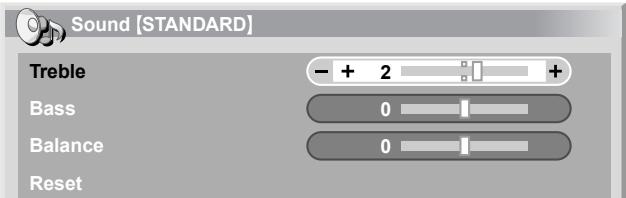
| Item | ← button | → button |
| Treble | For weaker treble | For stronger treble |
| Bass | For weaker bass | For stronger bass |
| Balance | Decreases audio from the right speaker. | Decreases audio from the left speaker. |
5 Press HOME MENU to exit the menu.

NOTE
- To restore the factory defaults for all items, press / to select "Reset" in step 3, and then press ENTER. A confirmation screen appears. Press / to select "Yes", and then press ENTER.
FOCUS
This shifts the sound coming direction (sound images) upward and produces clear sound contours.
1 Press HOME MENU.
2 Select "Sound" ( / then ENTER).
3 Select "FOCUS" (↑/↓).
4 Select the desired parameter ( / ) .
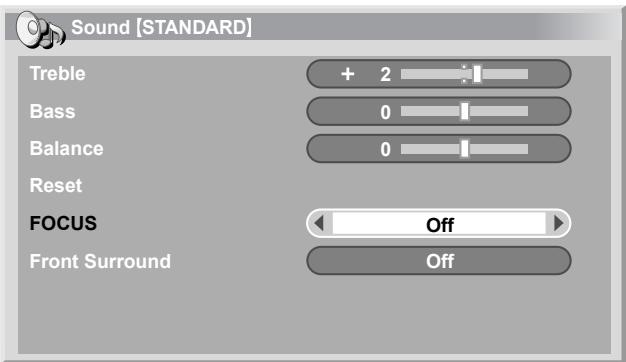
| Item | Description |
| Off
(factory default) | Deactivates the FOCUS. |
| On | Activates the FOCUS. |
5 Press HOME MENU to exit the menu.

NOTE
- The effect of this function differs depending on signals.
Front Surround
This provides three-dimensional sound effects and/or deep, rich bass.
1 Press HOME MENU.
2 Select "Sound" ( / then ENTER).
3 Select "Front Surround" (/) .
4 Select the desired parameter ( /)
| Item | Description |
| Off | Deactivates both the SRS and TruBass. |
| SRS | Reproduces highly effective three-dimensional sound. |
| TruBass (factory default) | Provides deep, rich bass using a new technology. |
| TruBass + SRS | Provides both TruBass and SRS effects. |
5 Press HOME MENU to exit the menu.

NOTE
- SRS (WOW) designates a status where the FOCUS is on and TruBass + SRS has been selected for Front Surround.
- SRS is a trademark of SRS Labs, Inc.
- WOW technology is incorporated under license from SRS Labs, Inc.
- The effect of this function differs depending on signals.
Power Control
Power Control provides convenient functions for power saving.
Energy Save
You may use one of the three Energy Save modes to save power consumption.
1 Press HOME MENU.
2 Select "Power Control" ( / then ENTER).
3 Select "Energy Save" (▲/▼ then ENTER).
4 Select "Save1", "Save 2", or "Picture Off" (▲/▼ then ENTER).
| Item | Description |
| Standard | Does not decrease the picture brightness. |
| Save1 | Slightly lowers power consumption while slightly suppressing the brightness drop level. |
| Save2 | Decreases the picture brightness and lowers power consumption. |
| Picture Off | Deactivates the screen to save power. To restore the screen display, press any button other than +/− - and ×. This setting is not memorised by the system. |
5 Press HOME MENU to exit the menu.
No Signal off
The system will be automatically placed into the standby mode if no signal is received for 15 minutes.
1 Press HOME MENU.
2 Select "Power Control" ( / then ENTER).
3 Select "No Signal off" ( / then ENTER).
4 Select "Enable" ( / then ENTER).
| Item | Description |
| Disable (factory default) | Does not place the system into the standby mode. |
| Enable | Places the system into the standby mode if no signal is received for 15 minutes. |
5 Press HOME MENU to exit the menu.

NOTE
- Five minutes before the system is placed into the standby mode, a message appears every minute.
- The system may not be placed into the standby mode when noise signals are present at the Media Receiver after a TV programme finishes.
No Operation off
The system will be automatically placed into the standby mode when no operation is performed for three hours.
1 Press HOME MENU.
2 Select "Power Control" ( / then ENTER).
3 Select "No Operation off" ( / then ENTER).
4 Select "Enable" ( / then ENTER).
| Item | Description |
| Disable
(factory default) | Does not place the system into the standby mode. |
| Enable | Places the system into the standby mode if no operation is performed for three hours. |
5 Press HOME MENU to exit the menu.

NOTE
- Five minutes before the system is placed into the standby mode, a message appears every minute.
Switching the vertical drive frequency
You can switch the vertical drive frequency for screen display between 75 Hz and 100 Hz. Choose the drive frequency that better suits your broadcasting signals.
1 Press HOME MENU.
2 Select "Option" (▲/▼ then ENTER).
3 Select "Drive Mode" ( / then ENTER).
4 Select 75Hz or 100Hz(/ then ENTER).
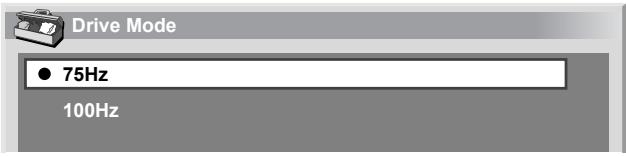
5 Press HOME MENU to exit the menu.

NOTE
- This setting can be made for each input source separately.
- This setting cannot be made when 480i, 480p, 1080i@60Hz, 720p@60Hz, or 1080p@24Hz signals are input.
- If you select "Auto" for "Side Mask" (page 38), the selection for "Drive Mode" becomes ineffective.
Adjusting image positions
Adjust the horizontal and vertical positions of images on the Plasma Display.
1 Press HOME MENU.
2 Select "Option" ( / then ENTER).
3 Select "Position" ( / then ENTER).
4 Select "H/V Position Adjust" (▲/▼ then ENTER).
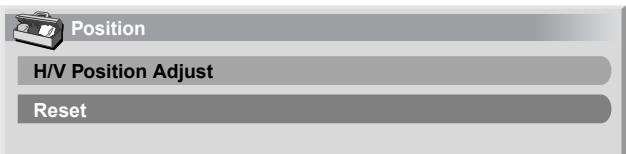
5 Adjust the vertical position ( / ) or the horizontal position ( / ) .
6 Press HOME MENU to exit the menu.

NOTE
- To restore the factory defaults for all items, press / to select "Reset" in step 4, and then press ENTER. A confirmation screen appears. Press / to select "Yes", and then press ENTER.
- Adjustments are stored separately according to input source.
After connecting to the INPUT 1, INPUT 2, or INPUT 3 terminal, specify the type of video signals to be received from the connected equipment. For the type of the signals, see the operation manual that came with the connected equipment.
Before starting the menu, press INPUT 1, INPUT 2, or INPUT 3 on the remote control unit or press INPUT on the Media Receiver to select an input source.
1 Press HOME MENU.
2 Select "Option" ( / then ENTER).
3 Select "Input Select" ( / then ENTER).
4 Select a signal type ( / then ENTER).
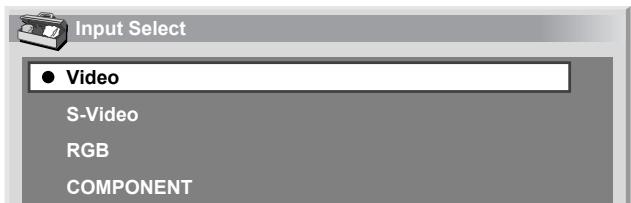
- For INPUT1, you can select Video or RGB.
- For INPUT2, you can select Video or S-Video or COMPONENT.
- For INPUT3, you can select Video, S-Video, or RGB.
5 Press HOME MENU to exit the menu.

NOTE
- If no image appears or images appear in inappropriate colours, specify another video signal type.
- For the signal types to be specified, check the operation manual that came with the connected equipment.
Colour system setting
If an image does not appear clearly, select another colour system (e.g., PAL, NTSC).
1 Press HOME MENU.
2 Select "Option" ( / then ENTER).
3 Select "Colour System" (▲/▼ then ENTER).
4 Select a video signal system ( / then ENTER).
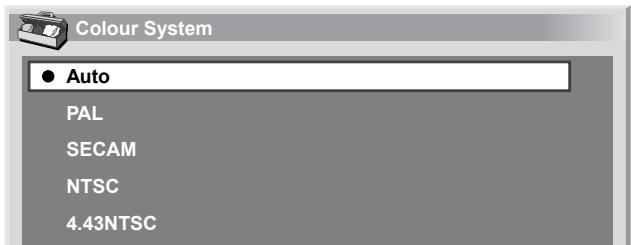
- You can select "Auto", "PAL", "SECAM", "NTSC", or "4.43NTSC".
- With "Auto" selected, input signals are automatically identified.
5 Press HOME MENU to exit the menu.

NOTE
The factory default is "Auto".
- You need to perform colour system setting for each of INPUT 1 to 4.
- For the colour system setting, see steps 11 and 12 under "Using Manual Adjust" (page 28).
Selecting a screen size manually
Press to switch among the screen size options selectable for the type of video signals currently received.
Each time you press 串 , the selection is switched.
- The selectable screen sizes differ depending on the types of input signals.
| Item | Description |
| 4:3 | For 4:3 "standard" pictures. A side mask appears on each side. |
| FULL 14:9 | For 14:9 squeeze pictures. A thin side mask appears on each side. |
| CINEMA 14:9 | For 14:9 letterbox pictures. A thin side mask appears on each side, and you may also see bars on the top and bottom with some programmes. |
| WIDE | In this mode the picture is progressively stretched toward each side of the screen. |
| FULL | For 16:9 squeeze pictures. |
| ZOOM | For 16:9 letterbox pictures. Bars may appear on the top and bottom with some programmes. |
| CINEMA | For 14:9 letterbox pictures. Bars may appear on the top and bottom on some programmes. |
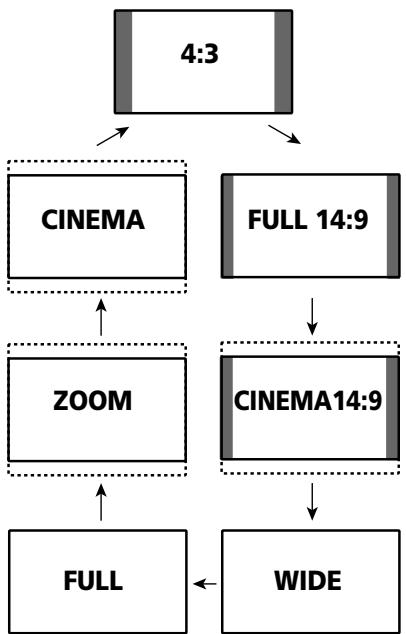

NOTE
- While watching High Definition TV broadcasting, pressing
switches among FULL, WIDE, 4:3, and ZOOM.
Selecting a screen size automatically
The Plasma Display automatically selects an appropriate screen size when the received video signals contain WSS (wide screen signaling) information or when video signals are received from a connected HDMI equipment (see page 41). To activate this function, use the following procedure.
1 Press HOME MENU.
2 Select "Option" (/ then ENTER).
3 Select "Auto Size" (▲/▼ then ENTER).
4 Select "On" ( / then ENTER).
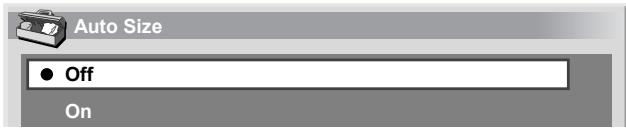
| Item | Description |
| Off
(factory default) | Deactivates the Auto Size function. |
| On | Activates the Auto Size function. |
5 Press HOME MENU to exit the menu.
NOTE
- Manually select an appropriate screen size if an image does not automatically switch to a correct screen format.
- When the video signal contains no aspect ratio information, the function will not work even with "On" selected.
Selecting a screen size for received 4:3 aspect ratio signals
Specify whether the Plasma Display should choose the 4:3 mode or WIDE mode when 4:3 aspect ratio signals are received with the Auto Size function activated.
1 Press HOME MENU.
2 Select "Option" ( / then ENTER).
3 Select "4:3 Mode" ( / then ENTER).
4 Select "WIDE" or "4:3" (▲/▼ then ENTER).
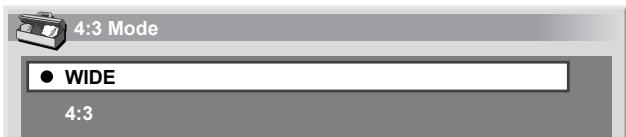
| Item | Description |
| WIDE (factory default) | Wide image without side masks. |
| 4:3 | Keeps the 4:3 aspect ratio and presents side masks. |
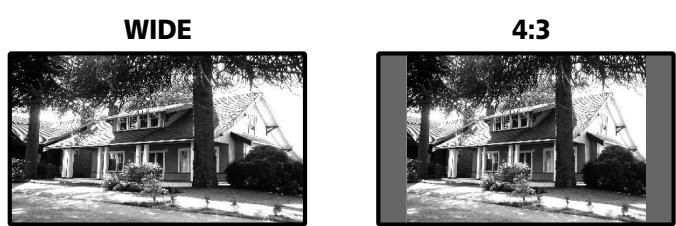
5 Press HOME MENU to exit the menu.
Changing the brightness at both sides of the screen (Side Mask)
With the 4:3, FULL 14:9, or CINEMA 14:9 screen size selected for the AV mode, you can change the brightness of the grey side masks that appear at both sides of the screen.
1 Press HOME MENU.
2 Select "Option" ( / then ENTER).
3 Select "Side Mask" (▲/▼ then ENTER).
4 Select the desired parameter (/ then ENTER).
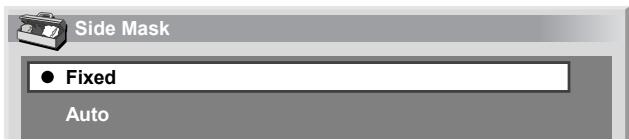
| Item | Description |
| Fixed
(factory default) | Always sets the same brightness for the grey side masks. |
| Auto | Adjusts the brightness of the grey side masks according to the brightness of images. |
5 Press HOME MENU to exit the menu.

NOTE
- If you select "Auto", the selection for "Drive Mode" (page 36) becomes ineffective.
Sleep Timer
When the selected time elapses, the Sleep Timer automatically places the system into the standby mode.
1 Press HOME MENU.
2 Select "Sleep Timer" (/ then ENTER).
3 Select the desired time (/ then ENTER).
- You can select from among "Off" (cancel), "30 min", "60 min", "90 min", and "120 min".
4 Press HOME MENU to exit the menu.

NOTE
- Five minutes before the selected time elapses, the remaining time appears every minute.
- To check the remaining time, perform steps 1 and 2. After checking the time, press HOME MENU to restore the previous display.
Using a password
The Plasma Display System provides the Child Lock function for preventing children from watching inappropriate programmes. You need to enter a password when watching programmes with "Block" specified. Before the system is shipped, "1234" is preset as the factory-default password. You can however, change the password as you want.
When using the Home menu you select "Auto Installation", "Analogue TV Setup", or "Password", a screen prompting password entry appears to prevent others from changing the programme settings at their choices.
Entering a password
In a case where you select a channel blocked with Child Lock or password entry is requested when attempting to open the menu, enter a password correctly.
1 Enter a correct 4-digit password using buttons 0-9.


NOTE
- If you fail password entry three times, "Invalid password." appears, and the menu is closed. In order to display the password entry screen again to unlock the password, select the blocked channel or open the menu again.
- If the password entry screen disappears before entry, you may recall it by pressing ENTER.
Changing the password
Use the following procedure to change the password.
1 Press HOME MENU.
2 Select "Setup" (/ then ENTER).
3 Select "Password" (/ then ENTER).
- The password entry screen appears. Enter the current 4-digit password using buttons 0 - 9.
4 Select "Change Password" (▲/▼ then ENTER).
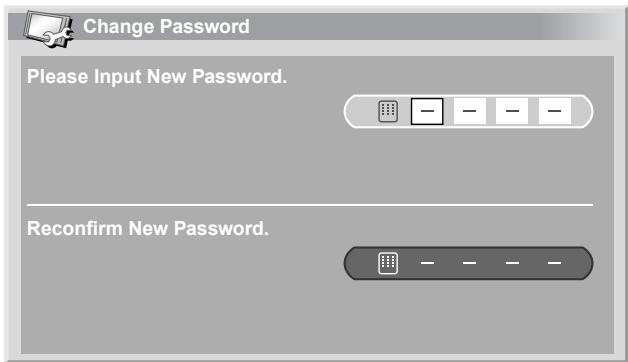
5 Enter a 4-digit password to be newly set, using buttons 0-9.
6 Enter the same password that you have entered in step 5.
- If an unmatched password is entered, the operation goes back to step 5 for reentry from the beginning.
- If you fail password change three times by entering unmatched passwords, the menu is closed.
7 Press HOME MENU to exit the menu.

NOTE
Take a note of the newly set password and keep it handy.
Resetting the password function
1 Press HOME MENU.
2 Select "Setup" ( / then ENTER).
3 Select "Password" (▲/▼ then ENTER).
- The password entry screen appears. Enter your 4-digit password using buttons 0 - 9.
4 Select "Reset" ( / then ENTER).
5 Select "Yes" ( / then ENTER).
6 Press HOME MENU to exit the menu.
NOTE
- The above procedure will reset the password to the factory default (1234).
Disabling the password function
Use the following procedure if you want to deactivate the protection function that prompts password entry.
1 Press HOME MENU.
2 Select "Setup" (/ then ENTER).
3 Select "Password" (▲/▼ then ENTER).
- The password entry screen appears. Enter your 4-digit password using buttons 0 - 9.
4 Select "Password Setting" (/ then ENTER).
5 Select "Disable" (▲/▼ then ENTER).
6 Press HOME MENU to exit the menu.
NOTE
- The above procedure will reset the password to the factory default (1234).
- After disabling the password function, you cannot change the Child Lock settings. For the Child Lock, see page 28.
- After disabling the password function, you cannot change or reset the password.
- When you enable the password function again after disabling it, the factory default password (1234) is restored.
We suggest you write down your password so you don't forget it.
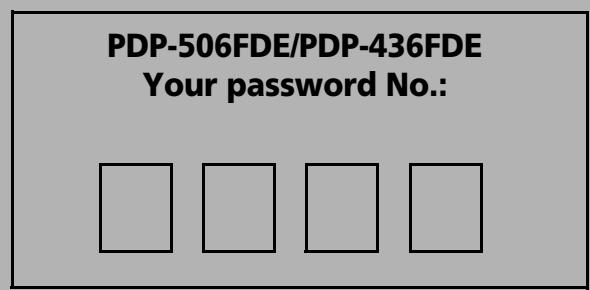
If you forget the password
When the message "Please Input Your Password" is displayed in the above procedure, press the ENTER button on the remote control unit and hold it down for 3 seconds or longer.
The password reverts to "1234".
You can connect many types of external equipment to your Plasma Display System, like a decoder, VCR, DVD player, personal computer, game console, and camcorder.
To view images coming from external equipment, select the input source using the INPUT buttons on the remote control (page 14) or the INPUT button on the Media Receiver.

CAUTION
- To protect all equipment, always unplug the Media Receiver from the power outlet before connecting to a decoder, VCR, DVD player, personal computer, game console, camcorder, or other external equipment.

NOTE
- Refer to the relevant operation manual (DVD player, personal computer, etc.) carefully before making connections.
Watching a decoder image
Connecting a decoder
Use the INPUT 1 terminal when connecting a decoder and other audiovisual equipment.
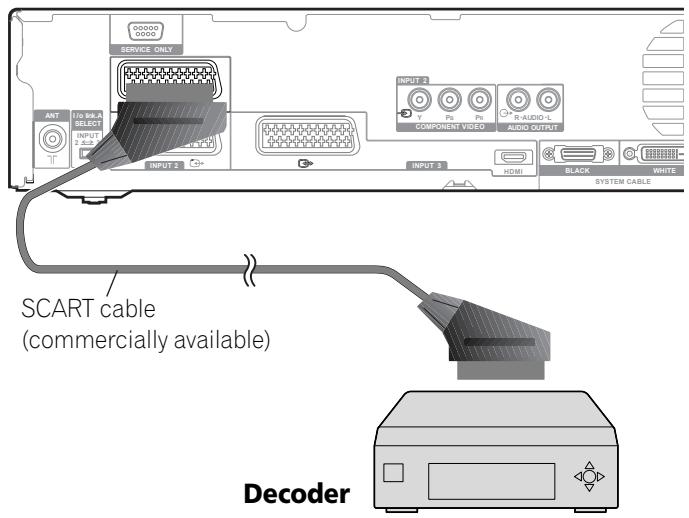
Media Receiver (rear view)
Displaying a decoder image
1 Press buttons 0 - 9 or P + / P to select a programme specified for decoder setting (page 28).
2 Press INPUT 1 on the remote control unit or press INPUT on the Media Receiver to select INPUT1.

NOTE
- Be sure to use INPUT1 to connect a decoder.
- If decoder images do not come in clearly, you may need to change the input signal type setting using the menu. See page 36.
- Refer to your decoder operation manual for the signal type.
Watching a VCR image
Connecting a VCR
Use the INPUT 2 terminals when connecting a VCR and other audiovisual equipment.
If your VCR supports TV-VCR advanced "AV link" systems (page 42), you can connect the VCR to the INPUT 2 or 3 terminal on the Media Receiver using the fully-wired 21-pin SCART cable.
AV link advanced system
- Download tuning information directly from TV to VCR (Preset download).
-
While watching TV, you can record a programme with a one-touch press of the VCR recording button. (WYSIWYR*)
-
Refer to your VCR operation manual as some VCRs have an exclusive key for WYSIWYR.
-
When you press the play button on the VCR, the system automatically turns on from standby and displays a VCR image.

NOTE
- TV-VCR advanced "AV link" systems may not be compatible with some external sources.
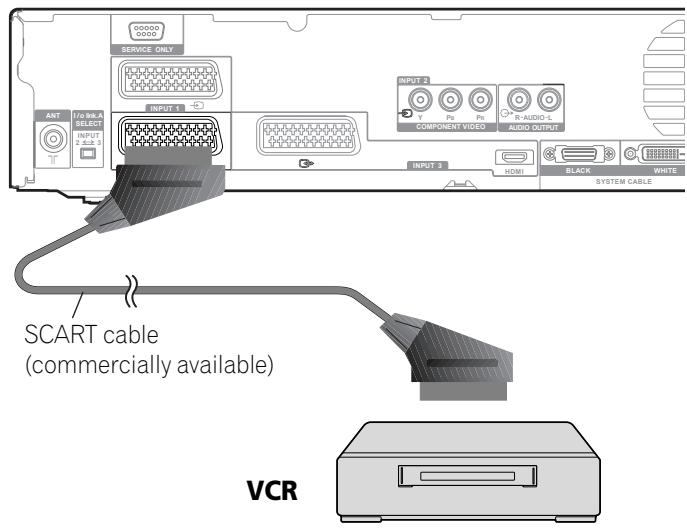
Media Receiver (rear view)
Displaying a VCR image
To watch a VCR image, press INPUT 2 on the remote control unit or press INPUT on the Media Receiver to select INPUT2.

NOTE
- If VCR images do not come in clearly, you may need to change the input signal type setting using the menu. See page 36.
Refer to your VCR operation manual for the signal type.
- The INPUT 2 terminals are checked for cable connections in the order where; 1) S-Video, 2) Video.
- Connect external equipment to only terminals that are to be actually used.
The INPUT 3 terminals include HDMI terminals to which digital video and audio signals can be input. To use the HDMI terminal, activate the terminal and specify the types of video and audio signals to be received from the connected equipment. For the types of these signals, see the operation manual that came with the connected equipment.
Before starting the menu, press INPUT 3 on the remote control unit or press INPUT on the Media Receiver to select INPUT 3.
Input signal correlation table
| 1920 1080i@50Hz |
| 720 576p@50Hz |
| 1280 720p@50Hz |
| 720(1440) 576i@50Hz |
| 1920 1080i@59.94/60Hz |
| 720 480p@59.94/60Hz |
| 1280 720p@59.94/60Hz |
| 720(1440) 480i@59.94/60Hz |
| 1920 1080p@24Hz |
For audio, the system supports the following:
- Linear PCM (STEREO 2ch)
- Sampling frequency: 32kHz,44.1kHz,48kHz
Connecting HDMI equipment
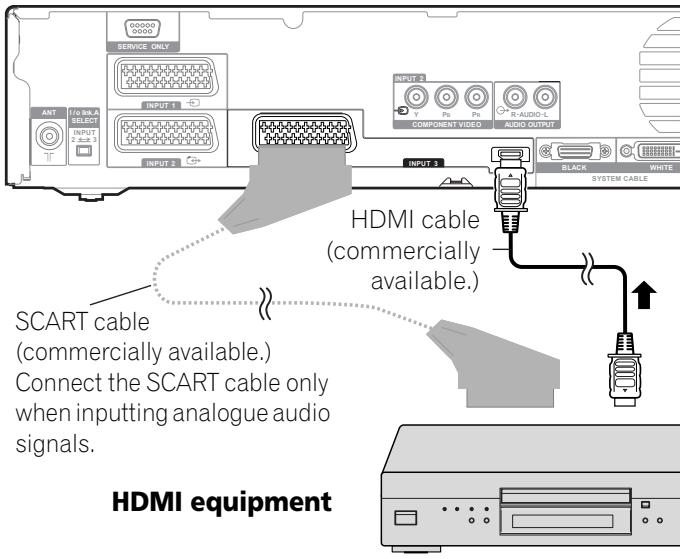
Media Receiver (rear view)
To activate the HDMI terminal:
1 Press HOME MENU.
2 Select "Option" ( / then ENTER).
3 Select "HDMI Input" ( / then ENTER).
4 Select "Setting" (/ then ENTER).
5 Select "Enable" (▲/▼ then ENTER).
| Item | Description |
| Disable (factory default) | Deactivates the HDMI terminal. |
| Enable | Activates the HDMI terminal. |
6 Press HOME MENU to exit the menu.
To specify the type of digital video signals:
1 Repeat steps 1 to 3 provided for "To activate the HDMI terminal".
2 Select "Video" ( / then ENTER).
3 Select the type of digital video signals ( / then ENTER).
- If you select "Auto", an attempt will be made to identify the type of digital video signals when digital video signals are received.
| Item | Description |
| Auto
(factory default) | Automatically identifies input digital video signals. |
| Colour-1 | Digital Component Video signals (4:2:2) locked |
| Colour-2 | Digital Component Video signals (4:4:4) locked |
| Colour-3 | Digital RGB signals locked |
4 Press HOME MENU to exit the menu.
NOTE
- If you select a parameter other than "Auto", make such a setting that results in natural colour.
- If no image appears, specify another digital video signal type.
- For the digital video signal types to be specified, check the operation manual that came with the connected equipment.
To specify the type of audio signals:
1 Repeat steps 1 to 3 provided for "To activate the HDMI terminal".
2 Select "Audio" ( / then ENTER).
3 Select the type of audio signals ( / then ENTER).
- If you select "Auto", an attempt will be made to identify the type of audio signals when audio signals are received.
| Item | Description |
| Auto
(factory default) | Automatically identifies input audio signals. |
| Digital | Accepts digital audio signals. |
| Analogue | Accepts analogue audio signals. |
4 Press HOME MENU to exit the menu.
NOTE
- If no sound is output, specify another audio signal type.
- For the audio signal types to be specified, check the operation manual that came with the connected equipment.
- Depending on the equipment to be connected, you also need to connect analogue audio cables.
Using i/o Link.A
The Plasma Display System incorporates three typical i/o Link.A functions for smooth connections between Media Receiver and other audiovisual equipment.
One Touch Play
While the Plasma Display System is in standby mode, it automatically turns on and plays back images from the audiovisual source (e.g. VCR, DVD).
WYSIWYR (What You See Is What You Record)
When the remote control unit of the connected VCR has the WYSIWYR button, you can automatically start recording by pressing the WYSIWYR button.
Preset Download
Automatically transfers channel preset information from the tuner on the Plasma Display System to the one on the connected audiovisual equipment (e.g. VCR) via the INPUT 2 or 3 terminal.

NOTE
- The i/o Link.A functions work only when the audiovisual equipment is connected to the INPUT 2 or 3 terminal on the Media Receiver with i/o Link.A via a fully wired 21-pin SCART.
- Either INPUT 2 or 3 is available for i/o Link.A, depending on the switch on the rear of the Media Receiver.
- Using this switch, select the input terminal to which recording equipment such as a VCR has been connected.
- Refer to operation manuals of each external equipment for the details.
- If a SCART cable has been connected to the INPUT 3 terminal with the i/o Link.A activated, input signals (other than Component) are automatically identified and displayed. If the i/o Link.A has been deactivated, Video is always selected for signals other than RGB because the system cannot identify among RGB, Y/C (S-Video), and CVBS (Video) signals; for example, receiving Y/C (S-Video) signals results in monochrome display.
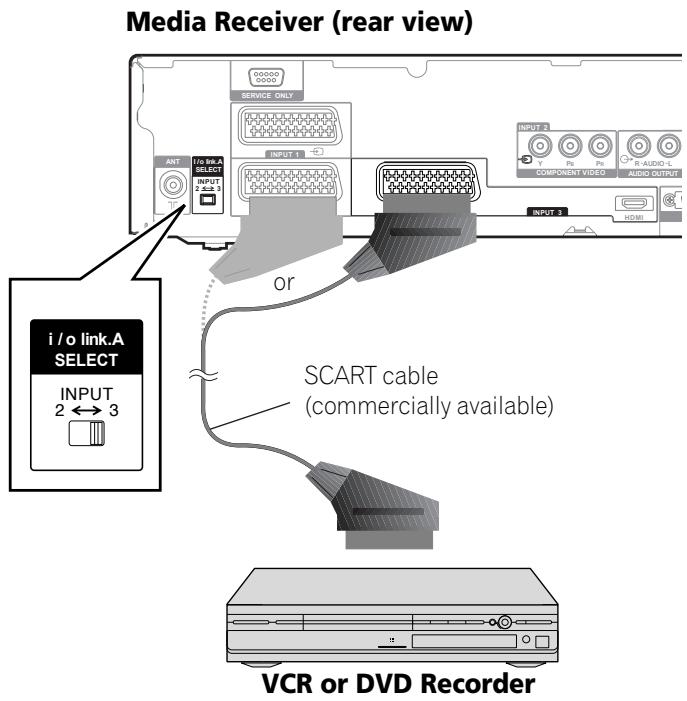
Watching a DVD image
Connecting a DVD player
Use the INPUT 2 terminal when connecting to a DVD player and other audiovisual equipment.
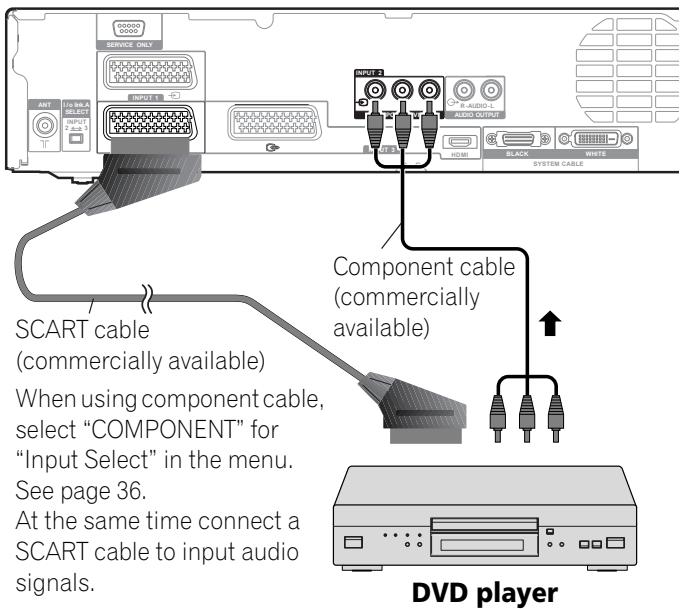
Media Receiver (rear view)
Displaying a DVD image
To watch a DVD image, press INPUT 2 on the remote control unit or press INPUT on the Media Receiver to select INPUT2.

NOTE
- If DVD images do not come in clearly, you may need to change the input signal type setting using the menu. See page 36.
- Refer to your DVD player operation manual for the signal type.
Enjoying a game console or watching camcorder images
Connecting a game console or camcorder
Use the INPUT 4 terminals to connect a game console, camcorder and other audiovisual equipment.
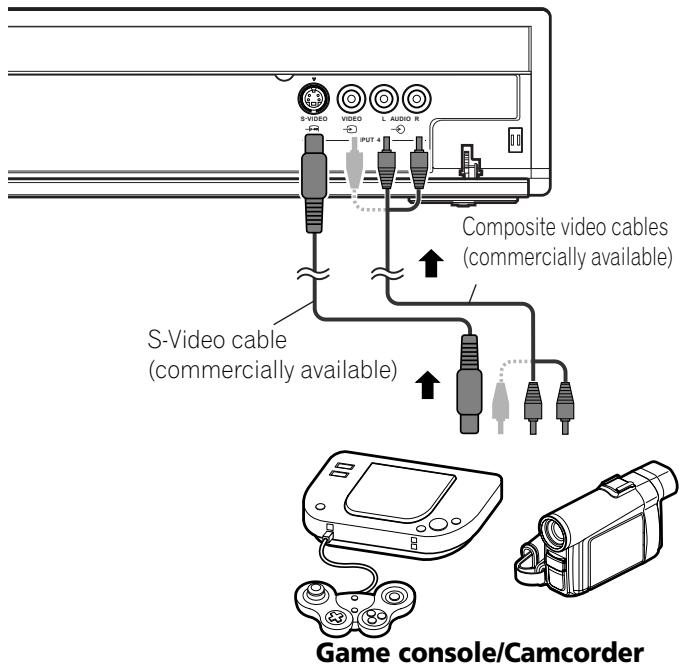
Media Receiver (front view)
Displaying an image from the game console or camcorder
To watch an image coming from the game console or camcorder, press INPUT 4 on the remote control unit or press INPUT on the Media Receiver to select INPUT4.

NOTE
- The INPUT 4 terminals are checked for cable connections in the order where; 1) S-Video, 2) Video.
- Connect external equipment to only terminals that are to be actually used.
Enjoying through audio equipment in connection
Connecting audio equipment
You can enjoy more powerful sound by connecting such audio equipment as an AV receiver.
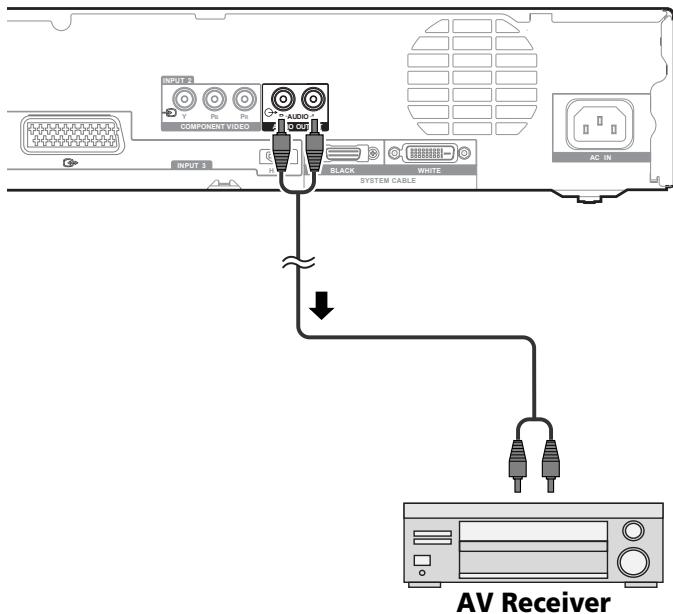
Media Receiver (rear view)

NOTE
- For details, refer to the operation manual for the audio equipment to be connected.
- Audio corresponding to video signals for the current image display is always output to the AUDIO OUTPUT terminals.
What is Teletext?
Teletext broadcasts pages of information and entertainment to specially equipped television sets. Your Plasma Display System receives Teletext signals broadcast by TV networks, and decodes them into graphical format for viewing. News, weather and sports information, stock exchange prices and programme previews are among many services available.
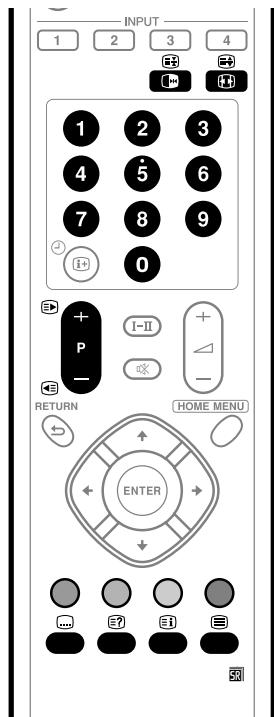
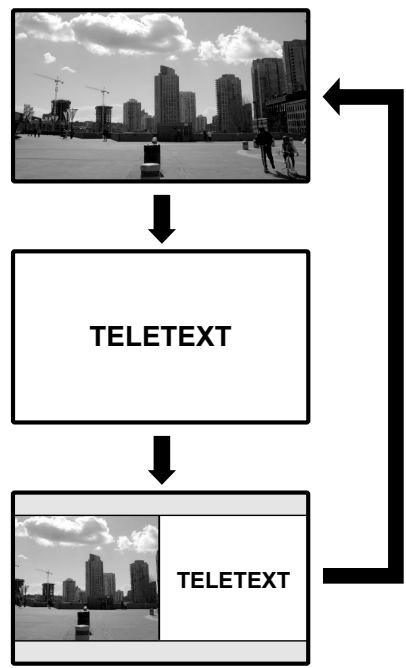
Operating the Teletext basics
Turning on and off Teletext
1 Select a TV channel or external input source providing a Teletext programme.
2 Press to display the Teletext (full screen).
3 Press again to display the Teletext on the right screen and normal image on the left screen.
Each time you press 3 , the screen switches as shown to the left.
- If you select a programme with no Teletext signal, "Cannot display Teletext." appears.
Selecting and operating Teletext pages
Use the following remote control buttons to select and operate Teletext pages.
Colour (RED/GREEN/YELLOW/BLUE):
You can select a group or block of pages displayed in the coloured brackets at the bottom of the screen by pressing the corresponding colour (RED/GREEN/YELLOW/BLUE) on the remote control unit.
0-9:
Directly select any page from 100 to 899 by using 0 - 9 .
图/图
Selects the next or previous page.
E
Each time you press 3 , the teletext image switches as shown below.
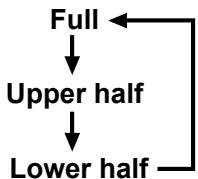
三?:
To display hidden information such as an answer to a quiz, press 3 .
- Press again to hide the information.
三:
To stop updating Teletext pages, press
- Press again to release the hold mode.
3i:
Displays an Index page for the CEEFAX/FLOF format. Displays a TOP Over View page for the TOP format.

NOTE
- Before displaying the Teletext, return the screen to the single-screen mode.
Displaying subpages
You can display several subpages as they are transmitted.
Subpage screen
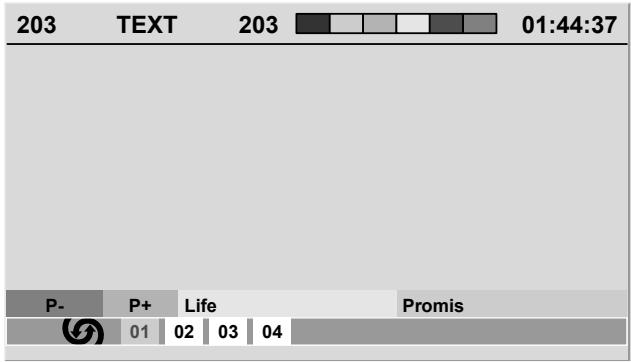
1 Press to display Teletext.
- If you open a page containing subpages, the subpages are automatically displayed in sequence.
2 To quit automatic subpage change, press / .
- You can then manually change subpages by pressing


NOTE
- Pressing 3 causes the page to be changed and the subpage screen to disappear.
- Pressing stops automatic subpage change and performs its respective button function.
Displaying TOP Over View
When receiving TOP Teletext, you can read a TOP text overview.
TOP Over View screen
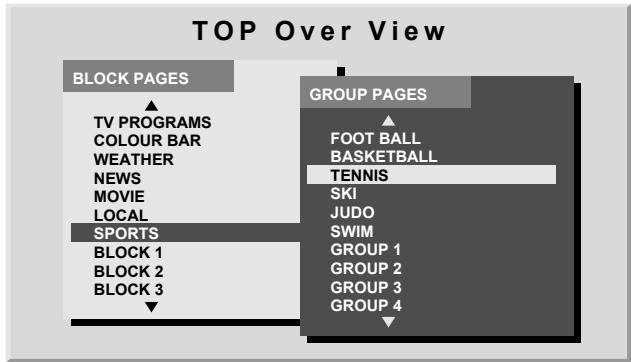
1 Press to display Teletext.
2 While receiving TOP Teletext, press to display TOP Over View.
3 Press / and / to select the desired block or group pages, and then press ENTER.

NOTE
- When the TOP Over View screen is in display, no other buttons are available than +/ -, I - II , and .
Displaying subtitle pages
You can display several subtitles as they are transmitted.
1 Press to display the subtitle.
- Subtitle is updated by the information sent by the broadcasting station.
2 Press again to access next available subtitle screen.
Troubleshooting
| Problem | Possible Solution |
| • No power.
• The system cannot be switched on. | • Make sure that the Plasma Display and the Media Receiver are connected correctly.
(See page 17.)
• Is the power cord disconnected? (See page 20.)
• Has the main power been turned on? (See pages 21 and 22.)
• Check if you pressed buttons 0 - 9 on the remote control unit. (See page 21.)
• If the indicator on the system lights up red, press 0 - 9. |
| • Blue and red rectangles appear on the screen alternately. | • Check if the system cable has been disconnected or almost disconnected. (See page 17.) |
| • The system cannot be operated. | • External influences such as lightning, static electricity, etc., may cause improper operation.
In this case, operate the system after first turning off the power of the Plasma Display and the Media Receiver, or unplugging the power cord and re-plugging it in after 1 or 2 minutes. |
| • Remote control unit does not operate. | • Are batteries inserted with polarity (+, -) aligned? (See page 19.)
• Are batteries worn out? Replace with new batteries. (See page 19.)
• Operate the remote control unit while pointing it toward the remote control sensor on the Plasma Display.
(See page 19.)
• Are you using it under strong or fluorescent lighting?
• Is a fluorescent light illuminated to remote control sensor? |
| • No image and audio is presented. | • Check if the input source for video has been unintentionally selected although you want to watch a TV channel. (See page 22.)
• Check if you have selected a channel blocked with Child Lock. (See page 28.)
• Enter a password to temporarily cancel Child Lock. (See page 38.)
• Check the cable connection with the antenna. (See page 20.)
• Check the cable connection with the other equipment. (See pages 40 to 43.) |
| • No picture. | • Is connection to other components correct? (See pages 40 to 43.)
• Is the Input Select setting correct? (See page 36.) |
| • Audio is output but no image is presented. | • Check if you have selected “Picture Off” for Energy Save. With this option selected, the screen is deactivated: only sound is output. To restore the screen display, press any button other than +/− or x (See page 35). |
| • Images are presented but no audio is output. | • Check if you have selected the minimum volume. (See page 23.)
• Check if you have muted sound. (See page 23.)
• When using INPUT 4 as the input source, check that the audio terminal is also in connection. (See page 43.) |
| • Sound is reversed between the right and left.
• Sound is output from only a single speaker. | • Check if the speaker cable connections have been reversed between the right and left or if the speaker cable from either speaker has been disconnected. (See pages 12 and 18.)
• Has the balance been correctly adjusted? (See page 34.) |
| • Picture is cut off. | • Is the image position correct? (See page 36.)
• Has the correct screen size been selected? (See pages 37.) |
| • Strange colour, light colour, dark or colour misalignment. | • Adjust the picture tone. (See pages 31 to 33.)
• Is the room too bright? The picture may look dark in a room that is too bright.
• Check the colour system setting. (See pages 28 and 36.) |
| • Power is suddenly turned off. | • The system's internal temperature has increased. Remove any objects blocking vent or clean. (See page 15.)
• Check the power control setting. (See page 35.)
• Check the sleep timer setting. (See page 38.) |
| • Panel sounds /noises | • Panel generated sounds, examples: Fan motor noise, Electrical Circuit Humming /Glass Panel buzzing are normal operation of a phosphor-based matrix display. |
If the following error codes appear on the screen, check the corresponding items in the table.
| Code | Message | Check |
| SD04 | Powering off. Internal temperature too high. Check temperature around PDP. | Check if the ambient temperature of the Plasma Display is high. |
| SD05 | Powering off. Internal protection circuits activated. Is there a short in speaker cable? | Check the speaker cable connections between the Plasma Display and the speakers. |
| SD11 | Powering off. Internal temperature too high. Check the temperature around media receiver. | Check if the ambient temperature of the Media Receiver is high. |
Connecting pin assignments for SCART
Various audio and video devices may be connected via the SCART terminals.
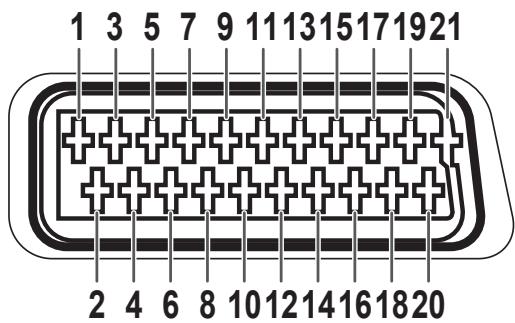
- Audio right output
- Audio right input
- Audio left output
- Common earth for audio
- Earth for blue
- Audio left input
-
Blue input
-
Audio-video control
- Earth for green
- Not used
- Green input
- Not used
- Earth for red
-
Not used
-
Red input
- Red/Green/Blue control
- Earth for video
- Earth for Red/Green/Blue control
- Video output
- Video input
- Plug shield
- Audio right output
- Audio right input
- Audio left output
- Common earth for audio
- Earth
- Audio left input
-
Not used
-
Audio-video control
- Earth
- AV link control
- Not used
- Not used
- Earth
-
Not used
-
Chroma S-Video input
- Not used
- Earth for video
- Earth
- Video output
- Video input/S-Video input
- Plug shield
- Audio right output
- Audio right input
- Audio left output
- Common earth for audio
- Earth
- Audio left input
-
Blue input
-
Audio-video control
- Earth
- AV link control
- Green input
- Not used
- Earth
-
Not used
-
Red input/Chroma S-Video input
- Red/Green/Blue control
- Earth for video
- Earth
- Video output
- Video input/S-Video input
- Plug shield
Specifications
| Item | 50" Plasma Display, Model: PDP-506PE | 43" Plasma Display, Model: PDP-436PE |
| Number of Pixels | 1280 · 768 pixels | 1024 · 768 pixels |
| Audio Amplifier | 13 W + 13 W (1 kHz, 10 %, 8 ) | 13 W + 13 W (1 kHz, 10 %, 8 ) |
| Surround System | SRS/FOCUS/TruBass | SRS/FOCUS/TruBass |
| Power Requirement | 220–240 V AC, 50/60 Hz, 344 W (0.4 W Standby) | 220–240 V AC, 50/60 Hz, 292 W (0.4 W Standby) |
| Dimensions | 1224 (W) · 717 (H) · 92 (D) mm | 1076 (W) · 632 (H) · 92 (D) mm |
| Weight | 31.8 kg (70.1 lbs.) | 25.8 kg (56.9 lbs.) |
| Item | Media Receiver, Model: PDP-R06FE |
| Colour System | PAL/SECAM/NTSC 3.58/NTSC 4.43/PAL 60 |
| TV Function | Receiving System | B/G, D/K, I, L/L' |
| Tuner VHF/UHF | E2-E69ch, F2-F10ch, I21-I69ch, IR A-IR Jch |
| Hyper-band, S1-S41ch |
| Auto Channel Preset | 99 ch, Auto Preset, Auto Label, Auto Sort |
| STEREO | NICAM/A2 |
| Terminals | Rear INPUT 1 | SCART (AV in, RGB in, TV out) |
| SCART (AV in/out, S-VIDEO in, AV link *1) Component Video |
| INPUT 2 | SCART (AV in/out, S-VIDEO in, RGB in, AV link *1), HDMI in *2 |
| INPUT 3 | 75 Din Type for VHF/UHF in |
| Antenna |
| Front INPUT 4 | S-VIDEO, AV in |
| AUDIO OUTPUT Terminal | (Rear) | AUDIO out (FIX) |
| Power Requirement | 220–240 V AC, 50/60 Hz, 16 W (0.4 W Standby) |
| Dimensions | 420 (W) · 90 (H) · 299 (D) mm |
| Weight | 3.5 kg |
1 Switchable
2 This conforms to HDMI1.1 and HDCP1.1.
HDMI (High Definition Multimedia Interface) is a digital interface that handles both video and audio using a single cable. HDCP (High-bandwidth Digital Content Protection) is a technology used to protect copyrighted digital contents that use the Digital Visual Interface (DVI).
- Design and specifications are subject to change without notice.
Trademarks
FOCUS, WOW, SRS and () symbol are trademarks of SRS Labs, Inc.
FOCUS and SRS technologies are incorporated under license from SRS Labs, Inc.
- This product includes FontAvenue® fonts licensed by NEC Corporation.
FontAvenue is a registered trademark of NEC Corporation.
- HDMI, the HDMI logo and High-Definition Multimedia Interface are trademarks or registered trademarks of HDMI Licensing LLC.
The names of companies or institutions are trademarks or registered trademarks of the respective companies or institutions.
IMPORTANT
Précautions relatives aux piles 19
Précautions relatives aux piles
Publication de Pioneer Corporation.
© 2005 Pioneer Corporation.
Wasist Videotext? 44
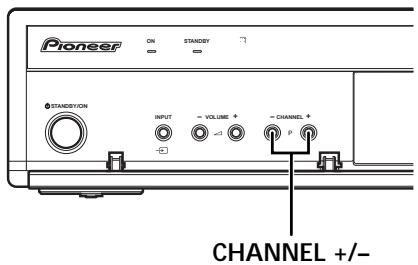
Media-Receiver (vorderseite)
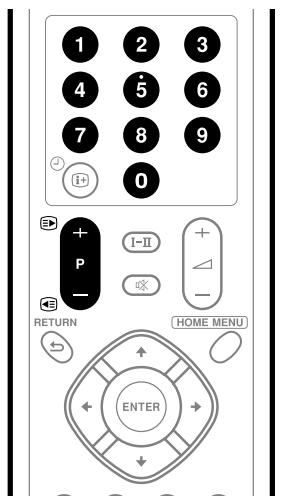
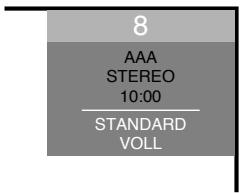
Kanalanzeige
Kanalwechsel
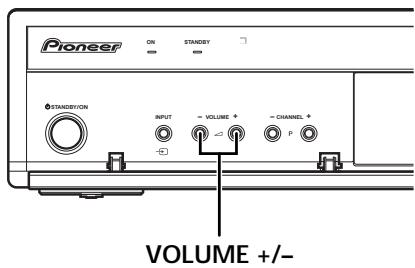
Media-Receiver (vorderseite)
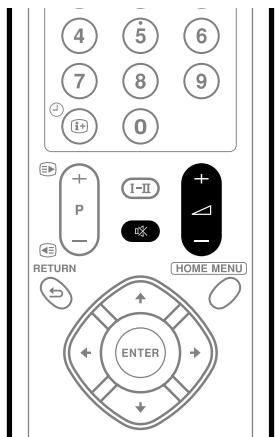
| Farbmanagement |
| R | 0 |
| Y | 0 |
| G | 0 |
| C | 0 |
| B | 0 |
| M | 0 |
Published by Pioneer Corporation.
Copyright © 2005 Pioneer Corporation.
All rights reserved.
PIONEER CORPORATION
4-1, Meguro 1-Chome, Meguro-ku, Tokyo 153-8654, Japan
PIONEER ELECTRONICS (USA) INC.
P.O. BOX 1540, Long Beach, California 90810-1540, U.S.A. TEL: (800) 421-1404
PIONEER ELECTRONICS OF CANADA, INC.
300 Allstate Parkway, Markham, Ontario L3R OP2, Canada TEL: 1-877-283-5901
PIONEER EUROPE NV
Haven 1087, Keetberglaan 1, B-9120 Melsele, Belgium TEL: 03/570.05.11
PIONEER ELECTRONICS ASIACENTRE PTE. LTD.
253 Alexandra Road, #04-01, Singapore 159936 TEL: 65-6472-7555
PIONEER ELECTRONICS AUSTRALIA PTY. LTD.
178-184 Boundary Road, Braeside, Victoria 3195, Australia, TEL: (03) 9586-6300
PIONEER ELECTRONICS DE MEXICO S.A. DE C.V.
Blvd.Manuel Avila Camacho 138 10 piso Col.Lomas de Chapultepec, Mexico,D.F. 11000 TEL: 55-9178-4270