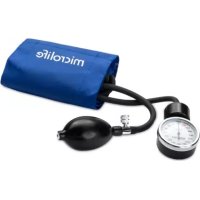
BP AG110 - Blood pressure monitor MICROLIFE - Free user manual and instructions
Find the device manual for free BP AG110 MICROLIFE in PDF.



User questions about BP AG110 MICROLIFE
0 question about this device. Answer the ones you know or ask your own.
Ask a new question about this device
Download the instructions for your Blood pressure monitor in PDF format for free! Find your manual BP AG110 - MICROLIFE and take your electronic device back in hand. On this page are published all the documents necessary for the use of your device. BP AG110 by MICROLIFE.
USER MANUAL BP AG110 MICROLIFE
natural_image
Medical pressure monitor with a black box and cord, no visible text or symbolsMicrolife BP AG1-10
EN → 1
FR → 6
IT→12
RU → 18
SR → 24
HR → 28
BG → 34
RO → 40
AR → 46
FA → 50
Microlife AG
Espenstrasse 139
9443 Widnau / Switzerland
www.microlife.com
Microlife UAB
P. Lukšio g. 32,
08222 Vilnius / Lithuania
BAG1-10 SSE-V11 292
Revision Date: 2021-07-07
microlife
Microlife BP AG1-10 BP AG1-10
text_image
Diagram of a blood pressure measurement device with labeled parts including a cup, pressure gauge, and bulb.microlife
Guarantee Card
Name of Purchaser / Nom de l'acheteur / Nome del rivenditore / Ф.И.О. покупателя / Ime i prezime kupca / Ime i prezime kupca / Име на купувача / Numele cumpârâtorului / اسم المッチري نام خربدار
Serial Number / Numéro de série / Numéro di serie / Серийный номер / Serijski broj / Serijski broj / Сериен номер / Numár de serie / محل / رقم التسلاى
Date of Purchase / Date d'achat / Data d'acquisto / Дата пскупки / Datum kupovine / Datum kupovine / Дата на закупуване / Data cumpârârii / شماره سريال تاريخ الثرا.
Specialist Dealer / Revendeur / Categoría Hivenditore / Специализированный дипер / Ovlaščeni diler / Ovlašteni prodavač / Специалист дистрибутор / Distributor de specialitate / تاريخ خريد التاجر المُقNP
microlife
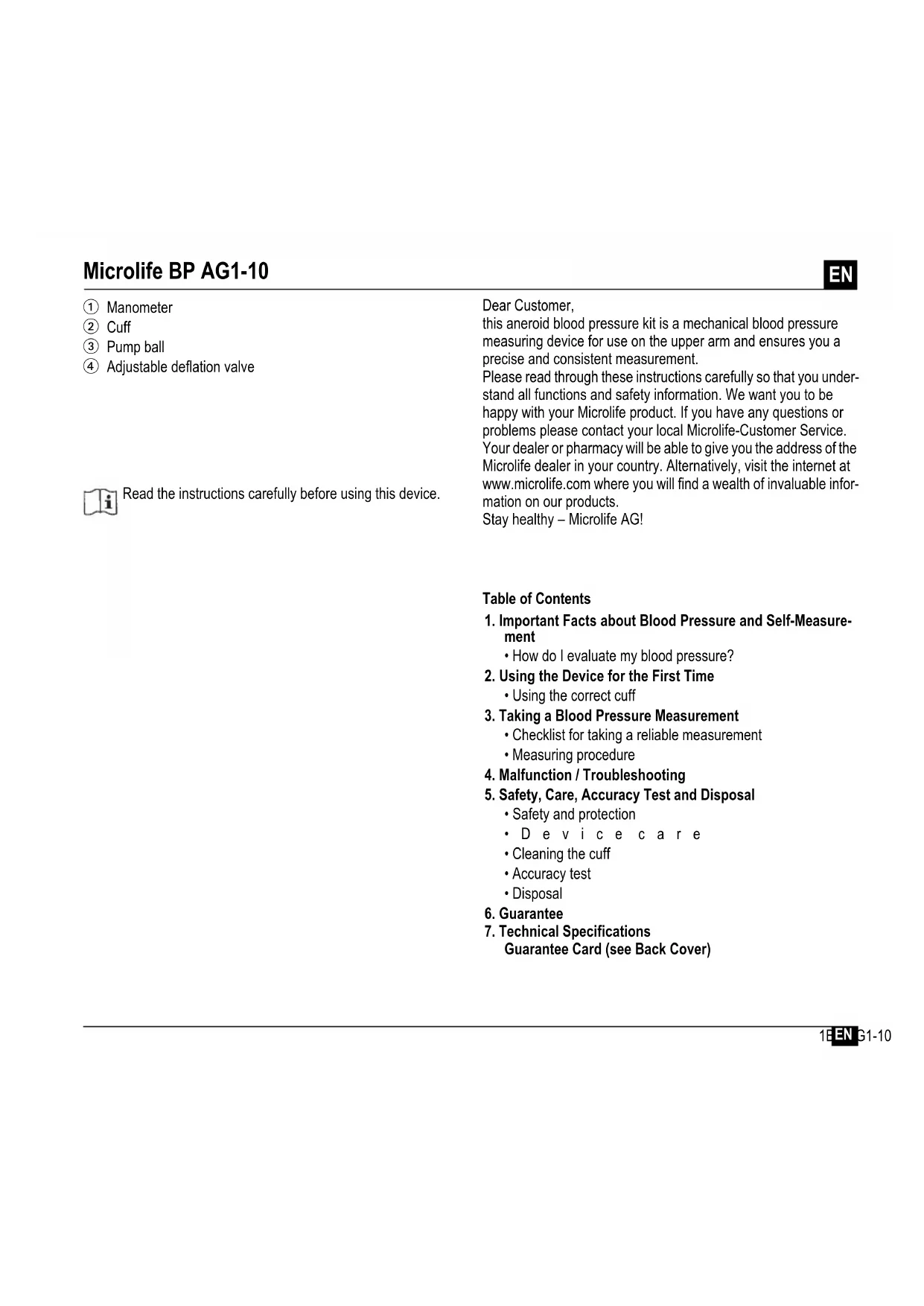
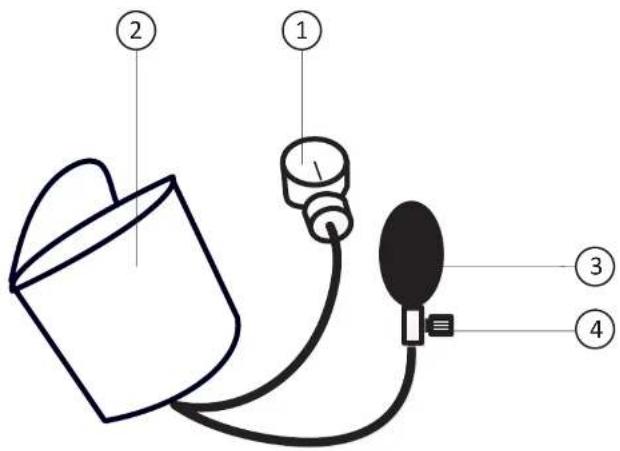
① Manometer
② Cuff
③ Pump ball
④ Adjustable deflation valve

Read the instructions carefully before using this device.
Dear Customer,
this aneroid blood pressure kit is a mechanical blood pressure measuring device for use on the upper arm and ensures you a precise and consistent measurement.
Please read through these instructions carefully so that you understand all functions and safety information. We want you to be happy with your Microlife product. If you have any questions or problems please contact your local Microlife-Customer Service.
Your dealer or pharmacy will be able to give you the address of the Microlife dealer in your country. Alternatively, visit the internet at www.microlife.com where you will find a wealth of invaluable information on our products.
Stay healthy – Microlife AG!
Table of Contents
- Important Facts about Blood Pressure and Self-Measurement
• How do I evaluate my blood pressure?
- Using the Device for the First Time
- Using the correct cuff
-
Taking a Blood Pressure Measurement
-
Checklist for taking a reliable measurement
-
Measuring procedure
-
Malfunction / Troubleshooting
-
Safety, Care, Accuracy Test and Disposal
-
Safety and protection
• Device care - Cleaning the cuff
- Accuracy test
-
Disposal
-
Guarantee
-
Technical Specifications
Guarantee Card (see Back Cover)
1. Important Facts about Blood Pressure and Self-Measurement
- Blood pressure is the pressure of the blood flowing in the arteries generated by the pumping of the heart. Two values, the systolic (upper) value and the diastolic (lower) value, are always measured.
- Permanently high blood pressure values can damage your health and must be treated by your doctor!
- Always discuss your values with your doctor and tell him/her if you have noticed anything unusual or feel unsure. Never rely on single blood pressure readings.
- There are many causes of excessively high blood pressure values. Your doctor will explain them in more detail and offer treatment where appropriate. Besides medication, relaxation techniques, weight loss and exercise can also lower your blood pressure.
- Under no circumstances should you alter the dosages of drugs or initiate a treatment without consulting your doctor.
- Depending on physical exertion and condition, blood pressure is subject to wide fluctuations as the day progresses. You should therefore take your measurements in the same quiet conditions and when you feel relaxed! Take at least two measurements per day, one in the morning and one in the evening.
- It is quite normal for two measurements taken in quick succession to produce significantly different results.
- Deviations between measurements taken by your doctor or in the pharmacy and those taken at home are quite normal, as these situations are completely different.
- Several measurements provide a much clearer picture than just one single measurement.
- Leave a small break of at least 15 seconds between two measurements.
- If you are pregnant, you should monitor your blood pressure regularly as it can change drastically during this time.
How do I evaluate my blood pressure?
Table for classifying home blood pressure values in adults in accordance with the international Guidelines (ESH, ESC, JSH). Data in mmHg.
| Range Systolic | Diastolic | Recommendation | ||
| 1. | blood pressure normal | < 120 < 74 | Self-check | |
| 2. | blood pressure optimum | 120 - 129 74 | Self-check | |
| 3. | blood pressure elevated | 130 - 134 80 | Self-check | |
| 4. | blood pressure too high | 135 - 159 85 | Seek medical advice | |
| 5. | blood pressure dangerously high | ≥ 160 | ≥ 100 | Urgently seek medical advice! |
The higher value is the one that determines the evaluation. Example: a blood pressure value of 140/80 mmHg or a value of 130/90 mmHg indicates «blood pressure too high».
2. Using the Device for the First Time
Using the correct cuff
When choosing the correct size cuff the arm circumference should be measured at the centre of the upper arm. 25 - 40 cm (9.8 - 15.7 inches) should be the correct size for the majority of people.
Only use Microlife cuffs.
Contact your local Microlife Service if the enclosed cuff ② does not fit.
3. Taking a Blood Pressure Measurement
Checklist for taking a reliable measurement
- Avoid activity, eating or smoking immediately before the measurement.
- Sit down on a back-supported chair and relax for 5 minutes. Keep the feet flat on the floor and do not cross your legs.
- Always measure on the same arm (normally left).
-
Remove close-fitting garments from the upper arm. To avoid constriction, shirt sleeves should not be rolled up - they do not interfere with the cuff if they are laid flat.
-
Always ensure that the correct cuff size is used (marking on the cuff).
• Fit the cuff closely, but not too tight.
- Make sure that the cuff is positioned 1-2 cm above the elbow.
- The artery mark on the cuff (ca. 3 cm long bar) must lie over the artery which runs down the inner side of the arm.
- Support your arm so it is relaxed.
- Ensure that the cuff is at the same height as your heart.
- Any improper setup or damage to the stethoscope will cause distorted sound or poor sound transmission causing inaccurate readings.
- Proper deflation rate is essential for an accurate reading.
Practice and master a recommended deflation rate of 2-3 mmHg per second or a drop of 1-2 marks on the manometer ① for each heartbeat.
Measuring procedure
- Place the chest piece underneath the cuff ② or 1-2 cm below it. Make sure the chest piece is in contact with the skin and lies on the brachial artery.
- Plug in the ear piece and check, if the chest piece is placed correctly, so that the Korotkoff sounds appear the loudest.
- Close the valve ④ on the pump ball ③ by turning the screw clockwise. Do not over-tighten.
- Take the pump ball ③ in your free hand (the arm you are not using to measure) and pump up the cuff. Watch the pressure indicator on the manometer ① and pump up to approx. 40 mmHg higher than the expected systolic value (the upper value).
- Inflate to 200 mmHg if you are not sure about the expected value.
- Open the valve ④ slowly by turning the screw counter clockwise whilst holding the stethoscope chest piece on the brachial artery. Listen carefully as the cuff begins to deflate. Note the reading on the manometer ① as soon as you hear a faint, rhythmic tapping or thumping sounds. This is the systolic blood pressure reading.
- Allow the pressure to continue dropping at the same deflation rate. Note the reading on the manometer ① as soon as the thumping sound stops. This is the diastolic blood pressure reading.
-
Deflate the cuff completely.
-
Repeat the measurement at least two further times and record your values, date and time immediately after finishing the measurements.
- Remove the cuff and the stethoscope.
4. Malfunction / Troubleshooting
If problems occur when using the device, the following points should be checked and if necessary, the corresponding measures are to be taken:
| Description Potential cause and remedy | |
| The sound transmission is poor, distorted or there is extraneous noise. | Check the ear pieces if they are dirty or cracked. If not, make sure you wear them properly.Check the tube if it is broken or twisted.Check the chest piece if there is any damage.Make sure the chest piece is in contact with the skin and lies on the brachial artery. Clean or replace any defective parts if found to avoid inaccurate reading. |
| The pressure does not rise although the pump ball 3 is pumping. | Make sure that the valve is closed.Make sure the cuff is properly connected to bulb and manometer.Check if the cuff, tube and/or bulb is leaking. Replace the defective parts if any. |
| The deflation rate can not be set to 2-3 mmHg/sec. by adjusting the valve 4. | Disassemble the valve from pump ball to check if there is any blockage in the airway of the valve. Clean the blockage and try again. If it still does not work, replace it to avoid inaccurate readings. |
| The manometer needle is not at 0 ± 3 mmHg at rest. | Make sure that the valve is completely open for zero check.If still more than 3 mmHg deviation, contact your dealer to recalibrate the manometer. |
If you think the results are unusual, please read through the information in «Section 1.» carefully.
5. Safety, Care, Accuracy Test and Disposal

Safety and protection
- This device may only be used for the purposes described in these instructions. The manufacturer cannot be held liable for damage caused by incorrect application.
- This device comprises sensitive components and must be treated with caution. Observe the storage and operating conditions described in the «Technical Specifications» section.
- Protect it from:
- water and moisture
- extreme temperatures
- impact and dropping
- contamination and dust
- direct sunlight
- heat and cold
- The cuffs are sensitive and must be handled with care.
- Only pump up the cuff once fitted.
- Never inflate beyond 300 mmHg.
• Always deflate the cuff completely before storage.
- Do not use this device if you think it is damaged or notice anything unusual.
- Never open this device.
- Read the additional safety information provided within the individual sections of this instruction manual.

Ensure that children do not use this device unsupervised; some parts are small enough to be swallowed. Be aware of the risk of strangulation in case this device is supplied with cables or tubes.
Device care
Clean the device only with a soft, dry cloth.
Cleaning the cuff
Carefully remove spots on the cuff with a damp cloth and soapsuds.

WARNING: Do not wash the cuff in a washing machine or dishwasher!
Accuracy test
We recommend this device is tested for accuracy every 2 years or after mechanical impact (e.g. being dropped). Please contact your local Microlife-Service to arrange the test (see foreword).
Disposal

Electronic devices must be disposed of in accordance with the locally applicable regulations, not with domestic waste.
6. Guarantee
This device is covered by a 2 year guarantee from the date of purchase. During this guarantee period, at our discretion, Microlife will repair or replace the defective product free of charge. Opening or altering the device invalidates the guarantee. The following items are excluded from the guarantee:
- Transport costs and risks of transport.
- Damage caused by incorrect application or non-compliance with the instructions for use.
- Damage caused by accident or misuse.
- Packaging/storage material and instructions for use.
- Regular checks and maintenance (calibration).
- Accessories and wearing parts: Tubes, pumping ball, cuff. Should guarantee service be required, please contact the dealer from where the product was purchased, or your local Microlife service. You may contact your local Microlife service through our website:
www.microlife.com/support
Compensation is limited to the value of the product. The guarantee will be granted if the complete product is returned with the original invoice. Repair or replacement within guarantee does not prolong or renew the guarantee period. The legal claims and rights of consumers are not limited by this guarantee.
7. Technical Specifications
Weight: 360 g
Dimensions: 175 x 70 x 103 mm
Storage conditions: -20 - +70 °C
30 - 85 % relative maximum humidity
Operating conditions: 0 - 46 °C
Measurement range: 0 - 300 mmHg
Resolution: 2 mmHg
Static accuracy: within ± 3 mmHg between 18 - 33 °C; within ± 6 mmHg between 34 - 46 °C
Air leakage: < ± 4 mmHg/min
Hysteresis error: within 0 - 4 mmHg
Included accessories: Cuff (25 - 40 cm), pump ball, valve, softbag
Reference to
standards: EN ISO 81060-1; ANSI / AAMI SP09
This device complies with the requirements of the Medical Device Directive 93/42/EEC.
Technical alterations reserved.
Accessoires inclus: brassard (25 - 40 cm), poire, valve, trousse souple
Référence aux normes: EN ISO 81060-1; ANSI / AAMI SP09
www.microlife.com/support
www.microlife.com/support
Kompenzacija je ograničena na vrednost proizvoda. Garancija će biti uvažena ako se vrati kompletan proizvod sa originalnim računom. Popravka ili zamena u garantnom roku ne produžava niti obnavlja garantni period.
7. Tehničke specifikacije
Težina: 360 g
Dimenzije: 175 x 70 x 103 mm
www.microlife.com/support