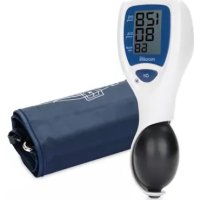
BP 3AS12 - Blood pressure monitor MICROLIFE - Free user manual and instructions
Find the device manual for free BP 3AS12 MICROLIFE in PDF.



User questions about BP 3AS12 MICROLIFE
0 question about this device. Answer the ones you know or ask your own.
Ask a new question about this device
Download the instructions for your Blood pressure monitor in PDF format for free! Find your manual BP 3AS12 - MICROLIFE and take your electronic device back in hand. On this page are published all the documents necessary for the use of your device. BP 3AS12 by MICROLIFE.
USER MANUAL BP 3AS12 MICROLIFE
natural_image
Close-up of a person's shoulder and shoulders in blue lighting, no visible text or symbolsMicrolife BP 3AS1-2
EN Semi-automatic Blood Pressure Monitor
Instruction Manual (1-11)
natural_image
Medical device with digital display showing blood pressure measurement (no visible text or symbols)This oscillometric blood pressure monitor is intended for measuring non-invasive blood pressure in people aged 12 years or older.
It is clinically validated in patients with hypertension, hypotension, diabetes, pregnancy, pre-eclampsia, atherosclerosis, end-stage renal disease, obesity and the elderly.
Important Safety Instructions

Type BF applied part
Batteries and electronic devices must be disposed of in accordance with the locally applicable regulations, not with domestic waste.

Ensure that children do not use the device unsupervised; some parts are small enough to be swallowed. Be aware of the risk of strangulation in case this device is supplied with cables or tubes.

Keep dry
Table of contents
1. Introduction
1.1. Features
1.2. Important information about self-measurement
2. Important information on the subject of blood pressure and its measurement
2.1. How does high/low blood pressure arise?
2.2. Which values are normal?
2.3. What can be done, if regular high/low values are obtained?
3. The various components of the blood pressure monitor
4. Putting the blood pressure monitor into operation
4.1. Inserting the batteries
4.2. Tube connection
5. Carrying out a measurement
5.1. Before the measurement
5.2. Common sources of error
5.3. Fitting the cuff
5.4. Measuring procedure
5.5. Inflating further
5.6. Discontinuing a measurement
5.7. Memory – displaying the last measurement
6. Error messages/malfunctions
7. Care and maintenance, recalibration
8. Guarantee
9. Technical specifications
10. www.microlife.com
1. Introduction
1.1. Features
The blood pressure monitor is a semi-automatic, digital blood pressure measuring device for use on the upper arm, which enables very fast and reliable measurement of the systolic and diastolic blood pressure as well as the pulse frequency by way of the oscillometric method of measuring.
The device offers a very high and clinical tested measurement accuracy and has been designed to provide a maximum of user-friendliness.
Before using, please read through this instruction manual carefully and then keep it in a safe place. For further questions on the subject of blood pressure and its measurement, please contact your doctor.
Attention!
1.2. Important information about self-measurement
- Do not forget: self-measurement means control, not diagnosis or treatment. Unusual values must always be discussed with your doctor. Under no circumstances should you alter the dosages of any drugs prescribed by your doctor.
- The pulse display is not suitable for checking the frequency of heart pacemakers!
- In cases of cardiac irregularity (Arrhythmia), measurements made with this device should only be evaluated after consultation with the doctor.
Electromagnetic interference
The device contains sensitive electronic components (Microcomputer). Therefore, avoid strong electrical or electromagnetic fields in the direct vicinity of the device (e.g. mobile telephones, microwave cookers). These can lead to temporary impairment of the measuring accuracy.
Do not use this device close to strong electromagnetic fields such as mobile telephones or radio installations. Keep a minimum distance of 3.3 m from such devices when using this device.
2. Important information on the subject of blood pressure and its measurement
2.1. How does high/low blood pressure arise?
The level of blood pressure is determined in a part of the brain, the so-called circulatory centre, and adapted to the respective situation by way of feedback via the nervous system. To adjust the blood pressure, the strength and frequency of the heart (Pulse), as well as the width of circulatory blood vessels is altered. The latter is effected by way of fine muscles in the blood-vessel walls.
The level of arterial blood pressure changes periodically during the heart activity: During the «blood ejection» (Systole) the value is maximal (systolic blood pressure value), at the end of the heart's «rest period» (Diastole) minimal (diastolic blood pressure value).
The blood pressure values must lie within certain normal ranges in order to prevent particular dis eases.
2.2. Which values are normal?
Blood pressure is too high if at rest, the diastolic pressure is above 90 mmHg and/or the systolic blood pressure is over 140 mmHg. In this case, please consult your doctor immediately. Long-term values at this level endanger your health due to the associated advancing damage to the blood vessels in your body.
With blood pressure values that are too low, i.e. systolic values under 100 mmHg and/or diastolic values under 60 mmHg, likewise, please consult your doctor.
Even with normal blood pressure values, a regular self-check with your blood pressure monitor is recommended. In this way you can detect possible changes in your values early and react appropriately. If you are undergoing medical treatment to control your blood pressure, please keep a record of the level of your blood pressure by carrying out regular self-measurements at specific times of the day. Show these values to your doctor. Never use the results of your measurements to alter independently the drug doses prescribed by your doctor.
Table for classifying blood pressure values (units mmHg) according to World Health Organization:
| Range Systolic Diastolic Recommendation | |||
| 1. | blood pressure normal | < 120 < 80 | |
| 2. | blood pressure normal | 120 - 129 80 - 84 | Self-check |
| 3. | blood pressure slightly high | 130 - 139 85 - 89 | Consult your doctor |
| 4. | blood pressure too high | 140 - 159 90 - 99 | Seek medical advice |
| 5. | blood pressure far too high | 160 - 179 100 - 109 | Seek medical advice |
| 6. | blood pressure dangerously high | ≥ 180 ≥ 110 | |
Further information
- If your values are mostly standard under resting conditions but exceptionally high under conditions of physical or psychological stress, it is possible that you are suffering from so-called «labile hypertension». Please consult your doctor if you suspect that this might be the case.
- Correctly measured diastolic blood pressure values above 120 mmHg require immediate medical treatment.
2.3. What can be done, if regular increased/low values are obtained?
a) Please consult your doctor.
b) Increased blood pressure values (various forms of hypertension) are associated long- and medium term with considerable risks to health. This concerns the arterial blood vessels of your body, which are endangered due to constriction caused by deposits in the vessel walls (Arteriosclerosis). A deficient supply of blood to important organs (heart, brain, muscles) can be the result. Furthermore, with long-term continuously increased blood pressure values, the heart will become structurally damaged.
c) There are many different causes of the appearance of high blood pressure. We differentiate between the common primary (essential) hypertension, and secondary hypertension. The latter group can be ascribed to specific organic malfunctions. Please consult your doctor for information about the possible origins of your own increased blood pressure values.
d) There are measures which you can take, not only for reducing a medically established high blood pressure, but also for prevention. These measures are part of your general way of life:
A) Eating habits
- Strive for a normal weight corresponding to your age. Reduce overweight!
- Avoid excessive consumption of common salt.
- Avoid fatty foods.
B) Previous illnesses
Follow consistently any medical instructions for treating previous illness such as:
• Diabetes (Diabetes mellitus)
• Fat metabolism disorder
• Gout
C) Habits
- Give up smoking completely
- Drink only moderate amounts of alcohol
- Restrict your caffeine consumption (Coffee)
D) Physical constitution
• After a preliminary medical examination, do regular sport.
- Choose sports which require stamina and avoid those which require strength.
- Avoid reaching the limit of your performance.
- With previous illnesses and/or an age of over 40 years, please consult your doctor before beginning your sporting activities. He will advise you regarding the type and extent of types of sport that are possible for you.
3. The various components of the blood pressure monitor
The illustration shows the blood pressure monitor, consisting of:
a) Measuring unit
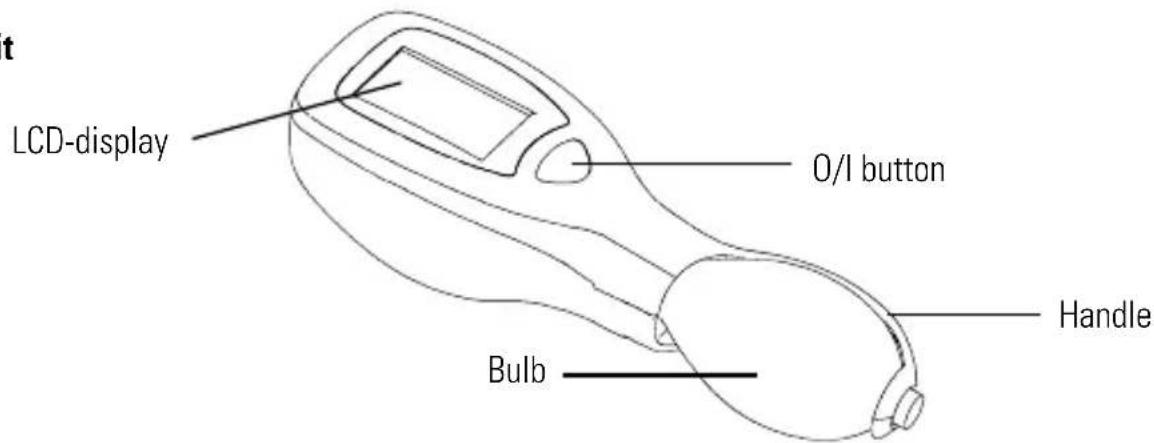
text_image
LCD-display O/I button Bulb Handleb) Cuff
cuff type M for arm circumference 22 - 32 cm or cuff type L for arm circumference 32 - 42 cm (available as special accessory)
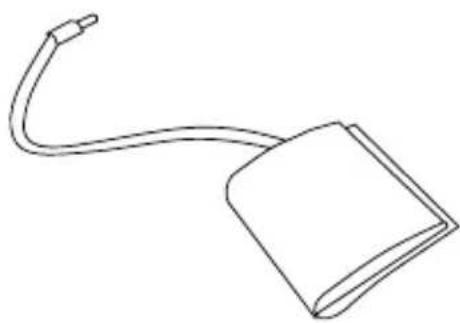
natural_image
Line drawing of a closed book with a curved cable, no text or symbols present4. Putting the blood pressure monitor into operation
4.1. Inserting the batteries
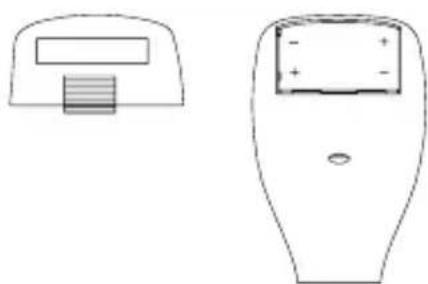
After you have unpacked your device, first insert the batteries. The battery compartment is located on the underside of the device (see illustration).
natural_image
Two simple line drawings of a device with no text or symbolsa) Remove cover as illustrated
b) Insert the batteries (2 x size 1.5 V), thereby observing the indicated polarity.
c) If the battery warning appears in the display, the batteries are empty and must be replaced by new ones.
Attention!
- After the battery warning appears, the device is blocked until the batteries have been replaced.
- Please use «AAA» long-life or alkaline 1.5 V batteries. The use of 1.2 V accumulators is not recommended.
- If this device is left unused for long periods, please remove the batteries from the device.

natural_image
Blank white rectangle with a small small icon at the bottom left corner (no text or symbols)Functional check: Press and hold the O/I button down to test all the display elements. When functioning correctly all segments appear.
4.2. Tube connection
Cuff (1-tube cuff + T-connector): Insert the cuff tube into the opening provided on the back of the device, as shown in the diagram.
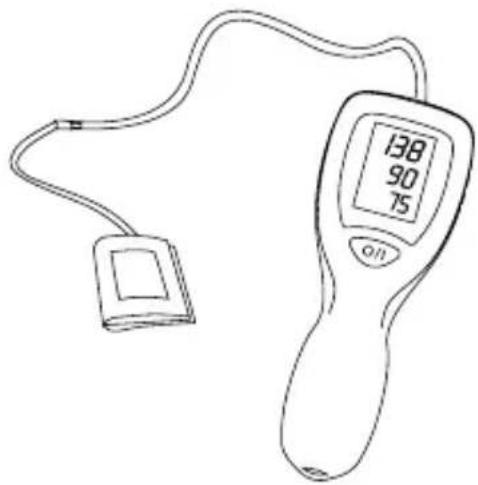
text_image
138 90 75 ON5. Carrying out a measurement
5.1. Before the measurement
- Avoid eating, smoking as well as all forms of exertion directly before the measurement. All these factors influence the measurement result. Try to find time to relax by sitting in an armchair in a quiet atmosphere for about 5 minutes before measurement.
- Remove any garment that fits closely to your upper arm.
• Always measure on the same arm (normally left). - Attempt to carry out the measurements regularly at the same time of day, since the blood pressure changes during the course of the day.
5.2. Common sources of error
Note: Comparable blood pressure measurements always require the same conditions!
These are normally always quiet conditions.
- All efforts by the patient to support their arm can increase blood pressure. Make sure you are in a comfortable, relaxed position and do not activate any of the muscles in the measurement arm during the measurement. Use a cushion for support if necessary.
- If the wrist artery lies considerably lower (higher) than the heart, an erroneously higher (lower) blood pressure will be measured! (Each 15 cm difference in height results in a measurement error of 10 mmHg!)
- Cuffs that are too narrow or too short result in false measurement values. Selecting the correct cuff is of extraordinary importance. The cuff size is dependent upon the circumference of the arm (measured in the centre). The permissible range is printed on the cuff. If this is not suitable for your use, please contact your dealer. Note: Only use clinically approved Original-Cuffs!
- A loose cuff or a sideways protruding air-pocket causes false measurement values.
5.3. Fitting the cuff
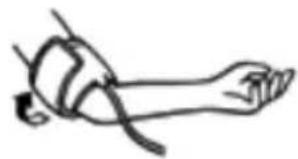
a) Push the cuff over the left upper arm so that the tube points in the direction of the lower arm.
b) Lay the cuff on the arm as illustrated. Make certain that the lower edge of the cuff lies approximately 2 to 3 ~cm above the elbow and that the rubber tube leaves the cuff on the inner side of the arm.
Important! The mark (ca. 3 cm long bar) must lie over the artery which runs down the inner side of the arm.
c) Tighten the free end of the cuff and close the cuff by affixing the closer.
d) There must be no free space between the arm and the cuff as this would influence the result. Clothing must not restrict the arm. Any piece of clothing which does (e.g. a pullover) must be taken off.
e) Secure the cuff with the closer in such a way that it lies comfortably and is not too tight. Lay your arm on a table (palm upwards) so that the cuff is at the same height as the heart. Make sure that the tube is not kinked.
Note:
If it is not possible to fit the cuff to your left arm, it can also be placed on the right one. However, all measurements should be made using the same arm.
5.4. Measuring procedure
After the cuff has been appropriately positioned, the measurement can begin:
a) Press the O/I button. Make sure the tube is properly attached to the device. The following appears in the display for 2 seconds: (Diag.). A short be-be-beep follows to indicate that the device has equilibrated with the pressure of the surroundings and the measurement can therefore begin. A «0» is shown in the display.
b) Grasp the handle and bulb with your free hand and Inflate the cuff to a pressure at least 40 mmHg higher than the expected systolic pressure. If you do not know the value of this pressure, inflate to a value of approximately 160 - 180 mmHg. The cuff pressure is shown continuously on the LCD.
natural_image
Simple line drawing of a human leg with a bandage, no text or symbols present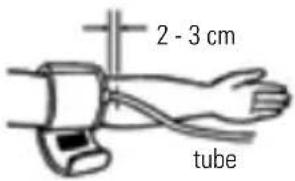
text_image
2 - 3 cm tube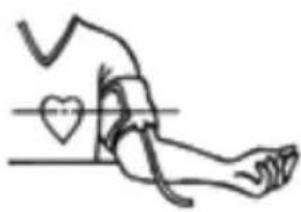
natural_image
Line drawing of a person lying on the foot with a heart symbol placed near the knee (no text or labels)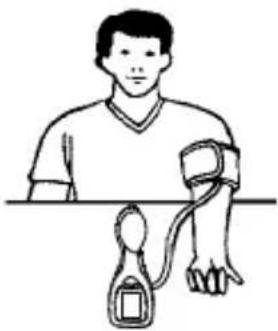
natural_image
Illustration of a person holding a wristwatch and a hanging device (no text or symbols)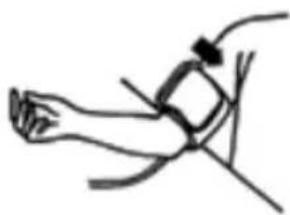
natural_image
Line drawing of a human leg with a wristband and wristpin (no text or symbols)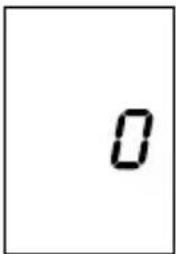
text_image
0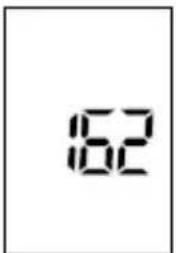
text_image
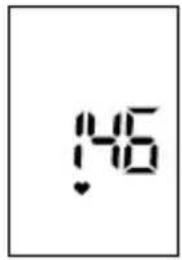
162c) After the inflation process remain in a quiet and relaxed sitting position. The measurement now proceeds on its own. If no measurement takes place and all that appears in the display is a flashing, upwards pointing arrow, see below under «Inflate further». When the device detects a pulse, a heart symbol in the display starts to flash.
d) A longer beep is sounded when the measurement has been completed. The systolic, and diastolic blood pressures and pulse rate now appear in the display. At the same time, the cuff pressure will be automatically released by the quick release valve of the device.
5.5. Inflating further
If the cuff is not inflated sufficiently, the measurement is broken off after a few seconds and a flashing arrow pointing upwards appears in the display. It is then necessary to inflate further to at least 20 mmHg higher than the previous value. The instruction to inflate further can appear several times if the pressure is still not sufficient.
Attention:
If the cuff is inflated too far (over 300 mmHg), «HI» appears in the display and a warning signal is sounded. The cuff pressure must then be immediately released by pressing the 0/I button.
As soon as the cuff is inflated sufficiently and the measurement is proceeding, continue as described under points c-d.
5.6. Discontinuing a measurement
If it is necessary to interrupt a blood pressure measurement for any reason (e.g. the patient feels unwell), the O/I button can be pressed at any time.
The device immediately lowers the cuff-pressure automatically.
5.7. Memory – displaying the last measurement
The measured results are stored in the device until a new measurement is carried out or the batteries are removed. You can call up the stored values at any time by pressing the O/I button for at least 3 seconds.
6. Error messages/malfunctions
If an error occurs during a measurement, the measurement is discontinued and a corresponding error code is displayed. (Example Error no. 1)
text_image
146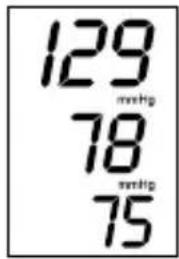
text_image
129 mmHg 78 mmHg 75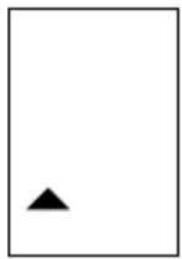
natural_image
Simple geometric shape: a black triangle on white background, enclosed in a rectangular border (no text or symbols)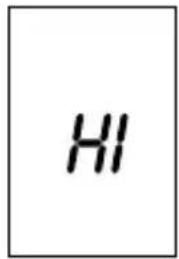
text_image
HI
text_image
O/I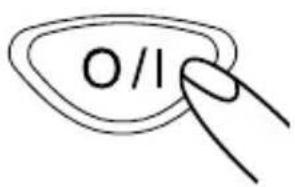
text_image
O/I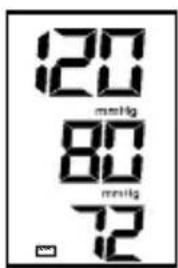
text_image
120 mmHg 80 mmHg 72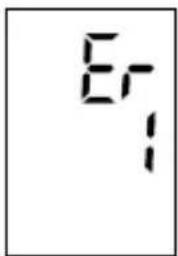
text_image
Er 1| Error No. Possible cause(s) | |
| ERR 1 | The systolic pressure was determined but after wards the cuff pressure fell below 20 mmHg. This situation can occur, for example, if the tube becomes unplugged after the systolic blood pressure has been measured. Further possible cause: No pulse has been detected. |
| ERR 2 | Unnatural pressure impulses influence the measurement result. Reason: The arm was moved during the measurement (Artefact). |
| ERR 5 | The measured results have indicated an unacceptable difference between the systolic and diastolic pressure. Take another measurement, carefully following the instructions. Contact your doctor, if you still obtain unusual results. |
| HI | The pressure in the cuff is too high (over 299 mmHg) OR the pulse is too high (over 200 beats per minute). Relax for 5 minutes and repeat the measurement.* |
| LO | The pulse is too low (less than 40 beats per minute). Repeat the measurement.* |
* Please consult your doctor, if this or any other problem occurs repeatedly.
Other possible malfunctions and their elimination – If problems occur when using the device, the following points should be checked and if necessary, the corresponding measures are to be taken:
| Malfunction Remedy | |
| The display remains empty when the instrument is switched on although the batteries are in place. | 1. Check whether the batteries are installed with the correct polarity and correct if necessary.2. If the display is unusual, re-insert batteries or exchange them. |
| The pressure does not rise although the pump is running. | ·Check the connection of the cuff tube and connect properly if necessary. |
| The device frequently fails to measure the blood pressure values, or the values measured are too low (too high). | 1. Fit the cuff correctly on the arm.2. Before starting the measurement make sure that the cuff is not fitted too tightly and that there is no rolled-up sleeve exerting pressure on the arm above the measuring position. Take off articles of clothing if necessary.3. Measure the blood pressure again in complete peace and quiet. |
| Every measurement results in different values although the device functions normally and the values are displayed. | ·Please read the following information and the points listed under «Common sources of error». Repeat the measurement. |
| The blood pressure values measured differ from those measured by the doctor. | ·Record the daily development of the values and consult your doctor about them. |
Further information
The level of blood pressure is subject to fluctuations even with healthy people. Important thereby is, that comparable measurements always require the same conditions (rest conditions)!
You must consult your specialist dealer or chemist if there are technical problems with the blood pressure device. Never attempt to repair the device yourself!
Any unauthorised opening of the device invalidates all guarantee claims!
7. Care and maintenance, recalibration
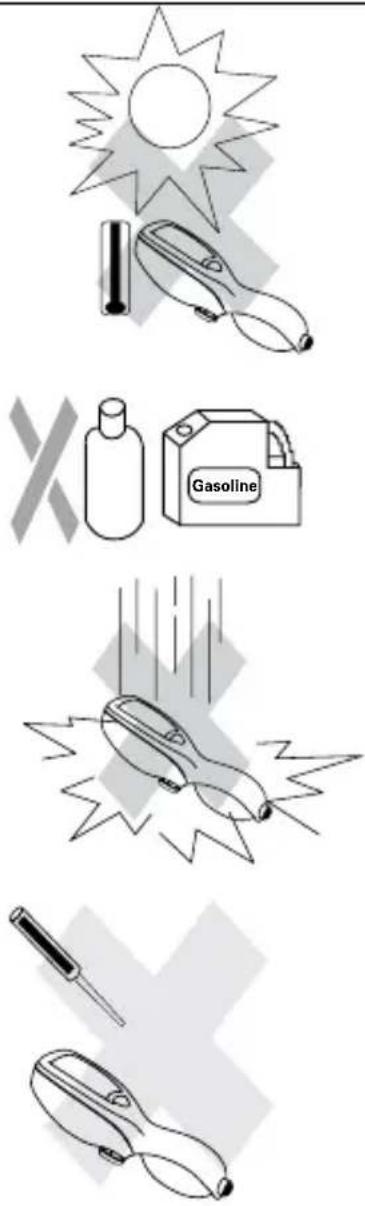
a) Do not expose the device to either extreme temperatures, humidity, dust or direct sunlight.
b) The cuff contains a sensitive air-tight bubble. Handle this carefully and avoid all types of straining through twisting or buckling.
c) Clean the device with a soft, dry cloth. Do not use petrol, thinners or similar solvent. Spots on the cuff can be removed carefully with a damp cloth and soapsuds. The cuff must not be washed!
d) Handle the tube carefully. Do not pull on it. Likewise, this is not to be buckled or laid over sharp edges.
e) Do not drop the device or treat it roughly in any way. Avoid strong vibrations.
f) Never open the device! Otherwise the manufacturer calibration becomes invalid!
text_image
Illustration showing four different types of medical or chemical devices with corresponding icons and labels: sun, fuel pump, gas bag, and pen.Periodical recalibration
Sensitive measuring devices must from time to time be checked for accuracy. We therefore recommend a periodical inspection of the static pressure display every 2 years.
Your specialist dealer would be pleased to provide more extensive information about this.
Follow instructions for use. This document provides important product operation and safety information regarding this device. Please read this document thoroughly before using the device and keep for future reference.
8. Guarantee
This device is covered by a 3 year guarantee from the date of purchase. During this guarantee period, at our discretion, Microlife will repair or replace the defective product free of charge.
Opening or altering the device invalidates the guarantee.
The following items are excluded from the guarantee:
• Transport costs and risks of transport.
- Damage caused by incorrect application or non-compliance with the instructions for use.
• Damage caused by leaking batteries.
- Damage caused by accident or misuse.
- Packaging/storage material and instructions for use.
- Regular checks and maintenance (calibration).
- Accessories and wearing parts: Batteries, pumping ball, power adapter (optional)
The cuff is covered by a functional guarantee (bladder tightness) for 2 years.
Should guarantee service be required, please contact the dealer from where the product was purchased, or your local Microlife service. You may contact your local Microlife service through our website: www.microlife.com/support
Compensation is limited to the value of the product. The guarantee will be granted if the complete product is returned with the original invoice. Repair or replacement within guarantee does not prolong or renew the guarantee period. The legal claims and rights of consumers are not limited by this guarantee.
- Technical specifications
| Weight: | 310 g (with batteries) |
| Size: | 68 (W) x 186 (L) x 48.5 (H) mm |
| Storage conditions: | -20 - +55 °C; 15 - 95 % relative maximum humidity |
| Operating conditions: | 10 - 40 °C; 15 - 95 % relative maximum humidity |
| Display: | LCD-Display (Liquid Crystal Display) |
| Measuring method: | oscillometric |
| Pressure sensor: | capacitive |
| Measuring range: | |
| SYS/DIA: | 20 - 280 mmHg |
| Pulse: | 40 - 200 per minute |
| Memory: | Storing the last measurements automatically |
| Measuring resolution: | 1 mmHg |
| Accuracy: | |
| Pressure: | within ± 3 mmHg |
| Pulse: | ± 5% of the reading |
| Voltage source: | 2 x 1.5 V alkaline batteries; size AAA |
| Battery lifetime: | approx. 780 measurements (using new batteries) |
| IP Class: | IP20 |
| Cuffs: | cuff type M for arm circumference 22 - 32 cm or cuff type L for arm circumference 32 - 42 cm (optional) |
| Reference to standards: | EN 1060-1 /-3 /-4; IEC 60601-1;IEC 60601-1-2 (EMC); IEC 60601-1-11 |
| Expected service life: | Device: 5 years or 10000 measurementsAccessories: 2 years |
This device complies with the requirements of the Medical Device Directive 93/42/EEC. Technical alterations reserved.
Detailed user information about our products and services can be found at www.microlife.com
Utilisation:
natural_image
Line drawing of a closed book with a curved cable extending from it (no text or symbols)natural_image
Line drawing of a blood pressure monitor with digital display and probe (no text or symbols)5. Prise de mesure
natural_image
Simple line drawing of a human leg and wrist (no text or symbols)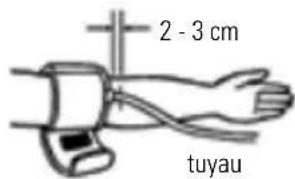
text_image
2 - 3 cm tuyau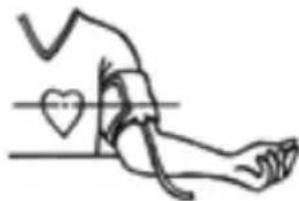
natural_image
Line drawing of a person's leg with a heart symbol on the knee, no text or labels present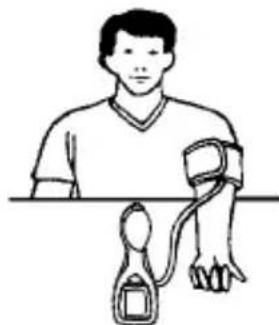
natural_image
Illustration of a person holding a wristwatch and a medical device (no text or symbols)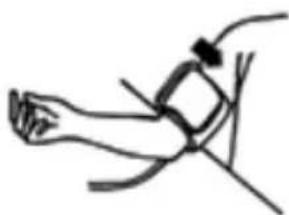
natural_image
Simple line drawing of a human leg and foot with a small object on the ankle (no text or symbols)natural_image
Simple geometric shape: a black triangle on white background (no text or symbols)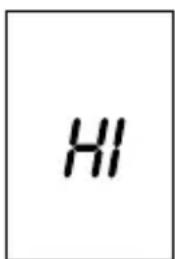
text_image
HItext_image
Illustration showing various methods of lighting and cleaning: sun, batteries, fuel can, spray gun, and power tools.natural_image
Line drawing of a medical or laboratory device with a curved tube attached to a rectangular block (no text or symbols)natural_image
Two simple line drawings of a handheld device with a rectangular panel and a circular button, no text or symbols present.Dikkat!Dikkat!
natural_image
Line drawing of a blood pressure monitor with a digital read and bulb (no text or symbols)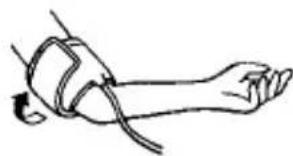
natural_image
Line drawing of a human leg with a bandage and wristband (no text or symbols)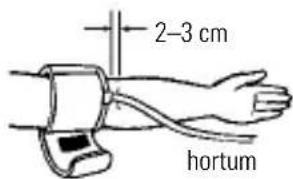
text_image
2-3 cm hortum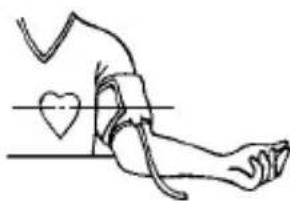
natural_image
Line drawing of a human leg with a heart symbol attached to the ankle (no text or labels)natural_image
Illustration showing two different physical or medical interventions: one with a person holding a wrist brace, the other with a leg and wrist strap (no text or symbols present)
text_image
0 162 146 × 129 78 75 ▲Dikkat:Dikkat:
text_image
Diagram showing four safety symbols: sun, thermometer, bottle with 'Gasoline' label, and electric shock hazard.natural_image
Illustration of a pen and a handheld device with a cross symbol overlay (no text or symbols present)natural_image
Simple line drawing of a closed book with a curved cable (no text or symbols)I/O ز
مبيض
ب) الرباط (إختيارى)
natural_image
Simple line drawing of a handheld device with a screen and handle (no text or symbols)١,٤. إدخال الطاريات
natural_image
Blank white rectangle with a small small icon in the bottom-left corner (no text or symbols)natural_image
Line drawing of a blood pressure monitor with digital display (no text or symbols)٣,٤. وصلة الأنبوب
natural_image
Line drawing of a human leg with wristband and bandages (no text or symbols)natural_image
Line drawing of a person lying on the foot with a heart symbol placed on the knee (no text or labels)natural_image
Illustration of a person using a blood pressure monitor and a medical device (no text or symbols)natural_image
Line drawing of a wristwatch with a circular grip and wristpin, no text or symbols presentملاحظة:
text_image
20 mapping 80 mapping 72