
SBCSC367 - Headphones PHILIPS - Free user manual and instructions
Find the device manual for free SBCSC367 PHILIPS in PDF.
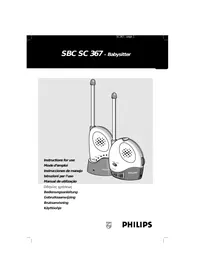


| Product type | Wireless babyphone (baby monitor) |
| Brand | Philips |
| Model | SBC SC367 |
| Transmission frequencies | 40.675 MHz / 40.695 MHz (2 channels) |
| Maximum range | 150 meters under ideal conditions |
| Power supply | 2 mains adapters 9 V DC, 200 mA (included) |
| Battery power (baby unit) | 4 LR6 1.5 V batteries (not supplied) |
| Battery power (parent unit) | 4 rechargeable NiCad 1.2 V batteries (included) |
| Battery life (baby unit) | Up to 30 hours |
| Battery life (parent unit) | Up to 5 hours |
| Main features | Sound-activated voice transmission, manual talk, LED sound level indicator, built-in thermometer (baby unit), intercom function, channel selection, belt clip |
| Operating mode | VOICE (voice activation), STANDBY, OFF |
| Loss of link sound indication | Audible beep after 30 seconds of disconnection |
| Charging the parent unit | On charging cradle (supplied), charging time 12-14 hours |
| Included accessories | 2 mains adapters, charging cradle, NiCad batteries, belt clip |
| Safety | Do not place the baby unit in the crib or within reach of the child; use only as a monitoring aid |
Frequently Asked Questions - SBCSC367 PHILIPS
User questions about SBCSC367 PHILIPS
0 question about this device. Answer the ones you know or ask your own.
Ask a new question about this device
Download the instructions for your Headphones in PDF format for free! Find your manual SBCSC367 - PHILIPS and take your electronic device back in hand. On this page are published all the documents necessary for the use of your device. SBCSC367 by PHILIPS.
USER MANUAL SBCSC367 PHILIPS
Instructions for use
Mode d'emploi
Illustrations 3 Technical specifications 42
Enn
Francais page 8
Congratulations! You have just purchased a truly cordless Babysitter (SBC SC367) that enables you to monitor your child from wherever you are in and around your house. The Babysitter has been tested to meet all necessary regulations and standards, and features a rechargeable battery back-up that guarantees operation at all times.
Note: While the Babysitter is intended as an aid, it is not a replacement for real parent supervision and should not be used as such.
2. QUICK REFERENCE
QUICK REFERENCE
- Connect one of the enclosed mains adapters to the 'baby unit' (transmitter) and the other to the 'parent unit' (receiver) recharging base (fig. 2).
- Set the transmitter to VOICE mode (fig. 1.6) and place it near the baby's bed.
- Place the receiver in the recharging base (fig. 2).
- Switch the receiver on to an acceptable sound level (fig. 1.4).
- Every time sound is detected from or near the baby, it is transmitted to the parent's unit.
- Adjust the sound level on the receiver as required.
3. POWER SUPPLY
Mains power supply
- Check that the mains voltage as indicated on the mains adapter corresponds to your local mains voltage. If it does not, consult your dealer or our service organisation.
- Connect a mains adapter to the transmitter as indicated in fig. 2.
- Place the receiver inside the recharging base and connect a mains adapter as indicated in fig. 2.
- If the mains power adapter is connected correctly, the red CHARGE LED on the recharging base lights up.
Battery power supply
Transmitter (batteries not enclosed) - Install batteries inside transmitter as indicated in fig. 3 for cordless transmitter operation.
Receiver (batteries enclosed)
- Rechargeable batteries are already installed inside the receiver.
- For maximum battery life make sure that the batteries inside the receiver are totally discharged and recharged on a regular basis.
3. POWER SUPPLY
Notes
- Both the transmitter and receiver have a 'battery low' indication. If the batteries are low the unit beeps and the red POWER LED starts flashing.
- To conserve batteries, connect the units to the mains by using the enclosed mains adapters.
- If batteries are installed and the mains power adapters are connected, the units operate on mains power. In the event of a mains failure, the batteries will take over.
IMPORTANT
- Replace batteries inside the transmitter with original PHILIPS LR6 POWERLIFE batteries only.
- Batteries inside the receiver are already installed. Replace these batteries with rechargeable NICAD (R6) batteries ONLY. DO NOT INSTALL ANY OTHER TYPE OF BATTERIES INSIDE THE RECEIVER!
4. OPERATION
OPERATION (fig. 4)
Transmitter
- Make sure the mains power adapter is connected correctly, or batteries are installed.
- Place the transmitter near the baby's bed, making sure that the microphone is placed in the best position for picking up baby's sounds.
IMPORTANT!
Make sure that the transmitter is always out of reach of the baby: never place the transmitter inside baby's bed or playpen!
- Select the VOICE mode using the mode switch (fig. 1.6).
- If sound is picked up by the built-in microphone, the transmitter starts transmitting automatically. The transmission stops when no sound is picked up any more. During transmission the green TRANSMIT LED lights up.
- The transmitter also has a button for manual transmission TALK (fig. 1.8). This function operates both during VOICE and OFF-mode. For manual transmission:
- Keep the TALK button pressed and speak into the microphone.
- The green TRANSMIT LED lights up.
- Spoken sound is transmitted until the TALK button is released.
Receiver
- Make sure that the mains power adapter is correctly connected to the recharging base, or that batteries are installed.
- If batteries are installed, the receiver uses rechargeable battery power only in the event of a mains failure, or when the unit is not placed inside the standing base.
- Place the receiver inside the recharging base, near to the parent's location.
- If the mains power adapter is connected correctly, the red CHARGE LED on the recharging base lights up.
- Switch the receiver on to an acceptable sound level (fig. 1.4).
- If a sound signal is received from the transmitter, it is heard via the built-in speaker.
- Adjust the sound level as required.
Notes
- For baby monitoring make sure the transmitter is in VOICE mode!
- Do not place transmitter and receiver too close to each other while operating. Otherwise the units will start resonating (giving a high-pitch sound).
4. OPERATION
IMPORTANT!
Before using the Babysitter, check the sound transmission to ensure that both units function correctly. After this first check, sound transmission should be checked on a regular basis as follows:
- Have an adult softly speak into the transmitter.
- Sounds transmitted from the baby room should be heard clearly via the receiver in another room.
CHANNEL SELECTION
- The Babysitter can use 2 different channels for radio signal transmission. If sound reception is very poor, please try the other transmission channel as follows:
- Move the channel selector on both units to the other channel (fig. 1.2 and fig. 1.7).
Note: Always make sure the channel switches on both units are set to the same position. This ensures optimum reception.
VISUAL SOUND INDICATION
The receiver has a sound level indicator, which visually alerts parents to their baby's crying, but no sound is heard via the speaker. To operate the sound level indicator:
- Make sure the transmitter is operational in VOICE mode.
- Switch the receiver on to the minimum sound level by adjusting the VOLUME control (fig.1.4).
- If a sound signal is received from the transmitter, the green sound LEVEL LEDs (fig. 1.5) light up. The louder the sound, the more LEDs light up.
ANTI-INTERFERENCE TECHNOLOGY
To reduce the reception of other signals, the unit checks each received signal for a special code. In this way annoying transmissions from e.g. radio amateurs, cordless telephones or other brands of babysitters are reduced to a minimum.
TRANSMISSION CONTROL
If the receiver is switched on, it will check that the transmitter is still within transmission range. If the signal is blocked, or if the baby unit is placed out of range of the receiver for more than 30 seconds, the receiver starts beeping. To stop this beeping, try one of the following options:
- Move the receiver closer to the transmitter to restore sound reception again.
- The maximum operating distance is 300 m in ideal conditions.
- Switch to the other transmission channel (see chapter 'Channel Selection').
- Check batteries in both transmitter and receiver (in case batteries are low).
ROOM TEMPERATURE INDICATION
The transmitter has a built-in thermometer to check the temperature inside baby's room. The temperature which is shown in green is the current room temperature.
RECHARGEABILITY
The receiver has a recharging function. If the rechargeable batteries are empty they can be recharged easily via the recharging base. To recharge batteries:
- Make sure that the mains power adapter is correctly connected to the recharging base.
- If the mains power adapter is connected correctly, the red CHARGE LED on the recharging base lights up.
- Place the receiver inside the recharging base; batteries start to recharge.
- Totally empty batteries will take up 12-14 hours to fully recharge.
BELT-CLIP
With completely charged batteries, the receiver can be used as a truly cordless product. The unit can be carried in and around the house, using the easy belt-clip. This clip can easily be attached to and removed from the receiver (fig. 5).
TALK-BACK POSSIBILITY
The receiver also has a talk-back possibility. Parents can talk to their children via the receiver. This means the Babysitter has full intercom capabilities. To set up the talk-back facility:
- Switch the transmitter to STANDBY using the MODE switch (fig. 1.6).
- Switch the receiver on the transmitter on to an acceptable sound level using the VOLUME control (fig. 1.9).
- Keep the TALK button (fig. 1.3) pressed on the receiver and talk clearly into the microphone (fig. 1.1).
- The signal is transmitted by the receiver and the received signal is heard on the transmitter speaker.
- Adjust the sound level as required.
Notes:
- Talking back via the receiver is only possible if the receiver is not receiving a signal!
- The transmitter only receives a signal if it is not already transmitting sounds.
- Switch the receiver on the transmitter off using the VOLUME control (fig. 1.9) again after using talk-back possibility. This conserves power.
1. GENERAL
TABLE OF CONTENTS
- GENERAL 8
- USER'S GUIDE 8
- POWER SUPPLY 8-9
- OPERATION 9-11 TECHNICAL DATA 42-43 ILLUSTRATIONS 3
INTRODUCTION
- Batteries 4 x 1.5V; LR6 (not included);
- Batteries 4 x 1.2V; NICAD (included);
- Mains power adapter, DC 9V, 200mA (2 x included).
Operating voltage: DC 6-9 Volt Battery back-up time:
- up to 30 hours (transmitter)
- up to 5 hours (receiver)
Transmission frequencies:
- 40.675 MHz / 40.695 MHz
TECHNICAL DATA
Power supply:
Transmission frequencies:
- 40.675 MHz / 40.695 MHz
TECHNICAL DATA
Power source:
Printed in The Netherlands
TCText/RR/9806

- QUICK REFERENCE
- POWER SUPPLY
- MAINS POWER SUPPLY
- BATTERY POWER SUPPLY
- NOTES
- IMPORTANT
- OPERATION
- OPERATION (FIG. 4)
- TRANSMITTER
- RECEIVER
- CHANNEL SELECTION
- VISUAL SOUND INDICATION
- ANTI-INTERFERENCE TECHNOLOGY
- TRANSMISSION CONTROL
- ROOM TEMPERATURE INDICATION
- RECHARGEABILITY
- BELT-CLIP
- TALK-BACK POSSIBILITY
- GENERAL
- TABLE OF CONTENTS
- INTRODUCTION
- TECHNICAL DATA
Brand : PHILIPS
Model : SBCSC367
Category : Headphones