PVDV102 - Camcorder PANASONIC - Free user manual and instructions
Find the device manual for free PVDV102 PANASONIC in PDF.


User questions about PVDV102 PANASONIC
0 question about this device. Answer the ones you know or ask your own.
Ask a new question about this device
Download the instructions for your Camcorder in PDF format for free! Find your manual PVDV102 - PANASONIC and take your electronic device back in hand. On this page are published all the documents necessary for the use of your device. PVDV102 by PANASONIC.
USER MANUAL PVDV102 PANASONIC
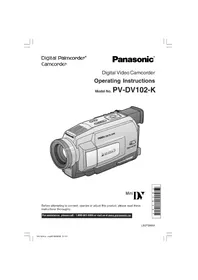
Digital Palmcorder Camcorder
Panasonic
Digital Video Camcorder Operating Instructions Model No. PV-DV102-K
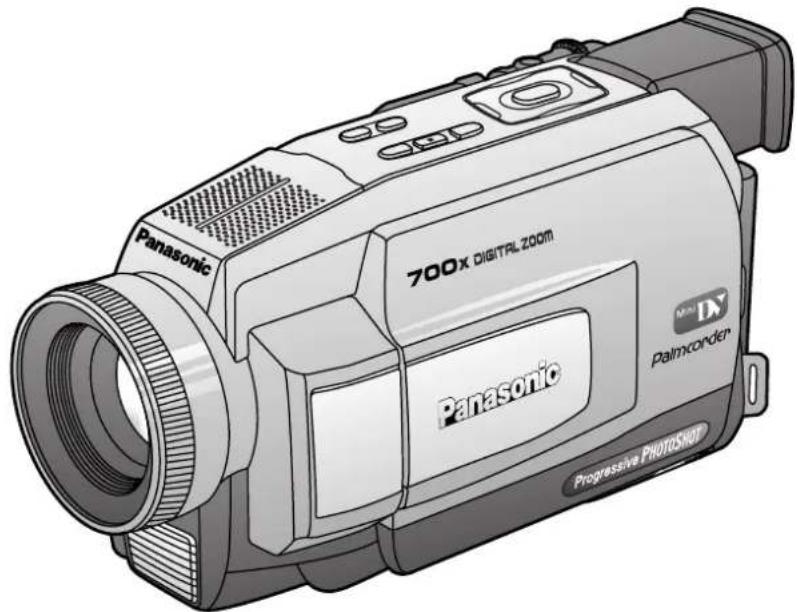
Mini DY
Before attempting to connect, operate or adjust this product, please read these instructions thoroughly.
For assistance, please call: 1-800-561-5505 or visit us at www.panasonic.ca

LSQT0565A
Things You Should Know
Thank you for choosing Panasonic!
You have purchased one of the most sophisticated and reliable products on the market today. Used properly, we're sure it will bring you and your family years of enjoyment. Please take time to fill in the information below. The serial number is on the tag located on the underside of your Palmcorder. Be sure to retain this manual as your convenient Palmcorder information source.
Date of Purchase
Dealer Purchased From
Dealer Address
Dealer Phone No.
Model No.
Serial No.
Safety Precautions
WARNING: TO PREVENT FIRE OR SHOCK HAZARD, DO NOT EXPOSE THIS EQUIPMENT TO RAIN OR MOISTURE.
Your Palmcorder is designed to record and play back in Standard Play (SP) mode and Long (LP) mode.
It is recommended that only cassette tapes that have been tested and inspected for use in VCR machines with the M_MIN mark be used.
CAUTION: TO PREVENT FIRE OR SHOCK HAZARD AND ANNOYING INTERFERENCE, USE THE RECOMMENDED ACCESSORIES ONLY.
CAUTION : TO PREVENT ELECTRIC SHOCK, MATCH WIDE BLADE OF PLUG TO WIDE SLOT, FULLY INSERT.
WARNING: DANGER OF EXPLOSION IF BATTERY IS INCORRECTLY REPLACED. REPLACE ONLY WITH THE SAME OR EQUIVALENT TYPE.

CAUTION
RISK OF ELECTRIC SHOCK DO NOT OPEN


This symbol warns the user that uninsulated voltage within the unit may have sufficient magnitude to cause electric shock.
Therefore, it is dangerous to make any kind of contact with any inside part of this unit.
CAUTION: TO REDUCE THE RISK OF ELECTRIC SHOCK, DO NOT REMOVE COVER (OR BACK) NO USER-SERVICEABLE PARTS INSIDE
REFER SERVICING TO QUALIFIED SERVICE PERSONNEL

This symbol alerts the user that important literature concerning the operation and maintenance of this unit has been included. Therefore, it should be read carefully in order to avoid any problems.
The above markings are located on the appliance bottom cover.
2
Important Safeguards
- Read Instructions — All the safety and operating instructions should be read before the unit is operated.
- Retain Instructions - The safety and operating instructions should be retained for future reference.
- Heed Warnings - All warnings on the unit and in the operating instructions should be adhered to.
- Follow Instructions — All operating and maintenance instructions should be followed.
- Cleaning — Unplug this video unit from the wall outlet before cleaning. Do not use liquid or aerosol cleaners. Use a dry cloth for cleaning.
- Attachments — Do not use attachments not recommended by the video product manufacturer as they may be hazardous.
- Water and Moisture - Do not use this video unit near water - for example near a bath tub, wash bowl, kitchen sink, or laundry tub, in a wet basement, or near a swimming pool, and the like.
- Accessories - Do not place this video unit on an unstable cart, stand, tripod, bracket, or table. The video unit may fall, causing serious injury to a child or adult, and serious damage to the unit. Use only with a cart, stand, tripod, bracket, or table recommended by the manufacturer, or sold with the video unit. Any mounting of the unit should follow the manufacturer's instructions and should use a mounting accessory
manufacturer. An appliance and cart combination should be moved with care. Quick stops, excessive force, and uneven surfaces may cause the appliance and cart combination to overturn.

- Ventilation — Slots and openings in the cabinet are provided for ventilation and to ensure reliable operation of the video unit and to protect it from overheating. These openings must not be blocked or covered. Never place the video unit on a bed, sofa, rug, or other similar surface, or near or over a radiator or heat register. This video unit should not be placed in a built-in installation such as a bookcase or rack unless proper ventilation is provided or the manufacturer's instructions have been adhered to.
-
Power Sources - This video unit should be operated only from the type of power source indicated on the marking label. If you are not sure of the type of power supply to your home, consult your appliance dealer or local power company. For video units intended to be operated from battery power, or other sources, refer to the operating instructions.
-
Grounding or Polarization - This video unit may be equipped with either a polarized 2-wire AC (Alternating Current) line plug (a plug having one blade wider than the other) or 3-wire grounding type plug, a plug having a third (grounding) pin.
The 2-wire polarized plug will fit into the power outlet only one way. This is a safety feature. If you are unable to insert the plug fully into the outlet, try reversing the plug. If the plug still fails to fit, contact your electrician to replace your obsolete outlet. Do not defeat the safety purpose of the polarized plug.
The 3-wire grounding type plug will fit into a grounding type power outlet. This is a safety feature. If you are unable to insert the plug into the outlet, contact your electrician to replace your obsolete outlet. Do not defeat the safety purpose of the grounding type plug.
- Power-Cord Protection — Power-supply cords should be routed so that they are not likely to be walked on or pinched by items placed upon or against them, paying particular attention to cords of plugs, convenience receptacles, and the point where they exit from the unit.
- Outdoor Antenna Grounding — If an outside antenna or cable system is connected to the video unit, be sure the antenna or cable system is grounded so as to provide some protection against voltage surges and built-up static charges. Part 1 of the Canadian Electrical Code, in USA Section 810 of the National Electrical Code, provides information with respect to proper grounding of the mast and supporting structure, grounding of the lead-in wire to an antenna discharge unit, size of grounding conductors, location of antenna discharge unit, connection to grounding electrodes, and requirements for the grounding electrode.
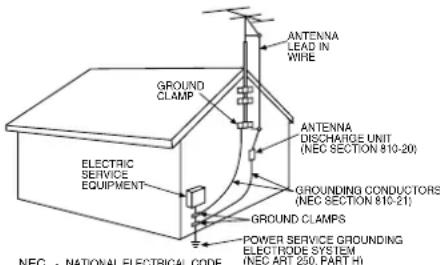
- Lightning — For added protection of this video unit receiver during a lightning storm, or when it is left unattended and unused for long periods of time, unplug it from the wall outlet and disconnect the antenna or cable system. This will prevent damage to the video unit due to lightning and power-line surges.
Important Safeguards
- Power Lines — An outside antenna system should not be located in the vicinity of overhead power lines or other electric light or power circuits, or where it can fall into such power lines or circuits. When installing an outside antenna system, extreme care should be taken to keep from touching such power lines or circuits as contact with them might be fatal.
- Overloading — Do not overload wall outlets and extension cords as this can result in a risk of fire or electric shock.
- Objects and Liquids — Never push objects of any kind into this video unit through openings as they may touch dangerous voltage points or short out parts that could result in a fire or electric shock. Never spill liquid of any kind onto the video unit.
- Servicing — Do not attempt to service this video unit yourself as opening or removing covers may expose you to dangerous voltage or other hazards. Refer all servicing to qualified service personnel.
- Damage Requiring Service — Unplug this video unit from the wall outlet and refer servicing to qualified service personnel under the following conditions: a. When the power-supply cord or plug is damaged.
b. If any liquid has been spilled into, or objects have fallen onto, the video unit.
c. If the video unit has been exposed to rain or water.
d. If the video unit does not operate normally by following the operating instructions. Adjust only those controls that are covered by the operating instructions, as an improper adjustment of other controls may result in damage and will often require extensive work by a qualified technician to restore the video unit to its normal operation.
e. If the video unit has been dropped or the cabinet has been damaged.
f. When the video unit exhibits a distinct change in performance - this indicates a need for service.
-
Replacement Parts — When replacement parts are required, be sure the service technician has used replacement parts specified by the manufacturer or have the same characteristics as the original part. Unauthorized substitutions may result in fire, electric shock or other hazards.
-
Safety Check—Upon completion of any service or repairs to this video unit, ask the service technician to perform safety checks to determine that the video unit is in safe operating order.
Precautions
USE & LOCATION
- TO AVOID SHOCK HAZARD ... Your Palmcorder and power supply should not be exposed to rain or moisture. Do not connect the power supply or operate your Palmcorder if it gets wet. Your Palmcorder has been designed for outdoor use, however, it is not designed to sustain direct exposure to water, rain, sleet, snow, sand, dust, or direct splashing from a pool or even a cup of coffee. This action could permanently damage the internal parts of your Palmcorder. Do not attempt to disassemble this unit. There are no user serviceable parts inside. Unplug your Palmcorder from the power supply before cleaning.
DO NOT AIM YOUR PALMCORDER AT THE SUN OR OTHER BRIGHT OBJECTS
DO NOT LEAVE THE PALMCORDER WITH THE EVF AIMED DIRECTLY AT THE SUN AS THIS MAY CAUSE DAMAGE TO THE INTERNAL PARTS OF THE EVF - DO NOT EXPOSE YOUR PALMCORDER TO EXTENDED HIGH TEMPERATURE ... Such as, direct sunlight, inside a closed car, next to a heater, etc... This action could permanently damage the internal parts of your Palmcorder.
- AVOID SUDDEN CHANGES IN TEMPERATURE ... If the unit is suddenly moved from a cold place to a warm place, moisture may form on the tape and inside the unit.
DO NOT LEAVE YOUR PALMCORDER OR THE POWER SUPPLY TURNED ON WHEN NOT IN USE. - STORAGE OF YOUR PALMCORDER ... Store and handle your Palmcorder in a manner that will not subject it to unnecessary movement (avoid shaking and striking). Your Palmcorder contains a sensitive pick-up device which could be damaged by improper handling or storage.
CARE
TO CLEAN YOUR PALMCORDER ... Do not use strong or abrasive detergents when cleaning your Palmcorder body.
- TO PROTECT THE LENS... Do not touch the surface of the lens with your hand. Use a commercial Palmcorder lens solution and lens paper when cleaning the lens. Improper cleaning can scratch the lens coating.
TO PROTECT THE FINISH OF YOUR PALMCORDER... Before handling your Palmcorder, make sure your hands and face are free from any chemical products, such as suntan lotion, as it may damage the finish.
Table of Contents
Things You Should Know 2
Important Safeguards 3
Precautions 4
Before Using 6
- Easy Cassette Eject/Insertion 7
Quick Guide 10
Supplying Power 12
Setting the Clock 14
Using the Palmcorder Menu 15
Camera Recording 16
·Simple Recording 16
- Digital PhotoShot Mode 18
- Zoom 19
Special Effect Features 21
Advanced Settings 25
Playback Your Recordings 29
Special Effect Features 31
Digital Features 37
Editing Features 41
PC Connection 45
PHOTOVU LINK (Optional) 47
Palmcorder Accessory System 49
Notes On Operations 50
Specifications 51
Before Requesting Service 52
On-Screen Displays (OSD) 54
Warranty 55
MENU OSD 56
Electronic Viewfinder/LCD Monitor Indications 60
Index of Controls 63
Index Back Cover
Before Using
Unpack your Palmcorder
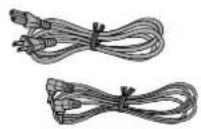
1 pc. AC Adaptor (PV-DAC11-K) with AC Cable and DC Cable
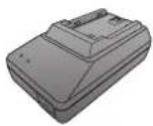
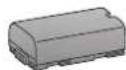
1 pc. Battery Pack (CGR-D08/ CGR-D08R)
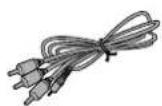
1 pc. A/V Cable (LSJA0280)
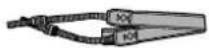
1 pc. Shoulder
Strap (LSFC0012)
1 pc. Lens Cap (LSYF0521) with Lens Cap Strap (LSGQ0066)

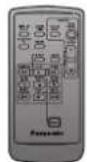
1 pc. IR Remote Control (LSSQ0294) with Battery (CR2025)
Microsoft and Windows are registered trademarks of Microsoft in the United States and other countries.
IntelPentiumis a registered trademark.
i.LINK is a trademark.
IBM is a registered trademark of IBM Company.
Record Speed/Playback Time
Use only those tapes having the MIn D* logo indicating the 6.35 mm digital standard.
| Cassette type | Record Speed/Playback time | |
| SP | LP | |
| AY-DVM30EA | 30 minutes | 45 minutes |
| AY-DVM60EA | 60 minutes | 90 minutes |
| AY-DVM80EA | 80 minutes 120 minutes | |
Erase Protection
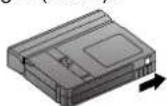
Cassettes have a sliding record tab to ensure recordings are not accidentally erased.
1 To prevent accidental erasure: Slide the tab to the left (open).
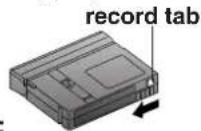
2 To record again:
Slide the tab to the right (close).
Before Using
Easy Cassette Eject/Insertion
- If the Palmcorder is connected to a power source, the cassette can be inserted and ejected without turning the Palmcorder on.
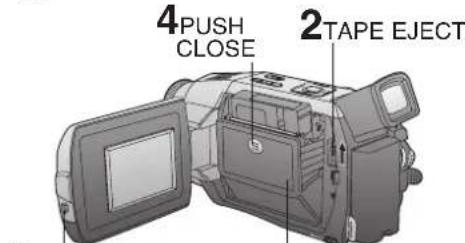
1LCD-OPEN
Cassette Compartment Cover
Before you begin
- Connect the Palmcorder to a power source. (pp. 12, 13)
1 Press LCD-OPEN to unlock the LCD monitor, and swing it fully open.
2 Slide TAPE EJECT to open the Cassette Compartment Cover.
Insert a cassette record tab up, window side facing out.
4 Press PUSH CLOSE to close the Cassette Compartment Cover.
To remove the cassette... Slide TAPE EJECT to open the Cassette Compartment Cover and pull the cassette tape straight out.
Note
- When inserting the cassette, make sure it is facing the right direction and then push it in completely.
Attaching the Shoulder Strap
1 Undo the two strap ends from their buckles.
2 Thread the strap ends through the Strap Attachment Rings.
3 Reinsert the strap ends through their buckles.
Make sure the straps are not twisted.
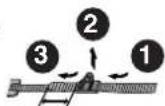
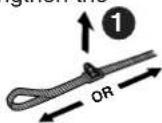
Adjust the Length
1 Loosen the strap from the Buckle and create a loop.
2 Pull the strap firmly through the Buckle to shorten or lengthen the strap.
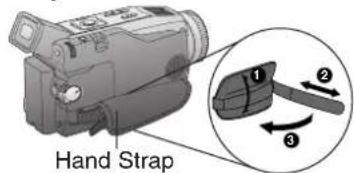
Hand Strap
Adjust the length of the Hand Strap to the size of your hand as illustrated.
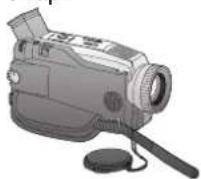
Lens Cap
Attaching the Lens Cap Strap:
Thread the Lens Cap Strap through the Strap Attachment Ring as shown.

Attaching the Lens Cap Cord to the Hand Strap:
Remove the Hand Strap from the front clasp and thread the Strap through the loop in the Lens Cap Cord. Reattach the Hand Strap.
7
Before Using
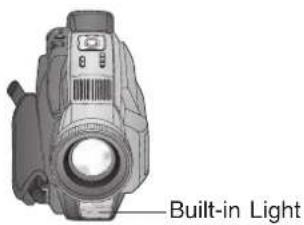
Using the Built-in Light
To brighten the natural colours in a scene.
Note
- Using Light reduces battery time.
- Provide adequate ventilation if using Light in a hot environment for a long time.
- Set LIGHT to OFF when not in use.
If light bulb needs to be replaced, take the Palmcorder to your nearest authorized Servicentre.
Remote Control
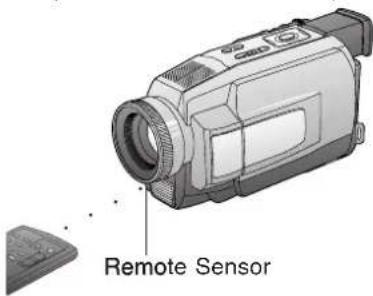
You can operate the major functions of your Palmcorder from up to approximately 5 m (16 feet) away (indoors). Aim the IR Remote Control toward the front of the Palmcorder and press the desired buttons (Remote Sensor is located under the lens).
Controlled Functions
Rec/Pause (p. 16)
Tele (Zoom) (p. 19)
Wide (Zoom) (p. 19)
- Date/Time (p. 60)
- Reset (p. 42)
PhotoShot (p. 18)
- Display On TV (p. 36)
- Counter/Time Code (p. 61)
Audio Dubbing (p. 41)
Record (p. 44)
- Menu (pp. 15, 42)
Play (pp.29,44)
8
Before you begin
- Connect the Palmcorder to a power source. (pp. 12, 13)
- Set POWER to CAMERA.
1 Hold down LIGHT for more than 0.7 seconds to turn ON or OFF.
"30" will appear on the screen.
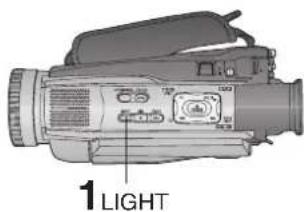
Caution
This light becomes hot during operation.
Make sure nothing covers the light during operation.
To operate Camera functions:
Set POWER to CAMERA.
To operate VCR functions:
Set POWER to VCR.
FF/Search (p. 31)
- REW/Search (p. 31)
- Pause/Select (pp. 14, 15, 33, 44)
- Stop/Set (pp. 14, 15, 29, 44)
- Slow/Frame Advance (Forward) (pp. 32, 33)
- Slow/Frame Advance (Backward) (pp. 32, 33)
Index Search (Forward) (pp. 33, 34)
- Index Search (Backward) (pp. 33, 34)
- Speaker Volume (p. 30)
Before Using
Replace the Battery
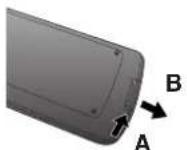
1 While pressing the tab in the direction of the arrow (A) with your fingernail, pull out the Battery Tray (B).
2 Insert the battery into the Battery Tray with the mark facing up. Do not reverse the polarity.
3 Insert the Battery Tray.
Replace battery with Panasonic PART NO. VSBW0004 (CR2025) only. Use of another battery may present a risk of fire or explosion. Caution: Battery may explode if mistreated. Dispose of used battery properly. Keep away from children. Do not recharge, disassemble or dispose of in a fire.
Remote Controlling Two Palmcorders
You can control any two Panasonic Palmcorders with one Remote control. In order for the remote to distinguish between the two units, it is necessary to set one of the Palmcorders to VCR 2. On the remote, press VCR 1 or VCR 2 to control the desired Palmcorder.
For VCR 2: Press these buttons at the same time.
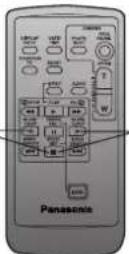
For VCR1: Press these buttons at the same time.
Note
- When the Palmcorder and remote are not set to the same mode (VCR1 or VCR2), "CHECK REMOTE MODE (REMOTE)" will appear.
1 Set POWER to VCR or CAMERA.
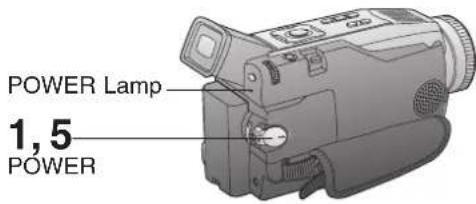
The POWER Lamp lights red.
- Be sure POWER is fully turned to VCR or CAMERA position.
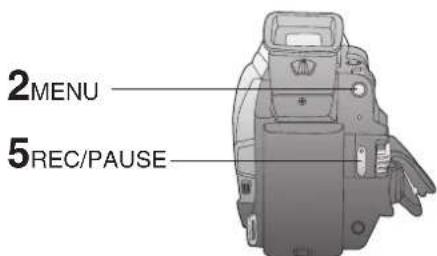
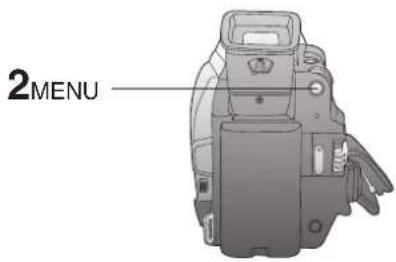
2 Press MENU to display the VCR or CAMERA mode menu screen.
Rotate JOG KEY to select SET-UP in the CAMERA mode menu screen or PLAY MODE in the VCR mode menu screen, then press JOG KEY to display the CAMERA SET-UP or VCR PLAY MODE menu screen.
4 Rotate JOG KEY to select REMOTE, and then press JOG KEY to select VCR 2. (Menu OSD: pp. 57, 58). Leave the other Palmcorder set to VCR1.
5 Set the Remote Control to VCR 1 or VCR 2 to correspond with the Palmcorder you wish to control. (See above left.)
After replacing the Remote Control Battery, the remote will default to VCR 1.
Quick Guide
Insert the Battery Pack
Before you begin
Charge the Battery. (p. 12)
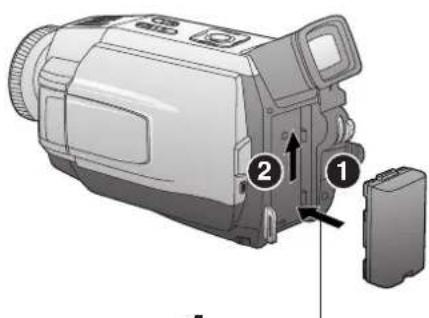
1 Insert the Battery Pack and slide it up until it locks with a click.
Insert Cassette
These Palmcorders are equipped with the Easy Cassette Eject System so it is easy to insert or remove tapes, even when on a tripod. (p. 7)
1
Press LCD-OPEN to unlock the LCD monitor, and swing it fully open.
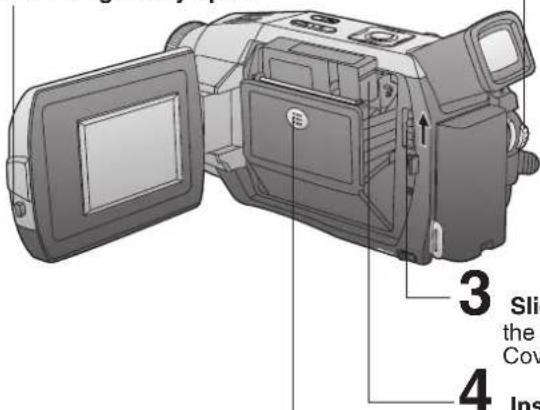
5
Press PUSH CLOSE mark to close the Cassette Compartment Cover.
Set POWER to VCR or CAMERA.
3
Slide TAPE EJECT to open the Cassette Compartment Cover.
Insert a cassette record tab up, window side facing out. -Make sure the record tab is closed.(p.6)
Quick Guide
Camera Recording
When the LCD monitor is fully open, the Viewfinder automatically turns OFF.
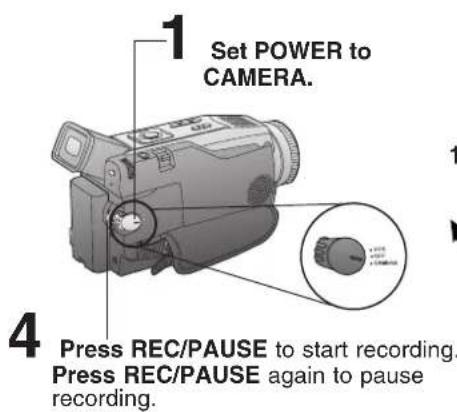
2 Adjust the Vision Adjustment Control to your eyesight.
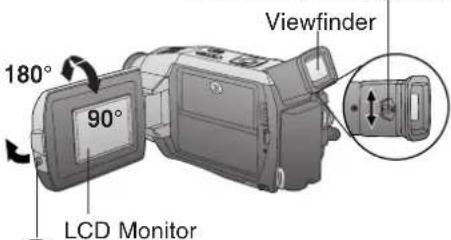
Before Use
3 Press LCD-OPEN to unlock the LCD monitor. Swing it fully open and adjust the angle.
To Watch Playback in the LCD (Liquid Crystal Display)
When the LCD monitor is fully open, the Viewfinder automatically turns OFF.
Before you begin
Charge the Battery. (p. 12)
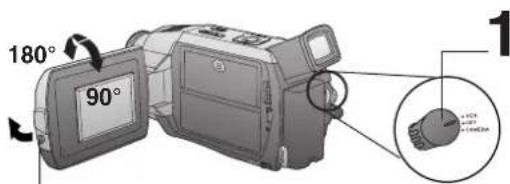
Set POWER to VCR.
2 Press LCD-OPEN to unlock the LCD monitor. Swing it fully open and adjust the angle.
Supplying Power
Charge the Battery Pack on the AC Adaptor
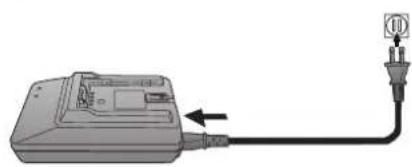
1 Connect and plug in the Power Cord as shown.
-
POWER Lamp will light.
-
Remove the DC Cable, if attached, from the adaptor.
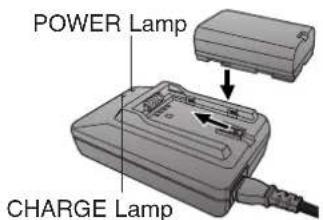
2 Attach the Battery as shown to charge.
- CHARGE Lamp lights up. It goes out when charging is complete (approx. 1 hour). Expect approx. 1 hour 30 minutes of operation (EVF usage) when fully charged.
3 Remove the Battery. Slide the Battery out and then lift up.
Note
About the Flashing of the CHARGE Lamp
-
Charge the Battery within an ambient temperature range of 10^ ( 50^ ) and 30^ ( 86^ ).
-
If charging is done in extreme low or high temperatures, Battery charge time increases.
CHARGE Lamp flashes when...
The Battery is being charged, but charging is taking longer than normal.
- Charging is not possible. Remove the Battery once, wait a short time, then re-attach it for charging.
Insert the Battery Pack
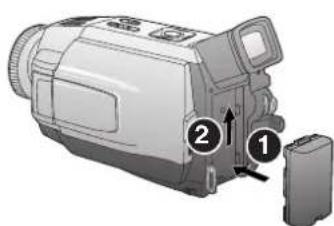
1 Insert the Battery Pack and slide it up until it locks with a click.
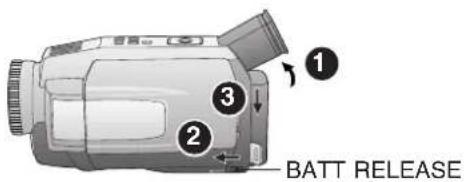
Remove the Battery Pack
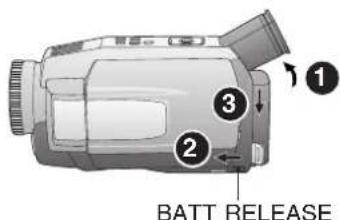
1 Tilt Viewfinder upward.
2 Remove the Battery Pack and slide the Battery downward while sliding the BATT RELEASE.
Supplying Power
Battery Care
Caution:
- Charge only with specified charger.
Charge the Battery within an ambient temperature range of 10^ (50^) and 30^ (86^) .
The Battery may be warm after charging or just after use. This is normal. - Do not use an insufficiently charged or worn out Battery.
If charging is done in extreme low or high temperatures, Battery charge time increases.
Safety precautions:
- Do not place the Battery near, or dispose of in fire.
- Do not directly connect (short circuit) the positive (+) and negative (-) terminals.
- Never attempt to disassemble or reassemble the Battery.
ATTENTION:

A lithium ion/polymer battery that is recyclable powers the product you have purchased. Please call 1-800-8-BATTERY for information on how to recycle this battery.
Use AC Adaptor
1 Slide the Battery downward while sliding BATT RELEASE to remove the Battery Pack. (p. 12)
2 Insert the DC Cable into the DC IN Terminal.
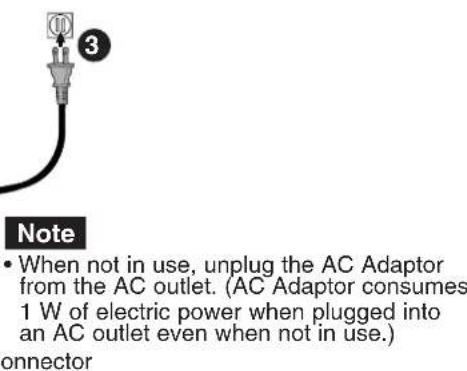
3 Connect the other end of the DC Cable to the AC Adaptor as shown.
4 Plug in the AC Adaptor.
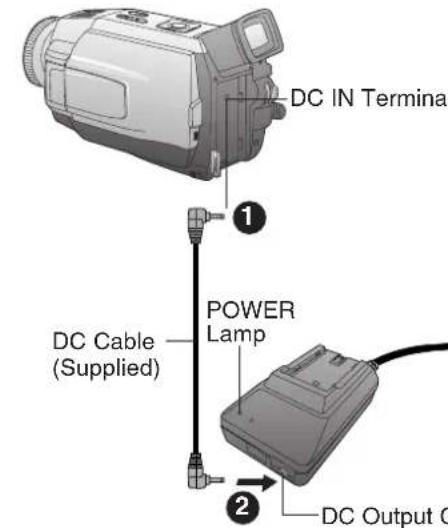
The POWER Lamp on the AC Adaptor lights up.
Setting the Clock
Set the Date and Time
The date and time is calculated, including leap year, up to DEC 31 2089.
Note
To make corrections, Press JOG KEY repeatedly to move back to an item and correct.
- A built-in Battery maintains clock operation. If the Palmcorder is not connected to a power source for a few months, the built-in battery may discharge and "CLOCK BATTERY" indication appears. (p. 54)
Before you begin
- Connect the Palmcorder to a power source. (pp. 12, 13)
- Set POWER to CAMERA or VCR.
1 Press MENU to display the Camera or VCR mode menu screen. (p. 15)
[CAMERA MENU]
![PANASONIC PVDV102 - [CAMERA MENU] - 1](/content/2026/03/449100/images/53595ecb3b99eb07bc37bd4aff501ccda2a8c1f9ec9a19cd7afbcb05ee87f686.jpg)
[ VCR MENU ]
![PANASONIC PVDV102 - [ VCR MENU ] - 1](/content/2026/03/449100/images/42403be08fd0e474173a1bfd9ed611f28b62f5466c4562938ec37d187fe1c2bd.jpg)
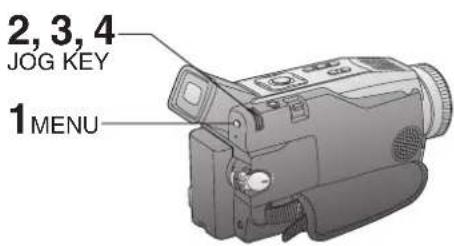
2 Rotate JOG KEY to select DISPLAY SETTING, and then press JOG KEY to display the DISPLAY SETTING menu screen.
3 Rotate JOG KEY to select CLOCK-SET, and then press JOG KEY to set to ON. (Menu OSD: pp. 57, 59.)
The DATE/TIME SETTING menu is displayed.
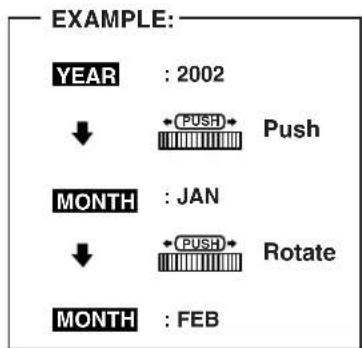
4 Rotate JOG KEY to select YEAR, then press JOG KEY to fix and move to the next item. Likewise, set the month, day, hour, and minutes.
![PANASONIC PVDV102 - [ VCR MENU ] - 2](/content/2026/03/449100/images/fcd46741d88356b226837321bd25afcec54af9693c9f692e5e88b0033376ceb8.jpg)
When DATE/TIME setting is completed, press MENU three times to start the clock and exit.
14
Using the Palmcorder Menu
The Palmcorder features two menu displays: one for CAMERA mode (recording) and the other for VCR mode (Playback). (pp. 56-59)
- While the Menu screen is displayed, you cannot record on or play a tape.
While recording, the Menu screen cannot be displayed. - During playback, the Menu screen can be displayed.
Before you begin
- Connect the Palmcorder to a power source. (pp. 12, 13)
- Set POWER to CAMERA or VCR.
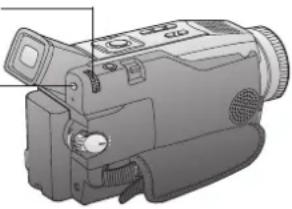
2,A,B,C JOG KEY
1,DMENU
Displaying the MENU
1 Press MENU to display the CAMERA or VCR menu (according to the POWER setting).
2 Rotate JOG KEY to select a menu item.
Setting the MENU Items (EX. VCR Mode menu)
APress JOG KEY to set your selection.
B Rotate JOG KEY to select a menu item.
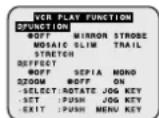
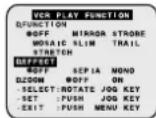
SET PUSH JOG KEY SET PUSH JOG KEY
EXIT PUSH MENU KEY
Press JOG KEY to set your selection.
The “●” mark indicates selection.
Press MENU twice to exit the menu.
CAMERA Main menu
1: D. FUNCTION
CAMERA FUNCTION menu is displayed. To select DFUNCTION, D.ZOOM, or PROGRESSIVE.
2:ADJUST
CAMERA ADJUST menu is displayed. To select PROG. AE or CINEMA.
3:REC MODE
CAMERA REC-MODE menu is displayed. To select REC-SPEED, AUDIO-REC, INDEX, SHUTTER, SELF-REC, WIND-CUT, or ZOOM-MIC.
4:SET-UP
CAMERA SET-UP menu is displayed. To select REMOTE or BEEP.
5:DISPLAY SETTING
DISPLAY SETTING menu is displayed. To select DISPLAY, C.RESET, DATE/ TIME, or CLOCK-SET.
6:LCD/EVF SETTING
LCD/EVF SETTING menu is displayed. To select LCD BRIGHTNESS, LCD COLOR or EVF BRIGHTNESS.
VCR Main menu
1:PLAYFUNCTION
VCR PLAY FUNCTION menu is displayed. To select D. FUNCTION, D.EFFECT, or D.ZOOM.
2:REC MODE
VCR REC MODE menu is displayed. To select REC-SPEED or AUDIO-DUB.
3:PLAY MODE
VCR PLAY MODE menu is displayed. To select INDEX, AUDIO, REMOTE, or B.SEARCH.
4:MULTI SETTING
MULTI SETTING menu is displayed. To select SPEED.
5:DISPLAY SETTING
DISPLAY SETTING menu is displayed. To select DISPLAY, C.RESET, DATE/ TIME, or CLOCK-SET.
6:LCD/EVF SETTING
LCD/EVF SETTING menu is displayed. To select LCD BRIGHTNESS, LCD COLOR or EVF BRIGHTNESS.
Camera Recording
Simple Recording
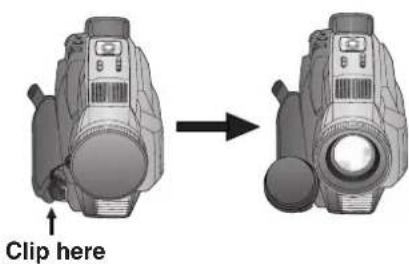
Remove the lens cap and clip it to the hand strap.
EVF
REC/PAUSE mode
WARNING:
- Do not leave the Palmcorder with the EVF aimed directly at the sun as this may cause damage to the internal parts of the EVF.
- Do not lift, or carry, the Palmcorder by the EVF or the LCD Monitor.
16
Before you begin
- Connect the Palmcorder to a power source. (pp. 12, 13)
- Insert a cassette with the record tab closed. (p. 6)
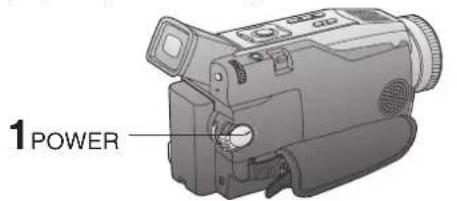
1 Set POWER to CAMERA.
The POWER Lamp lights red.
- Be sure POWER is fully turned to the CAMERA position.
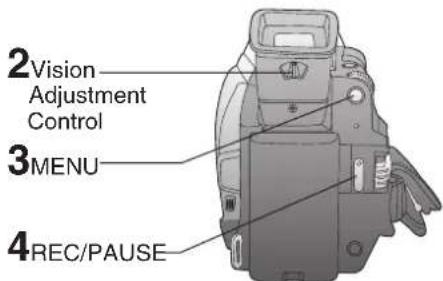
2 With the Viewfinder Eye Cup held up against your eye, adjust the Vision Adjustment Control to your eyesight.
- Adjust the EVF Brightness of the Viewfinder if necessary. Please refer to "To adjust the LCD/EVF BRIGHTNESS or COLOR" on page 17.
3 Set to REC-SPEED "SP" or "LP" in the CAMERA Mode Menu. (Menu OSD: p. 56)
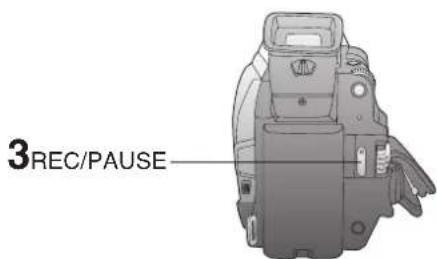
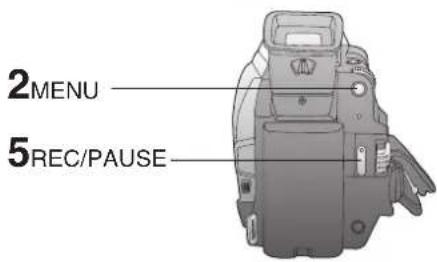
4 Press REC/PAUSE to start recording.
- "REC" is displayed on the screen. Press REC/PAUSE again to pause recording.
5 Set POWER to OFF when finished. To remove the cassette, slide TAPE EJECT.
- When the Palmcorder is aimed at excessively bright objects, or bright lights, a vertical bar may appear in the picture. This is a normal characteristic of the CCD pick-up device. Try to avoid this whenever possible.
To conserve power After 5 minutes, the Record/Pause mode will automatically change to Standby mode. To resume recording, set POWER to OFF and then ON again.
Camera Recording
Using the LCD Monitor
The LCD (Liquid Crystal Display) monitor can be used while recording.
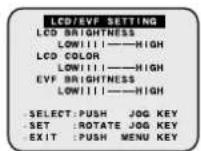
To adjust the LCD/EVF BRIGHTNESS or COLOR
EVF/LCD
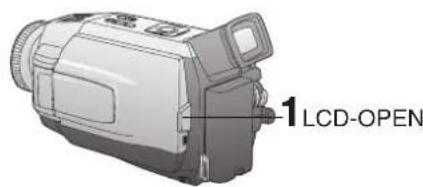
1 Press LCD-OPEN to unlock the LCD monitor.
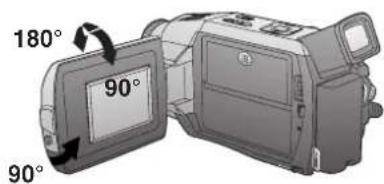
2 Swing the LCD monitor fully open and adjust the viewing angle.
The LCD monitor will automatically turn on.
- When the LCD monitor is completely closed, it will shut off automatically to save power.
- Adjust the LCD Brightness and/or colour of the LCD monitor if necessary. Please refer to "To adjust the LCD/EVF BRIGHTNESS or COLOR" below.
3 Start recording.
Note
- Using the LCD monitor will reduce battery operating time.
- Close the LCD monitor completely when not in use.
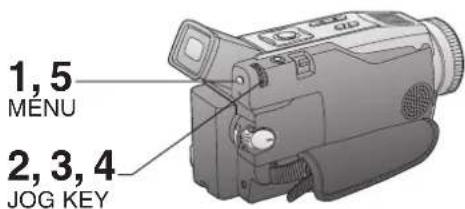
1 Press MENU to display the main menu screen.
2 Rotate JOG KEY to select LCD/EVF SETTING from the main menu screen. (Menu OSD:pp.57,59)
3 Press JOG KEY to display the LCD/EVF SETTING screen.
4 Press JOG KEY to select LCD BRIGHTNESS, LCD COLOR, or EVF BRIGHTNESS, then rotate JOG KEY to adjust.
5 Press MENU twice to exit this mode.
Camera Recording
Digital PhotoShot Mode
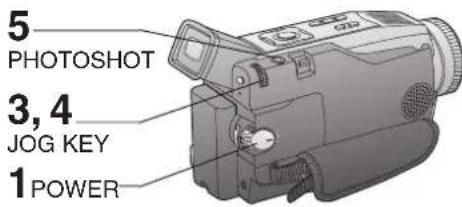
Use this feature to record a seven second (approx.) still image on the tape from the current camera picture. Audio is also recorded for on-the-spot narration. Or, you can add narration later with the Audio Dubbing feature to make an interesting slide show, etc. (p. 41)
Progressive PhotoShot Mode
With the progressive PhotoShot Function, you can record still pictures with higher resolution than with the normal PhotoShot Function.
18
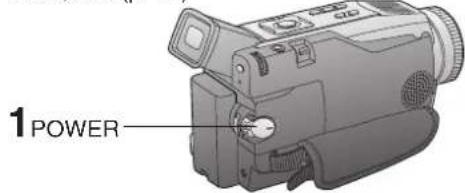
1 Set POWER to CAMERA.
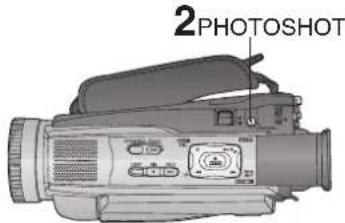
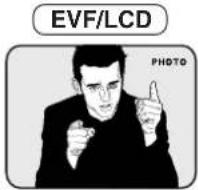
2 Press PHOTOSHOT in Record/Pause mode. "PHOTO" will appear in the EVF or the LCD monitor.
Note
- If SHUTTER on the menu screen is set to ON, a sound effect similar to the shutter of a film camera will be heard when PHOTOSHOT is pressed.
- When PHOTOSHOT is pressed, the playback image takes approx. 7 seconds to process. After that, the Camera mode screen will be displayed.
1 Set POWER to CAMERA.
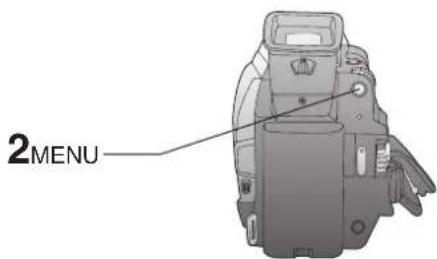
Press MENU to display the CAMERA mode menu screen.
mode menu screen. 3 Rotate JOG KEY to select D.FUNCTION, and press JOG KEY to display the CAMERA FUNCTION menu screen.
4 menu screen. Rotate JOG KEY to select PROGRESSIVE, and press JOG KEY to select ON or OFF.
- Press MENU twice to exit.
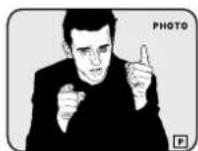
- "P" will appear in the EVF or the LCD monitor.
5 LCD monitor. Press PHOTOSHOT in Record/Pause mode.
EVF/LCD
Note
- This function may not work with D.E.I.S., D.ZOOM and D.FUNCTION functions.
Camera Recording
Zoom
You can gradually zoom in for close ups or zoom out for wide angle shots.
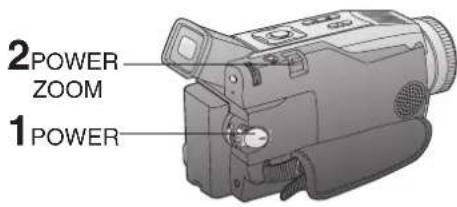
1 Set POWER to CAMERA.
2 Zoom slowly: by lightly pressing the "T" (Telephoto) or the "W" (Wide Angle) side of the POWER ZOOM.
Zoom quickly: by applying more pressure.
3 Start recording.
Note
- The zooming speed ranges from a slow 17 seconds to a fast 1.5 seconds according to the amount of pressure applied to the POWER ZOOM.
Zoom Microphone Function
Along with the zooming operation, the microphone's directional angle and sensitivity are varied for recording sounds.
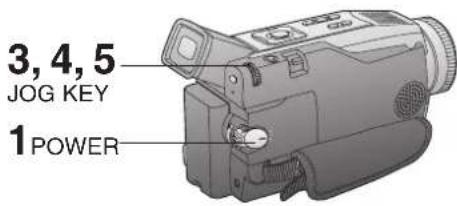
1 Set POWER to CAMERA.
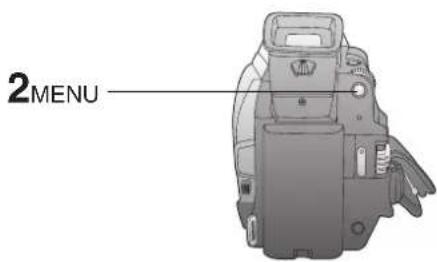
2 Press MENU to display the CAMERA mode menu screen.
3 Rotate JOG KEY to select RECO MODE, then press JOG KEY to display the CAMERA REC-MODE menu screen.
4 Rotate JOG KEY to select ZOOM-MIC in the CAMERA REC-MODE menu. (Menu OSD: p. 57)
Press JOG KEY to select ON. Press MENU twice to exit. “Z.MIC” will appear on the sc
Note
The Zoom Microphone Function may not work effectively if the surrounding noise is too loud.
Camera Recording
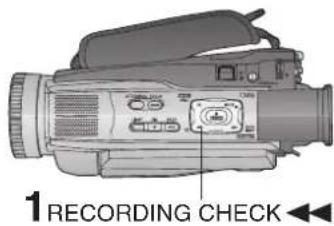
Recording Check
To playback the final few seconds of the last recorded scene in the REC/PAUSE mode.
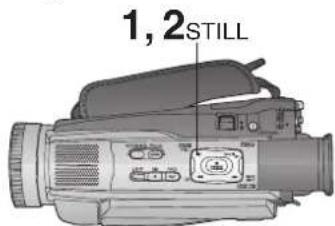
Recording Still Pictures
You can record still pictures of any desired duration together with sound.
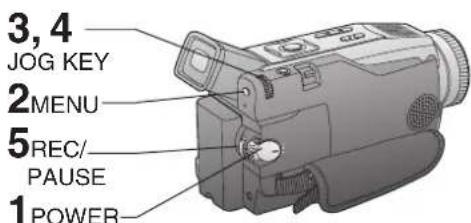
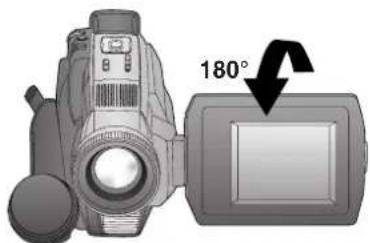
Self Recording
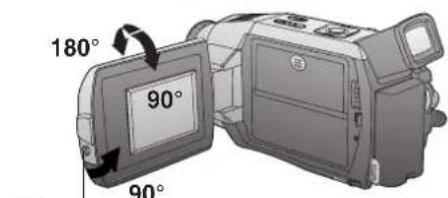
Rotate the LCD monitor 180 degrees so it faces the same direction as the lens to record yourself.
20
Press RECODING CHECKbriefly in the REC/PAUSE mode. The "CHK" indication appears. After checking, the Palmcorder ret to the REC/PAUSE mode.
- For Recording Check, the Palmcorder must be in the same mode (SP or LP) as was used for recording, otherwise the playback picture is distorted.
1 While in RECORD mode, press STILL and hold for 2 seconds to capture a still picture. The captured still picture will be recorded together with sound.
2 Press STILL once again to release the still picture. The camera will resume recording real-time pictures.
1 Set POWER to CAMERA.
2 Press MENU to display the CAMERA mode menu screen.
3 Rotate JOG KEY to select RECO MODE, then press JOG KEY to display the CAMERA REC-MODE menu screen.
4 Rotate JOG KEY to select SELFREC, and then press JOG KEY to select MIRROR.
The picture in the LCD monitor will appear reversed.
5 Start recording.
Special Effect Features
CINEMA Mode
You can record a picture compatible with a wide-screen TV equipped with an S2 picture terminal.
Backlight
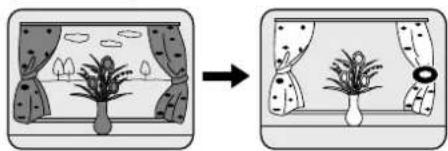
Use when recording a subject that is darker than the surrounding scene, in a shadowed area, or when the light source is behind your subject.
2,3BACKLIGHT
1 Set POWER to CAMERA.
2 Press MENU to display the CAMERA mode menu screen.
3 Rotate JOG KEY to select ADJUST then press JOG KEY to display the CAMERA ADJUST menu screen.
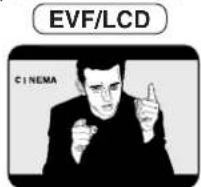
4 Rotate JOG KEY to select CINEMA, and then press JOG KEY to select ON.
- A black strip will appear at the top and bottom of the picture.
- Press MENU twice to exit.
CINEMA" will appear on the screen.
5 Start recording.
1 Set POWER to CAMERA.
2 Press BACK LIGHT to activate the Backlight feature.
The Indicator "O will appear in the EVF or LCD monitor.
3 Press BACK LIGHT again to cancel the Backlight feature.
EVF/LCD
Note
The Indicator "O" will not appear in the EVF or LCD monitor when OFF is selected in the DISPLAY menu.
Special Effect Features
Program AE
The Auto Exposure feature can be used to make quality recordings in a variety of scene situations.
Note
SPORTS mode
- The recorded images will not be so blurred when they are viewed later using slow or still picture playback.
- When playing back a sports mode recording, the movement may appear slightly jerky.
- Do not use this mode when recording under fluorescent, mercury, or sodium lighting. These types of lights will affect the colour and brightness of the images.
- A vertical band of light might appear when recording objects that are brightly illuminated or highly reflective.
- If the amount of light is insufficient, the SPORTS "X" indicator will flash in the EVF or the LCD monitor.
The image may flicker if this mode is used indoors.
22
1 Set POWER to CAMERA.
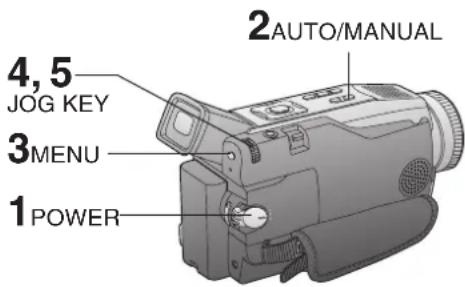
Hold down AUTO/MANUAL for more than 0.7 seconds so that the "MNL" indication appears in the EVF or the LCD monitor.
3 LCD monitor. Press MENU to display the menu screen.
4 Rotate JOG KEY to select ADJUST, and then press JOG KEY to display the CAMERA ADJUST menu screen.
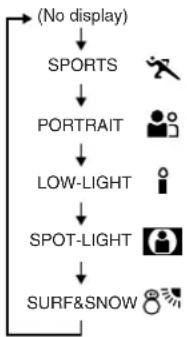
5 Rotate JOG KEY to select PROG.AE, then press JOG KEY repeatedly to select one of the five modes shown below.
6 Repeat steps 2~5 to select OFF to cancel this feature.
| Mode | Indication |
| For recording fast action scenes. | |
| For recording only subjects in the foreground, while ignoring subjects in the background. | |
| For recording in extreme low light conditions. | |
| Recording in situations where subjects are under a spotlight(s). | |
| For recording in locations with a high degree of “Dazzle,” such as snow slopes and the seashore. |
PORTRAIT mode
- The image may flicker if this mode is used indoors.
LOW-LIGHT mode
- Scenes recorded in extremely low light levels may turn out dark.
SPOT-LIGHT mode
If the recorded subject is extremely bright, the picture may appear whitish.
SURF&SNOW mode
- If the recorded subject is extremely bright, the picture may appear whitish.
- It is not possible to select the SPORTS mode or PORTAIT mode together with the MagicPix mode in the Digital function camera menu.
Special Effect Features
Audio/Video Fade In/Out
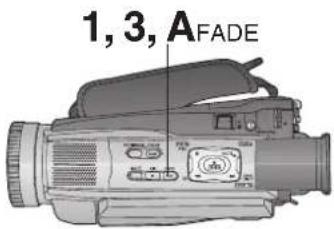
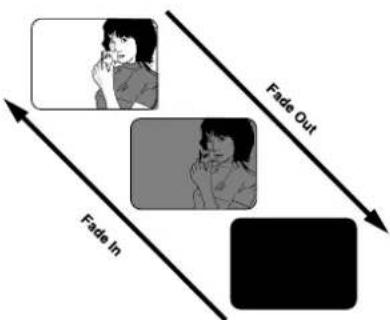
You can make smoother scene transitions for a more professional look.
2,
BREC/ PAUS
Fade In
Starting the first scene with "fade in" is very effective.
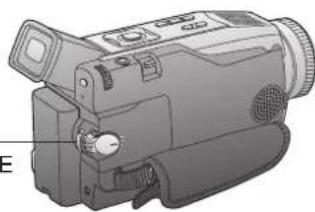
1 In REC/PAUSE mode, hold down FADE until the picture fades out.
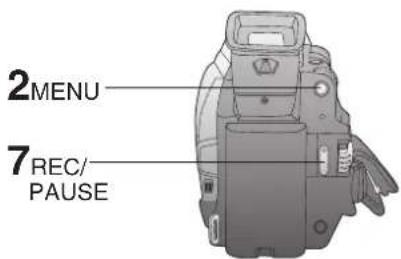
2 Press REC/PAUSE to start recording.
3 Release FADE and the picture will gradually fade in.
Fade Out
Use to create a soft ending or (together with fade in) for a soft transition from one scene to the next.
ADuring recording, hold down FADE until the picture fades out.
B Press REC/PAUSE to pause the recording.
Special Effect Features
Picture in Picture (PinP)
You can display a PinP (still image) screen on the Main Picture.
Note
PinP position is fixed at the bottom right of the screen.

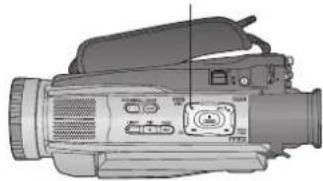
5.6.7
CAMERA STILL
1 Set POWER to CAMERA.
2 Press MENU to display the menu screen.
3 Rotate JOG KEY repeatedly to select D.FUNCTION, then press JOG KEY to display the CAMERA FUNCTION menu screen.
4 Press JOG KEY to select PinP
- Press MENU twice to exit this menu.
PinP will appear in the EVF or the LCD monitor.
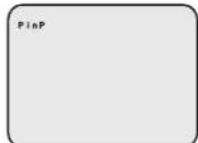
5 Aim at the scene you wish to place as PinP, then press II(CAMERA STILL) to freeze the image.
6 Press II (CAMERA STILL) again to place the frozen image as PinP.

7 Press REC/PAUSE to record a scene with PinP image.
- Press PHOTOSHOT to record a scene with PinP image in PhotoShot mode.
- Press II (CAMERA STILL) again to remove PinP image.
Advanced Settings
White Balance
Auto White Balance ("AWB") automatically maintains optimum colour balance in most lighting conditions. However, when using Digital Functions, etc., you may get better results by using the manual adjustment.
| Mode | Description |
| AWB | Automatically maintains optimum colour balance in most lighting conditions. |
| When the source illumination is a halogen lamp. | |
| When shooting outdoors on a sunny day. | |
| * | The White Balance setting that was previously set manually. |
Note
- When ZOOM is set to 10X or higher, White Balance cannot be adjusted.
1 Set POWER to CAMERA.
2 Hold down AUTO/MANUAL for more than 0.7 seconds so that the "MNL" indication appears in the EVF or the LCD monitor.
3 Press JOG KEY repeatedly until "AWB" appears in the EVF or LCD monitor.
4 Rotate JOG KEY to select other modes. (See mode chart at left.) Hold down AUTO/MANUAL for more than 0.7 seconds to cancel the setting.
- For manual White Balance adjustment:
A. Rotate JOG KEY to select "■".
B. Point the Palmcorder at a white object (full-screen) and hold JOG KEY down until "■" indication stops flashing.
If "■" indication flashes when the Palmcorder is turned on, the previous manual White Balance setting is in effect.
In the following cases, the "■" indication flashes:
The flashing indicates that the previously adjusted White Balance setting is still kept. This setting will be kept until White Balance is adjusted again.
- Correct White Balance may not be attainable manually in poor lighting conditions.
Advanced Settings
Auto Focus
The Palmcorder automatically adjusts the focus over the entire zoom range.
Manual Focus
Use Manual Focus (MF) when recording ...
- a subject through glass.
- a scene where the subject is far from the Palmcorder and there are objects in the foreground.
- a subject with distinct horizontal stripes.
- a subject not centred in the Viewfinder.
- subjects with shiny surfaces.
- an obliquely angled subject.
- a bright, flat subject such as a white wall.
- in low light situations.
- a scene with fast motions, like a golf swing. Re-focusing may be required
- when your Palmcorder is aimed at a new scene.
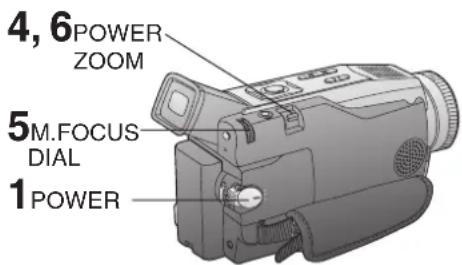

1 Set POWER to CAMERA.
2 Hold down AUTO/MANUAL for more than 0.7 seconds so that the "MNL" indication appears in the EVF or the LCD monitor.
3 Press FOCUS so that the "MF" (Manual Focus) indication appears in the EVF or the LCD monitor.
4 Press and hold POWER ZOOM, "T" side (Telephoto), until the lens is at maximum zoom in.
5 Turn M.FOCUS DIAL until the picture is in focus.
It may be necessary to back away from the subject to focus the image properly.
6 Press POWER ZOOM to "W" or "T" as desired.
The subject will remain in focus over the entire zooming range.
It may be necessary to back away from the subject to focus the image properly.
Note
- DISPLAY (Menu OSD: p. 57) must be set to on for MF, AE, W.BALANCE, or BACK LIGHT to be displayed on the LCD or EVF.
Macro Focus (for close-ups)
Press the "W" side of POWER ZOOM to the maximum wide angle position.
Auto Focus will function with the subject as close as 25mm (1 inch) in front of the lens.
Advanced Settings
High Speed Shutter
To record high speed motion (e.g. tennis stroke) with improved STILL or SLOW MOTION playback when watching the tape on this Palmcorder.
Auto Shutter
In the AUTO mode (no indication in the EVF and LCD monitor), the Palmcorder will automatically adjust the shutter speed (up to 1/350).
- AUTO mode is automatically selected whenever the POWER Switch is set to CAMERA.
Manual Selection
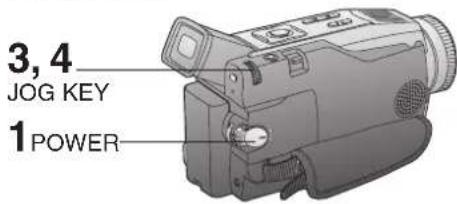
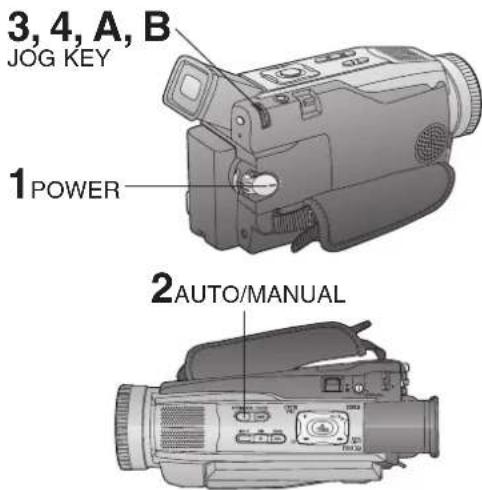
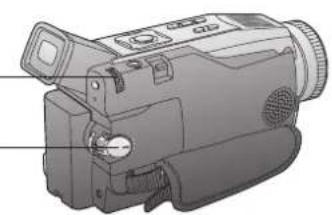
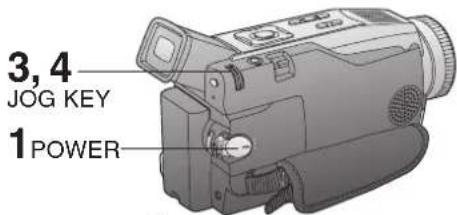
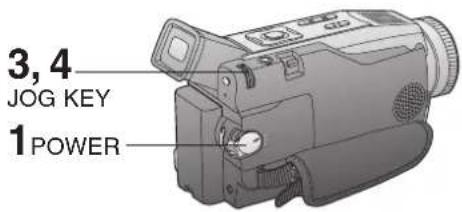
3,4
JOG KEY
1POWER
Note
- For proper colour reproduction, it is recommended that you use this feature outdoors. For indoor High Speed Shutter recording, additional halogen or tungsten light should be provided. Fluorescent light will degrade the picture quality.
- This feature requires ample light. More light is required for the fastest shutter speeds.
The Auto Focus system may not operate properly in insufficient light when using the High Speed Shutter. - When PROG.AE is ON, you cannot manually select the shutter speed.
- When MagicPix is ON, H.S.S. cannot manually select the shutter speed.
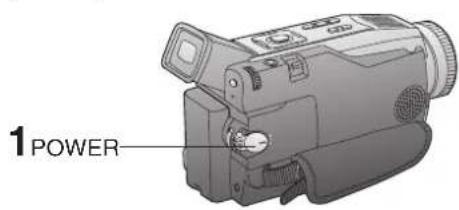
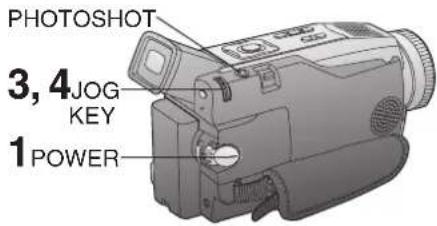
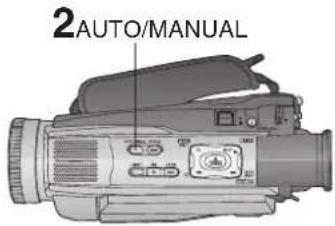
1 Set POWER to CAMERA.
2 Hold down AUTO/MANUAL for more than 0.7 seconds so that the "MNL" indication appears in the EVF or the LCD monitor.
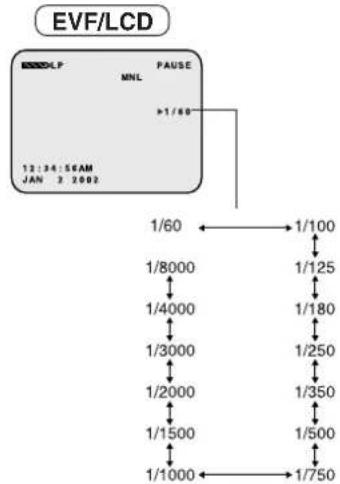
3 Press JOG KEY repeatedly to display the shutter speed.
4 Rotate JOG KEY to choose one of the following shutter speeds.
- Hold down AUTO/MANUAL for more than 0.7 seconds to cancel the setting.
Advanced Settings
Adjusting the Iris Manually
Normally, the Palmcorder adjusts the exposure automatically. However, when the background is extremely bright, or when the subject is backlit, you can compensate by adjusting the iris manually.
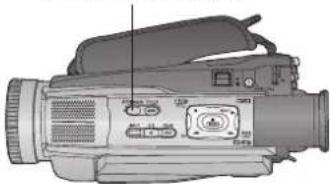
2AUTO/MANUAL
EVF/LCD
WIND-CUT
You can reduce sound distortion caused by wind hitting the microphone.
28
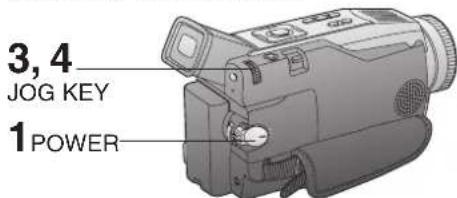
1 Set POWER to CAMERA.
2 Hold down AUTO/MANUAL for more than 0.7 seconds so that the "MNL" indication appears in the EVF or the LCD monitor.
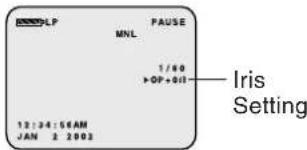
3 LCD monitor. Press JOG KEY repeatedly so that Iris setting indication appears in the EVF or the LCD monitor.
4 Rotate JOG KEY to adjust the iris;
- When a value closer to "CLOSE" is selected, the image becomes darker.
- When a value closer to "OP+18dB" is selected, the image becomes brighter.
- Hold down AUTO/MANUAL for more than 0.7 seconds to cancel the setting.
Note
The value to which +dB is attached indicates a gain value. If this value is too large, the quality of the image deteriorates.
Depending on ZOOM magnification, the iris value may not be displayed correctly.
If you are using Program AE mode, you cannot adjust the iris. If the iris is adjusted manually, the above modes will be cancelled.
1 Set POWER to CAMERA.
2 Press MENU to display the CAMERA mode menu screen.
3 Rotate JOG KEY to select REC MODE, then press JOG KEY to display the CAMERA REC-MODE menu screen.
4 Rotate JOG KEY to select WIND-CUT, and then press JOG KEY to select ON.
- Press MENU twice to exit.
WIND-CUT" will appear in the EVF or LCD monitor.
5 Start recording.
Playback Your Recordings
Playback using the LCD Monitor
You can also use the LCD monitor to playback your recording.
2LCD-OPEN
3REWIND SEARCH
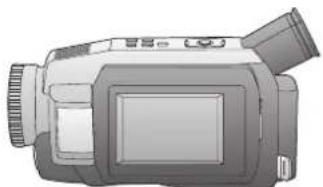
Connecting Earphone (not supplied)
PHONE Jack
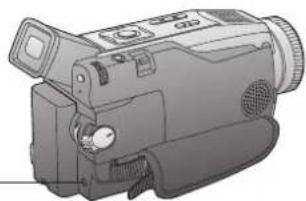
Before you begin
- Connect the Palmcorder to a power source. (pp. 12, 13)
- Insert a recorded cassette.
1 Set the POWER to VCR.
The POWER lamp lights red.
- Be sure POWER is fully turned to the VCR position.
2 Press LCD-OPEN to unlock the LCD monitor and swing open.
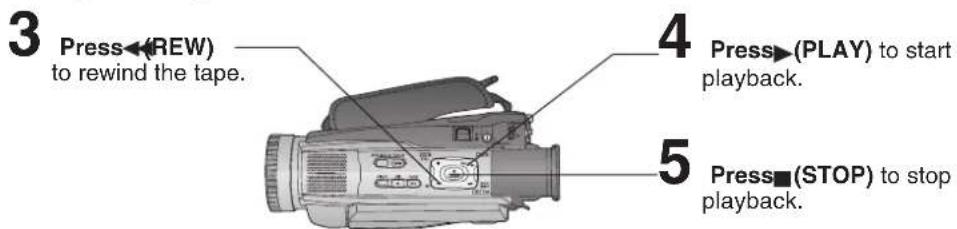
3 Press REWIND/SEARCH) to rewind the tape.
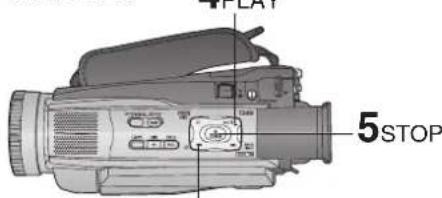
4 Press (PLAY) to start playback.
5 Press (STOP) to stop playback.
- When the tape reaches its beginning during rewind or rewind search, it will stop automatically.
Note
- When a tape recorded in LP mode on another digital video camera is played back on this unit, the picture may appear mosaic.
- Using the LCD monitor reduces battery operating time.
- You can place the Palmcorder on a table, etc. for viewing. Rotate the LCD Monitor 180^ and swing it up against the Palmcorder body as shown.
You can connect earphones (not supplied) to the PHONE Jack.
Playback Your Recordings
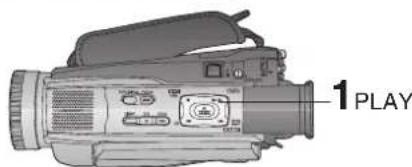
RepeatPlayback
EVF/LCD
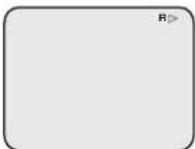
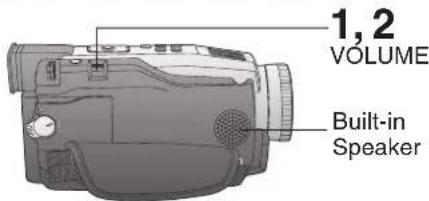
Adjusting the Volume
EVF/LCD
Blank Search
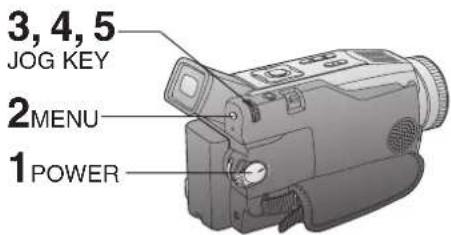
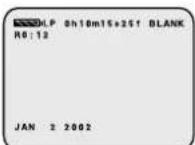
You can go directly to a blank portion of tape and start recording exactly where you left off.
EVF/LCD
30
1 Press PLAY for more than 5 seconds in STOP mode.
The Palmcorder will go into Repeat playback mode when the tape reaches its end.
The letter "R D" will appear in the EVF and LCD monitor.
2 Turn the Palmcorder OFF to exit the Repeat Playback mode.
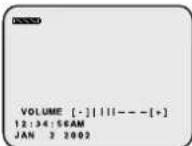
1 Rotate VOLUME to adjust the volume of the built-in speaker in PLAY mode.
The volume setting screen appears.
2 Press "T" to increase the volume or press "W" to decrease the volume.
1 Set POWER to VCR.
2 Press MENU to display the VCR mode menu screen.
3 Rotate JOG KEY to select PLAY MODE, then press JOG KEY to display the VCR PLAY MODE menu screen.
4 Rotate JOG KEY to select B.SEARCH in the VCR PLAY MODE menu. (Menu OSD: p. 58)
5 Press JOG KEY to select ON. "BLANK" will appear on the screen.
Special Effect Features
Note
Sound is muted during all special effects.
Rapid Visual Search
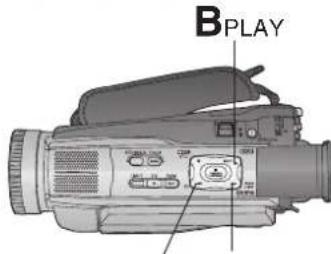
A, BREWIND/SEARCH
A, BFAST FORWARD/ SEARCH

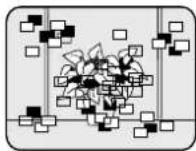
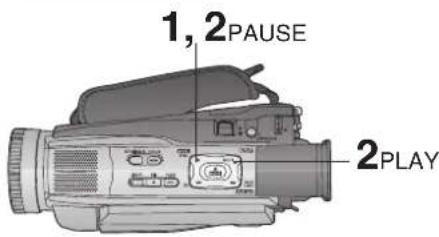
STILL Picture
Fast Forward/Rewind Check
Monitor normal picture playback during fast forward or rewind.
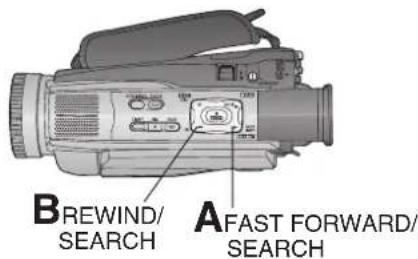
ADuring playback, hold down (FAST FORWARD/SEARCH) or (REWIND/SEARCH). The search will continue for as long as the button is held down.

OR Press FAST FORWARD/ SEARCH) or (REWIND/SEARCH) once for a continuous rapid visual search. Press (PLAY) to release.
Note
- When executing a rapid visual search, the picture may become bluish for an instant or mosaic. This is normal during this mode.
1 Press II (PAUSE) during playback.
2 Press (PLAY) or II (PAUSE) to release.
Note
To protect the tape and video heads, your Palmcorder's operating modes will revert as follows: STILL STOP (after 3 minutes.)
A Hold down FAST FORWARD/ SEARCH) during fast forward.
BHold down REWIND/SEARCH) during rewind.
The picture will appear for as long as the button is held down.
Special Effect Features
Note
Sound is muted during all special effects.
Slow Motion Playback (Remote Control Only)
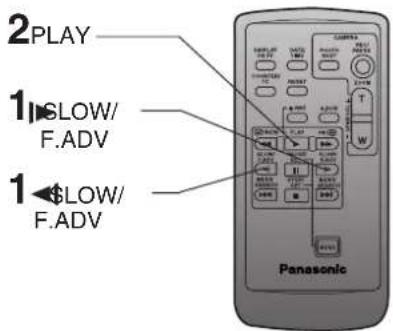
Forward Slow: Press SLOW/F.ADV during play. Reverse Slow: Press SLOW/F.ADV during play.
2 Press PLAY to release. (During reverse slow motion playback, time code indication may not change regularly.)
Note
- Palmcorder will automatically STOP when in slow motion for more than 10 minutes.
- During slow motion playback, picture may move up and down. This is normal.
- When you start or stop slow motion playback, the picture may become bluish for an instant.
Variable Speed Search
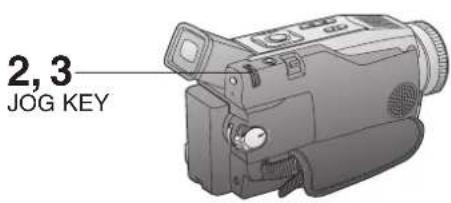
1 Press (PLAY) to start playback.
2 Press JOG KEY for about 1 second.
3 Rotate JOG KEY to adjust the playback speed.
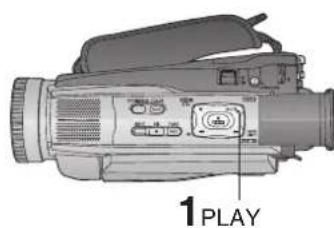
- Rotate JOG KEY clockwise for forward playback.
- Rotate JOG KEY counterclockwise for reverse playback.
To return to normal playback: Press (PLAY). Playback will continue at normal speed.
Note
The Variable Speed Search function offers a choice of six playback speeds (1/5X (LP mode: 1/3X), 1X, 2X, 5X, 10X, 20X) both in forward and reverse directions.
The review playback at the 1X speed is playback in reverse direction.
- During the Variable Speed Search (at a speed other than 1X), mosaic-like patterns will appear in the picture.
During the Variable Speed Search, sound is muted.
Special Effect Features
Note
Sound is muted during all special effects.
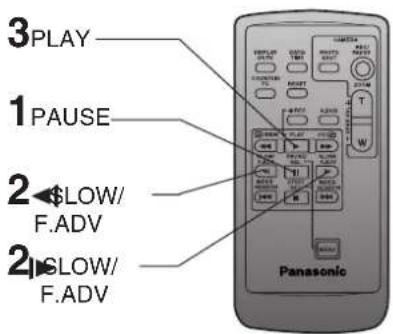
Frame by Frame Advance (Remote Control Only)
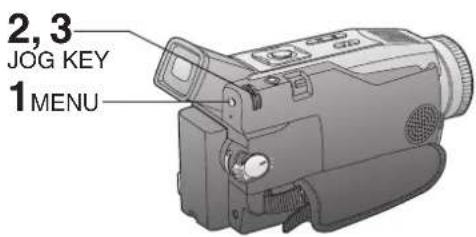
Index Search (Photo/Scene) (Remote Control Only)
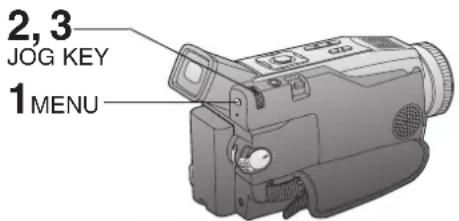
1 Press PAUSE during playback.
Press▶SLOW/F.ADV to do a frame by frame advance.
Press SLOW/F.ADV to do a frame by frame reverse.
3 Press PLAY to release.
Note
If you hold down SLOW/F.ADV, you can see a continuous series of still images at a slower speed than normal slow mode.
During frame by frame advance, a few frames may move automatically, and the picture may become bluish for an instant.
1 Press MENU to display the VCR mode menu screen.
2 Rotate JOG KEY to select PLAY MODE, and press JOG KEY to display the VCR PLAY MODE menu screen.
3 Rotate JOG KEY to select INDEX, and press JOG KEY to select PHOTO or SCENE.
- Press MENU twice to exit.
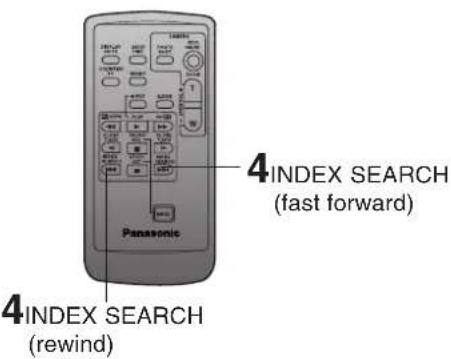
4 Press INDEX SEARCH fast forward or rewind on the remote control to advance or rewind the tape to playback a PhotoShot scene. To view the next PhotoShot, INDEX SEARCH must be pressed again.
Note
The picture quality will deteriorate slightly.
The tape remaining indicator will not appear while the PHOTOSHOT feature is used.
- In the Photo/Scene Index Search mode, the shutter sound effect may not be able to be heard even when SHUTTERT is set to ON.
- Photo Index Search may fail to detect a recorded PhotoShot image if the image is 3 seconds or less.
Special Effect Features
Note
Sound is muted during all special effects.
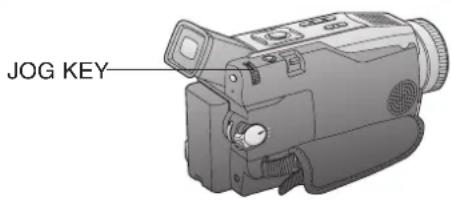
Jog Frame by Frame Search (Palmcorder Only)
Index Forward/Reverse Search (Remote Control Only)
Search for a particular scene by using the electronic index marks placed at the beginning of each recording.
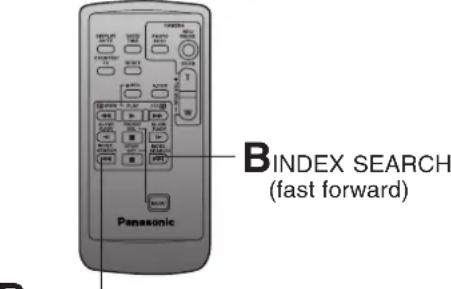
INDEX SEARCH (rewind)
Top Scan
If you hold down INDEX SEARCH for more than 2 seconds, the Palmcorder will scan for scenes (or PhotoShots) and playback the first few seconds of each.
To cancel this function, press PLAY or STOP.
Note
- Search will not work if there is a succession of PhotoShots.
34
During Still mode, rotate JOG KEY to advance or reverse the picture one frame at a time.
1 Press MENU to display the VCR mode menu screen.
2 Rotate JOG KEY to select PLAY MODE, then press JOG KEY to display the VCR PLAY MODE menu screen.
3 Rotate JOG KEY to select INDEX, and then press JOG KEY to select PHOTO or SCENE. (Menu OSD: p. 58) Press MENU twice to exit.
A Place the Palmcorder in the VCR STOP mode.
B Press INDEX SEARCH fast forward or rewind for the number of recordings (indexes) forward or back you want to view. The Palmcorder will advance or rewind to the desired recording and automatically start playback.
The number of times you pressed the button is displayed in the EVF and the LCD monitor if you set INDEX on the VCR menu to SCENE. (Menu OSD: p. 58) (e.g., if you press the button three times, "S3" will appear.)
- If the interval between scenes is less than 1 minute, index search may not operate properly.
Response time from pressing the button and the change in the scene number is quite slow. Do not press INDEX SEARCH rapidly and continuously.
- During Reverse Index Search mode, playback will not begin when a tape rewrites all the way to the beginning.
Special Effect Features
Strobe Multi Mode
In Strobe Multi Mode, you can select the rate at which a succession of still screens are captured from the playback picture.
Note
- A Multi Image Playback screen cannot be output from the DV terminal or Digital Still Image terminal.
- A Multi screen will have slightly lower image quality.
1 Set POWER to VCR.
2 Press MENU to display the menu screen.
3 Rotate and press JOG KEY to select and set MULTI SETTING.
4 Press JOG KEY repeatedly to set desired speed.
Strobe Speeds
| Strobe Speeds | 9 screen capture time |
| FAST | Every 0.3 seconds |
| NORM | Every 0.6 seconds |
| SLOW | Every 1.0 seconds |
- Press MENU twice to exit.
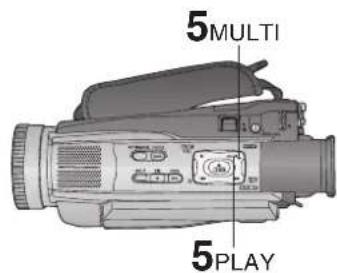
5 Press (PLAY) to start playback. Press (MULTI) at the point you want to start capturing.
- A succession of 9 screens will be captured, and playback will stop.
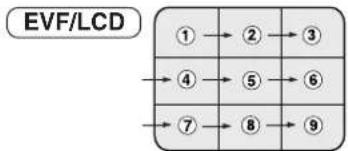
- Press (PLAY) to start playback.
Press STOP) to stop playback.
Special Effect Features
View Recording/Playback on your TV
[TV with AUDIO/VIDEO IN Jacks]
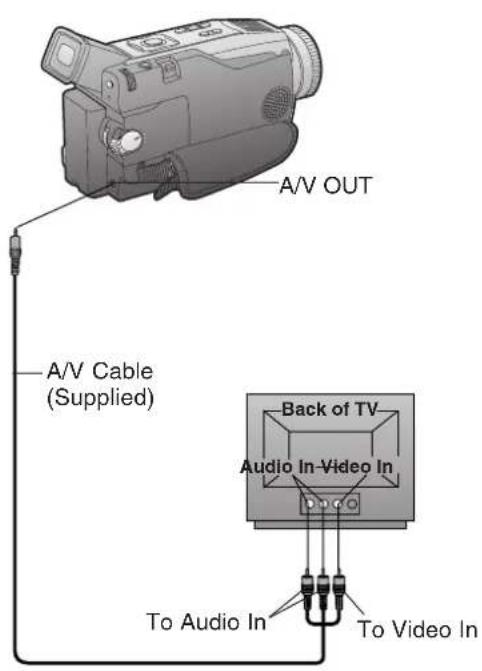
1 Set POWER to CAMERA or VCR.
To view what the Palmcorder is recording or to playback a tape on your TV.
2 Turn your TV ON and set it to LINE INPUT.
Check your TV operating instructions for further information.
3 Start playback or begin a recording.
Make sure the Palmcorder and TV are turned off while connecting.
- Please connect the A/V Cable securely.
Note
(Remote Control Only)
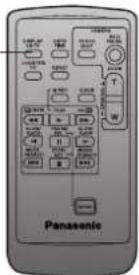
You can display the various EVF and LCD indications on your TV by pressing DISPLAY ON TV on the remote control. Press again to remove the indications.
DISPLAY
ON TV
Digital Features
Digital Zoom
This feature is useful when you want to record close-up shots of subjects located beyond a normal zoom range of 1X to 10X magnification. With the digital zoom feature, you can select a magnification of 25X, or even up to 700X.
Note
- Other Digital Functions are turned off automatically when the EIS and Digital Zoom are selected.

EVF/LCD
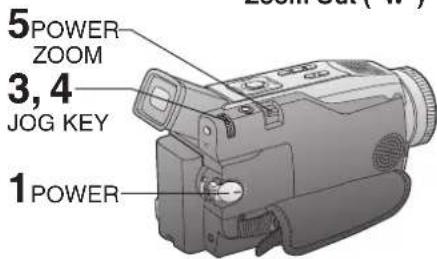
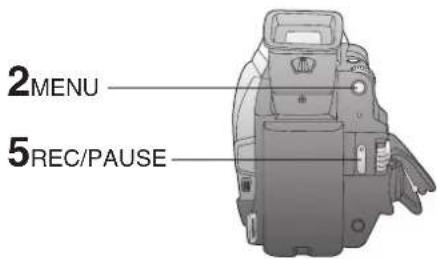
CAMERA mode
1 Set POWER to CAMERA.
2 Press MENU to display the CAMERA MENU screen.
3 Rotate JOG KEY to select D.FUNCTION, then press JOG KEY to display the CAMERA FUNCTION menu screen.
4 Rotate JOG KEY to select D.ZOOM, then press JOG KEY to select D.ZOOM1 or D.ZOOM2. D.ZOOM1: from 10X to 25X D.ZOOM2: from 10X to 700X OFF: Turn off D.ZOOM
- Press MENU twice to exit.
5 Press REC/PAUSE to start recording and press POWER ZOOM to zoom in or zoom out.
The magnification level is always displayed in the EVF or the LCD monitor when DISPLAY is set to ON. (Menu OSD: pp. 57, 59)
6 Repeat steps 2~4 to select OFF to cancel this feature.
Note
The normal optical zoom functions from 1X to 10X.
- As magnification increases, resolution significantly decreases.
- Because the image is enlarged digitally, the picture may become distorted when higher magnification levels are used.
- When the level falls below 10X, the normal zooming function will resume.
Focus distance becomes 1.2 m (4 feet) if the lens is in full telephoto.
(Continued on next page.)
Digital Features
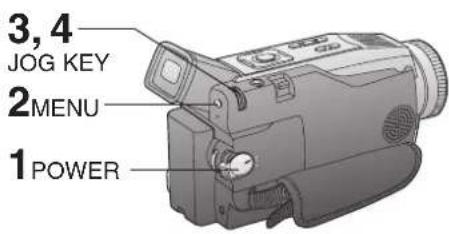
Digital Zoom (Continued)
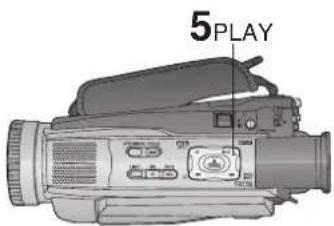
VCR mode
1 Set POWER to VCR.
2 Press MENU to display the VCR MENU screen.
3 Rotate JOG KEY to select PLAY FUNCTION, then press JOG KEY to display the VCR PLAY FUNCTION menu screen.
4 Rotate JOG KEY to select D.ZOOM, then press JOG KEY to select ON. Press MENU twice to exit.
5 Press (PLAY) to start playback. The centre portion of the image doubles in size.
6 Repeat steps 2~4 to select OFF to cancel this feature.
MagicPix Images
Colour recording of video or still images onto the Mini DV tape in low lighting. (pp. 40, 56)
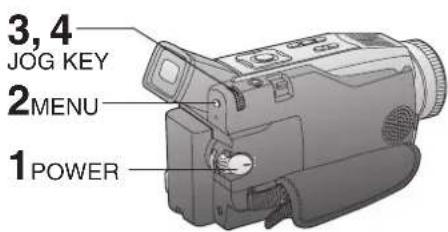
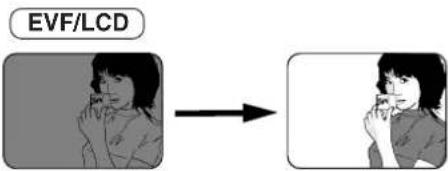
1 Set POWER to CAMERA.
2 Press MENU to display the menu screen.
3 Rotate JOG KEY to select D.FUNCTION, and then press JOG KEY to display the CAMERA FUNCTION menu screen.
4 Rotate JOG KEY to select D.FUNCTION, and then press JOG KEY repeatedly to select MAGICPIX. Press MENU twice to exit.
5 To cancel the Digital Function, press JOG KEY repeatedly to select OFF.
Digital Features
Dual Digital Electronic Image Stabilization System (D.E.I.S.)
This feature helps compensate for any unintentional hand or body movement. It can be used in both the Recording and Playback (VCR) modes.
Note
- Other Digital Functions are turned off automatically when the EIS and Digital Zoom are selected.

CAMERA mode
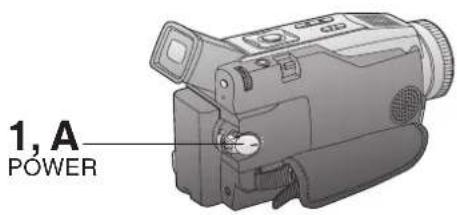
1 Set POWER to CAMERA.
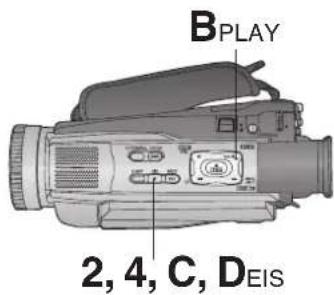
2 Press EIS to stabilize the picture.
- Picture flicker may be observed when taping under fluorescent lighting conditions.
The EIS indicator flashes when the light level is inadequate. - Turn D.E.I.S. OFF during recording when using a tripod.
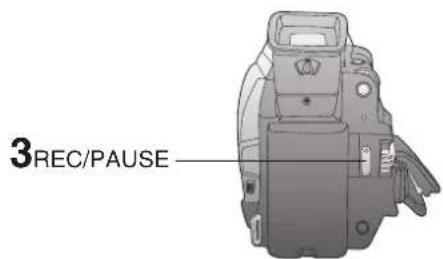
3 Press REC/PAUSE to start recording.
4 Press EIS again to cancel.
- Be sure that D.E.I.S. is turned off when not needed.
D.E.I.S. may not function when...
- Palmcorder movement is too extreme.
- Recording a subject with distinct horizontal or vertical stripes.
- Recording in low light situations.
- Recording a subject under a great amount of fluorescent light.
- Recording a scene with very fast motions.
VCR mode
A Set POWER to VCR.
B Press (PLAY) to start playback.
C Press EIS to stabilize the picture.
D Press EIS again to cancel.
- Be sure that D.E.I.S. is turned off when not needed.
Note
- When using D.E.I.S in VCR mode, the image size is slightly larger.
Digital Features
Other Digital Functions
Use the following features to add interest and professionalism to your recordings or playback. Select from twelve special effects.
3,4,5
JOG KEY
2MENU
1 POWER
Types of Digital Functions
MIRROR
Symmetrical image from the current camera picture.
STROBE
The recording appears as a sequence of still frames.
MOSAIC
The picture appears in a mosaic pattern.
The picture is expanded vertically.
The subject being recorded creates a trail when in motion.
STRETCH
The picture is expanded horizontally. MAGICPIX (Not available during playback) Colour recording of video or still images onto the Mini DV Tape in low lighting. (p. 38)
- Only Manual Focus is available.
WIPE
Successive scenes are separated in a way which simulates the drawing of a curtain.
MIX
The current scene is mixed in with the following scene during scene changes. PinP
PinP (Still image) is displayed on the Main Picture.
Digital Effects
(Playback only)
SEPIA
The picture is played back in sepia, a brownish colour, giving it an antique look.
MONO (Monotone)
The picture is played back in black-and-white.
40
1 Set POWER to CAMERA or VCR.
2 Press MENU to display the menu screen.
3 Rotate JOG KEY to select D.FUNCTION in the CAMERA mode menu screen or PLAY FUNCTION in the VCR mode menu screen, then press JOG KEY to display the CAMERA FUNCTION or VCR PLAY FUNCTION menu screen.
4 Rotate JOG KEY to select D.FUNCTION, and then press JOG KEY repeatedly to select one of the Digital Functions listed on the left.
5 To cancel the Digital Function, press JOG KEY repeatedly to select OFF.
Note
- The EIS and Digital Zoom features are turned off automatically when one of the Digital Functions listed at left is selected.
To use the WIPE function
a.In Camera mode, set the "D.FUNCTION" item in the main menu screen to "WIPE". (Menu OSD: p. 56)
b. Press REC/PAUSE to start recording.
c. Press REC/PAUSE to pause the recording. The last scene will be memorized.
d. Press RECORD/PAUSE to start recording again. The new scene will take the place of the memorized scene.
To use the MIX function
a.In Camera mode, set the "D.FUNCTION" item in the main menu screen to "MIX" (Menu OSD: p. 56). Then, perform steps b-d above.
The memorized scene and the new scene will appear mixed as the scene changes from one to the other.
Editing Features
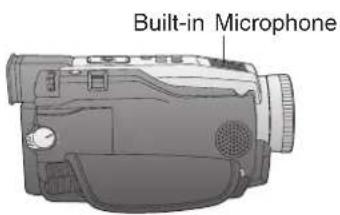
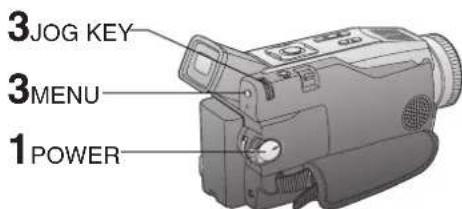
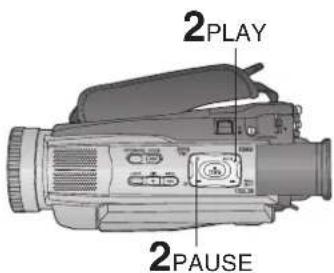
Audio Dubbing using the Built-in Microphone
The original sound can be replaced with new sound using the built-in Palmcorder microphone.
Before you begin
- Turn on the Palmcorder.
- Insert a pre-recorded tape to bedubbed.
The AUDIO-REC setting in CAMERA MENU mode should be as follows:
| 12 bit | The original sound is recorded on ST (Stereo) 1, and the new sound will be recorded on ST (Stereo) 2. |
| 16 bit | The original sound is replaced with the new sound. |
- Select 12 bit if you do not want the original sound to be completely replaced during an audio dub.
If you dub over a tape which has both 12 bit and 16 bit audio recordings on it, keep in mind that the original 16 bit audio portion will be completely replaced.
1 Set POWER to VCR.
- With the Remote Control, you can set the Palmcorder to stop automatically at a specific point on the tape. See "Memory-Stop Editing" on page 42.
2 Press (PLAY). Then press II (PAUSE) where you want dubbing to begin.
When using the Palmcorder only
3 Press MENU to display the VCR mode menu screen. Rotate JOG KEY to select REC MODE, then press JOG KEY to display the VCR REC MODE menu screen.
Rotate JOG KEY to select AUDIO-DUB, and then press JOG KEY to select ON.
The Palmcorder will go to Stand By mode, and "A.DUB II" indication appears in the EVF or the LCD monitor. Go to step 4.
When using the Remote Control only
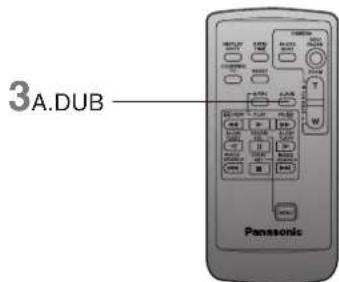
3 Press A.DUB on the Remote Control.
The Palmcorder will go to Stand By mode, and "A.DUBII" indication appears in the EVF or the LCD monitor. Go to step 4. (Continued on next page.)
Editing Features
To listen to the desired audio sound, set the AUDIO setting of the VCR mode MENU (Menu OSD: p. 58) as follows:
AUDIO:The following selections are available for 12 bit AUDIO dubbed recordings only (sound recorded in SP mode only).
| ST 1 | Set this position to listen to the original sound. |
| ST 2 | Set this position to listen to the audio dubbed sound. |
| MIX | Set this position to listen to both the original sound and the audio dubbed sound. |
Note
16 bit dubbed sound completely erases the original 16 bit recorded sound.
- If you dubbed using 12 bit AUDIO recording and then selected AUDIO-MIX in the menu for playback, the sound will be stereo regardless of the AUDIO-OUT setting.
- If you recorded in LP mode, you cannot use the A.DUB feature.
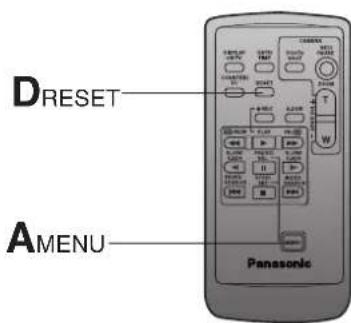
Memory-Stop Editing
You can set an automatic Dubbing stop point.
42
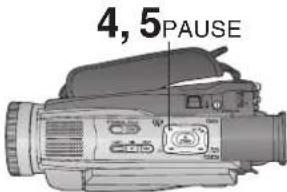
4 Press II (PAUSE) to start Audio Dubbing. "A.DUB Indication appears. Connect the Palmcorder to the TV in order to monitor the sound. (p. 36)
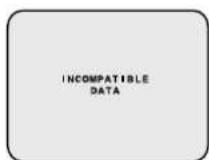
Only NTSC (National Television Standards Committee) recorded tapes can be audio dubbed. The following screen appears if the tape was not recorded in NTSC format.
5 PressII(PAUSE) to stop Audio Dubbing.
If the microphone used for dubbing gets too near the speaker of your TV, a howling noise (feedback) may occur.
If the tape position is in or was started in a blank section, you cannot use the A.DUB feature.
A Press MENU to display the VCR menu screen.
B Rotate JOG KEY to select DISPLAY SETTING, and then press JOG KEY to display the DISPLAY SETTING menu.
C rnt. Rotate JOG KEY to select DISPLAY, and then press JOG KEY to set to MEMORY.
Press MENU two times to exit MENU mode. Then, press RESET on the remote control to reset the Counter Memory to M 0:00:00.
Now, rewind to the editing start point and continue with steps 2-5. The tape will now stop automatically at "M 0:00:00".
Editing Features
Copying your Tapes to VHS Cassette
Source (Playing) Palmcorder
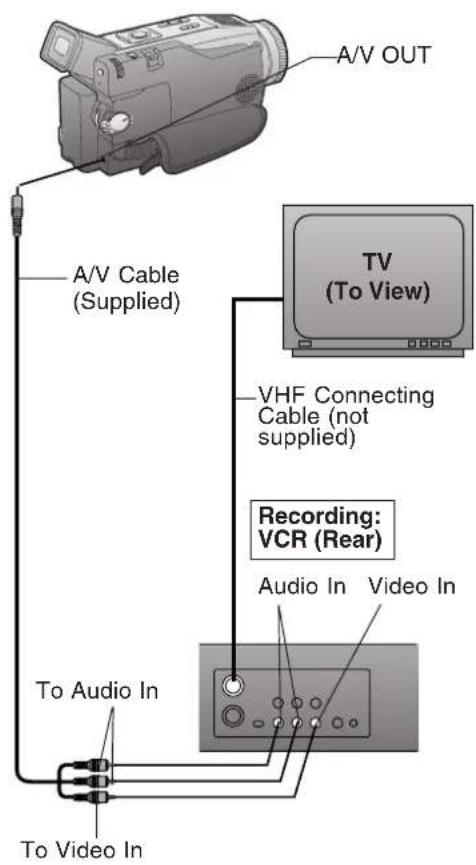
Monitor with your TV
- Turn the TV ON and select its VCR channel (either CH3 or CH4).
- Set the VCR/TV Selector on the recording VCR to VCR.
Before you begin
- Connect both Palmcorder and VCR to their power sources.
- Connect the Palmcorder to a VCR as illustrated left.
- Turn ON both units.
- Set the recording VCR's Input Signal Selector to LINE.
- Set the Palmcorder POWER to VCR.
1 Insert a pre-recorded tape into the source (playing) Palmcorder and a blank tape, with record tab in place, into the target VCR (Recorder).
2 Press (PLAY) on the Palmcorder. When the tape reaches the point from which you want to start dubbing, press PAUSE.
3 Place the VCR into REC/PAUSE mode. (See VCR manual.)
4 Simultaneously, press PAUSE on both units to begin copying.
5 Press STOP on both units when copying is completed.
Note
- For technical reasons, dubbing a tape may reduce its quality.
- Press DISPLAY ON TV on the Palmcorder Remote Control to eliminate EVF/LCD Monitor indications.
- If the Time Code is displayed in the EVF or LCD monitor, it cannot be reset.
Only the DATE/TIME, when displayed, will be recorded on the tape.
CAUTION:
Unauthorized exchanging and/or copying of copyrighted recordings may be copyright infringement.
Editing Features
Copying from Digital Equipment (dubbing)
High quality digital-to-digital copying can be accomplished if both Palmcorders incorporate the DV Input/Output (i.LINK) Connector (DV Interface cable (i.LINK) is not supplied).
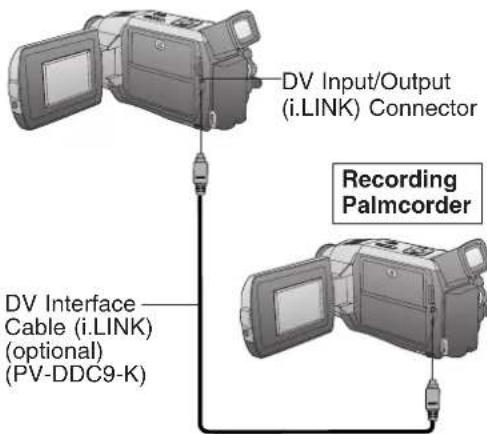
Source (Playing) Palmcorder
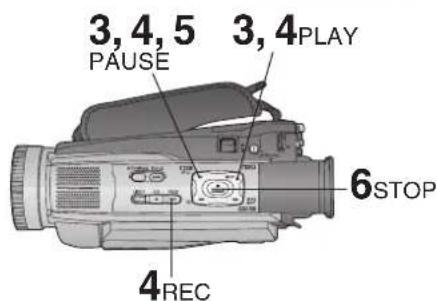
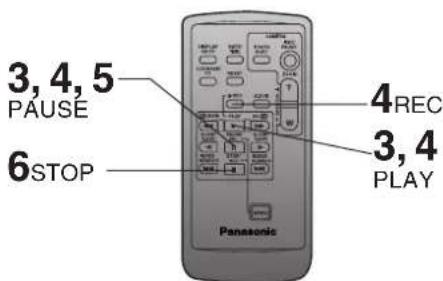
Before you begin
- Connect both Palmcorders to their power sources.
- Connect the two Palmcorders using the DV Interface cable (i.LINK) (4-pin to 4-pin).
- Turn both Palmcorders ON.
1 Insert a pre-recorded tape into the source (playing) Palmcorder, and set POWER to VCR.
2 Insert a blank tape with the record tab closed into the target (recording) Palmcorder and set POWER to VCR.
3 Press (PLAY) on the source Palmcorder. When the tape reaches the point from which you want to start dubbing, press II (PAUSE).
4 Hold down REC and press (PLAY) on the target (recording) Palmcorder. Press II (PAUSE) to pause the tape at the starting point of the dub.
5 Simultaneously, press II (PAUSE) on both units to begin dubbing.
6 Press (STOP) on the recording unit, and then press (STOP) on the playing unit to end dubbing.
Note
- When two Palmcorders are used for dubbing, it is recommended that the Remote Control VCR1 or VCR2 setting be used to avoid improper-operation.
CAUTION:
Unauthorized exchanging and/or copying of copyrighted recordings may be copyright infringement.
PC Connection
PC Connection with DV Interface Cable (i.LINK)
A video clip can be transferred directly to your PC (Personal Computer) via a DV Interface Cable (i.LINK) (not supplied) using products and software from a number of video editing software companies.
Using products from video editing software companies allows you to capture and edit video clips using the DV Interface (i.LINK).
Our DVC being OHCI compliant should have no problem working with any OHCI compliant Firewire Card/video - Editing software package.
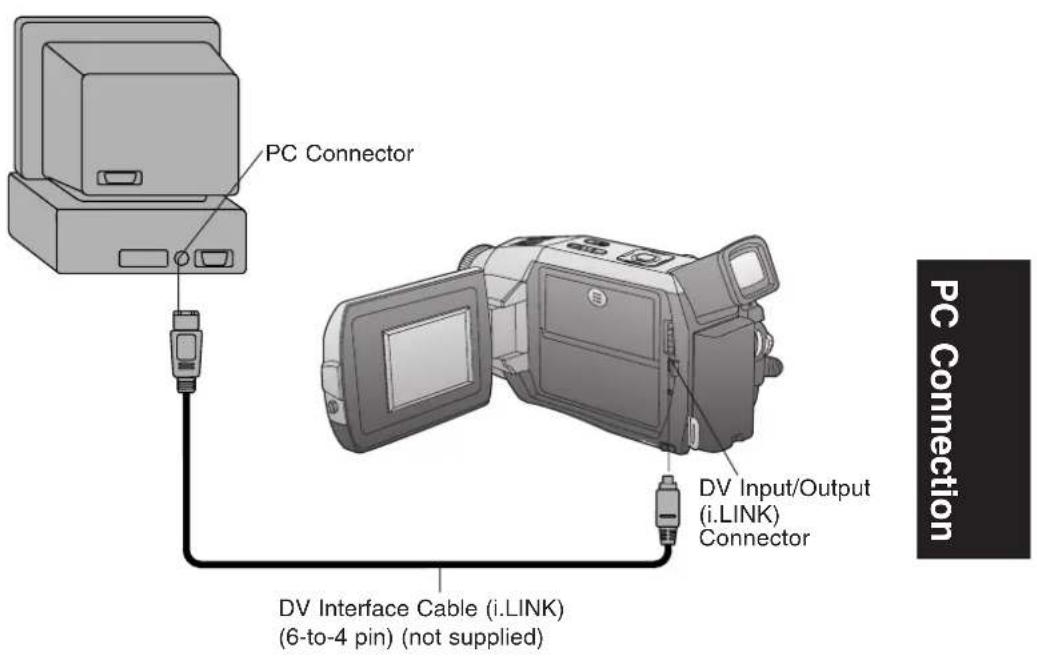
Note
- During Palmcorder playback, do not disconnect the DV Interface Cable (i.LINK) or turn the Palmcorder off as this may cause a PC hang-up error.
PC Connection
PHOTOVU LINK Driver (Optional)
An image recorded on the DV Tape can be transferred to your PC (Personal Computer).
System Requirements for PHOTOVU LINK Driver
- IBM PC/AT or compatible
Intel Pentium Processor - Microsoft Windows 95/98/Me/NT4.0/2000/XP
RAM: 16 MB or more - 2 MB minimum available hard disk space
256 colour monitor (full colour recommended)
3.5 inch 1.44 MB floppy disk drive (for installation)
- RS-232C serial port (D-Sub 9-pin) An adaptor (D-Sub 9-pin male to a D-Sub female) is required for a D-Sub 25-pin
- Mouse or other pointing device
Satisfy the conditions recommended by Microsoft for Windows.
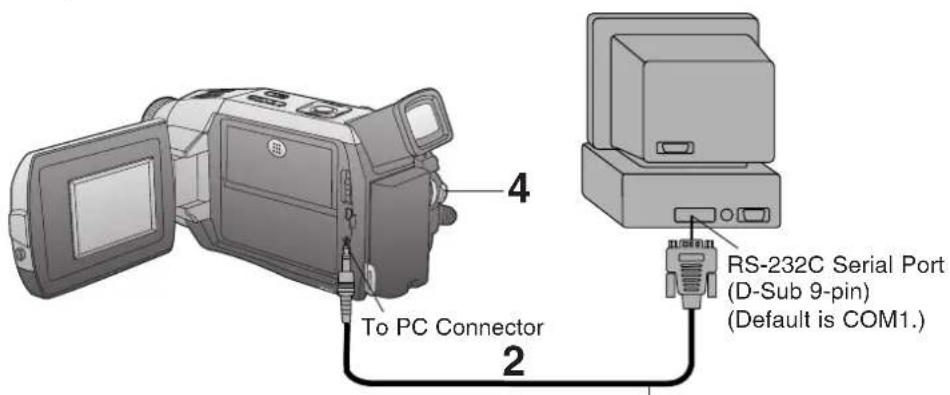
PC Connecting Cable for Windows (optional: PC Connection Unit (PV-DRS2, p 49))
Connection
1 Turn off your PC.
2 Connect the Palmcorder to your PC (Windows) using the PC connecting cable (optional: PC Connection Unit (PV-DRS2, p 49)).
- Before connecting the Palmcorder to the PC, make sure the PC power is off to ensure that images are transferred properly.
3 Turn on your PC.
4 Set the Palmcorder POWER to VCR.
Note
- For extended periods of use, it is recommended to use the AC Adaptor as a power source.
- Refer to PC or Windows manual to identify which COM port is to be used for connection.
46
PHOTOVU LINK (Optional)
1 Turn your PC (Personal Computer) on and start up Windows.
2 Insert PHOTOVU LINK DRIVER Disk (Optional) into a floppy disk drive.
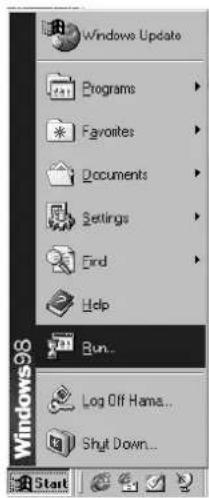
3 Click on Start, then "Run."
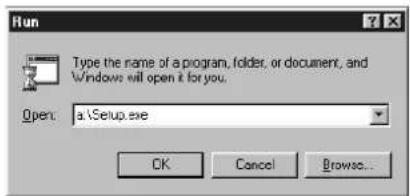
4 Type in "a:\setup.exe" and click OK. If your 3.5 inch floppy disk drive is no "A", use the appropriate letter.
5 Follow the instructions as they appear on the PC screen until the installation is complete.
- Setup window will disappear when the installation is complete.
Running the Software
PHOTOVU LINK:
You can transfer images from your Palmcorder tape to your PC.
Before you begin
- Insert the Tape. (p. 10)
Make Palmcorder-PC connections. (p. 46) - Turn your PC on.
- Set Palmcorder POWER to VCR.
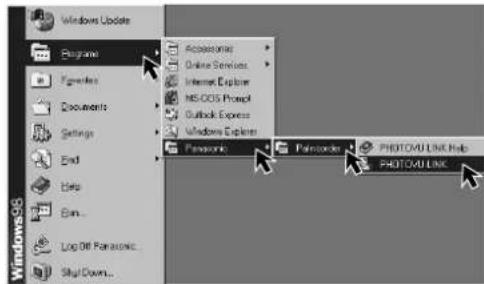
1 Click on Start, "Programs," "Panasonic," "Palmcorder," then "PHOTOVU LINK."
2 "PHOTOVU LINK" is opened.
Note
COM Port and Baudrate are automatically selected.
Refer to Help for information about application operations and other Error messages.
PHOTOVU LINK (Optional)
Using Tape Image Data
Pictures captured with the Palmcorder can be transferred to your PC.
Before you begin
Insert a recorded tape. (p. 10)
Make Palmcorder-PC connections. (p. 46)
- Turn your PC on.
- Set Palmcorder POWER to VCR.
1 Repeat steps 1 and 2 on page 47 to run the Software.
2 "Preview Window" screen appears.
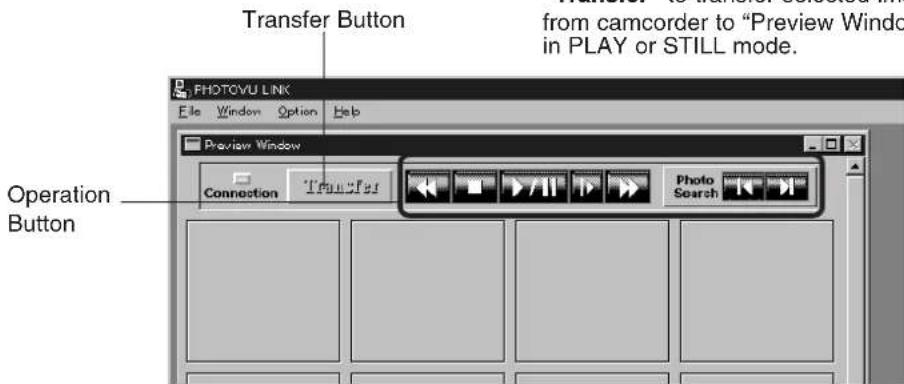
3 Search and Select a still scene you want to transfer to your PC using VCR Operation Buttons on the "Preview window" screen. Then click on "Transfer" to transfer selected image from camcorder to "Preview Window" in PLAY or STILL mode.
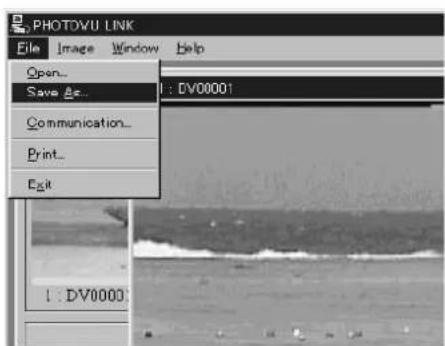
4 Click on "File" then "Save As". Save transferred image to PC.
Note
- If, while transferring the image to your PC, the displayed picture appears abnormal, close PHOTOVU LINK and turn Camcorder POWER off. Run PHOTOVU LINK again and turn Palmcorder Power back on. Now transfer again.
- Photo Search may fail to detect a recorded PhotoShot image if the image is 3 seconds or less.
Palmcorder Accessory System
| Accessory # | Figure | Description |
| PV-DAC11A-K | AC Adaptor with AC Cable and DC Cable | |
| CGR-D08A/1B | 800mAh / 1 h 30 min, Battery Pack | |
| CGR-D16A/1B | 1600mAh / 3 h, Battery Pack | |
| CGP-D28A/1B | 2800mAh/ 5 h, Battery Pack | |
| CGR-D53A/1K | 5300mAh / 9 h, Battery Pack | |
| PV-DDC9-K | DV Interface Cable (i.LINK) (4-pin to 4-pin) | |
| PV-DRC9-K | IR Remote Control | |
| PV-DRS2 | PC Connection Unit (RS-232C Serial Kit) | |
| PV-DCC11-K | Car Battery Cord |
Notes On Operations
Approximate Brightness Values
Your Palmcorder has been designed for normal scene illumination of 150 footcandles (1500 lx). However, the Palmcorder may be used at F1:1.8, if illumination is more than 0.5 footcandles (5 lx).
The table below shows the colour temperature for reference.
| PALMCORDER SETTINGS | CONDITIONS | KELVIN COLOURTEMPERATURE | ARTIFICIAL LIGHT SOURCENMIXTURE |
| (Amberr Filter Range) | ·Fair weather, blue sky | —10,000 | ·Colour television |
| ·Slightly cloudy sky | —8,000 | ||
| ·Cloudy or rainy sky | —7,000 | ||
| —6,500 | |||
| ·Sunlight in clear weather at midday | —6,000 | ·Fluorescent lamp (Daylight) | |
| —5,500 | ·Camera flash bulb | ||
| ·Average sunlight in clear weather | —5,000 | ·Blue lamp for photography | |
| ·Sunlight 2 hours after sunrise and before sunset | —4,500 | ·Fluorescent lamp (White) | |
| —4,000 | ·Normal flash bulb | ||
| —3,500 | ·Fluorescent lamp (Off-white) | ||
| ·Tungsten lamp for photography | |||
| —3,200 | ·Halogen lamp | ||
| ·Sunlight 40 min. after sunrise and before sunset | ·Iodine lamp | ||
| —2,800 | ·Tungsten lamp | ||
| ·Sunlight 30 min. after sunrise and before sunset | ·Acetylene lamp | ||
| ·Kerosene lamp | |||
| —2,000 | ·Candlelight | ||
| "OUTDOOR" | |||
| "AUTO" | |||
| "INDOOR" | |||
| (Blue Filter Range) |
Specifications
Power Source: Palmcorder: 7.2 V DC (Battery)
7.8 V DC (AC Adaptor)
AC Adaptor: 110/120/220/240 V AC, 50/60 Hz
Battery: Lithium-Ion Type DC 7.2 V
Power Consumption:
Palmcorder:7.2V/7.8V DC 6.5W (Max.9.5W)
AC Adaptor : 18 W
1 W (when not in use.)
Digital Interface RS-232C serial port (D-Sub 9-pin)
1.LINK (IEEE1394)
Video Signal: EIA Standard (525 lines, 60 fields) NTSC colour signal
Video Recording System: 2 rotary heads, helical scanning system
Audio: 12 bit (32 kHz) 4 tracks
16 bit (48 kHz) 2 tracks
Pick-Up System and Device: One integral colour filter Charge Coupled Device (CCD)
Lens: 10:1 zoom lens, F1:1.8 with auto iris control
Focal length: 3.6mm - 36mm
Power zoom function
Lens filter diameter: 43 mm
Viewfinder: 5.3 mm (0.21 inch) Liquid Crystal Electronic
Viewfinder
LCD Monitor: 63.5 mm (2.5 inch) Liquid Crystal Display
Minimum Illumination Required: 5 lx (F1:1.8) 0.5 footcandles
Operating Temperature:
32^ 104^(0^ 40^)
Operating Humidity: 10% 75%
Weight:
Palmcorder: 0.58kg
1.28 lbs.
AC Adaptor:0.16 kg
0.35 lbs.
Dimensions:
Palmcorder: 74 (W) x 88.5 (H) x 182 (D) mm
2-7/8 (W) x 3-1/2 (H) x 7-1/8 (D) inch
AC Adaptor : 70 (W) x 45 (H) x 115 (D) mm
2-3/4 (W) x 1-3/4 (H) x 4-1/2 (D) inch
Weight and dimensions shown are approximate.
Designs and specifications are subject to change without notice.
Before Requesting Service
Cleaning Care for Video Heads
Clogged Video Head
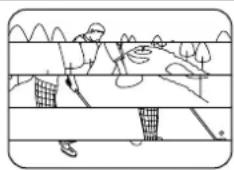
(a) Video Head Cleaning: Normally, your Palmcorder will not require head cleaning. However, it is possible that the heads may become clogged due to dust in the air, playing damaged tapes, long term use, etc. If "NEED HEAD CLEANING" appears for 5 seconds in the EVF or LCD monitor, the heads may require cleaning.
(b) Cleaning the Heads: It is recommended that head cleaning be performed by a qualified service technician. Please contact your nearest Panasonic Servicenter. An alternate solution is to obtain a head cleaning cassette. Please use Panasonic cleaning cassette (AY-DVMCLA). Be sure to follow the cleaning instructions carefully. Excessive use of the head cleaning cassette could shorten video head life.
Use this cassette only when a head clogging symptoms occur.
Refer servicing to qualified service personnel.
Tape Operations Caution
- When you go from function to function (PLAY, FF, REW etc.), please note that the unit will not accept a new function operation until the previous operation is complete.
- The POWER Button and all function buttons, (PLAY, FF, REW, etc.) are only operational after the tape has been completely loaded.
Lens Hood Area Operation Caution
When the following accessories are attached and the zoom is set to maximum wide angle, the four corners of the screen may appear darker:
- Wide or Telephoto conversion lens (optional).
A filter (optional), etc. and then the lens hood. - Two filters (optional).
Before Requesting Service
If you have a problem with your Palmcorder, it may be something you can correct yourself.
Check the list below for symptoms and corrections.
| Symptom | Correction |
| No picture in the EVF or LCD Monitor... | ·Make sure the Power Source is connected. (pp. 12, 13) ·Make sure the POWER switch is set to VCR or CAMERA. (pp. 16, 29) ·Check the Dew Indicator. (p. 54) ·Make sure the Battery is fully charged. (p. 12) ·Make sure all necessary cables are connected correctly and firmly. (p. 13) ·Make sure the Lens Cap is removed. (p. 16) |
| Video cassette cannot be inserted... | ·Make sure the Power Source is connected. (pp. 12, 13) ·Insert the cassette record tab up, window side facing out. (p. 10) |
| Video cassette cannot be removed... | ·Make sure the Power source is connected. (pp. 12, 13) |
| No operation starts when operation buttons are pressed... | ·Check the Dew Indicator. (p. 54) |
| Recording cannot be done... | ·Make sure the record tab is closed. (p. 6) ·Check the Battery Indication. (p. 60) |
| Auto Focus does not operate... | ·Make sure FOCUS is set to AUTO. (p. 26) ·Make sure the unit is ON and set to CAMERA mode. (p. 16) |
| Sound from microphone cannot be monitored... | ·Make sure the unit is set to REC or REC/ PAUSE mode. |
| Sound cannot be heard... | ·Make sure the Audio on the VCR MENU is set to ST1. (pp. 42, 58) |
On-Screen Displays (OSD)
The following warning displays appear in the EVF and the LCD monitor.
| Indications | Condition |
| TAPE NOT INSERTED | If the Palmcorder is in CAMERA mode without a cassette inserted, “☐” will flash and “TAPE NOT INSERTED” will appear for 5 seconds. Recording will not start. |
| CHECK REC TAB | If the Palmcorder is in CAMERA mode or Audio dub mode with the cassette sliding record tab opened, “☐” will flash and “CHECK RECENTAB” will appear for 5 seconds. Recording will not start. |
| CANNOT REC | When Audio dub is performed and recording is other than NTSC format, “☐” will flash and “CANNOT REC” will appear for 5 seconds. |
| END- TAPE END | When the tape is about to end in REC mode, “☐” END“ will flash and “TAPE END” will appear for 5 seconds. |
| INCOMPATIBLE TAPE | When an incompatible tape is detected, “INCOMPATIBLE TAPE” will appear for 5 seconds. |
| NEED HEAD CLEANING | If the video heads require cleaning, “NEED HEAD CLEANING” will appear for 5 seconds. |
| REMOTE | When the Palmcorder and remote are not set to the same mode (VCR1 or VCR2), “CHECK REMOTE MODE (REMOTE)” appears for 5 seconds. It also appears when the Palmcorder is first turned on. |
| CANNOT REC LP-MODE | When an AUDIO DUB is attempted on a pre-recorded LP tape, “CANNOT REC LP-MODE” will appear for 5 seconds. |
| WARNING - DEW DETECTED | If excessive moisture condenses in the unit, “WARNING” will flash, “DEW DETECTED” will appear, and the Palmcorder will automatically turn OFF in 15 seconds. In this case, wait until the indicator no longer flashes when your Palmcorder is turned ON again. |
| WARNING - LOW BATTERY | When a battery recharge is necessary, “WARNING” will flash, “LOW BATTERY” will appear, and the Palmcorder will automatically turn OFF in 15 seconds. (p. 60) |
| CLOCK BATTERY | When the built-in lithium clock battery is discharged, “CLOCK BATTERY” will appear. To re-charge the lithium clock battery, connect the AC Adaptor to the Palmcorder. Recharging takes approx. 4 hours. Reset the clock after charging. |
| INCOMPATIBLE DATA | If you play a tape recorded in a format other than NTSC or you try to copy copy-protected data, “INCOMPATIBLE DATA” will appear. |
Warranty
Panasonic Canada Inc.
5770 Ambler Drive, Mississauga, Ontario L4W 2T3
PANASONIC PRODUCT - LIMITED WARRANTY
Panasonic Canada Inc. warrants this product to be free from defects in material and workmanship and agrees to remedy any such defect for a period as stated below from the date of original purchase.
Camcorder Product - One (1) year, parts and labour
LIMITATIONS AND EXCLUSIONS
This warranty does not apply to products purchased outside Canada or to any product which has been improperly installed, subjected to usage for which the product was not designed, misused or abused, damaged during shipping, or which has been altered or repaired in any way that affects the reliability or detracts from the performance, nor does it cover any product which is used commercially. Dry cell batteries are also excluded from coverage under this warranty.
This warranty is extended to the original end user purchaser only. A purchase receipt or other proof of date of original purchase is required before warranty service is performed.
THIS EXPRESS, LIMITED WARRANTY IS IN LIEU OF ALL OTHER WARRANTYES, EXPRESS OR IMPLIED, EXCLUDING ANY IMPLIED WARRANTYES OF MERCHANTABILITY OR FITNESS FOR A PARTICULAR PURPOSE.
IN NO EVENT WILL PANASONIC CANADA INC. BE LIABLE FOR ANY SPECIAL, INDIRECT OR CONSEQUENTIAL DAMAGES.
In certain instances, some jurisdictions do not allow the exclusion or limitation of incidental or consequential damages, or the exclusion of implied warranties, so the above limitations and exclusions may not be applicable.
WARRANTY SERVICE
For product operation and information assistance, please contact your Dealer or our Customer Care Centre at:
Telephone #: (905) 624-5505 Fax #: (905) 238-2360 Web: www.panasonic.ca
For product repairs, please contact one of the following:
- Your Dealer who will inform you of an authorized Servicentre nearest you.
Our Customer Care Centre at (905) 624-5505 or www.panasonic.ca
A Panasonic Factory Servicentre listed below:
Richmond, British Columbia
Panasonic Canada Inc.
12111 Riverside Way
Richmond, BC V6W 1K8
Tel: (604) 278-4211
Fax: (604) 278-5627
Calgary, Alberta
Panasonic Canada Inc
6835-Bm St. N.E.
Calgary, AB T2E 7H
Tel: (403) 295-3955
Fax: (403) 274-5493
Mississauga, Ontario
Panasonic Canada Inc. 5770 Ambler Dr. Mississauga, ON L4W 2T3
Tel: (905) 624-8447
Fax: (905) 238-2418
Lachine, Quebec
Panasonic Canada Inc. 3075, rue Louis A. Amos
Lachine, QC H8T 1C4
Tel: (514) 633-8684
Fax: (514) 633-8020
CUSTOMER'S RECORD:
Customer Name:
Model Number: Serial Number:
Date of Purchase:
Dealer's Name:
Address: Phone Number:
IF YOU SHIP THE PRODUCT TO A SERVICENTRE
Carefully pack and send prepaid, adequately insured and preferably in the original carton.
Include details of the defect claimed, and proof of date of original purchase.
MENU OSD
Camera Mode Menu Screen
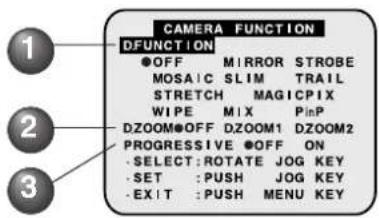
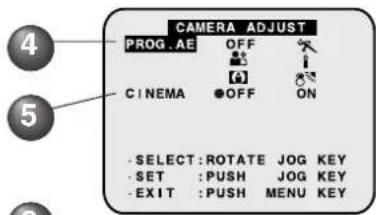
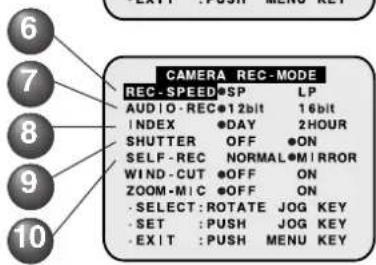
D.FUNCTION (pp.38,40) To select one of the 10 digital functions. Setting to OFF cancels the previously selected digital function.
D.ZOOM (p.37) To select D.ZOOM1 (from 10X to 25X) or D.ZOOM2 (from 10X to 700X). Setting to OFF cancels the previously selected digital zoom.
PROGRESSIVE (p. 18) When set to ON, still pictures taken with PhotoShot are recorded with a higher resolution than with normal PhotoShot.
4 PROG.AE (p.22) To select one of the 5 Program AE modes.Setting to OFF cancels the previously selected Program AE mode.
CINEMA (p.21) When set to ON, you can record a picture compatible with a wide-screen TV equipped with an S2 picture terminal.
REC-SPEED (pp.6,16) SP:Normal recording speed mode. LP: Recording time is 1.5 times as long as in the SP mode. For example, 120 minutes of recording is possible on a 80 minute tape.
AUDIO-REC (p. 41)
12 bit: The sound is recorded in the 12 bit/32 kHz mode.
16 bit: The sound is recorded in the 16 bit/48 kHz high-quality mode.
8 INDEX DAY: An index signal is recorded when recording is restarted after the date has changed since the last recording.
2 HOUR: An index signal is recorded when recording is restarted after a lapse of more than 2 hours.
9 SHUTTER (p. 18) When set to ON, still pictures taken in the PhotoShot mode are recorded with a visual shutter effect and click sound.
SELF-REC (p.20) NORMAL: During self-recording, the picture on the LCD Monitor is the same as it will be when recorded. MIRROR: During self-recording, the picture on the LCD Monitor is horizontally reversed.
MENU OSD
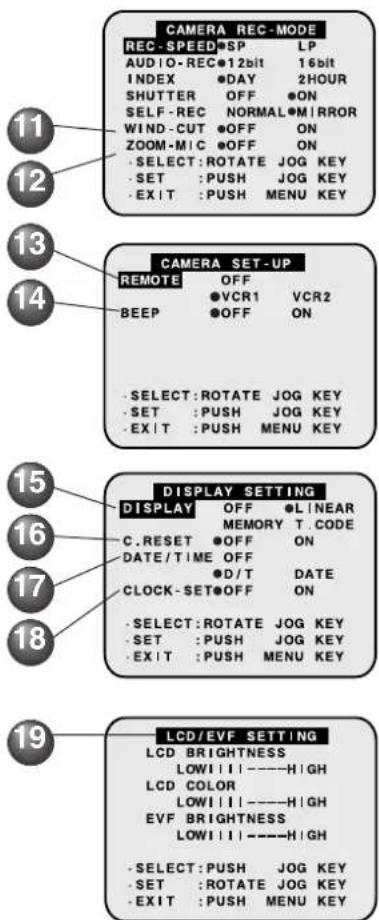
WIND-CUT (p.28) To reduce sound distortion caused by wind hitting the microphone.
12 ZOOM-MIC (p. 19) When set to ON, the microphone's directional angle and sensitivity vary according to the zoom operation.
13 REMOTE (p.9) VCR1: To receive signals from the Remote Control, set to VCR1. VCR2: To receive signals from the Remote Control, set to VCR2. OFF: To prevent reception of signals from the Remote Control.
BEEP Set to ON to hear beep when starting and stopping camera recording or when unusual conditions occur. To cancel the beep, set to OFF. Palmcorder will beep: Once when you start recording Twice when you stop recording Repeatedly when warning of unusual conditions. (p.54)
15 DISPLAY (p. 61) To select the desired type of display and counter indication displayed on the LCD Monitor or in the viewfinder.
16 C.RESET (p. 61) Setting to ON resets the counter to zero.
17 DATE/TIME (p. 60) The date and time can be set and displayed on the screen.
18 CLOCK-SET (p. 14) When set to ON, the date and time can be set on the screen. LCD/EVF SETTING (p. 17) Setting to ON displays the menu for adjusting the LCD brightness, colour level, and the EVF brightnes
MENU OSD
VCR Mode Menu Screen
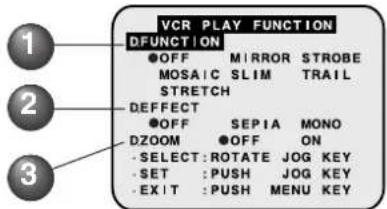
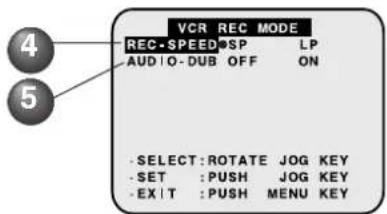
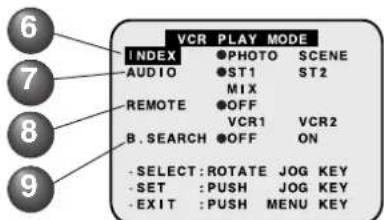
D.FUNCTION (p.40) To select one of the 6 digital functions. Setting to OFF cancels the previously selected digital function.
D.EFFECT (p.40) To select one of the 2 digital picture effects for playback. Setting to OFF cancels the previously selected digital effect.
3 D.ZOOM (p.38) Set to ON to double the size of a playback image. Setting to OFF cancels the previously selected digital zoom.
4 REC-SPEED (p. 6)
SP: Normal recording speed mode.
LP: Recording time is 1.5 times as long as in the SP mode. For example, 120 minutes of recording is possible on an 80 minute tape.
5 AUDIO-DUB (p. 41)
Set to AUDIO-DUB "ON" in the Menu OSD to use the Audio Dub feature.
6 INDEX (pp. 33, 34)
To select the desired Index Search function.
PHOTO: To search for Photo shot pictures.
SCENE: To search for scenes marked with Index signal.
AUDIO (p. 42)
To select the desired audio playback mode after performing audio dubbing in the 12 bit mode (SP mode only).
ST1: The original sound alone is played back.
ST2: The dubbed sound alone is played back.
MIX : The original sound and the dubbed sound are played back together.
8 REMOTE (p. 9)
VCR1: To receive signals from the Remote Control, set to VCR1.
VCR2: To receive signals from the Remote Control, set to VCR2.
OFF: To prevent reception of signals from the Remote Control.
B.SEARCH (Blank Search) (p. 30) Select ON to go directly to a blank portion of the tape.
MENU OSD
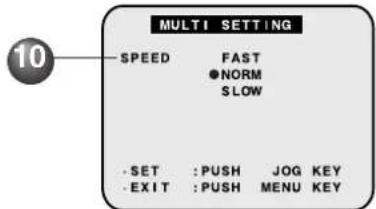
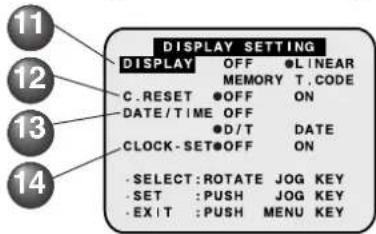
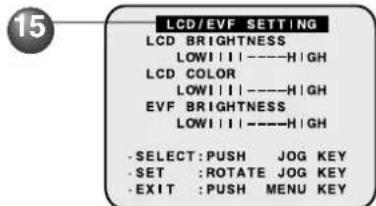
SPEED (p. 35)
In Strobe Multi mode, used to select the interval at which a succession of still screens are captured from the playback picture.
FAST:Every 0.3 seconds
NORM: Every 0.6 seconds
SLOW: Every 1.0 seconds
11 DISPLAY (p.61)
To select the desired type of display and counter indication displayed on the LCD Monitor or in the viewfinder.
12 C.RESET (p. 61)
Setting to ON resets the counter to zero.
13 DATE/TIME (p. 60)
The date and time can be set and displayed on the screen.
14 CLOCK-SET (p. 14)
When set to ON, the date and time can be set on the screen.
15 LCD/EVF SETTING (p. 17)
Setting to ON displays the menu for adjusting the LCD brightness, colour level, and the EVF brightness.
Electronic Viewfinder/LCD Monitor Indications
Here are some of the basic indications which will appear on the Palmcorder EVF and LCD Monitor. Only Date and Time indications will be recorded onto the tape.
CAMERA/VCR Mode
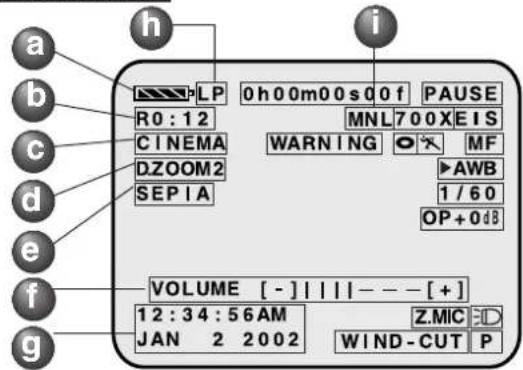

Battery Remaining
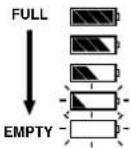

Tape Remaining
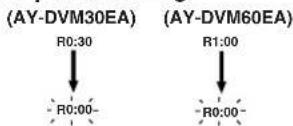
- It will take several seconds for the tape remaining indicator to operate after the tape starts moving.

CINEMA Indication
Menu OSD:p.56

Digital Zoom and other Digital Functions (Menu OSD: p. 56)
This display appears when the digital zoom function has been activated.

Playback Effect (Menu OSD: p. 58) This display appears when SEPIA o MONO is selected in VCR menu.

Volume Display (p. 30)
The volume bar appears when the volume of the built-in speaker is being adjusted.

Date and Time Indication
Menu OSD: pp. 57, 59
As shown below, the date and time indication changes each time DATE/TIME is selected from the Palmcorder's MENU (Menu OSD: pp. 57, 59) or the DATE/TIME Button is pressed on the remote.
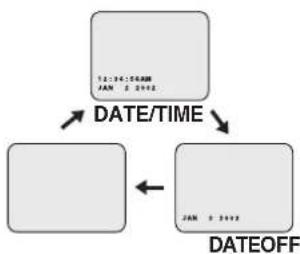

Tape Speed Indication
(Menu OSD:p.56) Indicates the tape speed (SP or LP).

MNL Indication (pp.25-28) This display appears when AUTO/ MANUAL is pressed to MANUAL.
Electronic Viewfinder/LCD Monitor Indications
CAMERA/VCR Mode
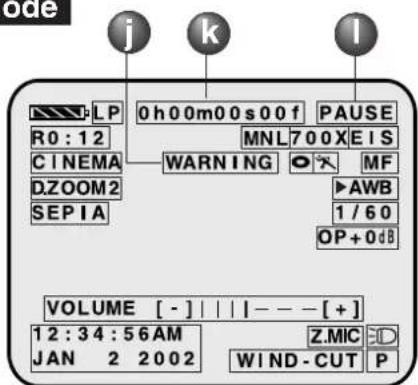

WARNING Indication (p. 54)
The warning displays appear in the EVF and the LCD monitor.

Display ON/OFF and Counter/Time Code
The indication switches as shown below when the desired "DISPLAY" mode is selected from the menu. (Menu OSD: pp. 57, 59)
- When OFF is selected, all displays are turned off.
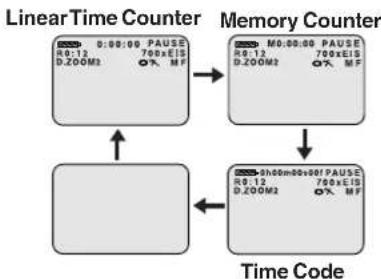
Memory Counter M 0:00:00
The Palmcorder will stop whenever it reaches the point where the counter was previously set to M 0:00:00 during audio dub, fast forward, or rewind.
Time Code 0h00m00s00f
The Palmcorder calculates and displays exactly where you are on any tape in terms of hours, minutes, seconds, and frames (30 frames = 1 second).
- This display cannot be reset.
IMPORTANT NOTE:
- Display must be set to ON for MF, AE, W.BALANCE or BACK LIGHT indications to be displayed on the EVF or LCD Panel when selected.
C. RESET does not work when DISPLAY is set to OFF and T.CODE.

Tape Mode Indications
REC Recording.
PHOTO PhotoShot recording.
PAUSE Paused during recording.
Playback.
Still.
ID> Slow (forward).
Slow (reverse).
Frame Advance (forward).
Frame Advance (reverse).
RRepeatPlayback.
CHK Recording Check.
FF Fast forward.
REW Rewind.
FF Search.
REW Search
BLANK Blank Search.
SEARCH Index Search.
Electronic Viewfinder/LCD Monitor Indications
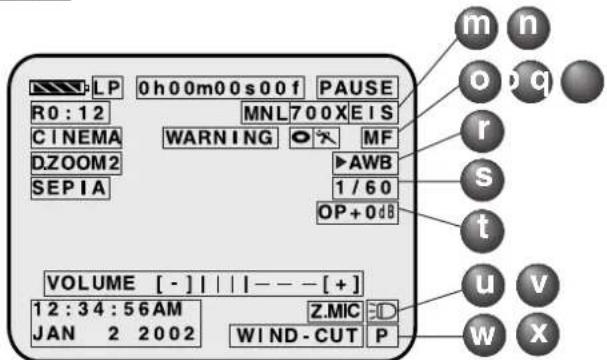
CAMERA/VCR Mode
Zoom Magnification Level (p. 37)
Digital EIS Indications (p. 39) This display appears when EIS is pressed.
Backlight Indication (p. 21) This display appears when BACK LIGHT is pressed.
p PROGRAM-AE Indication (p. 22)
Manual Focus Indication (p. 26)
White Balance Indication (p. 25)
Shutter Mode Indication (p. 27)
Iris Indication (p. 28)
Z.MIC Indication (Menu OSD:p.57) This display appears when ZOOM-MIC is set to ON.
Light Indication (p.8) This display appears when LIGHT is set to ON.
WIND-CUT Indication (Menu QSD:p.57)
This display appears when WIND-CUT is set to ON.
Progressive Indication (Menu OSD:p.56)
This display appears when PROGRESSIVE is set to ON.
Index of Controls
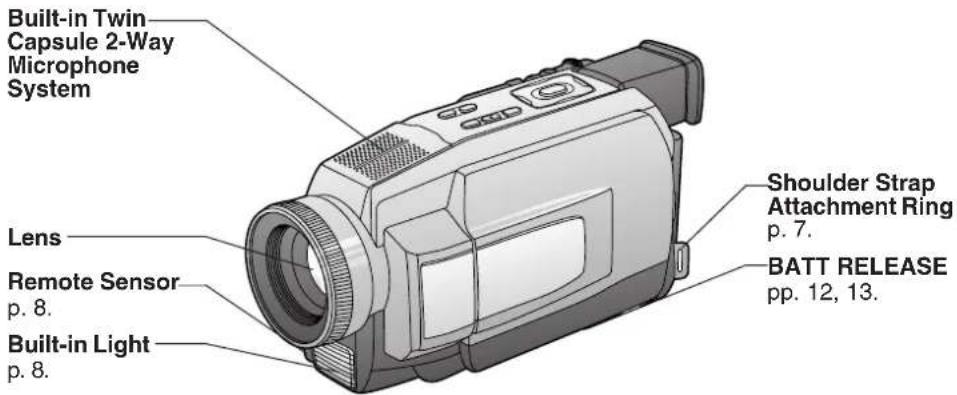
Front View
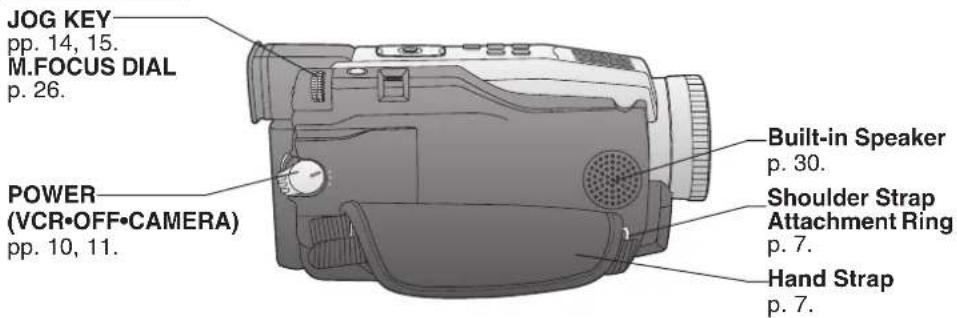
Side View
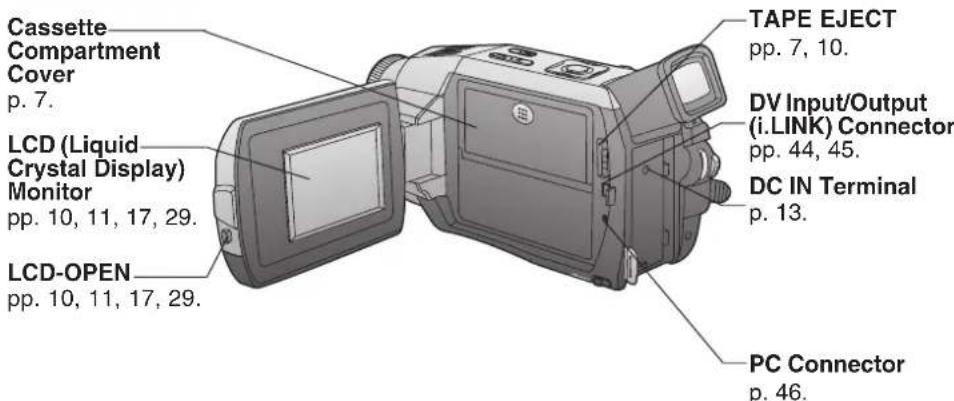
Rear View
Index of Controls
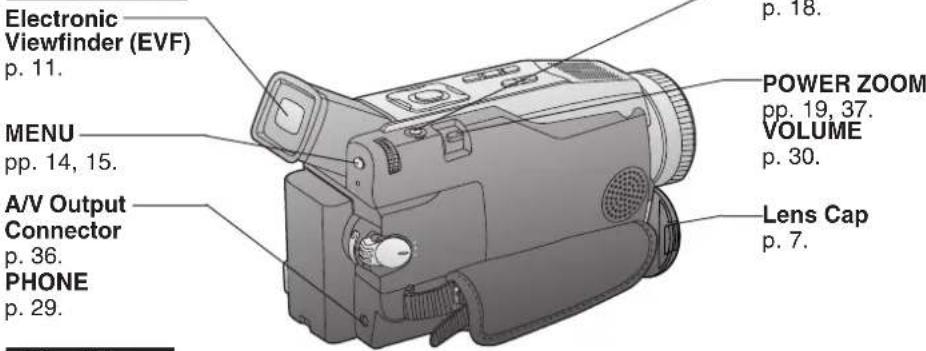
Rear View
Top View
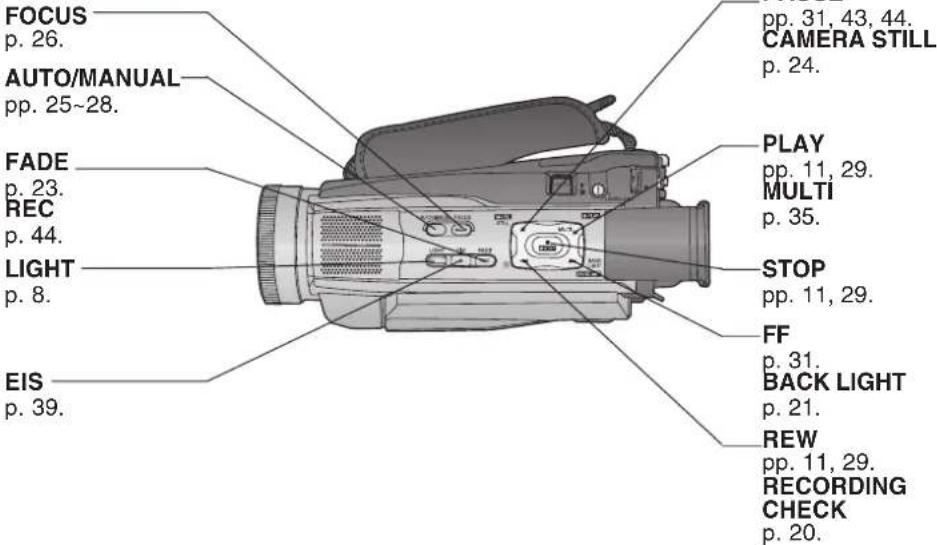
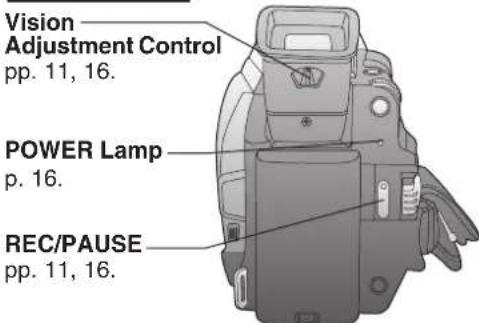
Back View
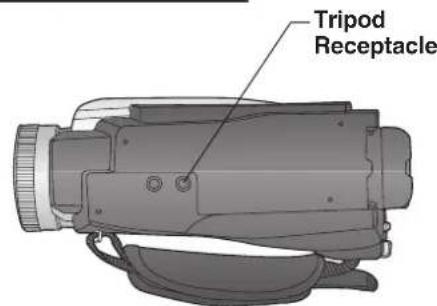
Underside View
Index of Controls
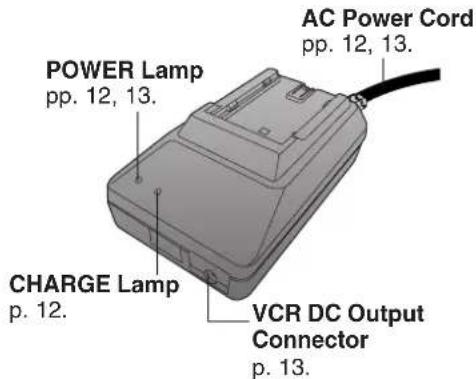
AC Adaptor
CAUTION:
This unit will operate on 110/120/220/240 V AC. An AC plug adaptor may be required for voltages other than 120V AC. Please contact either a local or foreign electrical parts distributor for assistance in selecting an alternate AC plug. We recommend using the accessory power plug adaptor (VJSS0070) in an area which has special AC outlets.
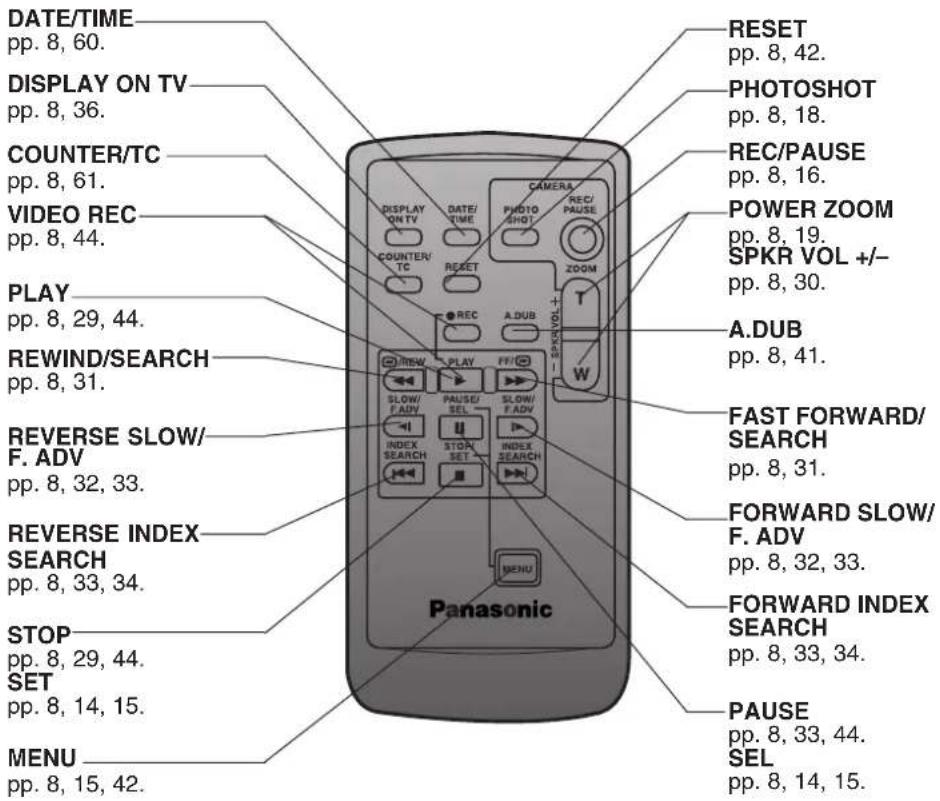
Remote Control
Index
A
AC Adaptor ... 6, 12, 13, 49
AC Cable 6, 12, 13, 49
Accessories (Optional). 49
Accessories (Supplied) ... 6
AV Cable 6,36
Audio Dubbing 41, 42
Audio/Video Fade In/Out 23
B
Backlight 21
Battery 9
Battery Pack. 6, 10, 12, 49
Battery Remaining
Indication 60
Battery Warning 54
Before Requesting Service
52, 53
Blank Search 30
Built-in Light 8
C
CINEMA Mode 21
Cleaning Care for
Video Heads 52
Clock Battery 54
Clock Set 14
Connecting Earphone ... 29
Copying from Digital
Equipment 44
Copying your Tapes .... 43
D
Date and Time Indication
60
DC Power Cable. 6, 13, 49
DEW Indication 54
Digital E.I.S. 39
Digital Functions 40
Digital PhotoShot Mode
18
Digital Video Cassette Tape
6 Digital Zoom 37, 38
DV Interface Cable (i.LINK)
44, 45, 49
E
Easy Cassette Eject 7
Erase Protection Tab..... 6
EVF/LCD Monitor
Indications.. 60~62
F
Fast Forward/Rewind Check
31
Focus 26
Frame by Frame Advance
33
H
Hand Strap 7
High Speed Shutter 27
1
Important Safeguards .... 3
Index of Controls 63-65
Index Search 33, 34
Iris 28
J
Jog Search 34
L
LCD/EVF Setting 17
Lens Cap. 6, 7, 16
Lens Cap Strap 6,7
M
MagicPix Images 38
Memory Counter 61
Memory Stop Editing .... 42
MENUSD 56~59
0
On-Screen Displays (OSD)
54
P
PC Connection 45, 46
PHOTOVU LINK 47, 48
Picture in Picture (PinP)
24
Playback using the LCD
Monitor 29
Precautions 4
Program AE 22
Progressive PhotoShot
Mode 18
Q
Quick Guide 10, 11
R
Rapid Visual Search .... 31
Recording Check 20
Recording Still Pictures
20
Remote Control
6,8,9,49,65
Remote Controlling Two
Palmcorders 9
RepeatPlayback. 30
S
Safety Precautions. 2
Self Recording 20
Shoulder Strap 6,7
Simple Recording ... 16, 17
Slow Motion Playback .. 32
Specifications 51
STILL Picture 31
Strobe Multi Mode 35
Supplying Power .... 12, 13
T
Table of Contents 5
Tape Remaining Indications
60
Tape Speed 6
Tape Warning 54
U
Using the Palmcorder Menu
15
V
Variable Speed Search. 32
VHF Connecting Cable
43
Volume Display 30,60
W
Warranty 55
White Balance 25
WIND-CUT 28
Z
Zoom In/Out 19
Zoom Microphone 19
Panasonic
Panasonic Canada Inc.
5770 Ambler Drive,
Mississauga, Ontario L4W 2T3
(905)624-5010
www.panasonic.ca
Montreal: 3075 Louis A. Amos, Lachine, Quebec H8T 1C4 (514) 633-8684
Toronto: 5770 Ambler Drive, Mississauga, Ontario L4W 2T3 (905) 238-2181
Calgary: 6835 8th Street N.E., Calgary, Alberta T2E 7H7 (403) 295-3922
Vancouver: 12111 Riverside Way, Richmond, BC V6W 1K8 (604) 278-4211

Printed in Japan
LSQT0565A
S0302A0
Directives important 3
Precautions 4
Preparatifs 6
- Insertion/éjection facile de la cassette 7
1 bloc-batterie (CGR-D08/ CGR-D08R)
Mode PhotoShot progressif
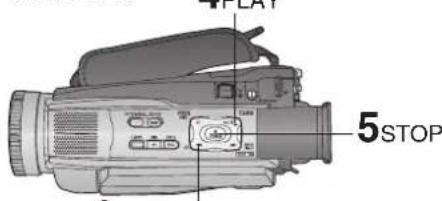
3Rebobinage/Reperage
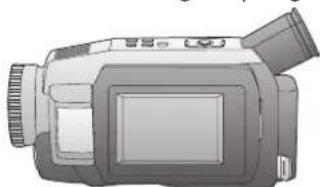
Molette de-selection (JOG KEY)
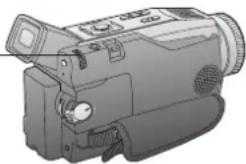
SLIM (Amincissement)
STRETCH (Etiatement)
WIPE (Transition volet)
Panasonic Canada Inc.
5770 Ambler Drive, Mississauga, Ontario L4W 2T3
Certificat de garantie limitee Panasonic
Richmond, British Columbia
Panasonic Canada Inc.
12111 Riverside Way
Richmond, BC V6W 1K8
Tel: (604) 278-4211
Fax: (604) 278-5627
Calgary, Alberta
Panasonic Canada Inc.
6835-8th St. N.E.
Calgary, AB T2E 7H7
Tél.:(403)295-3955
Telec.: (403) 274-5493
Mississauga, Ontario
Panasonic Canada Inc.
5770 Ambler Dr.
Mississauga, ON L4W 2T3
Tél.: (905) 624-8447
Téléç. : (905) 238-2418
Lachine, Quebec
Panasonic Canada Inc.
- rue Louis A.
Amos
Lachine, QC H8T 1C4
SELF-REC (Auto-enregistment)
(Page 20.)
Accessoires (fournis) 6
Adaptateur secteur
6.12,13,49
Cordon c.c. 6, 12, 13, 49
Directives important 3
Mode PhotoShot progressif
18
Mode Stroboscope Multi..35
0
Obturator grande vitesse . 27
P
Pare-vent 28
PHOTOVU LINK 47, 48
Pile 9
Pile de l'horloge 54
Poignée 7
Precautions 4
Protection contre
I'effacement accidentel ... 6
B
Panasonic Canada Inc.
5770 Ambler Drive,
Mississauga, Ontario L4W 2T3
(905)624-5010
www.panasonic.ca
Montreal: 3075 Louis A. Amos, Lachine, Quebec H8T 1C4 (514) 633-8684
Toronto: 5770 Ambler Drive, Mississauga, Ontario L4W 2T3 (905) 238-2181
Calgary: 6835 8th Street N.E., Calgary, Alberta T2E 7H7 (403) 295-3922
Vancouver: 12111 Riverside Way, Richmond, BC V6W 1K8 (604) 278-4211

Imprimé au Japon
LSQT0565A
S0302A0