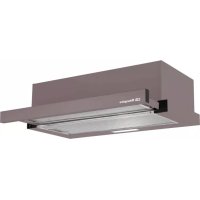
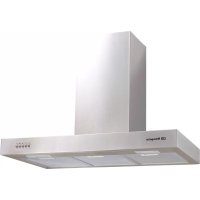
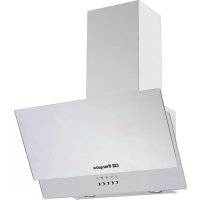
TL 07160 MA - Range hood Orbegozo - Free user manual and instructions
Find the device manual for free TL 07160 MA Orbegozo in PDF.


| Product type | Range hood |
| Brand | Orbegozo |
| Model | TL 07160 MA |
| Dimensions (W x D x H) | 516 x 496 x 38 mm |
| Weight | Approximately 5 kg |
| Power supply | 220-240 V ~ 50 Hz |
| Motor power | Not specified |
| Evacuation type | External extraction or internal recirculation |
| Number of speeds | 2 (low and high) |
| Lighting | LED bulb 2W |
| Filter type | Washable aluminum filter |
| Minimum distance from cooking surface | 65-75 cm |
| Installation | Wall-mounted or under cabinet |
| Maintenance | Clean filters every week, exterior once a month |
| Safety | Automatic shutdown, overheating protection |
| Spare parts | Aluminum filter, LED bulb 2W |
| Repairability | Bulb replacement by qualified technician |
| Warranty | 2 years |
Frequently Asked Questions - TL 07160 MA Orbegozo
User questions about TL 07160 MA Orbegozo
0 question about this device. Answer the ones you know or ask your own.
Ask a new question about this device
Download the instructions for your Range hood in PDF format for free! Find your manual TL 07160 MA - Orbegozo and take your electronic device back in hand. On this page are published all the documents necessary for the use of your device. TL 07160 MA by Orbegozo.
USER MANUAL TL 07160 MA Orbegozo
natural_image
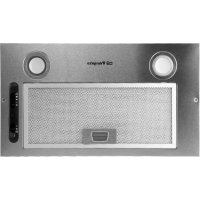
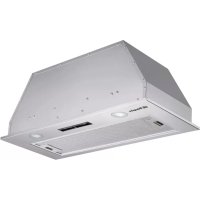
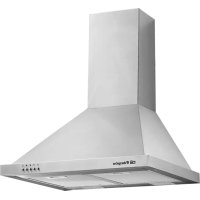
Three views of a kitchen air conditioner unit showing top, front, and side views (no text or symbols visible)TL 07160 BL/IN/MA
Sonifer,S.A.
Read this manual carefully before running this appliance and save it for reference in order to obtain the best results and ensure safe use.
natural_image
Diagram of airflow around a mechanical component with directional arrows indicating movement (no text or symbols)Forma 1:
natural_image
Technical line drawing of a mechanical assembly with no visible text or symbolsnatural_image
Diagram of a ventilation duct with cooling fans and airflow arrows indicating airflow direction (no text or symbols)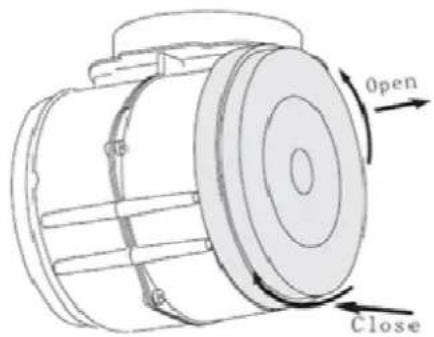
AVISO:
LIMPIEZA Y MANTENIMIENTO
Limpieza regular
natural_image
Technical line drawing of a mechanical assembly with no visible text or symbols
A) Carefully read the following important information regarding installation safety and maintenance. Keep this information booklet accessible for further consultations.
B) The appliance has been designed as a exhausting version(external exhaust)or as a filter version(internal air recycle) cooker hood.
-
This appliance can be used by children aged from 8 years and above and persons with reduced physical, sensory or mental capabilities or lack of experience and knowledge if they have been given supervision or instruction concerning use of the appliance in a safe way and understand the hazards involved. Children must never play with the appliance. Cleaning and user maintenance must never be carried out by children without supervision.
-
Children should be supervised to ensure that they do not play with the appliance.
- Keep the appliance and the cable cord out of the reach of children less than 8 years old.
- WARNING: In order to ensure your children's safety, please keep all packaging (plastic bags, boxes, polystyrene etc.) out of their reach.
- If the supply cord is damaged it must be repaired by the Authorized Service Agent.
- Never pull on the cord when unplugging.
- Do not use the unit with a damaged cord or plug, or if it is not working properly.
-
Do not handle the appliance with wet hands.
-
Never immerse the appliance in water or any other liquid.
-
Make sure the appliance has been unplugged before cleaning.
-
This appliance must be installed following the national regulations for electrical installations.
-
This appliance is for household use only.
-
In case that you need a copy of the instruction manual, you can ask for it writing an email to sonifer@sonifer.es
-
WARNING: In case of misuse, there is a risk of possible injury.
• Take care when the cooker hood is operating simultaneously with an open fireplace or burner that depend on the air in the environment and are supplied by other than electrical energy, as the cooker hood removes the air from the environment which a burner or fireplace need for combustion.
- Risk of fire if the cleaning is not carried out according to instructions.
- Do not flambé under the hood.
- CAUTION: Accessible parts may become hot when used with cooking appliances.
- Exhaust air should not be sent by conductors used to evacuate fumes from equipment powered by gas or other fuel.
- The minimum distance between elements of cooking and the bottom of the hood must be at least 65cm if the hood is installed on a gas cooking element. If installation instructions gas cooking element indicate a greater distance should be taken into account. 65cm distance cannot be reduced.
- The regulations regarding air evacuation must be respected.
- The negative pressure in the environment must not exceed 4 Pa (4*10-5 bar).
- Provide adequate ventilation in the environment for a safe operation of the cooker hood.
- Follow the local laws applicable for external air evacuation. Appliance shall only be used with rated voltage and frequency.
- Do not check the status of the filters while the cooker hood is operating.
- Do not touch the light bulbs after appliance use.
- Flame cooking is prohibited underneath the cooker hood.
- Constantly check food frying to avoid that the overheated oil may become a fire hazard.
WARNING
The lamps of this cooker hood are designed as supplementary illumination when cooking. They are not suitable for household illumination
INSTALLATION
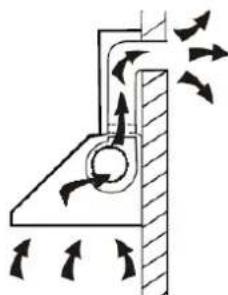
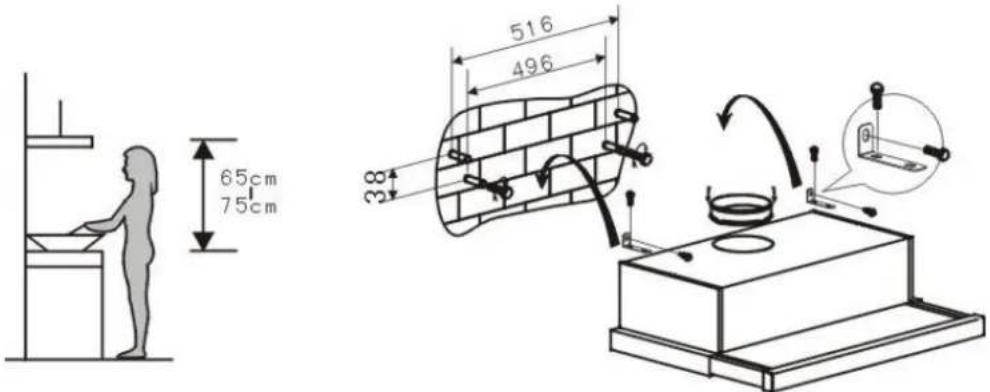
If you have an air outlet to the outside, your hood can be connected as the figure below with a pull-out tube.
natural_image
Diagram of airflow around a mechanical component with directional arrows indicating movement (no text or symbols)Way one:
- The cooker hood should be placed at a distance of 65-75cm from the cooking surface for best effect.
- To install onto the wall drill 4 holes of 8mm diameter on a suitable place according with the centre distance of hole in the back of the cooker hood.
- Insert the nut into the holes.
- Insert the screws into the nuts and tight them.
- Put up the cooker hood onto the fixed screws.
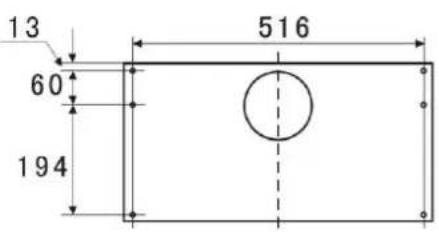
Way two:
- Drill 6 holes of 4mm of diameter at the bottom of the hanging cupboard.
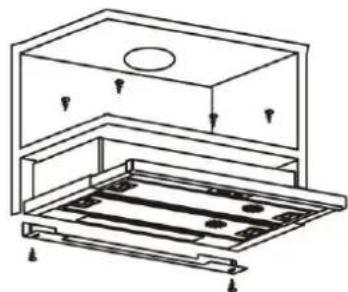
- Put the one way valve on the cooker hood, then install the cooker hood on the bottom of the cupboard, tighten the hood with enclosed 6 screws.
- Install the adjusted board on the bottom of the hood in order to keep out the gap between hood back and cupboard.
natural_image
Technical line drawing of a mechanical assembly with no visible text or symbolsOPERATION
- Connect the plug into the power.
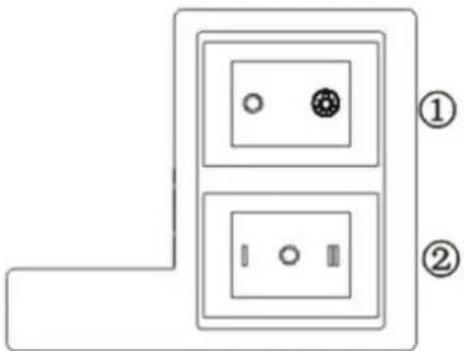
- Push the switch 1 into ⚙ position, the lamp will be on; push into "0" to switch off the lamp.
- Push the switch 2 into "I" to select low speed or to "II" to select high speed; "0" position the motor will switch off.
- The cooker hood will work at low or high speed when you pull out the front panel.
CLEANING AND MAINTENANCE
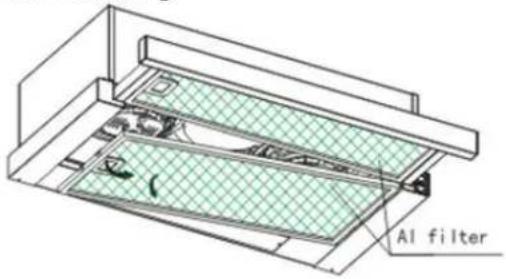
Disassembly and cleaning of aluminium filters.
- Follow this guide correctly to clean the filters.
- Press the filter lock button and pull down.
- Soak the filter in water, add detergent and leave it for 2-3 minutes. After cleaning with a brush, do not apply too much pressure, the filter is delicate and could easily be damaged.
- You can also wash the filters in the dishwasher at 60^ C.
- The filter is made of aluminium so it is advisable not to use aggressive cleaners that can corrode it.
- Make sure the hood if off when cleaning.
Regular cleaning
- Clean the aluminium filters weekly. This will prevent the risk of fire. As the filter collects grease, smoke and dust, it affects the efficiency of the hood. If the filters are not cleaned the grease can clog them.
Cleaning the hood
- To protect the hood body from corrosion, you should clean the outside of the hood with hot water and non-abrasive detergent every month. To do this, moisten a cloth with that water and clean the hood.
- Take care not to wet the engine and other interior parts, this could damage the hood.
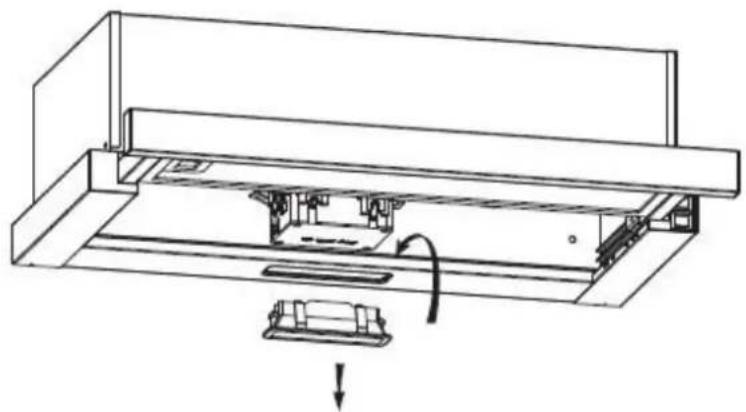
Changing the bulb
- Turn off and unplug the hood.
- Wait until the bulb has cooled before changing it.
- Use the same type of bulb, LED 2W.
- The bulb change should be performed by a qualified technician.
natural_image
Technical line drawing of a mechanical assembly with a component and directional arrow (no text or symbols)
Disposal of old electrical appliances.
The European directive 2002/96/EC on Waste Electrical and Electronic Equipment (WEEE), requires that old household electrical appliances must not be disposed of in the normal unsorted municipal waste stream. Old appliances must be collected separately in order to optimize the recovery and recycling of the materials they contain, and reduce the impact on human health and the environment. The crossed out “wheeled bin” symbol on the product reminds you of your obligation, that when you dispose of the appliance, it must be separately collected.
Consumers should contact their local authority or retailer for information concerning the correct disposal of their old appliance.
DECLARATION OF CONFORMITY: This device complies with the requirements of the Low Voltage Directive 2014/35/EU and the requirements of the EMC directive 2014/30/EU.
FRANÇAIS
AVERTISSEMENTS DE SÉCURITÉ
natural_image
Diagram of airflow around a mechanical component with directional arrows indicating movement (no text or symbols)Voie une:
natural_image
Technical line drawing of a mechanical assembly with no visible text or symbolsOPÉRATION
natural_image
Diagram of two electrical outlets with circular components and labeled parts (no text or symbols beyond labels)NETTOYAGE ET ENTRETIEN
Nettoyage régulier
natural_image
Technical line drawing of a mechanical assembly with a component and directional arrow (no text or symbols)
natural_image
Diagram of airflow around a mechanical component with directional arrows indicating movement (no text or symbols)natural_image
Technical line drawing of a mechanical assembly with mounting holes and internal components (no text or symbols)OPERAÇÃO
natural_image
Diagram of two electrical outlets with circular components and labeled parts (no text or symbols beyond labels)Limpieza regular
- Limpie os filtros de alumínio semanalmente. Con ello prevendrá o risco de incendio. Como o filtro recolhe o grasa, o humo eo pó, afecta a eficiência da campa. Si no se limpian los filtros la grasa puede obstruirlos.
natural_image
Technical line drawing of a mechanical assembly with a component and directional arrow (no text or symbols)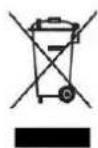
- TL 07160 BL/IN/MA
- Forma 1:
- AVISO:
- LIMPIEZA Y MANTENIMIENTO
- Limpieza regular
- WARNING
- INSTALLATION
- Way one:
- Way two:
- OPERATION
- CLEANING AND MAINTENANCE
- Regular cleaning
- Cleaning the hood
- Changing the bulb
- Disposal of old electrical appliances.
- FRANÇAIS
- AVERTISSEMENTS DE SÉCURITÉ
- Voie une:
- OPÉRATION
- NETTOYAGE ET ENTRETIEN
- Nettoyage régulier
- OPERAÇÃO
Brand : Orbegozo
Model : TL 07160 MA
Category : Range hood