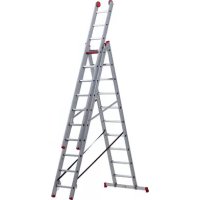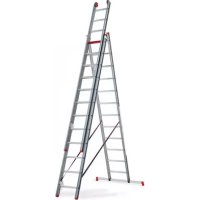
Atlantis ATR 3077 - Ladder Altrex - Free user manual and instructions
Find the device manual for free Atlantis ATR 3077 Altrex in PDF.

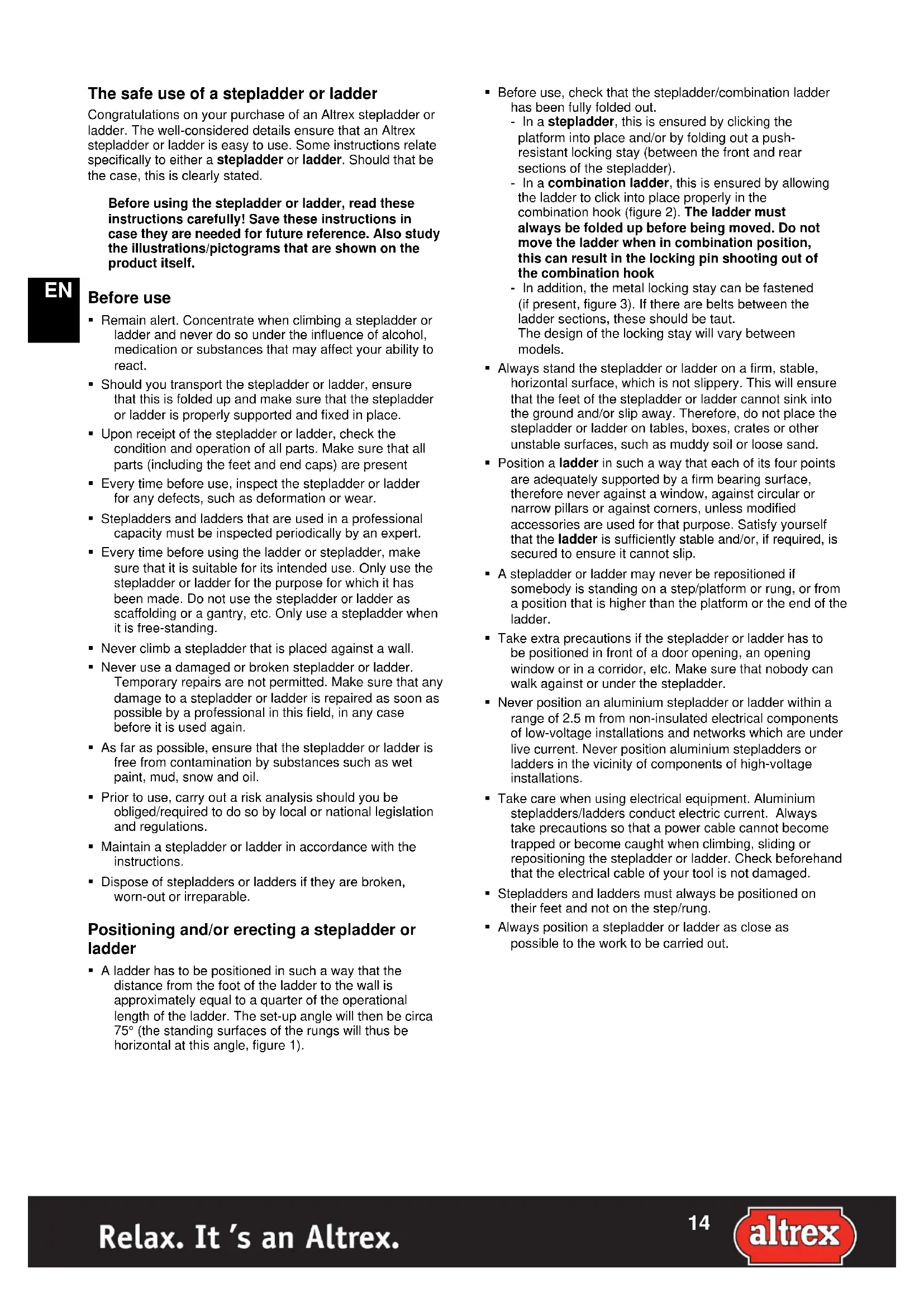


| Technical features | Aluminum ladder, maximum height of 7.7 meters, load capacity of 150 kg. |
|---|---|
| Usage | Ideal for working at height, renovations, and outdoor maintenance. |
| Maintenance and repair | Regularly check the condition of the rungs and fastenings, clean with a damp cloth. |
| Safety | Use only on flat surfaces, respect the load capacity, wear non-slip shoes. |
| General information | 5-year warranty, compliant with European safety standards. |
Frequently Asked Questions - Atlantis ATR 3077 Altrex
User questions about Atlantis ATR 3077 Altrex
0 question about this device. Answer the ones you know or ask your own.
Ask a new question about this device
Download the instructions for your Ladder in PDF format for free! Find your manual Atlantis ATR 3077 - Altrex and take your electronic device back in hand. On this page are published all the documents necessary for the use of your device. Atlantis ATR 3077 by Altrex.
USER MANUAL Atlantis ATR 3077 Altrex
Congratulations on your purchase of an Altrex stepladder or ladder. The well-considered details ensure that an Altrex stepladder or ladder is easy to use. Some instructions relate specifically to either a stepladder or ladder. Should that be the case, this is clearly stated.
Before using the stepladder or ladder, read these instructions carefully! Save these instructions in case they are needed for future reference. Also study the illustrations/pictograms that are shown on the product itself.
EN
Before use
- Remain alert. Concentrate when climbing a stepladder or ladder and never do so under the influence of alcohol, medication or substances that may affect your ability to react.
- Should you transport the stepladder or ladder, ensure that this is folded up and make sure that the stepladder or ladder is properly supported and fixed in place.
- Upon receipt of the stepladder or ladder, check the condition and operation of all parts. Make sure that all parts (including the feet and end caps) are present
- Every time before use, inspect the stepladder or ladder for any defects, such as deformation or wear.
- Stepladders and ladders that are used in a professional capacity must be inspected periodically by an expert.
- Every time before using the ladder or stepladder, make sure that it is suitable for its intended use. Only use the stepladder or ladder for the purpose for which it has been made. Do not use the stepladder or ladder as scaffolding or a gantry, etc. Only use a stepladder when it is free-standing.
- Never climb a stepladder that is placed against a wall.
- Never use a damaged or broken stepladder or ladder. Temporary repairs are not permitted. Make sure that any damage to a stepladder or ladder is repaired as soon as possible by a professional in this field, in any case before it is used again.
- As far as possible, ensure that the stepladder or ladder is free from contamination by substances such as wet paint, mud, snow and oil.
- Prior to use, carry out a risk analysis should you be obliged/required to do so by local or national legislation and regulations.
- Maintain a stepladder or ladder in accordance with the instructions.
- Dispose of stepladders or ladders if they are broken, worn-out or irreparable.
Positioning and/or erecting a stepladder or ladder
-
A ladder has to be positioned in such a way that the distance from the foot of the ladder to the wall is approximately equal to a quarter of the operational length of the ladder. The set-up angle will then be circa 75^ (the standing surfaces of the rungs will thus be horizontal at this angle, figure 1).
-
Before use, check that the stepladder/combination ladder has been fully folded out.
In a stepladder, this is ensured by clicking the platform into place and/or by folding out a push-resistant locking stay (between the front and rear sections of the stepladder).
- In a combination ladder, this is ensured by allowing the ladder to click into place properly in the combination hook (figure 2). The ladder must always be folded up before being moved. Do not move the ladder when in combination position, this can result in the locking pin shooting out of the combination hook
- In addition, the metal locking stay can be fastened (if present, figure 3). If there are belts between the ladder sections, these should be taut.
The design of the locking stay will vary between models.
- Always stand the stepladder or ladder on a firm, stable, horizontal surface, which is not slippery. This will ensure that the feet of the stepladder or ladder cannot sink into the ground and/or slip away. Therefore, do not place the stepladder or ladder on tables, boxes, crates or other unstable surfaces, such as muddy soil or loose sand.
- Position a ladder in such a way that each of its four points are adequately supported by a firm bearing surface, therefore never against a window, against circular or narrow pillars or against corners, unless modified accessories are used for that purpose. Satisfy yourself that the ladder is sufficiently stable and/or, if required, is secured to ensure it cannot slip.
- A stepladder or ladder may never be repositioned if somebody is standing on a step/platform or rung, or from a position that is higher than the platform or the end of the ladder.
Take extra precautions if the stepladder or ladder has to be positioned in front of a door opening, an opening window or in a corridor, etc. Make sure that nobody can walk against or under the stepladder. - Never position an aluminium stepladder or ladder within a range of 2.5m from non-insulated electrical components of low-voltage installations and networks which are under live current. Never position aluminium stepladders or ladders in the vicinity of components of high-voltage installations.
Take care when using electrical equipment. Aluminium stepladders/ladders conduct electric current. Always take precautions so that a power cable cannot become trapped or become caught when climbing, sliding or repositioning the stepladder or ladder. Check beforehand that the electrical cable of your tool is not damaged. - Stepladders and ladders must always be positioned on their feet and not on the step/rung.
- Always position a stepladder or ladder as close as possible to the work to be carried out.
Extending ladder, rope-operated ladder (or combination ladder as an extending ladder)
- When using a combination ladder as an extending ladder, ensure that your feet do not catch in any nylon belts that are present.
- By preference, slide an extending ladder out against a wall up to the required height.
- Ensure for multi-section ladders that the hooks properly grip onto or under (rope-operated ladders) the rungs.
- Check the locking of the various ladder sections before climbing the ladder (figure 4).
- The hooks are fitted with a locking catch. Always lock this locking catch and unlock it only for sliding the sections in and out. The locking catch is to ensure that the ladder does not slide out by accident.
- Make sure that it is only possible to climb the ladder from the extended side (except for rope-operated ladders).
- Make sure that the correct sequence is followed when sliding out the ladder: unlock the upper section of the ladder, slide it out to the required height and then lock it into place. If the ladder has 3 sections, repeat this procedure with the middle section.
- Always slide in the middle section of the ladder first of all (unlock, slide in, lock) and then the upper section of the ladder (unlock, slide in, lock). Pay particular attention to ensuring that the ladder sections are locked and unlocked at the right time.
- When the rope-operated ladder is used, the loose end of the lifting cord should be secured (when in the in-use position) to at least two rungs, where possible vertically below the lifting installation.
Use of the stepladder or ladder
- Never load a stepladder or ladder in excess of 150kg (= a person climbing the stepladder or ladder including any "baggage").
- When carrying out work, always keep both feet on a step/rung of the stepladder or ladder and always face the ladder/stepladder. Never stand, for example, with just one foot on the stepladder or ladder and the other foot resting on a window frame. Never reach or lean too far to the side when working on a stepladder or ladder (max. 1 arm length). If the centre of gravity is moved from the centre of the stepladder or ladder, this can become unstable and can collapse (rule of thumb: keep your navel between the uprights of the stepladder or ladder). If necessary, reposition the stepladder or ladder more frequently.
- Do not use a stepladder or combination ladder (in the A position) to access other (higher) levels.
- Only use the ladder (single, extending, rope-operated) to access a higher level with safety devices in place (for example, ladder safety step to access a roof/securing to an object).
- Never step sideways off a ladder.
- Never climb a ladder any higher than the red rung or never higher than the 4th rung from the top (the maximum safe standing height, figure 5).
- Never climb a stepladder without a supporting bracket higher than the 3rd step from the top.
- Always climb a ladder in the A position on the side on which the standing position of the rung is horizontal, therefore, not on the side with arched beams or the stabiliser (figure 7).
-
Never stand astride the ladder (figure 8).
-
Never slide a 3-section ladder in the A position out further than the red rung to the hinge point (figure 3).
-
Never climb a 3-section ladder in the A position further than to the hinge point (figure 6).
-
For a 3-section combination ladder, the following applies:
- Stepladder/ladders may only be used for light work and for short periods of time.
- If there is an unavoidable risk of direct contact with electricity, do not use this stepladder or ladder!
- Do not use a stepladder or ladder outdoors in high winds (force 6) or other unfavourable weather conditions.
- Never leave a stepladder or ladder unsupervised that has already been set up for use. Think about (playing) children.
- When possible, close windows and doors (not emergency exits) in the immediate vicinity of the work.
- Climb the stepladder or ladder when you have at least one hand free. When ascending/descending the stepladder or ladder, hold on properly. This should always be done while facing the stepladder or ladder.
- Do not use the stepladder or ladder as a bridge from which work is carried out.
- Wear sensible footwear to avoid slipping and/or painful knocks.
- Do not stand on a stepladder or ladder for long periods without taking regular breaks. Tiredness is a risk!
- Use a ladder of the correct length. The ladder should project by at least one metre above the required standing or step-over height (figure 9).
- Any tools that are used while standing on a stepladder or ladder have to be light and easy to use.
- Avoid any work that could cause sideways pressure on the stepladder/combination ladder, such as drilling into hard stone. This can cause the stepladder/combination ladder to tip over.
- While working, hold onto the stepladder or ladder with at least one hand, or take precautions if it is not possible to hold on.
- No more than one person should stand on a stepladder or ladder at the same time.
- Never stand on the supporting bracket of the stepladder.
- Never reposition the stepladder or ladder while somebody is standing on it.
- Never use a stepladder back to front or upside down. Only climb a single-sided stepladder on one side. Never stand on the rear frame! The side which can be climbed is recognisable by the horizontal steps. A double-sided stepladder can be climbed from either side.
- Never use a ladder back to front or upside down. The position of the ladder will be evident from the standing surfaces of the rungs that should be horizontal.
- Some ladders are fitted with a stabiliser which is supplied separately. Fit this, prior to use, in accordance with the enclosed instructions.
Additional safety instructions when using stepladders/ladders
- Never wear baggy clothing or jewellery. These could become caught when ascending or descending the stepladder or ladder which could lead to a fall.
-
Frequently check that the feet are not worn. Worn feet may damage the support surface, or can result in the stepladder or ladder slipping.
-
In the interest of personal safety, only use accessories or aids that have been recommended by Altrex.
- Do not leave any tools or other equipment at the bottom of the stepladder or ladder which you might trip over.
- Should a stepladder or ladder weigh more than 25kg , this should be lifted by two people.
- Store the ladder/stepladder in a dry place, out of the full sun, and far away from work which could potentially damage the ladder/stepladder (i.e. welding, grinding, demolition work, etc.).
Assembly and/or repair or replacement parts
Replacement parts supplied by Altrex must be assembled on the correct Altrex product and in the same way as the part that is replaced. Assembly (attachment) and/or repair is effectuated at the own risk and expense of the client. Altrex is not liable for damage caused by incorrect assembly and/or repair. Against payment, Altrex can be called in for the repair of your product, and/or the assembly of the parts in question.
Warranty conditions
This Altrex product has been designed, manufactured and tested with the greatest care. Should this product be used in accordance with the instructions and its intended use, a warranty will apply under the following conditions (the warranty period is indicated on the sticker at the side of our products):
1) Altrex guarantees the reliability of the product and the quality of the materials used for the product.
2) We will rectify any defects that are covered by the warranty by replacing the defective part, or the product itself, or by supplying a part for replacement.
3) Not covered by the warranty are any defects that occur as a result of the following:
a) Use of the product contrary to its intended use or contrary to the instructions for use
b) Normal wear and tear of the product.
c) Assembly or repair by the client or by third parties (with the exception of fitting the spare parts provided by Altrex as indicated above under point 2).
d) Any modified governmental regulations concerning the nature or quality of the material used in the product.
4) Any defects that are found upon the delivery of the product should be reported immediately to Altrex. Should notification of these defects not take place immediately, the warranty will be null and void. To make a claim under the warranty, Altrex or your Altrex dealer has to be provided with the proof of purchase.
5) Any defects of the product have to be reported to Altrex or your Altrex dealer as soon as possible, but in any case within 14 days of the defect being found.
6) a) Should a claim be made under the warranty conditions, Altrex has to have the opportunity to be able to investigate the product in its Quality Centre. The client must make the product available for this purpose. Should it be established during the investigation that the product has been used incorrectly, the costs of the investigation will be charged to the client.
b) Should the client ask for an investigation to be carried out by an independent institute, the costs for this investigation are at the expense of the client should it be established during the investigation that the product has been used incorrectly. The costs of
the investigation are also at the expense of the client if, prior to this investigation, Altrex offered to repair or to replace the product at no charge to the client.
Checklist inspection and checks before use
Ladders
- Check that the stiles (uprights) are not bent, bowed, twisted, dented, cracked, corroded or rotten.
- Check that the stiles around the fixing points and other components are in good condition.
- Check that fixings (usually rivets, screws or bolts) are not missing, loose, or corroded.
- Check that rungs are not missing, loose, excessively worn, corroded or damaged.
- Check that the rung hooks are not missing, damaged, loose or corroded and engage properly on the rungs.
- Check that guide brackets are not missing, damaged, loose or corroded and engage properly on the mating stile.
- Check that rubber feet / end caps are not missing, loose, excessively worn, corroded or damaged.
- Check that the entire ladder is free from contaminants (e.g. dirt, mud, paint, oil or grease).
- Check that locking catches (if fitted) are not damaged or corroded and function correctly.
Note: If any of the above Checks cannot be fully satisfied you should NOT use the ladder.
Stepladders
- Check that the front stiles and rear legs are not bent, bowed, twisted, dented, cracked, corroded or rotten.
- Check that the stiles / legs around the fixing points and other components are in good condition.
- Check that fixings (usually rivets, screws or bolts) are not missing, loose, or corroded.
- Check that treads are not missing, loose, excessively worn, corroded or damaged.
- Check that the hinges between front and rear sections are not damaged, loose or corroded.
- Check that the locking stays, horizontal back rails and corner braces are not missing, bent, loose, corroded or damaged.
- Check that rubber feet are not missing, loose, excessively worn, corroded or damaged.
- Check that the entire stepladder is free from contaminants (e.g. dirt, mud, paint, oil or grease).
- Check that the platform (if fitted) has no missing parts or fixings and is not damaged or corroded.
Note: If any of the above Checks cannot be fully satisfied you should NOT use the stepladder.