COA297 - Smoke detector ALECTO - Free user manual and instructions
Find the device manual for free COA297 ALECTO in PDF.



| Features | Details |
|---|---|
| Product type | Smoke detector |
| Power supply | 9V battery |
| Sensor | Photoelectric |
| Alarm sound level | 85 dB |
| Low battery indicator | Yes |
| Installation | Wall or ceiling mounting |
| Function test | Built-in test button |
| Dimensions | Diameter: 10 cm, Thickness: 3.5 cm |
| Weight | 300 g |
| Safety standards | Compliant with EN 14604 standard |
| Battery life | About 1 year |
| Warranty | 2 years |
Frequently Asked Questions - COA297 ALECTO
User questions about COA297 ALECTO
0 question about this device. Answer the ones you know or ask your own.
Ask a new question about this device
Download the instructions for your Smoke detector in PDF format for free! Find your manual COA297 - ALECTO and take your electronic device back in hand. On this page are published all the documents necessary for the use of your device. COA297 by ALECTO.
USER MANUAL COA297 ALECTO
text_image
60 minimum Space without air flow 60 minimum 1,5mVERMIJD DE VOLGENDE PLAATSEN VOOR MONTAGE:
ALARMWEERGAVE BIJ ACTIEF ALARM:
SENSOR FOUT INSPECTIE:
natural_image
Symbol of a trash bin crossed with a diagonal line, no text or numbers presentGENERAL:
VOUS NE POUVEZ PAS VOIR, NI SENTIR OU GOUTER LE MONOXYDE DE CARBONE ET CELA PEUT ÊTRE FATAL.
text_image
Diagram illustrating a multi-level home and daily living room layout with icons for work, dining, shower, car, and bathroom.
Recommended

Optional

Do not use
text_image
60 minimum Space without air flow 60 minimum 1,5mENDROITS DECONSEILLES POUR LE MONTAGE:
INFORMATION D'INSTALLATION:
INFORMATION INDICATION DES PILES:
DECLARATION DE CONFORMITE:
natural_image
Symbol of a trash bin crossed with no text or numbers, representing waste sorting or disposal (no text present)ALLGEMEIN:
natural_image
Symbol of a trash bin crossed with a diagonal line, no text or numbers presentGENERAL:
YOU CANNOT SEE, SMELL OR TASTE CARBON MONOXIDE AND IT CAN BE FATAL.
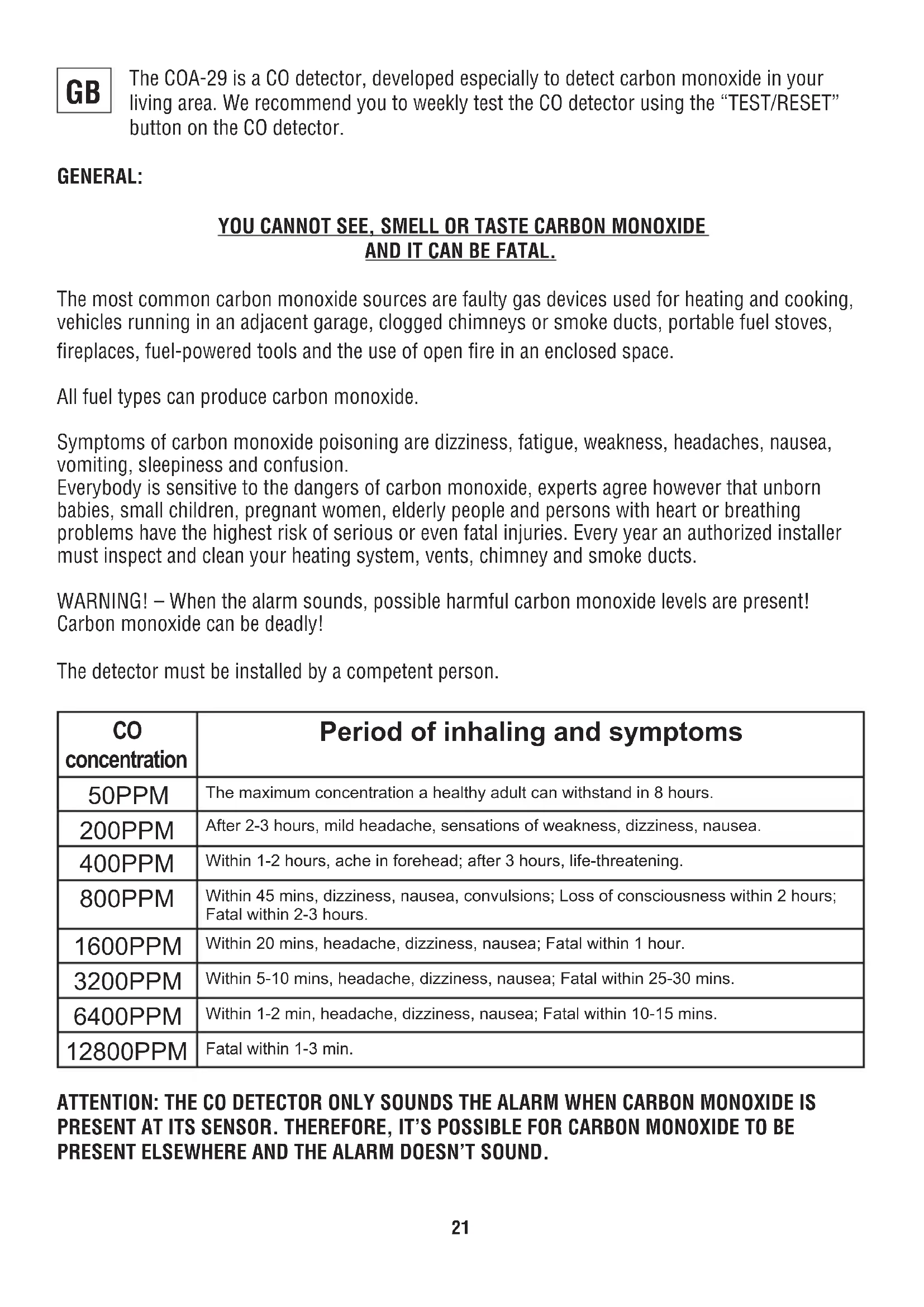
The most common carbon monoxide sources are faulty gas devices used for heating and cooking, vehicles running in an adjacent garage, clogged chimneys or smoke ducts, portable fuel stoves, fireplaces, fuel-powered tools and the use of open fire in an enclosed space.
All fuel types can produce carbon monoxide.
Symptoms of carbon monoxide poisoning are dizziness, fatigue, weakness, headaches, nausea, vomiting, sleepiness and confusion.
Everybody is sensitive to the dangers of carbon monoxide, experts agree however that unborn babies, small children, pregnant women, elderly people and persons with heart or breathing problems have the highest risk of serious or even fatal injuries. Every year an authorized installer must inspect and clean your heating system, vents, chimney and smoke ducts.
WARNING! – When the alarm sounds, possible harmful carbon monoxide levels are present! Carbon monoxide can be deadly!
The detector must be installed by a competent person.
| CO concentration | Period of inhaling and symptoms |
| 50PPM | The maximum concentration a healthy adult can withstand in 8 hours. |
| 200PPM | After 2-3 hours, mild headache, sensations of weakness, dizziness, nausea. |
| 400PPM | Within 1-2 hours, ache in forehead; after 3 hours, life-threatening. |
| 800PPM | Within 45 mins, dizziness, nausea, convulsions; Loss of consciousness within 2 hours; Fatal within 2-3 hours. |
| 1600PPM | Within 20 mins, headache, dizziness, nausea; Fatal within 1 hour. |
| 3200PPM | Within 5-10 mins, headache, dizziness, nausea; Fatal within 25-30 mins. |
| 6400PPM | Within 1-2 min, headache, dizziness, nausea; Fatal within 10-15 mins. |
| 12800PPM | Fatal within 1-3 min. |
ATTENTION: THE CO DETECTOR ONLY SOUNDS THE ALARM WHEN CARBON MONOXIDE IS PRESENT AT ITS SENSOR. THEREFORE, IT'S POSSIBLE FOR CARBON MONOXIDE TO BE PRESENT ELSEWHERE AND THE ALARM DOESN'T SOUND.
This CO detector is not a replacement for smoke, fire or other detectors.
This detector cannot protect people with special medical conditions and might not prevent any chronic health effects of carbon monoxide on the body. This is not a replacement for the correct installation, use and periodic maintenance of combustion equipment, nor adequate ventilation of spaces in which these devices are being used.
RECOMMENDED POSITIONING FOR THE COA-29:
- Install the CO detector in a bedroom, a hallway near the bedroom or the area near a combustion device (boiler, water heater, gas stove, etc.). Check whether the alarm can be heard inside bedrooms.
- In houses with multiple floors, it's recommended to install a CO detector on each floor.
- Install the CO detector at least 2 meters away from combustion devices, within the air flow from the combustion device. In the case of smaller spaces (<4m ^3 ), the detector should be installed outside these spaces.
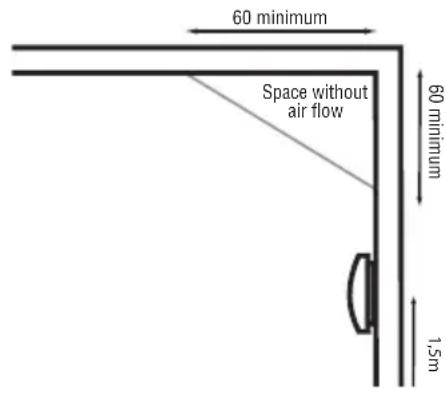
- Install the CO detector in spaces without open combustion devices, preferably 1.50m above the floor and outside spaces without air flow. In bedrooms, install the detector at ‘face height while sleeping’.
• Install the detector on a spot where the weekly check can be performed easily.
AVOID THE FOLLOWING PLACES FOR INSTALLATION:
- Never install the CO detector in spaces without air flow, such as roof ridges, arched ceilings or front roofs.
- Never install the CO detector in the turbulent air from ceiling fans, nor place it near vents with fresh air or close to doors and windows opening to the outside.
- Keep the CO detector away from extremely dusty, dirty or greasy spaces such as kitchens, garages and heating spaces < 4m^3 or pantries. Dust, grease and household chemicals can affect the sensor.
- Install the CO detector at least 0.5 meters away from gas discharge lamps (halogen) because of electronic interferences that can lead to false alarms.
- Keep the CO detector away from humid and wet spaces. Do not use spray cans near the CO detector.
- Never install the CO detector in spaces with temperatures lower than 0^ C or higher than 45^ C, and the humidity higher than 90%RH.
- Never install the CO detector behind curtains or furniture. Carbon monoxide must be able to reach the sensor to ensure the sensor can properly detect carbon monoxide levels. NEVER place the CO detector flat on a table or similar surface.
INSTALLATION INFORMATION:
Install the dector on a wall using plugs and screws or place it on a table. Insert the batteries into the detector. The Status LED will briefly illuminate, the detector will emit a short beep tone and the display briefly lights up. Now install the detector onto the mounting place and press the detector down until correctly fastened. You can perform the first test by briefly pressing the test button, see also paragraph “Testing and reset”.
USE:
The CO detector starts functioning after installing the batteries (High Energy Alkaline batteries 1.5V AA - LR6) and mounting the CO detector on the wall. The unit can only be placed onto the mounting plate with the batteries in place. The green “POWER” LED will flash every 40 seconds to indicate that the detector is working. When the sensor indicates an empty battery the detector emits a short beep tone every minute, you should replace the batteries as soon as possible. When these warnings start, the detector will continue to function correctly for at least 7 days. The table below shows when the detector will sound the alarm.
| CO concentration | NO ALARM for | ALARM for |
| 33PPM 120 min. | - | |
| 55PPM 60 min. 90 min. | ||
| 110PPM 10 min. 40 min. | ||
| 330PPM - 3 min. |
In accordance to the EN50291 standard.
When the alarm sounds, it must turn off within 6 seconds after moving the detector to a space with a CO concentration below 40PPM.
The detector will automatically perform an error check.
BATTERY INFORMATION INDICATION:
The battery is checked automatically.
The green power LED will flash every 40 seconds for as long as the battery power is higher than 3.5 Volts. This means the battery capacity is sufficient. As soon as the battery power drops below 3.5 Volts, a beep tone will be emitted when the green LED flashes briefly. At that time, please replace the batteries as soon as possible.
Use High Energy Alkaline batteries (3 x LR6 / 1.5V AA).
Remark: Rechargeable batteries are not suitable.
With both the supplied batteries and most A brand batteries on the market, it will take approximately 7 years before the batteries run empty.
TESTING AND RESET:
Testing:
When the CO detector is working under normal conditions, the sensor and siren should be tested at least every month by pressing the “TEST/RESET” button.
“ALARM” LEDs will blink. The detector will then emit 3 beeps while the red “ALARM” LED flashes 3 times. It means everything is in order.
If the sensor detects an error, the yellow “FAULT” LED will flash 2 times while 2 beep tones are emitted.
Reset:
The alarm can sometimes activate because of environmental influences, for example due to smoke with certain carbon monoxide concentrations or other chemical gases that are not life-threatening. In this case, you can press the “TEST/RESET” button provided that the CO value is below 150PPM. The alarm will stop and the detector immediately starts checking the gas again. If the concentration is above 150PPM, it’ll be impossible to stop the alarm. The red LED continues flashing, but the siren will stop for 5 minutes. If the concentration is still above 150PPM after those 5 minutes, the alarm will continue.
ALARM DISPLAY AT ACTIVE ALARM:
When there's an active alarm, the red "ALARM" LED will illuminate, 3 beep tones are emitted continuously. When the carbon monoxide concentration drops below 40PPM, the alarm will stop.
SENSOR FAULT INSPECTION:
When the CO detector is active and functions in standby mode, only the carbon monoxide is automatically tested every 2 minutes to verify its proper working.
You can use the “TEST/RESET” button to manually test both the carbon monoxide sensor and the alarm signal.
When the detector identifies an error, it will emit beep tones every 30 seconds and, in addition to this sound, the yellow “FAULT” LED will illuminate.
When an error is detected, the detector will check every 10 seconds whether the error is still present until it disappears.
When the detector reports an error, this could be because of broken circuitry, a faulty sensor or a permanent defect due to faulty electronic parts. Volatile chemical gases such as alcohol can also be the cause for error detection. Such errors can be corrected switching the detector off and leave it in fresh air for 24 hours. This will restore the sensor.
If the error is not cleared after these 24 hours, the detector is faulty and should be replaced.
Don't repair the detector yourself, but have it repaired by the importer.
The following substances and gases can cause false alarms or permanently damage the detector: methane, propane, iso-butane, ethylene, ethanol, alcohol, iso-propanol, benzene, toluene, acid, ether, hydrogen, hepatic gas, sulphur dioxide, aerosol, propellant, alcohol preparation, paint, thinner, dissolvent, bonding agents, shampoo, aftershave balm, perfume, car exhaust (cold start) and certain cleaning agents. When the alarm is contaminated and damaged by high concentrations of chemical gases, the sensor could be affected. This will lead to a temporary error or permanent damage. When the alarm sounds and you can smell a chemical gas, this could be the reason. Carbon monoxide is a colourless and odourless gas. Chemical gases do have an odour. If the detector sounds the alarm because of a chemical gas, please switch it off and leave it in fresh air for 30 minutes. If the detector remains in alarm mode or the concentration shown on the LCD screen increases or changes only slowly, it means that the alarm is contaminated by a chemical gas. In this case, remove the batteries and leave the detector in fresh air for a longer period of time to restore the sensor. If the sensor is still not functioning properly after a week in the fresh air, the sensor is faulty and the detector can no longer be used.
ALARM:
When the CO detector sounds the alarm, carbon monoxide (CO) might be present which can be fatal. Therefore, do never ignore this alarm.
What to do when the alarm sounds:
1 Open doors and windows and immediately do outside into the fresh air. Check whether everybody has left the building.
2 Call an official installer to inspect the correct functioning and state of maintenance of the combustion source (gas or oil powered equipment) that could be the cause for the CO alarm. Only enter the building again after the cause has been resolved and the building has been well ventilated.
The alarm sound can be switched off by pressing the TEST/RESET button (<150PPM).
LED INDICATION:
Red LED Alarm, carbon monoxide present
Green LED Normal functioning, flashes every 40 seconds
Yellow LED Sensor problem
SENSOR REPLACEMENT:
The sensor has a lifespan of 7 years. After 7 years you should replace the entire product because the sensor cannot be replaced.
If the yellow LED illuminates within these 7 years, even though you've reconnected or replaced the batteries, please refer to the paragraph "Sensor inspection".
If the red LED switches on, the yellow “FAULT” LED illuminates 2x and 2 beep tones are emitted, the entire product should be replaced.
MAINTENACE:
To keep your CO detector in proper working order, please follow these easy steps:
- Check whether the alarm is working properly by pressing the test button every week.
- Clean the CO detector with a vacuum cleaner or with a soft cloth or brush once every month to remove excess dust.
- Check whether the batteries are damaged, exhausted or corroded.
- Explain to children that they should not play with the CO detector and make sure they are aware of the dangers of carbon monoxide poisoning.
- Never use cleaning agents or other solutions to clean the CO detector.
- Never use air fresheners, hair spray or other aerosols near the CO detector.
- Don't paint the CO detector. Paint covers the vents preventing the sensor from detecting CO.
- Never disassemble, repair or modify the product yourself; there's a high risk that it will no longer function correctly or reliably.
SPECIFICATIONS:
Power supply: 3 x LR6, 1,5V AA high energy Alkaline batteries
Sensitivity and time: 33ppm, alarm is not activated within 120 minutes
50ppm, alarm is activated within 60\~90 minutes
100ppm, alarm is activated within 10\~40 minutes
300ppm, alarm is activated within 3 minutes
standby consumption: <20μA
consumption at alarm: <45mA
Sound pressure at alarm: >85dB (1m distance)
Environmental conditions
during use: 0\~40°C, 30\~95% humidity.
Type: Type B (unchecked output)
ENVIRONMENT:
Exhausted batteries may not be discarded, they must be brought to your local collection point for small chemical waste.
At the end of the product's life span, it must not be disposed of as normal domestic waste. You must bring it to a collection point for the recycling of electric and electronic equipment.
DECLARATION OF CONFORMITY
The declaration of conformity is available on the website WWW.ALECTO.NL

natural_image
Symbol of a trash bin crossed with a diagonal line, no text or numbers present| Mounting type Wall | |
| Main power source 3x Batteries, 1.5V Alkaline, included. | |
| Autonomy At least: 7 years | |
| Interconnectible device No | |
| Suitable for installation in a recreational vehicle | No |
| Individual alarm indicator Yes | |
| Alarm prevention facility Yes | |
Service
natural_image
Two black tool icons: a wrench and a right-pointing arrow, on a white background (no text or symbols)
WWW.ALECTO.NL SERVICE@ALECTO.NL

NL 073 6411 355 (Lokaal tarief)
BE 03 238 5666 (Lokaal tarief) (Tarif local)
Our service department cannot give personalized information regarding the installation or placement of these devices in your specific environment. Please consult a mechanic or home security specialist.