A51010HSW0 - Freezer AEG - Free user manual and instructions
Find the device manual for free A51010HSW0 AEG in PDF.



| Product type | Chest freezer |
| Brand | AEG |
| Model | A51010HSW0 |
| Height (mm) | 837 |
| Width (mm) | 563 |
| Depth (mm) | 526 |
| Net capacity (L) | Not specified, estimated 150-200 L |
| Climate class | SN, N, ST, T (+10°C to +43°C) |
| Voltage (V) | 220-240 |
| Frequency (Hz) | 50 |
| Operating autonomy (hours) | 30 |
| Refrigerant | Isobutane (R600a) |
| Thermostat | Yes, adjustable |
| Alarm | Yes, visual |
| Storage baskets | Yes, removable and stackable |
| Defrosting | Manual |
| Lid gasket | Removable and washable |
| Cleaning | Warm soapy water, mild detergent |
| Installation | 5 cm clearance around, level surface, rear ventilation |
| Energy consumption | Not specified, estimated class A+ or higher |
| Noise level | Not specified, normal compressor noise |
Frequently Asked Questions - A51010HSW0 AEG
User questions about A51010HSW0 AEG
0 question about this device. Answer the ones you know or ask your own.
Ask a new question about this device
Download the instructions for your Freezer in PDF format for free! Find your manual A51010HSW0 - AEG and take your electronic device back in hand. On this page are published all the documents necessary for the use of your device. A51010HSW0 by AEG.
USER MANUAL A51010HSW0 AEG
8. PROBLEEMOPLossing

WAARSCHUWING!
WE ARE THINKING OF YOU
Thank you for choosing this AEG product. You have chosen a product that brings with it decades of professional experience and innovation. Ingenious and stylish, it has been designed with you in mind. So whenever you use it, you can be safe in the knowledge that you will get great results every time.
Visit our website to:

Get usage advice, brochures, trouble shooter, service information: www.aeg.com

Register your product for better service: www.registeraeg.com

Buy Accessories, Consumables and Original spare parts for your appliance: www.aeg.com/shop
CUSTOMER CARE AND SERVICE
Always use original spare parts.
When contacting our Authorised Service Centre, ensure that you have the following data available: Model, PNC, Serial Number.
The information can be found on the rating plate.

Warning / Caution-Safety information.

General information and tips

Environmental information.
Subject to change without notice.
1. SAFETY INFORMATION
Before the installation and use of the appliance, carefully read the supplied instructions. The manufacturer is not responsible if an incorrect installation and use causes injuries and damages. Always keep the instructions with the appliance for future reference.
1.1 Children and vulnerable people safety
- This appliance can be used by children aged from 8 years and above and persons with reduced physical, sensory or mental capabilities or lack of experience and knowledge if they have been given supervision or instruction concerning use of the appliance in a safe way and understand the hazards involved.
- Do not let children play with the appliance.
- Keep all packaging away from children.
- Cleaning and user maintenance shall not be made by children without supervision.
1.2 General Safety
- This appliance is intended to be used in household and similar applications such as:
- Farm houses; staff kitchen areas in shops, offices and other working environments
- By clients in hotels, motels, bed and breakfast and other residential type environments
- Keep ventilation openings, in the appliance enclosure or in the built-in structure, clear of obstruction.
- Do not use mechanical devices or other means to accelerate the defrosting process, other than those recommended by the manufacturer.
- Do not damage the refrigerant circuit.
- Do not use electrical appliances inside the food storage compartments of the appliance, unless they are of the type recommended by the manufacturer.
- Do not use water spray and steam to clean the appliance.
-
Clean the appliance with a moist soft cloth. Only use neutral detergents. Do not use abrasive products, abrasive cleaning pads, solvents or metal objects.
-
Do not store explosive substances such as aerosol cans with a flammable propellant in this appliance.
- If the supply cord is damaged, it must be replaced by the manufacturer, its service agent or similarly qualified persons in order to avoid a hazard.
- If the appliance is equipped with an Ice maker or a water dispenser, fill them with potable water only.
- If the appliance requires a water connection, connect it to potable water supply only.
- The inlet water pressure (minimum and maximum) must be between 1 bar (0,1 MPa) and 10 bar (1 MPa)
2. SAFETY INSTRUCTIONS
2.1 Installation

WARNING!
Only a qualified person must install this appliance.
- Remove all the packaging.
- Do not install or use a damaged appliance.
- Obey the installation instruction supplied with the appliance.
Always be careful when you move the appliance because it is heavy. Always wear safety gloves. - Make sure the air can circulate around the appliance.
- Wait at least 4 hours before connecting the appliance to the power supply. This is to allow the oil to flow back in the compressor.
- Do not install the appliance close to radiators or cookers, oven or hobs.
- The rear of the appliance must stand against the wall.
- Do not install the appliance where there is direct sunlight.
- Do not install this appliance in areas that are too humid or too colds, such as the construction appendices, garages or wine cellars.
- When you move the appliance, lift it by the front edge to avoid scratching the floor.
2.2 Electrical connection

WARNING!
Risk of fire and electrical shock.
- The appliance must be earthed.
- All electrical connections should be made by a qualified electrician.
- Make sure that the electrical information on the rating plate agrees with the power supply. If not, contact an electrician.
Always use a correctly installed shockproof socket. - Do not use multi-plug adapters and extension cables.
- Make sure not to cause damage to the electrical components (e.g. mains plug, mains cable, compressor). Contact the Service or an electrician to change the electrical components.
- The mains cable must stay below the level of the mains plug.
- Connect the mains plug to the mains socket only at the end of the installation. Make sure that there is access to the mains plug after the installation.
- Do not pull the mains cable to disconnect the appliance. Always pull the mains plug.
2.3 Use

WARNING!
Risk of injury, burns, electrical shock or fire.
- Do not change the specification of this appliance.
- Do not put electrical appliances (e.g. ice cream makers) in the appliance unless they are stated applicable by the manufacturer.
- Be careful not to cause damage to the refrigerant circuit. It contains isobutane (R600a), a natural gas with a high level of environmental compatibility. This gas is flammable.
- If damage occurs to the refrigerant circuit, make sure that there are no flames and sources of ignition in the room. Ventilate the room.
- Do not let hot items to touch the plastic parts of the appliance.
- Do not put soft drinks in the freezer compartment. This will create pressure on the drink container.
- Do not store flammable gas and liquid in the appliance.
- Do not put flammable products or items that are wet with flammable products in, near or on the appliance.
- Do not touch the compressor or the condenser. They are hot.
- Do not remove or touch items from the freezer compartment if your hands are wet or damp.
- Do not freeze again food that has been thawed.
- Obey the storage instructions on the packaging of frozen food.
2.4 Care and cleaning

WARNING!
Risk of injury or damage to the appliance.
- Before maintenance, deactivate the appliance and disconnect the mains plug from the mains socket.
- This appliance contains hydrocarbons in the cooling unit. Only a qualified person must do the maintenance and the recharging of the unit.
- Regularly examine the drain of the appliance and if necessary, clean it. If the drain is blocked, defrosted water collects in the bottom of the appliance.
2.5 Disposal

WARNING!
Risk of injury or suffocation.
- Disconnect the appliance from the mains supply.
- Cut off the mains cable and discard it.
- Remove the lid to prevent children and pets to be closed inside of the appliance.
- The refrigerant circuit and the insulation materials of this appliance are ozone-friendly.
- The insulation foam contains flammable gas. Contact your municipal authority for information on how to discard the appliance correctly.
- Do not cause damage to the part of the cooling unit that is near the heat exchanger.
3. OPERATION
3.1 Switching on
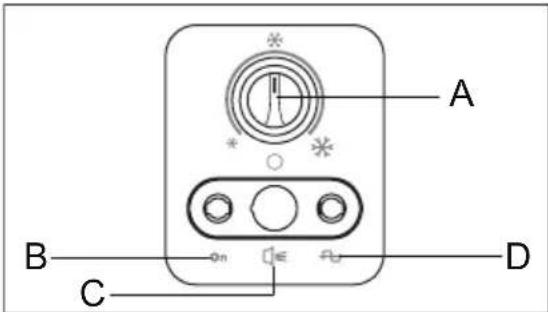
- Insert the electrical plug into a wall socket.
- Turn the Temperature Regulator to the Full Loaded position and let the appliance run for 24 hours to allow the correct temperature to be reached before placing food inside.
The pilot light will light up.
- Adjust the Temperature Regulator according to the quantity of the stored foods.
3.2 Switching off
To turn off the appliance, turn the Temperature regulator to the OFF position.
4. BEFORE FIRST USE

WARNING!
Refer to Safety chapters.
4.1 Cleaning the interior
Before using the appliance for the first time, the interior and all internal accessories should be washed with lukewarm
5. DAILY USE

WARNING!
Refer to Safety chapters.
3.3 Temperature regulation
The temperature within the appliance is controlled by the Temperature Regulator situated on the control panel.
To operate the appliance, proceed as follows:
To obtain the minimum coldness, turn the Temperature Regulator toward lower settings.
To obtain the maximum coldness, turn the Temperature Regulator toward higher settings.
water and some neutral soap to remove the typical smell of a brand new product, then dried thoroughly.

CAUTION!
Do not use detergents or abrasive powders, as these will damage the finish.
5.1 Freezing fresh food
The freezer compartment is suitable for freezing fresh food and storing frozen and deep-frozen food for a long time.
The maximum amount of food that can be frozen in 24 hours is specified on the rating plate.
The freezing process lasts 24 hours: during this period do not add other food to be frozen.
5.2 Storage of frozen food
When first starting-up or after a period out of use, before putting the products in the compartment let the appliance run at least 24 hours Temperature Regulator to the Full Loaded position.
CAUTION! In the ev
In the event of accidental defrost-ing, for example due to a power failure, if the power has been off for longer than the value shown in the technical characteristics chart under "rising time", the defrosted food must be consumed quickly or cooked immediately and then refrozen (after cooling).
5.3 Opening and closing the lid
CAUTION! Never pu
Never pull the handle with immense force.
As the lid is equipped with a tightly closing seal, it is not easy to reopen it shortly after closing (due to the vacuum formed inside). Wait for few minutes before reopening the appliance.
5.4 Storage baskets

The following picture shows how many baskets can be placed inside the freezer. The baskets will slide into each other.

You can purchase additional baskets from your local Service Centre.
6. HINTS AND TIPS
WARNING!
Refer to Safety chapters.
6.1 Hints for freezing
To help you make the most of the freezing process, here are some important hints:
The maximum quantity of food which can be frozen in 24 hours is shown on the rating plate.
The freezing process takes 24 hours. No further food to be frozen should be added during this period.
- Only freeze top quality, fresh and thoroughly cleaned, foodstuffs.
Prepare food in small portions to enable it to be rapidly and copletely frozen and to make it possible subsequently to thaw only the quantity required.
-
Wrap up the food in aluminium foil or plastic and make sure that the packages are airtight.
-
Do not allow fresh, unfrozen food to touch food which is already frozen, thus avoiding a rise in temperature of the latter.
- Lean foods store better and longer than fatty ones; salt reduces the storage life of food.
- Frozen liquids, if consumed immediately after removal from the freezer compartment, can possibly cause the skin to be freeze burnt.
It is advisable to show the freezing in date on each individual pack to enable you to keep tab of the storage time.
6.2 Hints for storage of frozen food
To obtain the best performance from this appliance, you should:
Make sure that the commercially frozen foodstuffs were adequately stored by the retailer.
- Be sure that frozen foodstuffs are transferred from the foodstore to the freezer in the shortest possible time.
- Do not open the lid frequently or leave it open longer than absolutely necessary.
- Once defrosted, food deteriorates rapidly and cannot be refrozen.
- Do not exceed the storage period indicated by the food manufacturer.
7. CARE AND CLEANING

WARNING!
Refer to Safety chapters.
7.1 Periodic cleaning

CAUTION!
Unplug the appliance before carrying out any maintenance operation.

Do not use detergents, abrasive products, highly perfumed cleaning products or wax polishes to clean the inner side of the appliance. Prevent damage to the cooling system. There is no need to clean the compressor area.
- Switch off the appliance.
- Regularly clean the appliance and the accessories with lukewarm water and neutral soap.
Clean the lid seal carefully.
- Fully dry the appliance.
- Connect the mains plug to the mains socket.
- Switch on the appliance.
7.2 Defrosting the freezer

CAUTION!
Never use sharp metal tools to scrape off frost from the evaporator as you could damage it. Do not use a mechanical device or any artificial means to speed up the thawing process other than those recommended by the manufacturer. A temperature rise of the frozen food packs, during defrosting, may shorten their safe storage life.
Defrost the freezer when the frost layer reaches a thickness of about 10-15 mm.
The amount of frost on the walls of the appliance will be increased by high levels of outer humidity and if the frozen food is not wrapped properly.
The best time to defrost the freezer when it contains no or only a little food.
- Switch off the appliance.
-
Remove any stored food, wrap it in several layers of newspaper and put it in a cool place.
-
Leave the lid open, remove the plug from the defrost water drain and collect all defrost water on a tray. Use a scraper to remove ice quickly.
- When defrosting is completed, dry the interior thoroughly. Close the lid.
- Switch on the appliance.
- Set the temperature regulator to obtain the maximum coldness and run the appliance for two or three hours using this setting.
- Reload the previously removed food into the compartment.
7.3 Periods of non-operation
When the appliance is not in use for long periods, take the following precautions:
- Disconnect the appliance from electricity supply.
- Remove all food.
- Defrost and clean the appliance and all accessories.
- Leave the lid open to prevent unpleasant smells.

If the cabinet will be kept on, ask somebody to check it once in a while to prevent the food inside from spoiling in case of a power failure.
8. TROUBLESHOOTING

WARNING!
Refer to Safety chapters.
8.1 What to do if...
| Problem Possible cause Solution | ||
| The appliance does not operate. | The appliance is switched off. | Switch on the appliance. |
| The mains plug is not connected to the mains socket correctly. | Connect the mains plug to the mains socket correctly. | |
| There is no voltage in the mains socket. | Connect a different electrical appliance to the mains socket. Contact a qualified electrician. | |
| The appliance is noisy. | The appliance is not supported properly. | Check if the appliance stands stable. |
| The cushion spacers located between the back of the cabinet and the pipes come loose. | Put them back in place again. | |
| The lid does not close completely. | The lid gaskets are dirty or sticky. | Clean the lid gaskets. |
| There is excessive frost. Eliminate excess frost. | ||
| Food packages are blocking the lid. | Arrange the packages in the right way, see the sticker on the appliance. | |
| The lid is difficult to open. | The lid gaskets are dirty or sticky. | Clean the lid gaskets. |
| The compressor operates continually. | Temperature is set incorrectly. | Refer to “Operation” chapter. |
| Many food products, to be frozen, were put in at the same time. | Wait some hours and then check the temperature again. | |
| The room temperature is too high. | Refer to climate class chart on the rating plate. | |
| Food products placed in the appliance were too warm. | Allow food products to cool to room temperature before storing. | |
| The lid has been opened too frequently. | Do not leave the lid open longer than necessary. | |
| The lid is not closed correctly. | Check if the lid closes well and the gaskets are undamaged and clean. | |
| There is too much frost and ice. | The lid is not closed correctly or the gasket is deformed/dirty. | Refer to “Closing the lid”. |
| The water drainage plug is not correctly positioned. | Position the water drainage plug in the correct way. | |
| Food products are not wrapped properly. | Wrap the food products better. | |
| Temperature is set incorrectly. | Refer to “Operation” chapter. | |
| The lid is not shut properly or do not close tightly. | Check if the lid closes well and the gaskets are undamaged and clean. | |
| The temperature in the appliance is too low/too high. | The temperature regulator is not set correctly. | Set a higher/ lower temperature. |
| The lid is not closed correctly. | Refer to “Closing the lid”. | |
| The food products temperature is too high. | Let the food products temperature decrease to room temperature before storage. | |
| Many products are stored at the same time. | Store less products at the same time. | |
| The thickness of the frost is greater than 4-5 mm. | Defrost the appliance. | |
| The lid has been opened often. | Open the lid only if necessary. | |
| There is no cold air circulation in the appliance. | Make sure that there is cold air circulation in the appliance. | |
8.2 Customer Service
If your appliance is still not working properly after making the above checks, contact the nearest service centre.
To obtain fast service, it is essential that when you apply for it you specify the model and serial number of your
9. INSTALLATION

WARNING!
Refer to Safety chapters.
9.1 Positioning

CAUTION!
If you are discarding an old appliance that has a lock or catch on the lid, you must ensure that it is made unusable to prevent young children being trapped inside.
This appliance should be installed in a dry, well ventilated indoor where the ambient temperature corresponds to the climate class indicated on the rating plate of the appliance:
| Climate class Ambient temperature |
| SN +10°C to +32°C |
| N +16°C to +32°C |
| ST +16°C to +38°C |
| T +16°C to +43°C |

Some functional problems might occur for some types of models when operating outside of that range. The correct operation can only be guaranteed within the specified temperature range. If you have any doubts regarding where to install the appliance, please turn to the vendor, to our customer service or to the nearest Service Centre

The appliance shall have the plug accessible after installation.
appliance which can be found either on the guarantee certificate or on the rating plate located on the external right side of the appliance.
9.2 Electrical connection
- Before plugging in, ensure that the voltage and frequency shown on the rating plate correspond to your domestic power supply.
- The appliance must be earthed. The power supply cable plug is provided with a contact for this purpose. If the domestic power supply socket is not earthed, connect the appliance to a separate earth in compliance with current regulations, consulting a qualified electrician.
- The manufacturer declines all responsibility if the above safety precautions are not observed.
- This appliance complies with the E.E.C. Directives.
9.3 Ventilation requirements
The airflow behind the appliance must be sufficient.
- Put the freezer in horizontal position on a firm surface. The cabinet must be on all four feet.
- Make sure that the clearance between the appliance and rear wall is 5cm
- Make sure that the clearance between the appliance and the sides is 5cm
10. NOISES
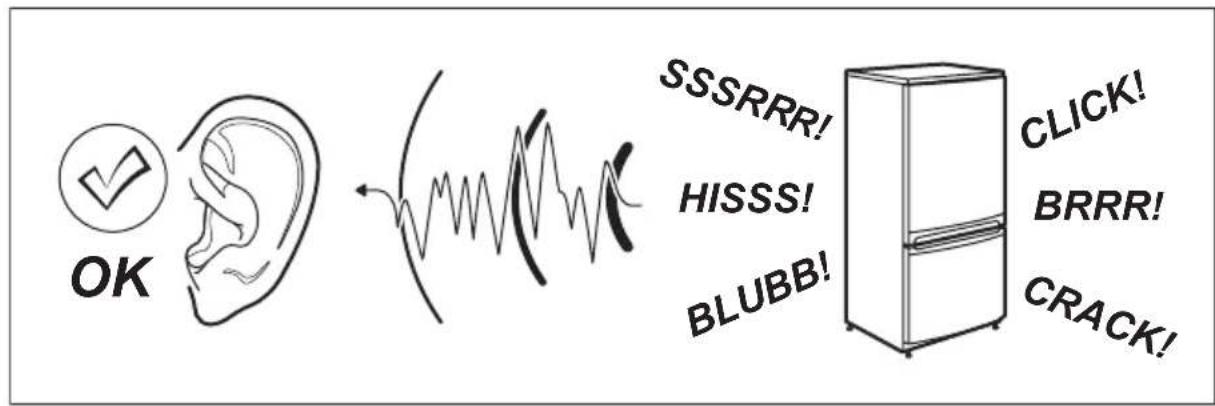
There are some sounds during normal running (compressor, refrigerant circulation).

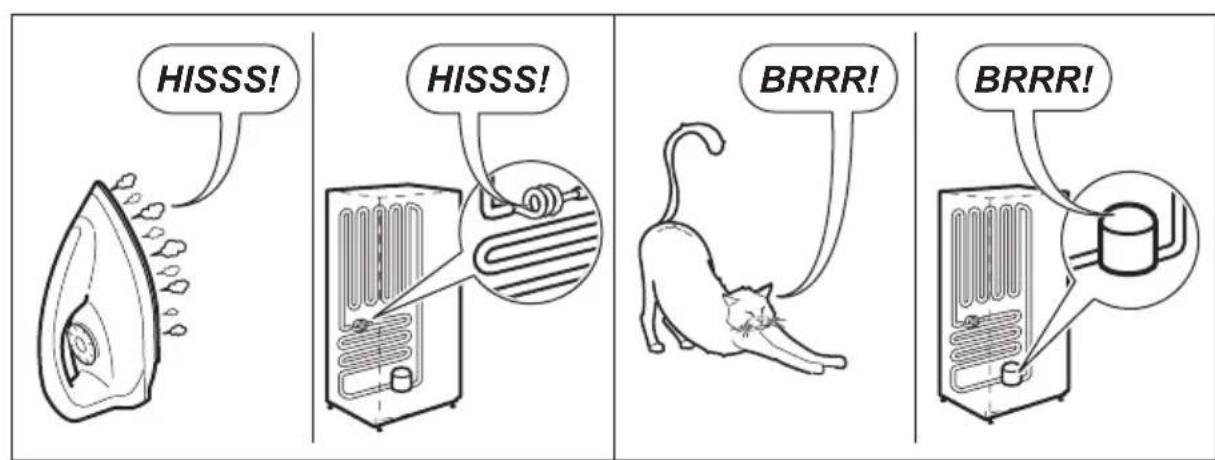

11. TECHNICAL INFORMATION
11.1 Technical data
| Height mm 837 |
| Width mm 563 |
| Depth mm 526 |
| Rising Time Hours 30 |
| Voltage Volts 220-240 |
| Frequency Hz 50 |
The technical information are situated in the rating plate, on the external or internal side of the appliance and in the energy label.
12. ENVIRONMENTAL CONCERNS
Recycle the materials with the symbol . Put the packaging in applicable containers to recycle it. Help protect the environment and human health and to recycle waste of electrical and electronic appliances.
Do not dispose appliances marked with the symbol 区 with the household waste. Return the product to your local recycling facility or contact your municipal office.
SOMMAIRE
- INFORMATIONS SUR LA SECURITE 27
- CONSIGNES DE SECURITE 28
- FONCTIONNEMENT 30
- AVANT LA PREMIÈRE UTILISATION 30
- UTILISATION QUOTIDIENNE 30
- CONSEILS 31
- ENTRETIEN ET NETTOYAGE 32
- RÉSOLUTION DES PROBLEMES EN CAS D'ANOMALIE DE FONCTIONNEMENT ... 33
-
INSTALLATION 35
-
BRUITS 36
- CARACTERISTIQUES TECHNIQUES 37
- EN MATIÈRE DE PROTECTION DE L'ENVIRONNEMENT 37