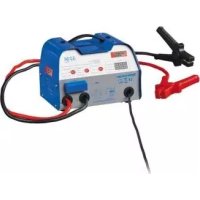
ULG 12 A1 - Battery charger ULTIMATE SPEED - Free user manual and instructions
Find the device manual for free ULG 12 A1 ULTIMATE SPEED in PDF.



| Product type | Car battery charger with jump start function |
| Brand | Ultimate Speed |
| Model | ULG 12 A1 |
| Input voltage | 230 V ~ 50 Hz |
| Output voltage | 6 V / 12 V |
| Adjustable charging current | 2 A, 6 A, 12 A (±10 %) |
| Compatible battery capacity | 8 – 180 Ah |
| Battery types | Lead-acid, AGM, Gel, Deep Cycle, 6V Regular |
| Jump start function | Yes, up to 75 A (short term) |
| Charging modes | Fast Charge, Normal Charge, Start |
| Digital display | Voltage, battery %, alternator % |
| Protection | Anti-spark, overheat, reverse polarity, short circuit |
| Enclosure protection rating | IP20 |
| Fuse | Yes, replaceable |
| Power supply | Mains 230 V |
| Package contents | Charger, two quick-connect clamps (red/black), user manual |
| Maintenance | Clean with a dry cloth; do not use solvents |
| Safety | Automatic shutdown, overload and short-circuit protection |
| Warranty | 2 years |
| Repairability | Replaceable fuse; other repairs by after-sales service |
Frequently Asked Questions - ULG 12 A1 ULTIMATE SPEED
User questions about ULG 12 A1 ULTIMATE SPEED
0 question about this device. Answer the ones you know or ask your own.
Ask a new question about this device
Download the instructions for your Battery charger in PDF format for free! Find your manual ULG 12 A1 - ULTIMATE SPEED and take your electronic device back in hand. On this page are published all the documents necessary for the use of your device. ULG 12 A1 by ULTIMATE SPEED.
USER MANUAL ULG 12 A1 ULTIMATE SPEED
Operation and Safety Notes Translation of original operation manual
IAN 100683
CH
DE AT CH
Before reading, unfold the page containing the illustrations and familiarise yourself with all functions of the device.
GB Operation and Safety Notes Page 35






Einleitung
EXPLOSIONSGEFAHR! Stellen

E-mail: service.it@cmc-creative.de
Telefono: +49 (0) 6894 9989752
Intended use
Parts description.. Page 36
Technical Data . Page 36
Scope of delivery.
Safety notices
Operation
Product properties.. 38
Connecting.. Page 38
Disconnecting. Page 39
Selecting the charging mode . Page 39
Jump starting.. Page 40
Replacing the fuse.. Page 41
Maintenance and care
Warranty and service information
Warranty terms.. Page 41
Extent of warranty.. Page 41
Processing of warranty claims..
Environmental instructions and disposal information
Declaration of Conformity
Introduction
| These original operating instructions / the device uses the following pictograms: | |||
| Read original operating instructions! | Caution! Risk of electric shock! | ||
| Note | Caution! Explosion hazard! | ||
| Observe the warning and safety instructions! | Dispose of packaging and device in an environmentally-friendly way! | ||
Car charger with jump start function ULG 12 A1
Introduction

Congratulations!
You have chosen high-quality device by our company. Familiarise yourself with the
product before using it for the first time. Carefully read the following original operating instructions and safety notices. Initial operation of this tool must be performed by trained personnel.
Intendeduse
The Ultimate Speed ULG 12 A1 is a car charger with impulse trickle charge (Chip Software) suitable for charging and trickle charging the following 6V or 12V rechargeable lead batteries with electrolyte solution, AMG batteries, lead-acid batteries, deep cycle (marine batteries), or gel batteries:
For automotive and motorcycle batteries with 12V / 6V and 8-180Ah capacity
You can also regenerate drained batteries (depending on battery type). The car charger features a protective circuit against sparking and overheating. Any improper or incorrect use will void the warranty. The manufacturer is not liable for damage caused by improper use. The device is not intended for commercial use.
Note: The car charger is not suitable for charging electric vehicles with built-in rechargeable battery.
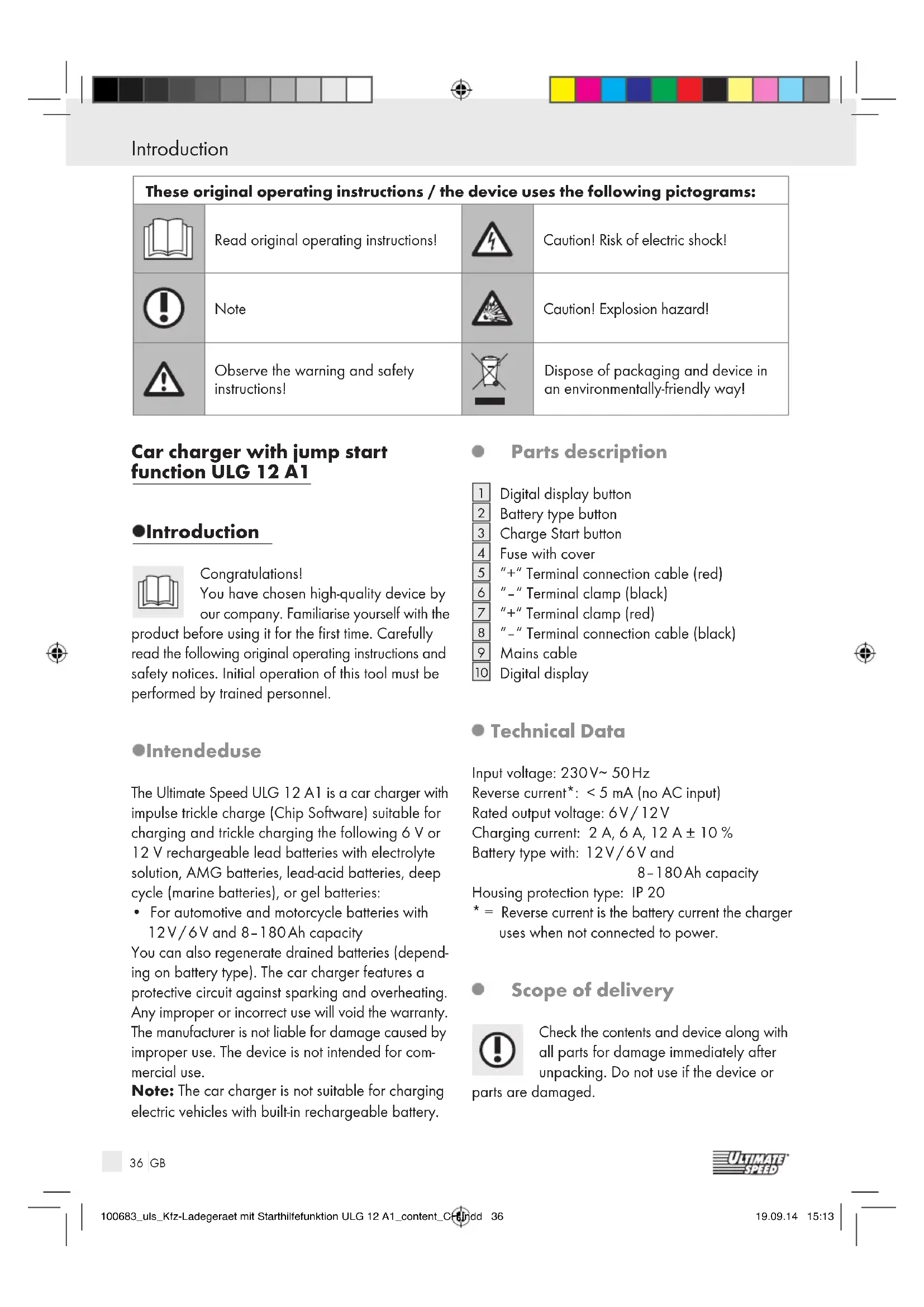
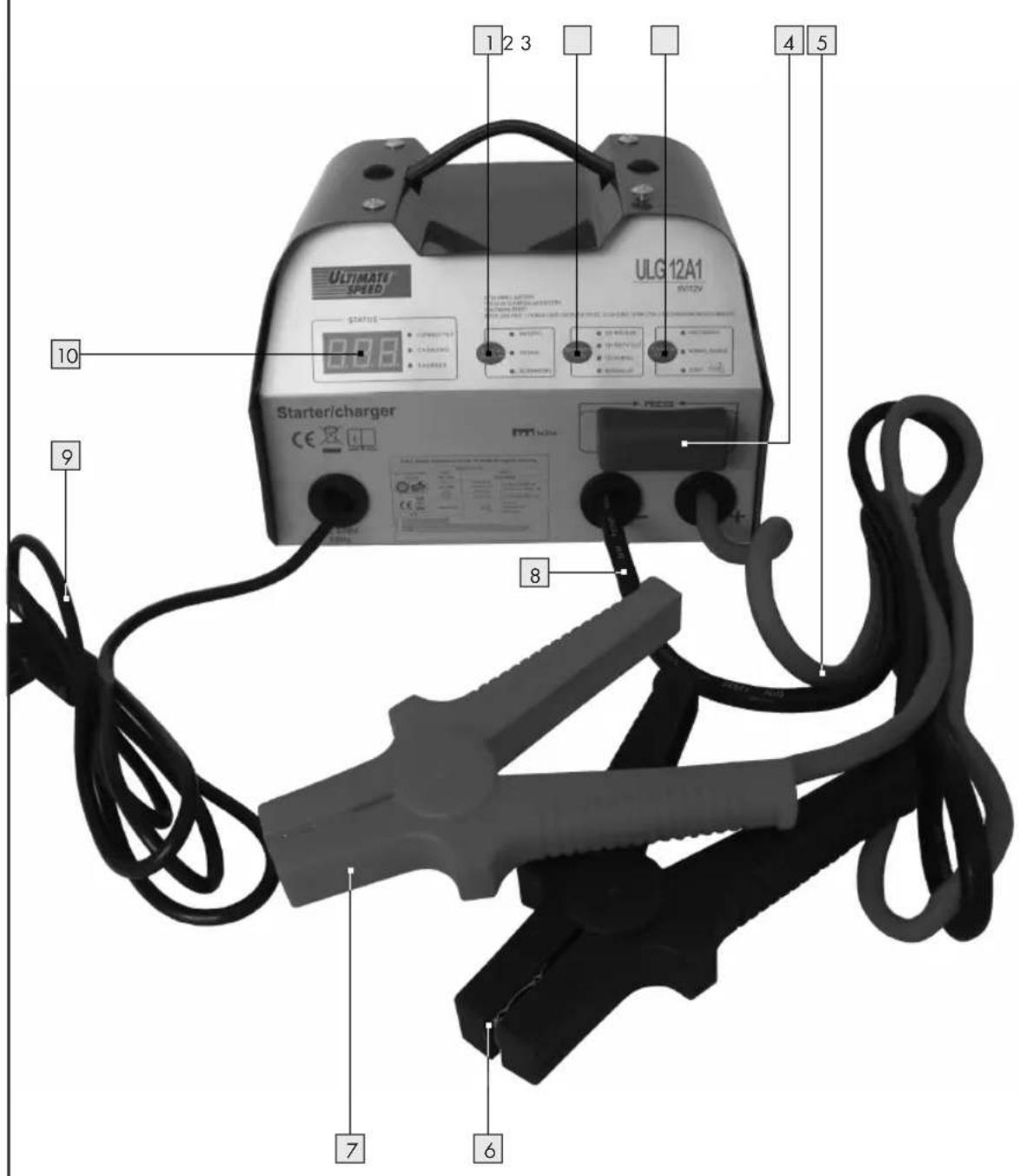
- Parts description
Digital display button
2 Battery type button
3 Charge Start button
4 Fuse with cover
5 " ^+ Terminal connection cable (red)
6"Terminal clamp (black)
7 " ^+ Terminal clamp (red)
8"-"Terminal connection cable (black)
9 Mains cable
Digital display
Technical Data
Input voltage: 230V 50Hz
Reverse current*: < 5 mA (no AC input)
Rated output voltage: 6V/12V
Charging current: 2 A, 6 A, 12 A ± 10%
Battery type with: 12V/6V and
8-180Ah capacity
Housing protection type: IP 20
^* = Reverse current is the battery current the charger uses when not connected to power.
Scope of delivery

Check the contents and device along with all parts for damage immediately after unpacking. Do not use if the device or
parts are damaged.

Introduction / Safety notices
1 Charger Ultimate Speed ULG 12 A1
2 Alligator clips (1 red, 1 black)
1 Original operating instructions

Safetynotices
KEEP OUT OF THE REACH OF CHILDREN!
DANGER! Avoid a danger to life and the risk of injuries due to improper use!
CAUTION! Do not operate the device if the cables, the mains cable or plug are damaged. A damaged mains cable indicates a life-threatening danger due to electric shock.
Only have a damaged power cable repaired by authorised and trained professionals! In the event a repair is required, please contact the service centre for your country!
DANGER OF ELECTRIC SHOCK!

For batteries permanently mounted in a vehicle, verify the vehicle is switched
off! Switch off the ignition und put the vehicle in park with the handbrake engaged (e.g. car) or fixed rope (e.g. electric boat)!
DANGER OF ELECTRIC SHOCK!

Disconnect the car charger from the mains before connecting or removing
the connectors to / from the battery.
First connect the clamp not connected to the car body.
Connect the other clamp to the car body, away from the battery and the petrol pipe.
Only then connect the car charger to the power supply.
Disconnect the car charger from the power supply after charging.
Only then remove the clamp from the car body. Following this, remove the clamp from the battery.
DANGER OF ELECTRIC SHOCK!

Only touch the terminal connection cables (^ - ^ and ^ + ^ ) in the insulated
area!
DANGER OF ELECTRIC SHOCK!

Establish the connection to the battery and the mains current socket com
pletely protected from moisture!
Ultnate
DANGER OF ELECTRIC SHOCK!

Only assemble, maintain and care for the car charger whilst disconnecte mains!
1
DANGER OF ELECTRIC SHOCK!

Once the charging and discharge process is completed, on batteries only installed in vehicles first disconnecting user's negative terminal connection can (1) from the battery's negative terminal.
Do not leave toddlers or children unsupervised in the car charger!
Children are not yet able to assess potential dangers in handling electric appliances. Always, exercise children to ensure they do not play in the tool.
This device may be used by children age 8 years and up, as well as by persons with reduced physical, sensory or mental capacities, or lacking experience and/or knowledge, so long as they are supervised or instructed in the safe use of the device and understand the associated risks. Children should not be allowed to play with the device. Cleaning and user maintenance should be performed by children without supervision.
EXPLOSION HAZARD! Protect

yourself from a highly explosive hydrogen-oxygen reaction! The battery
may emit gaseous hydrogen during charging and trickle charging. Oxyhydrogen is an explosive mix of gaseous hydrogen and oxygen. Contact with open fire (flames, embers or sparks) will cause the so-called oxyhydrogen reaction! Perform charging and trickle charging in a well ventilated room protected from the weather. Be sure there is no open fire (flames, embers or spark) during charging and maintenance charging!
DANGER OF EXPLOSION AND FIRE
HAZARD! Ensure that there is no possibility of ignition of explosive or flammable materials, such as petrol or solvents, while using the charger!
EXPOSSIVE GASSES! Avoid flames and sparks!
Ensure adequate ventilation whilst charging.
- Place the battery on a well ventilated surface, last charging. Ignoring this advice may damage the device.
Safety notices/Operation


EXPLOSION HAZARD! Ensure
the positive terminal connection cable does not come into contact with fuel petrol pipe)!
DANGER OF CHEMICAL BURNS! Protect
your eyes and skin against corrosion from acids (sulphuric acid) when coming into contact with the battery!
Use acid-proof goggles, clothing and gloves! If eyes or skin has come into contact with sulphuric acid, rinse the affected body region off with a plenty of clean water and consult a doctor straight away!
Avoid electric short-circuits when connecting the car charger to the battery. Only connect the negative terminal connection cable to the negative battery terminal or the car body. Only connect the positive terminal connection cable to the positive battery terminal!
Before connecting to the mains, verify the mains power has the required 230V 50Hz neutral lead, a 16 A fuse and an ELCB switch (earth leakage circuit breaker)! Ignoring this advice may damage the device.
Do not place the charger close to fire, heat and prolonged temperatures over 50^ ! The output power of the car charger automatically drops In higher temperatures.
Ensure no fuel lines, electric cables, hydraulic, water pipes are damaged by the screws whilst assembling the charger! Otherwise there is a risk of death or injuries!
Only use the car charger with the included original parts!
Do not cover the car charger with objects! Ignoring this advice may damage the device.
Protect the surfaces of the battery's electrical contacts from short circuiting!
Only use the car charger for charging and maintenance charging undamaged 6V-/12V lead-acid batteries (with electrolyte solution or gel)! Otherwise material damage could occur.
Do not use the car charger for charging or trickle charging non-rechargeable batteries. Otherwise material damage could occur.
D not use the car charger to charge or trickle charge a damaged or frozen battery! Otherwise material damage could occur.
Before connecting the charger, refer to the battery's original operating instructions for battery maintenance information! Otherwise there is a risk of injury and / or damaging the device.
Before connecting the charger to a battery permanently connected to a vehicle, refer to the vehicle's operating instructions for information about maintaining electrical safety and maintenance! Otherwise there is a risk of injury and / or property damage.
Also disconnect the car charger from the mains when not in use for environmental reasons! Remember standby operation also consumes electricity.
Always be alert and always be careful what you do. Always proceed with caution and do not operate the car charger when unfocused or feel unwell.
Operation
Remove the mains plug from the mains socket before performing any work on the car charger.
RISK OF ELECTRIC SHOCK!
DANGER OF DAMAGE TO PROPERTY! RISK OF INJURY!
Productproperties
This device is designed to charge a variety of SLA batteries (sealed lead-acid batteries) primarily used in cars, motorcycles and some other vehicles. These can be e.g. WET- (with liquid electrolyte), GEL- (with gelified electrolyte) or AGM batteries (with electrolyte absorbent glass mat). The special design of the device (also referred to as "three-level charging strategy") allows the battery to be charged to nearly 100% of its capacity. The charger can further be connected to the battery for extended periods to keep it in optimal condition.
Connecting
Before charging and trickle charging a battery permanently connected to the vehicle, first dis

Operation
connect the battery's negative terminal connection cable (black) from the negative battery terminal. The negative battery terminal is typically connected to the car body.
Then disconnect the vehicle's positive terminal connection cable (red) from the positive battery terminal.
Only then connect the battery charger's ^ 喜 + ^ 喜 crocodile clamp (red) 7 to the ^ 喜 + ^ 喜 battery terminal.
Connect the " - " crocodile clamp (black) to the " - " battery terminal. Plug the car charger's mains cable into the mains socket.
Note: If the connector clamps are correctly connected, the display will show the voltage and "connected" will light up. If the poles are reversed, the display will read 0.0 and "connected" will not light up.
If the connector clamps connected to the battery and the device is connected to power, the digital display 10 will read "Connected". After selecting a charging mode, the display will read "Charging". Once charging is complete, the display will read "Charged".
A continuously lit display with the battery not yet fully charged indicate a fault.
In this event, verify the connection clam68, 7 are correctly connected to the battery and the correct battery type is selected. If the display is still continuously lit, the battery may be defective.
Digital Display button 1: Use to switch between the digital display of voltage and charging progress in percent (Battery % ). Use this button to switch between the following displays:
disconnecting
Disconnect the device from the mains.
Remove the " - " crocodile clamp (blc) from the " - " battery terminal.
Remove the ^ 一 + " crocodile clamp (red) from the ^ 一 + battery terminal.
Reconnect the vehicle's positive connection cable the battery type to be charged. You can choose from to the positive battery terminal. battery types. The battery type must absolutely be connect the vehicle's negative connection cable correctly selected before starting the charging pro to the negative battery terminal. process:
- Voltage: indicates the voltage of the connected battery.
- Alternator %: output power in percent
Battery Type button 2: Use this button to set the battery type to be charged. You can choose from battery types. The battery type must absolutely be correctly selected before starting the charging process:
- Selecting the charging mode
You can charge a variety of batteries at different ambient temperatures using different charging modes. Compared to conventional car chargers, this device features a special function for reusing a drained battery / rechargeable battery. You can recharge a completely drained battery / rechargeable battery. The safe charging process protects against faulty connection and short-circuits. The integrated electronics do not switch the car charger on immediately after being connected, but only after selecting a charging mode.
- Battery %: indicates the charging progress for the connected battery in percent.
12 V Regular: these batteries (lead-acid batteries) are typically used in cars, lorries and motorcycles. They have vent caps and are often labelled "low-maintenance" or "maintenance-free". This battery type is designed to quickly transfer energy (e.g. starting an engine). "Regular" batteries should not be used for "Deep Cycle" applications.
12 V Deep Cycle: These batteries are commonly also labelled "Deep Cycle" or "Marine". This type of battery is typically larger than other battery types. It delivers less short-term energy but transmit energy longer. These batteries withstand numerous discharge cycles.
- 12 V AGM / Gel: The AGM battery type is typically a good Deep Cycle battery. They provide
Operation
the best "life" when recharged before being drained more than 50% . When fully discharged they withstand about 300 charging cycles. The GEL battery type is similar to AGM. The charging voltage is lower than for other lead-acid batteries. Using the wrong charger for a Gel battery will result in a reduction in power or a shorter life.
- 6 V Regular: Select this mode for conventional 6V batteries.
Charge Start button 3: Use this button to switch between the following options
- Fast Charge: charges quickly (recommended in low outdoor temperatures / winter)
Normal Charge: normal charging process (normal speed) - Start: briefly delivers 75 ampere to bridge a weak or drained battery to jump start an engine
Attention: This mode can only be exited by unplugging the mains plug 9.
- Jump starting
WARNING! Always make all the connections as described and in the correct order. The vehicle's electronics may otherwise be damaged. Proceed against the specifications at your own risk and responsibility.
Attention: This function is not suitable for batteries below 45 Ah. This function could damage batteries below 45 Ah.
Diesel vehicles and large-volume engines in part require amperages above 75 A for jump starting.
Note: The charger features an analysis program to protect the battery from damage (e.g. sulphation or rapid voltage drops), particularly during jump starting. The device will not switch on the jump starter with severely drained or heavily stressed batteries to protect the battery. During this process the battery is already being charged with lower currents (Charging lights up). The display continues to read "0". In this event the jump start function cannot be used. This will protect the battery from damage. You should then first charge the battery. You may also use the
"Fast Charge" or "Normal Charge" function for this purpose.
Connect the car charger's mains cable to power.
Connect the red connector cl to the positive battery terminal. (The positive terminal is marked with a "+" symbol and a red mark.)
Connect the black connector clamp to the negative battery terminal. (The negative terminal is marked with a " - " symbol and a black mark.)
If the connector clamps are connected correctly, the car charger will automatically select the correct battery type. You may review it in the "Battery Type" option field and if necessary change it by pressing the battery type button 2.
Now select the "Start" function using the Charge Start button 3. The cart charger will now analyse the battery's charge level. The display will now read "0".
Start the vehicle's ignition. The display will now show a 5 second countdown (of which 2 second priming / analysis function and 3 second jump start function at 75 A) when needing the car charger for jump starting (previously analysed by the car charger). During this countdown the car charger will briefly deliver 75 A to bridge the battery to start the car. This is followed by a 180 second pause to protect the battery. The cycle will now restart (2 second priming / analysis function and 3 second jump starting at 75 A/ 180 second pause).
To disconnect the device, first remove the terminal clamps (6 / 7) and unplug the power cord 9.
Note: If the battery is completely drained, the 75 A will not be sufficient to start all engines (e.g. diesel vehicles).
In this case, please select the "Fast Charge" option using the Charge Start button 3 and charge the battery 60% (preheating of diesel engines draws power from the battery. This requires 60% after preheating).
You can monitor the charging process in the display by selecting the "Battery %" option using the digital display button 1.
Once 60% has been reached, jump start again.

Operation / Maintenance and care / Warranty and service information
Attention: Exit the mode by unplugging the mains cable 9.
- Replacing the fuse
The car charger fuse can be damaged by e.g. hardware failure, overload, etc.
Unplug the power co before replacing the fuse.
Remove the fse cover by slightly pressing in the side.
Unscrew the f with a fitting open-end spanner and secure the new fuse.
Then screw it tight and replace the cover. repair or exchange of Note: If you need a new fuse, please contact new warranty period.
our service department (see chapter Warranty and Service Information).
Warranty terms
The warranty period begins on the date of purchase. Please retain the original receipt safely.
This document is required as your proof of purchase. Should this device show any defect in materials or manufacture within 2 years from the date of purchase, we will repair or replace it - at our discretion - free of charge. This warranty is conditional on the defective device and the receipt of purchase being presented within the 2 year warranty period including a brief written description of the nature of the defect and of the date it arose.
If the defect is covered by our warranty, we will return the repaired device or replacement thereof. A repair or exchange of the device does not extend a
- Maintenance and care
Iways unplug the power cord 9 from the mains socket before working on the car charger.
The device is maintenance-free. Switch off the device. Clean the device's metal and plastic with a dry cloth.
Never use solvents or other abrasive cleaners.
Warranty and service information
Creative Marketing Consulting GmbH warranty
Dear customer, the warranty for this device is 2 years from the date of purchase. In the event of product defects, you have legal rights against the retailer of this product. Your statutory rights are not limited in any way by our warranty detailed below.
- Extent of warranty
The device has been manufactured to strict quality guidelines and meticulously examined before delivery.
The warranty applies to faults in material or manufacture. This warranty does not apply to product parts subject to normal wear and tear and which can therefore be considered as wear items, or to damage to fragile parts, e.g. switches, storage batteries or glass parts. This warranty becomes void if the device has been damaged or improperly used or maintained. Strictly observe only the instructions within the original operating instructions for proper product use. Absolutely avoid any applications and actions the original operating instructions advise against.
This product is intended for private, non-commercial use only. Any incorrect or improper use of the device, use of force and changes not performed by our authorized service branch will void the warranty.
- Processing of warranty claims
Please follow the instructions below to ensure your claim is processed quickly:
... / Environmental instructions and disposal information / Declaration of Conformity
When inquiring about your product please have your receipt and product number (e.g. IAN) ready as your proof of purchase. The item number can be found on the type plate, engraving, the cover page of your instructions (bottom left) or the decal at the back or bottom. In the event of malfunctions or other defects, please first contact the service department below by phone or e-mail.
A product recorded as defective, along with the proof of purchase (sales receipt) and a description of the defect and when it occurred, can then be returned free of charge to you to the service address provided.

Notice:
Visit www.lidl-service.com to download this and many other manuals, product videos and software.
How to contact us:
GB
Name: C. M. C. GmbH
Website:www.cmc-creative.de
E-mail:service.gb@cmc-creative.de
Phone:0-808-189-0652
(standard German landline rates apply)
Registeredoffice:Germany
IAN 100683
Please note that the following address is not a service address.
Please first contact the service point named above.
Address:
C. M. C. GmbH
Katharina-Loth-Str. 15
66386 St. Ingbert
Germany
Environmentalinstructions and disposal information

Don't waste, recycle!

Device, accessories and packaging should be recycled in an environmentally friendly manner.
Do not throw the car charger into household rubbish, fire or into water. If possible, non-operational devices should be recycled. Contact your local retailer for information.

As the consumer you are legally obligated (Battery Ordinance) to return any used batteries. Batteries containing hazardous substances are marked with these symbols, indicating the ban on disposal through household rubbish. The designations of the determining heavy metal are: Cd = cadmium, Hg = mercury, Pb = lead.
Return used batteries through your municipal or community disposal facilities or the retailer. This satisfies your legal obligations and you are greatly contributing to protecting the environment.
Declaration of Conformity (C)
We,
C. M. C. GmbH
Responsible for documentation: Markus Zimmer
Katharina-Loth-Str. 15
66386 St. Ingbert
declare in our sole responsibility the product
Car charger with jump start function
Year of manufacture: 2014 / 44
IAN:100683
Year of CE mark: 14
Model: CAR CHARGER WITH JUMP START
FUNCTION ULG 12 A1

meets the basic safety requirements of European
Directives
EC Low Voltage Directive
2006/95/EC
EC Electromagnetic Compatibility Directive
2004/108/EC
Automotive EMC Directive
(2004/104/EC)
RoHS Directive
(2011/65/EU)
The object of the declaration described above meets the requirements of Directive 2011 / 65 / EC of the
European Parliament and Council dated 08 June
2011 restricting the use of certain hazardous sub
stances in electrical appliances and electronics.
The conformity assessment is based on the following harmonised standards:
EN 60335-2-29/A2:2010
EN 60335-1:2012
EN 62233:2008
EN 50498:2010
EN 55014-1:2006+A1:2009+A2:2011
EN 61000-3-2:2006+A1:2009+A2:2009
EN 61000-3-3:2008
- Quality Control Manager -


C.M.C.GmbH
Katharina-Loth-Str.15
66386 St. Ingbert
Deutschland
Last Information Update: 09/2014
Ident.No.: ULG12A1092014-CH
IAN 100683
CH